
Effect of Fear and Time Delay on Predator–Prey Interaction

Abstract
1. Introduction
2. Model Building and Analysis
2.1. Equilibrium Points
- (i)
- , the trivial equilibrium point, where both populations are extinct.
- (ii)
- , which represents the existence of prey only.
- (iii)
- , which represents the coexistence of prey and predator, where , provided that to ensure the positivity of the equilibrium, and is the solution of the second-order equationwhereTo get a unique positive solution, we need to take . If we take , we will get two negative solutions or imaginary solutions. When , the solution is given by
2.2. Local Stability of the Equilibrium Points
- (i)
- is unstable; i.e., the system will never allow for both populations to go extinct, regardless of their initial sizes.
- (ii)
- is locally asymptotically stable if ; i.e., under this condition, the predator might go extinct if its initial population size was very small.
- (iii)
- is locally asymptotically stable if and ; i.e., under these conditions, both populations will coexist.
- (i)
- The Jacobian matrix at is given byClearly, the eigenvalues of the matrix are r and −c, and hence, it is obvious that E0(0,0) is unstable.
- (ii)
- The Jacobian matrix at is given bywhich is an upper triangular matrix whose eigenvalues are and . This implies that is asymptotically stable if .
- (iii)
- The Jacobian matrix at is given byand hence the characteristic polynomial is given byClearly, this point is locally asymptotically stable if and .
2.3. Bifurcation Analysis of the Model
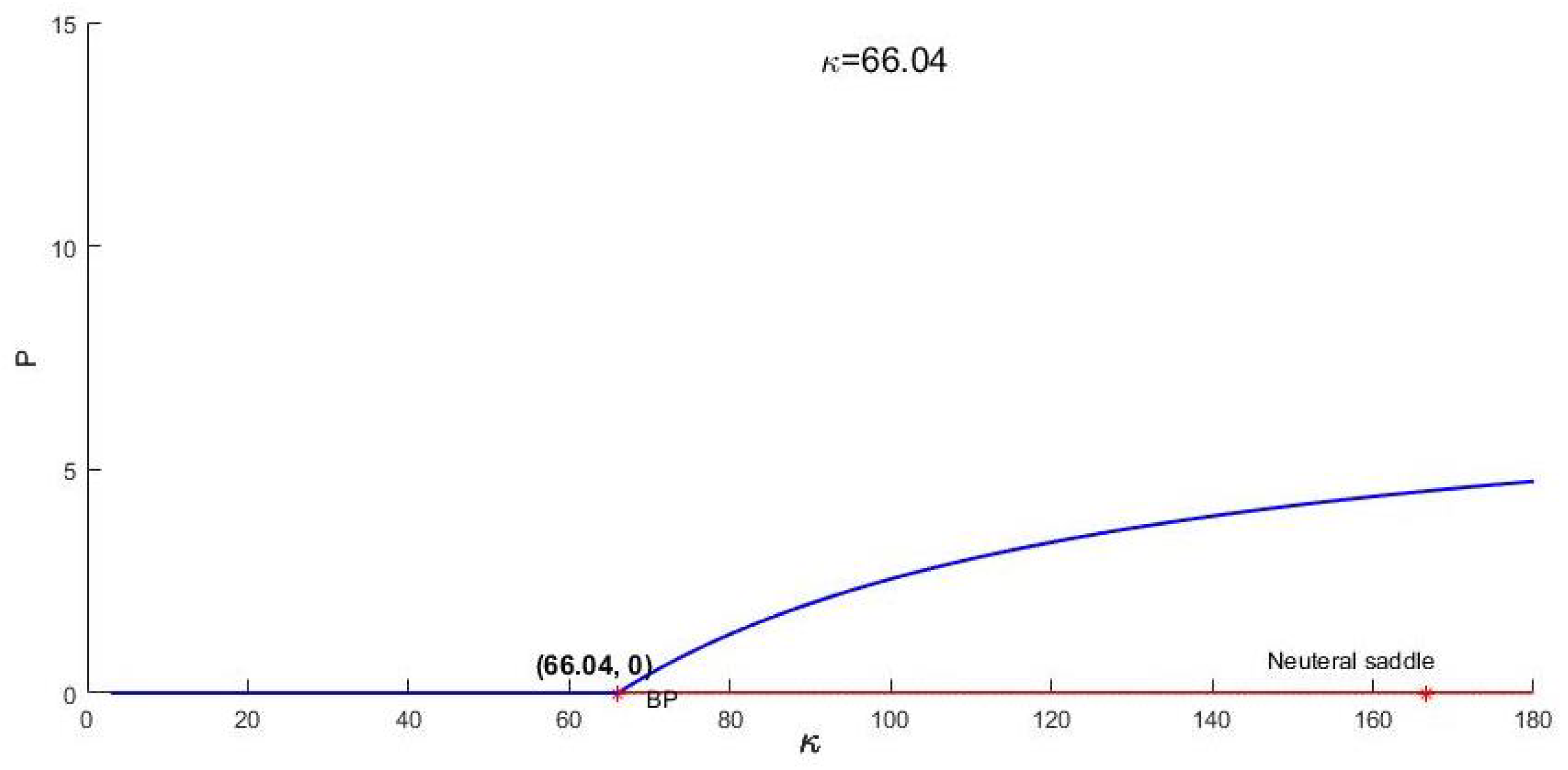
2.3.1. Transcritical Bifurcation Analysis
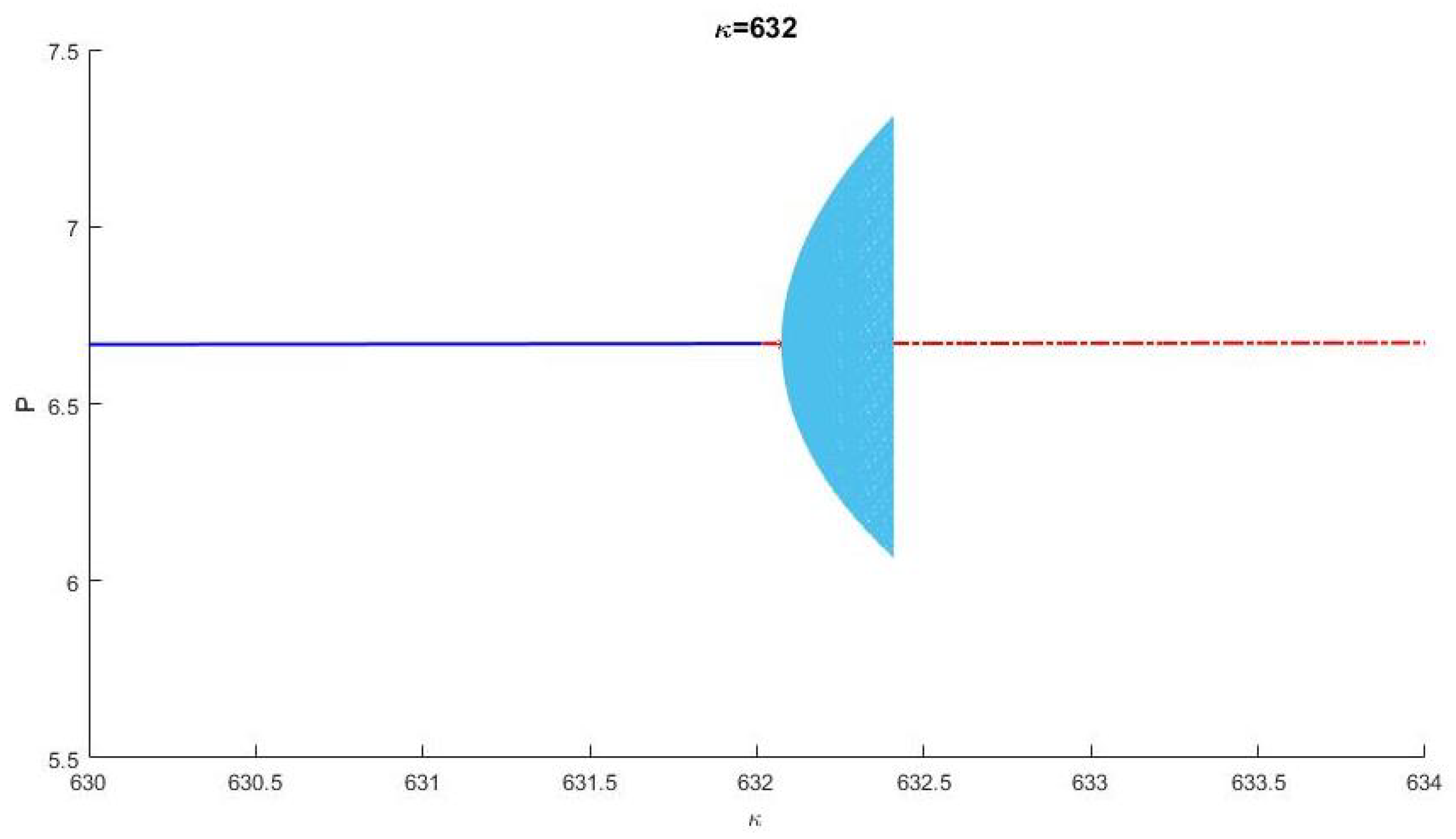
2.3.2. Hopf Bifurcation Analysis
2.4. Global Stability of the Prey-Only Steady States
3. The Model with the Time Delay
Local Stability of the Equilibrium Points with Time Delay
- (i)
- The Jacobian matrix at is given byandClearly, there is no change in stability; i.e., the time delay does not affect this point.
- (ii)
- The Jacobian matrix at is given by whereandNow,The characteristic equation is given byso that implies , orNow, substituting impliesThen we haveHence,which impliesHence,as we assume that without time delay, the equilibrium point must be stable, we must have . Hence it is not possible to get a positive solution for , and hence there is no change in stability due to the time delay.
- (iii)
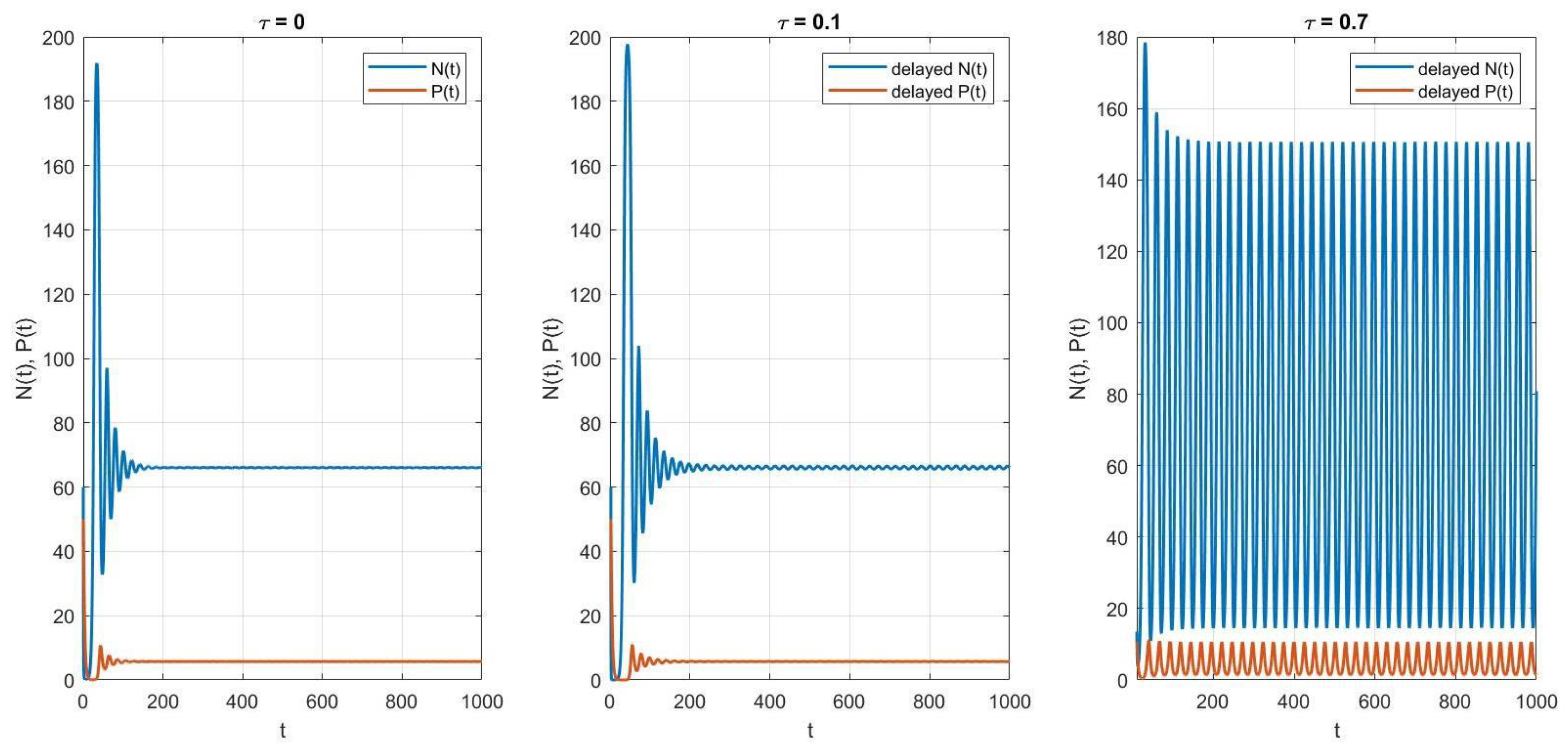
- The Jacobian matrix at is given by , whereandSimilarly,Hence, the characteristic polynomial is given bywhereSubstituting impliesThen we haveorwhich, after some mathematical simplification, could be written asClearly, it is possible to have a positive solution for the last equation, and hence the time delay will affect the stability of the coexistence equilibrium point; i.e., there is a critical value for after which the coexistence equilibrium becomes unstable and exhibits some oscillations.
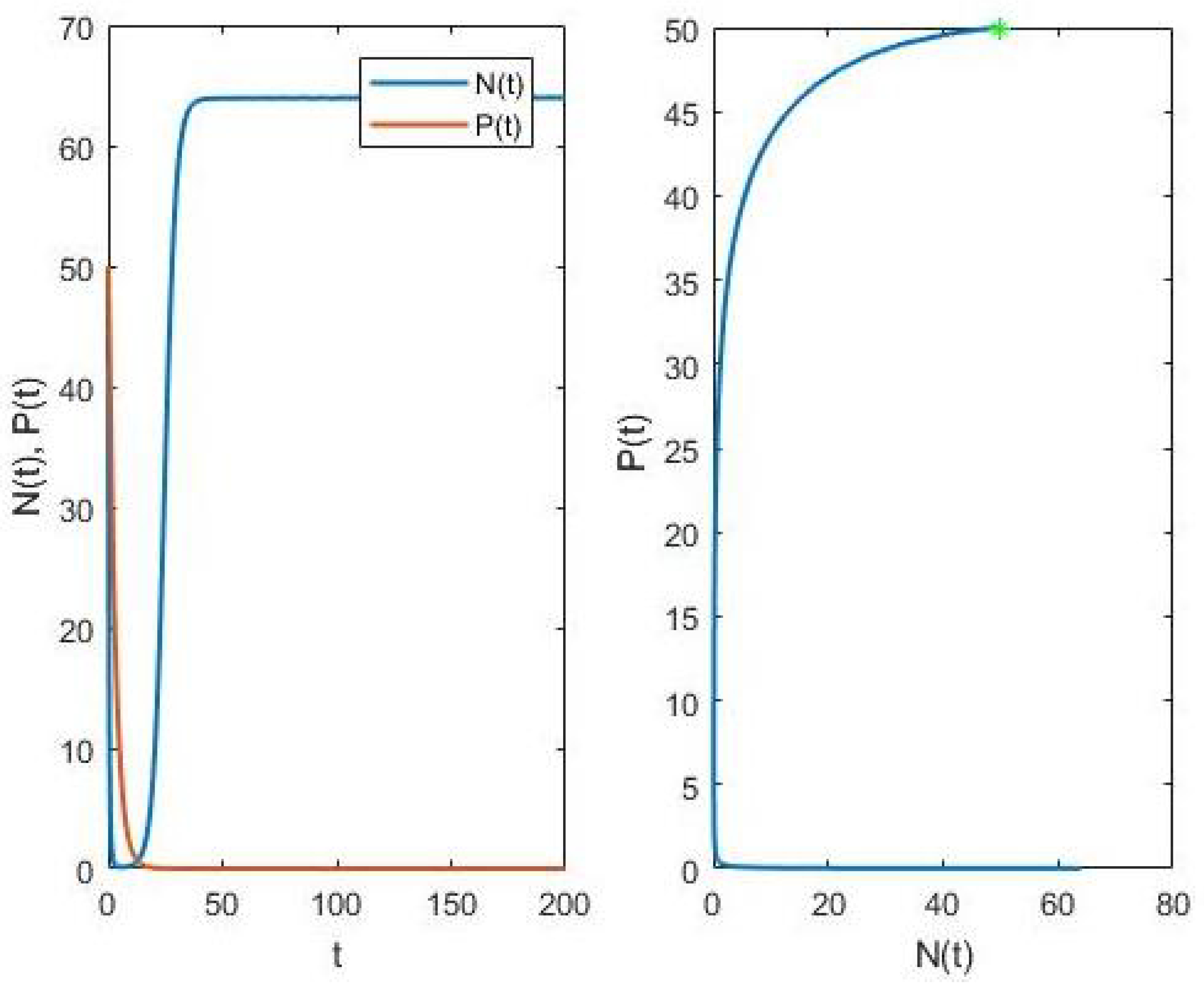
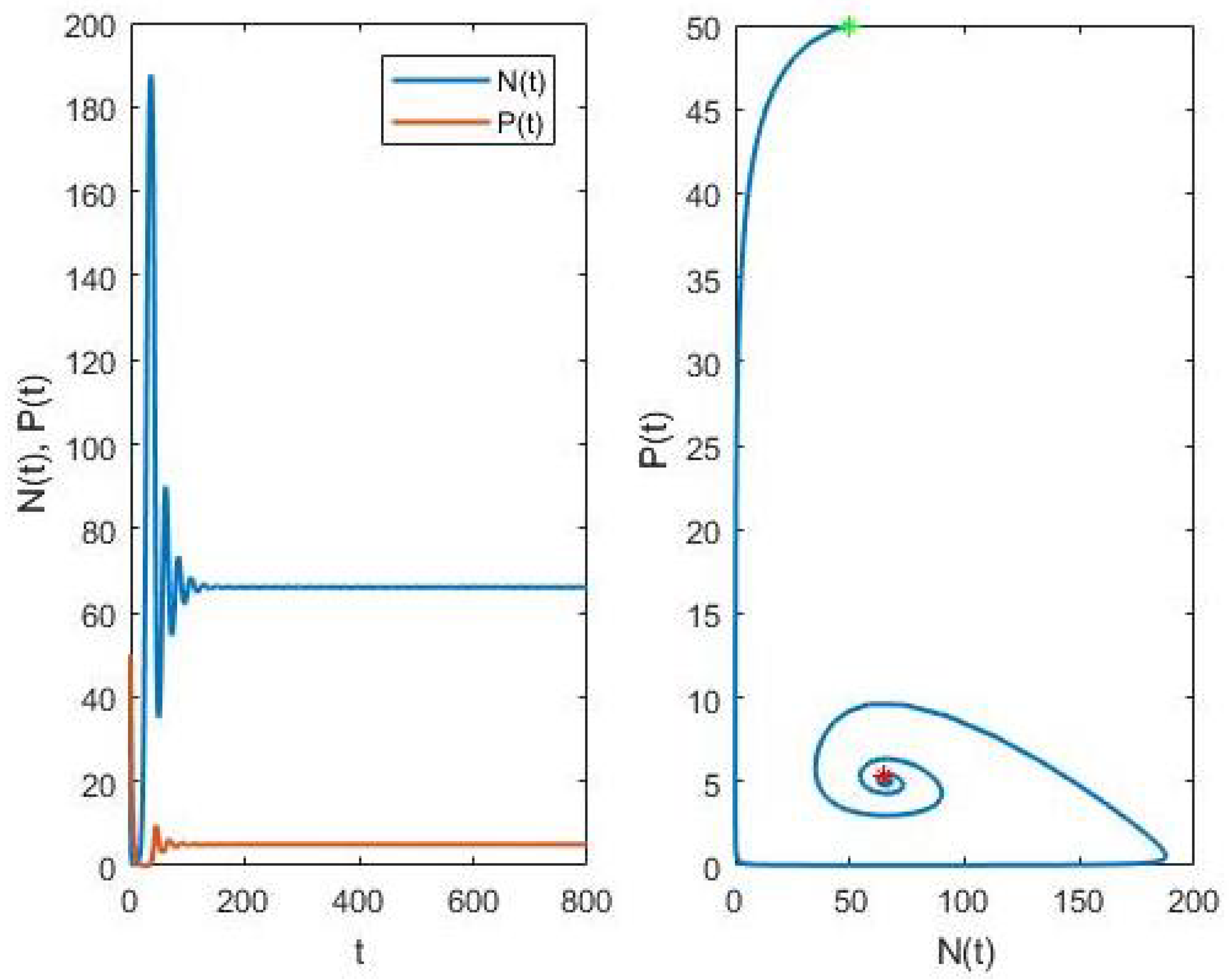
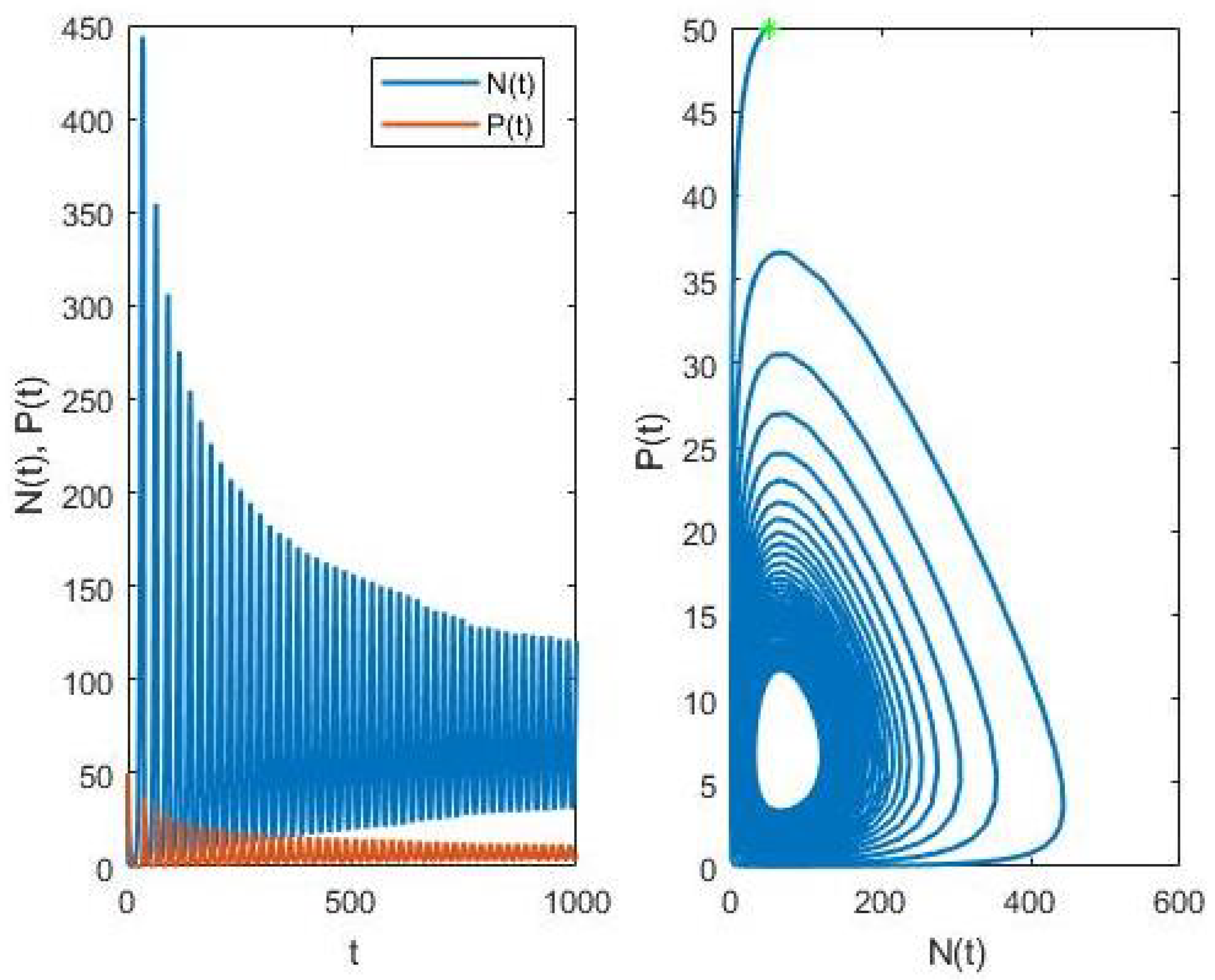
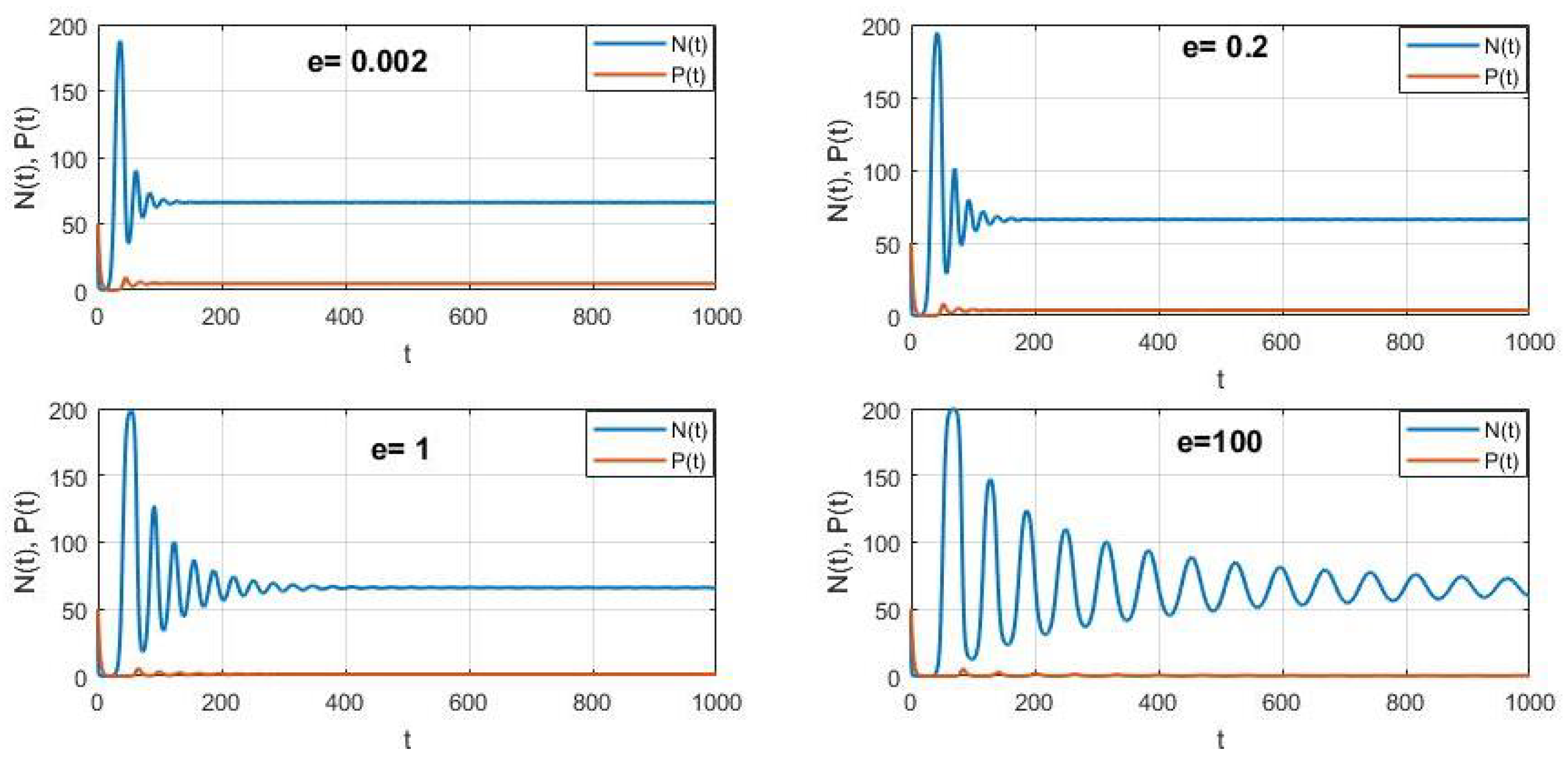
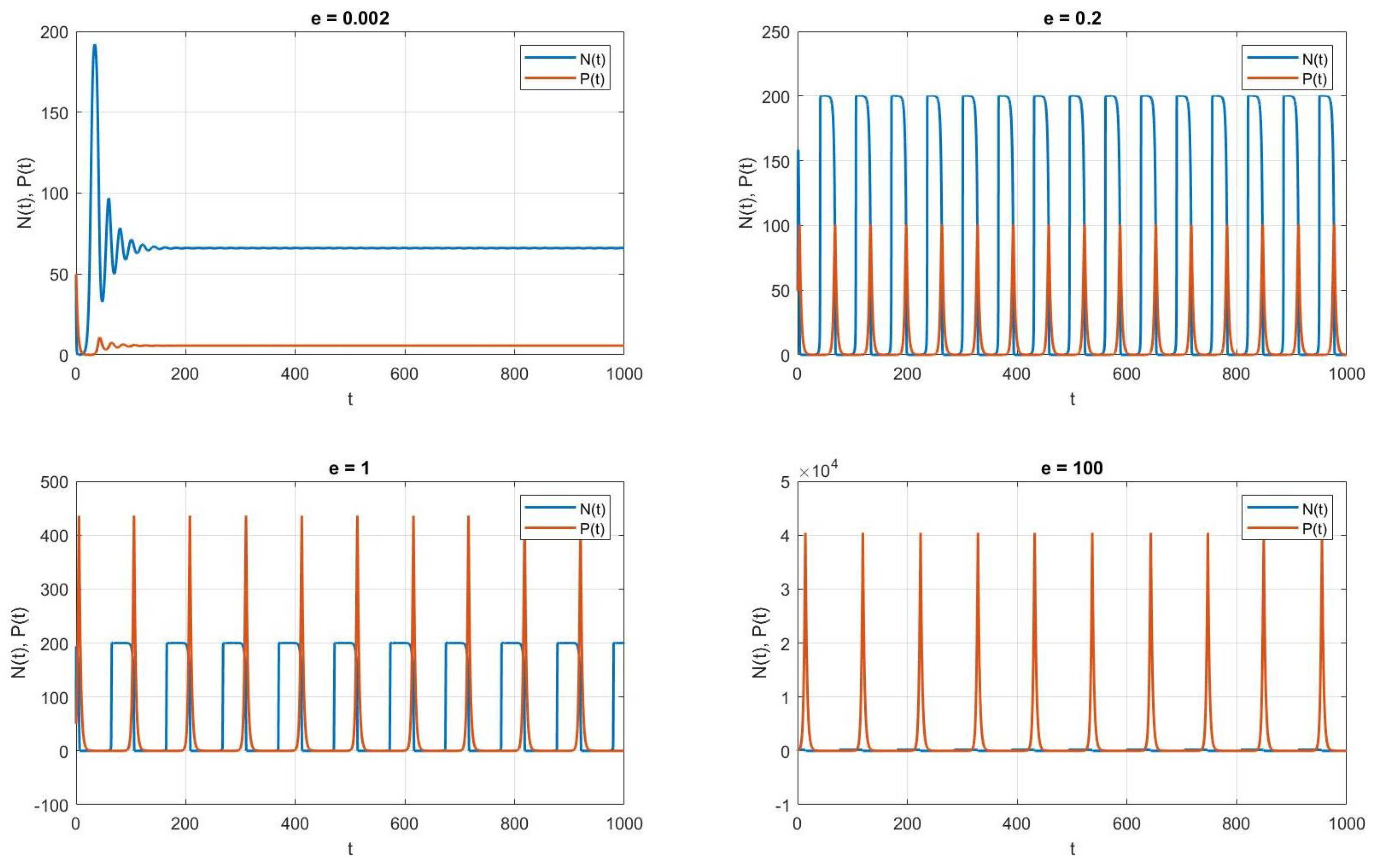
4. Numerical Simulation
5. Conclusions
Author Contributions
Funding
Data Availability Statement
Conflicts of Interest
References
- Ghosh, J.; Sahoo, P.; Poria, S. Prey-predator dynamics with prey refuge providing additional food to predator. Chaos Solitons Fractals 2017, 96, 110–119. [Google Scholar] [CrossRef]
- Jana, D. Stabilizing Effect of Prey Refuge and Predator’s Interference on the Dynamics of Prey with Delayed Growth and Generalist Predator with Delayed Gestation. Int. J. Ecol. 2014, 2014, 429086. [Google Scholar] [CrossRef][Green Version]
- Sih, A. Prey refuges and predator-prey stability. Theo. Pop. Biol. 1987, 31, 1–12. [Google Scholar] [CrossRef]
- Wang, X. Studying Both Direct and Indirect Effects in Predator-Prey Interaction. Master’s Thesis, The University of Western Ontario, London, ON, Canada, 2016. [Google Scholar]
- Zhang, H.; Cai, Y.; Fu, S.; Wang, W. Impact of the fear effect in a prey-predator model incorporating a prey refuge. App. Math. Comp. 2019, 356, 328–337. [Google Scholar] [CrossRef]
- Zanette, L.Y.; White, A.F.; Allen, M.C. Perceived predation risk reduces the number of offspring songbirds produce per year. Science 2011, 334, 1398–1401. [Google Scholar] [CrossRef] [PubMed]
- Wang, X.; Zanette, L.Y.; Zou, X. Modeling the fear effect in predator–prey interactions. J. Math. Biol. 2016, 73, 1179–1204. [Google Scholar] [CrossRef] [PubMed]
- Qi, C.; Guotai, C.; Wensheng, Y. The impact of fear effect on the dynamics of a delayed predator–prey model with stage structure. Int. J. Biomath. 2023, 16, 2250139. [Google Scholar] [CrossRef]
- Weili, K.; Yuanfu, S. The effects of fear and delay on a predator-prey model with Crowley-Martin functional response and stage structure for predator. AIMS Math. 2023, 8, 29260–29289. [Google Scholar]
- Das Bijoy, K.; Debgopal, S.; Samanta, G.P. Impact of fear in a delay-induced predator–prey system with intraspecific competition within predator species. Math. Comp. Simu. 2022, 191, 134–156. [Google Scholar]
- Lavanya, R.; Vinoth, S.; Sathiyanathan, K.; Zeric, N.T.; Hammachukiattikul, P.; Vadivel, R. Dynamical Behavior of a Delayed Holling Type-II Predator-Prey Model with Predator Cannibalism. J. Math. 2022, 4071375. [Google Scholar] [CrossRef]
- Liu, J.; Lv, P.; Liu, B.; Zhang, T. Dynamics of a Predator-Prey Model with Fear Effect and Time Delay. Complexity 2021, 1, 9184193. [Google Scholar] [CrossRef]
- Sasmal, S.K. Population dynamics with multiple Allee effects induced by fear factors—A mathematical study on prey-predator interactions. Appl. Math. Model. 2018, 64, 1–14. [Google Scholar] [CrossRef]
- Huang, Y.; Zhu, Z.; Li, Z. Modeling the Allee effect and fear effect in system incorporating a prey refuge. Adv. Differ. Equ. 2020, 2020, 321. [Google Scholar] [CrossRef]
- Martin, A.; Ruan, S. Predator-prey models with delay and prey harvesting. J. Math. Biol. 2001, 43, 247–267. [Google Scholar] [CrossRef] [PubMed]
- Cushing, J.M. Integrodifferential Equations and Delay Models. In Population Dynamics; Springer: Berlin/Heidelberg, Germany, 1977. [Google Scholar]
- Cushing, J.M. Predator Prey Interactions with Time Delays. J. Math. Biol. 1976, 3, 369–380. [Google Scholar] [CrossRef] [PubMed]
- Kuang, Y. Delay Differential Equations with Applications in Population Dynamics; Academic Press: New York, NY, USA, 1993. [Google Scholar]
- Gopalsamy, K. Harmless delay in model systems. Bull. Math. Biol. 1983, 45, 295–309. [Google Scholar] [CrossRef]
- Gopalsamy, K. Delayed responses and stability in two-species systems. J. Austral. Math. Soc. Ser. B 1984, 25, 473–500. [Google Scholar] [CrossRef]
- Hastings, A. Delays in recruitment at different trophic levels: Effects on stability. J. Math. Biol. 1984, 21, 35–44. [Google Scholar] [CrossRef] [PubMed]
- Ruan, S. Absolute stability, conditional stability and bifurcation in Kolmogorov-type predator-prey systems with discrete delays. Quart. Appl. Math. 2001, 59, 159–173. [Google Scholar] [CrossRef]
- Perko, L. Differential Equations and Dynamical Systems, 3rd ed.; Springer: Berlin/Heidelberg, Germany, 2000. [Google Scholar]
- Local Perturbation Analysis in MatCont. Available online: https://personal.math.ubc.ca/~keshet/Papers/LPA_BJTools_Supp2.pdf (accessed on 16 September 2025).



| Parameter | Definition |
|---|---|
| r | The growth rate of prey |
| The carrying capacity of prey | |
| e | The cost of fear |
| b | The predation rate |
| The conversion rate | |
| c | The death rate of the predator |
| Handling time |
| Parameter | Definition | Value |
|---|---|---|
| r | The growth rate of prey | |
| The carrying capacity of prey | 200 | |
| e | Cost of fear | |
| b | The predation rate | |
| The conversion rate | ||
| c | The death rate of the predator |
Disclaimer/Publisher’s Note: The statements, opinions and data contained in all publications are solely those of the individual author(s) and contributor(s) and not of MDPI and/or the editor(s). MDPI and/or the editor(s) disclaim responsibility for any injury to people or property resulting from any ideas, methods, instructions or products referred to in the content. |
© 2025 by the authors. Licensee MDPI, Basel, Switzerland. This article is an open access article distributed under the terms and conditions of the Creative Commons Attribution (CC BY) license (https://creativecommons.org/licenses/by/4.0/).
Share and Cite
Elmojtaba, I.; Al-Moqbali, M.; Al-Salti, N. Effect of Fear and Time Delay on Predator–Prey Interaction. AppliedMath 2025, 5, 175. https://doi.org/10.3390/appliedmath5040175
Elmojtaba I, Al-Moqbali M, Al-Salti N. Effect of Fear and Time Delay on Predator–Prey Interaction. AppliedMath. 2025; 5(4):175. https://doi.org/10.3390/appliedmath5040175
Chicago/Turabian StyleElmojtaba, Ibrahim, Mariam Al-Moqbali, and Nasser Al-Salti. 2025. "Effect of Fear and Time Delay on Predator–Prey Interaction" AppliedMath 5, no. 4: 175. https://doi.org/10.3390/appliedmath5040175
APA StyleElmojtaba, I., Al-Moqbali, M., & Al-Salti, N. (2025). Effect of Fear and Time Delay on Predator–Prey Interaction. AppliedMath, 5(4), 175. https://doi.org/10.3390/appliedmath5040175