

Article

A Non-Canonical Classical Mechanics

School of Physics, Sun Yat-Sen University, Xingang Xi Rd. 135, Guangzhou 510275, China
AppliedMath 2025, 5(4), 173; https://doi.org/10.3390/appliedmath5040173
Submission received: 10 October 2025 / Revised: 12 November 2025 / Accepted: 17 November 2025 / Published: 5 December 2025

Abstract

Based on noncommutative relations and the Dirac canonical dequantization scheme, I generalize the canonical Poisson bracket to a deformed Poisson bracket and develop a non-canonical formulation of the Poisson, Hamilton, and Lagrange equations in the deformed Poisson and symplectic spaces. I find that both of these dynamical equations are the coupling systems of differential equations. The noncommutivity induces the velocity-dependent potential. These formulations give the Noether and Virial theorems in the deformed symplectic space. I find that the Lagrangian invariance and its corresponding conserved quantity depend on the deformed parameters and some points in the configuration space for a continuous infinitesimal coordinate transformation. These formulations provide a non-canonical framework of classical mechanics not only for insight into noncommutative quantum mechanics, but also for exploring some mysteries and phenomena beyond those in the canonical symplectic space.

1. Introduction

Recent cosmological observations indicate novel contents of the universe, dark energy and dark matter [1,2], which become a challenge for current physics theories. In particular, the intrinsic spacetime incompatibility between quantum theory and gravity implies some deep mysteries behind the microscopic world and gravity [3,4,5], which inspire more novel ideas on spacetime quantization, noncommutative geometry, and quantum gravity [6,7,8,9].
Many attempts have been proposed to extend the Heisenberg algebra to noncommutative algebra for understanding novel puzzles in different spacetime scales [10,11,12,13,14,15,16,17], such as the deformed symplectic structure and its quantization [10,11,12] and the deformed Poisson backet in noncommutative phase space [13,14,15,16,17].
In condensed matter physics, a two-dimensional (2D) electronic system in a magnetic field is naturally equivalent to a 2D free electronic system working in the noncommutative phase space [18,19,20,21,22]. The noncommutative effects lead to a novel Aharonov–Bohm effect [23,24,25,26,27,28], magnetic monopole and Berry phases [29], an inertial spin Hall effect [30,31,32], and gravitational effects [33,34,35,36,37]. In particular, the non-local field leads to the extended and generalized uncertainty relations and novel angular momentum algebra in a deformed Hilbert space [38,39], which are associated with the noise-disturbance uncertainty principle [40,41,42].
The Heisenberg commutation relations were generalized to noncommutative relations [43]. We develop a formalism of noncommutative quantum mechanics, which includes Schrodinger, Klein–Gordon, and Dirac equations in the noncommutative phase space [43,44]. In particular, we propose a parameterization scheme, in which the noncommutative parameters are associated with the Planck length and cosmological constant such that the formulations of noncommutative quantum mechanics can be applied to understand novel phenomena, such as the particle–antiparticle asymmetry, wave-particle duality, and quantum decoherence in the Planck and cosmological scales [43,44,45]. Interestingly, what is the classical analog of noncommutative quantum mechanics [45]? Based on the Dirac canonical quantization scheme, the commutative relations correspond to the Poisson brackets in the Planck constant vanishing 0 . Thus, the noncommutative relations yield deformed Poisson brackets, which implies a noncommutative version of classical mechanics in the deformed Poisson manifold.
Many attempts at gravity quantization involve couplings of geometry and matter in the noncommutative spacetime background [46,47,48]. In particular, the Kontsevich’s deformation quantization is applied in quantum field theory, as well as its relational symplectic groupoid for constant Poisson structures [49,50]. These results imply some relationships between quantum geometry and quantum gravity in a deformed Poisson manifold.
In mathematics, the canonical symplectic structure was generalized to deformed symplectic and Poisson structures based on the Moyal product techniques with nonlinear Poisson brackets and deformed Lie algebra [6,7,8]. These generalizations reveal some connections between noncommutative algebra and geometry, which are associated with classical and quantum gravity [36,51,52]. Recently, in semi-classical approximation, Poisson electrodynamics with charged matter fields and Poisson gauge symmetry were studied as a noncommutative gauge theory [53,54]. Based on a twisted ∗-wedge product technique, Leonardo Castellani constructs a noncommutative Hamitonian formalism for noncommutative gravity [55].
In geometric analysis, the deformed symplectic and Poisson structures lead to noncommutative geometry and modify many geometric analysis tools, such as the Radon, twistor, and Penrose transforms [56,57,58].The deformed Poisson structure modifies the Radon transform to be non-Abelian to reconstruct information in medical images [56]. The twistor space is extended to a noncommutative geometry for constructing a conformal gravity and self-dual supergravity [59,60]. The Penrose transform yields a twistor Hamiltonian formalism and conformal higher spin theory in a noncommutative geometry [55,61,62]. In particular, the deformed Poisson structure is related to the classical Hamiltonian time crystal model and realized in terms of closed, knotted molecular rings [63]. Recently, it has been revealed that unimodularity and invariant volume forms for Hamiltonian dynamics on the Poisson–Lie groups and symplectic embeddings naturally define a P -structure on the exterior algebra of differential forms on a generic almost-Poisson manifold [54,64]. The Poisson electrodynamics with charged matter fields gives the low-energy limit of a rank-one noncommutative gauge theory [53]. One can calculate the four-point correlation functions of the all-loop geometry in the twistor space and give nonperturbative amplitudes at strong coupling in a pseudo-hyper-Kahler geometry [65,66]. These results imply many applications of geometric analysis tools in the deformed symplectic and Poisson geometries.
In general, the Poisson geometry contains richer geometric structures than the symplectic geometry. The Hamiltonian mechanics in the canonical symplectic space corresponds naturally to the Poisson mechanics. However, in the deformed Poisson manifold, there does not always exist a corresponding Hamiltonian formalism. Consequently, is there a Hamilton mechanics in the deformed Poisson manifold that corresponds to the noncommutative quantum mechanics? Can we observe the noncommutative quantum mechanics behaviors from the classical dynamics in a deformed Poisson manifold?
In this paper, I intend to answer above questions. In Section 2, I first review briefly the geometric description of classical mechanics and its relationship to canonical quantization. In Section 3, I present the noncommutative relations and their corresponding deformed Poisson brackets and give the deformed symplectic structure. In Section 4, I give the Poisson and Hamilton equations in the deformed Poisson and symplectic spaces. In Section 5, using the Legendre transformation, I obtain the Lagrange and Newtonian equations as well as the variational principle. In Section 6, I give symmetry and conservation laws in this noncommutative configuration space, including the Noether and Virial theorems, and their corresponding examples. I also give a symplectic group in this deformed symplectic space. In Section 7, I give the perspectives in physics and mathematics. Finally, I give the conclusions and outlook in Section 8. For readers’ convenience, in Appendix A, Appendix B, Appendix C and Appendix D, I give some derivation notes and calculation details.

2. A Brief Review of Canonical Classical Mechanics

2.1. Hamilton Equation and Poisson Bracket

Let me first recall the geometric description of the Hamilton mechanics in symplectic space. For a smooth curve in the symplectic space γ ( t ) ( Z , J ) , where Z = T M n × T M n , dim M = n and γ ( t ) = ( q ( t ) , p ( t ) ) , the time evolution (tangent vector) of this curve is generated by the flow of the Hamiltonian vector field on the symplectic space [67],
γ ˙ ( t ) = X H ( γ ( t ) ) .
The Hamiltonian vector field is defined by a Hamiltonian function,
J ( X H , · ) : = d H .
where the canonical symplectic structure is defined by J = d z i d z j . In the canonical symplectic coordinate system, the canonical symplectic matrix is given by
J = 0 n I n I n 0 n ,
where 0 n is the n × n zero matrix and I n is the n × n unit matrix. For any vector Y = Y i z i , and J 1 = J , we have
J ( X H , Y ) = d H · Y ; J X H = H ; X H = J H .
In the coordinate system, the Hamiltonian vector field can be expressed as X H i = J i j H z j . Let z i = q i and z n + i = p i , where i = 1 , , n ; the Hamiltonian vector field can be expressed as
X H = H p i q i H q i p i ,
where the double indexes are the Einstein’s summation convention. The phase flow generated by the Hamiltonian vector field gives dynamic evolution (1). For γ = q i and p i , respectively, the phase flow gives the Hamilton equation [67,68],
q ˙ i = H p i ; p ˙ i = H q i .
Since the symplectic manifold is non-degenerate d ω = 0 , the symplectic structure naturally induces a Poisson structure ( Z , Π ) defined by Π Γ ( 2 T M n ) and Π : = q i p i such that for any two smooth functions f and g on the cotangent space, the Poisson bracket is defined in the local canonical symplectic coordinate system by [67,68]
f , g = g p i f q i f p i g q i ,
which obeys
  • Skew-symmetry f , g = g , f ;
  • Bilinearity α f + β g , h = α f , g + β f , h ; f , α g + β h = α f , h + β g , h ;
  • The Leibniz rule f , g h = f , g h + g f , h ;
  • The Jacobian identity f , g , h + g , h , f + h , f , g = 0 ,
where α , β R .
For any function γ on Z, its time evolution is generated by the Poisson bracket [68,69],
γ ˙ = { γ , H } ,
which is called the Poisson equation. Using the Poisson bracket (7), the Hamiltonian vector field flow can be rewritten as
γ ˙ ( t ) = γ q i H p i γ p i H q i ,
In particular, for γ = q i and p i , the Poisson equation reduces to the Hamilton Equation (6). As a particular case of the Poisson bracket in (7), the generalized coordinates and momenta of the Poisson brackets are given by
q i , q j = 0 ; p i , p j = 0 ; q i , p j = δ i j .
They are called the fundamental Poisson brackets.

2.2. Classical–Quantum Correspondence of Dirac Canonical Quantization

In quantum mechanics, quantization can be regarded as a generalization from the Poisson bracket to the Heisenberg commutation relations, which is called the Dirac canonical quantization. In other words, the Heisenberg commutation relations reduce to the Poisson bracket when the Planck constant vanishes, 0 ; namely the Poisson brackets of these canonical variables are given by
Dirac canonical quantization (11a) x i , x j = 0 ; x ^ i , x ^ j = 0 , (11b) p i , p j = 0 ; 0 p ^ i , p ^ j = 0 , (11c) x i , p j = δ i j ; x ^ i , p ^ j = i δ i j ,
where i , j = 1 , 2 , 3 . The equations on the right side of (11) are called the Heisenberg commutation relations.

3. Noncommutative Relations and Deformed Poisson Bracket

3.1. Noncommutative Relations Beyond Heisenberg Relations

Novel phenomenon emergence, such as dark energy and dark matter [5,6,7], inspires ideas to extended the Heisenberg commutation relations to noncommutative spacetimes to understand these puzzles. One of the extended Heisenberg relations is the noncommutative relation in a deformed phase space [24,25,26],
X ^ i , X ^ j = i θ i j ; P ^ i , P ^ j = i η i j ; X ^ i , P ^ j = i κ i j ,
where
θ i j = 0 θ θ θ 0 θ θ θ 0 , η i j = 0 η η η 0 η η η 0 , κ i j = κ a κ b κ b κ b κ a κ b κ b κ b κ a .
are constant matrices. They describe noncommutative effects in noncommutative phase space. Note that η i j and θ i j are skew matrices, while κ i j is a symmetric matrix. In the noncommutative quantum mechanics, a non-canonical map can be used to connect the noncommutative relations to the Heisenberg canonical relations [26,44],
(14a) X ^ , P ^ ϕ x ^ , p ^ , (14b) X ^ i P ^ i x ^ i + θ 2 S i j p ^ j p ^ i + η 2 S i j x ^ j ,
where
S i j = 0 1 1 1 0 1 1 1 0 , S i j = 0 1 1 1 0 1 1 1 0 ,
where the left-side operators obey the noncommutative relations (12) and the right-side operators obey the Heisenberg commutation relations. It can be verified that the non-canonical map gives the parameter constraints [26,44]
κ a = 1 + θ η 2 , κ b = θ η 4 .
The noncommutative effects are described by two parameters θ and η . A formulation of noncommutative quantum mechanics based on these noncommutative relations is developed for exploring some mysteries, such as dark energy and quantum decoherence [43,44]. This map gives noncommutative effects within the framework of the Heisenberg commutation relation. This framework of noncommutative quantum mechanics is expected to be tested experimentally [24,25].
A natural question is what is a classical analog of this noncommutative quantum mechanics.

3.2. Dirac Canonical Dequantization and Deformed Poisson Bracket

In noncommutative quantum mechanics, the Heisenberg relations are generalized to noncommutative relations [26,43]; the Dirac canonical dequantization gives the classical–quantum correspondence
Dirac canonical dequantization (17a) X ^ i , X ^ j = i θ i j ; x i , x j π = θ i j , (17b) P ^ i , P ^ j = i η i j ; 0 p i , p j π = η i j , (17c) X ^ i , P ^ j = i κ i j ; x i , p j π = κ i j ,
This classical–quantum correspondence defines the Poisson bracket
f , g π : T M 3 × T M 3 R ,
which equivalently defines a bivector field π Γ ( 2 T M 3 ) . In the local coordinate system, the bivector field can be expressed as
π = 1 2 π i j z i z j , z Z ,
and the Poisson bracket can be expressed as
f , g π = π i j f z i g z j , z Z .
By the Dirac canonical dequantization in (17), the matrix representation of the Poisson form is given by
π i j = θ i j κ i j κ i j η i j ,
which is a 6 × 6 non-singular skew block matrix [45]. It should be remarked that the matrices θ i j , η i j and κ i j in (21) have the same forms in (13), but the dimensions of θ i j and η i j are x p 1 and x 1 p , respectively. They are different from the quantum versions of θ i j and η i j . Moreover, in the following sections, the notations, θ i j , η i j and κ i j , can be either matrices or its elements, which depends on the context.
It can be verified that the deformed matrix π is not linear isomorphic to the canonical Poisson bracket for non-zero θ i j , η i j and κ i j . Calculating the eigenvalues λ j of i π , we can find that not all eigenvalues are paired λ j = ± 1 . Based on the Willianson theorem, the deformed Poisson bracket (20) is not linear isomorphic to the canonical Poisson relations (see Appendix A).
Note that π i j is a non-degenerate constant matrix. It can be verified that the Poisson bracket (20) preserves the skew-symmetry, bilinearity, Leibniz rule, and Jacobian identity. Moreover, det π i j 0 , which implies that π i j is invertible. Let ( π 1 ) i j = ω i j such that π i k ω k j = δ j i . Thus, the symplectic structure can be defined by [67,69]
Ω : = 1 2 ω i j d z i d z j .
Using the matrices π i j , θ i j , η i j , and κ i j with (16), the matrix form of the symplectic structure is obtained,
ω i j = α i j ϕ i j ϕ i j β i j ,
where
α i j = 0 α α α 0 α α α 0 , β i j = 0 β β β 0 β β β 0 , ϕ i j = ϕ a ϕ b ϕ b ϕ b ϕ a ϕ b ϕ b ϕ b ϕ a
with
α = 16 η 16 24 θ η + 9 θ 2 η 2 β = 16 θ 16 24 θ η + 9 θ 2 η 2
ϕ a = 16 + 3 θ 2 η 2 16 24 θ η + 9 θ 2 η 2 ϕ b = 12 θ η + 3 θ 2 η 2 16 24 θ η + 9 θ 2 η 2 .
Note that det ω i j 1 . This implies that the symplectic structure (22) is not linear isomorphic to the canonical symplectic structure. In other words, we will study what the dynamical behaviors for the non-canonical classical mechanics are. They provide an alternative view to understand noncommutative quantum mechanics.
In general, the Hamilton and Lagrange mechanics usually work in 2 n -dimensional cotangent and tangent spaces T M n and T M n . Thus, in the following sections, we generalize the 3D notation to nD notation without loss of generality.

4. Poisson and Hamilton Equations

4.1. Poisson Equation

The Dirac canonical dequantization (17) gives the deformed Poisson bracket (20). In this deformed Poisson manifold, we obtain the Poisson equation.
Theorem 1. 
For any physical observable γ ( Z , π ) , its dynamical evolution can be given by the Poisson equation
γ ˙ ( z ) = γ ( z ) , H π .
In the coordinate system, the coordinates can be relabeled z i = Q i and z n + i = P i such that the Poisson equation can be rewritten as the explicit form
γ ˙ = γ Q i θ i j H Q j γ P i κ i j H Q j + γ Q i κ i j H P j + γ P i η i j H P j ,
where Q i , P i Z and i = 1 , , n .
Proof. 
The Hamiltonian vector field is defined by [67]
X H ( f ) : = f , H π , f C ( M ) .
In the coordinate system, the Hamiltonian vector field can be expressed as
X H ( f ) = π i j f z i H z j = X H i f z i , z Z ,
where
X H i = π i j H z j , X H = π i j H z j z i ,
is the Hamiltonian vector field. The dynamic phase flow γ is generated by the Hamiltonian vector field,
γ ˙ ( t ) = X H ( γ ( t ) ) = π i j H z j z i ( γ ( t ) ) = γ ( t ) , H π .
We relabel z i = Q i and z n + i = P i . The Poisson equation can be rewritten as
γ ˙ = γ , H π , = γ Q i γ P i θ i j κ i j κ i j η i j H Q j H P j = γ Q i θ i j H Q j γ P i κ i j H Q j + γ Q i κ i j H P j + γ P i η i j H P j .
For any physical variable χ on the (cotangent) phase space, χ T M n , χ , H Ω = 0 implies that χ is a conserved quantity.

4.2. Hamilton Equation

In the deformed symplectic manifold ( Z , Ω ) , we obtain the Hamilton equation.
Theorem 2. 
In the deformed symplectic manifold ( Z , Ω ) , where Ω is given in (22), the Hamilton equation is given by
Q ˙ i = κ i j H P j + θ i j H Q j ,
P ˙ i = η i j H P j κ i j H Q j ,
where i = 1 , 2 , , n .
Proof. 
In the deformed symplectic manifold ( M , Ω ) , the Hamiltonian vector field is defined by
Ω ( X H , · ) : = d H .
In the coordinate system, X H = ( X H ) i z i . For any vector Y = Y i z i . Thus,
ω i j ( X H ) i Y j = H z j Y j , Y j .
Consequently, we have
ω i j ( X H ) i = H z j .
Note that for π i k ω k j = δ j i and π i j = π j i , we have
( X H ) i = π i j H z j .
In the coordinate system, let z = Q i and z n + i = P i , the Hamiltonian vector field is given by
X H = θ i j κ i j κ i j η i j H Q j H P j = θ i j H Q j + κ i j H P j κ i j H Q j + η i j H P j .
Thus, the Hamiltonian vector field can be rewritten as
X H = θ i j H Q j + κ i j H P j Q i + κ i j H Q j + η i j H P j P i .
The dynamic phase flow γ is generated by the Hamiltonian vector field in the deformed sympplectic space ( Z , Ω ) ,
γ ˙ ( t ) = X H γ ( t ) .
For γ = Q i and P i , respectively, the dynamic flow can be expressed as the Hamilton equation,
Q ˙ i = κ i j H P j + θ i j H Q j ,
P ˙ i = η i j H P j κ i j H Q j ,
where i = 1 , 2 , , n . □
In fact, the Hamilton equation can be obtained directly by the Poisson Equation (27) for γ = Q i and P i , respectively.
Remark 1. 
From the mathematical viewpoint, the symplectic and Poisson geometries have different geometric structures. The symplectic structure is characterized by a non-degenerate and close 2-form, whereas the Poisson structure is characterized by a Poisson bracket, which is bilinear and skew-symmetric and satisfies the Leibniz and Jacobian rules. The canonical symplectic structure can naturally induce a Poisson structure, but the degenerate Poisson structure ( det π = 0 ) cannot reduce to the symplectic structure. In physics, the degenerate Poisson manifold can describe the constraint systems.
The Hamilton equations are a coupling system of differential equations associated with the noncommutative parameters θ i j , η i j , and κ i j Physically, κ i j induces the couplings between Q i and P j as the deformation of the canonical phase space, whereas θ i j induces an effective force driving particles with an extra velocity (see (33a)), and η i j yields a non-potential force associated with the velocity of particles (see (33b))). In the mathematical viewpoint, the Hamilton Equations (33) are given in a non-canonical symplectic coordinate system. Physically, the non-canonical symplectic coordinate system comes from a particular noncommutative relation (12). Thus, the Hamilton Equations (33) give noncommutative effects in classical systems.
It should be remarked that the deformed structures π and ω of the Poisson and symplectic spaces are not linear isomorphic to the canonical structure J, which gives different Poisson and Hamilton dynamics to the canonical dynamics even though there exists a local canonical coordinate on these deformed Poisson and symplectic manifolds based on the Darboux theorem. In other words, different physical observations occur in the same geometric structure of a manifold.

5. Lagrange Mechanics

5.1. Lagrange Equations

To obtain the Lagrange formulation, the inverse Legendre transformation can be used for the time-independent problem,
L ( Q i , Q ˙ i ) = P i Q ˙ i H ( Q i , P i ) ,
where the canonical momentum is defined by
P i : = L ( Q i , Q ˙ i ) Q ˙ i .
Theorem 3. 
In the deformed symplectic manifold ( Z , Ω ) , the Lagrange equation is given by
d d t L ( Q i , Q ˙ i ) Q ˙ i K i k L ( Q i , Q ˙ i ) Q k = R i k Q ˙ k ,
where
(45a) K i k = κ i k + η i j κ j θ k = δ i k + 3 θ η 4 4 θ η 4 + 3 θ η B i k , (45b) R i k = η i j κ j k = 4 η 4 + 3 θ η A i k ,
with
B i j = 2 1 1 1 2 1 1 1 2 , A i j = 0 1 1 1 0 1 1 1 0 .
and κ i j = κ i j 1 .
Proof. 
Note that from H ( Q i , P i ) Q j = L ( Q i , Q ˙ i ) Q j and the Hamilton equation, (33), we have
d d t L ( Q i , Q ˙ i ) Q ˙ i L ( Q i , Q ˙ i ) Q j = P ˙ i + H ( Q i , P i ) Q i , = η i j H ( Q i , P i ) P j κ i j H ( Q i , P i ) Q j + H ( Q i , P i ) Q i
The Hamilton Equation (33a) can be rewritten as
H ( Q i , P i ) P = κ i Q ˙ i κ i θ i k H ( Q i , P i ) Q k , = κ i Q ˙ i + κ i θ i k L ( Q i , Q ˙ i ) Q k ,
where i = 1 , 2 , , n and κ i = κ i 1 . Substituting (48) into (47) and letting κ i j = δ i j + κ ˜ i j , we have
d d t L ( Q i , Q ˙ i ) Q ˙ i L ( Q i , Q ˙ i ) Q j = η i j κ i Q ˙ i + κ i θ i k L ( Q i , Q ˙ i ) Q k κ ˜ i j H ( Q i , P i ) Q j = η i j κ i Q ˙ i + κ i θ i k L ( Q i , Q ˙ i ) Q k + κ ˜ i j L ( Q i , Q ˙ i ) Q j .
By moving the last two terms to the left side of (48), we obtain the Lagrange equations,
d d t L ( Q i , Q ˙ i ) Q ˙ i κ i k + η i j κ j θ k L ( Q i , Q ˙ i ) Q k = η i j κ j k Q ˙ k .
Consequently, by running the matrix calculation, (see Appendix B), we can obtain the matrix forms K i j and R i j in (45). □
Remark 2. 
The Lagrangian Equation (44) is also a coupling system of differential equations, which depend on the noncommutative parameters θ and η. In the non-canonical coordinates, the Poisson bracket leads to the couplings between the generalized coordinates as the deformation of the canonical phase space, while the noncommutative momenta with η i j yield a non-potential force that depends on the velocity of particles. The Lagrangian Equation (44) depends on the inverse Legendre transformation (42), namely d Q ˙ i d P k d P k d Q ˙ j = δ i j . For practical problems, we need to investigate this condition for the Lagrangian formulation. See Appendix C.

5.2. Newtonian Equation

From the Lagrange Equation (44), we can obtain the Newtonian equation.
Theorem 4. 
In the deformed symplectic manifold ( Z , Ω ) , the Newtonian equation is expressed as
m i j Q ¨ j = f i
where
m i j = 2 L Q ˙ i Q ˙ j ,
is the effective mass and
f i = K i j L Q j + R i j 2 L Q ˙ i Q j Q ˙ j
is the effective force. The first term in (53) is the conservation force and the second term is a non-conservation force that depends on the velocity of particle.
Proof. 
Suppose that the Lagrangian is non-singular, 2 L Q ˙ i Q ˙ j 0 , and does not depend explicitly on time; we have
d d t L Q ˙ i = 2 L Q ˙ i Q ˙ j Q ¨ j + 2 L Q ˙ i Q j Q ˙ j .
Substituting the Lagrange Equation (44) into the left side of (54) and rearranging the terms, we have
2 L Q ˙ i Q ˙ j q ¨ j = R i j Q ˙ j + K i j L Q j 2 L Q ˙ i Q j Q ˙ j .
We define the effective mass tensor and force in (52) and (53), respectively. □
Example 1. 
Let us consider a three-dimensional anisotropic oscillator; the Lagrangian is given by
L = 1 2 m i j x ˙ i x ˙ j 1 2 k i j x i x j , i , j = 1 , 2 , 3 .
The effective mass is obtained as m i j and the effective force is given by
f i = R i j x ˙ j K i j k j k x k
Thus, substituting (45) into (57), the Newtonian equation is obtained,
m i j x ¨ j = ( k i j + k ˜ i j ) x j + A i j x ˙ j .
where
(59a) k ˜ i j = 3 θ η 4 4 + θ η 4 + 3 θ η B i k k k j , (59b) A i j = 4 η 4 + 3 θ η A i j .
It can be seen that the second term is an effective force coming from the coordinate couplings and the third term is an effective velocity-dependent force. They vanish when θ = η = 0 .
To explore the basic features of this model (58), suppose that the system is isotropic, namely m i j = m δ i j , k i j = k δ i j , and ignore the higher terms O ( θ η ) , namely k ˜ i j 0 and A i j η A i j . Introduce a new vector to rewrite Equation (58) in the matrix form z ˙ = M z , where z = x , x ˙ T and
M = 0 I ω 2 I η m A ,
where ω = k m . Suppose that the eigenequation A v j = α j v j can be solved by the eigenvalues α j and their corresponding eigenvectors v j . Thus, the eigenequation of the M matrix is given by
λ 2 η m α j λ + ω 2 = 0 .
Consequently, the solution of (61) is obtained as
λ ± , j = η m α j ± η m α j 2 4 ω 2 2 ± i ω + η 2 m α j .
It can be verified that the eigenvalues and their corresponding eigenvectors are expressed as
(63a) α 1 = i 3 , v 1 = 1 2 i 3 2 , 1 2 i 3 2 , 1 T (63b) α 2 = i 3 , v 2 = 1 2 + i 3 2 , 1 2 + i 3 2 , 1 T (63c) α 3 = 0 , v 3 = 1 , 1 , 1 T .
Hence, the general solution is obtained,
x ( t ) = j = 1 3 c j + v j e λ + , j t + c j v j e λ , j t ,
where c j ± are the initial constants and
(65a) λ ± , 1 = ± i ω + 3 η 2 m (65b) λ ± , 2 = ± i ω 3 η 2 m (65c) λ ± , 3 = ± i ω
It can be seen that there are two modes for each coordinate component and these two modes oscillate inversely. The deformed parameter η modifies the frequency of two components. In other words, even though k 0 , the particle still oscillates in two coordinate components. These phenomena can be compared with a particle moving in a planar electromagnetic field, which is equivalent to a particle trapped within relative coordinates in a deformed symplectic space [70]. The electromagnetic field plays the role of noncommutative algebra and generates two oscillating modes [70].

5.3. Variational Principle

A natural question is how do we construct the variational principle in the noncommutative phase space. Suppose that the action is given by [71]
S = t 0 t f L d t ,
where we ignore the entities Q i , Q ˙ i of L without loss of generality. Similarly we ignore Q i , P i for the Hamiltonian H in the following section. The inverse Legendre transformation gives L = P i Q ˙ i H . Thus,
δ S = t 0 t f δ L d t , = t 0 t f δ ( P i Q ˙ i ) δ H d t ,
Note that δ ( P i Q ˙ i ) = d d t ( P δ Q ) P ˙ i δ Q i + Q ˙ i δ P i and t 0 t f d ( P δ Q ) = 0 at the fixed boundary condition. Thus, we have
δ S = t 0 t f Q ˙ i δ P i P ˙ i δ Q i δ H d t .
The variational derivative of H should be generalized to
δ H = D Q i H δ Q i + D P i H δ P i ,
where P i and Q i are generalized momentum and coordinate vectors in the noncommutative phase space defined by
(70a) P i : = κ i j P j + θ i j Q j , (70b) Q i : = η i j P j + κ i j Q j .
Thus, the directional derivative of the Hamitonian along the generalized momentum and coordinate vectors is expressed as
(71a) D P i H = κ i j H P j + θ i j H Q j , (71b) D Q i H = η i j H P j + κ i j H Q j .
Consequently, we have
δ S = t 0 t f Q ˙ i δ P i P ˙ i δ Q i D Q i H δ Q i D P i H δ P i d t , = t 0 t f Q ˙ i D P i H δ P i P ˙ i + D Q i H δ Q i d t
Finally, we obtain the generalized Hamilton equations
(73a) Q ˙ i = D P i H , (73b) P ˙ i = D Q i H .
Remark 3. 
In the variational derivative, we generalize the partial derivative to the directional derivative along the vectors Q i and P i to give the Hamilton equation rather than the generalized Lagrange equation because the start point is the Poisson equations in the non-canonical coordinates. The Lagrangian formulation in the deformed symplectic space relies on the compatibility between the Hamiltonian and Lagrangian formulations based on the Legendre transformation.

6. Symmetries and Conservation Laws

6.1. Noether Theorem

Let us investigate symmetry and conservation laws in the non-canonical symplectic space based on the Lagrange Equation (44). For convenience of comparison with the normal form of the Noether theorem, in Appendix D, we give the Noether theorem in the canonical symplectic coordinates. Here we give the Noether theorem in the deformed symplectic space.
Theorem 5 
(Noether Theorem). In the deformed symplectic manifold ( Z , Ω ) , the Lagrange equation is invariant under a one-parameter group of coordinate transformations Q = G ( Q , ϵ ) if
L Q i K i k L Q k R i k Q k ˙ G i ϵ + d d t L Q ˙ i G i ϵ = 0 .
In general, there does not exist a conserved quantity. However, if
L Q i K i k L Q k R i k Q k ˙ G i ϵ = 0 ,
this implies that
d d t L Q ˙ i G i ϵ = 0 ,
Consequently, the conserved quantity is defined by Γ : = L Q ˙ i G i ϵ .
Proof. 
The Lagrangian invariance δ L = 0 means
δ L = L Q k δ Q k + L Q ˙ k δ Q ˙ k = 0 .
Note that for δ Q k = G k ϵ δ ϵ and δ Q ˙ k = G ˙ k ϵ δ ϵ , δ L δ ϵ = 0 implies
0 = δ L δ ϵ = L Q k G k ϵ + L Q ˙ k d d t G i ϵ .
The Equation (78) can be rewritten as
L Q k d d t L Q ˙ k G k ϵ + d d t L Q ˙ k G i ϵ = 0 .
Using the Lagrange Equation (44), the first term in (79) can be simplified to (75),
L Q i K i k L Q k R i k Q k ˙ G i ϵ = 0 .
It can be seen from (79) that the first term vanishes for the Lagrange equation in the canonical coordinates such that the Noether theorem reduces to the normal form. However, in the deformed symplectic space, the Lagrange Equation (44) yields the condition (80) for a conserved quantity.
Theorem 6. 
In the deformed symplectic manifold ( Z , Ω ) , the continuous infinitesimal transformation is given by
Q i Q i = Q i + ϵ ξ i , ξ R n
where ϵ is the continuous infinitesimal parameter. ξ R n is an arbitary vector, which satisfies the equation
L Q i K i k L Q k R i k Q k ˙ ξ i = 0 ,
The conserved quantity is expressed as
Γ = L Q ˙ i ξ i .
Proof. 
Note that G i ϵ i = ξ i ; the condition (74) of the Lagrange equation invariance is expressed as
L Q i K i k L Q k R i k Q k ˙ ξ i + d d t L Q ˙ i ξ i = 0 .
and the condition of the conserved quantity becomes
L Q i K i k L Q k R i k Q k ˙ ξ i = 0 .
In general, the invariance of the Lagrange equation under the one-parameter group of coordinate transformations relies on the existence of solution ξ of Equation (74). The existence of the conserved quantity relies on the solution ξ of Equation (82).
Example 2. 
As an example, let us consider a 3D free particle; the Lagrangian is given by
L = 1 2 m x ˙ i x ˙ i , i = 1 , 2 , 3 .
where m is the mass of the particle. Note that L x i = 0 ; the condition of the existence of the conserved quantity (75) can be obtained as
x ˙ i R i j ξ j = 0 ,
where
R i j = 4 η 4 + 3 θ η 0 1 1 1 0 1 1 1 0 .
We have d d t L x ˙ i ξ i . Hence, the conserved quantity is obtained by
Γ = m x ˙ i ξ i ,
where ξ i satisfies the constraint Equation (87), which implies that there exists a solution space of ξ U R 3 . Let me give explicitly the conserved condition and its corresponding conserved quantity. Let me introduce a vector v i = x ˙ i R i j ; the vector can be given by
v = 4 η 4 + 3 θ η y ˙ + z ˙ , z ˙ x ˙ , x ˙ y ˙ .
For a given x ˙ 0 , the constraint Equation (87) gives
y ˙ + z ˙ ξ 1 + z ˙ x ˙ ξ 2 x ˙ y ˙ ξ 3 = 0 ,
which implies that if
y ˙ + z ˙ z ˙ x ˙ x ˙ y ˙ = 0 ,
there exists a vector ξ 0 such that v ˙ · ξ = 0 . This means that in the configuration space ( x , x ˙ ) , there exist some regions that satisfy Equation (92) such that the corresponding non-zero vector ξ is obtained, producing the conserved quantity Γ.
Example 3. 
For another example with potential, we consider the harmonic oscillator. The Lagrangian is given by
L = 1 2 m x ˙ i x ˙ i 1 2 k x i x i ,
where k is the elastic constant. Note that L x i = k x i ; calculating the factor of (82), we have
L x i L x k K k i x k ˙ R k i = k x i x k K k i x ˙ k R k i
Substituting K i j into (94), which reduces to
k x i x k δ k i + 3 θ η 4 4 θ η 4 + 3 θ η S k i x ˙ k R k i = k 3 θ η 4 4 θ η 4 + 3 θ η x k B k i . x ˙ k R k i
Consequently, the condition of the conserved quantity (82) is obtained,
x i W i j ξ j x ˙ i R i j ξ j = 0 ,
where W i j = k w B i j with
w = 3 θ η 4 θ η 4 3 θ η + 4 .
The conserved quantity has the same form as it in (89), but ξ satisfies the constraint Equation (96).
Similarly, introducing a vector v j = x i W i j x ˙ i R i j such that the condition (96) can be rewritten as
v j ξ j = 0
where
v 1 = k ω 2 x y + z 4 η 4 + 3 θ η y ˙ + z ˙
v 2 = k ω 2 y x z 4 η 4 + 3 θ η z ˙ x ˙
v 3 = k ω x y + 2 z + 4 η 4 + 3 θ η x ˙ + y ˙
Consequently, for given any point in the configuration space ( x , x ˙ ) 0 , if the vector satisfies v 1 v 2 v 3 = 0 , there exists a corresponding vector ξ such that v · ξ = 0 , which implies that the conserved quantity Γ = m x ˙ i ξ i .
Example 4. 
An electron moves in magnetic field. The Lagrangian is given by
L = 1 2 m x ˙ i x ˙ i e x ˙ i A i ,
where e is the electron charge and A i is the component of the magnetic potential. Note that L x i = 0 ; the constraint Equation (82) reduces to (87); the same condition (92) in the configuration space ( x , x ˙ ) yields the non-zero vector ξ such that the conserved quantity is L x ˙ i ξ i . Note that L x ˙ i = m x ˙ i e A i ; thus, the conserved quantity can be obtained as
Γ = m x ˙ i e A i ξ i ,
where ξ i satisfies the constraint equation v · ξ = 0 .
Remark 4. 
It should be noted that the conditions for the existence of the conserved quantity (82) and their special cases (87) and (96) depend on velocity. In other words, the conserved quantity depends on the point in the configuration space. This property is similar to a particle moving in a curved spacetime. In the non-canonical symplectic coordinate system, positions and momenta are combined together so that the conserved quantity depends on the point in the configuration space.

6.2. Virial Theorem

Let us first recall the Virial theorem in the canonical phase space. Based on the inverse Legendre transformation (42) [68], we have
H + L = P i Q ˙ i = d d t ( P i Q i ) Q i P ˙ i
Note that for finite P i and Q i , suppose that d d t ( P i Q i ) vanishes for long times [68],
d d t ( P i Q i ) : = lim τ 1 τ 0 τ d d t ( P i Q i ) d t = lim τ 1 τ ( P i Q i ) 0 τ 0 ,
where · means the long-time mean values. For the Hamilton equation P ˙ i = H Q i , we have
H + L = Q i H Q i .
This is the Virial theorem in the canonical phase space. For H = T + V and L = T V , where T is the kinetic energy and V is the potential energy, the Virial theorem reduces to
2 T = Q i V Q i .
In the noncommutative phase space, using the generalized Hamilton Equation (33b) and the Legendre transformation, the Virial theorem (107) is generalized to
Theorem 7. 
In the deformed symplectic manifold ( Z , Ω ) ,
H + L = κ i j Q j H Q i η i j Q j H P i .
Proof. 
Since d d t P i Q i = 0 , the Legendre transformation in (104) is given by
H + L = Q i P ˙ i
Using the Hamilton Equation (33b), we have
H + L = κ i j Q j H Q i η i j Q j H P i .
In particular, H = T + V and L = T V with T = P i P i 2 m ; note that Q j H P i = 1 m Q j P i , and the generalized Virial theorem is simplified to
Theorem 8. 
In the deformed symplectic manifold ( Z , Ω ) ,
2 T = κ i j Q j V Q i η i j m Q j P i .
It can be seen that the noncommutative effects of the coordinate and momenta induce couplings between different degrees of freedoms in the noncommutative phase space.
For the harmonic oscillator, V Q i = k Q i ; thus, we obtain
2 T = k κ i j Q i Q j η i j m Q j P i .
When κ i j = δ i j and η i j = 0 , the above result reduces to that in the canonical symplectic space, 2 T = k Q 2 [72].

6.3. Sympletic Group in Deformed Symplectic Manifolds

In general, let ( V , Ω ) be a symplectic space, and a linear transformation S : V V forms a symplectic group S Sp ( 2 n , R ) : = S GL ( 2 n , R ) | S T Ω S = Ω , where S T is the transposition matrix of S [73]. When Ω = J the deformed symplectic structure reduces to the canonical symplectic structure.
Theorem 9. 
Let S be a 2 × 2 block matrix,
S = A B C D ,
where A , B , C , and D are 3 × 3 matrices. For a symplectic structure matrix ω i j in (23),
(114a) For B = C = 0 , if A T α A = α , D T β D = β , A T ϕ D = ϕ ; (114b) or For A = D = 0 , if C T β C = α , B T α B = β , B T ϕ C = ϕ ;
 then S S p ( 2 n , R ) ; namely, S forms a symplectic group.
Proof. 
Suppose that
S = A 0 0 D and S T = A T 0 0 D T
where X T is the transpose matrix of X.
S T ω S = A T 0 0 D T α ϕ ϕ β A 0 0 D = ω .
Equation (116) yields
A T α A = α , D T β D = β , A T ϕ D = ϕ ,
Note that α and β are antisymetric and ϕ is symmetric. Consequently, Equation (117) satisfies Equation (116). Similarly, for A = D = 0 , we obtain (114b) □

7. Perspectives

7.1. Noncommutativity in Deformed Symplectic and Poisson Manifolds

Let me first briefly summarize the main results in Figure 1. In the symplectic geometry, the close and non-degenerate 2-forms induce the diffeomorphism between the tangent and cotangent spaces. In other words, the Hamiltonian function uniquely gives the Hamiltonian vector field, which naturally induces a Poisson structure characterized by the Poisson bracket (see the bottom part of Figure 1).
The classical–quantum correspondence of the Dirac canonical quantization assumes that the fundamental Poisson brackets correspond to the Heisenberg commutation relations. When the Heisenberg commutation relations are generalized to noncommutative relations, the classical–quantum correspondence yields a deformed Poisson bracket. However, the global symplectic structure relies on the non-degenerate Poisson tensor, namely invertible π i j . The non-degenerate deformed Poisson tensor π i j leads to a new formulation of Hamilton and Lagrange equations in the deformed symplectic space. Further, I demonstrate that the noncommutivity modifies the Noether and Virial theorems and gives some novel features beyond those in the canonical configuration space.

7.2. Novel Features of Deformed Symplectic and Poisson Manifolds

Note that π i j in (16) is antisymmetric; the deformed Poisson bracket (20) can be rewritten as a star product [74,75],
f π g : = f g + 1 2 π i j f Q i g P j .
When θ = η = 0 the star product reduces to the canonical Poisson bracket. In general, the Poisson manifold contains richer geometric structures than the symplectic manifold. For the degenerate Poisson manifold, there does not exist a global symplectic structure. The deformed Poisson manifold can be split into symplectic leaves. These leaf structures determine the deformed Poisson manifold localization. In particular, when θ and η are localized to be two smooth functions θ ( Q i , P i ) and η ( Q i , P i ) in the deformed Poisson space, the deformed Poisson structure is not globally diffeomorphic to the canonical structure. The star product can be generalized to more complicated forms [74,75]. How these deformed Poisson structures connect different quantum algebras is worth studying further.
Technically, the Poisson manifold is deeply related to some geometric analysis tools, such as the Radon, twistor, and Penrose transformations [56,57,58]. The deformed Poisson geometry yields a noncommutative algebra-based integral geometry to reconstruct the Radon transformation theory. The twistor and Penrose transformations extend the geometric spacetime to quantum spacetime, which could provide a framework of quantum gravity [57,58]. The Radon transformation is embedded the Poisson structures, combining the spatial and momentum coordinate information for the reconstruction of medical images [56]. The Poisson structure in the twistor transformation provides a natural connection between spacetime, complex, and noncommutative geometries to explore quantum geometric structures of spacetime and gravity [57,58]. The Penrose transformation further extends spacetime geometry to the Kahler geometry to generate a quantum geometry and quantum gravity [57,58]. When the symplectic and Poisson manifolds are deformed, they imply that the linear structure of the functions on manifolds could be quantized or noncommutative. In the Radon transformation, the deformed Poisson structures can involve the nonlinear response of the medium and reconstruct the Wigner function of the classical light field in medical image reconstruction. In the twistor and Penrose transformations, the noncommutative geometry induced by the deformed Poisson structure provides a way to construct the noncommutative Yang–Mills solution and to break the conformal symmetry, leading to the holographic quantum spacetime and quantum geometry.

7.3. Physical Domain of the Deformed Symplectic Space

The noncommutative parameters θ and η deform the Heisenberg commutation relations. They rotate the canonical symplectic coordinate system in phase space. What physical phenomena expect to be observed in this deformed symplectic space? Generally speaking, we expect novel physical phenomena depending on the deformed parameters. Thus, we can endow the deformed parameters with some physical meaning to give the physical domain in the deformed symplectic space. The novel phenomena in cosmology, such as dark matter and dark energy, inspire us to endow the deformed parameters with the Planck length and cosmological constant [45].
θ = P 2 ; η = Λ ,
where P is the Planck length and Λ is the cosmological constant. Thus, these parameters give the physical domain of this formulation, which provides some hints to understand some puzzles in unattainable energy or spacetime scales, such as dark energy and dark matter in cosmology [45]. Since the Planck length and cosmological constant are very small on the macroscopic scale, the deformed symplectic effects are also very small, which is a departure from the canonical coordinates. In particular, we find that this deformed effect breaks the rotation symmetry, which provides a physical scenario to understand the anisotropic cosmic background [45]. However, we can endow the deformed parameters with different meanings to explore different phenomena in different energy and spacetime scales.

8. Conclusions

Novel cosmological observations, such as dark matter and dark energy, stimulate new ideas to generalize classical and quantum mechanics. Noncommutative quantum mechanics inspires novel attempts to understand novel phenomena based on noncommutative relations beyond the Heisenberg relation. As a classical counterpart of noncommutative quantum mechanics, I give a novel formalism of classical mechanics in the deformed symplectic structure, including the Poisson, Hamilton, and Lagrange equations. I find that the deformed symplectic structure leads to the coupled effects of coordinates and momenta in these formulations of non-canonical classical mechanics. These coupling effects modify the Noether and Virial theorems. For a continuous infinitesimal coordinate transformation, the conservation law depends on the existence of a vector in the configuration space and the conserved quantity depends on some points in the configuration space.
These novel formulations of classical mechanics provide an alternative framework to explore some novel phenomena in cosmology, such as spacetime singularities, dark energy, and dark matter. Moreover, as a macroscopic framework, these formulations provide a classical platform to view the classical behaviors of noncommutative quantum mechanics beyond the Heisenberg algebra. The non-canonical classical dynamics reveals the noncommutative behaviors in quantum mechanics.
These results also inspire an alternative way to use the non-canonical coordinates in the Radon transformation for reconstruction of medical images and in the twistor and Penrose transformations for constructing quantum geometry and quantum gravity theories.

Funding

This research received no external funding.

Data Availability Statement

No new data were created or analyzed in this study. Data sharing is not applicable to this article.

Conflicts of Interest

The author declares no conflicts of interest.

Appendix A. The Criterion of Linear Isomorphism Between Two Poisson Structures

The criterion of two Poisson structures to be linear isomorphic follows the following theorem [73]. Let us first give the definition of the linear isomorphism.
Definition A1. 
Any non-canonical Poisson structure Π Λ 2 T Q n is linear isomorphic to the canonical Poisson structure if and only if there exists a linear transformation M G L ( 2 n , R ) such that M Π M T = J , where J is the canonical symplectic matrix.
Theorem A1. 
Any non-canonical Poisson structure Π Λ 2 T Q n satisfies Π T = Π and det Π 0 ; namely it is non-degenerate. Let λ j j = 1 n be the Williamson eigenvalues, namely the positive real eigenvalues of i Π , or equivalent to λ j = λ j Π 2 v j = λ j v j . If and only if λ 1 = λ 2 = · = λ n = 1 , M G L ( 2 n , R ) such that
M Π M T = j = 1 n 0 λ j λ j 0 .
Namely there exists an invertible matrix M G L ( 2 n , R ) such that M Π M T = J .
It can be verified that not all Williamson eigenvalues are equal to 1 for the deformed Poisson structure matrix π in (21).

Appendix B. The Derivation of the Matrices Rij and Kij

Using the deformed parameter matrices
θ i j = 0 θ θ θ 0 θ θ θ 0 , η i j = 0 η η η 0 η η η 0 , κ i j = 1 + θ η 2 θ η 4 θ η 4 θ η 4 1 + θ η 2 θ η 4 θ η 4 θ η 4 1 + θ η 2 ,
the inverse of the matrix κ i j is obtained as
κ i j 1 : = κ k j = 1 1 + 3 θ η 4 1 + θ η 4 θ η 4 θ η 4 θ η 4 1 + θ η 4 θ η 4 θ η 4 θ η 4 1 + θ η 4 ,
and
R i j = η i k κ k j = 1 1 + 3 θ η 4 0 η η η 0 η η η 0 1 + θ η 4 θ η 4 θ η 4 θ η 4 1 + θ η 4 θ η 4 θ η 4 θ η 4 1 + θ η 4 , = 4 η 4 + 3 θ η A i j ,
where
A i j = 0 1 1 1 0 1 1 1 0 .
Note that κ i j = δ i j θ η 4 B i j , and
η i k κ k θ j = 0 η η η 0 η η η 0 1 + θ η 4 θ η 4 θ η 4 θ η 4 1 + θ η 4 θ η 4 θ η 4 θ η 4 1 + θ η 4 0 θ θ θ 0 θ θ θ 0 = 4 θ η 4 + 3 θ η B i j ,
where
B i j = 2 1 1 1 2 1 1 1 2 .
Thus, we obtain
K i j = κ i j + η i k κ k θ j = δ i j 3 θ η 4 θ η 4 3 θ η + 4 B i j .

Appendix C. Legendre Transformation

The Legendre transformation is defined as a transformation from the tangent bundle over the configuration space to the cotangent bundle over phase space, ( Q , Q ˙ ) T M n T M n ( Q , P ) , which is defined by [68]
L ( Q i , Q ˙ i ) = P i Q ˙ i H Q i , P i ,
where P i = L Q ˙ i is the canonical momentum. Suppose that
det L Q ˙ i Q ˙ j 0 , det H P i P j 0
such that
L Q ˙ i Q ˙ k H P k P j = δ i j .
Consequently, there exists an inverse Legendre transformation, ( Q , P ) T M n T M n ( Q , Q ˙ ) , and
H ( Q i , P i ) = P i Q ˙ i L Q i , Q ˙ i ,
such that the Hamiltonian and Lagrangian formulations are compatible. By means of the partial derivative H with respect to p i and q i , the Euler–Lagrange equation is obtained as
d d t L Q ˙ i L Q i = 0 .
Remark A1. 
The Legendre transformation in physics is usually from the Lagrangian to Hamiltonian formations. When the transformation obeys (A11), there exists an inverse transformation from the Hamitonian to Lagrangian formulations. However, the condition (A11) is not always satisfied for practical problems. From the mathematical viewpoint, this condition is equivalent to the existence of the inverse function of the derivative for given functions, which is called reflexivity.

Appendix D. Noether Theorem

In the Lagrangian formalism, the coordinate translation is given as q Q , where q = ( q 1 , , q n ) and Q = ( Q 1 , , Q n ) . Explicitly, q i = G i ( Q ) , i = 1 , , n or q = G ( Q ) [69,72].
Definition A2. 
The coordinate transformation q = G ( Q , ϵ ) forms a one-parameter group if it satisfies
  • G ( Q , 0 ) = Q , for every Q;
  • for every ϵ 1 , ϵ 2 R , G G ( Q , ϵ 1 ) , ϵ 2 = G ( Q , ϵ 1 + ϵ 2 ) .
The Noether theorem gives the relationship between symmetries and conservation laws [72].
Theorem A2. 
The Lagrange equation is invariant under an invertible coordinate transformation q = G ( Q ) , namely L ( q , q ˙ ) = L ( Q , Q ˙ ) . Any one-parameter group of coordinate translations q = G ( Q , ϵ ) is associated with the conserved quantity or first integral
d d t Γ ( q , q ˙ ) = 0 ,
where
Γ ( q , q ˙ ) = L q ˙ i G i ϵ
is the conserved quantity under the coordinate transformation.

References

  1. Matarrese, S.; Colpi, M.; Gorini, V.; Moschella, U. Dark Matter and Dark Energy; Springer: Berlin/Heidelberg, Germany, 2011. [Google Scholar]
  2. Peebles, P.J.E. The cosmological constant and dark energy. Rev. Mod. Phys. 2003, 75, 559. [Google Scholar] [CrossRef]
  3. Rovelli, C. Quantum Gravity; Cambridge University Press: Cambridge, UK, 2004. [Google Scholar]
  4. Thiemann, T. Modern Canonical Quantum General Relativity; Cambridge University Press: Cambridge, UK, 2007. [Google Scholar]
  5. Fredenhagen, K. Gravity induced noncommutative spacetime. Rev. Math. Phys. 1995, 7, 559. [Google Scholar] [CrossRef]
  6. Douglas, M.R.; Nekrasov, N.A. Noncommutative field theory. Rev. Mod. Phys. 2001, 73, 977. [Google Scholar] [CrossRef]
  7. Szabo, R.J. Quantum field theory on noncommutative spaces. Phys. Rep. 2003, 378, 207–299. [Google Scholar] [CrossRef]
  8. Konechny, A.; Schwarz, A. Introduction to M(atrix) theory and noncommutative geometry. Phys. Rep. 2002, 360, 353–465. [Google Scholar] [CrossRef]
  9. Rosenbaum, M.; Vergara, J.D.; Juarez, L.R. Noncommutative field theory from quantum mechanical space-space noncommutativity. Phys. Lett. 2007, A367, 1–10. [Google Scholar] [CrossRef]
  10. Bayen, F.; Flato, M.; Fronsdal, C.; Lichnerowicz, A.; Sternheimer, D. Quantum mechanics as a deformation of classical mechanics. Lett. Math. Phys. 1977, 1, 521–530. [Google Scholar] [CrossRef]
  11. Bayen, F.; Flato, M.; Fronsdal, C.; Lichnerowicz, A.; Sternheimer, D. Deformation theory and quantization. I. Deformations of symplectic structures. Ann. Phys. 1978, 111, 61–110. [Google Scholar] [CrossRef]
  12. Bayen, F.; Flato, M.; Fronsdal, C.; Lichnerowicz, A.; Sternheimer, D. Deformation theory and quantization. II. Physical applications. Ann. Phys. 1978, 111, 111–151. [Google Scholar] [CrossRef]
  13. Flato, M.; Lichnerowicz, A.; Sternheimer, D. Deformations of Poisson brackets, Dirac brackets and applications. J. Math. Phys. 1976, 17, 1754–1762. [Google Scholar] [CrossRef]
  14. Aschieri, P.; Lizzi, F.; Vitale, P. Twisting all the way: From classical mechanics to quantum fields. Phys. Rev. D 2008, 77, 025037. [Google Scholar] [CrossRef]
  15. Lavagno, A. Deformed quantum mechanics and q-Hermitian Operators. J. Phys. A Math. Theor. 2008, 41, 244014. [Google Scholar] [CrossRef]
  16. Gamboa, J.; Loewe, M.; Rojas, J.C. Noncommutative quantum mechanics. Phys. Rev. D 2001, 64, 067901. [Google Scholar] [CrossRef]
  17. Gouba, L. A comparative review of four formulations of noncommutative quantum mechanics. Int. J. Mod. Phys. A 2016, 31, 1630025. [Google Scholar] [CrossRef]
  18. Ezawa, Z.F. Quantum Hall Effects: Field Theoretical Approach and Related Topics; World Scietific: Singapore, 2008. [Google Scholar]
  19. Kovacik, S.; Presnajder, P. Magnetic monopoles in noncommutative quantum mechanics 2. J. Math. Phys. 2018, 59, 082107. [Google Scholar] [CrossRef]
  20. Delduc, F.; Duret, Q.; Gieres, F.; Lefrancois, M. Magnetic fields in noncommutative quantum mechanics. J. Phys. Conf. Ser. 2008, 103, 012020. [Google Scholar] [CrossRef]
  21. Sivasubramanian, S.; Srivastava, Y.N.; Vitiello, G.; Widom, A. Quantum dissipation induced noncommutative geometry. Phys. Lett. A 2003, 311, 97–105. [Google Scholar] [CrossRef]
  22. Mendes, R.V. Quantum mechanics and non-commutative space-time. Phys. Lett. A 1996, 210, 232–240. [Google Scholar] [CrossRef]
  23. Das, A.; Falomir, H.; Nieto, M.; Gamboa, J.; Mendez, F. Aharonov-Bohm effect in a class of noncommutative theories. Phys. Rev. D 2011, 84, 045002. [Google Scholar] [CrossRef]
  24. Liang, S.-D.; Li, H.; Huang, G.-Y. Detecting noncommutative phase space by the Aharonov-Bohm effect. Phys. Rev. A 2014, 90, 010102. [Google Scholar] [CrossRef]
  25. Liang, S.-D.; Harko, T. Towards an observable test of noncommutative quantum mechanics. Ukr. J. Phys. 2019, 64, 975–982. [Google Scholar] [CrossRef]
  26. Liang, S.-D.; Lake, M.J. An Introduction to Noncommutative Physics in New advances in quantum geometry. Physics 2023, 5, 436–460. [Google Scholar] [CrossRef]
  27. Chaichian, M.; Langvik, M.; Sasaki, S.; Tureanu, A. Gauge Covariance of the Aharonov–Bohm Phase in Noncommutative Quantum Mechancs. Phys. Lett. B 2008, 666, 199–204. [Google Scholar] [CrossRef]
  28. Bellucci, S.; Nersessian, A.; Sochichiu, C. Two phases of the noncommutative quantum mechanics. Phys. Lett. B 2001, 522, 345–349. [Google Scholar] [CrossRef]
  29. Bastos, C.; Bertolami, O. Berry phase in the gravitational quantum well and the Seiberg–Witten map. Phys. Lett. A 2008, 372, 5556–5559. [Google Scholar] [CrossRef]
  30. Basu, B.; Chowdhury, D.; Ghosh, S. Inertial spin Hall effect in noncommutative space. Phys. Lett. A 2013, 377, 1661–1667. [Google Scholar] [CrossRef]
  31. Gomes, M.; Kupriyanov, V.G.; da Silva, A.J. Noncommutativity due to spin. Phys. Rev. D 2010, 81, 085024. [Google Scholar] [CrossRef]
  32. Falomir, H.; Gamboa, J.; Lopez-Sarrion, J.; Mendez, F.; Pisani, P.A.G. Magnetic-dipole spin effects in noncommutative quantum mechanics. Phys. Lett. B 2009, 680, 384–386. [Google Scholar] [CrossRef]
  33. Bertolami, O.; Rosa, J.G.; de Aragao, C.M.L.; Castorina, P.; Zappalà, D. Noncommutative gravitational quantum well. Phys. Rev. D 2005, 72, 025010. [Google Scholar] [CrossRef]
  34. Guzman, W.; Sabido, M.; Socorro, J. On noncommutative minisuperspace and the Friedmann equations. Phys. Lett. B 2011, 697, 271–274. [Google Scholar] [CrossRef]
  35. Harko, T.; Liang, S.-D. Energy-dependent noncommutative quantum mechanics. Eur. Phys. J. C 2019, 79, 300. [Google Scholar] [CrossRef]
  36. Kokado, A.; Okamura, T.; Saito, T. Noncommutative quantum mechanics and the Seiberg-Witten map. Phys. Rev. D 2004, 69, 125007. [Google Scholar] [CrossRef]
  37. Ho, P.-M.; Kao, H.-C. Noncommutative Quantum Mechanics from Noncommutative Quantum Field Theory. Phys. Rev. Lett. 2002, 88, 151602. [Google Scholar] [CrossRef]
  38. Lake, M.J.; Miller, M.; Ganardi, R.F.; Liu, Z.; Liang, S.-D.; Paterek, T. Generalised uncertainty relations from superpositions of geometries. Class. Quantum Gravity 2019, 36, 155012. [Google Scholar] [CrossRef]
  39. Lake, M.J.; Miller, M.; Liang, S.-D. Generalised Uncertainty Relations for Angular Momentum and Spin in Quantum Geometry. Universe 2020, 6, 56. [Google Scholar] [CrossRef]
  40. Bastos, C.; Bertolami, O.; Dias, N.C.; Prata, J.N. Violation of the Robertson-Schrodinger uncertainty principle and noncommutative quantum mechanics. Phys. Rev. D 2012, 86, 105030. [Google Scholar] [CrossRef]
  41. Bastos, C.; Bernardini, A.E.; Bertolami, O.; Dias, N.C.; Prata, J.N. Robertson-Schrodinger-type formulation of Ozawa’s noise-disturbance uncertainty principle. Phys. Rev. A 2014, 89, 042112. [Google Scholar] [CrossRef]
  42. Gomes, M.; Kupriyanov, V.G. Position-dependent noncommutativity in quantum mechanics. Phys. Rev. D 2009, 79, 125011. [Google Scholar] [CrossRef]
  43. Liang, S.-D. Klein-Gordon Theory in Noncommutative Phase Space. Symmetry 2023, 15, 367. [Google Scholar] [CrossRef]
  44. Liang, S.-D. Dirac Theory in Noncommutative Phase Spaces. Physics 2024, 6, 945–963. [Google Scholar] [CrossRef]
  45. Liang, S.-D. Deformed Hamilton mechanics in Noncommutative Phase Space. Int. J. Theor. Phys. 2024, 63, 262. [Google Scholar] [CrossRef]
  46. Feynman, R.P. Lectures on Gravitation; Addison-Wesley Publishing Company: Boston, MA, USA, 1995. [Google Scholar]
  47. DeWitt, B.S. Quantum Theory of Gravity. I. The Canonical Theory. Phys. Rev. 1967, 160, 1113–1148. [Google Scholar] [CrossRef]
  48. Carlip, S. Quantum gravity: A progress report. Rep. Prog. Phys. 2001, 64, 885–942. [Google Scholar] [CrossRef]
  49. Cattaneo, A.S.; Moshayedi, N.; Wernli, K. Relational symplectic groupoid quantization for constant poisson structures. Lett. Math. Phys. 2017, 107, 1649–1688. [Google Scholar] [CrossRef]
  50. Cattaneo, A.S.; Felder, G. Poisson sigma modelS and deformation quantization. Mod. Phys. Lett. A 2001, 16, 179–189. [Google Scholar] [CrossRef]
  51. Connes, A.; Marcolli, M. A walk in the noncommutative garden. In An Introduction to Noncommutative Geometry; Khalkhalkhai, M., Marcolli, M., Eds.; World Scientific: Singapore, 2007. [Google Scholar]
  52. Doplicher, S.; Fredenhagen, K.; Roberts, J.E. The quantum structure of spacetime at the Planck scale and quantum fields. Commun. Math. Phys. 1995, 172, 187–220. [Google Scholar] [CrossRef]
  53. Sharapov, A.A. Poisson electrodynamics with charged matter fields. J. Phys. A Math. Theor. 2024, 57, 315401. [Google Scholar] [CrossRef]
  54. Kupriyanov, V.G.; Szabo, R.J. Symplectic embeddings, homotopy algebras and almost Poisson gauge symmetry. J. Phys. A Math. Theor. 2022, 55, 035201. [Google Scholar] [CrossRef]
  55. Castellani, L. Noncommutative Hamiltonian formalism for noncommutative gravity. Class. Quantum Gravity 2023, 40, 165004. [Google Scholar] [CrossRef]
  56. Ramlau, R.; Scherzer, O. The Radon Transform; Walter de Gruyter: Berlin, Germany, 2019. [Google Scholar]
  57. Ward, R.S.; Wells, R.O., Jr. Twistor Geometry and Field Theory; Cambridge University Press: Cambridge, UK, 1990. [Google Scholar]
  58. Langvik, M.; Speziale, S. Twisted geometries, twistors, and conformal transformations. Phys. Rev. D 2016, 94, 024050. [Google Scholar] [CrossRef]
  59. Adamo, T.; Mason, L. Conformal and Einstein gravity from twistor actions. Class. Quantum Gravity 2014, 31, 045014. [Google Scholar] [CrossRef]
  60. Wolf, M. Self-dual supergravity and twistor theory. Class. Quantum Gravity 2007, 24, 6287–6327. [Google Scholar] [CrossRef]
  61. Hahnel, P.; McLoughlin, T. Conformal higher spin theory and twistor space actions. J. Phys. A Math. Theor. 2017, 50, 485401. [Google Scholar] [CrossRef]
  62. Kassandrov, V.V.; Markova, N.V. Geometry and kinematics induced by biquaternionic and twistor structures. J. Phys. Conf. Ser. 2021, 2081, 012023. [Google Scholar] [CrossRef]
  63. Dai, J.; Niemi, A.J.; Peng, X. Classical Hamiltonian time crystals–general theory and simple examples. New J. Phys. 2020, 22, 085006. [Google Scholar] [CrossRef]
  64. Gutierrez-Sagredo, I.; Ponte, D.I.; Marrero, J.C.; Padron, E.; Ravanpak, Z. Unimodularity and invariant volume forms for Hamiltonian dynamics on Poisson–Lie groups. J. Phys. A Math. Theor. 2023, 56, 015203. [Google Scholar] [CrossRef]
  65. He, S.; Huang, Y.-T.; Kuo, C.-K. All-loop geometry for four-point correlation functions. Phys. Rev. D 2024, 110, L081701. [Google Scholar] [CrossRef]
  66. Frost, H.; Gurdogan, O.; Mason, L. Amplitudes at Strong Coupling as Hyper-Kähler Scalars. Phys. Rev. Lett. 2024, 132, 151603. [Google Scholar] [CrossRef]
  67. Marsden, J.E.; Ratiu, T.S. Introduction to Mechanics and Symmetry; Springer: Berlin/Heidelberg, Germany, 1999. [Google Scholar]
  68. Fasano, A.; Marmi, S. Analytical Mechanics: An Introduction; OUP: Oxford, UK, 2006. [Google Scholar]
  69. Arnold, V.I. Mathematical Methods of Classical Mechanics; Springer: Berlin/Heidelberg, Germany, 1989. [Google Scholar]
  70. Zhang, P.-M.; Horvathy, P.A. Chiral decomposition in the non-commutative Landau problem. Ann. Phys. 2012, 327, 1730. [Google Scholar] [CrossRef]
  71. Nesbet, R.K. Variational Principles and Methods in Theoretical Physics and Chemistry; Cambridge University Press: Cambridge, UK, 2002. [Google Scholar]
  72. Teodorescu, P.P. Mechanical Systems. In Classical Models Volume III: Analytical Mechanics; Springer: Berlin/Heidelberg, Germany, 2009. [Google Scholar]
  73. de Gosson, M. Symplectic Geometry and Quantum Mechanics; Birkhauser Verlag: Basel, Switzerland; Boston, MA, USA; Berlin, Germany, 2006. [Google Scholar]
  74. Giachetta, G.; Mangiarotti, L.; Sardanashvily, G. Geometric and Algebroic Topologicol Methods in Quantum Mechanics; World Scientific Press: Singapore, 2005. [Google Scholar]
  75. Moshayedi, N. Kontsevich’s Deformation Quantization and Quantum Field Theory; Springer: Berlin/Heidelberg, Germany, 2022. [Google Scholar]
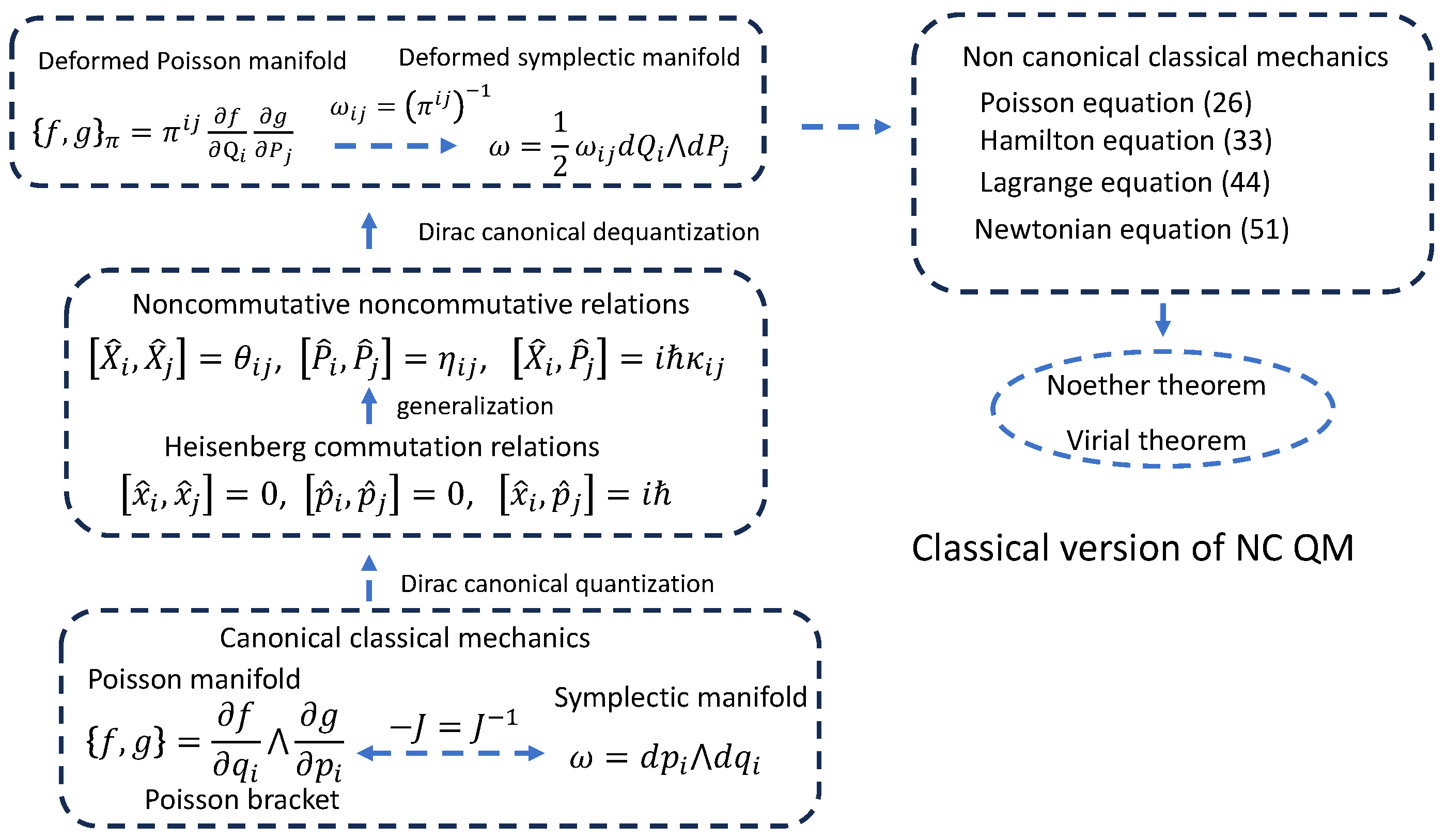
Figure 1. The non-canonical classical mechanics and its relation to noncommutativity and deformed symplectic and Poisson geometries.
Appliedmath 05 00173 g001
Disclaimer/Publisher’s Note: The statements, opinions and data contained in all publications are solely those of the individual author(s) and contributor(s) and not of MDPI and/or the editor(s). MDPI and/or the editor(s) disclaim responsibility for any injury to people or property resulting from any ideas, methods, instructions or products referred to in the content.