
Deep Learning Approaches with Explainable AI for Differentiating Alzheimer’s Disease and Mild Cognitive Impairment

Abstract
1. Introduction
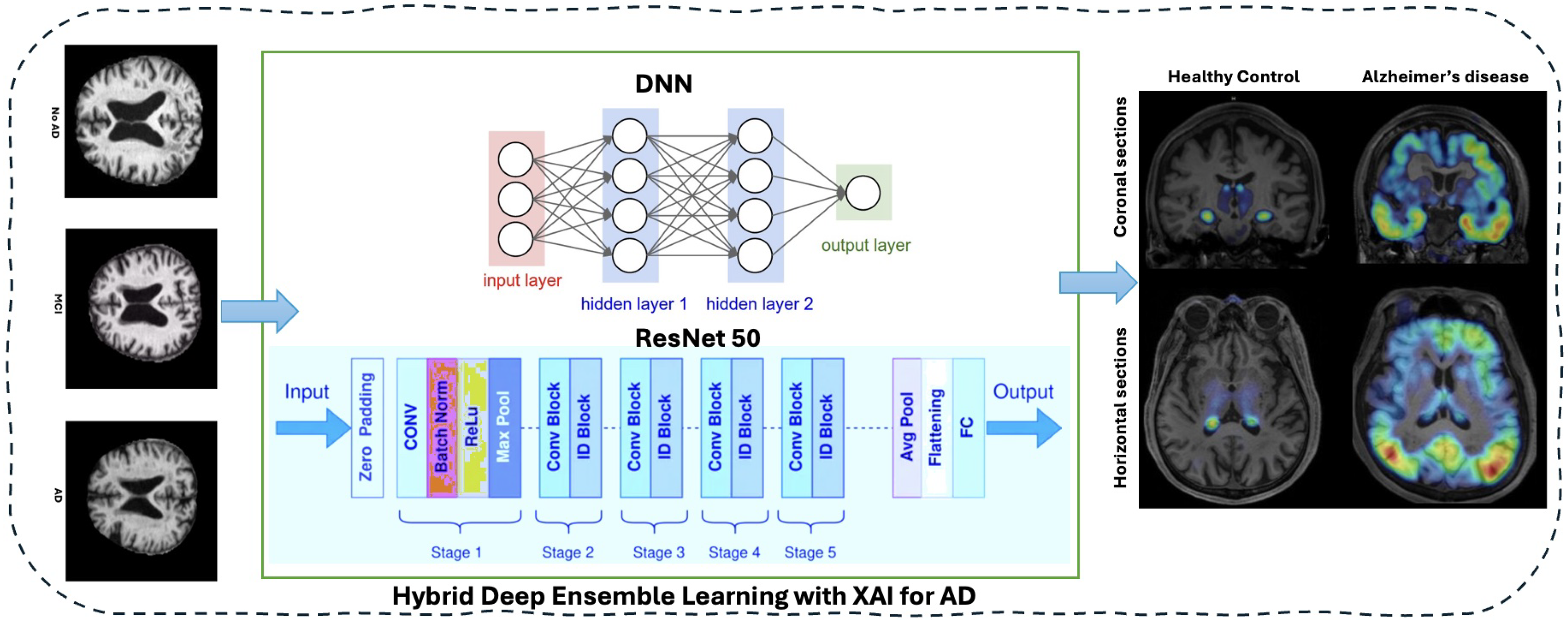
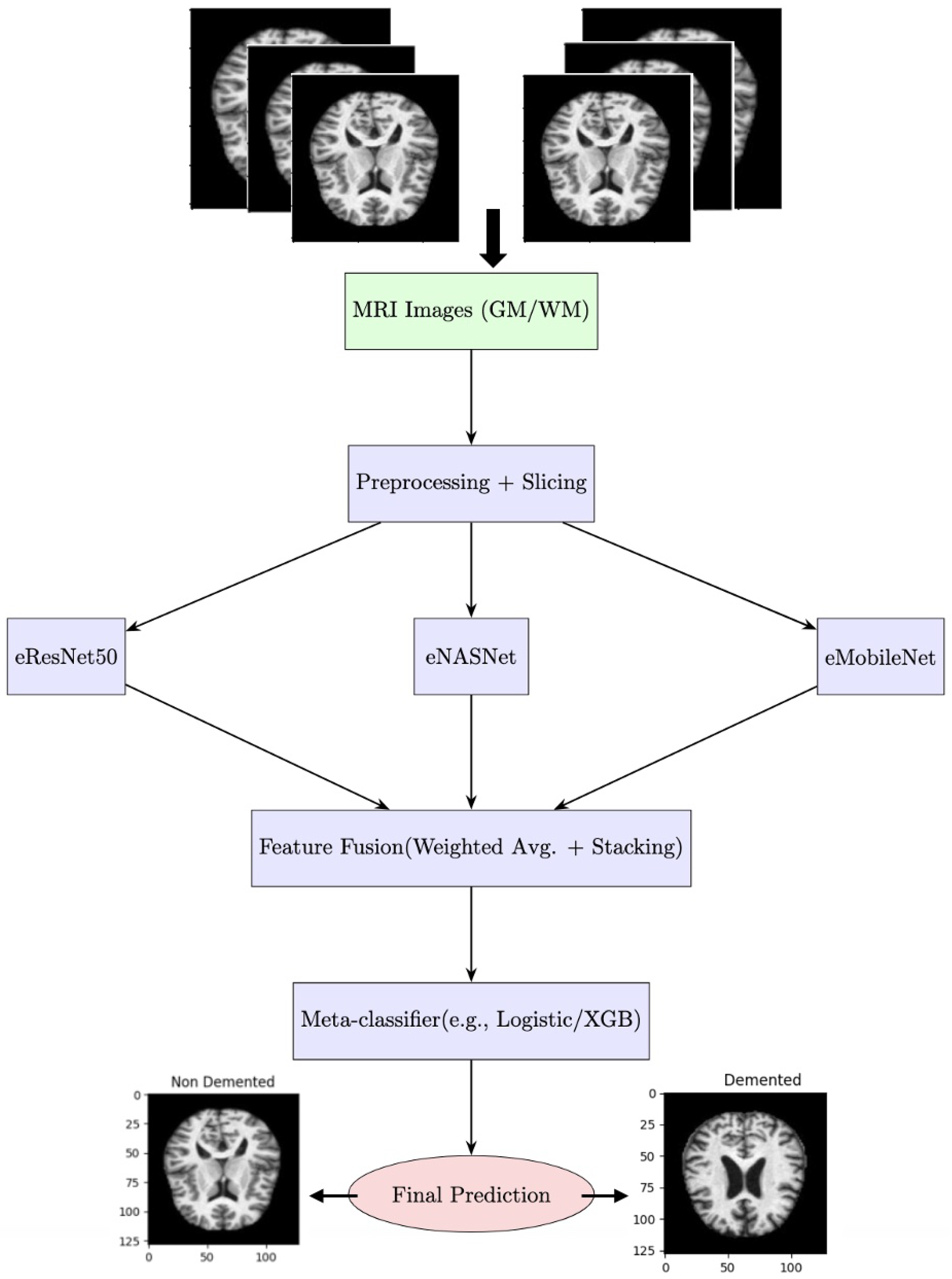
- We propose a novel ensemble diagnostic pipeline for Alzheimer’s disease (AD) classification that integrates transfer learning, weighted averaging, and stacked generalization into a unified framework.
- A meta-learner is employed to fuse predictions from multiple base models, leading to improved accuracy and generalization across diverse patient populations.
- We rigorously evaluate the proposed method on the ADNI dataset, ensuring clinical relevance and comparability with established diagnostic benchmarks.
- Our approach achieves superior performance compared with existing baselines, particularly in distinguishing between early AD and MCI, a challenging diagnostic boundary in clinical practice.
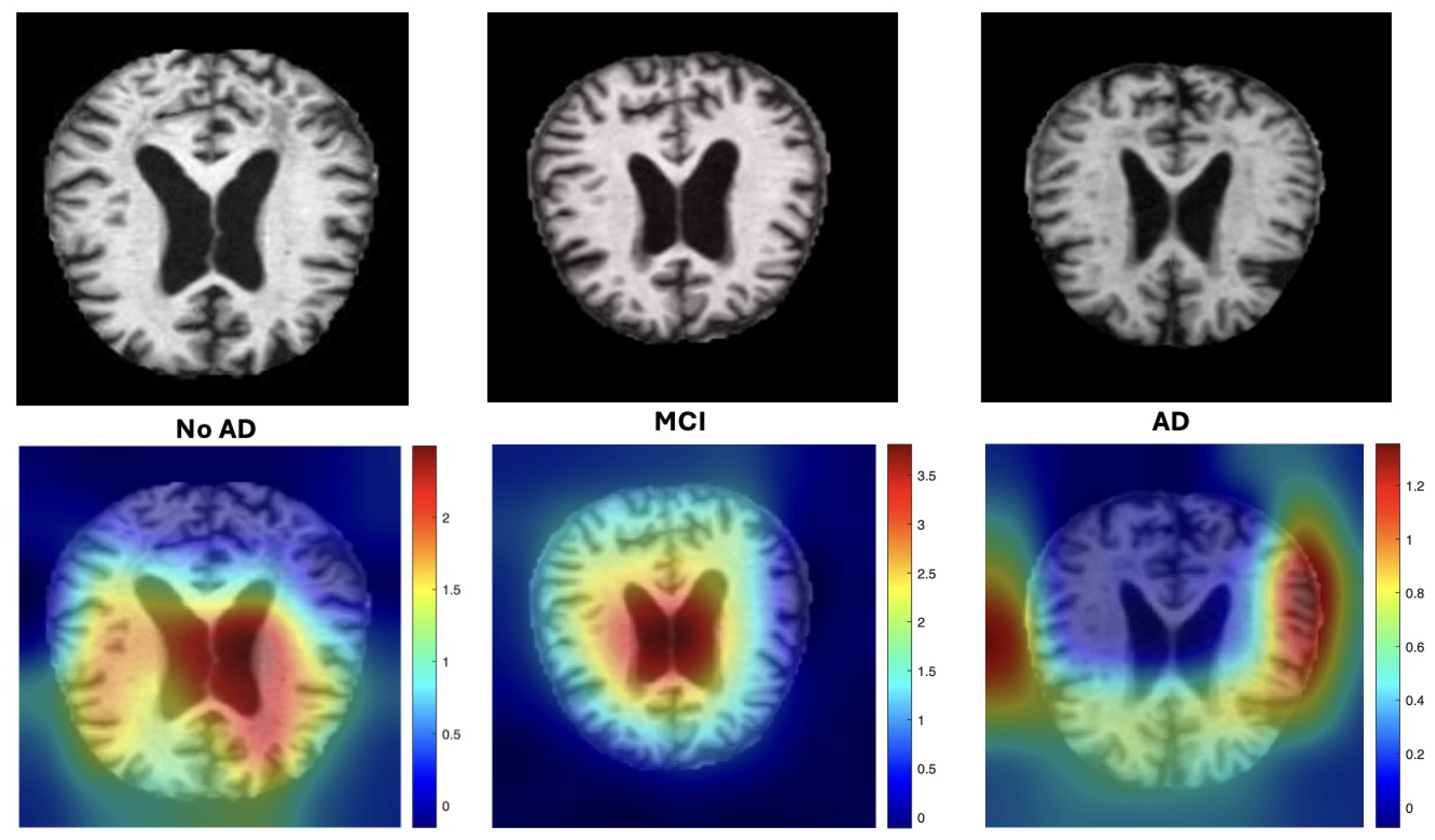
- We incorporate interpretability through Grad-CAM overlays (Figure 1), which demonstrate that the model consistently attends to clinically relevant neuroanatomical regions associated with AD progression.
- By integrating multiple architectures with decision fusion strategies, the proposed pipeline provides a robust and scalable diagnostic tool with strong potential for real-world clinical deployment.
2. Related Works
3. Methods and Materials
3.1. Data Source and Preprocessing
3.2. Deep Learning Framework of Hybrid Ensemble
3.2.1. Base Learners: Transfer and Fine-Tuning
- Feature Freezing: Feature freezing refers to the strategy of keeping the weights of the convolutional base layers fixed and training only the newly added fully connected (dense) layers. This technique is grounded in the idea that early convolutional layers in deep neural networks capture generic low-level features such as edges, textures, and patterns, which are broadly transferable across visual domains—even between natural images and medical images. By freezing these layers, we preserve the robust visual representations learned from large datasets while reducing the computational burden and preventing overfitting—particularly valuable in small datasets like ADNI. In our experiments, after importing pretrained models like ResNet50, NASNet, and MobileNet, we remove the original classification head and replace it with custom dense layers tailored for binary classification (AD vs. MCI). These new layers are randomly initialized and trained on MRI data while keeping the backbone unchanged. The goal during this stage is to quickly adapt the model to the new classification task by optimizing only a small subset of parameters. This approach yields surprisingly strong baseline performance and serves as a low-cost initialization for deeper adaptation.
- Fine-Tuning: While feature freezing captures general features, it does not fully exploit the domain-specific structure inherent in MRI images. Therefore, in the fine-tuning stage, we unfreeze a selected portion of the top layers of the convolutional base and retrain the network end to end using a small learning rate. This strategy allows the network to adapt higher-level features, such as spatial patterns in gray and white matter, which may be uniquely informative for distinguishing between AD and MCI. Fine-tuning is especially beneficial when there is a domain shift between the source dataset (e.g., ImageNet) and the target domain (e.g., neuroimaging). By updating the weights of the later layers, the model learns hierarchical features that are more semantically aligned with the target task. However, this stage must be executed carefully. A learning rate that is too high can disrupt previously learned general features, while too low a rate may not provide meaningful adaptation. We use a small learning rate (e.g., ) with adaptive optimization (Adam) and apply dropout to reduce overfitting. Together, feature freezing and fine-tuning form a powerful two-step training strategy that balances generalization and specificity. This approach enables the reuse of high-quality pretrained models while allowing deep adaptation to the specific characteristics of MRI data for Alzheimer’s diagnosis. Each base model outputs a probability for the input , interpreted as the predicted confidence of the sample belonging to the AD class.
3.2.2. Weighted Averaging Ensemble
3.2.3. Stacked Generalization (Stacking)
3.3. Network Architecture
3.4. Gradient-Weighted Class Activation Mapping
3.5. Implementation
3.6. Gradient-Weighted Class Activation Mapping (Grad-CAM)
| Algorithm 1 Hybrid Deep Ensemble with XAI for AD vs. MCI |
|
4. Results and Discussion

| Models | ACC (%) | SEN (%) | SPE (%) | AUC | PPV (%) | F1 (%) |
|---|---|---|---|---|---|---|
| bResNet50 | 97.65 | 100.00 | 94.29 | 0.95 | 96.33 | 98.14 |
| eResNet50 | 98.80 | 98.00 | 100.00 | 1.00 | 100.00 | 98.99 |
| bNASNet | 97.65 | 98.00 | 94.29 | 0.95 | 96.08 | 97.03 |
| eNASNet | 98.82 | 96.00 | 100.00 | 1.00 | 100.00 | 97.96 |
| bMobileNet | 97.64 | 98.00 | 94.28 | 0.95 | 96.07 | 97.03 |
| eMobileNet | 97.65 | 96.00 | 100.00 | 1.00 | 100.00 | 97.96 |
| bEnsemble | 98.82 | 98.00 | 100.00 | 0.95 | 100.00 | 98.99 |
| eEnsemble | 97.65 | 96.00 | 100.00 | 1.00 | 100.00 | 97.96 |
| Hybrid Ensemble | 99.21 | 98.89 | 100.00 | 1.00 | 100.00 | 99.44 |
| ACC (%) | SEN (%) | SPE (%) | AUC | PPV (%) | F1 (%) | |
|---|---|---|---|---|---|---|
| bResNet50 | 81.39 | 80.56 | 82.00 | 0.91 | 81.25 | 80.90 |
| eResNet50 | 86.05 | 83.33 | 88.00 | 0.95 | 85.41 | 84.36 |
| bNASNet | 81.39 | 55.56 | 100.00 | 0.92 | 100.00 | 71.43 |
| eNASNet | 87.21 | 75.00 | 96.00 | 0.95 | 93.75 | 83.33 |
| bMobileNet | 81.39 | 55.56 | 100.00 | 0.92 | 100.00 | 71.43 |
| eMobileNet | 89.53 | 83.33 | 94.00 | 0.95 | 91.30 | 87.18 |
| bEnsemble | 80.23 | 58.33 | 96.00 | 0.91 | 87.50 | 70.00 |
| eEnsemble | 88.37 | 80.56 | 94.00 | 0.96 | 90.24 | 85.16 |
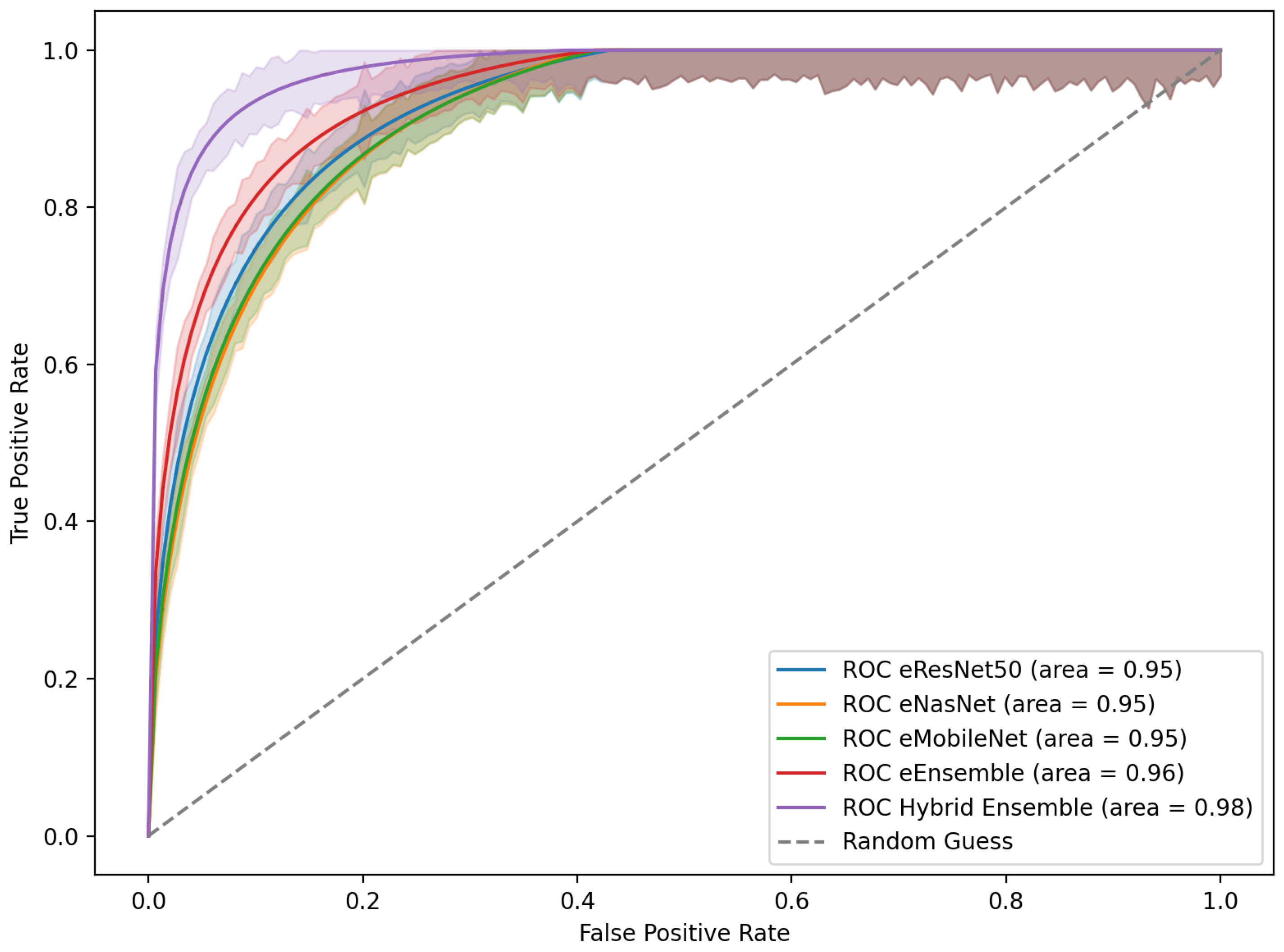
| Hybrid Ensemble | 91.02 | 86.11 | 96.00 | 0.98 | 93.47 | 89.69 |
| Reference | AD vs. NC | AD vs. MCI | MCI vs. NC |
|---|---|---|---|
| Billones et al. [63] | 98.33/98.89/97.78 | 90.00/91.67/97.78 | 91.67/92.22/91.11 |
| Sarraf et al. [62] | 98.84/–/– | –/–/– | –/–/– |
| Ortiz et al. [64] | 90.09/86.12/94.10 | 84.00/79.12/89.12 | 83.14/67.26/95.09 |
| Lian et al. [65] | 90.30/82.40/96.50 | –/–/– | –/–/– |
| Suk et al. [26] | 91.02/92.72/89.94 | –/–/– | 73.02/77.60/68.22 |
| Ji et al. [25] | 98.59/97.22/100.00 | 97.65/96.00/100.00 | 88.37/80.56/94.00 |
| Hybrid Ensemble | 99.10/98.80/100.00 | 99.21/98.89/100.00 | 91.02/86.11/96.00 |
5. Conclusions
Author Contributions
Funding
Informed Consent Statement
Data Availability Statement
Acknowledgments
Conflicts of Interest
Code Availability
Ethics Approval
Clinical Trial Registration
Generative AI Statement
Abbreviations
| Abbreviation | Full Term |
| ML | ML |
| DL | DL |
| XAI | XAI |
| AD | Alzheimer’s Disease |
| MCI | Mild Cognitive Impairment |
| MRI | Magnetic Resonance Imaging |
| ADNI | Alzheimer’s Disease Neuroimaging Initiative |
| NC | Normal Controls |
| Grad-CAM | Gradient-weighted Class Activation |
| MMSE | Mini-Mental State Examination |
| CDR | Clinical Dementia Rating |
| CSF | Cerebrospinal Fluid |
| PET | Positron Emission Tomography |
| MoCA | Montreal Cognitive Assessment |
| LSME | Long Short-Term Memory |
| LIME | Local Interpretable Model-Agnostic Explanations |
| LRP | Layer-wise Relevance Propagation |
| EADCD | Enhancing Automated Detection and Classification of Dementia |
| TIPAIT | Thinking Incapable People Using Artificial Intelligence Techniques |
| BGGO | Binary Greylag Goose Optimization |
| ISSA | Improved Salp Swarm Technique |
| WNN | Wavelet Neural Network |
| ConvNets | Convolutional Neural Networks |
| GM | Gray Matter |
| WM | White Matter |
| ROC | Receiver Operating Characteristic |
| AUC | Area Under the Curve |
References
- Brookmeyer, R.; Johnson, E.; Ziegler-Graham, K.; Arrighi, H.M. Forecasting the global burden of Alzheimer’s disease. Alzheimer’s Dement. 2007, 3, 186–191. [Google Scholar] [CrossRef]
- Prince, M.; Wimo, A.; Guerchet, M.; Ali, G.C.; Wu, Y.T.; Prina, M. World Alzheimer Report 2015. The Global Impact of Dementia: An Analysis of Prevalence, Incidence, Cost and Trends. Ph.D. Thesis, Alzheimer’s Disease International, London, UK, 2015. [Google Scholar]
- Winblad, B.; Amouyel, P.; Andrieu, S.; Ballard, C.; Brayne, C.; Brodaty, H.; Cedazo-Minguez, A.; Dubois, B.; Edvardsson, D.; Feldman, H.; et al. Defeating Alzheimer’s disease and other dementias: A priority for European science and society. Lancet Neurol. 2016, 15, 455–532. [Google Scholar] [CrossRef]
- Knopman, D.S.; Amieva, H.; Petersen, R.C.; Chételat, G.; Holtzman, D.M.; Hyman, B.T.; Nixon, R.A.; Jones, D.T. Alzheimer disease. Nat. Rev. Dis. Prim. 2021, 7, 33. [Google Scholar] [CrossRef]
- Heisterman, A.A.T. Cognitive disorders. Psychiatric Mental Health Nursing: Evidence-Based Concepts, Skills, and Practices; Lippincott Williams & Wilkins: Philadelphia, PA, USA, 2012. [Google Scholar]
- Day, G.S. Diagnosing Alzheimer Disease. Contin. Lifelong Learn. Neurol. 2024, 30, 1584–1613. [Google Scholar] [CrossRef]
- Zhang, W.; Li, Y.; Ren, W.; Liu, B. Artificial intelligence technology in Alzheimer’s disease research. Intractable Rare Dis. Res. 2023, 12, 208–212. [Google Scholar] [CrossRef]
- Frisoni, G.B.; Fox, N.C.; Jack, C.R., Jr.; Scheltens, P.; Thompson, P.M. The clinical use of structural MRI in Alzheimer disease. Nat. Rev. Neurol. 2010, 6, 67–77. [Google Scholar] [CrossRef] [PubMed]
- Jack, C.R., Jr.; Bennett, D.A.; Blennow, K.; Carrillo, M.C.; Dunn, B.; Haeberlein, S.B.; Holtzman, D.M.; Jagust, W.; Jessen, F.; Karlawish, J.; et al. NIA-AA research framework: Toward a biological definition of Alzheimer’s disease. Alzheimer’s Dement. 2018, 14, 535–562. [Google Scholar] [CrossRef] [PubMed]
- Reitz, C.; Brayne, C.; Mayeux, R. Epidemiology of Alzheimer disease. Nat. Rev. Neurol. 2011, 7, 137–152. [Google Scholar] [CrossRef] [PubMed]
- Henderson, A. The epidemiology of Alzheimer’s disease. Br. Med. Bull. 1986, 42, 3–10. [Google Scholar] [CrossRef]
- Zhang, X.X.; Tian, Y.; Wang, Z.T.; Ma, Y.H.; Tan, L.; Yu, J.T. The epidemiology of Alzheimer’s disease modifiable risk factors and prevention. J. Prev. Alzheimer’S Dis. 2021, 8, 313–321. [Google Scholar] [CrossRef]
- Morris, J.C. The Clinical Dementia Rating (CDR) current version and scoring rules. Neurology 1993, 43, 2412. [Google Scholar] [CrossRef]
- Folstein, M.F.; Folstein, S.E.; McHugh, P.R. “Mini-mental state”: A practical method for grading the cognitive state of patients for the clinician. J. Psychiatr. Res. 1975, 12, 189–198. [Google Scholar] [CrossRef]
- Mantzavinos, V.; Alexiou, A. Biomarkers for Alzheimer’s disease diagnosis. Curr. Alzheimer Res. 2017, 14, 1149–1154. [Google Scholar] [CrossRef] [PubMed]
- Cuingnet, R.; Gerardin, E.; Tessieras, J.; Auzias, G.; Lehéricy, S.; Habert, M.O.; Chupin, M.; Benali, H.; Colliot, O.; Initiative, A.D.N.; et al. Automatic classification of patients with Alzheimer’s disease from structural MRI: A comparison of ten methods using the ADNI database. Neuroimage 2011, 56, 766–781. [Google Scholar] [CrossRef]
- Liu, S.; Masurkar, A.V.; Rusinek, H.; Chen, J.; Zhang, B.; Zhu, W.; Fernandez-Granda, C.; Razavian, N. Generalizable deep learning model for early Alzheimer’s disease detection from structural MRIs. Sci. Rep. 2022, 12, 17106. [Google Scholar] [CrossRef] [PubMed]
- Razavian, N.; Blecker, S.; Schmidt, A.M.; Smith-McLallen, A.; Nigam, S.; Sontag, D. Population-level prediction of type 2 diabetes from claims data and analysis of risk factors. Big Data 2015, 3, 277–287. [Google Scholar] [CrossRef] [PubMed]
- Snyder, P.J.; Kahle-Wrobleski, K.; Brannan, S.; Miller, D.S.; Schindler, R.J.; DeSanti, S.; Ryan, J.M.; Morrison, G.; Grundman, M.; Chandler, J.; et al. Assessing cognition and function in Alzheimer’s disease clinical trials: Do we have the right tools? Alzheimer’s Dement. 2014, 10, 853–860. [Google Scholar] [CrossRef]
- Corey-Bloom, J.; Thal, L.; Galasko, D.; Folstein, M.; Drachman, D.; Raskind, M.; Lanska, D. Diagnosis and evaluation of dementia. Neurology 1995, 45, 211–218. [Google Scholar] [CrossRef]
- Larner, A. Screening utility of the Montreal Cognitive Assessment (MoCA): In place of–or as well as–the MMSE? Int. Psychogeriat. 2012, 24, 391–396. [Google Scholar] [CrossRef]
- Small, G.W.; Bookheimer, S.Y.; Thompson, P.M.; Cole, G.M.; Huang, S.; Kepe, V.; Barrio, J.R. Current and future uses of neuroimaging for cognitively impaired patients. Lancet Neurol. 2008, 7, 161–172. [Google Scholar] [CrossRef]
- Wolf, H.; Jelic, V.; Gertz, H.J.; Nordberg, A.; Julin, P.; Wahlund, L.O. A critical discussion of the role of neuroimaging in mild cognitive impairment. Acta Neurol. Scand. 2003, 107, 52–76. [Google Scholar] [CrossRef]
- Tigano, V.; Cascini, G.L.; Sanchez-Castañeda, C.; Péran, P.; Sabatini, U. Neuroimaging and neurolaw: Drawing the future of aging. Front. Endocrinol. 2019, 10, 217. [Google Scholar] [CrossRef]
- Ji, H.; Liu, Z.; Yan, W.Q.; Klette, R. Early diagnosis of Alzheimer’s disease using deep learning. In Proceedings of the 2nd International Conference on Control and Computer Vision, Jeju, Republic of Korea, 15–18 June 2019; pp. 87–91. [Google Scholar]
- Suk, H.I.; Lee, S.W.; Shen, D.; Alzheimer’s Disease Neuroimaging Initiative. Deep ensemble learning of sparse regression models for brain disease diagnosis. Med. Image Anal. 2017, 37, 101–113. [Google Scholar] [CrossRef]
- Shi, J.; Zheng, X.; Li, Y.; Zhang, Q.; Ying, S. Multimodal neuroimaging feature learning with multimodal stacked deep polynomial networks for diagnosis of Alzheimer’s disease. IEEE J. Biomed. Health Inform. 2017, 22, 173–183. [Google Scholar] [CrossRef]
- Litjens, G.; Kooi, T.; Bejnordi, B.E.; Setio, A.A.A.; Ciompi, F.; Ghafoorian, M.; Van Der Laak, J.A.; Van Ginneken, B.; Sánchez, C.I. A survey on deep learning in medical image analysis. Med. Image Anal. 2017, 42, 60–88. [Google Scholar] [CrossRef] [PubMed]
- Thibeau-Sutre, E.; Collin, S.; Burgos, N.; Colliot, O. Interpretability of machine learning methods applied to neuroimaging. Mach. Learn. Brain Disord. 2023, 27, 655–704. [Google Scholar]
- Alsubaie, M.G.; Luo, S.; Shaukat, K. Alzheimer’s disease detection using deep learning on neuroimaging: A systematic review. Mach. Learn. Knowl. Extr. 2024, 6, 464–505. [Google Scholar] [CrossRef]
- Bossa, M.N.; Sahli, H. A multidimensional ODE-based model of Alzheimer’s disease progression. Sci. Rep. 2023, 13, 3162. [Google Scholar] [CrossRef]
- Cheung, C.Y.; Ran, A.R.; Wang, S.; Chan, V.T.; Sham, K.; Hilal, S.; Venketasubramanian, N.; Cheng, C.Y.; Sabanayagam, C.; Tham, Y.C.; et al. A deep learning model for detection of Alzheimer’s disease based on retinal photographs: A retrospective, multicentre case-control study. Lancet Digit. Health 2022, 4, e806–e815. [Google Scholar] [CrossRef]
- Mmadumbu, A.C.; Saeed, F.; Ghaleb, F.; Qasem, S.N. Early detection of Alzheimer’s disease using deep learning methods. Alzheimer’s Dement. 2025, 21, e70175. [Google Scholar] [CrossRef] [PubMed]
- Koonce, B. ResNet 50. In Convolutional Neural Networks with Swift for Tensorflow: Image Recognition and Dataset Categorization; Springer: Berlin/Heidelberg, Germany, 2021; pp. 63–72. [Google Scholar]
- Abbas, Q.; Gul, A. Detection and classification of malignant melanoma using deep features of NASNet. SN Comput. Sci. 2022, 4, 21. [Google Scholar] [CrossRef]
- Nan, Y.; Ju, J.; Hua, Q.; Zhang, H.; Wang, B. A-MobileNet: An approach of facial expression recognition. Alex. Eng. J. 2022, 61, 4435–4444. [Google Scholar] [CrossRef]
- Lei, B.; Chen, S.; Ni, D.; Wang, T. Discriminative learning for Alzheimer’s disease diagnosis via canonical correlation analysis and multimodal fusion. Front. Aging Neurosci. 2016, 8, 77. [Google Scholar] [CrossRef]
- Cheung, C.Y.; Mok, V.; Foster, P.J.; Trucco, E.; Chen, C.; Wong, T.Y. Retinal imaging in Alzheimer’s disease. J. Neurol. Neurosurg. Psychiat. 2021, 92, 983–994. [Google Scholar] [CrossRef]
- Keane, P.A.; Sadda, S.R. Retinal imaging in the twenty-first century: State of the art and future directions. Ophthalmology 2014, 121, 2489–2500. [Google Scholar] [CrossRef]
- Junior, K.J.; Carole, K.S.; Theodore Armand, T.P.; Kim, H.C.; Initiative, A.D.N. Alzheimer’s Multiclassification Using Explainable AI Techniques. Appl. Sci. 2024, 14, 8287. [Google Scholar] [CrossRef]
- Anzum, H.; Sammo, N.S.; Akhter, S. Leveraging transformers and explainable AI for Alzheimer’s disease interpretability. PLoS ONE 2025, 20, e0322607. [Google Scholar] [CrossRef]
- Viswan, V.; Shaffi, N.; Mahmud, M.; Subramanian, K.; Hajamohideen, F. Explainable artificial intelligence in Alzheimer’s disease classification: A systematic review. Cogn. Comput. 2024, 16, 1–44. [Google Scholar] [CrossRef]
- Alotaibi, S.D.; Alharbi, A.A. Enhancing automated detection and classification of dementia in individuals with cognitive impairment using artificial intelligence techniques. Sci. Rep. 2025, 15, 24659. [Google Scholar] [CrossRef] [PubMed]
- Vlontzou, M.E.; Athanasiou, M.; Dalakleidi, K.V.; Skampardoni, I.; Davatzikos, C.; Nikita, K. A comprehensive interpretable machine learning framework for mild cognitive impairment and Alzheimer’s disease diagnosis. Sci. Rep. 2025, 15, 8410. [Google Scholar] [CrossRef] [PubMed]
- Fathi, S.; Ahmadi, A.; Dehnad, A.; Almasi-Dooghaee, M.; Sadegh, M.; Initiative, A.D.N. A deep learning-based ensemble method for early diagnosis of Alzheimer’s disease using MRI images. Neuroinformatics 2024, 22, 89–105. [Google Scholar] [CrossRef]
- Cao, K.; Xia, Y.; Yao, J.; Han, X.; Lambert, L.; Zhang, T.; Tang, W.; Jin, G.; Jiang, H.; Fang, X.; et al. Large-scale pancreatic cancer detection via non-contrast CT and deep learning. Nat. Med. 2023, 29, 3033–3043. [Google Scholar] [CrossRef]
- Qiu, D.; Ju, J.; Ren, S.; Zhang, T.; Tu, H.; Xie, F. A deep-learning based cascade algorithm for pancreatic tumor segmentation. Front. Oncol. 2024, 14, 1328146. [Google Scholar] [CrossRef]
- Ozawa, M.; Sone, M.; Hijioka, S.; Hara, H.; Wakatsuki, Y.; Ishihara, T.; Hattori, S.; Hirano, R.; Ambo, S.; Esaki, M.; et al. Deep learning-based automatic detection of pancreatic ductal adenocarcinoma ≤2 cm with high-resolution computed tomography. Jpn. J. Radiol. 2025, 11, 1870–1877. [Google Scholar] [CrossRef]
- Alaca, Y. Machine learning via DARTS-Optimized MobileViT models for pancreatic cancer diagnosis with graph-based deep learning. BMC Med. Inform. Decis. Mak. 2025, 25, 81. [Google Scholar] [CrossRef]
- Alaca, Y.; Akmeşe, Ö.F. Pancreatic Tumor Detection From CT Images Converted to Graphs Using Whale Optimization and Classification Algorithms With Transfer Learning. Int. J. Imaging Syst. Technol. 2025, 35, e70040. [Google Scholar] [CrossRef]
- Lundervold, A.S.; Lundervold, A. An overview of deep learning in medical imaging focusing on MRI. Z. Fuer Med. Phys. 2019, 29, 102–127. [Google Scholar] [CrossRef] [PubMed]
- Hossain, M.I.; Zamzmi, G.; Mouton, P.R.; Salekin, M.S.; Sun, Y.; Goldgof, D. Explainable AI for medical data: Current methods, limitations, and future directions. ACM Comput. Surv. 2025, 57, 1–46. [Google Scholar] [CrossRef]
- Rauniyar, A.; Hagos, D.H.; Jha, D.; Håkegård, J.E.; Bagci, U.; Rawat, D.B.; Vlassov, V. Federated learning for medical applications: A taxonomy, current trends, challenges, and future research directions. IEEE Internet Things J. 2023, 11, 7374–7398. [Google Scholar] [CrossRef]
- ADNI Data & Samples. Available online: https://adni.loni.usc.edu/data-samples/adni-data/ (accessed on 7 September 2025).
- Uraninjo. Augmented Alzheimer MRI Dataset. Available online: https://www.kaggle.com/datasets/uraninjo/augmented-alzheimer-mri-dataset/data (accessed on 14 November 2025).
- Krizhevsky, A.; Sutskever, I.; Hinton, G.E. Imagenet classification with deep convolutional neural networks. Adv. Neural Inf. Process. Syst. 2012, 25, 84–90. [Google Scholar] [CrossRef]
- Pampel, F.C. Logistic Regression: A Primer; Number 132; Sage publications: London, UK, 2020. [Google Scholar]
- Agliari, E.; Alemanno, F.; Barra, A.; De Marzo, G. The emergence of a concept in shallow neural networks. Neural Netw. 2022, 148, 232–253. [Google Scholar] [CrossRef] [PubMed]
- Friedman, J.H. Greedy function approximation: A gradient boosting machine. Ann. Stat. 2001, 29, 1189–1232. [Google Scholar] [CrossRef]
- Quach, L.D.; Quoc, K.N.; Quynh, A.N.; Thai-Nghe, N.; Nguyen, T.G. Explainable deep learning models with gradient-weighted class activation mapping for smart agriculture. IEEE Access 2023, 11, 83752–83762. [Google Scholar] [CrossRef]
- Selvaraju, R.R.; Cogswell, M.; Das, A.; Vedantam, R.; Parikh, D.; Batra, D. Grad-cam: Visual explanations from deep networks via gradient-based localization. In Proceedings of the IEEE International Conference on Computer Vision, Venice, Italy, 22–29 October 2017; pp. 618–626. [Google Scholar]
- Sarraf, S.; Tofighi, G. Deep learning-based pipeline to recognize Alzheimer’s disease using fMRI data. In Proceedings of the 2016 Future Technologies Conference (FTC), San Francisco, CA, USA, 6–7 December 2016; IEEE: New York, NY, USA, 2016; pp. 816–820. [Google Scholar]
- Billones, C.D.; Demetria, O.J.L.D.; Hostallero, D.E.D.; Naval, P.C. DemNet: A convolutional neural network for the detection of Alzheimer’s disease and mild cognitive impairment. In Proceedings of the 2016 IEEE Region 10 Conference (TENCON), Singapore, 4–5 March 2016; IEEE: New York, NY, USA, 2016; pp. 3724–3727. [Google Scholar]
- Ortiz, A.; Munilla, J.; Gorriz, J.M.; Ramirez, J. Ensembles of deep learning architectures for the early diagnosis of the Alzheimer’s disease. Int. J. Neural Syst. 2016, 26, 1650025. [Google Scholar] [CrossRef] [PubMed]
- Lian, C.; Liu, M.; Zhang, J.; Shen, D. Hierarchical fully convolutional network for joint atrophy localization and Alzheimer’s disease diagnosis using structural MRI. IEEE Trans. Pattern Anal. Mach. Intell. 2018, 42, 880–893. [Google Scholar] [CrossRef] [PubMed]


Disclaimer/Publisher’s Note: The statements, opinions and data contained in all publications are solely those of the individual author(s) and contributor(s) and not of MDPI and/or the editor(s). MDPI and/or the editor(s) disclaim responsibility for any injury to people or property resulting from any ideas, methods, instructions or products referred to in the content. |
© 2025 by the authors. Licensee MDPI, Basel, Switzerland. This article is an open access article distributed under the terms and conditions of the Creative Commons Attribution (CC BY) license (https://creativecommons.org/licenses/by/4.0/).
Share and Cite
Mostafa, F.; Hossain, K.; Das, D.; Khan, H. Deep Learning Approaches with Explainable AI for Differentiating Alzheimer’s Disease and Mild Cognitive Impairment. AppliedMath 2025, 5, 171. https://doi.org/10.3390/appliedmath5040171
Mostafa F, Hossain K, Das D, Khan H. Deep Learning Approaches with Explainable AI for Differentiating Alzheimer’s Disease and Mild Cognitive Impairment. AppliedMath. 2025; 5(4):171. https://doi.org/10.3390/appliedmath5040171
Chicago/Turabian StyleMostafa, Fahad, Kannon Hossain, Dip Das, and Hafiz Khan. 2025. "Deep Learning Approaches with Explainable AI for Differentiating Alzheimer’s Disease and Mild Cognitive Impairment" AppliedMath 5, no. 4: 171. https://doi.org/10.3390/appliedmath5040171
APA StyleMostafa, F., Hossain, K., Das, D., & Khan, H. (2025). Deep Learning Approaches with Explainable AI for Differentiating Alzheimer’s Disease and Mild Cognitive Impairment. AppliedMath, 5(4), 171. https://doi.org/10.3390/appliedmath5040171