Article

Extensions of Weighted Integral Inequalities for GA-Convex Functions in Connection with Fejér’s Result


by
Muhammad Amer Latif
Department of Mathematics, New York City College of Technology, 300 Jay St, Brooklyn, NY 11201, USA
AppliedMath 2025, 5(4), 168; https://doi.org/10.3390/appliedmath5040168 (registering DOI)

Submission received: 30 August 2025 / Revised: 18 October 2025 / Accepted: 27 October 2025 / Published: 3 December 2025

Abstract

This study introduces and analyzes several new functionals defined on the interval [ 0 , 1 ] , which are associated with weighted integral inequalities for geometrically–arithmetically ( G A ) convex functions. Building upon the classical Hermite–Hadamard and Fejér inequalities, we define mappings such as G ( u ) , H y u , K y u , N u , L ( u ) , L y ( u ) , and S y u , which incorporate a G A -convex function x and a non-negative, integrable weight function y that is symmetric about the geometric mean s 1 s 2 . Under these conditions, we establish novel Fejér-type inequalities that connect these functionals. Furthermore, we investigate essential properties of these mappings, including their G A -convexity, monotonicity, and symmetry. The validity of our main results is demonstrated through detailed examples. The findings presented herein provide significant refinements and weighted generalizations of known results in the literature.

1. Introduction and Motivation

The theory of inequalities for convex functions provides a powerful foundation for numerous results in mathematical analysis, optimization, and applied sciences. Among these, the Hermite–Hadamard inequality [1,2] stands out for its elegant geometric interpretation and widespread applications. It states that for a convex function x : [ s 1 , s 2 ] R , the following double inequality holds:
x s 1 + s 2 2 1 s 2 s 1 s 1 s 2 x ( τ ) d τ x ( s 1 ) + x ( s 2 ) 2 .
Inequalities (1) hold in the reversed direction if x is a concave function. Interested readers are referred to [3,4,5,6,7,8,9,10,11,12,13,14,15,16,17,18,19,20,21,22,23,24,25,26,27,28,29,30,31,32,33,34,35,36,37,38,39] for some generalizations, improvements, and variants of the well-known Hermite–Hadamard integral inequalities (1). A significant weighted generalization of (1) was provided by Fejér [40], who introduced a symmetric weight function y ( τ ) to obtain
x s 1 + s 2 2 s 1 s 2 y ( τ ) d τ s 1 s 2 x ( τ ) y ( τ ) d τ x ( s 1 ) + x ( s 2 ) 2 s 1 s 2 y ( τ ) d τ .
Inequalities (2) have many extensions and generalizations as well; see [5,16,19,20,21,22,25,27,28,29,30,31]. In many practical contexts, particularly in economics, information theory, and geometric modeling, phenomena are more naturally described by multiplicative or geometric means rather than arithmetic ones. This motivated the study of G A -convex functions (geometrically–arithmetically convex functions) [6,23], where a function x : I 0 , R is G A -convex if
x τ u λ 1 u u x τ + 1 u x λ
for all τ , λ I and u 0 , 1 . If the function x : I R is G A -concave, the inequality in (3) is reversed. The corresponding Hermite–Hadamard and Fejr-type inequalities for G A -convex functions involve integrals with the kernel d τ τ , reflecting their geometric nature [19,24]. While the literature contains many mappings (e.g., H, F, L [6,9,31]) designed to refine the classical inequalities, their analogues in the geometric setting remain less explored. This paper systematically bridges this gap by introducing a unified family of seven new functionals defined on [ 0 , 1 ] for GA-convex functions. These functionals are the natural geometric analogues of classical mappings, where arithmetic means are replaced with geometric means and the differential d τ is replaced with d τ τ .
Table 1 provides clear correspondence between key classical functionals and their new GA-convex counterparts introduced in this work.
The main contributions of this work are as follows:
  • To introduce a unified family of functionals ( G , H y , K y , N , L , L y , S y ) that serve as natural geometric counterparts to the well-known mappings for classical convex functions.
  • To establish a comprehensive set of Fejér-type inequalities that interrelate these functionals, providing refined bounds and revealing their properties, such as G A -convexity, monotonicity, and symmetry.
  • To demonstrate that our framework provides a powerful and unifying perspective, from which many known results (e.g., from [18,20,22]) can be derived as special cases when the weight function is 1 s 2 s 1 , with s 2 > s 1 .
This unified approach not only consolidates existing theory but also opens doors to new applications in areas where geometric means and weighted integrals are intrinsic, such as in the study of entropy, growth models, and geometric probability. The subsequent sections are structured as follows: Section 2 revisits essential preliminaries. Section 3 presents our main results. Section 4 provides simplified, illustrative examples to validate our findings, and Section 5 concludes by discussing potential applications and future research directions.

2. Preliminaries and Literature Review

The study of Hermite–Hadamard and Fejér inequalities has led to the development of numerous auxiliary functionals designed to refine these bounds. For classical convex functions, Dragomir, Tseng, and others [6,9,28,31] have extensively studied mappings such as G, F, H, H y , L, and L y , which interpolate between the values of the function at the midpoint, endpoints, and its integral mean over an interval of real numbers.
The primary objective of this paper is to systematically construct the geometric analogues of these classical functionals. In the following section, we will introduce a new family of mappings G , H y , K y , and S y defined for G A -convex functions over the interval 0 , 1 , where arithmetic means are replaced with geometric means and the differential d τ is replaced with d τ τ .
We state some key facts about G A -convex and convex functions and utilize them to demonstrate the essential points.
Theorem 1 
([6]). If [ s 1 , s 2 ] ( 0 , ) and the function G : [ ln s 1 , ln s 2 ] R is convex (concave) on [ ln s 1 , ln s 2 ] , then the function x : [ s 1 , s 2 ] R , x ( u ) = G ( ln u ) is G A -convex (concave) on [ s 1 , s 2 ] .
Remark 1 
([6]). It is obvious from Theorem 1 that if x : [ s 1 , s 2 ] R is G A -convex on [ s 1 , s 2 ] ( 0 , ) , then x exp is convex on [ ln s 1 , ln s 2 ] . It follows that x exp has finite lateral derivatives on ln s 1 , ln s 2 , and by the gradient inequality for convex functions, we have
x exp ( τ ) x exp ( λ ) ( τ λ ) φ ( exp λ ) exp ( λ ) ,
where φ ( exp λ ) x exp λ , x + exp λ for any τ , λ ln s 1 , ln s 2 .
The following inequality of the Hermite–Hadamard type for G A -convex functions holds (see [24] for an extension for G A - and h-convex functions):
Theorem 2 
([24]). Let x : I 0 , R be a G A -convex function and s 1 , s 2 I with s 1 < s 2 . If x L s 1 , s 2 , then the following inequalities hold:
x s 1 s 2 1 ln s 2 ln s 1 s 2 s 1 x τ τ d τ x s 1 + x s 2 2 .
The notion of geometrically symmetric functions was introduced in [19].
Definition 1 
([19]). A function y : s 1 , s 2 0 , R is geometrically symmetric with respect to 0 , if
y τ = y s 1 s 2 τ
holds for all τ s 1 , s 2 .
Fejér-type inequalities using G A -convex functions using geometric symmetric functions were presented by Latif et al. [19].
Theorem 3 
([19]). Let x : I 0 , R be a G A -convex function and s 1 , s 2 I with s 1 < s 2 . If x L s 1 , s 2 and y : s 1 , s 2 0 , R is non-negative, integrable, and geometrically symmetric with respect to s 1 s 2 , then
x s 1 s 2 s 2 s 1 y τ τ d τ s 2 s 1 x τ y τ τ d τ x s 1 + x s 2 2 s 2 s 1 y τ τ d τ .
Significant work has already been conducted to establish a foundation for inequalities involving G A -convex functions. For instance, functionals H , F , P , and I y were studied in [18,19,20]. Key established results that are pertinent to our work include the following: the G A -convexity and monotonicity of H , F , and P [18] (Theorems 4 and 5). The Fejér-type inequality is
x s 1 s 2 s 1 s 2 y τ τ d τ I y 0 I y u I y 1 = 1 2 s 1 s 2 x s 1 τ + x τ s 2 y τ τ d τ .
for the functional I y [20] (Theorem 7).
While these results provide an important starting point, the literature lacks a unified framework that interconnects a broader family of functionals. Our work addresses this gap by introducing a new suite of mappings and deriving a complete hierarchy of inequalities among them, as detailed in Section 3.
The main objectives of this study are to consider some mappings on 0 , 1 using a G A -convex function x : s 1 , s 2 I 0 , R and a non-negative integrable symmetric function y : s 1 , s 2 R about τ = s 1 s 2 related to inequalities (4) and (5) and to prove variants of inequalities that have been proven in [31]. We also discuss some properties of the mappings corresponding to the newly defined mappings over the interval 0 , 1 in the next section and establish a variant of Lemma [41] (the lemma on page 65) for G A -convex functions.

3. Main Results

Let x : s 1 , s 2 0 , R be a G A -convex mapping and consider the following mappings defined on 0 , 1 to R by
G ( u ) = 1 2 x s 1 s 1 s 2 1 u + x s 2 s 1 s 2 1 u ,
H y u = s 1 s 2 x τ u s 1 s 2 1 u y τ τ d τ ,
I y u = 1 2 s 1 s 2 x s 1 τ u s 1 s 2 1 u + x τ s 2 u s 1 s 2 1 u y τ τ d τ ,
K y u = 1 4 s 1 s 2 s 1 s 2 x s 1 τ u s 1 λ 1 u + x s 1 τ u λ s 2 1 u + x τ s 2 u s 1 λ 1 u + x τ s 2 u λ s 2 1 u y τ y λ τ λ d τ d λ ,
N u = 1 2 s 1 s 2 x s 1 s 1 λ 1 u + x s 2 λ s 2 1 u y τ τ d τ ,
L ( u ) = 1 2 ln s 2 ln s 1 s 1 s 2 x s 1 τ 1 u + x s 2 τ 1 u d τ τ ,
L y ( u ) = 1 2 s 1 s 2 x s 1 τ 1 u + x s 2 τ 1 u y τ τ d τ
and
S y u = 1 2 s 1 s 2 [ x s 1 u s 1 τ 1 u + x s 1 u τ s 2 1 u + x s 2 u s 1 τ 1 u + x s 2 u τ s 2 1 u ] y τ τ d τ .
The functionals defined above are constructed to probe the behavior of the G A -convex function x on the interval s 1 , s 2 in different ways. The mapping H y interpolates between the value at the geometric mean and the weighted integral mean of x. The mapping K y is a double integral functional that possesses inherent symmetry about u = 1 2 . Mappings L y and S y provide a link between the values of the function at the endpoints and its overall weighted average. The main theorems of this section establish precise inequalities among these functionals, effectively creating a hierarchy of bounds that refine the fundamental Fejér-type inequality (5).
Remark 2. 
It should be noted that H = H y = I y , F = K y , and L = L y = S y on [ 0 , 1 ] for y τ = 1 ln s 2 ln s 1 , τ s 1 , s 2 .
The following results for the functionals H , F , I y , N , L y , and S y are known from the literature [18,19,20]. They establish foundational properties such as G A -convexity, monotonicity, and Fejér-type inequalities (e.g., Theorems 4–8). These results provide the essential groundwork and motivation for the new theorems we present below, which explore the interconnections and properties of the full suite of functionals, particularly focusing on the new double-integral functional K y .
The author of [18] obtained the following refinement inequalities for (4) related to the mapping H .
Theorem 4 
([18]). Let x : s 1 , s 2 0 , R be a G A -convex function on s 1 , s 2 . Then,
(i) 
H is G A -convex 0 , 1 and increases monotonically on 0 , 1 .
(ii) 
The following hold:
x s 1 s 2 = H 0 H u H 1 = 1 ln s 2 ln s 1 s 1 s 2 x τ τ d τ .
Theorem 5 
([18]). Let x : s 1 , s 2 0 , R be a G A -convex function on s 1 , s 2 . Then,
(i) 
The following identities hold:
F u + 1 2 = F 1 2 u for all u 0 , 1 2 .
(ii) 
F is G A -convex on 0 , 1 .
(iii) 
The following identities hold:
inf u 0 , 1 F u = F 1 2 = 1 ln s 2 ln s 1 2 s 1 s 2 s 1 s 2 x τ λ τ λ d τ d λ
and
sup u 0 , 1 F u = F 0 = F 1 = 1 ln s 2 ln s 1 s 1 s 2 x τ τ d τ .
(iv) 
The following inequality is valid:
x s 1 s 2 F 1 2 .
(v) 
F increases monotonically on 1 2 , 1 and decreases monotonically on 0 , 1 2 .
(vi) 
H u F u for all u 0 , 1 .
Here, we point out the following lemma, which is very important to proving the results in the current study.
Lemma 1 
([20]). Let x : s 1 , s 2 0 , R be a G A -convex function and let s 1 λ 1 τ 1 τ 2 λ 2 s 2 with τ 1 τ 2 = λ 1 λ 2 . Then,
x τ 1 + x τ 2 x λ 1 + x λ 2 .
The author defined some new mappings related to (5) and discussed important properties of those mappings in a recent study [20,21,22].
The author proved Fejér-type inequalities in [18] that extend the inequalities given in Theorem 4 and Theorem 5 for the mappings related to (5), which in turn provide refinements of the inequalities (5). The author used Lemma 1 to obtain those refinements for (5). One of the results from [18] is mentioned below to be used in the remainder of this paper.
Theorem 6 
([18]). Let x, I y , N , and y be as defined above; then,
x s 1 s 2 s 1 s 2 y τ τ d τ I y 0 I y u I y 1 = 1 2 s 1 s 2 x s 1 τ + x τ s 2 y τ τ d τ = N 0 N u N 1 = x s 1 + x s 2 2 s 1 s 2 y τ τ d τ .
Some further Fejér-type inequalities were also obtained in [22] by the author that relate mappings G , I y , S y , and L y .
Theorem 7 
([22]). Let x, y, G , S y , and L y be defined as above. Then, we have the following results:
(i) 
L y is G A -convex on 0 , 1 .
(ii) 
The following inequalities hold for all u 0 , 1 :
H y u G u s 1 s 2 y τ τ d τ L y u 1 u s 1 s 2 x τ y τ τ d τ + u · x s 1 + x s 2 2 s 1 s 2 y τ τ d τ x s 1 + x s 2 2 s 1 s 2 y τ τ d τ ,
S y 1 u L y u
and
S y u + S y 1 u 2 L y u .
(iii) 
The following bound is true:
sup u 0 , 1 L y u = x s 1 + x s 2 2 s 1 s 2 y τ τ d τ .
Theorem 8 
([22]). Let x, y, G , I y , and S y be defined as above. Then,
(i) 
S y is G A -convex on 0 , 1 .
(ii) 
The following inequalities hold for all u 0 , 1 :
I y u G u s 1 s 2 y τ τ d τ S y u 1 u · 1 2 s 1 s 2 x s 1 τ + x τ s 2 y τ τ d τ + u · x s 1 + x s 2 2 s 1 s 2 y τ τ d τ x s 1 + x s 2 2 s 1 s 2 y τ τ d τ ,
I y 1 u S y u
and
I y u + I y 1 u 2 S y u .
(iii) 
The following identity holds:
sup u 0 , 1 S y u = x s 1 + x s 2 2 s 1 s 2 y τ τ d τ .
The following theorem establishes that the symmetric functional K y is itself G A -convex and attains its minimum at the symmetric point u = 1 2 , while providing a crucial lower bound for the product I y s 1 s 2 y τ τ d τ .
Theorem 9. 
Let x, y, I y , and K y be defined as above. Then,
(i) 
K y is G A -convex on 0 , 1 and symmetric about 1 2 .
(ii) 
K y is decreasing on 0 , 1 2 and increasing on 1 2 , 1 .
sup u 0 , 1 K y u = K y 0 = K y 1 = 1 2 s 1 s 2 x s 1 τ + x τ s 2 y τ τ d τ s 1 s 2 y τ τ d τ
and
inf u 0 , 1 K y u = K y 1 2 = s 1 s 2 s 1 s 2 x s 1 τ 1 4 λ 1 4 + 2 x s 1 s 2 τ 1 4 λ 1 4 + x s 2 τ 1 4 λ 1 4 y τ y λ τ λ d τ d λ
(iii) 
Inequalities
I y u s 1 s 2 y τ τ d τ K y u
and
x s 1 s 2 s 1 s 2 y τ τ d τ 2 K y 1 2 .
Proof. 
(i) It is easily observed from the G A -convexity of x that K y is G A -convex on 0 , 1 .
By changing the variable, we have that
K y u = K y 1 u , for all u 0 , 1 .
This proves that the mapping K y is symmetric about 1 2 .
(ii) Let u 1 < u 2 in 0 , 1 2 . Using the symmetry of K y , we have
K y u 1 = 1 2 K y u 1 + K y 1 u 1
and
K y u 2 = 1 2 K y u 2 + K y 1 u 2 .
Applying Lemma 1, we can prove that
1 2 K y u 2 + K y 1 u 2 1 2 K y u 1 + K y 1 u 1 .
This proves that K y decreases 0 , 1 2 . Since K y is symmetric about 1 2 and K y is decreasing on 0 , 1 2 , we obtain that K y is increasing on 1 2 , 1 . Using the symmetry and monotonicity of K y , we derive (17) and (18).
(iii) Using substitution rules for integration and the hypothesis of y, we have the following identity:
K y u = 1 4 s 1 s 2 s 1 s 2 x τ s 1 u λ s 1 1 u + x τ s 1 u s 2 s 1 λ 1 u + x τ s 2 u λ s 1 1 u + x τ s 2 u s 2 s 1 λ 1 u y τ y λ τ λ d λ d τ ,
for all u 0 , 1 .
By Lemma 1, the following inequalities hold for all u 0 , 1 , τ s 1 , s 2 , and λ s 1 , s 2 .
The inequality
1 2 x τ s 1 u s 1 s 2 1 u 1 4 x τ s 1 u λ s 1 1 u + x τ s 1 u s 2 s 1 λ 1 u
holds with the following choices:
τ 1 = τ 2 = τ s 1 u s 1 s 2 1 u , λ 1 = τ s 1 u λ s 1 1 u and λ 2 = τ s 1 u s 2 s 1 λ 1 u .
The inequality
1 2 x τ s 2 u s 1 s 2 1 u 1 4 x τ s 2 u λ s 1 1 u + x τ s 2 u s 2 s 1 λ 1 u
holds with the following choices:
τ 1 = τ 2 = τ s 2 u s 1 s 2 1 u , λ 1 = τ s 2 u λ s 1 1 u and λ 2 = τ s 2 u s 2 s 1 λ 1 u .
Multiplying inequalities (22) and (23) by y τ y λ τ λ and integrating them over τ on s 1 , s 2 , over λ on s 1 , s 2 , we obtain
s 1 s 2 y λ τ d λ · 1 2 s 1 s 2 x τ s 1 u s 1 s 2 1 u + x τ s 2 u s 1 s 2 1 u y τ τ d τ 1 4 s 1 s 2 s 1 s 2 x τ s 1 u λ s 1 1 u + x τ s 1 u s 2 s 1 λ 1 u + x τ s 2 u λ s 1 1 u + x τ s 2 u s 2 s 1 λ 1 u y τ y λ τ λ d λ d τ
Now, using identity (21) in (24), we derive inequality (19).
From inequality (19) and the monotonicity of K y , we have
x s 1 s 2 s 1 s 2 y τ τ d τ 2 = I y 0 s 1 s 2 y τ τ d τ I y 1 2 s 1 s 2 y τ τ d τ K y 1 2 .
Hence, inequality (20) is proved. □
Remark 3. 
If y τ = 1 ln s 2 ln s 1 , τ s 1 , s 2 in Theorem 9, then I y u = H u , K y u = F u , u 0 , 1 , and Theorem 9 is identical to Theorem 5.
Corollary 1. 
From Theorem 6 and Theorem 9, we obtain the following Fejér-type inequality:
x s 1 s 2 s 1 s 2 y τ τ d τ 2 I y u s 1 s 2 y τ τ d τ K y u 1 2 s 1 s 2 x s 1 τ + x τ s 2 y τ τ d τ s 1 s 2 y τ τ d τ .
Proof. 
From Theorem 6, we have
x s 1 s 2 s 1 s 2 y τ τ d τ I y 0 I y u .
Multiplying (27) by s 1 s 2 y τ τ 2 d τ and using (19) and (17), we get
x s 1 s 2 s 1 s 2 y τ τ d τ 2 I y u s 1 s 2 y τ τ d τ K y u 1 2 s 1 s 2 x s 1 τ + x τ s 2 y τ τ d τ s 1 s 2 y τ τ d τ .
In the next theorem, we point out some inequalities for the functions x, y, I y , K y , and S y considered above.
Theorem 10. 
Let x, y, I y , and S y be defined as above. Then, the following Fejér-type inequalities hold:
0 K y u I y u s 1 s 2 y τ τ d τ S y 1 u s 1 s 2 y τ τ d τ K y u ,
for u 0 , 1 .
Proof. 
Using substitution rules for integration and the hypothesis of y, we have the following identity:
K y u = 1 4 s 1 s 2 s 1 s 2 x τ s 1 u λ s 1 1 u + x τ s 1 u s 2 s 1 λ 1 u + x τ s 2 u λ s 1 1 u + x τ s 2 u s 2 s 1 λ 1 u y τ y λ τ λ d λ d τ = 1 2 s 1 s 2 s 1 s 1 s 2 x τ s 1 u λ 1 u + x τ s 1 u s 1 s 2 λ 1 u + x τ s 2 u λ 1 u + x τ s 2 u s 1 s 2 λ 1 u y τ y λ 2 s 1 τ λ d λ d τ
= 1 2 s 1 s 2 s 1 s 1 s 2 x s 1 τ u λ 1 u + x s 1 τ u s 1 s 2 λ 1 u + x s 1 τ u s 1 s 2 λ 1 u + x s 1 τ u λ s 2 s 1 1 u + x s 2 τ u λ s 2 s 1 1 u + x s 2 τ u s 1 s 2 λ 1 u + x s 2 τ u s 1 s 2 λ 1 u + x s 2 τ u λ 1 u y τ y λ 2 s 1 τ λ d λ d τ
for u 0 , 1 .
We can obtain the following inequalities as results of the usage of Lemma 1 for all u 0 , 1 , τ s 1 , s 2 , and λ s 1 , s 1 s 2 :
The inequality
x s 1 τ u λ 1 u + x s 1 τ u s 1 s 2 λ 1 u x s 1 τ u s 1 + x s 1 τ u s 1 s 2 1 u
holds for
τ 1 = s 1 τ u λ 1 u , τ 2 = s 1 τ u s 1 s 2 λ 1 u , λ 1 = s 1 τ u s 1 , λ 1 = s 1 τ u s 1 s 2 1 u
in Lemma 1.
The inequality
x s 1 τ u s 1 s 2 λ 1 u + x s 1 τ u λ s 2 s 1 1 u x s 1 τ u s 1 s 2 1 u + x s 1 τ u s 2
holds for
τ 1 = s 1 τ u λ s 2 s 1 1 u , τ 2 = s 1 τ u s 1 s 2 λ 1 u , λ 1 = s 1 τ u s 1 s 2 1 u and λ 2 = s 1 τ u s 2
in Lemma 1.
The inequality
x s 2 τ u λ 1 u + x s 2 τ u s 1 s 2 λ 1 u x s 2 τ u s 1 + x s 2 τ u s 1 s 2 1 u
holds for
τ 1 = s 2 τ u λ 1 u , λ 2 = s 2 τ u s 1 s 2 1 u τ 2 = s 2 τ u s 1 s 2 λ 1 u , λ 1 = s 2 τ u s 1
in Lemma 1.
The inequality
x s 2 τ u λ s 2 s 1 1 u + x s 2 τ u s 1 s 2 λ 1 u x s 2 τ u s 1 s 2 1 u + x s 2 τ u s 2
holds for
τ 1 = s 2 τ u λ s 2 s 1 1 u , τ 2 = s 2 τ u s 1 s 2 λ 1 u , λ 1 = s 2 τ u s 1 s 2 1 u and λ 2 = s 2 τ u s 2
in Lemma 1.
Multiplying inequalities (31)–(34) by y τ y λ 2 s 1 τ λ and integrating both sides over τ on s 1 , s 2 and over λ on s 1 , s 1 s 2 using identity (30), we get
2 K y u I y u + S y 1 u s 1 s 2 y τ τ d τ
for all u 0 , 1 . From (19) and (35), we derive the first inequality of (29). □
Remark 4. 
If y τ = 1 ln s 2 ln s 1 , τ s 1 , s 2 in Theorem 10, then I y u = H u , I y u = F u , and S y u = L u , u 0 , 1 , and Theorem 10 gives that the inequality
0 F u H u L 1 u F u
holds for all u 0 , 1 .
The following two Fejér-type inequalities are natural consequences of Theorems 6–10, and we omit their proofs.
Theorem 11. 
Let x, y, G , I y , K y , L y , and S y be defined as above. Then, the following inequality holds for all u 0 , 1 :
x s 1 s 2 s 1 s 2 y τ τ d τ 2 I y u s 1 s 2 y τ τ d τ K y u 1 2 I y u + S y 1 u s 1 s 2 y τ τ d τ 1 2 G u s 1 s 2 y τ τ d τ + S y 1 u s 1 s 2 y τ τ d τ 1 2 L y u + S y 1 u s 1 s 2 y τ τ d τ + 1 2 1 u s 1 s 2 x τ y τ τ d τ + u s 1 s 2 1 2 x s 1 τ + x τ s 2 y τ τ d τ + x s 1 + x s 2 2 × s 1 s 2 y τ τ d τ s 1 s 2 y τ τ d τ x s 1 + x s 2 2 s 1 s 2 y τ τ d τ 2
and
x s 1 s 2 s 1 s 2 y τ τ d τ 2 I y u s 1 s 2 y τ τ d τ K y u 1 2 I y u + S y 1 u s 1 s 2 y τ τ d τ 1 2 G u s 1 s 2 y τ τ d τ + S y 1 u s 1 s 2 y τ τ d τ 1 2 S y u + S y 1 u s 1 s 2 y τ τ d τ 1 2 1 2 s 1 s 2 x s 1 τ + x τ s 2 y τ τ d τ + x s 1 + x s 2 2 s 1 s 2 y τ τ d τ × s 1 s 2 y τ τ d τ x s 1 + x s 2 2 s 1 s 2 y τ τ d τ 2 .
Corollary 2. 
Let x, Q , G , H , F , and L be defined as above, and y τ = 1 ln s 2 ln s 1 , τ s 1 , s 2 . Then, we have, from Theorem 11,
x s 1 s 2 H u F u 1 2 H u + L 1 u 1 2 G u + L 1 u 1 2 L u + L 1 u 1 2 1 ln s 2 ln s 1 s 1 s 2 y τ τ d τ + x s 1 + x s 2 2 x s 1 + x s 2 2 .

4. Examples for the Validity of the Results

This section contains some examples that prove the validity of the results proved in Section 2.
Example 1. 
Let G τ = exp τ , τ ln 1 , ln 4 . Then, according to Theorem 1, x τ = τ is a G A -convex function on 1 , 4 . Moreover, the mapping y τ = τ + 4 τ is symmetric with respect to 2 over the interval 1 , 4 . Now, we observe that
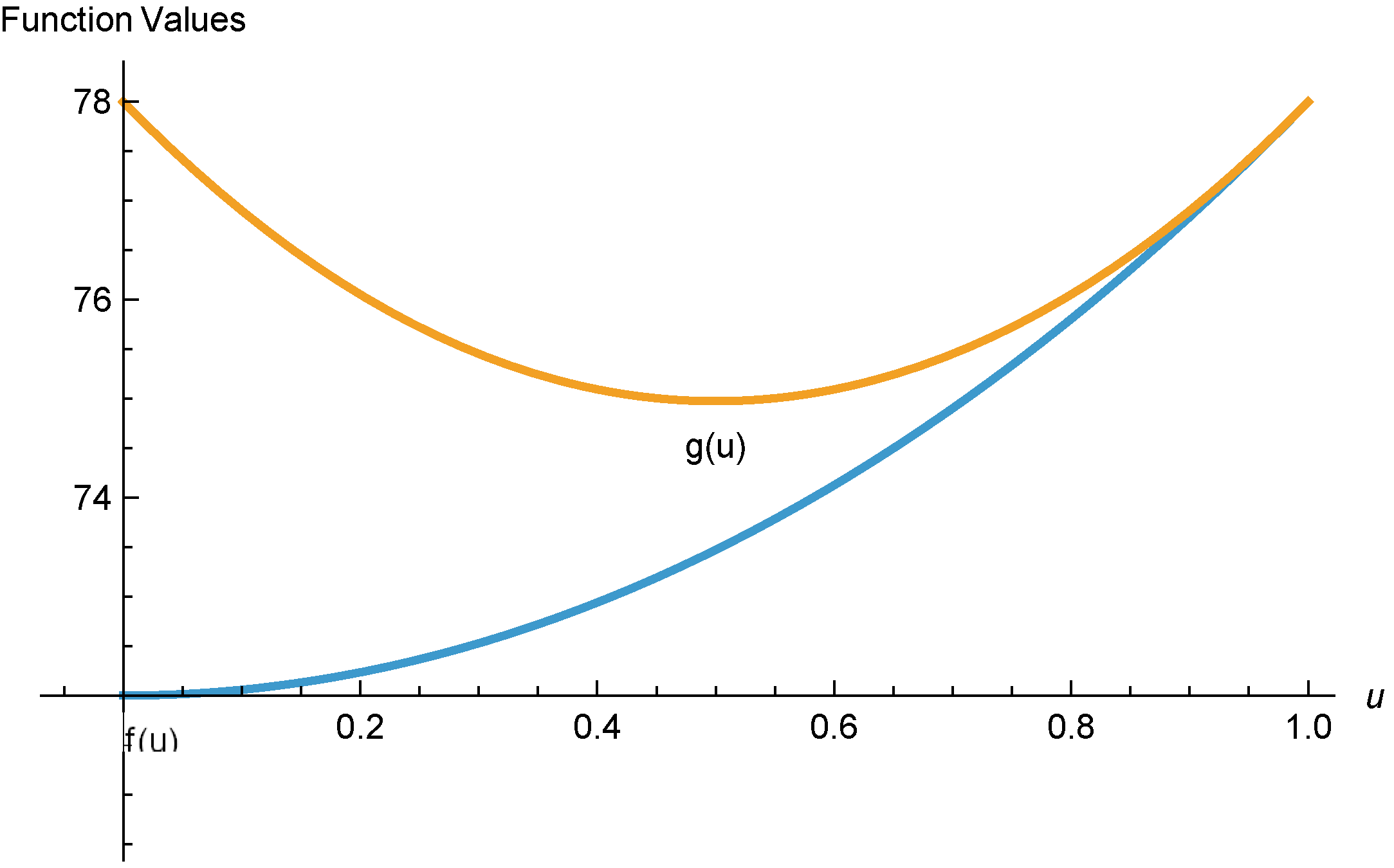
I y u s 1 s 2 y τ τ d τ = 1 2 s 1 s 2 x s 1 τ u s 1 s 2 1 u + x τ s 2 u s 1 s 2 1 u y τ τ d τ s 1 s 2 y τ τ d τ = 1 2 1 4 τ u + 4 τ u × τ + 4 τ τ 4 1 u d τ 1 4 τ + 4 τ τ d τ = 24 ( 5 u sinh ( u ln ( 2 ) ) 6 cosh ( u ln ( 2 ) ) 6 ) u 2 4 = f ( u ) .
and
K y u = 1 4 s 1 s 2 s 1 s 2 x s 1 τ u s 1 λ 1 u + x s 1 τ u λ s 2 1 u + x τ s 2 u s 1 λ 1 u + x τ s 2 u λ s 2 1 u y τ y λ τ λ d τ d λ = 1 4 1 4 1 4 τ u λ 1 u + τ u 4 λ 1 u + 4 τ u λ 1 u + 4 τ u 4 λ 1 u τ + 4 τ λ + 4 λ τ λ d τ d λ = 4 u 3 × 2 u + 4 u + 2 5 2 u 2 u 11 × 2 u 2 5 2 u 1 u 6 2 u + 1 ( u 3 ) ( u + 1 ) u 2 4 = g ( u ) .
Moreover, we also have
x s 1 s 2 s 1 s 2 y τ τ d τ 2 = 2 1 4 τ + 4 τ τ d τ 2 = 72
and
K y 1 2 = 1 4 1 4 1 4 τ 1 2 λ 1 2 + τ 1 2 4 λ 1 2 + 4 τ 1 2 λ 1 2 + 4 τ 1 2 4 λ s 2 1 2 τ + 4 τ λ + 4 λ τ λ d τ d λ = 4 225 1488 2 + 2113 74.9751 .
From (40) and (41), we conclude that inequality (20) holds true. Figure 1 proves the validity of the inequalities established in Theorem 9.
Example 2. 
Let G τ = exp τ , τ 1 , ln 4 . Then, according to Theorem 1, x τ = τ is a G A -convex function on 1 , 4 . Moreover the mapping y τ = τ + 4 τ is symmetric with respect to 2 over the interval 1 , 4 . Now, we observe that
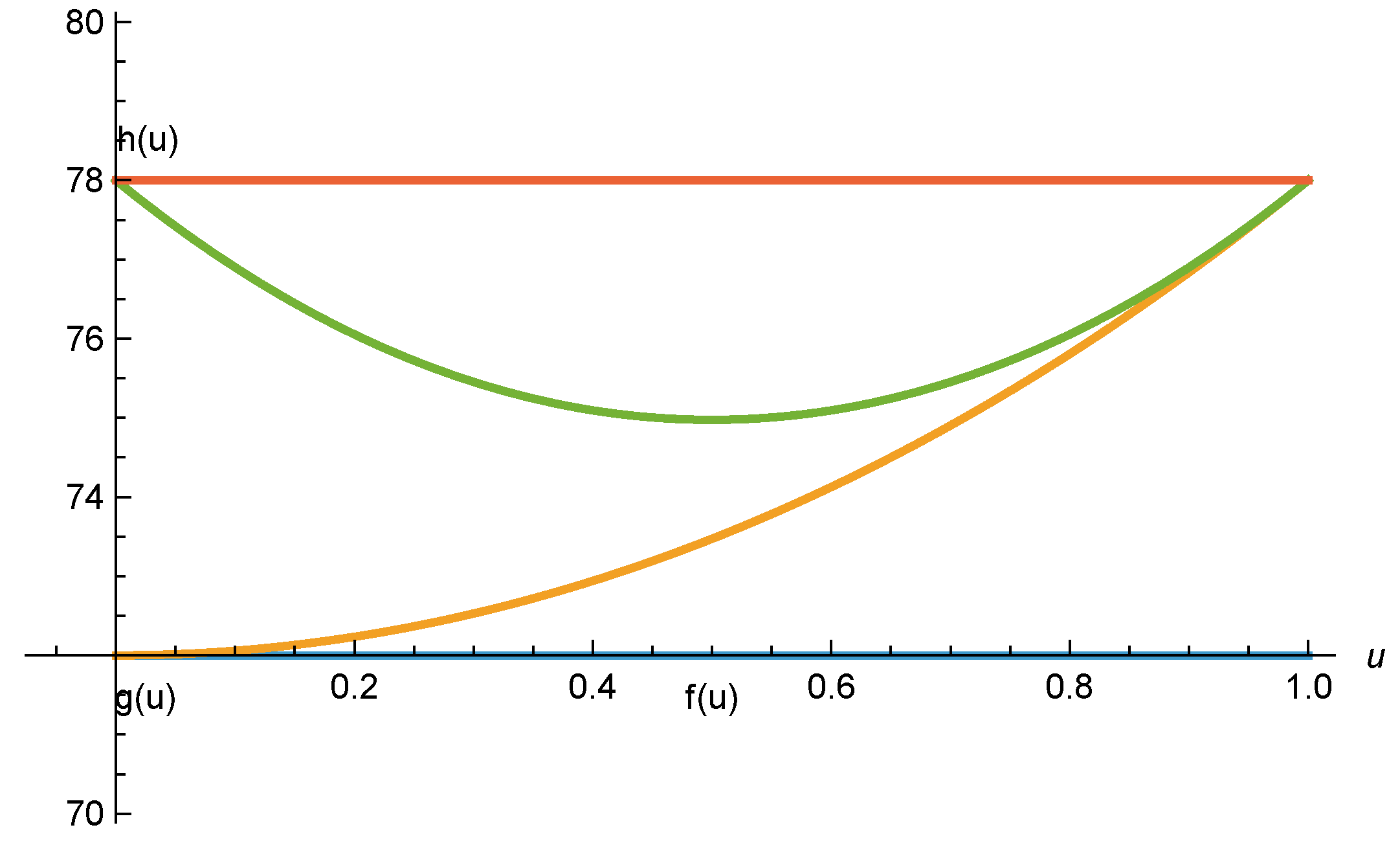
x s 1 s 2 s 1 s 2 y τ τ d τ 2 = 4 1 4 τ + 4 τ τ d τ 2 = 72 ,
I y u s 1 s 2 y τ τ d τ = 1 2 s 1 s 2 x s 1 τ u s 1 s 2 1 u + x τ s 2 u s 1 s 2 1 u y τ τ d τ s 1 s 2 y τ τ d τ = 1 2 1 4 τ u + 4 τ u × τ + 4 τ τ 4 1 u d τ 1 4 τ + 4 τ τ d τ = 24 ( 5 u sinh ( u ln ( 2 ) ) 6 cosh ( u ln ( 2 ) ) 6 ) u 2 4 = f ( u ) ,
K y u = 1 4 s 1 s 2 s 1 s 2 x s 1 τ u s 1 λ 1 u + x s 1 τ u λ s 2 1 u + x τ s 2 u s 1 λ 1 u + x τ s 2 u λ s 2 1 u y τ y λ τ λ d τ d λ = 1 4 1 4 1 4 τ u λ 1 u + τ u 4 λ 1 u + 4 τ u λ 1 u + 4 τ u 4 λ 1 u τ + 4 τ λ + 4 λ τ λ d τ d λ = 4 u 3 × 2 u + 4 u + 2 5 2 u 2 u 11 × 2 u 2 5 2 u 1 u 6 2 u + 1 ( u 3 ) ( u + 1 ) u 2 4 = g ( u ) ,
and
1 2 s 1 s 2 x s 1 τ + x τ s 2 y τ τ d τ s 1 s 2 y τ τ d τ = 1 2 1 4 τ + 4 τ τ + 4 τ τ d τ 1 4 τ + 4 τ τ d τ = 78 .
Figure 2 proves the validity of the inequalities proved in Corollary 1 over the interval [ 1 , 4 ] .
Example 3. 
Let G τ = exp τ , τ 0 , ln 4 . Then, according to Theorem 1, x τ = τ is a G A -convex function on 1 , 4 . Moreover, the mapping y τ = τ + 4 τ is symmetric with respect to 2 over the interval 1 , 4 . Now, we observe that
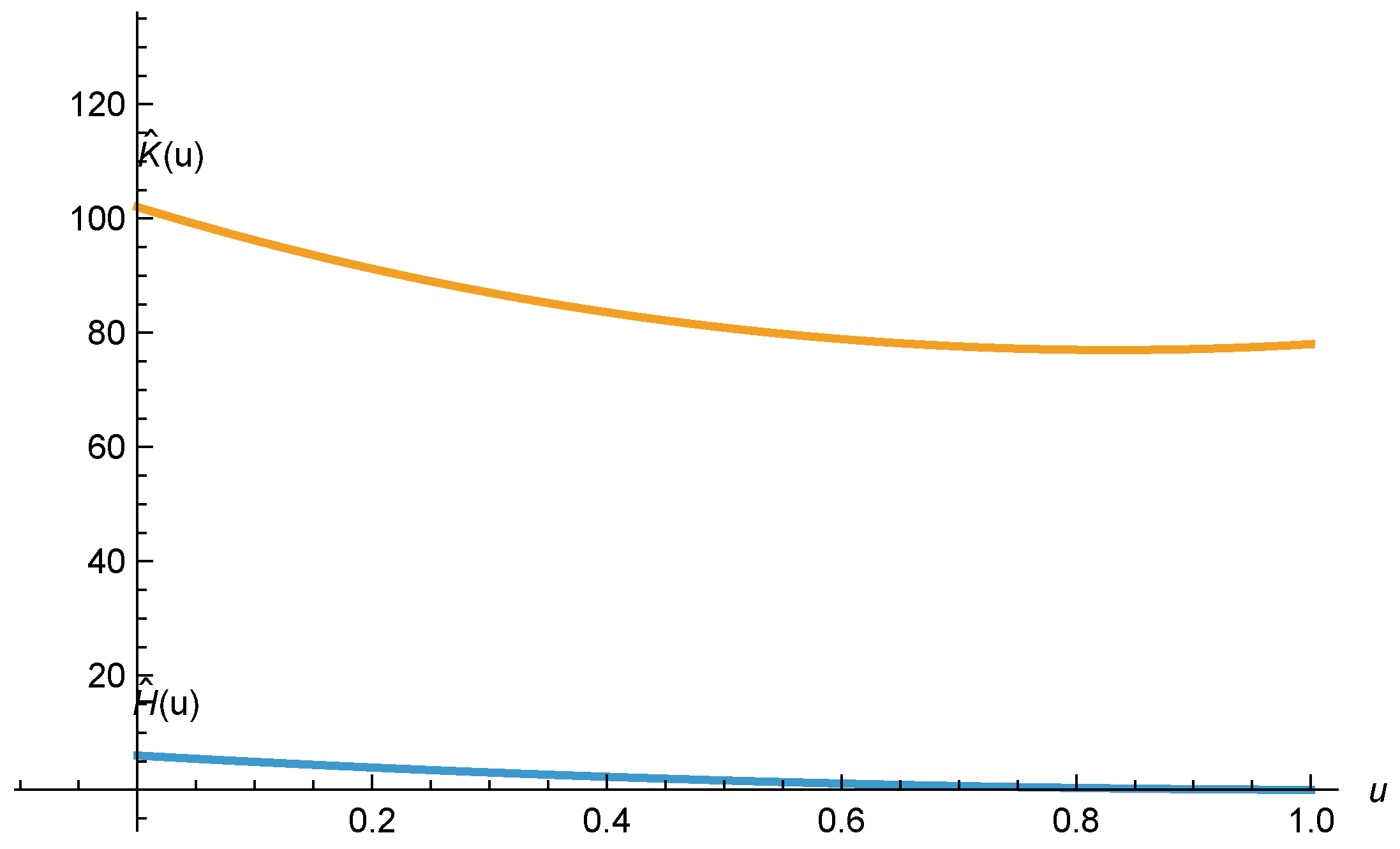
H ^ u : = K y u I y u s 1 s 2 y τ τ d τ = 1 4 1 4 1 4 τ u λ 1 u + τ u 4 λ 1 u + 4 τ u λ 1 u + 4 τ u 4 λ 1 u τ + 4 τ λ + 4 λ τ λ d τ d λ 1 2 1 4 4 1 u τ u + 4 τ u τ + 4 τ τ d τ 2 3 τ + 4 τ τ d τ = 4 u ( 5 u 11 ) ( 5 u 6 ) + 4 1 u ( 5 u + 1 ) ( 5 u + 6 ) ( u 3 ) ( u + 1 ) u 2 4 + ( u 3 ) ( u + 2 ) ( 13 ( u 1 ) u 76 ) ( u 3 ) ( u + 1 ) u 2 4 5 × 2 u + 1 ( u ( 5 u 29 ) 18 ) + 2 u ( u ( 5 u + 19 ) 42 ) ( u 3 ) ( u + 1 ) u 2 4 24 ( 5 u sinh ( u ln ( 2 ) ) 6 cosh ( u ln ( 2 ) ) 6 ) u 2 4
and
S y 1 u s 1 s 2 y τ τ d τ K y u = 1 2 1 4 λ u + 4 λ u + 4 u λ u + 4 u 4 λ u τ + 4 τ τ d τ 1 4 τ + 4 τ τ d τ 1 4 1 4 1 4 τ u λ 1 u + τ u 4 λ 1 u + 4 τ u λ 1 u + 4 τ u 4 λ 1 u τ + 4 τ λ + 4 λ τ λ d τ d λ = 3 × 2 1 2 u 2 u + 1 4 u + 4 5 2 u 1 u 6 2 u + 1 u 2 4 4 u 3 2 u + 4 u + 2 5 2 u 2 u 11 × 2 u 2 5 2 u 1 u 6 2 u + 1 ( u 3 ) ( u + 1 ) u 2 4 = K ^ ( u ) .
Figure 3 proves the validity of the inequalities proved in Theorem 10 over the interval [ 1 , 4 ] .
Remark 5. 
The other results of our findings can also be seen to be valid graphically or numerically, and we encourage interested readers to verify them.

5. Conclusions

This study successfully established a comprehensive and unified framework for analyzing weighted integral inequalities of the Fejér type for G A -convex functions. We introduced a cohesive family of functionals, including G ( u ) , H y u , K y u , N u , L ( u ) , L y ( u ) , and S y u defined on the interval [ 0 , 1 ] , which serve as the natural geometric analogues to classical mappings. Our main results provide a detailed hierarchy of inequalities that interconnect these functionals, offering significant refinements to the fundamental Hermite–Hadamard–Fejér inequality for G A -convex functions. We rigorously proved key properties of these mappings, such as G A -convexity, monotonic behavior, and symmetry, which are not merely technical achievements but provide deeper insight into the structure of G A -convexity itself. A notable strength of our approach is its generality; by choosing the specific weight y ( τ ) = 1 s 2 s 1 , our results seamlessly reduce to and generalize several important inequalities previously established in the literature [18,20,22]. The simplified illustrative example, utilizing the function x ( τ ) = τ , confirms the practical validity of our theoretical findings and demonstrates their computational accessibility. More importantly, as outlined in Section 5, the framework developed herein is not confined to pure mathematics. It holds genuine potential for application in diverse fields such as information theory, economic modeling, and geometric probability, where multiplicative processes and geometric means are inherent. Future research will focus on extending this work in several promising directions, including the development of discrete variants, exploration within fractional calculus, and generalization to other classes of generalized convexities.

Funding

This research received no external funding.

Data Availability Statement

No new data were created or analyzed in this study. Data sharing is not applicable to this article.

Acknowledgments

The author is thankful to the referees for their insightful remarks/suggestions that have greatly improved the final version of the manuscript.

Conflicts of Interest

The author declares no conflicts of interest.

References

  1. Hermite, C. Sur deux limites d’une int’egrale d’efinie. Mathesis 1893, 3, 82. [Google Scholar]
  2. Hadamard, J. ’Etude sur les propri’et’es des fonctions enti’eres en particulier d’une function consid’er’ee par Riemann. J. Math. Pures Appl. 1893, 58, 171–215. [Google Scholar]
  3. Ardic, M.A.; Akdemir, A.O.; Set, E. New Ostrowski like inequalities for GG-convex and GA-convex functions. Math. Inequal. Appl. 2016, 19, 1159–1168. [Google Scholar]
  4. Ardic, M.A.; Akdemir, A.O.; Yildiz, K. On some new inequalities via GG-convexity and GA-convexity. Filomat 2018, 32, 5707–5717. [Google Scholar] [CrossRef]
  5. Dragomir, S.S.; Latif, M.A.; Momoniat, E. Fej’er type integral inequalities related with geometrically-arithmetically convex functions with applications. Acta Comment. Univ. Tartu. Math. 2019, 23, 51–64. [Google Scholar]
  6. Dragomir, S.S. Some new inequalities of Hermite-Hadamard type for GA-convex functions. Annales Universitatis Mariae Curie-Sklodowska Lublin-Polonia 2018, LXXII, 55–68. [Google Scholar] [CrossRef]
  7. Dragomir, S.S. Iequalities of Hermite-Hadamard type for GA-convex functions. Ann. Math. Silesianae 2018, 32, 145–168. [Google Scholar] [CrossRef]
  8. Dragomir, S.S. Inequalities of Jensen type for GA-convex functions. RGMIA Res. Rep. Collect. 2015, 18, 1–26. [Google Scholar]
  9. Dragomir, S.S.; Cho, Y.J.; Kim, S.S. Inequalities of Hadamard’s type for Lipschitzian mappings and their applications. J. Math. Anal. Appl. 2000, 245, 489–501. [Google Scholar] [CrossRef]
  10. Dragomir, S.S.; Milosevic, D.S.; Sándor, J. On some refinements of Hadamard’s inequalities and applications. Univ. Belgrad. Publ. Elek. Fak. Sci. Math. 1993, 4, 3–10. [Google Scholar]
  11. Dragomir, S.S. On Hadamard’s inequality for convex functions. Mat. Balk. 1992, 6, 215–222. [Google Scholar] [CrossRef]
  12. Dragomir, S.S. On Hadamard’s inequality for the convex mappings defined on a ball in the space and applications. Math. Ineq. Appl. 2000, 3, 177–187. [Google Scholar] [CrossRef]
  13. Dragomir, S.S. On some integral inequalities for convex functions. Zb.-Rad. (Kragujevac) 1996, 18, 21–25. [Google Scholar]
  14. Dragomir, S.S.; Agarwal, R.P. Two new mappings associated with Hadamard’s inequalities for convex functions. Appl. Math. Lett. 1998, 11, 33–38. [Google Scholar] [CrossRef]
  15. Dragomir, S.S. Two mappings in connection to Hadamard’s inequalities. J. Math. Anal. Appl. 1992, 167, 49–56. [Google Scholar] [CrossRef]
  16. Kunt, M.; Işcan, I. Fractional Hermite-Hadamard-Fej’er type inequalities for GA-convex functions. Turk. J. Ineq. 2018, 2, 1–20. [Google Scholar]
  17. Işcan, I. Hermite-Hadamard type inequalities for GA-s-convex functions. Le Mat. 2014, 69, 129–146. [Google Scholar]
  18. Latif, M.A.; Kalsoom, H.; Khan, Z.A.; Al-moneef, A.A. Refinement mappings related to Hermite-Hadamard type inequalities for GA-convex function. Mathematics 2022, 10, 1398. [Google Scholar] [CrossRef]
  19. Latif, M.A.; Dragomir, S.S.; Momoniat, E. Some Fej’er type integral inequalities for geometrically-arithmetically-convex functions with applications. Filomat 2018, 32, 2193–2206. [Google Scholar] [CrossRef]
  20. Latif, M.A. Extensions of Fej’er type inequalities for GA-convex functions and related results. Filomat 2023, 37, 8041–8055. [Google Scholar] [CrossRef]
  21. Latif, M.A.; Budak, H.; Kashuri, A. Further refinements and inequalities of Fej’er’s type via GA-convexity. Int. J. Optim. Control. Theor. Appl. 2024, 14, 229–248. [Google Scholar] [CrossRef]
  22. Latif, M.A. Some companions of Fej’er type inequalities using GA-convex functions. Mathematics 2023, 11, 392. [Google Scholar] [CrossRef]
  23. Niculescu, C.P. Convexity according to the geometric mean. Math. Inequal. Appl. 2000, 3, 155–167. [Google Scholar] [CrossRef]
  24. Noor, M.A.; Noor, K.I.; Awan, M.U. Some inequalities for geometrically-arithmetically h-convex functions. Creat. Math. Inform. 2014, 23, 91–98. [Google Scholar] [CrossRef]
  25. Obeidat, S.; Latif, M.A. Weighted version of Hermite-Hadamard type inequalities for geometrically quasi-convex functions and their applications. J. Inequal. Appl. 2018, 2018, 307. [Google Scholar] [CrossRef] [PubMed]
  26. Qi, F.; Xi, B.-Y. Some Hermite-Hadamard type inequalities for geometrically quasi-convex functions. Proc. Indian Acad. Sci. Math. Sci. 2014, 124, 333–342. [Google Scholar] [CrossRef]
  27. Tseng, K.-L.; Hwang, S.R.; Dragomir, S.S. On some new inequalities of Hermite-Hadamard-Fej’er type involving convex functions. Demonstr. Math. 2007, 40, 51–64. [Google Scholar]
  28. Tseng, K.-L.; Hwang, S.R.; Dragomir, S.S. Fej’er-Type Inequalities (I). J. Inequal. Appl. 2010, 2010, 531976. [Google Scholar] [CrossRef]
  29. Tseng, K.-L.; Hwang, S.R.; Dragomir, S.S. Some companions of Fej’er’s inequality for convex functions. RACSAM 2015, 109, 645–656. [Google Scholar] [CrossRef]
  30. Tseng, K.-L.; Hwang, S.R.; Dragomir, S.S. Fej’er-type Inequalities (II). Math. Slovaca 2017, 67, 109–120. [Google Scholar] [CrossRef]
  31. Tseng, K.-L.; Hwang, S.R.; Dragomir, S.S. On some weighted integral inequalities for convex functions related Fej’er result. Filomat 2011, 25, 195–218. [Google Scholar] [CrossRef]
  32. Tseng, K.-L.; Yang, G.-S.; Hsu, K.-C. On some inequalities for Hadamard’s type and applications. Taiwan J. Math. 2009, 13, 1929–1948. [Google Scholar] [CrossRef]
  33. Xiang, R. Refinements of Hermite-Hadamard type inequalities for convex functions via fractional integrals. J. Appl. Math. Inform. 2015, 33, 119–125. [Google Scholar] [CrossRef]
  34. Yang, G.S.; Hong, M.C. A note on Hadamard’s inequality. Tamkang J. Math. 1997, 28, 33–37. [Google Scholar] [CrossRef]
  35. Yang, G.S.; Tseng, K.-L. On certain integral inequalities related to Hermite-Hadamard inequalities. J. Math. Anal. Appl. 1999, 239, 180–187. [Google Scholar] [CrossRef]
  36. Yang, G.S.; Tseng, K.-L. Inequalities of Hadamard’s type for Lipschitzian mappings. J. Math. Anal. Appl. 2001, 260, 230–238. [Google Scholar] [CrossRef]
  37. Yang, G.S.; Tseng, K.-L. On certain multiple integral inequalities related to Hermite-Hadamard inequalities. Util. Math. 2002, 62, 131–142. [Google Scholar]
  38. Yang, G.S.; Tseng, K.-L. Inequalities of Hermite-Hadamard-Fej’er type for convex functions and Lipschitzian functions. Taiwan J. Math. 2003, 7, 433–440. [Google Scholar]
  39. Zhang, X.-M.; Chu, Y.-M.; Zhang, X.-H. The Hermite-Hadamard type inequality of GA-convex functions and its application. J. Inequal. Appl. 2010, 2010, 507560. [Google Scholar] [CrossRef]
  40. Fej’er, L. Uber die Fourierreihen, II. Math. Naturwiss. Anz Ungar. Akad. Wiss. 1906, 24, 369–390. [Google Scholar]
  41. Hwang, D.-Y.; Tseng, K.-L.; Yang, G.S. Some Hadamard’s Inequalities for Coordinated Convex Functions in a Rectangle from the Plane. Taiwan J. Math. 2007, 11, 63–73. [Google Scholar] [CrossRef]
Figure 1. The graph validates the inequality (19) proved in Theorem 9 over the interval [ 1 , 4 ] . The blue and orange lines represent f ( u ) and g ( u ) respectively.
Appliedmath 05 00168 g001
Figure 2. The graph validates the inequality (26) proved in Corollary 1 over the interval [ 1 , 4 ] . The red, green and orange lines represent h ( u ) , g ( u ) and f ( u ) respectively.
Appliedmath 05 00168 g002
Figure 3. The graph validates the inequality (29) proved in Theorem 10 over the interval [ 1 , 4 ] . The blue and orange lines represent H ^ ( u ) and K ^ ( u ) respectively.
Appliedmath 05 00168 g003
Table 1. Correspondence between classical convex functionals and new GA-convex functionals.
Classical Functional (Refs.)New GA-Convex Functional (This Paper)Key Property / Role
G ( u ) , H ( u ) , L ( u ) [15,31] G ( u ) , H y ( u ) , L y ( u ) Endpoint & geometric mean interpolation
F ( u ) [15,31] K y ( u ) New: Double integral, symmetric about u = 1 / 2
S y ( u ) [31] S y ( u ) Weighted endpoint-average link
N ( u ) [11] N ( u ) Specific weighted average
Disclaimer/Publisher’s Note: The statements, opinions and data contained in all publications are solely those of the individual author(s) and contributor(s) and not of MDPI and/or the editor(s). MDPI and/or the editor(s) disclaim responsibility for any injury to people or property resulting from any ideas, methods, instructions or products referred to in the content.