1. Introduction
Graph dynamics, in which nodes are assigned labels from a finite set and each node may change its label over time according to a predefined set of updating rules, generally depending on the environment the node belongs to, is a language that is well-suited to describe evolutionary phenomena across several application fields, ranging from automata networks [
1,
2,
3] to general distributed computing models [
4,
5,
6], from biological systems [
7,
8] to social networks.
Despite the wide applicability of the model, in order to focus the discussion, in what follows the topic will be mainly centered on the dynamical process underlying opinion formation in social networks like, for instance, the one occurring in political elections. Actually, understanding social influence, including opinion formation and evolution, has been a focus of research in sociology for a long time up until recent years [
9,
10,
11,
12,
13,
14]. Within this setting, a set of individuals are engaged with each other in stronger or weaker relations of friendship or enmity and such relations influence the opinion of each of them. Any individual’s tendency is to conform to his friends’ opinions and to go against his enemies ones by taking into consideration each relation’s strength. The rules according to which individuals change their opinion are usually referred to as dynamics and many questions of interest here concern the predictability of the social network behavior: will all the individuals ever reach consensus, or will they ever reach a qualified majority about the opinions on a topic, or will the network ever reach an equilibrium configuration (that is, an opinion assignment in which the opinion of every individual in the network will never change according to the specified dynamics), and similar.
The questions mentioned above have been largely studied in the literature, by introducing a wide variety of dynamics, both deterministic and randomized, mainly in the binary opinion setting; that is, when individuals have to choose between two alternatives. As far as randomization is concerned, it is proposed in different aspects: either in the graph generation process [
15,
16], or by assuming that individuals may decide not to change their opinion even if the conditions to do it are met [
17,
18,
19,
20], or, finally, in the definition of the opinion dynamics themselves. As a few examples, stochastic models for opinion dynamics when only friendship relations occur have been considered, starting with the French-DeGroot model [
21,
22] and continuing with the social impact model [
23], the Voter model [
24,
25] and the majority rule model [
26] among others. Some of these models have been subsequently adapted to the case of friendship/enmity relations [
27,
28,
29,
30].
Deterministic binary opinion dynamics models have also been proposed and analyzed [
15,
31,
32,
33,
34,
35,
36]. In [
37], a general framework for the definition of deterministic opinion dynamics is proposed. The dynamics model introduced in [
34,
35] encompasses both the deterministic majority rule and the underpopulation one [
33]; this model has been subsequently extended to its maximum degree in [
38]. Many of the cited papers consider the binary majority rule, one of the most intuitive and most widely studied deterministic dynamics models, in which an individual, at any step, adopts the opinion held by the majority of the individuals he is connected with.
However, binary opinion dynamics are only a simplification of real-world and practical settings, with examples ranging from everyday life issues (e.g., which product to buy, which set of political parties to vote for, and similar scenarios) to more technical issues. As an example, automata networks (both a computational model itself and a tool frequently used to model the behavior of biological networks) are graphs in which nodes are associated with states belonging to a (finite) set. The node-state association evolves at discrete time steps according to the transition maps each node is equipped with: at each time step, the node’s transition map specifies the node’s state at the next time step based on the states of its neighboring nodes.
Non-binary dynamics have been considered too, mainly with respect to randomized models and/or by simulation tools [
39,
40,
41,
42,
43,
44,
45,
46]. A short overview of some of the contents of these papers is now provided. In [
47], the existence of non-binary asynchronous and non-deterministic dynamics allowing to maximize the diffusion of one target opinion starting with an assignment of the initial opinions of all individuals is studied, and the huge difference of such a property when considering binary and non-binary dynamics is highlighted. Indeed, while deciding if a dynamics leading to consensus exists is a problem in P in the binary opinions case, it is proved in [
47] that the same problem is computationally intractable in the three opinions case. The consensus reachability of
k-opinions probabilistic 3-majority dynamics (in which, at each time step, an individual and three of his friends are uniformly at random chosen and the individual takes the opinion held by the majority of the selected friends) is studied in [
44]. In [
46], a bound on the number of rounds necessary to reach plurality consensus with high probability with respect to the
h-majority with
k opinions problem is provided, where plurality consensus is the consensus on the opinion that is the most popular one at the beginning of the process. In [
41,
42,
43], three-opinion dynamics are studied with the third opinion being a
neutral one, adopted by an individual unable to choose one of the two, let us say, meaningful opinions according to the dynamics. In [
48,
49,
50], a majority dynamic is proposed and studied, which will be briefly described later in this paper.
Paper Achievements
This paper studies the computational complexity of some prediction problems with respect to three majority-based three-opinions synchronous deterministic dynamics; simply speaking, a deterministic dynamics is synchronous when each individual checks for the opportunity of an opinion change at every time step. The primary motivation underlying this work is that of extending the study of binary deterministic dynamics—for which a considerable amount of effort has been spent—to the much less considered non-binary deterministic dynamics, with a special interest in the conjecture posed in [
31]. Needless to say, this is a theoretical paper intended to be a first step to understanding the richness (in terms of complexity) of these, more general, models. In this respect, the specific dynamics here introduced play, first and foremost, the role of examples to serve as terms of comparison between tractable and intractable cases.
Regarding the prediction problems associated with synchronous deterministic dynamics, a couple of issues deserve attention. First, notice that, since the possible network opinion configurations are finite, then after a number of steps during which the network enters a set of distinct opinion configurations, a loop of opinion configurations starts. Hence, a natural solution to the above-mentioned prediction questions is to simulate the network evolution starting at a given opinion configuration until a configuration meeting the requests is met or a loop (of opinion configurations) is met.
In [
2], it is shown that, from the computational complexity point of view, no better strategy than the simulation one can be devised for synchronous deterministic dynamics unless P = NC. Actually, it has been proved in a series of papers (since [
31] and to [
38]) that a wide variety of binary-opinion dynamics, including the majority rule one, exhibit evolution sets containing a polynomial number of configurations in the network size (so yielding polynomial-time prediction algorithms) and loops of size at most 2 when the relations between pair of individuals are symmetric. In [
31], it has been conjectured that such a result (and, in fact, the same proof there proposed) could be generalized to general (non-binary) majority dynamics. The conjecture has been partially and positively solved since 1983 [
48,
49,
50] by assuming that each individual exploits his own a priori ranking in order to break ties: this means that whenever the same amount of social pressure pushes an individual towards two or more opinions, he will take the one in the best position within his personal ranking.
The aim of this paper is to introduce a set of three-opinion majority-based dynamics assuming no a priori preferences of the individuals about the three opinions, and to study the above-mentioned topics with respect to them. The main difficulty in moving from binary-opinion majority dynamics to ternary-opinion majority dynamics when no a priori information is available lies in the definition of majority itself. Actually, the definition of binary-opinion majority dynamics is intuitive and straightforward, with only the possibility of choosing how to break ties (keeping or changing opinion in case of an equal number of relations pushing towards each of the alternatives, with both definitions leading to the same complexity behavior). On the other hand, there are plenty of majority definitions when more than two opinions are considered, among which the two natural and intuitive definitions of the relative and the conservative absolute majority dynamics deserve mention: the former definition makes an individual adopt the opinion having the maximum consensus among its connections, the latter one makes an individual change his opinion only if another alternative is held by more than half of his connections. Furthermore, while the absolute majority is not exposed to ties, when defining a relative majority, dynamics decisions have to be made about how to manage them. As an example, how should an individual having opinion a and two friends, one with opinion b and one with opinion c, behave?
In
Section 3, we consider the same semantic difference between two opinions and the third one found in [
41,
42,
43] (which, however, moved in a non-deterministic setting and/or by simulation tools); that is, two opinions are the meaningful ones and the third opinion stands for neutrality. The dynamics defined in this setting work as follows: if the same number of connections pushes an individual towards each of the two meaningful opinions, then the individual becomes neutral. This dynamics fits for modeling the inability of individuals to make a decision when neither (meaningful) alternative receives more support than the other among the set of individuals he is connected with. Using a coding plus simulation technique, it is proved here that the evolution set of a network evolving to the dynamics just outlined contains a polynomial number of configurations in the network size, even in the presence of positive/negative relations of different strengths. By the above discussion, it follows that the prediction problems are polynomial-time decidable in this setting.
In
Section 4, a class of dynamics for three meaningful opinions is introduced that can be considered a generalization of the two-opinion underpopulation dynamics introduced in [
33]. Specifically, in this case, the situation is modeled in which an individual changes his opinion only for a second opinion (if it exists) that receives among the set of individuals he is connected with at least as much support as a threshold value, and only if such second opinion is strictly more preferred than the third opinion. This corresponds to the behavior of somewhat conservative individuals whose tendency is to try to keep an opinion until a threshold amount of social pressure works in favor of a change. A simulation technique is used here to prove that (some of) the prediction problems are PSPACE-complete even in a network of equal-strength positive relations only. This implies that the number of configurations in the evolution set of a network evolving according to such dynamics is super-polynomial in the network size unless P = PSPACE. The same technique also allows us to prove that the length of the orbit loop is not upper bounded by 2, so disproving the conjecture in [
31] in this case.
Finally, in
Section 5, a different majority definition is introduced: the strongly anti-conservative three-opinion majority, which can be considered the counterpart of the conservative absolute majority. Within this new definition, for a parameter
k, an individual keeps his opinion only if it is held by half plus
k of his connections or if it is not the case, but the other two alternatives obtain the same number of preferences from his connections. This kind of dynamic lends itself to modeling volatile behaviors in which individuals tend to quickly change their current opinion and to enthusiastically embrace a different opinion as soon as they hear of it a suitable number of times. This phenomenon is typically amplified in social networks, where the huge amount of content and the speed at which it circulates make forming a solid and lasting opinion a hard task, so that individuals freely abandon opinions as soon as the media attention shifts. By suitably adjusting the proof in
Section 4, the PSPACE-completeness of the prediction problems with respect to the strongly anti-conservative three-opinion majority dynamics and the existence of orbits having loop lengths greater than 2 are also proved in this case. The conjecture posed in [
31] is then contradicted in this last case as well.
A summary of the results concerning the complexity of the prediction problems is shown in
Table 1.
2. Preliminary Definitions and Notations
Let V be a finite set of entities and let be a finite set of labels or, equivalently, opinions. A -configuration of V is a labeling function . A -configuration of V evolves into a different -configuration of G according to a set of rules defined by a dynamics. Formally, a -dynamics is a functional , which specifies for a given -configuration of V at some time step t, the opinion configuration of V at step .
Generally speaking, elements of V influence each other based on the set E of (binary) relations among them, so that actually depends on the graph . Hence, and are usually referred to as, respectively, a configuration of G and a dynamics for G (instead of a configuration of V and a dynamics for V); the evolution of a configuration of G according to a dynamics for a graph is a configuration of G that will be denoted as . A dynamics is deterministic and synchronous if whenever and independently of the time the funcional is applied. In the remainder of this paper, only deterministic synchronous dynamics will be considered.
For any initial -configuration of a graph G, an opinion dynamics for G implicitly describes the evolution set of G starting at ; that is, an infinite discrete dynamic process during which, at each time step, each node might change the opinion it held at the previous step. Specifically, , where for , .
Since is deterministic and synchronous then is made of an (eventually empty) initial sequence of distinct configurations that will never appear in again, called the transient of , followed by a (eventually unit size) sequence of distinct configurations that will repeat forever, called the loop of .
The orbit of a configuration of a graph G according to a dynamics (in short, the -orbit of G at ) is ; that is, where and
For , , and
There exists such that for and .
The opinion configuration is an equilibrium configuration if .
In what follows, the sequence will be considered a set when required.
Let be a polynomial-time checkable in predicate over the set of -configuration of a graph . The -Reachability[] problem consists in deciding, given graph G in a -configuration , if a configuration exists such that ; this formalizes the informal idea of prediction problem used throughout the introduction.
In the next sections, directed and undirected graphs will be considered, and a major role in the specific dynamics defined there and in the analysis of the results presented will be played by the number of neighbors of each node in the graph to which it belongs. For the sake of completeness, some related definitions will now be provided. Let be an undirected graph; is the set of neighbors in G of node and the degree of u in G is . Let be an undirected graph; the set of in-neighbors in G of a node is the set (taking into account the arcs entering u) and the in-degree of u in G is ; the set of out-neighbors in G of a node is the set (taking into account the arcs exiting u) and the out-degree of u in G is . When several graphs are considered, subscripts will be used to denote which graph the notation is applied to: for instance if is an undirected graph a is a directed graph, both defined over the same set V of nodes, for the notations and shall refer, respectively, to the degree of u in G and to the in-degree of u in H.
3. Majority or Neutrality in Weighted Signed Undirected Graphs
Let
be a weighted signed graph with
, and let
be a
-configuration of
G. In this section, a dynamics
is considered in which each node takes opinion 0 if and only if the number of its neighbors having opinion
is equal to the number of its neighbors having opinion 1. Formally, the configuration
is defined as follows: for every
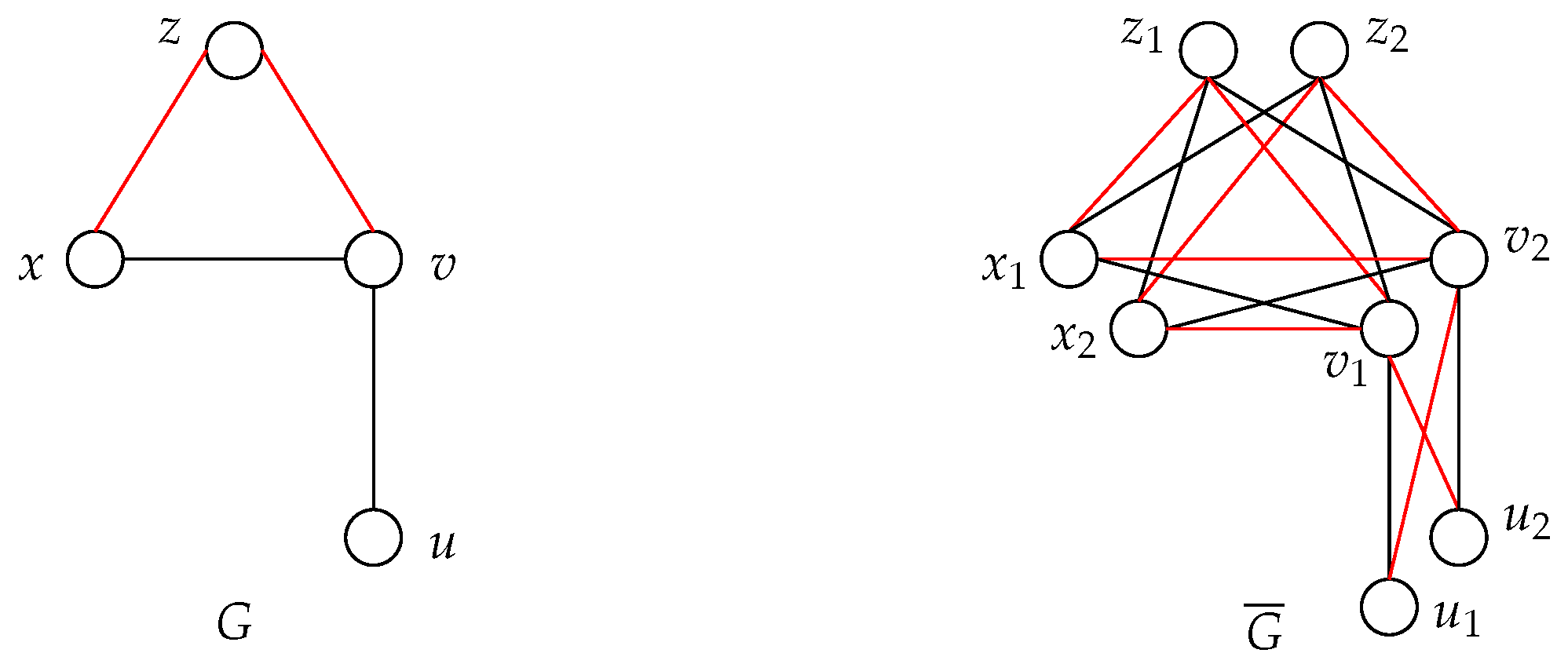
We now show how to simulate the evolution of G according to by the evolution of a related weighted signed graph according to a two-opinions related dynamics . Intuitively, in order to describe three opinions by a set of just two opinions a (sort of) binary coding of the set will be defined together with a new graph in which each node of G is “doubled”; that is, each node in G is mapped to a pair of nodes in : the goal is accommodating things in order to have the opinion of each of the nodes constituting a pair in being one (let us say) bit of the coding of the opinion of the corresponding node in G.
The graph
associated to
G is defined as follows (see
Figure 1)
with for ; that is, for each , contains the pair of nodes and ;
For every , contains the edges , , and with and .
Let
; the procedure deriving
from
G naturally induces a bijection
. Let
be the encoding of
such that
A -configuration of encodes a -configuration of G if, for every , it holds that . Less formally, encodes if, for every ,
and if and only if ;
and if and only if ;
and if and only if .
Notice that if encodes then it never happens that and for any .
The dynamics
for
is then defined by setting, for every
and for every configuration
of
,
where
is the set of neighbors of
x in
.
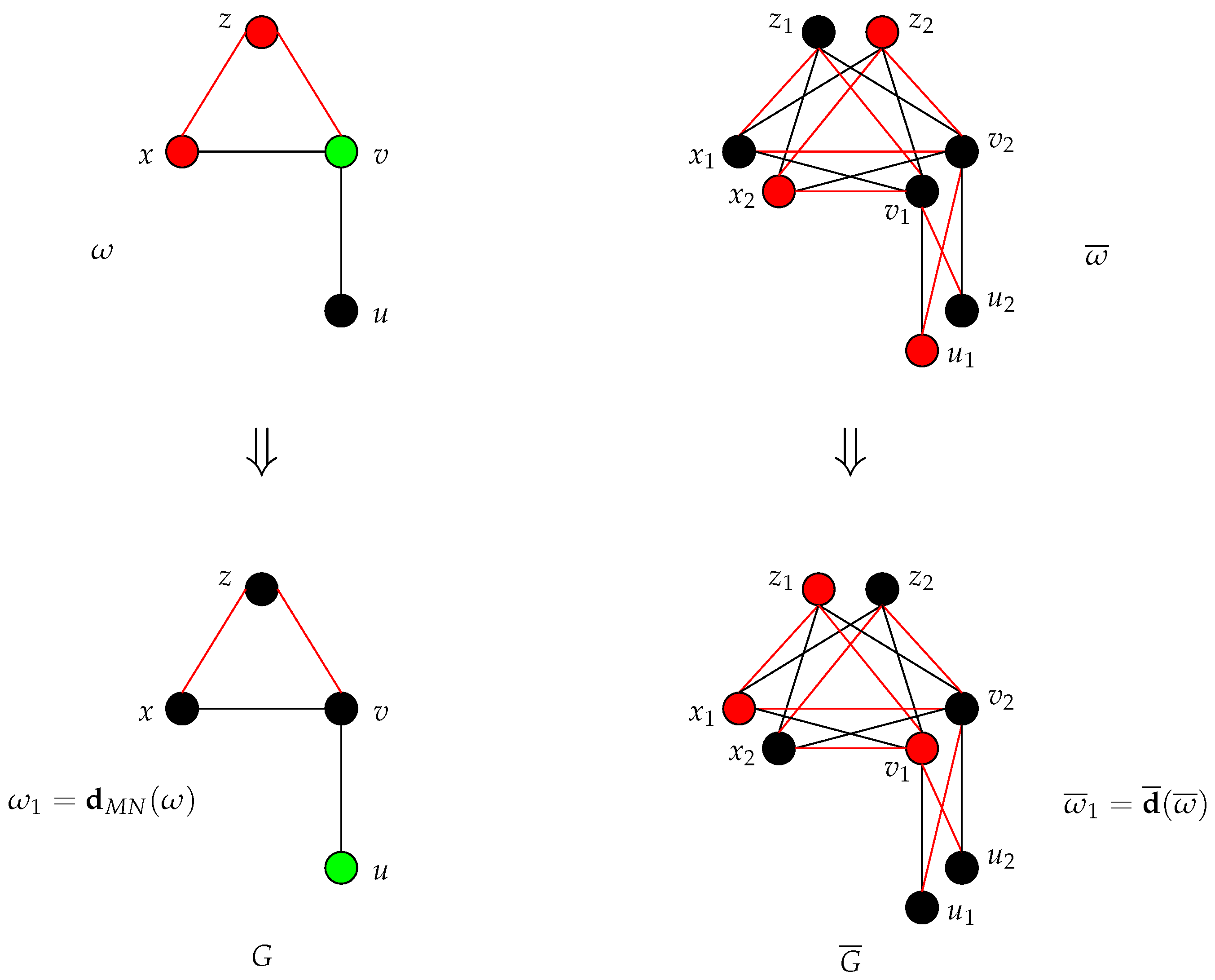
The next lemma proves that if
G is in any
-configuration
and
is in the configuration
encoding
, then
G -evolves much the same way as
-evolves (see
Figure 2).
Lemma 1. Let be an undirected signed weighted graph and let ω be a -configuration of G. If the -configuration of encodes ω then encodes .
Proof. For and for any , the contribution of u to at is defined as ; hence, the contribution of u to at is and the contribution of u to at is . Notice that, since encodes ,
If then and ,
If then and ,
If then and ;
that is, in any case
and
. As a consequence, for each
,
and, similarly,
This implies that:
If then and, hence, and so that and ;
If then and, hence, and so that and ;
If then and, hence, and so that and .
The assertion is so proved. □
The above lemma proves that there exists a one-to-one correspondence between the -configurations met by a graph G during its evolution according to starting at configuration and the -configurations met by during its evolution according to starting at configuration encoding : that is, if encodes then and with encoding for . Hence, the following theorem follows.
Theorem 1. Let be an undirected signed weighted graph and let ω be a -configuration of G. If the configuration of encodes ω then .
The dynamics
defined by (
1) is a particular case of a threshold-based dynamics, introduced in [
38] for signed weighted graphs. A threshold-based dynamics
is ruled by a pair
of functions such that
and
, and it is defined as follows: for any
-configuration
of
G and for each
,
where
. Notice that the dynamics
is a threshold-based dynamics such that, for every
,
. In [
38], it is proved that, for every pair of threshold functions
and
, for every signed weighted graph
, with
, and for every
-configuration
of
G,
; that is, the orbit size is polynomial in the size of
G and its edge weight values.
Hence, from the above discussion, as a consequence of Theorem 1, and by noticing that the number of nodes in is twice the number of nodes in G and that the number of edges in is twice the number of edges in G, the next theorem directly follows:
Theorem 2. For any signed weighted undirected graph G and for every -configuration ω for G, the size of is polynomially bounded in the size of G and in its edge weight values.
4. Generalizing the Underpopulation Rule
Let
be an undirected, unsigned, unweighted graph. The
underpopulation dynamics , with
, introduced in [
33], is governed by the pair
of parameters and is defined as follows: for any
-configuration
of
G and for each
,
where
. It is worthwhile to remark that an underpopulation dynamics
for a graph
G is actually a threshold-based dynamics
such that
and
for every node
u in
G; that is, an underpopulation dynamics is a threshold-based dynamics such that the threshold functions are constant functions.
Aiming to generalize underpopulation binary dynamics to the three opinions case, an
underpopulation -opinion dynamics ruled by the parameters
is here defined as follows: for any (undirected) graph
and for any
-configuration
for
G, the configuration
is defined so that, for each
,
where, for
,
.
In this section, the -Reachability[] problem will be proved to be PSPACE-complete for some choices of . Notice that membership to PSPACE directly follows by recalling the intuitive solution to any -Reachability problem; that is, simulating the graph evolution starting at a given opinion configuration until a configuration meeting the requests or a loop of configurations is met. Hence, the remaining of the section is devoted to proving the hardness issue.
Let
be the binary deterministic majority dynamics that, for an unweighted unsigned directed graph
, is defined as follows: if
is an opinion configuration for
G then
is such that, for every
,
where
is the number of in-neighbors of
u and, for
,
is the number of in-neighbors of
u having opinion 0 in
.
Let
be a PSPACE-complete language and let
be the deterministic Turing machine deciding
L in space
for some constant
. In [
35], for any
, an unsigned directed graph
and an opinion configuration
have been designed such that
and the opinion evolution according to the deterministic majority dynamics of
starting at
reaches a given final configuration
if and only if the computation
ends in
.
It turns out that the in-degree and out-degree of nodes in are all functions of only and they are independent from x; that is, they are constant.
We now show how to simulate the -opinion evolution of according to the deterministic majority dynamics by the -opinion evolution of a related unsigned weighted undirected graph according to an underpopulation dynamics.
Denote as the set of in-neighbors of u in , as the set of out-neighbors of u in , as the in-degree of u in , and as the out-degree of u in .
The procedure to get from first transforms into a graph such that all nodes in have the same out-degree and odd in-degree.
- (1)
The in-degree of all nodes in is made odd: this is accomplished by adding a self-loop to for every even in-degree node . Denote as the so derived graph and as and the in-degree and out-degree functions in . It can be easily verified that, for any , .
- (2)
The out-degree of all nodes in is made equal: by denoting as the maximum out-degree of nodes in , for every , dummy out-neighbors are added to u. Denote as D the set of dummy nodes, as the resulting graph, as its in-degree function; by construction is the out-degree of all its nodes.
- (3)
Notice that, since has constant size (with respect to x), then a constant number of dummy out-neighbors is added to any node in ; hence, and, finally, .
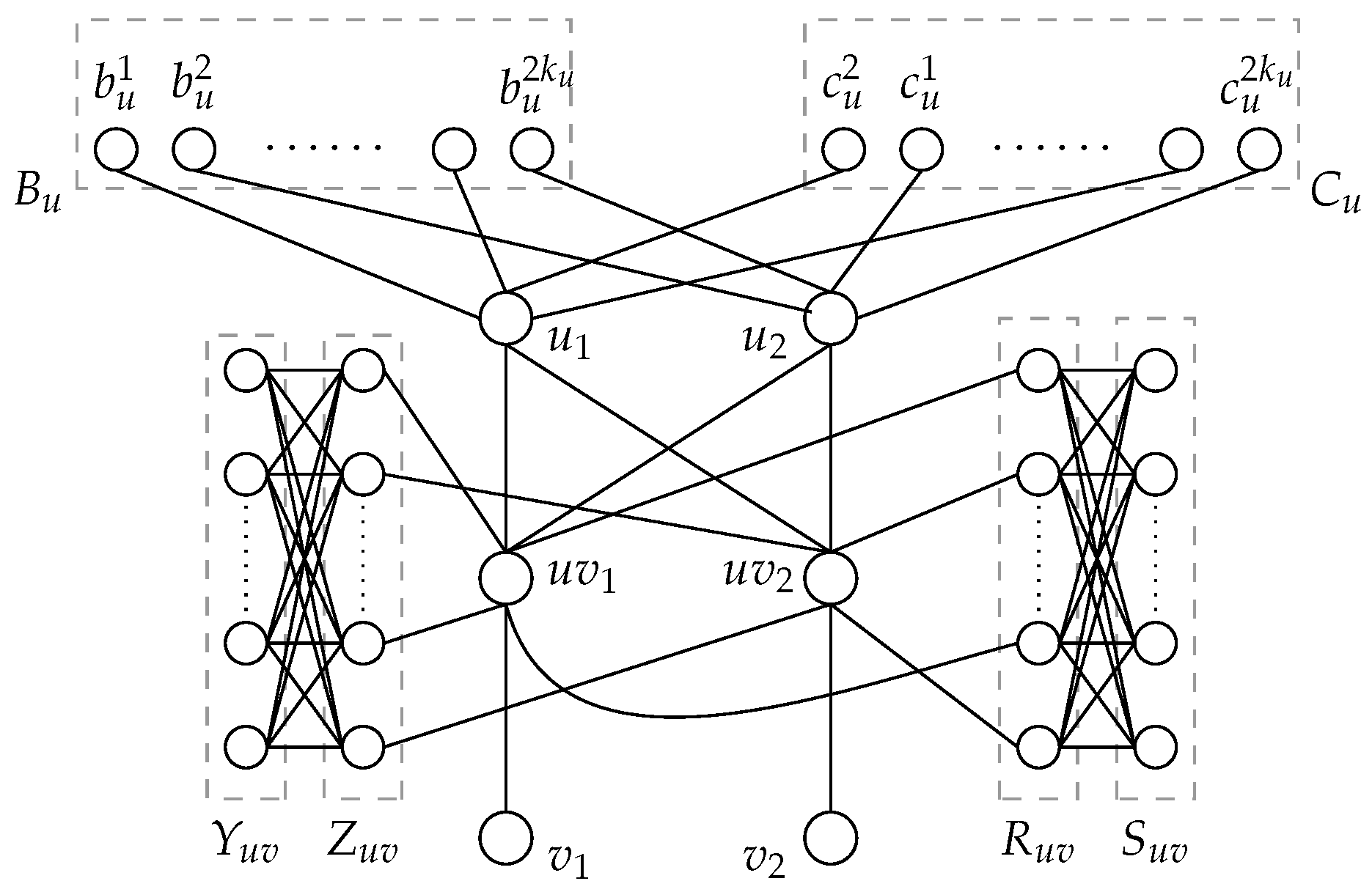
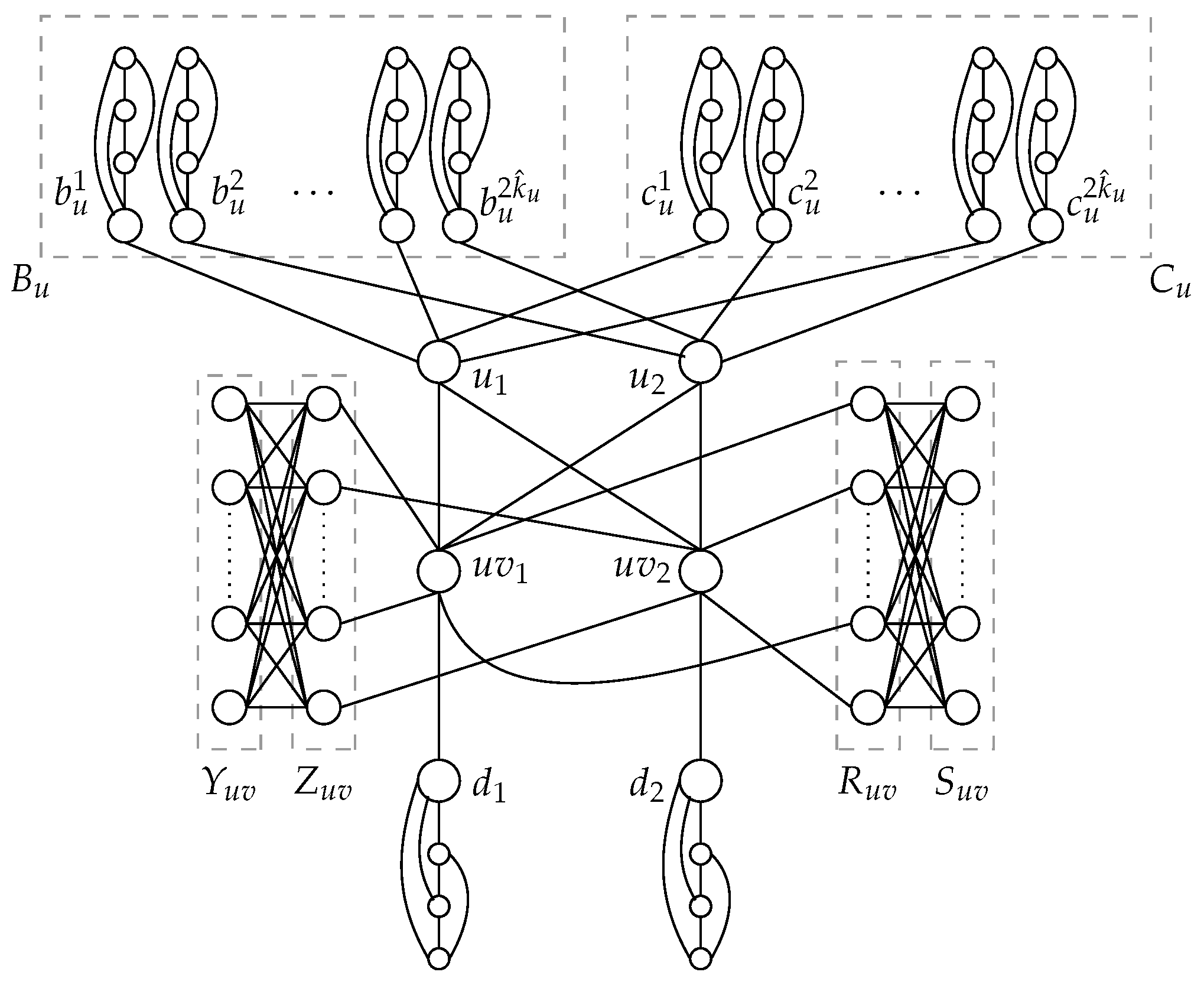
The graph
is then used to derive
(see
Figure 3). Intuitively, each arc
in
must be transformed into a structure ensuring that, at each step, the opinion of
u is communicated to
v but the opinion of
v is not communicated to
u. This is accomplished by
a) matching each node
u of
to a pair of nodes
in
and
b) matching each arc
of
to a pair of nodes
in
, both connected to both
and
and with
connected to
and
connected to
. In this way, if
and
have the same opinion, then
is more influenced by it than by the opinion of
(for
). Next, in order to forbid that
is influenced by the opinion of
and
:
c) two sets,
and
, of never changing opinion nodes are connected to
and
, and
d) two sets,
and
, of nodes whose opinions swing, respectively, between 0 and 2 and between 1 and 2 are connected to
and
. Finally,
and
are made part of two complete bipartite graphs, respectively, over the node set
and over the node set
, so that their swinging behavior is ensured.
Formally, the procedure to derive from is described in the following.
Define , and, for each node , define (recall that both and are odd).
For each node , contains the pair of nodes and and the pair of sets of nodes and . For , , , , .
For each dummy node , contains the pair of nodes and .
For each arc , contains the pair of nodes and and two complete bipartite graphs and , with , , and . Finally, for , , , , are edges in .
For each , , , and , , are edges in .
About node degrees.
- -
All nodes such that have degree in .
- -
Each dummy node has degree 1 in as well as each node in and each node in .
About the size of and the space complexity of the construction.
- -
For every , .
- -
For each arc , .
- -
Hence, since is constant (with respect to x) and since each node in is replaced by two nodes in , it follows that . This proves that deriving from requires space.
Denote as the degree function in .
The dynamics according to which opinions in
evolve is the underpopulation one
(that is,
in (
2)) with
Notice that
.
A -configuration of mirrors a -configuration of if
For every : , and and for every and ;
For every : , and , , for every , , , ;
For every dummy node , and .
The next lemma proves that, if is in a -configuration mirroring the -configuration G is in, then the -configuration held by after two -evolution steps mirrors the -configuration held by G after one -evolution step.
Lemma 2. Let be a -configuration for . If is the -configuration for that mirrors , then mirrors .
Proof. Recall that and .
First of all, it can be easily verified that, since the degree of any node in and in is , since the degree of any node in and in is , and since the degree of any dummy node in D, of every node in B and of every node in C is , by the definition of the following holds:
The assertion is still to be proved for nodes , , and for and .
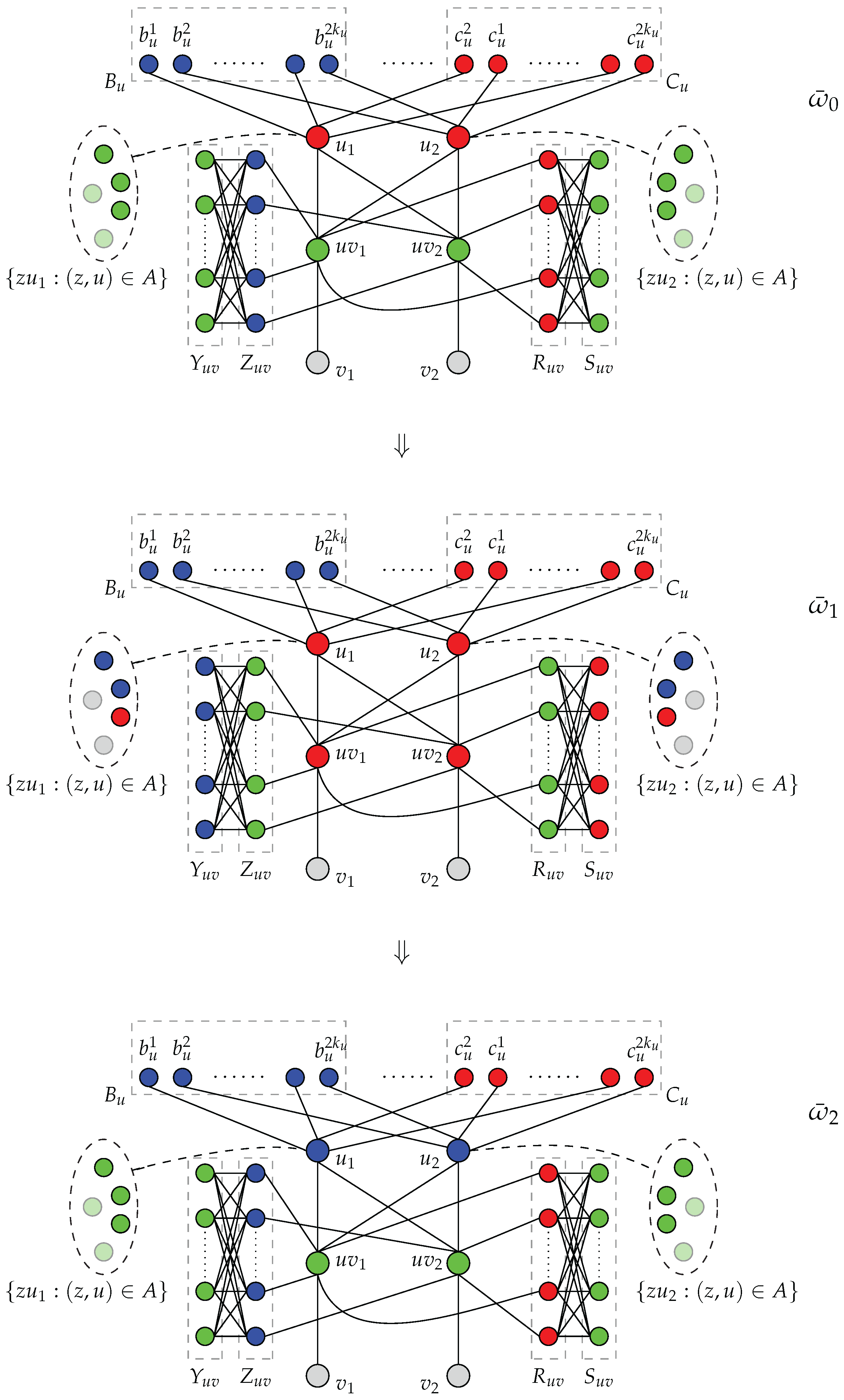
Let
; for
the following holds (see
Figure 4 for an example).
Figure 4.
The opinion evolution in of the nodes and (associated with node u in ), of the nodes and (associated with arc in ), and of the components , , , , and according to when . Blue colored nodes have opinion 0, red colored nodes have opinion 1, and green colored nodes have opinion 2.
Figure 4.
The opinion evolution in of the nodes and (associated with node u in ), of the nodes and (associated with arc in ), and of the components , , , , and according to when . Blue colored nodes have opinion 0, red colored nodes have opinion 1, and green colored nodes have opinion 2.
Opinions after one step. Since for every and , and since, by the definition of , then
Since
, from the above derivation it follows that
. Hence, since
then
.
For every
and
,
; since
and since all nodes in
have opinion 0 in
, if
then
so that, since
,
; symmetrically if
. Hence,
.
Opinions after two steps. It follows from the above discussion that, for every , for every and for every , and ; since all nodes in have opinion 2 in and since ,
then and, hence, and , and .
Since all of the
nodes in
have opinion 1 in
and
of them are adjacent to
, and since
for every
, then
Similarly, since all of the
nodes in
have opinion 0 in
and
of them are adjacent to
, then
Finally,
.
If
then
(by the definition of
) so that
and
Hence, since
and
, then
.
If
, then
so that
, and hence, since
too,
. □
From the above lemma, the next theorem holds.
Theorem 3. For any pair of -configurations and of , if and only if , where and are the -configurations of such that mirrors and mirrors .
As a consequence of the above theorem and of the hardness proof in [
35], it follows that
Corollary 1. Let be the -dynamics defined in this section. Deciding if a given graph in a given initial -configuration will ever reach a given target -configuration while evolving according to is PSPACE-complete even when restricted to unsigned, unweighted, undirected graphs.
Finally, a second noticeable consequence of Lemma 2 has been drawn. Since one evolution step of (or, equivalently, of ) according to is simulated by two evolution steps of according to , then an equilibrium configuration for with respect to corresponds to a loop of length 2 for with respect to .
In [
35], it has been proved that deciding if an unsigned, unweighted, undirected graph in a given initial binary configuration will ever reach an equilibrium configuration while evolving according to the deterministic majority dynamics is a PSPACE-complete problem still by describing the computation of a deterministic Turing machine by the
-evolution of a directed graph
. It turns out that
is obtained by adding to
a constant in-degree and constant out-degree component, so that the same procedure to derive
from
can be applied to
, resulting in an undirected (unsigned unweighted) graph
such that Lemma 2 holds for the pair of graphs
and
. Since deciding if
in a given initial binary configuration will ever reach an equilibrium configuration while evolving according to
is a PSPACE-complete problem, then, starting from some binary configuration, the
-evolution of
reaches either an equilibrium configuration or a loop of length at least 2. Correspondingly, the
-evolution of
in an initial ternary configuration mirroring a configuration of
reaches either a loop of length 2 or a loop of (even) length
.
Corollary 2. Let be the -dynamics defined in this section. Then:
Deciding if a given graph in a given initial -configuration will enter a length 2 loop while evolving according to is PSPACE-complete even when restricted to unsigned, unweighted, undirected graphs;
The evolution of an unsigned, unweighted and undirected graph in a given initial -configuration and evolving according to may enter a loop of length .
5. Strongly Anti-Conservative Majority Dynamics
A
three-opinions anti-conservative majority dynamics is here defined. Formally, let
be a graph and let
be a
stability-requirement function; the
is defined as follows: for any
-configuration
of
G, if
, then for every
In this section, small changes will be applied to the construction described in
Section 4 to derive the undircted graph
from the directed graph
in order to prove the PSPACE-completeness of
Reachability[
] with
arbitrarily close to half of the node degree function.
Let
be the graph described in
Section 4. In the construction deriving
, for each
, set
for some parameter
such that
and
is integer: indeed, since dummy out-neighbors may be added to any node in
without affecting its evolution, without loss of generality it can be assumed that
is odd and
can be chosen odd too, so that
is in fact integer.
Finally, for every node
, make it part of a 4-node clique; repeat the same procedure for every node
and for every node
. This ensures the opinion stability of the involved nodes with respect to dynamics
. Denote as
the graph obtained by the same procedure to get
with using
instead of
and by replacing nodes in
by cliques (see
Figure 5).
Notice that is actually a subgraph of ; hence, a -configuration of mirrors a -configuration of if:
Its restriction to mirrors ;
For every node z in the clique containing it holds that ;
For every node z in the clique containing it holds that ;
For every node z in the clique containing it holds that .
Denote as
so that
is the underpopulation dynamics (
2) with
.
Since all nodes
, with
, such that
have degree
in the graph
, if
denotes the node degree function in
, then for each
and
it holds that
By setting (where is the node degree function of a generic graph), and by noticing that, starting at a -configuration in which all nodes in any 4-node clique in have the same opinion, such nodes never change their opinion when evolves according to , the same arguments in the proof of Lemma 2 allow to prove the following lemma
Lemma 3. For any -opinion configuration for , if is the opinion configuration for that mirrors , then mirrors .
Since the above lemma holds for any , the next theorem is a consequence of it.
Theorem 4. For any , deciding if a given graph in a given initial -configuration will ever reach a given target -configuration while evolving according to the is PSPACE-complete even when restricted to unsigned, unweighted, undirected graphs, where denotes the dynamics such that σ is the constant function with for every node v in the graph.
Finally, by the same considerations leading to Corollary 2, the following corollary holds.
Corollary 3. For any , let be the dynamics where σ is the constant function such that for every node v in the graph. Then:
Deciding if a given graph in a given initial -configuration will enter a length 2 loop while evolving according to is PSPACE-complete even when restricted to unsigned, unweighted, undirected graphs;
tTe evolution of an unsigned, unweighted and undirected graph in a given initial -configuration and evolving according to may enter a loop of length .