1. Introduction
In 1989, Hibi [
1] made several conjectures on the h-vectors of Cohen–Macaulay standard graded algebras over a field. In particular, he conjectured that the h-vector of a standard graded Cohen–Macaulay domain is flawless ([
1], Conjecture 1.4). The h-vector
,
, of a Cohen–Macaulay standard graded algebra is flawless if
for
and
for
. Niesi and Robbiano [
2] disproved this conjecture by constructing a Cohen–Macaulay standard graded domain whose h-vector is
. Further, Hibi and Tsuchiya [
3] showed that the Ehrhart rings of the stable-set polytopes of cycle graphs of length 9 and 11 have non-flawless h-vectors by computation using the software Normaliz [
4]. Moreover, the present author showed that the Ehrhart ring of the stable-set polytope of any odd cycle graph whose length is at least 9 has non-flawless h-vectors ([
5], Theorem 5.2) by proving the conjecture of Hibi and Tsuchiya ([
3], Conjecture 1).
However, these examples have the slightest flaws, i.e., there exists i with and . In this paper, we construct a sequence of standard graded Cohen–Macaulay domains that have h-vectors with exponentially deep flaws, i.e., we show the following.
Theorem 1. Let be a field and ℓ an integer with . Then, there exists a standard graded Cohen–Macaulay domain over such that , , and an h-vector , , with . In particular, , , …is a sequence of Cohen–Macaulay standard graded domains over who have exponentially deep flaws.
This theorem is proved at the end of this paper.
2. Preliminaries
In this section, we establish notation and terminology. For unexplained terminology of commutative algebra and graphy theory we consult [
6] and [
7], respectively.
In this paper, all rings and algebras are assumed to be commutative with an identity element. Further, all graphs are assumed to be finite, simple and without loops. We denote the set of non-negative integers, the set of integers, the set of rational numbers, the set of real numbers and the set of non-negative real numbers by , , , and , respectively.
For a set X, the cardinality of X is denoted by . For sets X and Y, we define . For non-empty sets X and Y, we denote the set of maps from X to Y by . If is a subset of , then we treat as a subset of . If X is a finite set, we identify with the Euclidean space . For f, , and , we define maps and by and , for . Let A be a subset of X. We define the characteristic function of A by for and for . We denote the zero map, i.e., a map which sends all elements of X to 0, by 0. Further, if is a subset of X, then we treat as a coordinate subspace of , i.e., we identify with for any . For a non-empty subset of , the convex hull (resp. affine span) of is denoted by (resp. ).
Definition 1. Let X be a finite set and . For , we set .
For a field , the polynomial ring with n variables over is denoted by . Let be an -graded ring. We say that R is a standard graded -algebra if and R is generated by as a -algebra. Let and be -graded rings with . We denote the Segre product of R and S by .
Let Y be a finite set. Suppose that there is a family of indeterminates indexed by Y. For , the Laurent monomial, , is denoted by . A convex polyhedral cone in is a set C of the form , where , …, . If one can take , …, , we say that C is rational.
Let
C be a rational convex polyhedral cone. For a field
, we define
by
. By Gordon’s lemma, we see that
is a finitely generated
-algebra. In particular,
is Noetherian. Further, by the result of Hochster [
8], we see that
is normal and Cohen–Macaulay.
A subspace W of is rational if there is a basis of W contained in . Let and be rational subspaces of with and be a rational convex polyhedral cone in for . Then, is a rational convex polyhedral cone in that is isomorphic to the Cartesian product and .
Let X be a finite set and let be a rational convex polytope in , i.e., a convex polytope in whose vertices are in . In addition, let be a new element that is not contained in X. We set . Further, we set , . Then, is a rational convex polyhedral cone in . We define the Ehrhart ring of over a field by . We define and for . Then, is an -graded -algebra.
Note that if and are rational subspaces of with and is a rational convex polytope in for , 2, then is a rational convex polytope in that is isomorphic to the Cartesian product and .
It is known that
. Moreover, by the description of the canonical module of a normal affine semigroup ring by Stanley ([
9], p. 82), we have the following.
Lemma 1. The idealof is the canonical module of , where denotes the interior of in the topological space . The ideal of the above lemma is denoted by
and is called the canonical ideal of
. Note that the a-invariant (cf. ([
10], Definition 3.1.4)),
, of
is
.
A stable set of a graph is a subset S of V whose no two elements are adjacent. We treat the empty set as a stable set.
Definition 2. The stable-set polytope of a graph is Note that for any and . In particular, .
Then, is a rational convex polytope in with . If , we say that G is t-perfect.
Let
be an arbitrary graph and
. Set
is a clique and
. We define
by
We abbreviate as if it is clear from the context.
By the definition of
, we see that
Further, for
,
if and only if
,
and
, where
,
K is a maximal element of
and
C is an odd cycle without chords. However, since the values appearing in these inequalities are integers, these inequalities are equivalent to
,
and
, respectively. Therefore, by Lemma 1, we see that
3. Construction
Let be a field. In this section, for each integer , we construct a standard graded Cohen–Macaulay -algebra, , which has a non-flawless h-vector. The flaw of the h-vector is computed in the next section.
Let
ℓ be an integer with
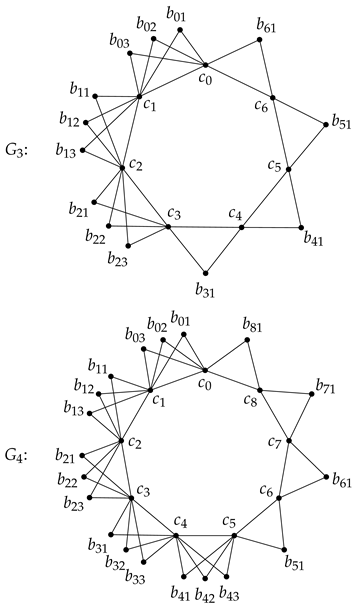
. We define a graph
by the following way. Set
The cases where
and 4 are as follows.

In addition, set
where
is the induced subgraph of
by
.
In the following, up to the end of the proof of Lemma 5, we fix ℓ and write , , , , , , and as just G, V, E, C, B, A, R and , respectively. Further, we consider the subscripts of , and the first subscript of modulo . For example, , and .
We set
for
and
. We also consider the subscript of
and the first subscript of
modulo
.
We define
for
and
by
It is easily verified that . We also consider the subscript of modulo . Note that and if or and . Otherwise, .
First we show the following.
Proposition 1. The ring A is a standard graded -algebra.
Proof. Since
it is enough to show that for any
with
there are
, …,
with
for
and
(i.e.,
has the integer decomposition property). We prove this fact by induction on
n.
The case where
is trivial. Suppose that
. We first consider the case where
for any
. Since
we see that there exists
j with
. Set
. Then, we claim that
.
First, since for any by assumption and for any , we see that for any .
Next let i be an integer with and . If or and , then . Thus, . If and , then and . Therefore, .
Finally, . Therefore, .
Next, suppose that for some i. Take with . We define by the following way.
First, we define
(
) by induction on
j. We define
. Suppose that
and for any
with
,
is defined so that
,
for
, and
implies
for
(these assumptions are trivially satisfied when
). We set
Then,
,
and
implies
. Thus, we can continue the induction procedure up to
. We also set
and we define
. Note that
. Note also that
implies
and
implies
or
, for any
.
Next we prove that .
First since , we see that for any .
Next we show that , for any and . First consider the case where . Then, . Further, by the definition of . Therefore, we see that . Next, consider the case where . Since and implies that , we see that .
Finally, since and implies for any , we see that . Thus, we see that .
Next, we prove that .
First, by the definition of , we see that implies for any . Since for any , we see that for any .
Next, we show that for any i and . If , then . Assume that . Then, . Thus, we see that by the definition of . Since implies or , for any , we see that . If , then . Suppose that . Then, by the property of noted above. Therefore, . Since , we see that . Therefore, .
Finally we show that
. Since
, we see that
□
Remark 1. The functions and in the proof of Proposition 1 are the characteristic function of some stable set of G. Therefore, the above proof shows that G is a t-perfect graph.
4. Structure of the Canonical Module
In this section, we study the generators and the structure of the canonical module of
A. First, we set
Then,
W is a codimension 1 vector subspace of
with
. Further, we set
and
Then,
is a
-subalgebra of
A (we denote this ring by
when it is necessary to express
ℓ). Further, since
for
, we see that
We denote this ring by
. Note that
for any
and
. By ([
5], Lemma 4.3) and the argument following the proof of it, we see the following.
Theorem 2. The elements , , …, of are linearly independent and Further, we see the following.
Proof. In order to prove the inclusion , it is enough to show that for any , . We prove this fact by induction on .
The case where
is trivial. Let
be an arbitrary element of
with
. By the proof of Lemma 4.3 in [
5], we see that there is
i with
for any
and
for any
j. Set
. Then, it holds that
.
In fact, for any by the choice of i and the definition of J. If or and , then . Thus, . If and , then by the definition of J. Therefore, by the choice of i, we see that . Finally, . Thus, we see that .
Since
, we see, by the induction hypothesis, that
Thus,
is a codimension 1 vector subspace of
. Since
and
for any
, we see, by Theorem 2, that
,
, …,
is a basis of
. Set
for
. Then,
for
. Set
for
. Then, by Lemma 2, we see that
It is easily verified that
is isomorphic to the Ehrhart ring of the unit cube for
. Therefore,
for
. Further, it is easily verified that
for
, 1,
and
. Thus, we see that
It is verified by a direct computation, or by Theorem 2.1 in [
11], that the Hilbert series of
is
. Therefore, the Hilbert series of
is
For each integer
k with
, we define
by
It is easily verified that and . Further, we see the following.
Lemma 3. It holds that .
Proof. Since for any , and , we see that . □
Consider the graded A-homomorphism, , , of degree 0. Then is a submodule of generated by . Further, we have the following.
Lemma 4. Further, is a rank-1-free A-module with basis .
Proof. This lemma is proved almost identically to Lemma 4.2 in [
5]. □
Set
for
. Then, the following holds.
Lemma 5. is a rank-1-free -module with basis for .
Proof. This lemma is proved almost identically to Lemma 4.5 in [
5]. □
Now, we prove Theorem 1. First, note that
. Let
,
, be the h-vector of
. Then,
By the second proof of Theorem 4.1 in [
9], we see that
where
denotes the Hilbert series of a graded module
M. Since
and there is an exact sequence
we see by Lemmas 4 and 5 that
since
for
. Therefore,
By comparing the coefficient of
in the numerators, we see that
Since
and
, we see that