Article

Does the Oxygen Functionality Really Improve the Thermodynamics of Reversible Hydrogen Storage with Liquid Organic Hydrogen Carriers?


by
Sergey P. Verevkin
1,2,*,
Artemiy A. Samarov
3 and
Sergey V. Vostrikov
4
1
Competence Centre CALOR, Faculty of Interdisciplinary Research, University of Rostock, 18059 Rostock, Germany
2
Department of Physical Chemistry, Kazan Federal University, 420008 Kazan, Russia
3
Department of Chemical Thermodynamics and Kinetics, Saint Petersburg State University, Peterhof, 198504 Saint Petersburg, Russia
4
Chemical-Technological Department, Samara State Technical University, 443100 Samara, Russia
*
Author to whom correspondence should be addressed.
Oxygen 2024, 4(3), 266-284; https://doi.org/10.3390/oxygen4030015
Submission received: 30 May 2024 / Revised: 25 June 2024 / Accepted: 27 June 2024 / Published: 2 July 2024

Abstract

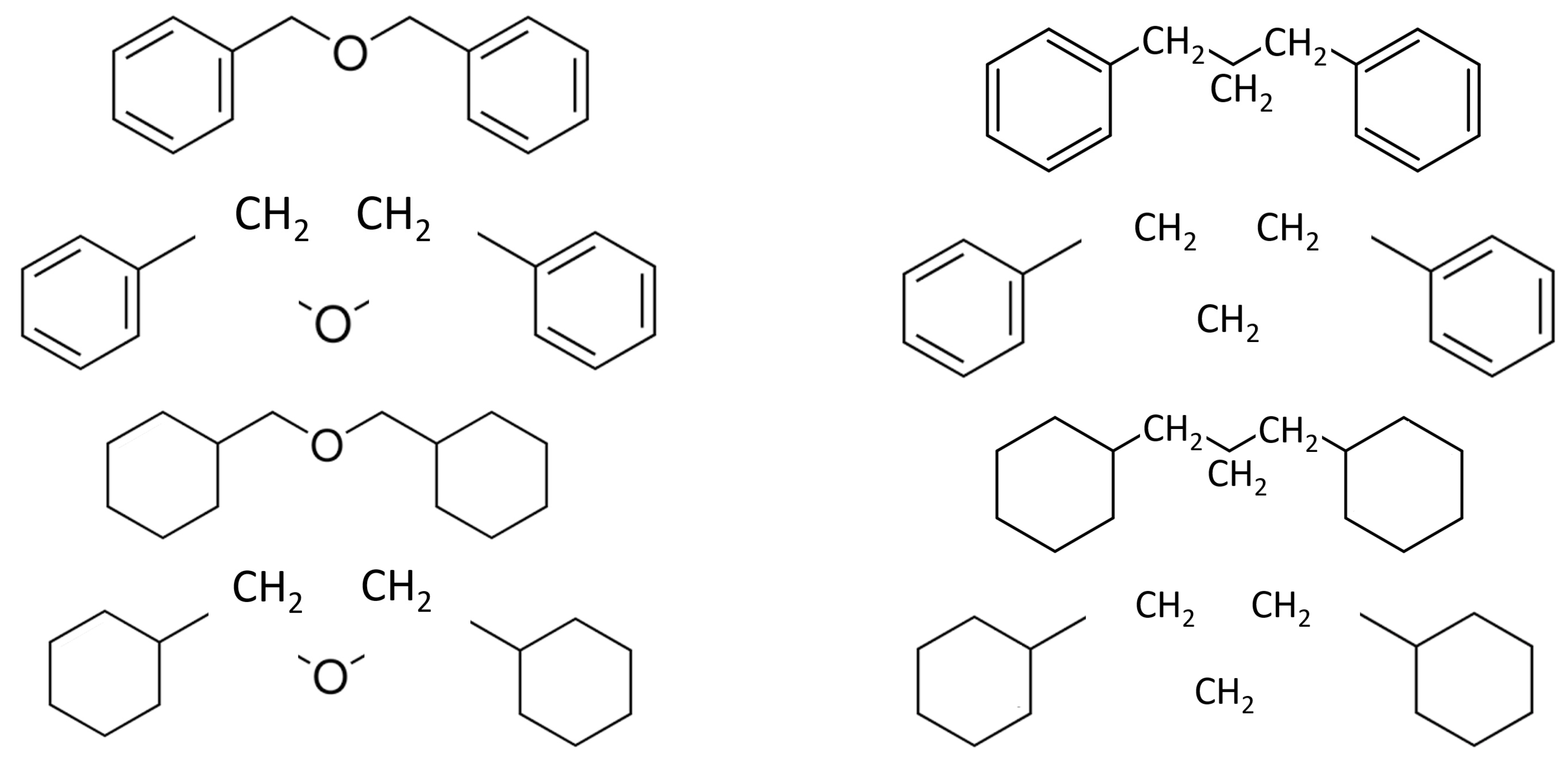
Liquid organic hydrogen carriers (LOHCs) are aromatic molecules that are being considered for the safe storage and release of hydrogen. The thermodynamic properties of a range of aromatic ethers were investigated using various experimental and theoretical methods to assess their suitability as LOHC materials. The absolute vapour pressures were measured for benzyl phenyl ether, dibenzyl ether and 2-methoxynaphthalene using the transpiration method. The standard molar enthalpies and entropies of vaporisation/sublimation were derived from the temperature dependence of the vapour pressures. The combustion energies of benzyl phenyl ether and dibenzyl ether were measured using high-precision combustion calorimetry, and their standard molar enthalpies of formation were derived from these data. High-level quantum chemical calculations were used to calculate the standard molar enthalpies of formation in the gas phase for benzyl phenyl ether, dibenzyl ether and 2-methoxynaphthalene. The latter values agreed very well with the experimental results obtained in this work. The thermodynamic properties of the hydrogenation/dehydrogenation reactions in liquid phase in LOHC systems based on methoxy–benzene, diphenyl ether, benzyl phenyl ether, dibenzyl ether and 2-methoxynaphthalene were derived and compared with the data for similarly structured hydrogen carriers based on benzene, diphenylmethane, 1,2-diphenylethane, 1,3-diphenylpropane and naphthalene. The influence of the oxygen functionality on the thermodynamic properties of the hydrogenation/dehydrogenation reactions was evaluated.
Keywords: hydrogen storage; LOHC; enthalpies of phase transitions; enthalpy of formation; vapour pressure; structure–property correlation; quantum-chemical calculations hydrogen storage; LOHC; enthalpies of phase transitions; enthalpy of formation; vapour pressure; structure–property correlation; quantum-chemical calculations