Article

Spatial Heterogeneity of Microplastic Contamination in a Tropical Sandy Beach: Influence of Management Regimes and Recreational Use


by
Kanokporn Kaewsong
1,*,
Jetsada Wongprom
2,
Adisak Ngiamsanoi
3 and
Surinthon Bunrod
4
1
Department of Conservation, Faculty of Forestry, Kasetsart University, Bangkok 10900, Thailand
2
Department of Silviculture, Faculty of Forestry, Kasetsart University, Bangkok 10900, Thailand
3
Protected Areas Regional Office 3, Department of National Parks, Wildlife and Plant Conservation, Bangkok 10900, Thailand
4
Natural Resources and Environmental Institute, Rajamangala University of Technology Srivijaya, Trang 92150, Thailand
*
Author to whom correspondence should be addressed.
Coasts 2026, 6(3), 26; https://doi.org/10.3390/coasts6030026
Submission received: 21 April 2026 / Revised: 17 June 2026 / Accepted: 25 June 2026 / Published: 29 June 2026

Abstract

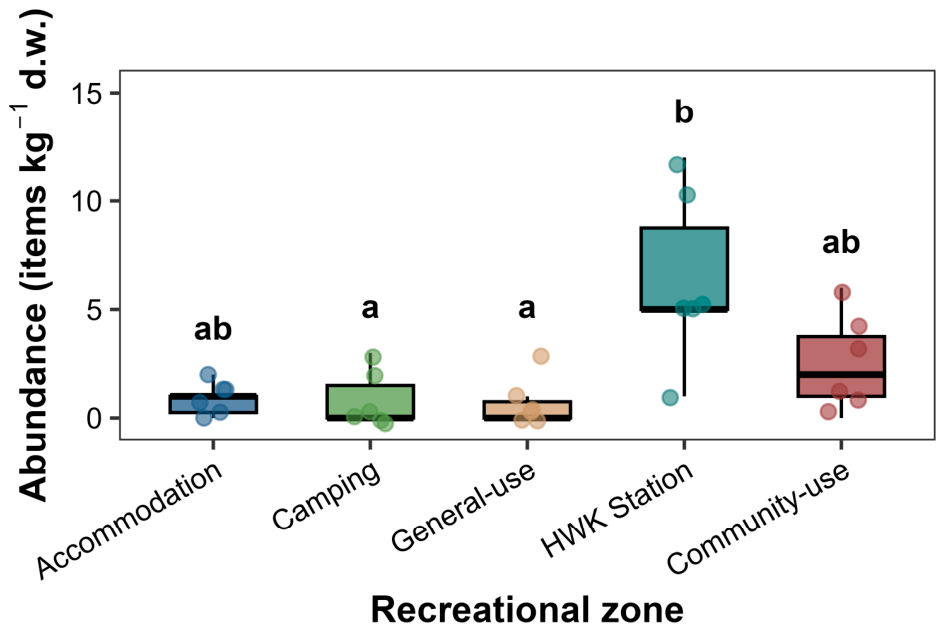
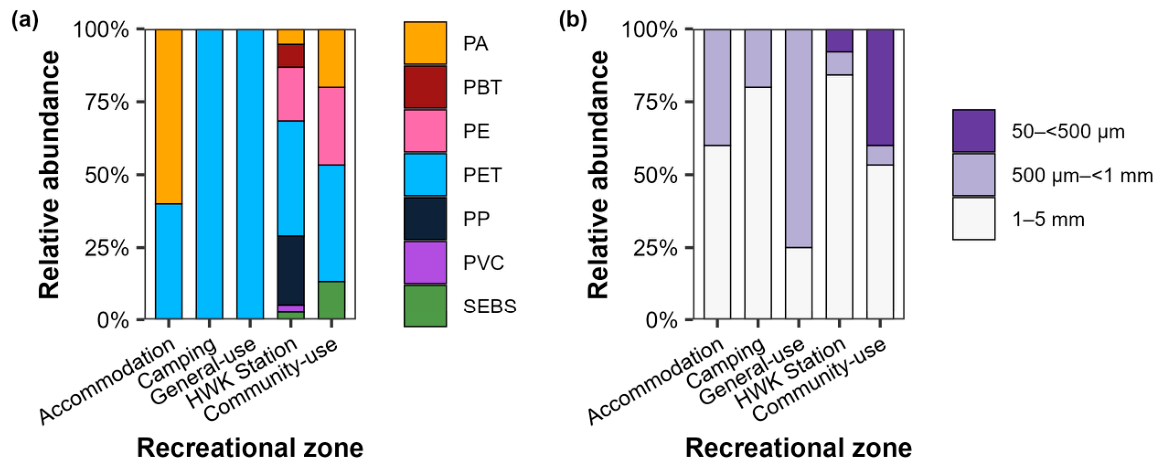
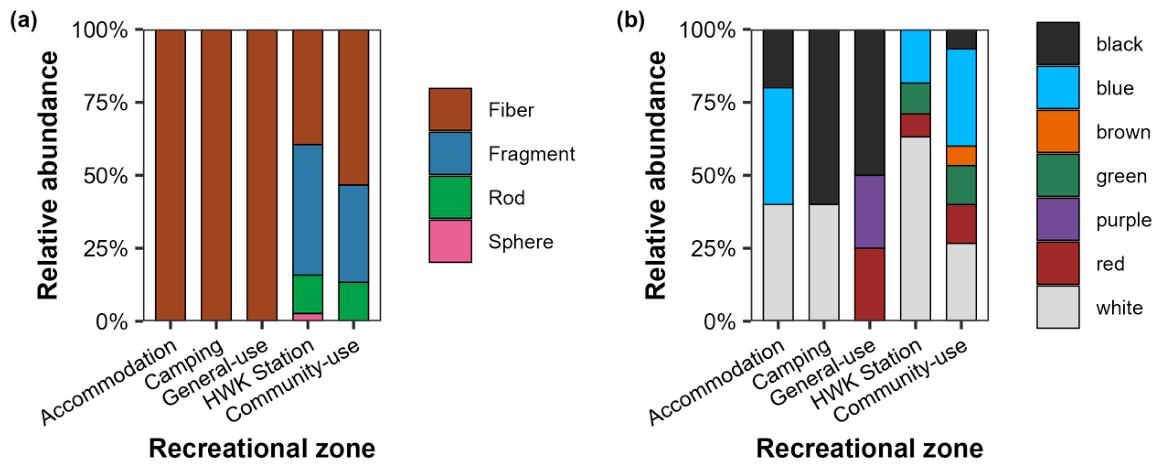
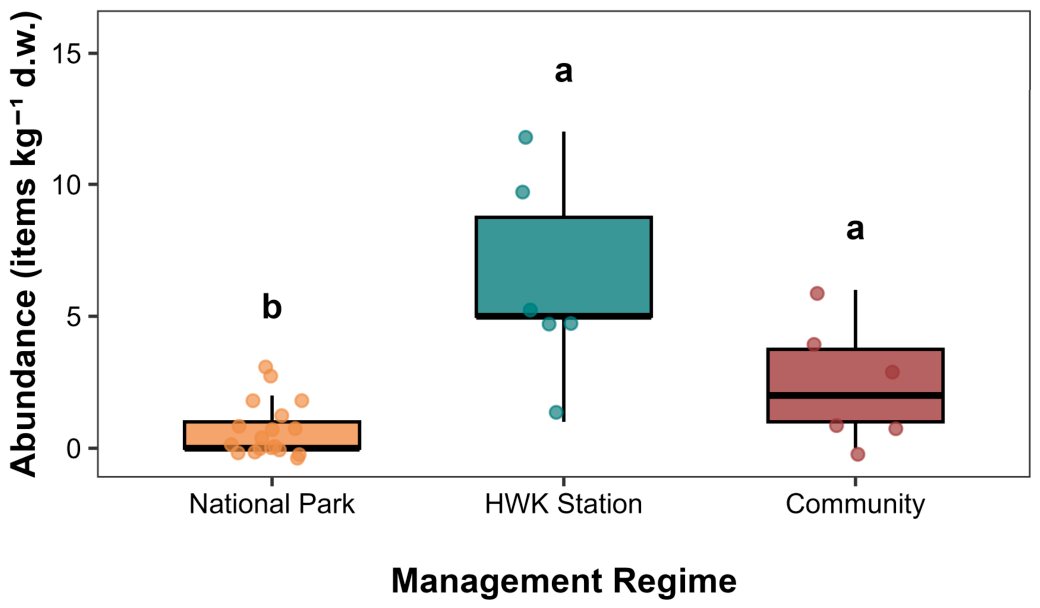
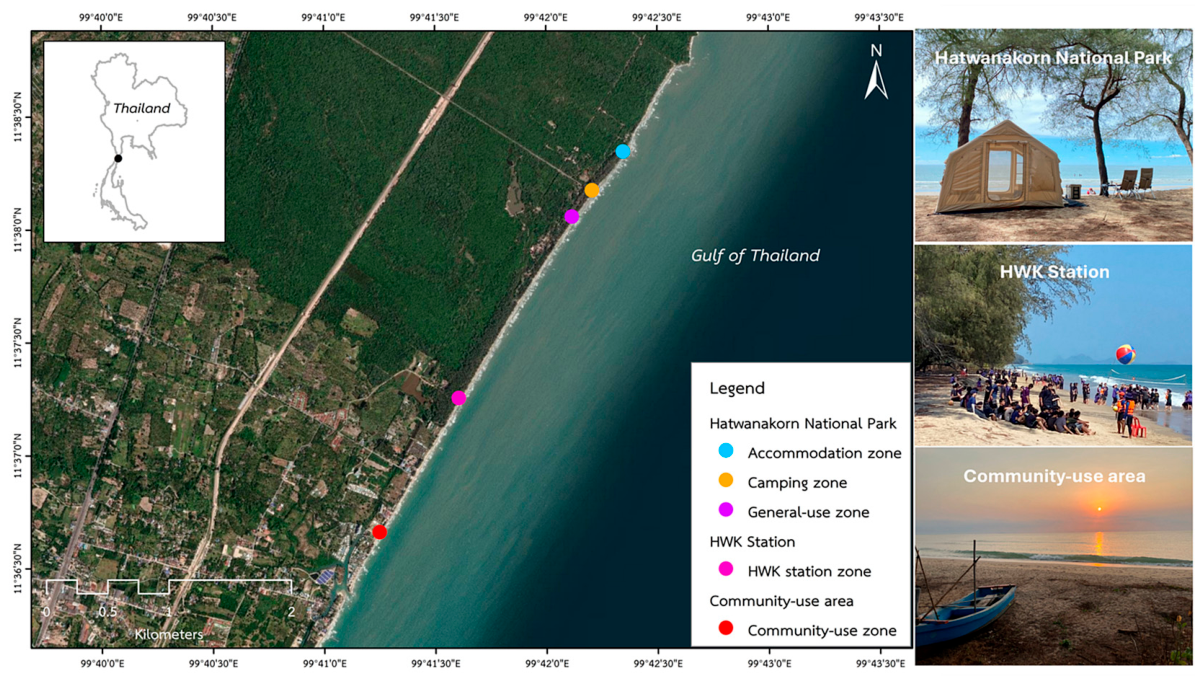
Microplastic contamination is a growing environmental concern in coastal ecosystems, particularly on recreational beaches where human activities may influence plastic inputs. This study investigated microplastic abundance and particle characteristics across five recreational zones along Hatwanakorn Beach in the Gulf of Thailand, focusing on fine-scale variability within a spatially continuous beach system and across management regimes. Supratidal sediments were collected using a quadrat-based approach, and polymer types were identified using Fourier Transform Infrared spectroscopy (FTIR). Fibers were the predominant particle type, followed by fragments, and most particles were classified as large microplastics (1–5 mm). Significant spatial differences in abundance were observed among recreational zones (Kruskal–Wallis test, χ2 = 13.37, p = 0.0096). At the management regime scale, a negative binomial generalized linear model also indicated significant differences (χ2 = 30.58, p < 0.001), with higher abundance in the Hatwanakorn Forestry Research and Student Training Station (HWK Station) and Community regimes than in the National Park regime. These results indicate that microplastic distribution can be spatially heterogeneous even within a continuous recreational beach system, underscoring the importance of accounting for fine-scale spatial variability when assessing microplastic contamination in coastal environments.
Keywords: microplastics; coastal environments; protected area; Gulf of Thailand; recreational beaches; management regimes microplastics; coastal environments; protected area; Gulf of Thailand; recreational beaches; management regimes