Article

Regional Validation of Satellite-Derived Beach Width and Slope in Microtidal Environments: The Role of Water Level Forcing and Classifier Training


by
Carolina Billet
1,2,3,
Guadalupe Alonso
1,3,*,
Matías Dinápoli
2,3,4,5 and
Walter Dragani
1,2,3,5
1
Servicio de Hidrografía Naval (SHN), Ministerio de Defensa, Av. Montes de Oca 2124, Buenos Aires C1270ABV, Argentina
2
Consejo Nacional de Investigaciones Científicas y Técnicas (CONICET), Godoy Cruz 2290, Buenos Aires C1425FQB, Argentina
3
Departamento de Ciencias de la Atmósfera y los Océanos (DCAO), Universidad de Buenos Aires, Ciudad Universitaria, Buenos Aires C1428EGA, Argentina
4
Centro de Investigaciones del Mar y la Atmósfera (CIMA), Consejo Nacional de Investigaciones Científicas y Técnicas (CONICET)–Universidad de Buenos Aires UBA, Intendente Güiraldes 2160–Ciudad Universitaria Pabellón II, Buenos Aires C1428EHA, Argentina
5
Unité Mixte Internationale, Instituto Franco-Argentino para el Estudio del Clima y sus Impactos, Centre National de la Recherche Scientifique and Consejo Nacional de Investigaciones Científicas y Técnicas, Centro de Investigaciones del Mar y la Atmósfera, Universidad de Buenos Aires (UMI IFAECI/CNRS-CONICET/CIMA/UBA), Ciudad Universitaria, Buenos Aires C1428EGA, Argentina
*
Author to whom correspondence should be addressed.
Coasts 2026, 6(1), 11; https://doi.org/10.3390/coasts6010011
Submission received: 30 January 2026 / Revised: 24 February 2026 / Accepted: 11 March 2026 / Published: 13 March 2026

Abstract

Satellite-derived shorelines (SDSs) are increasingly used to monitor beach morphology worldwide, yet their application remains poorly validated in microtidal environments strongly influenced by atmospheric forcing. In this study, the performance of CoastSat and CoastSat.slope using nine years of in situ beach profiles from six sandy beaches in Buenos Aires (Argentina) was evaluated. The analysis compares alternative sea level forcings—including global tidal predictions (FES2022), a regional barotropic model with meteorological forcing (MSAS), and wave setup from reanalysis products—and evaluates the effect of using locally trained classifiers on shoreline detection. The results show that locally trained classifiers markedly reduced RMSE values, from 9–21 m with the default classifier to 7–12 m with the locally trained one, while the MSAS model consistently outperforms FES2022 for sea level corrections across all sites. CoastSat.slope provided effective slope estimates for tidal corrections but tended to overestimate values relative to field data. Sensitivity tests confirmed that overestimation has a smaller impact on water level correction than underestimation, explaining why validation metrics improved when using CS.slope-derived slopes. These findings translate into actionable guidelines: (i) prioritize regional sea level models when nontidal variability is large; (ii) apply wave setup corrections cautiously in microtidal coasts; and (iii) use locally trained classifiers in heterogeneous or urbanized beaches. Overall, this study demonstrates that with appropriate parameterization, CoastSat is a reliable tool for shoreline monitoring in atmospherically forced, microtidal coasts, and its methodological insights are transferable to other low-energy, data-scarce regions worldwide.

1. Introduction

Coastal sandy beaches are dynamic environments that respond rapidly to environmental changes, holding ecological, economic, and social significance as hubs for tourism and recreation. Their ecological and socio-economic value underscores the need for effective and sustained monitoring, particularly in the face of accelerating climate change, sea level rise and coastal erosion. However, on-site measurements are often spatially or temporally limited, and long-term monitoring programs exist for only a few beaches globally [1,2,3,4]. In this context, remote sensing presents a compelling alternative to conventional data acquisition techniques, enabling the acquisition of freely accessible, reliable data from satellite missions at spatial resolutions ranging from 10 to 30 m [5]. The advent of Google Earth Engine (GEE) in 2017 [6] revolutionized satellite remote sensing by enabling cloud-based geospatial analysis. This has driven the development of algorithms like CoastSat [7], SHOREX [8] and CASSIE [9] that have been shown to accurately detect shorelines in Landsat images with RMSE values on the order of 10–12 m on microtidal beaches [10] (tidal range < 2 m [11,12]). Indeed, there is no consensus on which algorithm is better; it depends on the user’s preferences and the problem to be addressed.
CoastSat is an open-source tool on GitHub that has fostered a collaborative user community that improves usability and expands its applications. An extension of the tool, CoastSat.slope [13], also allows for the estimation of beach slopes by combining SDS data with tide level information. Despite its widespread application in several parts of the world [14,15,16,17,18,19,20,21,22], shoreline detection in CoastSat relies on a pre-trained image classifier built from a limited number of coastal environments [7], which may restrict its transferability to regions with different tidal regimes, sediment characteristics, and hydrodynamic conditions. For instance, the detected shoreline may correspond to the wet–dry sand interface rather than the instantaneous sea–land boundary, leading to systematic landward biases. Ref. [15] evaluated CoastSat at Truc Vert, a meso- to macrotidal (tidal ranges of 2–4 m and >4 m, respectively [11,12]) and high-energy sandy beach in France, using the default pre-trained classifier and reported large errors when applying tidal corrections alone (RMSE ≈ 28.9 m). Additionally, the error increased when including storm surge effects (RMSE ≈ 31.4 m). Even though the error was then reduced when wave runup was taken into account for training (RMSE ≈ 12.8 m), the shoreline position remained shifted landward because of the wet–dry sand interference. Similar results were reported by [23] along the high-energy, microtidal South African coast (spring tidal range ≤ 2 m), where the use of the default CoastSat classifier resulted in an RMSE ≈ 13.7 m and reduced to 10 m when incorporating the wave runup in training. Remarkably, the same error was even obtained for a winter storm with offshore significant wave heights exceeding 10 m.
In addition to classification-related limitations, as mentioned above, the interpretation of SDS also depends on an accurate representation of total sea level variability, which may become relevant in regions characterized by rich hydrodynamics. An example of such is the Southwestern Atlantic Continental Shelf where total water level variability results from the combined effect of tidal forcing and barotropic sea level anomalies driven by atmospheric forcing. In coastal regions off Buenos Aires Province, wind-driven oscillations can explain up to ~75% of the observed water level variance, while tides dominate only under calm atmospheric conditions [24,25]. Both positive and negative storm surges occur several times per year along the region and may reach amplitudes comparable to, or exceeding, the tidal signal [26,27]. These anomalies are primarily generated by wind stress and atmospheric pressure gradients associated with synoptic-scale systems, including cyclogenesis, and may act either locally or remotely. In many cases, sea level anomalies originate over the southern continental shelf and propagate northward as free coastal waves, affecting the study region even in the absence of strong local forcing [27,28]. More recently, it has been shown that atmospheric forcing structures sea level variability over a broad range of temporal scales, from synoptic to intraseasonal, producing coherent anomalies that impact large portions of the Buenos Aires coastline simultaneously [29]. Consequently, instantaneous shoreline positions derived from satellite imagery may be influenced by nontidal sea level anomalies even under moderate meteorological conditions, highlighting the need to account for atmospheric forcing when correcting satellite-derived beach metrics.
The effectiveness of shoreline corrections based on tidal and wave setup adjustments, such as those based on global models like FES2022 [30] or regional sea level models, has not been systematically tested across different coastal morphologies and tidal regimes. There are reports of CoastSat validation parameters in South America [31] and in Argentina [32] but these are only for specific sites and strongly limited in the number of observations. In this context, the aim of this study is to evaluate the performance of CoastSat and its extension for beach slope computation (CoastSat.slope) at sandy beach coasts characterized by high sea level variability driven by atmospheric forcing. A long-term, multi-site in situ beach profile dataset from the Buenos Aires Province coast (Argentina) is analyzed as a case study, covering approximately 130 km of coastline across six monitored locations. Beyond reporting performance, an end-to-end, reproducible workflow is presented together with a systematic sensitivity assessment of key configuration choices that are often treated implicitly in the literature, including the image classification strategy (default versus locally trained), the sea level forcing used for tidal correction (global tide only versus regional total sea level), the optional inclusion of wave setup, and uncertainties associated with beach face slope. Based on this evaluation, practical recommendations are formulated for the application of CoastSat for satellite-derived shoreline variability studies in dynamically and optically complex coastal environments, highlighting conditions under which global products are sufficient and those for which locally trained classifiers become critical. Optical complexity here refers to settings where mixed sediment types, urban infrastructure, or land cover heterogeneity complicate spectral discrimination between sand and water.

2. Materials and Methods

2.1. Beach Surveys

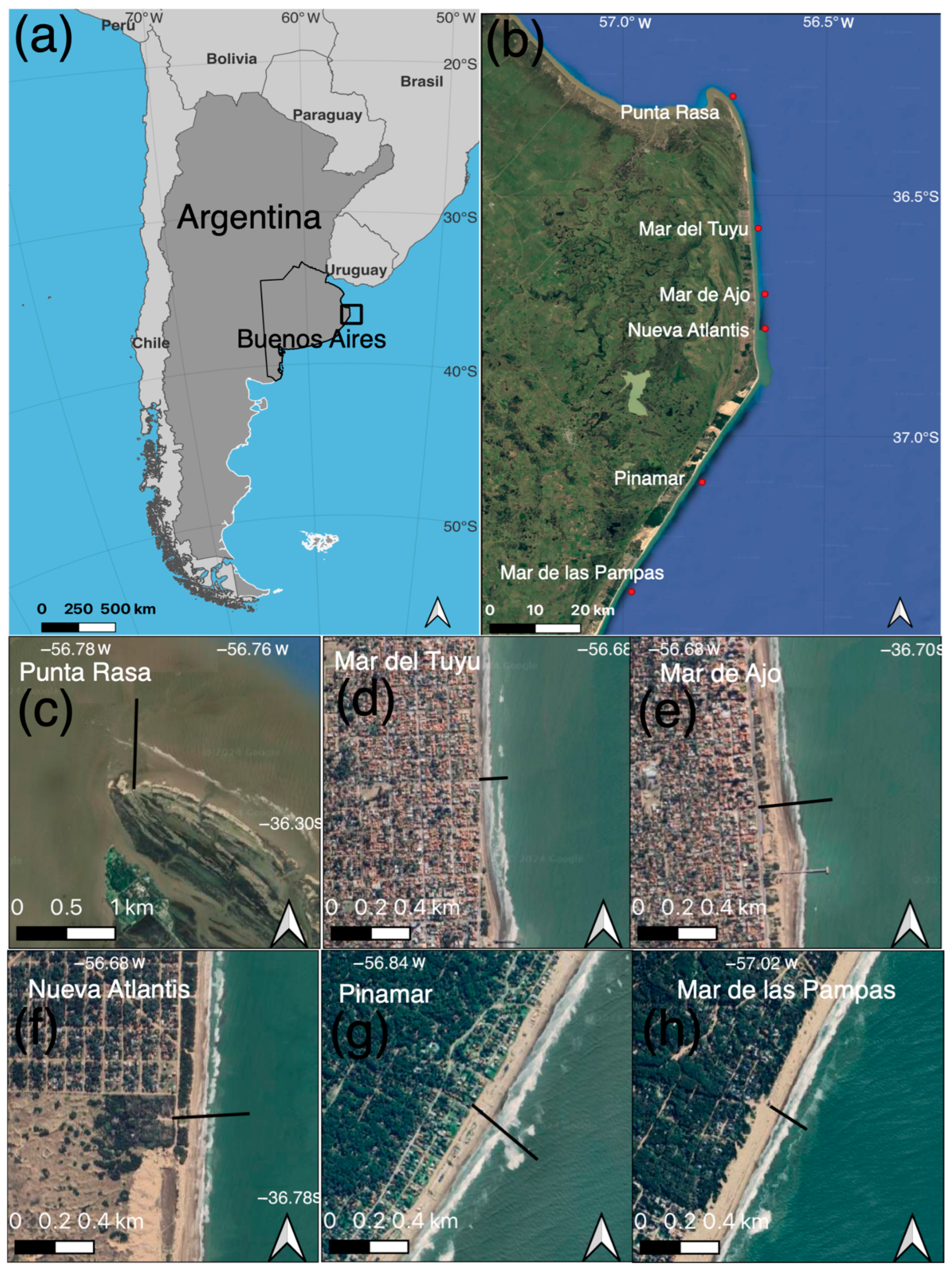
The Buenos Aires Province coastal region attracts approximately 3 million summer visitors to its sandy beaches. Despite that, monitoring programs of coastal dynamics in this area are scarce. Most studies focus on specific sites with sporadic observations; even sustained monitoring efforts are challenging (e.g., [33,34]). An exception is [35], the authors of which systematically surveyed beach profiles at six sites: Punta Rasa (PR), Mar del Tuyú (MDT), Mar de Ajó (MDA), Nueva Atlantis (NA), Pinamar (PI), and Mar de las Pampas (MDP) (Figure 1). Monthly profiles, collected from 2009 to 2018 during low spring tide to enable measurements over the sub-aerial beach, provide a valuable dataset for validating SDSs in the region.
According to [35], Buenos Aires Province’s beaches are composed of medium to fine sands and show seasonal changes, with the formation of temporary berms during summer. Beach width ranges between 40 and 70 m, with slopes varying from 0.017 to 0.045. The area is characterized by a mixed semidiurnal microtidal regime, with mean spring tidal ranges between 0.68 m at Pinamar and 0.77 m at San Clemente del Tuyú [36] and 1 m average offshore significant wave height, predominantly from the SE, E, and S. Visual observations at the surf zone of Pinamar indicate mean breaker heights of approximately 0.91 m [37], suggesting moderate wave transformation between offshore and nearshore conditions under typical conditions.
Beach surveys were carried out along fixed lines perpendicular to the shore, hereafter referred to as transects, that correspond to the regularly monitored beach profile at PR, MDT, MDA, NA, PI and MDP (Figure 1, black lines). At most sites, each transect extends from the dune down to approximately 1 m water depth. The exception is MDT, where the original dune line has been removed due to urban development; here, the transect begins at the urban front. Elevation measurements along each beach profile were acquired using precise geometric leveling (optical level and staff) following the procedure described in [35]. The instrument has a nominal error of ±1.5 mm per km of double leveling, which, over the short distances of these profiles (typically <400 m), results in vertical accuracies on the order of 1–5 mm. Considering operator and closure uncertainties, a conservative overall accuracy of ±1 cm is adopted for the beach profiles. All measurements were tied to permanent benchmarks at each site. Profile elevations were referenced to the mean sea level (MSL) and horizontally interpolated to obtain values every 5 m along each transect. At each site, between 49 and 57 beach profiles were surveyed per transect during the period October 2009–2018. Survey frequency was higher prior to 2016, with no gaps exceeding three consecutive months. After 2016, the frequency decreased due to intermittent logistical and operational constraints.
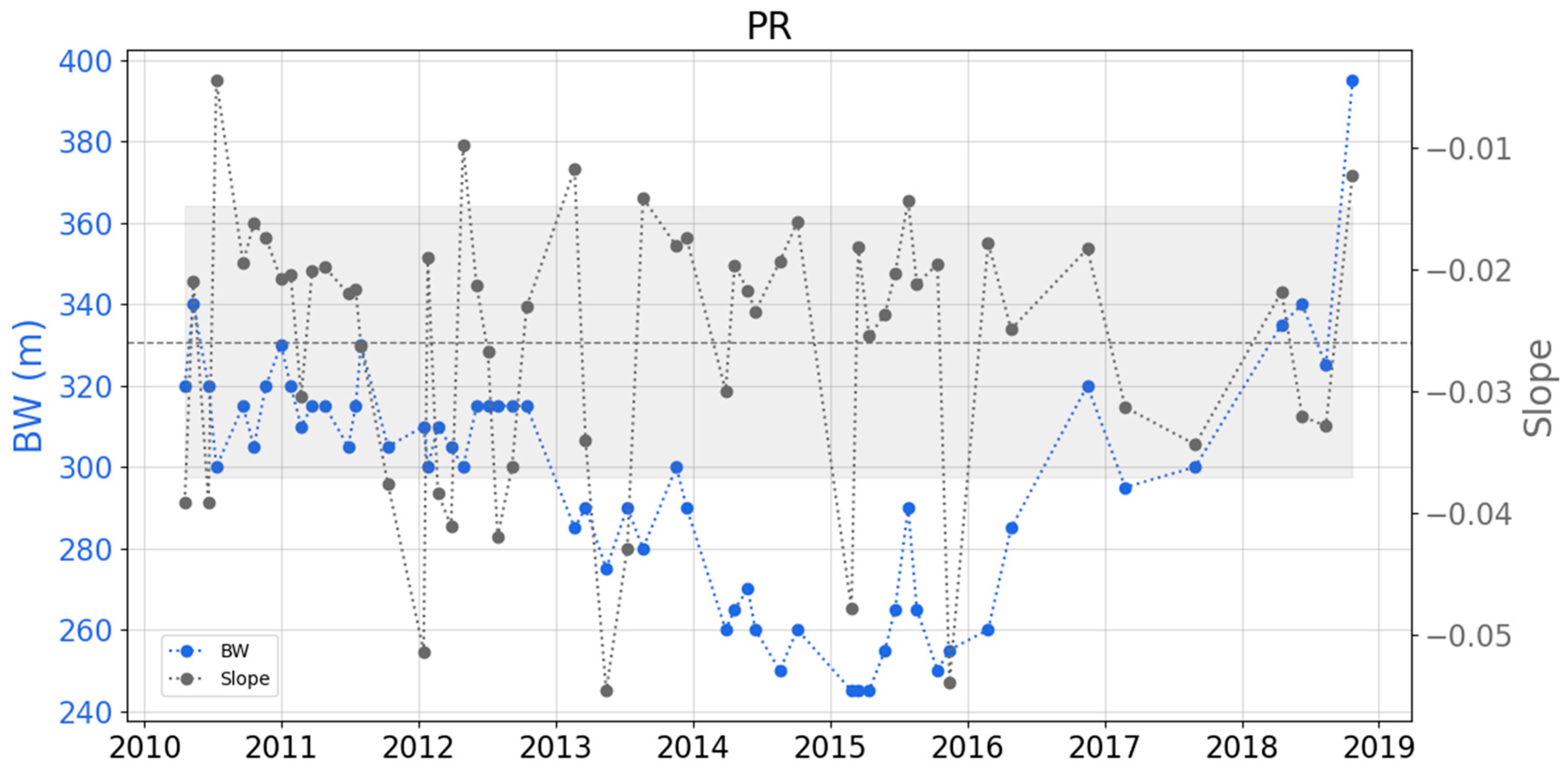
Beach width (BWobs) is defined as the horizontal distance from the benchmark to the intersection of the beach profile with MSL (Figure 2). Beach face slope was then estimated by a linear fit of the elevation along the active beach profile, defined as the segment between the Highest Astronomical Tide (HAT) and the Lowest Astronomical Tide (LAT) [35]. BWobs and the slope were derived from each surveyed profile, yielding a set of time series at all study sites, as illustrated for PR in Figure 2. For comparison, an additional slope was computed using the segment between the Mean Highest High Water (MHHW) and the Mean Lowest Low Water (MLLW).
It is important to mention that the site MDT is strongly modified by human intervention: the original dune line was removed to extend the urban front, with buildings constructed directly on the former beach. As a result, the site exhibits persistent chronic erosion, and most of the profile now remains permanently wet. Consequently, 20 out of 54 in situ measurements for MDT were discarded because the surveyed profiles were too short, as they were entirely below the MSL.

2.2. Satellite-Derived Beach Width Using CoastSat

Satellite-derived beach widths (BWsat) were computed using the CoastSat 2.5 toolkit [7], open-source Python 3.11 software, for the extraction of satellite-derived shorelines (SDSs). In CoastSat, the workflow includes image acquisition and preprocessing, supervised classification, shoreline extraction, and beach width computation along fixed transects.
Top-of-atmosphere multispectral bands for the region of interest were accessed and cropped via the Google Earth Engine’s API [6]. Satellite data from Landsat missions L5 (1986–2012), L7 (1999–2023), L8 (2013–2023), L9 (2021–2023), and Sentinel mission S2 (2015–2023) were downloaded over six polygons (i.e., area of interest) ranging in area from 13 km2 to 14 km2. The images, then, underwent local down-sampling from pixel to sub-pixel resolution, from 30 m to 15 m in Landsat and from 20 to 10 m in Sentinel. Images with more than 60% cloud-covered pixels were excluded from further analysis.
To map the sand–water interface, supervised image classifiers were trained using a set of Sentinel-2 (S2) and Landsat-8 (L8) images acquired between January 2019 and July 2019, selected to sample different tidal stages, ensuring that both dry and wet sand pixels were represented. Following the standard CoastSat classification scheme, pixels were manually labeled into four classes: sand, water, white water, and other land features. To mitigate class imbalance, the training set was balanced prior to model fitting, ensuring adequate representation of sand pixels. Locally labeled pixels were combined with a reduced subset of the original CoastSat training library, retaining only the white-water class to improve representation of wave-breaking conditions while preserving local spectral characteristics (Table S1). For each sensor family, a supervised classifier based on a Multilayer Perceptron was trained using multispectral reflectance features (scikit-learn; [38]). Sensor-specific classifiers were then applied to the full image archive, using the L8-trained model for all Landsat missions and the S2-trained model for Sentinel-2 imagery. Additional details are provided in the Supplementary Materials (Section S1: Image Classification Procedure). In addition, shoreline extraction was also performed using the default CoastSat classifier, which served as a baseline for comparison.
For each image, the Modified Normalized Difference Water Index (MNDWI) was computed, and an adaptive Otsu threshold [39] was applied to maximize inter-class variance between sand and water. Shoreline positions were then extracted from the thresholded MNDWI image using the Marching Squares algorithm [40], yielding the raw satellite-derived shorelines (raw SDSs). To reduce spurious detections and constrain unrealistic shoreline positions, a reference shoreline was manually digitized for each study site and used as a spatial constraint during automated shoreline extraction. The parameters adopted for shoreline detection are summarized in Table S2, while the threshold values defining the maximum allowed deviation from the reference shoreline are reported in Table S3.
Using this workflow, CoastSat detected 8247 raw SDSs across the six polygons. Erroneous, mis-referenced, and duplicated detections were subsequently removed, resulting in a total of 6509 usable raw SDSs for the period 1986–2023. To compute satellite-derived beach width comparable with in situ measurements (BWobs), each SDS was intersected with the transects used for the beach profiles (black lines in Figure 1), obtaining a raw BWsat for each transect and acquisition time. A detailed description of the shoreline–transect intersection procedure is provided in the Supplementary Materials (Section S2: CoastSat Configuration), including the adopted parameters summarized in Table S4.

2.3. Water Level Correction of BWsat

Raw SDSs detected on individual satellite images correspond to different instantaneous water levels (tide + nontidal components, z w l ). As a result, the raw BWsat reflects water level variability rather than morphological change. To remove this effect, each raw SDS is horizontally corrected to a reference elevation ( z r e f =   M S L ) using the beach slope.
Following ref. [14], the corrected cross-shore position is as follows:
x c o r r e c t e d = x w l + Δ x  
where:
Δ x =   z r e f z w l m  
Here, x w l is the instantaneous core shore water position, z w l is the corresponding water level (tidal + nontidal), z r e f is the reference elevation (MSL), and m =   t a n β is the beach slope. Both water level data and beach slope estimates are therefore required to apply the correction. For z w l , two types of modeled water level series were used: one considering only the tidal signal, and another representing regional water levels influenced by both tidal and atmospheric forcing (Section 2.3.1 and Section 2.3.2).

2.3.1. Tidal Levels

The CoastSat toolbox provides sea level series derived from the FES2022 [30] solution, which represents only the tidal component of sea level variability. These tidal elevations were used as one of the inputs of z w l in BWsat correction.

2.3.2. Sea Levels

To account for nontidal sea level variability, water level solutions from the Modelling System for the Argentine Sea (MSAS; [41]) were incorporated. MSAS is an adaptation of the scientific community numerical ocean model CROCO (Coastal and Regional Ocean COmmunity Model, http://www.croco-ocean.org (accessed 1 March 2026) [42]), whose source code has been modified to resolve the nonlinear depth-averaged horizontal momentum and continuity equations [28,29,41]. MSAS covers the Southwestern Atlantic Continental Shelf with a regular grid resolution of 1/8° and is forced by (i) 20 tidal constituents provided by the global tidal model TPXO9 [43]; (ii) surface stress tensor and atmospheric surface pressure derived from Climate Forecast System Reanalysis (CFSR) produced by the National Center for Environmental Prediction (NCEP) [43]; and (iii) daily observations of river runoff provided by the National Institute of Water [44] and the National System of Hydric Information.
MSAS solutions have been extensively validated against tide gauge observations along the Argentinian coast, including stations located near the present study area (e.g., San Clemente, Pinamar and Mar del Plata) and altimetry data. Hindcast evaluations show root mean square differences of approximately 0.20–0.25 m for total sea level anomalies, corresponding to normalized errors of about 6–9%, with linear correlations exceeding 0.8 and skill scores typically above 0.9 under both normal and storm surge conditions [41]. More recent evaluations of the MSAS model further demonstrate its ability to reproduce both the amplitude and timing of sea level variability along the Argentine coast. Ref. [29] showed that the model accurately captures the phase and propagation of atmospherically forced sea level anomalies across the Southwestern Atlantic Continental Shelf, maintaining high correlations with tide gauge observations over synoptic to intraseasonal time scales. The reader is referred to [45] for further information about MSAS and its performance in the context of current and operative ocean numerical models around the world.

2.3.3. Wave Setup

Wave setup can be removed from beach width data using a method analogous to tidal correction. This involves converting a vertical displacement to a horizontal one assuming a known beach slope, as described by Equation (1), but replacing z t i d e for z s e t u p . This vertical displacement is calculated following the generalized parameterization of [46]:
z s e t u p   =   0.35   t a n   β   ( H s L p ) 0.5
where H s is the significant wave height and L p is the peak wavelength in deep waters. Wave parameters from WAVERYS [47] were used to compute wave setup using six nodes approximately 2 km offshore of the transects (Figure 1b). This global product is the one that most accurately represents the wave parameters in the study area [48].

2.4. Satellite-Derived Beach Slope: CoastSat.Slope (CS.slope)

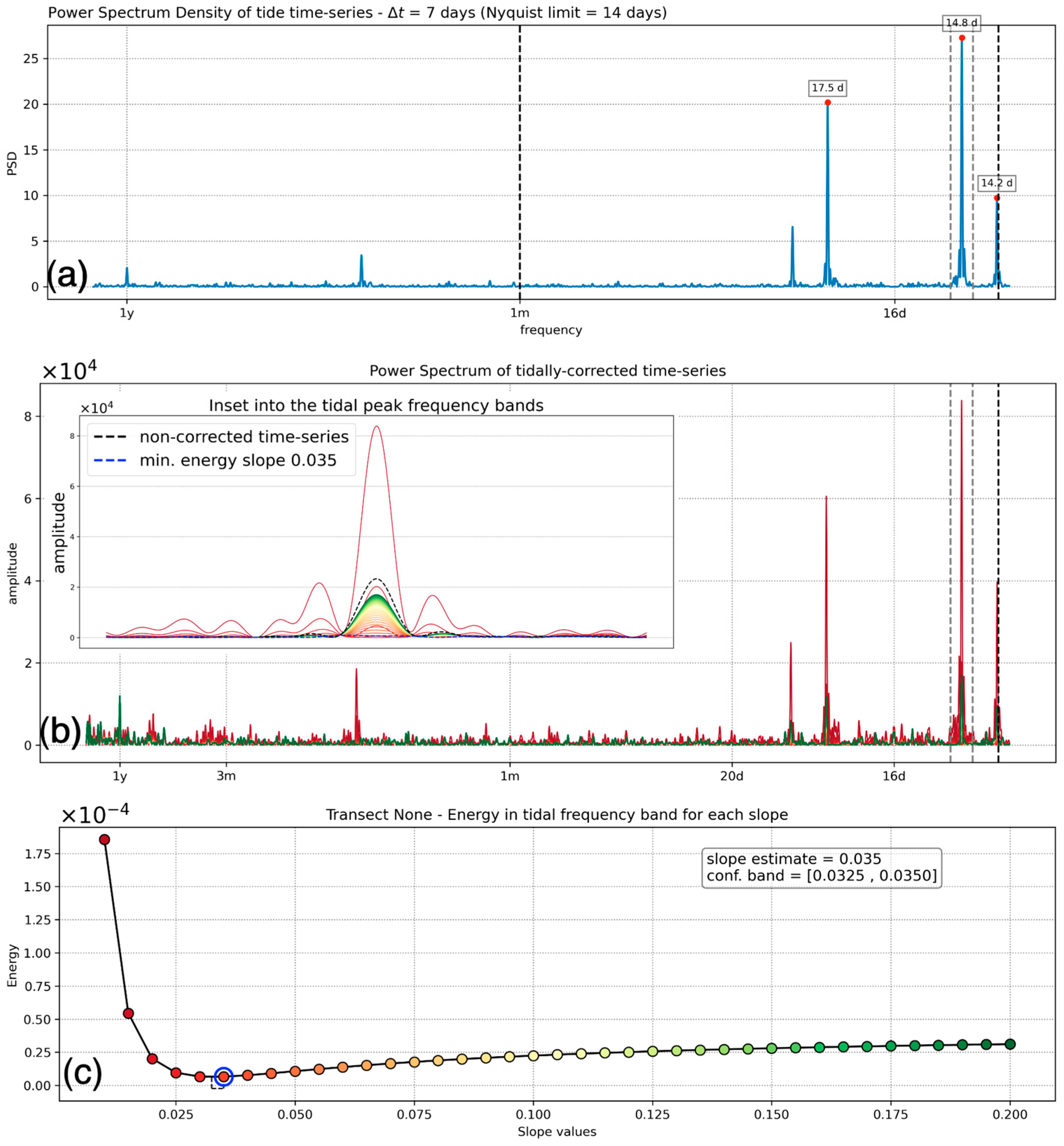
CS.slope [13] is an automated method for estimating global beach slope using SDSs, relying solely on remotely sensed data. To summarize CS.slope’s workflow, the detailed steps are outlined using data corresponding to MDA as an example. First, SDSs were extracted using CoastSat with locally trained classifiers, and then BWsat values were calculated for transects perpendicular to the coast (Section 2.2). Tidal levels at image acquisition times were obtained from FES2022. Subsequently, the “peak tidal frequency” in these irregularly sampled series was identified from the power spectral density (PSD), calculated with the Lomb–Scargle transform [49]. Figure 3a shows the PSD of the tidal series sampled at image times, with the highest peak near the spring-neap fortnightly cycle (14.76 days). Tidal correction (Section 2.3) was then applied to BWsat using a set of candidate slope values from 0.01 to 0.20, with the latter considered the maximum slope (indeed widely applicable) for sandy beach face slope [50]. For each candidate slope, the PSD of the tidally corrected BWsat time series was computed and tidal energy within the peak frequency band (gray dashed lines in Figure 3a) was quantified using the Lomb–Scargle approach. The optimal slope was defined as the one that minimizes tidal energy in the corrected time series [13] (Figure 3c). The physical rationale behind this criterion is that an accurate slope estimate will fully remove the tidal modulation from the corrected shoreline time series; an incorrect slope will leave residual tidal energy at the spring-neap frequency, which manifests as a detectable peak in the power spectrum.
Figure 3b shows the resulting PSD curves of the tidally corrected BWsat series for the tested slopes. The inset around the tidal peak frequency (~14.8 days) demonstrates how the magnitude of this peak is modulated by the slope value used for tidal correction. In this example (MDA), the ~14.8-day peak is effectively suppressed using a slope of 0.035 (blue dashed line, zoom in Figure 3b). The parameter values used for remote slope estimation are summarized in Table S5.

2.5. Validation

BWsat data were matched to BWobs within a ±3-day window, assuming limited morphological changes on this time scale. When no satellite detections were available within this range, but detections existed within ±10 days, BWsat at the in situ date was estimated by temporal interpolation. In the absence of satellite detections within either window, the corresponding observation was excluded from validation (31–52%, depending on location).
Raw SDSs were extracted with CoastSat using two image classification strategies: the default CoastSat pre-trained classifier and a locally trained classifier. For each strategy, raw BWsat values were computed as the intersection between the raw SDSs and the transects used for the beach profiles (see Section 2.2). The resulting raw BWsat was then corrected for water level variability using two alternative series: tidal prediction from FES2022 and sea level solutions from MSAS. For each time series, corrections were applied both with and without wave setup. To ensure consistent temporal coverage across all validation scenarios, periods with missing MSAS information—caused by gaps in atmospheric forcing fields in 2011 [43]—were excluded. As a result, up to nine observed beach profiles were removed to maintain consistency across all validation scenarios.
Because both tidal and wave setup corrections require an estimate of beach slope, slopes derived using the CS.slope module were independently validated beforehand (Section 2.4). In addition, a sensitivity analysis was conducted to assess the influence of slope variability on the corrected BWsat time series. The combination of classifier strategy, sea level forcing, and wave setup inclusion resulted in six scenarios (Table 1).
To quantify the agreement between BWsat and BWobs, we used the coefficient of determination (R2), the root mean square error (RMSE), bias (negative for landward offsets and positive for seaward offset) and the standard deviation of the individual errors (STDe). Trends in BWsat time series were calculated via Sen’s method, and their statistical significance was assessed with the non-seasonal Mann–Kendall test [51,52] at a 95% confidence level.

3. Results

3.1. Mean Beach Slope Validation

Table 2 presents a comparison between mean beach slopes obtained from the observed profiles described in Section 2.5 and slopes computed with CS.slope tool following the methodology described in Section 2.5. The results show that CS.slope overestimates the slope value at most sites. For the HAT–LAT range, the comparison yields a correlation coefficient of r = 0.678 (R2 = 0.460), with a bias of 0.011 and an RMSE of 0.013. Similarly, for the MHHW–MLLW range, the correlation coefficient is r = 0.669 (R2 = 0.448), with a bias of 0.008 and an RMSE of 0.011.

3.2. Beach Width Validation

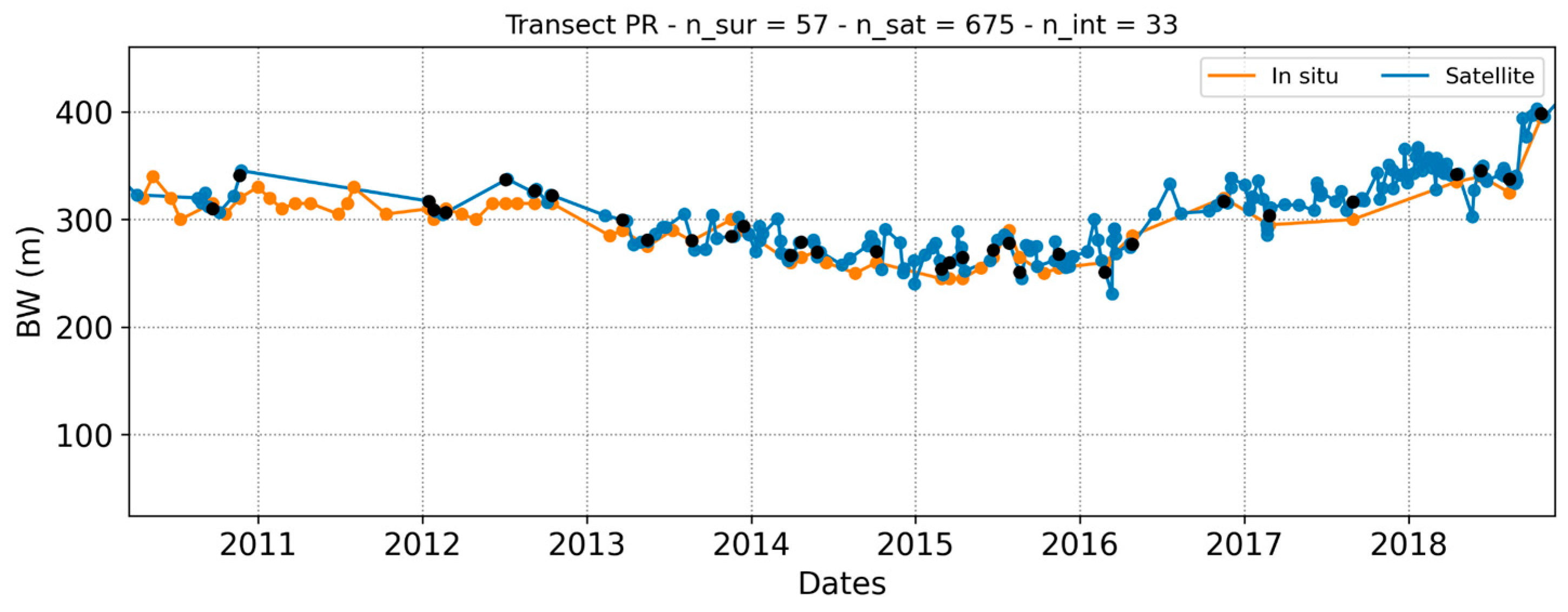
The validation of BWsat was conducted for each scenario reported in Table 1 using the slopes from CS.slope reported in the previous section (Table 2). As an example, Figure 4 presents a comparison between BWsatS2 (blue dots) and BWobs (orange dots) at PR. Satellite data that are selected for comparison with in situ measurements are highlighted with black circles in Figure 4.
Statistical scores for all sites and scenarios are summarized in Table 3. The results indicate that when considering corrections based on water levels from FES2022 without wave setup, the use of the locally trained classifier (S3) consistently improves metrics compared to the default classifier (S1). Across sites, RMSE values decrease from 9–21 m in S1 to 7–12 m in S3, with corresponding reductions in the STDe. Bias values are predominantly positive, indicating that BWsat tends to overestimate BWobs, consistent with the seaward displacement of the detected shoreline. Using sea level from MSAS in the correction (S2 and S4) generally leads to further improvements in performance. For most sites, RMSE and STDe values are comparable to or lower than those obtained using FES2022, particularly when combined with the locally trained classifier (S4). Correlation coefficients (R2) increase at several locations, notably at PR, where values remain close to 0.9 across configurations.
The inclusion of wave setup correction (S5 and S6) does not necessarily improve beach width estimations. On the contrary, adding setup generally increases RMSE and STDe and introduces a systematic seaward bias at all sites. Mean setup corrections are on the order of ~3 m at PR and MDT and ~4 m at the remaining sites, with maximum values reaching ~7 m at PR and ~9 m elsewhere. These effects are observed for both FES- and MSAS-based corrections.
Overall, the results indicate that classifier training strategy and water level forcing exert a stronger controlling effect on BWsat accuracy than the inclusion of wave setup for the sites analyzed here.
To further assess the consistency of satellite-derived beach width estimates at longer temporal scales, mean values, standard deviations, and trends were computed for the period 2010–2015 using both BWobs and BWsat corrected with FES (S3) and MSAS (S4) (Table 4). The period was selected because gaps in the in situ time series do not exceed three consecutive months, ensuring robust statistical estimates. Both MSAS- and FES-based corrections yield mean beach widths comparable to the in situ observations, although satellite-derived series exhibit larger standard deviations, reflecting higher short-term variability. Trends are consistently captured by BWsat for both sea level forcings, with slightly larger trend magnitudes compared to the in situ estimates. These results indicate that, despite differences in instantaneous error metrics, satellite-derived beach widths reproduce the main statistical properties and medium-term evolution observed in the in situ data.

3.3. BWsat Sensitivity to Beach Slope Variation

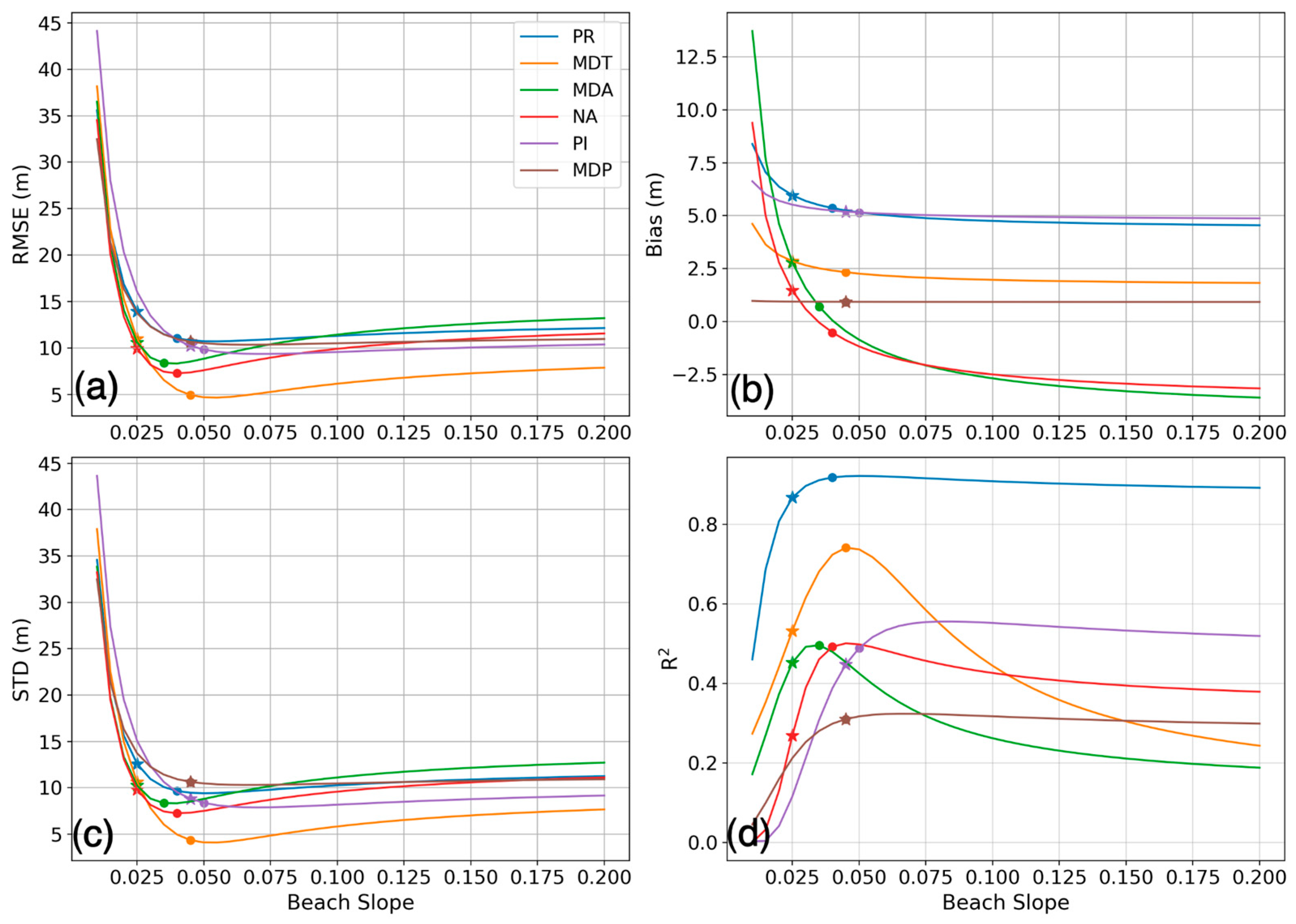
The sensitivity of sea level correction for BWsat to beach slope variation was analyzed using BWobs over the period 1986–2021. Corrections were performed using sea levels from MSAS and beach slopes values ranging from 0.01 to 0.2 in increments of 0.005. Figure 5 illustrates the metrics as a function of beach slope at each site; it should be mentioned that stars mark observed beach slopes, whereas dots indicate values derived from CS.slope. For all sites, the RMSE exhibits a consistent nonlinear response to slope, decreasing from small slope values to a minimum at intermediate ones, then slightly increasing toward larger beach slopes, reaching site-specific asymptotic values below ~14 m (Figure 5a). A similar pattern is observed for STDe (Figure 5c). In most cases, the RMSE and STDe obtained from CS.slope are lower than those from in situ beach slope estimates. Bias displays site-dependent behavior (Figure 5b). At PR and MDT, bias remains positive but decreases with increasing beach slope, whereas at MDA and NA it transitions from positive to negative values as beach slope increases. At PI, bias changes from negative to positive, while at MDP it remains consistently negative with limited sensitivity to beach slope. Across sites, bias values associated with CS.slope are generally closer to zero. The coefficient of determination (R2) increases with slope up to a maximum and decreases thereafter (Figure 5d). Except at MDA, the highest R2 values occur within the range of observed in situ beach slopes, indicating that intermediate values provide the best agreement between BWsat and BWobs.

4. Discussion and Conclusions

This study assessed the performance of the CoastSat and CoastSat.slope tools for shoreline and beach slope characterization using satellite-derived data. The validation spans six sites distributed along a ~130 km coastal sector and combines multi-year in situ beach profile observations, offering a solid basis for evaluating tool accuracy and configuration (classifier strategy, water level forcing, wave setup inclusion, and slope sensitivity). This regional, multi-site design allows conclusions to be drawn beyond a single-beach case study and provides practical guidance for applying CoastSat to other microtidal beach systems where atmospheric forcing significantly contributes to sea level variability.
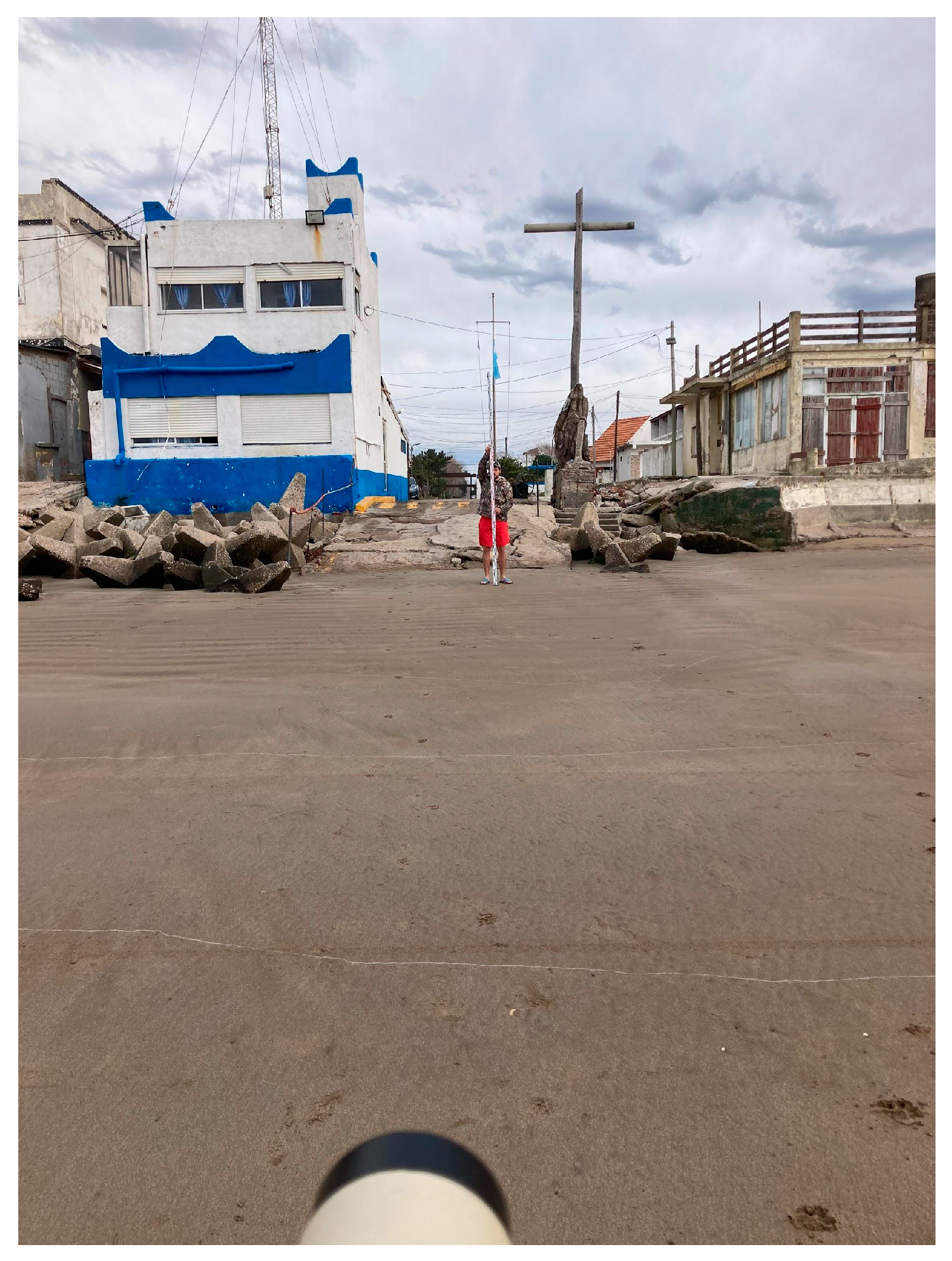
CS.slope estimates characteristic beach slopes using open-access data, making it applicable globally at a chosen spatial resolution. While validation by [13] reported strong agreement with field surveys (R2 = 0.93), other studies found much weaker correlations (e.g., [53] R2 = 0.22; [23] R2 = 0.2). In this study, CS.slope was applied to six sites, generally overestimating slopes compared to in situ measurements. These satellite-derived slopes were closer to those calculated between LAT and HAT (R2 = 0.46). The largest discrepancy occurred at MDT (0.02), likely reflecting its strong anthropogenic alteration, including beachfront constructions and chronic erosion (Figure 6). Sensitivity analysis demonstrates that slope underestimation produces much larger errors than overestimation. As a result, despite its positive bias, using CS.slope-derived slopes improved the validation metrics (RMSE, bias and STDe) compared to using field-derived slopes. This behavior can be explained by the fact that CS.slope provides an effective approximation of the beach slope in the vicinity of the mean sea level (MSL) isocontour, which is the elevation most frequently sampled by satellite-derived shorelines, as satellite acquisition times are characterized by an approximately symmetric distribution of water levels around the MSL across the study sites (51% negative and 49% positive water levels). These results emphasize that CS.slope should be interpreted as an effective slope associated with the water level range most frequently sampled by satellite-derived shorelines, rather than as a direct substitute for geomorphic slope estimates computed over the full tidal range. In this context, CS.slope can be considered a reliable tool for tidal corrections in satellite-derived beach width (BWsat) time series, while its systematic tendency to overestimate values should still be acknowledged when interpreting absolute slope magnitudes.
It was found that one of the main sources of error in BWsat is sea level correction [10]. Tidal corrections can be applied without in situ data using the global FES2022 model and CS.slope-derived beach slopes. This approach, based on freely available datasets, achieved RMSE values below 12 m across all sites, within the sub-pixel resolution of the method. Except at NA, where the STDe exceeded the STD of in situ data by 1 m, the STDe was equal to or smaller than the in situ STD, suggesting that residual detection uncertainty is comparable to (or smaller than) the observed short-term variability at most sites. FES2022 provides tidal levels but lacks atmospheric effects, which in some coasts of the world can contribute significantly to sea level variance such as, for instance, Buenos Aires Province coastline [54]. The MSAS numerical solutions, which incorporate atmospheric effects, improved validation metrics by reducing the RMSE at all study sites (except MDP, where it remained unchanged) and maintaining the STDe at or below the in situ STD. This indicates that detection errors remain within the range of natural variability. While MSAS outperformed FES2022, its one-year temporal gap limits its use for long-term climatology of beach width. Apart from that, BWsat effectively captured mean beach width and trends at all sites using both models, accurately reflecting beach characteristics.
Another physically justified sea level adjustment involves correcting for wave effects by incorporating a wave setup term. When converted to a horizontal shoreline displacement, the slope cancels out in the formulation used. This means that the performance of the wave setup correction depends entirely on offshore wave parameters. Ref. [55] showed that empirical approaches to wave setup yield highly variable results depending on the local wave input and that regional offshore wave products systematically differ from nearshore estimates derived from phase-resolving models. In low-energy environments such as the Buenos Aires Province coast, where mean significant wave heights are approximately 1 m, offshore wave parameters fall at the lower end of the conditions under which the formulation was originally calibrated, rendering them a poor proxy for the wave setup actually developing in the surf zone. This explains why, in contrast to results reported for high-energy microtidal coasts [23] and meso- to macrotidal beaches [19,56,57,58,59], the wave setup correction did not improve shoreline-based beach width estimates in the present study and introduced a systematic seaward bias at all sites. Improving the wave setup correction in this setting would require high-resolution nearshore bathymetric surveys and local wave modeling at each site, as regional wave modeling has been shown to systematically underestimate wave setup relative to phase-resolving local approaches [55].
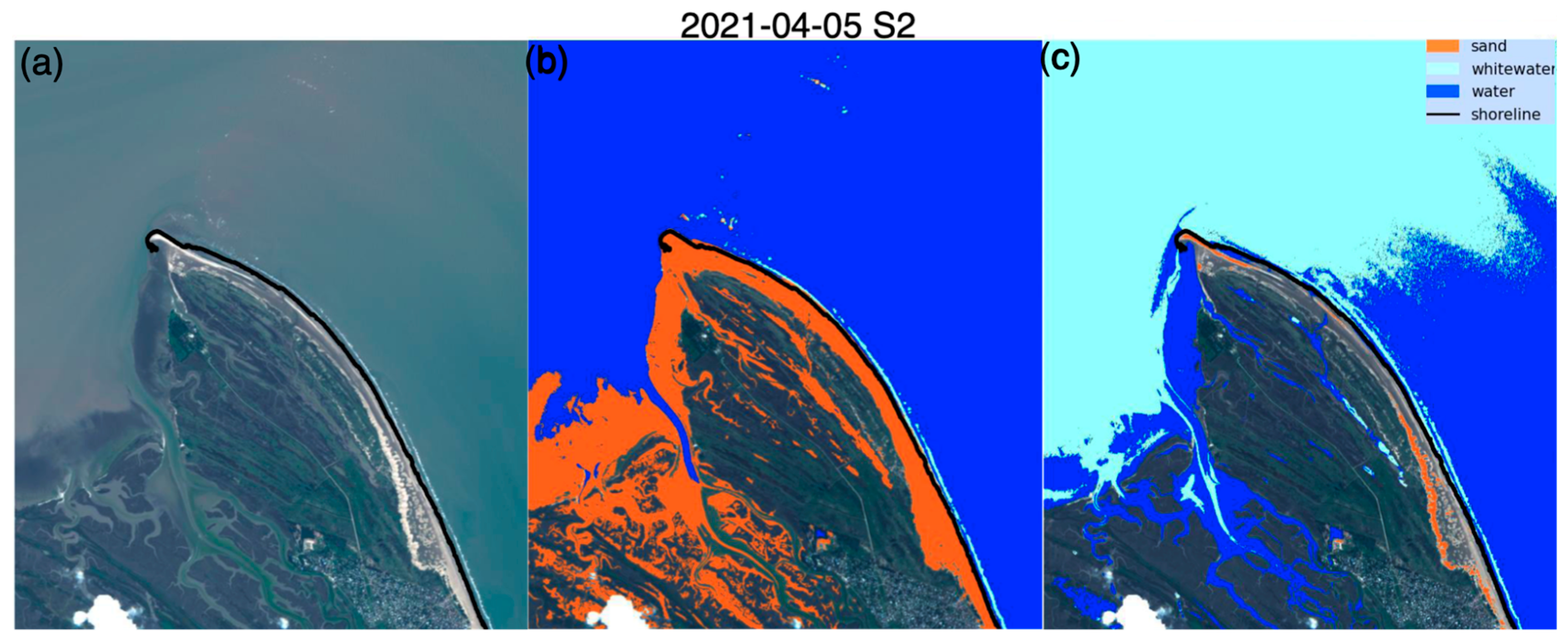
In this study, the default pre-trained classifier was adopted as the reference configuration and is the one presented in the results, as it provided the best performance among the built-in CoastSat classifiers. Alternative pre-trained options were also tested but resulted in poorer shoreline detection for the study area. However, training a new classifier specific to the study area’s satellite images significantly improved the performance. For example, at PR and MDT, the RMSE decreased by more than 70% when using locally trained classifiers. The improvement at MDT is notable given its highly urbanized nature, where beach profiles are predominantly wet and disrupted by constructions directly on the beach. On the other hand, PR’s unique estuary–ocean setting at Punta Rasa introduces sediments of sand, silt, and clay [60], which challenge the standard classifier’s ability to identify sandy pixels accurately (Figure 7). These results suggest that pre-trained models may struggle in complex environments like MDT and PR. Thus, for enhanced accuracy, training a classifier with local imagery is recommended when performing automatic shoreline detection in estuarine zones, deltas, or urban beaches worldwide.
Overall, the validation results indicate that satellite-derived beach widths depend primarily on the representation of sea level variability and the image-classification strategy, rather than on the inclusion of wave-related corrections. The combination of a locally trained image classifier with MSAS-derived water levels yields the most consistent agreement with in situ measurements across sites, while corrections based solely on FES2022 also provide reasonable estimates when regional atmospheric forcing is not available. The contrasting behavior of wave setup corrections, detrimental in this low-energy setting but beneficial in high-energy environments [23,61], underscores the importance of adapting correction strategies to local hydrodynamic conditions rather than applying them by default [10,46]. While this study demonstrates that satellite-based shoreline analysis can reliably capture both instantaneous variability and medium-term trends when key methodological choices are tailored to the local setting, its findings are specific to a microtidal coast with strong atmospheric forcing and low wave energy. Extending these insights to other data-scarce coastal regions with similar characteristics represents a promising direction for future work [19,62].

Supplementary Materials

The following supporting information can be downloaded at https://www.mdpi.com/article/10.3390/coasts6010011/s1: Table S1: Summary of image preprocessing parameters and training dataset composition for the supervised shoreline classification. The table reports preprocessing settings applied prior to classification, number of images downloaded and manually labeled for Landsat 8 (L8) and Sentinel-2 (S2), number of manually annotated pixels per class, augmented training dataset after incorporation of additional white-water samples from the original CoastSat training set, and final balanced training dataset used for model fitting.; Table S2: Shoreline extraction parameters used in the CoastSat workflow; Table S3: Maximum distance threshold (max_dist_ref, in meters) used to constrain automated shoreline detections relative to the manually digitized reference shoreline for each study site; Table S4: Parameters used to compute shoreline–transect intersections with compute_intersection_QC(); Table S5: Parameters used for beach-face slope estimation with the CoastSat SDS_slope module. The table reports the range of candidate slopes evaluated, temporal window, sampling interval, and spectral analysis parameters used for tidal peak identification and confidence assessment.

Author Contributions

Conceptualization, C.B. and G.A.; methodology, C.B., G.A. and M.D.; software, C.B.; validation, C.B.; formal analysis, C.B., G.A. and M.D.; investigation, C.B. and G.A.; resources, W.D.; data curation, C.B.; writing—original draft preparation, C.B. and M.D.; writing—review and editing, G.A. and W.D.; visualization, G.A. and W.D.; supervision, W.D.; project administration, G.A.; funding acquisition, W.D. All authors have read and agreed to the published version of the manuscript.

Funding

This work was supported by the Consejo Nacional de Investigaciones Científicas y Técnicas de Argentina (Grant number: 112-202001-01402CO). The Article Processing Charge (APC) for this publication was covered by an APC waiver granted by the publisher.

Data Availability Statement

The original data presented in the study are openly available in the Assessment of Satellite-Derived Shorelines and beach slopes in Buenos Aires Province (Argentina). CoastSat and CoastSat.slope can be accessed at https://doi.org/10.5281/zenodo.17902152.

Conflicts of Interest

The authors declare no conflicts of interest.

References

  1. Banno, M.; Nakamura, S.; Kosako, T.; Nakagawa, Y.; Yanagishima, S.; Kuriyama, Y. Long-Term Observations of Beach Variability at Hasaki, Japan. J. Mar. Sci. Eng. 2020, 8, 871. [Google Scholar] [CrossRef]
  2. Barnard, P.L.; Short, A.D.; Harley, M.D.; Splinter, K.D.; Vitousek, S.; Turner, I.L.; Allan, J.; Banno, M.; Bryan, K.R.; Doria, A.; et al. Coastal Vulnerability across the Pacific Dominated by El Niño/Southern Oscillation. Nat. Geosci. 2015, 8, 801–807. [Google Scholar] [CrossRef]
  3. de Alegría-Arzaburu, A.R.; Gracia-Barrera, A.D.; Kono-Martínez, T.; Coco, G. Subaerial and Upper-Shoreface Morphodynamics of a Highly-Dynamic Enclosed Beach in NW Baja California. Geomorphology 2022, 413, 108336. [Google Scholar] [CrossRef]
  4. Turner, I.L.; Harley, M.D.; Short, A.D.; Simmons, J.A.; Bracs, M.A.; Phillips, M.S.; Splinter, K.D. A Multi-Decade Dataset of Monthly Beach Profile Surveys and Inshore Wave Forcing at Narrabeen, Australia. Sci. Data 2016, 3, 160024. [Google Scholar] [CrossRef] [PubMed]
  5. Viaña-Borja, S.P.; Fernández-Mora, A.; Stumpf, R.P.; Navarro, G.; Caballero, I. Semi-Automated Bathymetry Using Sentinel-2 for Coastal Monitoring in the Western Mediterranean. Int. J. Appl. Earth Obs. Geoinf. 2023, 120, 103328. [Google Scholar] [CrossRef]
  6. Gorelick, N.; Hancher, M.; Dixon, M.; Ilyushchenko, S.; Thau, D.; Moore, R. Google Earth Engine: Planetary-Scale Geospatial Analysis for Everyone. Remote Sens. Environ. 2017, 202, 18–27. [Google Scholar] [CrossRef]
  7. Vos, K.; Splinter, K.D.; Harley, M.D.; Simmons, J.A.; Turner, I.L. CoastSat: A Google Earth Engine-Enabled Python Toolkit to Extract Shorelines from Publicly Available Satellite Imagery. Environ. Model. Softw. 2019, 122, 104528. [Google Scholar] [CrossRef]
  8. Sánchez-García, E.; Palomar-Vázquez, J.M.; Pardo-Pascual, J.E.; Almonacid-Caballer, J.; Cabezas-Rabadán, C.; Gómez-Pujol, L. An Efficient Protocol for Accurate and Massive Shoreline Definition from Mid-Resolution Satellite Imagery. Coast. Eng. 2020, 160, 103732. [Google Scholar] [CrossRef]
  9. Almeida, L.P.; Efraim De Oliveira, I.; Lyra, R.; Scaranto Dazzi, R.L.; Martins, V.G.; Henrique Da Fontoura Klein, A. Coastal Analyst System from Space Imagery Engine (CASSIE): Shoreline Management Module. Environ. Model. Softw. 2021, 140, 105033. [Google Scholar] [CrossRef]
  10. Vos, K.; Splinter, K.; Palomar-Vázquez, J.; Pardo-Pascual, J.; Cabezas-Rabadán, C.; Almonacid-Caballer, J.; Kras, E.; Luijendijk, A.; Calkoen, F.; Almeida, L.; et al. Satellite-Derived Shorelines for Monitoring of Sandy Beaches: A Benchmark Study. 2023. Available online: https://eartharxiv.org/repository/view/5564/ (accessed on 20 December 2025).
  11. Davies, J.L. A Morphogenic Approach to World Shorelines. Z. Geomorphol. 1964, 8, 127–142. [Google Scholar] [CrossRef]
  12. Masselink, G.; Hughes, M.; Knight, J. Introduction to Coastal Processes and Geomorphology; Routledge: Abingdon-on-Thames, UK, 2014. [Google Scholar]
  13. Vos, K.; Harley, M.D.; Splinter, K.D.; Walker, A.; Turner, I.L. Beach Slopes From Satellite-Derived Shorelines. Geophys. Res. Lett. 2020, 47, e2020GL088365. [Google Scholar] [CrossRef]
  14. Vos, K.; Harley, M.D.; Splinter, K.D.; Simmons, J.A.; Turner, I.L. Sub-Annual to Multi-Decadal Shoreline Variability from Publicly Available Satellite Imagery. Coast. Eng. 2019, 150, 160–174. [Google Scholar] [CrossRef]
  15. Castelle, B.; Ritz, A.; Marieu, V.; Lerma, A.N.; Vandenhove, M. Primary Drivers of Multidecadal Spatial and Temporal Patterns of Shoreline Change Derived from Optical Satellite Imagery. Geomorphology 2022, 413, 108360. [Google Scholar] [CrossRef]
  16. Curoy, J.; Ward, R.D.; Barlow, J.; Moses, C.; Nakhapakorn, K. Coastal Dynamism in Southern Thailand: An Application of the CoastSat Toolkit. PLoS ONE 2022, 17, e0272977. [Google Scholar] [CrossRef]
  17. Valderrama-Landeros, L.; Flores-Verdugo, F.; Flores-de-Santiago, F. Assessing the Coastal Vulnerability by Combining Field Surveys and the Analytical Potential of CoastSat in a Highly Impacted Tourist Destination. Geographies 2022, 2, 642–656. [Google Scholar] [CrossRef]
  18. Gurruchaga, P.; Lambert, M.; Alonso, R.; Solari, S. Sistema de MONITOREO de Playas En Base a Imágenes Para Uruguay. In ANALES; Universidade Federal do Rio Grande do Sul: Porto Alegre, Brazil, 2023; p. 114. [Google Scholar]
  19. Vos, K.; Harley, M.D.; Turner, I.L.; Splinter, K.D. Pacific Shoreline Erosion and Accretion Patterns Controlled by El Niño/Southern Oscillation. Nat. Geosci. 2023, 16, 140–146. [Google Scholar] [CrossRef]
  20. Torres-Freyermuth, A.; López-Ramade, E.; Medellín, G.; Arriaga, J.A.; Franklin, G.L.; Salles, P.; Uribe, A.; Appendini, C.M. Assessing Shoreline Dynamics over Multiple Scales on the Northern Yucatan Peninsula. Reg. Stud. Mar. Sci. 2023, 68, 103247. [Google Scholar] [CrossRef]
  21. Billet, C.; Alonso, G.; Danieli, G.; Dragani, W. Evaluation of Beach Nourishment in Mar Del Plata, Argentina: An Application of the CoastSat Toolkit. Coast. Eng. 2024, 193, 104593. [Google Scholar] [CrossRef]
  22. Robinet, A.; Bernon, N.; Nicolae Lerma, A. Multi-Decadal Shoreline Variability Along the Cap Ferret Sand Spit (SW France) Derived from Satellite Images. Remote Sens. 2025, 17, 1200. [Google Scholar] [CrossRef]
  23. Theron, D.; Theron, A.K. Monitoring and Analysis of South African Shoreline Dynamics Using Satellite Imagery. Estuaries Coasts 2026, 49, 30. [Google Scholar] [CrossRef]
  24. Simionato, C.G.; Vera, C.S.; Siegismund, F. Surface Wind Variability on Seasonal and Interannual Scales over Río de La Plata Area. J. Coast. Res. 2005, 21, 770–783. [Google Scholar] [CrossRef]
  25. Dinápoli, M.G.; Simionato, C.G.; Moreira, D. Nonlinear Interaction Between the Tide and the Storm Surge with the Current Due to the River Flow in the Río de La Plata. Estuaries Coasts 2021, 44, 939–959. [Google Scholar] [CrossRef]
  26. Alonso, G.; Simionato, C.G.; Dinápoli, M.G.; Saurral, R.; Bodnariuk, N. Positive Storm Surges in the Río de La Plata Estuary: Forcings, Long-Term Variability, Trends and Linkage with Southwestern Atlantic Continental Shelf Dynamics. Nat. Hazards 2024, 120, 5007–5032. [Google Scholar] [CrossRef]
  27. Dinápoli, M.G.; Simionato, C.G.; Moreira, D. Nonlinear Tide-Surge Interactions in the Río de La Plata Estuary. Estuar. Coast. Shelf Sci. 2020, 241, 106834. [Google Scholar] [CrossRef]
  28. Dinápoli, M.G.; Ruiz, J.J.; Simionato, C.G.; Berden, G. Improving the Short-range Forecast of Storm Surges in the Southwestern Atlantic Continental Shelf Using 4DEnSRF Data Assimilation. Q. J. R. Meteorol. Soc. 2023, 149, 2333–2347. [Google Scholar] [CrossRef]
  29. Dinápoli, M.G.; Simionato, C.G. On the Magnitude and Mechanisms of Occurrence of Nonlinear Tide-Surge Interactions in the Southwestern Atlantic Continental Shelf. Estuar. Coast. Shelf Sci. 2025, 323, 109357. [Google Scholar] [CrossRef]
  30. Carrere, L.; Lyard, F.; Cancet, M.; Allain, D.; Dabat, M.-L.; Fouchet, E.; Sahuc, E.; Faugere, Y.; Dibarboure, G.; Picot, N. A New Barotropic Tide Model for Global Ocean: FES2022. In Proceedings of the 2022 Ocean Surface Topography Science Team Meeting, Venice, Italy, 31 October–4 November 2022; p. 43. [Google Scholar]
  31. de Oliveira, E.B.; Barboza, E.G. Shoreline Change Assessment at Arroio Do Sal (Southern Brazil) Using Different Shoreline Extraction Methods. Remote Sens. Appl. Soc. Environ. 2024, 36, 101303. [Google Scholar] [CrossRef]
  32. Billet, C.; Bacino, G.; Alonso, G.; Dragani, W. Shoreline Temporal Variability Inferred from Satellite Images at Mar Del Plata, Argentina. Water 2023, 15, 1299. [Google Scholar] [CrossRef]
  33. Marcomini, S.C. Morfodinámica, Sedimentología, Geomorfología Ambiental y Sus Alteraciones Antropogénicas En Costas de Dunas del Noreste de la Provincia de Buenos Aires. Ph.D. Thesis, Facultad de Ciencias Exactas y Naturales, Universidad de Buenos Aires, Buenos Aires, Argentina, 2002. [Google Scholar]
  34. Bertola, G.R. Morfodinámica de Playas Del Sudeste de La Provincia de Buenos Aires (1983 a 2004). Lat. Am. J. Sedimentol. Basin Anal. 2006, 13, 31–57. [Google Scholar]
  35. Alonso, G.; Codignotto, J.; Bacino, G.; Dragani, W. Space-Time Variability of Erosion/Accretion in the Beaches of the Northeast of Buenos Aires Province, Argentina. Rev. Geográfica Chile Terra Aust. 2021, 57, 3–11. [Google Scholar] [CrossRef]
  36. Servicio de Hidrografia Naval Tablas de Marea. Available online: https://www.hidro.gov.ar/oceanografia/tmareas/form_tmareas.asp (accessed on 10 June 2025).
  37. Dragani, W.C.; Martin, P.B.; Alonso, G.; Codignotto, J.O.; Prario, B.E.; Bacino, G. Wind Wave Climate Change: Impacts on the Littoral Processes at the Northern Buenos Aires Province Coast, Argentina. Clim. Change 2013, 121, 649–660. [Google Scholar] [CrossRef]
  38. Pedregosa, F.; Varoquaux, G.; Gramfort, A.; Michel, V.; Thirion, B.; Grisel, O.; Blondel, M.; Prettenhofer, P.; Weiss, R.; Dubourg, V. Scikit-Learn: Machine Learning in Python. J. Mach. Learn. Res. 2011, 12, 2825–2830. [Google Scholar]
  39. Otsu, N. A Threshold Selection Method from Gray-Level Histograms. Automatica 1975, 11, 23–27. [Google Scholar] [CrossRef]
  40. Cipolletti, M.P.; Delrieux, C.A.; Perillo, G.M.; Piccolo, M.C. Superresolution Border Segmentation and Measurement in Remote Sensing Images. Comput. Geosci. 2012, 40, 87–96. [Google Scholar] [CrossRef]
  41. Dinápoli, M.; Simionato, C.G.; Moreira, D. Development and Validation of a Storm Surge Forecasting/Hindcasting Modelling System for the Extensive Río de La Plata Estuary and Its Adjacent Continental Shelf. Nat. Hazards 2020, 103, 2231–2259. [Google Scholar] [CrossRef]
  42. Debreu, L.; Marchesiello, P.; Penven, P.; Cambon, G. Two-Way Nesting in Split-Explicit Ocean Models: Algorithms, Implementation and Validation. Ocean Model. 2012, 49, 1–21. [Google Scholar] [CrossRef]
  43. Saha, S.; Moorthi, S.; Pan, H.-L.; Wu, X.; Wang, J.; Nadiga, S.; Tripp, P.; Kistler, R.; Woollen, J.; Behringer, D. The NCEP Climate Forecast System Reanalysis. Bull. Am. Meteorol. Soc. 2010, 91, 1015–1058. [Google Scholar] [CrossRef]
  44. Borús, J.; Uriburu Quirno, M.; Calvo, D. Evaluación de Caudales Diarios Descargados por los Grandes Riós del Sistema del Plata al Estuario del Río de la Plata. Alerta Hidrol 2008. [Google Scholar]
  45. Cirano, M.; Alvarez-Fanjul, E.; Capet, A.; Ciliberti, S.; Clementi, E.; Dewitte, B.; Dinápoli, M.; El Serafy, G.; Hogan, P.; Joseph, S. A Description of Existing Operational Ocean Forecasting Services around the Globe. State Planet. Discuss. 2024, 2024, 1–44. [Google Scholar] [CrossRef]
  46. Stockdon, H.F.; Holman, R.A.; Howd, P.A.; Sallenger, A.H., Jr. Empirical Parameterization of Setup, Swash, and Runup. Coast. Eng. 2006, 53, 573–588. [Google Scholar] [CrossRef]
  47. Law-Chune, S.; Aouf, L.; Dalphinet, A.; Levier, B.; Drillet, Y.; Drevillon, M. WAVERYS: A CMEMS Global Wave Reanalysis during the Altimetry Period. Ocean Dyn. 2021, 71, 357–378. [Google Scholar] [CrossRef]
  48. Salimbeni, A.; Dragani, W.; Alonso, G. Ocean Waves in the Southwestern Atlantic Ocean: An Evaluation of Global Wave Models. Int. J. Climatol. 2024, 44, 2725–2738. [Google Scholar] [CrossRef]
  49. VanderPlas, J.T. Understanding the Lomb–Scargle Periodogram. Astrophys. J. Suppl. Ser. 2018, 236, 16. [Google Scholar] [CrossRef]
  50. Bujan, N.; Cox, R.; Masselink, G. From Fine Sand to Boulders: Examining the Relationship between Beach-Face Slope and Sediment Size. Mar. Geol. 2019, 417, 106012. [Google Scholar] [CrossRef]
  51. Mann, H.B. Nonparametric Tests against Trend. Econom. J. Econom. Soc. 1945, 13, 245–259. [Google Scholar]
  52. Kendall, M.G. Further Contributions to the Theory of Paired Comparisons. Biometrics 1955, 11, 43–62. [Google Scholar] [CrossRef]
  53. Flanagan, H.; Fletcher, C.H.; Tavares, K.-D.; Lowe, K.; Mikkelsen, A. Empirical Assessment of Remotely Sensed Beach Slopes. In Proceedings of the AGU Fall Meeting, Chicago, IL, USA, 12–16 December 2022; p. EP15C-1104. [Google Scholar]
  54. Dinapoli, M.G.; Simionato, C.G. Study of the Tidal Dynamics in the Southwestern Atlantic Continental Shelf Based on Data Assimilation. Ocean Model. 2024, 188, 102332. [Google Scholar] [CrossRef]
  55. Toomey, T.; Marcos, M.; Wahl, T.; Agulles, M.; Enríquez, A.R.; Amores, A.; Orfila, A. Wave Setup Estimation at Regional Scale: Empirical and Modeling-Based Multi-Approach Analysis in the Mediterranean Sea. Weather Clim. Extrem. 2024, 44, 100685. [Google Scholar] [CrossRef]
  56. Cabezas-Rabadán, C.; Pardo-Pascual, J.E.; Palomar-Vázquez, J.; Ferreira, Ó.; Costas, S. Satellite Derived Shorelines at an Exposed Meso-Tidal Beach. J. Coast. Res. 2020, 95, 1027–1031. [Google Scholar] [CrossRef]
  57. Castelle, B.; Masselink, G.; Scott, T.; Stokes, C.; Konstantinou, A.; Marieu, V.; Bujan, S. Satellite-Derived Shoreline Detection at a High-Energy Meso-Macrotidal Beach. Geomorphology 2021, 383, 107707. [Google Scholar] [CrossRef]
  58. Vitousek, S.; Vos, K.; Splinter, K.D.; Erikson, L.; Barnard, P.L. A Model Integrating Satellite-Derived Shoreline Observations for Predicting Fine-Scale Shoreline Response to Waves and Sea-Level Rise Across Large Coastal Regions. J. Geophys. Res. Earth Surf. 2023, 128, e2022JF006936. [Google Scholar] [CrossRef]
  59. Vousdoukas, M.I.; Wziatek, D.; Almeida, L.P. Coastal Vulnerability Assessment Based on Video Wave Run-up Observations at a Mesotidal, Steep-Sloped Beach. Ocean Dyn. 2012, 62, 123–137. [Google Scholar] [CrossRef]
  60. Isla, M.F.; Guisado-Pintado, E.; Rodríguez-Galiano, V.F.; López-Nieta, D. Effects of Major Storms over a Spit-Tidal Flat Interaction System (Punta Rasa-Samborombón, Argentina). Sci. Total Environ. 2024, 930, 172818. [Google Scholar] [CrossRef] [PubMed]
  61. Graffin, M.; Taherkhani, M.; Leung, M.; Vitousek, S.; Kaminsky, G.; Ruggiero, P. Monitoring Interdecadal Coastal Change along Dissipative Beaches via Satellite Imagery at Regional Scale. Camb. Prisms Coast. Futur. 2023, 1, e42. [Google Scholar] [CrossRef] [PubMed]
  62. Vitousek, S.; Buscombe, D.; Vos, K.; Barnard, P.L.; Ritchie, A.C.; Warrick, J.A. The Future of Coastal Monitoring through Satellite Remote Sensing. Camb. Prism. Coast. Futures 2023, 1, e10. [Google Scholar] [CrossRef]
Figure 1. (a) The northeast of Buenos Aires Province (black rectangle). (b) A zoomed-in view of the study area, along with the location of the in situ surveys and the nodes where the tidal data of each model (FES2022 and MSAS) and the wave data of WAVERYS (red dots) were extracted. The position of the transects used in (c) Punta Rasa (PR), (d) Mar del Tuyu (MDT), (e) Mar de Ajo (MDA), (f) Nueva Atlantis (NA), (g) Pinamar (PI) and (h) Mar de las Pampas (MDP).
Coasts 06 00011 g001
Figure 2. Beach width obs (blue dots) and slope (gray dots) calculated from in situ measurements in Punta Rasa between HAT and LAT. Mean beach slope value is represented by dashed line and its standard deviation by gray shadow area.
Coasts 06 00011 g002
Figure 3. (a) The power spectrum density (PSD) of the subsampled tide level time series. The peak tidal frequency band (between vertical gray dashed lines) is centered at a frequency of 14.8 days. (b) The PSD of the ensemble of tidally (FES2022) corrected shoreline time series. The inset zooms on the peak tidal frequency band and shows how the magnitude of the peak at this frequency is entirely suppressed when using a slope of 0.035 (blue dashed line). (c) The energy in the peak tidal frequency band for the range of slopes tested. The slope that minimizes the energy inside the peak tidal frequency band is selected as the best estimate of the beach face slope (blue circle).
Coasts 06 00011 g003
Figure 4. The time series of the in situ (orange) and satellite tide-corrected BW (with MSAS model (blue)) between 2010 and 2019 for PR. Satellite data selected for comparison with in situ data are highlighted in black circles.
Coasts 06 00011 g004
Figure 5. RMSE (a), bias (b), error STDe (c) and R2 (d) as a function of the beach slope value used to perform tidal correction with the MSAS model data for the studied locations. Solid lines connect the discrete metric values obtained for the sequence of tested slope values at each site (PR: blue; MDT: orange; MDA: green; NA: red; PI: purple; MDP: brown). Mean beach slopes obtained from in situ data and CS.slope are indicated with stars and dots, respectively.
Coasts 06 00011 g005
Figure 6. Beach survey in Mar del Tuyu (MDT), June 2024. Public and private buildings built on beach can be observed, as well as chronic erosion it presents.
Coasts 06 00011 g006
Figure 7. An example of shoreline extraction at Punta Rasa from a Sentinel-2 image acquired on 5 April 2021. (a) An RGB image. (b) Image classification output using a locally trained CoastSat classifier, where each pixel is labeled as sand, water, white-water or other, and the extracted shoreline is shown in black. (c) Image classification output using the default CoastSat training model, with the same class labels and extracted shoreline shown in black.
Coasts 06 00011 g007
Table 1. A summary of the shoreline correction scenarios evaluated in this study. For each sea level forcing approach (MSAS and FES), three shoreline correction configurations were considered.
Wave Setup CorrectionWater Level for CorrectionTraining Set for ClassifierScenario
MSASFES2022LocalDefault
X XS1
X XS2
XX S3
X X S4
X XX S5
XX X S6
Table 2. Beach face slopes obtained from in situ measurements. HAT-LAT: from the profile segment between the Highest Astronomical Tide and Lowest Astronomical Tide; MHHS-MLLW: the area between the Mean Highest High Water and the Mean Lowest Low Water. Additionally, the slope obtained by the CS.slope tool.
SiteObsCS.Slope
HAT-LATMHHW-MLLW
PR−0.025 ± 0.018−0.035 ± 0.016−0.04
MDT−0.025 ± 0.008−0.025 ± 0.008−0.045
MDA−0.025 ± 0.006−0.030 ± 0.007−0.035
NA−0.025 ± 0.006−0.030 ± 0.010−0.04
PI−0.045 ± 0.017−0.050 ± 0.018−0.05
MDP−0.045 ± 0.018−0.050 ± 0.020−0.045
Table 3. Validation metrics (RMSE, Bias, STDe and R2) with sample size (n). Results are arranged in two main panels according to water level forcing used for shoreline correction: FES2022 (left: S1 (S3) [S5]) and MSAS (right: S2 (S4) [S6]). Within each panel, main value corresponds to default classifier without wave setup correction (S1/S2); values in parentheses correspond to local classifier without wave setup correction (S3/S4); and values in brackets additionally include wave setup correction (S5/S6).
SiteS1 (S3) [S5]S2 (S4) [S6]n
RMSE
(m)
STD e
(m)
Bias
(m)
R2RMSE
(m)
STD e
(m)
Bias
(m)
R2
PR21 (12) [13]15 (11) [11]13 (5) [8]0.8 (0.9) [0.9]19 (11) [13]13 (10) [9]14 (5) [8]0.9 (0.9) [0.9]33
MDT11 (7) [8]10 (7) [7]5 (1) [4]0.1 (0.3) [0.3]9 (5) [7]6 (4) [5]7 (2) [5]0.5 (0.7) [0.7]20
MDA9 (11) [10]9 (10) [10]2 (−4) [0]0.4 (0.3) [0.3]9 (8) [9]6 (8) [8]6 (0) [3]0.7 (0.5) [0.7]23
NA9 (10) [9]9 (9) [9]1 (−3) [1]0.3 (0.5) [0.5]9 (7) [7]8 (7) [7]3 (−1) [3]0.3 (0.5) [0.6]25
PI11 (12) [14]11 (11) [11]4 (6) [9]0.3 (0.3) [0.2]11 (9) [11]10 (8) [8]5 (4) [8]0.3 (0.6) [0.6]24
MDP9 (9) [9]9 (7) [7]1 (2) [6]0.1 (0.1) [0.1]10 (7) [8]10 (6) [7]−1 (1) [5]0.1 (0.2) [0.1]29
Table 4. Mean BW and trends for in situ and satellite data corrected using the FES2022 (S3) and MSAS (S4) models during the 2010–2015 period for the six sites.
SiteObsS3S4
Mean ± Std
(m)
Trend
(m/Year)
Mean ± Std
(m)
Trend
(m/Year)
Mean ± Std
(m)
Trend (m/Year)
PR293 ± 27−0.8287 ± 28−1.1289 ± 27−1.0
MDT25 ± 70.126 ± 120.228 ± 110.2
MDA131 ± 10-127 ± 14-131 ± 12-
NA141 ± 8-138 ± 13-140 ± 12-
PI127 ± 11-137 ± 11-138 ± 11-
MDP67 ± 10-69 ± 11-70 ± 11-
Disclaimer/Publisher’s Note: The statements, opinions and data contained in all publications are solely those of the individual author(s) and contributor(s) and not of MDPI and/or the editor(s). MDPI and/or the editor(s) disclaim responsibility for any injury to people or property resulting from any ideas, methods, instructions or products referred to in the content.