Article

Metabolomic Profile and Antioxidant Capacity of Methanolic Extracts of Mentha pulegium L. and Lavandula stoechas L. from the Portuguese Flora


1
Food Technology and Safety Unit, National Institute for Agricultural and Veterinary Research, 2780-157 Oeiras, Portugal
2
LEAF—Linking Landscape, Environment, Agriculture and Food—Research Center, Instituto Superior de Agronomia, University of Lisbon, Tapada da Ajuda, 1349-017 Lisboa, Portugal
3
Banco Português de Germoplasma Vegetal (BPGV), National Institute for Agricultural and Veterinary Research, 4700-859 Braga, Portugal
4
GREEN-IT Bioresources for Sustainability, Institute of Chemical and Biological Technology António Xavier, 2780-157 Oeiras, Portugal
5
Centro de Química Estrutural, Institute of Molecular Sciences, Instituto Superior Técnico, Universidade de Lisboa, 1049-001 Lisboa, Portugal
*
Author to whom correspondence should be addressed.
AppliedChem 2026, 6(1), 3; https://doi.org/10.3390/appliedchem6010003
Submission received: 31 October 2025 / Revised: 5 December 2025 / Accepted: 24 December 2025 / Published: 4 January 2026

Abstract

This study assessed the phenolic content, antioxidant capacity, and phytochemical composition of methanolic extracts from Portuguese Mentha pulegium L. and Lavandula stoechas L. Through spectrophotometric methods (TPC, FRAP, and DPPH), high-resolution techniques (HPLC-ESI(-)-HRMS/MS), along with multivariate techniques (PCA and cluster analysis). A total of 24 to 26 metabolites were identified across the analyzed plant species, including flavonoids, phenolic acids, terpenoids, jasmonates, and fatty acids. M. pulegium was primarily composed of diosmin and hesperidin, whereas L. stoechas exhibited amounts of rosmarinic acid and associated phenolic compounds. Multivariate and correlation analyses demonstrated variability within species and emphasized connections among metabolite categories, biosynthetic routes and environmental influences like altitude. Inland accessions of M. pulegium from Beja, Portalegre and Évora showed elevated TPC and FRAP levels while DPPH activity fluctuated according to distinct metabolite profiles. Despite these variations, phytochemical diversity did not adhere to a geographic trend, indicating that genetic and biosynthetic elements are more influential. The interplay between flavonoids and phenolic acids seemed crucial in determining antioxidant activity. Overall, the Portuguese germplasm of both species demonstrates substantial bioactive potential and chemical diversity, underscoring its value for food, nutraceutical, and pharmaceutical applications. These findings provide a scientific basis for selecting promising accessions and developing future biotechnological strategies.

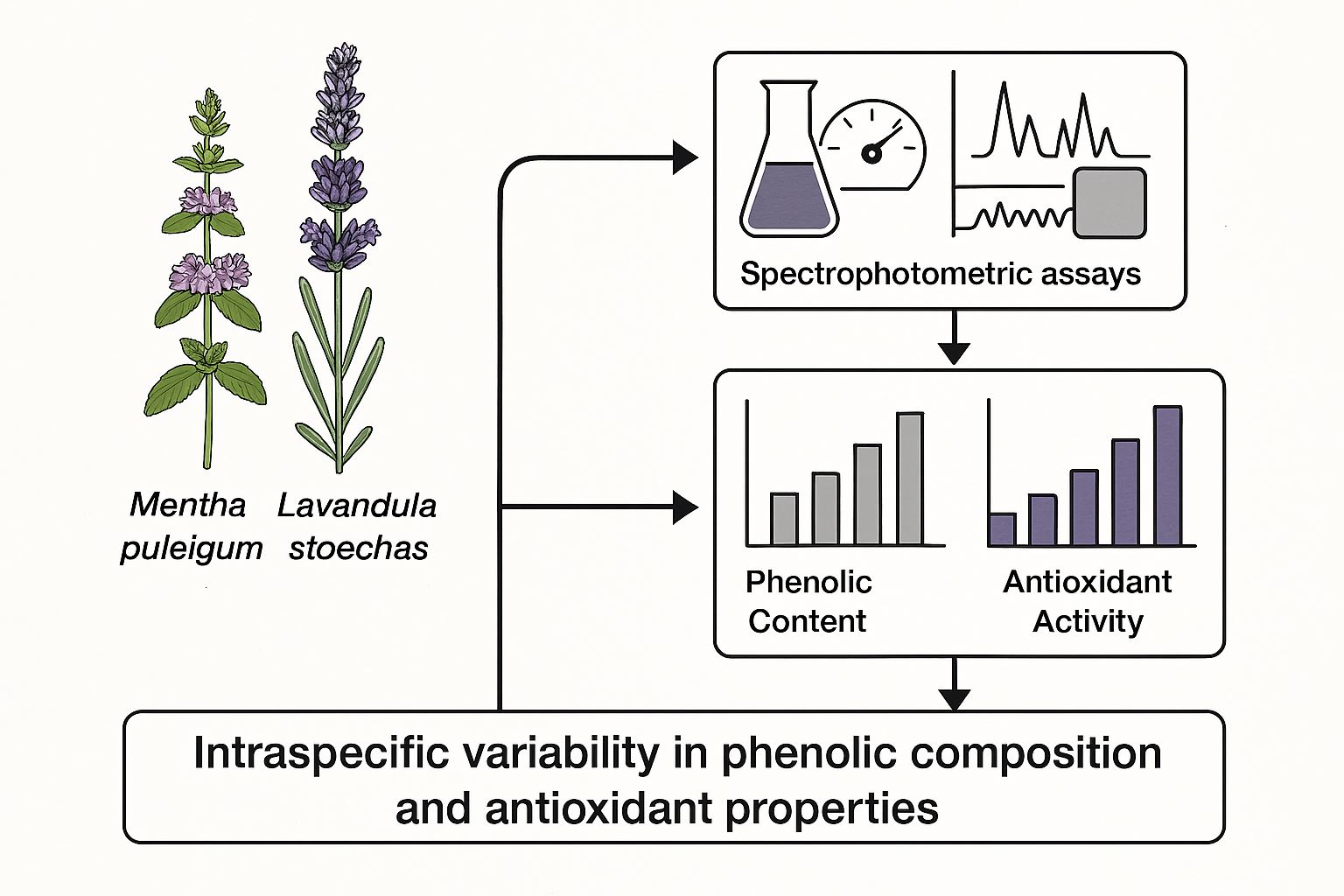
Graphical Abstract

1. Introduction

Medicinal and aromatic plants from the Lamiaceae family are really important for bioactive compounds in Mediterranean flora. They have a wide variety of secondary metabolites like phenolic compounds, flavonoids, terpenoids, and others [1]. Among these, Mentha pulegium L. (pennyroyal, poejo) and Lavandula stoechas L. (French lavender, lavanda-stoechas) are prominent in the Mediterranean and well-known for their high levels of phenolic compounds and flavonoids [2,3,4].
The unique phenolic composition and potential of bioactive compounds in M. pulegium and L. stoechas are the result of a mix of genetic, environmental, microclimatic, and seasonal factors. This variability can lead to differences between and within populations regarding their metabolic profiles. These metabolites offer a range of pharmacological benefits—antioxidant, antimicrobial, anti-inflammatory, anticholinesterase, cytotoxic, and nutraceutical—that fuel the scientific interest in their possible therapeutic and industrial uses [5,6,7,8,9]. Recent research has shown significant differences in chemical profiles linked to environmental changes [6,10,11,12,13].
Mentha pulegium L., part of the Mentha genus (Lamiaceae), has about 250 genera and 7000 species [1,14], and is naturally found in southern, central, and western Europe, northwest Africa, and the Middle East. In Portugal, it is quite common in regions like Entre Douro e Minho, Beira Litoral, Beira Alta, Beira Baixa, and Alentejo [11,15]. Traditionally, Mentha species it is been used in Portuguese cuisine, especially are widely used as food, spices, and flavoring agents for fish dishes, salads, infusions, and liqueurs. It also plays a significant role in folk medicine for digestive issues, respiratory problems, and mild infections [6,9]. Nutritionally, M. pulegium is low in calories due to its minimal protein, fat, and carbohydrate levels [16].
The recorded antioxidant, antimicrobial tyrosinase inhibition, repellent capability and anticholinesterase activities of M. pulegium mainly arise from its compounds [3,6,8,9,12,13,17,18]. Its methanolic extracts are recognized to include hydroxybenzoic acids, hydroxycinnamic acids, flavones and flavanol derivatives, with rosmarinic acid serving as the phenolic element frequently reported [3,8,18]. Recent innovations in High-Resolution Mass Spectrometry (HR-MS), often paired with chromatographic methods like UHPLC–QTOF–MS and HPLC–TOF/MS, have greatly enhanced our ability to study plant secondary metabolites. For example, ref. [4] reported identifying over 80 different metabolites in M. pulegium.
Lavandula stoechas L. is part of the Lavandula genus, which comprises approximately 30 species, with five being indigenous to Portugal [15]. Several studies have shown that L. stoechas possesses various biological properties such as anti-inflammatory, antioxidant, antispasmodic, anticancer, sedative, dementia, insecticidal, antimicrobial, and antifungal effects, stemming from its combination of bioactive substances, including flavonoids, terpenes, and phenolic acids [7,19,20,21,22,23,24,25,26].
While lavender is primarily cultivated for its essential oils, the non-volatile components are less researched, despite their rich presence of phenolic compounds such as glycosylated flavones and derivatives of caffeic, ferulic, and shikimic acids [5,20,21,24,25,27]. Different authors [20] recognize 68 compounds in L. stoechas, with hydroxycinnamic acids being the predominant category, alongside flavones, glycosylated flavones, caffeic acid-derived oligomers, and other phenolic substances, which include various glycosides, derivatives, and potentially coumarin-like structures, underscoring the significant bioactive potential of this species. Phenolic production in Lavandula takes place via the shikimic acid pathway, with flavones such as apigenin, luteolin, and hypolaetin constituting nearly 50% of the phenolic content, primarily in glycosylated forms [2,23,28]. Additionally, small metabolites exhibiting cytotoxic characteristics, jasmonates, and oxidized lipids have been observed, highlighting the therapeutic potential of this species [5,22,29]. In Portugal, L. stoechas extracts have been shown to possess caffeic acid derivatives, flavonoid glycosides, and rosmarinic acid derivatives [2]. The phenological phase significantly affects the phenolic content along with the antioxidant and antimicrobial activities, particularly for L. stoechas, as demonstrated by Sriti [30].
The antioxidant capacity of plant extracts is largely determined by their phenolic composition, which varies with species, plant part, extraction method, and growing conditions [31]. To assess antioxidant activity and total phenolics, spectrophotometric assays such as DPPH, FRAP, and Folin–Ciocalteu are widely used due to their reproducibility and low cost [31,32]. Nevertheless, to accurately identify the metabolites associated with these outcomes, it is crucial to complement these approaches with liquid chromatography coupled with high-resolution mass spectrometry (HPLC-ESI(-)-HRMS/MS). Integrating these methods with techniques such as Principal Component Analysis (PCA) and hierarchical clustering enables the detection of major compounds, examination of intra-species variation and linking of metabolites to their biological activities [33,34].
Despite these developments, there are still few studies that combine antioxidant tests (DPPH, FRAP, Folin–Ciocalteu) with HR-MS metabolite profiling for Portuguese populations of M. pulegium and L. stoechas. Given the rich biodiversity and varied climates in Portugal, local differences could significantly influence the phytochemical profiles and antioxidant capabilities of these plants.
So, this study plans to characterize methanolic extracts from Portuguese accessions of Mentha pulegium L. and Lavandula stoechas L. by integrating (i) a detailed identification of secondary metabolites using HPLC-ESI(-)-HRMS/MS, (ii) assessments of antioxidant capacity through TPC, FRAP, and DPPH assays, and (iii) multivariate analyses to pinpoint distinguishing compounds, explore variability within the species, and correlate the metabolomic profiles with bioactive properties. This approach will help promote Portuguese germplasm [35], deepen understanding of the chemical diversity in these species, and broaden their potential use in nutraceutical, pharmaceutical, and biotechnological fields.

2. Materials and Methods

2.1. Plant Material

A collection of 17 samples of flowering aerial parts of pennyroyal (Mentha pulegium L.), harvested in 2018, and eight samples of French lavender (Lavandula stoechas L.), harvested in 2021 (see Figure 1), were obtained from seed progeny of collet originating from the north-eastern to the south-southwestern regions of Portugal and conserved at the Portuguese Germplasm Bank (BPGV). The territories of origin are distinguished by elevated temperatures, minimal precipitation, predominantly concentrated in the autumnal and winter months, and a more pronounced continental influence in Portalegre, Beja and Évora, as opposed to a more Atlantic influence, which engenders milder climatic conditions in Setúbal. The samples of two species were harvested at the onset of the flowering period. The harvesting of pennyroyal took place between 1 August and 11 September 2018, whereas that of French lavender occurred on 7 June 2021. In consideration of the IPMA’s Normal Climatological Conditions—Braga 1991–2020 (Instituto Português do Mar e da Atmosfera; Portuguese Institute of the Sea and Atmosphere), it is evident that during the months of April and September of both years, there was an absence of days characterized by extreme temperatures. During the study period, ambient temperatures ranged from 10–15 °C (minimum) to 20–30 °C (maximum). The onset of anthesis was defined by the presence of approximately 20–30% of floral structures. At this phenological stage, plants exhibited a dry matter (DM) content between 20% and 25%, corresponding to an estimated moisture level of 80%. No fertilization was applied, and irrigation was limited to a single weekly application delivered via a drip system. The aerial portions bearing inflorescences were separated from the remaining biomass and subjected to natural desiccation under controlled ambient conditions. Drying was conducted in a cool, stable environment with adequate ventilation, ensuring the absence of direct light or solar exposure. Information regarding the location of the origin of the 25 accessions is provided below (Table 1).

2.2. Chemicals and Reagents

Methanol (p.a.), hydrochloric acid (37% w/v), iron(II) sulfate heptahydrate, iron(III) chloride hexahydrate, and sodium acetate trihydrate were sourced from Merck (Darmstadt, Germany). Folin–Ciocalteu reagent, gallic acid (990 g·L−1), and potassium ferricyanide (III) were supplied by Sigma-Aldrich (Sternheim, Germany). Anhydrous sodium carbonate was acquired from BDH (Poole, UK), while 2,4,6-tris(2-pyridyl)-s-triazine (TPTZ, 990 g·L−1) and ferric chloride were obtained from Fluka (Buchs, Germany). Panreac (Barcelona, Spain) provided anhydrous sodium sulfate, and absolute ethanol (anhydrous) was purchased from Carlo Erba (Marseille, France). Luteolin-7-O-glucoside was procured from Extrasynthèse (Genay, France). All other chemicals and reagents were used as received, with analytical or HPLC-MS Optima grade quality.

2.3. Preparation of Plant Extracts

The plant material was lyophilized in a freeze-sublimation system (Scanvac CoolSafe, Labogene Scandinavian by Design). Then, the dehydrated samples were ground in a laboratory mill (IKA® MF 10.2, Burladingen, Germany) equipped with a 1.0 mm mesh sieve. The resulting powder was vacuum-packed in polymeric films (LDPE, 60 μm) and oriented polyamide (PA, 30 μm) (Amcor Flexibles, Vila Nova de Gaia, Portugal). The samples were then stored in desiccators until subsequent analyses.
The non-volatile methanolic extracts were prepared by weighing 2.5 g of the dry material and subjecting it to maceration with 50 mL of methanol (purity 990 g L−1) under stirring at 150 rpm for 2 h at room temperature (20 °C). The extract was vacuum filtered using a Büchner funnel (90 mm) fitted with Whatman No. 1 filter paper (Whatman, Maidstone, UK) and dried on a rotary evaporator (40 °C; ~178 mbar). The dried residue was subsequently stored at −20 °C until use. For analysis, approximately 0.05 g of the dried residue was weighed, redissolved in 25 mL of methanol (purity 990 g L−1), and used for subsequent experiments.

2.4. Total Phenolic Content by Folin–Ciocalteu Method

The total phenolic content was assessed using a modified Folin–Ciocalteu method, based on the procedures described by [36] and further adapted according to [37]. Aliquots of 1–3 mL of diluted extract were transferred into 10 mL volumetric flasks containing distilled water, followed by the addition of 0.5 mL Folin–Ciocalteu reagent. The mixtures were thoroughly homogenized, and negative controls with water were included for hydro-alcoholic extracts. After a 5 min incubation, 1.5 mL of a 200 g·L−1 sodium carbonate solution was added, and the final volume was adjusted to 10 mL. The solutions were left at room temperature for 2 h, and a reagent blank was prepared in parallel. Absorbance was recorded at 750 nm using a double-beam UV–visible spectrophotometer (Hitachi U-2010, Tokyo, Japan). Total phenolic content was expressed as grams of gallic acid equivalents (GAE) per liter. The assay demonstrated linearity between 6.3 × 10⁻⁴ and 1.3 × 10⁻² g·L−1 GAE (r2 = 0.998, s = 0.019), and all determinations were performed in triplicate.

2.5. Antioxidant Activity

2.5.1. Ferric Ion Reducing Antioxidant Power Assay

The ferric reducing antioxidant power (FRAP) of the extracts was determined to evaluate their ability to reduce Fe3+ to Fe2+ in the presence of electron-donating compounds. The assay was adapted from [37,38]. FRAP reagent was prepared by dissolving 1 mmol·L−1 TPTZ and 2 mmol·L−1 ferric chloride in 0.25 mol·L−1 sodium acetate buffer (pH 3.6). Diluted extract aliquots were added to 1.8 mL of the reagent and incubated at room temperature (20 °C) for 4 min to allow the formation of the blue Fe2+–TPTZ complex. Absorbance was measured at 593 nm against a water blank using a double-beam UV–visible spectrophotometer (Hitachi U-2010). A calibration curve using iron sulfate over 0.13–3.50 μmol·L−1 (r2 = 0.995, s = 0.021) was employed to quantify the ferric reducing capacity, expressed as μmol Fe2+ per gram of extract. Each measurement was conducted in triplicate.

2.5.2. DPPH Radical Scavenging Capacity Assay

The free radical scavenging potential of the extracts was assessed using the DPPH assay, adapted from [39] and modified according to Serrano et al., 2024 [37]. A 0.1 mL aliquot of each extract, at varying concentrations, was combined with 2 mL of 0.07 mmol·L−1 DPPH in 95% ethanol. The mixtures were gently shaken and incubated in the dark at room temperature for 60 min. Absorbance was measured at 517 nm against a blank containing only ethanol and DPPH solution. To quantify radical scavenging activity, a calibration curve was prepared using Trolox in the range of 24–800 μmol·L−1, resulting in the linear regression equation y = 0.00103x + 0.01388 with a coefficient of determination of 0.99917. Radical scavenging activity was then expressed relative to Trolox equivalents. All measurements were performed in triplicate to ensure reproducibility.

2.6. Determination of Phenolic Compounds in Pennyroyal and Lavender Extracts by HRMS

Aliquots of 7 µL of methanolic extract of Mentha pulegium L. and Lavandula stoechas were analyzed on a HPLC Ultimate 3000 RSLC nano system (Thermo Fisher Scientific Inc., Waltham, MA, USA) interfaced with a QqTOF Impact II mass spectrometer with an ESI source (Bruer Daltonics, Bremen, Germany). Internal calibration of the mass analyser was achieved with a solution of ammonium formate (Fisher Chemical, Hampton, NH, USA) 10 µM introduced to the ion source via a 20 µL loop at the beginning of each analysis, using a six-port valve. The mass spectrometric parameters were set as follows: end plate offset, 500 V; capillary voltage, −2.5 kV; nebulizer, 4 bars; dry gas, 8 L·min−1; dry temperature, 200 °C; range m/z 100–1350. Two measurements were performed for all extracts in the ESI negative mode. Tandem mass spectra were acquired using a data-dependent acquisition (DDA) mode with an acquisition rate of 3 Hz using a dynamic method with a fixed cycle time of 3 s, and an isolation window of 0.03 Da. Data acquisition and processing were performed using the Data Analysis 5.2 software.
Chromatographic separation was achieved on a Kinetex C18 column 100 Å (150 × 2.1 mm, 2.6 μm particle size, Phenomenex, Torrance, CA, USA) at 50 °C, using a flow rate of 400 µL·min−1. The mobile phase was 0.1% v/v acid formic in water and in acetonitrile (Fisher Chemical Hampton, NH, USA), the elution gradient was as follows: 0–1.5 min linear gradient to 5% B; 1.5–8 min linear gradient to 99% B; 8–11 min isocratic 100% B; 11–12.5 min linear gradient to 5% B, and then the column was re-equilibrated with 5% B for 4 min.

2.7. Statistical Analysis

Data was analyzed using one-way ANOVA followed by Tukey’s HSD test, with significance defined at p < 0.05. Descriptive statistics, including mean values, range, and relative standard deviation (RSD), were calculated using Statistica™ 12.0 [40]. Pearson correlation coefficients were used to explore relationships among antioxidant capacity, total phenolic content, and individual phenolic compounds. Major phytochemical profiles of pennyroyal and lavender extracts were further examined in R (v4.1.2) according to [37]. Replicates were averaged and grouped by geographic origin using tidyverse v2.0.0 [41], visualized with ggplot2 v3.4.2 [42], and multivariate patterns assessed via principal component analysis (PCA) using prcomp. Hierarchical clustering of accessions was performed using Euclidean distances and UPGMA methodology, with dendrograms generated through base R plotting functions [43].

3. Results and Discussion

Based on the data presented in Tables 2 and 3, a comparative analysis was conducted for the total phenolic content (TPC) and antioxidant capacity (FRAP and DPPH methods) of Mentha pulegium L. and Lavandula stoechas L. extracts, which are obtained from descendants of accessions collected across various regions within the mainland of Portugal. Statistical analysis was performed using Tukey’s multiple comparison test (p < 0.05), with different letters indicating statistically significant differences among accessions.

3.1. Yield of Phenolic Compounds Extraction

3.1.1. Pennyroyal

The extraction yields obtained from the Portuguese Mentha pulegium L. accessions using methanol ranged from 9.39% (BPGV08459, Évora) to 13.86% (BPGV08468, Évora), with most values falling between 10% and 13%. These values indicate a good solubility of bioactive compounds in methanol and reflect an efficient extraction process. The variation among accessions may be attributed to differences in their chemical composition, morphology, and possibly environmental and genetic factors influencing the accumulation of methanol-soluble compounds. These yields are consistent with those reported for medicinal and aromatic plants using polar solvents and suggest that Portuguese M. pulegium accessions contain significant amounts of extractable secondary metabolites.
The comparison of the extraction yields obtained in this work with other authors is within a similar or slightly lower range. For instance, Brahmi [12] reported a methanolic extract yield of 15.17% in M. pulegium using cold maceration [44], observed yields up to 22.85% in plants harvested during the flowering stage. In Tunisia, [18] reported a particularly high yield of 22 ± 0.23% using methanol. In contrast, a Portuguese study by [9] obtained only 5.4% yield using ethanol, highlighting the impact of solvent polarity and extraction parameters on yield efficiency. Despite methodological differences, the methanolic yields from Portuguese accessions, especially those from inland regions, are comparable to or exceed several values reported internationally, reinforcing their potential as a rich source of bioactive compounds.

3.1.2. French Lavender

The methanolic extraction yields obtained from Portuguese Lavandula stoechas accessions were high, ranging from 17.10% (BPGV10383, Portalegre) to 30.13% (BPGV10370, Portalegre). Most accessions presented values above 24%, with BPGV10370, BPGV10376, BPGV10389, and BPGV10395 standing out with yields above 26%. These results reflect the excellent solubility of bioactive compounds in methanol, especially phenolic compounds, and indicate an efficient extraction process. The variation among accessions may be associated with genetic differences, morphological variations, and environmental factors specific to the regions of origin (Portalegre, Évora, and Castelo Branco), which influence the synthesis and accumulation of soluble secondary metabolites.
Compared to the literature, the yields obtained in this study fall within the upper range of values reported for L. stoechas using polar solvents. Most studies indicate yields generally ranging from 7% to 20% [45], depending on the solvent, phenological stage, and extraction technique. Ref. [26] obtained a yield of 22% using methanol. Thus, the values observed for Portuguese accessions, especially those from the Portalegre district, are not only competitive but, in some cases, exceed previously reported data, confirming the high potential of Lavandula stoechas L. as a source of bioactive compounds extractable with polar solvents.

3.2. Total Phenolic Content (TPC) and Antioxidant Capacity

3.2.1. Pennyroyal

Table 2 presents the variability in total phenolic content (TPC) among the methanolic extracts of different Mentha pulegium L. Portuguese accessions. TPC values ranged from 20.07 mg GAE/g DW (BPGV08476, Setúbal) to 35.29 mg GAE/g DW (BPGV08456 and BPGV08465, from Portalegre and Beja, respectively). These results indicate clear intraspecific variability in phenolic accumulation. Accessions from Beja (BPGV08465, BPGV08480, BPGV09893) and Portalegre (BPGV08456) exhibited the highest and statistically significant TPC values, highlighting the strong phenolic biosynthetic potential of interior Portuguese regions. Conversely, BPGV08476 (Setúbal) and BPGV08459 (Évora) showed the lowest TPC levels.
The phenolic content detected is in the upper range of those reported for M. pulegium in other countries, although direct comparison requires caution due to methodological differences between studies. For instance, Jebali [18] reported TPC values of 74.45 mg GAE/g DW for Tunisian populations, while Brahmi [12] observed 25.3 mg GAE/g DW in methanolic extracts of samples from Algeria. Additional research employing solvents (such as ethyl acetate extracts) similarly presents results in units that cannot be directly compared (for instance, μg GAE/g of dry extract) as noted by Khennouf [3]. Furthermore, studies on species of the genus Mentha demonstrate that the phenolic composition is dominated by rosmarinic acid and flavonoids [6], compounds that differ significantly among species and geographic areas. Thus, despite these methodological differences, the literature confirms that M. pulegium consistently exhibits high concentrations of phenolic compounds, a trend corroborated by the results obtained for the Portuguese germplasm.
Regarding the antioxidant capacity assessed by the FRAP assay, the results ranged from 170.503 to 289.680 μmol Fe2+/g DW, indicating substantial differences in the reducing power of the extracts. Accessions BPGV09893, BPGV08465, and BPGV08480 (all originating from Beja) stood out with the highest FRAP activities, aligned with their higher TPCs. This correlation aligns with the principle behind the FRAP assay, which primarily relies on electron transfer and is extensively reported in studies: extracts rich in phenols, especially rosmarinic acid and flavonoids, tend to exhibit strong reducing capacity [46], as demonstrated by research carried out in Bosnia and Herzegovina [8] and Tunisia [18], (FRAP = 570.08 μmol Fe2+/g DW). Accessions BPGV08476 (Setúbal) and BPGV08459 (Évora) exhibited the lowest FRAP values, consistent with their low phenolic contents.
The DPPH radical scavenging activity showed a distinct pattern, ranging from 57.505 to 356.246 μmol TE/g DW. The highest DPPH activity was recorded in accessions BPGV08453 (Portalegre), BPGV10427 (Portalegre), and BPGV08475 (Setúbal), all characterized by only moderate phenolic contents. This behavior is consistent with the nature of the DPPH assay, which predominantly involves hydrogen atom transfer and only partially electron transfer mechanisms. Thus, antioxidant efficiency strongly depends on the specific chemical structure of the compounds present [47,48], including certain subclasses of flavonoids and oxygenated monoterpenes characteristic of the genus Mentha, and not exclusively on TPC [49]. This phenomenon has been widely described in studies of M. pulegium, where extracts rich in structurally reactive molecules, even with moderate TPC, exhibit strong DPPH activity [3,12,18].
The case of accession BPGV08479 (Évora) clearly illustrates this dynamic: despite presenting a high TPC (34.03 mg GAE/g DW), it revealed one of the lowest DPPH values (58.935 μmol TE/g DW), confirming the absence of a linear correlation between the total phenolic content and this assay [46,50]. This discrepancy, also described by [6,8], reinforces that the qualitative, and not just quantitative, composition of phenols and the presence of non-phenolic antioxidants play determining roles.
These results deepen the understanding of the phytochemical diversity of Mentha pulegium L. and underscore the relevance of Portuguese germplasm as a promising source of bioactive compounds for the food, pharmaceutical, and nutraceutical industries.

3.2.2. French Lavender

Table 3 presents the results obtained for the total phenolic content (TPC) and antioxidant capacity (using the FRAP and DPPH assays) of methanolic extracts from different Portuguese Lavandula spp. accessions. Substantial variability was observed in TPC across the accessions, with values ranging from 42.133 mg GAE/g DW (BPGV10376, Portalegre) to 64.694 mg GAE/g DW (BPGV10373, Portalegre). Although the statistical differences are less pronounced relative to those seen in other aromatic species, the observed variation suggests the influence of genetic and environmental factors on phenolic biosynthesis.
Most accessions from Portalegre and Évora showed TPC levels above 60 mg GAE/g DW, BPGV10373, BPGV10395 and BPGV10383, thus highlighting the potential of these areas as significant suppliers of phenolic-rich biomass. Conversely, accession BPGV10376 (Portalegre) presented the TPC level, statistically inferior, to most of the other accessions.
In comparison to data found in the literature, the Portuguese accessions show TPC at higher levels than those documented in other nations. For example, Haddouchi [25] documented TPC values between 23 and 49 mg GAE/g DW in Lavandula species from Algeria, which are lower than the findings of the study. Likewise, Sriti [30] observed that TPC concentrations in L. stoechas varied considerably with stage, ranging from 26.5 to 56.1 mg GAE/g DW, with peak values observed during full flowering. Additional research, Ceylan [27] found TPC amounts (105.5 mg GAE/g) in methanol-based extracts of L. stoechas, whereas Mushtaq [26] observed even larger quantities (285.91 mg GAE/g of extract), reflecting the natural concentration of the extracts and making direct comparisons with values expressed by dry weight unfeasible. Collectively, these investigations support the propensity of Lavandula to gather bioactive substances, confirming the findings seen in the Portuguese accessions.
Concerning capacity assessed through FRAP, the measurements varied from 102.215 to 153.046 μmol Fe2+/g DW, with the greatest activities observed in accessions BPGV10383 (Portalegre) and BPGV10389 (Évora). These patterns imply a correlation between total phenolics and reducing antioxidant capacity since the accessions with elevated TPC generally exhibited higher FRAP values. More BPGV10376 displayed the lowest results for both parameters, reinforcing this correlation.
The literature also indicates that Lavandula possesses antioxidant reducing ability. Gülçin [19], while employing ethanolic extracts and presenting the findings as a percentage of inhibition in redox assays, reported a strong reducing ability in L. stoechas. Similarly, Ceylan [27] demonstrated high FRAP activity in methanolic extracts, associated with the presence of phenolic acids such as rosmarinic and caffeic acids. Despite the methodological differences and the units used, these data are consistent with the moderate to high FRAP values observed in the present study.
In contrast to FRAP, the antioxidant activity assessed by the DPPH method showed less variation among the accessions, with values ranging from 170.304 to 179.355 µmol TE/g DW, without statistically significant differences. Accession BPGV10395 (Évora) showed the highest value, followed by BPGV10373 (Portalegre), although all accessions revealed similar radical scavenging capacities. This limited variability suggests that the response to DPPH may depend less on the total phenolic content and more on the presence of specific compounds that are particularly reactive in this assay [19,27].
Previous studies also demonstrate a high radical scavenging capacity in Lavandula species, although generally expressed as a percentage of inhibition. Ref. [19] reported inhibitions between 86% and 98% for L. stoechas extracts, while Ceylan [27] observed 84.45%. Despite methodological differences and units (percentage vs. µmol TE/g DW), these studies corroborate the high affinity of the genus Lavandula for radical neutralization, in line with the results obtained in the Portuguese accessions. Thus, the Portuguese accessions are situated within a comparable or slightly elevated range, especially when accounting for methodological differences (e.g., extraction solvent, plant part used, units of expression).
The phenolic content and antioxidant activity of Mentha pulegium and Lavandula stoechas are consistent with what is usually found in other popular Lamiaceae plants. For M. pulegium, the values falling within or even surpassing the ranges reported for Thymus vulgaris (TPC 25–65 mg GAE/g; FRAP 150–300; DPPH 150–350) and Rosmarinus officinalis (TPC 30–60 mg GAE/g; FRAP 150–350; DPPH 150–400) [51,52,53]. Likewise, L. stoechas showed phenolic levels and antioxidant capabilities similar to those of Salvia officinalis (TPC 30–70 mg GAE/g; FRAP 100–250; DPPH 120–300) and Origanum vulgare (TPC 40–80 mg GAE/g; FRAP 200–400; DPPH 200–450). These comparisons suggest that both species have a solid intermediate-to-high antioxidant potential, which is typical in this family.
Looking at the Portuguese accessions we analyzed—especially those from Portalegre and Évora—they displayed a wide variety of phytochemicals and good antioxidant activity. While L. stoechas had less variability than M. pulegium, the findings still emphasize how important local germplasm can be as a source of bioactive compounds that could be useful in nutraceutical, pharmaceutical, and cosmetic industries. The link between TPC and FRAP stood out, showing just how much phenolics contribute to reducing capacity. On the other hand, the DPPH assay seemed to be more affected by specific compounds than by the overall amount of phenolics [54]. All in all, these results, along with other published studies, highlight the potential of regional Lamiaceae germplasm as a valuable source of high-quality antioxidant compounds.

3.3. Identification of Phytochemicals in Mentha pulegium L. and Lavandula stoechas by Liquid Chromatography–Tandem Mass Spectrometry

The methanolic extracts of Mentha pulegium L. (pennyroyal, Table 3) and Lavandula stoechas (French lavender, Table 4) were analyzed to determine their main phytochemical constituents using high-resolution tandem mass spectrometry (HR-MS/MS). Compounds were identified through their deprotonated molecular ions [M-H], taking into account instrument accuracy (≤5 ppm) and mSigma values (<25) to ensure precise assignments. Likely molecular formulas were confirmed by inspecting extracted ion chromatograms, and structural elucidation was supported by evaluation of isotopic patterns and fragmentation pathways. The proposed structures were further validated by comparison with previously reported literature.

3.3.1. Pennyroyal

Table 4 summarizes all the compounds characterized in the methanolic extracts of Mentha pulegium. A total of 24 compounds were identified, belonging to various metabolite classes.
Peaks 1–4 are associated with a jasmonate group of compounds. P4 was assigned to an oxo carboxylic acid known as tuberonic acid or hydroxyjasmonic acid (12-OH-JA), which has a function as a plant metabolite. P1 and P3 were assigned to sulfo jasmonate isomers based on the fragmentation path of their precursor ions. The deprotonated molecules with m/z 305 lose 79.9584 u (SO3 MW) to form the fragment ion m/z 225, which was attributed to the deprotonated (-OH)JA molecule. P9 and P11 with m/z 359 and 717 were characterized as rosmarinic (RA) and salvianolic B (Sal B) polyphenol acids.
Flavonoids comprise the primary compounds in pennyroyal extracts. P5 and P6 were attributed to flavone-diglucoside structures, one luteolin-rutinoside (m/z 593) and one apigenin-neohesperinoside (m/z 577). The tandem mass spectrum of the former exhibits a peak with m/z 285 attributed to the deprotonated molecule of luteolin, which results from the loss of the rutinoside moiety (308 u). The tandem mass spectrum of the latter shows a peak with m/z 269 assigned to the deprotonated molecule of apigenin, which also arises from the loss of 308 u. Peak 7 (m/z 607) and Peak 8 (m/z 609) were attributed to diosmin and hesperidin, one flavone-7-rutinoside and one flavanone-7-rutinoside. Both tandem mass spectra only displayed a peak associated with the loss of 308 u, which leads to the aglycone species, respectively, m/z 299 (diosmetin) and 301 (hesperitin). Diosmin and hesperidin are the more abundant flavonoids identified in all the pennyroyal extracts. These natural compounds have been extensively studied and used in treatment of venous and lymphatic disorders. Peak 12 is associated with one deprotonated molecule with m/z 591 and molecular formula C28H32O14. The MS/MS spectrum presents two fragment ions: one with m/z 283, formed from the loss of 308 u, which was attributed to a methylated flavone; the other one with m/z 268 is associated with the formation of an odd species (loss of CH3) confirming the presence of a methoxy group in its structure. Based on these results, P12 was attributed to an acacetin-rutinoside. P13 presents a deprotonated molecule with m/z 593, which generated an aglycone with m/z 285 and ionic formula [C16H13O5]. These results supported the proposal of an isosakuranetin-7-O-rutinoside, a 4′-methoxy-5,7-dihydroxy-flavanone-7-rutinoside. P15 and P19 are associated with two aglycones, the diosmetin (m/z 299) and sakuranetin (m/z 285). The extracts present two peaks due to jaceidin I (P16) and jaceidin 2 (P18). Jaceidin is a 5,7,4′-trihydroxy-3,6,3′-trimethoxyflavone with a [C18H16O8] molecular formula. Their MS/MS spectra provided fragments at m/z 344 and 323 related to the successive loss of one radical methyl from the precursor ion, and the fragment at m/z 301, which corresponds to the loss of two methyl groups and CO2.
At longer retention times, the extracts present a series of intense peaks related to fatty acids and terpenoids, a type of metabolites found in biological systems. P14 was attributed to an octadecadienoic acid (Malingic acid) with a C18H32O5 molecular formula, whereas P23 was assigned to a hydroxy fatty acid derived from an 18-carbon fatty acid with three double bonds. P17, a Pinellic acid, is a trihydroxyoctadecenoic acid with hydroxy groups at positions C-9, -12, and 13. It is functionally related to a 13(S)-HPODE. P24, a 13-HODE metabolite, was identified as a 9Z,11E-octadecadienoic acid carrying a 13-hydroxy substituent. Finally, P20, P21, and P22 were attributed to pentacyclic triterpenoids, a class of compounds characterized by a 30-carbon skeleton with five interconnected rings. They are known for a wide range of biological activities.
The eighteen polyphenols identified in the sixteen pennyroyal methanolic extracts are consistent with the metabolite profiles reported for extracts of Mentha pulegium L by A.Taamalli and collaborators [4]. However, the presence of terpenoids and fatty acids in their work has not been reported.

3.3.2. French Lavender

Twenty-six polyphenolic compounds were identified in each of the eight methanolic extracts of French lavender. The primary compounds can be classified into two classes: hydroxycinnamic acids (L2 to L10, L15, L18 and L19) and flavonoids (L12 to L14, L16, L17, L20, L21). Compounds are identified based on their m/z accurate values and by comparison of their fragmentation patterns with previous studies [20,55]. The results are summarized in Table 5.
L1 with m/z 197 was found to be a deprotonated molecule of one hydroxy carboxylic acid, the salvianic acid A, also known as danshensu. The extracts also exhibited a signal with m/z 393 (L11) that was ascribed to a fatty acylglycoside based on its accurate m/z value and fragmentation path. Compounds L2 to L9 belong to hydroxycinnamic acids, the largest class in all the extracts. They were assigned as hexoside conjugates of caffeic, coumaric and ferulic acids with characteristic fragments at m/z 179, 163 and 193, respectively, corresponding to their aglycone parts. L10 with m/z 521 was attributed to a rosmaniryl glucoside. L18, the primary peak of the mass spectrum, was assigned to the deprotonated molecule of rosmarinic acid (m/z 359), a caffeic acid ester with a characteristic fragmentation path (m/z 197, 179, 161 and 135). L19 displaying a deprotonated molecule with m/z 717 was attributed to salvianoic acid B, a polyphenolic acid formed by three molecules of danshensu and one molecule of caffeic acid.
In this study, a total of 7 flavonoids were identified. Five peaks were assigned to the class of flavones (luteolin, apigenin and a dihydroxy-dimethoxyflavone), whereas L12, identified as an eriodictyol, belongs to the flavanone class. L12, L13, L14, L16 and L17 are O-type flavonoid glycosides, while L20 and L21 are aglycones.
As observed in the penneroyal extracts, the mass spectra of all French lavender extracts also exhibited peaks associated with terpenoids and fatty acids, at longer retention times. L22 was identified as a trihydroxyoctadecanoic acid, and L23 to L26 are due to triterpenoids.
The key metabolites we found, including diosmin, hesperidin, and phenolic acids in M. pulegium, and rosmarinic acid and its derivatives in L. stoechas, line up perfectly with what earlier research has shown for similar species in the Lamiaceae family [52,56]. This match highlights the pharmacological importance of these compounds and gives a solid biochemical foundation for the biological effects associated with these plants. Notably, some of the metabolites we identified are well-regarded for their bioactive properties: diosmin and hesperidin from M. pulegium are known for their strong anti-inflammatory capabilities, operating through pathways like TLR4/NF-κB and lowering levels of pro-inflammatory cytokines, in addition to having significant antioxidant properties [3,57,58]. Similarly, the presence of rosmarinic acid and various phenolic derivatives in L. stoechas corresponds with previous findings that connect these compounds to antioxidant, anti-inflammatory, analgesic, and wound-healing effects [23,59,60,61]. On the other hand, ref. [62] identified moderate insecticidal activity against S. granarius in methanolic extracts, with rosmarinic acid being the major compound. In summary, the flavonoids, phenolic acids, terpenoids, and fatty acids detected through LC–MS/MS back up what was previously described in the literature and help clarify the anti-inflammatory, antimicrobial, and protective effects often linked to these plant species.

3.4. Correlations Among Different Parameters

3.4.1. Pennyroyal

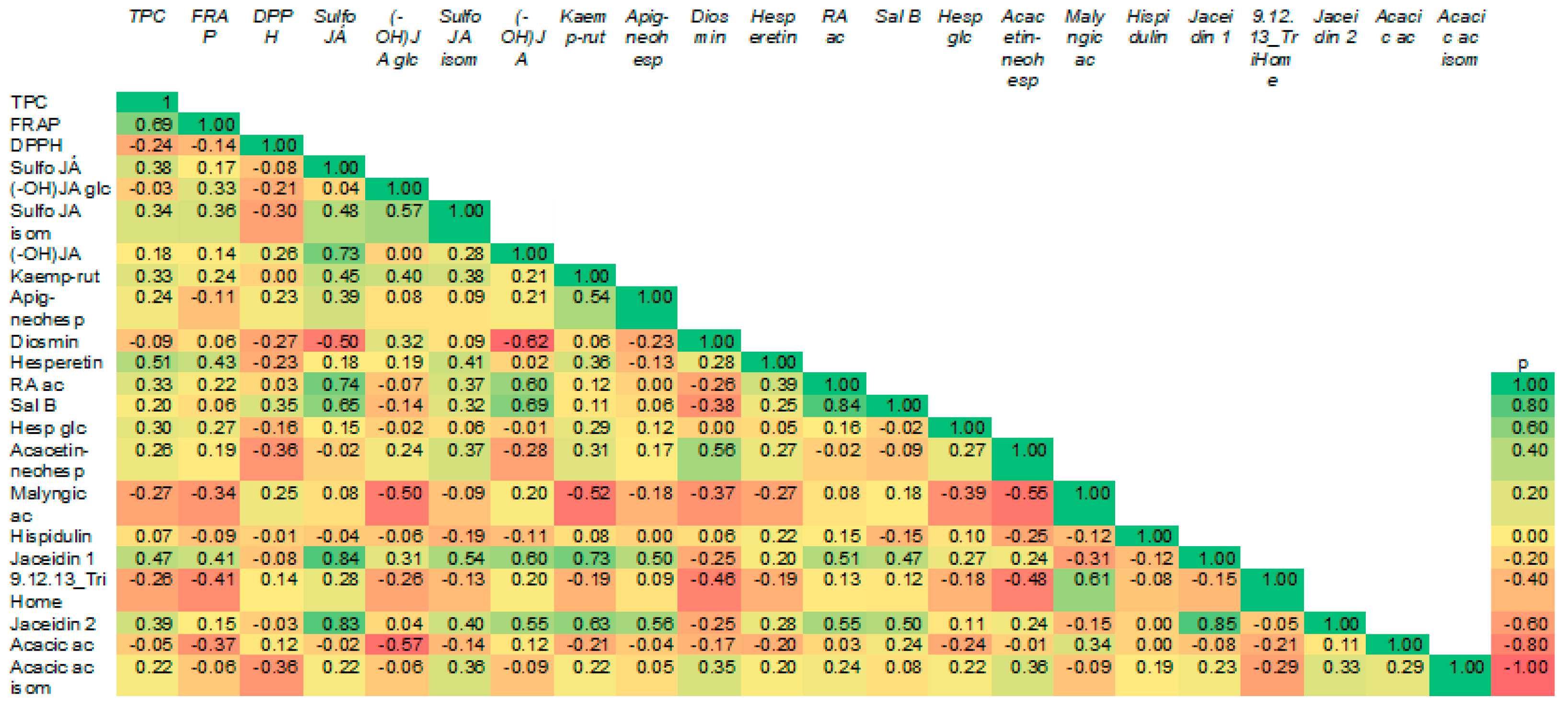
Pearson’s correlation coefficients (r) calculated between the main phenolic compounds identified by HPLC-ESI(-)-HRMS/MS and the antioxidant capacity assays of Mentha pulegium extracts reveal several strong relationships (|r| ≥ 0.70) that provide valuable insight into the phytochemical interactions and their potential influence on antioxidant activity (Figure 2).
While the total phenolic content (TPC) showed a moderately strong positive correlation with the FRAP assay (r = 0.69), this value is just below the threshold for strong correlation, indicating that phenolic compounds significantly contribute to the reducing power of the extract, although the association is somewhat less pronounced compared to other studies or species. The DPPH assay, in contrast, did not show any strong correlations with TPC or individual phenolics, highlighting that different antioxidant mechanisms may be influenced to varying degrees by specific compounds within the extract.
Several individual compounds displayed strong positive correlations with each other, suggesting linked biosynthetic pathways or co-accumulation patterns. Notably, jaceidin 1 exhibited a very strong positive correlation with sulfo JA (r = 0.84), implying a close biochemical or metabolic relationship between these flavonoid derivatives. This compound also correlated strongly with luteolin-rutinoside (Lut-rut) (r = 0.73), supporting the idea of shared flavonoid biosynthesis or functional synergy. Additionally, jaceidin 2 showed a strong positive correlation with jaceidin 1 (r = 0.85), further confirming the association within this group of related flavonoids.
Rosmarinic acid derivative (RA ac) and salvianolic acid B (Sal B) also demonstrated a very strong positive correlation (r = 0.84), indicating a likely coordinated biosynthetic pathway or similar regulatory mechanisms that influence their accumulation in the extract. These findings suggest that phenolic acids and their derivatives play a significant role in the phytochemical profile of pennyroyal.
On the other hand, some strong negative correlations were observed, indicating potential antagonistic relationships or metabolic trade-offs between compounds. For example, malyngic acid correlated negatively with luteolin-rutinoside (r = −0.52), which, although slightly below the 0.70 cutoff, suggests a possible divergent biosynthetic pathway or substrate competition between these molecules. Similarly, diosmin showed a moderate negative correlation with (-OH) jasmonic acid (r = −0.62), highlighting complex dynamics in secondary metabolite accumulation.
Overall, the strong correlations identified mainly cluster around flavonoid glycosides and phenolic acids, reinforcing their importance in the functional phytochemical matrix of Mentha pulegium. These associations likely reflect both biosynthetic linkage and possible synergistic or antagonistic effects impacting the antioxidant properties of the extracts. The absence of strong correlations with the DPPH assay suggests that free radical scavenging activity may be influenced by compounds other than those measured here or by complex interactions not captured by linear correlations alone.
The study demonstrates that combining multiple antioxidant assays provides a comprehensive assessment of plant extracts, particularly those rich in polyphenols and flavonoids, for potential nutritional and therapeutic use [55]. In Mentha pulegium, both phenolic content and antioxidant activity varied with plant maturity. Peak phenol accumulation, mainly apigenin (6.01 mg/g dry weight), occurred at full flowering, whereas the highest antioxidant activity during fructification did not correspond to maximum phenolic levels, indicating that factors beyond total phenol influence antioxidant potential [12].
Altogether, these findings demonstrate the importance of considering both the chemical profile and developmental stage in the evaluation of antioxidant activity in pennyroyal, and further support the use of multiple complementary assays to achieve a comprehensive understanding of plant bioactivity for nutritional and therapeutic applications.

3.4.2. French Lavender

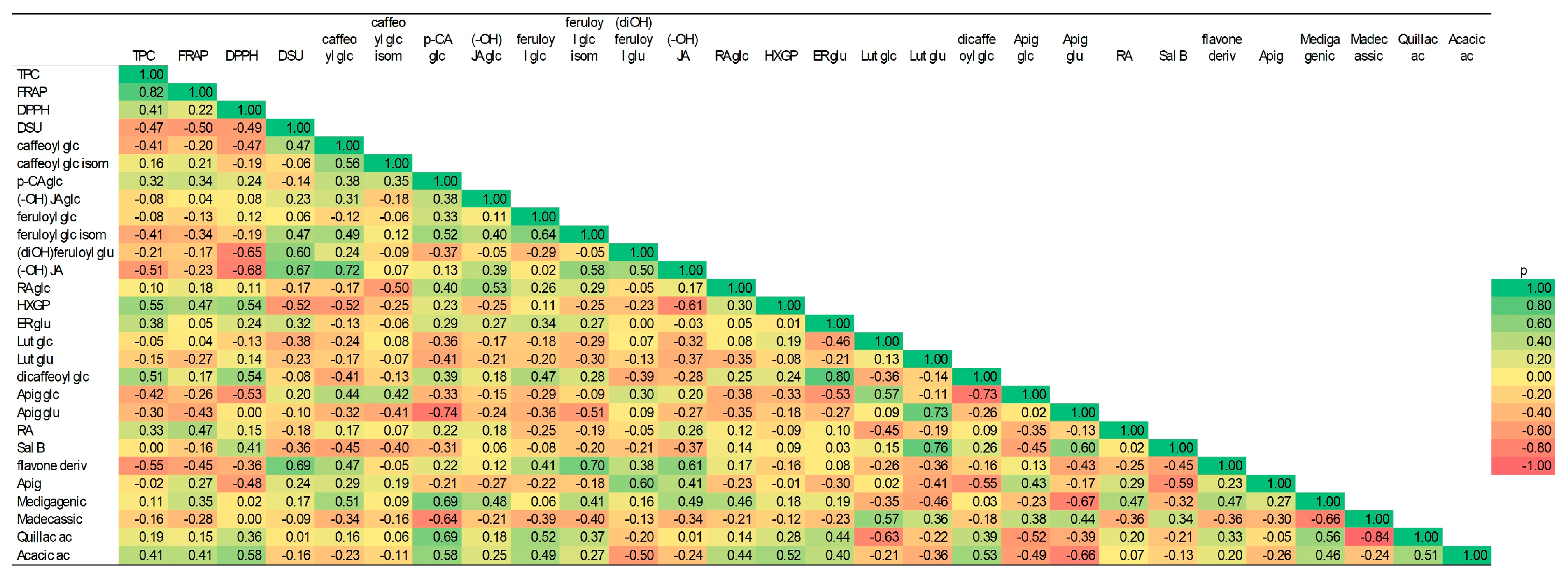
Figure 3 shows Pearson correlation coefficients (r) between the main phenolic compounds identified by HPLC-ESI(-)-HRMS/MS and the antioxidant activity of Lavandula stoechas L. extracts. Among the assays, total phenolic content (TPC) displayed a strong positive correlation with FRAP (r = 0.82), suggesting a major contribution of phenolics to the extract’s reducing power. Comparable trends were reported in previous studies [38], where FRAP correlated most strongly with TPC (r = 0.913), followed by TEAC (r = 0.856) and DPPH (r = 0.772), with Lamiaceae species such as rosemary and thyme consistently showing high antioxidant performance across all tests.
Regarding individual compounds, several strong correlations (|r| ≥ 0.70) were identified, providing insight into potential interactions and functional relationships within the phytochemical profile. Notably, apigenin 7-O-glucoside (Apig glu) showed a strong negative correlation with p-coumaroyl glucoside (p-CA glc) (r = −0.74), suggesting a possible antagonistic relationship or competition in biosynthetic pathways. Similarly, 12-hydroxy jasmonic acid (12-OH JA) exhibited a strong negative correlation with the DPPH assay (r = −0.68), indicating a limited contribution to free radical scavenging activity, despite being just below the 0.70 threshold.
A flavone derivative correlated strongly and positively with feruloyl glucoside isomer (r = 0.70), suggesting possible co-accumulation or structural-functional relationships. Additionally, dicaffeoyl glucoside demonstrated a strong positive correlation with eriodictyol 7-O-glucoside (ER glu) (r = 0.80), indicating a shared biosynthetic origin or synergistic presence within the extract.
Among triterpenoids, quillaic acid showed a very strong negative correlation with madecassic acid (r = −0.84), potentially reflecting divergent biosynthetic pathways or substrate competition. Moreover, luteolin 7-O-glucuronide (Lut glu) correlated strongly with apigenin 7-O-glucoside (r = 0.73), reinforcing the association between these flavonoid glycosides. Salvianolic acid B (Sal B) also exhibited a strong positive correlation with apigenin 7-O-glucoside (r = 0.76), indicating potential linkage in their metabolic pathways or accumulation patterns.
These results highlight that, beyond the overall contribution of total phenolic content to antioxidant capacity, specific compounds in L. stoechas interact in complex ways, either synergistically or antagonistically, potentially influencing the overall antioxidant behavior of the extracts.
Furthermore, the relationship between TPC, FRAP, and DPPH values highlights key distinctions in antioxidant mechanisms. Although these assays generally exhibit positive correlations—particularly when TPC is high, the strength and nature of these associations can vary. FRAP, which measures ferric-reducing antioxidant power, and DPPH, which assesses free radical scavenging capacity, are based on distinct chemical principles. Thus, individual compounds may affect each assay differently [63].
In some cases, a curvilinear rather than linear correlation between TPC and antioxidant assays has been observed, suggesting that the relationship may not be consistent across all concentration ranges. Additionally, specific phenolic structures may influence one assay more strongly than another. For example, FRAP values often show stronger correlations with TPC than DPPH, reflecting the prevalence of reducing compounds over radical scavengers in certain extracts. These considerations reinforce the need to apply multiple, complementary methods when evaluating antioxidant potential and interpreting phytochemical data [64].
Altogether, these findings further support the utility of combining complementary antioxidant assays in the profiling of polyphenol- and flavonoid-rich plants. This integrative approach enhances our understanding of the functional role of specific compounds and aids in selecting promising candidates for nutritional and therapeutic applications.

3.5. Principal Component Analysis (PCA) to Assess Overall Variation

3.5.1. Pennyroyal

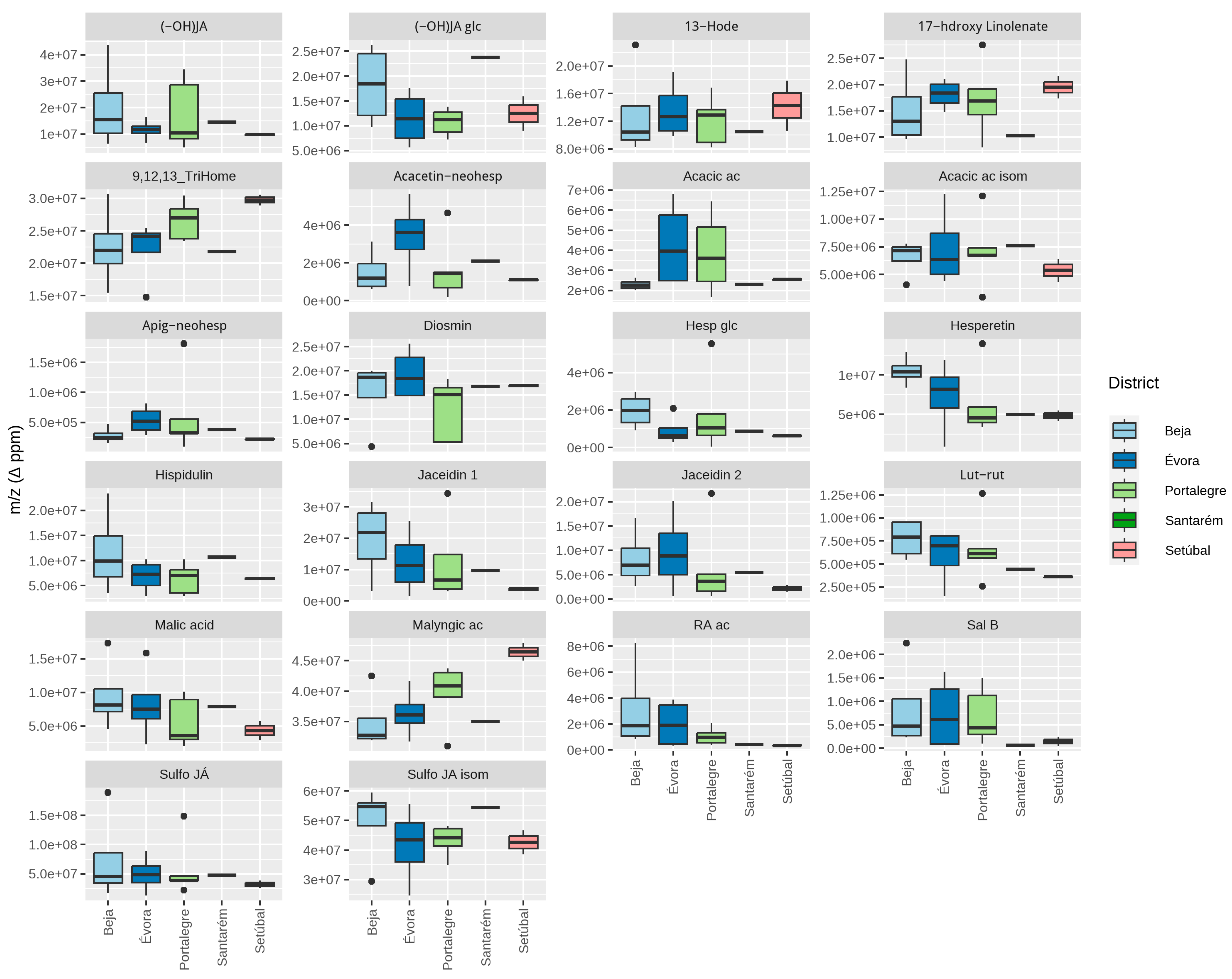
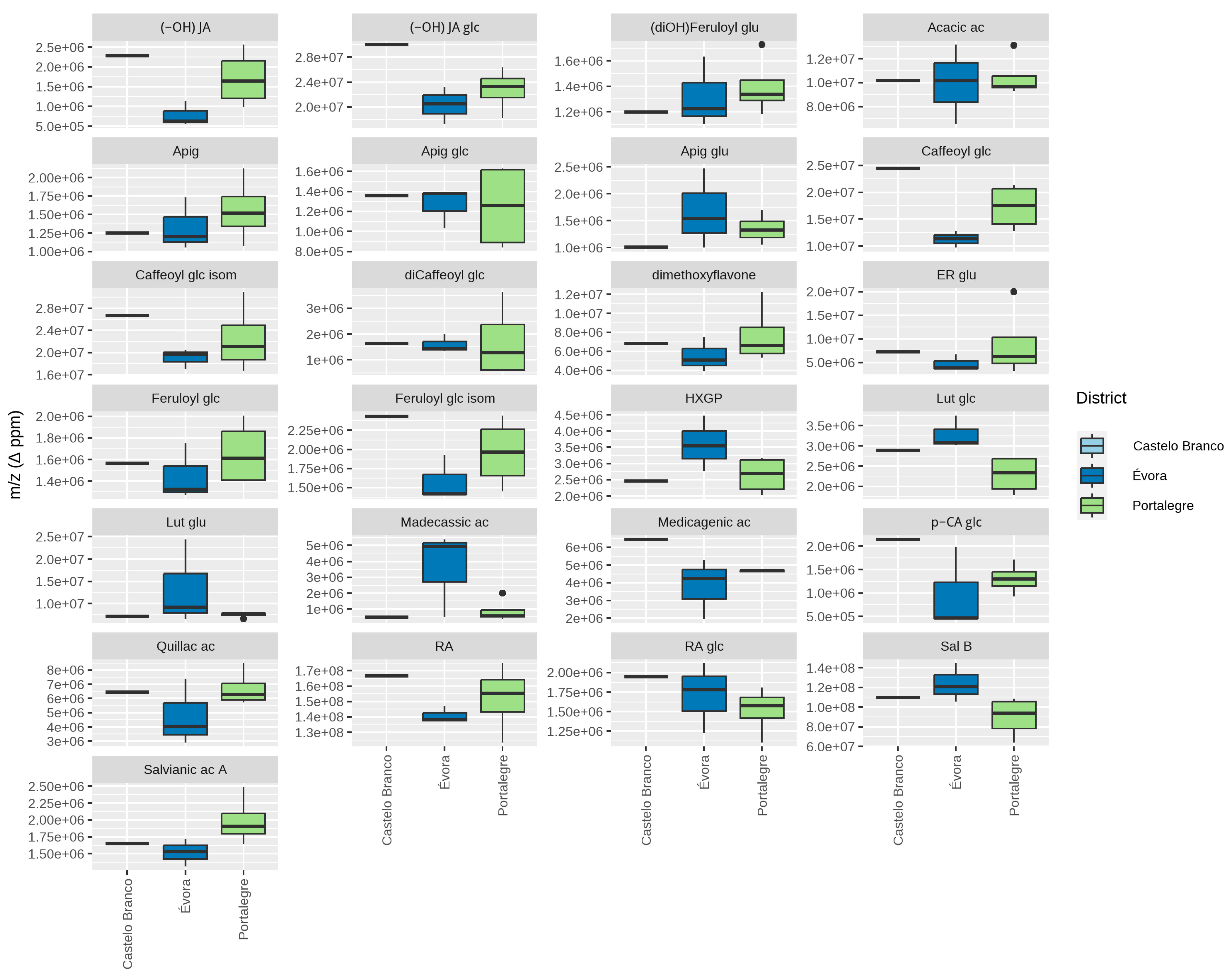
From the distribution of the average values per district for each compound (Figure 4), it is clear that pennyroyal accessions exhibit distinct phytochemical profiles, with variability in profile observed among origins. The variability in the profiles is evident when comparing accessions with the same provenance and from different districts. The variability in the profiles is demonstrated by the averages of m/z (∆ ppm) from Évora and Beja. In contrast, Portalegre exhibited a range of values in four composts, as observed with sulfo JA.
A total of twenty-two primary compounds were identified, two of which (SAL B and RA ac) may not be detectable for accessions from Santarém and Setúbal Districts.
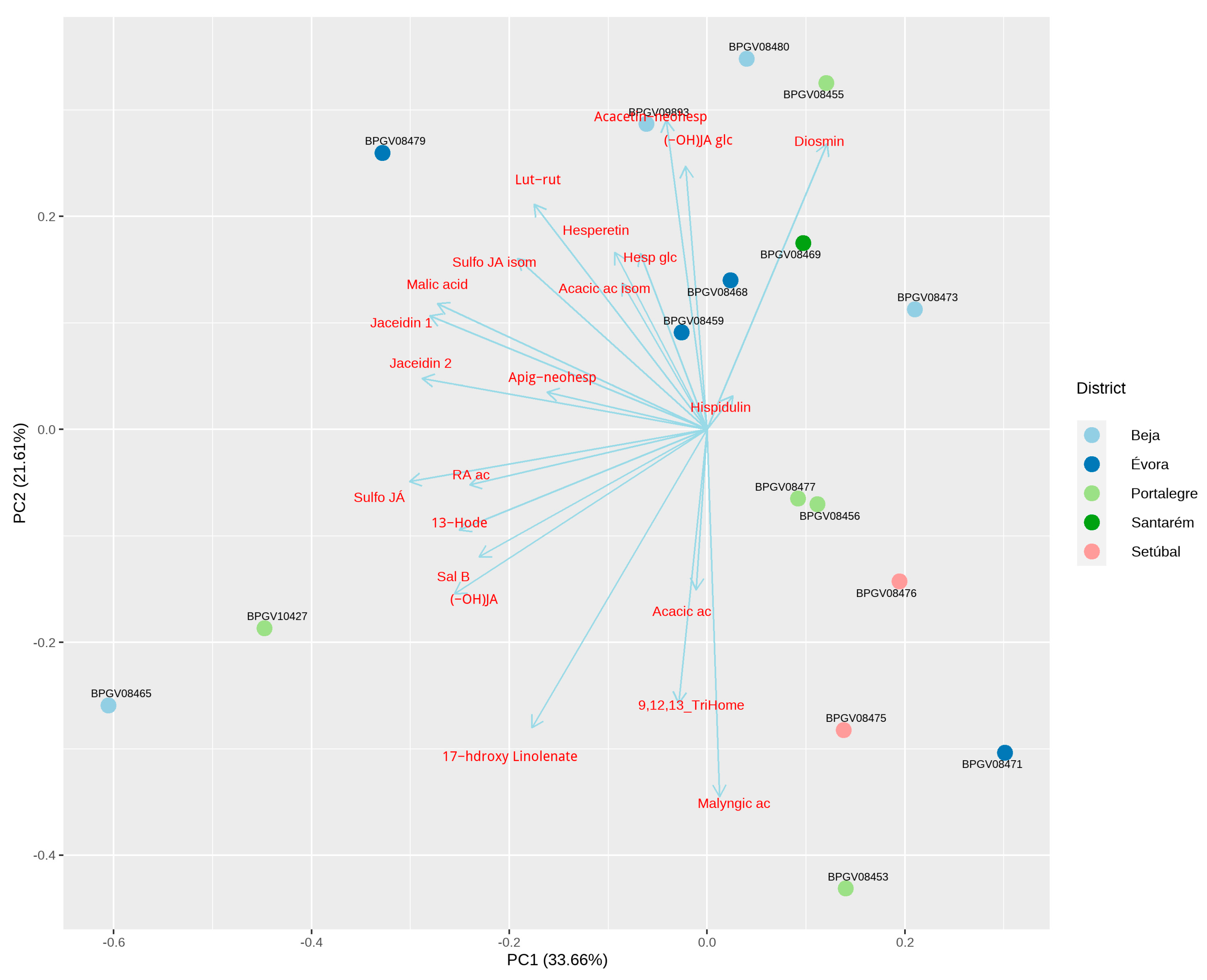
From the biplot analysis (Figure 5), it is evident that most of the variation between samples is explained by the first two principal components (55.2%). The distribution of the accessions occurs in the two axes, although the diffusion across PC2 is clearer. This seems to be mainly explained by diosmin, malyngic ac and acacetin–neohesp. The majority of compounds affect the separation of samples on PC1 with a similar weight. Two samples (BPGV08465 and BPGV10427) occupy the lower left quadrant, relatively isolated from the remaining samples. There is no evidence of clustering based on the district of origin of the samples. The accessions BPGV08465 and BPGV10427 were associated with antioxidant capacity through an alternative biosynthesis mechanism, in conjunction with BPGV08475, which is isolated separately in biplot analysis.
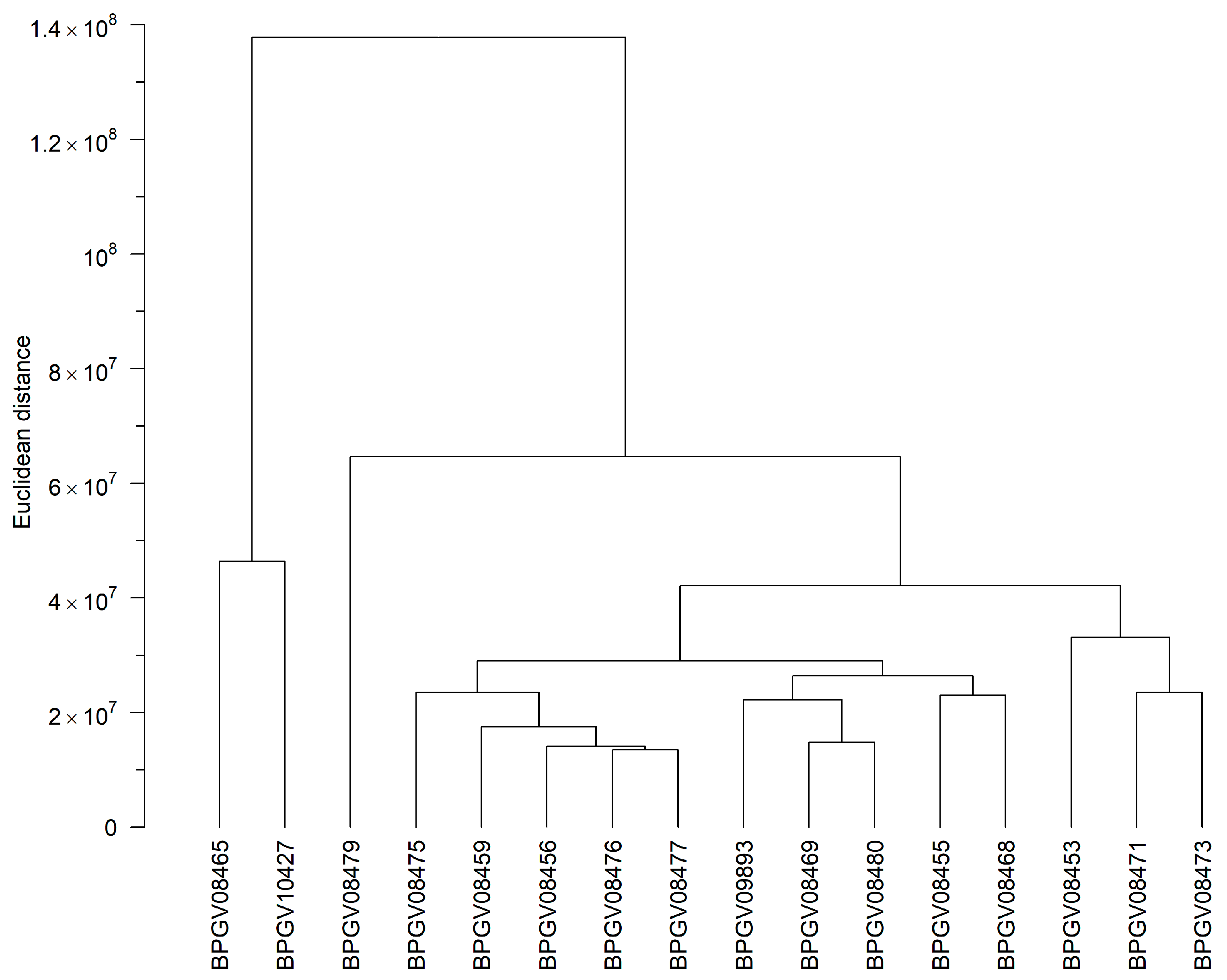
The dendrogram demonstrated five clusters that are not grouped by origins (Figure 6).
The integration of altitude data did not indicate any effect of altimetry on the identification and presence of almost all compounds, except for hesp glc and acacetin–neohesp, which seem to be dependent on the altitude of origin (p < 0.05. Nevertheless, research conducted on disparate crops, including the phenolic phytochemical profiles of diverse mints, as previously mentioned, and olive oil, pomegranate, and blueberries, suggests that there is a divergence depending on altitude.

3.5.2. French Lavender

A total of twenty-five compounds were identified, and as with pennyroyal, there is variability in the phytochemical profiles between geographical areas and between accessions from each area of origin (Figure 7).
It is evident that Évora is the origin with the greatest variability in profiles. It is also evident that accessions from Portalegre exhibit a higher degree of variability, with a total of 12 compounds identified within this category. In contrast, Évora demonstrates a distinct pattern, with nine compounds displaying variability that exceeds the levels observed in the other origins.
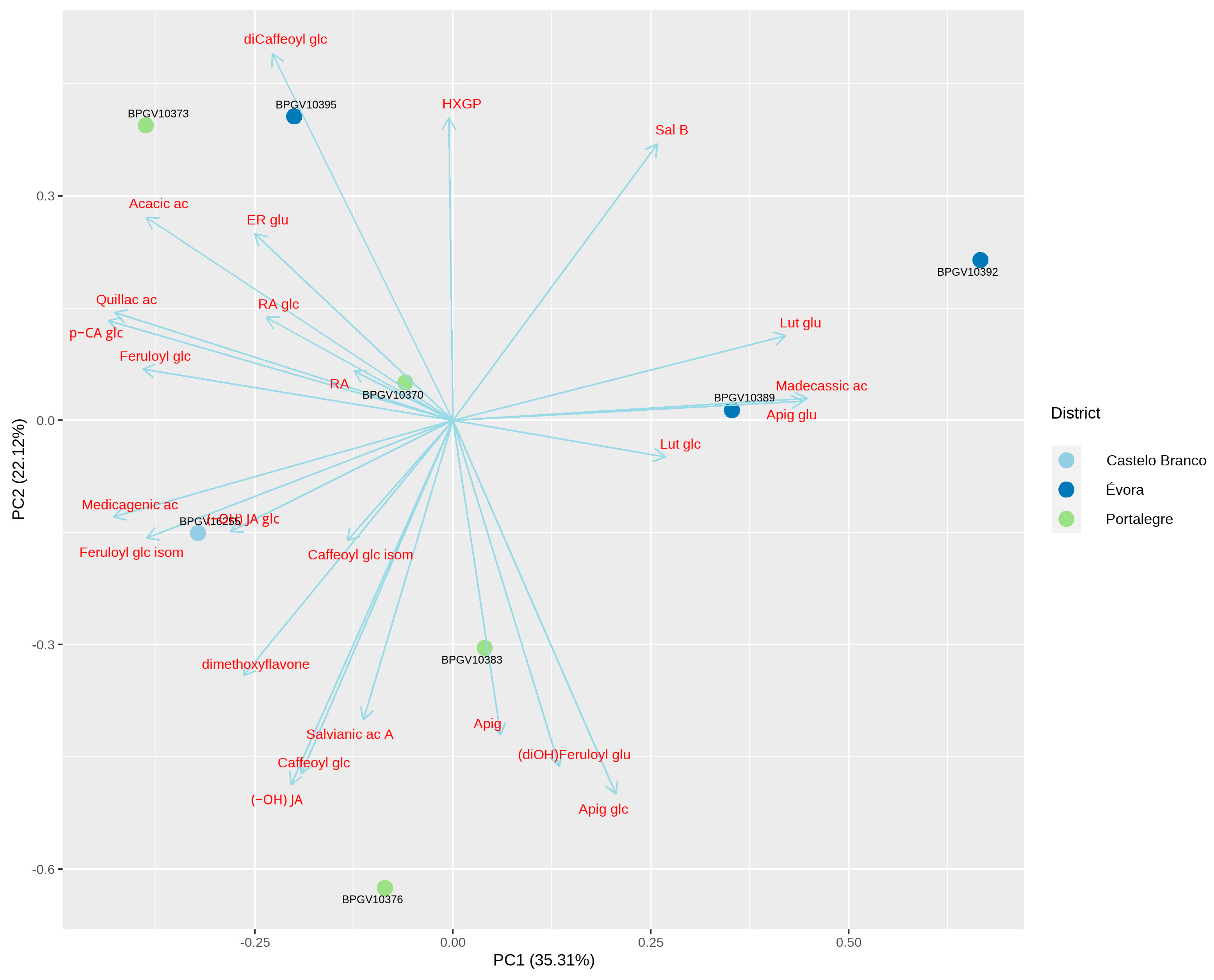
The two-axis projection, which accounts for 57.4% of the observed variance in the accessions, was determined by the primary compounds, namely madecassic ac and sal B, which were found in the positive quadrant of both axes (Figure 8). The accessions that were found to be associated with these compounds were BPGV10389 and BPGV10392, respectively. The results obtained from the study demonstrated that the values obtained for the TPC, FRAP and DPPH assays were elevated in these accessions. Apig glc was identified as the compound that defined the positive x quadrant, while the inverse was defined by the compounds diCaffeoyl glc and acacic ac. The former was found to be correlated with the positive y axis, with accession BPGV10373 being particularly noteworthy. The negative quadrant on both axes was found to be correlated with the compounds medicagenic ac and caffeoyl glc isom, with accession BPGV16255 being a prominent example. In the course of antioxidant capacity analyses, the accession BPGV16255 demonstrated elevated levels of total phenolic content (TPC) and ferric reducing antioxidant power (FRAP) and 2,2-diphenyl-1-picrylhydrazyl (DPPH) results.
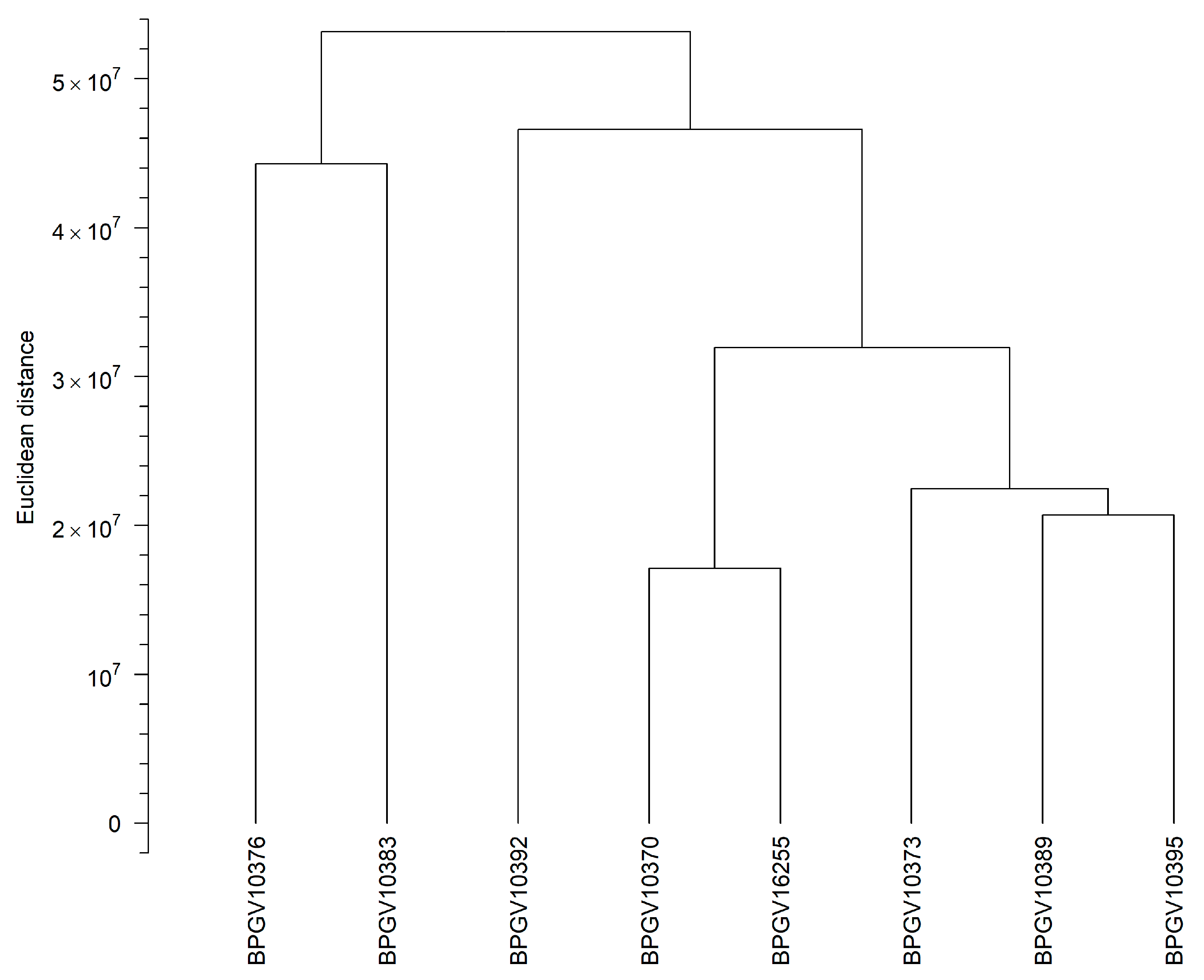
The dendrogram is a hierarchical representation of the genetic relationships between accessions, which are organized into four clusters (Figure 9). This clustering does not reflect the district of origin of the accessions
Furthermore, in the case of this group of French lavender accessions, the origin at higher altitudes was not a significant factor for most of the compounds, except for salvianic ac A, feruloyl glc and dimethoxyflavone (p < 0.05).

4. Conclusions

The Portuguese varieties of Mentha pulegium L. and Lavandula stoechas L. show a lot of phytochemical diversity and impressive antioxidant properties, making them interesting candidates for bioactive compounds in food, health supplements, and medicine. The detection of 24 metabolites in M. pulegium and 26 in L. stoechas, comprising flavonoids, phenolic acids, jasmonates, fatty acids, terpenoids, and triterpenoids, underscores the chemical intricacy of these species and their capacity to produce biological effects.
The trends noted in the concentrations of compounds and antioxidant activities, notably FRAP and DPPH, emphasize that the quality and variety of secondary metabolites are crucial for antioxidant effectiveness. The significant correlation between TPC and FRAP evident in L. stoechas shows that phenols are key factors in the reducing power of these species, whereas the variation in DPPH values implies distinct roles of certain compounds or their synergistic interactions.
A perspective sample from inland areas like Beja, Évora, and Portalegre was notable for having higher concentrations of phenols and increased antioxidant activity, supporting the impact of drier microclimates with larger temperature fluctuations on enhancing the biosynthesis of secondary metabolites. Moreover, multivariate analyses showed that genetic components primarily drive variation while the environment acts as a modulating influence.
Overall, both species possess traits that support their use in industry because of the abundant bioactive compounds they contain and the variety of chemotypes discovered. These findings open opportunities for the selection of high-quality genotypes; the refinement of extraction methods and the exploration of additional important biological effects, including antimicrobial, anti-inflammatory and vasoprotective actions.
Future investigations should focus on integrating environmental, phenological, and genetic factors into predictive models of chemical composition and developing breeding programs and industrial recovery processes that exploit the potential of these species as sustainable sources of bioactive compounds.

Author Contributions

Conceptualisation, V.L. and C.S.; methodology, V.L., C.S., M.C.O., A.S. and O.S.; software, C.S., C.G., O.S. and M.C.O.; validation, C.S. and M.C.O.; formal analysis, C.S., M.C.O., A.S. and O.S.; investigation, V.L., C.S., M.C.O. and O.S.; resources, V.L., A.M.B. and C.S.; data curation, C.S. and M.C.O.; writing—original draft preparation, C.S., C.G., V.L., A.M.B. and M.C.O.; writing—review and editing, V.L., C.S., M.C.O. and O.S.; visualization, V.L., C.S., O.S. and M.C.O.; supervision, V.L., C.S., M.C.O. and O.S.; project administration, V.L. and. C.S.; funding acquisition, V.L. and A.M.B. All authors have read and agreed to the published version of the manuscript.

Funding

Work developed within the project was financially supported by PDR2020-7.8.4-FEADER --784-042741 “Conservação e melhoramento de plantas aromáticas e medicinais (PAM)”, and Foundation for Science and Technology (FCT, Portugal), and Centro de Química Estrutural (CQE) is supported by the Fundação para a Ciência e Tecnologia (FCT, Portugal) through Projects UID/00100/2025 and UID/PRR/100/2025.

Institutional Review Board Statement

Not applicable.

Informed Consent Statement

Not applicable.

Data Availability Statement

The original contributions presented in the study are included in the article; further inquiries can be directed to the corresponding author.

Conflicts of Interest

The authors declare no conflicts of interest.

References

  1. Stankovic, M. Lamiaceae Species Biology, Ecology and Practical Uses; Special Issue Published in Plants; MDPI: Basel, Switzerland, 2020. [Google Scholar]
  2. Domingues, J.; Delgado, F.; Gonçalves, J.C.; Zuzarte, M.; Duarte, A.P. Mediterranean Lavenders from Section Stoechas: An Undervalued Source of Secondary Metabolites with Pharmacological Potential. Metabolites 2023, 13, 337. [Google Scholar] [CrossRef]
  3. Khennouf, S.; Dalila, B.; Djidel, S.; Dahamna, S.; Amira, S.; Noureddine, C.; Baghiani, A.; Harzallah, D.; Arrar, L. Polyphenols and antioxidant properties of extracts from Mentha pulegium L. and Matricaria chamomilla L. Pharmacogn. Commun. 2013, 3, 35–40. [Google Scholar] [CrossRef]
  4. Taamalli, A.; Arráez-Román, D.; Abaza, L.; Iswaldi, I.; Fernández-Gutiérrez, A.; Zarrouk, M.; Segura-Carretero, A. LC-MS-based metabolite profiling of methanolic extracts from the medicinal and aromatic species Mentha pulegium and Origanum majorana. Phytochem. Anal. 2015, 26, 320–330. [Google Scholar] [CrossRef]
  5. Sevim Nalkiran, H.; Nalkiran, I. Anticancer Effects and Phytochemical Profile of Lavandula stoechas. Pharmaceuticals 2025, 18, 1706. [Google Scholar] [CrossRef] [PubMed]
  6. Ćavar Zeljković, S.; Šišková, J.; Komzáková, K.; De Diego, N.; Kaffková, K.; Tarkowski, P. Phenolic Compounds and Biological Activity of Selected Mentha Species. Plants 2021, 10, 550. [Google Scholar] [CrossRef]
  7. Elrherabi, A.; Abdnim, R.; Loukili, E.H.; Laftouhi, A.; Lafdil, F.Z.; Bouhrim, M.; Mothana, R.A.; Noman, O.M.; Eto, B.; Ziyyat, A.; et al. Antidiabetic potential of Lavandula stoechas aqueous extract: Insights into pancreatic lipase inhibition, antioxidant activity, antiglycation at multiple stages and anti-inflammatory effects. Front. Pharmacol. 2024, 15, 1443311. [Google Scholar] [CrossRef]
  8. Politeo, O.; Bektašević, M.; Carev, I.; Jurin, M.; Roje, M. Phytochemical Composition, Antioxidant Potential and Cholinesterase Inhibition Potential of Extracts from Mentha pulegium L. Chem. Biodivers. 2018, 15, e1800374. [Google Scholar] [CrossRef]
  9. Teixeira, B.; Marques, A.; Ramos, C.; Batista, I.; Serrano, C.; Matos, O.; Neng, N.R.; Nogueira, J.M.F.; Saraiva, J.A.; Nunes, M.L. European pennyroyal (Mentha pulegium) from Portugal: Chemical composition of essential oil and antioxidant and antimicrobial properties of extracts and essential oil. Ind. Crops Prod. 2012, 36, 81–87. [Google Scholar] [CrossRef]
  10. Brahmi, F.; Lounis, N.; Mebarakou, S.; Guendouze, N.; Yalaoui-Guellal, D.; Madani, K.; Boulekbache-Makhlouf, L.; Duez, P. Impact of Growth Sites on the Phenolic Contents and Antioxidant Activities of Three Algerian Mentha Species (M. pulegium L., M. rotundifolia (L.) Huds., and M. spicata L.). Front. Pharmacol. 2022, 13, 886337. [Google Scholar] [CrossRef] [PubMed]
  11. Lopes, V.R.; Barata, A.M.; Rocha, F.; Pedro, L.G.; Barroso, J.G.; Figueiredo, A.C.L. Morphological and chemical variability assessment from Portuguese Mentha pulegium L. (pennyroyal) accessions. In Proceedings of the VIII International Ethnobotany Symposium, Lisbon, Portugal, 3-8 October 2010; Friends, the University for Peace Foundation and Faculty of Pharmacy, University of Lisbon: Lisbon, Portugal. ISBN 978-989-20-2789-0. 2011. [Google Scholar]
  12. Brahmi, F.; Dahmoune, F.; Kadri, N.; Chibane, M.; Dairi, S.; Remini, H.; Oukmanou-Bensidhoum, S.; Mouni, L.; Madani, K. Antioxidant capacity and phenolic content of two Algerian Mentha species M. rotundifolia (L.) Huds, M. pulegium L., extracted with different solvents. J. Complement. Integr. Med. 2017, 14, 20160064. [Google Scholar] [CrossRef]
  13. Cornara, L.; Sgrò, F.; Raimondo, F.M.; Ingegneri, M.; Mastracci, L.; D’Angelo, V.; Germanò, M.P.; Trombetta, D.; Smeriglio, A. Pedoclimatic Conditions Influence the Morphological, Phytochemical and Biological Features of Mentha pulegium L. Plants 2023, 12, 24. [Google Scholar] [CrossRef]
  14. Tafrihi, M.; Imran, M.; Tufail, T.; Gondal, T.A.; Caruso, G.; Sharma, S.; Sharma, R.; Atanassova, M.; Atanassov, L.; Valere Tsouh Fokou, P.; et al. The Wonderful Activities of the Genus Mentha: Not Only Antioxidant Properties. Molecules 2021, 26, 1118. [Google Scholar] [CrossRef]
  15. Lopes, V.; Barata, A. Ex situ morphological assessment of wild lavandula populations in portugal. Open Access J. Med. Aromat. Plants 2017, V3, 87–100. [Google Scholar] [CrossRef]
  16. Figueiredo, A.C.; Pedro, L.G.; Barroso, J.G.; Trindade, H.; Sanches, J.; Oliveira, C.; Correia, M. Mentha pulegium L. Agrotec Fevereiro 2014, 32–35. [Google Scholar]
  17. Ahmad, N.; Fazal, H.; Ahmad, I.; Abbasi, B.H. Free radical scavenging (DPPH) potential in nine Mentha species. Toxicol. Ind. Health 2011, 28, 83–89. [Google Scholar] [CrossRef]
  18. Jebali, J.; Ghazghazi, H.; Aouadhi, C.; Elbini-Dhouib, I.; Ben Salem, R.; Srairi-Abid, N.; Marrakchi, N.; Rigane, G. Tunisian Native Mentha pulegium L. Extracts: Phytochemical Composition and Biological Activities. Molecules 2022, 27, 314. [Google Scholar] [CrossRef]
  19. Gülçin, Ì.; Güngör Şat, İ.; Beydemir, Ş.; Elmastaş, M.; İrfan Küfrevioǧlu, Ö. Comparison of antioxidant activity of clove (Eugenia caryophylata Thunb) buds and lavender (Lavandula stoechas L.). Food Chem. 2004, 87, 393–400. [Google Scholar] [CrossRef]
  20. Contreras, M.d.M.; Algieri, F.; Rodriguez-Nogales, A.; Gálvez, J.; Segura-Carretero, A. Phytochemical profiling of anti-inflammatory Lavandula extracts via RP–HPLC–DAD–QTOF–MS and –MS/MS: Assessment of their qualitative and quantitative differences. Electrophoresis 2018, 39, 1284–1293. [Google Scholar] [CrossRef]
  21. Ahamad, R.; Kumar, S.; Akhtar, M.; Aqil, M.; Yar, M.S.; Akram, M.; Ismail, M.V.; Mujeeb, M. A Comprehensive Review of Lavandula stoechas L. (Ustukhuddus) Plant: Phytochemistry, Pharmacology, and In Silico Studies. Chem. Biodivers 2025, 22, e202401996. [Google Scholar] [CrossRef]
  22. Doğru, Z.; Doğru, M.S.; Yeşilay, G.; Kayalar, Ö.; Elmastaş, M. Anticancer activity of Lavandula stoechas L. flower ethanolic extract through apoptotic pathway modulation in colorectal cancer cells. Acta Pharm 2025, 75, 449–468. [Google Scholar] [CrossRef]
  23. Ez zoubi, Y.; Bousta, D.; Farah, A. A Phytopharmacological review of a Mediterranean plant: Lavandula stoechas L. Clin. Phytoscience 2020, 6, 9. [Google Scholar] [CrossRef]
  24. Silva, B.N.; Cadavez, V.; Caleja, C.; Pereira, E.; Calhelha, R.C.; Molina, A.K.; Finimundy, T.; Kostić, M.; Soković, M.; Teixeira, J.A.; et al. Chemical profiles and bioactivities of polyphenolic extracts of Lavandula stoechas L., Artemisia dracunculus L. and Ocimum basilicum L. Food Chem 2024, 451, 139308. [Google Scholar] [CrossRef] [PubMed]
  25. Haddouchi, F.; Chaouche, T.M.; Saker, M.; Ghellai, I.; Boudjemai, O. Phytochemical screening, phenolic content and antioxidant activity of Lavandula species extracts from Algeria. J. Pharm. Istanb. Univ. 2021, 51, 111–117. [Google Scholar] [CrossRef]
  26. Mushtaq, A.; Anwar, R.; Ahmad, M. Lavandula stoechas (L) a Very Potent Antioxidant Attenuates Dementia in Scopolamine Induced Memory Deficit Mice. Front. Pharmacol. 2018, 9, 1375. [Google Scholar] [CrossRef]
  27. Ceylan, Y.; Usta, K.; Usta, A.; Maltas Cagil, E.; Yildiz, S. Evaluation of Antioxidant Activity, Phytochemicals and ESR Analysis of Lavandula stoechas. Acta Phys. Pol. A 2015, 128, B-483. [Google Scholar] [CrossRef]
  28. Celep, E.; Akyüz, S.; İnan, Y.; Yesilada, E. Assessment of potential bioavailability of major phenolic compounds in Lavandula stoechas L. ssp. stoechas. Ind. Crops Prod. 2018, 118, 111–117. [Google Scholar] [CrossRef]
  29. Lesage-Meessen, L.; Bou, M.; Ginies, C.; Chevret, D.; Navarro, D.; Drula, E.; Bonnin, E.; del Río, J.; Odinot, E.; Bisotto, A.; et al. Lavender- and lavandin-distilled straws: An untapped feedstock with great potential for the production of high-added value compounds and fungal enzymes. Biotechnol. Biofuels 2018, 11, 217. [Google Scholar] [CrossRef]
  30. Sriti, J.; Fares, N.; Msaada, K.; Zarroug, Y.; Boulares, M.; Djebbi, S.; Selmi, S.; Limam, F. Phenological stage effect on phe-nolic composition, antioxidant, and antibacterialy activity of Lavandula stoechas extract. La Riv. Ital. Delle Sostanze Grasse 2022, 99, 225–234. [Google Scholar]
  31. Apak, R.; Özyürek, M.; Güçlü, K.; Çapanoğlu, E. Antioxidant Activity/Capacity Measurement. 1. Classification, Physicochemical Principles, Mechanisms, and Electron Transfer (ET)-Based Assays. J. Agric. Food Chem. 2016, 64, 997–1027. [Google Scholar] [CrossRef]
  32. Singleton, V.L.; Rossi, J.A. Colorimetry of Total Phenolics with Phosphomolybdic-Phosphotungstic Acid Reagents. Am. J. Enol. Vitic. 1965, 16, 144. [Google Scholar] [CrossRef]
  33. Abraham, E.J.; Kellogg, J.J. Chemometric-Guided Approaches for Profiling and Authenticating Botanical Materials. Front. Nutr. 2021, 8, 780228. [Google Scholar] [CrossRef]
  34. Anagbogu, C.F.; Zhou, J.; Olasupo, F.O.; Baba Nitsa, M.; Beckles, D.M. Lipidomic and metabolomic profiles of Coffea canephora L. beans cultivated in Southwestern Nigeria. PLoS ONE 2021, 16, e0234758. [Google Scholar] [CrossRef]
  35. Rocha, F.; Serra, O.; Vaz, M.; Silva, I.; Gaspar, C.; Lopes, V.; Barata, A.M. Portugal Gene Bank. In Plant Gene Banks: Genetic Resources Collections, Conservation and Sustainable Utilization; Al-Khayri, J.M., Salem, K.F.M., Jain, S.M., Kourda, H.C., Eds.; Springer Nature Singapore: Singapore, 2025; pp. 1–36. [Google Scholar]
  36. Slinkard, K.; Singleton, V.L. Total Phenol Analysis: Automation and Comparison with Manual Methods. Am. J. Enol. Vitic. 1977, 28, 49. [Google Scholar] [CrossRef]
  37. Serrano, C.; Oliveira, M.C.; Lopes, V.R.; Soares, A.; Molina, A.K.; Paschoalinotto, B.H.; Pires, T.C.S.P.; Serra, O.; Barata, A.M. Chemical Profile and Biological Activities of Brassica rapa and Brassica napus Ex Situ Collection from Portugal. Foods 2024, 13, 1164. [Google Scholar] [CrossRef] [PubMed]
  38. Deighton, N.; Brennan, R.; Finn, C.; Davies, H. Antioxidant properties of domesticated and wildRubus species. J. Sci. Food Agric. 2000, 80, 1307–1313. [Google Scholar] [CrossRef]
  39. Kondo, S.; Tsuda, K.; Muto, N.; Nakatani, S. Changes in Antioxidant Activity during Fruit Development in Citrus Fruit. Hortic. Res. 2002, 1, 63–66. [Google Scholar] [CrossRef]
  40. StatSoft. Inc. STATISTICA, Version 12; StatSoft. Inc.: Tulsa, OK, USA, 2013.
  41. Wickham, H.; Averick, M.; Bryan, J.; Chang, W.; McGowan, L.; François, R.; Grolemund, G.; Hayes, A.; Henry, L.; Hester, J.; et al. Welcome to the Tidyverse. J. Open Source Softw. 2019, 4, 1686. [Google Scholar] [CrossRef]
  42. Wickham, H. ggplot2: Elegant Graphics for Data Analysis; Springer International Publishing: Berlin/Heidelberg, Germany, 2016. [Google Scholar]
  43. Olivoto, T.; Lúcio, A. metan: An R package for multi-environment trial analysis. Methods Ecol. Evol. 2020, 11, 783–789. [Google Scholar] [CrossRef]
  44. Salem, N.; Sriti, J.; Bachrouch, O.; Msaada, K.; Khammassi, S.; Majdi, H.; Selmi, S.; Boushih, E.; Ouertani, M.; Hachani, N.; et al. Phenological stage effect on phenolic composition and repellent potential of Mentha pulegium against Tribolium castaneum and Lasioderma serricorne. Asian Pac. J. Trop. Biomed. 2018, 8, 207. [Google Scholar] [CrossRef]
  45. Tayarani-Najaran, Z.; Hadipour, E.; Seyed Mousavi, S.M.; Emami, S.A.; Mohtashami, L.; Javadi, B. Protective effects of Lavandula stoechas L. methanol extract against 6-OHDA-induced apoptosis in PC12 cells. J. Ethnopharmacol. 2021, 273, 114023. [Google Scholar] [CrossRef] [PubMed]
  46. Apak, R.; Güçlü, K.; Özyürek, M.; Çelik, S.E. Mechanism of antioxidant capacity assays and the CUPRAC (cupric ion reducing antioxidant capacity) assay. Microchim. Acta 2008, 160, 413–419. [Google Scholar] [CrossRef]
  47. Brand-Williams, W.; Cuvelier, M.E.; Berset, C. Use of a free radical method to evaluate antioxidant activity. LWT-Food Sci. Technol. 1995, 28, 25–30. [Google Scholar] [CrossRef]
  48. Shahidi, F.; Zhong, Y. Measurement of antioxidant activity. J. Funct. Foods 2015, 18, 757–781. [Google Scholar] [CrossRef]
  49. Prior, R.L.; Wu, X.; Schaich, K. Standardized methods for the determination of antioxidant capacity and phenolics in foods and dietary supplements. J. Agric. Food Chem. 2005, 53, 4290–4302. [Google Scholar] [CrossRef]
  50. Huang, D.; Ou, B.; Prior, R.L. The chemistry behind antioxidant capacity assays. J. Agric. Food Chem. 2005, 53, 1841–1856. [Google Scholar] [CrossRef] [PubMed]
  51. Hajimehdipoor, H.; Gohari, A.R.; Ajani, Y.; Saeidnia, S. Comparative study of the total phenol content and antioxidant activity of some medicinal herbal extracts. Res. J. Pharmacogn. 2014, 1, 21–25. [Google Scholar]
  52. Ulewicz-Magulska, B.; Wesolowski, M. Antioxidant Activity of Medicinal Herbs and Spices from Plants of the Lamiaceae, Apiaceae and Asteraceae Families: Chemometric Interpretation of the Data. Antioxidants 2023, 12, 2039. [Google Scholar] [CrossRef]
  53. Barros, L.; Heleno, S.A.; Carvalho, A.M.; Ferreira, I.C.F.R. Lamiaceae often used in Portuguese folk medicine as a source of powerful antioxidants: Vitamins and phenolics. LWT-Food Sci. Technol. 2010, 43, 544–550. [Google Scholar] [CrossRef]
  54. Skrovankova, S.; Mlcek, J. Antioxidant Potential and Its Changes Caused by Various Factors in Lesser-Known Medicinal and Aromatic Plants. Horticulturae 2025, 11, 104. [Google Scholar] [CrossRef]
  55. Zengin, G.; Yagi, S.; Selvi, S.; Cziáky, Z.; Jeko, J.; Sinan, K.I.; Topcu, A.A.; Erci, F.; Boczkaj, G. Elucidation of chemical compounds in different extracts of two Lavandula taxa and their biological potentials: Walking with versatile agents on the road from nature to functional applications. Ind. Crops Prod. 2023, 204, 117366. [Google Scholar] [CrossRef]
  56. Mascoloti Spréa, R.; Caleja, C.; Pinela, J.; Finimundy, T.C.; Calhelha, R.C.; Kostić, M.; Sokovic, M.; Prieto, M.A.; Pereira, E.; Amaral, J.S.; et al. Comparative study on the phenolic composition and in vitro bioactivity of medicinal and aromatic plants from the Lamiaceae family. Food Res. Int. 2022, 161, 111875. [Google Scholar] [CrossRef] [PubMed]
  57. Mohammadi, F.; Rahimi, K.; Ahmadi, A.; Hooshmandi, Z.; Amini, S.; Mohammadi, A. Anti-inflammatory effects of Mentha pulegium L. extract on human peripheral blood mononuclear cells are mediated by TLR-4 and NF-κB suppression. Heliyon 2024, 10, 375–387. [Google Scholar] [CrossRef] [PubMed]
  58. Sebai, E.; Serairi, R.; Saratsi, K.; Abidi, A.; Sendi, N.; Darghouth, M.A.; Wilson, M.S.; Sotiraki, S.; Akkari, H. Hydro-Ethanolic Extract of Mentha pulegium Exhibit Anthelmintic and Antioxidant Proprieties In Vitro and In Vivo. Acta Parasitol. 2020, 65, 375–387. [Google Scholar] [CrossRef]
  59. Cherbal, A.; Aytar, E.C.; Aydoğmuş, Z.; Fenghour, M.; Gheddar, K. Comprehensive evaluation of the anti-inflammatory effects of Lavandula stoechas L.: In vivo, in vitro, and in silico studies. J. Ethnopharmacol. 2025, 357, 120887. [Google Scholar] [CrossRef] [PubMed]
  60. Baali, F.; Boumerfeg, S.; Boudjelal, A.; Denaro, M.; Ginestra, G.; Baghiani, A.; Righi, N.; Deghima, A.; Benbacha, F.; Smeriglio, A.; et al. Wound-healing activity of Algerian Lavandula stoechas and Mentha pulegium extracts: From traditional use to scientific validation. Plant Biosyst.-Int. J. Deal. All Asp. Plant Biol. 2022, 156, 427–439. [Google Scholar] [CrossRef]
  61. Ferehan, H.; Laaradia, M.A.; Oufquir, S.; Aboufatima, R.; Moubtakir, S.; Sokar, Z.; Chait, A.; Bagri, A. Antioxidant, Analgesic and Anti-inflammatory Effects of Ethanolic Extract of Moroccan Lavandula stoechas L. OnLine J. Biol. Sci. 2021, 21, 346–358. [Google Scholar] [CrossRef]
  62. Karan, T. Metabolic profile and biological activities of Lavandula stoechas L. Cell. Mol. Biol. 2018, 64, 1–7. [Google Scholar] [CrossRef]
  63. Chaves, N.; Santiago, A.; Alías, J.C. Quantification of the Antioxidant Activity of Plant Extracts: Analysis of Sensitivity and Hierarchization Based on the Method Used. Antioxidants 2020, 9, 76. [Google Scholar] [CrossRef]
  64. Kiss, A.; Papp, V.A.; Pál, A.; Prokisch, J.; Mirani, S.; Toth, B.E.; Alshaal, T. Comparative Study on Antioxidant Capacity of Diverse Food Matrices: Applicability, Suitability and Inter-Correlation of Multiple Assays to Assess Polyphenol and Antioxidant Status. Antioxidants 2025, 14, 317. [Google Scholar] [CrossRef]
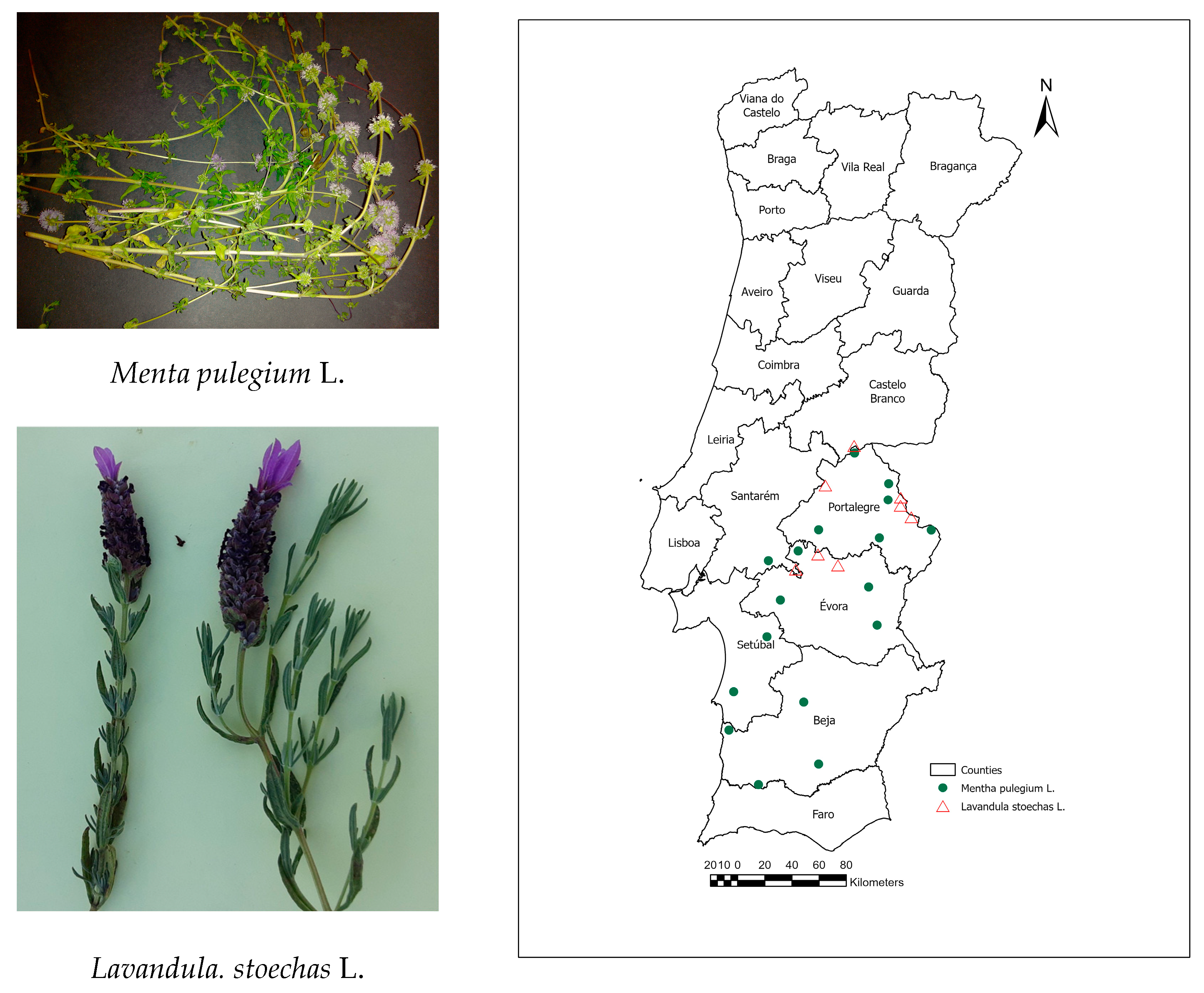
Figure 1. Geographical origins and common morphotype of the studied pennyroyal (Mentha pulegium L.) and French lavender (Lavandula stoechas L.) samples.
Appliedchem 06 00003 g001
Figure 2. Heatmap of Pearson correlation coefficients (r) between antioxidant capacity and individual phenolic compounds in pennyroyal extracts. Abbreviations: TPC (Total Phenolic Content), DPPH (2,2-diphenyl-1-picrylhydrazyl assay), FRAP (Ferric Reducing Antioxidant Power assay).
Appliedchem 06 00003 g002
Figure 3. Heatmap of Pearson correlation coefficients (r) between antioxidant capacity and individual phenolic compounds in lavender extracts. Abbreviations: TPC (Total Phenolic Content), DPPH (2,2-diphenyl-1-picrylhydrazyl assay), FRAP (Ferric Reducing Antioxidant Power assay).
Appliedchem 06 00003 g003
Figure 4. Variation between the average values (m/z (∆ ppm)) of the Pennyroyal accessions by region of origin.
Appliedchem 06 00003 g004
Figure 5. Principal component analysis biplot based on average value matrix of phytochemicals identifies 16 accessions of Pennyroyal. Colored dots represent accessions from a given origin. Blue arrows represent the influence of a given compound (in red) to the principal components.
Appliedchem 06 00003 g005
Figure 6. Hierarchical clustering of the 16 Pennyroyal accessions based on their LC-MS profile.
Appliedchem 06 00003 g006
Figure 7. Variation between the average values (m/z (∆ ppm)) of the French Lavender accessions by region of origin.
Appliedchem 06 00003 g007
Figure 8. Principal component analysis biplot based on average values matrix of phytochemicals identifies 8 accessions of French Lavender. Colored dots represent accessions from a given origin. Blue arrows represent the influence of a given compound (in red) to the principal components.
Appliedchem 06 00003 g008
Figure 9. Hierarchical clustering of the 8 French Lavender accessions based on their LC-MS profile.
Appliedchem 06 00003 g009
Table 1. The origin of the 25 accessions, Pennyroyal and French Lavender, from BPGV collection.
Pennyroyal
AccessionGeographyElevation (m)Lat. N; Long. W
BPGV08453Portalegre23839°5′8.88″ N; 7°1′51.96″ W
BPGV08454Portalegre60739°17′20.76″ N; 7°23′51.72″ W
BPGV08455Portalegre64439°23′51″ N; 7°23′22.92″ W
BPGV08456Portalegre24139°2′11.76″ N; 7°28′22.8″ W
BPGV08459Évora35838°42′45.72″ N; 7°34′3.72″ W
BPGV08465Beja20137°57′0″ N; 8°6′59.76″ W
BPGV08468Évora5738°57′9″ N; 8°9′49.68″ W
BPGV08469Santarém13838°53′13.92″ N; 8°25′3.72″ W
BPGV08471Évora22538°37′36.84″ N; 8°18′50.76″ W
BPGV08473Beja8837°45′48.96″ N; 8°44′35.88″ W
BPGV08476Setúbal6338°23′1.68″ N; 8°25′37.92″ W
BPGV08477Portalegre23139°36′5.76″ N; 7°40′50.88″ W
BPGV08479Évora26538°27′36.72″ N; 7°29′49.92″ W
BPGV08480Beja18437°24′12.96″ N; 8°29′35.88″ W
BPGV09893Beja21737°32′24.72″ N; 7°59′33.72″ W
BPGV10427Portalegre17539°5′31.2″ N; 7°59′24″ W
BPGV08475Setúbal10538°1′3.72″ N; 8°42′16.992″ W
French Lavender
AccessionGeographyElevation (m)Lat. N; Long. W
BPGV10370Portalegre32539°10′19.2″ N; 7°12′0″ W
BPGV10373Portalegre50839°14′56.4″ N; 7°17′24″ W
BPGV10376Portalegre52839°18′10.8″ N; 7°17′16.8″ W
BPGV10383Portalegre24639°23′16.8″ N; 7°55′51.6″ W
BPGV10389Évora18038°55′48″ N; 7°59′42″ W
BPGV10392Évora13238°49′48″ N; 8°11′2.4″ W
BPGV10395Évora25038°51′25.2″ N; 7°49′33.6″ W
BPGV16255Castelo Branco21239°38′56.4″ N; 7°41′2.4″ W
Table 2. Results of the Total Phenolic Content and Antioxidant Capacity in pennyroyal extracts.
AccessionOriginYield
%
TPC
mg GAE/g DW
FRAP
μmol Fe2+/g DW
DPPH
μmol TE/g DW
BPGV08471Évora11.659 ± 0.023 a,b,c,d,e,f28.81 ± 2.11 b,c,d,e193.561 ± 0.142 a,b,c,d,e73.371 ± 3.676 a,b,c
BPGV08475Setúbal10.148 ± 0.893 a,b,c27.77 ± 4.63 a,b,c,d,e239.243 ± 3.146 f,g288.144 ± 7.930 a,b,c
BPGV08480Beja12.860 ± 0.318 d,e,f30.88 ± 7.60 b,c,d,e242.814 ± 4.961 f,g76.404 ± 3.170 b,c
BPGV08459Évora9.392 ± 0.167 a24.89 ± 0.29 a,b,c181.025 ± 7.559 a,b,c252.614 ± 8.368 c
BPGV08479Évora13.235 ± 0.498 e,f34.03 ± 5.70 d,e228.745 ± 1.548 d,e,f,g58.935 ± 3.695 a
BPGV08476Setúbal13.041 ± 0.334 d,e,f20.07 ± 5.90 a170.503 ± 2.835 a58.784 ± 2.054 a
BPGV09893Beja12.087 ± 0.289 b,c,d,e,f31.76 ± 10.20 c,d,e289.680 ± 3.013 h146.738 ± 4.789 b,c
BPGV08477Portalegre12.126 ± 0.866 b,c,d,d,e,f27.87 ± 0.07 a,b,c,d,e188.134 ± 5.336 a,b,c,d63.139 ± 0.859 b,c
BPGV08473Beja10.467 ± 0.198 a,b,c,d29.22 ± 0.07 b,c,d,e225.338 ± 6.580 c,d,e,f,g200.126 ± 9.584 a,b,c
BPGV08454Portalegre10.802 ± 0.404 a,b,c,d,e22.59 ± 0.02 a,b237.167 ± 0.712 e,f,g84.396 ± 8.424 b,c
BPGV08455Portalegre12.546 ± 0.649 c,d,e,f30.84 ± 2.46 b,c,d,e237.017 ± 4.491 e,f,g78.416 ± 8.258 a,b.c
BPGV08468Évora13.858 ± 0.464 f28.97 ± 5.43 b,c,d,e229.171 ± 1.139 d,e,f,g69.518 ± 8.713 a,b,c
BPGV08469Santarém12.106 ± 0.260 b,c,d,e,f28.69 ± 6.91 b,c,d,e221.759 ± 1.389 b,c,d,e,f,g57.505 ± 4.497 a
BPGV08456Portalegre11.892 ± 0.269 a,b,c,d,e,f35.29 ± 2.35 e224.637 ± 1.092 c,d,e,f,g67.375 ± 5.567 a,b,c
BPGV10427Portalegre10.048 ± 1.813 a,b,c29.01 ± 2.64 b,c,d,e179.244 ± 2.921 a,b286.509 ± 12.834 a,b,c
BPGV08465Beja12.537 ± 0.377 c,d,e,f35.29 ± 1.06 e265.936 ± 0.223 g,h67.204 ± 0.422 a
BPGV08453Portalegre9.809 ± 0.897 a,b25.58 ± 1.78 a,b,c,d199.841 ± 2.973 a,b,c,d,e,f356.246 ± 3.477 a,b,c
The results are expressed as mean ± standard deviation (SD), from three replicates. Different superscript letters indicate the significant difference (p < 0.05) in each assay. GAE—gallic acid equivalents; TE—Trolox equivalents; DW—dried weight.
Table 3. Results of the Total Phenolic Content and Antioxidant Capacity in lavender extracts.
AccessionOriginYield
%
TPC
mg GAE/g DW
FRAP
μmol Fe2+/g DW
DPPH
μmol TE/g DW
BPGV10370Portalegre30.130 ± 2.503 a58.654 ± 6.719 a141.812 ± 4.969 a,b175.274 ± 4.383 a
BPGV10373Portalegre24.020 ± 2.263 a,b64.694 ± 4.193 a135.530 ± 3.782 a178.912 ± 0.666 a
BPGV10376Portalegre26.452 ± 1.222 a42.133 ± 3.037 b102.215 ± 2.012 c170.3042 ± 2.662 a
BPGV10383Portalegre17.104 ± 1.663 b62.473 ± 1.788 a153.046 ± 2.871 b174.015 ± 4.277 a
BPGV10389Évora26.882 ± 1.270 a61.422 ± 0.703 a148.661 ± 0.076 a,b175.259 ± 0.409 a
BPGV10392Évora22.764 ± 0.634 a,b52.226 ± 0.520 a,b110.034 ± 5.741 c177.099 ± 0.496 a
BPGV10395Évora26.270 ± 3.403 a62.279 ± 1.796 a143.756 ± 2.827 a,b179.355 ± 2.689 a
BPGV16255Castelo Branco24.444 ± 0.238 a,b54.686 ± 4.007 a,b136.678 ± 2.686 a174.847 ± 0.304 a
The results are expressed as mean ± standard deviation (SD), from three replicates. Different superscript letters indicate the significant difference (p < 0.05) in each assay. GAE—gallic acid equivalents; TE—Trolox equivalents; DW—dried weight.
Table 4. Identification and characterization of major phytochemicals in pennyroyal extracts using HPLC-ESI(-)-HRMS/MS.
PeaktR
(min)
Ionic
Formula
[M-H]
[(m/z)(Δ ppm; mSigma]
MS/MS
[(m/z)(Δ ppm) (Attribution)]
Proposed Metabolite
P13.33[C12H17O7S]305.0712 (−0.7; 9.5)225.1144 [C12H17O4) (−5.4)]Sulfo jasmonate
P23.48[C18H27O9]387.1676 (−3.9; 11.8)299.1502 [(C15H23O6) (−2.8)]
251.0568 [(C12H11O6) (−2.8)]
207.1038 [(C12H15O3) (−2.8)]
179.0347 [(C9H7O4) (−0.1)]
161.0243 [(C9H5O3) (−0.7)]
Hidroxyjasmonic acid Glc
P33.54[C12H17O7S]305.0715 (−4.6; 12.5)225.1145 [C12H17O4) (−5.8)]
147.0826 [C10H11O1) (−6.9)]
Sulfo jasmonate isomer
P43.85[C12H17O4]
225.1140 (−3.6; 3.5)167.1083 [C10H15O2) (−3.5)]
147.0816 [C10H11O1) (−2.9)]
Hydroxyjasmonic acid
P53.91[C27H29O15]593.1541 (−4.1; 10.4)447.0960 [C21H19O11) (−6.0)]
327.0533 [C17H11O7) (−7.1) 0, 2X0]
285.0422 [C15H9O6) (−6.0) Y0]
284.0340 [C15H8O6) (−4.9) (Y0−H)]
Luteolin-7-O-rutinoside
P64.14[C27H29O14]577.1580 (−3.1; 21.1]269.0467 [C15H9O5) (−4.4) Y0]Apigenin-7-O-neohesperidoside
P74.22[C28H31O15]607.1693 (−3.5; 12.1]299.0581 [C16H11O6) (−3.1) Y0]Diosmin
P84.26[C28H33O15]609.1852 (−4.4; 14.5]301.0737 [C16H13O6) (−5.2) Y0]Hesperidin
P94.35[C18H15O8]359.0787(−4.0; 14.2)197.0460 [C9H9O5) (−2.2)]
179.0349 [C9H7O4) (−2.2)]
161.0242 [C9H5O3) (−1.2)]
135.0450 [C8H7O2) (−1.2)]
Rosmarinic acid
P104.43[C22H23O11]463.1259 (−2.9; 12.9)301.0731 [C16H13O6) (−4.5) Y0]
268.0388 [C15H8O5) (−3.9)]
Hesperitin-7-O-Glc
P114.45[C36H29O16]717.1481(−3.1; 6.8)519.0960 [C27H19O11) (−3.9)]
475.1058 [C26H9O9) (−4.8)]
339.0525 [C18H11O7) (−0.5)]
299.0577 [C16H11O6) (−2.8)]
Salvianolic acid B
P124.72[C28H31O14]591.1727 (−1.4; 13.2)283.0606 [C16H11O5) (−2.1) Y0]
268.0388 [C15H8O5) (−3.9)]
Acacetin-7-O-rutinoside
P134.76[C28H33O14]593.1889 (−2.2; 8.7)342.1477 [C20H22O6) (−1.4)]
285.0787 [C16H13O5) (−6.1) Y0]
isoSakuranetin-7-O-rutinoside
P145.32[C18H31O5]327.2188 (−3.4; 6.1)291.1976 [C18H27O3) (−3.5)]
229.1455 [C12H21O4) (−4.2)]
211.1347 [C12H19O3) (−3.4)]
171.1027 [C9H15O3) (−0.4)]
Malyngic acid
P155.40[C16H11O6]299.0564 (−4.1; 32.7)284.0336 [C15H8O6) (−3.5)]
283.0232 [C15H7O6) (−1.9)]
256.0383 [C14H8O5) (−1.9)]
Diosmetin
P165.42[C18H15O8]359.0781 (−2.4; 12.7)344.0550 [C17H12O8) (−5.2)]
329.0312 [C16H9O8) (−2.7)]
314.0076 [C15H6O8) (−2.6)]
301.0361 [C15H9O7) (−2.5)]
286.0131 [C14H6O7) (−4.3)]
242.0226 [C13H6O5) (−4.3)]
Jaceidin 1
P175.54[C18H33O5]329.2347 (−4.2; 7.3)229.1454 [C12H21O4) (−3.6)]
211.1345 [C12H19O3) (−2.7)]
171.1025 [C9H15O3) (−1.2)]
Pinellic acid
P185.71[C18H15O8]359.0788 (−2.6; 8.2)344.0550 [C17H12O8) (−3.7)]
329.0315 [C16H9O8) (−3.6)]
314.0082 [C15H6O8) (−4.4)]
301.0361 [C15H9O7) (−2.5)]
286.0132 [C14H6O7) (−4.1)]
Jaceidin 2
P196.21[C16H13O5]285.0777 (−4.0; 6.2)239.0358 [C14H7O4) (−3.5)]
151.0040 [C7H3O4) (−2.4)]
Sakuranetin
P206.75[C30H47O5]487.3443 (−2.8; 1.8)469.3333 [C30H45O4) (−2.1)]
441.3387 [C29H45O3) (−2.9)]
343.2645 [C23H35O2) (−0.7)]
Asiatic acid
P216.84[C30H47O5]487.3442 (−2.7; 1.8)469.3333 [C30H45O4) (−2.1)]
441.3387 [C29H45O3) (−2.9)]
423.3230 [C29H43O2) (−2.3)]
371.2965 [C25H39O2) (−4.4)]
Acacic acid
P227.20[C30H47O4]471.3492 (−2.7; 9.3)337.2190 [C23H29O2) (−5.0)]Maslinic acid
P237.28[C18H29O3]293.2139 (−5.7; 8.6)275.2025 [C18H27O2) (−2.9)
183.1390 [C11H19O2) (−0.4)
171.1028 [C9H15O3) (−1.0)
Hydroxyoctadeca-trienoic acid
P247.65[C18H31O3]295.2294 (−5.1; 8.2)277.2182 [C18H29O2) (−3.4)
195.1394 [C12H19O2) (−1.5)
13-hydroxy-9Z,11E-octadeca-trienoic acid
Abbreviation: Glc, glucose.
Table 5. Identification and characterization of major phytochemicals in French Lavender extracts using HPLC-ESI(-)-HRMS/MS.
PeaktR
(min)
Ionic
Formula
[M-H]
[(m/z)(Δ ppm; mSigma]
MS/MS
[(m/z)(Δ ppm) (Attribution)]
Proposed Metabolite
L12.20[C9H9O5]197.0462 (−3.5; 12.8)179.0351 [(C9H7O4) (−0.8)]
135.0456 [(C8H7O2) (−0.8)]
Salvianic acid A
L23.11[C15H17O9]341.0896 (−5.3; 24.9)251.0583 [(C12H11O6) (−8.8)]
221.0469 [(C11H9O5) (−6.2)]
179.0359 [(C9H7O4) (−5.1)]
161.0246 [(C9H5O3) (−1.0)]
Caffeoylglucose
L33.23[C15H17O9]341.0897 (−5.7; 12.6)281.0680 [(C13H13O7) (−4.8)]
251.0572 [(C12H11O6) (−4.4)]
221.0465 [(C11H9O5) (−4.3)]
179.0351 [(C9H7O4) (−0.6)]
Caffeoylglucose isomer
L43.44[C15H17O8]325.0945 (−4.8; 4.7)205.0513 [(C11H9O4) (−3.2)]
193.0511 [(C10H9O4) (−3.5)]
163.0398 [(C9H7O3) (−1.3)]
161.0609 [(C10H9O2) (−0.3)]
145.0295 [(C9H6O2) (−0.2)]
Coumaric acid Glc
L53.48[C18H27O9]387.1676 (−3.9; 11.8)299.1502 [(C15H23O6) (−2.8)]
251.0568 [(C12H11O6) (−2.8)]
207.1038 [(C12H15O3) (−2.8)]
179.0347 [(C9H7O4) (−0.1)]
161.0243 [(C9H5O3) (−0.7)]
Hydroxy-jasmonic acid Glc
L63.61[C16H19O9]355.1046 (−3.2; 6.4)235.0626 [C12H11O5) (−10.2)]
193.0513 [C10H9O4) (−5.7)]
175.0403 [C10H7O3)(−1.7)]
Feruloylglucose
L73.68[C16H19O9]355.1049 (−4.1; 5.3)235.0628 [C12H11O5) (−6.8)]
193.0510 [C10H9O4) (−2.1)]
175.0404 [C10H7O3) (−1.6)]
Feruloylglucose isomer
L83.80[C16H19O10]371.0986 (−3.3; 5.2)249.0642 [C9H13O8) (−10.4)]
121.0308 [C7H5O2) (−3.5)]
dihydroferulic acid-4-O-Glr
L93.85[C12H17O4]225.1140 (−3.6; 3.5)167.1083 [C10H15O2) (−3.5)]
147.0816 [C10H11O1) (−2.9)]
Hydroxy-jasmonic acid
L103.85[C24H25O13]521.1316 (−2.9; 2.6)359.0779 [C18H15O8) (−1.8)]
197.0450 [C9H9O5) (−3.8)]
161.0233 [C9H5O3) (−1.3)]
Rosmarinyl Glc
L113.93[C17H29O10]393.1780 (−3.5; 8.2)197.0819 [C10H13O4) (−0.7)]
191.0574 [C7H11O5) (−6.8)]
183.1026 [C10H11O3) (−0.5)]
161.0463 [C6H9O5) (−4.7)]
Hexenyl-primeveroside
(HXGP)
L124.00[C21H19O12]463.0879 (−0.7; 3.2)329.0616 [C17H13O7) (−5.1) 0, 2X0]
287.0577 [C15H11O6) (−4.8) Y0]
151.0038 [C7H3O4) (−0.8) 13A]
135.0457 [C6H7O2) (−4.7)]
Eriodictyol-7-O-Glr
L134.01[C21H19O11]447.0934 (−0.8; 5.5)327.0527 [C17H11O7) (−5.1) 0, 2X0]
285.0413 [C15H9O6) (−2.9) Y0]
284.0338 [C15H8O6) (−4.0) (Y0−H)]
255.0319 [C14H7O5) (−7.9)]
151.0035 [C7H3O4) (−1.5) 1, 3A]
133.0245 [C8H4O2) (−4.3)]
Luteolin-7-O-Glc
L144.05[C21H17O12]461.0740 (−3.2; 15.2)327.0786 [C17H11O7) (−4.1) 0, 2X0]
285.0416 [C15H9O6) (−4.0) Y0]
179.0344 [C9H7O4) (−3.2)]
151.0032 [C7H3O4) (−3.3) 1, 3A]
113.0257 [C5H5O3) (−8.4)]
Luteolin-7-Glr
L154.22[C24H23O12]503.1215 (−3.9; 21.4)341.0892 [C15H17O9) (−4.2)]
281.0681 [C13H13O7) (−5.1)]
251.0574 [C12H11O6) (−4.9)]
161.0244 [C9H5O3) (−0.4)]
Dicaffeoyl-Glc
L164.26[C21H19O10]431.0994 (−2.9; 8.5)269.0453 [C15H9O5) (−1.2) Y0]
268.0391 [C15H8O5) (−5.1) (Y0−H)]
179.0351 [C9H7O4) (−0.6)]
151.0399 [C8H7O3) (−1.4)]
Apigenin-7-O-Glc
L174.30[C21H17O11]445.0781(−0.9; 6.2)269.0453 [C15H9O5) (−3.7) Y0]
197.0461 [C9H9O5) (−4.5)]
179.0343 [C9H7O4) (−4.1)]
161.0234 [C9H5O3) (−6.2)]
Apigenin-7-O-Glr
L184.35[C18H15O8]359.0787(−4.0; 14.2)197.0460 [C9H9O5) (−2.2)]
179.0349 [C9H7O4) (−2.2)]
161.0242 [C9H5O3) (−1.2)]
135.0450 [C8H7O2) (−1.2)]
Rosmarinic acid
L194.50[C36H29O16]717.1481(−3.1; 6.8)509.0945 [C31H16O8) (−1.0)]
339.0523 [C11H14O12) (−2.2)]
321.0421 [C11H12O11) (−0.5)]
295.0621 [C17H11O5) (−2.8)]
Salvianolic acid B
L205.13[C17H13O6]313.0724 (−2.1; 3.8)267.1610 [C15H23O4) (−3.0)]
207.1399 [C13H19O2) (−4.2)]
161.0242 [C9H5O3) (−1.2)]
151.0396 [C8H7O3) (−3.3)]
133.0300 [C8H5O3) (−3.8)]
3,7-Dihydroxy-3′,4′dimethoxy-flavone
L215.19 [C15H9O5]269.0460 (−1.8; 4.0)241.0513 [C14H9O4) (−3.2)]
151.0036 [C7H3O4) (−0.3) 1, 3A]
117.0339 [C8H5O) (−6.0)]
Apigenin
L225.54[C18H33O5]329.2347 (−4.2; 7.3)229.1454 [C12H21O4) (−3.6)]
211.1345 [C12H19O3) (−2.7)]
171.1025 [C9H15O3) (−1.2)]
Pinellic acid
L235.99[C30H45O6]501.3231 (−1.9; 5.0)483.3130 [C30H43O5) (−2.8)]
441.3028 [C28H41O4) (−4.0)]
233.0470 [C12H9O5) (−6.1)]
Medicagenic acid
L245.02[C30H47O6]503.3389 (−2.1; 5.0)485.3228 [C30H45O5) (−2.7)]
453.3023 [C29H41O4) (−2.7)]
441.3383 [C29H43O4) (−2.0)]
409.3125 [C28H41O2) (−3.2)]
233.0465 [C12H9O5) (−4.1)]
Madecassic acid
L256.75[C30H45O5]485.3283 (−2.3; 9.6)467.3177 [C30H43O4) (−2.3)]
425.3071 [C28H41O3) (−2.3)]
357.2815 [C24H37O2) (−4.4)]
Quillaic acid
L266.89[C30H47O5]487.3442 (−2.7; 1.8)469.3333 [C30H45O4) (−2.1)]
441.3387 [C29H45O3) (−2.9)]
425.3435 [C29H45O2) (−2.3)]
371.2965 [C25H39O2) (−4.4)]
Acacic acid
Abbreviations: Glc: glucose; Glr: glucuronide.
Disclaimer/Publisher’s Note: The statements, opinions and data contained in all publications are solely those of the individual author(s) and contributor(s) and not of MDPI and/or the editor(s). MDPI and/or the editor(s) disclaim responsibility for any injury to people or property resulting from any ideas, methods, instructions or products referred to in the content.