Article

Sustainable Plant-Based Biochar as Effective Methylene Blue Adsorbents: The Case of Alfalfa and Corn


by
Wioletta Barszcz
1,2,*,
Monika Łożyńska
1,
Maciej Życki
1,3,
Anna Kowalik-Klimczak
1 and
Małgorzata Wojtkowska
2
1
Łukasiewicz Research Network, Institute for Sustainable Technologies, K. Pułaskiego 6/10, 26-600 Radom, Poland
2
Faculty of Environmental Engineering, Warsaw University of Technology, Nowowiejska 20, 00-653 Warsaw, Poland
3
Institute of Material Science of Textile and Polymer Composite, Lodz University of Technology, S. Żeromskiego 116, 90-924 Łódź, Poland
*
Author to whom correspondence should be addressed.
AppliedChem 2026, 6(1), 16; https://doi.org/10.3390/appliedchem6010016
Submission received: 30 November 2025 / Revised: 30 December 2025 / Accepted: 23 February 2026 / Published: 1 March 2026

Abstract

A comprehensive study was conducted to determine the suitability of biochar produced from agricultural waste in the form of alfalfa (BL500) and corn (BC500) for methylene blue (MB) adsorption. As part of the research, biochar was produced at 500 °C by pyrolysis using a CO2 atmosphere. BL500 and BC500 biochar were characterised in terms of their physicochemical and structural properties using FTIR spectroscopy, Raman spectroscopy, and N2 adsorption–desorption. The produced biochars are characterised by a significant ash content and high carbon content. They have a specific surface area of 4.12 m2/g (BL500) and 19.84 m2/g (BC500), a micro-mesoporous structure and are rich in functional groups (including OH, COOH, CO). BL500 biochar showed greater effectiveness in removing methylene blue (MB) than BC500, with maximum sorption capacities of 39.94 mg/g and 19.47 mg/g, respectively. Furthermore, kinetic model fitting indicated that the adsorption process follows a pseudo-second-order model and a Langmuir monolayer model. However, the intramolecular diffusion model (IPD) and Bangham models confirmed that the adsorption process does not occur in a single stage. The produced biochar can be used as a sustainable adsorbent for MB from aqueous solutions.

1. Introduction

Dyes are among the most commonly used chemical compounds. The first dye used by humans was blue indigo, which was used by the Egyptians to dye clothing, among other things. Currently, over 100,000 chemical compounds are produced worldwide, with a total mass of approximately 700,000 tonnes, whose properties allow them to colour various materials [1,2,3,4]. Thanks to properties such as intense colour, chemical stability, light resistance and resistance to microbial degradation, organic dyes are used primarily in the textile, paper, tanning, cosmetics, pharmaceutical and even food industries [5]. The largest producer of dye-containing wastewater is the textile industry (approx. 54% share), followed by the dyeing industry (approx. 21%), the paper industry (approx. 10%), the tanning industry (approx. 8%) and the dye production industry (approx. 7%) [6,7]. Due to the widespread use of dyes in various industries, it is impossible to accurately estimate the amount of dye-containing wastewater produced. However, looking at global production and consumption, it can be assumed that once they enter the aquatic ecosystem, they pose a potential threat to the entire environment [8]. Many dyes have toxic, mutagenic and carcinogenic effects. For example, a study conducted on F344/N rats and B6C3F1 mice administered various doses of MB trihydrate showed significant changes, including in the spleen, which included hematopoietic cell proliferation, pigmentation, lymphocyte depletion in lymphoid follicles, and capsule fibrosis [9,10,11]. Their entry into water bodies can cause discolouration of surface waters. As a result, they can limit light penetration and thus affect the aquatic microbiome, aquatic vegetation and animals [12].
Dyes are divided into several groups depending on their chemical structure and ionic nature. The basic division includes cationic, anionic and non-ionic dyes. One of the most commonly used, especially in the textile and paper industries, is methylene blue (MB). It belongs to the group of cationic dyes, has a characteristic intense blue colour, and its colour depends on chromophore and auxochrome groups [13]. At the turn of the 19th and 20th centuries, it was used as a synthetic antimalarial drug. In addition, it can be used, among other things, in photodynamic cancer treatment, urinary tract infections, thyroid surgery and the treatment of plaque psoriasis [14,15,16]. Recent studies suggest that it may improve memory, which gives hope to Alzheimer’s patients [17,18]. MB is the most popular dye used in the textile industry due to its ability to strongly adhere to the space between cotton fibres [19]. Despite its therapeutic and technological usefulness, MB above certain concentrations is carcinogenic and toxic to living organisms. It is not biodegradable, which means that once it enters the environment, it can pose a real threat, causing respiratory failure, blindness, digestive disorders and even mental disorders in humans [20,21].
Due to the high chemical stability and difficult biodegradability of dyes, conventional wastewater treatment methods are not effective enough to remove them. Industrial dye wastewater, particularly from the textile industry, contains significant amounts of organic dyes, typically ranging from approx. 10–50 mg/dm3 to as much as several thousand mg/dm3 of total dye, depending on the process type and dilution rate [22]. In research conducted by Etana et al. [23], the total dye concentration in raw textile wastewater was approx. 377 mg/dm3 of identified dyes (e.g., Basic Red 46, Basic Violet 16, Basic Yellow 51, Basic Blue 3, Basic Blue 41) [23]. The removal of dyes, including MB, is carried out using various physicochemical methods based on, among other things, coagulation, chemical oxidation, membrane technologies, microwave treatment, phytoremediation and liquid–liquid extraction [24,25,26,27]. Although these methods can be effective, they often involve high operating costs, the need to use chemical compounds that may also be toxic, and, in addition, they can generate secondary pollution (e.g., retentates produced during membrane techniques or sediments generated during coagulation). In recent years, there has been growing interest in the adsorption method, which is considered to be relatively cost-effective and, thanks to the use of natural sorbents, activated carbon or biochar, effectively allows for the removal of dyes [8].
The adsorption process involves the formation of chemical bonds (chemisorption) or physical interactions (physisorption) between the adsorbent surface and the adsorbate. The effectiveness of adsorption is determined both by the properties of the adsorbate (e.g., dye) and by the properties of the adsorbent—its specific surface area, volume and pore distribution, surface charge and functional groups. Among the numerous materials tested as adsorbents of dyes from aqueous solutions are: activated carbons, zeolites, metal oxides, natural sorbents such as powdered walnut shells, and, more recently, biochars [6].
Biochars are produced by the pyrolysis of biomass (e.g., agri-food residues, forestry residues, animal husbandry residues), which is usually carried out at temperatures between 300 and 700 °C under anaerobic conditions or with limited oxygen access. Depending on the type of raw material, the pyrolysis parameters, and the modifications applied, biochar is highly effective at removing dyes. This is due to its properties, such as extensive specific surface area, microporous structure and the presence of functional groups, which can be comparable to activated carbon. In the study by Yu et al. [28], alkali-modified corn biochar was used to adsorb MB from aqueous solution. The authors demonstrated high efficiency of this material for MB adsorption (over 99%), and the maximum adsorption capacity was 270 mg/g. In another study, lychee seed biochar was used to adsorb the dye from an aqueous solution in the form of MB [29]. This study also achieved a high sorption capacity of 124 mg/g and found that the adsorption process itself proceeds in two stages towards chemisorption due to the presence of oxygen functional groups with which the dye molecules bonded. Biochars obtained from various types of biomass can be effective dye adsorbents, and their effectiveness depends on both their physicochemical properties and the pyrolysis conditions used.
The aim of the research was to produce biochar from alfalfa and corn crop residues, characterise it and verify its suitability for removing MB from aqueous solutions, determining the influence of the physicochemical properties of biochar on the adsorption process. Although biochar-based adsorbents for dye removal are widely reported, most studies emphasise high surface area while underestimating the role of ash content and surface chemistry. In particular, biochars derived from mineral- and protein-rich biomass such as alfalfa, as well as the use of a CO2 atmosphere during pyrolysis, remain insufficiently explored. Moreover, biochars derived from alafala biomass remain insufficiently explored as dye adsorbents, especially in direct comparison with lignocellulosic residues such as corn biomass. In this study, biochars from alfalfa and corn crop residues were produced via slow pyrolysis in a CO2 atmosphere at 500 °C and systematically compared for MB adsorption.

2. Materials and Methods

2.1. Pyrolysis

In order to obtain biochar, 20 g of alfalfa biomass (leaves and inflorescences) and corn biomass (leaves) were subjected to thermal conversion at 500 °C in a CO2 atmosphere with a flow rate of 2 L/min in a retort furnace (Czylok FCF-V12RM, Jastrzębie-Zdrój, Poland). The pyrolysis process was carried out in three stages: stage 1 involved an increase in temperature to 200 °C at a heating rate of 5 °C/min, stage 2 involved increasing the temperature to 450 °C at a heating rate of 6.8 °C/min and maintaining this temperature for 10 min, and stage 3 involved heating to 500 °C at a rate of 3 °C/min and maintaining the final temperature for 30 min. The entire pyrolysis process lasted approximately 130 min. After this time, the feedstock was seasoned for 22 h, and the obtained biochars were ground (Testchem LMW-S vibrating mill, Radlin, Poland) to a fraction of <2 mm. The efficiency of the pyrolysis process was also determined. The obtained biochars were designated as follows: BL500—alfalfa biochar and BC500—corn biochar.

2.2. Technical and Elemental Analysis

The moisture (W) and ash (A) content in the biochar samples were determined by drying, in accordance with PN-EN ISO 18134-2:2017-03 [30] and PN-ISO 1171 [31], respectively. A total of 1.00 ± 0.01 g of biochar was weighed into ceramic crucibles and then placed at 105 °C (moisture) and 815 °C (ash), respectively. After this time, the content of individual parameters was determined by calculating the difference in weight before and after. The analyses were performed in three repetitions.
The analysis of the content of elementary elements (carbon—C, hydrogen—H, nitrogen—N, sulfur—S) was performed by burning the sample in oxygen using an Elementar Vario EL II analyser (Langenselbold, Germany). The results were presented in dry weight, and the oxygen (O) content was determined from the difference. Results below 0.3% content (limit of detection) were considered insignificant.
The surface neutralisation point (pHpzc) was determined using the method presented by Moreno-Castilla et al., where 1.00 ± 0.01 g of biochar was placed in polypropylene containers and flooded with 20 cm3 of CO2-free water [32]. The prepared suspensions were shaken on a laboratory shaker (140 rpm) for 24 h, and then the pH of the solution was measured using a pH metre, thus determining the pHpzc value.

2.3. FTIR and Raman Spectroscopy

FTIR spectroscopy (Jasco FTIR 6200 spectrometer, Tokyo, Japan) was used to determine the surface functional groups present in biochars. The spectra were obtained in reflection mode, and spectral measurements from 30 scans were performed in the spectral range of 4000–600 cm−1 with a spectral resolution of 4 cm−1 and a TGS detector.
The structure was determined using Raman spectroscopy (NRS-5100 spectrometer from Jasco, Tokyo, Japan). The spectra were obtained using laser excitation with a wavelength of 532 nm and an exposure time of 60 s, in the Raman range from 100 cm−1 to 3700 cm−1 with a resolution of 3.62 cm−1.

2.4. BET Surface and Porous Analysis

The analysis of specific surface area (SBET) and pore distribution was performed based on the determination of N2 adsorption–desorption isotherms at 77 K (AUTOSORB IQ by Quantachrome, Boynton Beach, FL, USA). The biochar samples were degassed under vacuum (10−7 bar) at 50 °C for 48 h. The specific surface area was determined using the M-BET method, while the pore size distribution was determined using QSDFT (Quenched Solid Density Functional Theory) and BJH (Barrett, Joyner and Halenda).

2.5. Adsorption Study

2.5.1. Adsorbent Dose

Effect of the adsorbent dose in the form of BL500 and BC500 biochars on the MB adsorption efficiency. Various doses of adsorbents were placed in Erlenmeyer flasks: 0.01; 0.025; 0.05; 0.075; and 0.1 ± 0.01 g, and then a constant volume of MB solution with a concentration of 100 mg/dm3 and pH 5.2 was added. Next, the concentration of MB in the filtrates was determined spectrophotometrically, based on the calibration curve, at a wavelength of 656 nm, determined by scanning the entire wavelength range.
The percentage efficiency (E%) of dye adsorption was determined using the following formula (Equation (1)):
E % =   ( C 0 C t ) C 0 · 100 ,  
where terms are defined as follows:
E—adsorption efficiency after time t, [%];
C0—initial dye concentration, [mg/dm3];
Ct—concentration after time t of the adsorption process, [mg/dm3].
The dye adsorption capacity (qe) was determined by calculating the sorption capacity (qe) according to the following formula (Equation (2)):
q e =   ( C 0 C t )   · V m ,
where terms are defined as follows:
qe—sorption capacity [mg/g];
C0—initial dye concentration, [mg/dm3];
Ct—concentration after time t of the adsorption process, [mg/dm3]
V—solution volume, [dm3];
m—biochar mass, [g].

2.5.2. MB Adsorption Efficiency over Time

The MB adsorption efficiency over time was determined by placing 0.01 g of the analysed biochars in Erlenmeyer flasks and then adding 10 cm3 of MB solution with a concentration of 100 mg/dm3 and pH 5.2. The adsorption process was carried out at time intervals of 5, 10, 15, 30, 45, 60, 90, 120 and 150 min. The samples were then filtered and the amount of remaining MB (656 nm) in the filtrate was determined spectrophotometrically. The adsorption efficiency over time was also determined according to Equation (1).

2.5.3. Kinetics Models

The adsorption of MB at a concentration of 100 mg/dm3 was carried out in 100 cm3 flasks. The 0.05 ± 0.01 g of biochar was weighed into each flask, and then 10 cm3 of dye solution with a pH of 5.20 was added. Next, the flasks were placed on a laboratory shaker, and the adsorption process was carried out at 180 rpm. Adsorption was carried out by dynamic contact using a laboratory shaker (180 rpm) at intervals of 5, 10, 15, 30, 45, 60, 90, 120 and 150 min. After the process, the biochar was separated from the solution by filtration. Next, the concentration of methylene blue (MB) in the filtrates was determined spectrophotometrically, based on the calibration curve, at a wavelength of 656 nm, determined by scanning the entire wavelength range.
The experimental sorption capacity (qe) data obtained were compared with the values predicted by selected kinetic models: pseudo-first-order model (PFO), pseudo-second-order model (PSO), intramolecular diffusion model (IPD), and Bangham model, expressed in linear form (Equations (3)–(7); Table 1).

2.5.4. Adsorption Isotherm Models

The adsorption isotherms were determined by placing 0.05 ± 0.01 g of biochar in 100 cm3 flasks and then adding 10 cm3 of dye solution with concentrations of 20, 40, 60, 80 and 100 mg/dm3. The adsorption process was carried out at equilibrium, determined in kinetic tests. The biochar was separated from the solution by filtration, and then the MB concentration in the solution was determined spectrophotometrically at a wavelength of 656 nm. The adsorption isotherms were determined in a non-linear form according to the Langmuir and the Freundlich model equations (Equations (8) and (9); Table 2).

3. Results and Discussion

3.1. Biochars’ Technical and Elemental Characteristics

Biochar has diverse properties, which largely depend on the type of biomass subjected to pyrolysis. The content of components such as ash, carbon, oxygen and nitrogen is of particular importance in adsorption processes (Table 3). In this study, the pyrolysis yield for alfalfa biomass was 34.65%, while for corn waste it was 31.66%.
The analysis conducted indicates diverse physicochemical properties of biochars. BC500 has lower moisture and ash content than BL500, with differences of approx. 3% for moisture (W) and 5% for ash (A). Furthermore, it can be concluded that BC500 biochar contains less moisture than biochars obtained in other studies [37,38]. Under the pyrolysis conditions used, BL500 biochar has a lower C content (59.10%) but a higher content of N (3.69%), O (16.17%) and H (3.12%) than BC500 biochar (C—69.36%; O—11.28%; N—3.02%; H—2.88%). Furthermore, no S was detected in BL500 biochar. During the pyrolysis of organic materials, such as plant biomass, a series of primary and secondary chemical reactions, mainly radical in nature, occur, leading to the release of organic volatile compounds [39]. The course of these reactions depends mainly on the chemical structure of the biomass, as well as on the particle type and size and the process parameters [40,41]. Corn leaves consist mainly of carbohydrates (cellulose 32–40%, hemicellulose 18–25% and lignin 11–17%), which together with proteins, lipids and chlorophyll form their basic structure [42,43]. Alfalfa biomass, on the other hand, is characterised by a high content of protein, vitamins and a large proportion of mineral fraction [44,45]. This means that under the influence of temperature, the decomposition of biomass will proceed in a different way, thus affecting the physicochemical properties of biochar.
The pHpzc value is an important parameter determining the adsorption capacity of biochar, deciding whether it will electrostatically attract or repel contaminants with a specific charge. The obtained biochars have a pHpzc of 9.99 for BC500 and 10.38 for BL500. At a solution pH below pHpzc, the surface of the biochar is positively charged, which promotes the adsorption of negative ions. However, at a solution pH above pHpzc, the surface of the biochar becomes negatively charged, which intensifies the adsorption of positive ions [46]. The pH of the MB solution used in the study was 5.20; therefore, ΔpH (ΔpH = pHe − pHinit) for both biochars is approximately 5, which may suggest high efficiency of dye adsorption from the aqueous solution.
The H/C and O/C ratios are key indicators of the degree of carbonisation of biochar, which largely determine its chemical stability and surface properties [47,48]. Biochar BL500 has a higher O/C ratio (0.27) than biochar BC500, while the H/C ratio for both biochars is similar. An increased O/C ratio indicates a greater presence of oxygen-containing functional groups (e.g., –COOH, –OH), which may increase the polarity of the surface and the number of sites capable of interacting with ions and molecules. This may also be related to a higher mineral fraction content (oxygen in the form of metal oxides or carbonates) [49]. The surface of biochar formed in this way may promote a higher cation exchange capacity, but it should be emphasised that this parameter depends not only on elemental ratios, but also on a number of additional factors, such as pH, type of raw material, degree of aromatisation and development of the porous structure [50,51,52].

3.2. Structural Properties of Biochars

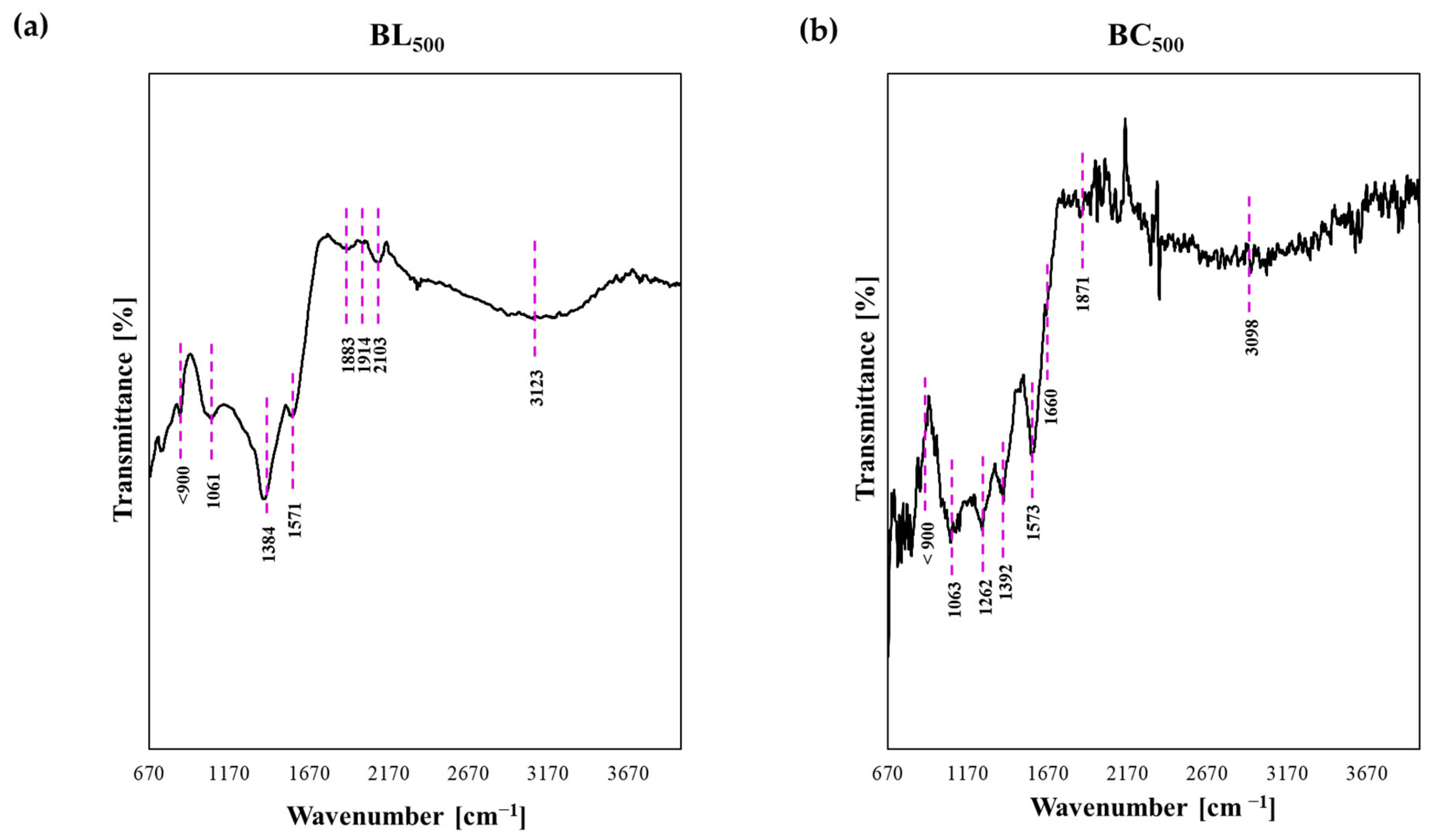
Surface functional groups present in sorption materials are responsible for the effective adsorption of organic pollutants from aqueous solutions. They act as active sites that interact with dye molecules. The produced biochars have different functional groups on their surface, with BC500 characterised by slightly greater diversity (Figure 1).
The characteristic broad band with a centre at a wavelength of approximately 3100 cm−1 originates from intramolecular vibrations in the -OH group, mainly from compounds such as cellulose, hemicellulose and lignin, in which hydrogen atoms form hydrogen bonds [53]. Further characteristic bands appear from the stretching vibrations of the carbonyl group C=O (wavelengths of 1883 cm−1 and 1871 cm−1 for biochar BL500 and BC500, respectively) [54]. The bands appearing at wavelengths of 1660 cm−1, 1573 cm−1, and 1392 cm−1 of BC500 biochar originate from the stretching vibrations of the methyl esterified carboxyl group COO-R, which are characteristic of compounds such as cellulose, hemicellulose and lignin [55]. In contrast, for BL500 biochar, these bands were identified at wavelengths of 1571 cm−1 and 1384 cm−1. The stretching vibrations of C-O bonds present in esters or ketones in the BC500 biochar spectrum are located at a wavelength of 1262 cm−1 [56]. The vibrations of the bond present in the -C-O-C group, characteristic of polysaccharides, were identified at wavelengths of 1061 cm−1 and 1063 cm−1 in the spectrum for BL500 and BC500 biochar, respectively [57]. Below the wavelength of 900 cm−1 in the spectra of both analysed biochars correspond, among others, to the vibrations of CH=CH vinyl groups or C-H bonds of aromatic rings [58].
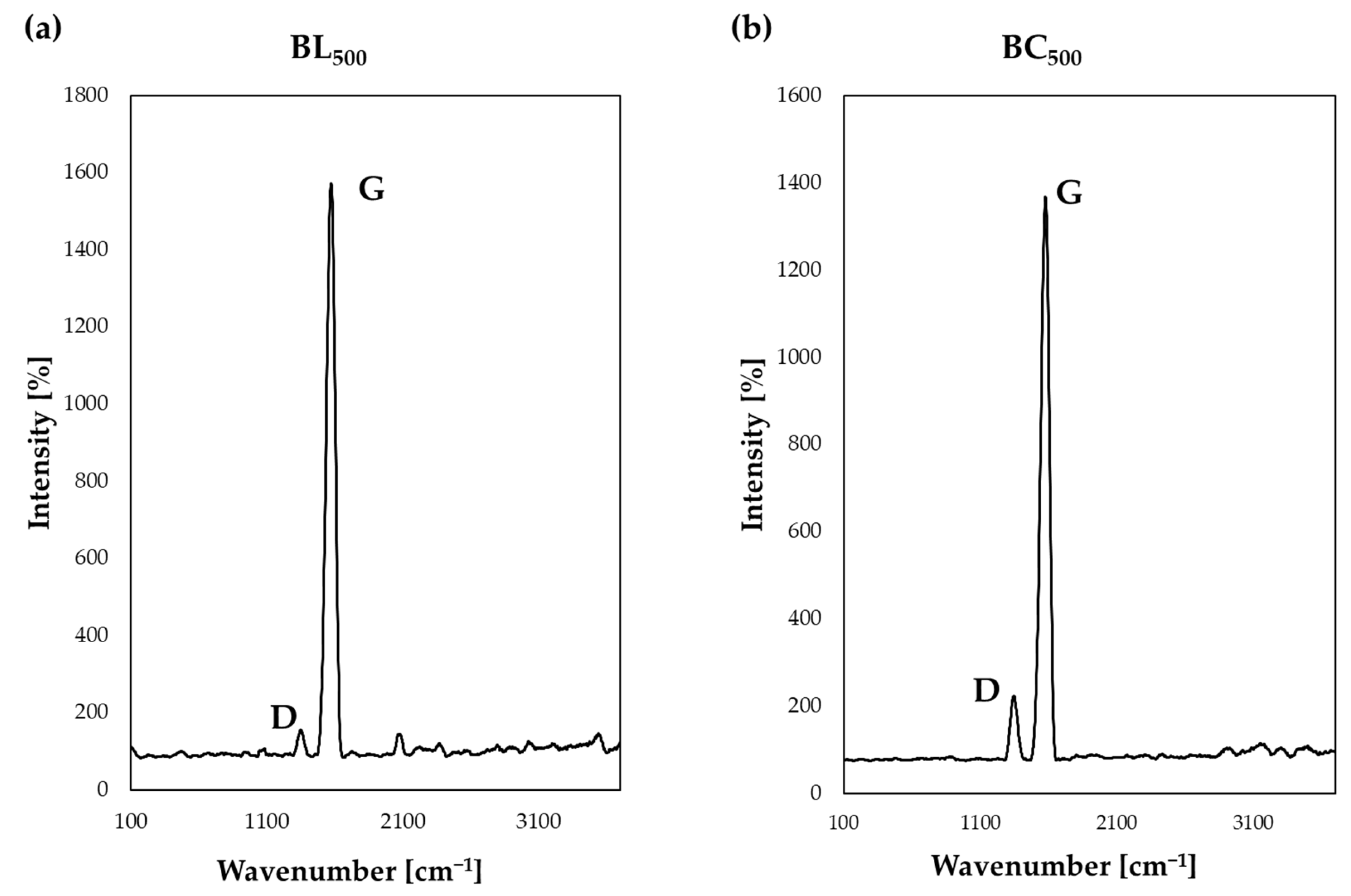
The produced biochars were also characterised in terms of structural order using Raman spectroscopy. Figure 2 shows the spectra obtained for both analysed biochars.
Raman spectrum analysis revealed the presence of two characteristic bands for carbon materials: D and G. The D band, located in the range of 1340–1360 cm−1, corresponds to so-called defects in the crystal structure of carbon materials. It arises as a result of disturbances in the symmetry of the graphite lattice, the presence of carbon layer edges, functional groups, oxygen atoms or sp3 defects [59], and the intensity of this band increases with the increase in the disorder of carbon structures. The G band, located at a wavelength of approximately 1580 cm−1, originates from the valence vibrations of C-C bonds in sp2 hybridisation, located within ordered graphite domains. Its presence and intensity indicate the formation of hexagonal networks in a graphite or graphene system.
An important parameter for determining the nature of the biochar structure is the ratio of the intensity of the defect bands to the intensity of the graphite band. The value of this ratio determines the degree of disorder in the structure, where the closer to 1, the more disordered the structure. The calculated ID/IG ratio values for BL500 biochar were 0.05, while for BC500 biochar, they were 0.12, which are characteristic of biochar obtained at lower temperatures [60,61]. Both of these values are close to 0, which indicates a well-ordered structure with a significant content of bonds typical for graphite materials. The differences in the ID/IG ratio between these two biochars may result from the different composition of the raw materials—corn biomass usually contains more hemicellulose, among other things, which may promote the formation of more defective structures during pyrolysis.
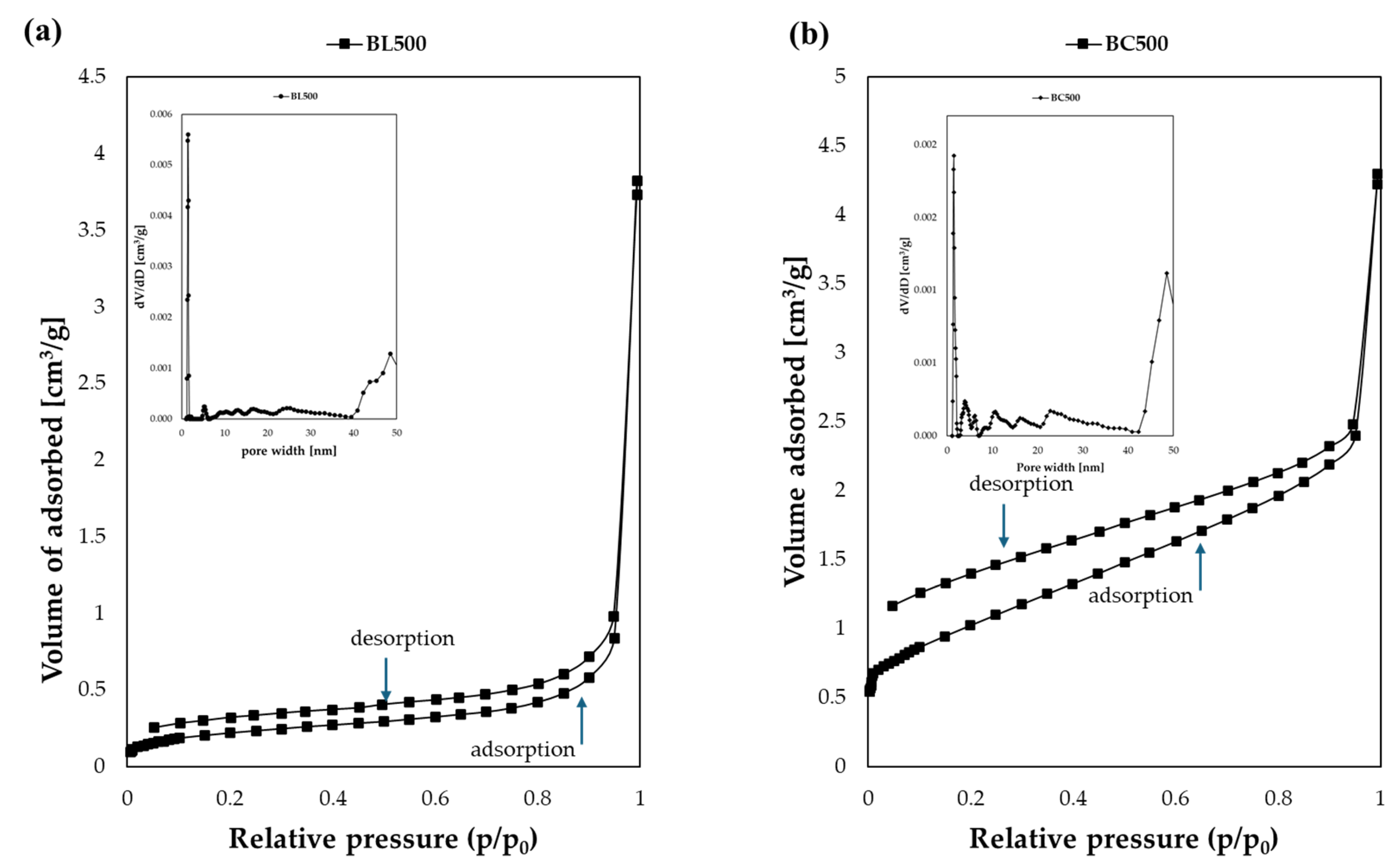
The porosity of biochars was determined based on N2 adsorption–desorption isotherms at 77 K (Figure 3). According to the IUPAC classification, the isotherms of both samples correspond to type II isotherms (Figure 3). The shape of this isotherm is related to unlimited monolayer–multilayer adsorption to high p/p0. In the case of both biochars, we are dealing with a gradual curvature, where the inflexion point is less visible. This means that from the very beginning there is a strong overlap of monolayers and multilayer adsorption begins [62].
The determined BET specific surface areas are relatively low: 4.12 m2/g for BL500 and 19.84 m2/g for BC500. This means that the proportion of the porous phase is limited, and some of the micropores may be inaccessible to N2 molecules (e.g., due to pore blockage by pyrolysis products or diffusion limitations at 77 K) [63]. BL500 and BC500 biochars are characterised by a mesoporous structure with some micropores. The majority of the BL500 surface area is occupied by mesopores ranging from 4 to 50 nm (89% of the surface area) with an average capacity of 0.0029 cm3/g. In addition, there are also larger micropores with an average size of 1.478 nm and a capacity of 0.014 cm3/g. BC500 biochar has micropores with an average size of 1.356 nm and a capacity of 0.004 cm3/g, which occupy approximately 49% of the surface area. The remainder is made up of mesopores.
The development of the porous structure of biochar depends largely on the composition of the biomass. The rapid decomposition of cellulose and hemicellulose promotes the formation of micropores through the emission of gaseous pyrolysis products, while lignin forms compact, aromatic structures with lower porosity but greater chemical stability [64,65]. BL500 and BC500 biochars also have a significant ash content (over 17% and 12%, respectively), and the mineral content can act both as a catalyst for pore development and as a factor blocking their availability [66]. As a result, biochar obtained from biomass with a high cellulose content and low ash content is usually characterised by the largest specific surface area and a favourable distribution of micro and mesopores.

3.3. Adsorption Properties

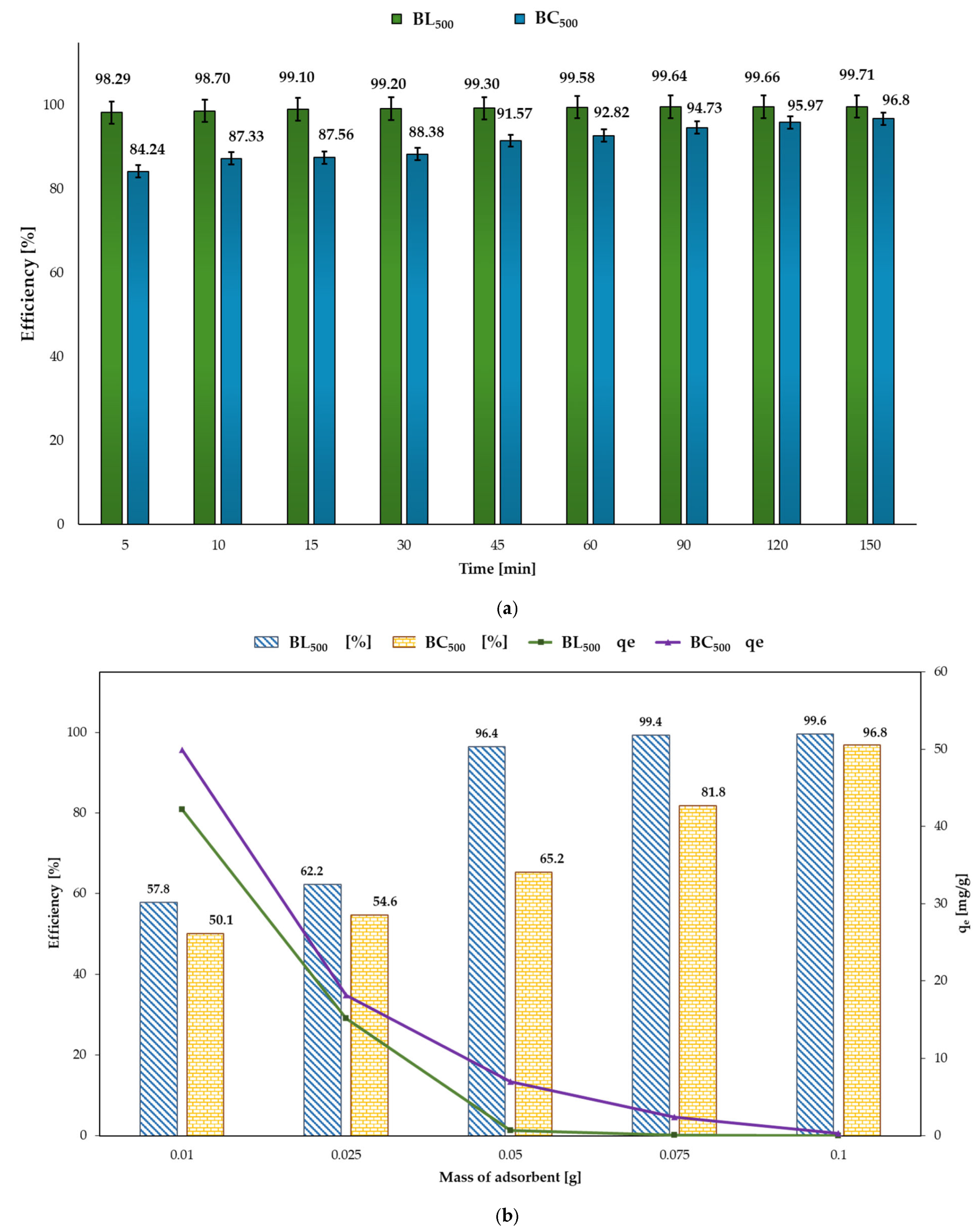
Biochars from lignocellulosic waste BL500 and BC500 were analysed for their ability to adsorb methyl blue (MB). The adsorption process was carried out using the contact method with shaking at 180 rpm, and the adsorption efficiency was analysed over a period of 5 to 150 min. Figure 4a. shows the determined MB adsorption efficiency on biochars over a period of 5 to 15 min. Analysis of the results obtained indicated that in the case of MB dye, BL500 proved to be a more effective adsorbent, adsorbing over 98% of the dye after only 5 min, while BC500 biochar adsorbed 84% of the initial dye concentration during this time. After 150 min of the adsorption process, the adsorption efficiency for the MB dye was 99.71% and 96.80% for BL500 and BC500 biochar, respectively. Such high dye removal efficiency by both biochars is probably related, among other things, to the high pHpzc (BL500—10.38; BC500—9.99). The obtained pHpzc values indicate that under the applied experimental conditions (pH ≪ pHpzc), the biochar surfaces are negatively charged, which favours the electrostatic attraction of the cationic methylene blue molecules.
According to the literature, increasing the sorbent dose usually leads to increased MB removal efficiency [67,68,69]. However, it may also result in a decrease in the sorption capacity per unit mass. As part of the research, analyses were carried out related to the effect of the adsorbent dose on the efficiency and adsorption capacity of BL500 and BC500 biochars (Figure 4b). The obtained results confirm the above-mentioned relationships.
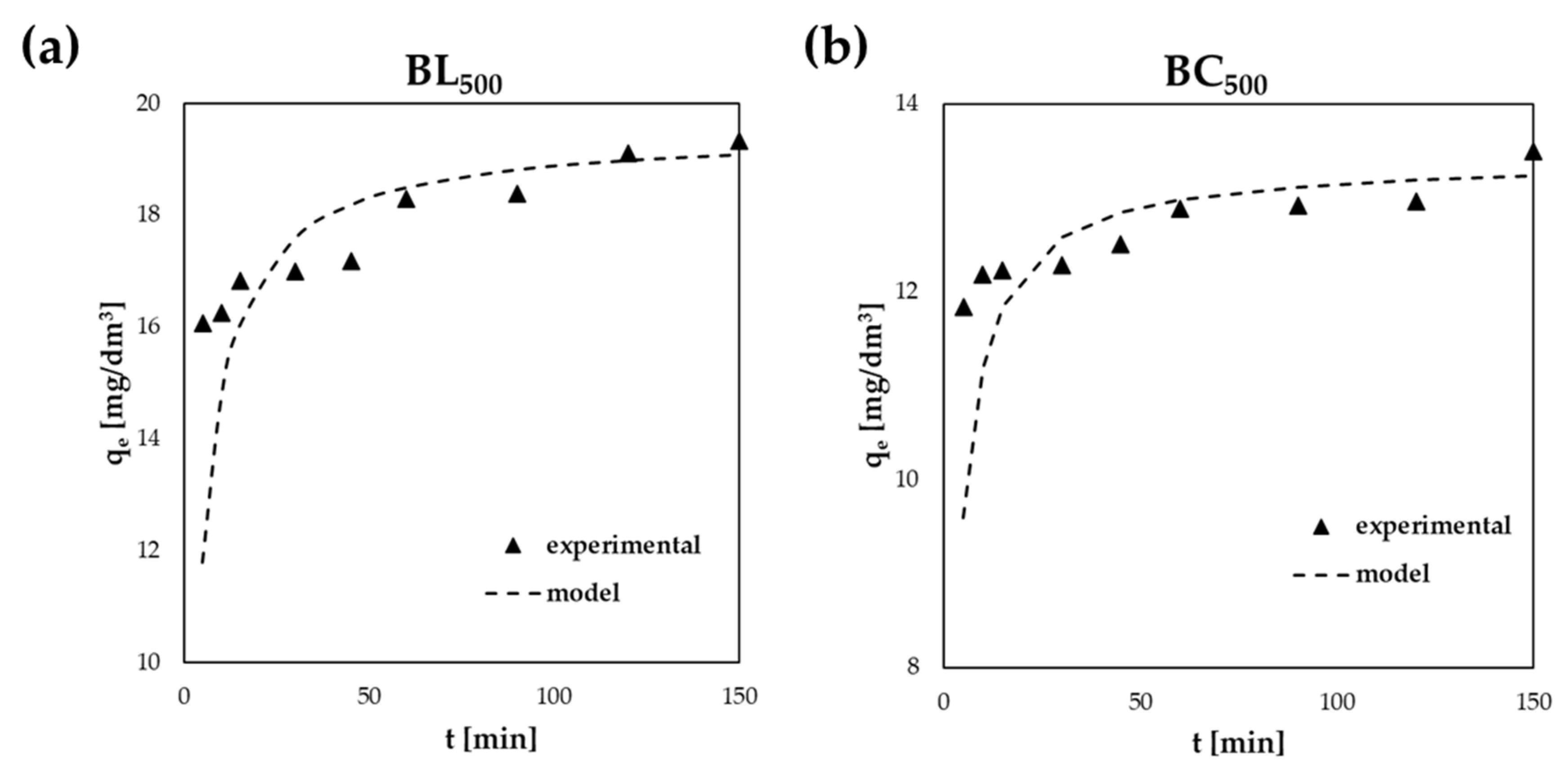
The kinetic parameters of the MB adsorption process were determined using the PFO, PSO, IPD and Bangham models (Table 4). Analysis of the determined kinetic parameters of MB adsorption on BL500 and BC500 biochar showed that the PSO model was the best fit for both materials, with correlation coefficients of R2 = 0.9988 and R2 = 0.9979, respectively (Figure 5). High correlation coefficients indicate that the MB adsorption process is controlled by a chemisorption mechanism through the formation of chemical bonds between dye molecules and functional groups on the surface of biochar [70].
Biochars BL500 and BC500 have similar sorption capacities at equilibrium under the conditions of the experiment (19.49 mg/g and 13.40 mg/g) in relation to MB, but there are significant differences in the speed of the entire process. The initial adsorption rate of MB for BL500 biochar is 5.98 mg/g·min, and for BC500 is 6.75 mg/g·min. This suggests that BL500 and BC500 biochar have a comparable number of active sites, allowing dye molecules to have better contact with the adsorbent surface.
Analysis of the PFO model coefficients allows us to conclude that the adsorption process is not limited to physisorption, especially in the case of BC500 biochar. In turn, the IPD and Bangham models confirm that the process is not a single-stage process. In the Bangham model, the high R2 coefficient value for both biochars confirms that dye diffusion in the pores is important during the adsorption process, but it is not the process that determines the adsorption rate. The IPD model showed relatively good linearity for both materials (R2 = 0.9649 for BL500 and 0.9345 for BC500). However, the non-zero intercept values (C = 15.30 for BL500 and 11.62 for BC500) indicate that intraparticle diffusion is not the sole rate-controlling step. This suggests that surface adsorption and boundary layer diffusion play a significant role, especially during the initial stages of adsorption [71].
The Bangham model exhibited lower correlation coefficients (R2 = 0.8576 and 0.8925), implying that pore diffusion alone cannot fully explain the adsorption mechanism. Nevertheless, the higher Bangham constant (Kβ) for BL500 suggests a greater contribution of pore-related interactions compared to BC500.
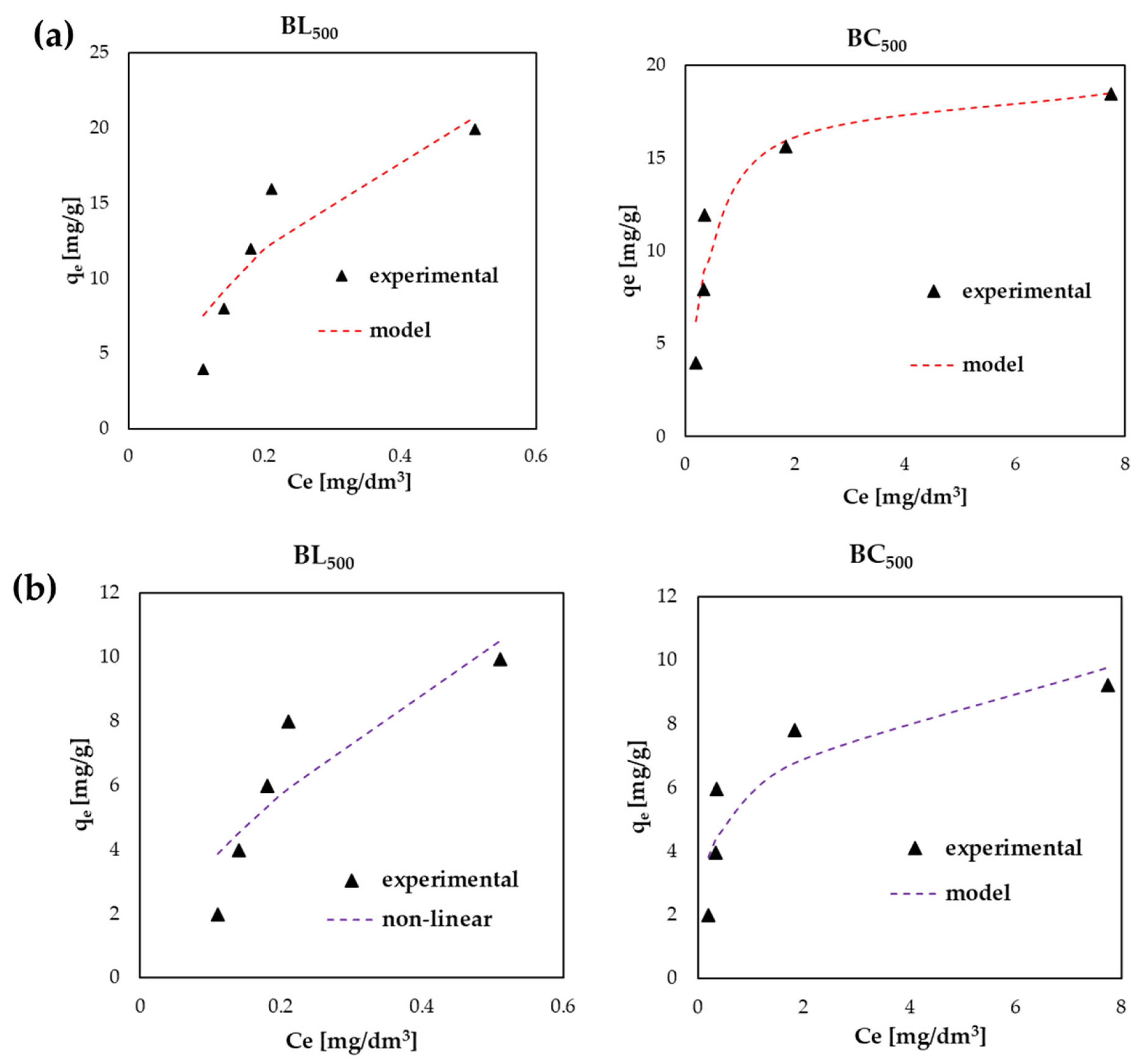
The MB adsorption isotherms on BL500 and BC500 biochar were expressed in the non-linear form of the Langmuir and the Freundlich model, and their fit is shown in Figure 6. The simulation fit values with all parameters are shown in Table 5. The Langmuir isotherm model is used to describe adsorption equilibrium, where adsorbate molecules form a single layer on the surface of the adsorbent [72]. In practice, fitting to this model means that the surface of the adsorbent is homogeneous and the adsorbed molecules are bound to only one activation centre. The Freundlich model, on the other hand, describes the adsorption equilibrium that occurs on a heterogeneous adsorbent surface with active sites of varying energy [36].
The analysis of MB adsorption isotherms on BL500 and BC500 biochar indicates a moderate fit to both models (Figure 6). The fit was performed using a non-linear method in order to avoid errors resulting from measurement data, especially when the data covers a wide range of concentrations [73].
For BL500 and BC500 biochar, the Langmuir model better reflects the MB adsorption mechanism (R2 0.8163 and 0.8944 for BL500 and BC500 biochar, respectively). BL500 biochar has a higher sorption capacity (qmax 39.94 mg/g), and the KL value (2.11 L/mg) indicates a strong affinity of the dye to the sorbent surface (Table 5). The high sorption capacity of MB on biochar has also been confirmed in other studies. For example, Al-Musawi and Al-Qaim [74] obtained a maximum adsorption capacity for biochar produced from fig fruit of 115 mg/g, and the adsorption process proceeded according to the Langmuir model [64]. In a study by Miayh et al. [75], the maximum sorption capacity of MB biosorbent from walnut shells was over 178 mg/g, and the adsorption process proceeded in a monolayer. In the case of BC500 biochar, the qmax value was 19.47 mg/g, and the KL constant value was 2.46 L/mg. The RL separation coefficient value close to 0 for both biochars means that MB adsorption on these materials is favourable and may be irreversible.
The fit to the Freundlich model is weaker than for the Langmuir model. The KF constant for BL500 biochar is 47.33, while for BC500 biochar it is 11.59. This confirms that alfalfa biochar has a higher MB sorption capacity and more active centres that can effectively bind the dye. The value of the constant n, which determines the extent to which adsorption proceeds favourably on the surface of the material, is in the range 1 < n < 10 for both biochars. For BL500 biochar, the value of this coefficient is 1.07, which is characteristic of adsorbents with a heterogeneous surface. However, the lower fit to the experimental data suggests that the Freundlich model is not dominant in the description of the analysed process (R2 of 0.7404 and 0.7868 for BL500 and BC500 biochar, respectively). However, it should be noted that the difference in fit between the Langmuir and the Freundlich models is not significantly large (Table 5). This may be due to the heterogeneity of the biochar surface and, consequently, the different activation energy of the active sites, which depends on the chemical composition and structure of the adsorbent [76,77,78].
The differences in the course of MB adsorption on BL500 and BC500 biochar are probably directly related to their structural composition and physicochemical properties. BL500 biochar has approx. 59% C, 16% O and nearly 18% A, and is characterised by a specific surface area of 4.12 m2/g. BC500 biochar, on the other hand, has a higher C content (69.36%), lower O (11%) and A (12%) content, and a specific surface area of 19.84 m2/g. Oxygen functional groups play a decisive role in dye adsorption, but so does the ash fraction present in the analysed materials. In the case of BC500 biochar, the lower ash content and higher proportion of organic oxygen groups allow for a more uniform MB adsorption process, which is confirmed by the fit to the Langmuir isotherm, with a dominant contribution of physisorption and the probable formation of π - -π interactions between the organic structures of carbon and the dye [79]. Biochar BL500 also shows that MB adsorption with its participation proceeds in accordance with chemisorption processes (fit to the PSO model), forming a monolayer. However, this process is not as homogeneous as in the case of BC500 biochar. BL500 biochar is characterised by a higher ash content (17.77%), which in turn makes its surface more heterogeneous and has active sites with different energies [80,81]. The presence of a mineral fraction in BL500 biochar presumably promotes the adsorption of the cationic MB dye more through ion exchange with anionic oxide centres, but also through electrostatic interactions [82,83,84].
The experimental data obtained and presented in this paper (Table 4 and Table 5) correspond to the data found in the literature. Using biochars obtained from various lignocellulosic biomass, the content of MB in the aquatic environment can be reduced by over 99%. Furthermore, using various biochar production and modification methods, adsorbents with a wide range of adsorption capacity can be obtained—from 7.8 to as much as 643 mg/g (Table 6). They confirm that MB adsorption occurs mainly through chemisorption, with the mechanism of dye binding (monolayer or multilayer) depending on the nature of the adsorbent surface. This nature will be influenced by many factors, including the composition and type of raw material from which the bio-gel is obtained, but also the parameters of the pyrolysis process (heating rate, protective gas or temperature). During the thermal decomposition reaction, substances with varying reactivity are released, which in turn lead to a series of chemical reactions that determine the final properties of biochar and its affinity for the adsorbate.

4. Conclusions

Residues from corn and alfalfa crops were subjected to pyrolysis in a CO2 atmosphere at a temperature of 500 °C using a three-stage cascade. This yielded biochar (BL500 and BC500) with specific physicochemical and structural properties. The process conditions used allowed biochar with a significant ash content (BL500—17.77% and BC500—12.58%), carbon (BL500—59.10% and BC500—69.36%) and oxygen (BL500—16.17% and BC500—11.28%). FTIR spectrum analysis determined that as a result of the decomposition of biomass components such as cellulose, lignin, proteins and lipids, free functional groups such as -O-H, -COO, C=O and O-C-O are formed on the surface of the biochar, and the ID/IG ratios determined from the Raman spectra confirm the ordered structure (0.05 for BL500 and 0.12 for BC500). Despite isotherms indicating microporosity, the SBET of biochars was low (4.12 m2/g for BL500 and 19.84 m2/g for BC500), which suggests limited availability of micropores, e.g., due to their blockage by pyrolysis products or diffusion effects. Both biochars exhibit a micro-mesoporous structure, with mesopores dominating in BL500 (89% of the surface area), while micropores account for about half of the total surface area in BC500.
The results obtained for MB dye adsorption indicated that BL500 biochar is a more effective adsorbent (98% of the dye adsorbed after 5 min) (Figure 4). The analysis of MB adsorption showed that for both BL500 and BC500, the Langmuir model best describes the equilibrium data, suggesting the dominance of the monolayer adsorption mechanism. BL500 biochar had a higher sorption capacity than BC500, and separation coefficients close to zero (BL500—0.02 and BC500—0.02) confirmed the favourable adsorption process on both materials. The fit to the Freundlich model was slightly weaker than that to the Langmuir model, but it confirmed the differences in the number of active centres on the surface of both sorbents and the heterogeneous nature of their surfaces. The kinetics of the process for both biochars were best described by the PSO model, and very high correlation coefficients (R2 = 0.9988 and R2 = 0.9979 for BL500 and BC500, respectively) indicate that the process is controlled by chemisorption. BC500 showed a significantly higher initial adsorption rate (h = 6.75 mg/(g·min)), which indicates a greater number of easily accessible active sites on its surface. Diffusion models (IPD and Bangham) confirmed that the process does not occur in a single stage and that the role of diffusion within the pores is significant, especially for BC500.
The present study provides new insight into MB adsorption on biochars produced from alfalfa and corn crop residues via slow pyrolysis in a CO2 atmosphere at 500 °C. By combining detailed physicochemical characterisation with kinetic and equilibrium modelling, this work demonstrates that high adsorption efficiency and rapid dye removal can be achieved even for biochars with relatively low BET surface areas. The results highlight the dominant role of surface chemistry and ash-related active sites over porosity alone and contribute to a better mechanistic understanding of dye adsorption on ash-rich, agricultural-waste-derived biochars.
Therefore, this study advances the current knowledge by elucidating how feedstock composition and pyrolysis atmosphere jointly determine biochar structure and adsorption behaviour, offering a complementary perspective to surface-area-driven approaches commonly reported in the literature.
The biochar produced from alfalfa and corn crop residues can therefore be considered as a potential sustainable adsorbent for dyes from aqueous solutions, while also fitting in with the principles of the circular economy. This is particularly important in the context of increasing levels of surface water pollution.

Author Contributions

Conceptualisation, W.B.; methodology, W.B., M.Ł. and M.Ż.; validation, W.B. and M.Ł.; formal analysis, A.K.-K.; investigation, W.B., M.Ł. and M.Ż.; resources, W.B.; writing—original draft preparation, W.B.; writing—review and editing, W.B., M.Ż., M.Ł. and A.K.-K.; visualisation, A.K.-K.; supervision, M.W.; project administration, W.B.; funding acquisition, W.B. and A.K.-K. All authors have read and agreed to the published version of the manuscript.

Funding

This research was funded by Lukasiewicz Research Network—Institute for Sustainable Technologist from Framework Programme task IV 1.3 “Development of a method for processing waste from the agri-food industry into biochar functional materials for water and wastewater treatment”, No. 03.709.

Institutional Review Board Statement

Not applicable.

Informed Consent Statement

Not applicable.

Data Availability Statement

The data that support the findings of this study are available on request from the corresponding author.

Acknowledgments

This work article has been completed while the third author was the Doctoral Candidate in the Interdisciplinary Doctoral School at the Lodz University of Technology, Poland.

Conflicts of Interest

The authors declare no conflicts of interest.

References

  1. Ganaie, R.F.; Rafiq, S.; Sharma, A. Recent Advances in Physico-chemical Methods for Removal of Dye from Wastewater. In IOP Conference Series: Earth and Environmental Science, Proceedings of the International Conference on Advance Earth Sciences & Foundation Engineering 23/06/2022–24/06/2022 Mohali, India, 26–27 May 2023; IOP Publishing: Bristol, UK, 2023; Volume 1110. [Google Scholar] [CrossRef]
  2. Asghar, A.; Aziz, A.; Raman, A.; Daud, W.M.A.W. Advanced oxidation processes for in-situ production of hydrogen peroxide/hydroxyl radical for textile wastewater treatment: A review. J. Clean. Prod. 2015, 87, 826–838. [Google Scholar] [CrossRef]
  3. Subramani, S.; Thinakaran, N. Isotherm, kinetic and thermodynamic studies on the adsorption behaviour of textile dyes onto chitosan. Process Saf. Environ. Prot. 2017, 106, 1–10. [Google Scholar] [CrossRef]
  4. Artifon, W.; Cesca, K.; de Andrade, C.J.; Ulson de Souza, A.A.; de Oliveira, D. Dyestuffs from textile industry wastewaters: Trends and gaps in the use of bioflocculants. Process Biochem. 2021, 111, 181–190. [Google Scholar] [CrossRef]
  5. Katheresan, V.; Kansedo, J.; Lau, S.Y. Efficiency of various recent wastewater dye removal methods: A review. J. Environ. Chem. Eng. 2018, 6, 4676–4697. [Google Scholar] [CrossRef]
  6. De Gisi, S.; Lofrano, G.; Grassi, M.; Notarnicola, M. Characteristics and adsorption capacities of low-cost sorbents for wastewater treatment: A review. Sustain. Mater. Technol. 2016, 9, 10–40. [Google Scholar] [CrossRef]
  7. Samsami, S.; Mohamadizaniani, M.; Sarrafzadeh, M.H.; Rene, E.R.; Firoozbahr, M. Recent advances in the treatment of dye-containing wastewater from textile industries: Overview and perspectives. Process. Saf. Environ. Prot. 2020, 143, 138–163. [Google Scholar] [CrossRef]
  8. Pandey, S.; Do, J.Y.; Kim, J.; Kang, M. Fast and highly efficient removal of dye from aqueous solution using natural locust bean gum based hydrogels as adsorbent. Int. J. Biol. Macromol. 2020, 143, 60–75. [Google Scholar] [CrossRef]
  9. Auerbach, S.S.; Bristol, D.W.; Peckham, J.C.; Travlos, G.S.; Hébert, C.D.; Chhabra, R.S. Toxicity and carcinogenicity studies of methylene blue trihydrate in F344N rats and B6C3F1 mice. Food Chem. Toxicol. 2010, 48, 169–177. [Google Scholar] [CrossRef]
  10. Gillman, P.K. CNS toxicity involving methylene blue: The exemplar for understanding and predicting drug interactions that precipitate serotonin toxicity. J. Psychopharmacol. 2011, 25, 429–436. [Google Scholar] [CrossRef]
  11. National Toxicology Program. Toxicology and carcinogenesis studies of methylene blue trihydrate (Cas No. 7220-79-3) in F344/N rats and B6C3F1 mice (gavage studies). Natl. Toxicol. Program Tech. Rep. Ser. 2008, 540, 1–224. [Google Scholar] [PubMed]
  12. Robinson, T.; McMullan, G.; Marchant, R.; Nigam, P. Remediation of dyes in textile effluent: A critical review on current treatment technologies with a proposed alternative. Bioresour. Technol. 2021, 77, 247–255. [Google Scholar] [CrossRef]
  13. Yang, C.; Dong, W.; Cui, G.; Zhao, Y.; Shi, X.; Xia, X.; Tang, B.; Wang, W. Highly efficient photocatalytic degradation of methylene blue by P2ABSA-modified TiO2 nanocomposite due to the photosensitization synergetic effect of TiO2 and P2ABSA. RSC Adv. 2017, 7, 23699–23708. [Google Scholar] [CrossRef]
  14. Uddin, M.K.; Nasar, A. Decolorization of Basic Dyes Solution by Utilizing Fruit Seed Powder. KSCE J. Civ. Eng. 2020, 24, 345–355. [Google Scholar] [CrossRef]
  15. Oz, M.; Lorke, D.E.; Hasan, M.; Petroianu, G.A. Cellular and molecular actions of Methylene Blue in the nervous system. Med. Res. Rev. 2011, 31, 93–117. [Google Scholar] [CrossRef]
  16. Marimuthu, M.; Praveen Kumar, B.; Mariya Salomi, L.; Veerapandian, M.; Balamurugan, K. Methylene Blue-Fortified Molybdenum Trioxide Nanoparticles: Harnessing Radical Scavenging Property. ACS Appl. Mater. Interfaces 2018, 10, 43429–43438. [Google Scholar] [CrossRef] [PubMed]
  17. Mori, T.; Koyama, N.; Segawa, T.; Maeda, M.; Maruyama, N.; Kinoshita, N.; Hou, H.; Tan, J.; Town, T. Methylene blue modulates β-secretase, reverses cerebral amyloidosis, and improves cognition in transgenic mice. J. Biol. Chem. 2014, 289, 30303–30317. [Google Scholar] [CrossRef]
  18. Li, L.; Qin, L.; Lu, H.L.; Li, P.J.; Song, Y.J.; Yang, R.L. Methylene blue improves streptozotocin-induced memory deficit by restoring mitochondrial function in rats. Brain Res. 2017, 1657, 208–214. [Google Scholar] [CrossRef] [PubMed]
  19. Manimohan, M.; Pugalmani, S.; Ravichandran, K.; Sithique, M.A. Synthesis and characterisation of novel Cu(II)-anchored biopolymer complexes as reusable materials for the photocatalytic degradation of methylene blue. RSC Adv. 2020, 10, 18259–18279. [Google Scholar] [CrossRef]
  20. Khan, I.; Saeed, K.; Zekker, I.; Zhang, B.; Hendi, A.H.; Ahmad, A.; Ahmad, S.; Zada, N.; Ahmad, H.; Shah, L.A.; et al. Review on Methylene Blue: Its Properties, Uses, Toxicity and Photodegradation. Water 2022, 14, 242. [Google Scholar] [CrossRef]
  21. Abdelrahman, E.A.; Hegazey, R.M.; El-Azabawy, R.E. Efficient removal of methylene blue dye from aqueous media using Fe/Si, Cr/Si, Ni/Si, and Zn/Si amorphous novel adsorbents. J. Mater. Res. Technol. 2019, 8, 5301–5313. [Google Scholar] [CrossRef]
  22. Yaseen, D.A.; Scholz, M. Textile dye wastewater characteristics and constituents of synthetic effluents: A critical review. Int. J. Environ. Sci. Technol. 2019, 16, 1193–1226. [Google Scholar] [CrossRef]
  23. Etana, R.; Angassa, K.; Getu, T. Dye removal from textile wastewater using scoria-based of vertical subsurface flow constructed wetland system. Sci. Rep. 2025, 15, 949. [Google Scholar] [CrossRef]
  24. Tir, M.; Moulai-Mostefa, N.; Nedjhioui, M. Optimizing decolorization of methylene blue dye by electrocoagulation using Taguchi approach. Desalin. Water Treat. 2015, 55, 2705–2710. [Google Scholar] [CrossRef]
  25. Aydın, O.; Benedetta, U.; Musah, G.R.A. Efficient Phytoremediation of Methyl Red and Methylene Blue Dyes from Aqueous Solutions by Juncus effusus. ACS Omega 2025, 10, 1943–1953. [Google Scholar] [CrossRef]
  26. Cheng, S.; Oatley, D.L.; Williams, P.M.; Wright, C.J. Characterisation and application of a novel positively charged nanofiltration membrane for the treatment of textile industry wastewaters. Water Res. 2012, 46, 33–42. [Google Scholar] [CrossRef] [PubMed]
  27. El-Ashtoukhy, E.-S.Z.; Fouad, Y.O. Liquid–liquid extraction of methylene blue dye from aqueous solutions using sodium dodecylbenzenesulfonate as an extractant. Alex. Eng. J. 2015, 54, 77–81. [Google Scholar] [CrossRef]
  28. Yu, H.; Zhang, Y.; Wang, L.; Tuo, Y.; Yan, S.; Ma, J.; Zhang, X.; Shen, Y.; Guo, H.; Han, L. Experimental and DFT insights into the adsorption mechanism of methylene blue by alkali-modified corn straw biochar. RSC Adv. 2024, 14, 1854–1865. [Google Scholar] [CrossRef]
  29. Sahu, S.; Pahi, S.; Tripathy, S.; Kumar Singh, S.; Behera, A.; Kumar Sahu, U.; Patel, R.K. Adsorption of methylene blue on chemically modified lychee seed biochar: Dynamic, equilibrium, and thermodynamic study. J. Mol. Liq. 2020, 315, 113743. [Google Scholar] [CrossRef]
  30. PN-EN ISO 18134-2:2017-03; Solid Biofuels—Determination of Moisture Content Part 2: Simplified Method (English Version). International Organization for Standardization: Geneva, Switzerland, 2017.
  31. PN-ISO 1171; Solid Fuels—Ash Determination (Polish Version). International Organization for Standardization: Geneva, Switzerland, 2002.
  32. Moreno-Castilla, C.; Lopez-Ramon, M.V.; Carrasco-Marín, F. Changes in surface chemistry of activated carbons by wet oxidation. Carbon N. Y. 2000, 38, 1995–2001. [Google Scholar] [CrossRef]
  33. Benjelloun, M.; Miyah, Y.; Evrendilek, G.A.; Zerrouq, F.; Lairini, S. Recent Advances in Adsorption Kinetic Models: Their Application to Dye Types. Arab. J. Chem. 2021, 14, 103031. [Google Scholar] [CrossRef]
  34. Bangham, D.H. The Gibbs adsorption equation and adsorption on solids. Trans. Faraday Soc. 1937, 33, 805–811. [Google Scholar] [CrossRef]
  35. Langmuir, I. The adsorption of gases on plane surfaces of glass, mica and platinum. J. Am. Chem. Soc. 1918, 40, 1361–1403. [Google Scholar] [CrossRef]
  36. Ahmed, H.R.; Kayani, K.F.; Ealias, A.M.; Aziz, K.H.H. A Comprehensive Review of Forty Adsorption Isotherm Models: An In-depth Analysis of Ten Statistical Error Measures. Water Air Soil Pollut. 2025, 236, 346. [Google Scholar] [CrossRef]
  37. Drané, M.; Zbair, M.; Hajjar-Garreau, S.; Josien, L.; Michelin, L.; Bennici, S.; Limousy, L. Unveiling the Potential of Corn Cob Biochar: Analysis of Microstructure and Composition with Emphasis on Interaction with NO2. Materials 2024, 17, 159. [Google Scholar] [CrossRef] [PubMed]
  38. Roman, A.; Bucura, F.; Botoran, O.R.; Radu, G.L.; Niculescu, V.C.; Soare, A.; Ion-Ebrasu, D.; Vagner, I.; Dunca, E.C.; Șandru, C.; et al. Thermochemical processing of agricultural waste into biochar with potential application for coal mining degraded soils. Results Eng. 2025, 26, 105497. [Google Scholar] [CrossRef]
  39. Wang, G.; Dai, Y.; Yang, H.; Xiong, Q.; Wang, K.; Zhou, J.; Li, Y.; Wang, S. A Review of Recent Advances in Biomass Pyrolysis. Energy Fuels 2020, 34, 15557–15578. [Google Scholar] [CrossRef]
  40. Parthasarathy, P.; Zuhara, S.; Al-Ansari, T.; McKay, G. A review on catalytic CO2 pyrolysis of organic wastes to high-value products. Fuel 2023, 335, 127073. [Google Scholar] [CrossRef]
  41. Li, Y.; Huang, S.; Wang, Q.; Li, H.; Zhang, Q.; Wang, H.; Wu, Y.; Wu, S.; Gao, I. Hydrogen transfer route and interaction mechanism during co-pyrolysis of Xilinhot lignite and rice husk. Fuel Process. Technol. 2019, 192, 13–20. [Google Scholar] [CrossRef]
  42. Masoero, F.; Rossi, F.; Pulimeno, A.M. Chemical composition and in vitro digestibility of stalks, leaves and cobs of four corn hybrids at different phenological stages. Ital. J. Anim. Sci. 2006, 5, 215–227. [Google Scholar] [CrossRef]
  43. Wojcieszak, D.; Przybył, J.; Ratajczak, I.; Goliński, P.; Janczak, D.; Waśkiewicz, A.; Szentner, K.; Woźniak, M. Chemical composition of maize stover fraction versus methane yield and energy value in fermentation process. Energy 2020, 198, 117258. [Google Scholar] [CrossRef]
  44. Gaweł, E.; Grzelak, M.; Janyszek, M. Lucerne (Medicago sativa L.) in the human diet—Case reports and short reports. J. Herb. Med. 2017, 10, 8–16. [Google Scholar] [CrossRef]
  45. Gaweł, E. Chemical composition of lucerne leaf extract (EFL) and its applications as a phytobiotic in human nutrition. Acta Sci. Pol. Technol. Aliment. 2012, 11, 303–310. [Google Scholar] [PubMed]
  46. Afolabi, F.O.; Musonge, P.; Bakare, B.F. Adsorption of Copper and Lead Ions in a Binary System onto Orange Peels: Optimization, Equilibrium, and Kinetic Study. Sustainability 2022, 14, 10860. [Google Scholar] [CrossRef]
  47. Abagandura, G.O.; Bansal, S.; Karsteter, A.; Kumar, S. Soil greenhouse gas emissions, organic carbon and crop yield following pinewood biochar and biochar–manure applications at eroded and depositional landscape positions: A field trial in South Dakota, USA. Soil Use Manag. 2022, 38, 487–502. [Google Scholar] [CrossRef]
  48. Premchand, P.; Demichelis, F.; Chiaramonti, D.; Bensaid, S.; Fino, D. Study on the effects of carbon dioxide atmosphere on the production of biochar derived from slow pyrolysis of organic agro-urban waste. Waste Manag. 2023, 172, 308–319. [Google Scholar] [CrossRef]
  49. Nair, R.R.; Kißling, P.A.; Marchanka, A.; Lecinski, J.; Turcios, A.E.; Shamsuyeva, M.; Rajendiran, N.; Ganesan, S.; Srinivasan, S.V.; Papenbrock, J.; et al. Biochar synthesis from mineral and ash-rich waste biomass, part 2: Characterization of biochar and co-pyrolysis mechanism for carbon sequestration. Sustain. Environ. Res. 2023, 33, 14. [Google Scholar] [CrossRef]
  50. Ghani, W.A.W.A.K.; Mohd, A.; da Silva, G.; Bachmann, R.T.; Taufiq-Yap, Y.H.; Rashid, U.; Ala’a, H. Biochar production from waste rubber-wood-sawdust and its potential use in C sequestration: Chemical and physical characterization. Ind. Crops Prod. 2013, 44, 18–24. [Google Scholar] [CrossRef]
  51. Tag, A.T.; Duman, G.; Ucar, S.; Yanik, J. Effects of feedstock type and pyrolysis temperature on potential applications of biochar. J. Anal. Appl. Pyrol. 2016, 120, 200–206. [Google Scholar] [CrossRef]
  52. Uttran, A.; Loh, S.K.; Kong, S.H.; Bachmann, R.T. Adsorption of NPK fertilizer and humic acid on palm kernel shell biochar. J. Oil Palm Res. 2018, 30, 472–484. [Google Scholar] [CrossRef]
  53. Sette, P.; Gomez Mattson, M.; Schebor, C.; Salvatori, D. Strategies for bioactive compound recovery from grape and apple wastes: Traditional and emerging technologies to reach zero waste discharge. Biomass Conv. Bioref. 2025, 15, 28877–28894. [Google Scholar] [CrossRef]
  54. Choi, Y.K.; Srinivasan, R.; Kan, E. Facile and Economical Functionalized Hay Biochar with Dairy Effluent for Adsorption of Tetracycline. ACS Omega 2020, 5, 16521–16529. [Google Scholar] [CrossRef]
  55. Apolloni, F.; Menegazzo, F.; Bittencourt, C.; Signoretto, M. Hazelnut shells and rice husks activated biochars for the adsorption of atrazine and terbuthylazine. Next Energy 2025, 7, 100291. [Google Scholar] [CrossRef]
  56. Wystalska, K.; Kowalczyk, M.; Kamizela, T.; Worwąg, M.; Zabochnicka, M. Properties and Possibilities of Using Biochar Composites Made on the Basis of Biomass and Waste Residues Ferryferrohydrosol Sorbent. Materials 2024, 17, 2646. [Google Scholar] [CrossRef]
  57. Saidi, H.; Aoulad El Hadj Ali, Y.; Azzouz, A.; Chraka, A.; Bouzit, L.; Stitou, M. Optimization and application of walnut shell-driver biochar for efficient removal of salicylic acid from wastewater: Experiment and theoretical study. Chem. Eng. Res. Des. 2025, 221, 22–36. [Google Scholar] [CrossRef]
  58. Bakly, S.; Al-Juboori, R.A.; Bowtell, L. Macadamia Nutshell Biochar for Nitrate Removal: Effect of Biochar Preparation and Process Parameters. C 2019, 5, 47. [Google Scholar] [CrossRef]
  59. Li, X.; Hayashi, J.; Li, C.Z. FT-Raman spectroscopic study of the evolution of char structure during the pyrolysis of a Victorian brown coal. Fuel 2006, 85, 1700–1707. [Google Scholar] [CrossRef]
  60. Xu, J.; Liu, J.; Ling, P.; Zhang, X.; Xu, K.; He, L.; Wang, Y.; Su, S.; Hu, S.; Xiang, J. Raman spectroscopy of biochar from the pyrolysis of three typical Chinese biomasses: A novel method for rapidly evaluating the biochar property. Energy 2020, 202, 117644. [Google Scholar] [CrossRef]
  61. Barszcz, W.; Łożyńska, M.; Molenda, J. Impact of pyrolysis process conditions on the structure of biochar obtained from apple waste. Sci. Rep. 2024, 14, 10501. [Google Scholar] [CrossRef]
  62. Thommes, M.; Kaneko, K.; Neimark, A.V.; Olivier, J.P.; Rodriguez-Reinoso, F.; Rouquerol, J.; Sing, K.S.W. Physisorption of gases, with special reference to the evaluation of surface area and pore size distribution (IUPAC Technical Report). Pure Appl. Chem. 2015, 87, 1051–1069. [Google Scholar] [CrossRef]
  63. Cychosz, K.A.; Thommes, M. Progress in the Physisorption Characterization of Nanoporous Gas Storage Materials. Engineering 2018, 4, 559–566. [Google Scholar] [CrossRef]
  64. Keiluweit, M.; Nico, P.S.; Johnson, M.G.; Kleber, M. Dynamic Molecular Structure of Plant Biomass-Derived Black Carbon (Biochar). Environ. Sci. Technol. 2010, 44, 1247–1253. [Google Scholar] [CrossRef] [PubMed]
  65. Munzeiwa, W.A.; Tsekoa, P.; Kammies, R.L.D.; Chelechele, K.; Oluwalana-Sanusi, A.E.; Chaukura, N. Influence of biomass baseline potential on biochar properties and performance for targeted applications. Discov. Water 2025, 5, 77. [Google Scholar] [CrossRef]
  66. Wang, J.; Wang, S. Preparation, modification and environmental application of biochar: A review. J. Clean. Prod. 2019, 227, 1002–1022. [Google Scholar] [CrossRef]
  67. Xu, J.; Fu, M.; Ma, Q.; Zhang, X.; You, C.; Shi, Z.; Wang, X.; Feng, W. Modification of biochar by phosphoric acid via wet pyrolysis and using it for adsorption of methylene blue. RSC Adv. 2023, 13, 15327–15333. [Google Scholar] [CrossRef]
  68. Ge, Q.; Li, P.; Liu, M.; Xiao, G.; Xiao, Z.; Mao, J.; Gai, X. Removal of methylene blue by porous biochar obtained by KOH activation from bamboo biochar. Bioresour. Bioprocess. 2023, 10, 51. [Google Scholar] [CrossRef]
  69. Zhu, Y.; Yi, B.; Yuan, Q.; Wu, Y.; Wang, M.; Yan, S. Removal of methylene blue from aqueous solution by cattle manure-derived low temperature biochar. RCS Adv. 2018, 8, 19917–19929. [Google Scholar] [CrossRef]
  70. Sahoo, T.R.; Prelot, B. Adsorption processes for the removal of contaminants from wastewater: The perspective role of nanomaterials and nanotechnology. In Nanomaterials for the Detection and Removal of Wastewater Pollutants; Elsevier: Amsterdam, The Netherlands, 2020; pp. 161–222. [Google Scholar] [CrossRef]
  71. Bracanović, I.; Kalijadis, A.; Simić, M.; Krstić, A. Adsorption of Methylene Blue from an Aqueous Solution by Carbon Materials: A Kinetic Study. Eng. Proc. 2025, 99, 19. [Google Scholar] [CrossRef]
  72. El Jery, A.; Alawamleh, H.S.; Sami, M.H.; Abbas, H.A.; Sammen, S.S.; Ahsan, A.; Imteaz, M.A.; Shanableh, A.; Shafiquzzaman, M.; Osman, H.; et al. Isotherms, kinetics and thermodynamic mechanism of methylene blue dye adsorption on synthesized activated carbon. Sci. Rep. 2024, 14, 970. [Google Scholar] [CrossRef]
  73. Foo, K.Y.; Hameed, B.H. Insights into the modeling of adsorption isotherm systems. Chem. Eng. J. 2010, 156, 2–10. [Google Scholar] [CrossRef]
  74. Al-Musawi, E.B.; Al-Qaim, F.F. Elimination of methylene blue dye from the aqueous solution using waste fig fruit as an activated carbon: A case study of nonlinear adsorption isotherm models and kinetic models. React. Kinet. Mech. Catal. 2025, 138, 967–989. [Google Scholar] [CrossRef]
  75. Miyah, Y.; Lahrichi, A.; Idrissi, M.; Khalil, A.; Zerrouq, F. Adsorption of methylene blue dye from aqueous solutions onto walnut shells powder: Equilibrium and kinetic studies. Surf. Interfaces 2018, 11, 74–81. [Google Scholar] [CrossRef]
  76. Rehman, A.; Park, M.; Park, S.-J. Current Progress on the Surface Chemical Modification of Carbonaceous Materials. Coatings 2019, 9, 103. [Google Scholar] [CrossRef]
  77. Bilgili, M.S.; Varank, G.; Sekman, E.; Top, S.; Özçimen, D. Modeling 4-chlorophenol removal from aqueous solutions by granular activated carbon. Environ. Model. Assess. 2012, 17, 289–300. [Google Scholar] [CrossRef]
  78. Majd, M.M.; Kordzadeh-Kermani, V.; Ghalandari, V.; Askari, A.; Sillanpää, M. Adsorption isotherm models: A comprehensive and systematic review (2010–2020). Sci. Total Environ. 2022, 812, 151334. [Google Scholar] [CrossRef]
  79. Guel-Nájar, N.A.; Rios-Hurtado, J.C.; Muzquiz-Ramos, E.M.; Dávila-Pulido, G.I.; González-Ibarra, A.A.; Pat-Espadas, A.M. Magnetic Biochar Obtained by Chemical Coprecipitation and Pyrolysis of Corn Cob Residues: Characterization and Methylene Blue Adsorption. Materials 2023, 16, 3127. [Google Scholar] [CrossRef]
  80. Enders, A.; Hanley, K.; Whitman, T.; Joseph, S.; Lehmann, S. Characterization of biochars to evaluate recalcitrance and soil quality. Bioresour. Technol. 2012, 114, 644–653. [Google Scholar] [CrossRef]
  81. Li, J.; Liang, N.; Jin, X.; Zhou, D.; Li, H.; Wu, M.; Pan, B. The role of ash content on bisphenol A sorption to biochars derived from different agricultural wastes. Chemosphere 2017, 171, 66–73. [Google Scholar] [CrossRef]
  82. Koyuncu, H.; Rıza Kul, A. Biosorption study for removal of methylene blue dye from aqueous solution using a novel activated carbon obtained from nonliving lichen (Pseudevernia furfuracea (L.) Zopf.). Surf. Interfaces 2020, 19, 100527. [Google Scholar] [CrossRef]
  83. Ge, H.; Wang, C.; Liu, S.; Huang, Z. Synthesis of citric acid functionalized magnetic graphene oxide coated corn straw for methylene blue adsorption. Bioresour. Technol. 2016, 221, 419–429. [Google Scholar] [CrossRef] [PubMed]
  84. Zhao, J.; Zhou, D.; Zhang, J.; Li, F.; Chu, G.; Wu, M.; Pan, B.; Steinberg, C.E.W. The contrasting role of minerals in biochars in bisphenol A and sulfamethoxazole sorption. Chemosphere 2021, 264, 128490. [Google Scholar] [CrossRef]
  85. Hassaan, M.A.; Yılmaz, M.; Helal, M.; El-Nemr, M.A.; Ragab, S.; El Nemr, A. Improved methylene blue adsorption from an aqueous medium by ozone-triethylenetetramine modification of sawdust-based biochar. Sci. Rep. 2023, 13, 12431. [Google Scholar] [CrossRef]
  86. Lonappan, L.; Rouissi, T.; Kumar Das, R.; Brar, S.K.; Ramirez, A.A.; Verma, M.; Surampalli, R.Y.; Valero, J.R. Adsorption of methylene blue on biochar microparticles derived from different waste materials. Waste Manag. 2016, 49, 537–544. [Google Scholar] [CrossRef]
  87. Hassaan, M.A.; Yılmaz, M.; Helal, M.; El-Nemr, M.A.; Ragab, S.; El Nemr, A. Isotherm and kinetic investigations of sawdust-based biochar modified by ammonia to remove methylene blue from water. Sci. Rep. 2023, 13, 12724. [Google Scholar] [CrossRef] [PubMed]
  88. Zhou, P.; Li, X.; Zhou, J.; Peng, Z.; Shen, L.; Li, W. Insights of the adsorption mechanism of methylene blue on biochar from phytoextraction residues of Citrus aurantium L.: Adsorption model and DFT calculations. J. Environ. Chem. Eng. 2023, 11, 110496. [Google Scholar] [CrossRef]
  89. Fan, S.; Tang, J.; Wang, Y.; Li, H.; Zhang, H.; Tang, J.; Wang, Z.; Li, X. Biochar prepared from co-pyrolysis of municipal sewage sludge and tea waste for the adsorption of methylene blue from aqueous solutions: Kinetics, isotherm, thermodynamic and mechanism. J. Mol. Liq. 2016, 220, 432–441. [Google Scholar] [CrossRef]
  90. Dawood, S.; Sen, T.K.; Phan, C. Adsorption removal of Methylene Blue (MB) dye from aqueous solution by bio-char prepared from Eucalyptus sheathiana bark: Kinetic, equilibrium, mechanism, thermodynamic and process design. Desalination Water Treat. 2016, 57, 28964–28980. [Google Scholar] [CrossRef]
Figure 1. FTIR spectra of analysis biochars: (a) BL500; (b) BC500.
Appliedchem 06 00016 g001
Figure 2. Raman spectra of analysis biochars: (a) BL500; (b) BC500.
Appliedchem 06 00016 g002
Figure 3. N2 adsorption–desorption isotherms in 77 K for biochar (a) BL500 oraz (b) BC500.
Appliedchem 06 00016 g003
Figure 4. The course of MB adsorption on BL500 and BC500 biochars expressed as (a) adsorption efficiency over time (m = 0.05 g; V = 0.01 dm3); (b) adsorption efficiency and capacity depending on the adsorbent dose.
Appliedchem 06 00016 g004
Figure 5. Fitting of the PSO model for MB adsorption on biochar: (a) BL500 and (b) BC500.
Appliedchem 06 00016 g005
Figure 6. Comparison of fit to nonlinear models, (a) Langmuir and (b) Freundlich, after MB adsorption on BL500 and BC500 biochar.
Appliedchem 06 00016 g006
Table 1. Assumptions of kinetic models.
ModelEquationModel Description
pseudo first order model (PFO)ln(qeqt) = log(qe) − k 1 t 2.303 , (3)In assumes that the adsorption rate is proportional to the number of free active sites [33]
qe—sorption capacity at equilibrium, [mg/g];
qt—sorption capacity after time t, [mg/g];
k1—rate constant of the PFO model, [min−1];
t—czas, [min].
pseudo second order model (PSO) t q t = 1 k 2 q e 2 t q e ,   (4)In assumes that the adsorption rate depends on the square of the concentration difference [33].
oraz
h = k 2 q e 2 , (5)
qe—sorption capacity at equilibrium, [mg/g];
qt—sorption capacity after time t, [mg/g];
k2—rate constant of the PSO model, [g/mg·min];
t—time, [min].
h—initial adsorption rate [mg/g·min]
Intramolecular diffusion model (IPD)qt = k3 t 1 / 2   + C , (6)It assumes that adsorption does not occur immediately on the outer surface but requires the diffusion of molecules into the pores [33].
qt—sorption capacity after time t, [mg/g];
k3—rate constant of the IPD model, [mg/g·min0.5];
t—time [min];
C—intercept.
Bangham model l n ( q e q e q t ) = l n k + α l n t , (7)It assumes that adsorption occurs in the pores of the adsorbent and is controlled by the diffusion of adsorbate molecules in the pores, rather than by a chemical reaction on the surface [34].
qe—sorption capacity at equilibrium [mg/g];
qt—sorption capacity after time t [mg/g];
k, α—model constants.
Table 2. Assumptions of adsorption isotherm models.
ModelEquationModel Description
Langmuir q e = q m a x K L C e 1   +   K L C e , (8)Model of a single adsorption layer on a homogeneous surface with non-interacting adsorption sites [35].
qe—sorption capacity at equilibrium [mg/g];
Ce—equilibrium concentration in the solution [mg/dm3];
qmax—maksymalna pojemność sorpcyjna [mg/g];
KL—Langmuir constant [dm3/mg].
Freundlich q e = K F C e 1 n , (9)Empirical multilayer isotherm for describing adsorption equilibrium for materials characterised by a heterogeneous surface [36].
qe—sorption capacity at equilibrium [mg/g];
Ce—equilibrium concentration in the solution [mg/dm3];
1/n—empirical exponent describing the intensity of adsorption;
KF—Freundlich constant [(mg/g)(dm3/mg){1/n}].
Table 3. Moisture content, ash content, and elemental analysis on a dry basis.
SampleBL500BC500
W[% s.m.]5.40 ± 0.562.49 ± 0.04
A[% s.m.]17.77 ± 0.3412.58 ± 0.80
pHpzc-10.38 ± 0.109.99 ± 0.01
C[%s.m.]59.10 ± 0.1069.36 ± 0.03
H[%s.m.]3.12 ± 0.072.88 ± 0.08
N[%s.m.]3.69 ± 0.033.02 ± 0.01
S[%s.m.]n.d.0.88 ± 0.04
O[%s.m.]16.17 ± 0.2211.28 ± 0.09
H/C-0.050.04
O/C-0.270.16
Table 4. Kinetics parameters for methylene blue adsorption on BL500 and BC500.
Kinetic ModelParametersBL500BC500
PFOq14.30680.8332
k10.01990.0023
R10.95250.3760
PSOq219.493213.4048
k20.01570.0376
h5.9756.7510
R20.99880.9979
IPDki20.33680.1412
C15.29611.6180
R20.96490.9345
Banghamαb0.21150.0565
Kb1.07620.0617
R20.85760.8925
Table 5. Parameters of Langmuir and the Freundlich isotherms for methylene blue adsorption on BL500 and BC500.
ModelParametersBL500BC500
Langmuirqmax39.9419.47
KL2.112.46
RL0.20.02
R20.81630.8944
FreundlichKF47.3311.59
n1.073.93
R20.74040.7868
Table 6. Comparison of the kinetics and adsorption isotherms of MB on different adsorbents.
AdsorbentKinetics ModelAdsorption IzotermsReferences
sawdust-based biochar-Langmuir—Freundlich[85]
pine wood biochar-Langmuir[86]
sawdust-based biocharpseudo-second order modelFreundlich—Langmuir -[87]
Citrus aurantium L. biochar pseudo-first order modelFreundlich[88]
municipal sewage sludge—tea waste biocharpseudo-second order modelLangmuir [89]
Eucalyptus sheathiana biochar pseudo-second order modelLangmuir[90]
Disclaimer/Publisher’s Note: The statements, opinions and data contained in all publications are solely those of the individual author(s) and contributor(s) and not of MDPI and/or the editor(s). MDPI and/or the editor(s) disclaim responsibility for any injury to people or property resulting from any ideas, methods, instructions or products referred to in the content.