


Reimagining Higher Education: The Promise and Challenges of Competency-Based Learning in the Digital Age

Abstract
1. Introduction
1.1. CBE and Traditional Credit Systems
1.2. Literature Gap and Research Rationale
1.3. Research Question and Objectives
- Analyze the effectiveness of different CBE implementation models across diverse institutional contexts and student populations.
- Evaluate the impact of CBE on student engagement, learning outcomes, and degree completion rates compared to traditional credit-hour systems.
- Identify critical success factors and barriers in CBE implementation, including institutional culture, faculty readiness, and technology infrastructure.
- Examine the alignment between CBE competency frameworks and industry workforce demands to assess graduate employability outcomes.
- Develop evidence-based recommendations for sustainable CBE implementation addressing accreditation compliance and quality assurance.
- Investigate the long-term implications of CBE adoption on higher education accessibility, equity, and institutional competitiveness.
2. Methods
2.1. Search Strategy
2.2. Eligibility Criteria
- Educational Level: Studies focused on post-secondary institutions (universities, colleges, and vocational training providers at the tertiary level).
- Publication Type: Peer-reviewed journal articles and conference papers presenting theoretical or empirical results. Accredited institutional case-study reports were included as a supplementary evidence strand, clearly distinguished from peer-reviewed literature in the analysis. Methodological justification: Large-scale CBE implementations are primarily documented in institutional rather than peer-reviewed outlets; excluding them would create a systematic evidence gap. A separate quality checklist assessing credibility, recency, accreditation status, and data transparency was applied to these sources (see Section 2.4).
- Topical Relevance: Studies addressing at least one of five search constructs: CBE principles and frameworks, assessment methodology, workforce alignment, technology integration, or implementation challenges and outcomes.
2.3. Screening Process and PRISMA Flow
2.4. Quality Appraisal and Data Synthesis
3. Results
3.1. Student-Centered Learning Philosophy
3.2. Outcome-Based Assessment Framework
3.3. Flexible Pacing and Mastery Standards
3.4. Implementation Frameworks for CBE
3.4.1. Competency Identification and Mapping
3.4.2. Curriculum Design and Development
3.4.3. Stakeholder Engagement and Change Management
3.4.4. Student Support Systems
3.4.5. Assessment Strategy Development
3.4.6. Faculty Development and Support
3.4.7. Technology Integration and Infrastructure
3.5. Institutional Applications: Case Studies
3.5.1. Case Study 1: University of Wisconsin Flexible Option
3.5.2. Case Study 2: Southern New Hampshire University College for America
3.5.3. Case Study 3: Purdue University Global ExcelTrack
3.5.4. Case Study 4: Northeastern University Align Program
3.5.5. Case Study 5: Western Governors University
3.5.6. Cross-Case Analysis and Synthesis
3.6. Challenges and Benefits of CBE
3.6.1. Implementation Challenges
- Institutional and cultural resistance: Faculty opposition stems from concerns about increased workload, pedagogical uncertainty, and threats to academic identity [7,14,31]. Levine et al. [7] quantify this resistance in medical education CBE reform, finding that faculty reporting concerns about workload increases were 2.4 times more likely to resist curriculum reform, and that this resistance was more durable than initial philosophical objections. Administrative resistance arises primarily from the complexity of financial aid compliance and the demands of IT infrastructure transformation [11,22].
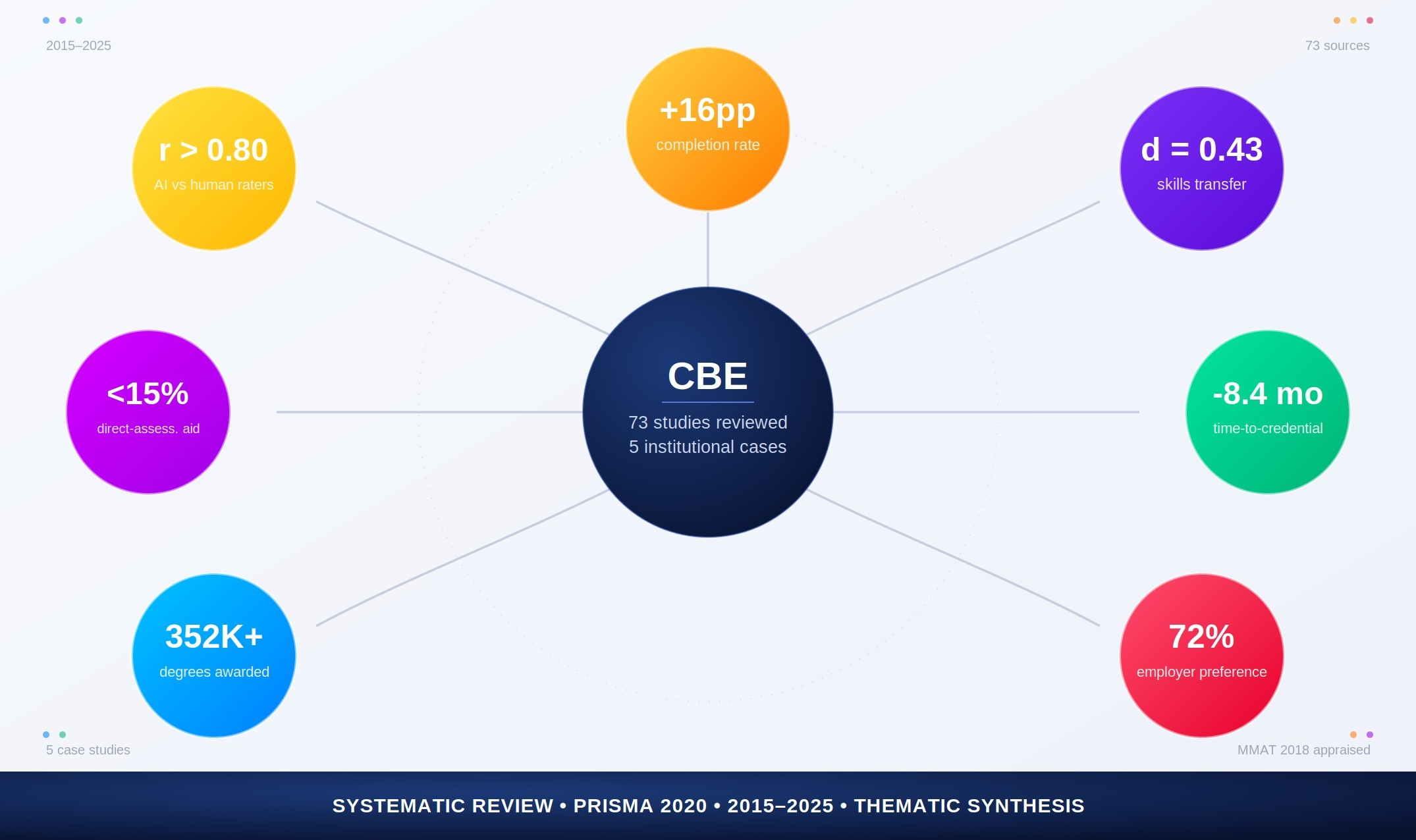
- Accreditation and regulatory compliance: Federal financial aid regulations in the United States, specifically the Satisfactory Academic Progress rules and credit-hour equivalency requirements, were designed for time-based programs and create direct structural barriers for self-paced CBE models [3,14,56]. Guthrie and Berkner [21] report that, as of 2023, fewer than 15% of U.S. CBE programs have received direct assessment status from the Department of Education, meaning the majority continue to operate through credit-equivalency workarounds that undermine the pacing flexibility CBE is designed to provide.
- Quality assurance and assessment credibility: Employers and accreditors cannot simply assess CBE credentials at face value because the meaning of a competency title varies significantly across programs [37,57]. Sluijsmans et al. [57] introduce a 12-criterion quality framework for competency assessment, covering aspects such as fitness for purpose, authenticity, cognitive complexity, meaningfulness, transparency, fairness, reproducibility, comparability, educational impact, costs, efficiency, and acceptability. Their research indicates that most CBE programs explicitly meet four to six of these criteria but rarely all twelve. Notably, the less addressed criteria, comparability, reproducibility, and educational impact, are precisely those most crucial for earning trust from employers and accreditation bodies.
- Resource requirements and financial sustainability: Upfront investment requirements for CBE are uniformly characterized as substantial. Porter and Reilly [45] estimate that full CBE conversion at a mid-sized institution requires an investment 2–3 times that of a traditional program redesign. However, they also project that CBE programs achieve lower per-student delivery costs at scale due to technology leverage and reduced content-delivery redundancy. This cost trajectory, high upfront, lower at scale, creates a cash-flow challenge for institutions without access to grant funding, disproportionately affecting under-resourced institutions serving the student populations that stand to benefit most from CBE [3,46].
3.6.2. Benefits and Advantages of CBE
4. Discussion
4.1. Effectiveness Across Diverse Institutional Contexts (Objective 1)
4.2. Impact on Engagement, Completion, and Outcomes (Objective 2)
4.3. Critical Success Factors and Barriers (Objective 3)
4.4. Workforce Alignment and Employability (Objective 4)
4.5. Recommendations for Sustainable Implementation (Objective 5)
4.6. Long-Term Implications for Equity and Institutional Competitiveness (Objective 6)
4.7. The CBE Contextual Fit Framework: An Original Synthesis
4.8. Policy Implications
4.9. Future Research Directions and Limitations
- Artificial intelligence and adaptive assessment represent the most transformative near-term opportunity. AI literacy is increasingly framed as a core, assessable competency in its own right [60,61,62], a shift reinforced by recent U.S. federal policy directing schools to integrate AI literacy into curricula [63]. Ellikkal and Rajamohan [47] demonstrate that AI competency assessment tools achieve inter-rater agreement with human experts that exceeds standard inter-rater reliability benchmarks for discrete, well-structured competency tasks. Kang et al. [13], based on their scoping umbrella review, project that AI-adaptive learning path generation will become a standard CBE feature within five years. Petrova [59] examines institutional strategies for developing AI competencies in higher education, finding that CBE’s competency-mapping architecture is better suited to integrating AI literacy as a defined, assessable outcome than traditional course-based curricula. Critically, Ellikkal and Rajamohan [47] identify equity risks in AI assessment deployment: automated scoring systems trained predominantly on majority-group demographic performance data may systematically underrate learners’ demonstrations of competence from linguistic or cultural minority backgrounds. Demographic equity audits must be a standard governance requirement for institutions deploying AI assessment tools.
- Micro-credentials and stackable qualifications mark a significant development in competency-based education (CBE), expanding its principles beyond traditional degrees. Digital badges and micro-credentials, viewed as individual, verifiable units of competency [64,65], have been officially integrated into state and district policy frameworks [66]. Varadarajan, et al. [38] highlight CBE’s mastery-and-portfolio model as highly compatible with digital badge and micro-credential systems. The rapid growth of the digital badge market—from 74 million badges worldwide in 2020 to an expected 74 million in 2025 [51]—indicates employer acceptance of detailed credentialing [67,68]. However, Stefaniak and Carey [69] warn that without quality standards, the surge in micro-credentials could lead to confusion and hinder effective hiring decisions.
- While often regarded as a future goal [5,70,71,72,73], the global standardization of competency frameworks is still in its early phases. Tahirsylaj and Sundberg’s [5] systematic review highlights five distinct visions of competency-based education (CBE) coexisting across various national and institutional contexts. They describe these as ‘traveling policies’ that cross borders and are adapted locally, often leading to definitional drift. Additionally, OECD [73] and UNESCO [71] are actively working on AI-compatible competency frameworks for teachers and students, which could serve as foundational standards for the broader effort toward CBE standardization.
Supplementary Materials
Funding
Institutional Review Board Statement
Informed Consent Statement
Data Availability Statement
Conflicts of Interest
References
- Klein-Collins, R. Competency-Based Degree Programs in the U.S.: Postsecondary Credentials for Measurable Student Learning and Performance; Council for Adult and Experiential Learning: Chicago, IL, USA, 2012. [Google Scholar]
- Laitinen, A. Cracking the Credit Hour; New America Foundation: Washington, DC, USA, 2012. [Google Scholar]
- Silva, E.; White, T.; Toch, T. The Carnegie Unit: A Century-Old Standard in a Changing Education Landscape; Carnegie Foundation for the Advancement of Teaching: Stanford, CA, USA, 2023. [Google Scholar]
- Nodine, T.R. How did we get here? A brief history of competency-based higher education in the United States. J. Compet.-Based Educ. 2016, 1, 5–11. [Google Scholar]
- Tahirsylaj, A.; Sundberg, D. Five visions of competence-based education and curricula as travelling policies: A systematic research review 1997–2022. J. Curric. Stud. 2026, 58, 1–26. [Google Scholar]
- Jonker, G.; de Leng, B.; Schijven, M.; ten Cate, O.; van Gurp, J. Managing curriculum reform in the transition to competency-based education using entrustable professional activities. In Entrustable Professional Activities in Health Professions Education; Ten Cate, O., Batalden, J., Carraccio, S., Casey, S.C., Long, V., Mink, L.M., van der Schaaf, T.J., Swing, D.A., Eds.; National Center for Biotechnology Information: Bethesda, MD, USA, 2022; pp. 1–15. [Google Scholar]
- Levine, E.; Kern, D.E.; Wright, S.M.; Carrese, J.A. Barriers or costs? Understanding faculty resistance to instructional changes associated with curricular reform. Can. Med. Educ. J. 2022, 13, 75–83. [Google Scholar]
- Johnstone, S.M.; Soares, L. Principles for developing competency-based education programs. Change Mag. High. Learn. 2014, 46, 12–19. [Google Scholar] [CrossRef] [Scilit]
- Gervais, J. The operational definition of competency-based education. J. Compet.-Based Educ. 2016, 1, 98–106. [Google Scholar]
- Soares, L. A Disruptive Look at Competency-Based Education: How the Innovative Use of Technology Will Transform the College Experience; Center for American Progress: Washington, DC, USA, 2012. [Google Scholar]
- Jancevska, S.; Stankovska, A. Implementing competency-based education through the personalized monitoring of primary students’ progress and assessment. Educ. Sci. 2025, 15, 252. [Google Scholar] [CrossRef] [Scilit]
- Henri, M.; Johnson, M.D.; Nepal, B. A review of competency-based learning: Tools, assessments, and recommendations. J. Eng. Educ. 2017, 106, 607–638. [Google Scholar]
- Kang, I.-G.; Moussavi, R.; Castle, C.E.; Pittack, C.; McEathron, S.R. A scoping umbrella review of competency-based education: Part I—A descriptive analysis of trends, practices, and gaps. Compet.-Based Educ. Res. J. 2025, 2, 1–32. [Google Scholar]
- Kelchen, R. The Landscape of Competency-Based Education: Enrollments, Demographics, and Affordability; American Enterprise Institute: Washington, DC, USA, 2015. [Google Scholar]
- Hora, M.T.; Oleson, A.K. Examining study habits in undergraduate STEM courses from a situative perspective. Int. J. STEM Educ. 2017, 4, 1. [Google Scholar] [CrossRef] [Scilit]
- Page, M.J.; McKenzie, J.E.; Bossuyt, P.M.; Boutron, I.; Hoffmann, T.C.; Mulrow, C.D.; Shamseer, L.; Tetzlaff, J.M.; Akl, E.A.; Brennan, S.E.; et al. Updating guidance for reporting systematic reviews: Development of the PRISMA 2020 statement. J. Clin. Epidemiol. 2021, 134, 103–112. [Google Scholar] [CrossRef] [Scilit] [PubMed]
- Linnenluecke, M.K.; Marrone, M.; Singh, A.K. Conducting systematic literature reviews and bibliometric analyses. Aust. J. Manag. 2020, 45, 175–194. [Google Scholar]
- Hong, Q.N.; Fàbregues, S.; Bartlett, G.; Boardman, F.; Cargo, M.; Dagenais, P.; Gagnon, M.-P.; Griffiths, F.; Nicolau, B.; O’Cathain, A.; et al. The Mixed Methods Appraisal Tool (MMAT) version 2018. Educ. Inf. 2018, 34, 285–291. [Google Scholar] [CrossRef] [Scilit]
- Braun, V.; Clarke, V. Using thematic analysis in psychology. Qual. Res. Psychol. 2006, 3, 77–101. [Google Scholar] [CrossRef] [Scilit]
- Adelman, C.; Ewell, P.; Gaston, P.; Schneider, C.G. The Degree Qualifications Profile: A Learning-Centered Framework for What College Graduates Should Know and Be Able to Do to Earn the Associate, Bachelor’s, or Master’s Degree; Lumina Foundation: Indianapolis, IN, USA, 2014. [Google Scholar]
- Guthrie, H.; Berkner, J. Competency-Based Education Updated April 2023; Policy Navigator: Washington, DC, USA, 2023. [Google Scholar]
- Gibson, R.; Smith, W. Competency-Based Learning: Four Challenges and Impediments; The Evolution: Toronto, ON, USA, 2023. [Google Scholar]
- Burnette, D.M. The renewal of competency-based education: A review of the literature. J. Contin. High. Educ. 2016, 64, 84–93. [Google Scholar] [CrossRef] [Scilit]
- McDonald, N. A private, nonprofit university’s experiences designing a competency-based degree for adult learners. J. Contin. High. Educ. 2018, 66, 34–45. [Google Scholar]
- Competency-Based Education Network (C-BEN). Quality Principles for Competency-Based Education Programs; C-BEN: Franklin, TN, USA, 2017. [Google Scholar]
- Sturgis, C.; Casey, K. Quality Principles for Competency-Based Education; Competency Works, Aurora Institute: Vienna, VA, USA, 2018. [Google Scholar]
- Zakaria, N.S.; Ahmad Rashid, N.A.; Jantan, M.R.; Kasim, N. Transitioning to competency-based education in nursing: A scoping review of curriculum review and revision strategies. BMC Nurs. 2025, 24, 1111. [Google Scholar] [CrossRef] [Scilit]
- Parson, L.; Childs, B.; Elzie, P. Using competency-based curriculum design to create a health professions education certificate program. Health Prof. Educ. 2018, 4, 207–217. [Google Scholar] [CrossRef] [Scilit]
- Driessen, E.; van Tartwijk, J.; Dornan, T. The self-critical doctor: Helping students become more reflective. BMJ 2008, 336, 827–830. [Google Scholar] [PubMed]
- Schmidt, L.W.; Harber-Aschan, L.; Naous, D.; Lim, S.; Rani, A.; Afergan, D. An MS in CS for non-CS majors: A ten year retrospective. In Proceedings of the 56th ACM Technical Symposium on Computer Science Education V. 1, Pittsburgh, PA, USA, 26 February–1 March 2025; Association for Computing Machinery: New York, NY, USA, 2025; pp. 1–7. [Google Scholar]
- Vargas, H.; Arredondo, E.; Heradio, R.; de la Torre, L. Standardizing course assessment in competency-based higher education: An experience report. Front. Educ. 2025, 10, 1579124. [Google Scholar] [CrossRef] [Scilit]
- Porter, S.R.; Polikoff, M.S. Measuring student engagement in competency-based education. Educ. Assess. 2012, 17, 187–208. [Google Scholar]
- Singh, T. Validity in student assessment: Implications for competency. Karabük Üniv. Tıp Fakültesi Derg. 2024, 17, 1–4. [Google Scholar] [CrossRef] [Scilit]
- Sangwa, S.N. Global convergence toward competency-based education for the knowledge economy. Open J. Transform. Educ. Lifelong Learn. 2025, 1, 2. [Google Scholar] [CrossRef] [Scilit]
- Kuh, G.D.; Jankowski, N.; Ikenberry, S.O.; Kinzie, J. Knowing What Students Know and Can Do: The Current State of Student Learning Outcomes Assessment in US Colleges and Universities; National Institute for Learning Outcomes Assessment: Urbana, IL, USA, 2014. [Google Scholar]
- U.S. Department of Education, Office of Educational Technology. Competency-Based Learning or Personalized Learning; U.S. Department of Education: Washington, DC, USA, 2015.
- Van Der Vleuten, C.P.; Schuwirth, L.W.T. Assessing professional competence: From methods to programs. Med. Educ. 2005, 39, 309–317. [Google Scholar] [PubMed]
- Varadarajan, S.; Koh, J.H.L.; Daniel, B.K. A systematic review of the opportunities and challenges of micro-credentials for multiple stakeholders: Learners, employers, higher education institutions and government. Int. J. Educ. Technol. High. Educ. 2023, 20, 13. [Google Scholar] [CrossRef] [Scilit] [PubMed]
- Mendenhall, R.W. Western Governors University. In Game Changers: Education and Information Technologies; Oblinger, D.G., Ed.; EDUCAUSE: Boulder, CO, USA, 2012; pp. 185–196. [Google Scholar]
- Western Governors University. 2023 Annual Report: Innovating for the Individual; Western Governors University: Salt Lake City, UT, USA, 2023. [Google Scholar]
- Garira, E. Needs assessment for the development of educational interventions to improve quality of education. Soc. Sci. Humanit. Open 2020, 2, 100020. [Google Scholar] [CrossRef] [Scilit]
- Bouchrika, I. Competency-Based Education Guide: Benefits & Differences to Traditional Education for 2026. 2025. Available online: https://research.com/education/competency-based-education (accessed on 1 June 2026).
- Caldwell, C. The evolution of competency-based education: Lessons from Western Governors University. Educ. Rev. 2019, 54, 48–63. [Google Scholar]
- Wiggins, G.; McTighe, J. Understanding by Design, 2nd ed.; ASCD: Alexandria, VA, USA, 2005. [Google Scholar]
- Porter, S.R.; Reilly, K. Competency-Based Education as a Potential Strategy to Increase Learning and Lower Costs; HCM Strategists: Washington, DC, USA, 2014. [Google Scholar]
- American Institutes for Research. Postsecondary Competency-Based Education; American Institutes for Research: Arlington, VA, USA, 2025. [Google Scholar]
- Ellikkal, A.; Rajamohan, S. Role of artificial intelligence in enhancing competency assessment and transforming curriculum in higher vocational education. Front. Educ. 2025, 10, 1551596. [Google Scholar] [CrossRef] [Scilit]
- Cunningham, J.B.; Hillier, E. Informal learning in the workplace: Key activities and processes. Educ. Train. 2013, 55, 37–51. [Google Scholar] [CrossRef] [Scilit]
- VerifyEd. Digital Badges Required for Education 2025; VerifyEd: Edinburgh, UK, 2025. [Google Scholar]
- VerifyEd. What Are Blockchain Digital Credentials? An Expert Guide (2025); VerifyEd: Edinburgh, UK, 2025. [Google Scholar]
- VerifyEd. Online Learning: What It Is and How Digital Credentials Transform 2025; VerifyEd: Edinburgh, UK, 2025. [Google Scholar]
- Specht-Boardman, R.; Gray, A.; Tims, B.; Bragg, D.; Whitmore, C. The University of Wisconsin Flexible Option is an effective model to prepare students for a recovering economy. J. Compet.-Based Educ. 2021, 6, e1235. [Google Scholar] [CrossRef] [Scilit]
- Hansen, S.E.W. Improving educational and financial effectiveness through innovation: A case study of Southern New Hampshire University’s College for America. Int. J. Educ. Dev. 2018, 58, 149–158. [Google Scholar] [CrossRef] [Scilit]
- Voorhees, R.A.; Milam, J.H. The hidden costs of competency-based education. J. Appl. Res. Community Coll. 2005, 12, 163–170. [Google Scholar]
- Starnes, D. How Purdue Global is Expanding Purdue U’s Access to Adult Learners; Higher Ed Dive: Newton, MA, USA, 2019. [Google Scholar]
- Book, P.A. All Hands on Deck: Ten Lessons from Early Adopters of Competency-Based Education; Western Interstate Commission for Higher Education: Boulder, CO, USA, 2014. [Google Scholar]
- Sluijsmans, D.M.A.; Struyven, K. Quality assurance in assessment: An introduction to this special issue. Stud. Educ. Eval. 2014, 43, 1–4. [Google Scholar] [CrossRef] [Scilit]
- Açıkgöz, T.; Babadoğan, M.C. Competency-based education: Theory and practice. Psycho-Educ. Res. Rev. 2021, 10, 67–95. [Google Scholar]
- Petrova, M. Strategies for developing AI competencies in higher education. Front. Educ. 2025, 10, 1683909. [Google Scholar]
- Chiu, T.K.F. AI literacy and competency: Definitions, frameworks, development and future research directions. Interact. Learn. Environ. 2025, 33, 3225–3229. [Google Scholar] [CrossRef] [Scilit]
- Cengage Group. 4 Ways AI Has Impacted Education: 2025 AI Education Impact; Cengage Group: Boston, MA, USA, 2025. [Google Scholar]
- World Economic Forum. Why AI Literacy Is Now a Core Competency in Education; World Economic Forum: Geneva, Switzerland, 2025. [Google Scholar]
- The White House. Advancing Artificial Intelligence Education for American Youth; Executive Order 14277; The White House: Washington, DC, USA, 2025. [Google Scholar]
- Digital Promise. Digital Badges; Digital Promise: Washington, DC, USA, 2014. [Google Scholar]
- Clement, J. What Is a Digital Badge? A credible: Mountain View, CA, USA, 2025. [Google Scholar]
- Council of Chief State School Officers. Understanding Micro-Credentials; CCSSO: Washington, DC, USA, 2020. [Google Scholar]
- MITR Media. The Future of Credentialing: Micro-Credentials and Digital Badges; MITR Media: Mumbai, India, 2025. [Google Scholar]
- Edutech Global. Digital Credentials in Education: The Future of Academic Recognition; Edutech Global: Katy, TX, USA, 2025. [Google Scholar]
- Stefaniak, J.; Carey, K. Instilling purpose and value in the implementation of digital badges in higher education. Int. J. Educ. Technol. High. Educ. 2019, 16, 44. [Google Scholar] [CrossRef] [Scilit]
- UNESCO. Competency-Based Learning: A Global Perspective; UNESCO-UNEVOC International Centre: Bonn, Germany, 2017. [Google Scholar]
- UNESCO. AI Competency Framework for Teachers; UNESCO: Paris, France, 2025. [Google Scholar]
- OECD. The Future of Education and Skills: Education 2030; OECD Publishing: Paris, France, 2018. [Google Scholar]
- OECD. Empowering Learners for the Age of AI: An AI Literacy Framework for Primary and Secondary Education; OECD Publishing: Paris, France, 2025. [Google Scholar]



| Aspect | Competency-Based Education (CBE) | Traditional Credit System |
|---|---|---|
| Learning Focus | Mastery of specific competencies and skills | Completion of credit hours and coursework |
| Time Structure | Flexible, self-paced progression | Fixed semester/quarter schedules |
| Assessment Method | Demonstration of competency through authentic assessments | Grades based on exams, assignments, and participation |
| Progression Criteria | Proven mastery of learning outcomes | Accumulation of predetermined credit hours |
| Student Support | Individualized coaching and mentoring | Traditional classroom instruction with office hours |
| Degree Completion | Based on demonstrated competencies | Based on credit-hour accumulation (typically 120+ h) |
| Cost Structure | Often subscription-based or competency-based pricing | Per-credit-hour or flat tuition rates |
| Employer Recognition | Growing acceptance; emphasis on skills | Well-established; universally recognized |
| Quality Assurance | Focus on learning outcomes and real-world applications | Emphasis on accreditation and standardized processes |
| Flexibility | High flexibility for working adults and non-traditional students | Limited flexibility; structured schedules |
| Competency Domain | Specific Competencies | Performance Indicators | Assessment Methods | Proficiency Levels |
|---|---|---|---|---|
| Communication | Written Communication | Produces clear, coherent written documents | Portfolio review, Writing samples | Novice, Developing, Proficient, Advanced |
| Oral Communication | Delivers effective presentations | Presentation evaluation, Peer feedback | Novice, Developing, Proficient, Advanced | |
| Digital Communication | Uses technology tools effectively | Technology demonstrations, Digital portfolios | Novice, Developing, Proficient, Advanced | |
| Critical Thinking | Problem Analysis | Identifies and analyzes complex problems | Case study analysis, Problem-solving exercises | Novice, Developing, Proficient, Advanced |
| Solution Development | Develops innovative solutions | Project-based assessments, Research projects | Novice, Developing, Proficient, Advanced | |
| Professional Skills | Teamwork | Collaborates effectively in teams | Team project evaluations, Peer assessments | Novice, Developing, Proficient, Advanced |
| Competency | Unsatisfactory (1) | Developing (2) | Proficient (3) | Advanced (4) |
|---|---|---|---|---|
| Problem Solving | Fails to identify key issues or develop solutions | Identifies some issues, but solutions are incomplete | Identifies key issues and develops appropriate solutions | Identifies complex issues and develops innovative, well-reasoned solutions |
| Communication | Unable to convey ideas clearly | Communicates with significant errors | Communicates clearly with minor errors | Communicates with exceptional clarity and precision |
| Teamwork | Fails to contribute effectively to team efforts | Contributes minimally; limited responsiveness | Contributes effectively to team goals | Demonstrates exemplary leadership in team contexts |
| Research Skills | Fails to locate or evaluate relevant sources | Locates some sources, but the evaluation is limited | Locates and evaluates relevant sources effectively | Demonstrates sophisticated research and evaluation skills |
| Phase | Duration | Key Activities | Deliverables | Stakeholders |
|---|---|---|---|---|
| Planning | 6 months | Stakeholder engagement, Needs assessment, Resource planning | Implementation plan, Budget allocation | Administration, Faculty, Students |
| Design | 12 months | Competency mapping, Curriculum development, Assessment design | Competency frameworks, Course materials | Faculty, Industry partners, Students |
| Pilot | 6 months | Small-scale implementation, Testing, and refinement | Pilot program results, Feedback reports | Faculty, Students, Administration |
| Implementation | 18 months | Full program launch, Faculty training, Student support | Operational programs, Support systems | All stakeholders |
| Evaluation | Ongoing | Assessment of outcomes, Continuous improvement | Evaluation reports, Improvement plans | Administration, Faculty, External evaluators |
| Technology Component | Required Features | Implementation Priority |
|---|---|---|
| Learning Management System | Competency tracking, Flexible pacing, Portfolio management | High |
| Assessment Platform | Multiple assessment types, Automated scoring, Analytics | High |
| Student Information System | CBE-compatible records, Transcript management, Reporting | High |
| Digital Badging System | Micro-credential issuance, Verification, Stack ability | Medium |
| Analytics Dashboard | Real-time reporting, Predictive analytics, Visualization | Medium |
| Mobile Applications | Student access, Progress tracking, Notifications | Lower |
| Institution | CBE Model Type | Target Population | Employer Co-Design | Coaching Structure | Accreditation Approach | Key Reported Outcome |
|---|---|---|---|---|---|---|
| UW Flexible Option | Direct Assessment CBE | Adult learners, military, working parents | Advisory validation | Dedicated coaches | Regional; PRISMA-documented | 58% retention vs. 41% benchmark |
| SNHU College for America | Employer-Partnered CBE | Working adults, employer-sponsored | Active co-architect role | Supervisor feedback loops | Direct assessment status | 89% employment within 6 months |
| Purdue Global ExcelTrack | Hybrid Credit-Competency | Adult learners, career changers | Iterative review cycles | Personalized advising | Credit-hour equivalency | 43% bypassed ≥1 course; −4.5 months |
| Northeastern Align | Specialist Professional CBE | Non-CS majors for CS careers | Active co-architect role | Project-based mentoring | Regional accreditation | 67% complete in ≤3 years |
| Western Governors University | Pure Self-Paced CBE | Broad adult learner population | Market-responsive review | Dedicated mentors (WGU staff) | Direct assessment status | 28% complete bachelor’s in <3 years |
Disclaimer/Publisher’s Note: The statements, opinions and data contained in all publications are solely those of the individual author(s) and contributor(s) and not of MDPI and/or the editor(s). MDPI and/or the editor(s) disclaim responsibility for any injury to people or property resulting from any ideas, methods, instructions or products referred to in the content. |
© 2026 by the author. Licensee MDPI, Basel, Switzerland. This article is an open access article distributed under the terms and conditions of the Creative Commons Attribution (CC BY) license.
Share and Cite
Zaky, H. Reimagining Higher Education: The Promise and Challenges of Competency-Based Learning in the Digital Age. Knowledge 2026, 6, 15. https://doi.org/10.3390/knowledge6030015
Zaky H. Reimagining Higher Education: The Promise and Challenges of Competency-Based Learning in the Digital Age. Knowledge. 2026; 6(3):15. https://doi.org/10.3390/knowledge6030015
Chicago/Turabian StyleZaky, Hany. 2026. "Reimagining Higher Education: The Promise and Challenges of Competency-Based Learning in the Digital Age" Knowledge 6, no. 3: 15. https://doi.org/10.3390/knowledge6030015
APA StyleZaky, H. (2026). Reimagining Higher Education: The Promise and Challenges of Competency-Based Learning in the Digital Age. Knowledge, 6(3), 15. https://doi.org/10.3390/knowledge6030015