1. Introduction
Online graduate micro-credentials sit at the intersection of two promises. They are presented as flexible learning pathways for working professionals and as portable credential signals for employers and professional communities [
1,
2,
3,
4]. In online graduate settings, those promises are tightly coupled: short-form credentials must support credible learning while also communicating value beyond the course or platform through which they are earned [
5,
6,
7].
Yet, the scholarship surrounding these credentials is difficult to read as a field. Existing reviews synthesize opportunities and challenges for learners, employers, institutions, and governments, and they document persistent definitional ambiguity, uneven implementation, and varied use cases [
8,
9,
10,
11,
12]. What is still missing is an updateable, cross-disciplinary map showing where online graduate micro-credential scholarship is published, how it is framed as learning versus signaling, and which themes dominate the retrieved corpus. Without such a map, claims about program design, recognition, and future evidence needs remain harder to situate.
Evidence maps are useful in fast-moving domains because they organize broad literatures rather than adjudicate effects. In a field like micro-credentials—where terminology shifts, platform arrangements evolve, and evidence accumulates unevenly across disciplines—a rerunnable map can show where research concentrates, how problems are framed, and which gaps warrant deeper qualitative and empirical study. This study therefore uses OpenAlex and a transparent, seedless machine-assisted triage workflow to map a clearly defined search space while preserving breadth and traceability.
This paper makes three contributions. First, it provides an updateable OpenAlex-based workflow for corpus construction and auditability. Second, it uses and internally validates a conservative, theory-informed heuristic typology to distinguish learning-first from signal-first framings and standalone from stackable credential structures. Third, it surfaces candidate themes from topic modeling to guide follow-on qualitative synthesis. Across these contributions, the learning/signaling tension serves as the manuscript’s conceptual spine and links the evidence map to a future research agenda. The sections that follow develop the conceptual framing, present the workflow, report the evidence-map and theme results, and discuss implications for online graduate micro-credential design, recognition, and next-step research.
2. Background and Conceptual Framing
Because micro-credentials are simultaneously a learning-design intervention and a credentialing infrastructure, the literature tends to mix pedagogical claims with ecosystem and policy claims. Three conceptual lenses help organize these debates. Signaling theory directs attention to how credentials communicate otherwise hard-to-observe capabilities under conditions of information asymmetry [
5]. Credential-ecology perspectives treat micro-credentials as relational arrangements whose value depends on issuers, standards, platforms, and recognition practices rather than on the badge artifact alone [
6,
7]. Credentialist and political-economy critiques caution that proliferating smaller credentials can intensify sorting, fragmentation, and platform dependence even while expanding flexible participation [
13,
14,
15,
16,
17]. This background section uses those lenses to clarify what micro-credentials are, why online graduate contexts heighten governance and quality stakes, and why the evidence-map typology later distinguishes learning from signaling and standalone from stackable forms.
2.1. Micro-Credentials, Digital Credentials, and Graduate Online Pathways
Micro-credentials do not have a single settled definition; what counts as a micro-credential varies by policy context, issuer, assessment expectations, and the degree of credit/articulation. International policy statements nevertheless converge on the idea that micro-credentials are certified learning achievements smaller than traditional degrees and intended to support lifelong learning and employability [
1,
3,
4]. In graduate contexts, these definitional differences become especially consequential because credit-bearing micro-credentials that articulate into degrees generate different governance and quality pressures than non-credit badges used primarily for professional signaling.
Here, online graduate micro-credentialing is used as a pragmatic label for the OpenAlex-retrieved scholarship surfaced by the query packs—work that combines micro-credential terminology with online and higher-education context cues. Because the goal is mapping rather than narrow eligibility filtering, some records inevitably touch adjacent contexts or use cases; the emphasis is on documenting the retrieved OpenAlex search space transparently.
From a signaling perspective, micro-credentials matter because they attempt to make learning legible to audiences who cannot directly observe what a learner knows or can do. A short credential does not signal value automatically; its interpretability depends on what is being certified, how evidence is attached to the claim, who issues it, and whether intended audiences trust the format [
5,
18,
19,
20,
21].
Peer-reviewed scholarship increasingly frames micro-credentials as part of a wider “credential ecology,” in which universities, platforms, employers, and policy actors negotiate what counts as evidence of learning and employability [
6,
7,
13]. In this view, micro-credentials are less a single product than an arrangement of relationships: assessment practices, competency claims, issuer credibility, articulation pathways, metadata standards, and recognition infrastructures jointly determine whether a credential has value.
Credentialist and critical perspectives add a needed caution. If qualifications structure access to opportunities, proliferating smaller credentials can widen options for some learners but also redistribute risk, intensify sorting, or unbundle degrees into marketized fragments with uneven recognition [
13,
14,
17,
22,
23]. Recent work on digitalized higher education likewise suggests that platform partnerships and data infrastructures are not neutral delivery mechanisms; they shape where value accrues, who controls credential records and interfaces, and how portability is governed [
15,
16].
Complementing these critiques, empirical and design-oriented studies document emerging institutional strategies, implementation barriers, and quality considerations across regions and sectors [
11,
12,
24,
25,
26,
27,
28], including work responding to shifting delivery conditions and capacity-building for online provision [
29,
30,
31,
32,
33].
Related work clusters around three strands. One examines digital badges and open badge infrastructures as a common “container” for micro-credentials, with attention to learner motivation, feedback, goal-setting, and the instructional design choices that make badges meaningful rather than superficial signals [
34,
35,
36,
37,
38,
39,
40,
41,
42]. A second strand focuses on employer interpretation and recognition, asking when micro-credentials operate as credible signals versus noise in hiring and advancement decisions [
18,
19,
20,
21,
43]. A third, smaller technical literature explores verification and credential management infrastructures—including blockchain-based approaches—to support portability, tamper-resistance, and automated validation across platforms [
44,
45,
46]. For online graduate programs, these badge and credential infrastructures often become the public “interface” through which assessment evidence, competency claims, and institutional credibility are interpreted by employers and learners. Together, these strands show that the relevant unit of analysis is not only the credential itself but also the ecology through which it is interpreted and circulated [
6,
7].
Online delivery amplifies both the opportunity and the complexity of graduate micro-credentials. It can lower access barriers and enable rapid iteration, but it also raises familiar concerns in online graduate education: instructional design quality, learner support, academic integrity, and the validity of assessment evidence. As a result, micro-credentials require alignment across learning outcomes, assessment evidence, credential metadata, and recognition. In the evidence map that follows, the typology and candidate themes help show which of these concerns dominate the literature and which remain comparatively under-developed.
Digital credentialing is sometimes framed as a technical fix (badges, credential wallets, registries), but its consequences are institutional and equitable. Portability across institutions and employers depends on shared standards, trusted intermediaries, and long-term stewardship of credentials beyond a learner’s relationship with a platform or program. Because micro-credentials are marketed as employability tools, equity questions sit at the center: who can access them, how costs and risks are distributed, and whether micro-credentials mitigate or reproduce inequities in graduate education and labor markets.
Across this literature, micro-credentials are rarely neutral: authors tell different stories about what micro-credentials are for. Some frame them as learner-centered pathways (flexibility, personalization, just-in-time learning), while others foreground market-centered logics (skills pipelines, employability metrics, and competitive positioning). In some accounts, micro-credentials complement degrees by widening access and creating on-ramps; in others, they risk fragmenting learning into narrow signals with uneven recognition [
8,
9]. Seen together, signaling theory, credential ecology, and credentialist critique point to two analytically useful questions for an evidence map: is a paper primarily concerned with producing learning or communicating value, and does it treat the credential as a discrete artifact or as part of a broader pathway/ecology? Those questions motivate the simple typology used below.
2.2. A Heuristic Evidence-Map Typology
To make the evidence map easier to interpret, this paper uses a simple heuristic 2 × 2 typology. It is intended for evidence mapping, not as a fine-grained theoretical classification, but it is conceptually anchored in the lenses above. The learning-first/signal-first distinction captures whether a paper foregrounds the production of capability or the communication of capability under information asymmetry [
5]. The standalone/stackable distinction captures whether a paper treats the credential as a relatively discrete artifact or as one element in a wider credential ecology of pathways, credit, and recognition [
6,
7]. The typology combines two contrasts that recur throughout micro-credential discourse:
Learning-first vs. Signal-first. Learning-first framings emphasize pedagogy, curriculum design, assessment, learner support, and learning pathways. Signal-first framings emphasize credential value, verification, employability, and stakeholder recognition.
Standalone vs. Stackable. Standalone micro-credentials are framed as independent certificates or badges without explicit articulation. Stackable micro-credentials are framed as composable elements of pathways, programs, or credit-bearing structures.
This typology is useful because it parallels common decisions faced in online program strategy while keeping critical questions in view. Learning-first framings align with instructional design, assessment, and learner experience, whereas signal-first framings align with employer partnerships, credential registries, and communication of value. Standalone framings align with short-course and professional development offerings, while stackable framings align with pathway design, articulation policy, and degree integration. At the same time, credentialist critiques remind us that stackability is not automatically beneficial and signal strength is not automatically equitable; both depend on governance, recognition, and the institutional conditions under which credentials circulate [
13,
14].
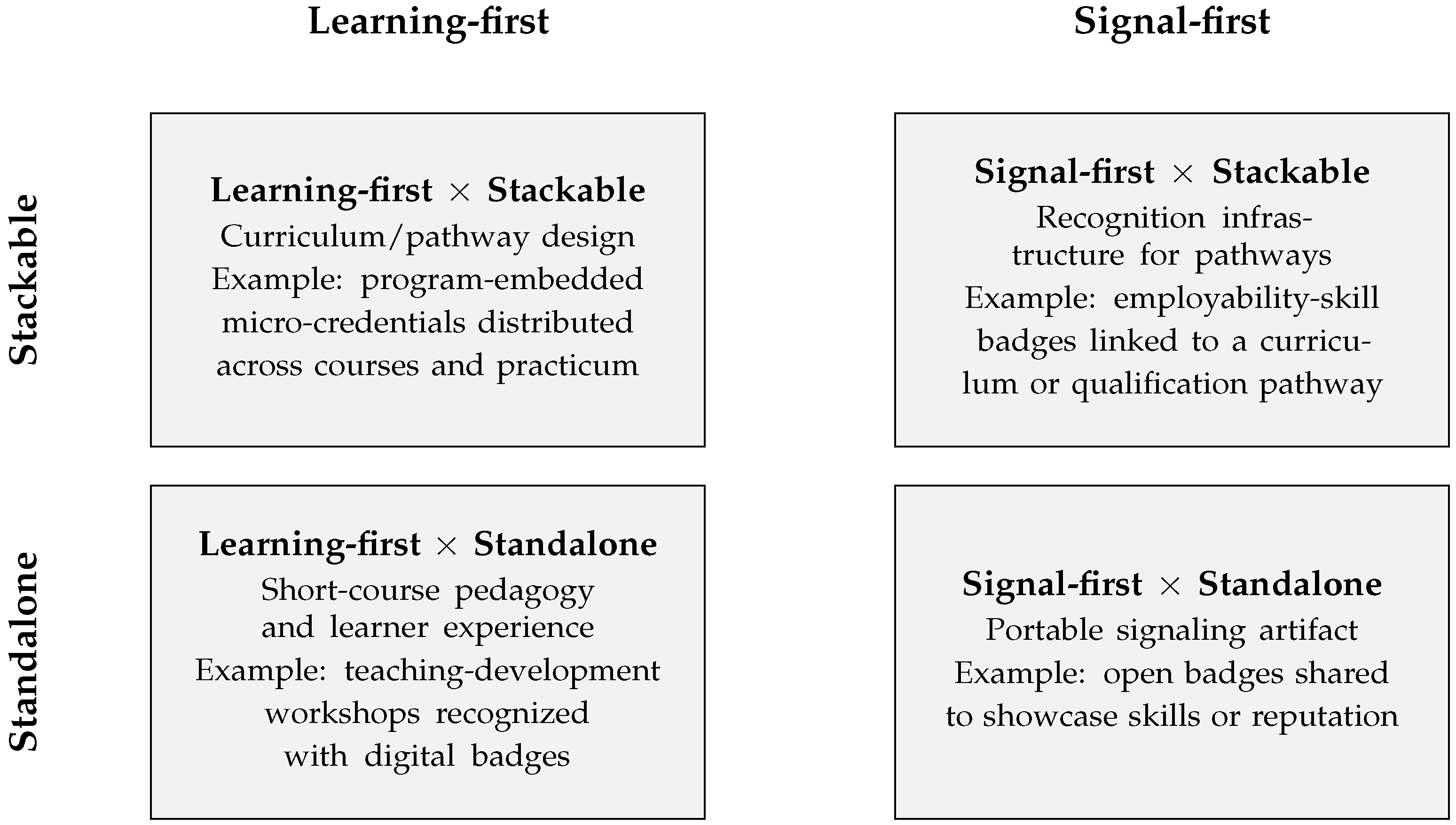
Figure 1 offers a conceptual version of the typology before the empirical counts are introduced. The quadrants often correspond to learning-first × stackable curriculum/pathway design work (sequencing, advising, assessment, articulation), learning-first × standalone short-course pedagogy and learner experience (design, support, feedback, motivation), signal-first × stackable recognition infrastructure for pathways (credential value, verification, employer alignment, credit recognition), and signal-first × standalone portable signaling artifacts (badges/credentials intended primarily for showcasing skills or employability).
Illustrative cases corresponding to these quadrants include educator-preparation micro-credentials embedded across an educator preparation program and distributed through courses, practicum, and student teaching (learning-first × stackable), digital badges used to recognize stand-alone professional learning workshops and seminars in higher education (learning-first × standalone), employability-skill micro-credentialing that links curriculum innovation, ePortfolio evidence, and employer-facing recognition across a wider academic journey (signal-first × stackable), and National Instruments’ open badging program, where sharing badges helps earners establish skills and reputation beyond a particular course (signal-first × standalone) [
18,
30,
35,
43]. These examples are illustrative rather than exhaustive; their purpose is to orient the reader before the analytic distribution is introduced later in
Section 5.
Table 1 summarizes the credential-ecology crosswalk used to interpret the evidence-map typology.
In this manuscript, the typology is implemented with transparent, keyword-based rules applied to titles and abstracts (documented in the scripts and output artifacts). For this revision, the operational rules were made deliberately conservative: records without clear directional cue dominance are left unclassified rather than being forced into a quadrant. The typology is therefore meant as a descriptive lens, not a definitive taxonomy. Its purpose is to show how the retrieved literature distributes across narrative emphases and structural assumptions while preserving visible uncertainty for deeper qualitative synthesis. The next section details the workflow and the rerunnable artifacts that make this classification auditable.
2.3. Why a Seedless, Updateable Workflow?
Many evidence maps are one-off snapshots: useful in the moment, but hard to reproduce, audit, or refresh as the literature grows. In fast-moving innovation domains, the map matters most when it can be rerun—producing comparable artifacts (tables and figures) without relying on closed databases or opaque corpus-construction steps. Here, OpenAlex provides an open retrieval substrate [
47], and the workflow pairs that substrate with seedless triage—a weak-supervision approach that uses transparent, rule-based signals to score records and document relevance-annotation logic without requiring a hand-labeled training set [
48,
49].
Using an updateable workflow is particularly important for micro-credential research because the domain evolves quickly: new credential standards emerge, platform partnerships change, and institutional strategies shift. An evidence map that can be rerun allows researchers to (a) monitor how the field shifts over time, (b) compare subdomains (e.g., health professions vs. computing), and (c) build cumulative qualitative synthesis on top of a stable, auditable corpus-construction process.
A final conceptual point is how credential ecology will be used in the interpretation that follows. In this paper, it is not treated only as background framing. Instead, it serves as a reading guide for the stable findings reported later: stackability is interpreted as a question of pathway structure and articulation governance rather than as a simple product feature; recognition is interpreted through issuer credibility, audience uptake, and the visibility of assessment evidence; portability is interpreted through metadata, standards, and stewardship across settings; and platform/issuer relations are treated as part of the governance conditions that shape whether a credential remains legible beyond the immediate course context [
2,
6,
7]. The typology therefore identifies dominant framings in the retrieved literature, while credential ecology is used to interpret the relational conditions under which those framings would matter in practice.
3. Research Questions
Rather than assuming a single, settled definition of “online graduate micro-credentialing,” this study maps how the scholarship is distributed, framed, and left underdeveloped. The analysis addresses four research questions that move from publication patterns to framings, themes, and future evidence needs.
RQ1: Where and when is scholarship on online graduate micro-credentialing being published in the retrieved OpenAlex search space (2010–2026)?
RQ2: Which narrative framings dominate the analytic set—learning-first vs. signal-first and standalone vs. stackable?
RQ3: What candidate themes emerge from topic modeling of titles/abstracts, and how can they guide follow-on qualitative coding and synthesis?
RQ4: What gaps in evidence emerge from the mapped literature, and what future qualitative and empirical research do they warrant?
4. Materials and Methods
4.1. Design
An evidence-map study was conducted to assemble a transparent, updateable corpus of scholarship relevant to online graduate micro-credentialing. Using OpenAlex metadata, records were retrieved and deduplicated, then seedless triage was applied to produce auditable relevance annotations rather than to filter the corpus. These annotations, alongside a heuristic typology and topic modeling, were used to describe how the retrieved literature is distributed and to generate candidate themes for follow-on qualitative synthesis. No physical devices, instruments, chemicals, reagents, commercial cell lines, samples, or materials were used. Software/package versions for the scripts used in retrieval, deduplication, screening, typology construction, and topic modeling are recorded in the dependency files in the v1.0.2 public release [
50].
Methodologically, this study is positioned as an evidence map. Evidence maps typically use systematic searching across a broad field to identify concentrations, absences, and future research needs, then present that landscape in a user-friendly form [
51]. That differs from a conventional systematic review, which is usually organized around a more focused question and is designed to appraise and synthesize included studies, and from a scoping review, which generally aims to map the breadth of evidence, concepts, and study types across a topic [
52,
53]. It also differs from a bibliometric review: although bibliometric studies likewise use large-scale publication metadata, they primarily analyze citation, co-authorship, or science-mapping structures, whereas the present study uses metadata chiefly to construct and characterize a rerunnable search space and then layers on a framing typology and candidate theme analysis [
54]. Accordingly, the claims made here are descriptive of the retrieved literature landscape and its dominant framings; they are not effect estimates, formal critical appraisals, or claims of exhaustive coverage of the full micro-credential literature.
In operational terms, the archived build separated corpus construction from later descriptive subset use. Four traceable stages created the analytic set: (1) execute two OpenAlex query packs with pack-specific publication-year windows; (2) ingest and deduplicate records using OpenAlex identifiers, DOI, and exact title/year matching; (3) apply seedless triage to generate auditable relevance bands and uncertainty flags; and (4) retain all deduplicated records in the analytic set for evidence mapping. Later analyses then used that retained corpus in different ways: topic modeling was run on the full analytic set, whereas typology counts were reported only for the typology-eligible/classifiable subset.
Table 2 summarizes this logic from retrieval to later analytic use.
This manuscript provides the evidence map and traceability infrastructure. A natural next stage is a tighter, qualitative synthesis focused on learner experience, assessment evidence, employer interpretation, or domain-specific implementations, using the same transparent sampling frame and rerunnable workflow.
To make that traceability inspectable rather than aspirational, the workflow is paired with a versioned public software release that archives the run-specific query logs, retrieved pack files, deduplication reports, analytic outputs, and manuscript artifacts for this evidence-map snapshot [
50,
55].
4.2. Data Source: OpenAlex
OpenAlex is an open catalog of scholarly works, authors, venues, institutions, and concepts, designed to support transparent bibliometrics and discovery [
47]. OpenAlex provides structured metadata (e.g., title, abstract when available, venue, year, DOI, and citation counts) and stable identifiers that facilitate deduplication. Because OpenAlex aggregates content from multiple sources and indexes a heterogeneous scholarly universe, metadata completeness is uneven across records and over time (e.g., abstracts, venue fields, or affiliations may be missing or later corrected) [
47,
56]. For this reason, OpenAlex should be understood here as the retrieval substrate for a transparent map, not as a proxy for the full literature itself. The queries operate over whatever indexed metadata are available at the time of retrieval, so the resulting corpus is best interpreted as a reproducible OpenAlex search space. That search space is an operational subset of the broader scholarship: records may be absent from the map because they were not indexed in OpenAlex at the time of searching, lacked searchable metadata, used different terminology, or fell outside the explicit query logic, not because they do not exist in the wider literature. Accordingly, this study should be read as an evidence map of the retrieved OpenAlex search space rather than as an exhaustive census of all micro-credential scholarship.
4.3. Search Strategy and Query Packs
Two query packs were executed in OpenAlex to capture both online graduate micro-credentialing and the broader micro-credential ecosystem. Pack A (online/graduate emphasis) targeted the recent online/graduate slice of the literature, while Pack B (ecosystem baseline) emphasized broader stackability, short-course, credit recognition, interoperability, and governance vocabulary.
Query packs were developed through brief pilot testing and refinement to ensure coverage of both online/graduate context cues (Pack A) and ecosystem vocabulary (Pack B), reducing dependence on any single dominant phrase. In the archived build, Pack A was executed over publication years 2020–2026 and Pack B over 2010–2026; the archived working-run window spanned 23 January 2026 to 31 March 2026, and the public snapshot used for this manuscript was prepared on 31 March 2026 [
50]. To keep the Methods readable while making the retrieval logic inspectable,
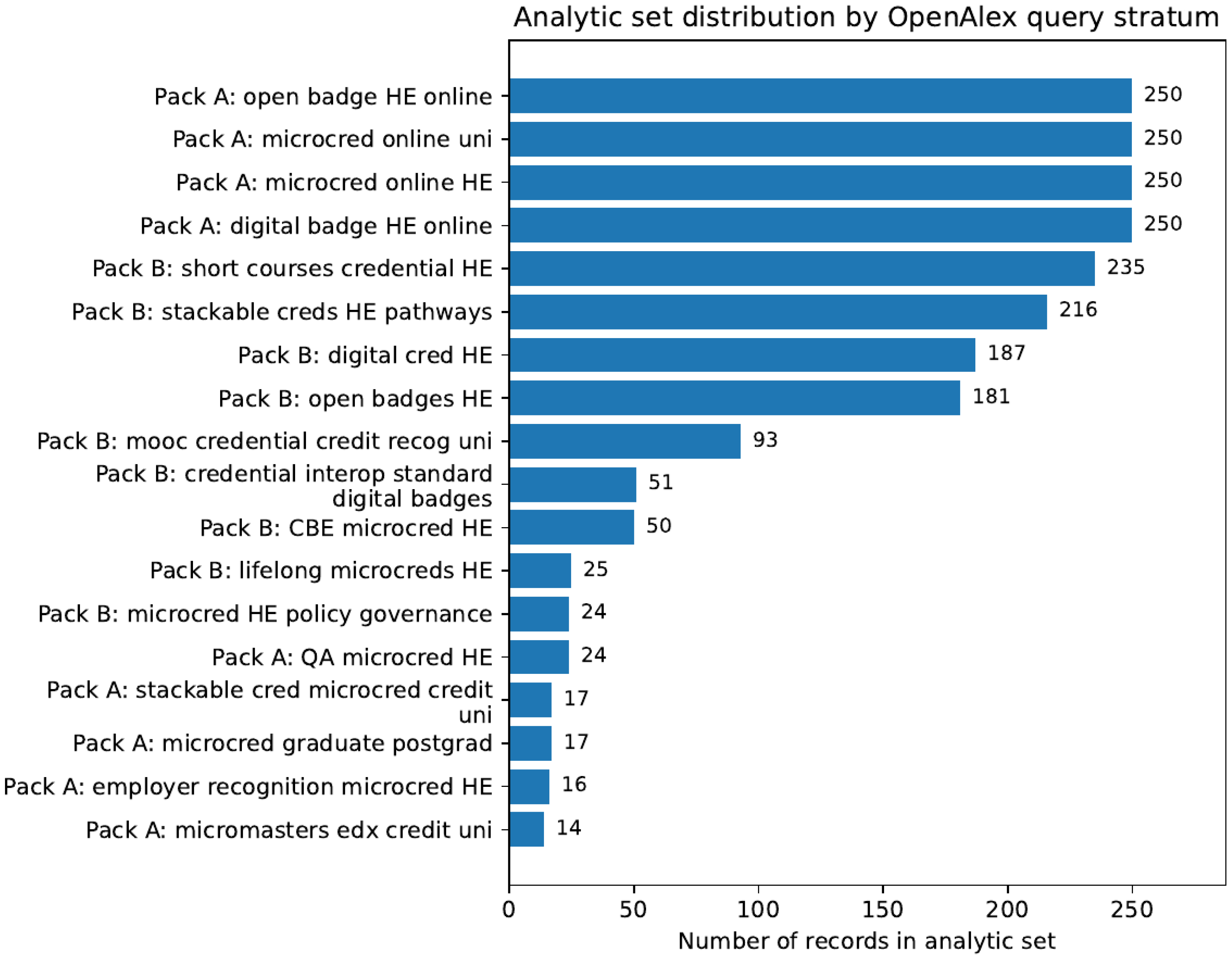
Appendix C reproduces the exact executed query strings, pack-specific year windows, and the analytic-set contribution of each query stratum, while the public release continues to archive the same definitions in the configuration and search-log files [
50].
The intent is not to claim exhaustive coverage of all micro-credential scholarship, but to provide a reproducible evidence map of a clearly defined retrieval strategy. Reproducibility here means that the same retrieval logic can be rerun against the same source. It does not imply that the resulting corpus is interchangeable with the full universe of relevant scholarship. For the published evidence-map build, inclusion was therefore determined by the retrieval design plus deduplication. No additional title/abstract or full-text exclusions were applied after deduplication; instead, the seedless-triage step generated auditable relevance annotations for all retained records. The distribution of records across query strata is reported in
Appendix C because it contextualizes how the corpus was constructed and where retrieval emphasis was strongest.
4.4. Deduplication and Analytic Set
Search results were ingested and deduplicated using OpenAlex identifiers, DOI, and title/year exact matching. The archived release exposes this step through retrieved-record files, an ingest report, a deduplication report, and a duplicate-group map, making it possible to inspect what entered the pipeline and which records were collapsed as duplicates in this snapshot [
50].
Table 2 makes the corpus-construction logic explicit by stating the operative rule, its purpose, and the records retained or affected at each stage.
For clarity, retrieval, deduplication, annotation, and later subset analyses were distinct steps rather than successive screens. Retrieval defined the broad search space (2535 records), deduplication produced the analytic set (2150 unique works), and seedless triage annotated all 2150 retained records without exclusion. Subsequent analyses were then defined on top of that retained corpus: topic modeling used the full analytic set, whereas the heuristic typology was applied only to the typology-eligible subset with explicit credential, badge, or certificate language plus higher-education context, yielding 281 eligible records, of which 223 were classifiable and 58 remained unclassified. No record was removed because of triage score, typology eligibility, or topic-model use; those later steps only determined how retained records were analyzed and reported.
This choice prioritizes breadth, reduces the risk that early automation suppresses emerging or interdisciplinary work, and allows results to be interpreted as an evidence map of the retrieved OpenAlex search space. At the same time, the triage scores still support sensitivity analyses and targeted qualitative sampling in follow-on synthesis.
4.5. Seedless, Machine-Assisted Triage
Seedless triage uses programmatic weak supervision: interpretable rule families are applied directly to titles and abstracts to generate relevance annotations without a hand-labeled seed set [
48,
49]. For this manuscript, the goal was not to replace human review with an opaque classifier, but to make early relevance cues explicit, inspectable, and rerunnable within an evidence-map workflow.
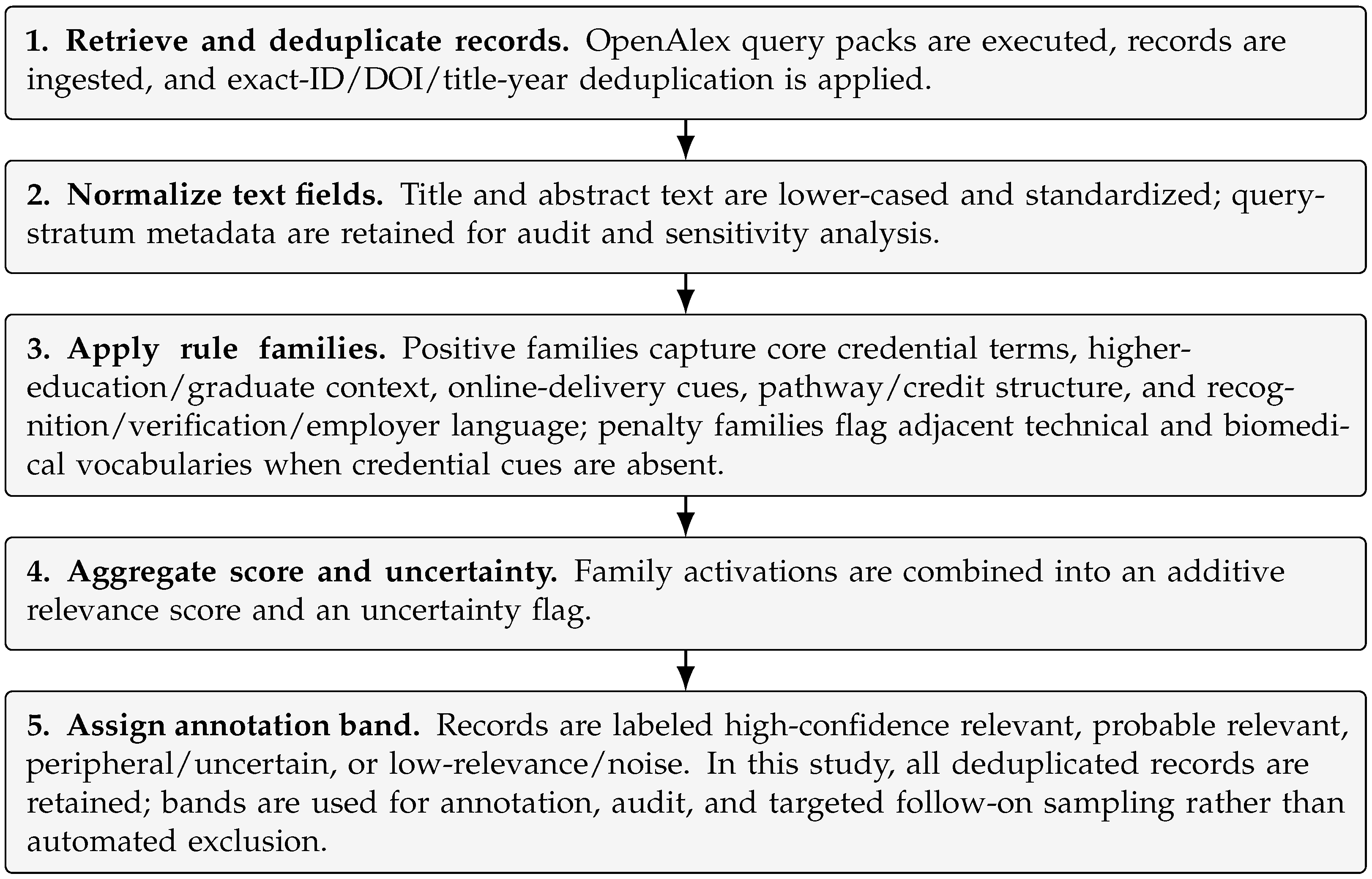
Figure 2 summarizes the workflow. After retrieval and deduplication, title/abstract text and query-stratum metadata were normalized. Each record was then evaluated against positive signal families (core micro-credential vocabulary; higher-education/graduate context; online-delivery context; pathway/credit/governance cues; and recognition/verification/employer cues) and against ambiguity penalties designed to catch adjacent technical and biomedical literatures that can enter through shared digital or skills language.
For transparency, one activation per family was counted per record. Core credential vocabulary contributed ; higher-education/graduate, online-delivery, pathway/credit, and recognition/verification families each contributed ; and ambiguity penalty families contributed when activated without a core credential cue (or when activated alongside a core credential cue). Scores ≥ 8 were labeled high-confidence relevant; scores of 5–7 were labeled probable relevant; scores of 2–4 were labeled peripheral/uncertain; and scores ≤ 1 were labeled low-relevance/noise. Records with missing or minimal abstract text were also flagged uncertain unless at least two positive families were present. Because this study retained all deduplicated records for mapping, these bands were used for annotation and audit only, not automated exclusion.
Supplementary File S1 provides the full peer-review rule inventory, a machine-readable rule table, and scored illustrative examples so the annotation logic can be audited or rerun outside the manuscript. The same thresholds and rule families are also mirrored in the archived pipeline materials so that the manuscript, supplement, and rerunnable release remain aligned [
50]. For readability, the main text therefore stays at the workflow and condensed-family level (
Figure 2;
Table 3), while the full rule inventory and scored examples remain in
Supplementary File S1.
Even without automated filtering, the triage outputs remain useful. Scores support sensitivity analyses (e.g., comparing high- vs. low-score subsets), help prioritize qualitative coding effort, and make it transparent how rule-based relevance cues behave across query strata. In future iterations, the same workflow can be configured for narrower corpus definitions (e.g., graduate-only or credit-bearing micro-credentials) while preserving an auditable record of how those restrictions were applied.
4.6. Heuristic Evidence-Map Typology
This study operationalized the learning-first vs. signal-first and standalone vs. stackable dimensions using transparent keyword-based rules applied to titles and abstracts. Automated text classifications can be useful for large corpora, but they require problem-specific validation and close reading because lexical cues may be sparse, mixed, or misleading in individual records [
57]. Reviewer feedback therefore motivated a small validation exercise and a conservative revision of the operational typology.
Relative to the earlier always-assigned version, three refinements were made. First, a record had to contain explicit credential, badge, or certificate language together with higher-education context to be considered typology-eligible. Second, purpose and structure ties were left unclassified rather than defaulted to learning-first or stackable. Third, records with no directional cues on an axis were also left unclassified. These changes reduce forced assignments in mixed conceptual/policy papers and in framework abstracts that blend badge-level and pathway-level language. Accordingly, typology eligibility defines a later descriptive subset within the retained analytic set rather than an additional corpus-filtering stage.
A 100-record hand-coded audit was then conducted on a stratified sample from the revised classifiable subset. Because a second coder was not available during revision, this is reported transparently as a single-coder audit rather than as formal inter-coder reliability. Agreement is summarized with raw percentage agreement and Cohen’s
[
58,
59].
Table 4 reports the revised typology counts, and
Appendix F reports the audit results and the remaining areas of uncertainty.
4.7. Topic Modeling and Candidate Themes
To support thematic synthesis, topic modeling was applied to the full analytic set using non-negative matrix factorization (NMF) with term frequency–inverse document frequency (TF–IDF) features derived from titles and abstracts. NMF is a reasonable fit for this corpus because the title/abstract matrix is sparse and non-negative, and the factorization yields additive, parts-based components that are straightforward to inspect as candidate text themes [
60]. In comparative topic-model evaluations, NMF has also been shown to produce interpretable and often coherent descriptor sets for text corpora, including in direct comparisons with LDA-family baselines [
61,
62].
The number of themes was reported at
. Following topic-modeling guidance, this should not be read as the single “true” number of latent topics in the literature; choosing
k is a pragmatic model-selection decision that trades off coherence, stability, prevalence, and interpretability against over-splitting [
63,
64,
65]. In the present evidence-map setting,
was retained as a descriptive reporting resolution: it separates several large, readable macro-clusters while keeping the appendix compact enough for manual audit.
Candidate themes with top terms are reported in
Table A1; relative theme sizes are summarized later in
Section 5. The theme-handling logic then proceeded in three linked steps. First, generation: the NMF model produced candidate theme outputs for the full analytic set, including the top-term descriptors and relative theme sizes reported here, with the broader run-level theme-model outputs archived alongside the public release [
50]. Second, label audit/checking: provisional labels were manually checked against the reported top terms and revised conservatively so that mixed, adjacent-domain, or noisy clusters were marked explicitly rather than normalized into cleaner field labels. Third, cautious synthesis/use: the manuscript reports the audited themes as navigational aids—highlighting a small number of broad macro-clusters and treating smaller mixed or adjacent-domain clusters as boundary-detection outputs—rather than as definitive latent constructs.
Appendix B mirrors this three-step generation–audit–synthesis chain in compact form.
This theme-handling sequence follows topic-modeling guidance that topic labels and interpretations require human checking rather than automatic acceptance of top terms alone [
62,
65]. Because topic-model outputs remain sensitive to preprocessing choices and random initialization [
66], full validation of any label still requires close reading in follow-on qualitative synthesis. Because several candidate themes remain mixed or adjacent-domain, the manuscript limits reporting to the summary figure and appendix tables rather than adding a denser theme-network graphic that could imply stronger relational structure than the model currently supports. Accordingly, no single theme label is interpreted on its own; the manuscript relies on the combination of top terms, relative size, and post-audit label status when drawing descriptive thematic claims.
In an evidence-mapping context, topic modeling therefore functions as a “candidate theme generator”: it makes the corpus legible, surfaces clusters that merit deeper reading, and supports transparent theme discovery that can be revisited as the corpus evolves. With the workflow, audit trail, and theme-handling rules established,
Section 5 turns from pipeline design to what the retrieved OpenAlex search space looks like in publication, framing, and thematic terms.
5. Results
The results move from landscape to storyline: first publication trends (years and venues), then framing patterns captured by the evidence-map typology, and finally candidate thematic clusters from topic modeling to guide deeper qualitative synthesis.
5.1. Corpus Overview and Publication Trends
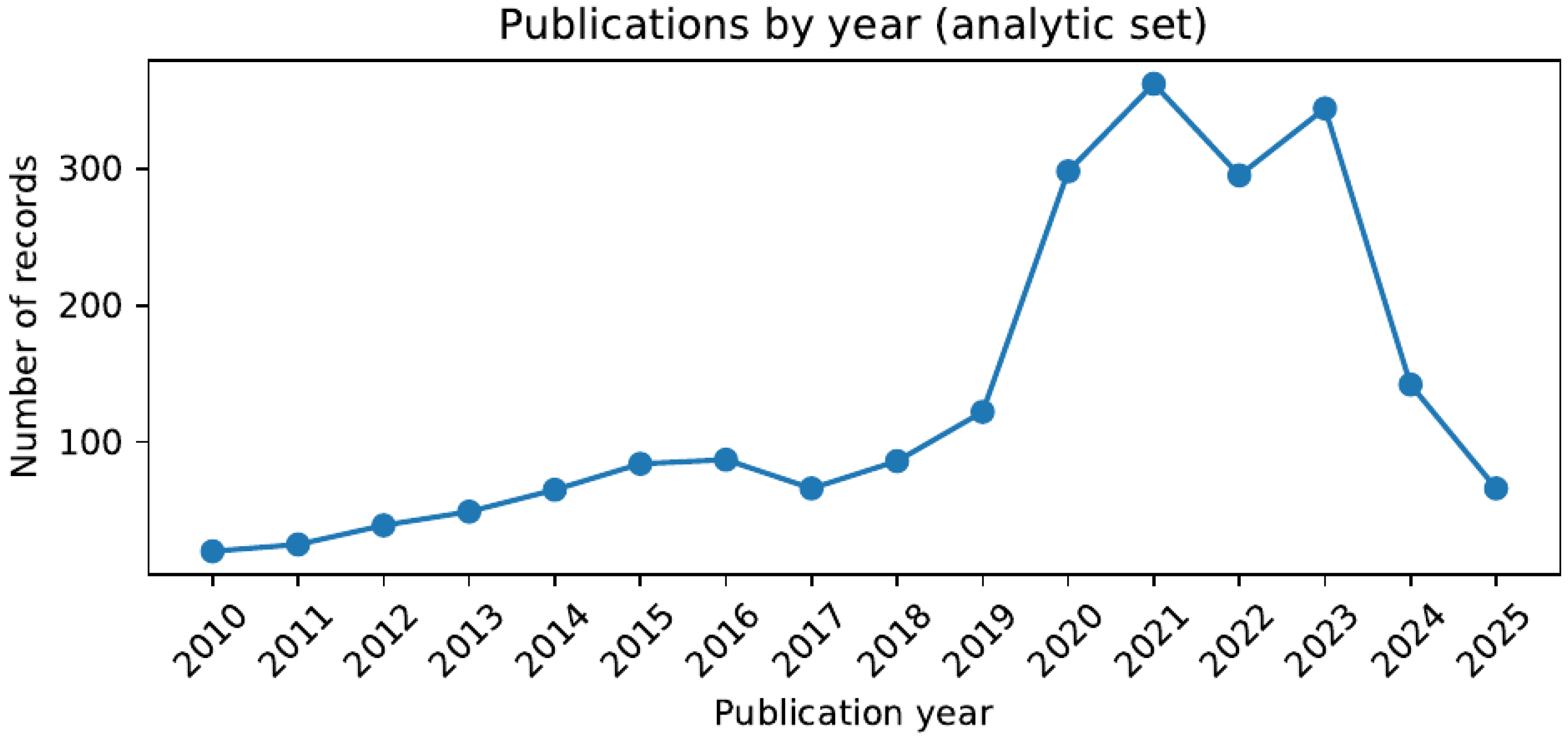
Publication volume is modest from 2010 to 2018, rises in 2019, and accelerates from 2020 onward (
Figure 3). The series peaks in 2021 and remains high through 2023, suggesting sustained scholarly attention during a period when the literature increasingly linked micro-credentials to short-form, online upskilling agendas. That inflection aligns with landscape and synthesis work describing micro-credentials as a rapidly expanding policy and institutional discussion amid reskilling/upskilling pressures and expanding online delivery models [
6,
8,
9,
12,
28].
Across the analytic set, 70.1% of records were published from 2020 to 2025. The recency of the corpus suggests that conceptual framing, governance models, and empirical evaluation have been developing in parallel [
2,
8,
9,
12,
24]. That mix helps explain why governance, quality assurance, and recognition recur as concerns later in the results.
The growth curve is most defensibly read as a literature-consolidation pattern rather than as a precise proxy for real-world adoption. The retrieved scholarship increasingly converges on micro-credentials as a shared object of policy, design, and implementation discussion. The right edge of the series should also be interpreted cautiously: the visible taper in 2024–2025 may partly reflect index lag in a recent OpenAlex snapshot, and the terminal retrieval year (2026) was incomplete at the time of searching and therefore is reported only in
Appendix C,
Table A4 as 0 records rather than plotted in
Figure 3 [
47,
56].
5.2. Venue Concentration and Metadata Completeness
No single venue dominates scholarship on online graduate micro-credentialing. Relevant work is scattered across education, educational technology, computing, and applied-domain outlets, so meaningful synthesis must cross disciplinary boundaries. For Knowledge readers, this dispersion is itself a knowledge-management problem: key design, governance, and recognition insights are distributed across communities with different vocabularies and methods. Systematic reviews report a similarly scattered landscape, with uneven emphases and evaluation depth across contexts [
8,
11,
12].
The most frequent venues include IEEE Access () and Sustainability (), alongside education-oriented journals such as Education and Information Technologies () and IRRODL (). The dispersion underscores the interdisciplinary character of micro-credential scholarship: research appears not only in online learning venues but also in venues focused on technology, computing, and applied domains.
Rather than treating micro-credentials as a single, self-explanatory object, this dispersion is better read as evidence that the field spans multiple parts of the credential ecology: educational design, labor-market signaling, and digital infrastructure. Meaningful synthesis therefore has to connect instructional, institutional, and recognition-oriented literatures rather than privilege a single venue community [
6,
7,
15].
OpenAlex metadata completeness shapes interpretation of venue patterns. Venue metadata is missing for 116 records (5.4% of the analytic set). Missing venue metadata is reported explicitly (see
Table A5 in
Appendix D); it is not treated as a venue category. It also underscores that open bibliographic infrastructures enable transparency and reproducibility while still requiring careful attention to missingness and data quality [
47].
5.3. Query-Stratum Distribution and Retrieval Emphasis
The counts reported here reflect the retrieval space defined by the query packs, not the entire micro-credential literature.
Appendix C,
Figure A1 and
Table A3 show how multiple targeted strata contributed to the corpus, reducing reliance on any single dominant phrase and broadening coverage to adjacent terms (e.g., stackability, short courses, open badges, interoperability). Absence from this map should therefore be interpreted cautiously: it may reflect data-source coverage, metadata availability, or search-term fit as much as genuine absence from the wider field. For prevalence claims beyond this search space, triangulate with complementary retrieval strategies.
5.4. Evidence-Map Typology: Learning-First vs. Signal-First and Standalone vs. Stackable
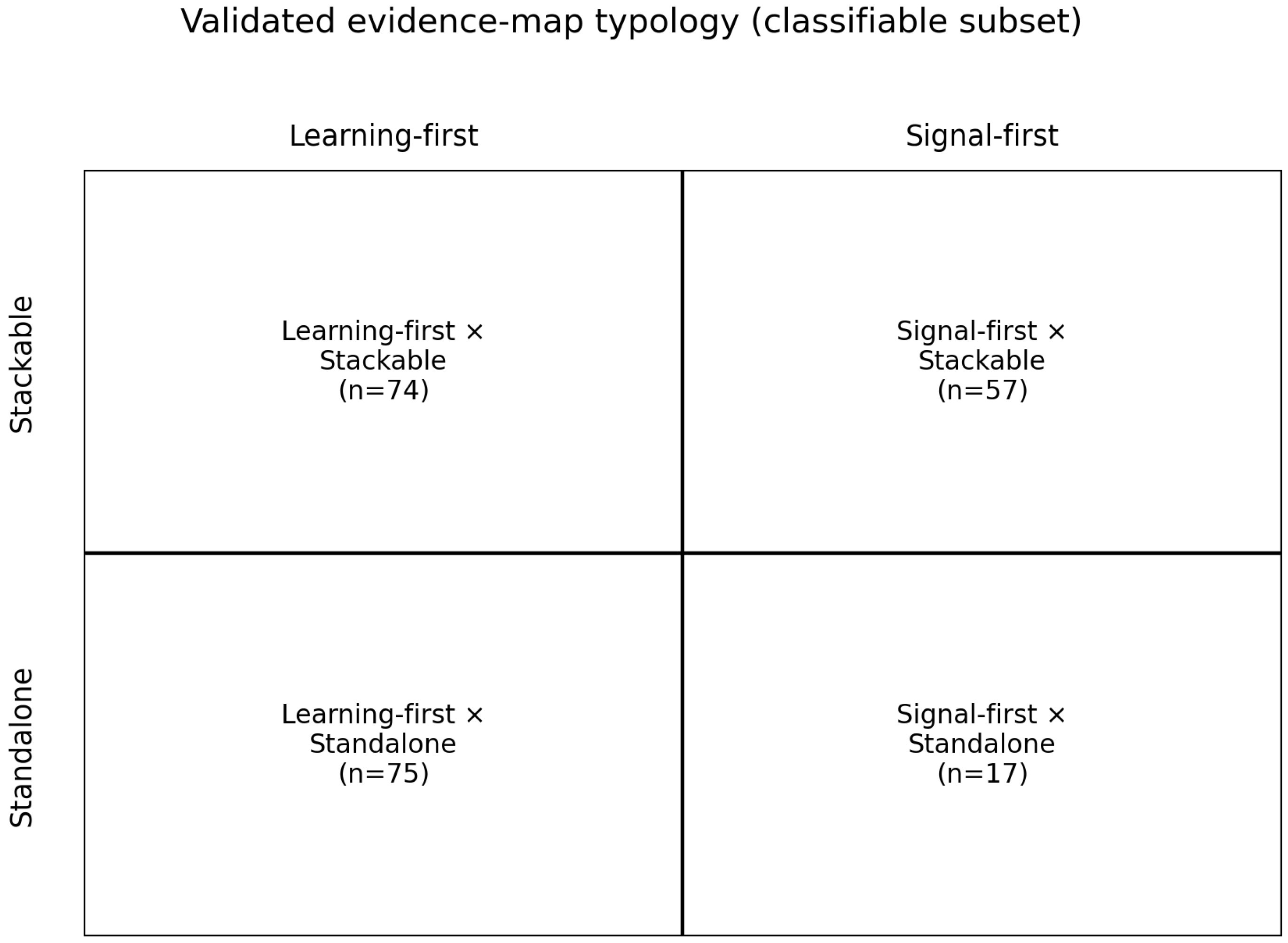
Figure 4 shows the empirical distribution across the validated evidence-map typology introduced conceptually in
Figure 1. After restricting assignments to typology-eligible records with directional cue dominance, 281 of 2150 records were typology-eligible, 223 were classifiable, and 58 remained mixed or unclassified rather than being forced into a quadrant. Within the classifiable subset, learning-first framings were more common (149 of 223; 66.8%), while stackable framings also remained more common (131 of 223; 58.7%) but no longer overwhelmingly so. This more conservative distribution still aligns with review literature that emphasizes implementation, pathway design, and institutional adoption, while tempering the stronger earlier inference that the field is almost uniformly stackable [
2,
6,
8,
11,
12,
24].
At the level of literature framing, the validated counts support a narrower claim than the earlier always-assigned version: pathway and program architectures are common narrative frames, yet standalone badge and short-course discussions remain a substantial share of the classifiable typology subset. This should still not be read as direct evidence that implemented offerings are either fully stackable or fully standalone in practice; it remains a claim about how the retrieved scholarship most often organizes the micro-credential idea [
2,
6,
27].
A 100-record hand-coded audit supported the revised rules (purpose-axis agreement = 85.0%,
; structure-axis agreement = 93.0%,
; full-quadrant agreement = 80.0%,
;
Appendix F). Disagreements clustered mainly in mixed conceptual/policy papers that discussed pedagogy and recognition together, and in framework papers that blended badge-level and pathway-level language. Those disagreement patterns reinforce the decision to leave mixed cases unclassified rather than assign them by default.
Signal-first framings are less prevalent overall, but they remain substantive within stackable contexts (57 of 223; 25.6%). That quadrant captures work that treats micro-credentials as part of coherent learning pathways while foregrounding recognition, credential value, and employability outcomes. Interpreted through signaling theory, these papers implicitly assume that micro-credentials carry value only when audiences can interpret and trust what the credential communicates [
5,
18,
19,
20]. Signal-first × standalone work remains the smallest classifiable quadrant (17 of 223; 7.6%), consistent with arguments that signaling value is often reinforced by ecosystem alignment, verification, and recognized pathway structures [
32,
34,
37,
46].
These patterns point to a need for research that examines the lived implementation details behind these framings: how stackable pathways are governed, how assessment evidence is documented, and how employers interpret credential signals.
5.5. Candidate Themes from Topic Modeling
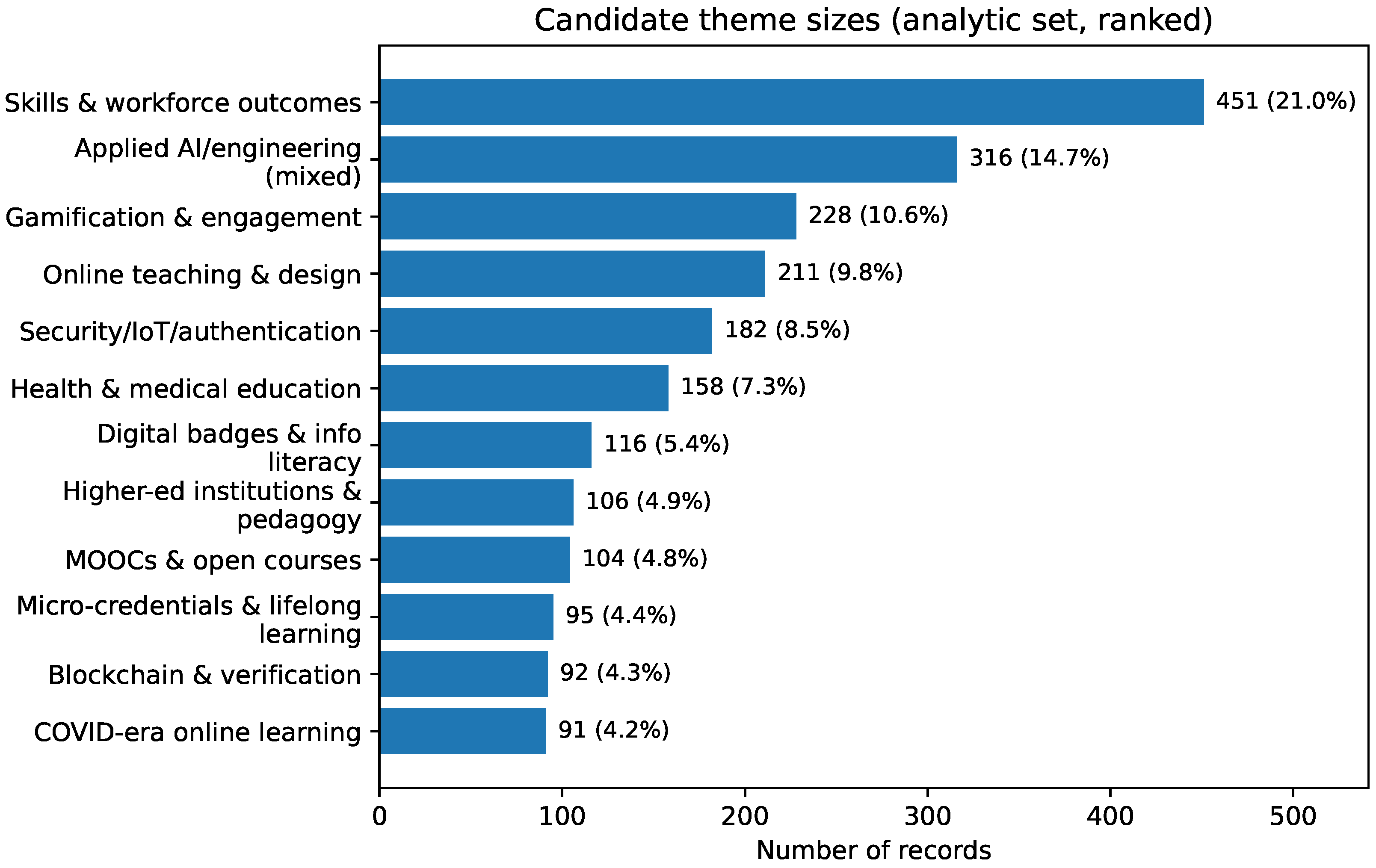
Appendix A,
Table A1 lists candidate themes after a conservative label audit against the reported top terms, and
Figure 5 ranks those themes from largest to smallest using short audited labels for readability. Consistent with the three-step generation–audit–synthesis workflow described in
Section 4.7 and
Appendix B, the narrative below treats the model output as a candidate theme layer: relatively direct term profiles are summarized as substantive areas, whereas mixed or adjacent-domain themes are interpreted more cautiously as boundary-detection outputs. Three large themes account for nearly half of the analytic set. Theme 10 (21.0%) is best read as a skills, careers, and workforce/economic-outcomes cluster. Theme 11 (14.7%) is not a clean recognition cluster; its top terms instead indicate a mixed applied-technology topic spanning AI, engineering, management, and ethics language. Theme 2 (10.6%) centers on gamification, motivation, and student engagement. The prominence of workforce/economic language is consistent with review literature showing strong employability and skills framing across micro-credential discussions, while Theme 2 overlaps with badge-adjacent work on motivation, engagement, and instructional design [
8,
9,
12,
36,
38,
40,
41,
42].
Several mid-sized and smaller topics are clearer when described as mixed or adjacent-domain clusters rather than as sharply bounded micro-credential themes. Theme 8 is a broad online teaching/learning and educational-design cluster. Theme 9 captures digital badges, open badges, and information-literacy/professional-development language. Theme 3 captures explicit micro-credential/lifelong-learning/institutional vocabulary, Theme 5 captures blockchain and verification infrastructure, and Theme 7 reflects MOOC/open-course language. By contrast, Theme 4 reflects health and medical education, Theme 1 reflects security/IoT/authentication terms, and Theme 6 is largely pandemic-era vocabulary. The model therefore surfaces both corpus-relevant themes and several boundary/noise clusters introduced by the deliberately broad retrieval strategy.
Taken together, the repaired appendix suggests that the topic model is most useful as a navigation layer rather than as a definitive taxonomy of the field. It separates dominant workforce, engagement, pedagogy, badge, and infrastructure areas while also making visible adjacent technical and domain literatures captured in the broader OpenAlex search space. These candidate themes can therefore guide deeper reading and qualitative coding, but mixed topics should be validated against representative records before being treated as substantive field categories. Read together, these publication, framing, and theme results point less to a settled credential model than to a field organized around pathway design, recognition, and infrastructure questions. The Discussion interprets that pattern as an argument about pathway structure, signal value, governance, equity, and practice.
6. Discussion
This evidence map offers a structured view of scholarship on online graduate micro-credentialing captured through a transparent OpenAlex retrieval strategy. It should be read as a map of the retrieved literature—its dominant framings, recurring concerns, and visible gaps—rather than as direct evidence about how micro-credentials perform in practice. Where the discussion refers to candidate themes, it does so only at the macro-cluster level supported by the three-step generation–audit–synthesis chain described in
Section 4.7. On that basis, three analytic claims follow. First, the literature is more coherently read as a pathway-governance literature than as a literature about isolated badge artifacts: stackable framings remain common, but the validated typology also shows enough standalone discussion to caution against treating stackability as the default state. Second, learning and signaling are better understood as coupled functions than as competing alternatives: learning-first framings dominate, yet signal-first work becomes most visible where recognition and employability claims become consequential. Third, the recurring appearance of portability, quality assurance, and infrastructure issues suggests that the field’s central bottleneck is not credential production alone, but the relational conditions that make credentials interpretable, trusted, and portable across settings. Read through the credential-ecology crosswalk introduced at the end of
Section 2, the subsections below develop these claims through pathway design, recognition, governance/infrastructure, equity, and practice.
6.1. Stackability as a Common—But Not Overwhelming—Narrative
The central tension in the structure results is flexibility versus fragmentation. Stackable framings are common, but their practical value depends on whether short-form credentials behave as guided pathways or as loosely connected fragments. On an ecological reading, that structure axis is most useful not because it measures modularity by itself, but because it indicates how the literature imagines pathway structure and the governance needed to make articulation credible. Once mixed and low-cue records are withheld from forced assignment, the structure dimension becomes more balanced. In policy terms, this pattern is closest to frameworks that treat stackability as something to be deliberately designed and described rather than assumed. The 2022 European approach to micro-credentials, for example, defines micro-credentials as assessed learning outcomes that may be stand-alone or combined into larger credentials, and it places weight on transparent criteria, portability, and quality assurance [
4]. Read against that framework, the map points to a literature preference for pathway language that still requires articulation rules, credit policies, learner-facing guidance, and safeguards against stranded or non-transferable accumulation [
14,
23].
That is why pathway promise also produces governance burden. OECD policy work sharpens the point: the quality and value of micro-credentials depend on provider and government action around recognition processes, quality assurance, and learner information [
2]. For online graduate education, the more institutions promise flexible accumulation, the more they must stabilize sequencing, prerequisites, credit translation, and advising structures rather than assume that stackability will emerge automatically. A particularly important construct is cross-program coherence: the alignment of learning outcomes, assessments, and credential metadata across multiple short experiences.
Once that pathway logic is in view, the next question is how those pathways become credible to audiences beyond the course itself—that is, how learning-first design connects to signal-first recognition.
6.2. Learning-First vs. Signal-First: Integrating Design with Recognition
The purpose results suggest a second tension: pedagogic richness versus signal legibility. Learning-first framings still outnumber signal-first framings in the validated classifiable subset, which suggests that the retrieved literature more often treats micro-credentials as educational design problems than as labor-market instruments alone. It also aligns with long-standing priorities in online learning research, including instructional design, learner support, and evidence of learning. Yet, the validation audit also showed that the purpose axis is less stable than the structure axis: disagreements clustered in mixed conceptual and policy papers that discussed pedagogy and recognition simultaneously. That pattern is analytically important because it suggests that the field’s core challenge is not choosing between learning and signaling, but translating between them. On the credential-ecology reading proposed in
Section 2, this purpose axis is therefore most useful when it directs attention to the conditions that make a credential interpretable—issuer credibility, metadata, and recognition—alongside the design choices that generate assessable learning in the first place.
Signal-first framings remain especially meaningful within stackable contexts. Interpreted through signaling theory, that subset suggests that micro-credentials are discussed as having value only when intended audiences can interpret and trust what the credential communicates [
5,
7,
19,
20,
21]. Credential-ecology perspectives help explain why standalone signal-first work is comparatively uncommon: signal strength is usually reinforced by articulation arrangements, recognizable issuers, metadata standards, and interoperability infrastructures rather than by the badge artifact alone [
6,
18,
43,
46]. Signal-first work therefore becomes most salient where learning claims have to travel beyond the immediate course setting. The signal literature further suggests that even a well-designed micro-credential may have limited signaling value if employers do not recognize it, if it is not portable, or if its assessment evidence is opaque. Conversely, visibility in a platform ecosystem does not by itself establish durable learning quality [
18,
19,
20,
21].
A useful next step is to treat learning design and signaling as coupled mechanisms. Studies can trace how assessment evidence becomes credential metadata, how employers interpret digital signals, how learners weigh time and cost against anticipated recognition, and how institutions communicate—and learners understand—the relationship between micro-credentials and degrees. In online graduate programs, those linkages are likely to shape whether micro-credentials function as both credible learning experiences and legible career signals. For practice, that means instructional design, issuer positioning, and recognition strategy should be built together rather than treated as separate stages.
This connection between learning and signaling also reframes quality assurance: if micro-credentials claim workplace value, assessment evidence and competency claims must be legible, durable, and trustworthy.
6.3. Quality Assurance, Assessment, and Competency Evidence
The quality-assurance discussion turns on a third tension: rich evidence versus scalable trust. The repaired topic appendix does not yield a clean, standalone quality-assurance topic. Instead, quality-assurance, assessment, and competency language appears across broader teaching/learning, institutional, and infrastructure clusters. That pattern still echoes concerns in policy and review literatures about the quality and value of micro-credentials [
2,
8]. Analytically, it suggests that quality assurance is not a detached administrative overlay. It is the mechanism through which local assessment becomes an externally interpretable claim.
OECD policy work sharpens the point. It argues that readability, portability, and recognition depend on how credentials are documented and on whether quality-assurance and recognition systems can accommodate them at scale [
2]. In that policy framing, descriptors such as workload, learning outcomes, assessment method, and credit or recognition status are not peripheral metadata. They are part of the trust infrastructure through which micro-credentials gain value. That logic fits the present map, where quality-related language appears dispersed across teaching, institutional, and infrastructure clusters rather than isolated in a single self-contained theme.
Quality assurance also has an institutional dimension. The practical challenge is to document enough evidence to sustain trust without making the system administratively unworkable at scale. When micro-credentials are integrated into graduate programs, institutions face questions about faculty workload, governance approvals, academic standards, and integrity of assessment in online environments. Empirical research that documents quality-assurance models—including rubrics, competency frameworks, and verification practices—would be especially valuable for institutions seeking evidence-informed implementation strategies.
A more concrete implication is that quality assurance partly resides in the credential record itself. Open Badges 2.0 defines a portable badge assertion that can carry issuer information, criteria, alignment, evidence, verification, expiration, revocation, and endorsement data rather than only a badge graphic [
67]. In this paper’s learning/signaling terms, those fields matter because they preserve the link between what was learned, how it was assessed, and what outside audiences are being asked to trust.
One underexplored area is how assessment evidence is represented and communicated. The practical question is not whether every micro-credential should expose raw student work. It is whether the credential carries enough structured information—for example, competency or outcome statements, level/workload, assessment method, issuer identity, status, and where appropriate curated evidence—for employers or receiving institutions to interpret the claim. Research that examines how such competency claims are designed, and how evidence is presented to employers, would connect online learning assessment research with credential ecosystem research [
2,
33,
67].
That need for legible evidence immediately raises the next layer of the problem: interoperability and portability—what travels with the credential, who can verify it, and what governance structures make that travel trustworthy.
6.4. Interoperability, Credential Technology, and the Politics of Portability
The main infrastructure tension is portability versus platform dependence. Digital badges and open credential ecosystems appear across multiple themes. The map therefore shows that portability and verification are persistent subjects of discussion, but it does not show that interoperable infrastructures already work smoothly in practice. On the ecological reading used here, this is also the point at which issuer/platform relations become analytically visible: portability depends on who hosts, verifies, updates, and governs the credential after issuance, not only on whether a technical standard exists. The EU recommendation is useful here because it ties micro-credential uptake to authentication support and to open standards for portability, stackability, interoperability, exchange, and information sharing [
4]. OECD policy work similarly treats recognition, portability, and learner information as linked governance problems rather than as automatic consequences of digitizing a badge [
2]. Read alongside recent political-economy work on digitalized higher education, the implication is that portability is not only a technical standards question. It is also a governance question about stewardship, vendor dependence, and where value is captured within the credential ecosystem [
15,
16,
17]. For institutions, this raises practical questions about procurement, data governance, learner privacy, and credential stewardship over time (verification, expiration, and revocation).
Open Badges 2.0 and W3C Verifiable Credentials make the issue more concrete, but they do not dissolve the governance problem. Open Badges 2.0 was designed to package achievement information into portable badge files with structured metadata and validation procedures [
67]. W3C Verifiable Credentials, now standardized in the Verifiable Credentials Data Model v2.0, define a broader issuer–holder–verifier model for exchanging tamper-evident claims and metadata, with explicit support for credential subjects, status, and evidence [
68]. For online graduate micro-credentials, the practical point is not that every institution needs a new wallet strategy immediately. It is that portability is stronger when competency claims, issuer provenance, and credential status remain inspectable after the credential leaves the issuing platform.
From an online learning perspective, interoperability research can bridge program design and learning analytics. If micro-credentials are meant to travel, what metadata should travel with them? How can competency evidence be represented in ways that are meaningful to employers while respecting learner privacy? How do credential registries and standards align (or fail to align) with institutional registrars and transcript systems? From the standpoint of this paper’s central learning/signaling argument, standards matter because they help keep learning evidence attached to the signal. Without structured metadata, a badge can circulate as an image divorced from its criteria; without verifiable provenance and status, the same badge can be difficult for employers or partner institutions to trust at scale [
2,
67,
68]. Together, these questions suggest that the micro-credential field is not only a pedagogical innovation space but also a socio-technical infrastructure space.
6.5. Equity, Access, and Learner Support in Online Graduate Micro-Credentials
The equity tension is widening access versus reproducing stratification. Policy narratives often present micro-credentials as tools for widening participation and supporting lifelong learning [
1,
3]. For online graduate education, these narratives position short, flexible credentials as potentially lowering time-to-entry and reducing upfront commitment for some learners. The map, however, does not show whether those promises are realized in practice. Shorter, lower-commitment offerings can reduce entry barriers, but they can also shift cost and risk onto learners if recognition, advising, or downstream returns are weak. If micro-credentials are priced in ways that shift costs to learners, unevenly recognized by employers, or used as substitutes for more durable credentials for certain populations, they can reproduce or intensify existing stratifications. Equity-focused critiques therefore caution against assuming participation benefits and underscore the need to evaluate access, support, and downstream returns [
14,
28,
69].
That is why the current map matters less as evidence of equity success than as evidence of where equity questions are being deferred. In the present map, equity is not a dominant organizing frame in its own right. The themes that most clearly implicate equity are Theme 10 (skills, careers, and workforce outcomes; 21.0%), Theme 8 (online teaching, learning, and design; 9.8%), and Theme 9 (digital badges, open badges, and information literacy/professional-development language; 5.4%) in
Table A1, together with the two stackable quadrants in
Table 4. Read substantively, these parts of the map raise equity questions about who can enter and persist in pathway-based offerings, what kinds of online supports and assessment conditions are available, and whose credentials are most likely to be interpreted as credible signals by employers or receiving institutions.
The map is notably thinner on equity as a direct object of study. None of the 12 candidate themes is centered on access, affordability, advising, or differential returns, and the smallest classifiable quadrant remains signal-first × standalone, suggesting relatively limited attention to how portable signals function outside broader pathway or ecosystem arrangements. This does not mean equity is absent from the field; rather, it means equity usually appears indirectly through workforce, pathway, and recognition discussions rather than through dedicated studies of distributional outcomes.
Future research should therefore turn these absences into concrete questions rather than assume either equitable or inequitable effects. For learning-first × stackable work, one question is which learners are best positioned to navigate multi-step online pathways and what advising, articulation, and financial-support structures reduce dead ends or non-transferable accumulation. For signal-first work, a second question is how recognition and labor-market returns vary by issuer type, field, geography, and learner background, especially when employer-facing value is a central claim. For the broader online teaching/learning literature, a third question is which learners receive adequate accessibility, mentoring, and time-flexibility supports in short-form graduate offerings. Grounding future studies in access, progression, recognition, and return measures would make equity claims more evidence-based in online graduate micro-credentials.
6.6. Domain Specificity and Graduate Micro-Credentialing
The domain results introduce a further contrast between common infrastructure and field-specific recognition. Topic modeling also suggests that the retrieved literature spans diverse applied domains. That matters for graduate education because standards of evidence, employer recognition, and professional regulation vary by field. Micro-credentials in health professions, for example, may be shaped by licensure and competency frameworks in ways that differ from computing or business. Micro-credentials embedded in engineering or technology-oriented contexts may place more emphasis on technical skill verification and portfolio evidence.
These patterns suggest that “online graduate micro-credentialing” is not a single unified phenomenon in the literature. It is better understood as a family of implementations that share certain infrastructures (digital credentialing, online delivery, short-form learning) but differ in governance, assessment evidence, and recognition. The implication is that a generic micro-credential model will travel unevenly across fields unless it is interpreted through domain-specific standards, audiences, and regulatory constraints. Evidence maps such as this one can therefore support more targeted domain-specific syntheses and help the field move from broad discourse to context-sensitive, empirically grounded claims.
6.7. From Evidence Map to Qualitative Synthesis: A Practical Pathway
The practical tension for follow-on review work is breadth versus interpretive depth. Evidence maps are intentionally descriptive: they show what exists, how it is distributed, and where deeper synthesis is needed. The next step is interpretive synthesis and targeted evaluation that speak more directly to design, implementation, and outcomes in online graduate micro-credentialing. The workflow presented here is meant to make that transition straightforward.
One practical approach is a two-stage process. In Stage 1, researchers use the map outputs to define a transparent sampling frame for deeper reading. The topic model, for example, provides candidate themes and relative theme sizes (
Table A1;
Figure 5). Rather than reading the full corpus sequentially, researchers can purposively sample within themes (e.g., the top
n records per theme by relevance score, citation count, or recency) to ensure coverage of the field’s major clusters. The 2 × 2 typology can serve as a second sampling axis, allowing comparisons between learning-first and signal-first subsets or between standalone and stackable discussions.
Stage 2 would involve structured qualitative coding of the sampled set. A codebook could be aligned to constructs relevant to online graduate micro-credentialing, such as instructional design strategies, assessment evidence, learner support models, technology platforms, employer engagement, and equity considerations. The same sampling logic can also support narrower evaluative reviews or focused empirical follow-up on specific pathway, recognition, or governance questions.
Because micro-credential studies often blend conceptual, policy, and implementation accounts, coding can also track study type (conceptual, descriptive, empirical evaluation, design research) and unit of analysis (learner, instructor, program, institution, ecosystem). The aim is not only to summarize topics but to extract design principles, implementation challenges, and evidence claims that are meaningful for online graduate program leaders and researchers.
The seedless triage artifacts also support transparency in this transition. Even when the full corpus is retained (as in this manuscript), relevance scores and decision logs make it possible to report exactly how a qualitative subset was chosen, reducing concerns about arbitrary cherry-picking. Topic-model outputs can likewise be treated as hypotheses about thematic structure that are then tested and refined through human reading and coding. This workflow is especially suitable when a field is growing quickly and when multiple vocabularies and communities of practice coexist under the umbrella of “micro-credentials.”
Taken together, this mapping-to-synthesis pathway offers a bridge to follow-on studies that move beyond describing the corpus to interpreting what it means for online graduate learning and to evaluating how particular implementations perform.
6.8. Methodological Implications: Updateable Evidence Maps as Living Research Infrastructure
The methodological tension is one-off synthesis versus living research infrastructure. Finally, this paper contributes an approach to evidence mapping that can be updated and extended rather than used once and discarded. OpenAlex enables transparent retrieval and deduplication, while seedless triage provides auditable relevance-annotation logic without requiring labeled training sets. That combination is well suited to fast-moving online learning innovations, where the literature grows quickly and traditional, closed-database systematic reviews can be difficult to reproduce.
The outputs produced here—descriptive tables and figures, a heuristic typology, and candidate themes—are intended to support follow-on work. Three practical extensions follow naturally from this workflow:
Qualitative coding and synthesis: Use the candidate themes as a starting point for structured qualitative coding, including refinement of theme labels, identification of key theoretical frames, and synthesis of empirical findings.
Sub-mapping by domain or context: Micro-credentials vary across disciplines (e.g., computing, health professions, business). Sub-maps can identify domain-specific design and recognition patterns.
Longitudinal monitoring: Rerunning the evidence map annually can track how scholarship shifts as micro-credential policies, standards, and platform ecosystems mature.
In that sense, the evidence map can function as living research infrastructure: a shared, updateable baseline from which more targeted studies—including qualitative syntheses, learner-outcome evaluations, employer-interpretation studies, portability/governance analyses, and policy-focused reviews—can be launched. For this manuscript, the archived v1.0.2 Zenodo release is intended to play that lightweight compendium role. It provides a README/config layer, together with scripts, logs, derived outputs, and manuscript artifacts that can be inspected directly [
50,
55]. Those analytic claims remain bounded by the source, selection, and interpretive choices built into this evidence map. The next section makes those boundaries explicit so the contribution is read at the appropriate level of inference.
7. Limitations
7.1. Database and Snapshot Limitations
This evidence map is built from a single bibliographic substrate—OpenAlex—and should therefore be read as a map of a retrieved OpenAlex search space rather than as an exhaustive census of all micro-credential scholarship. Relevant works may be absent because they were not indexed in OpenAlex at the time of retrieval, were incompletely described, or were represented with metadata that did not support discovery through the executed queries [
47,
56]. This constrains any claim about the absolute size, venue distribution, or completeness of the wider literature. A follow-on study that triangulates OpenAlex with additional bibliographic sources and hand-checked reference chaining would address this source-coverage limitation more directly.
OpenAlex metadata are also uneven and time-sensitive. Missing abstracts, missing venue fields, later corrections, and ongoing index expansion can affect both discoverability and downstream descriptive counts, especially near the right edge of the time series [
47,
56]. This constrains claims about very recent publication volume and about the exact stability of venue or year counts across snapshots. Time-stamped reruns and cross-snapshot comparison studies would address this snapshot-drift limitation.
7.2. Retrieval and Selection Limitations
The corpus is terminology-dependent by design. The query packs were built to capture online/graduate micro-credentialing and adjacent ecosystem language, but scholarship using other labels, local policy terms, or weak title/abstract signaling may fall outside the retrieved set, while adjacent-domain records may still enter through shared digital, skills, or credential vocabulary. This constrains any inference that a topic is substantively absent from the wider field, because some apparent absences may instead be retrieval-language absences. Sensitivity reruns with expanded vocabularies, citation chaining, and expert-informed term harvesting would address this retrieval-dependence limitation.
Selection in the published build was defined by retrieval plus deduplication rather than by a narrower post hoc screening stage: all deduplicated records were retained, and later triage bands were used only for annotation. That conservative choice preserves breadth and makes the search space auditable, but it also means that some retained records are only peripheral to online graduate micro-credentialing in a narrower substantive sense. This constrains claims that treat the analytic set as a tightly delimited topical corpus rather than as a transparent evidence-map sampling frame. A follow-on study using the same retrieval backbone but adding explicit full-text or high-confidence subset screening would address this selection-breadth limitation.
7.3. Method and Interpretation Limitations
The typology and candidate themes are heuristic descriptive devices applied mainly to titles and abstracts. They are useful for making a large corpus legible, but they do not substitute for full-text conceptual analysis, and both rule-based classification and topic modeling remain sensitive to sparse cues, mixed abstracts, preprocessing choices, and corpus noise. This constrains claims about the exact prevalence of particular framings or themes, which should be read as navigational summaries of the retrieved literature rather than as definitive latent structure. Multi-coder full-text coding and follow-on qualitative synthesis would address this interpretation limitation more directly.
The typology-validation exercise also remains limited. It was conducted as a transparent 100-record single-coder audit, and only a subset of the analytic set was typology-eligible and classifiable under the revised conservative rules. This constrains claims about the reproducibility of the quadrant assignments and about generalizing those counts to the full analytic set. Larger multi-coder validation studies and axis-specific reliability checks would address this audit limitation.
Finally, this study is descriptive of a literature landscape, not evaluative of implementation outcomes. The map shows how retrieved scholarship frames online graduate micro-credentials and where attention concentrates, but it does not establish whether particular pathway models improve learning, mobility, employability, or equity in practice. This constrains any causal or performance claim about micro-credentials themselves. Outcome-focused program evaluations, learner longitudinal studies, employer-interpretation studies, and governance case studies are the appropriate follow-on designs for those claims.
Taken together, these limitations mean that the manuscript is strongest as a transparent, rerunnable map of a retrieved literature space and as a sampling frame for targeted follow-on studies, not as a definitive census of the field or a direct evaluation of implementation effects.
8. Conclusions
Online graduate micro-credentialing is expanding as both a learning-pathway strategy and a credential-signaling strategy. Using an open, updateable workflow, this study maps a large, deduplicated OpenAlex corpus and describes the field through publication trends, a validated evidence-map typology, and candidate themes from topic modeling. After conservative typology assignment and a small hand-coded audit, learning-first framings remain more common, while the structure dimension is more mixed than the earlier always-assigned counts suggested. Signal-first narratives remain most visible when papers foreground recognition, credential value, and employability within pathway contexts [
2,
4,
7,
8,
9].
The audited topic clusters emphasize workforce/economic outcomes, engagement-oriented digital learning, and broad online teaching/learning. Smaller badge, micro-credential, and verification-infrastructure clusters also appear, alongside several mixed or adjacent-domain topics that should be interpreted cautiously. Taken together, these findings suggest a field more developed around pathway design and implementation than around the downstream conditions that make credentials legible, portable, and trusted across contexts. Viewed through credential ecology, the map therefore appears to privilege pathway structure more than the inter-organizational arrangements that stabilize issuer credibility, metadata quality, recognition, and portability.
Two practical implications stand out for program leaders. One is architectural: because pathway-oriented framings remain common, institutions should invest early in articulation policy, advising and learner navigation supports, and assessment strategies that generate credible evidence for both academic and employer audiences. The other is relational: recognition cannot be treated as an “add-on.” If micro-credentials are expected to function as labor-market signals, design work must include employer-facing communication, transparent competency claims, and durable credential infrastructure. That infrastructure should preserve criteria, evidence, issuer provenance, and status in portable metadata so credentials can be verified and interpreted across institutional and platform settings [
67,
68].
The future research agenda surfaced by the map is comparatively clear. More work is needed on learner outcomes and progression in stackable pathways; employer and professional interpretation of micro-credential signals; portability and governance across platforms, registrars, and institutions; and policy arrangements around credit recognition, quality assurance, funding, and long-term stewardship. More broadly, the evidence map is intended to be reusable. As OpenAlex metadata expands and micro-credential terminology evolves, the same retrieval and analysis workflow can be rerun to refresh counts, figures, and candidate themes, supporting cumulative qualitative synthesis, targeted evaluation, and policy-oriented research on this emerging credential form.
By making the research landscape more legible and the mapping process rerunnable, this study provides a durable baseline for cumulative synthesis and for empirical work that can better connect learning design to signal value in online graduate micro-credentialing.