Article

Effects of Different Soybean Protein Sources on Growth Performance, Feed Utilization Efficiency, and Gut Microbiota of Pacific White Shrimp (Litopenaeus vannamei) in Green Water and Clear Water Systems


School of Fisheries, Aquaculture, and Aquatic Sciences, Auburn University, Auburn, AL 36849, USA
*
Author to whom correspondence should be addressed.
Aquac. J. 2026, 6(3), 25; https://doi.org/10.3390/aquacj6030025
Submission received: 8 April 2026 / Revised: 26 June 2026 / Accepted: 30 June 2026 / Published: 2 July 2026

Abstract

Two growth trials were conducted to evaluate the effects of solvent-extracted soybean meal (SBM), low-oligosaccharide soybean meal (LO-SBM), and enzyme-treated soybean meal (ET-SBM) on the growth performance, feed utilization, and gut microbiome of the Pacific white shrimp (Litopenaeus vannamei). Nine diets were tested, including a basal diet using solvent-extracted soybean meal as the main protein source. The solvent-extracted soybean meal was then replaced with LO-SBM or ET-SBM at 40%, 60%, 80%, and 100% on an isonitrogenous and isolipidic basis. In the 8-week outdoor green water trial, all growth metrics, FCR and apparent net protein retention (ANPR) showed no significant differences among diets (p > 0.05). However, there was a significant effect of LO-SBM on phosphorus retention. In the clear water trial, intermediate inclusion levels of LO-SBM (60–80%) slightly improved growth metrics and phosphorus retention (p < 0.05) without affecting protein utilization, while 100% LO-SBM did not provide additional benefits. Diets with ET-SBM showed similar performance; however, phosphorus retention was reduced. Diets did not affect whole-body composition (p > 0.05), except for phosphorus and moisture. Gut microbiota analysis revealed that shrimp fed 100% ET-SBM had notably higher alpha diversity (Shannon index = 5.45, observed species = 326.41) compared to those fed 100% LO-SBM (Shannon index = 4.59, observed species = 242.69), indicating improved microbial stability with ET-SBM. Nonetheless, there were no significant differences in beta diversity or taxonomic composition between treatments (p > 0.05). This study demonstrates that incorporating 60–80% LO-SBM into the diet improves shrimp growth and nutrient utilization. Additionally, ET-SBM may also support shrimp growth, nutrient efficiency, and microbial diversity, suggesting that both LO-SBM and ET-SBM can be beneficial for shrimp nutrition.

1. Introduction

Fishmeal (FM) remains a key ingredient in shrimp feed due to its high protein content, balanced essential amino acid profile, low anti-nutritional factor content, and good palatability, which is especially important as shrimp culture continues to be one of the fastest-growing aquaculture industries worldwide [1,2]. Rising costs, resource scarcity, and environmental impacts have led to growing interest in alternatives to the high use of fishmeal (FM) as a protein source in shrimp feed production [3,4]. Many plant-based ingredients have been utilized as substitutes for fish meal, but solvent-extracted soybean meal (SBM) has received the most focus because it has a reliable composition, is inexpensive, and is widely available. The incorporation of SBM in practical shrimp diets may be limited due to the presence of anti-nutritional factors (ANFs) such as trypsin inhibitors, antigens, lectins, saponins, and oligosaccharides; inadequate levels of specific essential amino acids (EAA), like methionine and lysine; and diminished palatability. These variables may adversely affect development, digestion, and nutritional accessibility in shrimp [5,6]. Roasting, eliminating soluble sugars, fermenting, enzymatic treatment, mechanical pressing, and cultivating new varieties are just a few of the methods that have been shown to lessen the effects of antinutritive components, boost protein content, and improve digestibility [5,6,7].
Oligosaccharides are a kind of complex carbohydrate that may be found in soybean meal. It is the presence of these carbohydrates, raffinose and stachyose, which together make up around fifteen percent of soybean meal, that is responsible for the overall decrease in digestibility of soybean meal [6]. Advancements in soybean breeding have yielded cultivars that generate a significant amount of protein while concurrently producing a small quantity of oligosaccharides [8]. Also, various processing methods have been developed over time to reduce or eliminate harmful substances, lower raffinose (0.58 to 0.08) and stachyose (3.23 to 0.42) [9] improve the availability of vitamins and minerals, and make the nutrients in solvent-extracted SBM easier to digest [10]. Enzymatic hydrolysis and fermentation utilizing microorganisms such as Bacillus subtilis, Aspergillus oryzae, and Lactobacillus plantarum [11,12,13], along with fractionation processes and various other strategies to break down long-chain carbohydrates such as NSPs to improve their nutritional value [14,15], have been employed to achieve these objectives with varying degrees of success, resulting in numerous SBM products. Furthermore, Sookying and Davis [16] proposed that in order to achieve the necessary protein content, the higher protein levels of differently processed SBM necessitate a lower inclusion level, giving more space for feed formulations. This space could be utilized to supplement deficient nutrients and/or add functional ingredients, thereby improving the nutritional quality of the diet. Even with these improvements, we still do not fully understand how various soybean meal types influence shrimp growth and feed use, which is why more research is needed.
The internal and external body of the white shrimp is colonized by a diverse array of microorganisms [17]. The microbial populations residing in the digestive tract significantly influence the animal’s digestion, nutrition, and immunological response [18]. The microbiota of the digestive system offers significant enzymatic capacity, influencing various facets of host physiology. Because of this, the type of diet and feed ingredients given to shrimp directly affect their gut microbial balance and overall health.
Advances in SBM processing, including oligosaccharide elimination and enzymatic treatment, present interesting techniques to enhance shrimp feed efficiency while mitigating anti-nutritional effects. Nevertheless, few studies have investigated the impact of these modified soybean meals on the gut microbiota and digestive efficiency of shrimp in controlled environments. This study seeks to assess the impact of low-oligosaccharide and enzyme-treated soybean meals as dietary protein sources on the gut microbiota, growth performance, and feed efficiency of Pacific white shrimp (L. vannamei) cultivated in a green water and clear water recirculating aquaculture system (RAS).

2. Materials and Methods

2.1. Post-Larvae Nursing

PLs were supplied by Homegrown Shrimp LLC, located in Indiantown, FL, USA. The PLs were acclimatized and placed in a nursery tank for rearing until they attained the appropriate size for stocking. They were offered commercial feed, Zeigler PL Raceway Plus (Zeigler Bros. Inc., Gardners, PA, USA; protein ≥ 50%, fat ≥ 15%, fiber ≤ 1%), during the nursery phase. The feed amount was calculated as a percentage of biomass, based on the pooled average weight of a subsample of 60 PLs per tank, which was measured every week.

2.2. Diet Preparation

Nine test diets were formulated, each of which contained a different processed soybean meal product as its primary protein source. These diets were iso-nitrogenous and iso-lipidic, with a protein content of 35 g 100 g−1 and a lipid content of 8 g 100 g−1. The basal diet consisted of 6 g 100 g−1 of menhaden fishmeal (Special Select Menhaden fishmeal, Omega Protein Inc., Houston, TX, USA), ~49.63 g 100 g−1 of solvent-extracted soybean meal (Bunge, St. Louis, MO, USA), and 7.5 g 100 g−1 of corn protein concentrate (Empyreal 75TM, Cargill Corn Milling, Blair, NE, USA). Eight additional diets were created by substituting the solvent-extracted soybean meal in the basal diet with high protein low oligosaccharide (LO-SBM, from Benson Hill, St. Louis, MO, USA; company later purchased by Confluence Genetics ProVIA) and enzyme-treated (ET-SBM, Hamlet Protein Inc., Findlay, OH, USA) soybean meal on an equal protein basis at 40, 60, 80, and 100%, respectively. Proximate composition and amino acid (AA) profiles of tested ingredients (Table 1) and diets (Table 2 and Table 3) were analyzed at the University of Missouri Agriculture Experiment Station Chemical Laboratories (Columbia, MO, USA). Table 4 shows the mineral composition of diets analyzed at Midwest Laboratories.
The experimental diets were prepared at Auburn University’s Aquatic Animal Nutrition Laboratory (Auburn, AL, USA) using standard laboratory protocols. The dry ingredients (pre-ground) and oil were weighed and mixed for 15 min in a Globe® 20 Quart Planetary Mixer model SP20 (Globe® Food Equipment Co., Dayton, OH, USA). For pellet-ready consistency, hot water (30–45% by weight) was added. With a meat grinder and 3 mm die, diets were pressure-pelleted. The diet strands were then dried overnight on wire trays in a forced air oven (<45 °C) to achieve a moisture level of less than 10%. Crumbled and packaged dry pellets were stored at 4 °C for the green water experiment and clear water until needed.

2.3. System and Water Quality

The outdoor green water trial was conducted at the Claude Peteet Mariculture Center in Gulf Shores, AL, in compliance with animal care policy. The system used aeration through two air stones per tank connected to a regenerative compressor, as well as two vertical fluidized bed biological filters with Kaldness media for recirculation. Utilizing a centrifugal sump pump, water was obtained from an outdoor shrimp pond, with a daily water exchange rate of 5% to preserve natural productivity. Twice daily, a YSI Professional Plus meter (Yellow Springs Instrument Co., Yellow Springs, OH, USA) was employed to record salinity, pH, temperature, and dissolved oxygen. Total ammonia nitrogen (TAN) was measured weekly using an ion-selective electrode (Orion 4-Star Plus pH/ISE) and a WaterLink Spin Touch spectrophotometer (LaMotte, Chestertown, MD, USA), which also measured nitrite, nitrate, alkalinity, calcium, phosphate, and magnesium. The average of the readings from both meters was used to calculate TAN values.
The clear water trial was conducted in an indoor recirculation system at the E.W. Shell Fisheries Center, Auburn University, Alabama, in compliance with the university’s animal care policy. The system was composed of forty-four 80 L glass aquaria that were connected to a shared 800 L reservoir. An Aquadyne bead filter (Aquadyne Filtration Systems, Hartwell, GA, USA) (0.2 m2 media, 0.6 × 1.1 m) and a biological filter with Kaldness media were used to maintain water quality. Air stones connected to a regenerative blower were employed to maintain dissolved oxygen levels at or near saturation in all containers and the sump. Temperature, salinity, and dissolved oxygen were monitored twice daily using a YSI-2030 pro digital oxygen/temperature meter (YSI Corporation, Yellow Springs, OH, USA). Nitrite-N, TAN, and pH were measured biweekly using a YSI 9300 photometer (YSI, Yellow Springs, OH, USA)and a pHep meter (Hanna Instrument, Smithfield, RI, USA).respectively. All parameters in both trials were found to be within an acceptable range for the cultured species, as summarized in Table 5 and Table 6.

2.4. Growth Trials

Thirty Pacific white shrimp (0.29 ± 0.01 g, mean ± SD) were stocked in thirty-six 800 L tanks connected to two 800 L reservoir tanks in the green water trial at a density of approximately 35 shrimp m−2. Feed was offered four times daily, and nine diets were randomly assigned, each with four replicates. The feed rations were adjusted based on an estimated weekly weight gain (0.29 g to 2.8 g) and an assumed feed conversion ratio (FCR) of 1.2, and growth was monitored biweekly by bulk-weighing 10 shrimp from one tank per treatment.
For the clear water trial, fifteen Pacific white shrimp (0.78 ± 0.03 g) were stocked at a density of approximately 83 shrimp m−2 into forty-four 80 L aquaria. Nine diets were randomly assigned to the shrimp, with five replicates for eight diets and four for one diet. Survival was monitored weekly to adjust feed rations, which were determined using an assumed FCR of 1.6. Shrimp from both systems were enumerated, bulk-weighed, and assessed for mean final biomass, weight gain, weight gain percentage, survival, and FCR following the eight- and five-week trials. For proximate whole-body and mineral composition analysis, four shrimp from each tank in both experiments were frozen at −20 °C.
Later, samples of frozen shrimp were thawed, chopped, weighed, and dried in a Cole-Parmer® OVF-400 Series Mechanical Convection Drying Oven (Vernon Hills, IL, USA) for 24 h at 95 °C. The samples were then crushed for proximate analysis. Pulverized and packaged shrimp samples were sent to Midwest Laboratories Inc. (Omaha, NE, USA) for proximate and mineral analysis. Additionally, feed apparent net protein retention and phosphorus retention were calculated.
Additionally, in the clear water trial, two whole shrimp guts per tank from the basal treatments, LO-SBM 100% and ET-SBM 100%, were deposited in a cryovial for gut microbial community investigation. The digesta were frozen in liquid nitrogen and stored at −80 °C until the gut microbiome communities were determined. DNA extraction and sequencing were carried out by ZymoBIOMICS Targeted Sequencing Service (Zymo Research, Irvine, CA, USA) [19]. Zymo Research extracted DNA using the ZymoBIOMICS® DNA Miniprep Kit (Zymo Research, Irvine, CA, USA) and an elution volume of 50 μL, as per product guidelines. The 16S rRNA gene’s V3-V4 hypervariable region was amplified from extracted DNA using the Quick-16STM Plus NGS Library Prep Kit (Zymo Research, Irvine, CA, USA). The ZymoBIOMICS® Microbial Community DNA Standard (Zymo Research, Irvine, CA, USA) was utilized as a positive control, while blank extraction and library preparation controls served as negative controls. Sequencing was done on an Illumina® NextSeq 2000TM (Illumina, San Diego, CA, USA) utilizing a P1 reagent kit (600 cycles) and a 25% PhiX spike-in.

2.5. Statistical Analysis

The data analysis was conducted using SAS software (Version 9.4, SAS Institute, Cary, NC, USA). One-way ANOVA and Tukey’s multiple comparison tests were used to assess significant variations among treatment means (p < 0.05) for growth performance and proximate whole-body composition of the shrimp. All parametric parameters’ residuals were tested for normality using the Shapiro–Wilk test and equivalent variances using Bartlett’s test [20,21]. The bacterial data were analyzed using R version 4.2.1 (R Foundation for Statistical Computing, Vienna, Austria). The graphics were created using GraphPad Prism 9 for Windows (GraphPad Prism Software, San Diego, CA, USA). The Shannon diversity index and observed richness for microbial composition of gut samples between different treatments were analyzed using one-way ANOVA. Microbiota beta-diversity of gut samples was assessed at the ASV level using Bray UniFrac, BrayGenus UniFrac, unweighted UniFrac, and weighted UniFrac beta-diversity distances across treatments. Bray–Curtis dissimilarity analysis was also incorporated to quantify compositional differences, based on microbe counts, between groups [22]. The vegan package [23] was used to evaluate the homogeneity of dispersion (betadisper). Permutational multivariate analysis of variance (PERMANOVA; BiodiversityR) was conducted on all distance metrics to test for shifts in beta-diversity centroids between experimental dietary groups [24]. PERMANOVA on all matrices was computed considering the extraction technique as a fixed effect and using type III sum of squares and unrestricted permutation of data with 999 permutations [25].

3. Results

3.1. Growth Performance and Feed Utilization Efficiency

In the eight-week green water trial, no significant differences were observed in the growth performance of L. vannamei fed different protein sources (p > 0.05; Table 7), with final weights ranging from 19.46 g to 20.87 g and weight gain exceeding 6400%. Protein utilization was not adversely affected by either ingredient, but phosphorus retention was higher in LO-SBM diets, peaking at 29.30% in the 80% LO-SBM group, whereas ET-SBM diets reduced phosphorus retention, with the lowest value (22.79%) at 100% ET-SBM inclusion. Whole-body proximate composition showed no significant differences except for crude fat and phosphorus (p < 0.05; Table 8). ET-SBM 80% diets yielded the lowest protein content (73.88%), while crude fat levels were approximately 4% higher in shrimp fed 80% ET-SBM than in other groups. Ingredient type and inclusion level did not significantly affect most proximate parameters, although inclusion level influenced crude fat content (p = 0.043).
In the clear water trial, dietary treatments significantly affected most growth performance parameters, except for survival rates, which were unaffected by LO-SBM and ET-SBM inclusion levels (p > 0.05; Table 9). LO-SBM 60% and 80% diets achieved slightly higher final weights (8.44–8.45 g), weekly gains (0.95 g), and weight gain percentages (p < 0.05), while LO-SBM 40% had the best FCR (1.29; p = 0.067). ET-SBM diets significantly influenced final weight, weight gain, and weekly gain (p < 0.05), with the 100% ET-SBM group achieving the greatest values, though FCR, protein retention, and phosphorus retention were unaffected. Proximate composition was largely unaffected except for moisture, dry matter, and phosphorus content (Table 10), whereas crude protein, fat, and ash contents showed no significant differences among diets. LO-SBM 40% had significantly lower moisture and higher dry matter (p = 0.044), while phosphorus content was significantly higher in LO-SBM 40% and 80% diets (p < 0.05). Phosphorus retention was significantly higher in LO-SBM 80% (p = 0.042). For ET-SBM, only phosphorus content was significantly affected (p < 0.05), with the highest level (0.95%) recorded in the 100% ET-SBM group.

3.2. Microbial Composition of Shrimp Gut Samples

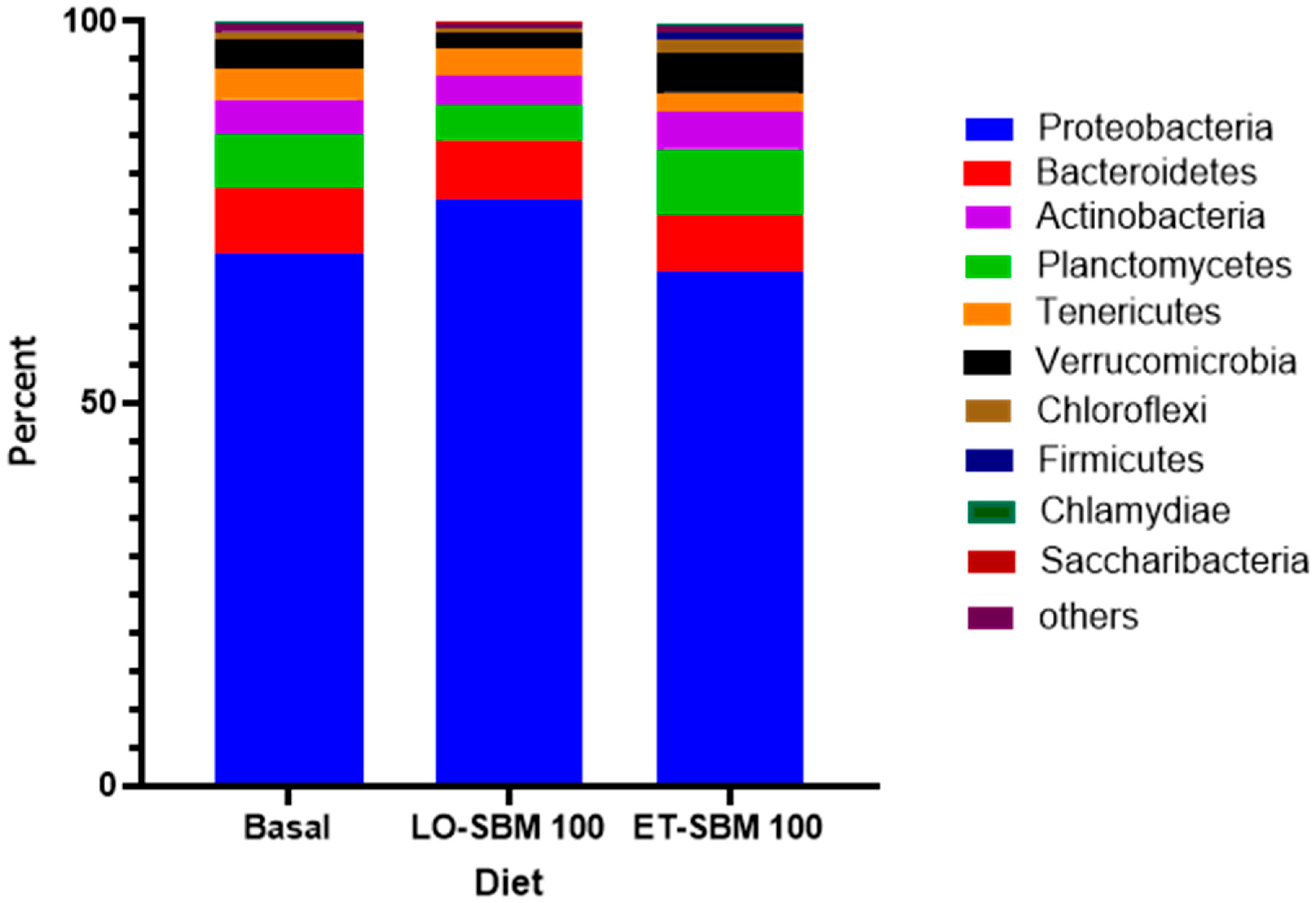
The overall bacterial abundance in gut samples was categorized into 10 bacterial phyla for each treatment, as illustrated in Figure 1. Sequences that could not be categorized into any recognized groups were designated as ‘others’. In the baseline, LO-SBM 100%, and ET-SBM 100% treatments, the predominant phyla were Proteobacteria, comprising 69.49%, 76.58%, and 67.26%, respectively. Additionally, phyla such as Actinobacteria, Bacteroidetes, Planctomycetes, Tenerricutes, Verrucomicrobia, Chloroflexi, Firmicutes, Chlamydiae, and Saccharibacteria were observed in all treatments.
Alpha diversity indices were used to assess the richness and diversity of the intestinal microbiota in shrimp subjected to various diets. Both metrics showed significant differences between treatments: observed number of species (p = 0.019) and Shannon index (p = 0.027) (Table 11). Shrimp consuming the enzyme-treated soybean meal (ET-SBM 100%) diet demonstrated the highest alpha diversity, evidenced by a considerably elevated Shannon index (5.45) and observed species count (326.41) relative to the other treatments. Conversely, shrimp consuming the low-oligosaccharide soybean meal (LO-SBM 100%) diet exhibited the lowest alpha diversity, evidenced by a considerably diminished Shannon index (4.59) and a lower observed species count (242.69). All indices showed intermediate values in the basal diet group, which, depending on the metric, were statistically similar to both the ET-SBM and LO-SBM groups. These data indicate that ET-SBM improves gut microbial variety and richness, potentially fostering a more stable and resilient intestinal environment, whereas a high inclusion of LO-SBM may adversely impact the microbial community structure.
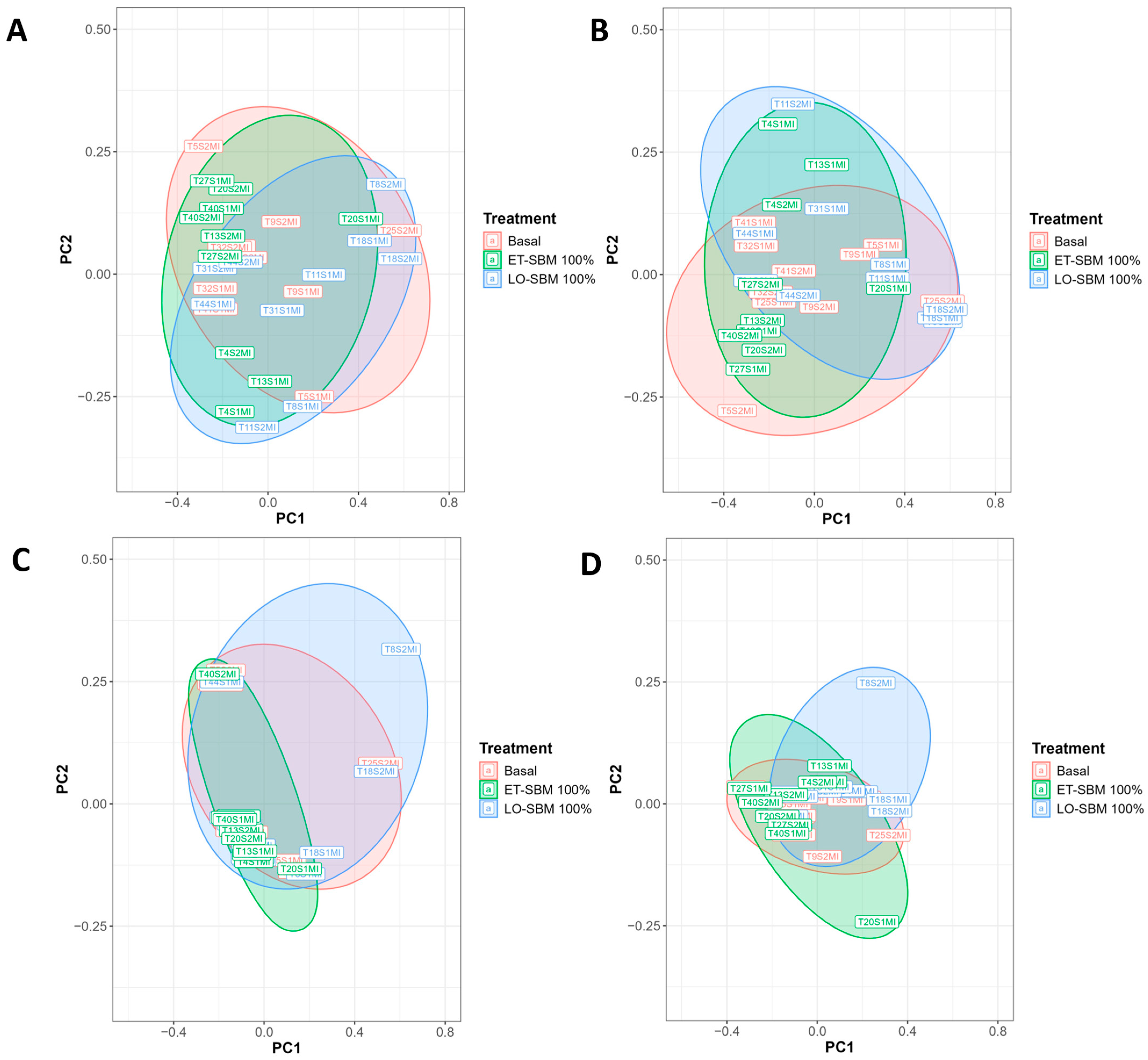
A Principal Coordinate Analysis (PCoA) was employed to assess the similarities in microbial community makeup (Figure 2). The PERMANOVA analysis, categorized by treatment, performed on Bray–Curtis dissimilarity matrices derived from ASV-level data, revealed no statistically significant changes (p > 0.05) in gut samples. No substantial changes in dispersion were observed according to the betadisper test (p > 0.05) for all metrics.

4. Discussion

Pacific white shrimp were fed with several soy protein sources in these experiments, including solvent-extracted soybean meal, low-oligosaccharide soybean meal, and enzyme-treated soybean meal. The diets were formulated to be iso-nitrogenous and iso-lipidic, featuring a balanced profile of essential amino acids, especially lysine and methionine, which are generally deficient in plant-based diets. This indicates that using specific processed soybean meal products or cultivars to enhance quality and reduce anti-nutritional factors (ANFs), along with appropriate diet formulation, can effectively substitute solvent-extracted soybean meal in shrimp diets. The growth data from the prior trial’s results [10] validated that low-oligosaccharide and enzyme-treated soybean meals can be utilized in varying quantities without impeding L. vannamei growth. Although shrimp fed the 80% ET-SBM diet exhibited whole-body crude fat levels that were approximately 4% higher than those of the other groups, this difference may be attributable to slight variations in dietary crude fat content and did not appear to affect growth performance. This pattern was uniform across multiple growth indices, with the only exceptions being those related to the whole-body composition of the cultured shrimp.
Previous studies have shown a negative correlation between oligosaccharide levels and shrimp digestibility [8]. The current findings support the use of soybean cultivars with low oligosaccharide content in shrimp feed formulations. Shrimp given reduced-oligosaccharide soybean meal performed similarly to those in the other treatment groups, demonstrating that decreasing oligosaccharide levels had no negative impact on growth performance. This finding is consistent with Fang et al. [26] and Nguyen et al. [10], who found that numerous low-oligosaccharide soybean cultivars increased final weight, growth rate, and feed conversion ratio in Pacific white shrimp, which may be attributed due to increased crude protein, sucrose and amino acid concentrations [27], reductions in trypsin inhibitors levels [9,28], or/and reduction in concentration of stachyose and raffinose in LO-SBM as they were produced from a genetically selected variety that has low concentrations of oligosaccharides [29]. Similarly, an examination of three non-genetically modified soybean cultivars revealed that Navita 1, a low-oligosaccharide cultivar, had no significant negative effects at low or high inclusion levels, whereas the other two soybean cultivars performed poorly [30], which may be because Navita 1 originates from a different cultivar than the other two soybean cultivars. However, the current findings differ from those reported by Zhou et al. [8], who discovered that shrimp fed a high-protein, low-oligosaccharide soybean variety had a much lower final weight and a greater feed conversion ratio, which may be because a higher protein content does not necessarily result in better growth, as although increased protein digestibility can contribute to greater weight gain, shrimp growth also depends on factors such as feed intake and the overall balance of essential nutrients rather than protein digestibility alone. These findings indicate that new soybean cultivars, when paired with appropriate processing procedures, may enhance growth performance.
In the current study, ET-SBM showed growth performance outcomes similar to those of shrimp fed basal and LO-SBM at various levels. In line with the results of this study, Galkanda-Arachchige and Davis [31] found that in a clear water system with no natural productivity, enzyme-treated soybean meal produced results similar to those of solvent-extracted soy, indicating no barrier to the growth of Pacific white shrimp at an inclusion rate of up to 100%, which maybe because enzymatic treatment of soybean meal reduces anti-nutritional factors [32], reduction in allergenic proteins, i.e., glycinin and β-conglycinin [33], or/and contains a lot of small peptides easier for absorption [34] thus improving ingredient quality and enabling greater inclusion in feeds. The findings indicate that the incorporation of enzyme-treated soybean meals does not provide adverse consequences, exhibiting just a minor difference in overall body composition, potentially influenced by factors such as fat content, digestibility, and the complexity of the enzyme treatment processes.
Gut microbiota analysis revealed that shrimp fed 100% ET-SBM had notably higher alpha diversity (Shannon index = 5.45, observed richness = 326.41) compared to those fed 100% LO-SBM (Shannon index = 4.59, observed species = 242.69). This study shows that dietary treatments did affect Shannon and observed species indices of L. vannamei, suggesting that supplementation of L. vannamei diets with LO-SBM and ET-SBM significantly affected the alpha diversity of bacterial microbiota in the intestine of shrimp, in contrast to the results reported by Fan et al. [35], where use of enzyme-treated soybean meal in L. vannamei diets did not alter the alpha diversity as measured with the Shannon and Simpson indices. Cheng et al. [36] also reported non-significant microbiota diversity analysis results in L. vannamei with the inclusion of Bacillus subtilis E20-fermented soybean meal compared to conventional soybean meal diets. The improvement of nutrition by enzyme treatment of soybean meal may influence the richness and diversity of intestinal microbiota in shrimp, possibly due to more bioactive compounds in ET-SBM, or maybe because the ingredients act as probiotics/prebiotics, or because the enzymatic treatment process is beneficial. In largemouth bass, substituting 30% fermented SBM (FSBM) for FM significantly increased the intestinal abundance of Mycoplasma and Cetobacterium, which may be linked to the decreased ANF levels [37]. Shao et al. [38] demonstrated that partial replacement of fishmeal with enzyme-treated SBM maintained intestinal health and microbial balance in L. vannamei.
Beta diversity reveals differences in the bacterial community structure and is commonly assessed using the weighted UniFrac distances [39] and visualized as principal component analysis plots [40]. In this study, dietary treatments had no significant influence on the beta diversity of the intestinal bacterial microbiota of L. vannamei. This is in contrast with Shao et al. [38], who found that the inclusion of enzyme-treated soybean meal in L. vannamei diets did alter the beta diversity of intestinal bacterial communities.
Proteobacteria dominate the intestines of a substantial number of aquatic species, such as freshwater prawns [41] and shrimp, including black tiger shrimp [42] and white shrimp [43], and remain dominant despite dietary modifications and physiological stress in shrimp [44]. The most abundant bacteria found were Proteobacteria in all SBM-fed shrimps. This observation aligns with the findings of Cheng et al. [36], where Proteobacteria were abundant in L. vannamei fed a Bacillus subtilis E20-fermented soybean meal diet. The second most prevalent phylum in our study was Bacteroidetes, which is comparable to that of Fan et al. [35] and Cheng et al. [36], in contrast to previous research on L. vannamei by Zeng et al. [44]. Bacteroidetes significantly contribute to the degradation of dietary fiber in humans [45]. The unexpected prevalence of Bacteroidetes in the study may be associated with the fiber content of SBM. Ammonium and nitrite can be converted to water and dinitrogen gas by the bacterial phylum Planctomycetes, so these bacteria can therefore simultaneously eradicate the accumulation of the two nitrogen compounds that are most detrimental to aquatic life, as per van Niftrik and Jetten [46]. In our investigation, Actinobacteria were also one of the dominant phyla. Prior research has indicated that the phylum Actinobacteria exhibits a probiotic effect by generating phenol oxidase, potentially benefiting the intestinal health of the host [46,47]. In shrimp, the metabolic processes of the intestinal microbiota may be substantially affected by drastic changes in circumstances, such as varying culture stages and health status [48]. Therefore, the 10 most abundant bacterial phyla initially identified in the intestine of L. vannamei in this study serve as a reference for the subsequent evaluation of the intestinal health of shrimp fed diets supplemented with soybean meal.

5. Conclusions

Under the conditions of this study, there were no adverse effects from the substitution of low-oligosaccharide and enzyme-treated soybean meals for solvent-extracted soybean meal in shrimp feeds. Under green water conditions, phosphorus retention was lowest in the shrimp fed basal diets, indicating better phosphorus availability in the other meals. In the clear water system, diets containing 60–80% LO-SBM resulted in significantly higher growth and higher phosphorus retention compared with the basal diet. These results indicate that LO-SBM is superior to solvent-extracted SBM. The use of ET-SBM under green water conditions did not improve shrimp performance. However, under clear water conditions, shrimp offered the ET-SBM 100% diet were significantly larger than those offered the basal diet, indicating some advantages. Gut microbiota investigation showed that adding ET-SBM increased alpha diversity, which could be good for the stability and resilience of the gut. On the other hand, high diversity remained the same, which means that the diet did not greatly impact the general structure of the microbial community. Regardless of the source of protein, there were only minor alterations in the shrimps’ body composition. The significance of further investigation and development of alternative protein sources for aquaculture feed is highlighted by these results.

Author Contributions

A.K. and K.Q.N.: Conceptualization, Methodology, Investigation, Data curation, Formal analysis, Visualization, Writing—original draft; C.S.A., A.N.A. and T.L.C.: Investigation; M.R.: Investigation, Writing—review and editing; T.J.B.: Writing—review and editing; D.A.D.: Funding acquisition, Conceptualization, Validation, Writing—review and editing, Supervision, Project administration. All authors have read and agreed to the published version of the manuscript.

Funding

This work was supported in part by the Alabama Agricultural Station and the Hatch program (ALA016-1-19102) of the National Institute of Food and Agriculture, U.S. Department of Agriculture, and the United Soybean Board project (#2411-107-0201).

Institutional Review Board Statement

US law does not include invertebrates in IACUC requirement, in actuality no cold blooded species is included in the law. However, some groups have chosen to develop IACUC standards for cold blooded fish. The AU policy is that invertebrates do not require IACUC program approval. Therefore, this study was exempt from IACUC review.

Informed Consent Statement

Not Applicable.

Data Availability Statement

The data that support the findings of this study are available from the corresponding author upon reasonable request.

Acknowledgments

The authors would like to express their gratitude to those who reviewed this manuscript and to the students and staff who participated in this project from Auburn University and Claude Peteet Mariculture Center. The authors thank our fellow students for their assistance with trial preparations. The mention of trademarks and proprietary products does not constitute endorsement by Auburn University and is not intended to exclude other products or services that may be suitable.

Conflicts of Interest

The authors declare no conflicts of interest.

References

  1. Tacon, A.G.J.; Hasan, M.R.; Allan, G.; El-Sayed, A.-F.M.; Jackson, A.; Kaushik, S.J.; Ng, W.K.; Suresh, V.; Viana, M.T. Aquaculture feeds: Addressing the long-term sustainability of the sector. In Proceedings of the Global Conference on Aquaculture, Phuket, Thailand, 22–25 September 2010; pp. 193–231. Available online: https://openknowledge.fao.org/server/api/core/bitstreams/6e938128-9c7a-401f-84b9-eebb2a3e16d3/content/i2734e03c.pdf (accessed on 24 August 2024).
  2. Hulefeld, R.; Habte-Tsion, H.-M.; Lalgudi, R.S.; McGraw, B.; Cain, R.; Allen, K.; Thompson, K.R.; Tidwell, J.H.; Kumar, V. Nutritional evaluation of an improved soybean meal as a fishmeal replacer in the diet of Pacific white shrimp, Litopenaeus vannamei. Aquac. Res. 2018, 49, 1414–1422. [Google Scholar] [CrossRef]
  3. Naylor, R.L.; Hardy, R.W.; Buschmann, A.H.; Bush, S.R.; Cao, L.; Klinger, D.H.; Little, D.C.; Lubchenco, J.; Shumway, S.E.; Troell, M. A 20-year retrospective review of global aquaculture. Nature 2021, 591, 551–563. [Google Scholar] [CrossRef] [PubMed]
  4. Tacon, A.G.J.; Metian, M. Global overview on the use of fish meal and fish oil in industrially compounded aquafeeds: Trends and future prospects. Aquaculture 2008, 285, 146–158. [Google Scholar] [CrossRef]
  5. Dersjant-Li, Y. The use of soya protein in aquafeeds. Oilseeds Focus 2021, 7, 29–31. Available online: https://journals.co.za/doi/abs/10.10520/ejc-vp_oilseeds_v7_n2_a10 (accessed on 24 August 2024).
  6. Gatlin, D.M., III; Barrows, F.T.; Brown, P.; Dabrowski, K.; Gaylord, T.G.; Hardy, R.W.; Herman, E.; Hu, G.; Krogdahl, Å.; Nelson, R.; et al. Expanding the utilization of sustainable plant products in aquafeeds: A review. Aquac. Res. 2007, 38, 551–579. [Google Scholar] [CrossRef]
  7. Francis, G.; Makkar, H.P.S.; Becker, K. Antinutritional factors present in plant-derived alternate fish feed ingredients and their effects in fish. Aquaculture 2001, 199, 197–227. [Google Scholar] [CrossRef]
  8. Zhou, Y.-G.; Davis, D.A.; Buentello, A. Use of new soybean varieties in practical diets for the Pacific white shrimp, Litopenaeus vannamei. Aquac. Nutr. 2015, 21, 635–643. [Google Scholar] [CrossRef]
  9. Pangeni, D.; Jendza, J.A.; Menon, D.R.; Anil, L.; Yang, X.; Baidoo, S.K. Effect of replacing conventional soybean meal with low oligosaccharide soybean meal fed to weanling piglets. J. Anim. Sci. 2017, 95, 320–326. [Google Scholar] [CrossRef] [PubMed]
  10. Nguyen, K.Q.; Hussain, A.S.; Araujo, A.N.; Strebel, L.M.; Corby, T.L.; Rhodes, M.A.; Bruce, T.J.; Cuéllar-Anjel, J.; Davis, D.A. Effects of different soybean protein sources on growth performance, feed utilization efficiency, intestinal histology, and physiological gene expression of Pacific white shrimp (Litopenaeus vannamei) in green water and indoor biofloc system. Aquaculture 2026, 611, 743021. [Google Scholar] [CrossRef]
  11. Wang, L.; Zhou, H.; He, R.; Xu, W.; Mai, K.; He, G. Effects of soybean meal fermentation by Lactobacillus plantarum P8 on growth, immune responses, and intestinal morphology in juvenile turbot (Scophthalmus maximus L.). Aquaculture 2016, 464, 87–94. [Google Scholar] [CrossRef]
  12. Leeper, A.; Sauphar, C.; Berlizot, B.; Ladurée, G.; Koppe, W.; Knobloch, S.; Skírnisdóttir, S.; Björnsdóttir, R.; Øverland, M.; Benhaïm, D. Enhancement of Soybean Meal Alters Gut Microbiome and Influences Behavior of Farmed Atlantic Salmon (Salmo salar). Animals 2023, 13, 2591. [Google Scholar] [CrossRef] [PubMed]
  13. Tsai, C.F.; Lin, L.J.; Wang, C.H.; Tsai, C.S.; Chang, S.C.; Lee, T.T. Effects of fermented soybean meal with Bacillus velezensis, Lactobacillus spp. or their combination on broiler performance, gut antioxidant activity and microflora. Anim. Biosci. 2022, 35, 1892–1903. [Google Scholar] [CrossRef] [PubMed]
  14. Jacobsen, H.J.; Kousoulaki, K.; Sandberg, A.S.; Carlsson, N.G.; Ahlstrøm, Ø.; Oterhals, Å. Enzyme Pre-Treatment of Soybean Meal: Effects on Non-Starch Carbohydrates, Protein, Phytic Acid, and Saponin Biotransformation and Digestibility in Mink (Neovison vison). Anim. Feed Sci. Technol. 2018, 236, 1–13. [Google Scholar]
  15. Li, C.; Zhang, B.; Liu, C.; Zhou, H.; Wang, X.; Mai, K.; He, G. Effects of Dietary Raw or Enterococcus faecium Fermented Soybean Meal on Growth, Antioxidant Status, Intestinal Microbiota, Morphology, and Inflammatory Responses in Turbot (Scophthalmus maximus L.). Fish Shellfish Immunol. 2020, 100, 261–271. [Google Scholar] [CrossRef] [PubMed]
  16. Sookying, D.; Davis, D.A. Use of soy protein concentrate in practical diets for Pacific white shrimp (Litopenaeus vannamei) reared under field conditions. Aquac. Int. 2012, 20, 357–371. [Google Scholar] [CrossRef]
  17. Das, S.; Ward, L.R.; Burke, C. Prospects of using marine actinobacteria as probiotics in aquaculture. Appl. Microbiol. Biotechnol. 2008, 81, 419–429. [Google Scholar] [CrossRef] [PubMed]
  18. Sommer, F.; Bäckhed, F. The gut microbiota—Masters of host development and physiology. Nat. Rev. Microbiol. 2013, 11, 227–238. [Google Scholar] [CrossRef] [PubMed]
  19. Oliveira, B.P.N.; Padeniya, U.; Bledsoe, J.W.; Davis, D.A.; Liles, M.R.; Hussain, A.S.; Wells, D.E.; Bruce, T.J. Evaluation of Probiotic Effects on the Growth Performance and Microbiome of Nile Tilapia (Oreochromis niloticus) in a High-Density Biofloc System. Aquac. Nutr. 2025, 2025, 5868806. [Google Scholar] [CrossRef] [PubMed]
  20. Bartlett, M.S. Some Examples of Statistical Methods of Research in Agriculture and Applied Biology. Suppl. J. R. Stat. Soc. 1937, 4, 137–183. [Google Scholar] [CrossRef]
  21. Shapiro, S.S.; Wilk, M.B. An Analysis of Variance Test for Normality (Complete Samples). Biometrika 1965, 52, 591–611. [Google Scholar] [CrossRef]
  22. Bray, J.R.; Curtis, J.T. An Ordination of the Upland Forest Communities of Southern Wisconsin. Ecol. Monogr. 1957, 27, 326–349. [Google Scholar] [CrossRef] [PubMed]
  23. Oksanen, J.; Blanchet, F.G.; Friendly, M.M.; Kindt, R.; Legendre, P.; McGlinn, D.; Minchin, P.R.; O’Hara, R.B.; Simpson, G.L.; Solymos, P. Vegan: Community Ecology Package. R Package Version 2.5-6. Community Ecol. Package, Version. 2017. Available online: https://github.com/vegandevs/vegan (accessed on 24 August 2024).
  24. Kindt, R.; Coe, R. Tree Diversity Analysis: A Manual and Software for Common Statistical Methods for Ecological and Biodiversity Studies; World Agroforestry Centre: Nairobi, Kenya, 2005. [Google Scholar]
  25. Chapagain, P.; Arivett, B.; Cleveland, B.M.; Walker, D.M.; Salem, M. Analysis of the fecal microbiota of fast- and slow-growing rainbow trout (Oncorhynchus mykiss). BMC Genom. 2019, 20, 788. [Google Scholar] [CrossRef] [PubMed]
  26. Fang, X.; Yu, D.; Buentello, A.; Zeng, P.; Davis, D.A. Evaluation of new non-genetically modified soybean varieties as ingredients in practical diets for Litopenaeus vannamei. Aquaculture 2016, 451, 178–185. [Google Scholar] [CrossRef]
  27. Baker, K.M.; Utterback, P.L.; Parsons, C.M.; Stein, H.H. Nutritional value of soybean meal produced from conventional, high-protein, or low-oligosaccharide varieties of soybeans and fed to broiler chicks. Poult. Sci. 2011, 90, 390–395. [Google Scholar] [CrossRef] [PubMed]
  28. Refstie, S.; Storebakken, T.; Roem, A.J. Feed consumption and conversion in Atlantic salmon (Salmo salar) fed diets with fish meal, extracted soybean meal or soybean meal with reduced content of oligosaccharides, trypsin inhibitors, lectins and soya antigens. Aquaculture 1998, 162, 301–312. [Google Scholar] [CrossRef]
  29. Chen, X.; Parsons, C.M.; Bajjalieh, N. Nutritional evaluation of new reduced oligosaccharide soybean meal in poultry. Poult. Sci. 2013, 92, 1830–1836. [Google Scholar] [CrossRef] [PubMed]
  30. Qiu, X.; Buentello, A.; Shannon, R.; Mustafa, A.; Abebe, A.; Davis, D.A. Evaluation of three non-genetically modified soybean cultivars as ingredients and a yeast-based additive as a supplement in practical diets for Pacific white shrimp Litopenaeus vannamei. Aquac. Nutr. 2018, 24, 173–183. [Google Scholar] [CrossRef]
  31. Galkanda-Arachchige, H.; Davis, D.A. Evaluation of differently processed soybean meal products as ingredients in practical diets for Pacific white shrimp Litopenaeus vannamei. Aquac. Nutr. 2020, 26, 287–295. [Google Scholar] [CrossRef]
  32. Zheng, L.; Li, D.; Li, Z.L.; Kang, L.N.; Jiang, Y.Y.; Liu, X.Y.; Chi, Y.P.; Li, Y.Q.; Wang, J.H. Effects of Bacillus fermentation on the protein microstructure and anti-nutritional factors of soybean meal. Lett. Appl. Microbiol. 2017, 65, 520–526. [Google Scholar] [CrossRef] [PubMed]
  33. Deng, Z.; Duarte, M.E.; Jang, K.B.; Kim, S.W. Soy protein concentrate replacing animal protein supplements and its impacts on intestinal immune status, intestinal oxidative stress status, nutrient digestibility, mucosa-associated microbiota, and growth performance of nursery pigs. J. Anim. Sci. 2022, 100, skac255. [Google Scholar] [CrossRef] [PubMed]
  34. Ma, D.; Fan, J.; Zhu, H.; Su, H.; Jiang, P.; Yu, L.; Liao, G.; Bai, J. Histologic examination and transcriptome analysis uncovered liver damage in largemouth bass from formulated diets. Aquaculture 2020, 526, 735329. [Google Scholar] [CrossRef]
  35. Fan, Y.; Luo, K.; Guo, Y.; Gao, W.; Xu, Q.; Zhang, W.; Mai, K. Replacement of fish meal by enzyme-treated soybean on the growth performance, intestine microflora, immune responses and disease resistance of Pacific white shrimp Litopenaeus vannamei. Aquac. Res. 2021, 52, 4619–4628. [Google Scholar] [CrossRef]
  36. Cheng, A.C.; Yeh, S.P.; Hu, S.Y.; Lin, H.L.; Liu, C.H. Intestinal microbiota of white shrimp, Litopenaeus vannamei, fed diets containing Bacillus subtilis E20-fermented soybean meal (FSBM) or an antimicrobial peptide derived from B. subtilis E20-FSBM. Aquac. Res. 2020, 51, 41–50. [Google Scholar] [CrossRef]
  37. He, M.; Li, X.; Poolsawat, L.; Guo, Z.; Yao, W.; Zhang, C.; Leng, X. Effects of fish meal replaced by fermented soybean meal on growth performance, intestinal histology and microbiota of largemouth bass (Micropterus salmoides). Aquac. Nutr. 2020, 26, 1058–1071. [Google Scholar] [CrossRef]
  38. Shao, J.; Zheng, Q.; Chen, Z.; Zhu, W.; Ren, Q.; Yuan, K.; Yang, L. Enzyme-Treated Soybean Meal Serves as an Effective Alternative to Fishmeal in the Diet of the Shrimp Penaeus vannamei. Aquac. Nutr. 2025, 2025, 2312302. [Google Scholar] [CrossRef] [PubMed]
  39. Peng, K.; Jin, L.; Niu, Y.D.; Huang, Q.; McAllister, T.A.; Yang, H.E.; Denise, H.; Xu, Z.; Acharya, S.; Wang, S.; et al. Condensed Tannins Affect Bacterial and Fungal Microbiomes and Mycotoxin Production during Ensiling and upon Aerobic Exposure. Appl. Environ. Microbiol. 2018, 84, e02274-17. [Google Scholar] [CrossRef] [PubMed]
  40. Yang, P.; Hu, H.; Liu, Y.; Li, Y.; Ai, Q.; Xu, W.; Zhang, W.; Zhang, Y.; Zhang, Y.; Mai, K. Dietary stachyose altered the intestinal microbiota profile and improved the intestinal mucosal barrier function of juvenile turbot, Scophthalmus maximus L. Aquaculture 2018, 486, 98–106. [Google Scholar] [CrossRef]
  41. Miao, S.; Zhu, J.; Zhao, C.; Sun, L.; Zhang, X.; Chen, G. Effects of C/N ratio control combined with probiotics on the immune response, disease resistance, intestinal microbiota and morphology of giant freshwater prawn (Macrobrachium rosenbergii). Aquaculture 2017, 476, 125–133. [Google Scholar] [CrossRef]
  42. Rungrassamee, W.; Klanchui, A.; Maibunkaew, S.; Chaiyapechara, S.; Jiravanichpaisal, P.; Karoonuthaisiri, N. Characterization of Intestinal Bacteria in Wild and Domesticated Adult Black Tiger Shrimp (Penaeus monodon). PLoS ONE 2014, 9, e91853. [Google Scholar] [CrossRef] [PubMed]
  43. Li, E.; Xu, C.; Wang, X.; Wang, S.; Zhao, Q.; Zhang, M.; Quin, J.G.; Chen, L. Gut Microbiota and its Modulation for Healthy Farming of Pacific White Shrimp Litopenaeus vannamei. Rev. Fish. Sci. Aquac. 2018, 26, 381–399. [Google Scholar] [CrossRef]
  44. Zeng, S.; Huang, Z.; Hou, D.; Liu, J.; Weng, S.; He, J. Composition, diversity and function of intestinal microbiota in pacific white shrimp (Litopenaeus vannamei) at different culture stages. PeerJ 2017, 5, e3986. [Google Scholar] [CrossRef] [PubMed]
  45. Zhang, M.; Chekan, J.R.; Dodd, D.; Hong, P.-Y.; Radlinski, L.; Revindran, V.; Nair, S.K.; Mackie, R.I.; Cann, I. Xylan utilization in human gut commensal bacteria is orchestrated by unique modular organization of polysaccharide-degrading enzymes. Proc. Natl. Acad. Sci. USA 2014, 111, E3708–E3717. [Google Scholar] [CrossRef] [PubMed]
  46. van Niftrik, L.; Jetten, M.S.M. Anaerobic Ammonium-Oxidizing Bacteria: Unique Microorganisms with Exceptional Properties. Microbiol. Mol. Biol. Rev. 2012, 76, 585–596. [Google Scholar] [CrossRef] [PubMed]
  47. Duan, Y.; Wang, Y.; Liu, Q.; Dong, H.; Li, H.; Xiong, D.; Zhang, J. Changes in the intestine microbial, digestion and immunity of Litopenaeus vannamei in response to dietary resistant starch. Sci. Rep. 2019, 9, 6464. [Google Scholar] [CrossRef] [PubMed]
  48. Fan, L.; Wang, Z.; Chen, M.; Qu, Y.; Li, J.; Zhou, A.; Xie, S.; Zeng, F.; Zou, J. Microbiota comparison of Pacific white shrimp intestine and sediment at freshwater and marine cultured environment. Sci. Total Environ. 2019, 657, 1194–1204. [Google Scholar] [CrossRef] [PubMed]
Figure 1. Relative abundance of bacterial phyla present in the guts of Pacific white shrimp (L. vannamei) cultured in a clear water RAS for five weeks, fed diets containing SBM, LO-SBM or ET-SBM as main protein sources at various levels, stocked at 15 shrimp tank−1 (~83 shrimp m−2) with an initial weight of 0.78 ± 0.03 g (mean ± standard deviation).
Aquacj 06 00025 g001
Figure 2. A Principal Coordinate Analysis (PCoA) plot based on (A). Bray UniFrac (PERMANOVA p = 0.178, betadisper p = 0.239), (B). BrayGenus UniFrac (PERMANOVA p = 0.065, betadisper p = 0.533), (C). Unweighted UniFrac (PERMANOVA p = 0.265, betadisper p = 0.111) and (D). Weighted UniFrac (PERMANOVA p = 0.118, betadisper p = 0.935) beta-diversity distances of Pacific white shrimp (L. vannamei) gut microbiota cultured in a clear water RAS for five weeks, fed diets containing SBM, LO-SBM or ET-SBM as main protein sources at various levels, stocked at 15 shrimp tank−1 (~83 shrimp m−2) with an initial weight of 0.78 ± 0.03 g (mean ± standard deviation).
Aquacj 06 00025 g002
Table 1. Proximate and amino acid composition (% as is) of each protein source used to assess shrimp growth in the green water and clear water RAS.
Proximate
Composition (g 100 g−1) *
SBMLO-SBMET-SBMCPCFishmeal
         Crude protein43.2853.3661.5677.4666.00
         Moisture13.3210.596.487.116.14
         Crude fat0.260.000.003.138.58
         Crude fiber3.652.936.310.840.80
         Ash5.926.246.191.5319.95
Amino acids
composition (g 100 g−1) *
         Alanine1.882.242.666.924.06
         Arginine3.083.844.382.463.79
         Aspartic acid4.806.176.894.695.51
         Cysteine0.610.760.861.490.54
         Glutamic acid7.849.9011.0317.697.94
         Glycine1.842.232.602.164.96
         Histidine1.121.391.621.641.52
         Hydroxylysine0.040.050.000.060.25
         Hydroxyproline0.110.050.09-1.14
         Isoleucine2.052.612.993.362.57
         Leucine3.414.124.7513.034.30
         Lysine2.813.343.971.314.74
         Methionine0.600.730.832.111.67
         Phenylalanine2.272.803.145.032.54
         Proline2.112.673.037.213.51
         Serine1.792.222.603.992.17
         Taurine0.110.140.15-0.69
         Threonine1.632.012.402.632.49
         Tryptophan0.550.710.790.480.56
         Tyrosine1.671.942.094.051.88
         Valine2.132.653.093.613.01
Total42.4952.6760.0883.9659.93
Note: SBM: soybean meal (Bunge, St. Louis, MO, USA); LO-SBM: low-oligosaccharide SBM (Bright Day, Benson Hill, St. Louis, MO, USA); ET-SBM: enzyme-treated SBM (Hamlet HP300, Hamlet Protein Inc., Findlay, OH, USA); Fishmeal: Special Select Menhaden fishmeal, Omega Protein Inc., Houston, TX, USA. * Proximate analysis done by University of Missouri Laboratory (Columbia, MO, USA) with results expressed as g 100 g−1.
Table 2. Formulation (g 100 g−1 as is) of experimental diets based on iso-nitrogenous and iso-lipidic (35 g 100 g−1 protein and 8 g 100 g−1 lipid) basis, for Pacific white shrimp (L. vannamei) cultured in clear water and green water RAS, fed diets containing SBM, LO-SBM or ET-SBM as main protein sources at various levels.
Diet NameBasalLO-SBM 40%LO-SBM 60%LO-SBM 80%LO-SBM 100%ET-SBM 40%ET-SBM 60%ET-SBM 80%ET-SBM 100%
Fishmeal a6.006.006.006.006.006.006.006.006.00
SE-SBM b49.6328.0317.236.43-27.9017.046.16-
LO-SBM c-18.1127.1636.2141.60----
ET-SBM d-----17.9626.9535.9541.05
CPC—Empyreal 75 e7.507.507.507.507.507.507.507.507.50
Menhaden fish oil f2.402.402.402.402.402.402.402.402.40
Soy oil3.703.653.623.603.583.343.162.982.87
Lecithin (soy) g1.001.001.001.001.001.001.001.001.00
Cholesterol h0.120.120.120.120.120.120.120.120.12
Corn Starch h2.305.847.629.3910.456.438.4810.5411.71
Whole wheat i22.2522.2522.2522.2522.2522.2522.2522.2522.25
Mineral premix j0.500.500.500.500.500.500.500.500.50
Vitamin premix k1.801.801.801.801.801.801.801.801.80
Choline chloride l0.200.200.200.200.200.200.200.200.20
Rovimix Stay-C 35% m0.100.100.100.100.100.100.100.100.10
CaP-dibasic n2.502.502.502.502.502.502.502.502.50
Proximate
composition (g 100 g−1 as is) *
Crude protein40.1039.8040.3040.3041.0039.3040.0037.5038.80
Moisture7.647.327.707.737.837.877.638.048.69
Crude Fat8.898.648.469.108.428.188.9812.88.75
Crude Fiber5.604.203.103.003.705.505.004.203.40
Ash8.028.107.367.157.408.167.917.628.13
Note: SE-SBM: Solvent-extracted soybean meal; LO-SBM: low-oligosaccharide soybean meal; ET-SBM: enzyme-treated soybean meal. a Special Select Menhaden fishmeal, Omega Protein Inc., Houston, TX, USA. b Bunge, St. Louis, MO, USA. c Confluence Genetics ProVIA, St. Louis, MO, USA. d Hamlet HP300, Hamlet Protein Inc., Findlay, OH, USA. e Empyreal 75TM, Cargill Corn Milling, Cargill Inc., Blair, NE, USA. f Omega Protein Inc., Houston, TX, USA. g The Solae Company, St. Louis, MO, USA. h MP Biomedicals Inc., Solon, OH, USA. i Bobs Red Mill, Milwaukie, OR, USA. j Trace mineral premix (g100 g−1 premix): Cobalt chloride, 0.004; Cupric sulfate pentahydrate, 0.550; Ferrous sulfate, 2.000; Magnesium sulfate anhydrous, 13.862; Manganese sulfate monohydrate, 0.650; Potassium iodide, 0.067; Sodium selenite, 0.010; Zinc sulfate heptahydrate, 13.193; Alpha-cellulose, 69.664. k Vitamin premix (g kg−1 premix): Thiamin HCl, 4.95; Riboflavin, 3.83; Pyridoxine HCl, 4.00; Ca-Pantothenate, 10.00; Nicotinic acid, 10.00; Biotin, 0.50; folic acid, 4.00; Cyanocobalamin, 0.05; Inositol, 25.00; Vitamin A acetate (500,000 IU g−1), 0.32; Vitamin D3 (1,000,000 IU g−1), 80.00; Menadione, 0.50; Alpha-cellulose, 856.81. l MO Biomedicals Inc., Solon, OH, USA. m Stay C®, (L-ascorbyl-2-polyphosphate 35% Active C), Roche Vitamins Inc., Parsippany, NJ, USA. n Acros Organics B. V. B. A. Thermo Fisher Scientific, Waltham, MA, USA. * Proximate analysis performed by Midwest Laboratories Inc. (Omaha, NE, USA) with results expressed as g 100 g−1 of feed as is, unless otherwise indicate.
Table 3. Amino acid profile (g 100 g−1 as is) of experimental diets based on iso-nitrogenous and iso-lipidic (35 g 100 g−1 protein and 8 g 100 g−1 lipid) basis for Pacific white shrimp (L. vannamei) cultured in clear water and green water RAS, fed diets containing SBM, LO-SBM or ET-SBM as main protein sources at various levels.
Amino AcidsBasalLO-SBM 40%LO-SBM 60%LO-SBM 80% LO-SBM 100%ET-SBM 40%ET-SBM 60%ET-SBM 80%ET-SBM 100%
Alanine1.891.861.881.841.841.972.011.851.78
Arginine2.182.242.272.312.332.262.222.072.15
Aspartic Acid3.393.483.553.583.593.543.473.213.32
Cysteine0.530.520.530.530.520.520.500.470.47
Glutamic Acid7.037.167.287.257.267.337.366.736.75
Glycine1.601.581.611.581.641.631.621.561.60
Histidine0.930.940.950.950.940.960.950.880.90
Hydroxylysine0.010.010.010.010.010.010.010.010.01
Hydroxyproline0.110.090.090.070.100.090.100.150.13
Isoleucine1.661.691.691.691.661.711.681.541.54
Leucine3.223.253.273.243.193.413.483.173.02
Lysine1.992.002.032.052.042.001.901.761.84
Methionine0.670.640.640.630.600.640.620.570.58
Proline2.192.222.232.222.232.292.342.182.13
Serine1.521.561.601.601.601.661.681.571.60
Taurine0.230.230.230.230.240.240.230.210.23
Threonine1.301.311.331.331.331.381.371.271.30
Tryptophan0.460.410.490.450.460.460.450.420.45
Tyrosine1.231.241.251.271.271.321.361.241.20
Valine1.771.791.801.801.771.811.791.641.64
Total35.8236.1736.7036.6036.5637.2537.1834.4034.51
Note: LO-SBM: low-oligosaccharide SBM (Bright Day, Benson Hill, St. Louis, MO, USA); ET-SBM: enzyme-treated SBM (Hamlet HP300, Hamlet Protein Inc., Findlay, OH, USA). Amino acid analysis performed by University of Missouri Laboratory (Columbia, MO, USA) with results expressed as g 100 g−1 of feed as is, unless otherwise indicated.
Table 4. Mineral profile (g 100 g−1 as is) of experimental diet based on an iso-nitrogenous and iso-lipidic (35 g 100 g−1 protein and 8 g 100 g−1 lipid) basis for Pacific white shrimp (L. vannamei) cultured in clear water and green water RAS, fed diets containing SBM, LO-SBM or ET-SBM as main protein sources at various levels.
MineralsBasalLO-SBM 40%LO-SBM 60%LO-SBM 80%LO-SBM 100%ET-SBM 40%ET-SBM 60%ET-SBM 80%ET-SBM 100%
Sulfur (%)0.410.390.410.380.410.390.420.380.39
Phosphorus (%)1.501.421.481.361.491.501.581.501.64
Potassium (%)1.351.211.321.171.261.281.401.301.39
Magnesium (%)0.230.20.230.210.220.230.240.220.24
Calcium (%)1.161.091.091.281.171.271.301.211.37
Sodium (%)0.100.090.090.090.090.100.100.090.10
Iron (ppm)159155144132132143149144156
Manganese (ppm)54.9048.4050.3049.0050.3051.6050.9044.4047.30
Copper (ppm)31.7029.9031.8023.5023.9029.7029.7029.6024.60
Zinc (ppm)193195211195189218213186207
Note: LO-SBM: low-oligosaccharide SBM (Bright Day, Benson Hill, St. Louis, MO, USA); ET-SBM: enzyme-treated SBM (Hamlet HP300, Hamlet Protein Inc., Findlay, OH, USA). Mineral analysis performed by Midwest Laboratories Inc. (Omaha, NE, USA) with results expressed as g 100 g−1 of feed as is, unless otherwise indicated.
Table 5. Water quality of a green water RAS during eight weeks containing Pacific white shrimp (L. vannamei) fed diets with SBM, LO-SBM or ET-SBM at various levels, based on iso-nitrogenous and iso-lipidic (35 g 100 g−1 protein and 8 g 100 g−1 lipid) basis, stocked at 30 shrimp tank−1 (~35 shrimp m−2) with an initial weight at 0.216 ± 0.007 g (mean ± standard deviation). Values are shown as mean ± standard deviation, with minimum and maximum of each parameter in parentheses.
Parameters
Dissolved oxygen (mg L−1)6.88 ± 0.64
(5.08, 8.40)
Temperature (°C)30.54 ± 1.91
(25.18, 33.35)
Salinity (g L−1)11.40 ± 1.78
(8.76, 15.15)
Total ammonia nitrogen (mg L−1)0.39 ± 0.89 *
(0, 3.22)
Nitrite nitrogen (mg L−1)0.02 ± 0.02
(0, 0.20)
Nitrate nitrogen (mg L−1)0.40 ± 0.60
(0, 7.00)
pH7.97 ± 0.30
(7.30, 10.29)
Alkalinity (mg L−1)82.75 ± 14.54
(65, 102)
Calcium (mg L−1)153.38 ± 30.50
(132, 202)
Magnesium (mg L−1)356.50 ± 99.16
(235, 516)
Phosphate (mg L−1)3.21 ± 0.64
(2, 4)
* Average ammonia nitrogen readings from ion electrode and WaterLink Spin Touch.
Table 6. Water quality of a clear water RAS over five weeks containing Pacific white shrimp (L. vannamei) fed diets with SBM, LO-SBM or ET-SBM as main protein sources at various levels based on iso-nitrogenous and iso-lipidic (35 g 100 g−1 protein and 8 g 100 g−1 lipid) basis, stocked at 15 shrimp tank−1 (~83 shrimp m−2) with an initial weight at 0.78 ± 0.03 g (mean ± standard deviation).
Parameters
Dissolved oxygen (mg L−1)6.86 ± 0.53
Temperature (°C)28.22 ± 0.96
Salinity (g/L) 9.45 ± 1.03
pH8.07 ± 0.20
Total ammonia nitrogen (mg L−1)0.17 ± 0.12
Nitrite nitrogen (mg L−1)0.14 ± 0.11
Table 7. Growth response and feed efficiency of Pacific white shrimp (L. vannamei) reared in a green water RAS over eight weeks and fed diets containing SBM, LO-SBM or ET-SBM as main protein sources at various levels based on iso-nitrogenous and iso-lipidic (35 g 100 g−1 protein and 8 g 100 g−1 lipid) basis, stocked at 30 shrimp tank−1 (~35 shrimp m−2) with an initial weight at 0.29 ± 0.01 g (mean ± standard deviation).
DietSurvival (%)Final Weight (g)Weight Gain (%)Weekly Gain (g)Feed Conversion RatioApparent Net Protein Retention (%)Phosphorus Retention (%)
Basal96.6720.3869482.511.0551.0325.35 b
LO-SBM 40%100.0020.3868072.511.0152.6728.00 ab
LO-SBM 60%100.0020.7068662.551.0052.4826.07 b
LO-SBM 80%100.83 *19.9267352.451.0451.1829.30 a
LO-SBM 100%98.3320.8770652.571.0150.3726.06 b
PSE1.340.271790.030.020.980.72
p-value0.2420.1690.7310.1470.2490.4300.008
Basal96.6720.3869482.511.0551.0325.35
ET-SBM 40%99.1719.4965762.401.0650.5224.23
ET-SBM 60%100.83 *19.9166082.451.0250.8424.32
ET-SBM 80%97.5019.4664512.401.1050.9523.64
ET-SBM 100%97.5019.7564332.431.0651.1622.79
PSE1.550.501630.060.020.701.64
p-value0.3700.6910.2200.6920.3500.1770.999
Note: Values represent the mean of four replicates of each diet. * The survival was >100%, maybe because during the growth trial, it is possible that some shrimp moved from neighboring tanks. Means not sharing any letter are significantly different by Tukey’s HSD test (Parametric ANOVA) at the 5% level of significance. LO-SBM: low-oligosaccharide SBM (Bright Day, Benson Hill, St. Louis, MO, USA); ET-SBM: enzyme-treated SBM (Hamlet HP300, Hamlet Protein Inc., Findlay, OH, USA); PSE: pooled standard error.
Table 8. Whole-body (g 100 g−1 dry weight) proximate composition of Pacific white shrimp (L. vannamei) reared in a green water RAS over eight weeks and fed diets containing SBM, LO-SBM or ET-SBM as main protein sources at various levels based on iso-nitrogenous and iso-lipidic (35 g 100 g−1 protein and 8 g 100 g−1 lipid) basis, stocked at 30 shrimp tank−1 (~35 shrimp m−2) with an initial weight at 0.29 ± 0.01 g (mean ± standard deviation).
Proximate AnalysisMoisture (%) *Dry Matter (%)Crude Protein (%) Crude Fat (%)Ash (%)Phosphorus (%)
Basal74.5325.4777.237.8612.351.44
LO-SBM 40%74.5825.4276.758.4212.451.46
LO-SBM 60%74.8725.1377.207.9912.281.41
LO-SBM 80%74.4325.5776.439.1811.931.48
LO-SBM 100%75.1424.8676.438.5511.651.44
PSE0.270.2670.450.410.230.02
p-value0.3490.3460.5610.2170.140.176
Basal74.5325.4777.237.86 b12.351.44
ET-SBM 40%75.0224.9877.587.81 b12.181.42
ET-SBM 60%74.9025.1076.158.60 b11.51.44
ET-SBM 80%74.3025.7073.8812.35 a11.281.37
ET-SBM 100%74.9025.1076.089.15 b11.71.43
PSE0.310.310.870.380.400.02
p-value0.4560.4590.066<0.0010.3290.051
Note: Values represent the mean of four replicates of each diet. * Based on an as-is basis. Means not sharing any letter are significantly different by Tukey’s HSD test (Parametric ANOVA) at the 5% level of significance. LO-SBM: low-oligosaccharide SBM (Bright Day, Benson Hill, St. Louis, MO, USA); ET-SBM: enzyme-treated SBM (Hamlet HP300, Hamlet Protein Inc., Findlay, OH, USA); PSE: pooled standard error.
Table 9. Growth response and feed efficiency of Pacific white shrimp (L. vannamei) reared in a clear water RAS for five weeks, fed diets containing SBM, LO-SBM or ET-SBM as main protein sources at various levels, stocked at 15 shrimp tank−1 (~83 shrimp m−2) with an initial weight of 0.78 ± 0.03 g (mean ± standard deviation).
DietSurvival (%)Final Weight (g)Weight Gain (%)Weekly Gain (g)Feed Conversion RatioApparent Net Protein Retention (%)Phosphorus Retention (%)
Basal78.337.49 b873.2 b0.84 b1.50 a30.6910.51 ab
LO-SBM 40% *88.337.99 ab892.2 ab0.89 ab1.29 b37.0610.39 ab
LO-SBM 60%74.668.44 a985.1 a0.95 a1.48 ab34.3911.49 ab
LO-SBM 80%74.668.45 a987.7 a0.95 a1.46 ab34.6414.02 a
LO-SBM 100%80.008.01 ab940.5 ab0.90 ab1.44 ab34.6410.09 b
PSE3.700.2023.250.020.061.95 0.92
p-value0.1340.0270.0100.0230.0670.2630.042
Basal78.337.49 b873.20.84 b1.5030.6910.51 ab
ET-SBM 40%80.007.72 ab905.50.86 ab1.4834.2910.59 ab
ET-SBM 60%82.667.14 b806.30.79 b1.5031.98.41 b
ET-SBM 80%89.337.24 b834.00.80 b1.4737.769.11 b
ET-SBM 100%73.337.92 a891.20.89 a1.6034.3010.96 ab
PSE3.730.1523.450.020.082.08 0.76
p-value0.0750.0070.0390.0060.5950.1550.115
Note: Values represent the mean of five and four (*) replicates of each diet. Means that do not share any letter are significantly different by Tukey’s HSD test (Parametric ANOVA) at the 5% level of significance. LO-SBM: low-oligosaccharide SBM (Bright Day, Benson Hill, St. Louis, MO, USA); ET-SBM: enzyme-treated SBM (Hamlet HP300, Hamlet Protein Inc., Findlay, OH, USA); PSE: pooled standard error.
Table 10. Whole-body composition of Pacific white shrimp (L. vannamei) reared in a clear water RAS for five weeks fed diets containing SBM, LO-SBM or ET-SBM as main protein sources at various levels stocked at 15 shrimp tank−1 (~83 shrimp m−2) with an initial weight of 0.78 ± 0.03 g (mean ± standard deviation). Means that do not share any letter are significantly different according to Tukey’s HSD test (Parametric ANOVA) at the 5% level of significance.
Proximate AnalysisMoisture (%) **Dry Matter (%)Crude Protein (%) Crude Fat (%) Ash (%)Phosphorus (%)
Basal24.78 a75.32 b74.589.7010.780.79 c
LO-SBM 40% *23.26 b76.74 a73.3510.7310.990.94 a
LO-SBM 60%23.49 ab76.51 ab75.129.8810.680.85 bc
LO-SBM 80%24.24 ab75.76 ab74.1210.3210.720.92 ab
LO-SBM 100%24.12 ab75.88 ab74.129.2210.440.82 c
PSE0.320.320.730.420.210.02
p-value0.0440.0440.4860.1620.551<0.001
Basal24.7875.3274.589.710.780.79 c
ET-SBM 40%23.6176.3974.3010.3410.920.94 a
ET-SBM 60%23.5676.4474.7810.2410.860.87 b
ET-SBM 80%23.8476.1674.9210.9410.670.92 ab
ET-SBM 100%23.9876.0275.6610.3410.920.95 a
PSE0.360.360.910.600.230.01
p-value0.2190.2190.8620.7040.923<0.001
* n = 4. ** As-is basis. LO-SBM: low-oligosaccharide SBM (Bright Day, Benson Hill, St. Louis, MO, USA); ET-SBM: enzyme-treated SBM (Hamlet HP300, Hamlet Protein Inc., Findlay, OH, USA); PSE: pooled standard error.
Table 11. Average Shannon diversity index and observed richness of bacterial communities in gut samples of Pacific white shrimp (L. vannamei) cultured in a clear water RAS for five weeks, fed diets containing SBM, LO-SBM or ET-SBM as main protein sources at various levels, stocked at 15 shrimp tank−1 (~83 shrimp m−2) with an initial weight of 0.78 ± 0.03 g (mean ± standard deviation). Means that do not share any letter are significantly different by Tukey’s HSD test (Parametric ANOVA) at the 5% level of significance.
TreatmentShannon Diversity IndexObserved Richness
Basal5.34 ab296.71 b
LO-SBM 100%4.59 c242.69 c
ET-SBM 100%5.45 a326.41 a
p-value0.0270.019
Disclaimer/Publisher’s Note: The statements, opinions and data contained in all publications are solely those of the individual author(s) and contributor(s) and not of MDPI and/or the editor(s). MDPI and/or the editor(s) disclaim responsibility for any injury to people or property resulting from any ideas, methods, instructions or products referred to in the content.