Article

Virtual Delivery of Supervised Physical Fitness Assessments for Childhood Cancer Survivors: A Feasibility Study


1
Discipline of Exercise and Sport Science, Faculty of Medicine and Health, The University of Sydney, Sydney 2006, Australia
2
The Daffodil Centre, The University of Sydney, and Cancer Council NSW, Sydney 2006, Australia
3
International Centre for Future Health Systems, UNSW Medicine and Health, University of New South Wales, Sydney 2052, Australia
4
Dalla Lana School of Public Health, The University of Toronto, Toronto, ON M5T 3M7, Canada
5
Cancer Centre for Children, Children’s Hospital at Westmead, Sydney 2145, Australia
6
School of Kinesiology, University of the Fraser Valley, Chilliwack, BC V2R 0N3, Canada
7
Services & Programs, Camp Quality Australia, Sydney 2060, Australia
*
Author to whom correspondence should be addressed.
Physiologia 2026, 6(2), 32; https://doi.org/10.3390/physiologia6020032
Submission received: 31 March 2026 / Revised: 21 April 2026 / Accepted: 23 April 2026 / Published: 27 April 2026
(This article belongs to the Section Exercise Physiology)

Abstract

Background: Childhood cancer survivors commonly experience long-term treatment effects that impair physical function. Access to in-person physical fitness assessments is often limited by geographic, logistical, and resource constraints. Virtually supervised physical fitness assessments may offer a feasible alternative; however, evidence in this population remains limited. Methods: This study evaluated the feasibility of delivering virtually supervised physical fitness assessments via videoconference for children and adolescents aged 5–18 years following completion of cancer treatment. Assessments evaluated lower-body strength (30 s sit-to-stand), upper-body strength (30 s push-up), mobility (timed up-and-go), balance (single-leg balance), aerobic endurance (two-minute step), and flexibility (sit-and-reach). Pre-defined feasibility benchmarks included recruitment (≥15 participants within three months), assessment completion (≥85% of participants completing all six assessments), individual assessment completion (≥90% of planned assessments completed), technique fidelity (≥85% of assessments performed with correct technique), session duration (≥90% of sessions completed in ≤30 min), safety (no adverse events), and participant satisfaction (qualitative feedback). Results: Twenty-nine participants were enrolled, with 28 completing the virtual assessments. The sample (61% male) had a mean age of 9.8 ± 3.7 years (range 5–16), with acute lymphoblastic leukaemia the most common diagnosis (46%). Recruitment exceeded benchmarks (23 participants within three months). Assessment completion was 92.9% (26/28), individual assessment completion was 98.8% (166/168), and technique fidelity was 90.9%, with the lowest fidelity for push-ups (73.1%). Most sessions were completed within 30 min (92.9%; median 19.5 min, range 15–33). No adverse events occurred. Feedback indicated high satisfaction, highlighting convenience, engagement, and practicality. Conclusions: Virtually supervised physical fitness assessments were feasible, safe, and acceptable for childhood cancer survivors. These findings provide initial feasibility evidence to support further validation and implementation research before broader clinical application.

1. Introduction

Advances in the management of childhood cancer have led to substantial increases in 5-year survival rates, increasing from approximately 50% in the 1970s [1] to 80–85% today [2] in high-income countries. While these improvements reflect major progress in treatment protocols and supportive care [3,4], the physical, psychosocial and economic cost of a cure remains high. More than 95% of survivors will develop at least one chronic health condition by 45 years of age [5]. As an example, several chemotherapies are cardiotoxic (such as anthracyclines like Doxorubicin/Adriamycin) and can increase cardiovascular disease risk in survivors by 5–15 times compared with the general population [6,7].
In addition to chronic health issues, survivors are at high risk for cancer-related adverse lifestyle effects, such as physical inactivity and sedentary behaviour, often persisting long after treatment [8,9]. Cancer and its treatments are often associated with pain, limited range of motion, balance deficits, gait impairment, increased risk of excess weight gain or obesity, low bone mass and mental health concerns [4]. These risk factors can diminish quality of life, increase healthcare utilisation, and contribute to premature mortality in this population [9,10]. Given these pervasive late effects, interventions that preserve or restore physical function are essential components of survivorship care.
Lifestyle behaviours, particularly physical inactivity, further exacerbate the health risks faced by survivors. Compared with their healthy siblings, survivors are less likely to meet recommended physical activity guidelines and more likely to engage in sedentary behaviours such as prolonged screen time [11,12,13,14]. Cancer-related fatigue is a major contributor to these behavioural patterns, including in the post-treatment period [15]. Consequently, survivors frequently present with reduced cardiorespiratory fitness, diminished muscular strength, and impaired ability to perform activities of daily living [16,17,18]. These deficits are particularly concerning given the central role of physical fitness in predicting long-term health outcomes in paediatric populations [19,20]. Importantly, physical fitness is a modifiable risk factor, underscoring the need to assess and promote physical activity and exercise for childhood cancer survivors. This underscores the urgent need to assess and promote physical activity and exercise for childhood cancer survivors.
Exercise is increasingly recognised as a safe and effective intervention in paediatric oncology, improving strength, fitness, fatigue, and quality of life [4,21,22]. International guidelines recommend that physical activity opportunities be embedded across all contexts of a child’s life, from healthcare settings to schools and homes [23]. To support the safe and tailored delivery of such interventions, physical fitness assessments are essential. They provide objective data on cardiorespiratory fitness, muscular strength, balance, and flexibility, enabling clinicians to identify areas of limitation, prescribe individualised exercise, and monitor progress over time [24,25]. However, despite their importance, the implementation of these assessments in survivorship care remains inconsistent and often dependent on local resource availability.
Despite their clinical value, in-person physical fitness assessments remain underutilised in paediatric oncology due to substantial logistical challenges. Families often face long travel times, financial costs, reliance on parental transport, and limited access to cancer-specialised exercise professionals [14,26,27]. In countries such as Australia, where paediatric oncology services are concentrated in urban centres, survivors in rural and regional areas experience additional inequities in accessing exercise oncology support [28,29]. These barriers restrict participation in structured physical activity programs and reduce opportunities for ongoing monitoring of health and fitness.
Although evidence supporting virtual exercise interventions is growing, substantially less is known about the feasibility of virtually supervised physical fitness assessments in clinical populations. In adult oncology, remote and in-person administrations of the sit-to-stand, timed up-and-go, two-minute step test, and sit-and-reach show high concordance, with intraclass correlation coefficients (ICCs) frequently ≥ 0.85 [30,31,32]. Hoenemeyer et al. [32] further reported excellent test–retest reliability across measures of mobility, flexibility, balance, and strength, with no adverse events. A telehealth exercise program for haematopoietic-cell-transplant survivors also achieved 95% completion of both baseline and follow-up assessments [33]. However, evidence supporting virtually delivered exercise interventions does not inherently establish the feasibility or validity of virtually supervised physical fitness assessments, which involve distinct procedural, observational, and safety considerations.
Evidence in younger populations is also encouraging. Lai et al. [34] demonstrated that telehealth assessments of sit-to-stand, timed up-and-go, and handgrip strength were valid and reliable in adolescents with and without mobility disabilities (specifically cerebral palsy), with no safety incidents. Within paediatric oncology, Lambert et al. [35] piloted a telehealth exercise program for survivors of acute lymphoblastic leukaemia, reporting good adherence and sensitivity of remote assessments; however, technical requirements (e.g., access to stable internet and suitable devices) and scheduling demands limited recruitment. These findings suggest that virtual physical fitness assessments may be feasible in selected adult and paediatric populations; however, targeted evidence in childhood cancer survivorship remains limited.
Although virtual physical fitness assessments have demonstrated feasibility in adults, transplant survivors, and broader paediatric cohorts, systematic reviews confirm that the literature is dominated by adult samples, with “nearly no focus on children” [36]. While ongoing trials such as Maharaj et al. [37] are beginning to incorporate telehealth baseline physical fitness assessments into home-based interventions for survivors, no published studies have reported feasibility outcomes in this population.
Establishing feasibility in childhood cancer survivors is a necessary precursor to subsequent validity and implementation research. Demonstrating that survivors and families can complete virtually supervised physical fitness assessments safely, efficiently, and with high satisfaction will provide the foundation for scaling digital assessment models in paediatric exercise oncology. Accordingly, the primary aim of the study was to evaluate the feasibility of delivering virtually supervised physical fitness assessments to survivors aged 5–18 years. Feasibility outcomes included recruitment, assessment battery and individual assessment completion, technique fidelity, session duration, safety, and participant satisfaction. A secondary, explicitly exploratory aim was to examine potential associations between participant characteristics (e.g., age, time since treatment) and key feasibility indicators such as assessment completion and technique fidelity. These analyses were intended to generate hypotheses and inform future study design rather than to support definitive inference.

2. Methods

2.1. Study Design

This cross-sectional study evaluated the feasibility of conducting virtually supervised physical fitness assessments in survivors aged 5–18 years. The study formed the baseline assessment of the MERRIER Study (ACTRN12624000604505p) [38]. Design and reporting followed the CONSORT 2016 extension for pilot and feasibility trials [39] and complementary guidance for non-randomised pilot studies [40].

2.2. Participants and Setting

Eligible participants were those who were diagnosed with a malignancy before age 18, had completed intensive cancer therapy (maintenance chemotherapy permitted), were aged 5–18 years at enrolment, and had a parent and/or participant willing to provide informed consent. Exclusion criteria include medical conditions prohibiting exercise participation (e.g., cardiomyopathy, uncontrolled arrhythmias, or other significant cardiovascular disease), planned treatment during the study period likely to impair participation (e.g., major surgery), pregnancy, and preference of the family, child, or treating team not to participate.
Parents completed the Pre-Exercise Screening System for Young People (PSS-YP [41]) via telephone with study staff. The PSS-YP, developed by Exercise & Sports Science Australia, is a screening tool designed to assess physical-activity readiness and identify contraindications to exercise in young people. All assessments were conducted virtually in participants’ homes via secure Microsoft Office Teams videoconference, which is an institutionally approved, secure videoconferencing platform used for clinical and research activities. All sessions were supervised in real time by an Accredited Exercise Physiologist. Parents or guardians were guided on camera positioning and safety oversight when required. Ethical approval was obtained on 1 July 2024 from the University of Sydney Human Research Ethics Committee (2024/HE000391).

2.3. Recruitment and Consent

Participants were recruited from the MERRIER Study, an online exercise trial in collaboration with Camp Quality (a national childhood cancer charity supporting children and families affected by cancer). Camp Quality coordinated initial recruitment by distributing a digital study advertisement outlining eligibility, procedures, and contact details via newsletters, email communications, and social media to families engaged in their programs. Families who indicated interest were subsequently contacted by telephone by the research team to confirm eligibility. Eligible families were then provided with detailed written study information. Written informed consent was obtained from the parent or guardian prior to participation. Recruitment for this study occurred between March and September 2025.

2.4. Physical Fitness Assessments

Prior to assessment, families were emailed pre-recorded instructional videos, an equipment checklist, and a visual infographic outlining setup requirements, safety considerations, and how each assessment was to be performed. Families also received a study pack containing materials, including a ruler and a 3 m pre-cut rope for the sit-and-reach and timed up-and-go tests, respectively. These materials were designed to standardise participant preparation and assist with correct equipment setup in the home environment. During the live session, the supervising Accredited Exercise Physiologist provided verbal instructions, visual demonstrations, and real-time feedback to ensure standardisation and safety. Participants were asked to wear comfortable clothing suitable for physical activity and to position their video-enabled device to allow full visibility of movements.
Assessments were selected for their clinical relevance in paediatric oncology, minimal equipment requirements, and established feasibility and safety for virtual delivery in paediatric populations. Each participant completed six physical fitness assessments, evaluating lower- and upper-body strength, mobility, balance, aerobic endurance, and flexibility (Table 1). For push-ups, participants performed either a full or knee-supported variation; no other test modifications were permitted. For balance assessments, brief re-attempts were allowed if balance was lost immediately after trial initiation. Assessments were conducted in a semi-standardised sequence, beginning with the sit-to-stand test and concluding with the two-minute step test (Table 1). The order of the other assessments was flexibly adapted based on participant fatigue, equipment availability, and child preference to optimise safety and test completion.

2.5. Feasibility Outcomes and Benchmarks

Feasibility outcomes were predefined based on a previous paediatric exercise oncology feasibility trial [49]. Outcomes included recruitment, total assessment completion, individual assessment completion, technique fidelity, session duration, safety, and participant satisfaction (Table 2). Technique fidelity was operationalised as a binary, protocol-based outcome for each assessment (Table 1). Correct technique required participants to demonstrate the appropriate start position, movement pattern, and safety requirements for the assessment, as determined by real-time observation from the supervising Accredited Exercise Physiologist. Individual repetitions were counted only if performed according to protocol. If a participant was unable to safely or consistently perform the correct movement pattern (e.g., despite repeated instruction or attempts) or was non-compliant with instructions, the assessment was deemed invalid and discontinued.

2.6. Data Collection and Management

Data were recorded directly into a secure Research Electronic Data Capture (REDCap) database [50] immediately following each assessment session. Data entries were double-checked by two team members by re-scoring the recorded videos to minimise transcription errors.

2.7. Sample Size

This feasibility sub-study aimed to recruit a minimum of 15 participants, consistent with guidance suggesting that sample sizes of 12–30 are sufficient to evaluate procedural feasibility, logistics, and acceptability in pilot studies [51]. No formal power or sample-size calculation was performed, as the study was not designed or powered to test hypotheses or conduct inferential comparisons. The sample size was selected to allow estimation of recruitment, completion, fidelity, and safety metrics and to inform the design of future validation and implementation studies.

2.8. Participant Characteristics and Data Sources

Demographic and clinical data were obtained from parent-reported baseline questionnaires. Residential postcodes reported by parents during enrolment were used to determine geographic remoteness via the Accessibility/Remoteness Index of Australia (ARIA) postcode lookup tool [52]. Participants were classified as residing in metropolitan (major city) or non-metropolitan (regional, rural, or remote) areas for descriptive reporting of geographic distribution.

3. Data Analysis and Statistical Methods

3.1. Quantitative Analysis

Analyses followed a feasibility analytical framework designed to quantitatively evaluate recruitment, completion, and other feasibility domains [49]. Participant characteristics (e.g., age, sex, diagnosis, time since treatment) and feasibility outcomes were summarised using descriptive statistics. Frequencies and percentages were calculated for categorical variables. Continuous data were summarised using means and standard deviations for normally distributed variables, or medians and interquartile ranges for non-normally distributed variables, as appropriate. Recruitment rates, assessment battery completion, individual assessment completion, technique fidelity, session duration, and adverse events were reported against the predefined feasibility benchmarks (Table 2). Exploratory analyses were conducted to examine relationships between participant characteristics and feasibility outcomes, including completion of all six assessments and overall or test-specific technique fidelity. All inferential analyses were exploratory and interpreted descriptively, and no adjustment for multiple comparisons was applied due to the hypothesis-generating nature of the analyses. Spearman’s rank-order correlations were used to assess associations between continuous variables (age, time since treatment completion, and fidelity measures). Spearman’s ρ was selected over Pearson’s r due to the small sample size, non-normal and bounded distributions of feasibility variables, and the presence of monotonic rather than strictly linear relationships. These findings should be interpreted as exploratory and descriptive and are not intended to imply causal or mechanistic relationships. Statistical significance for quantitative analyses was set at p < 0.05. All analyses were performed using IBM SPSS Statistics, Version 31 (IBM Corp., Armonk, NY, USA).

3.2. Qualitative Analysis

Participant feedback was collected using a single open-ended question at the conclusion of each session regarding experiences of completing the assessments virtually. Given the small number of respondents and the exploratory purpose of the study, responses were summarised descriptively to capture key aspects of acceptability, including practicality, comfort, and perceived value, rather than being subjected to formal qualitative analysis.

3.3. Participant Recruitment

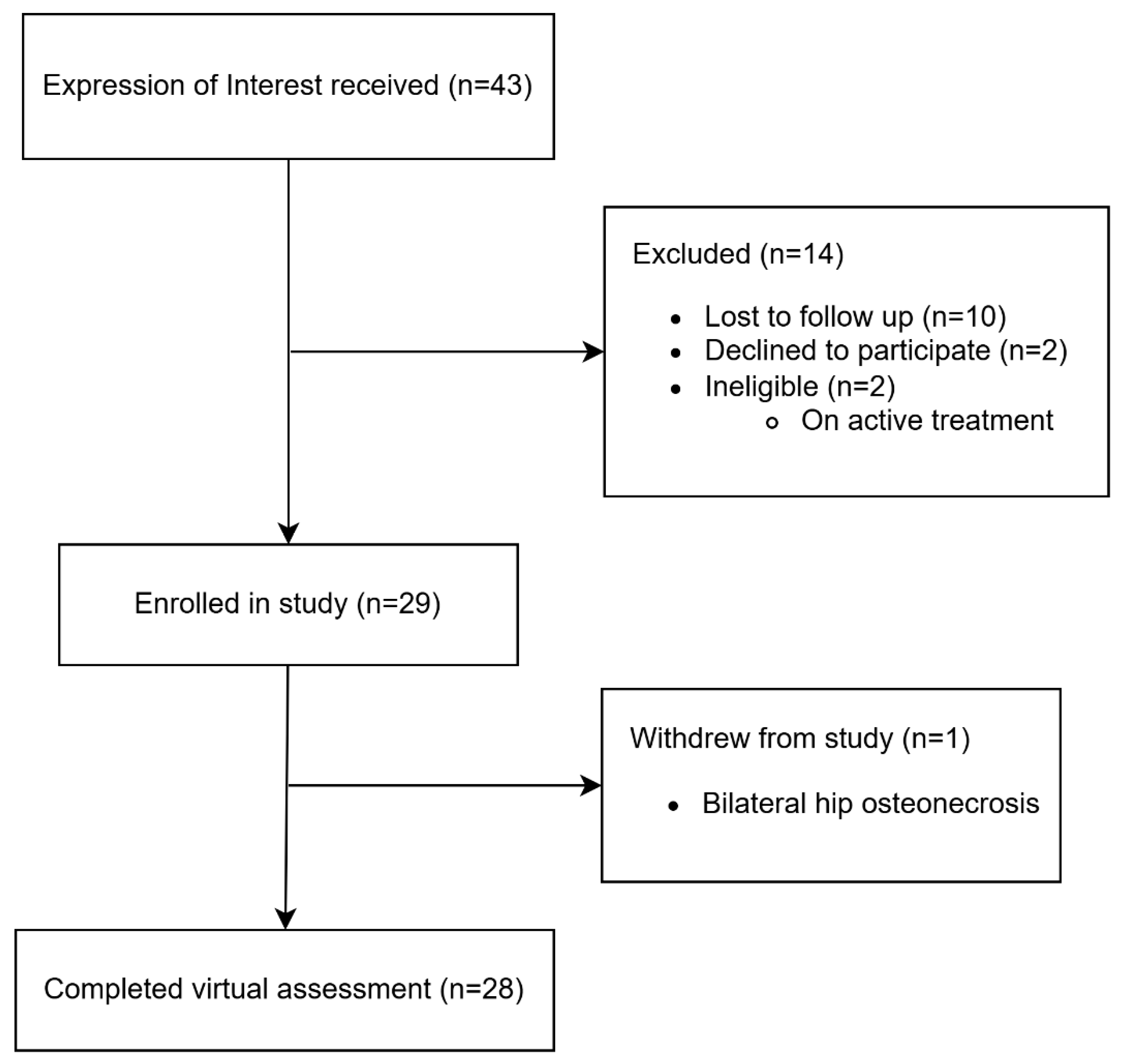
A total of 43 families completed an expression of interest through the Camp Quality study via newsletter promotion between March and September 2025 (Figure 1). Of these, two subsequently declined participation, two were ineligible due to being on active treatment, and 10 were lost to follow-up after three attempts to contact them, with the remaining 29 enrolled in the study. One enrolled participant withdrew prior to their virtual assessment and was not included in the analyses due to bilateral hip osteonecrosis, leaving 28 participants included in the final analysis. No participants discontinued mid-session.

3.4. Participant Characteristics

Participants (n = 28) had a mean age of 9.8 years (SD = 3.7; range = 5–16), with 61% male (Table 3). The most frequent diagnosis was acute lymphoblastic leukaemia (46%), and all participants had received chemotherapy, often in combination with surgery (61%) or radiotherapy (39%). The median time since completion of systemic treatment was 1.3 years (IQR = 0.5–6.3), with two participants (7%) still receiving maintenance chemotherapy at assessment. Most children presented with at least one comorbidity (89%), typically a single condition (75%). The most common comorbidities were anxiety (18%), asthma (7%), and depression (4%). Additional parent-reported conditions (21%) included neurodevelopmental disorders (e.g., ADHD, autism), endocrine or metabolic disturbances (e.g., hypothyroidism, adrenal insufficiency), and fatigue or coordination difficulties. The cohort was predominantly metropolitan (89%), with three participants residing outside major cities (n = 2 in regional centres, n = 1 in a small rural town).

3.5. Feasibility Outcomes and Assessment Performance

Recruitment exceeded the predefined benchmark, with 23 participants enrolled within the first three months (target ≥ 15, Table 4). Assessment battery completion was achieved by 26/28 participants (92.9%). Two participants (7.1%) completed five of the six assessments, and none discontinued mid-session.
Across all participants, 166/168 planned assessments (98.8%) were completed, exceeding the ≥90% benchmark. Technique fidelity, judged against predefined protocol criteria (Table 1), was achieved in 151 of 166 completed assessments (90.9%). Fidelity was highest for the single-leg balance and two-minute step tests (100%) and lowest for the push-up test (73%). Completion metrics include all planned assessments, whereas technique fidelity proportions were calculated only among successfully completed assessments. Most sessions (26/28; 92.9%) were completed within 30 min, with a median duration of 19.5 min (range = 15–33), meeting the ≥90% benchmark. No serious or minor adverse events occurred.
Completion and technique fidelity rates for each assessment are reported as follows. All participants completed the timed up-and-go, sit-to-stand, sit-and-reach, single-leg balance, and two-minute step tests, while 26 participants (92.9%) completed the push-up test. Technique fidelity was achieved for 26/28 timed up-and-go (92.9%), 25/28 sit-to-stand (89.3%), 25/28 sit-and-reach (89.3%), 19/26 push-up (73.1%), 28/28 single-leg balance (100%), and 28/28 two-minute step (100%) assessments.

3.6. Participant Acceptability Feedback

Open-ended acceptability feedback was obtained from nine families. Responses consistently highlighted practical convenience, child engagement in familiar environments, positive experiences, and perceived value beyond the assessment itself.
Families frequently highlighted the practical convenience of home-based sessions, describing reduced travel burden and greater scheduling flexibility. Comments included “Would rather do it at home over a hospital any day of the week” (MER01) and “If you’re in the city, it’s probably easier than going into the city with the other two kids…to get into the city this early is a bit tricky. It’s good.” (MER05), and “It’s easier to get online than to meet someone.” (MER22).
Parents also emphasised improved child engagement in familiar surroundings, noting that children were more cooperative and attentive when tested at home. One parent explained, “At home is good because…if she is familiar in this area, she is more likely to follow. But in a clinic or hospital…she is not really doing what they ask.” (MER04). Another reported, “He does psych appointments on telehealth so he’s fairly comfortable engaging.” (MER10).
Regarding participant experience, both parents and children described the sessions as straightforward and enjoyable, using terms such as “easy,” “good,” and “fun.” Typical comments included “Easy, great, totally fine” (MER01), “That was perfect—really fun actually” (MER06, parent), and “Pretty good, pretty easy, it wasn’t hard.” (MER25).
Finally, families noted benefits extending beyond the assessment itself, citing increased motivation for physical activity and opportunities for shared family participation. For instance, one parent remarked, “We’re pretty keen to keep him going and moving and build his fitness and flexibility back up,” while another added, “It’s good to be home and doing something together.” (MER06).

3.7. Missing Data and Exclusions

Minor item-level missing data occurred for technique fidelity outcomes, with two planned push-up assessments discontinued after repeated unsuccessful attempts to achieve correct technique and therefore excluded from fidelity denominators. No other protocol deviations occurred, no assessments were terminated for safety reasons, and all predefined feasibility benchmarks were evaluated using observed data without imputation. Qualitative feedback was obtained from nine families (32.1%), as the open-ended question was unintentionally omitted in several sessions.

3.8. Exploratory Analyses

Exploratory analyses descriptively examined associations between participant characteristics and feasibility outcomes, focusing on completion and technique fidelity. Participants who completed all six assessments were generally older than those who did not (median = 9.0 years vs. 5.0 years) and had a longer time since treatment completion (median = 1.7 years vs. 0.04 years). Given the very small number of non-completers (n = 2), these comparisons are descriptive, and no formal between-group statistical testing was performed.
When analysed continuously, child age demonstrated a positive correlation with overall technique fidelity (Spearman’s ρ = 0.61, p < 0.001). Time since treatment completion was positively but not significantly correlated with fidelity (ρ = 0.32, p = 0.092). At the individual assessment level, older age was associated with higher fidelity on the sit-to-stand (ρ = 0.43, p = 0.024) and push-up tests (ρ = 0.50, p = 0.010). Children who did not achieve correct form on the sit-to-stand (median = 5 years, IQR 5–6) and push-up tests (median = 7 years, IQR 5–8) were notably younger than those demonstrating correct technique (sit-to-stand median = 9 years, IQR 8–13; push-up median = 12 years, IQR 8–14). No significant associations were observed between time since treatment completion and any individual assessment (ρ = 0.23–0.27, all p > 0.05). Sex and diagnosis type were not associated with assessment completion or technique fidelity.

4. Discussion

This study evaluated the feasibility of delivering virtually supervised physical fitness assessments for survivors following completion of treatment. The findings demonstrate that these assessments can be implemented safely, efficiently, and with high procedural fidelity in the home environment. All predefined feasibility benchmarks were achieved: 23 participants were enrolled within three months, 92.9% completed the full assessment battery, 98.8% of planned assessments were completed, and 92.9% of sessions were conducted within 30 min, with no adverse events reported. These outcomes demonstrate that virtual physical fitness assessments are feasible and safe to deliver under supervised conditions in paediatric cancer survivorship.
Technique fidelity was achieved in 90.9% of all assessments, indicating that children were mostly able to follow structured movement instructions effectively under live virtual supervision. From the assessor’s perspective, verbal instruction and live visual demonstration were generally sufficient to explain correct performance, with occasional need for additional prompting related to camera positioning, attention, or task complexity. Slightly lower fidelity in the push-up (73.1%), sit-and-reach, and sit-to-stand (89.3%) tests may reflect higher task complexity and postural control demands.
Exploratory analyses supported this interpretation, showing a positive correlation between child age and overall technique, and significant associations for the sit-to-stand and push-up tests. Children who did not achieve fidelity on the sit-to-stand and push-up tests were notably younger than those demonstrating correct technique. This reduction in fidelity among younger participants (approximately 5–7 years) suggests that early school-aged children may require closer monitoring, repeated cues, or partial in-person supervision to optimise virtual test accuracy. These findings are consistent with developmental research suggesting continued maturation of strength, coordination, and postural control throughout late childhood and adolescence, with rapid neuromuscular and balance gains during puberty [53,54]. These associations should be interpreted as hypothesis-generating and reflective of feasibility considerations, rather than evidence of causal or developmental mechanisms.
Time since treatment completion showed a positive but non-significant relationship with fidelity, raising the possibility that time since treatment completion may be associated with performance quality, though this requires confirmation in adequately powered studies. This trend is consistent with prior studies reporting that motor and strength impairments immediately following paediatric cancer therapy improve gradually with increasing time in remission [55,56]. Notably, current paediatric exercise oncology guidelines do not prescribe a single optimal time point for conducting physical fitness assessments [23]. Rather, movement and assessment are recommended to be individualised and considered across the cancer continuum [23]. The combination of real-time professional supervision, pre-recorded instructional resources, and familiar home environments likely contributed to the overall high standard of test performance observed.
Qualitative feedback reinforced the quantitative findings, with families consistently describing the virtual sessions as convenient, engaging, and enjoyable. Participants reported reduced logistical burden, improved comfort, and a preference for home-based testing over hospital visits. Some families also noted broader benefits beyond the assessment itself, including increased motivation for PA and opportunities for shared family participation. This supports a broader interpretation of feasibility, one that incorporates emotional engagement, motivation, and family-centred value in addition to procedural benchmarks.
These findings align with and extend prior evidence demonstrating the feasibility and procedural reliability of virtually delivered physical fitness assessments across clinical populations. For example, in adults with chronic respiratory disease, virtual assessment of the one-minute sit-to-stand test demonstrated excellent agreement with in-person administration (ICC = 0.98) and negligible bias [57]. Similarly, Lavín-Pérez et al. (2023) [58] reported equivalent balance performance between remote and in-person conditions in adults with low back pain, highlighting the methodological robustness of home-based testing.
Comparable findings have been reported from other oncology studies. Hoenemeyer et al. (2022) [32] and Heslop et al. (2023) [31] found that remotely administered sit-to-stand, timed up-and-go, and flexibility tests produced comparable outcomes to face-to-face protocols in adult cancer survivors, accompanied by high adherence and procedural safety. Guidarelli et al. (2022) [59] further demonstrated excellent intra-rater reliability for remote timed up-and-go assessments (ICC ≈ 0.98) among older adults, reinforcing the broader applicability of mobility testing under virtual supervision. The present study’s high completion rates and strong technique fidelity are conceptually consistent with these previous findings.
Evidence from other paediatric settings further supports the feasibility of virtual assessments. Vendrusculo et al. (2024) [60] reported equivalent physiological and fatigue responses between remote and clinic-based step tests in children with cystic fibrosis, achieving 100% test completion and excellent caregiver acceptability. Lai et al. (2024) [34] similarly observed strong convergent validity for remote timed up-and-go, sit-to-stand, and handgrip assessments (ICC = 0.92–0.98) among children and adolescents with and without mobility disabilities. Together, these studies indicate that with structured instruction and supervision, children can safely and effectively perform standardised physical fitness assessments in home environments.
However, within paediatric oncology, feasibility data remain scarce. Lambert et al. (2021) [35] reported good adherence to virtual and telehealth-delivered exercise programs among survivors of acute lymphoblastic leukaemia, while identifying logistical barriers such as internet instability and limited device access, issues echoed by Klein et al. (2025) [36]. In the current study, collaboration with a childhood cancer community organisation likely facilitated recruitment and engagement by introducing the study through trusted community-based networks. This community partnership model may represent a promising strategy for engaging families who are traditionally under-represented in survivorship research. The findings also build on those of Schmidt-Andersen et al. (2025) [49], who demonstrated the feasibility and safety of in-person physical fitness assessments during active treatment in paediatric oncology. By extending these principles to a fully virtual format in the post-treatment phase, the present study suggests that structured, exercise physiology-led assessments can feasibly support children across different treatment stages and delivery modalities. This evidence situates the current study within a growing body of work supporting virtually supervised physical fitness assessments as a viable model for ongoing functional monitoring in childhood cancer survivorship.
From a clinical perspective, the feasibility outcomes observed in this study highlight considerations relevant to future implementation of virtual physical fitness assessments within survivorship care. Many survivors face persistent barriers to in-person evaluations due to travel demands, time constraints, and limited access to exercise professionals with oncology expertise [26,27,29]. Virtual physical fitness assessments may offer a feasible option for monitoring physical function in survivorship care, pending validation of measurement equivalence and clinical utility. Notably, no participants discontinued mid-session, and no adverse events occurred, reflecting the high procedural safety and tolerability of the virtual assessment model. These outcomes provide preliminary feasibility evidence relevant to future implementation research. Additionally, several families reported enjoying the process, suggesting that virtual assessments may offer value beyond functional testing. This aligns with principles of family-centred care and may provide psychosocial benefits in survivorship contexts.
A strength of this study lies in its systematic application of an established feasibility framework encompassing recruitment, retention, technique fidelity, safety, and acceptability [49] for in-person paediatric oncology trials. Adapting these metrics to a virtual context enabled direct procedural comparison and a robust evaluation of implementation success. The use of the CONSORT 2016 extension for pilot and feasibility trials [39] ensured transparent reporting and reproducibility, aligning this study with contemporary methodological standards. Multimedia instructional supports, including pre-recorded videos, infographics, and live verbal cueing, were integral to maintaining procedural fidelity across diverse home environments. The assessment battery’s simplicity and minimal equipment requirements further reduced participant burden, promoting accessibility for families with varying resources. The active presence of adult family members provided both safety oversight and emotional reassurance, consistent with family-centred care principles that emphasise shared responsibility and empowerment in paediatric rehabilitation.
Several limitations should be considered when interpreting these findings. First, recruitment was conducted through a childhood cancer charity, which may have introduced selection bias by preferentially engaging families who are more motivated, digitally literate, or positively disposed toward exercise and research participation. As a result, feasibility outcomes observed in this study may overestimate acceptability and completion relative to the broader childhood cancer survivor population. Second, the wide age range included (5–18 years) spans multiple developmental stages, which may affect the suitability and consistency of the assessment battery. As suggested by exploratory findings, younger children demonstrated lower technique fidelity for selected assessments, indicating that additional adaptation, supervision, or age-specific protocols may be required to optimise feasibility and accuracy across developmental stages. As a feasibility sub-study, the sample size was modest and not powered to evaluate efficacy, reliability, or between-group differences. The absence of an in-person comparator prevents conclusions regarding the validity of virtual assessment scores and limits interpretation of performance outcomes in clinical contexts. Although a concurrent in-person comparator would have strengthened validity inference, this was not feasible due to the national recruitment strategy, long travel distances, and the absence of routine post-treatment clinic visits for many survivors. Future research incorporating concurrent in-person and virtual assessments is therefore required to establish criterion validity and measurement equivalence.
Technique fidelity was assessed by a single rater, introducing potential observer bias; incorporation of blinded secondary raters or automated video-analysis methods may improve objectivity in future studies. Environmental variability inherent to home-based testing—including differences in chair height, floor surface, lighting, and camera positioning—may also have influenced performance or scoring accuracy, as is commonly reported in telehealth research [30,36]. In addition, the assessment order was not randomised, which may have introduced minor order or fatigue effects; standardised environmental setup and sequencing guidelines may help mitigate these issues in future trials. Qualitative data collection was brief and opportunistic, intended as preliminary acceptability feedback rather than in-depth qualitative analysis, limiting the breadth and depth of participant perspectives. As feedback was solicited by the same assessor who conducted the assessments in a live online setting, responses may have been influenced by social desirability and should be interpreted cautiously as indicative of acceptability rather than robust qualitative evidence. Finally, the sample was predominantly metropolitan, with limited representation from regional or rural areas, restricting generalisability across geographic and digital-divide contexts. Although virtual models may help address travel-related barriers, digital inequities related to connectivity, device access, and caregiver support may persist if not proactively addressed. Broader recruitment strategies targeting rural and socioeconomically diverse populations are needed to assess equity and generalisability. Building upon this feasibility foundation, future research should investigate the validation and standardisation of virtual physical fitness assessments in paediatric oncology. Large, multicentre trials are required to evaluate measurement reliability, sensitivity to change, and criterion validity against established in-person tests. Including diverse subgroups, across age, diagnosis, treatment type, and geography, will enhance generalisability. Expanding the test battery to encompass cardiorespiratory endurance, agility, and reaction time could provide a more comprehensive profile of functional capacity. Qualitative and participatory research should be integrated to explore user experience, technology usability, and contextual barriers to adoption. In-depth interviews with parents, children, and clinicians may reveal factors that influence motivation, engagement, and sustained participation in virtual testing. These insights could inform the co-design of user-centred platforms tailored to family needs.
Digital integration also presents opportunities for scale-up. Wearable devices and accelerometer-based monitoring can complement virtual assessments by capturing habitual physical activity and recovery trends. Advances in artificial intelligence, such as pose estimation software, exemplified in the PLATINUMS project [61], may enable automated movement scoring, reducing assessor burden and improving standardisation. Hybrid models combining initial in-person assessments with virtual follow-up may strike an optimal balance between accessibility, safety, and data accuracy. To ensure scalability and equity, future implementation frameworks should incorporate universal technical support, low-bandwidth options, and device access programs to address the digital divide. Development of consensus-based virtual assessment protocols, including setup checklists, camera-angle standards, and real-time safety procedures, will be critical for integration into clinical practice and future trials.

5. Conclusions

This study provides novel feasibility evidence supporting the safe, acceptable, and logistically viable delivery of real-time, virtually supervised physical fitness assessments for childhood cancer survivors aged 5–18 years following treatment completion. All predefined feasibility benchmarks were met, with high assessment completion, strong technique fidelity, and no adverse events observed. Participant feedback indicated high acceptability of the virtual format, reinforcing its feasibility in this context. By establishing feasibility and safety, this study lays the groundwork for future research to evaluate the validity, effectiveness, and implementation potential of virtual physical fitness assessments in paediatric oncology. While virtual delivery may have the potential to address logistical barriers associated with in-person assessments, such as travel and scheduling demands, these outcomes were not directly evaluated in the present study. Further research is therefore required before broader clinical implementation can be recommended.

Author Contributions

D.M. conceived and received funding to support the study. All authors contributed to the study design. D.M. drafted the protocol with input from all authors. A.O. led the study analysis with supervision from D.M. A.O. led the manuscript with supervision from D.M. and input from all authors. All authors have read and agreed to the published version of the manuscript.

Funding

David Mizrahi and Lauren Ha are supported by fellowships from The Kids Cancer Project. Alexandra Martiniuk was supported by an Australian National Health and Medical Research Council (NHMRC) Investigator Grant (ID: APP1195086). Ben Smith is supported by a Cancer Institute NSW Career Development Fellowship (2021/CDF1138).

Institutional Review Board Statement

The study was approved by the University of Sydney Health Research Ethics Committee (2024/HE000391) on 1 July 2024.

Informed Consent Statement

Informed consent was obtained from all participants.

Data Availability Statement

Data is available upon reasonable request.

Acknowledgments

Thank you to all the survivors and parents, as well as staff from Camp Quality, who provided feedback on the design of this study.

Conflicts of Interest

The authors have no competing interests to declare that are relevant to the content of this article.

References

  1. Ries, L.A.G.; Smith, M.A.; Gurney, J.G.; Linet, M.S.; Tamra, T.; Young, J.L.; Bunin, G.R. Cancer Incidence and Survival Among Children and Adolescents: United States SEER Program 1975–1995; National Cancer Institute: Bethesda, MD, USA, 1999.
  2. Miller, K.D.; Fidler-Benaoudia, M.; Keegan, T.H.; Hipp, H.S.; Jemal, A.; Siegel, R.L. Cancer statistics for adolescents and young adults, 2020. CA Cancer J. Clin. 2020, 70, 443–459. [Google Scholar] [CrossRef]
  3. Erdmann, F.; Frederiksen, L.E.; Bonaventure, A.; Mader, L.; Hasle, H.; Robison, L.L.; Winther, J.F. Childhood cancer: Survival, treatment modalities, late effects and improvements over time. Cancer Epidemiol. 2021, 71, 101733. [Google Scholar] [CrossRef]
  4. Morales, J.S.; Valenzuela, P.L.; Velázquez-Díaz, D.; Castillo-García, A.; Jiménez-Pavón, D.; Lucia, A.; Fiuza-Luces, C. Exercise and Childhood Cancer-A Historical Review. Cancers 2021, 14, 82. [Google Scholar] [CrossRef]
  5. Bhatia, S.; Tonorezos, E.S.; Landier, W. Clinical Care for People Who Survive Childhood Cancer: A Review. JAMA 2023, 330, 1175–1186. [Google Scholar] [CrossRef]
  6. Chow, E.J.; Chen, Y.; Kremer, L.C.; Breslow, N.E.; Hudson, M.M.; Armstrong, G.T.; Border, W.L.; Feijen, E.A.; Green, D.M.; Meacham, L.R.; et al. Individual prediction of heart failure among childhood cancer survivors. J. Clin. Oncol. 2015, 33, 394–402. [Google Scholar] [CrossRef] [PubMed]
  7. Nottage, K.A.; Ness, K.K.; Li, C.; Srivastava, D.; Robison, L.L.; Hudson, M.M. Metabolic syndrome and cardiovascular risk among long-term survivors of acute lymphoblastic leukaemia—From the St. Jude Lifetime Cohort. Br. J. Haematol. 2014, 165, 364–374. [Google Scholar] [CrossRef] [PubMed]
  8. Morales, J.S.; Valenzuela, P.L.; Rincón-Castanedo, C.; Santos-Lozano, A.; Fiuza-Luces, C.; Lucia, A. Is health status impaired in childhood cancer survivors? A systematic review and meta-analysis. Crit. Rev. Oncol. Hematol. 2019, 142, 94–118. [Google Scholar] [CrossRef]
  9. Oeffinger, K.C.; Mertens, A.C.; Sklar, C.A.; Kawashima, T.; Hudson, M.M.; Meadows, A.T.; Friedman, D.L.; Marina, N.; Hobbie, W.; Kadan-Lottick, N.S.; et al. Chronic health conditions in adult survivors of childhood cancer. N. Engl. J. Med. 2006, 355, 1572–1582. [Google Scholar] [CrossRef] [PubMed]
  10. Armstrong, G.T.; Kawashima, T.; Leisenring, W.; Stratton, K.; Stovall, M.; Hudson, M.M.; Sklar, C.A.; Robison, L.L.; Oeffinger, K.C. Aging and risk of severe, disabling, life-threatening, and fatal events in the childhood cancer survivor study. J. Clin. Oncol. 2014, 32, 1218–1227. [Google Scholar] [CrossRef]
  11. Arroyave, W.D.; Clipp, E.C.; Miller, P.E.; Jones, L.W.; Ward, D.S.; Bonner, M.J.; Rosoff, P.M.; Snyder, D.C.; Demark-Wahnefried, W. Childhood cancer survivors’ perceived barriers to improving exercise and dietary behaviors. Oncol. Nurs. Forum 2008, 35, 121–130. [Google Scholar] [CrossRef]
  12. Bogg, T.F.; Shaw, P.J.; Cohn, R.J.; Wakefield, C.E.; Hardy, L.L.; Broderick, C.; Naumann, F. Physical activity and screen-time of childhood haematopoietic stem cell transplant survivors. Acta Paediatr. 2015, 104, e455–e459. [Google Scholar] [CrossRef]
  13. Lown, E.A.; Hijiya, N.; Zhang, N.; Srivastava, D.K.; Leisenring, W.M.; Nathan, P.C.; Castellino, S.M.; Devine, K.A.; Dilley, K.; Krull, K.R.; et al. Patterns and predictors of clustered risky health behaviors among adult survivors of childhood cancer: A report from the Childhood Cancer Survivor Study. Cancer 2016, 122, 2747–2756. [Google Scholar] [CrossRef]
  14. Mizrahi, D.; Wakefield, C.E.; Simar, D.; Ha, L.; McBride, J.; Field, P.; Cohn, R.J.; Fardell, J.E. Barriers and enablers to physical activity and aerobic fitness deficits among childhood cancer survivors. Pediatr. Blood Cancer 2020, 67, e28339. [Google Scholar] [CrossRef] [PubMed]
  15. Spathis, A.; Hatcher, H.; Booth, S.; Gibson, F.; Stone, P.; Abbas, L.; Barclay, M.; Brimicombe, J.; Thiemann, P.; McCabe, M.G.; et al. Cancer-Related Fatigue in Adolescents and Young Adults After Cancer Treatment: Persistent and Poorly Managed. J. Adolesc. Young Adult Oncol. 2017, 6, 489–493. [Google Scholar] [CrossRef] [PubMed]
  16. Ness, K.K.; Mertens, A.C.; Hudson, M.M.; Wall, M.M.; Leisenring, W.M.; Oeffinger, K.C.; Sklar, C.A.; Robison, L.L.; Gurney, J.G. Limitations on physical performance and daily activities among long-term survivors of childhood cancer. Ann. Intern. Med. 2005, 143, 639–647. [Google Scholar] [CrossRef]
  17. Söntgerath, R.; Eckert, K. Impairments of Lower Extremity Muscle Strength and Balance in Childhood Cancer Patients and Survivors: A Systematic Review. Pediatr. Hematol. Oncol. 2015, 32, 585–612. [Google Scholar] [CrossRef] [PubMed]
  18. van Brussel, M.; Takken, T.; Lucia, A.; van der Net, J.; Helders, P.J. Is physical fitness decreased in survivors of childhood leukemia? A systematic review. Leukemia 2005, 19, 13–17. [Google Scholar] [CrossRef]
  19. Raghuveer, G.; Hartz, J.; Lubans, D.R.; Takken, T.; Wiltz, J.L.; Mietus-Snyder, M.; Perak, A.M.; Baker-Smith, C.; Pietris, N.; Edwards, N.M. Cardiorespiratory Fitness in Youth: An Important Marker of Health: A Scientific Statement from the American Heart Association. Circulation 2020, 142, e101–e118. [Google Scholar] [CrossRef]
  20. Smith, J.J.; Eather, N.; Morgan, P.J.; Plotnikoff, R.C.; Faigenbaum, A.D.; Lubans, D.R. The health benefits of muscular fitness for children and adolescents: A systematic review and meta-analysis. Sports Med. 2014, 44, 1209–1223. [Google Scholar] [CrossRef]
  21. Campbell, K.L.; Winters-Stone, K.M.; Wiskemann, J.; May, A.M.; Schwartz, A.L.; Courneya, K.S.; Zucker, D.S.; Matthews, C.E.; Ligibel, J.A.; Gerber, L.H.; et al. Exercise Guidelines for Cancer Survivors: Consensus Statement from International Multidisciplinary Roundtable. Med. Sci. Sports Exerc. 2019, 51, 2375–2390. [Google Scholar] [CrossRef]
  22. Gauß, G.; Beller, R.; Boos, J.; Däggelmann, J.; Stalf, H.; Wiskemann, J.; Götte, M. Adverse Events During Supervised Exercise Interventions in Pediatric Oncology—A Nationwide Survey. Front. Pediatr. 2021, 9, 682496. [Google Scholar] [CrossRef]
  23. Wurz, A.; McLaughlin, E.; Lategan, C.; Chamorro Viña, C.; Grimshaw, S.L.; Hamari, L.; Götte, M.; Kesting, S.; Rossi, F.; van der Torre, P.; et al. The international Pediatric Oncology Exercise Guidelines (iPOEG). Transl. Behav. Med. 2021, 11, 1915–1922. [Google Scholar] [CrossRef] [PubMed]
  24. Verweij, N.M.; Schiphorst, A.H.; Pronk, A.; van den Bos, F.; Hamaker, M.E. Physical performance measures for predicting outcome in cancer patients: A systematic review. Acta Oncol. 2016, 55, 1386–1391. [Google Scholar] [CrossRef] [PubMed]
  25. Thompson, P.D.; Arena, R.; Riebe, D.; Pescatello, L.S. ACSM’s new preparticipation health screening recommendations from ACSM’s guidelines for exercise testing and prescription, ninth edition. Curr. Sports Med. Rep. 2013, 12, 215–217. [Google Scholar] [CrossRef] [PubMed]
  26. Kennedy, M.A.; Bayes, S.; Newton, R.U.; Zissiadis, Y.; Spry, N.A.; Taaffe, D.R.; Hart, N.H.; Galvão, D.A. Implementation barriers to integrating exercise as medicine in oncology: An ecological scoping review. J. Cancer Surviv. 2022, 16, 865–881. [Google Scholar] [CrossRef]
  27. McLoone, J.K.; Sansom-Daly, U.M.; Paglia, A.; Chia, J.; Larsen, H.B.; Fern, L.A.; Cohn, R.J.; Signorelli, C. A Scoping Review Exploring Access to Survivorship Care for Childhood, Adolescent, and Young Adult Cancer Survivors: How Can We Optimize Care Pathways? Adolesc. Health Med. Ther. 2023, 14, 153–174. [Google Scholar] [CrossRef]
  28. Robertson, L.; Richards, R.; Egan, R.; Szymlek-Gay, E.A. Promotion and support of physical activity among cancer survivors: A service provider perspective. Psychooncology 2013, 22, 441–446. [Google Scholar] [CrossRef]
  29. Signorelli, C.; Fardell, J.E.; Wakefield, C.E.; Webber, K.; Cohn, R.J. The Cost of Cure: Chronic Conditions in Survivors of Child, Adolescent, and Young Adult Cancers. In Cancer and Chronic Conditions: Addressing the Problem of Multimorbidity in Cancer Patients and Survivors; Koczwara, B., Ed.; Springer: Singapore, 2016; pp. 371–420. [Google Scholar] [CrossRef]
  30. Buckinx, F.; Rezoulat, M.; Lefranc, C.; Reginster, J.-Y.; Bruyere, O. Comparing remote and face-to-face assessments of physical performance in older adults: A reliability study. Geriatr Nurs. 2024, 55, 71–78. [Google Scholar] [CrossRef]
  31. Heslop, P.A.; Hurst, C.; Sayer, A.A.; Witham, M.D. Remote collection of physical performance measures for older people: A systematic review. Age Ageing 2023, 52, afac327. [Google Scholar] [CrossRef]
  32. Hoenemeyer, T.W.; Cole, W.W.; Oster, R.A.; Pekmezi, D.W.; Pye, A.; Demark-Wahnefried, W. Test/Retest Reliability and Validity of Remote vs. In-Person Anthropometric and Physical Performance Assessments in Cancer Survivors and Supportive Partners. Cancers 2022, 14, 1075. [Google Scholar] [CrossRef]
  33. Lee, K.; Shamunee, J.; Lindenfeld, L.; Ross, E.; Hageman, L.; Sedrak, M.S.; Wong, F.L.; Nakamura, R.; Forman, S.J.; Bhatia, S.; et al. Feasibility of implementing a supervised telehealth exercise intervention in frail survivors of hematopoietic cell transplantation: A pilot randomized trial. BMC Cancer 2023, 23, 390. [Google Scholar] [CrossRef]
  34. Lai, B.; Wadsworth, D.; Spring, K.; Jones, C.S.; Mintz, M.; Malone, L.A.; Kim, Y.; Wilroy, J.; Lee, H. Validity and Reliability of a Telehealth Physical Fitness and Functional Assessment Battery for Ambulatory Youth with and without Mobility Disabilities: Observational Measurement Study. JMIR Rehabil. Assist. Technol. 2024, 11, e50582. [Google Scholar] [CrossRef]
  35. Lambert, G.; Alos, N.; Bernier, P.; Laverdière, C.; Kairy, D.; Drummond, K.; Dahan-Oliel, N.; Lemay, M.; Veilleux, L.-N. Home-Based Telehealth Exercise Intervention in Early-On Survivors of Childhood Acute Lymphoblastic Leukemia: Feasibility Study. JMIR Cancer 2021, 7, e25569. [Google Scholar] [CrossRef]
  36. Klein, T.; Worth, A.; Niessner, C.; Hanssen-Doose, A. Remote assessment of physical fitness via videoconferencing: A systematic review. BMC Sports Sci. Med. Rehabil. 2025, 17, 11. [Google Scholar] [CrossRef]
  37. Maharaj, A.; Jefferies, J.L.; Mulrooney, D.A.; Armstrong, G.T.; Brinkman, T.M.; O’Neil, S.T.; Terrell, S.; Partin, R.E.; Srivastava, D.K.; Hudson, M.M.; et al. Design and methods of a randomized telehealth-based intervention to improve fitness in survivors of childhood cancer with exercise intolerance. Contemp. Clin. Trials 2023, 133, 107339. [Google Scholar] [CrossRef]
  38. Mizrahi, D.; Martiniuk, A.; Hibbert, L.; Govender, D.; Sibbald, T.; Mitchell, R.; Millard, N.; Ha, L.; Ragusa, D.; Brown, K.; et al. Implementing an online-delivered exercise program for childhood cancer survivors: A hybrid effectiveness-implementation protocol for the MERRIER study. JSAMS Plus 2025, 5, 100095. [Google Scholar] [CrossRef] [PubMed]
  39. Eldridge, S.M.; Chan, C.L.; Campbell, M.J.; Bond, C.M.; Hopewell, S.; Thabane, L.; Lancaster, G.A. CONSORT 2010 statement: Extension to randomised pilot and feasibility trials. BMJ 2016, 355, i5239. [Google Scholar] [CrossRef] [PubMed]
  40. Lancaster, G.A.; Thabane, L. Guidelines for reporting non-randomised pilot and feasibility studies. Pilot. Feasibility Stud. 2019, 5, 114. [Google Scholar] [CrossRef] [PubMed]
  41. Beetham, K.; Booth, V.; Furzer, B.; Reid, R.; Ton, T.; Willis, C.; Wright, K. Evaluating the feasibility of a Pre-Exercise Screening System for Young People. J. Sci. Med. Sport 2021, 24, S34–S35. [Google Scholar] [CrossRef]
  42. Wang, T.H.; Liao, H.F.; Peng, Y.C. Reliability and validity of the five-repetition sit-to-stand test for children with cerebral palsy. Clin. Rehabil. 2012, 26, 664–671. [Google Scholar] [CrossRef]
  43. Itzkowitz, A.; Kaplan, S.; Doyle, M.; Weingarten, G.; Lieberstein, M.; Covino, F.; Vialu, C. Timed Up and Go: Reference Data for Children Who Are School Age. Pediatr. Phys. Ther. 2016, 28, 239–246. [Google Scholar] [CrossRef]
  44. Sember, V.; Grošelj, J.; Pajek, M. Balance Tests in Pre-Adolescent Children: Retest Reliability, Construct Validity, and Relative Ability. Int. J. Environ. Res. Public Health 2020, 17, 5474. [Google Scholar] [CrossRef] [PubMed]
  45. Baumgartner, T.A.; Oh, S.; Chung, H.; Hales, D. Objectivity, Reliability, and Validity for a Revised Push-Up Test Protocol. Meas. Phys. Educ. Exerc. Sci. 2002, 6, 225–242. [Google Scholar] [CrossRef] [PubMed]
  46. Mayorga-Vega, D.; Merino-Marban, R.; Viciana, J. Criterion-Related Validity of Sit-and-Reach Tests for Estimating Hamstring and Lumbar Extensibility: A Meta-Analysis. J. Sports Sci. Med. 2014, 13, 1–14. [Google Scholar] [PubMed]
  47. Rikli, R.E.; Jones, C.J. Functional Fitness Normative Scores for Community-Residing Older Adults, Ages 60–94. J. Aging Phys. Act. 1999, 7, 162–181. [Google Scholar] [CrossRef]
  48. Williams, N. The Borg Rating of Perceived Exertion (RPE) scale. Occup. Med. 2017, 67, 404–405. [Google Scholar] [CrossRef]
  49. Schmidt-Andersen, P.; Pouplier, A.; Faigenbaum, A.D.; Beth, C.K.; Olsen, C.C.; Lykkedegn, S.; Hasle, H.; Müller, K.; Larsen, H.B.; Fridh, M.; et al. Evaluating Feasibility of an Exercise Intervention Including Physical Assessment During the First 6 Months of Cancer Treatment in Children and Adolescents in a Randomized Controlled Trial. Pediatr. Blood Cancer 2025, 72, e31498. [Google Scholar] [CrossRef]
  50. Harris, P.A.; Taylor, R.; Thielke, R.; Payne, J.; Gonzalez, N.; Conde, J.G. Research electronic data capture (REDCap)—A metadata-driven methodology and workflow process for providing translational research informatics support. J. Biomed. Inform. 2009, 42, 377–381. [Google Scholar] [CrossRef]
  51. Maleyeff, L.; Leclair, V.; Golchi, S.; Hudson, M. The efficiencies of pilot feasibility trials in rare diseases using Bayesian methods. arXiv 2025. [Google Scholar] [CrossRef]
  52. PoCoG. Accessibility/Remoteness Index of Australia (ARIA); University of Sydney Psycho-Oncology Co-operative Research Group: Camperdown, Australia, 2012. [Google Scholar]
  53. Yapici, H.; Gulu, M.; Yagin, F.H.; Eken, O.; Gabrys, T.; Knappova, V. Exploring the Relationship between Biological Maturation Level, Muscle Strength, and Muscle Power in Adolescents. Biology 2022, 11, 1722. [Google Scholar] [CrossRef]
  54. Micarelli, A.; Viziano, A.; Augimeri, I.; Micarelli, B.; Alessandrini, M. Age-related Assessment of Postural Control Development: A Cross-sectional Study in Children and Adolescents. J. Mot. Behav. 2020, 52, 418–426. [Google Scholar] [CrossRef]
  55. Keiser, T.; Gaser, D.; Peters, C.; Oberhoffer-Fritz, R.; Kesting, S.; von Luettichau, I. Short-Term Consequences of Pediatric Anti-cancer Treatment Regarding Blood Pressure, Motor Performance, Physical Activity and Reintegration into Sports Structures. Front. Pediatr. 2020, 8, 463. [Google Scholar] [CrossRef] [PubMed]
  56. Goebel, A.M.; Koustenis, E.; Rueckriegel, S.M.; Pfuhlmann, L.; Brandsma, R.; Sival, D.; Skarabis, H.; Schuelke, M.; Hernáiz Driever, P. Motor function in survivors of pediatric acute lymphoblastic leukemia treated with chemotherapy-only. Eur. J. Paediatr. Neurol. 2019, 23, 304–316. [Google Scholar] [CrossRef] [PubMed]
  57. Larrateguy, S.; Otto-Yáñez, M.; Bogado, J.; Larrateguy, L.; Barros-Poblete, M.; Mazzucco, G.; Blanco, I.; Gimeno-Santos, E.; Torres-Castro, R. Agreement and Reliability Between Tele-Assessment and In-Person Assessment of the One-Minute Sit-to-Stand Test in Patients with Chronic Respiratory Diseases. J. Clin. Med. 2025, 14, 5049. [Google Scholar] [CrossRef]
  58. Lavín-Pérez, A.M.; León-Llamas, J.L.; Salas Costilla, F.J.; Collado-Mateo, D.; López de Las Heras, R.; Gasque Celma, P.; Villafaina, S. Validity of On-Line Supervised Fitness Tests in People with Low Back Pain. Healthcare 2023, 11, 1019. [Google Scholar] [CrossRef]
  59. Guidarelli, C.; Lipps, C.; Stoyles, S.; Dieckmann, N.F.; Winters-Stone, K.M. Remote administration of physical performance tests among persons with and without a cancer history: Establishing reliability and agreement with in-person assessment. J. Geriatr. Oncol. 2022, 13, 691–697. [Google Scholar] [CrossRef]
  60. Vendrusculo, F.M.; da Costa, G.A.; Bagatini, M.A.; Lemes, B.; Faria, C.A.; de Oliveira, L.C.; Aquino, E.D.S.; Donadio, M.V.F. Feasibility of performing the 3-minute step test with remote supervision in children and adolescents with cystic fibrosis: A comparative study. Pediatr. Investig. 2024, 8, 83–90. [Google Scholar] [CrossRef] [PubMed]
  61. Hvid, L.; Coote, S.; Pau, M.; Kalron, A. An AI-Based Telerehabilitation Solution to Improve Mobility in People with Multiple Sclerosis (the PLATINUMS Project): Protocol for an Implementation and Evaluation Study. JMIR Res. Protoc. 2025, 14, e75983. [Google Scholar] [CrossRef]
Figure 1. CONSORT-style participant flow diagram showing the number of families who completed an expression of interest, enrolled, and were analysed, with reasons for exclusion.
Physiologia 06 00032 g001
Table 1. Summary of physical fitness assessment protocols.
Physical Fitness AssessmentProtocol
Sit-to-Stand Test (30 s)Assesses lower-body strength and endurance by counting repetitions performed in 30 s [42]. Participants used a stable, armless chair (~43 cm seat height) or similar if unavailable, sitting upright with feet flat and arms crossed.
Timed Up-and-Go TestAssesses functional mobility and dynamic balance by timing the participant rising from a chair, walking 3 m, turning, returning, and sitting down [43]. Two trials were performed, and the mean was recorded using a handheld stopwatch.
Single-Leg Balance TestAssesses static balance in eyes-open and eyes-closed conditions [44]. Each leg was tested twice, and the highest score (seconds balanced, up to 30 s) was recorded. Trials ended if arms uncrossed, legs touched, or posture was lost. Brief re-attempts were permitted if balance was lost immediately after trial initiation.
Push-Up Test (30 s)Assesses upper-body endurance by counting repetitions performed in 30 s [45]. Participants performed either full push-ups (toes on ground, legs straight) or modified push-ups (knees on ground). Assessments were discontinued if correct technique could not be achieved after repeated instruction.
Sit-and-Reach Test Assesses flexibility of the hamstrings and lower back [46]. Participants sat with legs extended, shoes off, and reached forward along a ruler or sit-and-reach box. Distance in cm was recorded relative to the toes; positive values indicated reaching beyond the toes, whereas negative values indicated being short of the toes.
Two-Minute Step Test Assesses aerobic endurance by marching in place for two minutes [47]. Target knee height was set at the midpoint between the patella and iliac crest. Steps with the right leg were counted, and rate of perceived exertion (1–10) recorded post-test [48].
Note. m = metres; s = seconds; cm = centimetres. All assessments were delivered under live virtual supervision; protocol adaptations specific to the virtual setting are noted where applicable.
Table 2. Predefined feasibility outcomes and benchmarks.
DomainBenchmark
Recruitment≥15 participants enrolled within the first three months.
Assessment battery completion≥85% of participants complete the full six-test assessment battery.
Individual assessment completion≥90% of all planned individual physical fitness assessments completed.
Technique fidelity≥85% of assessments performed with correct technique, as judged by the supervising Accredited Exercise Physiologist during live or recorded observation against predefined exercise protocol criteria.
Session duration≥90% of sessions completed in ≤30 min.
SafetyNo serious adverse events; minor issues were documented descriptively if they occurred. Adverse events were defined as any injury, symptom exacerbation, or medical event occurring during or immediately following the assessment.
Participant satisfactionQualitative reporting of participant and/or parent/guardian feedback (open-ended responses).
Table 3. Baseline participant characteristics (n = 28).
Mean (SD); Range
Age, years9.8 (3.7); 5–16
median (IQR); range
Time since treatment completion, years1.3 (0.5–6.3); 0–15.3
n (%)
Sex
Male17 (60.7)
Female11 (39.3)
Primary diagnosis
Acute lymphoblastic leukaemia13 (46.4)
Rhabdomyosarcoma3 (10.7)
Bone cancer (incl. osteosarcoma/Ewing sarcoma)2 (7.1)
Brain/spinal cord tumours2 (7.1)
Neuroblastoma2 (7.1)
Wilms tumour2 (7.1)
Acute myeloid leukaemia1 (3.6)
Other3 (10.7)
Treatment received 1
Chemotherapy28 (100)
Surgery17 (60.7)
Radiotherapy11 (39.3)
Stem cell transplant5 (17.9)
Other 21 (3.6)
Maintenance chemotherapy during study
Yes2 (7.1)
No26 (92.9)
Comorbidities (parent-reported)
03 (10.7)
121 (75.0)
23 (10.7)
≥31 (3.6)
Residential location 3
Metropolitan25 (89.3)
Non-metropolitan3 (10.7)
Note. SD = standard deviation; IQR = interquartile range; n = number of participants. 1 Participants could receive more than one treatment; percentages may not total 100%. 2 “Other” treatment refers to one participant who underwent clinical trial therapy for chronic graft-versus-host disease. 3 Residential classification based on ARIA (metropolitan vs. non-metropolitan) categories.
Table 4. Feasibility outcomes compared with predefined benchmarks.
DomainObserved OutcomeBenchmarkAchieved (Y/N)
Recruitment23 participants (within three months)≥15 within three monthsY
Assessment battery completion26/28 participants (92.9%)≥85%Y
Individual assessment completion166/168 assessments (98.8%)≥90%Y
Technique fidelity 1151/166 assessments (90.9%)≥85%Y
Duration26/28 participants (92.9%) ≤ 30 min
Median 19.5 min (range 15–33)
≥90%Y
Safety0 serious AEs; 0 minor AEs0 serious AEsY
Note. Y = yes; N = no; AE = adverse event. 1 The denominator for technique fidelity outcomes excludes two push-up assessments that were discontinued prior to completion and therefore could not be evaluated.
Disclaimer/Publisher’s Note: The statements, opinions and data contained in all publications are solely those of the individual author(s) and contributor(s) and not of MDPI and/or the editor(s). MDPI and/or the editor(s) disclaim responsibility for any injury to people or property resulting from any ideas, methods, instructions or products referred to in the content.