Brief Report

Excess Post-Exercise Oxygen Consumption in Master Swimmers: Age and Performance Effects

by
Cássia Daniele Zaleski Trindade
1,
Cláudia Dornelles Schneider
2,
Rodrigo Zacca
3,4,5,
Sofia Monteiro
6,7,
Ricardo J. Fernandes
6,7,* and
Flávio Antônio de Souza Castro
1
1
Aquatic Sports Research Group, Universidade Federal do Rio Grande do Sul, Felizardo St., 750, Porto Alegre 90010-150, RS, Brazil
2
Graduate Program on Rehabilitation Sciences, Universidade Federal de Ciências da Saúde de Porto Alegre, Sarmento Leite St., 245, Porto Alegre 90050-170, RS, Brazil
3
Research Centre in Physical Activity, Health and Leisure (CIAFEL), Faculty of Sport, University of Porto, 4200-450 Porto, Portugal
4
Laboratory for Integrative and Translational Research in Population Health (ITR), 4050-600 Porto, Portugal
5
Laboratory of Sport Physiology, Faculty of Sport, University of Porto, 4200-450 Porto, Portugal
6
Centre of Research, Education, Innovation and Intervention in Sport (CIFI2D), Faculty of Sport, University of Porto, 4200-450 Porto, Portugal
7
Porto Biomechanics Laboratory (LABIOMEP), Faculty of Sport, University of Porto, 4200-450 Porto, Portugal
*
Author to whom correspondence should be addressed.
Physiologia 2026, 6(2), 24; https://doi.org/10.3390/physiologia6020024
Submission received: 18 February 2026 / Revised: 15 March 2026 / Accepted: 24 March 2026 / Published: 29 March 2026
(This article belongs to the Section Exercise Physiology)

Abstract

Excess post-exercise oxygen consumption (EPOC) reflects cardiorespiratory fitness, energy metabolism and the residual physiological effects of preceding exercise. We aimed to compare EPOC profiles of master swimmers across different age groups and performance levels. Fourteen male master swimmers performed a 200 m all-out front crawl and breath-by-breath gas exchange and their heart rates were recorded during exercise and for 5 min post-exercise. A single exponential regression model was fitted to the post-exercise oxygen uptake kinetics to determine the EPOC amplitude, time constant and time delay. The EPOC magnitude was calculated as the area under the oxygen uptake–time curve. Swimmers were grouped into younger vs. older and faster vs. slower clusters using the 50th percentile, and the associations between age, performance and physiological variables were examined. Older swimmers were slower and showed a lower peak oxygen uptake than their younger counterparts (213.9 ± 27.9 vs. 165.7 ± 24.9 s and 39.1 ± 4.8 vs. 50.2 ± 8.1 mL∙kg−1∙min−1; p < 0.05). Slower swimmers were older and displayed a lower EPOC amplitude than faster performers (69.8 ± 7.3 vs. 45.7 ± 1.7 years and 23.2 ± 4.0 vs. 36.8 ± 10.2 mL∙kg−1∙min−1; p < 0.05). Although many of the variables did not differ between groups, effect sizes were moderate to very large (except for time constant and time delay). The swimmers’ age related directly to their performance and inversely to their peak oxygen uptake, peak heart rate and EPOC amplitude, while performance presented inverse associations with peak oxygen uptake, peak heart rate, EPOC amplitude and EPOC magnitude (p < 0.05). Master swimmers of different ages and performance levels exhibited distinct EPOC characteristics, which may provide relevant information regarding the individualisation of training and recovery strategies in this population.

1. Introduction

Excess post-exercise oxygen consumption (EPOC) refers to the elevation in oxygen uptake ( V ˙ O2) above resting levels during recovery and reflects the physiological processes required to restore homeostasis. EPOC is influenced by several mechanisms, including phosphocreatine resynthesis, the thermogenic effect of elevated body temperature, increased circulating catecholamines and lactate clearance, highlighting its multifactorial metabolic origin [1]. Therefore, the analysis of the post-exercise V ˙ O2 recovery curve may provide relevant information on cardiorespiratory fitness, energy metabolism and the residual effects of the preceding exercise [2,3,4]. In swimming, these responses should be interpreted within the specific physiological context of the aquatic environment, where performance depends on the interaction between aerobic and anaerobic energy supply, efficient oxygen transport and utilization, swimming mechanics and ventilatory constraints imposed by body position, hydrostatic pressure and the breathing pattern [5]. Recent work using breath-by-breath assessment with a snorkel system has strengthened the methodological basis for analyzing gas-exchange responses in ecologically valid swimming conditions [5]. Although EPOC has been extensively investigated in cycling and running, evidence remains scarce in swimming [3,6,7] and rowing [8].
In master swimming, evidence on age-related changes in performance, energetics and biomechanics remains limited and is largely based on cross-sectional observations, highlighting the need for more focused physiological profiling in this population [9,10]. Specifically, potential age- and performance-related differences in EPOC among master swimmers remain poorly understood. This is relevant because post-exercise oxygen consumption may provide complementary insight into recovery demands after maximal efforts beyond performance time alone. The novelty of the current study lies not simply in examining a different athletic population, but in determining whether master swimmers of different ages and performance levels exhibit distinct EPOC characteristics following the same maximal 200 m front-crawl test. The aim of this study was to compare EPOC responses in master swimmers across distinct age groups and performance levels.

2. Results

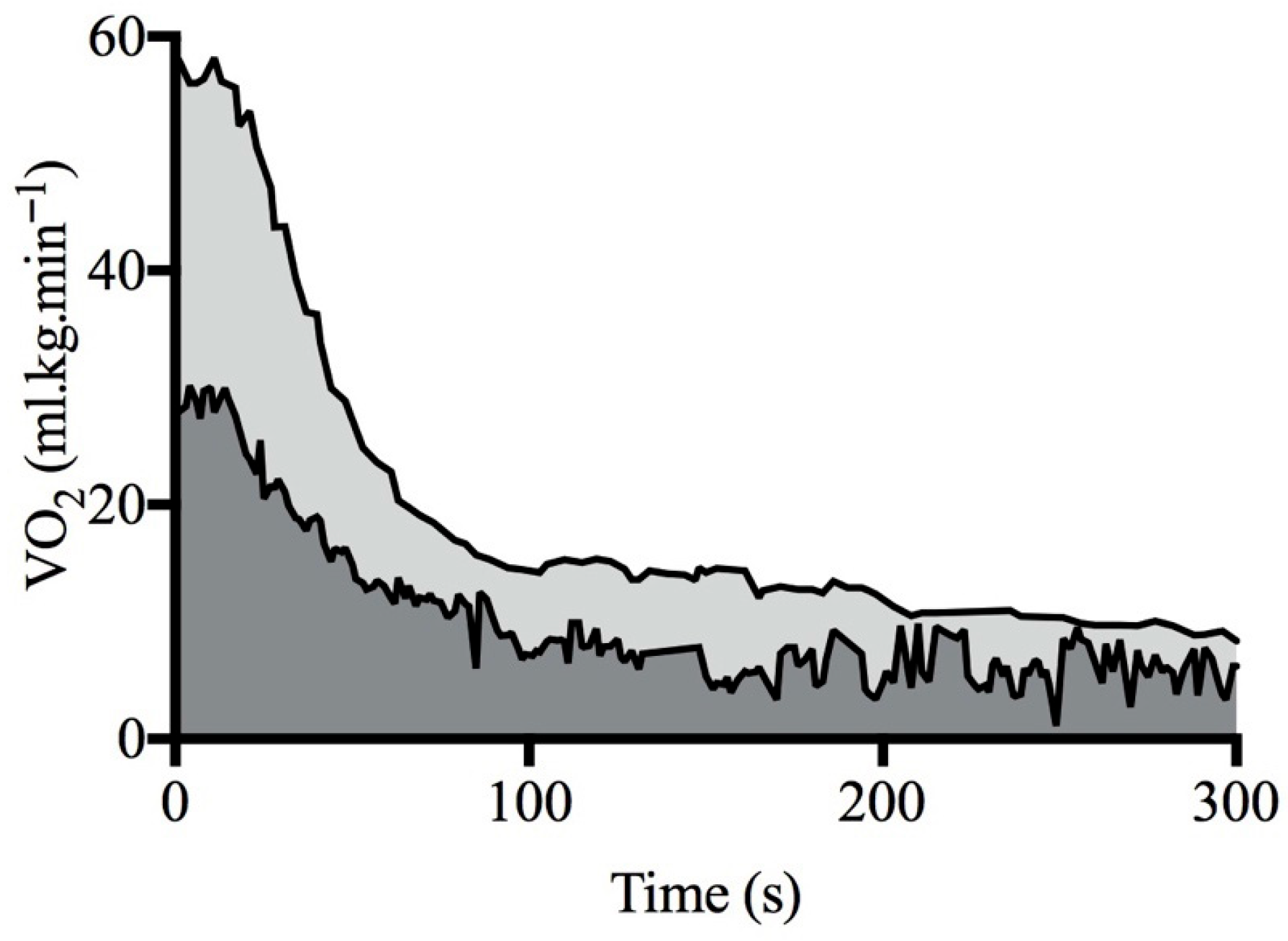
The mean ± SD and 95% confidence intervals for age, physical characteristics, T200, V ˙ O2 peak, heart rate, amplitude, time constant, time delay and EPOC magnitude during recovery are presented in Table 1, while the individual time course of this latter variable is illustrated in Figure 1 for two representative male master swimmers. Younger swimmers were faster and showed higher V ˙ O2 peaks than their older counterparts, whereas faster swimmers were younger and exhibited higher amplitude than slower participants (all for p < 0.05). Although several between-group differences did not reach statistical significance, the effect sizes were moderate to very large, except for V ˙ O2 time constant and time delay. The associations between age, T200 and the physiological variables are summarized in Table 2.

3. Discussion

The results showed that younger swimmers were also the faster performers, as reflected by the very strong positive relationship between age and T200 (r = 0.92, p < 0.001), indicating that increasing age was closely associated with slower 200 m performance. This age-related performance decline is consistent with systematic evidence in master swimmers, which also reports concurrent age-associated changes in energetics and biomechanics [9]. Healthy ageing is associated with preferential atrophy and loss of type II muscle fibres, altered neuromuscular activation and reduced power output, which modify both energy system contribution and movement mechanics [11]. Our results showed that younger and faster swimmers exhibited higher amplitudes and EPOC magnitudes, with large effect sizes, while age and performance were inversely related with both amplitude and EPOC magnitude, as well as V ˙ O2 peak and heart rate. These findings are consistent with the well-described behaviour of EPOC as increasing exponentially with exercise intensity and linearly with exercise duration [7], making EPOC magnitude a useful physiological marker of the metabolic cost and relative training load of a given session.
In the analysis depicted in Figure 1, with just two swimmers (one young and fast and one older and slower), the lower EPOC magnitude observed in older and slower swimmers may reflect both lower absolute and relative exercise intensity and age-related changes in muscle characteristics. Metabolites derived from anaerobic metabolism, particularly lactate accumulation and subsequent clearance, have been proposed as key contributors to EPOC magnitude [6], and significant associations between post-exercise lactate and EPOC magnitude have already been observed [12]. Healthy ageing is characterized by a decrease in the size and number of muscle fibres, predominantly type II fibres, which are primarily responsible for anaerobic glycolytic energy production during exercise [13]. This shift may explain why older swimmers showed a reduced EPOC magnitude compared with their younger counterparts [14]. Nevertheless, the between-group comparison did not reach statistical significance for EPOC magnitude, despite the large effect size).
Our results showed that younger and faster swimmers exhibited higher amplitudes and EPOC magnitudes, with large effect sizes, while age and performance were inversely associated with amplitude, EPOC magnitude, O2 peak and peak heart rate. These findings are consistent with the established behaviour of EPOC, which generally increases with exercise intensity and duration [7]. In this context, EPOC magnitude should be interpreted as providing complementary physiological information on the metabolic disturbance and post-exercise recovery demands imposed by a maximal swimming bout, rather than as a standalone indicator of training load.
Although V ˙ O2 peak differed between groups, recovery kinetics, as characterized by the time constant and time delay, did not differ, with trivial to small effect sizes. Recent swimming-specific work using updated open-source tools for VO2 kinetics modelling has shown that a mono-exponential function may adequately describe the VO2 off-transient across intensity domains and, in some cases, a model without time delay provides the best fit, which helps contextualize the small between-group differences observed for time delay in the present data [15]. These results suggest that post-exercise V ˙ O2 recovery kinetics may depend more on aerobic fitness and training status than on chronological age per se [16], as more aerobically trained individuals typically display faster V ˙ O2 recovery, more efficient lactate clearance and quicker phosphocreatine resynthesis [2]. The absence of differences in time constant and time delay aligns with the idea that well-trained older swimmers can preserve recovery kinetics despite the expected decline in aerobic capacity [17]. In master swimmers who maintain regular and structured training, long-term adaptations in muscle oxidative capacity and oxygen delivery may offset the expected age-related slowing of V ˙ O2 kinetics, despite lower maximal aerobic capacity. Moreover, the current results are in line with previous research reporting that high-level swimmers exhibited greater amplitude and a shorter time constant during 200 m recovery [18], supporting the link between performance level and V ˙ O2 off-transient kinetics.
These findings highlight that both age and performance level modulate the magnitude of the EPOC response in master swimmers, even when V ˙ O2 off-transient kinetics parameters remain broadly similar. Larger amplitude and EPOC magnitude in younger and faster swimmers suggest greater post-exercise homeostatic disturbance and potentially greater short-term recovery demands after a maximal 200 m front-crawl effort. From a practical perspective, these responses may help coaches and sport physiologists interpret maximal test outcomes beyond performance time alone, particularly when prescribing high-intensity sets or adjusting recovery intervals in master swimmers. Conversely, lower EPOC responses in older and slower swimmers may reflect a lower anaerobic contribution and/or lower relative exercise strain, which may support more individualized pacing strategies and carefully targeted high-intensity stimuli while respecting recovery limitations.
The current findings should also be interpreted in light of some limitations. The sample size was relatively small, only male master swimmers were included and the cross-sectional design does not allow causal inference. In addition, no perceptual or biochemical markers such as rating of perceived exertion or blood lactate were collected, which limits the interpretation of the relative contribution of effort and metabolism to the observed EPOC responses. The use of median splits for age and performance grouping also simplifies variables that are inherently continuous. Finally, although EPOC profiling may offer indirect insight into cardiorespiratory and metabolic recovery after intense exercise, the present design does not support direct conclusions regarding long-term health outcomes or metabolic health.

4. Materials and Methods

4.1. Participants

Fourteen male master swimmers volunteered to participate in the current study (mean ± SD: age 47.9 ± 14.9 years, body mass 78.4 ± 8.7 kg and height 178.5 ± 6.6 cm). Master swimming competition begins at 25 years of age and the youngest participant included in the current sample was 26 years old. An a priori sample size estimation was performed using G*Power (version 3.1.9.7; Düsseldorf, Germany) for an F-test family, ANOVA fixed effects, special, main effects and interactions, assuming an effect size f of 0.40, α = 0.05, power = 0.80, numerator df = 1 and two groups, which indicated a required total sample size of 52 participants. Given the difficulty of recruiting competitive master swimmers who met all inclusion criteria and were available to complete the full protocol, the final sample was smaller than initially estimated. Based on the observed effect sizes for EPOC magnitude, the achieved statistical power was 0.73 for the performance grouping and 0.60 for the age grouping. Swimmers were eligible if they had trained regularly over the previous two years, with a minimum frequency of three swimming sessions per week and a minimum swimming volume of 2000 m·day−1, to ensure a consistent level of swimming-specific training exposure compatible with the testing protocol, and if they had competed in master events during the previous year.
Given the specific characteristics of masters swimming, all participants were classified as Tier 3 [19], as they compete in regional and national events within this category. Among the 14 participants, in the younger group, three performed resistance training 2–5 times per week and one played soccer twice weekly (recreational). In the older group, two performed resistance training 2–5 times per week and two practiced cycling twice weekly (recreational). When participants were divided by performance levels (higher vs. lower performance), the higher-performance group included three participants performing resistance training 2–5 times per week and one playing soccer twice weekly. In the lower-performance group, two performed resistance training 2–5 times per week and two practiced cycling twice weekly. Swimmers who did not train for more than four weeks and presented injuries or sickness that could compromise the experiments were excluded. The study was approved by the local ethics committee (approval number 67847417.0.0000.5347) and conducted according to the Declaration of Helsinki.

4.2. Study Design

Anthropometric data, as well as information regarding swimming training in the week prior to testing and the participants’ regular physical activities, were obtained through individual interviews. Training load was quantified in arbitrary units (AUs) by categorizing swimming distances into intensity zones according to the method previously described [20]. In the day preceding the testing, the swimmers did not perform strenuous exercise and followed their normal diet. The experiments took place in a 25 m indoor pool (water and air temperature of 28 and 24 °C, respectively, and ~75% relative humidity) at the same time of the day and swimmers were previously familiarized with the snorkel and nose clip. They had a light breakfast, including ~500 mL of water or non-caffeinated beverage, 3 h before performing an individual ~800 m front-crawl warm-up at a moderate intensity. Then, the swimmers rested for 10 min until the respiratory exchange ratio was stabilized around 0.8.
The experimental protocol consisted of a single 200 m all-out front-crawl bout (T200) performed with in-water starts and open turns without underwater gliding due to snorkel constraints [18]. Time to complete the T200 was recorded and used as the swimming performance measure. Expired gas exchange was continuously recorded breath-by-breath with a telemetric portable gas analyser (K5, Cosmed, Rome, Italy) connected to a respiratory snorkel and valve system (AquaTrainer® snorkel, Cosmed, Italy) and heart rate was monitored using a chest strap (Garmin, 920XT, Olathe, KS, USA) [18,21]. This snorkel-based breath-by-breath approach has been used to characterize ventilatory and gas-exchange responses across increasing swimming intensity domains, supporting its applicability in ecologically valid pool testing [5].
To reduce noise from breath-by-breath measurements, errant breaths (e.g., coughing or swallowing) were excluded via the ergospirometric software (OMNIA 2.2.1.; Cosmed, Rome, Italy). Following published criteria, only values within ± 4 standard deviations of the mean were included in the final analysis [22] since this approach minimizes occasional artefacts in breath-by-breath gas-exchange data during swimming and improves the reliability of subsequent parameter estimation [23]. Peak V ˙ O2 and heart rate were defined as the highest values recorded during the test. Immediately after the exercise ended, EPOC was assessed by asking swimmers to continue breathing through the snorkel for 5 min [6] while standing in water up to shoulder level.

4.3. Data Analysis

Post-exercise V ˙ O2 kinetics during EPOC was modelled using a mono-exponential function (Equation (1)) [21] and the related parameters were estimated with respective confidence limits using nonlinear regression bootstrapping with 1000 samples (with replacement from the observed residuals) after standard breath-by-breath quality control to reduce inter-breath variability and improve confidence in model-derived parameters in swimming-specific testing [23]:
V ˙ O 2 ( t )   =   EE V ˙ O 2 H ( t TD p ) A p ( 1 e ( t TD p ) / τ p ) ,
where V ˙ O2(t) is V ˙ O2 at the time t, EE V ˙ O2 is the end-exercise V ˙ O2 value, Ap, TDp and τp are the amplitude, time delay and time constant of the V ˙ O2 fast component (respectively) and H represented the Heaviside step function. The estimated parameters and goodness of fit (2.25 ± 0.4; 95% confidence intervals: 2.0 to 2.4) were analyzed with raw data by excluding errant breaths. The EPOC magnitude was calculated as the area under the post-exercise V ˙ O2–time curve using the trapezoidal method, after subtracting pre-exercise V ˙ O2 [24].

4.4. Statistical Analysis

Swimmers were separated into two age groups (younger vs. older) and two performance groups (faster vs. slower) according to the 50th percentile of age and T200 performance (respectively). Data distribution was checked using the Shapiro–Wilk test and data are presented using the mean ± SD with 95% confidence intervals. Group differences were examined using a two-way factorial ANOVA (2 × 2) with age and performance groups as fixed factors, and the interaction effects were tested. The effect sizes for between-group differences were calculated using Hedges’ g and interpreted with the following effect size criteria: 0–0.19 trivial, 0.2–0.59 small, 0.6–1.19 moderate, 1.2–1.99 large, 2.0–3.99 very large and ≥4.0 nearly perfect [25]. Associations between variables were analyzed using the Pearson correlation coefficient (r) and interpreted as small (≥0.2), medium (≥0.5) and large (≥0.8). All statistical procedures were performed using SPSS (v. 20.0 IBM Corporation, Armonk, NY, USA) and in GraphPad Prism (v.8; La Jolla, CA, USA) with the significance level set at p = 0.05.

5. Conclusions

Master swimmers of different ages and performance levels exhibit distinct EPOC responses after a maximal 200 m front-crawl effort, with amplitude and magnitude appearing to be the most sensitive variables. Younger and faster swimmers showed larger post-exercise oxygen consumption responses, suggesting greater homeostatic disturbance and potentially greater short-term recovery demands. Therefore, EPOC profiling may provide useful complementary information beyond performance time alone when interpreting maximal test responses and when planning recovery strategies in master swimmers.

Author Contributions

Conceptualization, C.D.Z.T., R.Z. and F.A.d.S.C.; methodology, C.D.Z.T., C.D.S., R.Z., S.M., R.J.F. and F.A.d.S.C.; software, C.D.Z.T. and R.Z.; validation, C.D.S., R.J.F. and F.A.d.S.C.; formal analysis, C.D.Z.T., R.Z. and F.A.d.S.C.; investigation, C.D.Z.T., C.D.S. and F.A.d.S.C.; resources, F.A.d.S.C.; data curation, C.D.Z.T., C.D.S., R.Z. and F.A.d.S.C.; writing—original draft preparation, C.D.Z.T., R.Z., S.M., R.J.F. and F.A.d.S.C.; writing—review and editing, R.Z., S.M., R.J.F. and F.A.d.S.C.; visualization, R.Z., S.M., R.J.F. and F.A.d.S.C.; supervision, C.D.S. and F.A.d.S.C.; project administration, C.D.S. and F.A.d.S.C.; funding acquisition, F.A.d.S.C. All authors have read and agreed to the published version of the manuscript.

Funding

CDZT was funded by the Coordenação de Aperfeiçoamento de Pessoal de Nível Superior—Brasil (CAPES)—grant number Code 001 and FASC is a research fellow from the National Council for Scientific and Technological Development (CNPq), Brasília, Brazil (grant number: 302743/2025-1). R.Z. was supported by the Research Center in Physical Activity, Health and Leisure (CIAFEL), Faculty of Sport, University of Porto (FADEUP), which is part of the Laboratory for Integrative and Translational Research in Population Health (ITR); both are funded by the Fundação Para a Ciência e Tecnologia (FCT; grants Reference: UID/00617/2025 with DOI: https://doi.org/10.54499/UID/00617/2025; and Reference: LA/P/0064/2020 with DOI: https://doi.org/10.54499/LA/P/0064/2020).

Institutional Review Board Statement

The study was conducted in accordance with the Declaration of Helsinki and approved by the Institutional Ethics Committee of Universidade Federal do Rio Grande do Sul (approval number 67847417.0.0000.5347 on 11 November 2019).

Informed Consent Statement

Informed consent was obtained from all subjects involved in the study.

Data Availability Statement

The raw data supporting the conclusions of this article will be made available by the authors on request.

Acknowledgments

The authors would like to thank the swimmers and their coaches for their willingness to participate in this study.

Conflicts of Interest

The authors declare no conflicts of interest. The funders had no role in the design of the study; in the collection, analyses, or interpretation of data; in the writing of the manuscript; or in the decision to publish the results.

References

  1. Gaesser, G.A.; Brooks, G.A. Metabolic bases of excess post-exercise oxygen consumption: A review. Med. Sci. Sports Exerc. 1984, 16, 29–43. [Google Scholar] [CrossRef]
  2. Tomlin, D.L.; Wenger, H.A. The Relationship Between Aerobic Fitness and Recovery from High Intensity Intermittent Exercise. Sports Med. 2001, 31, 1–11. [Google Scholar] [CrossRef]
  3. Sousa, A.; Figueiredo, P.; Zamparo, P.; Vilas-Boas, J.P.; Fernandes, R.J. Anaerobic alactic energy assessment in middle distance swimming. Eur. J. Appl. Physiol. 2013, 113, 2153–2158. [Google Scholar] [CrossRef]
  4. Mann, T.N.; Webster, C.; Lamberts, R.P.; Lambert, M.I. Effect of exercise intensity on post-exercise oxygen consumption and heart rate recovery. Eur. J. Appl. Physiol. 2014, 114, 1809–1820. [Google Scholar] [CrossRef]
  5. Monteiro, A.S.; Magalhães, J.F.; Knechtle, B.; Buzzachera, C.F.; Vilas-Boas, J.P.; Fernandes, R.J. Acute ventilatory responses to swimming at increasing intensities. PeerJ 2023, 11, e15042. [Google Scholar] [CrossRef]
  6. Borsheim, E.; Bahr, R. Effect of exercise intensity, duration and mode on post-exercise oxygen consumption. Sports Med. 2003, 33, 1037–1060. [Google Scholar] [CrossRef]
  7. LaForgia, J.; Withers, R.T.; Gore, C.J. Effects of exercise intensity and duration on the excess post-exercise oxygen consumption. J. Sports Sci. 2006, 24, 1247–1264. [Google Scholar] [CrossRef]
  8. Sousa, A.; Rodriguez, F.A.; Machado, L.; Vilas-Boas, J.P.; Fernandes, R.J. Exercise modality effect on oxygen uptake off-transient kinetics at maximal oxygen uptake intensity. Exp. Physiol. 2015, 100, 719–729. [Google Scholar] [CrossRef] [PubMed]
  9. Ferreira, M.I.; Barbosa, T.M.; Costa, M.J.; Neiva, H.P.; Marinho, D.A. Energetics, Biomechanics, and Performance in Masters’ Swimmers: A Systematic Review. J. Strength Cond. Res. 2016, 30, 2069–2081. [Google Scholar] [CrossRef] [PubMed]
  10. Neiva, H.P.; Fernandes, R.J.; Cardoso, R.; Marinho, D.A.; Abraldes, J.A. Monitoring Master Swimmers’ Performance and Active Drag Evolution along a Training Mesocycle. Int. J. Environ. Res. Public Health 2021, 18, 3569. [Google Scholar] [CrossRef] [PubMed]
  11. Tieland, M.; Trouwborst, I.; Clark, B.C. Skeletal muscle performance and ageing. J. Cachexia Sarcopenia Muscle 2018, 9, 3–19. [Google Scholar] [CrossRef] [PubMed]
  12. de Aguiar, R.A.; Cruz, R.S.T.T.; Pereira, K.L.; Caputo, F. Relationships between V ˙ O2 and blood lactate responses after all-out running exercise. Appl. Physiol. Nutr. Metab. 2015, 40, 263–268. [Google Scholar] [CrossRef]
  13. Miljkovic, N.; Lim, J.Y.; Miljkovic, I.; Frontera, W.R. Aging of skeletal muscle fibers. Ann. Rehabil. Med. 2015, 39, 155–162. [Google Scholar] [CrossRef]
  14. Reaburn, P.; Dascombe, B. Anaerobic performance in masters athletes. Eur. Rev. Aging Phys. Act. 2009, 6, 39–53. [Google Scholar] [CrossRef]
  15. Monteiro, A.S.; Azevedo, R.M.S.; Zacca, R.; Ogonowska-Slodownik, A.; Buzzachera, C.F.; Vilas-Boas, J.P.; Fernandes, R.J. VO2FITTING Software: New Insights and Practical Applications (VO2FITTING Software Update). J. Hum. Kinet. 2025, 97, 89–100. [Google Scholar] [CrossRef]
  16. George, M.A.; McLay, K.M.; Doyle-Baker, P.K.; Reimer, R.A.; Murias, J.M. Fitness Level and Not Aging per se, Determines the Oxygen Uptake Kinetics Response. Front. Physiol. 2018, 9, 277. [Google Scholar] [CrossRef] [PubMed]
  17. Murias, J.M.; Paterson, D.H. Slower VO2 Kinetics in Older Individuals: Is It Inevitable? Med. Sci. Sports Exerc. 2015, 47, 2308–2318. [Google Scholar] [CrossRef] [PubMed]
  18. Sousa, A.; Figueiredo, P.; Keskinen, K.L.; Rodriguez, F.A.; Machado, L.; Vilas-Boas, J.P.; Fernandes, R.J. VO2 Off Transient Kinetics in Extreme Intensity Swimming. J. Sports Sci. Med. 2011, 10, 546–552. [Google Scholar]
  19. McKay, A.K.A.; Stellingwerff, T.; Smith, E.S.; Martin, D.T.; Mujika, I.; Goosey-Tolfrey, V.L.; Sheppard, J.; Burke, L.M. Defining training and performance caliber: A participant classification framework. Int. J. Sports Physiol. Perform. 2022, 17, 317–331. [Google Scholar] [CrossRef]
  20. Mujika, I.; Busso, T.; Lacoste, L.; Barale, F.; Geyssant, A.; Chatard, J.C. Modeled responses to training and taper in competitive swimmers. Med. Sci. Sports Exerc. 1996, 28, 251–258. [Google Scholar] [CrossRef]
  21. Monteiro, A.S.; Carvalho, D.D.; Azevedo, R.; Vilas-Boas, J.P.; Zacca, R.; Fernandes, R.J. Post-swim oxygen consumption: Assessment methodologies and kinetics analysis. Physiol. Meas. 2020, 41, 105005. [Google Scholar] [CrossRef] [PubMed]
  22. Ozyener, F.; Rossiter, H.B.; Ward, S.A.; Whipp, B.J. Influence of exercise intensity on the on- and off-transient kinetics of pulmonary oxygen uptake in humans. J. Physiol. 2001, 533, 891–902. [Google Scholar] [CrossRef] [PubMed]
  23. Fernandes, R.J.; de Jesus, K.; Baldari, C.; de Jesus, K.; Sousa, A.C.; Vilas-Boas, J.P.; Guidetti, L. Different VO2max time-averaging intervals in swimming. Int. J. Sports Med. 2012, 33, 1010–1015. [Google Scholar] [CrossRef]
  24. Tabata, I.; Irisawa, K.; Kouzaki, M.; Nishimura, K.; Ogita, F.; Miyachi, M. Metabolic profile of high intensity intermittent exercises. Med. Sci. Sports Exerc. 1997, 29, 390–395. [Google Scholar] [CrossRef]
  25. Bernards, J.R.; Sato, K.; Haff, G.G.; Bazyler, C.D. Current research and statistical practices in sport science and a need for change. Sports 2017, 5, 87. [Google Scholar] [CrossRef] [PubMed]
Figure 1. The magnitude of excess post-exercise oxygen consumption for a younger–faster and older–slower master swimmer (light- and dark-grey areas, respectively).
Physiologia 06 00024 g001
Table 1. Master swimmers group comparisons for age, performance, cardiovascular, ventilatory and excess post-exercise oxygen consumption kinetics (EPOCMAG) variables.
Age 50th PercentilePerformance 50th Percentile
Younger
(n = 7)
Older
(n = 7)
F; p; gFaster
(n = 7)
Slower
(n = 7)
F; p; g
Age (y)31.8 ± 3.6
[27.3—36.4]
49.6 ± 2.6
[25.6—73.5]
33.0; <0.001;
0.69—mod
45.7 ± 1.7
[29.9—61.5]
69.8 ± 7.3
[54.8—73.1]
20.2; 0.001;
4.5—nearly perfect
T200 (s)165.7 ± 24.9
[142.6—188.8]
213.9 ± 27.9
[188.0—239.8]
7.8; 0.018;
1.82—large
162.1 ± 20.0
[143.6—180.5]
217.5 ± 23.7
[195.4—239.5]
15.9;0.003;
2.52—very large
Body weight
(kg)
79.3 ± 7.4
[72.4—86.2]
81.3 ± 7.0
[73.9—88.7]
0.53; 0.477
0.27—small
79.3 ± 8.1
[70.8—87.9]
82.1 ± 6.5
[76.0—88.1]
0.44; 0.518
0.38—small
Height
(cm)
181.6 ± 5.1
[176.9—186.4]
176.7 ± 2.9
[173.6—179.8]
5.16; 0.042
1.18—moderate
181.7 ± 5.6
[175.8—187.7]
177.9 ± 6.2
[172.2—183.7]
1.29; 0.30
0.64—moderate
Upper-arm span
(cm)
187.5 ± 5.9
[182.0—193.4]
181.9 ± 4.2
[177.4—186.4]
3.72; 0.080
1.09—moderate
186.9 ± 6.2
[180.3—193.5]
183.1 ± 6.4
[177.1—189.1]
1.29; 0.279
0.60—moderate
Training load
(A.U.)
3.81 ± 2.01
[1.95—5.68]
4.25 ± 2.48
[1.95—6.54]
0.128; 0.726
0.19—trivial
4.45 ± 2.02
[2.57—6.32]
4.07 ± 1.89
[2.32—5.83]
0.126; 0.728
0.19—trivial
V ˙ O2peak
(mL∙kg−1∙min−1)
50.2 ± 8.1
[42.7—57.8]
39.1 ± 4.8
[34.6—43.6]
5.6; 0.039;
1.66—large
49.2 ± 9.4
[40.5—57.9]
40.2 ± 5.0
[35.5—44.9]
1.93; 0.19;
1.19—moderate
Heart rate (bpm)165.2 ± 4.8
[159.1—171.2]
148 ± 14.7
[134.3—161.6]
1.36; 0.26;
1.57—large
160.7 ± 9.1
[152.2—169.2]
147.5 ± 14.3
[134.3—160.8]
1.91; 0.26;
1.10—moderate
Amplitude (mL∙kg−1∙min−1)34.7 ± 11.6
[23.9—45.5]
25.3 ± 6.2
[19.5—31.0]
0.84; 0.38;
1.01—moderate
36.8 ± 10.2
[27.5—46.2]
23.2 ± 4.0
[19.4—26.9]
6.02; 0.03;
1.75—large
Time constant (s)46.8 ± 6.5
[40.8—52.9]
50.2 ± 9.3
[41.6—58.9]
0.68; 0.42;
0.42—small
48.7 ± 6.5
[42.7—54.7]
48.4 ± 9.7
[39.4—57.5]
0.16; 0.69;
0.03—trivial
Time delay (s)8.7 ± 7.1
[2.1—15.2]
13.1 ± 7.7
[5.9—20.2]
0.006; 0.93;
0.59—small
9.8 ± 7.5
[2.8—16.8]
12.0 ± 7.8
[4.7—19.3]
2.69; 0.13;
0.28—small
EPOCMAG (mL)2942 ± 972
[2042—3841]
1838 ± 669
[1219—2456]
2.84; 0.14;
1.30—large
2988 ± 788
[2259—3718]
1791 ± 803
1048—2535
3.72; 0.72;
1.50—large
Table 2. Relations between age, performance and excess post-exercise oxygen consumption variables of male master swimmers (significant values are identified with an *).
VariablesT200 (s) V ˙ O2peak
(mL∙kg−1∙min−1)
Heart Rate
(bpm)
Amplitude
(mL∙kg−1∙min−1)
Time Constant (s)Time Delay (s)EPOCMAG
Age (y)0.92
<0.001 *
−0.73
0.003 *
−0.67
0.008 *
−0.57
0.031 *
0.12
0.67
0.24
0.39
−0.62
0.017 *
T200 (s) −0.75
0.004 *
−0.68
0.007 *
−0;66
0.009 *
0.25
0.38
0.17
0.54
−0.65
0.011 *
V ˙ O2peak
(mL∙kg−1∙min−1)
−0.76
0.001 *
0.73
0.003 *
−0.06
0.83
−0.29
0.30
0.61
0.02 *
Heart rate (bpm) 0.38
0.17
0.095
0.74
−0.15
0.60
0.47
0.08
Amplitude (mL∙kg−1∙min−1) 0.03
0.89
−0.08
0.78
0.74
0.002 *
Time constant (s) 0.13
0.64
0.24
0.34
Time delay (s) 0.12
0.67
Disclaimer/Publisher’s Note: The statements, opinions and data contained in all publications are solely those of the individual author(s) and contributor(s) and not of MDPI and/or the editor(s). MDPI and/or the editor(s) disclaim responsibility for any injury to people or property resulting from any ideas, methods, instructions or products referred to in the content.