Article

One Week of a Betalain-Rich Beetroot Concentrate Does Not Improve 4 km Time-Trial Performance but Impairs Repeated Sprint Cycling Performance in Trained Cyclists


1
Health Sciences Department, Drexel University, Philadelphia, PA 19104, USA
2
Department of Kinesiology, Sport Studies & Physical Education, SUNY Brockport, Brockport, NY 14420, USA
*
Author to whom correspondence should be addressed.
Physiologia 2025, 5(4), 54; https://doi.org/10.3390/physiologia5040054
Submission received: 9 September 2025 / Revised: 1 December 2025 / Accepted: 2 December 2025 / Published: 5 December 2025
(This article belongs to the Special Issue Exercise Physiology and Biochemistry: 3rd Edition)

Abstract

Purpose: We aimed to assess the effects of one-week betalain-rich beetroot concentrate (BRC) supplementation on high-intensity cycling performance in trained cyclists. Methods: Eighteen male (n = 15) and female (n = 3) cyclists (age: 38.83 ± 8.09; weight: 73.23 ± 10.95 kg; height: 176.86 ± 9.60 cm) were supplemented with a BRC or a placebo (PLA) for six days prior to the experimental trials. On the seventh day, a final dose was administered, and participants completed three all-out 15 s cycling sprints back-to-back, followed by a 4 km cycling time trial (TT). Physiological indicators related to performance were measured throughout the 4 km TT. Results: Sprint performance remained unchanged following PLA treatment. However, BRC treatment led to significant reductions in sprint performance during sprints 2 and 3 compared to sprint 1 (p < 0.05). Time trial performance did not differ between treatments (p > 0.05). Significant increases in physiological and psychological responses during the 4-km time trial were observed following both treatments (p < 0.05). However, heart rate was higher at 2 km compared to 1 km, the respiratory exchange ratio was slightly elevated at 2 km and 4 km relative to 1 km, and VO2 was slightly higher at 3 km and 4 km compared to pre-TT following BRC treatment only (p < 0.05). Conclusions: One week of a BRC does not enhance 4 km TT performance but may impair repeated-sprint performance in trained cyclists.

1. Introduction

Cycling is a physiologically demanding sport that requires cyclists to perform at various intensities and durations, ranging from 30 s to >12 h. A cyclist’s ability to maintain their highest sustainable power output is a key determinant of performance [1]. Moreover, the ability to intermittently generate supramaximal power to accelerate and subsequently recover is an important determinant of cycling performance [2]. At such intensities, however, there is a progressive reduction in the force-generating capacity of exercising muscle [3].
The use of dietary supplements to improve performance is a common practice among competitive athletes [4]. Phytonutrients found in plants may enhance performance by reducing oxidative stress, inflammation, and cellular damage, improving blood flow, supporting exercise metabolism, or through a combination of these mechanisms [4]. Therefore, the use of such supplements may serve as an effective strategy to enhance performance and reduce fatigue, particularly for well-trained athletes who have reached a level of training maturity where even small improvements can translate to competitive success [5].
Red beetroot juice (RBJ) is well-known for ergogenic properties related to its high nitrate concentration. Specifically, RBJ has been shown to enhance short-duration, high-intensity time-trial performance [6] and improve supramaximal cycling performance [7]. However, RBJ also contains other bioactive ingredients, including betalains. Betalains are a class of water-soluble pigments found in red beetroot with reported anti-inflammatory and antioxidant properties [8,9]. Administration of a betalain-rich concentrate (BRC) void of dietary nitrates has been shown to reduce inflammation and oxidative stress [10] and increase NO availability [11] in human participants. Despite limited research on the ergogenic properties of isolated betalains (i.e., independent of dietary nitrate), recent investigations into their effects on exercise performance suggest the potential of BRC as an ergogenic aid.
Research by Van Hoorbeke et al. [12] and Montenegro et al. [13] examined the effects of one week of a BRC in trained athletes. The authors reported that BRC improved time-trial (TT) performance when conducted immediately [12,13] and 24 h after [13] a submaximal exercise task. In both studies, researchers observed attenuated rises in indices of muscle damage after each of their respective TTs, indicating reduced exercise-induced muscle damage [12,13]. Mumford et al. [14] found modest improvements in submaximal cycling performance with corresponding increases in post-exercise blood flow following a similar dosing strategy. Though the mechanisms responsible for the observed improvements are unclear, researchers postulate that the effects were attributed to BRC’s anti-inflammatory and antioxidant properties, preserving skeletal muscle blood flow, and myocyte function and integrity.
During short-duration, supramaximal efforts, the phosphagen system contributes the largest proportion of energy, with phosphocreatine (PCr) as the substrate. During repeated bouts of high-intensity exercise, restoration of muscle power is primarily determined by PCr resynthesis, and to a lesser extent, recovery of muscle pH [15]. Between sprints, both the resynthesis of PCr and pH recovery rely on blood flow and aerobic metabolism (i.e., oxygen delivery and utilization). During intense efforts, however, NO is inhibited by the production of ROS, thereby impairing oxygen delivery and waste removal from working tissue [16]. In addition, high-intensity exercise can also induce muscle damage [17]. Collectively, these can contribute to fatigue and impairment in performance.
To date, no study has investigated a one-week dose of a BRC on high-intensity and supramaximal cycling performance. Exercise-induced reactive oxygen species (ROS) production and local inflammation are intensity-dependent, with greater increases seen at intensities above the lactate threshold [18]. Therefore, it is plausible that the efficacy of BRC is enhanced during higher-intensity efforts. Therefore, the purpose of this study was to examine the effects of one week of supplementation with a BRC on repeated sprint and subsequent 4 km TT cycling performance, and variables associated with performance and substrate utilization. Given the limited research demonstrating improvements in TT performance and blood flow [11,14,19] following BRC supplementation, it was hypothesized that one week of BRC supplementation would enhance both cycling performance and the underlying physiological responses associated with exercise.

2. Results

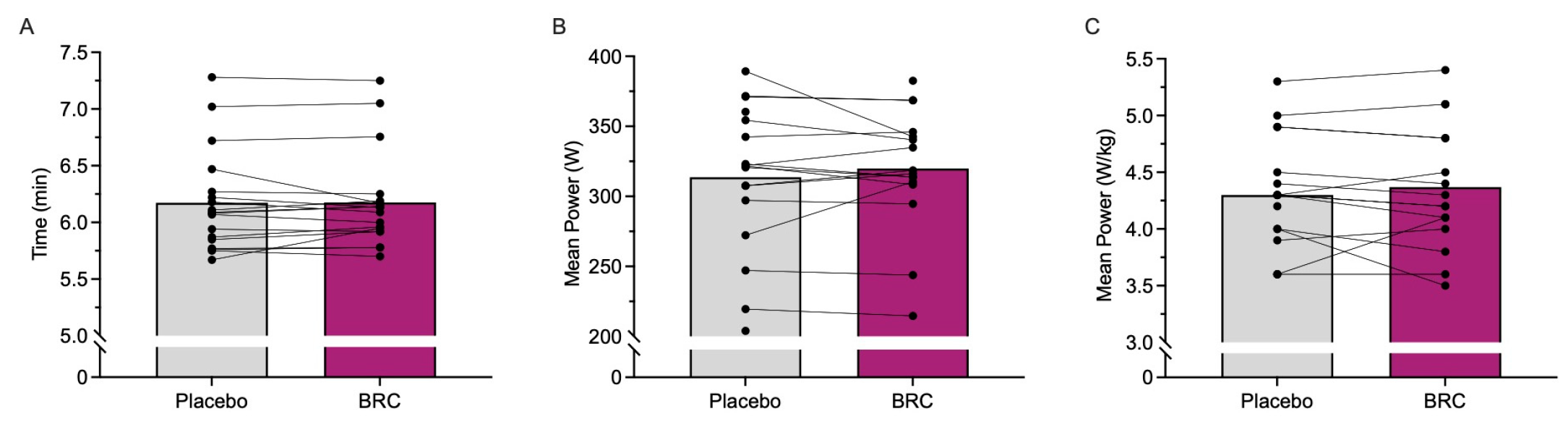
Numerical values for all data points can be found in the Supplementary Tables. There was no significant main effect of treatment on peak power (p = 0.387), relative peak power (p = 0.182), mean power (p = 0.265), relative mean power (p = 0.718), or fatigue index (p = 0.858) during RSE. There was a significant main effect for sprint number in peak power (p = 0.023; ηp2 = 0.186), and relative peak power (p = 0.020; ηp2 = 0.214). A post hoc analysis identified significant differences for peak power and relative peak power, whereby peak power (p = 0.038) and relative peak power (p = 0.026) were lower in sprint 2 compared to sprint 1, while relative peak power was lower in sprint 3 compared to sprint 1 (p = 0.040) following BRC supplementation only. There was a trend in significance for the main effect of sprint for mean power (p = 0.050), whereby mean power was lower in sprints 2 (p = 0.042) and 3 (p = 0.044) compared to sprint 1 following BRC treatment only (Figure 1). Regarding the 4 km TT, there were no significant differences in time to completion or absolute and relative mean power between treatments (Figure 2).
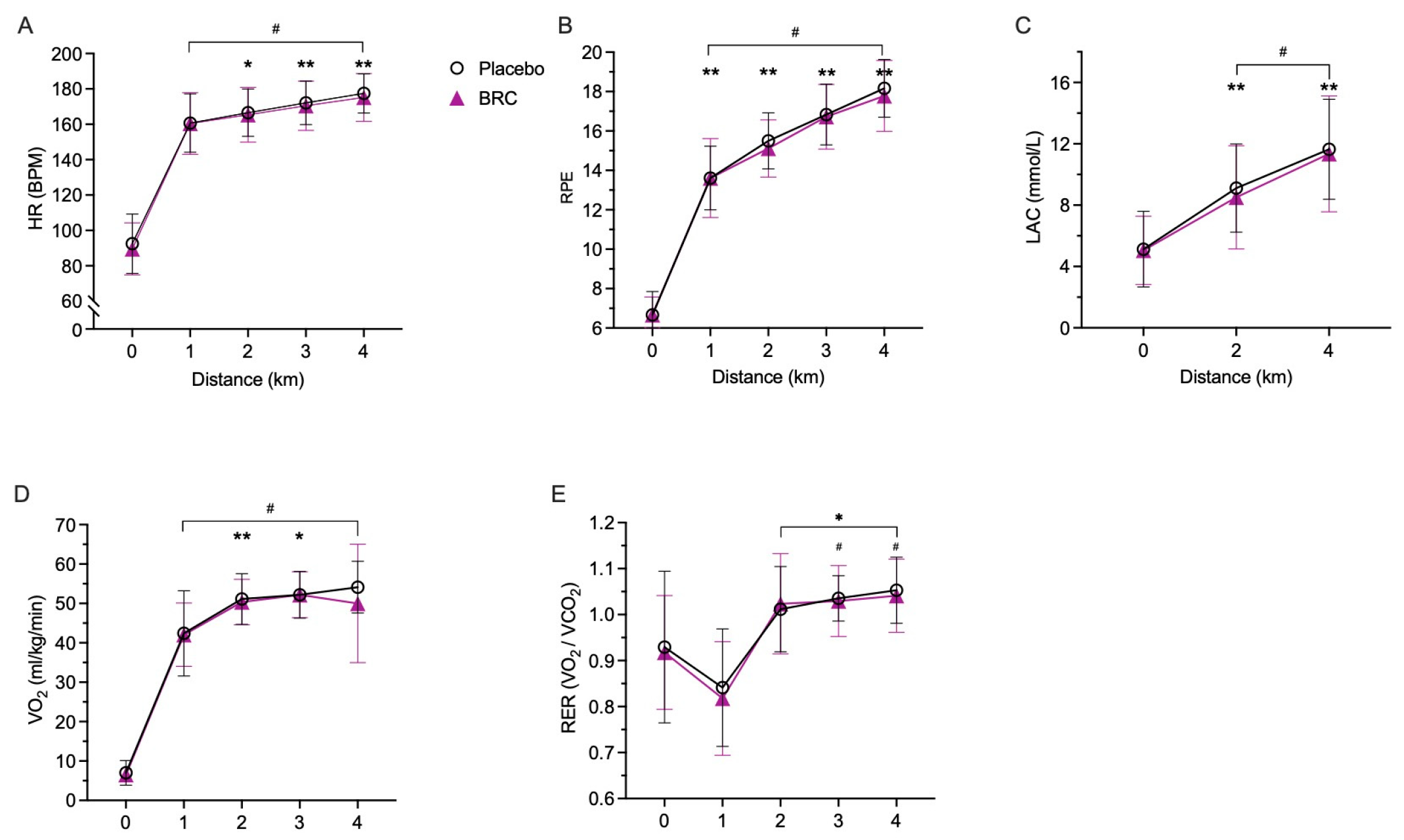
There was no significant main effect of treatment on any of the 4 km time trial variables, which included HR (p = 0.390), RPE (p = 0.254), LAC (p = 0.374), VO2 (p = 0.232), and RER (p = 0.590). Note, purple bars are BRC treatment and grey bars are the placebo.
There was a significant distance effect for HR (p < 0.001), whereby HR increased from pre-exercise (0 km) over the 4 km distance for both treatments. HR was significantly higher at 3 km compared to 2 km, and 4 km compared to 3 km for both treatments (p < 0.001), whereas HR was significantly elevated during 2 km compared to 1 km in the BRC treatment only (p = 0.045; Figure 3A).
A significant main effect for distance was observed for RPE (p < 0.001; ηp2 = 0.983) for both treatments. RPE was significantly greater at 2 km than 1 km, 3 km than 2 km, and 4 km than 3 km for both treatments (p < 0.05; Figure 3B).
Lactate significantly increased linearly over distance (p < 0.0001; ηp2 = 0.946), with LAC being greater at 2 km than 0 km, and 4 km greater than 2 km for both treatments (p < 0.001; Figure 3C).
Oxygen consumption significantly increased from baseline in both treatments over the 4 km TT (p < 0.001). Oxygen consumption was significantly greater at 2 km than at 1 km for both treatments (p < 0.001), whereas VO2 was significantly greater at 3 km compared to 2 km following BRC only (p = 0.005; Figure 3D).
There was a significant main effect for distance in RER (p < 0.001; ηp2 = 0.803), whereby RER was greater in 2, 3, and 4 km compared to 1 km for both treatments (p < 0.001). The respiratory exchange ratio was significantly greater at 3 and 4 km when compared to 0 km in the BRC only (p < 0.05; Figure 3E).

3. Discussion

This study aimed to examine the effects of a one-week dosing strategy with a BRC on high-intensity cycling performance. The principal findings were that BRC did not attenuate fatigue induced by supramaximal RSE or improve 4 km TT performance. Moreover, BRC did not improve variables associated with performance during the 4 km TT.

3.1. Repeated-Sprint Performance

This is the first study to examine the effects of BRC on supramaximal RSE cycling performance. However, supplementation with RBJ has been shown to attenuate fatigue and improve cycling performance at higher intensities. Aucouturier et al. [20] found that supplementing with a nitrate-rich RBJ for three days improved tolerance to supramaximal exercise (i.e., 15 s sprints at 170% of maximal aerobic power followed by 30 s rest) and increased microvascular perfusion in working muscle. Jonvik et al. [21] reported six days of nitrate-rich RBJ improved time-to-peak power without influencing peak or average power during three back-to-back all-out Wingate tests. Collectively, these improvements may reflect dietary nitrates’ ability to enhance NO, promoting blood flow and thus PCr resynthesis and mitigating the accumulation of metabolites such as H+ and ADP during the resting phase.
Considering the research showing improvements in blood flow following BRC supplementation, we hypothesized that BRC supplementation would improve RSE performance. Contrary to our hypotheses, however, BRC did not attenuate the reduction in RSE performance. Interestingly, there were significant reductions in relative peak power and mean power observed following BRC during the RSE. The significant reductions in force following BRC may reflect the importance of free radicals in cellular function. Optimal muscle function is observed when muscles are in a mildly oxidized state, as transient increases in ROS have been shown to increase calcium’s sensitivity to troponin [22]. Thus, the antioxidants provided by BRC may impair muscle performance at very high intensities such as these. Notably, no reductions in power were observed in the PLA group. Considering recovery from repeated sprints is largely attributed to PCr recovery [15], the work/rest ratio employed in the current study (1:8) may have provided adequate recovery of PCr. Similar findings were reported by Crisafulli et al. [23], who reported that peak and mean power were maintained over five 15-s all-out sprints in recreationally active cyclists. A possible explanation is that aerobically trained athletes tend to exhibit higher PCr resynthesis rates [24], thereby lending credibility to the potential ergolytic effects of antioxidants provided by the BRC. Of course, fatigue is a multifaceted and complex phenomenon, so it is encouraged to exercise caution when interpreting the findings. However, we believe these findings raise interesting questions that merit further exploration into the potential adverse effects of antioxidant supplementation for short-duration, high-intensity efforts such as those employed herein.
The discrepancy in our findings in RBJ may support the alternative mechanisms through which RBJ is thought to enhance performance. Although RBJ’s effects on hemodynamics are well established, dietary nitrate contained in RBJ has also been shown to also enhance performance through mechanisms independent of vasodilation. Specifically, supplementation with nitrate has been shown to enhance muscle contraction efficiency and improve calcium handling and excitation-contraction coupling [25].

3.2. 4 km TT Performance

To date, only three studies have investigated the effects of a BRC on exercise performance. Using a one-week loading paradigm, Van Hoorebeke et al. [12] reported no significant improvements in average speed, VO2, or substrate utilization during the 30-min submaximal running performance in competitive runners despite observing improvements in HR and RPE. However, the researchers did see improvements in 5 km TT running performance, which commenced immediately following the 30-min submaximal bout. The authors attributed the improvements in performance to BRC antioxidant and anti-inflammatory properties attenuating muscle damage, evidenced by reduced lactate dehydrogenase concentrations, an indirect index of muscle damage, 30 min following the 5 km TT, which may reflect preserved muscle cell integrity and thus performance [12].
Using a similar dosing strategy, Montenegro et al. [13] reported no significant improvements in average power, HR, VO2, RPR, or RER during the 40-min submaximal cycling task in competitive triathletes. However, the authors reported significant improvements in 10 km TT running performance immediately following cycling exercise, and recovery 5 km TT 24 h post–10 km TT. Like Van Hoorebeke and colleagues [12], the researchers reported significant reductions in creatine kinase, a marker of muscle damage, immediately following 10 km TT performance, further substantiating BRC’s potential to mitigate exercise-induced muscle damage and improve performance via its bioactive properties. In contrast to the findings of Montenegro et al. [13], Mumford et al. [14] found improvements in power output during a 30-min TT in well-trained cyclists following 7 days of a BRC. The researchers reported a significant improvement in post-exercise blood flow, which they attributed as a contributing factor to the observed improvements in cycling performance. Interestingly, however, the researchers observed significant, albeit mild, exercise-induced elevations in oxidative stress and inflammatory markers that were not different between BRC and PLA groups. The magnitude of metabolic disturbances, and thus peripheral fatigue, is greater after shorter distance TT [26]. Therefore, an explanation for the: (1) null effects during the submaximal trials employed by Van Hoorebeke et al. [12] and Montenegro et al. [13]; (2) the significant improvements in performance during shorter distance (i.e., higher intensity) trials; and (3) the small increases in inflammatory markers reported by Mumford et al. [14], may lie in the intensity of the exercise bouts.
Contrary to our hypotheses, however, BRC did not affect 4 km TT performance. Though surprising, the literature exploring fatigue mechanisms and antioxidant research may provide some insight into our findings. First, exogenous antioxidant supplementation likely has little to no effect on exercise performance at high intensities [22]. Reductions in muscle fiber shortening velocity during high-intensity exercise are likely caused by traditional fatigue mechanisms, such as reductions in local pH and increases in inorganic phosphates, and not oxidative stress. The difference in our findings compared to Mumford et al. [14] supports the observation that ROS have a more pronounced fatiguing effect during submaximal efforts and recovery than higher intensity efforts [27]. Moreover, our findings may also indicate that BRC’s potential lies in its ability to attenuate muscle damage, as demonstrated by the improvements in performance following exercise in Van Hoorebeke et al. [12] and Montenegro et al. [13]. Therefore, future studies should explore the effects of BRC on reducing muscle damage following intense exercise. Regarding the significant differences in HR, VO2, and RER observed following BRC treatment, none of the measures appear to be physiologically meaningful, as they lack consistency and do not correspond with any observed changes in performance, indicating a need for further investigation.

3.3. Experimental Considerations

Regarding the divergence in our findings, additional considerations should be stated. First, inter-individual variability in baseline redox status can influence the ergogenic effects of antioxidant supplements. Lower endogenous antioxidant status may potentiate the ergogenic properties of BRC, as demonstrated by Margaritelis et al. [28], who reported increases in redox status with concomitant improvements in exercise performance in individuals with lower baseline vitamin C status. It is known that well-trained individuals tend to have higher antioxidant status, decreasing the potential of exogenous antioxidant supplements such as BRC. Thus, future research may want to include untrained or recreationally active participants as part of their study design investigating the effects of BRC on high-intensity exercise. Additionally, inter-individual variation in betalain metabolism may account for the heterogeneity in the current research findings. In a recent study investigating the bioavailability and removal of betalains, Wang et al. [29] found that the gut microbiota plays a critical role in the metabolism of betalains. Considering gut biodiversity varies between individuals, this may explain the inconsistent findings among studies.

3.4. Limitations

We consider the novelty of this research to be its primary strength, as it adds valuable insight to the limited body of evidence on the ergogenic potential of betalains. However, this study is not without limitations. First, we did not assess plasma betalain concentrations and therefore cannot definitively attribute any observed effects—or lack thereof—to betalains. Assessing plasma betalains alongside markers of redox status and inflammation may offer insights into variability in absorption and potential effects on oxidative stress and inflammation. Additionally, the lack of dietary control or diet logs is a limitation of the present study. Considering that dietary habits, particularly fruit and vegetable consumption, are linked to antioxidant status, we believe this is a tool that would add valuable insight to future studies. Finally, this study employed a small sample, consisting mainly of men, which limits its generalizability, particularly to women. Therefore, we recommend that future research examine this question in a larger, more representative population.

4. Materials and Methods

4.1. Participants

A preliminary power analysis was conducted for each dependent variable with G*Power version 3.1. Assuming that a BRC would elicit a moderate effect on cycling performance, and using an alpha of 0.05 and a desired power of 0.80, it was determined that a minimum sample size of 16 would be needed to achieve statistical significance in cycling performance. A total of 18 participants were recruited from a local cycling club and were classified as “Tier 2” according to the participant classification framework by McKay et al. [30] (Table 1). Each participant was required to have trained consistently for a minimum of 6 weeks before data collection. A pre-participatory screening (pg. 1 of PAR-Q +) assessed physical activity readiness and medication use, and a brief activity questionnaire was used to determine eligibility. Individuals were excluded from participating if they: (1) had any musculoskeletal injuries that could be made worse by participating in this study (e.g., sprain or strain of lower limb); (2) had documented medical conditions or exhibited signs and symptoms of medical conditions; (3) were taking any medication that would interfere with the interpretation of our results; and/or were pregnant. These included, but were not limited to, anti-inflammatory drugs, antibiotics, anti-hypertensives, and any medicine controlling the digestive system. All procedures were approved by the Institutional Review Board in accordance with the Declaration of Helsinki.

4.2. Experimental Procedures

This study employed a randomized, double-blind, placebo-controlled, crossover, counterbalanced design. Participants arrived at the laboratory for a total of three visits, all of which took place during the same time of day. The first visit served as a familiarization session. After giving written consent, participants had their height and weight measured, were fitted to the electronically braked cycling ergometer (Velotron Pro, RacerMate, Seattle, WA, USA), and were introduced to the cycling exercises to help them become accustomed to the required intensity. Once familiarization was complete, each participant was randomly assigned the BRC treatment or a placebo (PLA) by an individual who did not participate in data collection or analysis. Participants were instructed to: (1) arrive at the laboratory for the testing sessions following an overnight fast of at least 10 h, with water consumption permitted ad libitum; (2) avoid strenuous activity for 24 h prior to testing; and (3) avoid alcohol and caffeine consumption for 24 h and 12 h, respectively, before each testing session (i.e., visits 2 and 3). Finally, before leaving the lab, participants were administered their designated supplement along with explicit instructions on dosing frequency.
Prior to each experimental trial, participants were supplemented with 2 × 50 mg doses per day (one capsule in the morning and one in the evening) for 6 days, along with a single dose administered 1.5 h before each testing session of a nitrate-free, freeze-dried beetroot concentrate standardized to 25% betalains per capsule (BRC), or rice hulls (PLA). This dosing scheme was based on previous studies that demonstrated the performance-enhancing effects of a BRC. Randomization and blinding of participants and researchers were carried out by an individual who was not involved in data collection or analysis. To maintain blinding, all treatments were administered in identical capsules.
The first testing session took place no less than 48 h after the familiarization session. Participants were asked to arrive at the laboratory 1.5 h after consuming the supplement and breakfast. To maintain consistency, participants were asked to consume the same breakfast before each testing session. Upon arriving at the laboratory, participants were given 5 min to rest. Once ready, participants were fitted with a heart rate (HR) monitor (Polar Unite Heart Rate Sensor, Polar, Kempele, Finland), and warmed up for 20 min at a resistance of 2 watts/kg. At min 10 and 12, participants performed a 5 s sprint at a resistance equal to the participant’s calculated workload for the repeated sprint exercise (RSE). After 5 min, participants were given an additional 10 min to recover and stretch before commencing the testing. Once ready, participants performed the RSE, which consisted of three 15 s “all-out” sprints at a fixed resistance of 7.5% of body weight in kg interspersed by 120 s of passive rest. Passive rest was chosen, as the inclusion of active recovery between sprints has been shown to increase oxygen utilization during recovery and limit pH restoration which may impair oxidative metabolism and the potential for PCr resynthesis [31]. Absolute and relative peak and minimum power, and fatigue index were recorded after each sprint. Verbal encouragement was provided during each sprint.
Immediately following the RSE, participants cycled for 10 min at a resistance of 1.2 watts/kg as an active recovery. Afterward, participants were fitted with a mouthpiece that collected respiratory gases and commenced with the 4 km TT. Breath-by-breath analysis was recorded every 15 s by a metabolic cart (TrueOne 2400, Parvo Medics, Murray, UT, USA), and all oxygen consumption (VO2) values were expressed relative to the participant’s body weight in milliliters per kilogram per minute (ml/kg/min). Oxygen was analyzed using a paramagnetic oxygen sensor (accuracy ± 0.1%, response time of 200 ms), which sampled oxygen in expired air on a breath-by-breath basis. These data were used to calculate VO2 every 15 s. At the end of each km of the TT, two 15-s data points were averaged and recorded as the participant’s VO2 during that km. For the duration of the TT, participants were blinded to the elapsed time and HR but allowed to view the distance covered. Oxygen consumption, respiratory exchange ratio (RER), rating of perceived exertion (RPE), and HR were measured immediately before the start of the 4 km TT, and every km thereafter. Blood lactate (LAC) was measured via a finger capillary prick (Lactate Plus Meter, Nova Biomedical, Waltham, MA, USA) immediately before, and at 2 km and 4 km. The frequency of LAC collection was reduced from every km during pilot testing, as it was found to interfere with 4 km TT performance. Time to completion and absolute and relative mean power were recorded upon completion of the TT.
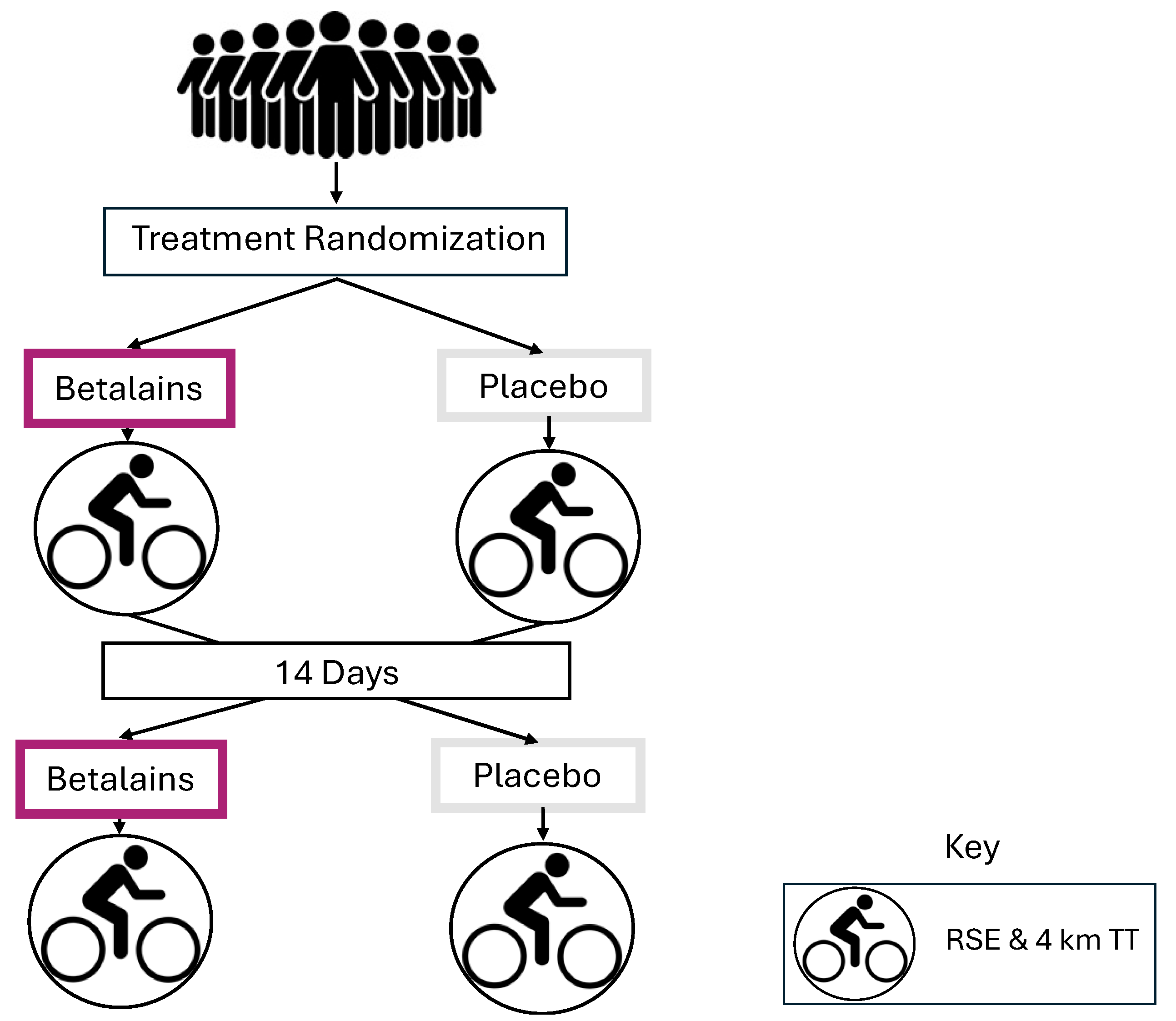
Before leaving the lab, participants received the alternate treatment and were instructed to begin supplementation one week later. Participants returned to the laboratory for the final testing session two weeks later (i.e., 7-day washout period plus 7-day loading period at the same time of day; Figure 4).

4.3. Statistical Analysis

The Shapiro–Wilk test of normality was performed to determine the distribution of data for each test, and nonparametric tests were performed when the assumption of normality was violated. Alpha was set to 0.05. For the RSE trials, two-way repeated measures ANOVA was used to analyze the effects of treatment (BRC and PLA) and sprint number (1, 2, and 3) on peak power, mean power, and fatigue index. For the 4 km time trial, two-way repeated measures ANOVA was used to analyze the effects of treatment condition and distance (0, 1, 2, 3, and 4 km) on RPE, and RER. Due to one missing datapoint for HR (at 4 km during a placebo trial) and one missing datapoint for VO2 (at 4 km during a BRC trial), mixed model analysis was performed to determine the effects of treatment and distance on HR and VO2. Finally, a two-way repeated measures ANOVA for treatment and distance (0, 2, and 4 km) was used to analyze LAC. Partial eta squared (ηp2) was calculated for all ANOVA tests. A paired t-test was used to determine differences in mean power between BRC and PLA, and a Wilcoxon signed-rank test was used to determine differences in time to completion due to abnormal data distribution. All statistical tests and graphing were performed using GraphPad Prism software 10.6.1.

5. Conclusions

In conclusion, a one-week dosing strategy with a BRC did not improve 4 km time trial performance or variables associated with performance but did impair RSE performance in trained cycling athletes. The results of this study suggest that trained athletes may want to avoid BRC supplementation prior to supramaximal efforts. In light of recent and prior findings, further investigation is warranted to determine whether BRC possesses any ergogenic properties. Future studies should consider examining BRC’s effects in untrained or recreationally trained individuals, as well as its effects on muscle damage and during longer-duration, submaximal exercise.

Supplementary Materials

The following supporting information can be downloaded at: https://www.mdpi.com/article/10.3390/physiologia5040054/s1.

Author Contributions

Conceptualization, S.V.; methodology, S.V. and J.F.; software, J.F. and C.M.; validation, J.F. and C.M.; formal analysis, M.E.S.; investigation, J.F., S.K., A.S. and G.F.; resources, J.F.; data curation, J.F., S.V., S.K., A.S. and G.F.; writing—original draft preparation, S.V.; writing—review and editing, S.V., M.E.S. and J.F.; visualization, S.V. and M.E.S.; supervision, J.F.; project administration, S.V. and J.F. All authors have read and agreed to the published version of the manuscript.

Funding

This research received no external funding.

Institutional Review Board Statement

The study was conducted in accordance with the Declaration of Helsinki, and approved by the Institutional Review Boardof SUNY Brockport University (protocol code STUDY00004946 and approval date 23 May 2024).

Informed Consent Statement

Informed consent was obtained from all subjects involved in the study.

Data Availability Statement

The primary data for this study is available from the authors upon direct request.

Acknowledgments

We would like to thank the folks at FutureCeuticals for donating both the supplement and the placebo in kind. Also, we would like to thank the participants for volunteering their time and effort for this study.

Conflicts of Interest

The authors declare no conflicts of interest.

Abbreviations

The following abbreviations are used in this manuscript:
BRCBetalain-rich concentrate
HRHeart rate
LACLactate
NONitric oxide
PCrPhosphocreatine
PLAPlacebo
RBJRed Beetroot
RERRespiratory exchange ratio
ROSReactive oxygen species
RPERating of perceived exertion
RSERepeated sprint exercise
TTTime trial
VO2Oxygen consumption

References

  1. Jeukendrup, A.E.; Craig, N.P.; Hawley, J.A. The Bioenergetics of World Class Cycling. J. Sci. Med. Sport 2000, 3, 414–433. [Google Scholar] [CrossRef]
  2. Fiorenza, M.; Hostrup, M.; Gunnarsson, T.P.; Shirai, Y.; Schena, F.; Iaia, F.M.; Bangsbo, J. Neuromuscular Fatigue and Metabolism during High-Intensity Intermittent Exercise. Med. Sci. Sports Exerc. 2019, 51, 1642–1652. [Google Scholar] [CrossRef]
  3. Weavil, J.C.; Amann, M. Neuromuscular Fatigue during Whole Body Exercise. Curr. Opin. Physiol. 2019, 10, 128–136. [Google Scholar] [CrossRef]
  4. Alfieri, A.; D’Angelo, S.; Mazzeo, F. Role of Nutritional Supplements in Sport, Exercise and Health. Nutrients 2023, 15, 4429. [Google Scholar] [CrossRef]
  5. Peeling, P.; Binnie, M.J.; Goods, P.S.R.; Sim, M.; Burke, L.M. Evidence-Based Supplements for the Enhancement of Athletic Performance. Int. J. Sport Nutr. Exerc. Metab. 2018, 28, 178–187. [Google Scholar] [CrossRef]
  6. Wong, T.H.; Sim, A.; Burns, S.F. The Effects of Nitrate Ingestion on High-Intensity Endurance Time-Trial Performance: A Systematic Review and Meta-Analysis. J. Exerc. Sci. Fit. 2022, 20, 305–316. [Google Scholar] [CrossRef]
  7. Tan, R.; Cass, J.K.; Lincoln, I.G.; Wideen, L.E.; Nicholl, M.J.; Molnar, T.J.; Gough, L.A.; Bailey, S.J.; Pennell, A. Effects of Dietary Nitrate Supplementation on High-Intensity Cycling Sprint Performance in Recreationally Active Adults: A Systematic Review and Meta-Analysis. Nutrients 2024, 16, 2764. [Google Scholar] [CrossRef]
  8. Clifford, T.; Howatson, G.; West, D.; Stevenson, E. The Potential Benefits of Red Beetroot Supplementation in Health and Disease. Nutrients 2015, 7, 2801–2822. [Google Scholar] [CrossRef]
  9. Albano, C.; Negro, C.; Tommasi, N.; Gerardi, C.; Mita, G.; Miceli, A.; De Bellis, L.; Blando, F. Betalains, Phenols and Antioxidant Capacity in Cactus Pear (Opuntia ficus-indica (L.) Mill.) Fruits from Apulia (South Italy) Genotypes. Antioxidants 2015, 4, 269–280. [Google Scholar] [CrossRef]
  10. Pietrzkowski, Z.; Nemzer, B.; Spórna, A.; Stalica, P.; Tresher, W.; Keller, R.; Jimenez, R.; Michałowski, T.; Wybraniec, S. Influence of Betalain-Rich Extract on Reduction of Discomfort Associated with Osteoarthritis. New Med. 2010, 1, 12–17. [Google Scholar]
  11. Nemzer, B.V.; Pietrzkowski, Z.; Hunter, J.M.; Robinson, J.L.; Fink, B. A Betalain-Rich Dietary Supplement, but Not PETN, Increases Vasodilation and Nitric Oxide: A Comparative, Single-Dose, Randomized, Placebo-Controlled, Blinded, Crossover Pilot Study. J. Food Res. 2020, 10, 26. [Google Scholar] [CrossRef]
  12. Van Hoorebeke, J.; Trias, C.; Davis, B.; Lozada, C.; Casazza, G. Betalain-Rich Concentrate Supplementation Improves Exercise Performance in Competitive Runners. Sports 2016, 4, 40. [Google Scholar] [CrossRef] [PubMed]
  13. Montenegro, C.F.; Kwong, D.A.; Minow, Z.A.; Davis, B.A.; Lozada, C.F.; Casazza, G.A. Betalain-Rich Concentrate Supplementation Improves Exercise Performance and Recovery in Competitive Triathletes. Appl. Physiol. Nutr. Metab. 2017, 42, 166–172. [Google Scholar] [CrossRef]
  14. Mumford, P.W.; Kephart, W.C.; Romero, M.A.; Haun, C.T.; Mobley, C.B.; Osburn, S.C.; Healy, J.C.; Moore, A.N.; Pascoe, D.D.; Ruffin, W.C.; et al. Effect of 1-Week Betalain-Rich Beetroot Concentrate Supplementation on Cycling Performance and Select Physiological Parameters. Eur. J. Appl. Physiol. 2018, 118, 2465–2476. [Google Scholar] [CrossRef]
  15. Mendez-Villanueva, A.; Edge, J.; Suriano, R.; Hamer, P.; Bishop, D. The Recovery of Repeated-Sprint Exercise Is Associated with PCr Resynthesis, While Muscle pH and EMG Amplitude Remain Depressed. PLoS ONE 2012, 7, e51977. [Google Scholar] [CrossRef]
  16. Przyborowski, K.; Proniewski, B.; Czarny, J.; Smeda, M.; Sitek, B.; Zakrzewska, A.; Zoladz, J.A.; Chlopicki, S. Vascular Nitric Oxide–Superoxide Balance and Thrombus Formation after Acute Exercise. Med. Sci. Sports Exerc. 2018, 50, 1405–1412. [Google Scholar] [CrossRef] [PubMed]
  17. Leite, C.D.F.C.; Zovico, P.V.C.; Rica, R.L.; Barros, B.M.; Machado, A.F.; Evangelista, A.L.; Leite, R.D.; Barauna, V.G.; Maia, A.F.; Bocalini, D.S. Exercise-Induced Muscle Damage after a High-Intensity Interval Exercise Session: Systematic Review. Int. J. Environ. Res. Public Health 2023, 20, 7082. [Google Scholar] [CrossRef]
  18. Kawamura, T.; Muraoka, I. Exercise-Induced Oxidative Stress and the Effects of Antioxidant Intake from a Physiological Viewpoint. Antioxidants 2018, 7, 119. [Google Scholar] [CrossRef]
  19. Vitti, S.; Bruneau, M.; Bisgrove, L.; Grey, S.; Levine, S.; Mattern, C.; Faller, J. Effects of a Single Dose of a Betalain-Rich Concentrate on Determinants of Running Performance and Recovery Muscle Blood Flow: A Randomized, Triple-Blind, Placebo-Controlled, Crossover Trial. Eur. J. Appl. Physiol. 2025. [Google Scholar] [CrossRef] [PubMed]
  20. Aucouturier, J.; Boissière, J.; Pawlak-Chaouch, M.; Cuvelier, G.; Gamelin, F.-X. Effect of Dietary Nitrate Supplementation on Tolerance to Supramaximal Intensity Intermittent Exercise. Nitric Oxide 2015, 49, 16–25. [Google Scholar] [CrossRef]
  21. Jonvik, K.L.; Nyakayiru, J.; Van Dijk, J.W.; Maase, K.; Ballak, S.B.; Senden, J.M.G.; Van Loon, L.J.C.; Verdijk, L.B. Repeated-Sprint Performance and Plasma Responses Following Beetroot Juice Supplementation Do Not Differ between Recreational, Competitive and Elite Sprint Athletes. Eur. J. Sport Sci. 2018, 18, 524–533. [Google Scholar] [CrossRef]
  22. Cheng, A.J.; Yamada, T.; Rassier, D.E.; Andersson, D.C.; Westerblad, H.; Lanner, J.T. Reactive Oxygen/Nitrogen Species and Contractile Function in Skeletal Muscle during Fatigue and Recovery. J. Physiol. 2016, 594, 5149–5160. [Google Scholar] [CrossRef]
  23. Crisafulli, D.L.; Buddhadev, H.H.; Brilla, L.R.; Chalmers, G.R.; Suprak, D.N.; San Juan, J.G. Creatine-Electrolyte Supplementation Improves Repeated Sprint Cycling Performance: A Double Blind Randomized Control Study. J. Int. Soc. Sports Nutr. 2018, 15, 21. [Google Scholar] [CrossRef] [PubMed]
  24. Van Oorschot, J.W.M.; Schmitz, J.P.J.; Webb, A.; Nicolay, K.; Jeneson, J.A.L.; Kan, H.E. 31P MR Spectroscopy and Computational Modeling Identify a Direct Relation between Pi Content of an Alkaline Compartment in Resting Muscle and Phosphocreatine Resynthesis Kinetics in Active Muscle in Humans. PLoS ONE 2013, 8, e76628. [Google Scholar] [CrossRef]
  25. Jones, A.M.; Thompson, C.; Wylie, L.J.; Vanhatalo, A. Dietary Nitrate and Physical Performance. Annu. Rev. Nutr. 2018, 38, 303–328. [Google Scholar] [CrossRef]
  26. Hsu, M.-J.; Chan, H.-L.; Huang, Y.-Z.; Lin, J.-H.; Hsu, H.-H.; Chang, Y.-J. Mechanism of Fatigue Induced by Different Cycling Paradigms with Equivalent Dosage. Front. Physiol. 2020, 11, 545. [Google Scholar] [CrossRef] [PubMed]
  27. Debold, E.P.; Westerblad, H. New Insights into the Cellular and Molecular Mechanisms of Skeletal Muscle Fatigue: The Marion J. Siegman Award Lectureships. Am. J. Physiol.-Cell Physiol. 2024, 327, C946–C958. [Google Scholar] [CrossRef] [PubMed]
  28. Margaritelis, N.V.; Nastos, G.G.; Vasileiadou, O.; Chatzinikolaou, P.N.; Theodorou, A.A.; Paschalis, V.; Vrabas, I.S.; Kyparos, A.; Fatouros, I.G.; Nikolaidis, M.G. Inter-Individual Variability in Redox and Performance Responses after Antioxidant Supplementation: A Randomized Double Blind Crossover Study. Acta Physiol. 2023, 238, e14017. [Google Scholar] [CrossRef]
  29. Wang, Y.; Adekolurejo, O.O.; Wang, B.; McDermott, K.; Do, T.; Marshall, L.J.; Boesch, C. Bioavailability and Excretion Profile of Betacyanins—Variability and Correlations between Different Excretion Routes. Food Chem. 2024, 437, 137663. [Google Scholar] [CrossRef]
  30. McKay, A.K.A.; Stellingwerff, T.; Smith, E.S.; Martin, D.T.; Mujika, I.; Goosey-Tolfrey, V.L.; Sheppard, J.; Burke, L.M. Defining Training and Performance Caliber: A Participant Classification Framework. Int. J. Sports Physiol. Perform. 2022, 17, 317–331. [Google Scholar] [CrossRef]
  31. Thurlow, F.; Weakley, J.; Townshend, A.D.; Timmins, R.G.; Morrison, M.; McLaren, S.J. The Acute Demands of Repeated-Sprint Training on Physiological, Neuromuscular, Perceptual and Performance Outcomes in Team Sport Athletes: A Systematic Review and Meta-Analysis. Sports Med. 2023, 53, 1609–1640. [Google Scholar] [CrossRef] [PubMed]
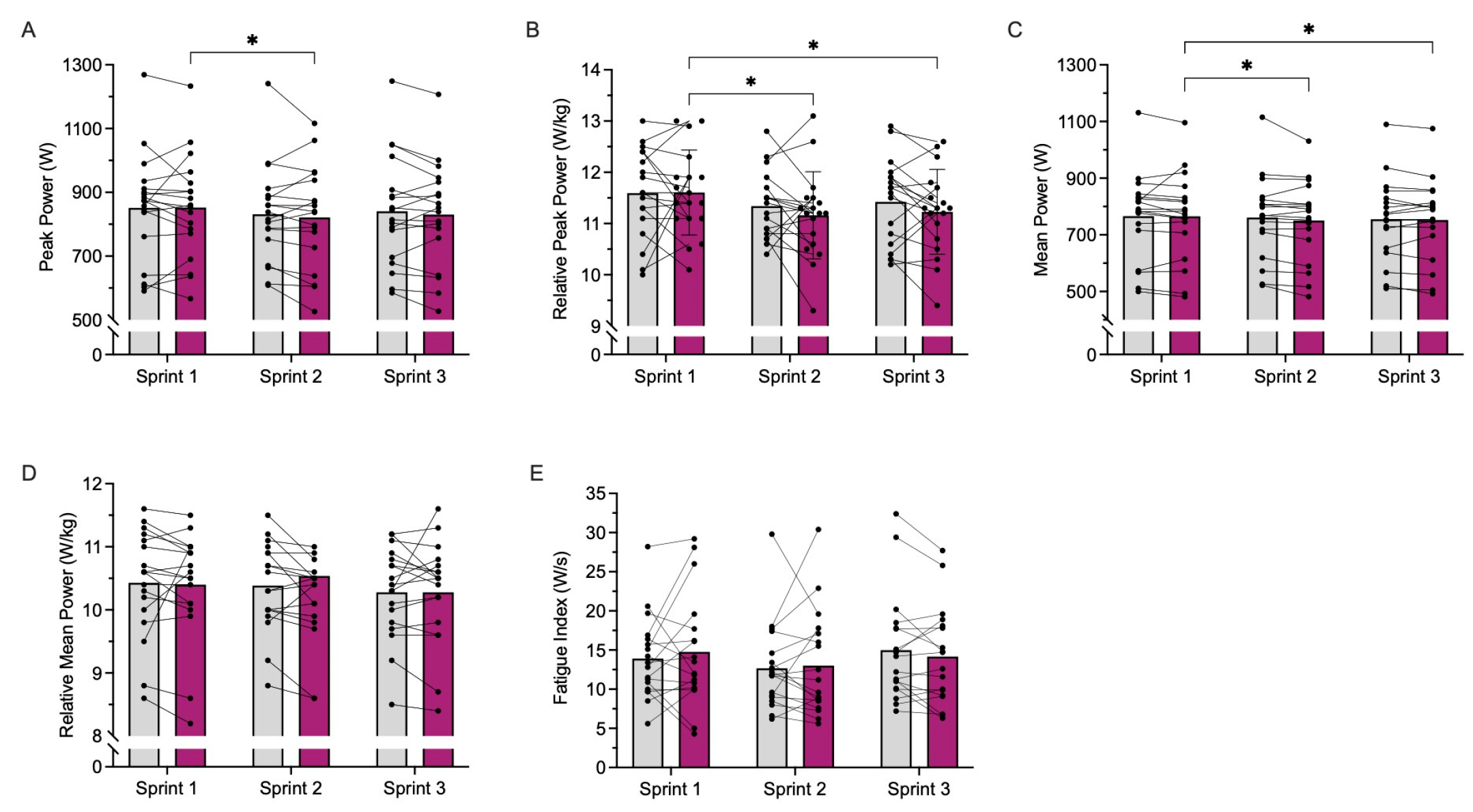
Figure 1. Mean individual repeated measures of peak power (A), relative peak power (B), mean power (C), relative mean power (D), and fatigue index (E) during RSE. * Denotes a significant difference between sprints for BRC treatment only. Note, purple bars are BRC treatment and grey bars are the placebo.
Physiologia 05 00054 g001
Figure 2. Mean and individual repeated measures of time to completion (A), mean power (B), and relative mean power (C) during the 4 km TT.
Physiologia 05 00054 g002
Figure 3. Mean ± standard deviation of heart rate (A), rate of perceived exertion (B), lactate (C), oxygen consumption (D), and respiratory exchange ratio (E) during the 4 km TT. # = different from baseline (0 km) (p < 0.05); ** = different from the previous time point for both Placebo and BRC (p < 0.05); * = different from the previous time point for BRC only (p < 0.05). Note, purple lines are BRC treatment and black lines are the placebo.
Physiologia 05 00054 g003
Figure 4. Visual representation of the study timeline. Abbreviations: RSE = repeated-sprint exercise; TT = time trial.
Physiologia 05 00054 g004
Table 1. Participant characteristics expressed as mean ± SD.
VariableValues
N (M/F)18 (15/3)
Age (yr)38.83 ± 8.09
Height (cm)176.86 ± 9.60
Weight (kg)73.23 ± 10.95
Weekly training (h)9.68 ± 3.09
Disclaimer/Publisher’s Note: The statements, opinions and data contained in all publications are solely those of the individual author(s) and contributor(s) and not of MDPI and/or the editor(s). MDPI and/or the editor(s) disclaim responsibility for any injury to people or property resulting from any ideas, methods, instructions or products referred to in the content.