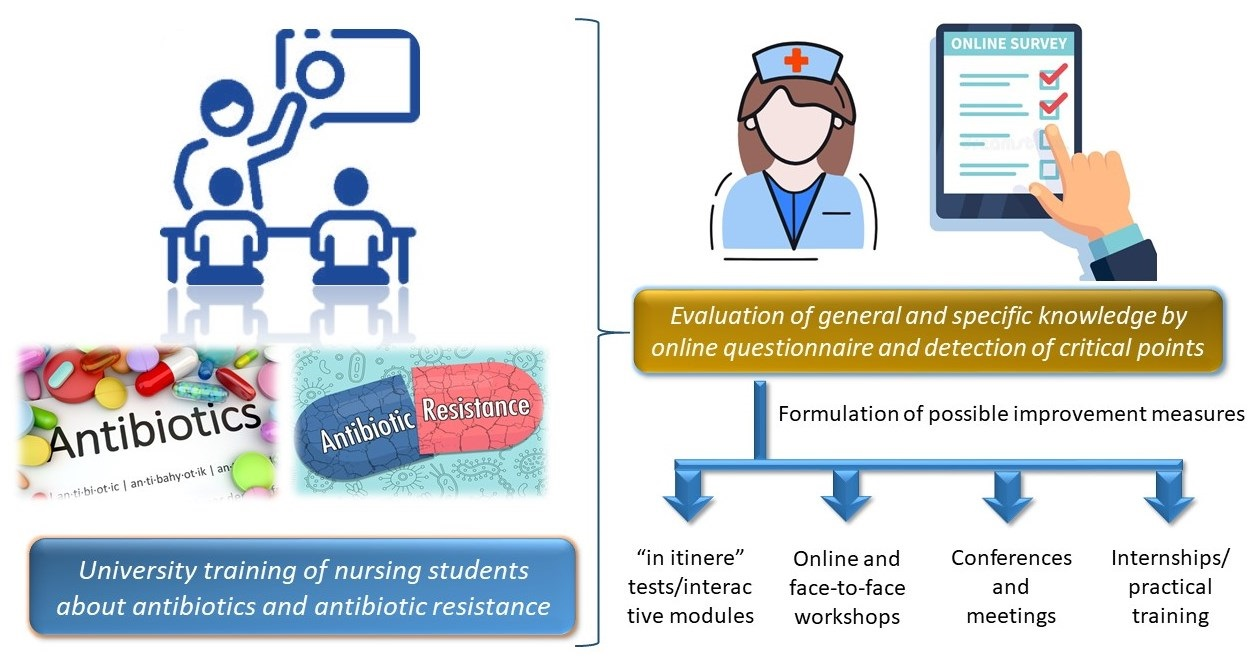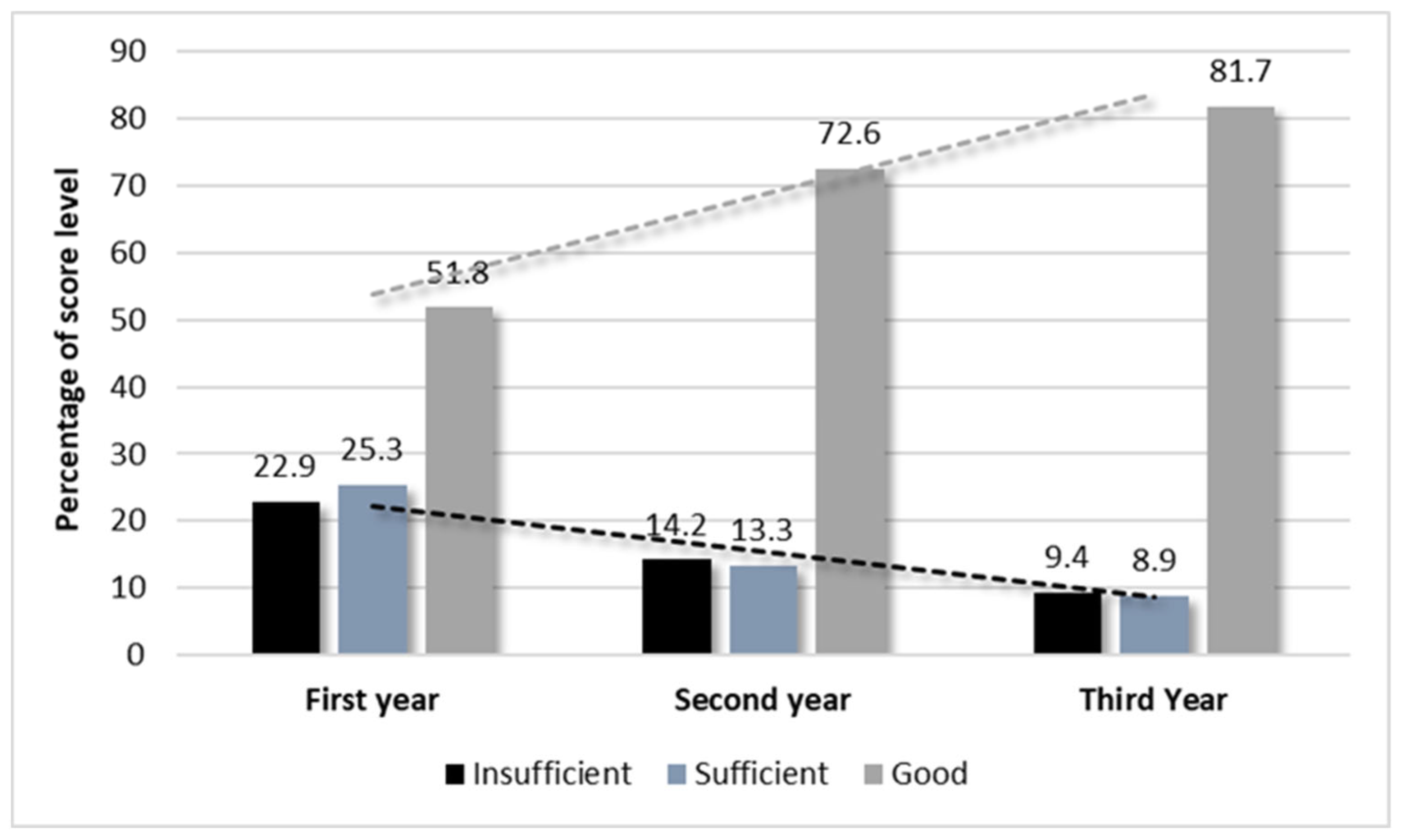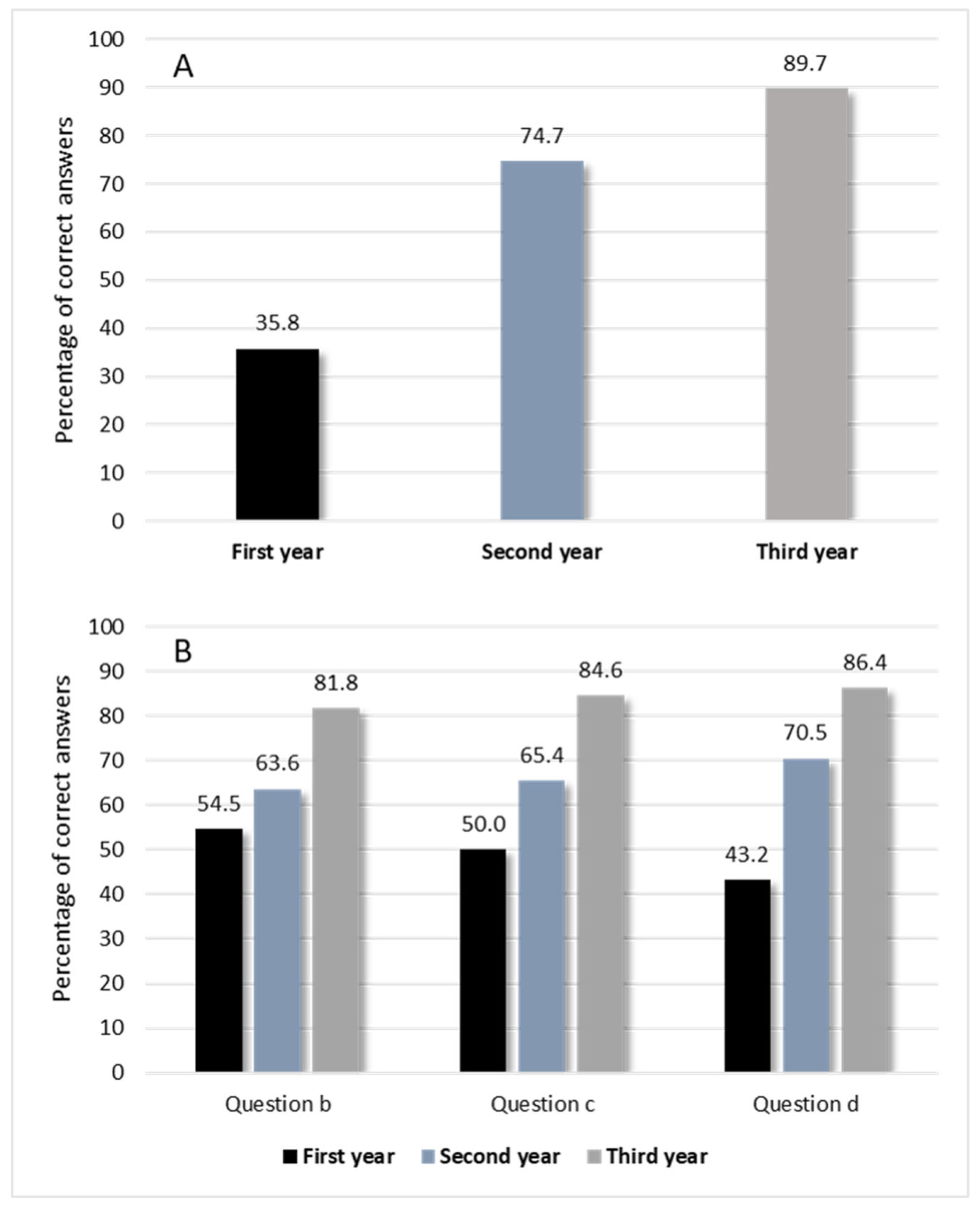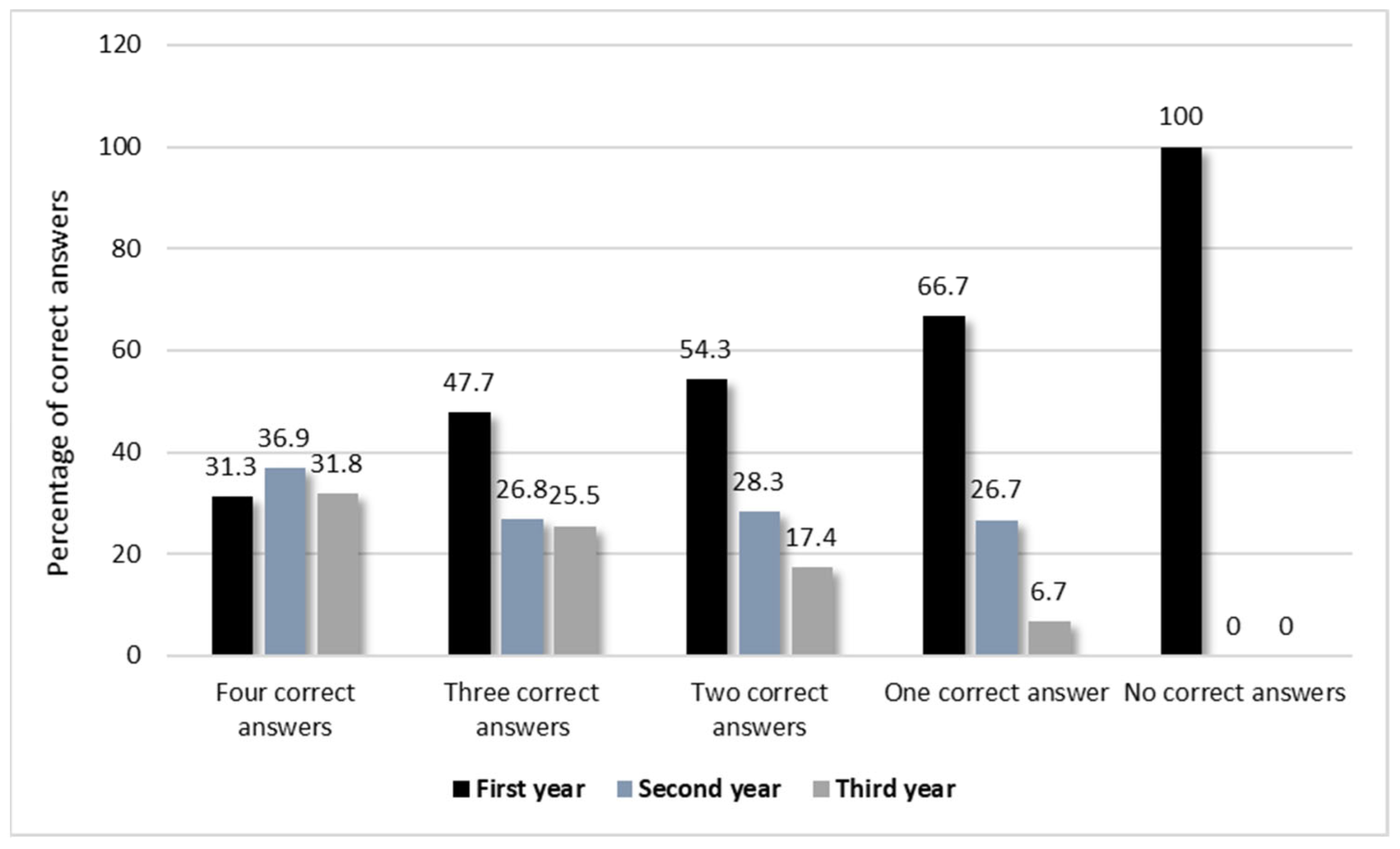

Assessment of Nursing Students’ Knowledge of Antibiotic Resistance in an Italian University Setting: A Survey of Knowledge, Attitudes, and Practices

 , and
, and
Abstract
1. Introduction
2. Materials and Methods
2.1. General Methodology
2.2. Statistical Analyses
3. Results
3.1. General Features of the Sample
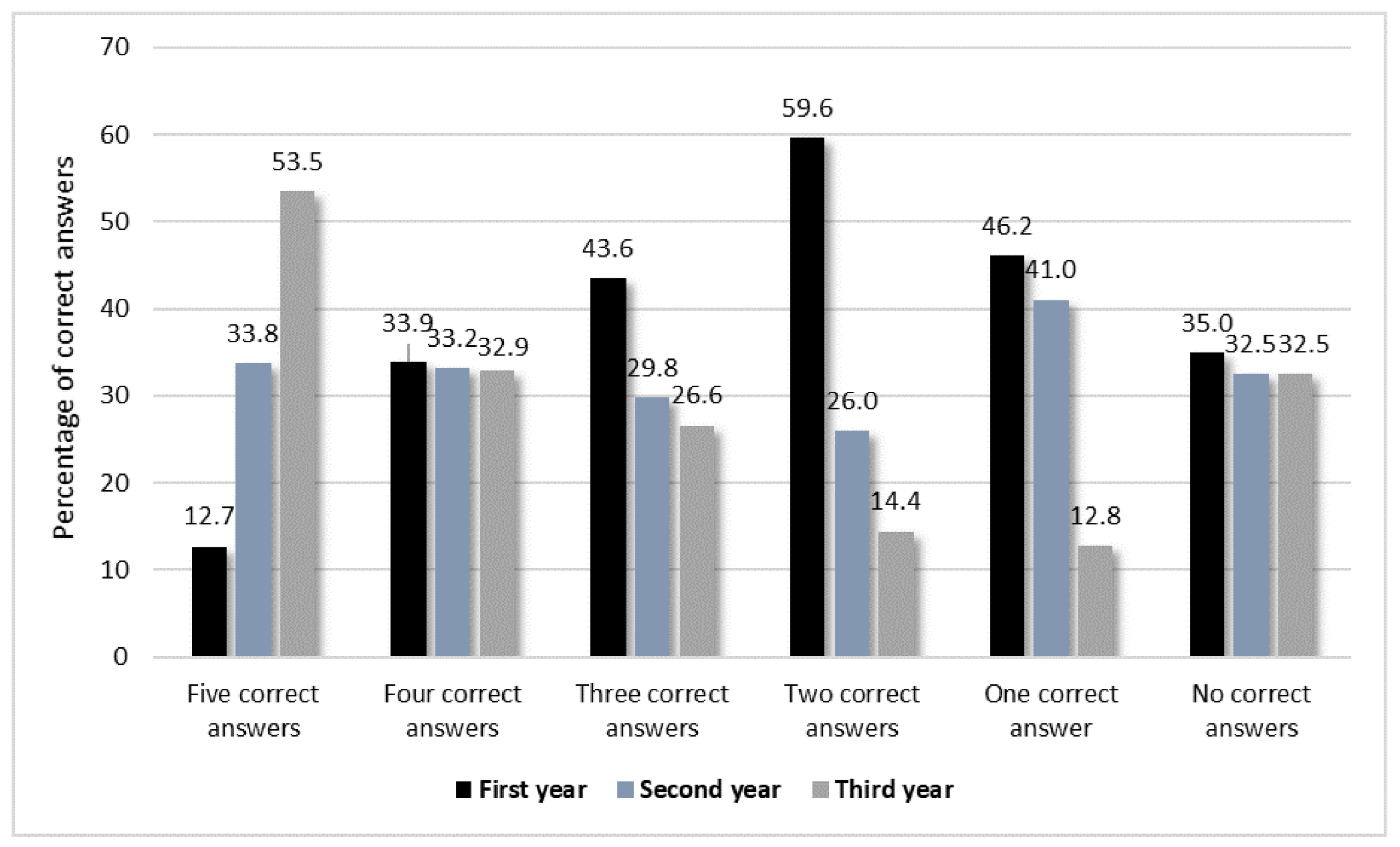
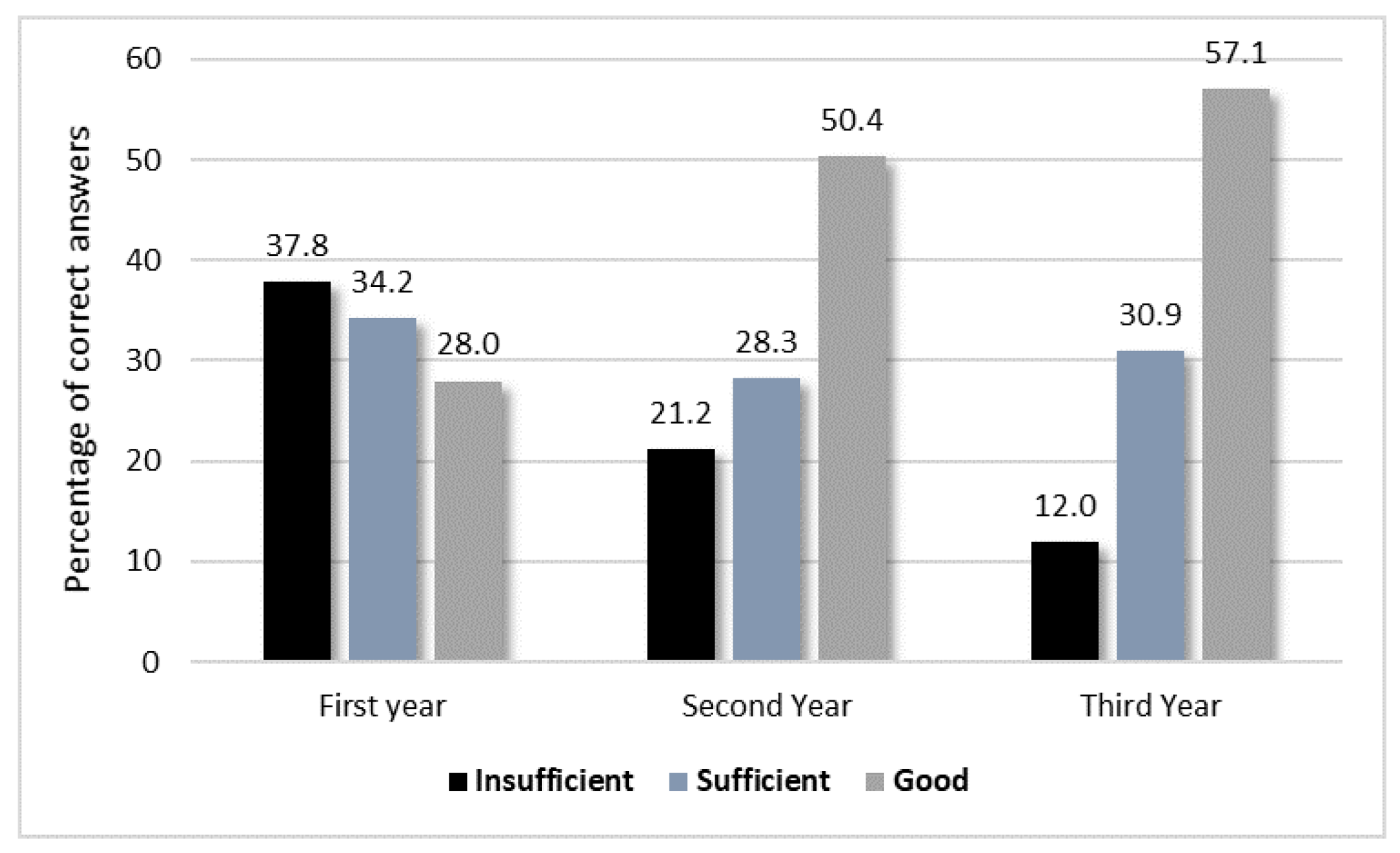
3.2. Overall Knowledge Score
3.3. General Knowledge of Antibiotics
3.4. General Knowledge of ABR
3.5. Past Experiences with Antibiotics
4. Discussion
5. Conclusions
Limits of the Study
Author Contributions
Funding
Institutional Review Board Statement
Informed Consent Statement
Data Availability Statement
Conflicts of Interest
References
- Aslam, B.; Khurshid, M.; Arshad, M.I.; Muzammil, S.; Rasool, M.; Yasmeen, N.; Shah, T.; Chaudhry, T.H.; Rasool, M.H.; Shahid, A.; et al. Antibiotic Resistance: One Health One World Outlook. Front. Cell. Infect. Microbiol. 2021, 11, 771510. [Google Scholar] [CrossRef]
- World Health Organization (WHO). Antimicrobial Resistance. 2023. Available online: https://www.who.int/news-room/fact-sheets/detail/antimicrobial-resistance (accessed on 10 June 2025).
- Machowska, A.; Lundborg, C.S. Drivers of irrational use of antibiotics in Europe. Int. J. Environ. Res. Public Health 2019, 16, 27. [Google Scholar] [CrossRef]
- Llor, C.; Bjerrum, L. Antimicrobial resistance: Risk associated with antibiotic overuse and initiatives to reduce the problem. Ther. Adv. Drug Saf. 2014, 5, 229–241. [Google Scholar] [CrossRef] [PubMed]
- Ramachandran, P.; Rachuri, N.K.; Martha, S.; Shakthivel, R.; Gundala, A.; Battu, T.S. Implications of Overprescription of Antibiotics: A Cross-Sectional Study. J. Pharm. Bioallied Sci. 2019, 11, S434–S437. [Google Scholar] [CrossRef] [PubMed]
- Bassetti, S.; Tschudin-Sutter, S.; Egli, A.; Osthoff, M. Optimizing antibiotic therapies to reduce the risk of bacterial resistance. Eur. J. Intern. Med. 2022, 99, 7–12. [Google Scholar] [CrossRef]
- Dodds, D.R. Antibiotic resistance: A current epilogue. Biochem. Pharmacol. 2017, 134, 139–146. [Google Scholar] [CrossRef] [PubMed]
- Larsson, D.G.; Flach, C.F. Antibiotic resistance in the environment. Nat. Rev. Microbiol. 2022, 20, 257–269. [Google Scholar] [CrossRef]
- Huemer, M.; Mairpady Shambat, S.; Brugger, S.D.; Zinkernagel, A.S. Antibiotic resistance and persistence—Implications for human health and treatment perspectives. EMBO Rep. 2020, 21, e51034. [Google Scholar] [CrossRef] [PubMed]
- Sodhi, K.K.; Singh, C.K. Recent development in the sustainable remediation of antibiotics: A review. Total Environ. Res. Themes 2022, 3, 100008. [Google Scholar] [CrossRef]
- Antimicrobial Resistance Collaborators. Global burden of bacterial antimicrobial resistance in 2019: A systematic analysis. Lancet 2022, 399, 629–655. [Google Scholar] [CrossRef]
- De Kraker, M.E.; Stewardson, A.J.; Harbarth, S. Will 10 Million People Die a Year due to Antimicrobial Resistance by 2050? PLoS Med. 2016, 13, e1002184. [Google Scholar] [CrossRef] [PubMed]
- Romandini, A.; Pani, A.; Schenardi, P.A.; Pattarino, G.A.C.; De Giacomo, C.; Scaglione, F. Antibiotic Resistance in Pediatric Infections: Global Emerging Threats, Predicting the Near Future. Antibiotics 2021, 10, 393. [Google Scholar] [CrossRef] [PubMed]
- Velazquez-Meza, M.E.; Galarde-López, M.; Carrillo-Quiróz, B.; Alpuche-Aranda, C.M. Antimicrobial resistance: One Health approach. Vet. World 2022, 15, 743–749. [Google Scholar] [CrossRef]
- Collignon, P.J.; McEwen, S.A. One Health-Its Importance in Helping to Better Control Antimicrobial Resistance. Trop. Med. Infect. Dis. 2019, 4, 22. [Google Scholar] [CrossRef]
- Venter, H.; Henningsen, M.L.; Begg, S.L. Antimicrobial resistance in healthcare, agriculture and the environment: The biochemistry behind the headlines. Essays Biochem. 2017, 61, 1–10. [Google Scholar] [CrossRef] [PubMed]
- Facciolà, A.; Pellicanò, G.F.; Visalli, G.; Paolucci, I.A.; Venanzi Rullo, E.; Ceccarelli, M.; D’Aleo, F.; Di Pietro, A.; Squeri, R.; Nunnari, G.; et al. The role of the hospital environment in the healthcare-associated infections: A general review of the literature. Eur. Rev. Med. Pharmacol. Sci. 2019, 23, 1266–1278. [Google Scholar]
- Khadse, S.N.; Ugemuge, S.; Singh, C. Impact of Antimicrobial Stewardship on Reducing Antimicrobial Resistance. Cureus 2023, 15, e49935. [Google Scholar] [CrossRef]
- CDC 2023. III. Precautions to Prevent Transmission of Infectious Agents. Available online: https://www.cdc.gov/infection-control/hcp/isolation-precautions/precautions.html (accessed on 15 July 2025).
- Joint Commission International. Approved: New antimicrobial stewardship standard. Jt. Comm. Perspect. 2016, 36, 1–3. [Google Scholar]
- Barlam, T.F.; Cosgrove, S.E.; Abbo, L.M.; MacDougall, C.; Schuetz, A.N.; Septimus, E.J.; Srinivasan, A.; Dellit, T.H.; Falck-Ytter, Y.T.; Fishman, N.O.; et al. Executive Summary: Implementing an Antibiotic Stewardship Program: Guidelines by the Infectious Diseases Society of America and the Society for Healthcare Epidemiology of America. Clin. Infect. Dis. 2016, 62, 1197–1202. [Google Scholar] [CrossRef]
- Center for Disease Control and Prevention. The Core Elements of Hospital Antibiotic Stewardship Programs. Available online: https://www.cdc.gov/antibiotic-use/healthcare/pdfs/core-elements.pdf (accessed on 1 September 2025).
- Crespo-Rivas, J.C.; Guisado-Gil, A.B.; Peñalva, G. Are antimicrobial stewardship interventions effective and safe in long-term care facilities? A systematic review and meta-analysis. Clin. Microbiol. Infect. 2021, 27, 1431–1438. [Google Scholar] [CrossRef]
- Manning, M.L.; Pfeiffer, J.; Larson, E.L. Combating antibiotic resistance: The role of nursing in antibiotic stewardship. Am. J. Infect. Control 2016, 44, 1454–1457. [Google Scholar] [CrossRef]
- Pulcini, C.; Morel, C.M.; Tacconelli, E. Human resources estimates and funding for antibiotic stewardship teams are urgently needed. Clin. Microbiol. Infect. 2017, 23, 785–787. [Google Scholar] [CrossRef]
- Gotterson, F.; Buising, K.; Manias, E. Nurse role and contribution to antimicrobial stewardship: An integrative review. Int. J. Nurs. Stud. 2021, 117, 103787. [Google Scholar] [CrossRef] [PubMed]
- Ahouah, M.; Lartigue, C.; Rothan-Tondeur, M. Perceptions of Antibiotic Therapy Among Nursing Home Residents: Perspectives of Caregivers and Residents in a Mixed Exploratory Study. Antibiotics 2019, 8, 66. [Google Scholar] [CrossRef] [PubMed]
- Olans, R.N.; Olans, R.D.; De Maria, A., Jr. The Critical Role of the Staff Nurse in Antimicrobial Stewardship—Unrecognized, but Already There. Clin. Infect. Dis. 2016, 62, 84–89. [Google Scholar] [PubMed]
- Sobierajski, T.; Mazińska, B.; Wanke-Rytt, M.; Hryniewicz, W. Knowledge-Based Attitudes of Medical Students in Antibiotic Therapy and Antibiotic Resistance. A Cross-Sectional Study. Int. J. Environ. Res. Public Health 2021, 18, 3930. [Google Scholar] [CrossRef]
- Abushaheen, M.A.; Muzaheed Fatani, A.J.; Alosaimi, M.; Mansy, W.; George, M.; Acharya, S.; Rathod, S.; Divakar, D.D.; Jhugroo, C.; Vellappally, S.; et al. Antimicrobial resistance, mechanisms and its clinical significance. Dis. Mon. 2020, 66, 100971. [Google Scholar] [CrossRef] [PubMed]
- King, O.; West, E.; Lee, S.; Glenister, K.; Quilliam, C.; Wong Shee, A.; Beks, H. Research education and training for nurses and allied health professionals: A systematic scoping review. BMC Med Educ. 2022, 22, 385. [Google Scholar] [CrossRef] [PubMed]
- Kõrgemaa, U.; Sisask, M.; Ernits, Ü. Nurses retrospective view on nursing education: A repeated cross-sectional study over three decades. Heliyon 2024, 10, e26211. [Google Scholar] [CrossRef]
- Wang, G.; Xia, Y.; Chen, Q.; Halili, X.; Huang, H. Exploring academic and clinical nurses’ perspectives on evidence-based nursing course for undergraduates from perspectives of academic-practice partnerships: A qualitative study. BMC Nurs. 2024, 23, 657. [Google Scholar] [CrossRef]
- World Health Organization. Antibiotic Resistance: Multi-Country Public Awareness Survey. 2015. Available online: https://iris.who.int/server/api/core/bitstreams/c629209a-fc45-45e0-b84b-b3ff9917bb20/content (accessed on 10 August 2025).
- Karthikeyan, V.; Saini, N.; Nadarajan, R.; Gopimohan, M.; Roy, P. Multidisciplinary Collaboration in Combatting Antimicrobial Resistance: Insights and Outcomes From the National Alliance of Medical Professionals on Antimicrobial Resistance (NAMP-AMR) Initiative. Cureus 2024, 16, e68932. [Google Scholar] [CrossRef] [PubMed]
- Manning, M.L.; Giannuzzi, D. Keeping patients safe: Antibiotic resistance and the role of nurse executives in antibiotic stewardship. J. Nurs. Adm. 2015, 45, 67–69. [Google Scholar] [CrossRef] [PubMed]
- Oerther, S.; Oerther, D.B. Antimicrobial resistance needs to be combated at primary levels of prevention by nurses. Nurs. Open 2020, 7, 678–679. [Google Scholar] [CrossRef] [PubMed]
- Hamilton, R.M.; Merrill, K.C.; Luthy, K.E.; Nuttall, C. Knowledge, attitudes, and perceptions of nurse practitioners about antibiotic stewardship. J. Am. Assoc. Nurse Pract. 2020, 33, 909–915. [Google Scholar] [CrossRef] [PubMed]
- Newland, R.; Singleton, S.; Waterall, J. Antimicrobial stewardship: Nurses’ critical role in preventing antimicrobial resistance. Br. J. Nurs. 2021, 30, 1140–1141. [Google Scholar] [CrossRef]
- Hamdy, R.; Neal, W.; Nicholson, L.; Ansusinha, E.; King, S. Pediatric nurses’ perceptions of their role in antimicrobial stewardship: A focus group study. J. Pediatr. Nurs. 2019, 48, 10–17. [Google Scholar] [CrossRef]
- Aliafsari Mamaghani, E.; Soleimani, A.; Zirak, M. Trust in nurses and its association with medication adherence of cardiovascular patients: A descriptive correlational study. Int. J. Nurs. Stud. Adv. 2024, 8, 100278. [Google Scholar] [CrossRef]
- Bahari, Z.; Vosoghi, N.; Ramazanzadeh, N.; Moshfeghi, S.; Aghamohammadi, M. Patient trust in nurses: Exploring the relationship with care quality and communication skills in emergency departments. BMC Nurs. 2024, 23, 595. [Google Scholar] [CrossRef]
- Sedighi, S.; Sadeghi, A.; Roshanaei, G.; Purfarzad, Z. The relationship between nurses’ caring behaviors and patient loyalty: Trust towards nurses as a mediating role. BMC Nurs. 2025, 24, 568. [Google Scholar] [CrossRef]
- Rábano-Blanco, A.; Domínguez-Martís, E.M.; Mosteiro-Miguéns, D.G.; Freire-Garabal, M.; Novío, S. Nursing Students’ Knowledge and Awareness of Antibiotic Use, Resistance and Stewardship: A Descriptive Cross-Sectional Study. Antibiotics 2019, 8, 203. [Google Scholar] [CrossRef]
- Purssell, E.; McCrae, N. The rise and fall of university-based nurse training. Nurse Educ. Pract. 2021, 56, 103081. [Google Scholar] [CrossRef]
- National Academies of Sciences, Engineering, and Medicine; National Academy of Medicine; Committee on the Future of Nursing 2020–2030; Wakefield, M.K.; Williams, D.R.; Le Menestrel, S.; Flaubert, J.L. (Eds.) The Future of Nursing 2020–2030: Charting a Path to Achieve Health Equity; 7, Educating Nurses for the Future; National Academies Press (US): Washington, DC, USA, 2021. Available online: https://www.ncbi.nlm.nih.gov/books/NBK573912/ (accessed on 10 September 2025).
- Bennadi, D. Self-medication: A current challenge. J. Basic Clin. Pharm. 2013, 5, 19–23. [Google Scholar] [CrossRef]
- Lee, C.R.; Cho, I.H.; Jeong, B.C.; Lee, S.H. Strategies to minimize antibiotic resistance. Int. J. Environ. Res. Public Health 2013, 10, 4274–4305. [Google Scholar] [CrossRef]
- Rather, I.A.; Kim, B.C.; Bajpai, V.K.; Park, Y.H. Self-medication and antibiotic resistance: Crisis, current challenges, and prevention. Saudi J. Biol. Sci. 2017, 24, 808–812. [Google Scholar] [CrossRef]
- Muteeb, G.; Rehman, M.T.; Shahwan, M.; Aatif, M. Origin of Antibiotics and Antibiotic Resistance, and Their Impacts on Drug Development: A Narrative Review. Pharmaceuticals 2023, 16, 1615. [Google Scholar] [CrossRef] [PubMed]
- Kilari, V.; Oroszi, T. The Misuse of Antibiotics and the Rise of Bacterial Resistance: A Global Concern. Pharmacol. Pharm. 2024, 15, 508–523. [Google Scholar] [CrossRef]
- De Vita, E.; Segala, F.V.; Frallonardo, L.; Civile, G.; De Scisciolo, D.; Novara, R.; De Vito, A.; De Girolamo, M.G.; Amendolara, A.; Piccolomo, L.; et al. Knowledge, Attitudes, and Practices toward Antimicrobial Resistance among Young Italian Nurses and Students: A Multicenter, Cross-Sectional Study. Ann. Glob. Health 2024, 90, 46. [Google Scholar] [CrossRef]
- Bouchoucha, S.L.; Kilpatrick, M.; Phillips, N.M.; Hutchinson, A.F. Nursing students’ awareness and perceptions of nurses’ role in antimicrobial stewardship. Nurse Educ. Pract. 2021, 52, 103036. [Google Scholar] [CrossRef] [PubMed]
- Precha, N.; Sukmai, S.; Hengbaru, M.; Chekoh, M.; Laohaprapanon, S.; Makkaew, P.; Dom, N.C. Knowledge, attitudes, and practices regarding antibiotic use and resistance among health science and non-health science university students in Thailand. PLoS ONE 2024, 19, e0296822. [Google Scholar] [CrossRef]



| General Features | Results |
|---|---|
| Total sample of students attending the Nursing Science course | 874 (first year: 320; second year: 293; third year: 261) |
| Percentage response rate (absolute number) | 76.9% (672) |
| Average number of adherent students per year (M * ± SD §) | 224 ± 24.5 |
| Adherent students per year: absolute number (%) | First year: 253 (79.1% of first-year attendants; 37.6% of adherent sample) Second year: 226 (77.1% of second-year attendants; 33.6% of adherent sample) Third year: 193 (73.9% of third-year attendants; 28.7% of adherent sample) |
| Average age (M * ± SD §) of the adherent sample | 21.9 ± 3.6 (min. 18–max: 47) |
| Percentage of adherent students’ gender (absolute number) | M **: 30.7% (206) W §§: 69.3% (466) |
| Nationality of the adherent sample | Italians: 99% (51.8% coming from the city of Messina and its provincial territory; 41.8% coming from other Sicilian provinces; 6.3% coming from the neighbouring region of Calabria) Foreigners: 1% |
| Correct Answer | Incorrect Answer | Incorrect Answer | |||||||
|---|---|---|---|---|---|---|---|---|---|
| (a) Antibiotics are taken in case of... | Bacterial infections | Viral infections | All types of infection | ||||||
| TOT 530 (79.1%) | TOT 88 (12.9%) | TOT 54 (8.0%) | |||||||
| I year 178 (33.6%) | II year 188 (35.5%) | III year 164 (30.9%) | I year 57 (64.8%) | II year 22 (25.0%) | III year 9 (10.2%) | I year 19 (35.2%) | II year 15 (27.8%) | III year 20 (37.0%) | |
| (b) You can use the antibiotics prescribed to a friend or family member to treat the same disease | False | True | I do not know | ||||||
| TOT 622 (92.5%) | TOT 24 (3.6%) | TOT 26 (3.9%) | |||||||
| I year 229 (36.8%) | II year 212 (34.1%) | III year 181 (29.1%) | I year 11 (45.8%) | II year 5 (20.8%) | III year 8 (33.4%) | I year 13 (50.0%) | II year 9 (34.6%) | III year 4 (15.4%) | |
| (c) You can use the same antibiotics that helped you to recover from a previous disease in the past | False | True | I do not know | ||||||
| TOT 621 (92.4%) | TOT 26 (3.9%) | TOT 25 (3.7%) | |||||||
| I year 227 (36.5%) | II year 211 (34.0%) | III year 183 (29.5%) | I year 13 (50%) | II year 9 (34.6%) | III year 4 (15.4%) | I year 13 (52.0%) | II year 6 (24.0%) | III year 6 (24.0%) | |
| (d) When do you think it is better to stop an antibiotic treatment? | After taking all the prescribed pills | When I feel better | I do not know | ||||||
| TOT 615 (91.5%) | TOT 44 (6.5%) | TOT 13 (1.9%) | |||||||
| I year 219 (35.6%) | II year 211 (34.3%) | III year 185 (30.1%) | I year 25 (56.8%) | II year 13 (29.5%) | III year 6 (13.6%) | I year 9 (69.2%) | II year 2 (15.4%) | III year 2 (15.4%) | |
| Correct Answer | Incorrect Answer | Incorrect Answer | Incorrect Answer | |||||||||
|---|---|---|---|---|---|---|---|---|---|---|---|---|
| (a) ABR is when our body becomes resistant to antibiotics | False | True | I do not know | // | ||||||||
| TOT 170 (25.3%) | TOT 495 (73.6%) | TOT 7 (1.1%) | ||||||||||
| I year 53 (31.2%) | II year 77 (45.3%) | III year 40 (23.5%) | I year 197 (39.8%) | II year 146 (29.5%) | III year 152 (30.7%) | I year 4 (57.1%) | II year 2 (28.6%) | III year 1 (14.3%) | ||||
| (b) Antibiotic-resistant bacteria can be acquired by… | All the following answers | Contact with someone affected by an infection caused by antibiotic-resistant bacteria | Contact with items contaminated by antibiotic-resistant bacteria | Contact with animals or foods contaminated by antibiotic-resistant bacteria | ||||||||
| TOT 416 (61.9%) | TOT 86 (12.8%) | TOT 40 (6.0%) | TOT 130 (19.3%) | |||||||||
| I year 121 (29.1%) | II year 159 (38.2%) | III year 136 (32.7%) | I year 43 (50.0%) | II year 20 (23.3%) | III year 23 (26.7%) | I year 18 (45.0%) | II year 10 (25.0%) | III year 12 (30.0%) | I year 71 (54.6%) | II year 37 (28.5%) | III year 22 (16.9%) | |
| (c) What can happen when you get an infection caused by antibiotic-resistant bacteria? | All the following answers | The disease can last for a longer period of time | You might need of a hospital admission | You might need to intake more antibiotics | ||||||||
| TOT 399 (59.4%) | TOT 91 (13.6%) | TOT 116 (17.2%) | TOT 66 (9.9%) | |||||||||
| I year 123 (30.8%) | II year 133 (33.4%) | III year 143 (35.8%) | I year 47 (51.6%) | II year 29 (31.9%) | III year 15 (16.5) | I year 58 (50.0%) | II year 39 (33.6%) | III year 19 (16.4%) | I year 27 (40.9%) | II year 24 (36.4%) | III year 15 (22.7%) | |
| (d) ABR is a widespread reality. There is nothing I can do to counteract it | False | True | I do not know | // | ||||||||
| TOT 620 (92.3%) | TOT 47 (7.0%) | TOT 5 (0.7%) | ||||||||||
| I year 234 (37.7%) | II year 209 (33.7%) | III year 177 (28.5%) | I year 18 (38.3%) | II year 16 (34.0%) | III year 13 (27.7%) | I year 3 (60.0%) | II year 1 (20.0%) | III year 1 (20.0%) | ||||
| (e) I can contribute to reduce ABR if | I undergo all the suggested vaccinations | I always take antibiotics every time I have fever | I share antibiotic treatment with someone else | // | ||||||||
| TOT 584 (86.9%) | TOT 77 (11.5%) | TOT 11 (1.6%) | ||||||||||
| I year 218 (37.3%) | II year 190 (32.5%) | III year 176 (30.1%) | I year 28 (36.4%) | II year 32 (41.5%) | III year 17 (22.1%) | I year 7 (63.6%) | II year 4 (36.4%) | III year 0 (0.0%) | ||||
| (a) Have you ever taken antibiotics? | |||
| Yes | TOT 644 (95.8%) | ||
| I year 238 (37.0%) | II year 217 (33.7%) | III year 189 (29.3%) | |
| No | TOT 13 (1.9%) | ||
| I year 7 (53.8%) | II year 4 (30.8%) | III year 2 (15.4%) | |
| I do not remember | TOT 15 (2.2%) | ||
| I year 8 (53.3%) | II year 5 (33.4%) | III year 2 (13.3%) | |
| (b) Who recommended them to you? | |||
| Doctor | TOT 647 (96.3%) | ||
| I year 236 (36.5%) | II year 220 (34.0%) | III year 191 (29.5%) | |
| Chemist | TOT 5 (0.8%) | ||
| I year 3 (60.0%) | II year 1 (20.0%) | III year 1 (20.0%) | |
| Relative/Friend | TOT 14 (2.0%) | ||
| I year 6 (42.9%) | II year 5 (35.7%) | III year 3 (21.4%) | |
| Nobody | TOT 2 (0.3%) | ||
| I year 1 (50.0%) | II year 0 (0.0%) | III year 1 (50.0%) | |
| I do not remember | TOT 4 (0.6%) | ||
| I year 3 (75.0%) | II year 0 (0.0%) | III year 1 (25.0%) | |
| (c) Where did you find antibiotics? | |||
| Purchase in pharmacy | TOT 622 (92.6%) | ||
| I year 239 (38.4%) | II year 209 (33.6%) | III year 174 (28.0%) | |
| Relative/Friend | TOT 2 (0.3%) | ||
| I year 1 (50.0%) | II year 1 (50.0%) | III year 0 (0.0%) | |
| Internet | TOT 4 (0.5%) | ||
| I year 3 (75.0%) | II year 1 (25.0%) | III year 0 (0.0%) | |
| At home, after previous use | TOT 34 (5.1%) | ||
| I year 4 (11.8%) | II year 12 (35.3%) | III year 18 (52.9%) | |
| I do not remember | TOT 10 (1.5%) | ||
| I year 4 (40.0%) | II year 1 (10.0%) | III year 5 (50.0%) | |
Disclaimer/Publisher’s Note: The statements, opinions and data contained in all publications are solely those of the individual author(s) and contributor(s) and not of MDPI and/or the editor(s). MDPI and/or the editor(s) disclaim responsibility for any injury to people or property resulting from any ideas, methods, instructions or products referred to in the content. |
© 2026 by the authors. Licensee MDPI, Basel, Switzerland. This article is an open access article distributed under the terms and conditions of the Creative Commons Attribution (CC BY) license.
Share and Cite
Calimeri, S.; Lo Giudice, D.; Giordano, F.; Laganà, A.; Facciolà, A. Assessment of Nursing Students’ Knowledge of Antibiotic Resistance in an Italian University Setting: A Survey of Knowledge, Attitudes, and Practices. Hygiene 2026, 6, 20. https://doi.org/10.3390/hygiene6020020
Calimeri S, Lo Giudice D, Giordano F, Laganà A, Facciolà A. Assessment of Nursing Students’ Knowledge of Antibiotic Resistance in an Italian University Setting: A Survey of Knowledge, Attitudes, and Practices. Hygiene. 2026; 6(2):20. https://doi.org/10.3390/hygiene6020020
Chicago/Turabian StyleCalimeri, Sebastiano, Daniela Lo Giudice, Francesco Giordano, Antonio Laganà, and Alessio Facciolà. 2026. "Assessment of Nursing Students’ Knowledge of Antibiotic Resistance in an Italian University Setting: A Survey of Knowledge, Attitudes, and Practices" Hygiene 6, no. 2: 20. https://doi.org/10.3390/hygiene6020020
APA StyleCalimeri, S., Lo Giudice, D., Giordano, F., Laganà, A., & Facciolà, A. (2026). Assessment of Nursing Students’ Knowledge of Antibiotic Resistance in an Italian University Setting: A Survey of Knowledge, Attitudes, and Practices. Hygiene, 6(2), 20. https://doi.org/10.3390/hygiene6020020