Article

Short-Time Variations in the Algal Community Structure of the Urban Danubian Backwater “Alte Donau” with Special Focus on the Green Alga Gloeotaenium loitlesbergerianum


Department of Functional and Evolutionary Ecology, University of Vienna, Djerassiplatz 1, A-1030 Vienna, Austria
*
Author to whom correspondence should be addressed.
Phycology 2026, 6(1), 31; https://doi.org/10.3390/phycology6010031
Submission received: 5 February 2026 / Revised: 4 March 2026 / Accepted: 6 March 2026 / Published: 9 March 2026

Abstract

Urban water bodies serve as biodiversity hot spots in a human-influenced landscape. We studied the backwater “Alte Donau” (Vienna, Austria), which has been the subject of ongoing management and restoration efforts. We aimed to capture short-term variations in the planktonic and benthic algal community during a vegetation period with a specific focus on Gloeotaenium loitlesbergerianum with its primary distribution in tropical regions. In total, 196 algal taxa were identified, indicating a high and balanced species diversity. Although the waterbody is shallow and densely colonized by macrophytes, phytoplankton and microphytobenthos exhibited significant differences in composition, particularly in spring. Less pronounced differences during summer were probably caused by macrophyte harvesting combined with recreational activities. We found a clear seasonal pattern with spring characterized by blooms of Ochrophyta, followed by a shift towards green algae, Dinophyta, and Cyanobacteria during summer and autumn. We found high variability in spring samples, whereas summer and autumn samples showed increasing similarity. Temperature, silicate, and alkalinity were the primary environmental factors structuring algal community composition. G. loitlesbergerianum was detected during warmer months from May through October across a temperature range of 14 to 28 °C, with highest abundances >20 °C. Warmer water and altered nutrient regimes not only stress native populations but also promote the establishment of new species such as G. loitlesbergerianum, accelerating community shifts. Therefore, sustained monitoring, targeted macrophyte restoration, and effective nutrient management are crucial for preserving both water quality and biodiversity in such systems.

1. Introduction

Global mean temperatures (Temp), impacted by climate change [1], have risen by nearly 1.5 °C above pre-industrial levels in recent years [2]. Alpine and urban regions experience greater Temp increases than lowland and rural areas, reflecting regional variations in climate sensitivity and land-use factors [3]. In Austria, warming has been substantially higher, with an annual Temp rise of around 3.1 °C since 1900, more than twice the global average [3]. Not only terrestrial systems, but also aquatic ecosystems are vulnerable to shifts in Temp caused by climate change, amongst other factors [4]. Due to their smaller size, freshwater systems are even more prone than marine environments, affecting also the organisms therein [5,6,7]. Even minimal environmental changes can threaten these ecosystems and impact their organisms [8].
Freshwater ecosystems play a crucial role in regulating the global climate and maintaining biodiversity [9]. They provide critical habitats for a wide variety of organisms, including fish, amphibians, invertebrates, and aquatic vegetation [10]. Beyond their ecological importance, aquatic ecosystems are essential sources of drinking water and food. They also serve as valuable areas for human recreation and provide various ecosystem services [11]. Warming of these ecosystems will have drastic consequences in the future, not only for humans but also for biodiversity [7]. Biodiversity loss and community shifts trigger ecological imbalances, reducing the resilience of freshwater ecosystems [12].
Among the sensitive groups of environmental changes in freshwater ecosystems are microalgae. As primary producers at the base of the aquatic food web, algae respond rapidly to changes in environmental conditions such as Temp, light availability, and nutrient concentrations [13], which makes them ideal bioindicators of water quality [14,15]. Climate-induced alterations in water Temp and stratification patterns can lead to shifts in algal species composition, seasonal dynamics, and bloom frequencies [16,17]. Climate change often goes along with warming, promoting the proliferation of species adapted to higher Temp, including alien species. Also, cyanobacterial blooms are increasingly found in warmer, eutrophicated inland waters, some of which are harmful [16,18,19]. In addition, rising atmospheric carbon dioxide (CO2) concentrations promote cyanobacterial blooms by increasing carbon uptake efficiency [20]. Increased frequency of severe weather events leads to greater surface water runoff from agricultural and urban areas, resulting in higher nutrient loads into aquatic systems. Although nutrients are essential for algal growth, excessive quantities lead to hyper-eutrophication. This often boosts large-scale algal blooms, particularly of Cyanobacteria, which thrive under such conditions and can disrupt ecological balance [21]. The blooms age and decompose over time, creating dead zones where O2 levels are too low to support most aquatic life. The changes can trigger cascading effects across higher trophic levels, ultimately altering the structure and functioning of entire ecosystems [22].
Seasonal patterns in algal composition reflect adaptations to specific environmental conditions. In spring and late autumn, Chrysophyceae and diatoms typically dominate due to their tolerance of cooler Temp and lower light supply. In addition, cooler water has higher density and viscosity than warm water, thereby reducing the sinking velocity of heavy phytoplankton [23]. These groups efficiently utilize all available nutrients, often allowing them to dominate the community [24]. Dinophyta predominantly thrive during the summer and early autumn, coinciding with stratification and the onset of nutrient limitation. Cyanobacteria and Chlorophyta exhibit increased growth at Temp between 20 and 35 °C, with Cyanobacteria capable of forming harmful algal blooms [25,26]. Many cyanobacterial species regulate their position in the water column by using gas vesicles, thereby facilitating optimal light exposure [27].
Urban lakes, such as Alte Donau, are particularly exposed to pollution and eutrophication due to intensive recreational use and high shoreline development, which reduce their resilience [28,29,30]. Over the years, it has undergone substantial ecological shifts. Phytoplankton monitoring in Alte Donau dates to the 1980s, as indicated by ecological surveys summarized by Löffler [31]. In the 1990s, the water body transitioned from a mesotrophic, macrophyte-dominated state to a hypertrophic, turbid one characterized by a high biomass of filamentous cyanobacteria, primarily Limnothrix redekei (Goor) Meffert and Cylindrospermopsis raciborskii (Wołoszyńska) Seenayya & Subba Raju [32,33,34]. The blooms reduced water transparency to less than 30 cm, creating an urgent need for comprehensive restoration measures. After several measures failed, the so-called RIPLOX method was successfully applied to reduce phosphorus in the water column and to oxidize the uppermost sediment layer [35]. In addition, macrophytes, primarily Myriophyllum spicatum L., were transplanted to reduce nutrient concentrations in the water column further. Currently, the City of Vienna removes approximately 2000 tons of aquatic vegetation from Alte Donau using specialized mowing boats. These measures transformed the ecosystem into a macrophyte-dominated, oligo- to mesotrophic state characterized by high water transparency [33]. Although the restoration measures have been largely successful, some challenges remain. pH values exceed 9.5 in downstream areas due to intense macrophyte photosynthesis, decreased buffer capacity resulting from biogenic decalcification, and low groundwater inflow [33]. To solve this problem, water from the impoundment Neue Donau is loaded with carbonate and then discharged into Alte Donau. Since the last decade, stable mesotrophic conditions have been maintained with mean total phosphorus (TP) values ranging from 12 to 14 µg L−1 and mean chlorophyll-a (Chl-a) values from 3 to 4.5 µg L−1 [33]. Although highly impacted by human activities, Alte Donau remains an ecologically valuable habitat, sustaining a rich diversity of aquatic life within an urbanized landscape.
The algal community in Alte Donau has undergone significant changes over the past 30 years, primarily driven by restoration efforts. These alterations have significantly impacted the aquatic ecosystem, influencing algal growth patterns and prompting notable shifts in community composition [33,36]. Former hypertrophic conditions favored the dominance of Cyanobacteria, as nutrient-rich waters, such as those enriched with phosphorus and nitrogen, stimulate their growth [37,38]. Nowadays, under mesotrophic conditions, the system supports a more balanced and taxonomically diverse assemblage, including Cyanobacteria, diatoms (Bacillariophyceae), green algae (Chlorophyta and Streptophyta), and Chrysophyceae. These environmental conditions are characterized by moderate nutrient levels, which support a variety of phytoplankton species while preventing the dominance of any single group [39]. High diversity is crucial for maintaining ecosystem stability and resilience [40,41,42]. Following the transition, C. raciborskii disappeared from Alte Donau, while other Cyanobacteria, such as Microcystis and Aphanocapsa species, became characteristic of the summer phytoplankton community [33]. Climate change has further influenced algal dynamics, with warmer winters and earlier ice melt resulting in earlier thermal stratification. Consequently, phytoplankton growth initiates earlier in the season, occasionally even under ice cover [43,44,45].
The impacts of climate change, particularly Temp fluctuations and shifts in precipitation patterns, on phytoplankton dynamics in mesotrophic shallow lakes remain insufficiently understood. As environmental conditions change, some species will disappear, while others will be introduced [46]. One major change is the expansion of tropical and subtropical species into temperate regions due to rising water Temp [16,19,47]. This applies to the algal genera Limnothrix and Cylindrospermopsis, which are problematic in nutrient-rich waters and often cause harmful algal blooms [48], as it was observed also in the Alte Donau [33,35]. Furthermore, alterations in water chemistry resulting from elevated CO2 concentrations and increased nutrient runoff create conditions that are favorable to the proliferation of these taxa [49].
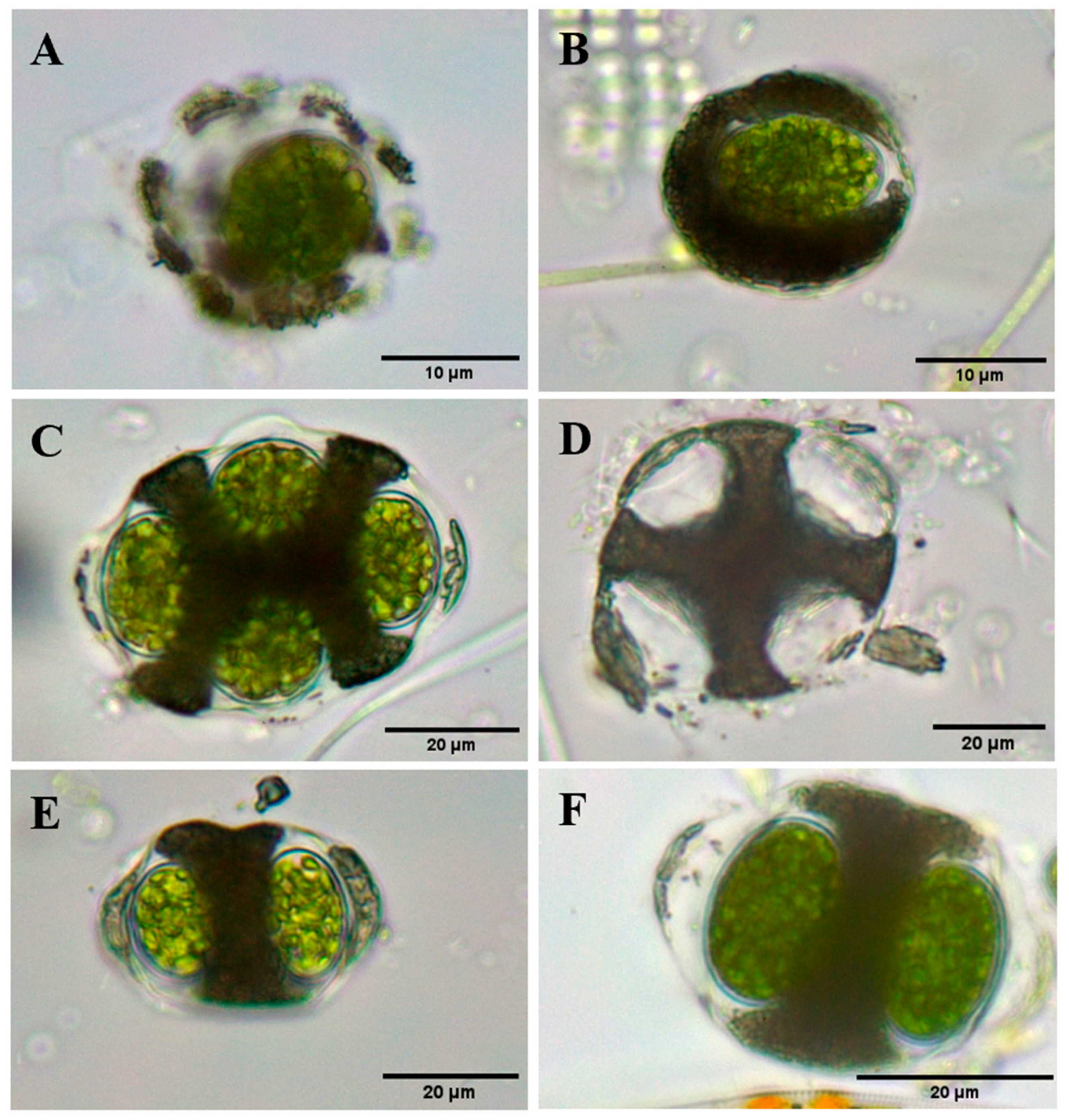
Shifts in environmental conditions also allow non-harmful species to extend their ranges into new habitats [50]. Among the latest records in Alte Donau is the Chlorophyceaen species Gloeotaenium loitlesbergerianum Hansgirg. The genus Gloeotaenium is characterized by its typical colonies, which consist of two to four cells (occasionally up to eight), while solitary cells are rare. The colonies are enclosed within a stratified sheath containing calcite crystals [51,52]. The genus comprises two species, the very rare and endemic Gloeotaenium minus Pascher, only found in Austria, and the cosmopolitan G. loitlesbergerianium, which is mainly found in warmer regions [53], although this species was first described by Hansgirg in 1890 around Bad Ischl, Austria [54]. The colonies of G. loitlesbergerianium are oval to elliptical in shape. Two-celled colonies measure up to 60 × 40 μm, and four-celled colonies reach a diameter of up to 60 μm; broad, hyaline, mucilaginous envelopes surround them. The colonies are described as free-floating. The morphology of G. loitlesbergerianium is characterized by broadly asymmetric, oval-shaped cells measuring 18–35 × 15–20 μm. Furthermore, the cells with colonies are delineated by a hyaline or gray to black stratified layer of the mother cell wall. This layer appears as either a transverse band in two-celled colonies or a diagonal cross in four-celled colonies, with visible calcite crystals on its surface, contributing to the structural framework of the colonies [55]. Microchemical tests and spectroscopic analyses identified calcium carbonate (CaCO3) as the main component of the mineral bands within the cell walls [56]. In addition, they detected strontium, magnesium, and barium, which are likely to occur as carbonates as well [53]. G. loitlesbergerianum has occasionally been found in the littoral zone of the Číčovské Mŕtve Rameno, an oxbow lake near the Danube River in southern Slovakia [55,57]. In Alte Donau, however, its presence has only been documented in the past 4 years (personal communication with Roland Heinz, DWS Hydro-Ökologie GmbH, Vienna).
The exact reasons for the recent occurrence of G. loitlesbergerianium remain unclear. It is unlikely that the species has been overlooked previously, because the lake is regularly monitored by experts for more than 30 years because of intense recreational activities, its former eutrophication problems and restoration measures taken. Moreover, G. loitlesbergerianium has a distinctive appearance, which makes this species easy to recognize. We assume that rising water Temp due to climate change may have favored the presence of G. loitlesbergerianium, as this species is primarily found in warmer waters [53]. Additionally, shifts towards higher pH, mainly driven by extensive macrophyte growth, could have created favorable conditions for the establishment of this species. Changes in nutrient levels, whether driven by external inputs or internal ecosystem processes, may also have promoted the proliferation of G. loitlesbergerianium. Interactions among these factors likely play a significant role in facilitating the growth and spread of this exceptional species. Based on previous observations, we assumed that G. loitlesbergerianium exhibits a seasonal occurrence pattern, with its presence restricted to the summer months. Additionally, we anticipated only marginal differences between the benthic and pelagic communities due to the shallow depth of the water body, but significant shifts in composition during the growing season. Specifically, we expected Ochrophyta to dominate during cooler periods. During the summer, the algal community was predicted to consist of green algae, dinoflagellates, and Cyanobacteria. Especially during warmer periods, when water Temp exceeds 25 °C, a substantial increase in the proportion of Cyanobacteria was expected.

2. Materials and Methods

2.1. Study Site

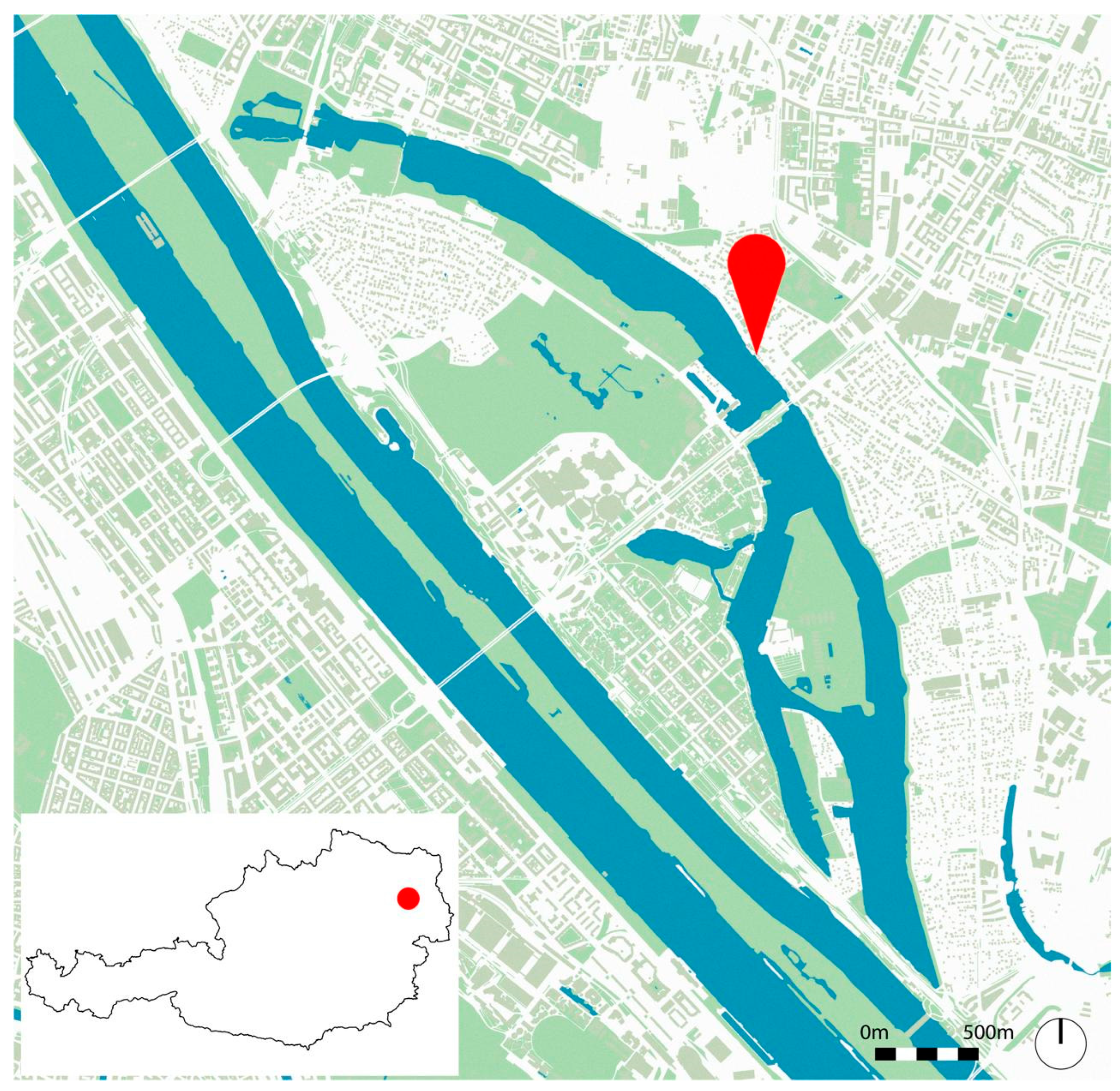
Alte Donau is a shallow lake in the city of Vienna (Austria) within the geological region known as the Vienna Basin (Wiener Becken) (Figure 1). It originated as an arm of the Danube River and was formed during the river regulation phase between 1870 and 1875 [35]. Today, Alte Donau is amongst the most important recreational areas in Vienna. It is divided into two distinct basins: the upper basin, spanning 0.55 km2 and with a volume of 1.34 × 10⁶ m3, and the larger lower basin, with a surface area of 0.88 km2 and a volume of 2.20 × 10⁶ m3. Alte Donau has an average depth of 2.5 m, with a maximum depth of 7.0 m occurring in a single depression located in the northern basin. The backwater has no natural surface inflow or outflow. As a result, its water balance is mainly maintained by groundwater inflow and precipitation [33]. The region is characterized by a temperate continental climate, with a mean annual Temp of 10.9 °C (https://en.climate-data.org/europe/austria/vienna/vienna-41/, accessed on 12 November 2025). Annual precipitation ranges from 607 mm to 717 mm, distributed relatively evenly throughout the year, with a slight peak in early summer (https://www.climate.top/austria/vienna/precipitation/, accessed on 12 November 2025).

2.2. Field Sampling and In Situ Measurements

The sampling site is in the upper basin of the Alte Donau in the 22nd district of Vienna, at the Hofbauer boat rental facility (48°14′26″ N 16°25′35″ E; Figure 1). Samples were collected once a week from March to October 2024, coinciding with the growing season of macrophytes and Gloeotaenium. Sampling included the pelagial and benthal. Macrophytes and attached benthos were collected using a grate sampler. Macrophytes were then carefully transferred into vessels containing site water. Plankton was subsequently collected using a plankton net with a mesh size of 40 μm. In addition, site water was collected for membrane filtration to assess picoplankton. For the chemical analysis and filtration processes conducted in the laboratory, site water was gathered in bottles. Field measurements performed on site were O2 in absolute and relative concentration (MultiLine® Multi 3510 IDS; Xylem Analytics, Weilheim, Germany), pH, Temp (WTW pH 3310; Xylem Analytics, Weilheim, Germany), and specific conductivity (Cond) (WTW pH/Cond 340i; Xylem Analytics, Weilheim, Germany). Irradiance was measured at the surface and 0.75 m depth for calculation of light attenuation coefficient µ (SKYE Instruments Ltd., Llandrindod Wells, UK, UVA UVB sensor): µ = ln (I0 − Iz)/z, where I0 = intensity at surface; Iz = intensity after passing through the water column at depth z.

2.3. Laboratory Work

To determine dry mass (DM), glass microfiber filters (Whatman GF/C; Cytiva, Marlborough, MA, USA; particle retention: 1.2 μm) were pre-combusted and pre-weighed. Then, a defined volume of the water sample was filtered using vacuum filtration. The filters were dried at 80 °C until constant weight was achieved and then reweighed. DM (mgL−1) = (filter incl. material (mg) − empty filter (mg))/filtered volume (L). For ash mass (AM) determination, the filters were then combusted at 450 °C for 2.5 h and reweighed. Particulate organic matter of the DM (POM = or ash-free dry mass) was calculated by subtracting AM from DM. Spectrophotometric Chl-a analysis for estimating algal biomass was performed by filtering a defined volume of site water onto glass fiber filters (Whatman GF/C; particle retention: 1.2 μm). The filter was stored at −20 °C for at least one day to assist algal cell bursts. Frozen filters were cut and ground in 5 mL of 90% cold acetone and then homogenized using an ultrasonicator (Branson Sonifier 250; Branson Ultrasonics, Brookfield, CT, USA). Pigment extraction was carried out, followed by storage in the dark at 4 °C for twelve hours. Extracts were then centrifuged for 10 min (Eppendorf, Centrifuge 5810 R), and the clear supernatant was measured at 663 nm using a V-1200 spectrophotometer (VWR International; Radnor, PA, USA). Chl-a concentration was calculated according to Lorenzen [58]. Chl-a (μg L−1) = 11.40 × E663 × v × V−1 × d−1, where E663 is the absorbance at 663 nm; v is the volume of the extract in ml; V is the sample volume in L; and d is the cuvette path length in cm.
Total alkalinity (carbonate hardness HCO3) was determined titrimetrically using unfiltered site water (Carbonate Hardness Test MQuant® 108048; Merckmillipore, Darmstadt, Germany). Sodium (Na+), Potassium (K+), Calcium (Ca2+), Magnesium (Mg2+) (OENORM DIN EN ISO 14911) and Chloride (Cl), Sulfate (SO42−), and Nitrate (NO3) (DIN EN ISO 10304-1) were analyzed from filtered samples with ion chromatography using a Metrohm 761 Compact IC (Cation column: Metrohm Metrosep C2; Anion column: Metrohm Metrosep A Supp 5; 0.45 μm filters, Whatman Puradisc; Cytiva, Marlborough, MA, USA). TP was determined after wet combustion of unfiltered samples (OENORM DIN EN ISO 6878) using a spectrophotometer (Hach-Lange DR 2800; Loveland, CO, USA). Soluble reactive phosphorus (PO43−-P), nitrite-N (NO2-N), ammonium-N (NH4+-N), and silicate (SiO4-Si) were measured from filtrates (0.45 μm filters, Whatman Puradisc; Cytiva, Marlborough, MA, USA) using photometric methods: PO43−-P with α-phosphomolybdenum blue at 890 nm (OENORM DIN EN ISO 6878), NO2-N via diazotization as a violet-red azo dye at 542 nm (DIN EN ISO 26777). NH4+-N was quantified photometrically using the indophenol-blue (IPB) method at 655 nm (DIN38406-5, OENORM ISO 7150-1). SiO4-Si was measured using the photometric unreduced silicomolybdic acid method as yellow β-silicomolybdic acid at 400 nm (DIN38405-21). Trophic State Index values according to Carlson [59] were calculated from measured TP and Chl-a concentrations.
To obtain a comprehensive overview of the overall algal biodiversity, three different methods were used for identification: (i) identifying phytoplankton gathered through a 40 µm net; (ii) algae collected from macrophytes and phytobenthos; (iii) residues on filters after vacuum filtration for picophytoplankton (membrane filters, pore size 0.45 µm, Sartorius, Göttingen, Germany). Light microscopy (Leica DM500; Leica DM 2000 Led, camera: Leica ICC50 W; Leica Microsystems, Wetzlar, Germany) was performed with both live and preserved material for species identification to the lowest possible taxonomic level [51,52,60,61,62,63,64,65,66]. Identified taxa names were cross-checked with valid species names in algaebase [67]. Samples were identified as live material as early as possible and stored at 4 °C until analysis. In addition, part of the samples was preserved with a few drops of formaldehyde for later identification (final concentration approximately 0.2%; the low concentration was used to maintain cell structures and color intact). For diatom identification, the heat combustion method was used to prepare permanent microscopic slides [68]. First, 1 mL of the sample was applied onto a coverslip, which was then transferred to a Ceran plate. The plate was heated carefully to accelerate drying. Next, heating was set to maximum to combust organic substances (only the inorganic part remains). During this process, the color switches from brown, as organic material is incinerated, to black and then to grey. The slide was then dipped into 5% hydrochloric acid (HCl) for about 10 s and subsequently rinsed with reverse osmosis water (MilliQ) to remove carbonate precipitation. The coverslip was heated to dryness again, then the frustules were embedded in Naphrax®. Algal abundance was assessed using a semiquantitative scale ranging from 0 to 5, initially developed by Korde [69], and has since been widely applied in various water monitoring programs (0 = not present, 1 = very rare/sporadic, 2 = rare, 3 = moderate, 4 = high, 5 = very high abundance) [70].

2.4. Statistics

For comparing seasons and phytobenthos versus phytoplankton, we performed a Permutational Multivariate Analysis of Variance (PERMANOVA; 999 permutations) based on Bray–Curtis dissimilarities with the PRIMER V7 software package (PRIMER-E Quest Research Ltd.). We applied a distance-based test for homogeneity of multivariate dispersions with the PERMDISP routine in PRIMER (p(perm) = 0.401 for communities, 0.059 for seasons). Seasonal data was categorized as follows: Spring: March to May; Summer: June to August; Autumn: September to October. For seasonal post hoc comparisons, the significance p-level was adjusted to 0.0167 (Bonferroni correction for three groups). In addition, two-dimensional non-metric multidimensional scaling (NMDS) was conducted using PRIMER V7 to show the overall structure of the benthic and pelagic algal community datasets along seasons. For further analysis, including the calculation of Shannon diversity and Evenness, we combined pelagic and benthic taxa into a single data set to represent the overall community composition. A Mantel test (RELATE tool in PRIMER V7) revealed a significant positive correlation between the benthic and planktonic community (ρ = 0.954, p = 0.1%, 999 permutations). We assessed community diversity using n3-transformed relative abundance data to reflect accurate proportions. To explore the relationship between environmental factors and the algal community, we performed a direct gradient analysis with the vegan-community ecology tool version 2.7 in R version 4.5.2 (R Core Team). First, a Detrended Correspondence Analysis was conducted to estimate the gradient length in our dataset. With a gradient length of 1.6 standard deviation units, Redundancy Analysis (RDA) was chosen as direct gradient analysis. Variance Inflation Factors (VIFs) were first calculated to assess and then minimize multicollinearity, and only variables with VIFs below 5 were included in the model. p-values were adjusted for multiple testing using the false discovery rate (FDR) correction [71]. A triplot was generated showing the environmental variables and the 20 species with the highest goodness-of-fit values.
To investigate the potential ecological niche of G. loitlesbergerianum, a non-parametric multiplicative regression (NPMR) approach was employed using the software package HyperNiche V 2.30 (Wild Blueberry Media LLC) with a local mean-fitting model and a Gaussian weighting function. Predictors were seven environmental parameters potentially influencing the occurrence of this taxon. The response matrix consisted of a single quantitative variable displaying the abundance of G. loitlesbergerianum across 25 sampling dates.

3. Results

3.1. Environmental Conditions

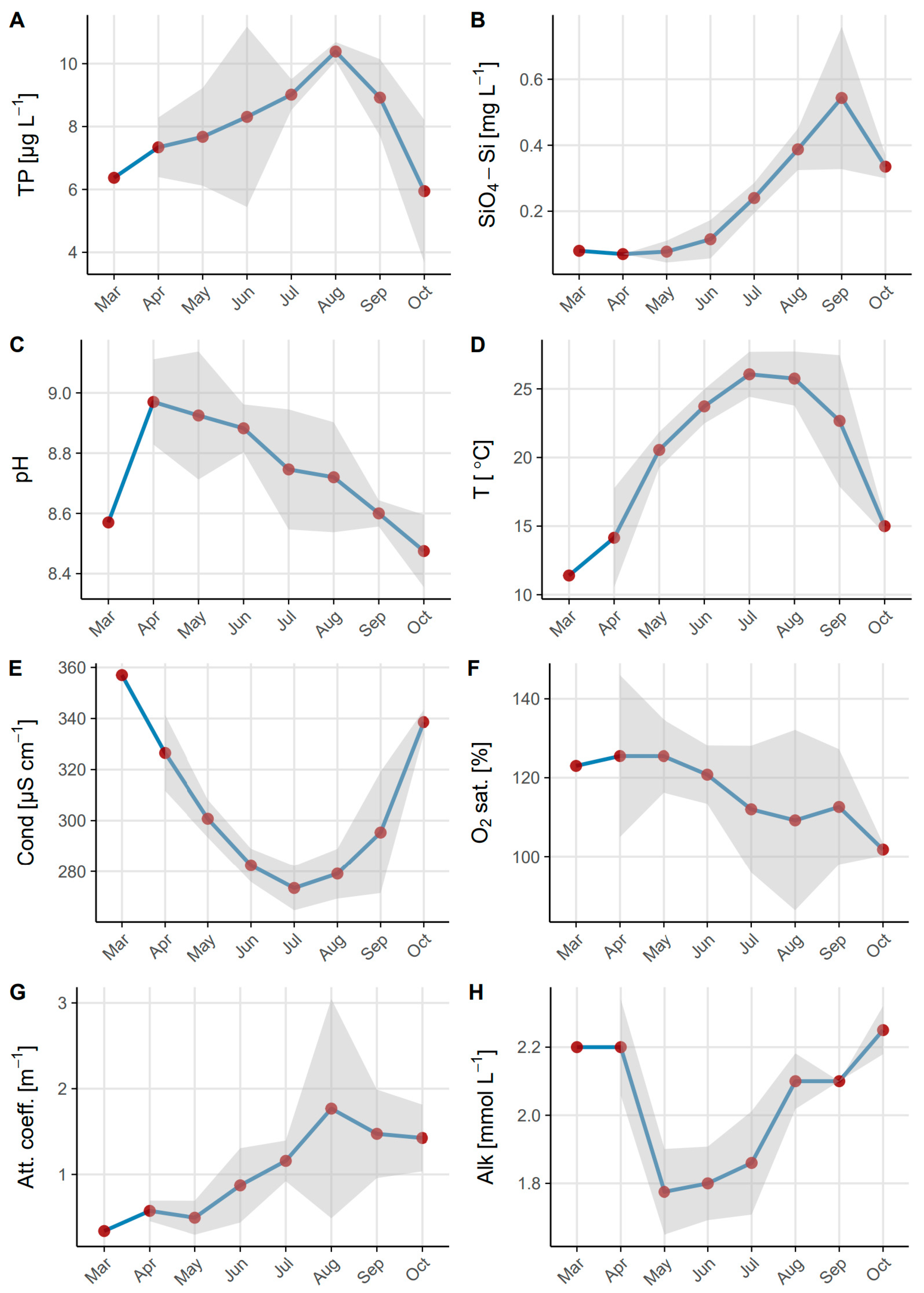
We observed notable seasonal variations (Figure 2). TP concentrations nearly doubled, increasing from 6 µg L−1 in March to 11 µg L−1 in August (Figure 2A). SiO4-Si concentrations were lowest in May (0.01 mgL−1) and increased to 0.8 mgL−1 by September (Figure 2B). Temp strongly increased from 11.4 °C in March to a peak of 28.4 °C in August, followed by a decline to 15 °C in October (Figure 2D). Cond decreased from approximately 360 µScm−1 to a minimum of 275 µScm−1 in July, then increased again to 340 µScm−1 in autumn (Figure 2E). Light attenuation increased during the summer months from 0.4 m−1 in March to a maximum of 1.75 m−1 in August (Figure 2G). Alkalinity declined from 2.2 mmolL−1 in April to a minimum of 1.8 mmolL−1 in May and slightly increased to a maximum in October (Figure 2H). Trophic State Index values, calculated from the mean values of TP (8.4 µg L−1) and Chl-a (4 µg L−1), were approximately 35 for TP and 44 for Chl-a, classifying the backwater as oligo-mesotrophic.

3.2. Algal Community Composition

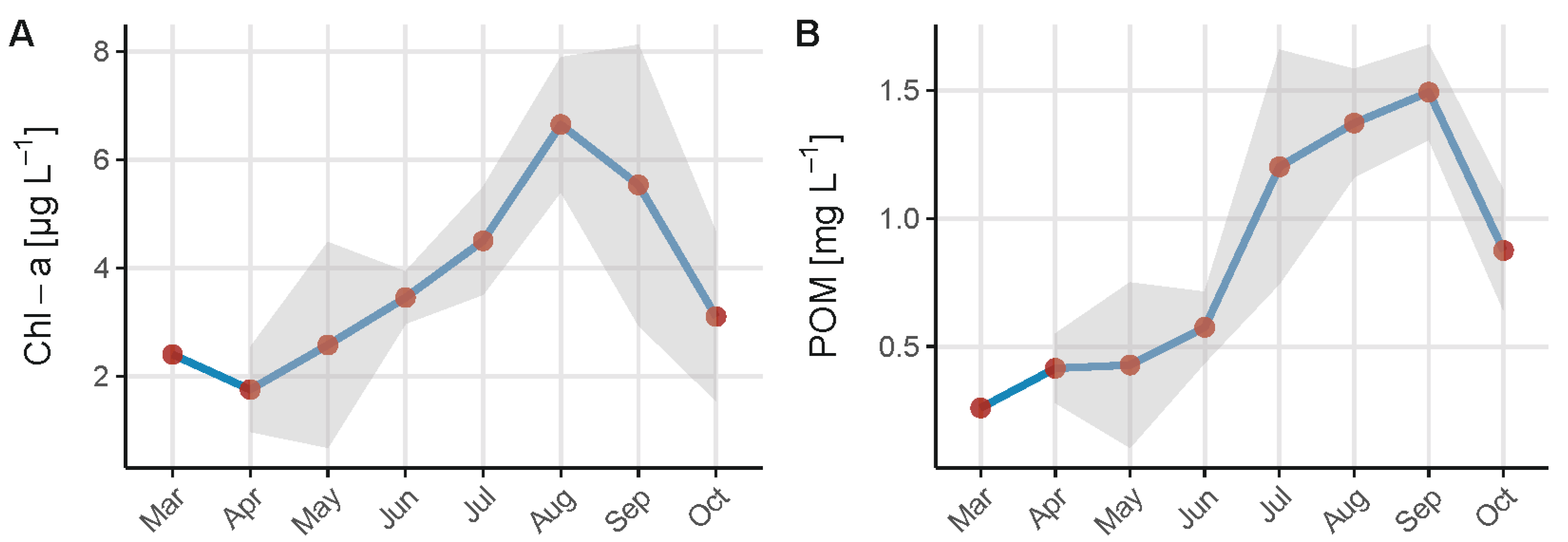
Chl-a was used as a proxy for algal biomass and showed significant differences across seasons (Kruskal–Wallis test, p = 0.013, n = 25), with a significant increase from spring to summer (Dunn test, p = 0.006). We did not find a significant difference between summer and autumn, nor between spring and autumn. Chl-a (Figure 3A) showed a minimum of 0.8 µg L−1 in April and a maximum of 6.7 µg L−1 in August. POM concentrations were lowest in March (0.3 mg L−1) and peaked in September at 1.5 mg L−1 (Figure 3B).
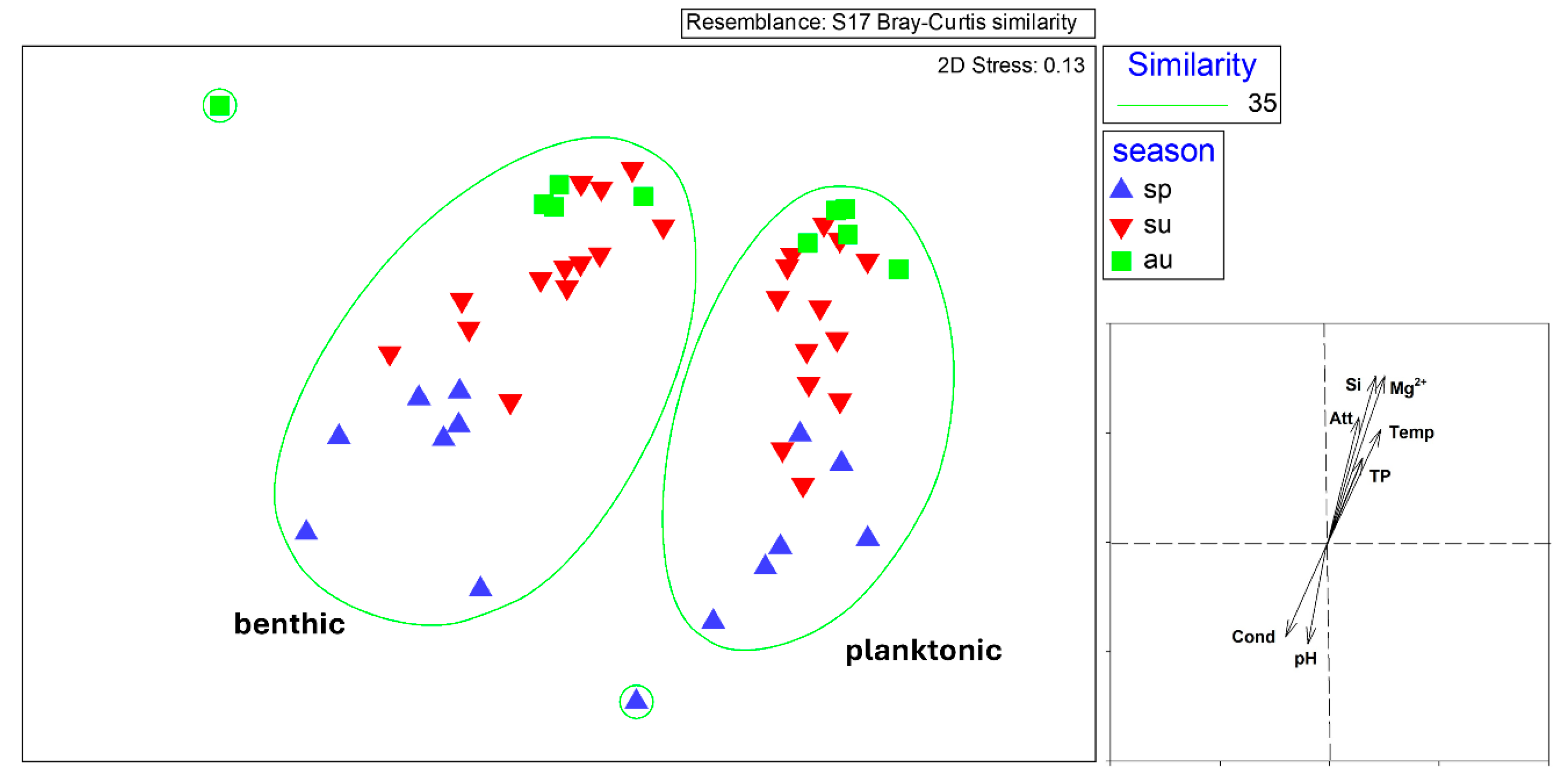
In total, 196 algal taxa were identified. Green algae (102) comprised the highest taxa number, followed by Cyanobacteria (40), Bacillariophyceae (33), Euglenophyta (9), Chrysophyceae (5), Dinophyta (4), Cryptophyta (2), and Rhodophyta (1) (Supplementary Tables S1 and S2, Supplementary Figures S1–S3). NMDS (Stress: 2D = 0.13, 3D = 0.08) revealed a clear seasonal pattern (Figure 4). MNDS axis 1 showed only weak correlations with environmental variables, but axis 2 was highly correlated with variables reflecting seasonal changes (insert Figure 4). Assemblages during spring showed higher variations compared to summer and autumn ones (Figure 4). PERMANOVA revealed significant differences in algal community composition across seasons (p = 0.001), Bonferroni-adjusted post hoc tests showed that the spring community differed from both summer and autumn, but summer and autumn were similar (Supplementary Table S3). We also found a clear separation between benthic and planktonic samples, as confirmed by PERMONOVA (p = 0.001, Supplementary Table S3), but both communities developed similarly (Mantel test ρ = 0.954, p = 0.1%, 999 permutations).
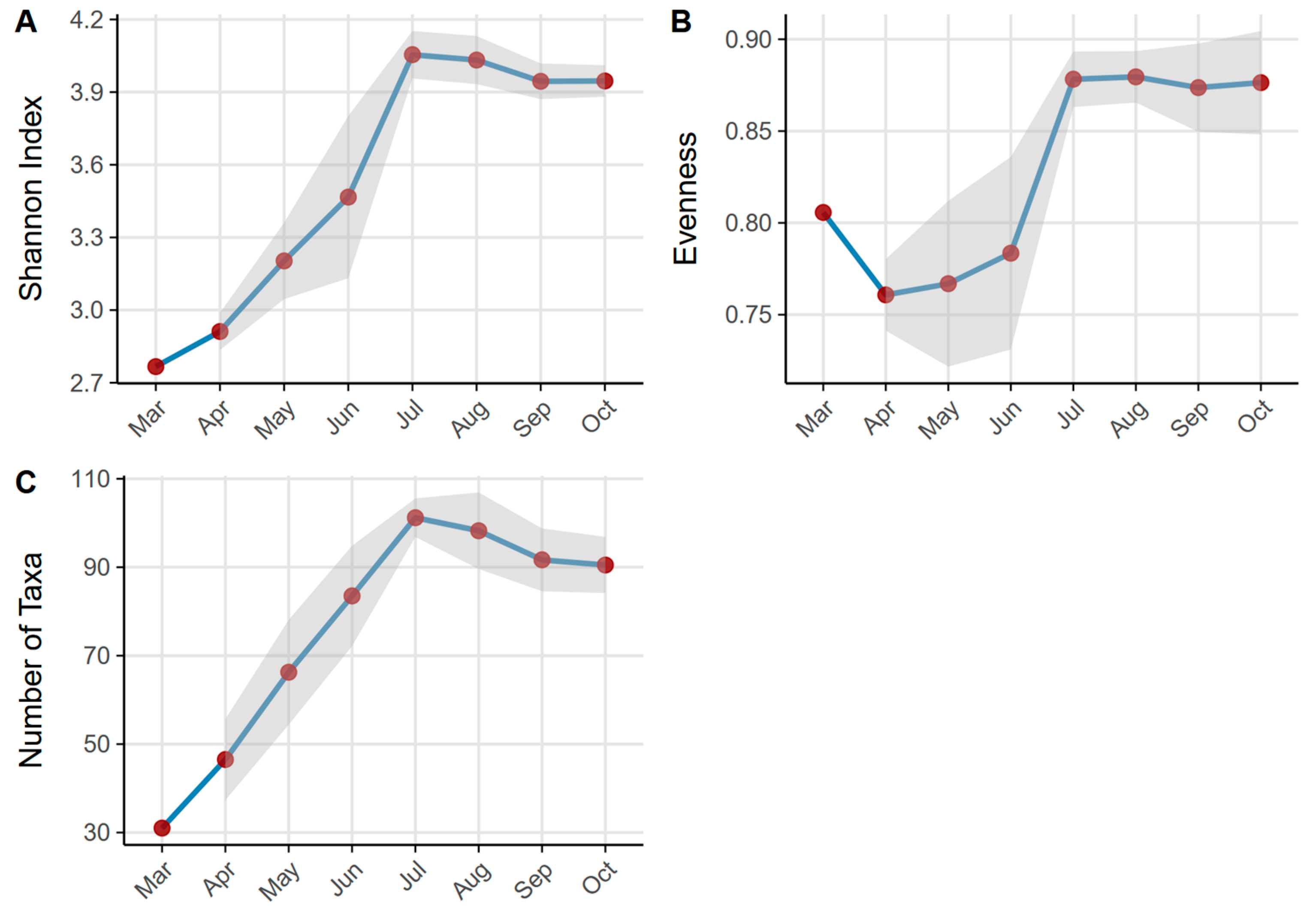
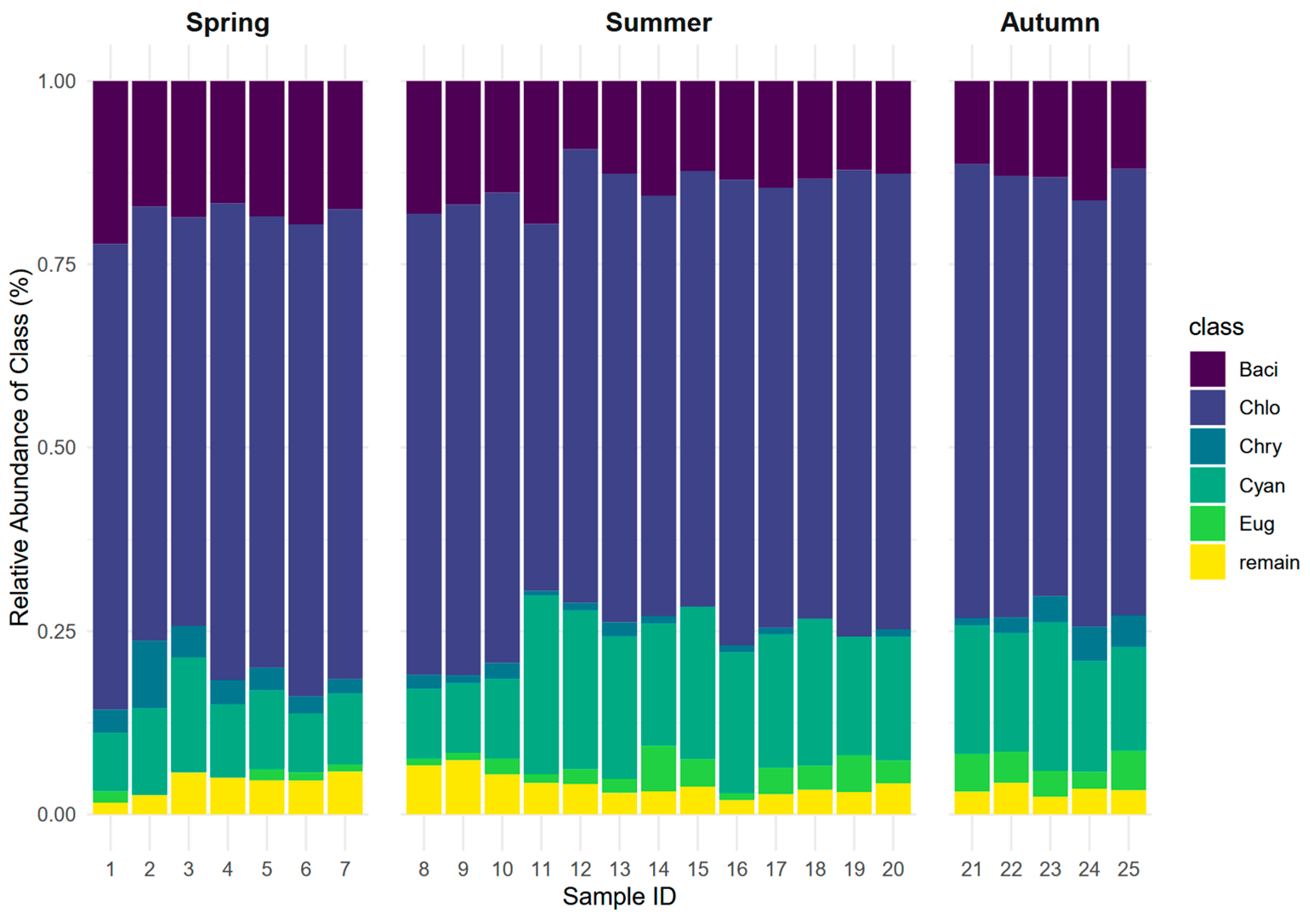
Lowest mean values for Shannon diversity index (Figure 5A) and Evenness (Figure 5B) were calculated for spring (Average: H′ = 3.0; E = 0.75). This followed a significant increase during summer (Average: H′ = 3.8; E = 0.83) and autumn (Average: H′ = 3.9; E = 0.86). Taxa number (Figure 5C) was found to be highest in the summer months. Highest diversity and evenness were obtained in July (101 taxa, H′ = 4.0; E = 0.88), while the lowest values were observed in March (31 taxa, H′ = 2.7; E = 0.8). To gain insight into the relative contribution of algal groups to the overall taxa number, percentage contributions were analyzed for each sampling day. Relative algal group contributions remained almost constant throughout the seasons, with only minor changes observed (Figure 6). Basically, Cyanobacteria taxa contribution increased during the summer and autumn at the expense of diatoms, which had the highest relative contributions in spring.
A closer look showed that occurrences of individual taxa displayed distinct seasonal patterns. In spring, diatoms were dominated by benthic or tychoplanktic species such as Cymbella spp., Navicula spp., and especially Epithemia sorex (Kützing) and Staurosira construens (Ehrenberg). During early summer, the community included E. sorex and Epithemia turgida (Ehrenberg) Kützing, along with Amphipleura pellucida (Kützing) Kützing (Supplementary Figure S3E), Navicula spp., Epithemia gibba (Ehrenberg) Kützing, and Nitzschia spp. In late summer, more planktic taxa occurred, with Fragilaria crotonensis (Kitton) and S. construens being particularly common. By autumn, F. crotonensis and S. construens, Navicula spp., and Nitzschia spp. continued to be moderately abundant. Planktonic Chrysophyceae like Uroglenopsis americana (G.N.Calkins) Lemmermann, Dinobryon spp. (Supplementary Figure 2H) were abundant in spring and autumn.
The spring assemblage of Chloro- & Streptophyta comprised benthic species, including Oedogonium sp., Spirogyra sp., and Cosmarium reniforme (Ralfs) W.Archer, but also planktic taxa like Neglectella solitaria (Wittrock) Stenclová & Kaštovský, Pseudopediastrum boryanum (Turpin) E.Hegewald (Supplementary Figure S2A), and Botryococcus braunii (Kützing) (Supplementary Figure S1E). Early summer showed a more diverse composition in green algae, including also some desmids, such as Micrasterias crux-melitensis (Ralfs), which is commonly found in peat bogs. In late summer, the community included more planktic taxa such as B. braunii, Desmodesmus armatus (Chodat) E.H.Hegewald, Lacunastrum gracillimum (West & G.S.West) H.A.McManus, Cosmarium moniliforme (Ralfs), Heimansia pusilla (L.Hilse) Coesel, and Staurastrum teliferum var. gladiosum (W.B.Turner) Coesel & Meesters (Supplementary Figure S1A). In autumn, species such as Staurastrum tetracerum (Ralfs ex Ralfs), Euastrum bidentatum (Nägeli) (Supplementary Figure S1D), Scenedesmus obtusus (Meyen), and Cosmarium reniforme (Ralfs) W.Archer were noted.
Cyanobacteria observations in spring included Aphanocapsa sp. and Chroococcus limneticus (Lemmermann). In early summer, cyanobacterial diversity increased with Anabaena sp., Dolichospermum lemmermannii (Figure S3D), Aphanothece clathrata (West & G.S.West), C. limneticus, Merismopedia sp., Microcystis sp., Planktolyngbya limnetica (Lemmermann) Komárková-Legnerová & Cronberg, and Snowella lacustris (Chodat) Komárek & Hindák. In late summer, the assemblage was additionally characterized by Pseudanabaena sp. and Chroococcus sp. In autumn, Aphanocapsa conferta (West & G.S.West) Komárková-Legnerová & Cronberg; P. limnetica, and S. lacustris persisted.
Within Dinophyta, spring marked the occurrence of Ceratium hirundinella (O.F.Müller) Dujardin (Supplementary Figure S3F), which bloomed in May, but was rare in the following weeks. Peridinium willei (Huitfeldt-Kaas) was documented at the end of May and in early summer. Euglenophyta observations included a few Euglena sp. in spring. Phacus pleuronectes (O.F.Müller) Nitzsch ex Dujardin (Supplementary Figure S3G) was observed in early summer. In late summer, Phacus salinus (F.E.Fritsch) E.W.Linton & Karnkowska and Euglena sanguinea (Ehrenberg) appeared. Both P. pleuronectes and P. salinus remained present in autumn. Also, the rare Rhodophyta Kyliniella latvica (Skuja) was detected in July.
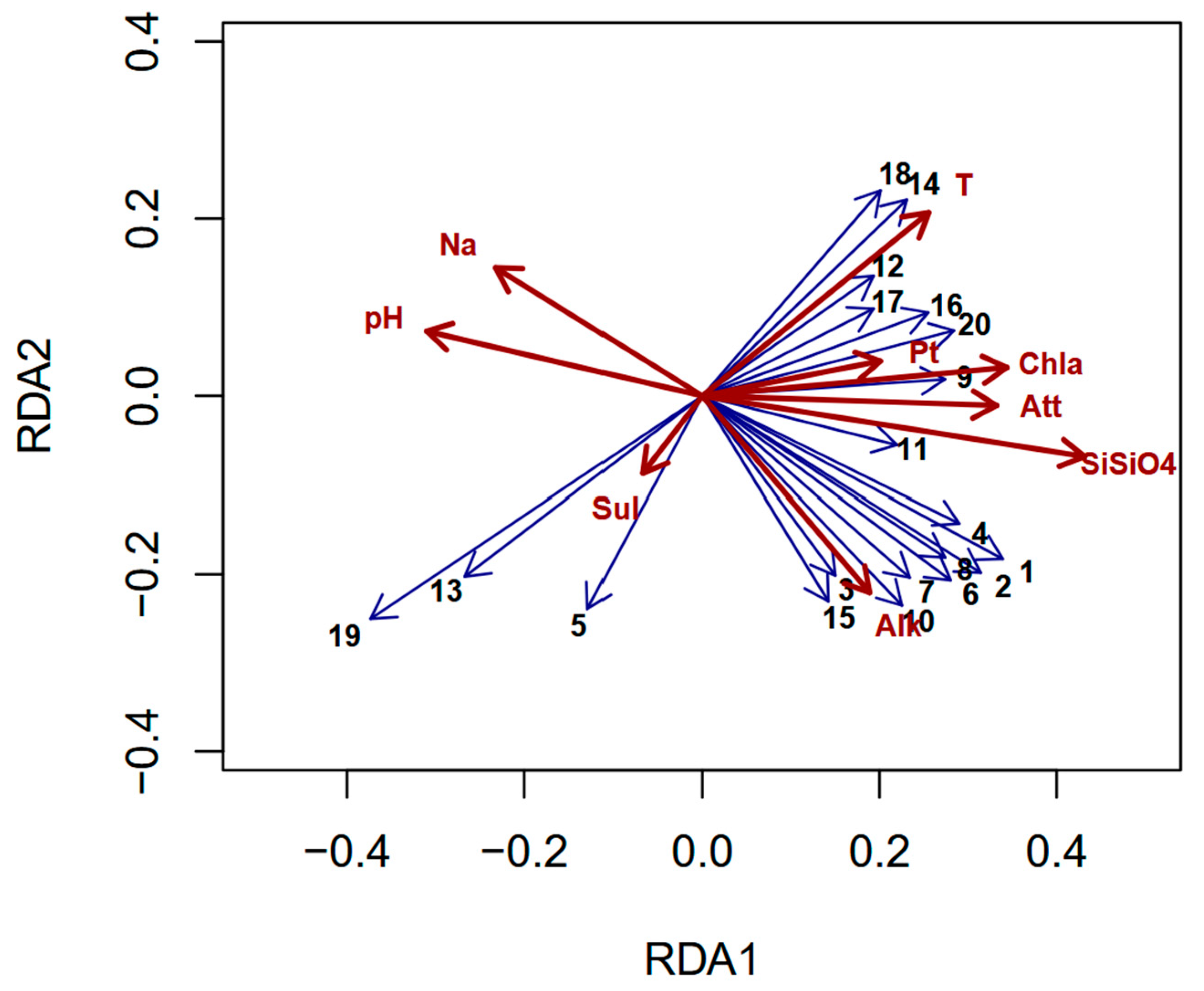
RDA explained 57.3% of the cumulative variation. RDA axes were statistically significant, with the first two accounting for 59.0% of the explained fitted variation (Table 1; Figure 7). The first RDA axis was primarily related to Chl-a, SiO4-Si, and light attenuation. The second axis was related to Temp, Na+, and alkalinity, the latter with negative loading. The most influential and statistically significant variables were SiO4-Si, Temp, and alkalinity (Table 2); conditional effects analysis indicated that SiO4-Si, Temp, and TP had significant independent effects on species composition (Table 3). Among the species with the highest fit to the RDA model (for species labelling, refer also to Supplementary Table S4), the following patterns were observed: Cosmarium reniforme (Ralfs) W.Archer (number 5 in Figure 7) was associated with higher sulfate concentrations. Staurastrum tetracerum (Ralfs ex Ralfs) (9) showed a positive association with Chl-a. Phacus salinus (F.E.Fritsch) E.W.Linton & Karnkowska (7) and Dinobryon sociale (Ehrenberg) Ehrenberg (3) were present at higher alkalinity. Several green algae, including Cosmarium moniliforme (Ralfs) (14), Pandorina morum (O.F.Müller) Bory (18) and Tetraedron caudatum (Corda) Hansgirg (12), showed a preference for higher Temp. In contrast, Dinobryon sertularia Ehrenberg (19) and Staurosira venter (Ehrenberg) Cleve & J.D.Möller (13) were predominantly found at lower Temp. Closterium leibleinii (Kützing ex Ralfs) (11) was observed at lower pH values. Heimansia pusilla (L.Hilse) Coesel (1) and Lacunastrum gracillimum (West & G.S.West) H.A.McManus (4) were associated with low Na+ concentrations. Finally, Lyngbya sp. C.Agardh ex Gomont (20) and Kirchneriella obesa (West) West & G.S.West (16) were present at higher TP concentrations.

3.3. A Special Focus on Gloeotaenium loitlesbergerianum

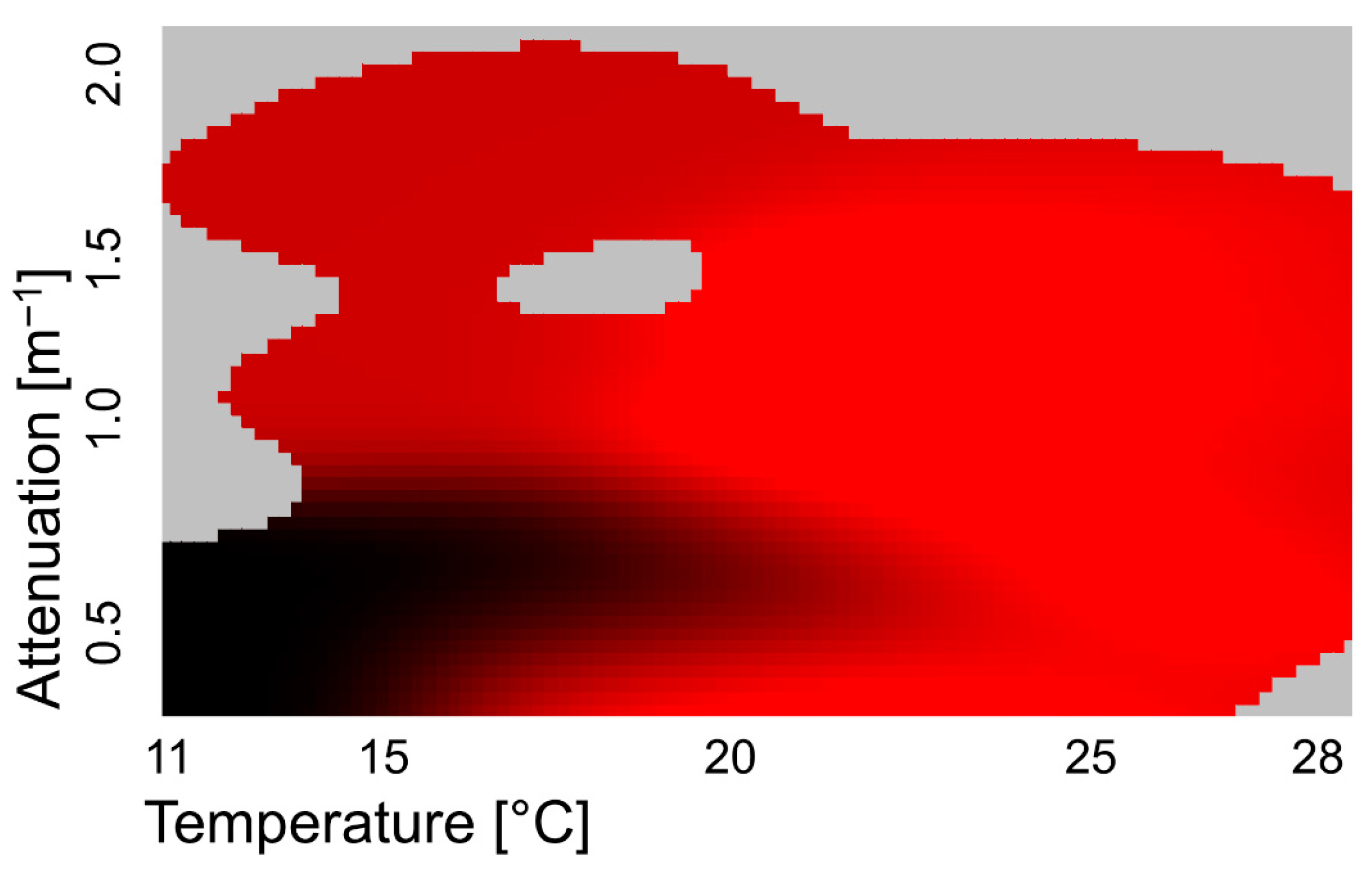
G. loitlesbergerianum (Figure 8) was first recorded on 13 May (5th sampling), then present at all following sampling days, but with higher relative abundance during summer and in benthic samples. We calculated various NPMR models, including Ca2+, Temp, Cond, pH, TP, light attenuation, and alkalinity as predictor variables (Supplementary Table S5). From the resulting Hyperniche models, the best predictor matrices suggested Temp as main predictor, followed by light attenuation and TP, with the latter contributing only low information (Table 4, Supplementary Table S4). Temp emerged as the strongest individual predictor, particularly when combined with light attenuation (Figure 9). Temp increased from 10 °C in April to 20 °C in May, coinciding with the first recorded occurrence of G. loitlesbergerianum at 19 °C. The species was observed across a Temp range of 14 °C to 28 °C, with peak abundances occurring between 20 °C and 25 °C.

4. Discussion

Chl-a concentrations ranged from 0.8 µg L−1 in April to 6.7 µg L−1 in August, comparable to previous studies in the Alte Donau, as summarized by Dokulil et al. [33]. As is commonly done, we analysed pelagic Chl-a, thus excluding primary producers such as macrophytes and benthic algae. These groups, however, are major components of shallow systems rich in macrophyte vegetation. Roughly estimating these fractions would increase the overall Chl-a and provide a more complete view of the system’s trophic state. Shallow lakes, such as the Alte Donau, benefit from a clear, macrophyte-dominated state, as submerged aquatic vegetation plays a crucial role in enhancing water transparency by stabilizing sediments and reducing nutrient availability for algae [72]. Moreover, the presence of macrophytes is associated with lower phytoplankton biomass, as reflected in reduced Chl-a concentrations [73]. This reinforces the significant benefits of restoring Alte Donau through implementing macrophytes.
POM is a complex and dynamic component in lakes that includes both living and nonliving matter from within the lake and external sources. It plays a key role in lake productivity, food web dynamics, and the behavior of trace contaminants [74]. The observed increase in POM towards autumn reflects both production and decay processes. A significant positive correlation was found between Chl-a and POM (r = 0.59, p = 0.002), indicating that algal biomass plays a major role in POM concentrations. Based on a Chl-a-to-biomass conversion factor of 2%, the estimated algal contribution to POM ranged between 5 and 60% (median: 20%). Although algae were an essential component of POM, other planktonic organisms and organic material also contributed significantly. POM accounted for the majority of the particle load, contributing about 85% to DM.
Algae serve as valuable bioindicators for changing environmental conditions due to their pivotal role as primary producers at the base of the aquatic food web [75,76]. Nutrient levels, water Temp, and light supply are commonly treated as main abiotic factors in shaping the algal community structure [77], of which the latter two are often influenced by the seasons. NMDS analysis revealed that spring algal communities were more variable compared to those in summer and autumn, indicating a gradual seasonal transition. These findings are consistent with temperate lakes, where seasonality can be divided into two principal phases: a cold season (from winter to spring) and a warm season (from summer to autumn). Major shifts in species composition typically occur during the transitional periods between these phases [78]. The ability to repeatedly acclimate to seasonal conditions over time promotes community stability, as certain taxonomic groups consistently dominate during specific seasons [36,79]. Spring was characterized by higher heterogeneity in environmental conditions, thus reflecting species composition. Fast-growing r-strategists rapidly exploited the high resource availability in the cooler, well-mixed water column [80]. In contrast, summer and autumn conditions were stable, favoring the development of more homogeneous algal assemblages. Early summer was more dominated by K-strategists, which can be tolerant to limited resources [80]. This seasonal pattern aligns with previous studies that observed the influence of seasonal variations on algal community structure and β-diversity [81]. The production phase in spring is often marked by high primary productivity, which supports the development of a mature, high-biomass community by summer. In contrast, the diversification phase in autumn is characterized by a notable increase in species diversity as environmental conditions become more variable [82].
We also found significant differences between the planktonic and benthic algae communities. Again, the differences were largest in spring; during summer and especially in autumn, the communities were becoming more similar (Figure 4). We explain this pattern by excessive macrophyte growth, disturbance caused by recreational activities and management practices including cutting and harvesting of macrophytes. In such shallow systems, the partial habitats are tightly interconnected. With the data collected, we cannot determine the type of disturbance, but we assume they act synergistically to promote sediment resuspension, thereby increasing community similarity. The impact of macrophyte harvesting on the pelagic photoautotrophic biomass has been proven by Morris et al. [83], and the phytoplanktonic community has also sporadically been documented [84,85], but these studies were mainly related to nutrients and underwater light availability, not to physical disturbance such as turbulence caused by cutting and removing macrophytes. The comparable seasonal development of the planktonic and the benthic microalgae (Mantel test ρ = 0.954, p = 0.001%) indicates that both communities were shaped by the same environmental factors, mainly representing seasons. Shannon diversity indices ranging from 3.0 to 3.9 indicate a high and well-balanced species diversity, with multiple taxa contributing substantially to the overall community composition. Chrysophyceae were dominant in spring and autumn, and diatoms were most abundant in spring. In the summer, the algal community consisted of a mixture of green algae, dinoflagellates, and Cyanobacteria. With Temp exceeding 25 °C in August, a substantial increase in Cyanobacteria was documented, but with taxa different to those which caused severe problems in the past.
The algal species composition closely resembled that of previous studies of Alte Donau [33]. Several common and frequent species were identified, each displaying distinct seasonal patterns. Lowest diversity occurred in spring, suggesting a community structure co-dominated by fewer, more competitive taxa, which took advantage of increasing light and nutrient availability after winter, such as the Chrysophyceae Uroglena americana, which form blooms on the surface water in late spring. This species can maintain continuous growth even under extended periods of low-nutrient supply and has been linked to changes in taste and odor in many oligotrophic and mesotrophic systems during spring and autumn [86]. Another characteristic spring genus was Dinobryon spp., typically found in oligo- to mesotrophic waters. With pH levels in Alte Donau approaching 9.0, the presence of Dinobryon divergens is consistent with its known occurrence in environments with pH > 8.7 [87]. Diatoms were most abundant in spring, coinciding with their preference for lower Temp. The benthic diatom Epithemia sorex typically thrives in oligo-mesotrophic freshwater environments, while it can also occur in brackish waters [88,89]. The strong influence of SiO4-Si, Temp and Chl-a indicated that spring dynamics were linked to diatom growth and bloom development, followed by reduced uptake and nutrient accumulation post-bloom. Warmer water has lower density and viscosity, which accelerates the sinking of particles [90]. Warmer Temp may negatively affect the presence and abundance of diatoms [77]. These Temp-dependent physical properties are often neglected in ecological studies, despite their influence on particle dynamics. In diatoms, sinking velocity also depends on their physiological state. Larger diatoms tend to sink more rapidly, which can limit their productivity. However, by producing thinner frustules, they can slow their descent, extend the period available for photosynthesis, and reduce the energetic cost of buoyancy regulation, ultimately enhancing their fitness [91]. Studies revealed that under light, Coscinodiscus wailesii exhibited a much wider range of sinking velocity at nutrient limitation compared to sufficient nutrient supply [92]. The role of SiO4-Si was equally prominent, especially in structuring the diatom community during spring. The spring dominance of tychoplanktonic and benthic diatoms mirrors past findings linking spring diatom blooms to high silica availability [93]. Rapid diatom growth typically depletes the available silicic acid; as concentrations fall below critical thresholds, diatom growth becomes limited, leading to a decline in their abundance [94]. The observed peak in SiO4-Si concentrations during late summer was likely linked to low abundances in the pelagial caused by the high sinking velocities of heavy diatoms [91]; in autumn, diatoms became abundant again.
We observed a significant increase in the taxa number from summer to autumn. During the summer, higher Temp, increased stratification and macrophyte harvesting promoted the coexistence of more taxa, particularly Cyanobacteria and green algae [95]. Aquatic macrophytes play a crucial role in maintaining overall water quality and a clear-water state, which in turn supports a diverse and balanced phytoplankton community [96]. Furthermore, dense macrophyte beds provide habitat and refuge for various microorganisms and zooplankton, helping to regulate nutrient cycling and limit the dominance of bloom-forming algae [97]. Temp emerged as a key environmental parameter for algal communities, especially promoting the proliferation of green algae and several cyanobacterial species during summer [98]. Notably, increases in TP and Temp led to higher algal biomass. After all, it should be noted that TP levels around 1990 were considerably higher, ranging from 50 to 70 μg L−1 [33], whereas the highest TP concentrations in our study were 12 μg L−1. This aligns with previous findings showing that warm Temp, pH and elevated nutrient levels enhance primary production of Cyanobacteria in shallow lakes [17], which can result in significant shifts in algal biodiversity [99]. In summer, calm weather and higher Temp can lead to temporary thermal stratification, which, however, does not last over more extended periods [33]. Rising Temp is a significant threat to freshwater ecosystems. Already reaching 28 °C in summer, Alte Donau faces increased risks of cyanobacterial dominance under continued climate warming [100,101]. Combined with higher nutrient availability, these shifts could further promote bloom formation and disrupt ecological balance [20,48]. Nevertheless, some macrophyte species are better able to tolerate high phytoplankton biomass, and those that can endure shading can maintain dominance, thereby supporting overall ecosystem stability [102].
We observed an increase in Cyanobacteria such as Snowella lacustris and Planktolyngbya limnetica, which are characteristic of shallow lakes in temperate regions [103]. Potentially harmful species, such as Dolichospermum and Microcystis, which are known for their ability to form blooms and produce toxins [104,105], were recorded only sporadically. Some species achieve optimal growth at higher Temp [104]. As climate change progresses, these traits are likely to give Cyanobacteria a competitive advantage, potentially leading to increased dominance in aquatic ecosystems in the future.
The occurrence of benthic taxa like various species of Cosmarium, Closterium, and Spirogyra in the water column may result from hydrodynamic mixing and wind-induced resuspension, processes commonly observed in shallow lake systems [106]. Additional reasons could include frequent macrophyte harvesting and heavy rental boat traffic. Multiple desmid species were observed, with notable increases in species richness during the summer months. Even the rare species Micrasterias crux-melitensis was present in early summer, which is commonly found in the phytobenthos of mesotrophic, slightly acidic wetlands [107]. This pattern corresponds with previous research in other habitats, which identifies stratification as a key driver of growth and succession for these taxa [108,109,110]. Many desmid taxa prefer oligotrophic conditions [111] and partial atelomixis [112]. Although this mixing pattern is usually observed in tropical lakes, elevated Temp in Alte Donau, reaching nearly 30 °C, may create similar conditions. In our study, the green algae Cosmarium moniliforme, Pandorina morum and Tetraedron caudatum showed a clear preference for higher Temp. This aligns with other findings [98], which reported a shift toward dominance by algal taxa that thrive under warmer, more variable thermal conditions. The high diversity until early autumn indicated that environmental conditions also promoted growth of other taxa, such as Phacus pleuronectes and P. salinus. Euglenophyta thrive in environments with elevated nutrient availability and are often used as bioindicators of organic pollution [113]. A flood event occurring near Vienna in September 2024 likely contributed to an increased nutrient inflow.
We found alkalinity to be a key parameter for algal community composition. This was also reported in studies from other water bodies [114]. Alkalinity plays a central, yet previously underestimated, role in carbon cycling in freshwater lakes throughout the year [115]. In our study, Phacus salinus and Dinobryon sociale were found to be associated with higher alkalinity. A distinct decrease in Cond was observed during the summer months, coinciding with a notable reduction in alkalinity. These parallel trends likely reflect enhanced photosynthetic activity of macrophytes, which reduces both ion concentrations and dissolved CO2 in the water [116]. At a pH around 8, hydrogen carbonate is the dominant inorganic carbon source for photosynthesis, which requires balancing carbon dioxide. As a side effect of maintaining this equilibrium, carbonate precipitates during photosynthesis, lowering dissolved ion concentrations and forming calcite layers on macrophytes. This phenomenon is probably also responsible for the distinct stratified calcite sheath of G. loitlesbergerianum. It remains to be studied whether this taxon actively precipitates calcite as a defense mechanism, comparable to coccolithophorids [117], or if the calcite sheaths reflect an impaired metabolism to avoid carbonate precipitation.
Macrophytes can effectively compete with phytoplankton only if they receive sufficient light for photosynthesis [102]. By altering nutrient ratios, reducing ionic stress, and stabilizing water chemistry, macrophytes create favorable conditions for certain algal groups, particularly r-strategists [118]. Thanks to past macrophyte restoration efforts, Alte Donau maintains favorable mesotrophic conditions, underscoring macrophytes’ crucial role as ecosystem engineers in shaping algal biomass and community composition.
Underwater light climate proved to be another significant variable in shaping the overall algal community composition and the occurrence of G. loitlesbergerianum (Figure 7 and Figure 9, Table 2). The underwater light climate is driven by both external factors, such as weather conditions, day length, and solar altitude, and internal factors like particle load and macrophytes. The following question arises now: which internal factors were responsible for light attenuation in the current study? With the current data set, we cannot do variance partitioning of potential predictors, but we can draw some conclusions. Although phytoplankton contributes to suspended particles in the water column, its low biomass indicates low self-shading. As phytoplankton accounted for a major component of the overall particle load, we conclude that the particle load is not substantially driving light attenuation. Another internal factor is water plants. Macrophytes affect the underwater light climate in various ways, both directly and indirectly: shading depends on plant morphology and canopy development [118,119], and in the immediate vicinity, light availability is lower due to shading effects. On the other hand, macrophytes stabilize the water column, reducing turbulence and resuspension, thereby enhancing light availability [119]. Macrophyte moving will first result in increased turbidity due to particle resuspension, including the detachment of benthic forms, followed by increased light penetration in the water column because shading effects are no longer present. Moreover, the removal of macrophytes also reduces nutrient levels in the system [120]. Although this topic was beyond the scope of the current study, we assume that external factors and macrophytes are primarily responsible for the underwater light climate in this lake’s current trophic state.
Temp played a significant role in shaping the distribution of G. loitlesbergerianum. The species was observed during the warmer months, from May to October, and was absent in early spring. It occurred across a relatively broad Temp range (14–28 °C), with peak abundances between 20 °C and 25 °C. These findings are consistent with previous observations from tropical and subtropical regions, such as Brazil, where G. loitlesbergerianum has been reported in waters with an annual average Temp of 24 °C [53]. Interestingly, in our study, the species remained detectable even in October when Temp dropped below 20 °C, indicating a certain degree of cold tolerance. In addition, higher light attenuation promoted the growth of this species. The higher light attenuation observed in August coincided with elevated Temp, potentially creating synergistic conditions that favoured growth [121]. Another possible factor contributing to the occurrence of G. loitlesbergerianum in Alte Donau was elevated pH levels. The identification of CaCO3 as the principal component of the observed precipitation band suggests potential biocalcification [122]. While CaCO3 deposition is common among marine algae, it is considered relatively rare in freshwater taxa [123]. However, increased pH > 8.6 in Alte Donau creates a chemical environment that favors carbonate precipitation [33]. Therefore, the altered carbonate chemistry of the system may represent a previously underappreciated ecological driver behind the occurrence and persistence of G. loitlesbergerianum. However, given the lack of strong statistical associations, it is likely that other factors not considered in the current study (e.g., biological interactions) may also influence its occurrence and should be further explored in future studies.

5. Conclusions

Our study aimed to investigate the seasonal dynamics of algal communities in Alte Donau and identify the key environmental drivers shaping these trends. Algal communities exhibited distinct seasonal patterns. Spring was characterized by the dominance of diatoms and occasional blooms of Chrysophyceae, interpreted as r-strategists exploiting abundant nutrients and favorable light conditions. These fast-growing species rapidly exploit the high resource availability in the cooler, well-mixed water column. In early summer, species richness increased, reflecting a more diverse community dominated by K-strategists, such as the desmids Cosmarium and Closterium. Late summer and early autumn showed a pronounced increase in Cyanobacteria, which often represent r-strategists. The shifts between r- and K-strategists reflect not only seasonal changes in Temp and light but also alterations in nutrient dynamics and physical water structure. This also indicates a transition toward algal communities that thrive under warmer Temp and altered nutrient regimes. Key environmental drivers identified in our study included SiO4-Si, TP, pH, and alkalinity—all of which influence community composition.
Recent restoration measures in Alte Donau have successfully reduced nutrient loads, improved water quality and partially mitigated local pollution. These positive outcomes demonstrate that local management can restore ecosystem balance and reduce the dominance of harmful algae. However, climate change remains a pervasive threat, with rising Temp, altered stratification patterns, and extreme weather events potentially destabilizing algal dynamics even in nutrient-rich waters. While local interventions (macrophyte restoration, nutrient control, pollution mitigation) can buffer the system, their effectiveness is limited under global-scale pressures, highlighting the need to integrate local restoration with broader climate action. The occurrence of G. loitlesbergerianum during warmer months suggests that rising Temp and elevated pH may play a critical role in shaping its distribution in temperate systems in the future, highlighting the increasing sensitivity of Alte Donau to climate change and anthropogenic stressors. There is some evidence that G. loitlesbergerianum may serve as a reliable bioindicator of warming trends in similar temperate, shallow lakes across Europe. Maintaining ecosystem services such as biodiversity, water quality, and recreational value will therefore require continued monitoring and adaptive management alongside global efforts to combat climate change.

Supplementary Materials

The following supporting information can be downloaded at https://www.mdpi.com/article/10.3390/phycology6010031/s1, Figure S1: Light micrographs representing algal taxa 1; Figure S2: Light micrographs representing algal taxa 2; Figure S3: Light micrographs representing algal taxa 3; Table S1: Taxonomic list of planktonic algae; Table S2: Taxonomic list of phytobenthos; Table S3: PERMANOVA results; Table S4: Full taxonomic names corresponding to the numbering in the RDA biplot; Table S5: Best NPMR model selected from Hyperniche with 2 variables, Temp and attenuation, included.

Author Contributions

Conceptualization, M.S.; methodology, L.S. and M.S.; validation, L.S. and M.S.; formal analysis, M.S.; field work, L.S.; laboratory work, L.S.; resources, M.S.; writing—original draft preparation, L.S. and M.S.; writing—review and editing, L.S. and M.S.; visualization, L.S. and M.S.; supervision, M.S. All authors have read and agreed to the published version of the manuscript.

Funding

This research received no external funding.

Data Availability Statement

All data supporting the findings of this study are available within the paper and its Supplementary Materials. Raw data will be sent upon request.

Acknowledgments

Hubert Kraill (University of Vienna) supported chemical analysis. Open Access Funding by the University of Vienna.

Conflicts of Interest

The authors declare no relevant financial or non-financial interests. The authors have no competing interests to declare that are relevant to the content of this article.

Abbreviations

The following main abbreviations are used in this manuscript:
TempTemperature
Chl-aChlorophyll-a
TPTotal phosphorus
CondSpecific conductivity
DMDry mass
AMAsh mass
POMParticulate organic matter
PERMANOVAPermutational Multivariate Analysis of Variance
NMDSnon-metric multidimensional scaling
RDARedundancy Analysis
NPMRnon-parametric multiplicative regression

References

  1. Crowley, T.J. Causes of Climate Change over the Past 1000 Years. Science 2000, 289, 270–277. [Google Scholar] [CrossRef]
  2. McCulloch, M.T.; Winter, A.; Sherman, C.E.; Trotter, J.A. 300 years of sclerosponge thermometry shows global warming has exceeded 1.5  °C. Nat. Clim. Change 2024, 14, 171–177. [Google Scholar] [CrossRef]
  3. Huppmann, D.; Keiler, M.; Riahi, K.; Rieder, H. Second Austrian Assessment Report on Climate Change; Austrian Academy of Sciences Press: Vienna, Austria, 2025; p. 591. [Google Scholar]
  4. Niinemets, Ü.; Kahru, A.; Mander, Ü.; Nõges, P.; Nõges, T.; Tuvikene, A.; Vasemägi, A. Interacting environmental and chemical stresses under global change in temperate aquatic ecosystems: Stress responses, adaptation, and scaling. Reg. Environ. Change 2017, 17, 2061–2077. [Google Scholar] [CrossRef]
  5. van Vliet, M.T.H.; Franssen, W.H.P.; Yearsley, J.R.; Ludwig, F.; Haddeland, I.; Lettenmaier, D.P.; Kabat, P. Global river discharge and water temperature under climate change. Glob. Environ. Change 2013, 23, 450–464. [Google Scholar] [CrossRef]
  6. Wanders, N.; van Vliet, M.T.H.; Wada, Y.; Bierkens, M.F.P.; van Beek, L.P.H. High-Resolution Global Water Temperature Modeling. Water Resour. Res. 2019, 55, 2760–2778. [Google Scholar] [CrossRef]
  7. Prakash, S. Impact of climate change on aquatic ecosystems and its biodiversity: An overview. Int. J. Biol. Innov. 2021, 03, 312–317. [Google Scholar] [CrossRef]
  8. Zhang, P.; Kuramae, A.; van Leeuwen, C.H.A.; Velthuis, M.; van Donk, E.; Xu, J.; Bakker, E.S. Interactive Effects of Rising Temperature and Nutrient Enrichment on Aquatic Plant Growth, Stoichiometry, and Palatability. Front. Plant Sci. 2020, 11, 58. [Google Scholar] [CrossRef] [PubMed]
  9. Johnson, M.F.; Albertson, L.K.; Algar, A.C.; Dugdale, S.J.; Edwards, P.; England, J.; Gibbins, C.; Kazama, S.; Komori, D.; MacColl, A.D.C.; et al. Rising water temperature in rivers: Ecological impacts and future resilience. WIREs Water 2024, 11, e1724. [Google Scholar] [CrossRef]
  10. Schofield, K.A.; Alexander, L.C.; Ridley, C.E.; Vanderhoof, M.K.; Fritz, K.M.; Autrey, B.C.; DeMeester, J.E.; Kepner, W.G.; Lane, C.R.; Leibowitz, S.G.; et al. Biota connect aquatic habitats throughout freshwater ecosystem mosaics. J. Am. Water Resour. Assoc. 2018, 54, 372–399. [Google Scholar] [CrossRef]
  11. Ferreira, V.; Bini, L.M.; González Sagrario, M.d.l.Á.; Kovalenko, K.E.; Naselli-Flores, L.; Padial, A.A.; Padisák, J. Aquatic ecosystem services: An overview of the Special Issue. Hydrobiologia 2023, 850, 2473–2483. [Google Scholar] [CrossRef]
  12. Tickner, D.; Opperman, J.J.; Abell, R.; Acreman, M.; Arthington, A.H.; Bunn, S.E.; Cooke, S.J.; Dalton, J.; Darwall, W.; Edwards, G.; et al. Bending the curve of global freshwater biodiversity loss: An emergency recovery plan. BioScience 2020, 70, 330–342. [Google Scholar] [CrossRef]
  13. Reynolds, C.S. A changing paradigm of pelagic food webs. Int. Rev. Hydrobiol. 2008, 93, 517–531. [Google Scholar] [CrossRef]
  14. Martínez-Burgos, W.J.; Pozzan, R.; de Carvalho, J.C.; Cavali, M.; Mariano, A.B.; Vargas, J.V.C.; Ordonez, J.; Severo, I.A.; Soccol, C.R. The role of microalgae as bioindicators of aquatic contamination. In Algae as a Natural Solution for Challenges in Water-Food-Energy Nexus: Toward Carbon Neutrality; Kurniawan, T.A., Anouzla, A., Eds.; Springer Nature: Singapore, 2024; pp. 323–347. [Google Scholar]
  15. Borics, G.; Wolfram, G.; Chiriac, G.; Belkinova, D.; Donabaum, K. Intercalibration of the National Classifications of Ecological Status for Eastern Continental Lakes: Biological Quality Element: Phytoplankton; Publications Office of the European Union: Luxembourg, 2018; p. 28. [Google Scholar]
  16. Paerl, H.W.; Paul, V.J. Climate change: Links to global expansion of harmful cyanobacteria. Water Res. 2012, 46, 1349–1363. [Google Scholar] [CrossRef] [PubMed]
  17. Havens, K.E.; Paerl, H.W. Climate Change at a Crossroad for Control of Harmful Algal Blooms. Environ. Sci. Technol. 2015, 49, 12605–12606. [Google Scholar] [CrossRef]
  18. Monchamp, M.-E.; Spaak, P.; Pomati, F. High dispersal levels and lake warming are emergent drivers of cyanobacterial community assembly in peri-Alpine lakes. Sci. Rep. 2019, 9, 7366. [Google Scholar] [CrossRef]
  19. Paerl, H.W.; Huisman, J. Climate change: A catalyst for global expansion of harmful cyanobacterial blooms. Environ. Microbiol. Rep. 2009, 1, 27–37. [Google Scholar] [CrossRef]
  20. Visser, P.M.; Verspagen, J.M.H.; Sandrini, G.; Stal, L.J.; Matthijs, H.C.P.; Davis, T.W.; Paerl, H.W.; Huisman, J. How rising CO2 and global warming may stimulate harmful cyanobacterial blooms. Harmful Algae 2016, 54, 145–159. [Google Scholar] [CrossRef]
  21. Carpenter, S.R.; Caraco, N.F.; Correll, D.L.; Howarth, R.W.; Sharpley, A.N.; Smith, V.H. Nonpoint pollution of the surface waters with phosphorus and nitrogen. Ecol. Appl. 1998, 8, 559–568. [Google Scholar] [CrossRef]
  22. Diaz, R.J.; Rosenberg, R. Spreading Dead Zones and Consequences for Marine Ecosystems. Science 2008, 321, 926–929. [Google Scholar] [CrossRef] [PubMed]
  23. Zhu, J.; Cheng, J.; Zeng, J.; Zhang, W.; Liu, C.; Effiong, K.S.; Hao, Q. A Review of Phytoplankton Sinking Rates: Mechanisms, Methodologies, and Biogeochemical Implications. Biology 2026, 15, 130. [Google Scholar] [CrossRef]
  24. Winder, M.; Sommer, U. Phytoplankton response to a changing climate. Hydrobiologia 2012, 698, 5–16. [Google Scholar] [CrossRef]
  25. Lürling, M.; Eshetu, F.; Faassen, E.J.; Kosten, S.; Huszar, V.L.M. Comparison of cyanobacterial and green algal growth rates at different temperatures. Freshw. Biol. 2012, 58, 552–559. [Google Scholar] [CrossRef]
  26. Lakshmikandan, M.; Li, M.; Pan, B. Cyanobacterial Blooms in Environmental Water: Causes and Solutions. Curr. Pollut. Rep. 2024, 10, 606–627. [Google Scholar] [CrossRef]
  27. Salmaso, N.; Tolotti, M. Phytoplankton and anthropogenic changes in pelagic environments. Hydrobiologia 2020, 848, 251–284. [Google Scholar] [CrossRef]
  28. Birch, S.; McCaskie, J. Shallow urban lakes: A challenge for lake management. Hydrobiologia 1999, 395, 365–378. [Google Scholar] [CrossRef]
  29. Naselli-Flores, L. Urban lakes: Ecosystems at risk, worthy of the best care. In Proceedings of the 12th World Lake Conference, Jaipur, India, 28 October–2 November 2007; pp. 1333–1337. [Google Scholar]
  30. Mitroi, V.; Maleval, V.; Deroubaix, J.-F.; Vinçon-Leite, B.; Humbert, J.F. What urban lakes and ponds quality is about? Conciliating water quality and ecological indicators with users’ perceptions and expectations about urban lakes and ponds quality in urban areas. J. Environ. Policy Plan. 2022, 24, 701–718. [Google Scholar] [CrossRef]
  31. Löffler, H. Alte Donau. Limnologische Projektstudie—Ökosystem Alte Donau; Universität Wien/Wasserstraßendirektion: Vienna, Austria, 1988; p. 242. [Google Scholar]
  32. Schagerl, M.; Donabaum, K.; Dokulil, M.T.; Riedler, P. Restoration of “Alte Donau”—A backwater in Vienna used as recreation area. Acta Agron. Ovariensis 1999, 41, 51–60. [Google Scholar]
  33. Dokulil, M.T.; Donabaum, K.; Teubner, K. The Alte Donau. Successful Restoration and Sustainable Management: An Ecosystem Case Study of a Shallow Urban Lake; Springer International Publishing AG: Cham, Switzerland, 2018. [Google Scholar]
  34. Dokulil, M.T.; Teubner, K. Cyanobacterial dominance in lakes. Hydrobiologia 2000, 438, 1–12. [Google Scholar] [CrossRef]
  35. Donabaum, K.; Schagerl, M.; Dokulil, M.T. Integrated management to restore macrophyte domination. Hydrobiologia 1999, 395–396, 87–97. [Google Scholar] [CrossRef]
  36. Dokulil, M.T.; Teubner, K. Long-term adjustment of phytoplankton structure to environmental traits at timescales during lifetime development and over generations. Hydrobiologia 2023, 851, 823–847. [Google Scholar] [CrossRef]
  37. Wang, Z.; Akbar, S.; Sun, Y.; Gu, L.; Zhang, L.; Lyu, K.; Huang, Y.; Yang, Z. Cyanobacterial dominance and succession: Factors, mechanisms, predictions, and managements. J. Environ. Manag. 2021, 297, 113281. [Google Scholar] [CrossRef]
  38. Kuczyńska-Kippen, N.; Kozak, A.; Celewicz, S. Cyanobacteria respond to trophic status in shallow aquatic ecosystems. Sci. Total Environ. 2024, 949, 174932. [Google Scholar] [CrossRef]
  39. Tian, W.; Zhang, H.; Zhao, L.; Zhang, F.; Huang, H. Phytoplankton Diversity Effects on Community Biomass and Stability along Nutrient Gradients in a Eutrophic Lake. Int. J. Environ. Res. Public Health 2017, 14, 95. [Google Scholar] [CrossRef]
  40. Loreau, M.; de Mazancourt, C. Biodiversity and ecosystem stability: A synthesis of underlying mechanisms. Ecol. Lett. 2013, 16, 106–115. [Google Scholar] [CrossRef]
  41. Downing, A.L.; Leibold, M.A. Species richness facilitates ecosystem resilience in aquatic food webs. Freshw. Biol. 2010, 55, 2123–2137. [Google Scholar] [CrossRef]
  42. Vasiliev, D. The Role of Biodiversity in Ecosystem Resilience. IOP Conf. Ser. Earth Environ. Sci. 2022, 1072, 012012. [Google Scholar] [CrossRef]
  43. Adrian, R.; Walz, N.; Hintze, T.; Hoeg, S.; Rusche, R. Effects of ice duration on plankton succession during spring in a shallow polymictic lake. Freshw. Biol. 1999, 41, 621–634. [Google Scholar] [CrossRef]
  44. Horvat, Z.; Horvat, M.; Pastor, K.; Bursić, V.; Puvača, N. Multivariate Analysis of Water Quality Measurements on the Danube River. Water 2021, 13, 3634. [Google Scholar] [CrossRef]
  45. McClish, S.; Bushinsky, S.M. Majority of southern ocean seasonal sea ice zone bloom net community production precedes total ice retreat. Geophys. Res. Lett. 2023, 50, e2023GL103459. [Google Scholar] [CrossRef]
  46. Rosset, V.; Lehmann, A.; Oertli, B. Warmer and richer? Predicting the impact of climate warming on species richness in small temperate waterbodies. Glob. Change Biol. 2010, 16, 2376–2387. [Google Scholar] [CrossRef]
  47. Osland, M.J.; Stevens, P.W.; Lamont, M.M.; Brusca, R.C.; Hart, K.M.; Waddle, J.H.; Langtimm, C.A.; Williams, C.M.; Keim, B.D.; Terando, A.J.; et al. Tropicalization of temperate ecosystems in North America: The northward range expansion of tropical organisms in response to warming winter temperatures. Glob. Change Biol. 2021, 27, 3009–3034. [Google Scholar] [CrossRef]
  48. Kosten, S.; Huszar, V.L.M.; Bécares, E.; Costa, L.S.; van Donk, E.; Hansson, L.A.; Jeppesen, E.; Kruk, C.; Lacerot, G.; Mazzeo, N.; et al. Warmer climates boost cyanobacterial dominance in shallow lakes. Glob. Change Biol. 2011, 18, 118–126. [Google Scholar] [CrossRef]
  49. Verspagen, J.M.H.; Van de Waal, D.B.; Finke, J.F.; Visser, P.M.; Huisman, J. Contrasting effects of rising CO2 on primary production and ecological stoichiometry at different nutrient levels. Ecol. Lett. 2014, 17, 951–960. [Google Scholar] [CrossRef]
  50. Häder, D.-P.; Gao, K. Aquatic Productivity under Multiple Stressors. Water 2023, 15, 817. [Google Scholar] [CrossRef]
  51. Komárek, J.; Fott, B. (Eds.) Chlorophyceae (Grünalgen), Ordnung Chlorococcales. 7. Teil, 1. Hälfte; Schweizerbart’sche Verlagsbuchhandlung: Stuttgart, Germany, 1983; Volume XVI, p. 1044. [Google Scholar]
  52. John, D.M.; Guiry, M.D.; Wilbraham, J.; Krokowski, J. The 2011 edition of “The Freshwater Algal Flora of the British Isles”: Additions, corrections, nomenclatural and taxonomic changes. Appl. Phycol. 2022, 3, 36–71. [Google Scholar] [CrossRef]
  53. Ramos, G.J.P.; Oliveira, I.B.d.; Moura, C.W.d.N. On the occurrence of the genus Gloeotaenium (Oocystaceae, Trebouxiophyceae) in Brazil. Rodriguésia 2021, 72, 1–5. [Google Scholar] [CrossRef]
  54. Transeau, E.N. The Life History of Gloeotaenium. Bot. Gaz. 1913, 55, 66–73. [Google Scholar] [CrossRef][Green Version]
  55. Hindák, F.; Hindáková, A. Morphology and taxonomy of some rare chlorococcalean algae (Chlorophyta). Biologia 2008, 63, 781–790. [Google Scholar] [CrossRef]
  56. Devi Prasad, P.V.; Chowdary, Y.B.K. Nature and composition of the mineral deposition in the freshwater alga Gloeotaenium loitlesbergarianum Hansgirg (Chlorophyta, Chlorococcales). Phycologia 1982, 21, 323–326. [Google Scholar] [CrossRef]
  57. Hindák, F.; Hindáková, A. Sinice/cyanobaktérie a riasy Národnej prírodnej rezervácie Číčovské mŕtve rameno. Ochr. Prír. 1998, 16, 17–24. [Google Scholar]
  58. Lorenzen, C.J. Determination of chlorophyll and phaeopigments: Spectrophotometric equations. Limnol. Oceanogr. 1967, 12, 343–346. [Google Scholar] [CrossRef]
  59. Carlson, R.E. A trophic state index for lakes. Limnol. Oceanogr. 1977, 22, 361–369. [Google Scholar] [CrossRef]
  60. Linne von Berg, K.H.; Hoef-Emden, K.; Melkonian, M. Der Kosmos-Algenführer; Kosmos Gesellschaft der Naturfreunde; Franckh’sche Verlagshandlung: Stuttgart, Germany, 2004. [Google Scholar]
  61. Streble, H.; Krauter, D.; Bäuerle, A. Das Leben im Wassertropfen; Kosmos Verlag Franckh’sche Verlagshandlung: Stuttgart, Germany, 2018; p. 400. [Google Scholar]
  62. Wehr, J.D.; Sheath, R.G.; Patrick Kociolek, J. Freshwater Algae of North America, 2nd ed.; Elsevier Academic Press: Amsterdam, The Netherlands, 2015. [Google Scholar]
  63. Lange-Bertalot, H.; Hofmann, G.; Werum, M.; Cantonati, M. Freshwater Benthic Diatoms of Central Europe. Over 800 Common Species used in Ecological Assessment; English Edition with Updated Taxonomy and Added Species; Koeltz Botanical Books: Oberreifenberg, Germany, 2017. [Google Scholar]
  64. Komárek, J.; Anagnostidis, K. Cyanoprokaryota. 1, Chroococcales; Fischer: Stuttgart, Germany, 1999; p. 548. [Google Scholar]
  65. Komárek, J.; Anagnostidis, K. Cyanoprokaryota. 2, Oscillatoriales; Fischer: Stuttgart, Germany, 2005; p. 759. [Google Scholar]
  66. Komárek, J.; Anagnostidis, K. Cyanoprokaryota. 3, Heterocytous Genera; Fischer: Stuttgart, Germany, 2013; p. 1130. [Google Scholar]
  67. Guiry, M.D.; Guiry, G.M. AlgaeBase. Available online: https://www.algaebase.org (accessed on 3 April 2025).
  68. Krammer, K.; Lange-Bertalot, H. (Eds.) Bacillariophyceae. 1, Naviculaceae; G. Fischer: Stuttgart, Germany, 2007; Volume 2/1, p. 876. [Google Scholar]
  69. Korde, N.V. Methods of biological study of bottom sediments of lakes (field work and biological analyses). Life Fresh Waters USSR 1956, 4, 383–413. [Google Scholar]
  70. Alster, A.; Kaplan-Levy, R.N.; Barinova, S.S.; Zohary, T. Analyzing semiquantitative phytoplankton counts. Hydrobiologia 2023, 851, 1079–1090. [Google Scholar] [CrossRef]
  71. Benjamini, Y.; Hochberg, Y. Controlling the False Discovery Rate: A Practical and Powerful Approach to Multiple Testing. J. R. Stat. Society. Ser. B 1995, 57, 289–300. [Google Scholar] [CrossRef]
  72. Scheffer, M. Ecology of Shallow Lakes; Springer: Dordrecht, The Netherlands, 2004. [Google Scholar]
  73. Takamura, N.; Kadono, Y.; Fukushima, M.; Nakagawa, M.; Kim, B.H.O. Effects of aquatic macrophytes on water quality and phytoplankton communities in shallow lakes. Ecol. Res. 2003, 18, 381–395. [Google Scholar] [CrossRef]
  74. Xu, J.; Lyu, H.; Xu, X.; Li, Y.; Li, Z.; Lei, S.; Bi, S.; Mu, M.; Du, C.; Zeng, S. Dual stable isotope tracing the source and composition of POM during algae blooms in a large and shallow eutrophic lake: All contributions from algae? Ecol. Indic. 2019, 102, 599–607. [Google Scholar] [CrossRef]
  75. Haque, M.A.; Jewel, M.A.S.; Akhi, M.M.; Atique, U.; Paul, A.K.; Iqbal, S.; Islam, M.S.; Das, S.K.; Alam, M.M. Seasonal dynamics of phytoplankton community and functional groups in a tropical river. Environ. Monit. Assess. 2021, 193, 704. [Google Scholar] [CrossRef] [PubMed]
  76. Li, X.; Zhao, Y.; Chai, F.; Yu, H.; Sun, X.; Liu, D. Phytoplankton Community Structure Dynamics in Relation to Water Environmental Factors in Zhalong Wetland. Int. J. Environ. Res. Public Health 2022, 19, 14996. [Google Scholar] [CrossRef] [PubMed]
  77. Mesquita, M.C.B.; Prestes, A.C.C.; Gomes, A.M.A.; Marinho, M.M. Direct effects of temperature on growth of different tropical phytoplankton species. Microb. Ecol. 2019, 79, 1–11. [Google Scholar] [CrossRef]
  78. Teubner, K. Synchronised changes of planktonic cyanobacterial and diatom assemblages in North German waters reduce seasonality to two principal periods. Arch. Hydrobiol. Adv. Limnol. 2000, 55, 565–580. [Google Scholar]
  79. Anneville, O.; Dur, G.; Rimet, F.; Souissi, S. Plasticity in phytoplankton annual periodicity: An adaptation to long-term environmental changes. Hydrobiologia 2017, 824, 121–141. [Google Scholar] [CrossRef]
  80. Salmaso, N.; Naselli-Flores, L.; Padisák, J. Functional classifications and their application in phytoplankton ecology. Freshw. Biol. 2014, 60, 603–619. [Google Scholar] [CrossRef]
  81. Tang, X.; He, H.; Qin, Q.; Xu, F.; Liu, F.; Zhang, F. Seasonal variation in the β-diversity of periphytic algae and its response to landscape patterns in the Chishui River, a naturally flowing tributary of the upper Yangtze River. Ecol. Evol. 2025, 15, e70976. [Google Scholar] [CrossRef] [PubMed]
  82. Martí, R.; Uriz, M.J.; Ballesteros, E.; Turon, X. Seasonal variation in the structure of three Mediterranean algal communities in various light conditions. Estuar. Coast. Shelf Sci. 2005, 64, 613–622. [Google Scholar] [CrossRef]
  83. Morris, K.; Boon, P.I.; Bailey, P.C.; Hughes, L. Alternative stable states in the aquatic vegetation of shallow urban lakes. I. Effects of plant harvesting and low-level nutrient enrichment. Mar. Freshw. Res. 2003, 54, 185–200. [Google Scholar] [CrossRef]
  84. Morris, K.; Bailey, P.C.E.; Boon, P.I.; Hughes, L. Effects of plant harvesting and nutrient enrichment on phytoplankton community structure in a shallow urban lake. Hydrobiologia 2006, 571, 77–91. [Google Scholar] [CrossRef]
  85. Zhu, S.; Wu, X.; Zhou, M.; Ge, X.; Yang, X.; Wang, N.; Lin, X.; Li, Z. Effects of Harvesting Intensity on the Growth of Hydrilla verticillata and Water Quality. Sustainability 2022, 14, 15390. [Google Scholar] [CrossRef]
  86. Green, W.R.; Hufhines, B. A rare Uroglena bloom in Beaver Lake, Arkansas, spring 2015. Lake Reserv. Manag. 2016, 33, 8–13. [Google Scholar] [CrossRef]
  87. Lehman, J.T. Ecological and nutritional studies on Dinobryon Ehrenb.: Seasonal periodicity and the phosphate toxicity problem. Limnol. Oceanogr. 1976, 21, 646–658. [Google Scholar] [CrossRef]
  88. Vishnyakov, V.S.; Kulikovskiy, M.S.; Genkal, S.I.; Dorofeyuk, N.I.; Lange-Bertalot, H.; Kuznetsova, I.V. Taxonomy and geographical distribution of the diatom genus Epithemia Kützing in water bodies of Central Asia. Inland Water Biol. 2014, 7, 318–330. [Google Scholar] [CrossRef]
  89. Chiba, T.; Horie, Y.; Tuji, A. Seven Epithemia taxa (Bacillariophyta) from Lake Akan (Japan) and their salinity tolerances. PhytoKeys 2023, 229, 139–155. [Google Scholar] [CrossRef]
  90. Zhang, W.; Hao, Q.; Zhu, J.; Deng, Y.; Xi, M.; Cai, Y.; Liu, C.; Zhai, H.; Le, F. Nanoplanktonic diatom rapidly alters sinking velocity via regulating lipid content and composition in response to changing nutrient concentrations. Front. Mar. Sci. 2023, 10, 1255915. [Google Scholar] [CrossRef]
  91. Miklasz, K.A.; Denny, M.W. Diatom sinkings speeds: Improved predictions and insight from a modified Stokes’ law. Limnol. Oceanogr. 2010, 55, 2513–2525. [Google Scholar] [CrossRef]
  92. Du Clos, K.T.; Karp-Boss, L.; Villareal, T.A.; Gemmell, B.J. Coscinodiscus wailesi mutes unsteady sinking in dark conditions. Biol. Lett. 2019, 15, 20180816. [Google Scholar] [CrossRef] [PubMed]
  93. Sommer, U. The periodicity of phytoplankton in Lake Constance (Bodensee) in comparison to other deep lakes of central Europe. Hydrobiologia 1986, 138, 1–7. [Google Scholar] [CrossRef]
  94. Krause, J.W.; Schulz, I.K.; Rowe, K.A.; Dobbins, W.; Winding, M.H.S.; Sejr, M.K.; Duarte, C.M.; Agustí, S. Silicic acid limitation drives bloom termination and potential carbon sequestration in an Arctic bloom. Sci. Rep. 2019, 9, 8149. [Google Scholar] [CrossRef]
  95. Maberly, S.C.; Chao, A.; Finlay, B.J. Seasonal patterns of phytoplankton taxon richness in lakes: Effects of temperature, turnover and abundance. Protist 2022, 173, 125925. [Google Scholar] [CrossRef]
  96. Swe, T.; Lombardo, P.; Ballot, A.; Thrane, J.-E.; Sample, J.; Eriksen, T.E.; Mjelde, M. The importance of aquatic macrophytes in a eutrophic tropical shallow lake. Limnologica 2021, 90, 125910. [Google Scholar] [CrossRef]
  97. Amorim, C.A.; Jeppesen, E.; Moura, A.N. How do additions of submerged macrophytes, large-bodied cladocerans and nutrients impact tropical plankton communities? A mesocosm experiment. Hydrobiologia 2024, 852, 489–501. [Google Scholar] [CrossRef]
  98. Rasconi, S.; Winter, K.; Kainz, M.J. Temperature increase and fluctuation induce phytoplankton biodiversity loss—Evidence from a multi-seasonal mesocosm experiment. Ecol. Evol. 2017, 7, 2936–2946. [Google Scholar] [CrossRef]
  99. Frenken, T.; Brandenburg, K.M.; Van de Waal, D.B. Long-term nutrient load reductions and increasing lake TN: TP stoichiometry decrease phytoplankton biomass and diversity in a large shallow lake. Limnol. Oceanogr. 2023, 68, 2389–2401. [Google Scholar] [CrossRef]
  100. Baker, K.G.; Geider, R.J. Phytoplankton mortality in a changing thermal seascape. Glob. Change Biol. 2021, 27, 5253–5261. [Google Scholar] [CrossRef] [PubMed]
  101. Capon, S.J.; Stewart-Koster, B.; Bunn, S.E. Future of Freshwater Ecosystems in a 1.5 °C Warmer World. Front. Environ. Sci. 2021, 9, 784642. [Google Scholar] [CrossRef]
  102. Xie, D.; Yu, D.; You, W.-H.; Wang, L.-G. Algae mediate submerged macrophyte response to nutrient and dissolved inorganic carbon loading: A mesocosm study on different species. Chemosphere 2013, 93, 1301–1308. [Google Scholar] [CrossRef]
  103. Nõges, T.; Nõges, P.; Laugaste, R. Water level as the mediator between climate change and phytoplankton composition in a large shallow temperate lake. Hydrobiologia 2003, 506, 257–263. [Google Scholar] [CrossRef]
  104. Paerl, H.W.; Otten, T.G. Harmful Cyanobacterial Blooms: Causes, Consequences, and Controls. Microb. Ecol. 2013, 65, 995–1010. [Google Scholar] [CrossRef] [PubMed]
  105. Hobbs, W.O.; Dreher, T.W.; Davis, E.W.; Vinebrooke, R.D.; Wong, S.; Weissman, T.; Dawson, M. Using a lake sediment record to infer the long-term history of cyanobacteria and the recent rise of an anatoxin producing Dolichospermum sp. Harmful Algae 2021, 101, 101971. [Google Scholar] [CrossRef]
  106. Reynolds, C.S. The Ecology of Phytoplankton; Cambridge University Press: New York, NY, USA, 2006. [Google Scholar]
  107. Neustupa, J.; Škaloud, P.; Štástný, J. The molecular phylogenetic and geometric morphometric evaluation of Micrasterias crux-melitensis/M. radians species complex. J. Phycol. 2010, 46, 703–714. [Google Scholar] [CrossRef]
  108. Reynolds, C.S.; Huszar, V.; Kruk, C.; Naselli-Flores, L.; Melo, S. Towards a functional classification of the freshwater phytoplankton. J. Plankton Res. 2002, 24, 417–428. [Google Scholar] [CrossRef]
  109. Souza, M.B.G.; Barros, C.F.A.; Barbosa, F.; Hajnal, É.; Padisák, J. Role of atelomixis in replacement of phytoplankton assemblages in Dom Helvécio Lake, South-East Brazil. Hydrobiologia 2008, 607, 211–224. [Google Scholar] [CrossRef][Green Version]
  110. Padisák, J.; Crossetti, L.O.; Naselli-Flores, L. Use and misuse in the application of the phytoplankton functional classification: A critical review with updates. Hydrobiologia 2008, 621, 1–19. [Google Scholar] [CrossRef]
  111. Huszar, V.L.M.; Silva, L.H.S.; Domingos, P.; Marinho, M.; Melo, S. Phytoplankton species composition is more sensitive than OECD criteria to the trophic status of three Brazilian tropical lakes. In Proceedings of the 10th Workshop of the International Association of Phytoplankton Taxonomy & Ecology (IAP), Granada, Spain, 21–29 June 1996; pp. 59–71. [Google Scholar]
  112. Barbosa, F.A.R.; Padisák, J. The forgotten lake stratification pattern: Atelomixis, and its ecological importance. Verh. Internat. Verein. Limnol. 2002, 28, 1385–1395. [Google Scholar]
  113. Sultana, S.; Khan, S.; Shaika, N.A.; Hena, S.M.; Mahmud, Y.; Haque, M.M. Ecology of freshwater harmful euglenophytes: A review. Heliyon 2024, 10, e29625. [Google Scholar] [CrossRef]
  114. Maileht, K.; Nõges, T.; Nõges, P.; Ott, I.; Mischke, U.; Carvalho, L.; Dudley, B. Water colour, phosphorus and alkalinity are the major determinants of the dominant phytoplankton species in European lakes. Hydrobiologia 2012, 704, 115–126. [Google Scholar] [CrossRef]
  115. Perolo, P.; Escoffier, N.; Chmiel, H.E.; Many, G.; Bouffard, D.; Perga, M.E. Alkalinity contributes at least a third of annual gross primary production in a deep stratified hardwater lake. Limnol. Oceanogr. Lett. 2023, 8, 359–367. [Google Scholar] [CrossRef]
  116. Kahara, S.N.; Vermaat, J.E. The effect of alkalinity on photosynthesis–light curves and inorganic carbon extraction capacity of freshwater macrophytes. Aquat. Bot. 2003, 75, 217–227. [Google Scholar] [CrossRef]
  117. Monteiro, F.M.; Bach, L.T.; Brownlee, C.; Bown, P.; Rickaby, R.E.M.; Poulton, A.J.; Tyrrell, T.; Beaufort, L.; Dutkiewicz, S.; Gibbs, S.; et al. Why marine phytoplankton calcify. Sci. Adv. 2016, 2, e1501822. [Google Scholar] [CrossRef]
  118. Lv, T.; He, Q.; Hong, Y.; Liu, C.; Yu, D. Effects of Water Quality Adjusted by Submerged Macrophytes on the Richness of the Epiphytic Algal Community. Front. Plant Sci. 2019, 9, 1980. [Google Scholar] [CrossRef]
  119. Zhu, M.; Zhu, G.; Nurminen, L.; Wu, T.; Deng, J.; Zhang, Y.; Qin, B.; Ventelä, A.-M. The Influence of Macrophytes on Sediment Resuspension and the Effect of Associated Nutrients in a Shallow and Large Lake (Lake Taihu, China). PLoS ONE 2015, 10, e0127915. [Google Scholar] [CrossRef]
  120. Kuiper, J.J.; Verhofstad, M.J.; Louwers, E.L.; Bakker, E.S.; Brederveld, R.J.; van Gerven, L.P.; Janssen, A.B.; de Klein, J.J.; Mooij, W.M. Mowing Submerged Macrophytes in Shallow Lakes with Alternative Stable States: Battling the Good Guys? Environ. Manag. 2017, 59, 619–634. [Google Scholar] [CrossRef] [PubMed]
  121. Singh, S.P.; Singh, P. Effect of temperature and light on the growth of algae species: A review. Renew. Sustain. Energy Rev. 2015, 50, 431–444. [Google Scholar] [CrossRef]
  122. Devi Prasad, P.V.; Chowdary, Y.B.K. Effect of some organic carbon sources on the dark calcification of the freshwater green alga Gloeotaenium. New Phytol. 1981, 87, 297–300. [Google Scholar] [CrossRef]
  123. Lewin, J.C. (Ed.) Calcification; Academic Press: New York, NY, USA; London, UK, 1962. [Google Scholar]
Figure 1. Map of study site. The insert map shows Vienna’s location in Austria, marked by a red dot. The main map provides a detailed view of Alte Donau in Vienna (source OpenStreetMap). To the left, the main branch of the Danube River (Donau) and the Neue Donau are shown. To the right, the Alte Donau is depicted, divided into the upper and lower basins. The red mark indicates the specific sampling site within the study area (48°14′26″ N 16°25′35″ E).
Phycology 06 00031 g001
Figure 2. Mean values and standard deviation (light grey) of characteristic limnological parameters from March to October. (A) Total phosphorus; (B) silicate; (C) pH; (D) water temperature; (E) conductivity; (F) oxygen saturation; (G) coefficient of light attenuation coefficient; (H) alkalinity.
Phycology 06 00031 g002
Figure 3. Mean values and standard deviation of (A) Chl-a and (B) particulate organic matter from March to October.
Phycology 06 00031 g003
Figure 4. Two-dimensional NMDS plot showing seasonal patterns in algal community composition. Seasonal differences are represented by distinct colors, as indicated in the legend. The grouping was based on a Cluster analysis (similarity level 35%). Insert right: correlation coefficients of environmental variables with r > 0.2 (n = 25 for each group).
Phycology 06 00031 g004
Figure 5. Mean values and standard deviation of (A) Shannon Index, (B) Evenness and (C) taxa number from March to October.
Phycology 06 00031 g005
Figure 6. Composition of algal groups across sampling events. The x-axis represents sample days, with distinct segments for each season (Spring: 1–7, Summer: 8–20, Autumn: 21–25), illustrating seasonal variations in algal group composition. The y-axis depicts the taxa number of each class in percentage. Each class is distinguished by a different color, as indicated in the legend. Abbreviations: Baci, Bacillariophyta (Diatoms); Chlo, Chloro- & Streptophyta; Chry, Chrysophyceae; Cyan, Cyanobacteria; Eug, Euglenophyta; “remain”: Cryptophyceae, Dinophyta and Rhodophyta.
Phycology 06 00031 g006
Figure 7. Biplot of RDA with environmental variables and 20 algae species fittest to the RDA model. Species names are presented as numbers for easy readability (for explanation, see text and Supplementary Table S3). Abbreviations of variables: T, temperature; Alk, alkalinity; Pt, total phosphorus; Na, sodium; Sul, sulfate; Att, light attenuation.
Phycology 06 00031 g007
Figure 8. Light microscopy images of G. loitlesbergerianum. (A,B) Mature unicellular individuals. (C) Four-celled family, front view. (D) Four-celled family, front view, empty. (E) Four-celled family, lateral view. (F) Two-celled family, lateral view.
Phycology 06 00031 g008
Figure 9. Ecological niche of G. loitlesbergerianum based on 2 main factors provided by Hyperniche model: temperature (°C) and light attenuation. The model uses three color codes: black = absence of G. loitlesbergerianum, red intensity = abundance, grey = no data available (n = 25).
Phycology 06 00031 g009
Table 1. Summary of RDA results based on Hellinger-transformed taxa abundances. The table displays eigenvalues, cumulative explained variation, pseudo-canonical correlations, and the cumulative explained fitted variation for axes 1 and 2. p-values indicate the statistical significance of their contribution to the explained variation in relation to the environmental variables.
StatisticsAxis 1Axis 2
Eigenvalues0.0820.033
Explained variation (cum.)24.06%33.15%
Pseudo-canonical correlation0.690.42
Explained fitted variation (cum.)41.98%58.95%
p value0.0010.002
Table 2. Summary table of significant explanatory variables to the RDA model, including VIF, R2 and p values. Abbreviations of variables: Temp, temperature; Att, light attenuation; Alk, alkalinity; Na+, sodium.
VariableRDA1RDA2VIFR2p Value
SiO4-Si0.976−0.2163.970.75020.001
pH−0.9480.3172.50.41120.005
Temp0.6460.7632.70.63620.001
Att0.999−0.0351.660.42290.001
Alk0.498−0.8672.80.56060.001
Chl-a0.9890.1472.930.46290.002
Na+−0.7390.6742.170.38580.003
Table 3. Contribution of SiO4-Si, temperature (Temp), and total phosphorus (TP) to the explained variation based on conditional effects. The table reports the Pseudo-F statistics, unadjusted p-values, and false discovery rate (FDR)-adjusted p-values.
VariablePseudo-Fpp (Adj., FDR)
SiO4-Si5.760.0010.009
Temp3.220.0040.016
TP2.410.0020.014
Table 4. Best fittings of Gloetotaenium Hyperniche models with one, two and three predictor variables. Cutoff of response variable Gloetotaenium = 0, local mean model with Gaussian weighing function.
Predictor Number123
Eval (xR2)0.1710.2580.272
Average Size8.6562.0191.687
Variable 1TempTempTP
Tolerance 12.5502.5503.206
Variable 2 AttenuationTemp
Tolerance 2 0.1702.550
Variable 3 Attenuation
Tolerance 3 0.170
Disclaimer/Publisher’s Note: The statements, opinions and data contained in all publications are solely those of the individual author(s) and contributor(s) and not of MDPI and/or the editor(s). MDPI and/or the editor(s) disclaim responsibility for any injury to people or property resulting from any ideas, methods, instructions or products referred to in the content.