Brief Report

Reproduction Pattern of a Codium tomentosum Population from the Northern Portuguese Coast

by
Teresa Cunha Pacheco
1,2,†,
Maria Francisca Sá
1,2,*,†,
Isabel Sousa-Pinto
1,2 and
Gonçalo Silva Marinho
1,2,*
1
Department of Biology, Faculty of Sciences, University of Porto, Rua do Campo Alegre s/n, 4169-007 Porto, Portugal
2
CIIMAR/CIMAR-LA, Interdisciplinary Centre of Marine and Environmental Research, University of Porto, Terminal de Cruzeiros do Porto de Leixões, 4450-208 Matosinhos, Portugal
*
Authors to whom correspondence should be addressed.
These authors contributed equally to this work.
Phycology 2025, 5(4), 66; https://doi.org/10.3390/phycology5040066
Submission received: 3 October 2025 / Revised: 24 October 2025 / Accepted: 27 October 2025 / Published: 1 November 2025

Abstract

Codium tomentosum is a native green seaweed of high ecological and commercial interest along the Atlantic coast of Portugal. Although recently introduced into aquaculture via vegetative propagation, its cultivation remains limited. Production still relies primarily on wild-harvested biomass, including the supply of starting material for aquaculture. Understanding the species’ reproductive biology, particularly the timing of sexual reproduction, is important to support sustainable biomass production and reduce pressure on wild populations. In this context, the present study aimed to assess the seasonal reproductive pattern of a natural C. tomentosum population from the Aguçadoura shore (Northern Portugal). The reproductive status of C. tomentosum was assessed monthly between September 2020 and August 2022. Gametogenesis was initiated in summer, with gametangia persisting through autumn and winter, followed by a marked reduction or complete absence in spring, coinciding with thallus regression observed in the field. Male and female gametangia differed significantly in length (247.34 ± 36.22 µm and 288.70 ± 28.39 µm, respectively). Fertile individuals, yielding viable gametes, were identified between August and March across the years. Male gametes measured 4.32 ± 0.46 µm in length, and female gametes were significantly larger (19.42 ± 0.40 µm). This study confirms that C. tomentosum exhibits a well-defined reproductive period on the Northern Portuguese coast, extending from late summer to early spring. These findings are expected to contribute to the responsible management of natural populations and guide strategies for the collection of starting material, ultimately ensuring the long-term sustainable production of this species.

1. Introduction

Codium tomentosum Stackhouse is a green seaweed (Chlorophyta, Bryopsidales) widely distributed across the temperate Atlantic coasts, ranging from the British Isles southwards to Cape Verde, including the Azores. Although its distribution is fragmented, it can form dense patches on suitable substrates [1,2]. In Northern Portugal, it is a native species, inhabiting exposed rocky shores, low intertidal zones, and tide pools [3]. Temporal variation in the biomass of Codium spp. occurs, with summer peaks resulting from growth on perennial holdfasts and a subsequent decline in autumn and winter due to thallus loss, leaving only the basal disc attached to the substrate [3]. Ecologically, C. tomentosum plays a key role in structuring coastal habitats. Its spongy thallus provides a complex three-dimensional matrix that supports diverse epiphytic and endophytic communities [4,5]. As a photosynthetic organism, it contributes significantly to primary production and nutrient cycling, while also serving as a food source for herbivores, including ecologically important species such as the sea slug, Elysia viridis [6,7]. Its sensitivity to environmental stressors, including pollution and rising sea surface temperatures, highlights its potential as a bioindicator of ecological change in coastal systems [1,8].
C. tomentosum is commercially cultivated in Portugal using tumble culture in land-based tanks within integrated multi-trophic aquaculture systems. In these systems, continuous aeration allows the fronds to remain free-floating, ensuring homogeneous exposure to light and nutrients (for more details, see Marques et al. [9] and Marques et al. [10]). This species is widely appreciated in haute cuisine due to its appealing flavor [11]. It is considered a valuable natural resource, due to its rich biochemical composition, including polyunsaturated fatty acids, sulfated galactans, and a variety of bioactive compounds with antioxidant, anti-inflammatory and cosmeceutical properties [4,12,13]. These properties make it a promising raw material for applications across the food, pharmaceutical and bioremediation sectors [7,11,14,15].
Species within the genus Codium exhibit two morphologically distinct thalli: the spongy thallus, composed of pigmented utricles and internal medullary filaments, and the filamentous thallus, consisting of fine, branched filaments that may arise from isolated utricles, medullary filaments, or zygotes [16,17]. Codium has a diplontic life cycle. Sexual reproduction occurs via gametic meiosis, with male and female gametangia developing laterally from utricles and producing anisogamous biflagellate gametes. These fuse to form diploid zygotes that germinate into a new thallus [18,19,20]. Additionally, Codium spp. exhibit vegetative propagation abilities, with utricles regenerating into new thalli following mechanical detachment or grazing [16], allowing rapid colonization.
To our knowledge, very few studies have addressed the seasonal reproductive status of Portuguese C. tomentosum populations. However, it has been reported that C. tomentosum exhibits a marked seasonal distribution, with biomass increasing during the warmer months, particularly from late spring to early autumn, reaching sexual maturity in summer on the Portuguese coast [3,21,22]. In North-Western Spain, a higher proportion of gametangia-bearing individuals was reported for C. tomentosum collected in February compared to July, when fewer or no reproductive structures were observed [2,23]. The reproductive period varies regionally and temporally, influenced by environmental factors such as temperature and irradiance [23,24], reinforcing the need to characterize the phenology of this species on a local scale, as macroalgal reproduction is highly dependent on site-specific environmental conditions.
The increasing demand for seaweed biomass, together with sustainability concerns, highlights the need to understand the reproductive pattern of native species like C. tomentosum [25,26]. Although this species is already commercially cultivated in Portugal [9], with the potential to reduce pressure on natural stocks, both direct harvesting and aquaculture production still depend on the collection of wild specimens, with aquaculture relying primarily on them as a source of starting material.
In this context, the present study investigates the seasonal reproductive status of a natural population of C. tomentosum from the Northern Portuguese coast, addressing critical knowledge gaps in its reproductive phenology. The results are expected to support the sustainable management of natural stocks and guide strategies for the collection of starting material, ultimately contributing to the long-term sustainable production of the species.

2. Materials and Methods

2.1. Sampling

Biological material was collected monthly between September 2020 and August 2022 during low tide at the intertidal area of Praia de Paimó, Aguçadoura (Póvoa de Varzim, Northern Portugal; 41°25′47.6″ N, 8°47′05.3″ W). The study site is characterized by an extensive granitic rocky platform and is subject to high hydrodynamic activity during winter and relatively calmer conditions in summer [27]. Sampling was not conducted in October 2020 and February 2021 due to adverse sea conditions. Specimens of C. tomentosum (n = 20) were randomly selected from the rocky shore area and excised right above the holdfast. They were transported within one hour in hermetically sealed bags containing seawater from the sampling site, and placed inside insulated boxes to keep the temperature constant. In the laboratory, samples were rinsed with sterile seawater to minimize the presence of epiphytic organisms and subsequently transferred to 10 L aerated culture vessels with sterile seawater, kept at 16 °C, 12 h light: 12 h dark photoperiod, and 60 µmol photons m−2 s−1, until further processing (lab procedure completed within 24 h).

2.2. Seasonal Fertility Assessment

To evaluate the seasonal reproductive patterns of C. tomentosum, a standardized fertility assessment was performed monthly.

2.2.1. Gametangia Assessment

To access the presence and density of gametangia, 3 apical fragments of spongy thalli (3 cm in length) were excised from 20 specimens (n = 20), gently blotted dry using laboratory paper, and weighed. The fragments were then homogenized in 20 mL sterile seawater using an electric blender (MR 500, Braun GmbH, Kronberg im Taunus, Germany) at full speed for 30 s to obtain a suspension of utricles and medullary filaments. Aliquots of this suspension (5 mL) were transferred to gridded 50 mm Petri dishes and observed under an inverted microscope (Nikon Eclipse TE200, Tokyo, Japan), connected to Nikon NIS-Elements Microscope Imaging Software (NIS) 5.42.00. The presence or absence of gametangia was assessed, allowing classification of individuals as gametangia-bearing or non-gametangia-bearing throughout the study period. When gametangia were observed, images were recorded and their dimensions (length and diameter) measured using Image J Software 1.53e (U. S. National Institutes of Health, Bethesda, MD, USA). Additionally, gametangia density was determined by counting the number of gametangia in four 2 × 2 mm squares (16 mm2 in total) of the gridded Petri dish. The volume corresponding to the observed area was calculated using the formula V = a2·h, where a was 4 mm and h corresponds to the height of the liquid column in the dish. This allowed the estimation of gametangia per milliliter and subsequent extrapolation to gametangia per g of fresh biomass (based on the initial weight of the apical fragments). This method was applied systematically across all months to ensure accurate and comparable quantitative assessments of gametangia density.

2.2.2. Gamete Assessment

To access gamete viability (i.e., fertility), apical fragments were subjected to a desiccation-induced osmotic shock to promote gamete release by rupture of both male and female gametangia walls [24]. For each specimen, three apical fragments were first blotted dry and left at room temperature for 2 h. They were then immersed in 5 mL sterile seawater in Petri dishes and incubated at 16 °C under a 12 h light: 12 h dark photoperiod with a light intensity of 20 µmol photons m−2 s−1. After 3 days, the apical fragments were removed, and the Petri dishes were examined under an inverted microscope to detect gamete release. Images of released gametes were captured, and their dimensions (length and diameter) were measured using Image J Software. Following gamete release, cultures were maintained under the same environmental conditions for up to 60 days to monitor the development of zygotes and germlings. Observations were conducted weekly to assess gamete viability and germination. Germination was defined as the successful development beyond the zygote stage, characterized by the elongation of a germination tube, which led to the formation of the germling, a siphonous filament precursor of the spongy thallus [28]. Specimens were considered fertile only when all three developmental stages were observed—gamete release, germination, and germling development. In the absence of germination, specimens were classified as non-fertile.

2.3. Statistical Analysis

The data were tested for normality and homogeneity of variances using the Shapiro–Wilk test and Levene’s test, respectively. When these assumptions were satisfied, differences among sample means or factor interactions were assessed with ANOVA, followed by Tukey’s post hoc test for pairwise comparisons. When normality or homogeneity of variances was not satisfied, a Kruskal–Wallis test was applied, and if significant, post hoc pairwise comparisons were conducted using Dunn’s test with Bonferroni correction. All results are expressed as mean ± standard deviation. Differences were considered statistically significant at p < 0.05.

3. Results

3.1. Seasonal Fertility

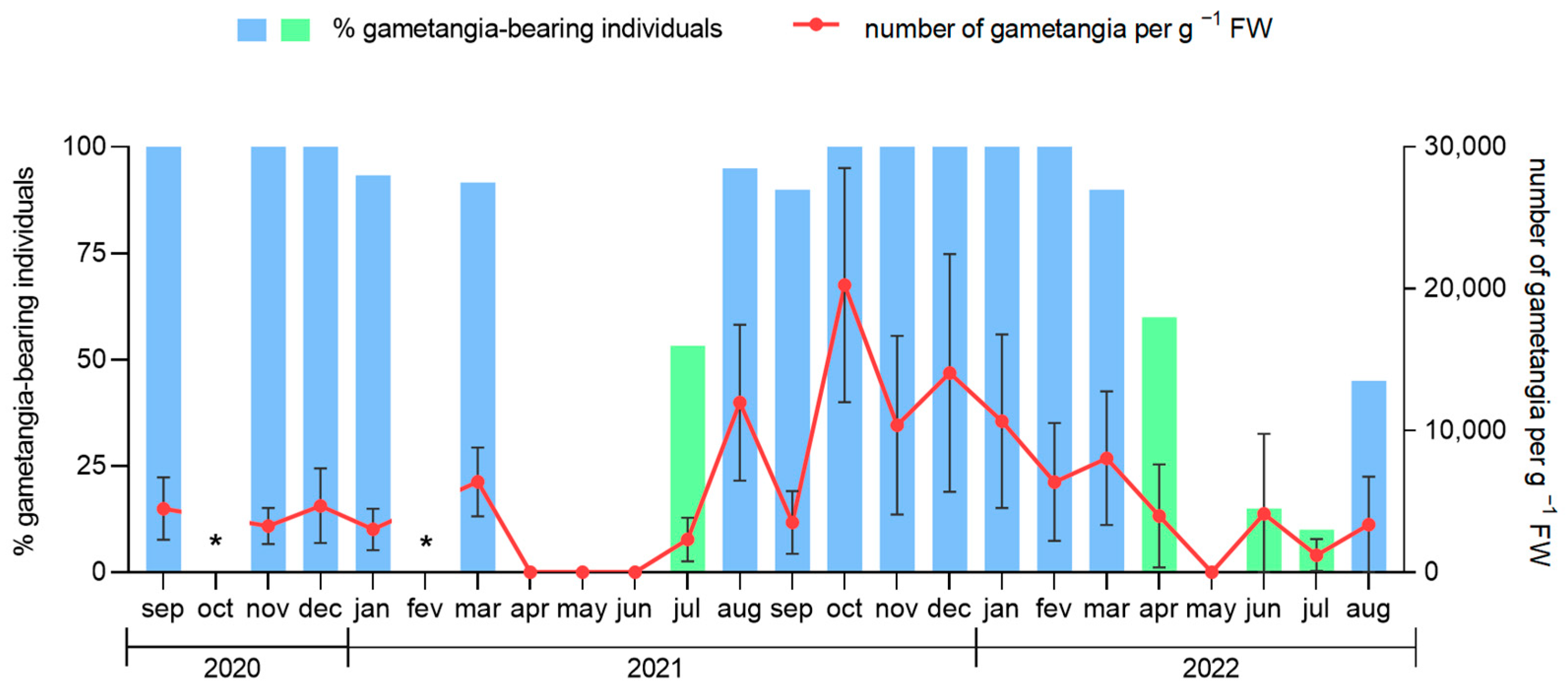
Specimens of C. tomentosum from the Aguçadoura shore were fertile from August, across autumn and winter, until March (Figure 1). During this period, viable gametes were released, and subsequent germination and germling development were observed. The non-fertile period occurred between April and July (spring to early summer). Even though the specimens collected in July 2021, April, June, and July 2022 exhibited gametangia, they were immature and unable to yield viable gametes. During the spring months of April, May, and June 2021, and again in April 2022, no gametangia were detected.
The Kruskal–Wallis test showed significant variation in gametangia density throughout the sampling months (χ2(22) = 219.2, p < 0.0001). Gametangia density peaked in October 2021, with an average of 20,253 ± 8263 gametangia per g of fresh biomass, and reached a minimum in July 2022, with an average of 1218 ± 1125 gametangia per g of fresh biomass. Dunn’s test revealed that gametangia density recorded in October 2021 was not significantly different from March, August, November and December 2021, and January, March, June and July 2022, but differed significantly from every other month (p < 0.05).
From August to March (late summer to late winter), 90% to 100% of individuals analyzed exhibited gametangia, except in August 2022, when only 45% were observed. On the other hand, during July 2021, April, June, and July 2022 (spring to early summer), only 10% to 60% of individuals bore gametangia, corresponding to a non-fertile period.
Most C. tomentosum specimens bore both male and female gametangia; however, in some individuals, only male or female gametangia were observed. Additionally, different sexes were never observed developing in the same utricle.

3.2. Reproductive Structures

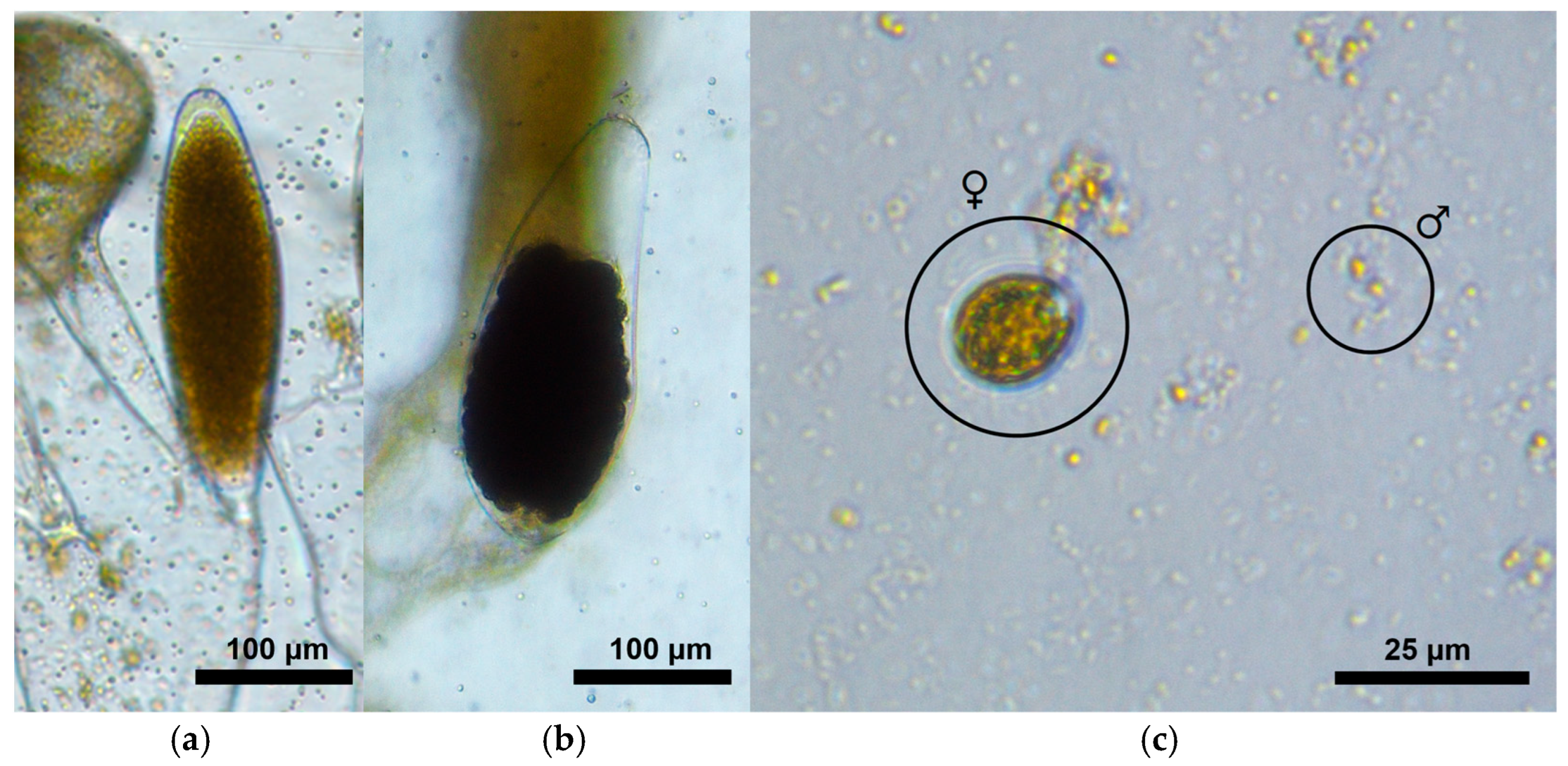
The reproductive structures of C. tomentosum collected from the Aguçadoura shore on the Northern Portuguese coast were observed. Male gametangia were distinguishable by their olive-green coloration and homogeneous internal content (Figure 2a). Female gametangia were longer, exhibited a dark green coloration and contained spherical female gametes (Figure 2b).
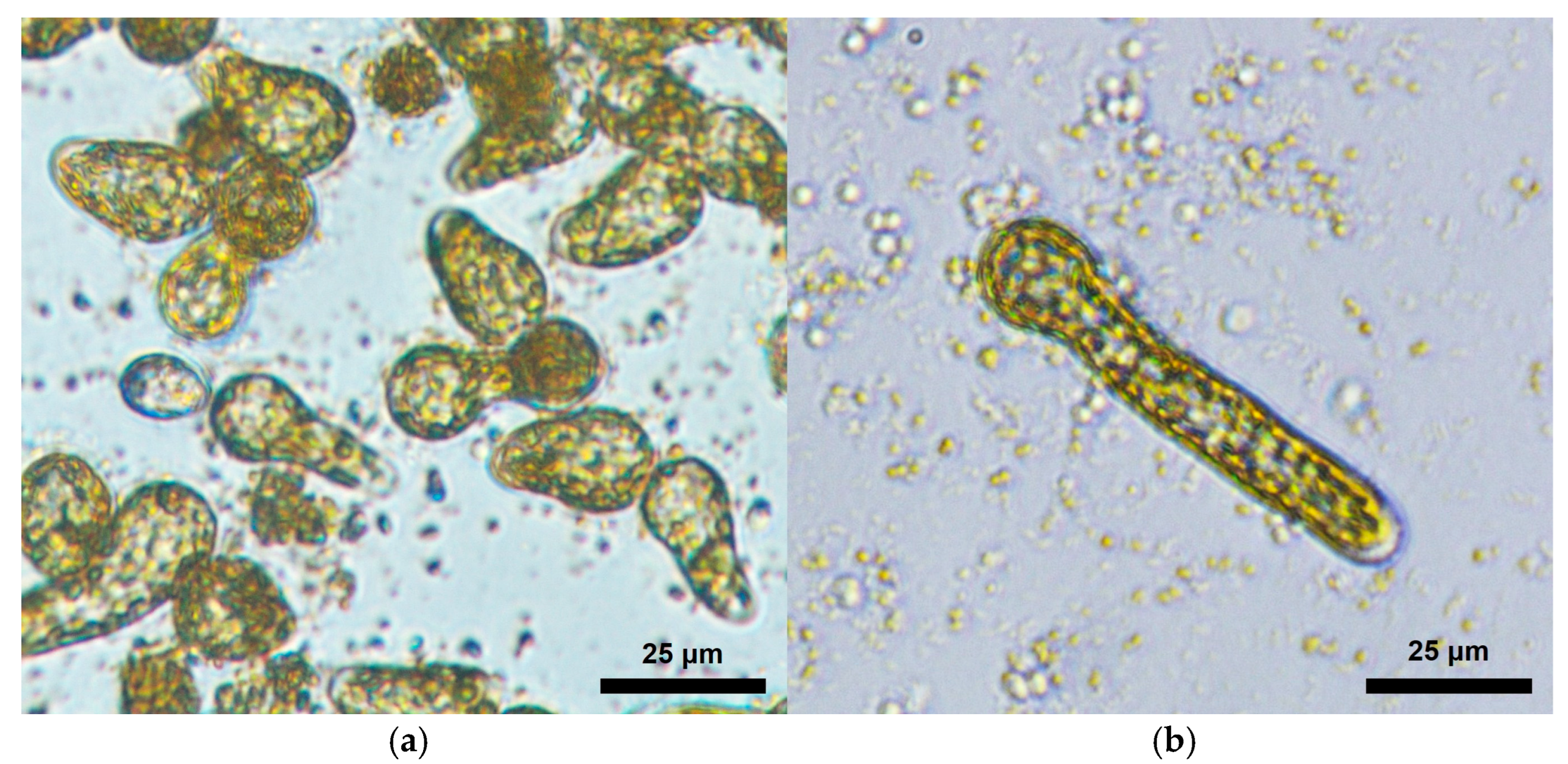
Male gametes were identified by their characteristic rotational movement immediately following gamete release and by the presence of two anterior flagella. Female gametes were ovoid in shape, possessed two anterior flagella, displayed a dark green coloration due to the presence of many chloroplasts, and were motile upon release (Figure 2c). Although gamete fusion was not directly observed under a microscope, male gametes were observed actively swimming around female gametes. Zygote-like structures (Figure 3a) were detected after three days, and germling development (Figure 3b) was observed after seven days, approximately.
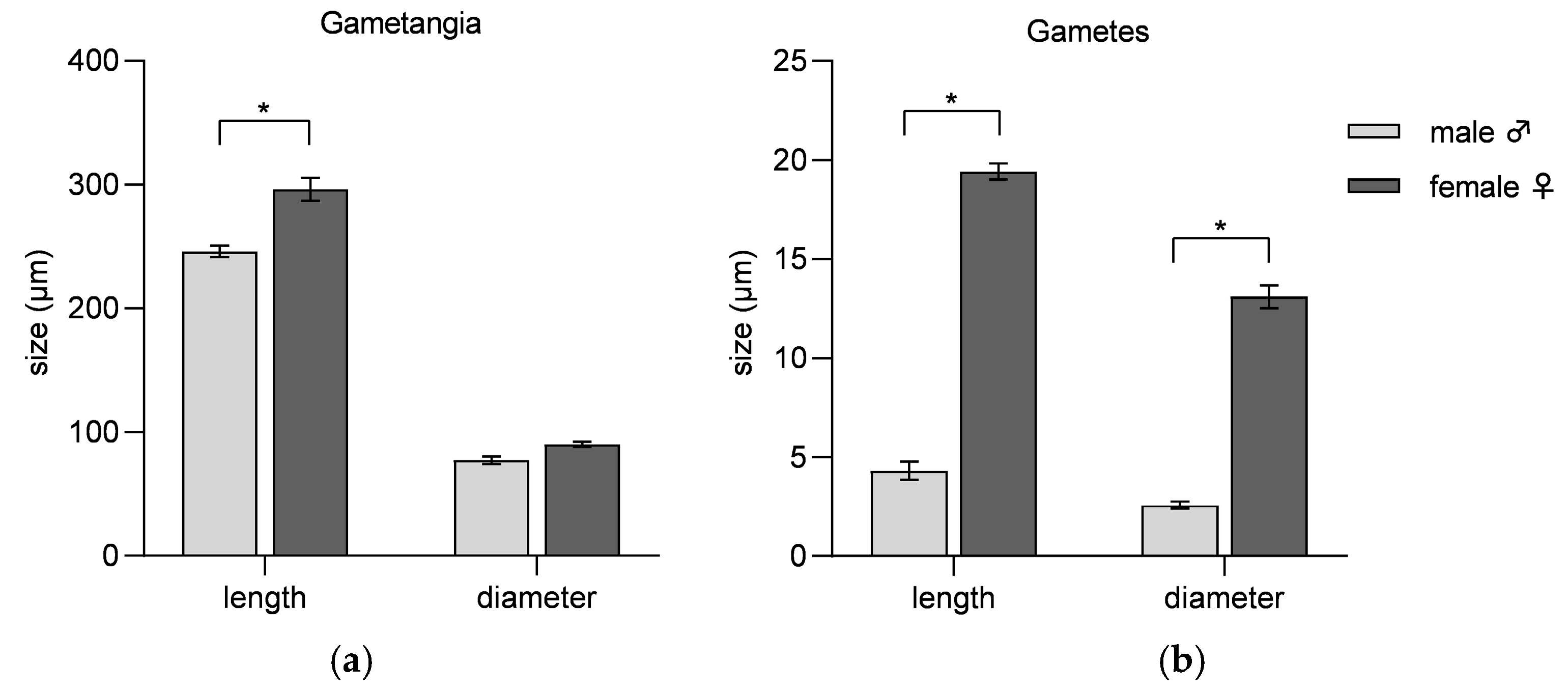
Male gametangia collected between September 2020 and March 2021 exhibited a mean length of 247.34 ± 36.22 µm and a mean diameter of 78.98 ± 12.04 µm (Figure 4a). In contrast, female gametangia were significantly longer, with a mean length of 288.70 ± 28.39 µm and a mean diameter of 91.71 ± 10.13 µm (Figure 4a). A statistically significant difference in length was observed between male and female gametangia (p < 0.05), whereas no significant difference was found in diameter (p = 0.29).
The mean length of male gametes was 4.32 ± 0.46 µm, with a mean diameter of 2.58 ± 0.19 µm (Figure 4b). Female gametes exhibited a mean length of 19.42 ± 0.40 µm and a mean diameter of 13.11 ± 0.60 µm (Figure 4b). Both the length and diameter of female gametes were significantly higher than those of male gametes (p < 0.0001), with female gametes being approximately 4.5 times longer.

4. Discussion

4.1. Seasonal Fertility

The reproductive profile of C. tomentosum from the Aguçadoura shore displayed a well-defined seasonal pattern, with fertility extending from late summer through winter and declining by early spring. Gametangia were consistently present between August and March, peaking in October, and gradually declining throughout winter, while spring and early summer (April–July) corresponded to a non-fertile period, during which either immature gametangia or no reproductive structures were detected. This seasonal pattern aligns with previous reports of reproductive activity in Atlantic Codium species, where gametogenesis is generally initiated during periods of higher water temperature and photoperiod, followed by a gradual decline in winter [18,20,29].
The marked seasonal cycle observed in Aguçadoura is consistent with reproductive dynamics described for other intertidal macroalgae in Northern Iberia, where environmental cues such as temperature, irradiance and nutrient availability have been identified as triggers of reproduction onset [30,31]. For instance, Laminaria ochroleuca from the north coast of Portugal also shows a marked seasonal cycle with reproduction occurring from mid-spring to early winter and peaking in late summer [30]. In the present study, the complete absence of gametangia during the spring months, particularly in May, suggests a reproductive pause coinciding with the thallus regression reported for Codium spp. populations from Northern Portugal [3]. The re-initiation of gametogenesis in summer indicates a synchronized reproductive strategy, likely adapted to ensure gamete release and zygote settlement under favorable environmental conditions.
Comparisons with congeners reinforce this interpretation. In C. fragile from the Northwest Atlantic, reproductive thalli develop in summer, with maximum fertility reported in autumn, before degenerating in winter–early spring [24]. Similarly, C. amplivesiculatum from the Northeast Pacific exhibits peak reproductive activity in October–November and minimal fertility in April [32]. For C. tomentosum var. mucronatum from the coast of Morocco, reproductive activity has been reported only from summer to early autumn [33], suggesting narrower windows of fertility that may reflect local environmental conditions or intraspecific variability.
Together, these observations highlight a general trend across Codium species from the North Atlantic coast, of reproductive activity concentrated in late summer–autumn, with April–May consistently representing a period of minimal fertility.
From an applied perspective, defining the reproductive window of C. tomentosum has direct implications for sustainable production, which is still primarily based on a wild harvest. Current aquaculture production relies largely on vegetative propagation and the collection of wild thalli as starting material [9,25]. Our results may inform decision-making on sustainable resource management, harvest timing, and starting material supply strategies. The findings revealed that the collection of specimens for gamete extraction should be carried out during the fertile period (August–March). Defining the optimal harvesting window for biomass provision in different market applications is more complex, as multiple aspects must be considered. One option could be targeting the non-fertile period, as this seems like an obvious measure to protect reproductive capacity. However, during the non-fertile period (April–July), regrowth is taking place after biomass regression during winter, so biomass density is generally at its lowest [3]. Moreover, this newly formed biomass is also essential to ensure the reproductive capacity over the upcoming months, as it becomes fertile in summer. In this context, harvesting during late autumn and winter could provide certain advantages, including higher biomass densities, allowing regrowth, sexual maturation and reproduction during spring and summer. Finally, a comprehensive understanding of this species’ reproduction strategy is essential. In particular, further studies should clarify the relative contribution of sexual reproduction versus asexual reproduction—through the growth of new thalli from perennial holdfasts (filamentous mat) observed in the field [3]—to the colonization and maintenance of natural populations.

4.2. Gametangia and Gametes

The male and female gametangia dimensions reported in this study were within the range described for other Codium species and smaller than those observed for the invasive C. fragile [34]. Female gametangia in C. tomentosum were significantly larger than male gametangia, a dimorphic pattern also documented in C. coactum, C. subtubulosum [34] and C. fragile [18]. Although no statistically significant differences in diameter were detected between male and female gametangia, this outcome may be attributed to the high biological variability, possibly associated with differences in the maturation stage of individual gametangia, which resulted in large standard deviations that could mask potential biologically relevant differences. Gametangia color and morphology were consistent with descriptions for males [35] and females [20] of C. fragile subsp. novae-zelandiae.
The male gametes observed in this study are consistent with previous descriptions for Codium spp., exhibiting a green–yellow coloration, an elongated to obovate shape, and two anterior flagella [18,34,35]. Female gametes were ovoid to pyriform, with a dark green color due to numerous discoid chloroplasts and two anterior flagella [18,20,34]. In terms of size, female gametes (19.4 µm length; 13.1 µm diameter) were approximately 4.5 times larger than male gametes (4.3 µm length; 2.6 µm diameter), similar to values reported for C. fragile (female ≈ 20 µm; male 3–4 µm) [18]. Female gametes in this study were larger than those reported for C. fragile subsp. novae-zelandiae (15 µm length; 10–11 µm diameter) [20], while male gametes were smaller than those reported for this same subspecies (5–7.5 µm length and 4–5 µm diameter) [35].
Overall, morphometric analysis confirmed clear sexual dimorphism in both gametes and gametangia, consistent with the anisogamous reproductive mode characteristic of Codium [19,20]. The relatively larger size of female gametes reflects greater energetic investment, supporting zygote viability and early development, while the smaller size of male gametes favors higher production and mobility [36,37]. Although gamete fusion was not directly observed, motile male gametes actively swimming around female gametes were noted. This was followed by loss of motility (flagella loss) and attachment of female gametes to the substrate with subsequent development of zygotes and germlings, which is consistent with previous reports for sexual reproduction in Codium spp. [18,34].

5. Conclusions

This study shows that C. tomentosum from the Northern Portuguese coast has a well-defined sexual reproductive period extending from late summer to early spring, with gametangia density peaking between August and November, and a clear gamete dimorphism. Understanding this reproductive pattern is important given the increasing demand for seaweed biomass and sustainability concerns. While commercial cultivation of C. tomentosum can reduce the pressure on natural stocks, production still relies heavily on wild-collected biomass. By revealing the seasonal reproductive dynamics, this study provides essential information to guide the sustainable management of natural resources and the collection of starting material, supporting the long-term production of this valuable species.

Author Contributions

Conceptualization, T.C.P., M.F.S., I.S.-P. and G.S.M.; methodology, M.F.S., T.C.P. and G.S.M.; investigation, M.F.S., T.C.P. and G.S.M.; formal analysis, M.F.S., T.C.P. and G.S.M.; writing—original draft preparation, M.F.S. and T.C.P.; writing—review and editing, G.S.M. and I.S.-P.; supervision, G.S.M. and I.S.-P.; project administration, G.S.M. and I.S.-P.; funding acquisition, I.S.-P. All authors have read and agreed to the published version of the manuscript.

Funding

This work was integrated into the research and innovation AquaVitae (AV) project funded by the European Union’s Horizon 2020 Research and Innovation Programme under Grant Agreement No. 818173.

Institutional Review Board Statement

Not applicable.

Informed Consent Statement

Not applicable.

Data Availability Statement

The original contributions presented in this study are included in the text. Further inquiries can be directed to the corresponding author.

Conflicts of Interest

The authors declare no conflicts of interest.

Abbreviations

The following abbreviations are used in this manuscript:
spp.Species
var.Variety
subsp.Subspecies

References

  1. Mansour, H. Influence of different habitats on the chemical constituents of Codium tomentosum. Egypt. J. Bot. 2018, 58, 275–285. [Google Scholar] [CrossRef]
  2. García, A.G.; Olabarria, C.; Arrontes, J.; Álvarez, Ó.; Viejo, R.M. Spatio-temporal dynamics of Codium populations along the rocky shores of N and NW Spain. Mar. Environ. Res. 2018, 140, 394–402. [Google Scholar] [CrossRef] [PubMed]
  3. Melo, R.; Sousa-Pinto, I.; Antunes, S.C.; Costa, I.; Borges, D. Temporal and spatial variation of seaweed biomass and assemblages in Northwest Portugal. J. Sea Res. 2021, 174, 102079. [Google Scholar] [CrossRef]
  4. da Costa, E.; Melo, T.; Moreira, A.S.P.; Alves, E.; Domingues, P.; Calado, R.; Abreu, M.H.; Domingues, M.R. Decoding bioactive polar lipid profile of the macroalgae Codium tomentosum from a sustainable IMTA system using a lipidomic approach. Algal Res. 2015, 12, 388–397. [Google Scholar] [CrossRef]
  5. González, A.; Santelices, B. A dichotomous species of Codium (Bryopsidales, Chlorophyta) is colonizing Northern Chile. Rev. Chil. Hist. Nat. 2004, 77, 293–304. [Google Scholar] [CrossRef]
  6. Rauch, C.; Tielens, A.G.M.; Serôdio, J.; Gould, S.B.; Christa, G. The ability to incorporate functional plastids by the sea slug Elysia viridis is governed by its food source. Mar. Biol. 2018, 165, 82. [Google Scholar] [CrossRef]
  7. Rey, F.; Cartaxana, P.; Melo, T.; Calado, R.; Pereira, R.; Abreu, H.; Domingues, P.; Cruz, S.; Rosário Domingues, M. Domesticated populations of Codium tomentosum display lipid extracts with lower seasonal shifts than conspecifics from the wild-relevance for biotechnological applications of this green seaweed. Mar. Drugs 2020, 18, 188. [Google Scholar] [CrossRef] [PubMed]
  8. El-Said, G.F. Bioaccumulation of Key Metals and Other Contaminants by Seaweeds from the Egyptian Mediterranean Sea Coast in Relation to Human Health Risk. Hum. Ecol. Risk Assess. 2013, 19, 1285–1305. [Google Scholar] [CrossRef]
  9. Marques, R.; Cruz, S.; Calado, R.; Lillebø, A.; Abreu, H.; Pereira, R.; Pitarma, B.; da Silva, J.M.; Cartaxana, P. Effects of photoperiod and light spectra on growth and pigment composition of the green macroalga Codium tomentosum. J. Appl. Phycol. 2021, 33, 471–480. [Google Scholar] [CrossRef]
  10. Marques, R.; Moreira, A.; Cruz, S.; Calado, R.; Cartaxana, P. Controlling Light to Optimize Growth and Added Value of the Green Macroalga Codium tomentosum. Front. Mar. Sci. 2022, 9, 906332. [Google Scholar] [CrossRef]
  11. Moreira, A.; Cruz, S.; Marques, R.; Cartaxana, P. The underexplored potential of green macroalgae in aquaculture. Rev. Aquac. 2022, 14, 5–26. [Google Scholar] [CrossRef]
  12. Giossi, C.E.; Cruz, S.; Rey, F.; Marques, R.; Melo, T.; do Rosário Domingues, M.; Cartaxana, P. Light Induced Changes in Pigment and Lipid Profiles of Bryopsidales Algae. Front. Mar. Sci. 2021, 8, 745083. [Google Scholar] [CrossRef]
  13. Rabecca, R.; Doss, A.; Pole, R.P.P.; Satheesh, S. Phytochemical and anti-inflammatory properties of green macroalga Codium tomentosum. Biocatal. Agric. Biotechnol. 2022, 45, 102492. [Google Scholar] [CrossRef]
  14. Le Pennec, G.; Gall, E.A. The microbiome of Codium tomentosum: Original state and in the presence of copper. World J. Microbiol. Biotechnol. 2019, 35, 167. [Google Scholar] [CrossRef]
  15. Peréz Lloréns, J.L. Those Curious and Delicious Seaweeds: A Fascinating Voyage from Biology to Gastronomy; Informa UK Limited: London, UK, 2018. [Google Scholar]
  16. Nanba, N.; Kado, R.; Ogawa, H.; Komuro, Y. Formation and growth of filamentous thalli from isolated utricles with medullary filaments of Codium fragile spongy thalli. Aquat. Bot. 2002, 73, 255–264. [Google Scholar] [CrossRef]
  17. Hwang, E.K.; Baek, J.M.; Park, C.S. Cultivation of the green alga, Codium fragile (Suringar) Hariot, by artificial seed production in Korea. J. Appl. Phycol. 2008, 20, 469–475. [Google Scholar] [CrossRef]
  18. Borden, C.A.; Stein, J.R. Reproduction and early development in Codium fragile (Suringar) Hariot: Chlorophyceae. Phycologia 1969, 8, 91–99. [Google Scholar] [CrossRef]
  19. Chang, J.-S.; Dai, C.-F.; Chang, J. Gametangium-like Structures as Propagation Buds in Codium edule Silva (Bryopsidales, Chlorophyta). Bot. Mar. 2003, 46, 431–437. [Google Scholar] [CrossRef]
  20. Miravalles, A.B.; Leonardi, P.I.; Cáceres, E.J. Female gametogenesis and female gamete germination in the anisogamous green alga Codium fragile subsp. novae-zelandiae (Bryopsidophyceae, Chlorophyta). Phycol. Res. 2012, 60, 77–85. [Google Scholar] [CrossRef]
  21. Muha, T.P.; Skukan, R.; Borrell, Y.J.; Rico, J.M.; Garcia de Leaniz, C.; Garcia-Vazquez, E.; Consuegra, S. Contrasting seasonal and spatial distribution of native and invasive Codium seaweed revealed by targeting species-specific eDNA. Ecol. Evol. 2019, 9, 8567–8579. [Google Scholar] [CrossRef] [PubMed]
  22. Sá, M.F.; Pacheco, T.C.; Sousa-Pinto, I.; Marinho, G.S. Sexual Propagation in the Green Seaweed Codium tomentosum—An Emerging Species for Aquaculture. Phycology 2024, 4, 533–547. [Google Scholar] [CrossRef]
  23. Rojo, I.; Olabarria, C.; Santamaria, M.; Provan, J.; Gallardo, T.; Viejo, R.M. Coexistence of congeneric native and invasive species: The case of the green algae Codium spp. in Northwestern Spain. Mar. Environ. Res. 2014, 101, 135–144. [Google Scholar] [CrossRef] [PubMed]
  24. Churchill, A.C.; Moeller, H.W. Seasonal patterns of reproduction in New York. Populations of Codium fragile (sur.) Hariot subsp. tomentosoides (Van Goor) Silva. J. Phycol. 1972, 8, 147–152. [Google Scholar] [CrossRef]
  25. Araújo, R.; Vázquez Calderón, F.; Sánchez López, J.; Azevedo, I.C.; Bruhn, A.; Fluch, S.; Garcia Tasende, M.; Ghaderiardakani, F.; Ilmjärv, T.; Laurans, M.; et al. Current Status of the Algae Production Industry in Europe: An Emerging Sector of the Blue Bioeconomy. Front. Mar. Sci. 2021, 7, 626389. [Google Scholar] [CrossRef]
  26. Sousa, C.; Sousa-Pinto, I.; Oliveira, I.; Marinho, G.S. Seasonal variation in the composition and antioxidant potential of Codium tomentosum and Ulva lacinulata produced in a land-based integrated multi-trophic aquaculture system. J. Appl. Phycol. 2025, 37, 1557–1572. [Google Scholar] [CrossRef]
  27. Cabral, J.P. Characterization and multivariate analysis of Patella intermedia, Patella ulyssiponensis and Patella vulgata from Povoa de Varzim (Northwest Portugal). Iberus 2003, 21, 1–17. [Google Scholar]
  28. Ding, L.; Yan, J.; Zhang, Y.; Huang, B.; Liang, J.; Guo, Y.; Chu, Y. Effects of light intensity and artificial aeration on growth and photosynthetic physiology of marine invasive green alga Codium fragile from Bohai Sea, China. Res. Sq. 2022, rs.3, 1–23. [Google Scholar]
  29. Hanisak, M.D. Growth Patterns of Codium fragile ssp. tomentosoides in Response to Temperature, Irradiance, Salinity, and Nitrogen Source. Mar. Biol. 1979, 50, 319–332. [Google Scholar]
  30. Pereira, T.R.; Azevedo, I.C.; Oliveira, P.; Silva, D.M.; Sousa-pinto, I. Life history traits of Laminaria ochroleuca in Portugal: The range-center of its geographical distribution. Aquat. Bot. 2019, 152, 1–9. [Google Scholar] [CrossRef]
  31. Lüning, K. Seaweeds: Their Environment, Biogeography, and Ecophysiology; John Wiley & Sons: Hoboken, NJ, USA, 1991. [Google Scholar]
  32. Maceiras, R.; Rodríguez, M.; Cancela, A.; Urréjola, S.; Sánchez, A. Macroalgae: Raw material for biodiesel production. Appl. Energy 2011, 88, 3318–3323. [Google Scholar] [CrossRef]
  33. Hassoun, M.; Salhi, G.; Bouksir, H.; Moussa, H.; Riadi, H.; Kazzaz, M. Codium tomentosum var. mucronatum et son epiphyte Aglaothamnion pseudobyssoides, deux nouvelles espèces d’algues benthiques pour la phycoflore du Maroc. Codium tomentosum var. mucronatum and Aglaothamnion pseudobyssoides, two new records for Morocco. Acta Bot. Malacit. 2014, 39, 37–44. [Google Scholar] [CrossRef]
  34. Prince, J.S.; Trowbridge, C.D. Reproduction in the green macroalga Codium (Chlorophyta): Characterization of gametes. Bot. Mar. 2004, 47, 461–470. [Google Scholar] [CrossRef]
  35. Miravalles, A.B.; Leonardi, P.I.; Cáceres, E.J. Male gametogenesis ultrastructure of Codium fragile subsp. novae-zelandiae (Bryopsidophyceae, Chlorophyta). Phycologia 2011, 50, 370–378. [Google Scholar] [CrossRef]
  36. Togashi, T.; Horinouchi, Y.; Parker, G.A. A comparative test of the gamete dynamics theory for the evolution of anisogamy in Bryopsidales green algae. R Soc. Open Sci. 2021, 8, 201611. [Google Scholar] [CrossRef] [PubMed]
  37. Gallardo, T. Marine Algae: General Aspects (Biology, Systematics, Field and Laboratory Techniques). In Marine Algae: Biodiversity, Taxonomy, Environmental Assessment, and Biotechnology; CRC Press: Boca Raton, FL, USA, 2015; pp. 1–67. [Google Scholar]
Figure 1. Seasonal reproductive status of C. tomentosum—fertile (blue bars) and non-fertile (green bars) individuals; percentage of gametangia-bearing individuals (bars); and gametangia density (number of gametangia per g of fresh (FW) biomass (red line)). * Sampling in October 2020 and February 2021 was not possible due to adverse sea conditions.
Phycology 05 00066 g001
Figure 2. (a) Male gametangia and (b) female gametangia of C. tomentosum; (c) female and male gametes right after release.
Phycology 05 00066 g002
Figure 3. (a) Zygote-like structures germinating and (b) germling of C. tomentosum.
Phycology 05 00066 g003
Figure 4. (a) Average male and female gametangia size and (b) average male and female gamete size (length and diameter) for samples collected from September 2020 to March 2021. Data presented as mean ± SD. Significant differences are indicated by * (p < 0.05).
Phycology 05 00066 g004
Disclaimer/Publisher’s Note: The statements, opinions and data contained in all publications are solely those of the individual author(s) and contributor(s) and not of MDPI and/or the editor(s). MDPI and/or the editor(s) disclaim responsibility for any injury to people or property resulting from any ideas, methods, instructions or products referred to in the content.