Article

Marine-Derived Mycosporine-like Amino Acids from Nori Seaweed: Sustainable Bioactive Ingredients for Skincare and Pharmaceuticals


by
Manuela Gallego-Villada
1,
Tatiana Muñoz-Castiblanco
1,
Juan C. Mejía-Giraldo
2,
Luis M. Díaz-Sánchez
3,
Marianny Y. Combariza
4 and
Miguel Angel Puertas-Mejía
1,*
1
Grupo de Investigación en Compuestos Funcionales, Facultad de Ciencias Exactas y Naturales, Universidad de Antioquia, UdeA, Calle 70 No. 52-21, Medellín 050010, Colombia
2
Facultad de Ciencias Farmacéuticas y Alimentarias, Universidad de Antioquia UdeA, Calle 70 No. 52–21, Medellín 050010, Colombia
3
Departamento de Química, Universidad de Pamplona, Carrera 4 Nº 4-38 Centro, Pamplona 540001, Colombia
4
Escuela de Química, Universidad Industrial de Santander, Carrera 27 Calle 9, Bucaramanga 680002, Colombia
*
Author to whom correspondence should be addressed.
Phycology 2025, 5(4), 64; https://doi.org/10.3390/phycology5040064
Submission received: 15 September 2025 / Revised: 8 October 2025 / Accepted: 13 October 2025 / Published: 1 November 2025
(This article belongs to the Special Issue Development of Algal Biotechnology)

Abstract

Mycosporine-like amino acids (MAAs) are multifunctional, UV-absorbing and antioxidant metabolites produced by marine algae, offering promising applications in biotechnology and dermocosmetic sciences. In this study, MAAs were sustainably extracted from nori seaweed (Porphyra spp.) using an ultrasound-assisted aqueous method, an eco-friendly approach that ensures efficiency and industrial scalability. Chromatographic enrichment followed by MALDI-TOF mass spectrometry confirmed the presence of bioactive compounds, including porphyra-334, palythine, and myc-ornithine. The enriched fraction exhibited potent antioxidant activity (low IC50 in DPPH and ABTS assays) and significant anti-elastase effects, highlighting its potential as a natural anti-aging agent. To optimize delivery, MAAs were incorporated into a stable water-in-oil nanoemulsion, which maintained droplet sizes below 400 nm and a low polydispersity index (PDI < 0.2) for up to four months. A randomized, double-blind clinical study in 20 volunteers further demonstrated that the MAA-based nanoemulsion significantly improved skin hydration (+53.6%) and reduced transepidermal water loss (TEWL), confirming its humectant and barrier-strengthening efficacy. These findings position Porphyra spp. as a sustainable marine resource for producing MAAs, and demonstrate their practical potential as natural, multifunctional ingredients in eco-conscious cosmetic and pharmaceutical formulations.

1. Introduction

One of the key factors contributing to skin aging is dehydration. This condition affects not only the skin’s aesthetic appearance but also its overall health and functionality [1]. The epidermis, the outermost layer of the skin, consists of approximately 60–65% water and is covered by a hydrolipidic film, an emulsion of water and lipids maintained by the secretions of sweat and sebaceous glands. Structurally, the epidermis is organized into four main strata: basal, spinous, granular, and corneous. The basal, or germinative, layer consists of proliferating keratinocytes with a water content of approximately 70%, which supports optimal metabolic activity and the continuous formation of new cells. In the spinous layer, keratinocytes begin synthesizing partially polar lipids, while the water content decreases to approximately 30%, contributing to the initial establishment of the lipid barrier. Within the granular layer, cells undergo further dehydration, reducing their water content to around 15%. Finally, the stratum corneum, composed of flattened and densely packed corneocytes, maintains a water content of 13–15%, which is essential for preserving the skin’s barrier function and protecting underlying tissues against transepidermal water loss, microbial invasion, and UV-induced damage [2].
However, over time, the skin gradually loses its natural capacity to retain moisture. This decline is influenced by several factors, including sun exposure, genetics, intrinsic aging, and inadequate skincare practices. Dehydrated skin becomes more fragile and rough, often exhibiting fine scaling and, in more severe cases, fissures or cracking of the surfaces [3,4]. Maintaining proper hydration is essential for preserving the skin’s health and optimal physiological performance over time [5]. When the skin lacks adequate hydration, its flexibility is compromised, resulting in decreased elasticity and a greater tendency to develop fine lines, especially in areas where the skin is thinner or subjected to greater tension. The appearance of wrinkles is another noticeable consequence of dehydration, as insufficient water content makes the skin more susceptible to premature wrinkle formation. In addition to wrinkles, loss of hydration leads to a reduction in skin volume and firmness, increasing the visibility of aging signs even at an early age and ultimately compromising the youthful appearance of the skin [4,6].
To address these limitations, nanotechnology-based delivery systems have gained considerable attention. Several nanoscale carriers, including nanoparticles [7], liposomes [8], and oil-in-water (O/W) nanoemulsions [9], have demonstrated the ability to enhance solubility, stability, and bioavailability of bioactive molecules. Among these, nanoemulsions (NEs) are particularly advantageous for topical delivery, as they can improve the solubility and skin deposition of lipophilic phytochemicals such as quercetin, catechin, and β-carotene [10,11,12]. Enhanced skin deposition not only prolongs efficacy but also improves therapeutic and cosmetic outcomes [13,14,15,16]. Water-in-oil (W/O) nanoemulsions, in particular, offer advantages for topical formulations, including superior occlusivity, enhanced water resistance, and improved stability compared to O/W systems [17,18]. W/O emulsions are widely utilized in dermatological and cosmetic formulations such as cold creams and barrier creams. Their structure enables controlled delivery of hydrophilic actives via the dispersed aqueous phase while minimizing skin irritation [19]. This structural versatility enhances both therapeutic and cosmetic performance.
Among natural bioactive candidates for dermocosmetic applications are mycosporines and mycosporine-like amino acids (MAAs), low-molecular-weight, water-soluble compounds primarily derived from marine organisms [20]. MAAs offer potent antioxidant, anti-inflammatory, and anti-aging activities, positioning them as multifunctional ingredients for cosmeceutical formulations [21].
Given their diverse bioactivities and excellent safety profiles, MAAs are gaining attention for inclusion in topical delivery systems targeting cosmetic and pharmaceutical markets. This study aimed to develop a novel water-in-oil nanoemulsion incorporating a mycosporine-enriched extract (MF). The formulation was systematically evaluated for antioxidant and anti-elastase activities, indicating its potential utility as a natural multifunctional agent in skin health applications.

2. Materials and Methods

2.1. Obtention of Mycosporine-Enriched Extract

The extraction of mycosporine-like amino acids (MAAs) was performed using an ultrasound-assisted extraction method adapted from Rodrigues et al. [22], with modifications. Briefly, 2.0 g of commercially available nori seaweed (Best Choice, Bogotá, Colombia) was extracted with 50 mL of deionized water. The mixture was subjected to an ultrasonic bath operating at 30 Hz and processed at room temperature for 30, 60, and 90 min. Ultrasound was applied in cycles of 10 min with 2 min pauses between each cycle. After extraction, the resulting mixture was centrifuged at 3200 rpm for 10 min using a Scilogex DMO412 (SCILOGEX, Rocky Hill, CT, USA) centrifuge equipped with a fixed-angle rotor (radius: 11 cm). The supernatant was collected and the residue discarded. The obtained extract was then dried at 45 °C in a forced convection oven to obtain the MAAs extract (ME). The optimal extraction time was selected based on a univariate ANOVA analysis.
The ME was purified by column chromatography (30 × 2.5 cm) using silica gel 60 (particle size: 0.063–0.200 mm; pore size: 60 Å) as the stationary phase. A total of 4 g of ME was loaded onto the column for separation. A gradient elution system consisting of water and ethanol (from 10:0 to 0:10, v/v) was used as the mobile phase. Fractions of 15 mL were collected and analyzed using UV-Vis spectroscopy Thermo Scientific Evolution 60S (Thermo Fisher Scientific, Waltham, MA, USA) in the range of 200–500 nm. Fractions exhibiting the characteristic MAAs absorption band at 334 nm were combined and dried at 45 °C, yielding the MAAs-enriched fraction (MF).

2.2. Analysis of MAAs by MALDI-TOF Mass Spectrometry

For MALDI-TOF analysis, a matrix solution of 2,5-dihydroxybenzoic acid (DHB, 20 mg/mL) was prepared in a 1:1 (v/v) acetonitrile:water mixture containing 0.1% trifluoroacetic acid (TFA). The MF sample was dissolved in methanol at a concentration of 1 mg/mL. Equal volumes of the matrix and sample solutions were mixed, and 1 μL of the mixture was applied to a polished steel target plate using the dry-drop method. The solvent was allowed to evaporate at room temperature.
Mass spectra were acquired using a Bruker MALDI-TOF/TOF UltraFleXtreme mass spectrometer (Bruker Daltonics, Billerica, MA, USA), equipped with a solid-state Nd:YAG laser (λ = 355 nm) operating at a frequency of 1 kHz and a pulse duration of 6 ns. Positive ion spectra were recorded over the m/z range of 100–1200, utilizing pulsed ion extraction (PIE) with a delay of 100 ns and an acceleration potential of 20 kV. Spectra were obtained in reflectron mode at 25 kV, with a laser pulse energy of 2.0 μJ. External calibration was conducted using a peptide calibration standard containing leucine enkephalin, bradykinin, bombesin, and renin substrate (Sigma-Aldrich, St. Louis, MO, USA), with α-cyano-4-hydroxycinnamic acid (α-CHCA) as the matrix. Each reported spectrum represented an accumulation of 2000 individual laser shots. Data analysis was carried out using FlexAnalysis software (v.3.3, Bruker Daltonics, Billerica, MA, USA), which provided signal-to-noise ratio (S/N), monoisotopic mass, ion abundance, and resolution data. Molecular formulas were proposed based on a custom database of previously reported MAAs [23]. Experimental isotopic patterns were compared with theoretical ones using ChemCalc software (Zakodium, Lonay, Switzerland; web-based stable release) for validation. Data visualization was performed using OriginPro 9.0 (OriginLab Corp., Northampton, MA, USA).

2.3. Antioxidant Assays

The antioxidant activities of ME and MF were evaluated using multiple assays, including lipid peroxidation inhibition in a methyl linoleate (MeLo) model system, DPPH and ABTS radical scavenging assays, and total phenolic content (TPC) determined by the Folin–Ciocalteu method, following the protocol reported by Muñoz-Castiblanco et al. [24]. All experiments were performed in triplicate, and results were expressed as mean ± standard deviation (SD).

2.3.1. Total Phenolic Content (TPC)

TPC was quantified using the Folin–Ciocalteu colorimetric method. A sample solution was prepared in distilled water at 1.0 mg/mL. In a test tube, 0.1 mL of the sample was mixed with 1.5 mL of Folin–Ciocalteu reagent and left to react for 10 min in the dark. Then, 0.3 mL of sodium carbonate solution (20% w/v) was added, and the mixture was incubated at 40 °C for 30 min. Absorbance was measured at 765 nm using a UV-Vis spectrophotometer. The phenolic content was calculated from a gallic acid calibration curve and expressed as milligrams of gallic acid equivalents per gram of dry sample (mg GAE/g).

2.3.2. DPPH• Radical Scavenging Activity

The DPPH assay was conducted as described by Ed-Dahmani et al. [25] with modifications. A 0.05 mM DPPH solution in methanol was prepared and mixed with 200 μL of sample solution at concentrations ranging from 0.0025 to 1 mg/mL. After a 45 min incubation in the dark at room temperature, the absorbance was measured at 515 nm. The percentage of radical inhibition was calculated using:
% I n h i b i t i o n = A c o n t r o l A s a m p l e A c o n t r o l 100
where Acontrol is the absorbance of the DPPH solution without sample and Asample is the absorbance in the presence of the extract. Ascorbic acid was used as a positive control. Results were expressed as IC50 values, representing the sample concentration required to inhibit 50% of the radical.

2.3.3. ABTS•+ Radical Scavenging Activity

The ABTS assay was performed according to the method previously described [26]. The ABTS•+ radical cation was generated by mixing 7 mM ABTS with 2.45 mM potassium persulfate (1:1, v/v) and allowing the solution to stand in the dark for 16 h. The resulting solution was diluted with distilled water to an absorbance of 0.70 ± 0.02 at 734 nm. A total of 100 μL of the sample was added to 1 mL of ABTS•+ solution and incubated for 7 min in the dark. Absorbance was measured at 734 nm, and radical inhibition was calculated using Equation (1), with A corresponding to the absorbance of the ABTS solution alone. IC50 values were determined as described above.

2.3.4. Lipid Peroxidation Inhibition in Methyl Linoleate (MeLo)

Lipid peroxidation was assessed using a MeLo model system by quantifying conjugated dienes (CD) and thiobarbituric acid reactive substances (TBARS) [27]. A 10 mM MeLo solution in methanol was prepared. Then, 900 μL of the MeLo solution was mixed with 100 μL of the sample (2 mg/mL) and incubated for five days at 40 ± 5 °C under light exposure. Illumination was provided by a conventional tubular LED lamp (T8, 18 W, 120 cm length) emitting in the visible range of 400–700 nm, with an average light intensity of approximately 3500 lux (≈45 W/m2) at the sample surface. The experiment was carried out in an aluminum container filled with sand to maintain a stable temperature during exposure. Controls included a positive control (1 mL MeLo alone) and a negative control (900 μL MeLo + 100 μL BHT at 0.2% w/v). Conjugated Dienes (CD): After incubation, 100 μL of the reaction mixture was diluted with 2.4 mL of ethanol (1:25 ratio). Absorbance was measured at 234 nm, and CD concentration was calculated using an extinction coefficient of 29,000 M−1 cm−1. Results were expressed as mmol CD/kg sample.
Thiobarbituric Acid Reactive Substances (TBARS): For TBARS quantification, 50 μL of the reaction mixture was combined with 350 μL ethanol, 100 μL BHT (0.2% w/v in ethanol), and 500 μL of TBA solution (0.37% w/v in 0.25 mM HCl). The mixture was heated at 90 ± 5 °C for 30 min. Absorbance was measured at 535 nm, with turbidity correction performed by subtracting the absorbance at 600 nm. TBARS levels were expressed as mmol malondialdehyde (MDA)/kg MeLo, using an extinction coefficient of 156,000 M−1 cm−1.

2.4. Nanoemulsion Preparation

A water-in-oil (W/O) nanoemulsion was formulated using a Benchmark PULSE 150 ultrasonic homogenizer. The oil phase comprised mineral oil and vitamin E, while the aqueous phase included deionized water, polyethylene glycol (PEG), hyaluronic acid, elastin, water-soluble vitamin E, and 0.5% (w/w) MF (components and concentrations are listed in Table 1). A surfactant blend of Span 80 and Tween 80 (7:3, w/w) was employed. The oil phase and surfactants were mixed sequentially under magnetic stirring at 1500 rpm, followed by the gradual addition of the aqueous phase with continuous stirring for 15 min at room temperature. The resulting pre-emulsion was then sonicated at 40% amplitude in pulsed mode (5 s on, 5 s off) for 10 min, with the process conducted in an ice bath to maintain a temperature below 50 °C. The nanoemulsion was characterized for droplet size and polydispersity index (PDI) using dynamic light scattering (DLS) with a Malvern Zetasizer Lab [28].

2.5. Anti-Elastase Activity Assay

The anti-elastase activity was evaluated following the method described by Shanura et al. [29] with minor modifications. Type I elastase derived from porcine pancreas (E1250; specific activity: 4.6 U/mg, Sigma-Aldrich, Burlington, MA, USA) was prepared at 0.43 mg/mL in Tris-HCl buffer (10 mM, pH 8.0). For the assay, 300 µL of Tris-HCl buffer was first mixed with 75 µL of the chromogenic substrate N-succinyl-Ala-Ala-Ala-p-nitroanilide (2.0 mM, prepared in Tris-HCl buffer). Subsequently, 150 µL of the sample solution and 75 µL of the elastase enzyme solution were added to the reaction mixture. The mixture was thoroughly homogenized and incubated at 25 °C for 20 min. After incubation, the absorbance was measured at 410 nm using a microplate reader. A reagent blank (distilled water), an enzyme blank (Tris-HCl buffer plus elastase), and a negative control (buffer, substrate, and enzyme, representing 100% enzymatic activity) were included in each assay to ensure accuracy and reproducibility. The percentage of elastase inhibition was calculated, and the inhibitory activity was expressed as the IC50 value, defined as the concentration of sample required to inhibit 50% of the elastase activity under the assay conditions.
%   I n h i b i t o r y   a c t i v i t y = A N C A B E A s a m p l e A B E × 100
where
  • ANC is the absorbance of the negative control after incubation,
  • ASample is the absorbance of the sample after incubation,
  • ABE is the absorbance of the enzyme blank (buffer solution and enzyme).

2.6. In Vivo Evaluation of the Moisturizing and Humectant Efficacy and In Vitro Antiradical Assays of the Nanoemulsion

2.6.1. Ethical Considerations

The moisturizing and humectant studies were conducted by Delivery Clinical Studies (Sabaneta, Antioquia, Colombia) under the oversight of the Fracture Risk Research Ethics Committee, S.A., which operates following Colombian ethical and legal guidelines established in Resolution 008430 of 1993 and Resolution 002378 of 2008 of the Ministry of Social Protection. The Committee also adheres to the principles of the Declaration of Helsinki (and its subsequent revisions) and the International Conference on Harmonization Good Clinical Practice (ICH-GCP) guidelines.
The study involving human volunteers was conducted in full compliance with the ethical principles outlined above. The protocol was reviewed and approved by the Research Ethics Committee of Riesgo de Fractura S.A. during a meeting held on 21 January 2025 (Record CEI-164).

2.6.2. Study Design

This was a randomized, double-blind, controlled clinical trial designed to evaluate the moisturizing and humectant (barrier function) efficacy of a topical nanoemulsion formulation. The trial assessed effects on skin hydration and transepidermal water loss (TEWL) under controlled environmental conditions.

2.6.3. Participant Recruitment and Selection

Volunteers were recruited electronically via email and web-based platforms. Interested individuals registered through an online database and were subsequently invited to an informational session. During this session, participants were thoroughly informed, both orally and in writing, about the study objectives, procedures, timeline, potential risks, and restrictions. Those who consented to participate completed a medical history questionnaire covering allergies, skin conditions, current medications, and prior participation in similar studies.
Exclusion criteria eliminated candidates with physical or dermatological conditions that could interfere with product application. Eligible volunteers who met all inclusion criteria signed an informed consent form and received a copy for their records. Participants were explicitly informed of their right to withdraw from the study at any point without penalty.

2.6.4. Demographics and Sample Size

A public call for volunteers was conducted electronically via email and web announcements, allowing interested individuals to register in a database. Subsequently, an informational meeting was held during which potential participants were thoroughly briefed, both verbally and in writing, on the study’s purpose, schedule, limitations, and possible risks. Those who voluntarily agreed to participate completed a questionnaire covering their medical history, allergies, dermatological conditions, current medications, and any prior participation in similar studies. Volunteers who met the inclusion and exclusion criteria and who did not present any physical or dermatological conditions that could interfere with the product’s application were selected for participation. All volunteers received detailed information regarding the study objectives and potential risks, provided written informed consent, and were reminded of their right to withdraw from the study at any time without consequence. The sample size was determined by the number of eligible volunteers who met the selection criteria and consented to participate, ensuring adequate representation to evaluate the product’s safety and tolerance under controlled conditions. All procedures involving human participants were conducted in accordance with the ethical principles outlined in the Declaration of Helsinki and approved by the corresponding institutional ethics committee.
Finally, twenty healthy adult volunteers (male and female), aged 18–65 years, were selected based on the inclusion and exclusion criteria. Demographic data collected included name, age, sex, ethnic background, skin type, and overall health status.

2.6.5. Inclusion Criteria

The study included male and female adults aged 18 to 65 years who self-reported having dry skin, with the degree of dryness assessed based on the participants’ own perception. Participants had to be free from ongoing medical conditions, willing to follow the study instructions, and able to provide complete and reliable health and demographic information.

2.6.6. Exclusion Criteria

People were not eligible to take part if they were pregnant or breastfeeding, or if they were taking medications that could affect skin hydration, such as diuretics, corticosteroids, or acne treatments. Individuals with known sensitivities to cosmetics or moisturizers, or those with skin conditions such as psoriasis, lupus, melanoma, or rosacea, were excluded. Similarly, participants with chronic skin allergies, excessive hair in the test area, or those who had recently taken part in a similar dermatological study without a minimum two-month washout period were not eligible.

2.6.7. Participant Withdrawal Criteria

Participants could be withdrawn from the study if they did not follow the study requirements, developed a medical condition that might interfere with the results, or decided to withdraw their consent at any time.

2.6.8. Study Restrictions

To keep conditions consistent across participants, some restrictions were applied. Volunteers were asked to avoid using deodorants, moisturizing soaps, or cosmetic products on the test area for a week before and during the study. They were also asked not to consume coffee on the day of each study session.

2.6.9. Product Application Protocol

Before application, all participants underwent a 25 min acclimatization period under controlled environmental conditions. A 10 cm2 test site was selected on the inner forearm according to the randomization plan. Baseline skin hydration and TEWL measurements were taken on both the treatment and control areas. The nanoemulsion was applied once to the designated area of clean, dry skin (2.5 × 4 cm) using a dose of 25 µL (2 mg/cm2). Instrumental measurements of skin hydration and TEWL were taken at the following time points post-application: 0.5, 2, 4, 6, 8, and 10 h. The average results for each volunteer were calculated for each of the moments evaluated, respectively.

2.6.10. Measurement Techniques

Skin hydration was evaluated using the Corneometer, which measures the skin’s capacitance and expresses results in arbitrary units (a.u.) and as a percentage change from baseline. TEWL was assessed using the Tewameter TM 300 (Courage+Khazaca, Köln, Germany), and results were reported in g/h/m2 and as a percentage variation from baseline. Measurements were consistently performed on both treated and untreated areas under identical environmental conditions to ensure the reliability of the data.
Additionally, the antiradical activity of NE and NE-MYC was assessed using DPPH and ABTS+ assays. The percentage inhibition of these radicals was calculated to determine the influence of MAAs on the antioxidant activity of the formulation. These assays were performed following the procedures described in Section 2.3.2 and Section 2.3.3.

2.6.11. Statistical Analysis

Fisher’s least significant difference (LSD) test was applied to perform multiple range comparisons, and analysis of variance (ANOVA) was used to evaluate potential interactions among the studied factors. In the in vivo assessment, the Wilcoxon nonparametric test was employed to analyze paired differences between baseline and treatment measurements. A significance threshold of p < 0.05 was established. Data are presented as mean values ± standard deviation (SD).

3. Results and Discussion

3.1. Extraction Yield

In this study, a mycosporine-enriched fraction (MF) was successfully obtained from Porphyra spp. through an optimized ultrasound-assisted aqueous extraction followed by purification using a cation exchange resin. The extraction yield of approximately 17.9% (w/w) is comparable to yields reported by Orfanoudaki et al. [30] and De la Coba et al. [31], ranging from 10% to 22%, depending on the extraction method and algae species (Table 2). The use of ultrasound in this study likely contributed to cell wall disruption and enhanced mass transfer, facilitating efficient extraction while employing water as a green solvent, which is highly desirable for industrial scalability and environmental sustainability.
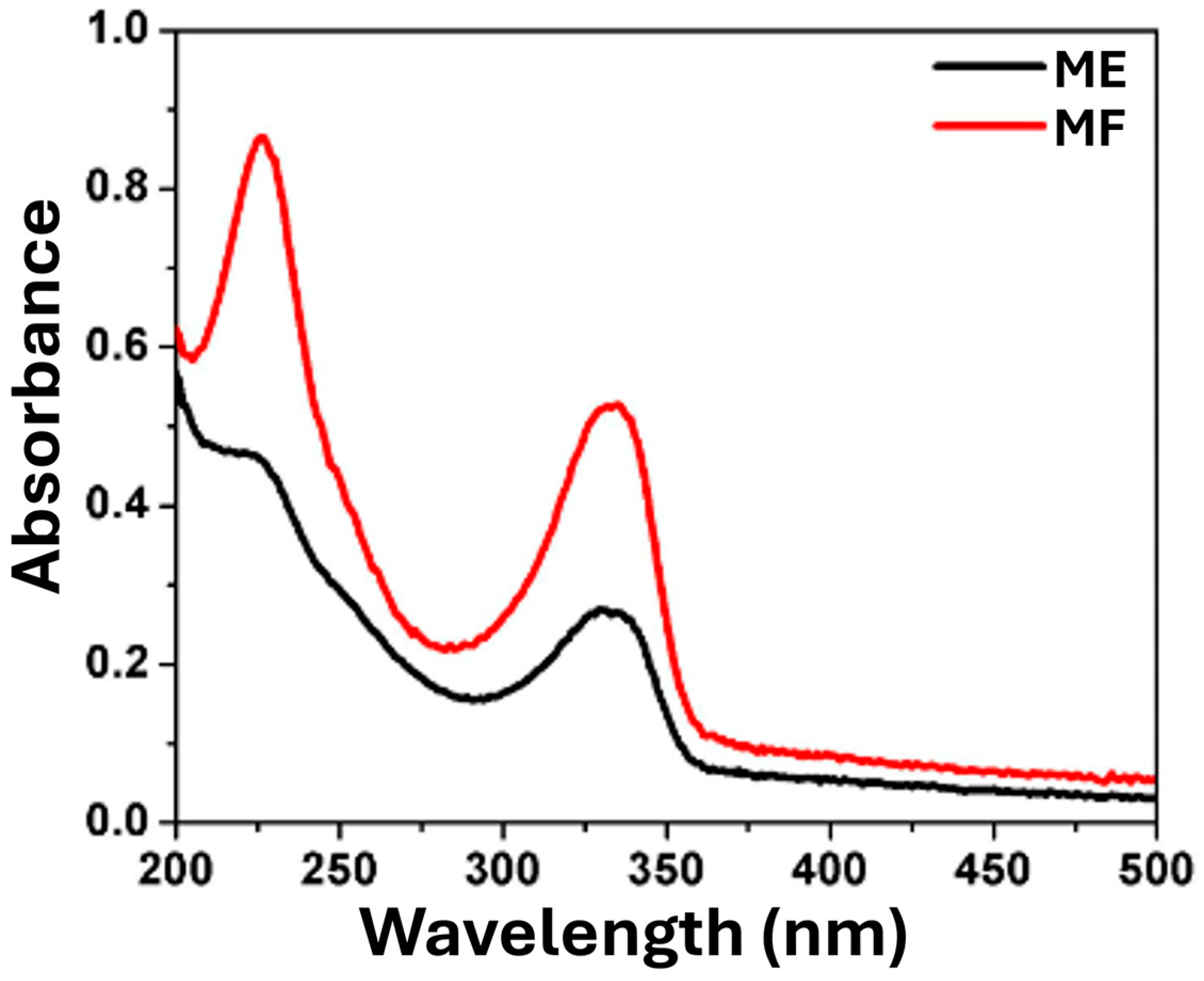
The enrichment process yielded an MF with 5% w/w concentration of MAAs. As shown in Figure 1, the enriched fraction exhibited a higher absorbance at 330 nm compared to the crude extract, confirming successful concentration of MAAs.
Ultrasound-assisted aqueous extraction proved effective for MAA isolation. Extended extraction times did not significantly enhance yield, consistent with prior findings suggesting degradation of heat-sensitive compounds at prolonged durations. The enrichment step yielded a concentrated fraction with markedly higher UV-absorbing properties, suitable for cosmeceutical applications.

3.2. MALDI-TOF Mass Spectrometry Characterization

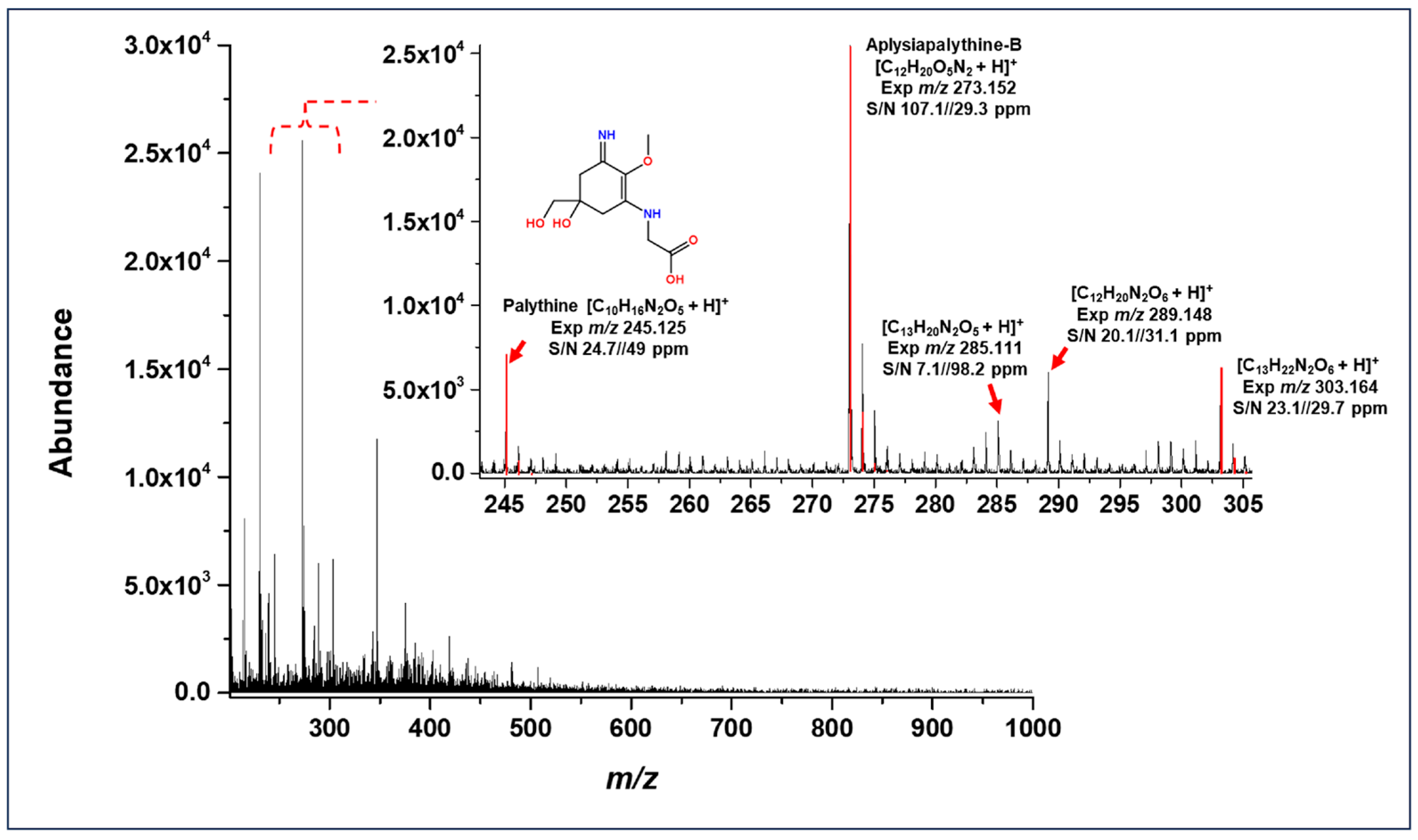
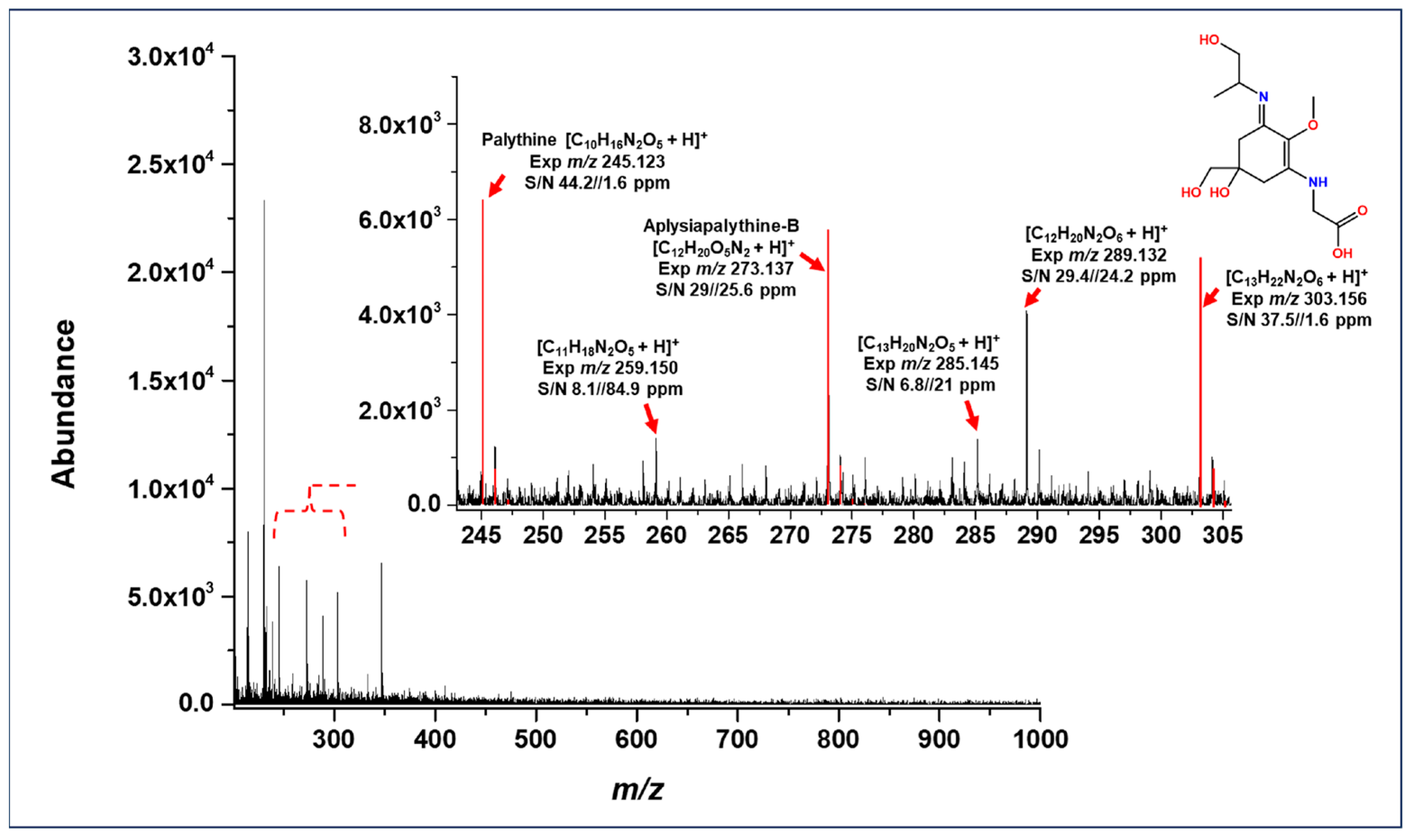
Matrix-Assisted Laser Desorption/Ionization Time-of-Flight (MALDI-TOF) mass spectrometry was utilized to analyze the molecular composition of the MAAs extracts and enriched fractions. The MALDI-TOF chemical profiles are illustrated in Figure 2 and Figure 3, and summarized in Table 3 and Table 4.
The identified compounds include a diverse range of mycosporine-like amino acids (MAAs), such as palythine, N-methylpalythine, aplysiapalythine-B, palythene, usujirene, palythine-threonine, asterine-330, mycornithine, methyl-amine threonine, palythinol, porphyra-334, and hexose-bound palythine-serine. Compound identification was achieved by comparing the theoretical and experimental mass-to-charge ratios (m/z) of the protonated ions [M + H]+, as well as assessing mass accuracy (Δ ppm), isotopic pattern fidelity, and signal-to-noise (S/N) ratios. It is important to note that several of these compounds are structural isomers, sharing identical molecular formulas and isotopic distributions, which complicates their definitive assignment based solely on MALDI-TOF MS data. Still, the proposed identifications were also based on previously reported spectral data in the literature.
A comparative analysis of the MAAs extract (Figure 2 and Table 3) and the purified MAAs-enriched fraction (Figure 3 and Table 4) demonstrates significant improvements in mass accuracy and signal-to-noise ratios following purification. Notably, the enriched fraction shows palythine with a mass accuracy of 1.6 ppm and a signal-to-noise ratio of 44.2, compared to 49.0 ppm and 24.7 in the crude extract. These enhancements highlight the effectiveness of the purification process in refining the MAAs composition.
The MALDI-TOF MS analysis enabled precise identification of several MAAs in both the crude extract and the enriched fraction. Compounds such as palythine, N-methylpalythine, aplysiapalythine-B, and porphyra-334 were identified through mass accuracy and isotopic pattern matching. However, structural isomerism posed challenges during spectral interpretation, especially for compounds like palythene and usujirene, which share molecular formulas. Nonetheless, identification was corroborated by previous literature and comparative analysis. MALDI-TOF profiling confirms the presence of biologically relevant MAAs that are suitable for cosmeceutical applications.

3.3. Antioxidant Assays

Marine algae represent a significant source of phenolic compounds, exhibiting a diverse range of TPC values. The total phenolic content (TPC) of the samples is reported in Table 5. The enriched fraction (MF) displayed a significantly higher total phenolic content (TPC) of 9.64 ± 0.65 mg GAE/g, nearly triple that of the crude extract (ME), which registered 3.32 ± 0.21 mg GAE/g. This enrichment aligns MF’s phenolic concentration with the upper range reported for certain brown and red algae extracts. For instance, Ericaria crinita (formerly Cystoseira crinite), a brown seaweed, was documented to contain TPC values mately 87.70 ± 1.03 mg GAE/g [32]. Similarly, freeze-dried Kappaphycus alvarezii (Rhodophyta) samples exhibited a TPC value of 1.28 mg GAE/g [33]. Among macroalgal species evaluated in Ireland (Laminaria digitata, Fucus serratus—Phaeophyceae, Gracilaria gracilis—Rhodophyta, Codium fragile—Chlorophyta), showed superior phenolic content, 9.90 ± 0.08 mg GAE/g, which is comparable to MF values [34]. These comparisons suggest that the phenolic concentration in MF not only reflects successful bioactive enrichment but also demonstrates competitive antioxidant potential relative to other marine-sourced extracts. Moreover, the considerable variability in reported TPCs across algal species underscores the importance of both species selection and extraction optimization in maximizing the functional value of natural cosmetic ingredients.
The IC50 values presented in Table 5 represent the mean ± standard deviation (SD) of three independent biological replicates, each analyzed in triplicate (n = 9 total measurements). Statistical significance was determined using Fisher’s LSD test (p < 0.05). The MF fraction showed significantly lower IC50 values in both DPPH and ABTS assays compared to the crude extract (ME) and negative controls, confirming its superior radical-scavenging performance.
This trend is consistent with recent studies, which report that purified MAAs such as palythine and porphyra-334 display lower IC50 values (higher activity) than crude extracts, especially under alkaline conditions, but generally remain less potent than ascorbic acid [35,36]. Furthermore, MF effectively inhibited both the initiation (CD formation) and propagation (MDA accumulation) phases of lipid peroxidation in a MeLo oxidation model, showing comparable efficacy to standard antioxidants, as also demonstrated in in vitro and in vivo models [37,38].
However, several limitations must be acknowledged. The IC50 values of MAAs and phenolic compounds in the MF remain higher than those of synthetic antioxidants such as Trolox or BHT, reflecting their moderate scavenging capacity but improved biocompatibility and photostability. In addition, potential matrix effects in the topical formulation, arising from interactions between hydrophilic and lipophilic excipients, may influence the apparent antioxidant activity and release kinetics of the bioactives. Additionally, the structure–activity relationship of MAAs is well established, with mycosporine-glycine and mycosporine-2-glycine frequently exhibiting the highest antioxidant activity. Furthermore, environmental parameters, including pH and temperature, can significantly influence their efficacy [39]. The antioxidant properties of MAAs make them promising candidates for cosmeceutical and topical applications [40,41,42].
Finally, to support the cosmeceutical translation of this formulation, further studies are required to assess long-term safety, skin irritation potential, and in vivo efficacy under repeated application. These considerations outline the next steps toward validating Porphyra-derived compounds as safe, sustainable antioxidants for dermocosmetic use.

3.4. Anti-Elastase Activity

The anti-elastase activity of mycosporine-like amino acids (MAAs) in Table 6 is consistent with recent research, which highlights their potential as natural inhibitors of elastase and anti-aging agents. The inhibitory activity against pancreatic elastase showed statistically significant differences among the three analyzed samples, with the MAA-enriched fraction (FM) demonstrating stronger anti-elastase activity (IC50 = 6.320 ± 1.119 mg/mL) than the crude extract (ME) (IC50 = 13.270 ± 2.217 mg/mL), though both were less potent than the positive control, EGCG (IC50 = 0.083 ± 0.021 mg/mL). This pattern aligns with literature, which confirms that MAAs possess moderate but significant elastase inhibitory activity, and that enrichment or purification enhances their potency [43,44].
Recent studies have documented that MAAs from marine algae and cyanobacteria inhibit elastase, collagenase, and hyaluronidase, contributing to their anti-photoaging and skin-protective properties. For example, MAAs extracted from red algae have demonstrated anti-aging effects in vitro, including elastase inhibition, which supports their use in cosmeceutical formulations [43]. Furthermore, the anti-elastase activity of MAAs is influenced by their structural features, particularly the presence of hydroxyl groups, which facilitate interactions with the enzyme’s active site. This mechanistic insight matches the explanation regarding hydrogen bonding and conformational changes leading to enzyme inhibition [45,46].
While most studies focus on the broad anti-aging and antioxidant effects of MAAs, the specific inhibition of elastase by MAA-enriched fractions is repeatedly cited as a key mechanism for their anti-wrinkle and skin-firming benefits. Our study confirms that MAA-enriched fractions have significantly improved anti-elastase activity compared to crude extracts, though they remain less potent than synthetic inhibitors like EGCG. These findings reinforce the potential of MAAs as natural anti-aging agents in cosmeceutical applications, with their efficacy closely tied to enrichment and structural features.

3.5. Nanoemulsion Stability and Droplet Size

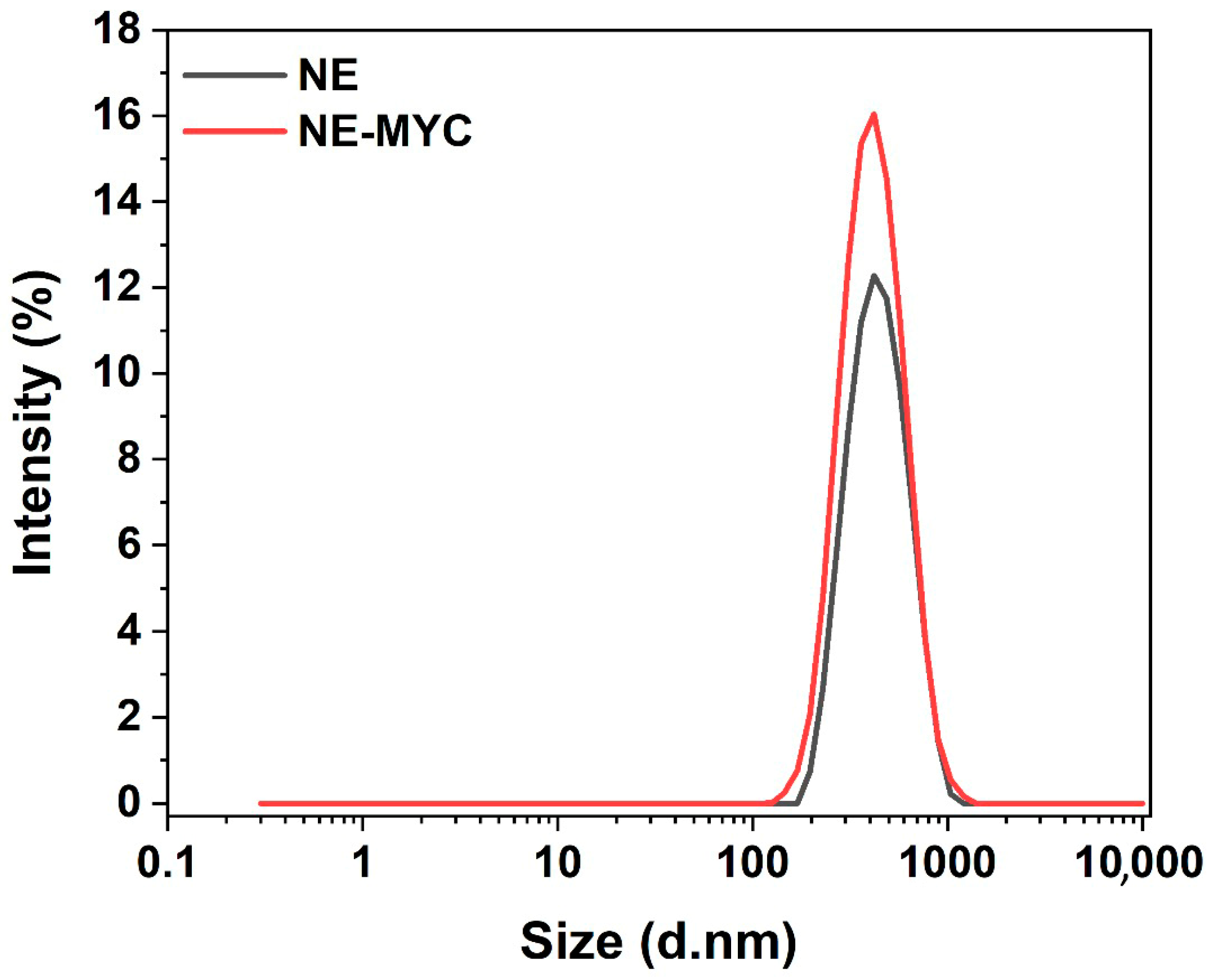
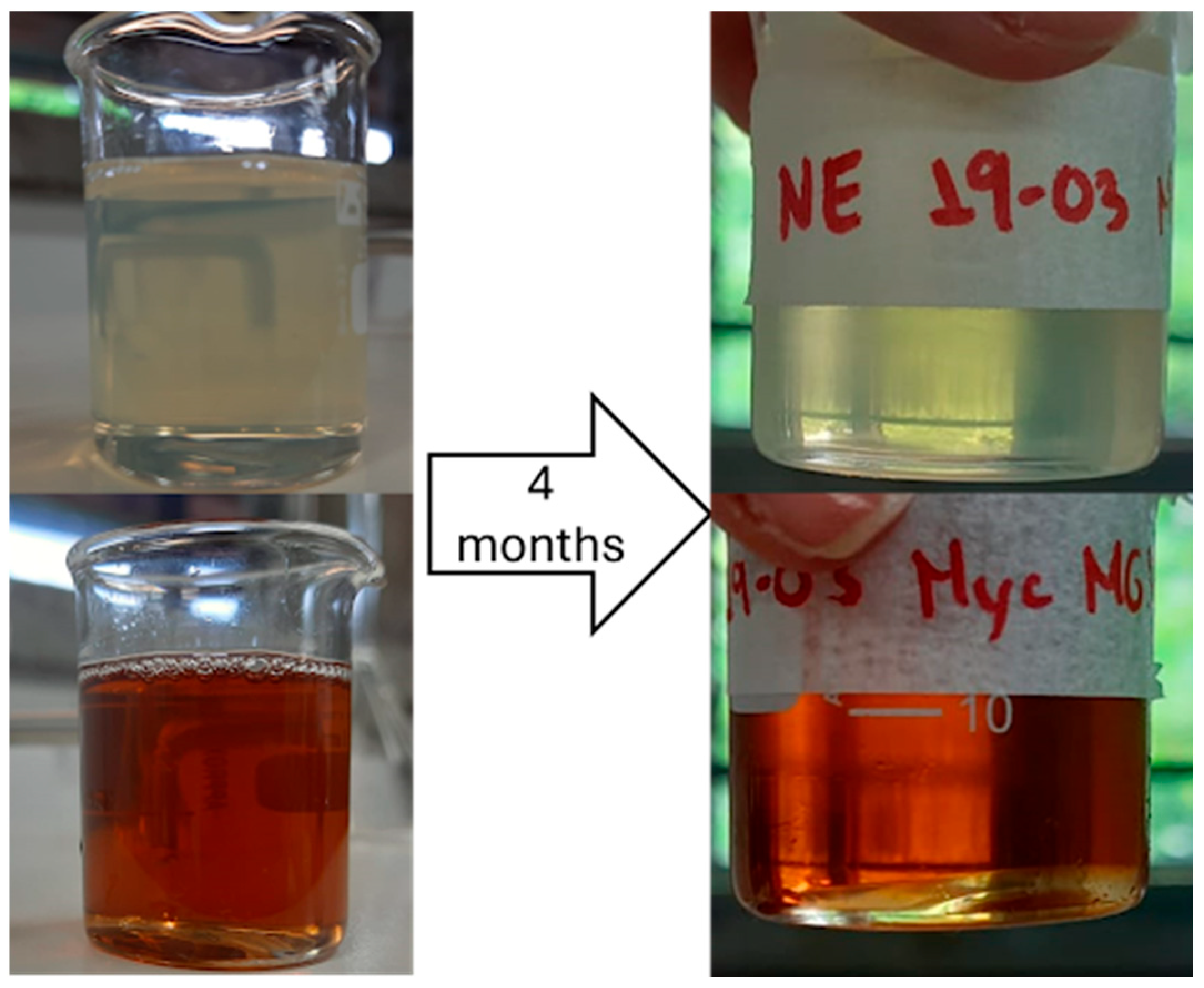
Formulations with a 7:3 Span 80/Tween 80 ratio remained visually stable for up to four months, while higher Span 80 ratios (9:1, 8:2) showed early turbidity and instability. Dynamic Light Scattering (DLS) revealed that both NE and NE-MYC (7:3) had mean droplet sizes around 400 nm and low polydispersity indices (PDI < 0.2), indicating narrow, homogeneous size distributions and robust physical stability. The incorporation of MAAs did not compromise stability and may have slightly reduced droplet size, suggesting enhanced interfacial organization (Figure 4).
These findings are consistent with the literature, which demonstrates that nanoemulsions with droplet sizes in the 20–500 nm range and low PDI exhibit high kinetic stability, resisting phase separation and aggregation for extended periods [47]. The stability of nanoemulsions is highly sensitive to surfactant ratios, droplet size, and the presence of amphiphilic or hydrogen-bonding additives such as MAAs, which can improve interfacial properties and stability [48]. Research also shows that optimal surfactant ratios are critical for preventing coalescence and maintaining clarity, with instability (turbidity, phase separation) arising when ratios are suboptimal. Furthermore, the use of functional bioactives like MAAs can enhance nanoemulsion stability by reinforcing the interfacial layer and reducing droplet size, as observed in this research (Table 7, Figure 5).

3.6. Hydration and Barrier Function Assessment

Maintaining the integrity of the skin barrier through effective hydration is essential for overall skin health. Skincare formulations targeting hydration aim to increase or retain water content within the stratum corneum, primarily by combining occlusive agents (which reduce transepidermal water loss, TEWL) and hygroscopic components (which attract and retain moisture). These mechanisms work synergistically to enhance hydration and reinforce the skin barrier.
Instrumental bioengineering techniques provide objective, quantitative assessments of these effects. Skin hydration is commonly measured using a Corneometer®, which evaluates skin capacitance as a proxy for water content, while TEWL is assessed using open-chamber devices, with results expressed in g/m2/h. These methods are considered gold standards for evaluating the efficacy of humectant and moisturizing formulations, as they provide data not accessible through clinical observation alone [49,50].
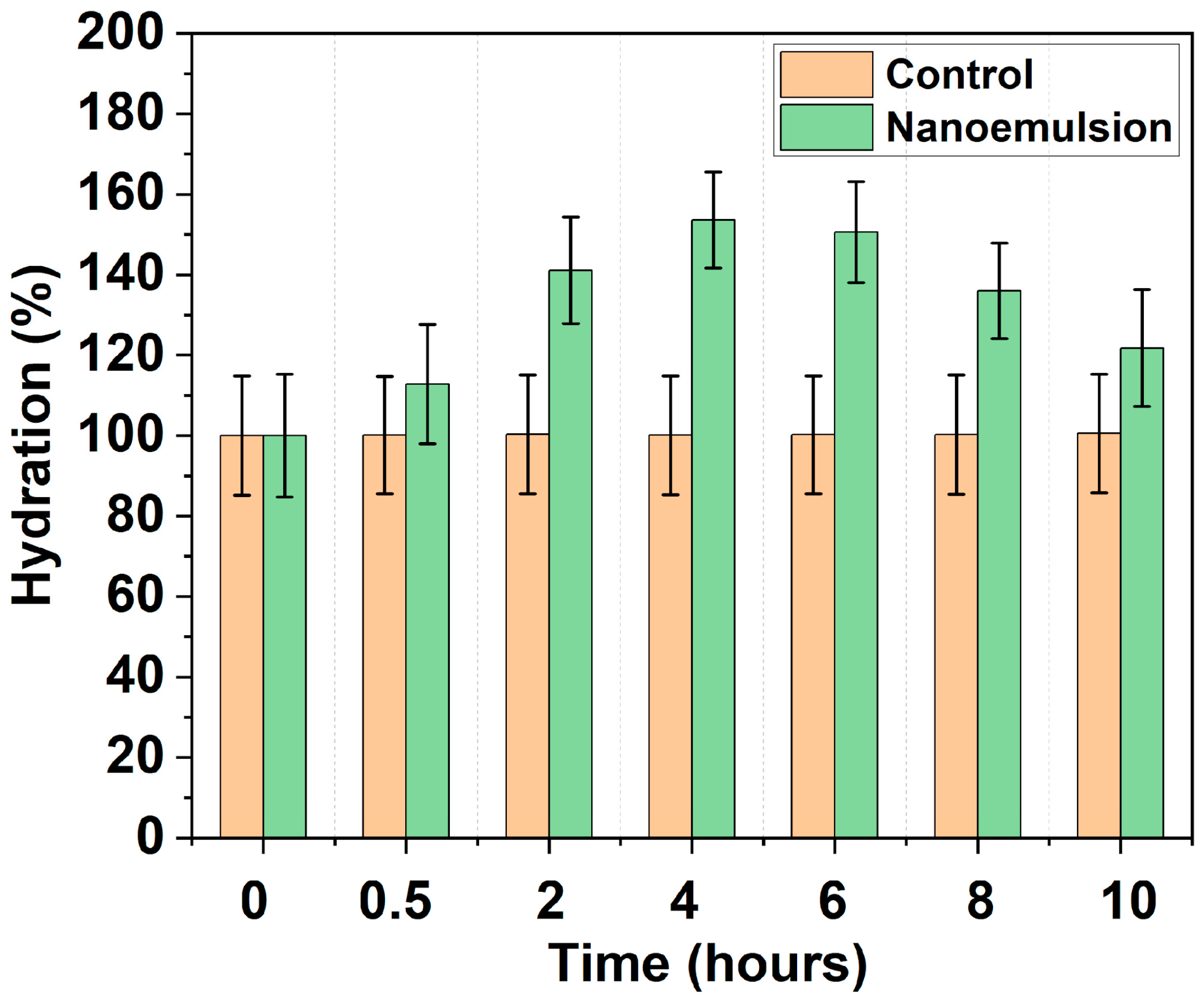
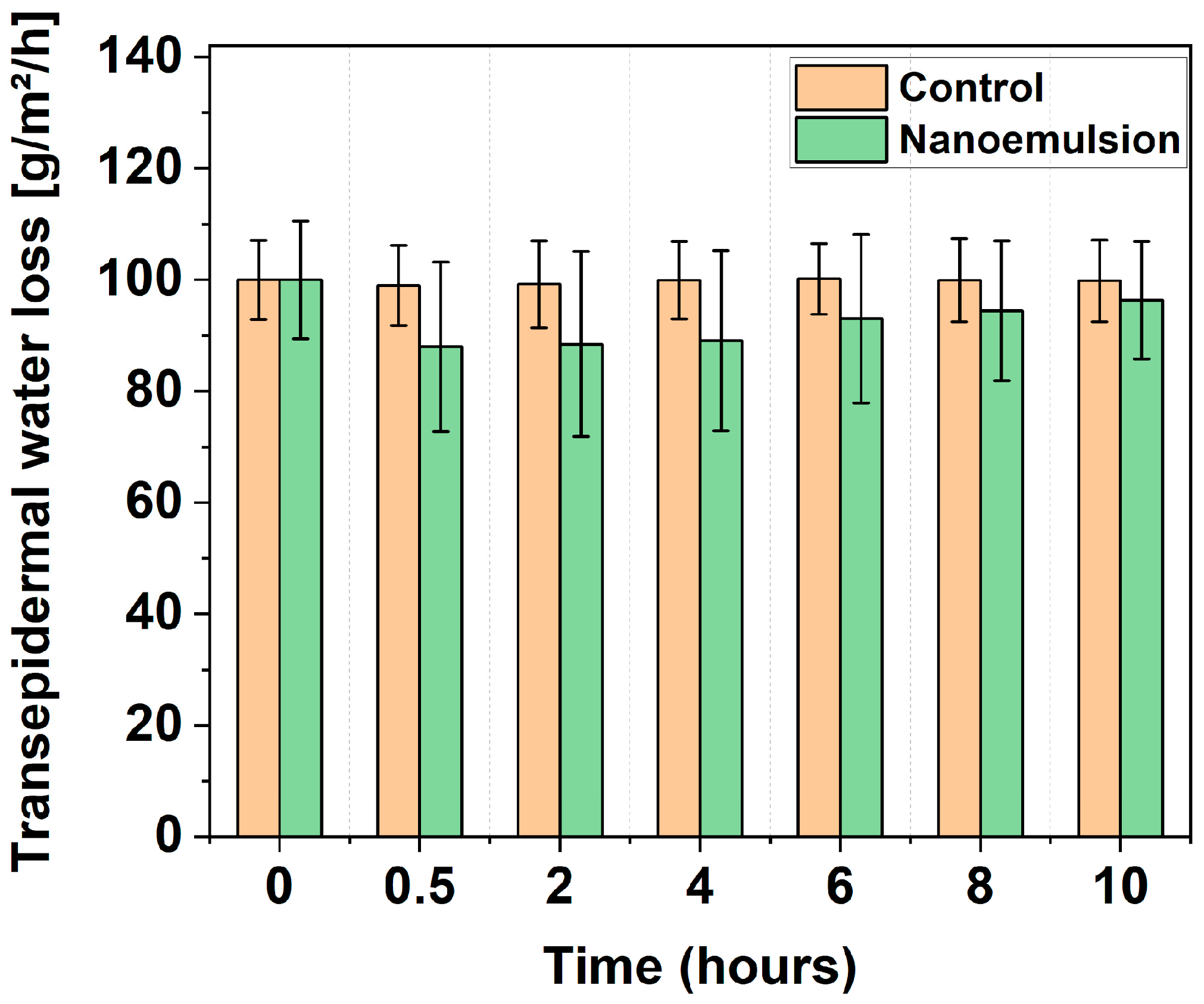
In our study, the immediate and sustained moisturizing efficacy of a mycosporine-based nanoemulsion was evaluated in 20 volunteers (Figure 6). The treated area showed a rapid increase in hydration (12.79% at 30 min), peaking at 53.64% at 4 h, and remaining significantly elevated (21.80% above baseline) at 10 h post-application. The control area showed no significant changes, confirming the effect was due to the nanoemulsion. These results are consistent with recent findings that nanoemulsions can deliver bioactive compounds efficiently, leading to rapid and prolonged increases in skin hydration and barrier function. TEWL measurements confirmed enhanced barrier function, with significant reductions at all time points in the treated area, while the control area remained unchanged (Figure 7).
Supporting this, Pedrosa et al. [50] showed that MAA-loaded emulsions act as effective chemical barriers, providing UV protection and maintaining physical integrity, without compromising emulsion stability, highlighting their suitability for barrier reinforcement. Tello Quiroz et al. [51] further confirmed that nanoemulsions with marine algae extracts rich in MAAs are physically stable, efficiently deliver bioactives, and offer barrier benefits. Additionally, Ibrahim et al. [49] demonstrated in animal models that nanoemulsions upregulate barrier-related proteins and reduce water loss. While conducted with a different active ingredient, this study provides mechanistic evidence supporting the general principle that nanoemulsions can enhance barrier function.
On the other hand, both the blank nanoemulsion (NE) and the MAA-loaded nanoemulsion (NE-MYC) demonstrated high antioxidant capacity in the DPPH• and ABTS•+ radical scavenging assays. NE achieved inhibition values of 85.84 ± 4.59% for DPPH• and 85.90 ± 3.71% for ABTS•, while NE-MYC reached significantly higher values of 93.40 ± 5.55% and 97.56 ± 0.71%, respectively (p < 0.05). The incorporation of 0.5% w/w MAA extract into the nanoemulsion therefore increased radical neutralization by approximately 10% compared to the blank formulation. In contrast, cosmetic products containing 0.1% BHT, commonly used as a synthetic antioxidant, typically achieve inhibition levels below 20% [52]. These results highlight NE-MYC as a potent natural antioxidant system and suggest its potential as a viable alternative to BHT in cosmetic formulations.
Finally, our findings confirm that MAAs, particularly when formulated in nanoemulsions, exhibit potent anti-elastase and anti-aging effects while simultaneously improving skin hydration and barrier integrity, providing rapid and sustained skin hydration, reducing TEWL, and reinforcing barrier function (Table 8). These benefits are supported by their physical stability, efficient bioactive delivery, and ability to enhance both chemical and biological barrier properties. When combined with their well-documented antioxidant activities, these attributes position MAAs as highly promising candidates for next-generation skincare and cosmeceutical applications.
Additionally, in vitro assays were designed to minimize confounders by testing all fractions under identical conditions, with results normalized to extract concentration and verified in triplicate. The enhanced activity of the mycosporine fraction (MF) is attributed to the enrichment of MAAs and phenolic compounds, confirmed by chromatographic and spectroscopic analyses. In the topical formulation, vitamin E, hyaluronic acid, and glycerin were included for their dermocosmetic roles, stabilization, hydration, and barrier support at concentrations too low to confound antioxidant or anti-elastase assays. Comparative formulations (ME vs. MF-enriched) confirmed that observed improvements were driven primarily by the Porphyra fraction. These controls mitigate formulation-related confounding and validate the specific contribution of the enriched extract.
Lastly, the aqueous extraction of Porphyra bioactives was developed as a solvent-free, low-energy process that minimizes waste and preserves the antioxidant integrity of mycosporine-like amino acids and phenolic compounds, in line with green chemistry principles. Although the prototype formulation employs mineral oil and PEG-based surfactants for stability, future optimization will incorporate renewable alternatives such as sugarcane-derived squalane, caprylic/capric triglycerides, and alkyl polyglucosides to improve biodegradability and reduce fossil dependency. Recognizing the seasonal variability of Porphyra biomass, ongoing biochemical profiling aims to standardize harvest conditions and ensure consistent bioactive yields. A comprehensive life cycle assessment (LCA) will be performed in future stages to quantify the environmental benefits of the green extraction process and identify improvement opportunities within the formulation. These efforts support the development of a sustainable, marine-derived cosmeceutical platform that integrates green processing, renewable ingredients, and responsible biomass utilization.

4. Conclusions

This study demonstrates the successful development of a mycosporine-based nanoemulsion through an integrated approach combining sustainable extraction, biochemical characterization, and clinical evaluation. Using an eco-friendly, water-based extraction method enhanced by ultrasound, MAAs were efficiently obtained from Porphyra spp., a readily available marine biomass. The extract was further enriched and identified using MALDI-TOF mass spectrometry, confirming the presence of bioactive compounds such as porphyra-334, palythine, and myc-ornithine molecules widely recognized for their UV-absorbing, antioxidant, and anti-inflammatory activities. Physicochemical characterization confirmed excellent colloidal stability (low polydispersity index and no visible phase separation for over four months), making it suitable for long-term cosmetic or dermatological use 34.
In vitro and in vivo results support the multifunctional nature of the formulation. The nanoemulsion demonstrated potent antioxidant activity, significant elastase inhibition associated with anti-aging benefits, and a clinically validated improvement in skin hydration and barrier function. The hydration effect was rapid and sustained, while the reduction in TEWL confirmed improved barrier integrity. These effects demonstrate the synergistic role of MAAs and the nanoemulsion matrix in enhancing skin health through both immediate and prolonged action. Importantly, this research aligns with the principles of sustainable chemistry and green formulation design by utilizing marine biomass, minimizing solvent use, and targeting natural alternatives to synthetic cosmetic agents. The results provide a compelling argument for the inclusion of MAA-based nanoemulsions in environmentally responsible skincare and cosmetic formulations, particularly those aiming to deliver antioxidant and moisturizing benefits in a single platform.
Future studies may focus on long-term safety assessments, expanded clinical trials, and the exploration of other marine sources rich in MAAs to further scale this technology. This work paves the way for novel, sustainable, and multifunctional ingredients that meet the growing demands of consumers and regulators for efficacy, safety, and environmental responsibility in dermocosmetic science.

Author Contributions

Methodology, formal analysis, investigation, M.G.-V., T.M.-C. and L.M.D.-S.; Conceptualization, T.M.-C., J.C.M.-G. and M.Y.C.; Supervision, M.Y.C., J.C.M.-G. and M.A.P.-M.; Validation, J.C.M.-G. and M.Y.C.; Writing—original draft, M.G.-V., J.C.M.-G. and M.A.P.-M.; Review and editing, T.M.-C., M.Y.C., J.C.M.-G. and M.A.P.-M.; Supervision, resources, project administration, funding acquisition, M.A.P.-M. All authors have read and agreed to the published version of the manuscript.

Funding

This research received no external funding.

Institutional Review Board Statement

The study was conducted under the oversight of the Fracture Risk Research Ethics Committee, S.A., which operates in accordance with Colombian ethical and legal guidelines established in Resolution 008430 of 1993 and Resolution 002378 of 2008 of the Ministry of Social Protection. The Committee also adheres to the principles of the Declaration of Helsinki (and its subsequent revisions) and the International Conference on Harmonization Good Clinical Practice (ICH-GCP) guidelines. The study involving human volunteers was conducted in full compliance with the ethical principles outlined above. The protocol was reviewed and approved by the Research Ethics Committee of Riesgo de Fractura S.A. during a meeting held on 21 January 2025 (Record CEI-164).

Informed Consent Statement

Informed consent was obtained from all subjects involved in the study.

Data Availability Statement

The original contributions presented in this study are included in the article. Further inquiries can be directed to the corresponding author.

Acknowledgments

This work was supported by the CODI of the Universidad de Antioquia (Project no. 2022-55010 and 2022-52641). T.M-C., gratefully acknowledges the doctoral fellowship awarded by Minciencias through the Programa de Becas de Excelencia Doctoral del Bicentenario (2019, Primera Corte).

Conflicts of Interest

The authors declare no conflicts of interest.

References

  1. Hussein, R.S.; Bin Dayel, S.; Abahussein, O.; El-Sherbiny, A.A. Influences on Skin and Intrinsic Aging: Biological, Environmental, and Therapeutic Insights. J. Cosmet. Dermatol. 2025, 24, e16688. [Google Scholar] [CrossRef] [PubMed]
  2. Wang, Y.C.; Ma, S.H.; Chang, Y.T.; Chen, C.C. Clinical evaluation of skin aging: A systematic review. Arch. Gerontol. Geriatr. 2025, 139, 105995. [Google Scholar] [CrossRef] [PubMed]
  3. González-Guerra, E.; Alcalá, T.E.; Guerra-Tapia, A. Envejecimiento cutáneo: Causas y tratamiento. Más Dermatol. 2017, 29, 4–12. [Google Scholar] [CrossRef]
  4. Klotz, T.; Moran, H.; Vu, P.; Maddern, G.; Wagstaff, M. Commonly recommended moisturising products: Effect on transepidermal water loss and hydration in a scar model. Burns 2025, 51, 107629. [Google Scholar] [CrossRef]
  5. Martínez García, R.M.; Jiménez Ortega, A.I.; Lorenzo-Mora, A.M.; Bermejo, L.M. [Importance of hydration in cardiovascular health and cognitive function]. Nutr. Hosp. 2022, 39, 17–20. [Google Scholar] [CrossRef]
  6. De Decker, I.; Hoeksema, H.; Vanlerberghe, E.; Beeckman, A.; Verbelen, J.; De Coninck, P.; Speeckaert, M.M.; Blondeel, P.; Monstrey, S.; Claes, K.E.Y. Occlusion and hydration of scars: Moisturizers versus silicone gels. Burns 2023, 49, 365–379. [Google Scholar] [CrossRef]
  7. Fonseca, M.; Rehman, M.; Soares, R.; Fonte, P. The Impact of Flavonoid-Loaded Nanoparticles in the UV Protection and Safety Profile of Topical Sunscreens. Biomolecules 2023, 13, 493. [Google Scholar] [CrossRef]
  8. Sen, K.; Banerjee, S.; Mandal, M. Dual drug loaded liposome bearing apigenin and 5-Fluorouracil for synergistic therapeutic efficacy in colorectal cancer. Colloids Surf. B 2019, 180, 9–22. [Google Scholar] [CrossRef]
  9. Abcha, I.; Souilem, S.; Neves, M.A.; Wang, Z.; Nefatti, M.; Isoda, H.; Nakajima, M. Ethyl oleate food-grade O/W emulsions loaded with apigenin: Insights to their formulation characteristics and physico-chemical stability. Food Res. Int. 2019, 116, 953–962. [Google Scholar] [CrossRef]
  10. Bhushani, J.A.; Karthik, P.; Anandharamakrishnan, C. Nanoemulsion based delivery system for improved bioaccessibility and Caco-2 cell monolayer permeability of green tea catechins. Food Hydrocoll. 2016, 56, 372–382. [Google Scholar] [CrossRef]
  11. Pool, H.; Mendoza, S.; Xiao, H.; McClements, D.J. Encapsulation and release of hydrophobic bioactive components in nanoemulsion-based delivery systems: Impact of physical form on quercetin bioaccessibility. Food Funct. 2013, 4, 162–174. [Google Scholar] [CrossRef]
  12. Qian, C.; Decker, E.A.; Xiao, H.; McClements, D.J. Nanoemulsion delivery systems: Influence of carrier oil on β-carotene bioaccessibility. Food Chem. 2012, 135, 1440–1447. [Google Scholar] [CrossRef]
  13. Duarte, J.; Sharma, A.; Sharifi, E.; Damiri, F.; Berrada, M.; Khan, M.A.; Singh, S.K.; Dua, K.; Veiga, F.; Mascarenhas-Melo, F.; et al. Topical delivery of nanoemulsions for skin cancer treatment. Appl. Mater. Today 2023, 35, 102001. [Google Scholar] [CrossRef]
  14. Hamed, R.; Basil, M.; AlBaraghthi, T.; Sunoqrot, S.; Tarawneh, O. Nanoemulsion-based gel formulation of diclofenac diethylamine: Design, optimization, rheological behavior and in vitro diffusion studies. Pharm. Dev. Technol. 2016, 21, 980–989. [Google Scholar] [CrossRef]
  15. Kaur, A.; Katiyar, S.S.; Kushwah, V.; Jain, S. Nanoemulsion loaded gel for topical co-delivery of clobitasol propionate and calcipotriol in psoriasis. Nanomed. Nanotechnol. Biol. Med. 2017, 13, 1473–1482. [Google Scholar] [CrossRef]
  16. Walia, N.; Dasgupta, N.; Ranjan, S.; Chen, L.; Ramalingam, C. Fish oil based vitamin D nanoencapsulation by ultrasonication and bioaccessibility analysis in simulated gastro-intestinal tract. Ultrason. Sonochem. 2017, 39, 623–635. [Google Scholar] [CrossRef]
  17. Chen, X.; Liu, K.; He, P.; Zhang, H.; Fang, Y. Preparation of Novel W/O Gel-Emulsions and Their Application in the Preparation of Low-Density Materials. Langmuir 2012, 28, 9275–9281. [Google Scholar] [CrossRef]
  18. Silva, T.J.; Fernandes, G.D.; Bernardinelli, O.D.; Silva, E.C.d.R.; Barrera-Arellano, D.; Ribeiro, A.P.B. Organogels in low-fat and high-fat margarine: A study of physical properties and shelf life. Food Res. Int. 2021, 140, 110036. [Google Scholar] [CrossRef] [PubMed]
  19. Kirtane, A.R.; Karavasili, C.; Wahane, A.; Freitas, D.; Booz, K.; Le, D.T.H.; Hua, T.; Scala, S.; Lopes, A.; Hess, K.; et al. Development of oil-based gels as versatile drug delivery systems for pediatric applications. Sci. Adv. 2022, 8, eabm8478. [Google Scholar] [CrossRef] [PubMed]
  20. Vega, J.; Schneider, G.; Moreira, B.R.; Herrera, C.; Bonomi-Barufi, J.; Figueroa, F.L. Mycosporine-like amino acids from red macroalgae: Uv-photoprotectors with potential cosmeceutical applications. Appl. Sci. 2021, 11, 5112. [Google Scholar] [CrossRef]
  21. Muñoz-Losada, K.J.; Gallego-Villada, M.; Puertas-Mejía, M.A. An Overview of Sargassum Seaweed as Natural Anticancer Therapy. Future Pharmacol. 2025, 5, 5. [Google Scholar] [CrossRef]
  22. Rodrigues, D.; Sousa, S.; Silva, A.; Amorim, M.; Pereira, L.; Rocha-Santos, T.A.P.; Gomes, A.M.P.; Duarte, A.C.; Freitas, A.C. Impact of Enzyme- and Ultrasound-Assisted Extraction Methods on Biological Properties of Red, Brown, and Green Seaweeds from the Central West Coast of Portugal. J. Agric. Food Chem. 2015, 63, 3177–3188. [Google Scholar] [CrossRef] [PubMed]
  23. Griffiths, M.J.; Garcin, C.; van Hille, R.P.; Harrison, S.T.L. Interference by pigment in the estimation of microalgal biomass concentration by optical density. J. Microbiol. Methods 2011, 85, 119–123. [Google Scholar] [CrossRef]
  24. Muñoz-Castiblanco, T.; Santa Maria de la Parra, L.; Peña-Cañón, R.; Muñoz-Losada, K.; Mejía-Giraldo, J.C.; León, I.E.; Puertas-Mejía, M.Á. Antioxidant and cytotoxic properties of water-soluble crude polysaccharides from two edible mushroom species of Ramaria. ChemistrySelect 2024, 9, e202303738. [Google Scholar] [CrossRef]
  25. Ed-Dahmani, I.; El fadili, M.; Kandsi, F.; Conte, R.; El Atki, Y.; Kara, M.; Assouguem, A.; Touijer, H.; Lfitat, A.; Nouioura, G.; et al. Phytochemical, Antioxidant Activity, and Toxicity of Wild Medicinal Plant of Melitotus albus Extracts, In Vitro and In Silico Approaches. ACS Omega 2024, 9, 9236–9246. [Google Scholar] [CrossRef] [PubMed]
  26. Gu, J.; Zhang, H.; Wen, C.; Zhang, J.; He, Y.; Ma, H.; Duan, Y. Purification, characterization, antioxidant and immunological activity of polysaccharide from Sagittaria sagittifolia L. Food Res. Int. 2020, 136, 109345. [Google Scholar] [CrossRef]
  27. Kumar, S.; Krishna Chaitanya, R.; Preedy, V.R. Chapter 20—Assessment of Antioxidant Potential of Dietary Components. In HIV/AIDS; Preedy, V.R., Watson, R.R., Eds.; Academic Press: Oxford, UK, 2018; pp. 239–253. [Google Scholar]
  28. Akram, S.; Anton, N.; Omran, Z.; Vandamme, T. Water-in-Oil Nano-Emulsions Prepared by Spontaneous Emulsification: New Insights on the Formulation Process. Pharmaceutics 2021, 13, 1030. [Google Scholar] [CrossRef]
  29. Shanura Fernando, I.P.; Asanka Sanjeewa, K.K.; Samarakoon, K.W.; Kim, H.-S.; Gunasekara, U.K.D.S.S.; Park, Y.-J.; Abeytunga, D.T.U.; Lee, W.W.; Jeon, Y.-J. The potential of fucoidans from Chnoospora minima and Sargassum polycystum in cosmetics: Antioxidant, anti-inflammatory, skin-whitening, and antiwrinkle activities. J. Appl. Phycol. 2018, 30, 3223–3232. [Google Scholar] [CrossRef]
  30. Orfanoudaki, M.; Hartmann, A.; Alilou, M.; Gelbrich, T.; Planchenault, P.; Derbré, S.; Schinkovitz, A.; Richomme, P.; Hensel, A.; Ganzera, M. Absolute Configuration of Mycosporine-Like Amino Acids, Their Wound Healing Properties and In Vitro Anti-Aging Effects. Mar. Drugs 2020, 18, 35. [Google Scholar] [CrossRef]
  31. de la Coba, F.; Aguilera, J.; Figueroa, F.L.; de Gálvez, M.V.; Herrera, E. Antioxidant activity of mycosporine-like amino acids isolated from three red macroalgae and one marine lichen. J. Appl. Phycol. 2009, 21, 161–169. [Google Scholar] [CrossRef]
  32. Berber, I.; Avsar, C.; Koyuncu, H. Antimicrobial and antioxidant activities of Cystoseira crinita Duby and Ulva intestinalis Linnaeus from the coastal region of Sinop, Turkey. J. Coast. Life Med. 2015, 3, 441–445. [Google Scholar] [CrossRef]
  33. Nunes, A.; Dutra, F.S.; Brito, S.N.S.; Pereira-Vasques, M.S.; Azevedo, G.Z.; Schneider, A.R.; Oliveira, E.R.; Santos, A.A.D.; Maraschin, M.; Vianello, F.; et al. Effect of Biomass Drying Protocols on Bioactive Compounds and Antioxidant and Enzymatic Activities of Red Macroalga Kappaphycus alvarezii. Methods Protoc. 2024, 7, 88. [Google Scholar] [CrossRef] [PubMed]
  34. Heffernan, N.; Smyth, T.; Soler-Villa, A.; FitzGerald, R.; Brunton, N. Phenolic content and antioxidant activity of fractions obtained from selected Irish macroalgae species (Laminaria digitata, Fucus serratus, Gracilaria gracilis and Codium fragile). J. Appl. Phycol. 2014, 27, 519–530. [Google Scholar] [CrossRef]
  35. Nishida, Y.; Kumagai, Y.; Michiba, S.; Yasui, H.; Kishimura, H. Efficient Extraction and Antioxidant Capacity of Mycosporine-Like Amino Acids from Red Alga Dulse Palmaria palmata in Japan. Mar. Drugs 2020, 18, 502. [Google Scholar] [CrossRef]
  36. Yamamoto, R.; Toriumi, S.; Kawagoe, C.; Saburi, W.; Kishimura, H.; Kumagai, Y. Extraction and antioxidant capacity of mycosporine-like amino acids from red algae in Japan. Biosci. Biotechnol. Biochem. 2024, 88, 830–838. [Google Scholar] [CrossRef]
  37. Kageyama, H.; Waditee-Sirisattha, R. Antioxidative, Anti-Inflammatory, and Anti-Aging Properties of Mycosporine-Like Amino Acids: Molecular and Cellular Mechanisms in the Protection of Skin-Aging. Mar. Drugs 2019, 17, 222. [Google Scholar] [CrossRef]
  38. Rosic, N. Mycosporine-Like Amino Acids: Making the Foundation for Organic Personalised Sunscreens. Mar. Drugs 2019, 17, 638. [Google Scholar] [CrossRef]
  39. Singh, V.; Das, B.; Jha, S.; Rana, P.; Kumar, R.; Sinha, R. Characterization, DFT study and evaluation of antioxidant potentials of mycosporine-like amino acids (MAAs) in the cyanobacterium Anabaenopsis circularis HKAR-22. J. Photochem. Photobiol. B Biol. 2024, 257, 112975. [Google Scholar] [CrossRef]
  40. Naveira, R.; Granone, L.; Massa, A.; Churio, M.S. Argentine squid (Illex argentinus): A source of mycosporine-like amino acids with antioxidant properties. Food Chem. 2023, 438, 137955. [Google Scholar] [CrossRef]
  41. Vega, J.; Bonomi-Barufi, J.; Gómez-Pinchetti, J.; Figueroa, F. Cyanobacteria and Red Macroalgae as Potential Sources of Antioxidants and UV Radiation-Absorbing Compounds for Cosmeceutical Applications. Mar. Drugs 2020, 18, 659. [Google Scholar] [CrossRef] [PubMed]
  42. Waditee-Sirisattha, R.; Kageyama, H. Protective effects of mycosporine-like amino acid-containing emulsions on UV-treated mouse ear tissue from the viewpoints of antioxidation and antiglycation. J. Photochem. Photobiol. B 2021, 223, 112296. [Google Scholar] [CrossRef]
  43. Figueroa, F. Mycosporine-Like Amino Acids from Marine Resource. Mar. Drugs 2021, 19, 18. [Google Scholar] [CrossRef]
  44. Suh, S.-S.; Hwang, J.; Park, M.; Seo, H.H.; Kim, H.-S.; Lee, J.H.; Moh, S.H.; Lee, T.-K. Anti-Inflammation Activities of Mycosporine-Like Amino Acids (MAAs) in Response to UV Radiation Suggest Potential Anti-Skin Aging Activity. Mar. Drugs 2014, 12, 5174–5187. [Google Scholar] [CrossRef]
  45. Ryu, J.; Park, S.J.; Kim, I.H.; Choi, Y.H.; Nam, T.J. Protective effect of porphyra-334 on UVA-induced photoaging in human skin fibroblasts. Int. J. Mol. Med. 2014, 34, 796–803. [Google Scholar] [CrossRef] [PubMed]
  46. Wada, N.; Sakamoto, T.; Matsugo, S. Mycosporine-like amino acids and their derivatives as natural antioxidants. Antioxidants 2015, 4, 603–646. [Google Scholar] [CrossRef] [PubMed]
  47. Sneha, K.; Kumar, A. Nanoemulsions: Techniques for the preparation and the recent advances in their food applications. Innov. Food Sci. Emerg. Technol. 2021, 76, 102914. [Google Scholar] [CrossRef]
  48. Kim, G.W.; Yun, S.-Y.; Jang, J.; Lee, J.B.; Kim, S.Y. Enhanced stability, formulations, and rheological properties of nanoemulsions produced with microfludization for eco-friendly process. J. Colloid Interface Sci. 2023, 646, 311–319. [Google Scholar] [CrossRef]
  49. Ibrahim, D.; Abdelfattah-Hassan, A.; Badawi, M.; Ismail, T.; Bendary, M.; Abdelaziz, A.; Mosbah, R.; Mohamed, D.; Arisha, A.; El-Hamid, M. Thymol nanoemulsion promoted broiler chicken’s growth, gastrointestinal barrier and bacterial community and conferred protection against Salmonella Typhimurium. Sci. Rep. 2021, 11, 7742. [Google Scholar] [CrossRef] [PubMed]
  50. Pedrosa, V.M.D.; Sanches, A.G.; da Silva, M.B.; Lupino Gratão, P.; Isaac, V.L.B.; Gingri, M.; Teixeira, G.H.A. Production of mycosporine-like amino acids (MAAs)-loaded emulsions as chemical barriers to control sunscald in fruits and vegetables. J. Sci. Food Agric. 2021, 102, 801–812. [Google Scholar] [CrossRef]
  51. Tello Quiroz, J.; Rodriguez Martinez, I.A.; Urrea-Victoria, V.; Castellanos, L.; Aragón Novoa, D.M. Marine Algae Extract-Loaded Nanoemulsions: A Spectrophotometric Approach to Broad-Spectrum Photoprotection. Cosmetics 2025, 12, 101. [Google Scholar] [CrossRef]
  52. Ferrarini, S.R.; Tozetto, J.T.; Tozetto, A.T.; Hoshino, B.T.; Andrighetti, C.R.; Ribeiro, E.B.; Cavalheiro, L. Extract of Punica granatum L.: An alternative to BHT as an antioxidant in semissolid emulsified systems. Química Nova 2016, 40, 97–104. [Google Scholar] [CrossRef]
Figure 1. UV–Vis spectra of ME (crude extract) and MF (enriched fraction).
Phycology 05 00064 g001
Figure 2. MALDI-TOF mass spectra of MAA extracts. The insets display the molecular formulas, experimental masses, mass accuracy, signal-to-noise ratios, and theoretical and experimental isotopic patterns of the identified compounds.
Phycology 05 00064 g002
Figure 3. MALDI-TOF mass spectra of the purified MAAs-enriched fraction. The insets display the molecular formulas, experimental masses, mass accuracy, signal-to-noise ratios, and theoretical and experimental isotopic patterns of the identified compounds.
Phycology 05 00064 g003
Figure 4. Visual stability after 4 months. Top: NE 7:3; Bottom: NE-MYC 7:3.
Phycology 05 00064 g004
Figure 5. Droplet Size Distribution by DLS. Left: NE 7:3; Right: NE-MYC 7:3.
Phycology 05 00064 g005
Figure 6. Average percentage (%) increase in skin hydration over time in the treated area (nanoemulsion) versus the untreated (control) area.
Phycology 05 00064 g006
Figure 7. Average transepidermal water loss (TEWL) values [g/m2/h] in the treated area (nanoemulsion) versus the untreated (control) area.
Phycology 05 00064 g007
Table 1. Composition of the nanoemulsion.
PhaseConcentration (% w/w)Ingredient
Oil81.50 Mineral oil
0.50 Vitamin E (oil)
3.00 TWEEN 80
8.00 SPAN 80
Aqueous5.15 Water
0.50 Vitamin E (aq)
0.20 Ethylene glycol
0.50 Elastin
0.50 Hyaluronic acid
0.15 MAAs extract
Table 2. Extraction yield of MAAs using ultrasound-assisted aqueous extraction.
Time (min)Yield (%, w/w)
3017.913 ± 0.72 a
6018.893 ± 2.00 a
9016.551 ± 1.33 a
Different superscript letters indicate significant differences (Fisher’s LSD test, n = 3, p < 0.05).
Table 3. Compounds detected in the MAA extract (ME) using MALDI-TOF MS.
CompoundDetected Ionm/z
Theoretical
MALDI MS
m/z
Experimental
Mass
Accuracy
(Δ ppm)
S/N
Palythine[C10H16N2O5 + H]+245.113245.12549.024.7
N-Methylpalythine[C11H18N2O5 + H]+259.128259.14254.04.2
Aplysiapalythine-B[C12H20O5N2 + H]+273.144273.15229.3107.1
Palythene[C13H20N2O5 + H]+285.144285.11198.27.1
Usujirene[C13H20N2O5 + H]+285.144285.11198.27.1
Palythine-threonine[C12H20N2O6 + H]+289.139289.14831.120.1
Asterine-330[C12H20N2O6 + H]+289.139289.14831.120.1
Mycornithine[C13H22N2O6 + H]+303.155303.16429.723.1
Myc methylamine threonine[C13H22N2O6 + H]+303.155303.16429.723.1
Palythinol[C13H22N2O6 + H]+303.155303.16429.723.1
Porphyra-334[C14H22N2O8 + H]+347.144347.17280.744.4
Hexose-bound palythine-serine[C17H28N2O11 + H]+437.176437.1752.35.9
Table 4. Compounds detected in the purified MAAs-enriched fraction (MF) using MALDI-TOF MS.
CompoundDetected Ionm/z TheoreticalMALDI MS
m/z ExperimentalMass Accuracy
(Δ ppm)
S/N
Palythine[C10H16N2O5 + H]+245.113245.1131.644.2
N-Methylpalythine[C11H18N2O5 + H]+259.128259.15084.98.1
Aplysiapalythine-B[C12H20O5N2 + H]+273.144273.13725.629.0
Palythene[C13H20N2O5 + H]+285.144285.14521.06.8
Usujirene[C13H20N2O5 + H]+285.144285.14521.06.8
Palythine-threonine[C12H20N2O6 + H]+289.139289.13224.229.4
Asterine-330[C12H20N2O6 + H]+289.139289.13224.229.4
Myc-ornithine[C13H22N2O6 + H]+303.155303.1561.637.5
Myc methyl-amine threonine[C13H22N2O6 + H]+303.155303.1561.637.5
Palythinol[C13H22N2O6 + H]+303.155303.1561.637.5
Porphyra-334[C14H22N2O8 + H]+347.144347.17177.860.9
Table 5. Antiradical activity (DPPH, ABTS), conjugated dienes (CD), thiobarbituric acid reactive substances (TBARS), and total phenolic content (TPC) of ME (MAAs extract), MF (MAAs-enriched fraction), positive control (PC), and negative control (NC).
SampleIC50 (mg/mL)CD
(mmol DC/kg MeLo)
TBARS
(mmol MDA/ kg MeLo)
TPC
(mg GAE/g)
DPPHABTS
AA0.016 ± 0.001 a0.033 ± 0.001 a---
ME1.097 ± 0.064 b0.378 ± 0.008 b228.34 ± 7.97 a0.17 ± 0.04 a3.32 ± 0.21 a
MF0.359 ± 0.018 c0.149 ± 0.001 c245.54 ± 5.98 b0.28 ± 0.02 a9.64 ± 0.65 b
PC--487.92 ± 4.69 c9.04 ± 1.10 b-
NC--169.36 ± 2.10 d0.39 ± 0.01 a-
Different superscript letters indicate significant differences (Fisher’s LSD test, n = 3, p < 0.05).
Table 6. In vitro Anti-Elastase Activity Expressed as IC50 (mg/mL). ME: Crude MAA extract, MF: MAA-enriched fraction, EGCG: Epigallocatechin gallate.
SampleIC50 (mg/mL)
ME13.270 ± 2.217 a
MF6.320 ± 1.119 b
EGCG0.083 ± 0.021 c
Different superscript letters indicate significant differences (Fisher’s LSD test, n = 3, p < 0.05).
Table 7. Droplet Size and Polydispersity Index of Nanoemulsions.
Formulation/ConditionDroplet Size (nm)PDIStability DurationComments
NE403.3 ± 13.30.1731 ± 0.01926 a -
NE-MYC385.8 ± 7.2850.1744 ± 0.03493 a -
NE 7:3, NE-MYC 7:3386–403<0.2≥4 monthsStable, homogeneous, improved by MAAs
Suboptimal surfactant ratiosLarger/variable>0.2<1 weekEarly turbidity, phase separation
Different superscript letters indicate significant differences (Fisher’s LSD test, n = 3, p < 0.05).
Table 8. Comparison of the barrier function of MAA nanoemulsions with other models.
Study/ActiveModel/SystemKey Findings on Hydration/Barrier
Clinical MAA nanoemulsion (this work)Human volunteersRapid, sustained hydration; reduced TEWL
MAAs [50]Plant/EmulsionStable, effective barrier, UV protection
MAAs [51]Algae/NanoemulsionStable, efficient delivery, photoprotection
Thymol [49]Animal/NanoemulsionUpregulation of barrier proteins, reduced permeability
Disclaimer/Publisher’s Note: The statements, opinions and data contained in all publications are solely those of the individual author(s) and contributor(s) and not of MDPI and/or the editor(s). MDPI and/or the editor(s) disclaim responsibility for any injury to people or property resulting from any ideas, methods, instructions or products referred to in the content.