
Article

Impact of Algae Species from the Baltic Sea Region on Ruminal Fermentation Parameters and Methane Mitigation Using an In Vitro Gas Production System

1
Institute of Animal Nutrition, Friedrich-Loeffler-Institute (FLI), Federal Research Institute for Animal Health, 38116 Brunswick, Germany
2
Institute for Animal Nutrition, University of Veterinary Medicine Hannover, Foundation, 30173 Hanover, Germany
3
Pharmaceutical Biotechnology, Institute of Pharmacy, University of Greifswald, 17489 Greifswald, Germany
4
Department of Ecology, University of Rostock, 18051 Rostock, Germany
5
ZosteraTec UG (Ltd.), 18119 Rostock, Germany
*
Author to whom correspondence should be addressed.
Ruminants 2026, 6(1), 18; https://doi.org/10.3390/ruminants6010018
Submission received: 5 February 2026 / Revised: 28 February 2026 / Accepted: 9 March 2026 / Published: 11 March 2026

Simple Summary

Methane is a potent greenhouse gas that has a major impact on global warming. The biggest sector of anthropogenic methane emissions worldwide is the sector of agriculture, with most of the methane emissions coming from animal husbandry. Primarily, methane is produced in the rumen during microbial fermentation of feed and then released into the atmosphere via belching. One possibility to reduce ruminal methane emissions is the use of feed additives which have an impact on methanogenesis. In this study, six different algae, potentially cultivable in the Baltic Sea, were evaluated for their impact on different fermentation parameters and methane mitigation when used as a feed supplement in an in vitro gas production system. The experiment showed that the addition of the red alga Colaconema spp. and the green alga Ulva intestinalis in particular has an impact on the short-chain fatty acid profile, with possible gas reduction potential and without negatively impacting fermentation in the rumen. Therefore, these two algae could be possible local cultivable options for further investigation in vivo.

Abstract

This study evaluated the effects of four macroalgae (Colaconema spp., Ulva intestinalis, Ceramium spp., Pylaiella litoralis) and two microalgae (Haematococcus pluvialis, Porphyridium purpureum), chosen due to their local cultivability in the southern Baltic Sea region and potential gas-reducing properties reported for their taxa, on rumen fermentation and methane production. Therefore, the in vitro ANKOM Rf gas production system was used; three trials were conducted and gas kinetics, gas composition after 48 h of incubation, and short-chain fatty acids (SCFAs) were analyzed. For Trial 1.1, the algae biomasses were added at 4% to a conventional dairy diet and incubated in buffered rumen fluid for 48 h, to evaluate their potential as a supplement. In Trial 1.2, the polysaccharide-enriched algae extracts were added at 2% to the base diet using the same procedure, to investigate the role of the polysaccharide content. For Trial 2, the macroalgae biomasses were evaluated solely to assess their fermentation potential. The addition of the red alga Colaconema spp. (Colaconema) altered the SCFA profile with a shift towards propionate (rate of change in propionate concentration, ΔC3 = 1.216; p < 0.001), without compromising total SCFA yield. The same could be assessed for Ulva intestinalis (U. intestinalis), limited to Trial 2 (ΔC3 = 0.516; p < 0.001). The addition of U. intestinalis led to reduced initial gas production (p = 0.003), reaching the maximum gas production rate at 5.8 h of incubation, 0.3–0.7 h later than the others (5.1–5.5 h). While there was no significant methane reduction at the chosen inclusion rates, the results indicate that both algae influence the SCFA profile and therefore fermentation pattern, with U. intestinalis warranting further investigation on gas production dynamics.

1. Introduction

The rapid increase in global greenhouse gas (GHG) emissions, dominated by methane (CH4) and carbon dioxide (CO2), is posing one of the greatest challenges for our planet’s environment [1]. Due to the high potency of CH4 as a GHG but its short half-life in comparison to CO2, reductions in CH4 emission could be an option for limiting near-term global warming [2].
In the rumen, microbiota ferment feed material into short-chain fatty acids (SCFAs) that provide approximately 70% of the cow’s energy requirements [3]. One byproduct of this synthesis is hydrogen (H2). To prevent ruminal H2 accumulation, methanogenic archaea reduce H2 to CH4, which is released into the atmosphere by ructus [4]. The agricultural sector accounts for 40% of anthropogenic CH4 emissions with the main source being ruminal gastrointestinal fermentation [5]. Therefore feeding approaches to reduce CH4 emission in the rumen are becoming increasingly important in sustainable ruminant nutrition [6,7]. One strategy that has been widely pursued in recent years is the inclusion of various algae species in the diet of ruminants. Some algae contain metabolites that mitigate CH4 production through distinct mechanisms [8,9,10]. For instance, certain red macroalgae are known to produce bromoform, a halogenated methane analog, which blocks methyl-coenzyme-M-reductase [11,12,13], while brown algae act through tannins that directly inhibit methanogens and protozoa [14,15,16]. Additionally, saponins found in green algae contribute to CH4 reduction via their antimicrobial properties [17,18].
Besides these known secondary metabolites that directly inhibit methanogens, algae also contain high concentrations of polysaccharides, usually consisting of repeating monosaccharide structures, which differ between algae species [19]. Xu et al. showed that the polysaccharide porphyran in Porphyra haitanensis, an Asian red alga, can act as a prebiotic in the human gut by altering the composition of its microbiota and increase total SCFA production [20]. Furthermore, it is described that polysaccharide addition in the diet can induce shifts in the ruminal microbiome in vitro, which could lead to CH4 reduction [21]. Besides their prebiotic impact, polysaccharides derived from macro- and microalgae can also have antimicrobial effects by disrupting the membrane of bacteria, like ulvan from the green alga Ulva reticulata against Escherichia coli [22], or by preventing the adhesion of bacteria on intestinal cells [19]. Various in vitro rumen studies have been conducted so far, for instance by Machado et al. and Wasson et al. [23,24], concerning CH4 mitigation potential of several algae. They evaluated the CH4-inhibiting potential of the red alga Asparagopsis taxiformis (A. taxiformis) and also different brown algae at inclusion rates ranging from 2% dry matter (DM) [24] to 20% organic matter (OM) [23], while Park et al. [25] observed a significant reduction rate in CH4 for the green alga Ulva spp. included at 4% DM. Additionally, in vivo feeding trials examined algae inclusion at 2–4% DM without negatively impacting the animals’ performance and health, indicating that these inclusion levels are feasible in practical feeding strategies [26].
Previous in vitro studies have primarily used biomass from algae grown in tropical or subtropical marine waters [23,24]. These algae necessitate transport with a higher CO2 footprint due to long-distance hauls. Consequently, the cultivation of algae in the Baltic Sea region with the potential to influence fermentation pathways and CH4 production in ruminants is of particular interest. Data on Baltic Sea algae remain scarce, especially regarding their isolated polysaccharide fractions and effects on fermentation patterns. Due to the species-specific nutrient composition in algae, which is also influenced by environmental conditions, algae grown in the brackish ecosystem of the Baltic Sea region may differ in their composition from marine counterparts [27]. Because ruminal fermentation is driven by substrate characteristics [28], these algae may elicit different rumen fermentation responses. Additionally, the excessive nutrient conditions in the Baltic Sea could make biomass production feasible while also contributing to internal eutrophication control due to nutrient removal [29]. Therefore, the objective of this study was to investigate a total of six macro- and microalgae found in the southern Baltic Sea in terms of their effect on ruminal gas and CH4 production in vitro, when used as feed supplement. The focus was on species that have the potential for commercially interesting biomass production, including representatives of red, green and brown algae, to allow for evaluation of fermentation processes across phylogenetically diverse groups. Thus, the different algae were chosen due to their cultivation potential, biomass availability, and taxonomic affiliation, to assess how they would impact fermentation characteristics.
Additionally, an extraction of the algae was conducted for the purpose of accumulating their polysaccharides. Previous research indicates that extraction can influence chemical composition and conformation of algal biomass by concentrating soluble polysaccharides that are otherwise embedded within the cell matrix, potentially increasing their accessibility to rumen microbiota [30]. In vitro studies have further demonstrated that certain algal extracts can alter rumen microbial populations and reduce CH4 [31].
Therefore, the inclusion of the extracts was conducted to more accurately evaluate the possible impact of the naturally included polysaccharides on fermentation parameters, and disentangle the contribution of structural carbohydrates from other algae components.
It was hypothesized that incorporating the different algae species and their polysaccharide-enriched extracts as potential feed supplement into a conventional dairy diet could modulate SCFA pattern and production, while influencing total gas and CH4 production.

2. Materials and Methods

The animal experiment was conducted according to the European Community regulations concerning the protection of experimental animals and the guidelines of the German Animal Welfare Act, and was approved by the Lower Saxony State Office for Consumer Protection and Food Safety, Oldenburg, Germany (AZ33.33-42502-04-24-00635).

2.1. Algae: Cultivation and Harvesting

A total of six algae were examined in this experiment, including four macroalgae—Colaconema spp. (Colaconema), Ceramium spp. (Ceramium), Ulva intestinalis (U. intestinalis), and Pylaiella litoralis (P. litoralis)—and two microalgae: Porphyridium purpureum (P. purpureum) and Haematococcus pluvialis (H. pluvialis). Further information on the algae is provided in Table 1. All algae were provided freeze-dried and stored at −80 °C until further use.

2.2. Polysaccharide Extraction

The extraction of hydrophilic compounds from freeze-dried algae material was conducted by the University of Greifswald as follows: A hot water extraction was carried out, where 5–6 g of algae material was ground in an electric blender and incubated overnight at 70 °C in a 200 mL shaking flask at 200 rpm. After cooling, the algae material was centrifuged at 10,000× g for 20 min at 4 °C. The supernatant was centrifuged again at 5000× g for 10 min in a spin-out rotor. After centrifugation, the supernatant was collected, precipitated with 80% methyl ethyl ketone (MEK) ethanol and incubated overnight at 5–6 °C. The precipitated extract was then centrifuged again at 10,000× g for 20 min at 4 °C. Thereafter, the pellet was washed three times with MEK ethanol and stored at −20 °C before lyophilization. Due to the high viscosity of the P. purpureum extract, the extraction process was slightly adapted: 60 mL of the extract was diluted with 140 mL of double-distilled water after the second centrifugation and then centrifuged again at 10,000× g for 90 min at 4 °C. The supernatant was collected and the extract was precipitated overnight with 800 mL MEK ethanol and could be collected as a gel-like mass before lyophilization.
The precipitated polysaccharide extracts were stored at −20 °C until further use for in vitro incubations.

2.3. Ruminal Fluid Collection

Ruminal fluid was collected before each run at the experimental station of the Friedrich-Loeffler-Institute (FLI) Braunschweig, Lower Saxony, Germany, from three multiparous rumen-fistulated German Holstein cows, currently in peak and mid lactation. All fistulas are allocated at the dorsal ruminal sack and ruminal fluid was collected from three different locations (cranioventral, ventral, caudoventral) of the rumen. Animals were fed ad libitum with a diet consisting of 40% maize silage, 20% grass silage, and 5% wheat straw on a DM basis with an estimated dry matter intake (DMI) of 22 kg DM/d, provided as a Partial Mixed Ration (PMR), and 35% concentrate on a DM basis, provided individually through automatic feeding stations (Supplementary Materials, Table S1). Ruminal fluid was collected directly after milking in the morning, to make sure that the cows had a fasting period for at least 1 h. A probe according to Geishauser [32], connected to a hand suction pump (SELEKT Rumen-Fluid Collector, Nimrod Veterinary Products Ltd., Moreton-in-Marsh, Gloucestershire, UK), was introduced through the cannula. The ruminal fluid was then collected under vacuum from the ventral ruminal sack and transferred into a prewarmed 500 mL glass flask that was deoxygenized by flushing with argon, with the first few 100 mL being discarded to minimize contamination. The ruminal fluid was then immediately transferred into prewarmed 500 mL polyethylene bottles, which were previously flushed with argon, sealed airtight, and placed into a portable warming box (cordless cooler and warmer box CW001G, Makita Werkzeug GmbH, Ratingen, Germany) at a constant 39 °C for transport to the laboratory for inoculation. Time between the collection of ruminal fluid and inoculation never exceeded 1 h.
In the laboratory, the ruminal fluid of all three cows was strained through one layer of sieve cloth with a 250 µm mesh opening. It was then pooled in equal volumes in a 2 L laboratory glass bottle (Schott AG, Mainz, Germany) that was kept in a water bath at 39 °C. All procedures were conducted under constant argon flow.

2.4. Experimental Setup

The experiments were carried out using the in vitro ANKOM RF Gas Production System (ANKOM Technology, Macedon, NY, USA) according to the ANKOM operator’s manual for rumen studies [33].
The whole experiment consisted of multiple trials, all arranged in completely randomized one-factorial designs. First, all algal biomasses were tested as supplement in a feed ration (Trial 1.1), followed by their extracts as supplement (Trial 1.2). Thereafter, fermentation potential of the four macroalgae biomasses was tested (Trial 2). Following the same basic procedure each trial, all substrates were conducted in triplicate for each run, doing four independent runs per trial, which each incubation bottle representing one biological replicate. The experimental setup for all trials is visualized in the Supplementary Materials, Figure S1.

2.5. Algae and Base Diet Preparation

An initial batch of the total mixed ration (TMR) used for Trial 1.1 and 1.2 as the base diet was dried at 60 °C for 48 h, ground at 1 mm (SM1, Retsch, Haan, Germany), and stored at −20 °C for all experimental runs. It consisted of 60% silages (70% maize silage and 30% grass silage) and 40% concentrate.
The lyophilized biomasses of the algae were provided ground (1 mm), except for Ceramium and P. litoralis, which were ground to pass through a 1 mm sieve (SM 1, Retsch, Haan, Germany) before use.
The lyophilized extracts for Trial 1.2 were provided ready to use.
For Trial 2, microalgae were excluded because the yield obtained from the cultivation of P. purpureum was insufficient.

2.6. Experimental Procedure

The following experimental procedure was identical for all trials.
A buffer solution was prepared as described by Goering/Van Soest [34]. Substrates were weighed into three bottles each and equilibrated at 39 °C. This resulted in 1.0 g of TMR with the different algae added at 4% DM (w/w) to the base substrate for Trial 1.1, and 1.0 g TMR with the algae extracts added at only 2% (w/w), due to supposed enhanced accumulation of polysaccharides, to the base substrate for Trial 1.2. Three bottles with an extra 4% DM for Trial 1.1 and 2% DM for Trial 1.2 of the TMR served as control (CON). Due to limitations in biomass availability for Colaconema, Ceramium and P. litoralis, the amount of substrate used in Trial 2 was lowered to 0.5 g DM. Four bottles in each trial were devoid of substrate and used as blanks for correction. This resulted in a total of 25 bottles for Trials 1.1 and 1.2 and 16 bottles for Trial 2 each run. One additional bottle per experimental variant was added to the system in each trial to allow for the analysis of a baseline sample.
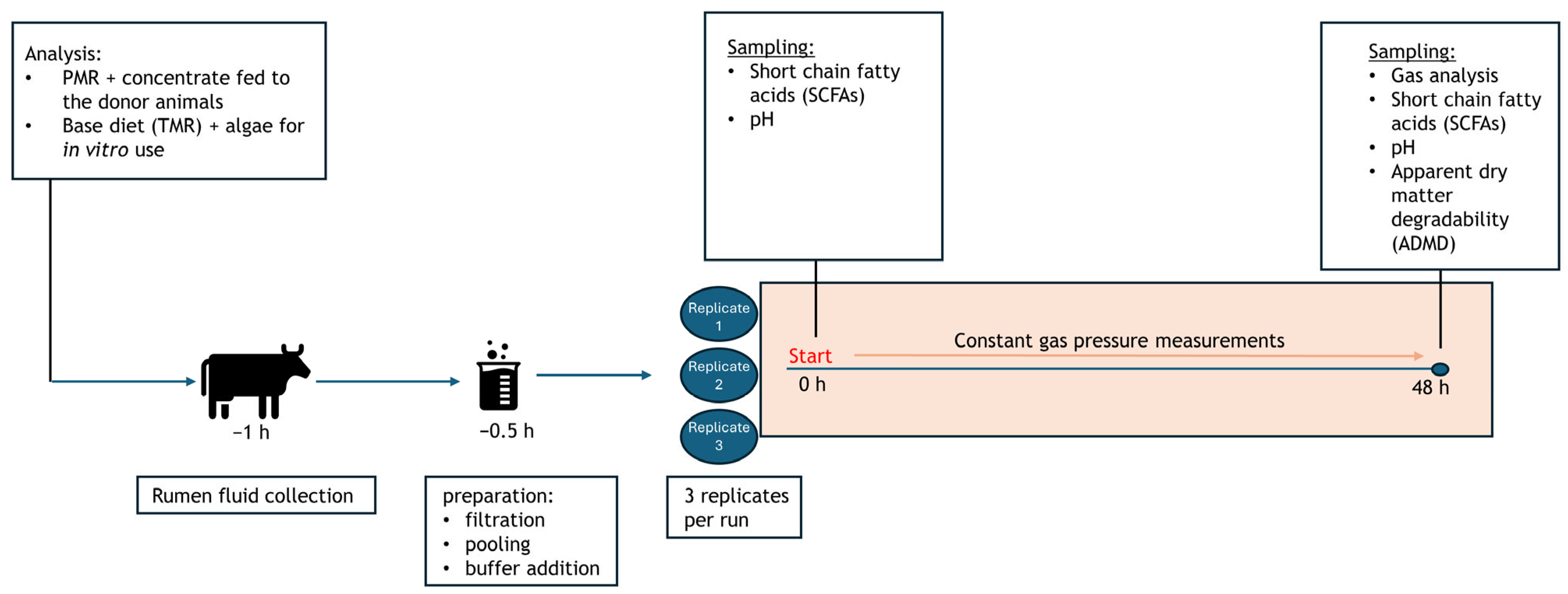
A volume of 100 mL buffered rumen fluid, with a buffer-to-rumen fluid concentration ratio of 4:1, was added to each of the 250 mL flasks. Afterwards, the ANKOM gas production modules (RF1) for gas measurement were put on the inoculated flasks. Each flask was flushed with argon to release any leftover oxygen before it was sealed shut. All bottles were placed on a magnetic stirrer (350 rpm) in a heating oven at 39 °C. After equilibration, the magnetic stirrer was reduced to 120 rpm and all valves on the gas production modules were opened until current pressure in each bottle reached 0.00 ± 0.02 pounds per square inch (psi). Valves were then closed and the experiment was run for 48 h with a live recording interval of 60 s, a recording interval of 1 min, an automatic release of pressure at 4 psi above ambient pressure, and an open valve time of 250 ms. Baseline samples for each experimental variant for pH and SCFAs were collected immediately after starting the system, and were removed from the experiment afterwards. Temperature in °C, cumulative gas pressure in psi, and current gas pressure in psi in every bottle were automatically measured via the ANKOM system. A schematic example of one ANKOM run is shown in Figure 1.

2.7. Sampling and Analyses

Feed samples of the pre-incubated diet and weekly samples of the TMR fed to the fistulated donor animals throughout the whole experiment were analyzed according to the standard methods of the Association of German Agricultural Analytic and Research Institutes [35] for DM (3.1), crude ash (CA; 8.1), crude protein (CP; 4.1.2), ether extract (EE; 5.1), crude fiber (CF; 6.1.1) starch (7.2.1), sugar (7.1.1), acid detergent fiber (ADFom; 6.5.2), and neutral detergent fiber (treated with α-amylase; aNDFom; 6.5.1). The algae biomasses were all analyzed in the same manner for DM and CA. Since the specific nitrogen-to-protein conversion factor for the algae is unknown, total nitrogen content (total N) determined via the Dumas method [35] (4.1.2) is shown instead of crude protein content. Due to restricted biomass availability of Ceramium, P. litoralis, H. pluvialis and P. purpureum, aNDFom could only be analyzed for Colaconema and U. intestinalis, and non-structural carbohydrates (starch and sugar) could only be analyzed for Colaconema, U. intestinalis, and H. pluvialis.
The monosaccharide composition of aliquots from the algae extracts was determined at the Complex Carbohydrate Research Center at the University of Georgia (CCRC, University of Georgia, Athens, GA, USA) using a gas chromatography–mass spectrometry (GC/MS)-based method with per-O-trimethylsilyl (TMS) derivates according to Santander et al. [36] and the alditol acetate method according to Peña et al. [37].
Measurements of pH of each flask content were conducted using a glass electrode (SenTix 41 (pH); pH 7110; WTW, Xylem Analytics Germany GmbH, Weilheim, Germany). SCFAs were analyzed according to Geissler et al. [38] using a gas chromatograph (Clarus 680; PerkinElmer LAS GmbH, Rodgau, Germany). Samples of 12 mL were taken from each replicate and the branched-chain ratio (BCR) was calculated as the sum of branched-chain SCFAs divided by the sum of straight-chain SCFAs, based on acetic acid equivalents.
From each flask, 12 mL gas samples were taken after 48 h through a septum using a gas-tight syringe (HamiltonTM 1000 Series GastightTM Syringe; HamiltonTM 81530, Bonaduz, Switzerland) and Exetainer® (Labco limited; Exetainer® 12 mL vial, Lampeter, UK) for analysis purposes. Samples were analyzed for CH4, CO2, H2, and nitrogen (N2) via GC by the DBI laboratory for gas and environmental technology (DBI Gas- und Umwelttechnik GmbH, Leipzig, Germany) according to recognized analytical standards (DIN 51872-4:1990-06) for gaseous fuels and other gases [39]. Total gas production, CH4 concentration, N2 concentration, CO2 concentration and H2 concentration were corrected by data obtained from the blanks for each run
To estimate the in vitro apparent dry matter degradability (ADMD) after each 48 h run, undigested residues in the bottles were directly filtered into pre-dried and weighed nylon bags with a 50 µm mesh opening (10 × 20 cm; R1020; ANKOM Technology, Macedon, NY, USA) after cooling the bottles to 4 °C. The nylon bags were then washed with deionized water, dried for 72 h at 60 °C, cooled in a desiccator for 1 h, and weighed, following a modified methodology of Alvarado-Ramirez et al. [40]. ADMD values were then corrected by data obtained from the blanks for each run.

2.8. Calculations

Samples showing measuring errors or gas leakage were manually excluded from any analyses. Therefore, 9–12 replicates for each experimental variant were available for statistical analysis.
The cumulative gas pressure, measured in psi and converted to kilopascals (kPa) by multiplication by 6.895, was converted into mL using the ideal gas law (Equation (1)):
n = p ( V R T )
where
n = gas produced in moles (mol);
p = pressure in kPa;
V = head space volume in the glass bottle in liters (L);
T = temperature in Kelvin (K);
R = gas constant.
Gas volume was then converted into mL using the molar gas volume at standard temperature and pressure, assuming ideal gas behavior, where 1 mole will occupy 22.4 L (Equation (2)):
V = n   × 22.4   × 1000
where
V = volume of gas produced (mL);
n = gas produced (mol);
22.4 = fixed factor;
1000 = conversion factor.
Converted volumes were adjusted to mL/g ADMD using the ADMD measured for each unit. Gas production kinetics were modeled using the Gompertz function according to Zwietering et al. [41] and previously accepted for in vitro gas production profiles by Schofield et al. [42]. The detailed equations for the different Gompertz models used in this experiment are provided in Supplementary Material, Calculation S1.
For substrates showing biphasic growth rates in Trial 2, the double Gompertz function was used (Supplementary Materials, Calculation S1).
Colaconema and U. intestinalis were fitted using the single Gompertz model, while Ceramium and P. litoralis were fitted using the double Gompertz. Model selection was based on the Akaike Information Criterion (AIC) and the Root Mean Square Error (RMSE), with the better-fitting model showing a lower AIC and RMSE.
For all trials, the time of the maximal gas production rate (T(max)) was calculated as the inflection point of the fitted gas production curves. For all samples fitted with the double Gompertz model in Trial 2, two inflection points were identified (T(max)1 and T(max)2). The detailed equations are provided in Supplementary Materials, Calculation S1.
To allow for a statistical comparison between monophasic and biphasic kinetics in Trial 2, a Global T(max) was determined for all samples. This is defined as the unique inflection point for Colaconema and U. intestinalis and the time point of the absolute maximal gas production rate for Ceramium and P. litoralis derived from the fitted functions.
For all trials, the estimated time points at which 25%, 33%, 50%, 66% and 75% of the maximum gas production occurred were evaluated using the fitted data.
Total SCFAs were adjusted to mmol/g ADMD and gas concentrations of CH4, CO2, H2, N2 were adjusted to mL/g ADMD using the ADMD measured for each unit. For evaluation of pH over time, ΔpH was calculated from pH values of the initial measurement and after 48 h of incubation. The same was done for the different SCFAs.

2.9. Statistics

Nonlinear regression was performed in R studio (version 4.2.2) using the nlsLM() function from the minpack.lm package [43].
Statistical analysis of gas production kinetics for Trials 1.1 and 1.2 was done with the linear mixed-effect model using the lmer() function in the lme4 package in R [44]. Depending on the trial, group (algae, CON) was set as a fixed effect, while run and replicate nested in run were set as random effects.
Due to the non-normal distribution of residuals in Trial 2, data were log-transformed and analyzed using the generalized linear mixed-effect model (GLMMs) with the glmer() function of the lme4 package in R [44]. Group (algae) was set as a fixed effect, while run and replicate nested in run were set as random effects.
Statistical effects were declared as significant at p < 0.05. When significant effects were detected, pairwise comparisons of estimated marginal means (EMMs) were performed with p-values adjusted for multiple comparisons using the Tukey test for Trials 1.1 and 1.2. For Trial 2, significance was tested by comparing nested models via likelihood ratio test using the Chi Square distribution. All following values are reported as EMMs with additional standard error of the mean (SEM).
For statistical analysis of pH, SCFA, ADMD, and gas concentrations of CH4, CO2, H2, N2, the MIXED procedure of SAS version 9.4 (SAS Institute Inc., Cary, NC, USA) with the restricted maximum likelihood method was used. Group (algae, CON) was used as fixed effect, while run was set as a random factor. Due to limited within-run variance for these parameters, the model was simplified by not including replicate nested within run as an additional random factor. Statistical effects were declared as significant with a p-value < 0.05 and Tukey’s post hoc test was used for comparison of EMMs. All following values are declared as least square means (LS-Means), with additional SEM.

3. Results

3.1. Chemical Composition of the Incubated Diet and Algae

The analysis of all lyophilized algae biomasses revealed similar DM content, ranging between 90 and 98%. A comparison of the algae samples with the incubated TMR showed that all algae exhibited higher concentrations of total N, with Colaconema displaying the highest concentration and Ceramium and P. litoralis showing the lowest values. Except for H. pluvialis, all algae also showed a higher CA concentration compared to the TMR, with P. litoralis exhibiting the highest CA content of 521 g/kg DM. Considering the aNDFom content, U. intestinalis had the highest concentration, while Colaconema demonstrated the lowest of all algae tested (Table 2).
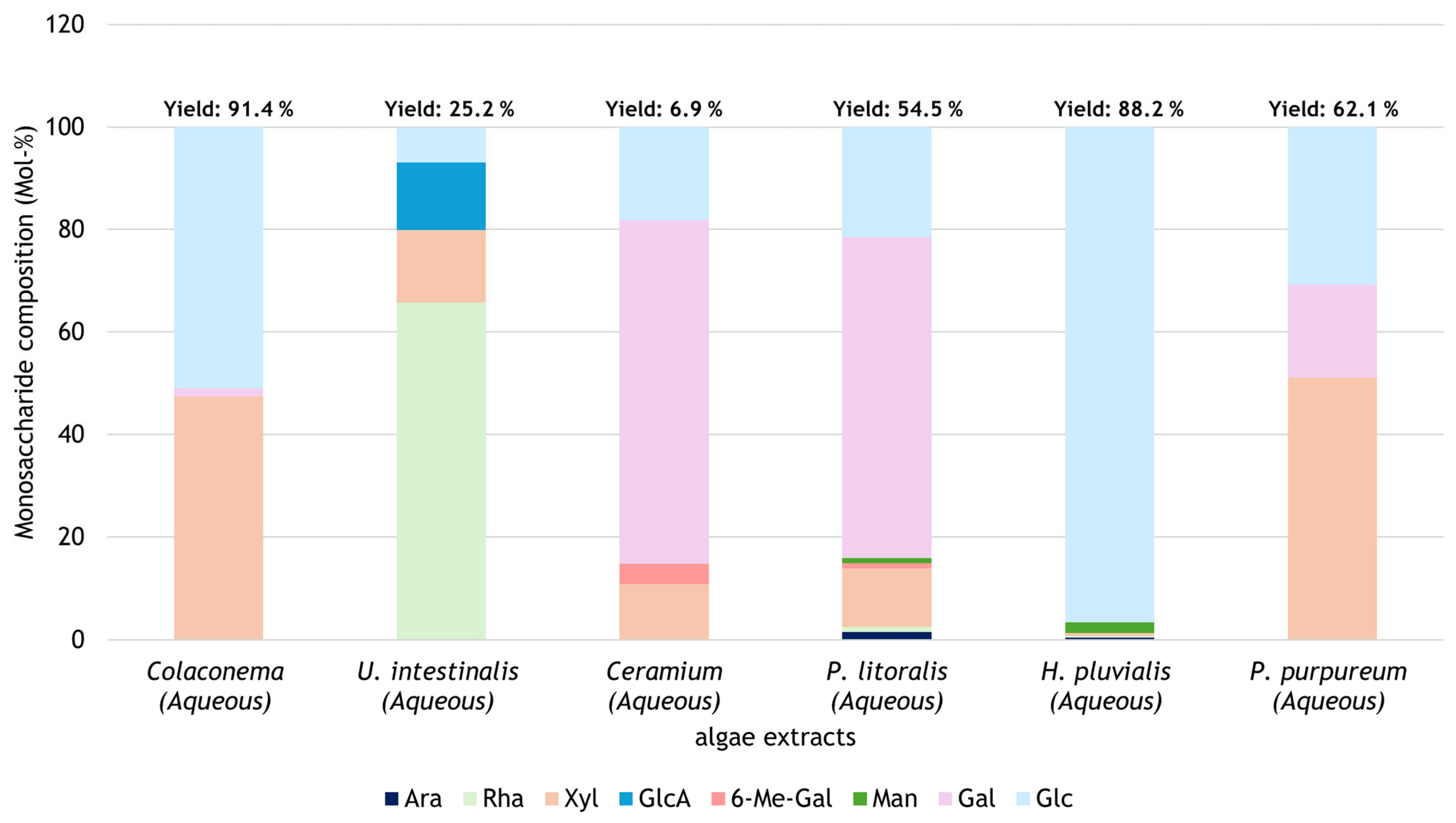
The monosaccharide composition of the tested algae extracts and their carbohydrate yield varied between algae extracts (Figure 2). The highest relative carbohydrate content was observed by Colaconema, followed by H. pluvialis and P. purpureum, while Ceramium was the lowest-yielding sample, followed by U. intestinalis. Glucose (Glu) appeared to be the most abundant monosaccharide for the extracts of Colaconema, H. pluvialis and P. purpureum whereas galactose (Gal) was predominant for Ceramium and P. litoralis. For U. intestinalis, rhamnose (Rha) was the most apparent monosaccharide, followed by xylose (Xyl), which was also the second most prevalent sugar in Colaconema and P. purpureum. The total values for monosaccharide composition and total carbohydrate content, expressed in µg and Mol%, can be found in the Supplementary Materials, Table S2.

3.2. In Vitro Gas Production Kinetics and Methane Production

  • Trial 1.1
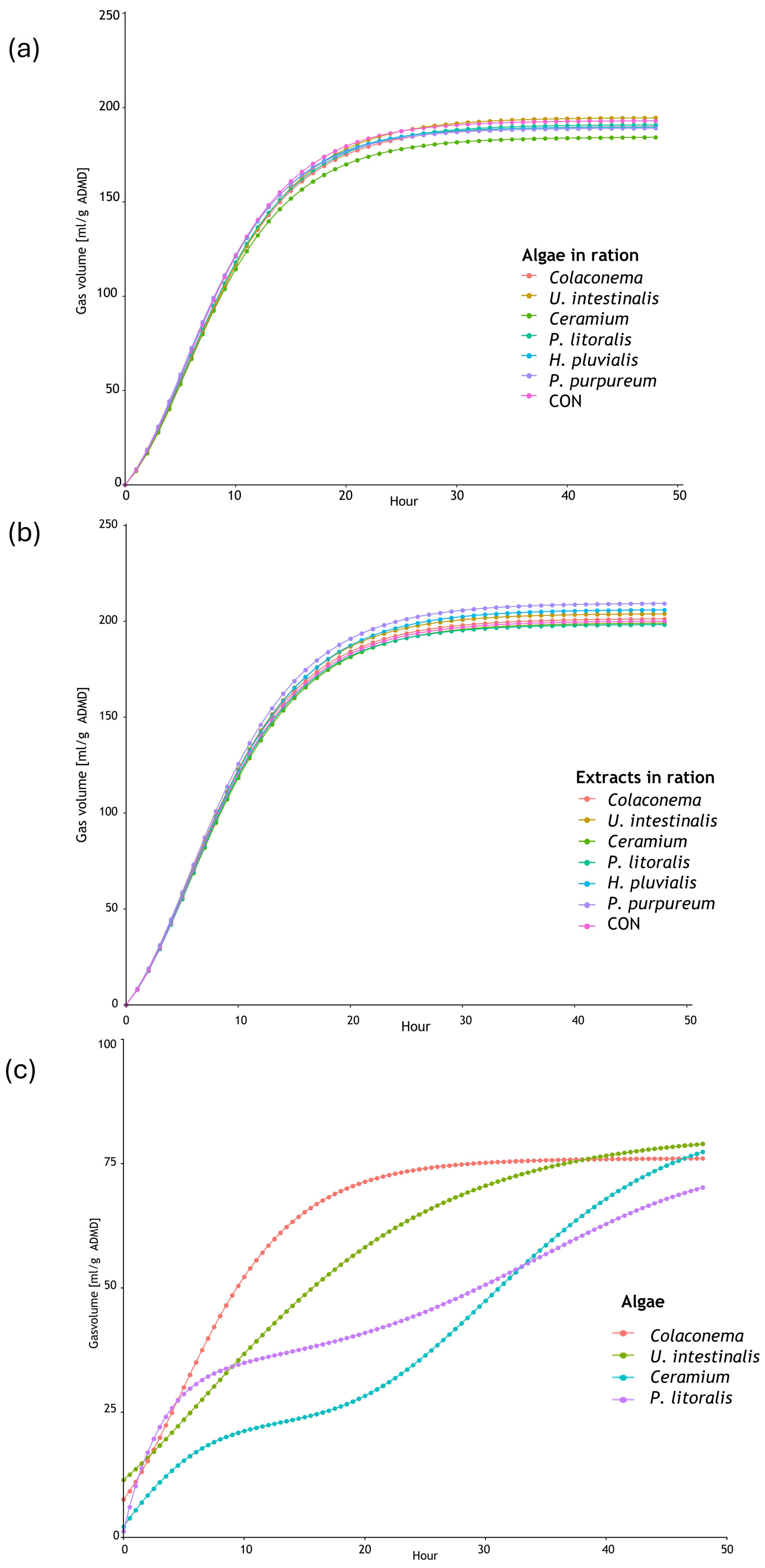
Examining the different parameters of the gas kinetic analysis revealed no marked differences, except for T(max), which was reached later by U. intestinalis compared to H. pluvialis (p = 0.015) and P. purpureum (p = 0.006) (Table 3, Figure 3a). The same could be assessed considering the estimated time points at which 25%, 33%, and 50% of the maximum gas production occurred, with U. intestinalis taking significantly longer compared to H. pluvialis (p < 0.05) and P. purpureum. (p < 0.05). At the time points where 66% and 75% of the maximum gas was produced, the same difference could be observed, but only between U. intestinalis and P. purpureum (p < 0.05). Thereafter, no differences between all substrates could be assessed until the total gas volume was reached (Table 4, Figure 3a). The gas analysis showed no significant differences in CH4 production between all substrates (Table 3).
  • Trial 1.2
Overall, no significant differences between the extracts across the different parameters of the gas kinetic analysis, the total gas volume, and the total CH4 production after 48 h of incubation were detected, but the gas analysis revealed a significantly higher concentration of N2 for Colaconema compared to U. intestinalis. No further changes between the other algae or CON could be observed (Table 3, Figure 3b).
  • Trial 2
Colaconema and U. intestinalis displayed sigmoidal-shaped gas growth curves and monophasic gas kinetics, while Ceramium and P. litoralis displayed double-sigmoidal-shaped gas growth curves and biphasic gas kinetics (Figure 3c). For Global T(max), a difference between Ceramium and Colaconema and between Ceramium and P. litoralis could be detected (p < 0.001). In comparison, P. litoralis reached Global T(max) the earliest, followed by Colaconema and U. intestinalis. The inflection point was reached by Ceramium latest after 13.91 h of incubation (Table 5, Figure 3c).
For the estimated time points at which 25% of the maximum gas volume was produced (T(25)), a significant difference between Ceramium and the other algae used (p < 0.001) could be identified, with Ceramium taking longer and P. litoralis and Colaconema taking the least time to reach 25% of the modeled maximum gas production. For T(33), only P. litoralis showed no difference in comparison to Colaconema and U. intestinalis, while it was reached fastest by Colaconema and slowest by Ceramium (p < 0.001). At T(50), a significant difference between all algae could be observed (p < 0.001), with Colaconema reaching T(x) the earliest, followed by U. intestinalis, then P. litoralis, and at last Ceramium. At the remaining observed estimated time points, at which 66% and 75% of the maximum gas volume were produced, a significant difference between Colaconema and the other macroalgae, and between U. intestinalis and the other algae tested, could be observed (p < 0.001), with Colaconema reaching T(x) the earliest, followed by U. intestinalis and thereafter Ceramium and P. litoralis, between whom no significant difference was detectable (Table 4).
After 48 h of incubation, P. litoralis showed a significantly lower final total gas volume compared to U. intestinalis (p = 0.007), with a lower total CH4 production than U. intestinalis and Colaconema (p ≤ 0.026). Otherwise, there were no differences across experimental groups, although it is noteworthy that the curves for Ceramium and P. litoralis in Figure 3c suggest a slight upward trend, implying that the peak gas production may not have been reached after 48 h of incubation.

3.3. Fermentation Parameters

3.3.1. pH Measurements and ADMD

  • Trial 1.1
The rate of change in pH value (ΔpH) revealed a difference between U. intestinalis and P. purpureum (p < 0.001), with a relatively lower ΔpH for U. intestinalis compared to P. purpureum, resulting in a lower final pH value of 6.51 for P. purpureum in comparison to the higher final pH value of 6.60 for U. intestinalis (Table 6).
The ADMD in % after the 48 h incubation process exhibited no significant differences among all algae (Table 6).
  • Trial 1.2
For the extracts of Colaconema and U. intestinalis, ΔpH was significantly lower compared to H. pluvialis and CON (p < 0.001). Meanwhile, P. purpureum exhibited a significantly lower ADMD (81.40%) compared to CON (85.85%), Ceramium (85.01%), and P. litoralis (86.325%) (p = 0.010) (Table 6).
  • Trial 2
P. litoralis differed significantly concerning ΔpH (p < 0.001), with a lower value compared to the other algae. Colaconema, U. intestinalis and Ceramium did not differ significantly from each other, resulting in a higher final pH of 7.36 for P. litoralis in comparison to 7.21–7.26 for Colaconema, U. intestinalis and Ceramium (Table 6).
The ADMD in % showed differences between all algae (p < 0.001), with Colaconema exhibiting the highest ADMD, followed by U. intestinalis and Ceramium, leaving P. litoralis with the lowest ADMD among the macroalgae used (Table 6).

3.3.2. SCFA Production

Total SCFA production and the calculated BCR are presented in Table 6, while the C2:C3 ratio for all trials as well as the changes in acetic acid (ΔC2), propionic acid (ΔC3), and butyric acid (ΔC4) concentrations between both sampling points are presented in Table 7. The changes in isobutyric acid (ΔC4iso), valeric acid (ΔC5), and isovaleric acid (ΔC5iso) are shown in Table S3 of the Supplementary Materials, while absolute SCFA concentrations (mmol/L) are provided in Table S4 of the Supplementary Materials.
  • Trial 1
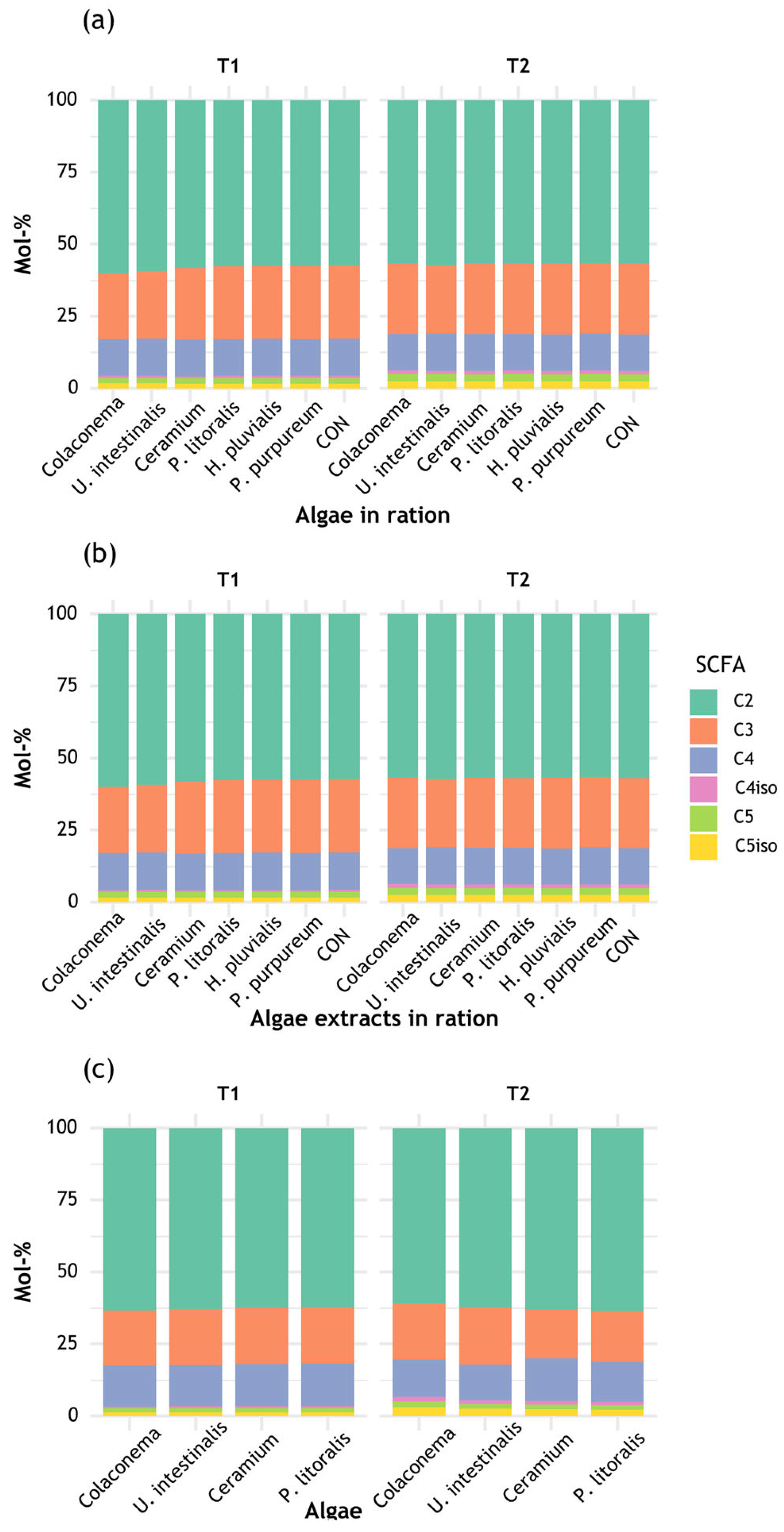
The C2:C3 ratio ranged between all treatments from 2.25 to 2.62 at the start of the experiment and from 2.33 to 2.54 after the 48 h incubation period. The rate of change in the C2:C3 ratio (ΔC2:C3) revealed a significantly lower value for Colaconema compared to all other treatments (p < 0.001). This is reflected in ΔC2, where Colaconema also exhibited a significantly lower value (p ≤ 0.044) compared to all substrates except U. intestinalis, and in ΔC3, where Colaconema showed a higher value than Ceramium and P. litoralis (p ≤ 0.033). There were no detectable effects on ΔC4, total SCFA production, or the BCR. Total SCFA concentrations in mol-% are illustrated in Figure 4a.
  • Trial 1.2
The inclusion of the algae extracts resulted in a C2:C3 ratio between 3.24 and 4.23 at the start of the experiment and a ratio of 2.83 to 2.96 after the 48 h incubation period between all extracts. The highest shift between both timepoints was exhibited by the extract of Colaconema, resulting in a significantly (p < 0.001) lower ΔC2:C3 compared to the other substrates. For ΔC2, Colaconema showed lower values compared to the other substrates (p < 0.001), while for ΔC3, the inclusion of Colaconema resulted in a significantly higher value compared to the other extracts and CON (p ≤ 0.012). Comparing the results of ΔC4, Colaconema exhibited a significantly higher mean in relation to the other substrates (p < 0.001), followed by U. intestinalis, which reflects a significant difference only between P. litoralis and P. purpureum (p ≤ 0.004). No significant changes in total SCFA production and the BCR were detectable. Total SCFA concentrations in mol-% are illustrated in Figure 4b.
  • Trial 2
The utilization of the algae as the exclusive source of sustenance resulted in a C2:C3 ratio ranging from 3.25 to 3.33 at the start of the experiment, and from 3.11 to 3.72 after the 48 h incubation period, with Colaconema and U. intestinalis exhibiting lower values for ΔC2:C3 compared to Ceramium and P. litoralis (p < 0.001).
An overall lower ΔC2 was shown by Colaconema, in contrast to the values exhibited by the other algae (p < 0.001). The second lowest value was exhibited for U. intestinalis, which was significantly lower compared to P. litoralis (p < 0.001), but did not differ from Ceramium. For ΔC3, Colaconema and U. intestinalis exhibited the highest values, therefore revealing a difference between Ceramium and P. litoralis (p < 0.001), which appeared to have a lower ΔC3. For ΔC4, the highest values were observed in Ceramium (p < 0.001), followed by Colaconema and P. litoralis, between whom no significant differences could be detected. U. intestinalis exhibited the lowest value of all substrates (p ≤ 0.044). Total SCFA production in mmol/g DM showed significantly higher values for Colaconema and U. intestinalis compared to P. litoralis and Ceramium, with a higher BCR for Colaconema (0.07) compared to P. litoralis (0.05) (p < 0.001). Total SCFA concentrations in mol-% are visualized in Figure 4c.

4. Discussion

4.1. Gas Production and Kinetics

When observing the gas kinetics of the algae biomass addition to the base ration in the present study, the timepoint at which the maximal growth of gas production occurred (T(max)) differed between the inclusion of the macroalga U. intestinalis and the two microalgae H. pluvialis and P. purpureum, resulting in U. intestinalis reaching the inflection point about half an hour later compared to the microalgae. The same could be assessed when looking at the points in time (T(x)) when 25% to 75% of the total gas production occurred, with U. intestinalis taking up to an hour longer than the two microalgae to reach T(x). The gas production itself is dependent on the feed composition, feed intake and diversity of the microbiome [45]. Different components of the plant cell wall are degraded by rumen microbes to the intermediate pyruvate, which is fermented to SCFAs and gases (mainly CO2 and CH4), while different factors, such as starch or sugar concentration, can have a limiting or exaggerating influence on SCFA and gas production [46]. The analysis of the different algae exhibited the highest aNDFom content for U. intestinalis, which is 2.2 times higher compared to the microalgae. Meanwhile, starch and sugar contents are up to 20 times lower in comparison to the microalga H. pluvialis, indicating that the higher aNDFom content of U. intestinalis, combined with the low starch and sugar concentration, could alter the whole ration and therefore be an influencing factor for slower gas production. The association of high aNDFom content with lower fermentation kinetics is in line with other studies [46,47]. At the same time, starch and sugar are known to be easily accessible for rumen microbes, resulting in initial faster gas production due to the high fermentability [46].
However, Trial 1.1 of the present study showed no effect of the different algae on methane production and final total gas volume. This is contrary to results of Maia et al. [48], where the inclusion rate of 25% DM Ulva spp. resulted in a lower gas and CH4 production, when included in a basal diet of meadow hay. These incongruences might occur due to the lower inclusion of 4% DM (w/w) that was used in the present study, indicating that a higher inclusion level of U. intestinalis might have an effect on total gas and CH4 production. Machado et al. [23] also tested different marine macroalgae for their gas reduction potential and showed an overall reduction in total gas pressure for all algae tested, in comparison with the control group. In this setting, the different algae were included at a higher inclusion rate of 20% OM. While higher inclusion rates (20–25%) could result in greater CH4 reduction potential, this approach may be limited by adverse effects on inhibition of general rumen fermentation, described by Ahmed et al. for the inclusion of different brown algae species at 20% [49]. Similarly, A. taxiformis and Dictyota bartayresii at 20% inclusion level reduced methane output in vitro, but also showed the lowest total SCFA concentrations [23], indicating that these inclusion rates are rarely feasible for ruminant feeding. Meanwhile, different studies recommend a concentration of 2% DM, especially referencing the red alga A. taxiformis [10,12], to impact CH4 production, while research conducted by Park et al. [25] showed a significant reduction rate of CH4 for U. intestinalis included at 4% DM. Moreover, it is essential to acknowledge the primary objective of utilizing locally produced algae as a CH4-inhibiting dietary supplement, which could have the potential to be a natural and locally available substitute. Therefore, a supplementation of 4% DM seemed to be the best possible option for an initial screening of all different algae in the present experiment.
An effect of the basal diet could also be a possible reason for the lack of CH4 reduction observed in the present study, relating to Maia et al. [48], where an inclusion of 25% DM Ulva spp. in a basal diet of corn silage showed no effect on methane production, while an inclusion in a basal diet of meadow hay showed lower methane production rates, proposing that higher starch contents influence the CH4 reduction potential. Therefore, the basal diet, consisting of grass and maize silage and concentrate in this experiment could have an influence on the rate of gas and CH4 produced.
For the inclusion of the algae extracts in the diet, a lower inclusion rate of 2% DM was used due to the supposed enhanced accessibility of polysaccharides for the microbes after extraction [50]. The inclusion of the extracts showed no effect on gas kinetics and CH4 production, indicating that the polysaccharides derived from the extracts alone did not alter the microbial community in a way that influences methane reduction at the chosen inclusion rate and incubation time of 48 h. At the same time, it must be taken into account that the carbohydrate yield differed among the algae extracts (Figure 2). Therefore, lower-yielding samples may need to be added at higher concentrations in future experiments to better demonstrate and compare their possible effects on gas production kinetics. Nevertheless, a significant change in N2 production after 48 h occurred, with a higher value for the inclusion of the Colaconema extract in comparison to the extract of U. intestinalis. All values were already corrected for oxygen contamination. Lower nitrogen concentration in the gas phase for the addition of the U. intestinalis extract could be due to nitrogen fixation through rumen bacteria, previously described by Jones et al. [51], indicating that the extract of U. intestinalis might influence the nitrogen concentration in the ration. At the same time, Colaconema showed a relatively higher total N concentration in the biomass, which might influence the total N content in the extract as well. Therefore, there is no need for the microbes to fix atmospheric nitrogen due to the N input through the alga. This can be seen for instance in high-protein diets, where the protein is degraded to ammonia N or incorporated into microbial protein by rumen microorganisms [52]. Because ammonia N was not evaluated in this experiment, further research is needed to evaluate the exact mechanisms responsible for the observed changes in nitrogen concentrations. Additionally, Trubetskaya et al. showed that ethanol–water and water extraction can increase nitrogen content in comparison to biomass for certain algae [53]. This supports the interpretation that different matrices (algae biomass vs. extract) may capture different nitrogen fractions. Because N concentration was not measured in the extracts, it is unclear whether the extraction process impacted total N content, making it difficult to fully explain the observed differences. Additionally, it remains uncertain whether the relatively low inclusion level of the algae extracts (2% w/w) alone was sufficient to significantly induce these gas phase alterations. Therefore, the reason for the discrepancy between algae biomass and extract remains unclear and needs further investigation.
When evaluating the different algae used as the sole feed source, gas kinetics differ significantly between the four macroalgae. In particular, P. litoralis and also Ceramium showed a biphasic growth rate; therefore, a double Gompertz model was used to better fit the data. As previously described by Gomes et al. [54], the double Gompertz is an accurate model to fit double-sigmoidal curves. Double-sigmoidal growth curves indicate that two fractions of fermentable carbohydrates exist: one which is highly fermentable and another one which is slowly fermentable [55]. To better evaluate the exact mechanisms why these biphasic growth rates occur for the two algae, further evaluation of the sugar content of the algae biomass needs to be done. Additionally, P. litoralis showed a moderate aNDFom-content and very high CA concentration (>500 g/kg DM). High CA content reduces the amount of microbial degradable biomass and therefore reduces the fermentation capacity of the algae. In combination with its significantly lower total gas production in comparison to U. intestinalis, the cellulosic structures in the cell membrane of P. litoralis seem to be less fermentable than the ones for the other macroalgae. This hypothesis can also be verified in the present study when reviewing the ADMD of P. litoralis, which showed the lowest value of all macroalgae observed. Similar findings were observed by Han et al. [55] for other algae tested in in vitro systems. This also goes along with P. litoralis showing a lower total methane production than Colaconema and U. intestinalis.
The gas production profile of Ceramium revealed a diauxic pattern with a distinct transition phase. Therefore, the Global T(max) was located in the transition zone between the rapid and slow fermentable fractions, indicating significant overlap of the two degradation phases. This suggests that fiber degradation began close to or at the same time as the depletion of soluble carbohydrates, which can be linked to colonization and multiplication of microbes that are responsible for fiber degradation, already during the degradation process of the rapidly fermentable fraction [56,57]. This differs from the degradation process of P. litoralis, in which two distinct fractions with an initial fast gas production rate can be verified.
Colaconema and U. intestinalis were the two algae that showed a sigmoidal growth rate, with similar final gas volume and a similar methane production. There are different assumptions why typical sigmoidal-shaped growth curves occur. France et al. [58] thought that a sigmoidal shape goes along with increased substrate accessibility caused by increased microbial attachment and numbers, and Groot et al. [56] inferred that colonization of microbes around the substrate happened before the maximum fermentation rate was reached. In combination with the highest ADMD of Colaconema, followed by U. intestinalis, the idea of increased substrate accessibility going along with a sigmoidal-shaped curve can be assessed in this study.
These observed differences in fermentation patterns of the pure algae were not evident when included in the feed ration, although algae and also algae extracts showed consequently sigmoidal-shaped growth when being added to the TMR in Trial 1.1 and 1.2, also with similar final gas volume and CH4 production, indicating that the fermentation characteristics of the basal TMR were mainly reflected, whereas the algae and algae extracts contributed only marginally to the overall curve dynamics. Consequently, the intrinsic fermentation of the algae cannot be the only factor to explain the changes in gas kinetics observed for U. intestinalis, which were absent in the other macroalgae tested, when added at 4% DM to the ration in Trial 1.1. Due to the lack of differences concerning gas production in Trial 1.2, polysaccharide content does not seem to be the influencing factor for the observed effect either, although it has to be taken into account that the U. intestinalis extract was one of the lower yielding samples, indicating that a higher extract concentration of U. intestinalis could impact the gas kinetics differently. Overall, it remains unclear whether a specific fermentation byproduct or a gas-inhibiting factor is responsible; thus, further investigation is required.

4.2. SCFA Production and pH

Getachew et al. [59] showed a positive correlation between gas production and SCFA production in different kinds of feeds in vitro. This can be observed in Trial 2, where P. litoralis exhibited the lowest amount of SCFAs produced, and in combination also the lowest total gas volume. Concurrently, P. litoralis had a BCR that was 0.02 times lower compared to Colaconema. The BCR is a measured ratio and shows the relative abundance of branched-chain SCFAs compared to straight-chain SCFAs, meaning that a higher BCR indicates a higher share of branched-chain fatty acids. These are mainly produced during deamination and decarboxylation of branched-chain amino acids [60]. Therefore, higher BCR values indicate an increase in protein degradation relative to carbohydrate fermentation. Therefore, the higher BCR of Colaconema indicates that this alga induced a shift towards enhanced proteolytic activity, which could be associated with its higher total N content. No such shifts were observed in Trials 1.1 and 1.2, indicating that the inclusion rate of the algae or their extracts was insufficient to impact the BCR.
While total SCFA values, and the values for the different SCFAs observed, are all in the physiological range [4], differences, especially concerning C2 and C3, are visible through all trials. Only the inclusion of the red alga Colaconema and its extract in the diet resulted in a significantly lower C2:C3 ratio due to an increase in C3 concentration and a decrease in C2 concentration, indicating that Colaconema has created a microbial shift towards C3 without inhibiting total SCFA production. This can be accounted as a positive aspect for this alga compared to other research, where the inclusion of red algae resulted in inhibition of SCFA synthesis [9,24]. As Colaconema biomass and extract created a shift towards C3, the responsible factor is likely present in both fractions.
Only in Trial 2, U. intestinalis also had an impact on the C2:C3 ratio comparable to Colaconema, indicating that both algae, but mainly Colaconema, might contain compounds that favor C3 producers, which might differ in concentration or bioavailability between the two algae.
C3 is mainly used for gluconeogenesis and has a higher concentration in high-starch or -sugar diets [3]. Interestingly, Colaconema was not the alga with the highest starch or sugar content concerning its biomass, but the extract exhibited the highest carbohydrate yield, with glucose and xylose being the most abundant monosaccharides, indicating a high presence of glucose-based polysaccharides and xylan- or hemicellulose-type components [61]. While glucose is metabolized through glycolysis, xyloses are usually metabolized through the pentose–phosphate pathway resulting in production of either glyceraldehyde-3-phosphate and fructose-6-phosphate, which then enter glycolysis, acetyl-phosphate, resulting in acetate production, or ribose-5-phosphate, which is used for histidine synthesis [62]. While high glucose level can increase propionate production [3], xylose metabolization could also proceed through the succinate pathway, which produces C3 [62]. The effect on the C2:C3 ratio was reproducible when it was used as a sole feed source in Trial 2. The observed shift in SCFA production without an effect on total SCFA was previously described by Machado et al. [13], who saw similar shifts when methane inhibitors like bromoform were added. Bromoform is a secondary metabolite mainly attributed to the methane mitigation potential of the red alga A. taxiformis, typically resulting in a strong reduction in CH4 formation accompanied by H2 accumulation, which might then be redirected [63,64]. C3 formation serves as an alternative hydrogen sink and has been proposed to influence methane yield via competition with methanogens for metabolic H2 [65]. However, the observed increase in C3 concentration was not accompanied by CH4 reduction. Whilst the presence of secondary metabolites in Colaconema cannot be discounted in this experiment, the absence of characteristic bromoform-like responses may be more plausibly explained by the carbohydrate and polysaccharide composition of the alga, which has been shown to stimulate propionogenic pathways as described above.
Additionally, the discrepancy may also result from the use of an end-point measurement for methane and therefore no methane production kinetics could be evaluated over the incubation period. Additionally, although C3 levels differed significantly, the shift in the molar proportions could likely be too minor to limit the H2 availability for methanogenesis. Furthermore, H2 balance was not evaluated in this study; therefore, inference regarding H2 competition remains speculative and needs further investigation.
Together with these described shifts, an increase in butyrate was observed in the past by Machado et al. [13], which was not detectable in Trial 1.1 but can be observed in Trial 1.2, where the addition of the extract of Colaconema resulted in an increase of 11.2% in butyrate, while it decreased over time for the other substrate combinations, including U. intestinalis. This effect was not reproducible in Trial 2, where butyrate decreased over time for U. intestinalis and Colaconema, respectively.
Therefore, the monosaccharide composition and concentration in the extracts may be one of the influencing factors on SCFA pattern, but the extent to which the tested monosaccharides can be liberated from their polymeric structures has not been assessed and therefore needs to be considered.
The pH observation revealed values that were in the physiological range [66] of the rumen pH, between 6.0 and 7.4, and never dropped beyond 6.4 through all trials. The pH value in the rumen can differ even within a day, depending on diet, time of feeding, and time of sampling [67]. Therefore, the variation in pH between the two measurements done in each run can be considered as physiological, also taking into account that a batch culture system was used, where no food was added throughout the experiment, and no products were removed during the 48 h incubation period, resulting in accumulation of fermentation products and therefore a decrease in pH. The higher rate of change (0.89) in pH for P. purpureum, in comparison to U. intestinalis (0.73) in Trial 1.1, might be due to the higher aNDFom content of the green alga in comparison to high sugar and starch contents in the microalgae, especially seen in the monosaccharide content of the P. purpureum extract, which could influence the composition of the whole ration and therefore have an impact on pH. As already mentioned, starch and sugar are rapidly fermentable and therefore more likely to cause a drop in pH [66]. More obvious changes could be observed in Trial 2, where a higher fermentation rate and higher SCFA content went along with a bigger drop in pH. These correlations are commonly observed in rumen studies, because ruminal pH is closely correlated to substrate degradation, which influences the SCFA synthesis [4]. The lower ΔpH observed for the extracts of U. intestinalis and Colaconema in Trial 1.2, compared to the control and the microalga H. pluvialis, may be due to their differences in sugar content. However, these shifts were more pronounced than in Trial 1.1, likely because the extracts increased the accessibility of saccharide compounds to the microbes, thereby exerting a greater influence on the ration than the inclusion of algae biomass [68].

4.3. Limitations

Limitations should be considered when interpreting the findings of the present in vitro experiments.
Restricted biomass availability for Ceramium, P. litoralis, H. pluvialis and P. purpureum resulted in limited chemical analyses; therefore, not all parameters were available for all algae tested. For the extracts, total N and mineral concentrations were not quantified; therefore, potential changes in nutrient composition due to extraction cannot be fully excluded and need further investigation.
For all trials, the measurement of gas production was conducted throughout the whole 48 h incubation period, while analysis of CH4 and other gases was conducted exclusively after completion of the 48 h incubation. Therefore, potential changes in CH4 kinetics or dynamics during the incubation could not be assessed. Furthermore, the in vitro batch culture system does not replicate passage rate, absorption processes, or long-term microbial adaption, and therefore may differ from in vivo conditions, also taking into account that the retention time in the rumen varies depending on feed type, particle size and intake levels and therefore is not always set at 48 h [69]. Accumulation of fermentation products may also influence fermentation kinetics compared to in vivo conditions. As no microbial community analyses are presented, mechanistic interpretation remains limited. Therefore, the present results should be interpreted as fermentation patterns under controlled in vitro conditions rather than reflecting on animal performance.

4.4. Feasibility

Beyond the observed biological effects, the inclusion of Colaconema and U. intestinalis in particular at 4% DM in the animal’s diet may be feasible, regarding in vivo studies, where similar algae inclusion levels demonstrated acceptance [70]. Although no reduction in CH4 was observed at the chosen inclusion rate, algal supplementation could complement existing CH4 mitigation strategies, for example application of chemical inhibitors [71], due to their local cultivability and possible multifunctional effects mainly concerning the SCFA profile. Their effectiveness under commercial feeding conditions, however, remains to be evaluated. Therefore, future studies are needed to determine the practical potential of these Baltic Sea algae as sustainable feed supplements.

5. Conclusions

This study provides an overview of different algae from the Baltic Sea region and their polysaccharide-enriched extracts on rumen gas and CH4 production, as well as on various fermentation parameters, through an in vitro screening. The data indicate that U. intestinalis and Colaconema in particular influence fermentation pattern when added to a ruminant diet, albeit without having a significant impact on gas and methane production at the concentrations used in this study. The red alga Colaconema and the green alga U. intestinalis showed changes in the SCFA profile with a shift towards C3, indicating an influence on propionate producers and fermentation patterns. While none of the used algae or their extracts showed a reduction in CH4 concentration after 48 h of incubation at the chosen inclusion rates, the inclusion of U. intestinalis biomass, added at 4% of the base substrate weight, in the base diet resulted in a mildly reduced initial gas production. This finding suggests that implementing gas composition analyses at more frequent intervals than those employed in the present experiment could provide a clearer picture of the impact on CH4 reduction during the incubation period.
Overall, U. intestinalis and Colaconema represent locally available options for future research within sustainable feeding strategies. However, implementation will depend on economic feasibility and cultivation potential. Therefore, further research is needed to assess the large-scale feasibility of these algae as well as their influence on animal performance and metabolism, particularly with regard to their effect on SCFA patterns, under in vivo conditions.

Supplementary Materials

The following supporting information can be downloaded at https://www.mdpi.com/article/10.3390/ruminants6010018/s1: Table S1: Chemical composition of the donor animals’ diet. The TMR consists of 65% PMR and 35% concentrate; Table S2: Monosaccharide composition (Mol% and µg) of the different algae extracts (aqueous) tested analyzed by GC-MS. Analysis does not distinguish between free monomers and those incorporated into polysaccharides; Table S3: Rate of change of isobutyric acid (ΔC4iso), valeric acid (ΔC5) and isovaleric acid (ΔC5iso) are shown for the addition of the algae and control (CON) in Trial 1.1, for the addition of the algae extracts and control (CON) in Trial 1.2 and the four algae biomasses in Trial 2. Values are presented as least square means (LS-Means) with their standard error of the mean (SEM) displayed for each parameter. Effects were considered significantly different with p-values < 0.05. Pairwise comparison of substrates was performed using the Tukey test. Values with different letters differ significantly (p < 0.05); Table S4: The final values after 48 h of incubation of the different short chain fatty acids (SCFAs), as well as the total SCFA concentration, are shown for the addition of the algae and control (CON) in Trial 1.1, for the addition of the algae extracts and control (CON) in Trial 1.2 and the four algae biomasses in Trial 2. Values are presented as means with additional pooled standard error of the mean (SEM); Figure S1: (a) Experimental setup of Trial 1.1 and 1.2: A total of 1.0 g DM of the TMR was weighed in each substrate-containing ANKOM bottle. The remaining four bottles (Blanks) were devoid of substrate and utilized for correction. For Trial 1.1, 4% (w/w) DM of algae biomass were added. For Trial 1.2, the algal extracts were added at 2% (w/w). (b) Experimental setup of Trial 2: A total of 0.5 g DM of the algae biomasses was used. The remaining four bottles (Blanks) were devoid of substrate and utilized for correction; Calculation S1: Detailed equations of the models used for gas kinetic modulation.

Author Contributions

Conceptualization, T.S. and D.v.S.; data curation, S.B.; formal analysis, S.B., F.B. and S.D.; funding acquisition, T.S. and D.v.S.; investigation, S.B.; methodology, S.B. and D.v.S.; project administration, T.S.; resources, U.M.; software, S.B. and F.B.; supervision, C.V., S.D. and D.v.S.; validation, S.B., J.K., F.B. and D.v.S.; visualization, S.B.; writing—original draft, S.B.; writing—review and editing, U.M., J.K., F.B., C.V., M.R., T.S., C.S., M.P., S.D. and D.v.S. All authors have read and agreed to the published version of the manuscript.

Funding

This study was conducted as part of the collaborative project ReMeAl (Reduction of methane emission of ruminants through algae supplementation), funded by the Federal Ministry for Research, Technology and Space (funding code 03WIR2220A-D).

Institutional Review Board Statement

The animal study protocol was conducted according to the European Community regulations concerning the protection of experimental animals and the guidelines of the German Animal Welfare Act, and was approved by the Lower Saxony State Office for Consumer Protection and Food Safety, Oldenburg, Germany (Approval Code: 33.19-42502-04-24-00635; Approval Date: 15 October 2024). In Lower Saxony, Germany, the approval and oversight of animal experiments is coordinated regionally through the Lower Saxony State Office for Consumer Protection and Food Safety (LAVES), according to German law (§15 TierSchG, Animal Welfare Act). Animals in this experiment served solely as donors of rumen fluid used for the in vitro incubations and were not subject to experimental treatments.

Informed Consent Statement

Not applicable.

Data Availability Statement

Data in this manuscript were collected and managed in accordance with the data management policy of the FLI. Data for statistical analyses and supplemental data will be made publicly available at Zenodo (https://doi.org/10.5281/zenodo.18335590) upon acceptance. Link for reviewers only: https://zenodo.org/records/18335590?preview=1&token=eyJhbGciOiJIUzUxMiJ9.eyJpZCI6IjA5M2ExY2M2LWFhZjItNDUwNC1iYzNjLWUwNmE4NmVmNjM2MCIsImRhdGEiOnt9LCJyYW5kb20iOiIzNTY5YWJhMzk0Nzg4Y2FlMjYzY2Q5OGNlNDMwYjZiMCJ9.9qdMYbWU1h7ndykMb2RdLndIky1NwlPlLmjaqSsm20GuCHvJ4Pef3c_myuIJ23KW11GaY6Y7SMNijMd1cbIFjg (accessed on 5 February 2026).

Acknowledgments

The authors thank the co-workers of the Institute of Animal Nutrition and the co-workers of the experimental station of the Friedrich-Loeffler-Institut in Brunswick for their support, as well as all other members of the ReMeAl team. We especially thank Sophie Steinhagen from the Department of Marine Science at the University of Göteborg and the Company Sea and Sun for the supply of algae biomass. During the preparation of this manuscript, the authors used Google’s Gemini 3 Pro via Google AI Studio (Google, 2026) for assistance with R code generation and debugging. The authors have reviewed and edited the output and take full responsibility for the content of this publication.

Conflicts of Interest

The author Prof. Mathias Paschen is affiliated with ZosteraTec UG. This affiliation did not influence the study design, data collection, analysis, interpretation, or publication of the results. No financial support was received from the company for this work. The remaining authors declare no conflicts of interest.

Abbreviations

The following abbreviations are used in this manuscript:
GHGGreenhouse gas
CH4Methane
CO2Carbon dioxide
H2Hydrogen
N2Nitrogen
psiPounds per square inch
SCFAShort-chain fatty acid
C2Acetic acid
C3Propionic acid
C4Butyric acid
C5Valeric acid
C4isoIsobutyric acid
C5isoIsovaleric acid
DMDry matter
PMRPartial mixed ration
TMRTotal mixed ration
ADMDApparent dry matter degradability
CACrude ash
CPCrude protein
EEEther extract
ADFomAcid detergent fiber
NDFomNeutral detergent fiber
GC/MSGas chromatography/mass spectrometry
ColaconemaColaconema spp.
U. intestinalisUlva intestinalis
CeramiumCeramium spp.
P. litoralisPylaiella litoralis
H. pluvialisHaematococcus pluvialis
P. purpureumPorphyridium purpureum
CONControl

References

  1. Umweltbundesamt. Berichterstattung unter der Klimarahmenkonvention der Vereinten Nationen und dem Kyoto-Protokoll 2023: Nationaler Inventarbericht zum Deutschen Treibhausgasinventar 1990–2021. Clim. Change 2023, 28, 70–74. [Google Scholar]
  2. Lee, H.; Calvin, K.; Dasgupta, D.; Krinner, G.; Mukherji, A.; Thorne, P.W.; Trisos, C.; Romero, J.; Aldunce, P.; Barrett, K.; et al. Climate Change 2023: Synthesis Report; Core Writing Team, Lee, H., Romero, J., Eds.; Contribution of Working Groups I, II and III to the Sixth Assessment Report of the Intergovernmental Panel on Climate Change; IPCC: Geneva, Switzerland, 2023. [Google Scholar] [CrossRef]
  3. Bergman, E.N. Energy contributions of volatile fatty acids from the gastrointestinal tract in various species. Physiol. Rev. 1990, 70, 567–590. [Google Scholar] [CrossRef]
  4. Breves, G.; Diener, M.; Gäbel, G. Physiologie der Haustiere, 6th ed.; Thieme: Stuttgart, Germany, 2022. [Google Scholar]
  5. United Nations Environment Programme and Climate Clean Air Coalition. Global Methane Assessment: Benefits and Costs of Mitigating Methane Emissions; United Nations Environment Programme and Climate Clean Air Coalition: Nairobi, Kenya, 2021; Available online: https://www.ccacoalition.org/sites/default/files/resources//2021_Global-Methane_Assessment_full_0.pdf (accessed on 5 January 2026).
  6. Hegarty, S.R.; Passetti, A.C.R.; Dittmer, M.K.; Wang, Y.; Shelton, S.; Emmet-Booth, J.; Wollenberg, E.; McAllister, T.; Leahy, S.; Beauchemin, K.; et al. An Evaluation of Emerging Feed Additives to Reduce Methane Emissions from Live-Stock: Edition 1; A report coordinated by Climate Change, Agriculture and Food Security (CCAFS) and the New Zealand Agricultural Greenhouse Gas Research Centre (NZAGRC) Initiative of the Global Research Alliance (GRA); CCAFS: Cape Canaveral, FL, USA, 2021. [Google Scholar]
  7. Gerber, P.J.; Steinfeld, H.; Henderson, B.; Mottet, A.; Opio, C.; Dijkman, J.; Falcucci, A.; Tempio, G. Tackling Climate Change Through Live-Stock: A Global Assessment of Emissions and Mitigation Opportunities; Food and Agriculture Organization of the United Nations: Rome, Italy, 2013. [Google Scholar]
  8. Ryel Min, B.; Genovese, G.; Castleberry, L.; Lockard, C.; Waldrip, H.; Miller, D.; Akbay, A.; Morabito, M.; Manghisi, A.; Spagnuolo, D.; et al. The Potential Role of Two Red Seaweeds That Promote Anti-methanogenic Activity and Rumen Fermentation Profiles Under Laboratory Conditions. J. Anim. Sci. 2021, 99, 183. [Google Scholar] [CrossRef]
  9. Terry, S.A.; Krüger, A.M.; Lima, P.M.; Gruninger, R.J.; Abbott, D.W.; Beauchemin, K.A. Evaluation of Rumen Fer-mentation and Microbial Adaptation to Three Red Seaweeds Using the Rumen Simulation Technique. Animals 2023, 13, 1643. [Google Scholar] [CrossRef] [PubMed]
  10. Roque, M.B.; Brooke, G.C.; Ladau, J.; Polley, T.; Marsh, J.L.; Najafi, N.; Pandey, P.; Singh, L.; Kinley, R.; Salwen, K.J.; et al. Effect of the macroalgae Asparagopsis taxiformis on methane production and rumen microbiome assemblage. Anim. Microbiome 2019, 1, 3. [Google Scholar] [CrossRef] [PubMed]
  11. Thauer, R.K. the Wolf cycle comes full circle. Proc. Natl. Acad. Sci. USA 2012, 109, 15084–15085. [Google Scholar] [CrossRef]
  12. McGurrin, A.; Maguire, J.; Tiwari, B.K.; Garcia-Vaquero, M. Anti-methanogenic potential of seaweeds and sea-weed-derived compounds in ruminant feed: Current perspectives, risks and future prospects. J. Anim. Sci. Biotechnol. 2023, 14, 145. [Google Scholar] [CrossRef]
  13. Machado, L.; Magnusson, M.; Paul, N.A.; Kinley, R.; de Nys, R.; Tomkins, N. Identification of bioactives from the red seaweed Asparagopsis taxiformis that promote antimethanogenic activity in vitro. J. Appl. Phycol. 2016, 28, 3117–3126. [Google Scholar] [CrossRef]
  14. Choi, Y.Y.; Shin, H.N.; Lee, S.J.; Kim, S.H.; Eom, S.J.; Lee, S.S.; Kim, T.E.; Lee, S.S. In vitro five brown algae extracts for efficiency of ruminal fermentation and methane yield. J. Appl. Phycol. 2021, 33, 1253–1262. [Google Scholar] [CrossRef]
  15. Carulla, J.E.; Kreuzer, M.; Machmüller, A.; Hess, H.D. Supplementation of Acacia mearnsii tannins decreases methanogenesis and urinary nitrogen in forage-fed sheep. Aust. J. Agric. Res. 2005, 56, 961–970. [Google Scholar] [CrossRef]
  16. Min, B.R.; Solaiman, S.; Waldrip, H.M.; Parker, D.; Todd, R.W.; Brauer, D. Dietary mitigation of enteric methane emissions from ruminants: A review of plant tannin mitigation options. Anim. Nutr. 2020, 6, 231–246. [Google Scholar] [CrossRef]
  17. Holtshausen, L.; Chaves, A.V.; Beauchemin, K.A.; McGinn, S.M.; McAllister, T.A.; Odongo, N.E.; Cheeke, P.R.; Benchaar, C. Feeding saponin-containing Yucca schidigera and Quillaja saponaria to decrease enteric methane production in dairy cows. J. Dairy Sci. 2009, 92, 2809–2821. [Google Scholar] [CrossRef]
  18. Fleck, J.D.; Betti, A.H.; da Silva, F.P.; Troian, E.A.; Olivaro, C.; Ferreira, F.; Verza, S.G. Saponins from Quillaja saponaria and Quillaja brasiliensis: Particular Chemical Characteristics and Biological Activities. Molecules 2019, 24, 171. [Google Scholar] [CrossRef] [PubMed]
  19. Cheong, K.-L.; Zhang, Y.; Li, Z.; Li, T.; Ou, Y.; Shen, J.; Zhong, S.; Tan, K. Role of Polysaccharides from Marine Sea-weed as Feed Additives for Methane Mitigation in Ruminants: A Critical Review. Polymers 2023, 15, 3153. [Google Scholar] [CrossRef]
  20. Xu, S.-Y.; Aweya, J.J.; Li, N.; Deng, R.-Y.; Chen, W.-Y.; Tang, J.; Cheong, K.-L. Microbial catabolism of Porphyra haitanensis polysaccharides by human gut microbiota. Food Chem. 2019, 289, 177–186. [Google Scholar] [CrossRef]
  21. Tong, J.; Zhang, H.; Wang, J.; Liu, Y.; Mao, S.; Xiong, B.; Jiang, L. Effects of different molecular weights of chitosan on methane production and bacterial community structure in vitro. J. Integr. Agric. 2020, 19, 1644–1655. [Google Scholar] [CrossRef]
  22. van Tran, T.T.; Truong, H.B.; Tran, N.H.V.; Quach, T.M.T.; Nguyen, T.N.; Bui, M.L.; Yuguchi, Y.; Thanh, T.T.T. Structure, conformation in aqueous solution and antimicrobial activity of ulvan extracted from green seaweed Ulva reticulata. Nat. Prod. Res. 2018, 32, 2291–2296. [Google Scholar] [CrossRef]
  23. Machado, L.; Magnusson, M.; Paul, N.A.; de Nys, R.; Tomkins, N. Effects of Marine and Freshwater Macroalgae on In Vitro Total Gas and Methane Production. PLoS ONE 2014, 9, e85289. [Google Scholar] [CrossRef] [PubMed]
  24. Wasson, D.E.; Stefenoni, H.; Cueva, S.F.; Lage, C.; Räisänen, S.E.; Melgar, A.; Fetter, M.; Hennessy, M.; Narayan, K.; Indugu, N.; et al. Screening macroalgae for mitigation of enteric methane in vitro. Sci. Rep. 2023, 13, 9835. [Google Scholar] [CrossRef] [PubMed]
  25. Park, K.Y.; Jo, Y.H.; Ghassemi Nejad, J.; Lee, J.C.; Lee, H.G. Evaluation of nutritional value of Ulva sp. and Sargassum horneri as potential eco-friendly ruminants feed. Algal Res. 2022, 65, 102706. [Google Scholar] [CrossRef]
  26. Thorsteinsson, M.; Weisbjerg, M.R.; Lund, P.; Bruhn, A.; Hellwing, A.L.F.; Nielsen, M.O. Effects of dietary inclusion of 3 Nordic brown macroalgae on enteric methane emission and productivity of dairy cows. J. Dairy Sci. 2023, 106, 6921–6937. [Google Scholar] [CrossRef]
  27. Złoch, I.; Zgrundo, A.; Bryłka, J. The biotechnological and economic potential of macroalgae in the Baltic Sea. Planta 2025, 261, 88. [Google Scholar] [CrossRef]
  28. Dijkstra, J. Quantitative Aspects of Ruminant Digestion and Metabolism, 2nd ed.; CABI Pub: Wallingford, UK; Cambridge, MA, USA, 2005. [Google Scholar]
  29. Kotta, J.; Raudsepp, U.; Szava-Kovats, R.; Aps, R.; Armoskaite, A.; Barda, I.; Bergström, P.; Futter, M.; Gröndahl, F.; Hargrave, M.; et al. Assessing the potential for sea-based macroalgae cultivation and its application for nutrient removal in the Baltic Sea. Sci. Total Environ. 2022, 839, 156230. [Google Scholar] [CrossRef]
  30. Vega-Gómez, L.M.; Molina-Gilarranz, I.; Fontes-Candia, C.; Cebrián-Lloret, V.; Recio, I.; Martínez-Sanz, M. Production of hybrid protein-polysaccharide extracts from Ulva spp. seaweed with potential as food ingredients. Food Hydrocoll. 2024, 153, 110046. [Google Scholar] [CrossRef]
  31. Choi, Y.; Lee, S.J.; Kim, H.S.; Eom, J.S.; Jo, S.U.; Le Guan, L.; Seo, J.; Kim, H.; Lee, S.S.; Lee, S.S. Effects of seaweed ex-tracts on in vitro rumen fermentation characteristics, methane production, and microbial abundance. Sci. Rep. 2021, 11, 24092. [Google Scholar] [CrossRef]
  32. Geishauser, T. An instrument for collection and transfer of ruminal fluid and for administration of water soluble drugs in adult cattle. Bov. Pract. 1993, 27, 38–42. [Google Scholar] [CrossRef]
  33. ANKOM Technology. ANKOM Rf Gas Production System Operators Manual; ANKOM Technology: Macedony, NY, USA, 2023; Available online: https://www.ankom.com/sites/default/files/2024-09/RF_Manual_090424.pdf (accessed on 17 May 2024).
  34. Goering, H.K.; van Soest, P.J. FORAGE FIBER ANALYSES (Apparatus, Reagents, Procedures, and Some Applications). In Agriculture Handbook; United States Department of Agriculture: Washington, DC, USA, 1970. [Google Scholar]
  35. Naumann, C.; Bassler, R. Methodenbuch Band III: Die Chemische Untersuchung von Futtermitteln, 3rd ed.; VDLUFA-Verlag: Darmstadt, Germany, 2012. [Google Scholar]
  36. Santander, J.; Martin, T.; Loh, A.; Pohlenz, C.; Gatlin, D.M.; Curtiss, R. Mechanisms of intrinsic resistance to antimicrobial peptides of Edwardsiella ictaluri and its influence on fish gut inflammation and virulence. Microbiology 2013, 159, 1471–1486. [Google Scholar] [CrossRef] [PubMed]
  37. Peña, M.J.; Tuomivaara, S.T.; Urbanowicz, B.R.; O’Neill, M.A.; York, W.S. Methods for structural characterization of the products of cellulose- and xyloglucan-hydrolyzing enzymes. Methods Enzymol. 2012, 510, 121–139. [Google Scholar] [CrossRef]
  38. Geissler, C.; Hoffmann, M.; Hiokel, B. Ein Beitrag zur gaschromatographischen Bestimmung flüchtiger Fettsäuren. Arch. Anim. Nutr. 1976, 26, 123–129. [Google Scholar] [CrossRef]
  39. DIN 51872-4:1990-06; Testing of Gaseous Fuels and Other Gases—Determination of the Components; Gaschromatographic Procedure. Deutsches Institut für Normung (DIN): Berlin, Germany, 1990. [CrossRef]
  40. Alvarado-Ramírez, E.R.; Maggiolino, A.; Elghandour, M.M.M.Y.; Rivas-Jacobo, M.A.; Ballesteros-Rodea, G.; de Palo, P.; Salem, A.Z.M. Impact of Co-Ensiling of Maize with Moringa oleifera on the Production of Greenhouse Gases and the Characteristics of Fermentation in Ruminants. Animals 2023, 13, 764. [Google Scholar] [CrossRef] [PubMed]
  41. Zwietering, M.H.; Jongenburger, I.; Rombouts, F.M.; van’t Riet, K. Modeling of the bacterial growth curve. Appl. Environ. Microbiol. 1990, 56, 1875–1881. [Google Scholar] [CrossRef]
  42. Schofield, P.; Pitt, R.E.; Pell, A.N. Kinetics of fiber digestion from in vitro gas production. J. Anim. Sci. 1994, 72, 2980–2991. [Google Scholar] [CrossRef]
  43. Elzhov, T.V.; Mullen, K.M.; Spiess, A.; Bolker, B. minpack.lm: R Interface to the Levenberg-Marquardt Nonlinear Least-Squares Algorithm Found in MINPACK, Plus Support for Bounds, R Package Version 1.2-4; RStudio: Boston, MA, USA, 2023.
  44. Bates, D.; Mächler, M.; Bolker, B.; Walker, S. Fitting Linear Mixed-Effects Models Using lme4. J. Stat. Soft. 2015, 67, 1–48. [Google Scholar] [CrossRef]
  45. Brede, M.; Haange, S.-B.; Riede, S.; Engelmann, B.; Jehmlich, N.; Rolle-Kampzczyk, U.; Rohn, K.; von Soosten, D.; von Bergen, M.; Breves, G. Effects of different formulations of glyphosate on rumen microbial metabolism and bacterial community composition in the rumen simulation technique system. Front. Microbiol. 2022, 13, 873101. [Google Scholar] [CrossRef]
  46. Pastorelli, G.; Simeonidis, K.; Faustini, M.; Le Mura, A.; Cavalleri, M.; Serra, V.; Attard, E. Chemical Characterization and In Vitro Gas Production Kinetics of Alternative Feed Resources for Small Ruminants in the Maltese Islands. Metabolites 2023, 13, 762. [Google Scholar] [CrossRef]
  47. Chino Velasquez, L.B.; Molina-Botero, I.C.; Moscoso Muñoz, J.E.; Gómez Bravo, C. Relationship between Chemical Composition and In Vitro Methane Production of High Andean Grasses. Animals 2022, 12, 2348. [Google Scholar] [CrossRef] [PubMed]
  48. Maia, M.R.G.; Fonseca, A.J.M.; Oliveira, H.M.; Mendonça, C.; Cabrita, A.R.J. The Potential Role of Seaweeds in the Natural Manipulation of Rumen Fermentation and Methane Production. Sci. Rep. 2016, 6, 32321. [Google Scholar] [CrossRef] [PubMed]
  49. Ahmed, E.; Batbekh, B.; Fukuma, N.; Hanada, M.; Nishida, T. Evaluation of Different Brown Seaweeds as Feed and Feed Additives Regarding Rumen Fermentation and Methane Mitigation. Fermentation 2022, 8, 504. [Google Scholar] [CrossRef]
  50. Chen, Y.; Li, Q.; Xu, B.; Xiang, W.; Li, A.; Li, T. Extraction Optimization of Polysaccharides from Wet Red Microalga Porphyridium purpureum Using Response Surface Methodology. Mar. Drugs 2024, 22, 498. [Google Scholar] [CrossRef] [PubMed]
  51. Jones, K.; Thomas, J.G. Nitrogen fixation by the rumen contents of sheep. J. Gen. Microbiol. 1974, 85, 97–101. [Google Scholar] [CrossRef]
  52. Bach, A.; Calsamiglia, S.; Stern, M.D. Nitrogen metabolism in the rumen. J. Dairy Sci. 2005, 88, E9–E21. [Google Scholar] [CrossRef]
  53. Trubetskaya, A.; Haseneder, R.; Herdegen, V.; Leimbrock, L.; Pisano, I.; Joseph, Y.; Vogt, C.; Kaschabek, S.R.; Zuber, J. Integrated Analytical Approach to Micro- and Macroalgae: Tailored Extraction Strategies for Sustainable Biorefineries. ACS Omega 2026, 11, 4605–4618. [Google Scholar] [CrossRef] [PubMed]
  54. Gomes, C.S.; Strangfeld, M.; Meyer, M. Diauxie Studies in Biogas Production from Gelatin and Adaptation of the Modified Gompertz Model: Two-Phase Gompertz Model. Appl. Sci. 2021, 11, 1067. [Google Scholar] [CrossRef]
  55. Han, K.J.; McCormick, M.E. Evaluation of nutritive value and in vitro rumen fermentation gas accumulation of de-oiled algal residues. J. Anim. Sci. Biotechnol. 2014, 5, 31. [Google Scholar] [CrossRef] [PubMed]
  56. Groot, J.C.; Cone, J.W.; Williams, B.A.; Debersaques, F.M.; Lantinga, E.A. Multiphasic analysis of gas production kinetics for in vitro fermentation of ruminant feeds. Anim. Feed Sci. Technol. 1996, 64, 77–89. [Google Scholar] [CrossRef]
  57. McAllister, T.A.; Bae, H.D.; Jones, G.A.; Cheng, K.J. Microbial attachment and feed digestion in the rumen. J. Anim. Sci. 1994, 72, 3004–3018. [Google Scholar] [CrossRef] [PubMed]
  58. France, J.; Dijkstra, J.; Dhanoa, M.S.; Lopez, S.; Bannink, A. Estimating the extent of degradation of ruminant feeds from a description of their gas production profiles observed in vitro:derivation of models and other mathematical considerations. Br. J. Nutr. 2000, 83, 143–150. [Google Scholar] [CrossRef]
  59. Getachew, G.; Robinson, P.; DePeters, E.; Taylor, S. Relationships between chemical composition, dry matter degradation and in vitro gas production of several ruminant feeds. Anim. Feed Sci. Technol. 2004, 111, 57–71. [Google Scholar] [CrossRef]
  60. Allison, M.J.; Bryant, M.P. Biosynthesis of branched-chain amino acids from branched-chain fatty acids by rumen bacteria. Arch. Biochem. Biophys. 1963, 101, 269–277. [Google Scholar] [CrossRef]
  61. Scheller, H.V.; Ulvskov, P. Hemicelluloses. Annu. Rev. Plant Biol. 2010, 61, 263–289. [Google Scholar] [CrossRef]
  62. Ungerfeld, E.M. Metabolic Hydrogen Flows in Rumen Fermentation: Principles and Possibilities of Interventions. Front. Microbiol. 2020, 11, 589. [Google Scholar] [CrossRef]
  63. Machado, L.; Magnusson, M.; Paul, N.A.; Kinley, R.; de Nys, R.; Tomkins, N. Dose-response effects of Asparagopsis taxiformis and Oedogonium sp. on in vitro fermentation and methane production. J. Appl. Phycol. 2016, 28, 1443–1452. [Google Scholar] [CrossRef]
  64. Denman, S.E.; Tomkins, N.W.; McSweeney, C.S. Quantitation and diversity analysis of ruminal methanogenic populations in response to the antimethanogenic compound bromochloromethane. FEMS Microbiol. Ecol. 2007, 62, 313–322. [Google Scholar] [CrossRef] [PubMed]
  65. Schulman, M.D.; Valentino, D. Factors influencing rumen fermentation: Effect of hydrogen on formation of propionate. J. Dairy Sci. 1976, 59, 1444–1451. [Google Scholar] [CrossRef] [PubMed]
  66. Krause, K.M.; Oetzel, G.R. Understanding and preventing subacute ruminal acidosis in dairy herds: A review. Anim. Feed Sci. Technol. 2006, 126, 215–236. [Google Scholar] [CrossRef]
  67. Dado, R.G.; Allen, M.S. Continuous Computer Acquisition of Feed and Water Intakes, Chewing, Reticular Motility, and Ruminal pH of Cattle. J. Dairy Sci. 1993, 76, 1589–1600. [Google Scholar] [CrossRef]
  68. Fu, Y.; Jiao, H.; Sun, J.; Obinwanne Okoye, C.; Zhang, H.; Li, Y.; Lu, X.; Wang, Q.; Liu, J. Structure-activity relation-ships of bioactive polysaccharides extracted from macroalgae towards biomedical application: A review. Carbohydr. Polym. 2024, 324, 121533. [Google Scholar] [CrossRef]
  69. Hartnell, G.F.; Satter, L.D. Determination of rumen fill, retention time and ruminal turnover rates of ingesta at different stages of lactation in dairy cows. J. Anim. Sci. 1979, 48, 381–392. [Google Scholar] [CrossRef]
  70. Thorsteinsson, M.; Chassé, É.; Curtasu, M.V.; Battelli, M.; Bruhn, A.; Hellwing, A.L.F.; Weisbjerg, M.R.; Nielsen, M.O. Potential of 2 northern European brown seaweeds (Fucus serratus and Fucus vesiculosus) as enteric methane inhibitors in dairy cows. J. Dairy Sci. 2024, 107, 10628–10640. [Google Scholar] [CrossRef]
  71. Jayanegara, A.; Sarwono, K.A.; Kondo, M.; Matsui, H.; Ridla, M.; Laconi, E.B.; Nahrowi. Use of 3-nitrooxypropanol as feed additive for mitigating enteric methane emissions from ruminants: A meta-analysis. Ital. J. Anim. Sci. 2018, 17, 650–656. [Google Scholar] [CrossRef]
Figure 1. The procedure of an ANKOM run is shown exemplarily starting with the collection of rumen fluid and ending after a 48 h incubation period, including the preparation of the rumen fluid and the temporal parameters of the sampling process.
Ruminants 06 00018 g001
Figure 2. Monosaccharide composition (Mol-%) of the different algae extracts (aqueous) tested and analyzed by GC-MS. Analysis does not distinguish between free monomers and those incorporated into polysaccharides. The stacked bars represent the molar ratio of individual glycosyl residues. The values above each bar indicate the total carbohydrate yield (% w/w). Abbreviations: Ara = arabinose; Rha = rhamnose; Xyl = xylose; GlcA = glucuronic acid; 6-Me-Gal = 6-methyl-glactose; Man = mannose; Gal = galactose; Glc = glucose; Colaconema = Colaconema spp.; U. intestinalis = Ulva intestinalis; Ceramium = Ceramium spp.; P. litoralis = Pylaiella litoralis; H. pluvialis = Haematococcus pluvialis; P. purpureum = Porphyridium purpureum.
Ruminants 06 00018 g002
Figure 3. (a) Trial 1.1 (algae tested in ration): Cumulative gas production fitted to the Gompertz model. Gas curves showing the gas volume (mL/g ADMD) over the 48 h incubation period for the addition of the algae and the control. Values are the estimated marginal means (EMMs) of the modeled parameters conducted with the ANKOM gas production system. ADMD = apparent dry matter degraded. (b) Trial 1.2 (algae extracts tested in ration): Cumulative gas production fitted to the Gompertz model. Gas curves showing the gas volume (mL/g ADMD) over the 48 h incubation period for the addition of extracts and the control. Values are the estimated marginal means (EMMs) of the modeled parameters conducted with the ANKOM gas production system. ADMD = apparent dry matter degraded. (c) Trial 2 (algae tested solely): Gas curves showing the gas volume (mL/g ADMD) over the 48 h incubation period for the algae. Colaconema and U. intestinalis were fitted a single Gompertz function, while Ceramium and P. litoralis were fitted a double Gompertz-model. Values are the estimated marginal means (EMMs) of the modeled parameters conducted with the ANKOM gas production system. ADMD = apparent dry matter degraded. Colaconema = Colaconema spp.; U. intestinalis = Ulva intestinalis; Ceramium = Ceramium spp.; P. litoralis = Pylaiella litoralis; H. pluvialis = Haematococcus pluvialis; P. purpureum = Porphyridium purpureum; CON = control.
Ruminants 06 00018 g003
Figure 4. Total short-chain fatty acid (SCFA) content measured according to Geissler et al. [38] for Trial 1.1 (a), Trial 1.2 (b), and Trial 2 (c). SCFA concentration is shown in mol-% for all algae or algae extracts tested at both sampling points (T1; T2) each trial. C2 = acetate; C3 = propionate; C4 = butyrate; C5 = valerate; C4iso = isobutyrate; C5iso = isovalerate; Colaconema = Colaconema spp.; U. intestinalis = Ulva intestinalis; Ceramium = Ceramium spp.; P. litoralis = Pylaiella litoralis; H. pluvialis = Haematococcus pluvialis; P. purpureum = Porphyridium purpureum; T1 = 0 h; T2 = 48 h.
Ruminants 06 00018 g004
Table 1. Information on the different algae used in the in vitro experiment.
CategoryClassificationAlgae SpeciesCultivation
MacroalgaRed algaColaconema spp.Marine Laboratory of the University of Gothenburg, Sweden; culture collection
MacroalgaRed algaCeramium spp.ZosteraTec UG (Rostock, Germany); collected in the Baltic Sea, Wilhelmshöhe, Rostock, Germany (coordinates: 54.178184, 12.013208), in August 2024
MacroalgaGreen algaUlva intestinalisMarine Laboratory of the University of Gothenburg, Sweden; culture collection
MacroalgaBrown algaPylaiella litoralisZosteraTec UG (Rostock, Germany); collected in the Baltic Sea, Wilhelmshöhe, Rostock, Germany (coordinates: 54.178184, 12.013208), in August 2024
MicroalgaRed algaPorphyridium purpureumInstitute for Pharmaceutical Biotechnology, University of Greifswald, Greifswald, Germany; in vitro cultivation
MicroalgaGreen algaHaematococcus pluvialisCompany Sea and Sun (Trappenkamp, Schleswig-Holstein, Germany); up- and downstream process for Astaxanthin production; leftover algae biomass after Astaxanthin production was provided for experimental use.
Table 2. Chemical composition of all algae biomasses (A1–A6) and the base total mixed ration (TMR) used in Trials 1.1 and 1.2.
Feed *DM (%)OM
(% DM)
CA
(g/kg DM)
Total N (g/kg DM)CP
(g/kg DM)
EE
(g/kg DM)
aNDFom (g/kg DM)ADF (g/kg DM)Starch (g/kg DM)Sugar
(g/kg DM)
Col946930955- -92-448
U. int.907921237--324-66
Cer947029929--149---
P. lit.954852126--102---
H. pluv.96946241--147-110122
P. pur.987227532------
TMR569462231483723613830431
* Col = Colaconema spp.; U. int. = Ulva intestinalis; Cer = Ceramium spp.; P. lit. = Pylaiella lit.; H. pluv. = Haematococcus pluvialis; P. pur. = Porphyridium purpureum; DM = dry matter; OM = organic matter; CA = crude ash; Total N = total nitrogen content; CP = crude protein; EE = ether extract; aNDFom = neutral detergent fiber; ADF = acid detergent fiber. - Indicates that parameters were not analyzed due to limitations in biomass availability. For CP data for the alga is not shown due to the unknown conversion factor for the different algae.
Table 3. Modeled parameters of gas kinetics, total gas volume, and total methane (CH4), carbon dioxide (CO2), hydrogen (H2) and nitrogen (N2) production over 48 h of incubation of the algae added to the base diet and control (CON) in Trial 1.1, and the algae extracts added to the base diet and control (CON) in Trial 1.2. All parameters are displayed as estimated marginal means (EMMs). Values of gas kinetic parameters are A (asymptote), μ (growth rate), λ (lag time) and T(max) (time of the maximal gas production rate/inflection point of the curve). The standard error of the mean (SEM) is displayed for each parameter. Effects are declared as significant with p-values < 0.05. Values denoted by different letters differ significantly (p < 0.05). Pairwise comparison of substrates was performed using the Tukey test.
TrialSubstrate *AμλT(max)Gas Volume After 48 h
(mL/g ADMD)
CH4 After 48 h
(mL/g ADMD)
CO2 After 48 h
(mL/g ADMD)
H2 After
48 h
(mL/g ADMD)
N2 After 48 h
(mL/g ADMD)
1.1Col204.1313.570.005.50 ab203.99 24.61 113.770.0172.58
U. int208.1713.640.135.80 a208.01 24.60100.350.0144.08
Cer198.1613.400.005.46 ab198.00 23.06 100.570.0042.70
P. lit.205.4913.720.005.47 ab205.35 24.72 95.560.0182.92
H. pluv.203.1214.260.035.33 b203.04 24.45 101.330.0112.78
P. pur.203.8414.270.005.15 b203.75 24.29 90.960.0163.46
CON206.4314.260.075.44 ab206.34 24.60 98.970.0142.75
SEM3.970.500.210.183.921.836.780.010.87
p-value
substrate0.3690.1950.3650.0030.8550.6120.5060.0540.868
1.2Col218.7714.100.005.38218.5526.93113.770.0134.95 a
U. int.220.4814.120.005.52220.3327.12114.690.0062.78 b
Cer216.1313.550.005.52215.9526.80114.080.0533.75 ab
P. lit.213.4913.800.005.58213.3526.19110.980.0173.54 ab
H. pluv.224.0414.000.005.52223.8427.62116.780.0174.51 ab
P. pur.226.8914.450.005.52226.6727.66116.340.0123.60 ab
CON215.9913.960.005.54215.8326.55112.390.0104.15 ab
SEM4.350.330.200.114.091.273.380.010.77
p-value
substrate0.0510.5080.8280.9190.2620.7060.6590.080.047
* Col = Colaconema spp.; U. int. = Ulva intestinalis; Cer = Ceramium spp.; P. lit. = Pylaiella lit.; H. pluv. = Haematococcus pluvialis; P. pur. = Porphyridium purpureum; CON = control.; ADMD = apparent dry matter degradability.
Table 4. Modeled parameters for the substrates in Trial 1.1, Trial 1.2, and Trial 2 at the points in time when a certain percentage of the gas was produced. For Trial 2, data were log-transformed for statistical analysis and are presented as back-transformed geometric means for better readability. T(25) –T(75) = time when 25–75% of the modeled total gas volume was produced. Values are presented as estimated marginal means (EMMs) with their standard error of the mean (SEM) displayed for each parameter. Effects were considered significantly different with p-values < 0.05. Pairwise comparison of substrates was performed using the Tukey test. Values with different letters differ significantly (p < 0.05).
SubstrateTimepoint (T(x)) at Which a Certain Percentage of Total Gas Was Produced (h)
T(25)T(33)T(50)T(66)T(75)
1.1Col3.68 ab4.98 ab7.55 ab10.54 ab12.5 ab
U. int.3.95 a5.27 a7.88 a10.92 a12.9 a
Cer3.72 ab5.01 ab7.56 ab10.55 ab12.5 ab
P. lit.3.65 ab4.94 ab7.50 ab10.49 ab12.4 ab
H. pluv.3.51 b4.74 b7.17 b9.99 b11.8 ab
P. pur.3.51 b4.73 b7.14 b9.97 b11.8 b
CON3.81 ab5.03 ab7.43 ab10.24 ab12.0 ab
SEM0.290.300.360.480.56
p-value
substrate0.0150.0060.0070.0160.025
1.2Col3.504.857.5110.612.6
U. int.3.644.987.6310.712.7
Cer3.594.967.6810.812.9
P. lit.3.705.037.6510.712.7
H. pluv.3.564.957.6910.912.9
P. pur.3.624.977.6610.812.8
CON3.664.997.6310.712.7
SEM0.160.140.150.240.30
p-value
substrate0.8760.9180.9640.9630.957
2Col2.80 b (±0.41)4.10 c (±0.48)6.65 d (±0.69)9.66 c (±0.47)11.54 c (±0.67)
U. int.3.92 b (±0.57)6.51 b (±0.76)11.29 c (±1.17)17.53 b (±0.85)20.72 b (±1.20)
Cer12.25 a (±2.10)17.90 a (±2.31)27.15 a (±3.04)33.87 a (±1.82)37.36 a (±2.33)
P. lit.2.78 b (±0.45)5.17 bc (±0.66)16.84 b (±1.85)31.73 a (±1.71)38.11 a (±2.37)
p-value
substrate<0.001<0.001<0.001<0.001<0.001
Col = Colaconema spp.; U. int. = Ulva intestinalis; Cer = Ceramium spp.; P. lit. = Pylaiella litoralis; H. pluv. = Haematococcus pluvialis; P. pur. = Porphyridium purpureum; CON = control.
Table 5. Modeled parameters of gas kinetics Trial 2: For Colaconema and U. intestinalis, a single Gompertz model was chosen and, therefore, only T(max)1 is displayed. For Ceramium and P. litoralis, a double Gompertz model was chosen and both inflection points (T(max)1 and T(max)2) are shown. For comparison purposes, the Global T(max) was evaluated for Ceramium and P. litoralis as the time point of the maximum gas production rate derived from the fitted model. Additionally, total gas volume, and total methane (CH4), carbon dioxide (CO2), hydrogen (H2) and nitrogen (N2) production over 48 h of incubation for all algae in Trial 2 are displayed. Values are presented as estimated marginal means (EMMs) with their standard error of the mean (SEM) displayed for each parameter. Effects are declared as significant with p-values < 0.05. Values with different letters differ significantly (p < 0.05). Pairwise comparison of substrates was performed using the Tukey test.
SubstrateT(max)1T(max)2Global
T(max)
Gas Volume After 48 h
(mL/g ADMD)
CH4
After 48 h
(mL/g ADMD)
CO2
After 48 h
(mL/g ADMD)
H2
After 48 h
(mL/g ADMD)
N2
After 48 h
(mL/g ADMD)
Col4.54NA4.54 b78.61 ab4.09 a16.05 ab0.011.62
U. int.7.73NA7.73 ab86.41 a3.83 a17.44 a0.022.81
Cer2.9329.4313.91 a77.21 ab3.43 ab13.29 b0.011.27
P. lit.0.0333.850.61 b66.62 b2.52 b9.60 c0.001.61
SEM1.111.362.55.970.441.320.010.45
p-value
substrate <0.0010.0140.007<0.0010.1710.073
Col = Colaconema spp.; U. int. = Ulva intestinalis; Cer = Ceramium spp.; P. lit. = Pylaiella litoralis; NA = not available; ADMD = apparent dry matter degraded.
Table 6. pH at the start of the experiment and after 48 h of incubation, ΔpH (pH t0–pH t48), apparent dry matter degradability (ADMD), total short-chain fatty acid (SCFA) concentration and branched-chain ratio (BCR) are shown for the addition of the algae and control treatment (CON) in Trial 1.1, the addition of algae extracts and control (CON) in Trial 1.2., and the algae biomasses in Trial 2. Values are presented as least square means (LS-Means) with their standard error of the mean (SEM) displayed for each parameter. Effects were considered significantly different with p-values < 0.05. Pairwise comparison of substrates was performed using the Tukey test. Values with different letters differ significantly (p < 0.05).
TrialSubstrate *pH ΔpHADMD (%)SCFA
(mmol/g DM)
BCR
0 h48 h
1.1Col7.376.53−0.84 ab87.210.640.07
U. int.7.336.60−0.73 a87.09.790.07
Cer7.396.51−0.88 ab87.410.630.07
P. lit.7.366.52−0.84 ab86.710.600.07
H. pluv.7.346.52−0.82 ab87.610.800.07
P. pur.7.406.51−0.89 b87.710.680.07
CON7.296.50−0.79 ab87.710.910.06
SEM0.020.020.100.370.380.001
p-value
substrate 0.0010.2680.1100.627
1.2Col7.336.52−0.82 ac85.00 ab 11.230.06
U. int.7.386.55−0.83 ac84.52 ab 11.380.06
Cer7.386.53−0.85 abc85.01 a 10.900.06
P. lit.7.396.52−0.87 bc86.32 a 11.040.06
H. pluv.7.386.51−0.88 b84.58 ab 11.680.06
P. pur.7.396.53−0.86 bc81.40 b 10.820.06
CON7.396.52−0.88 b85.85 a 10.320.06
SEM0.010.020.031.940.350.003
p-value
substrate 0.0010.0100.0810.542
2Col7.497.22−0.27 b97.67 a10.92 a0.07 a
U. int.7.457.21−0.24 b79.15 b10.33 a0.06 b
Cer7.507.26−0.24 b71.05 c9.11 b0.06 b
P. lit.7.457.36−0.09 a59.73 d8.51 b0.05 c
SEM0.010.010.030.880.250.003
p-value
substrate <0.001<0.001<0.001<0.001
* Col = Colaconema spp.; U. int. = Ulva intestinalis; Cer = Ceramium spp.; P. lit. = Pylaiella litoralis; H. pluv. = Haematococcus pluvialis; P. pur. = Porphyridium purpureum; CON = control.
Table 7. Ratio of acetic acid (C2) and propionic acid (C3) (C2:C3) at the start of the experiment and after 48 h of incubation, rate of change in this ratio (ΔC2:C3)–(C2:C3 0 h–C2:C3 48 h) and rate of change in C2, C3, C4 (ΔC2, ΔC3, ΔC4) are shown for the addition of the algae and control (CON) in Trial 1.1, for the addition of the algae extracts and control (CON) in Trial 1.2 and the four algae biomasses in Trial 2. Values are presented as least square means (LS-Means) with their standard error of the mean (SEM) displayed for each parameter. Effects were considered significantly different with p-values < 0.05. Pairwise comparison of substrates was performed using the Tukey test. Values with different letters differ significantly (p < 0.05).
TrialSubstrateC2:C3 ΔC2:C3ΔC2ΔC3ΔC4
0 h48 h
1.1Col2.62 2.33 −0.283 a −2.863 a1.216 a−0.437
U. int.2.54 2.54 0.015 b −1.534 ab−0.401 ab−0.347
Cer2.37 2.36 0.010 b −1.183 b−0.579 b0.056
P. lit.2.29 2.38 0.082 b −0.662 b−1.169 b−0.140
H. pluv.2.29 2.33 0.023 b −0.772 b−0.570 b−0.126
P. pur.2.28 2.35 0.102 b −0.597 b−1.250 b−0.539
CON2.25 2.35 0.130 b 0.008 b−1.333 b−0.101
SEM0.100.100.1471.160.8590.439
p-value
substrate <0.001<0.001<0.0010.733
1.2Col4.23 2.88 −1.329 a −7.925 a4.119 a1.357 a
U. int.3.44 2.91 −0.526 b −3.262 b2.017 b−0.704 b
Cer3.25 2.90 −0.363 b −1.996 b1.630 b−1.304 b
P. lit.3.21 2.83 −0.400 b −1.577 b2.094 b−2.002 c
H. pluv.3.31 2.91 −0.403 b −1.745 b1.877 b−1.670 b
P. pur.3.46 2.96 −0.502 b −1.756 b2.389 b−2.056 c
CON3.24 2.91 −0.313 b −1.785 b1.420 b−1.351 b
SEM0.150.070.1500.5580.5920.572
p-value
substrate <0.001<0.001<0.001<0.001
2Col3.33 3.11 −0.22 a −2.406 a0.509 a−1.351 a
U. int.3.27 3.15 −0.12 a −0.558 b0.516 a−1.978 b
Cer3.26 3.72 0.47 b 0.350 bc−2.351 b0.122 c
P. lit.3.25 3.63 0.38 b 1.207 c−1.709 b−0.901 a
SEM0.300.230.090.400.5680.384
p-value
substrate <0.001<0.001<0.001<0.001
Col = Colaconema spp.; U. int. = Ulva intestinalis; Cer = Ceramium spp.; P. lit. = Pylaiella lit.; H. pluv. = Haematococcus pluvialis; P. pur. = Porphyridium purpureum; CON = control; C2 = acetic acid; C3 = propionic acid; C4 = butyric acid.
Disclaimer/Publisher’s Note: The statements, opinions and data contained in all publications are solely those of the individual author(s) and contributor(s) and not of MDPI and/or the editor(s). MDPI and/or the editor(s) disclaim responsibility for any injury to people or property resulting from any ideas, methods, instructions or products referred to in the content.