Article

Amazonian Fruit (Samanea tubulosa) in Dairy Cattle Diets: In Vitro Fermentation, Gas Production, and Digestibility


by
Jozivaldo Prudêncio Gomes de Morais
1,
Adibe Luiz Abdalla
2,
Alexandre de Azevedo Olival
3,
Mariana Campana
1,
Francine Basso Facco
4 and
Tiago Antonio Del Valle
4,*
1
Departamento de Biotecnologia e Produção Vegetal e Animal, Centro de Ciências Agrárias, Universidade Federal de São Carlos, Araras 13604-900, SP, Brazil
2
Centro de Energia Nuclear na Agricultura, Universidade de São Paulo, Piracicaba 13416-000, SP, Brazil
3
Campus Alta Floresta, Universidade Estadual do Mato Grosso, Alta Floresta 78580-000, MT, Brazil
4
Departamento de Zootecnia, Centro de Ciências Rurais, Universidade Federal de Santa Maria, Santa Maria 97105-900, RS, Brazil
*
Author to whom correspondence should be addressed.
Ruminants 2025, 5(4), 64; https://doi.org/10.3390/ruminants5040064
Submission received: 4 November 2025 / Revised: 4 December 2025 / Accepted: 5 December 2025 / Published: 13 December 2025

Simple Summary

The Amazonian tree Samanea tubulosa, locally known as the Bordão-de-velho, produces pods rich in nutrients that serve as valuable feed for cattle, particularly during periods of pasture scarcity. In this study, we evaluated how including these pods at varying levels in dairy cow diets affects in vitro ruminal fermentation and gas production. Four pod inclusion levels were tested (0, 100, 200, and 300 g/kg of dry matter). The presence of S. tubulosa enhanced fermentation efficiency and reduced gas production in lower-energy diets without affecting digestibility or methane production. These results suggest that S. tubulosa pod can be used as an alternative forage in ruminant production systems, supporting the sustainable use of native Amazonian resources.

Abstract

Edible trees, such as Bordão-de-velho (BVP; Samanea tubulosa), are being studied for their nutritional potential and the presence of bioactive compounds that influence ruminal fermentation. This study aimed to evaluate, using an in vitro assay, the effects of increasing the inclusion of BVP pods in dairy cow diets formulated with different energy levels. The experiment was conducted with eight treatments obtained from a 4 × 2 factorial arrangement, containing four levels of pod inclusion (0, 100, 200, and 300 g/kg dry matter) and two dietary energy levels (high and low). Increasing BVP levels resulted in a linear reduction in gas production from digestible organic matter in low-energy diets, without altering dry matter and organic matter digestibility or methane production. There was an increase in pH and in the acetate/propionate ratio, along with a reduction in the concentrations of short-chain fatty acids and isoacids. In conclusion, Samanea tubulosa pods improve fermentation efficiency and reduce gas production, making them a promising forage source for low-productivity animal diets.

1. Introduction

Innovative silvopastoral techniques using native forest trees are being studied to reduce deforestation [1]. Well-adapted tree species can provide several improvements, including animal shade and improved soil fertility. Moreover, several species produce fruits with high protein and energy content and are edible by ruminants [2]. Babaçu (Attalea speciosa), Baginha (Stryphnodendron pulcherrimum), Bordão-de-velho (Samanea tubulosa), Cajá (Spondias mombin), Jatobá (Hymenaea courbaril), and Jenipapo (Genipa americana) produce large amounts of pods with high nutritional content, high digestibility, and palatability [3].
Samanea tubulosa (Bordão-de-Velho) is notably important for animal nutrition in the Amazon, especially in the dry season when its fruits fall and are consumed by cattle. Nevertheless, daily intake recommendations, quality attributes, and anti-nutritional factor risks remain unclear. Bordão-de-Velho is a medium-sized legume tree with high forage potential. Its fleshy pods have sweet pulp [4] and are characterized by a high protein (149 g/kg crude protein) and energy content [3]. Additionally, BVP has secondary compounds with anti-methanogenic potentials, such as tannin and saponin [5]. Diets containing BVP may adversely affect fiber digestion, change the rumen fermentation process, and reduce methane production [6,7]. Due to considerable starch content (approximately 220 g/kg), BVP increases rumen propionic acid production [5]. For instance, Anastasook et al. [8] found that the supplementation with 60 g/kg of dry matter (DM) of BVP in the 40% roughage diet modified rumen fermentation and reduced methane emission by 9.25% in dairy steers. Use of a closely related species in the same genus, S. saman (up to 30% DM), in low-quality cross-breed diets decreased methane production linearly [5]. However, to the best of our knowledge, there is no study evaluating the increasing doses of BVP (S. tubulosa) in diets formulated to have different energy levels.
The in vitro fermentation technique is widely employed for assessing nutritional strategies to mitigate CH4 production [9] and provides a flexible screening approach for alternative interventions [10]. We hypothesized that increased levels of BVP linearly improve fermentation profile and decrease methane production per g of digestible organic matter, especially in low-energy diets. Therefore, the present study aimed to evaluate the effects of increasing BVP in dairy cows’ diets containing different energy levels on in vitro fermentation profile, gas, and methane production.

2. Materials and Methods

The present trial was performed at the Animal Nutrition Laboratory of the Center for Nuclear Energy in Agriculture (University of São Paulo, Piracicaba, Brazil) from January to March 2022.

2.1. Treatments and Experimental Design

Experimental diets followed a 4 × 2 factorial design to evaluate diet energy levels and BVP levels. Diets were formulated according to NRC [11] guidelines to meet requirements for high- (40 kg/d milk yield, 600 kg BW, 2.5 BSC, and 150 days in milk—DIM) and low (20 kg/d milk yield, 600 kg BW, 2.5 BSC, and 150 DIM)-production dairy cows. In addition, BVP was harvested in Alta Floresta (Mato Grosso State, Legal Amazon) between October and December 2020 and chemically characterized. Increasing levels of BVP (0, 100, 200, and 300 g/kg DM) were added to diets instead of corn silage, Cynodon hay, soybean meal, and citric pulp (Table 1). Soybean hulls were used to adjust diets’ CP and neutral detergent fiber (NDF) levels. Diets were evaluated in a randomized block design with blocks corresponded to fluid donors (n = 3).

2.2. In Vitro Assay

Six rumen-cannulated sheep were used as donors and maintained on a standard maintenance diet. Rumen fluid was collected 4 h post-feeding to maximize microbial activity and fermentation potential. The collected fluid was strained through four layers of cheesecloth, pooled in equal proportions from all donors, and maintained at 39 °C under anaerobic conditions during transport to the laboratory. The mixed inoculum was prepared by combining rumen fluid with McDougall’s buffer at a 1:2 volume ratio, as is standard in in vitro fermentation protocols [12,13]. All incubations were conducted at 39 °C in sealed bottles filled with carbon dioxide. Substrate samples (1 g DM) were weighed, inserted in filter bags (Ankom F-57, Ankom Technology, Macedon, NY, USA), sealed, and incubated in 160 mL bottles with 75 mL of buffer and inoculum solution (1:3 proportion). For each inoculum, three bottles were incubated per treatment, and three additional blank bottles per inoculum, yielding 126 bottles in total. Bottles were sealed with a rubber stopper and incubated at 39 °C for 72 h. Gas pressure was measured at 0, 2, 4, 8, 16, 24, 30, 36, 48, 60, 72 h after the start of incubation, using a pressure transducer and recorder (Pressure Press 800, LANA, CENA/USP, Piracicaba, Brazil). Gas produced for each bottle was determined according to the equation “V (mL) = 6.142 psi + 0.045” (n = 138; p < 0.01; R2 = 0.99), where V is the gas volume (mL) and psi is the measured pressure. Total gas production was determined by summing measured volumes.
Gas samples for methane determination were taken after 24, 48, and 72 h. Bottles were cooled (4 °C) post-incubation to halt fermentation. Filter bags were washed with neutral detergent and ashed in a muffle oven for four hours at 550 °C to determine degraded organic matter (DOM, g/kg). The ratio between the amount of degraded organic matter (mg) and the total gas production (mL) in 48 h was used as a partition factor (PF) to estimate microbial efficiency [14]. Effects of BVP tannins on ruminal fermentation were further evaluated by incubating 1 g substrate (BVP/diet) with or without PEG 4000 [15].

2.3. Chemical Analysis

The BVP substrate was chemically characterized according to AOAC [16], measuring DM, organic matter (OM), NDF [17], acid detergent fiber (ADF), and CP. Total tannins (TT) and condensed tannins (CT) were measured by the HCl-butanol method, according to Makkar [18], with results expressed as tannic acid (TT) and leucocyanidin (CT) equivalents. Non-fibrous carbohydrates (NFC) were estimated by the equation [19].
N F C = 1000 a s h C P N D F E E
Ammonia-N levels were determined by the micro-Kjeldahl procedure [20]. Methane and short-chain fatty acids were evaluated using a gas chromatograph system (Shimadzu GC-2010, Shimadzu Corporation, Tokyo, Japan) according to Lima et al. [21].

2.4. Calculations and Statistical Analysis

Gas production through time (0, 2, 4, 8, 16, 24, 36, 48, 60, and 72 h of incubation) was analyzed using PROC NLIN and the following model, France et al. [22]:
G a s   p r o d u c t i o n   m L = A   × 1 e b × t L c × t L
where t is the time of incubation, A is the potential of gas production, b is the fractional degradation rate, and L is the lag time. Effective gas production at 48 h of incubation (µ48) was assessed considering model parameters.
The biological effect of the tannins was quantified according to the following equation:
B i o l o g i c a l   e f f e c t = g a s   p r o d u c t i o n   i n   p r e s e n c e   o f   P E G g a s   p r o d u c t i o n   i n   a b s e n c e   o f   P E G
Data was analyzed using PROC MIXED of SAS (9.4. version, SAS Inc., Cary, NC) and the following model:
Y i j k = μ +   E i +   B V P j +   E × B V P i j +   i k +   e i j k
With i k ~ N ( 0 , σ k 2 ) and e i j k ~ N ( 0 , σ e 2 ) ; where Y i j k is the observed value of dependent variable; μ is the overall mean; Ei is the fixed effect of energy level (i = 1 and 2); BVPj is the fixed effect of BVP level (j = 1 to 4); E × BVPij is the fixed interaction affect among energy and BVP effect; ik is the random effect of inoculum (k = 1 to 3); eijk is the random residual error; N stands for Gaussian distribution; σ k 2 is the variance of each inoculum; and σ e 2 is the random residual variance. The BVP levels effects were studied using polynomial contrasts to evaluate linear and quadratic effects.

3. Results

3.1. Chemical Composition of BVP and Biological Effect

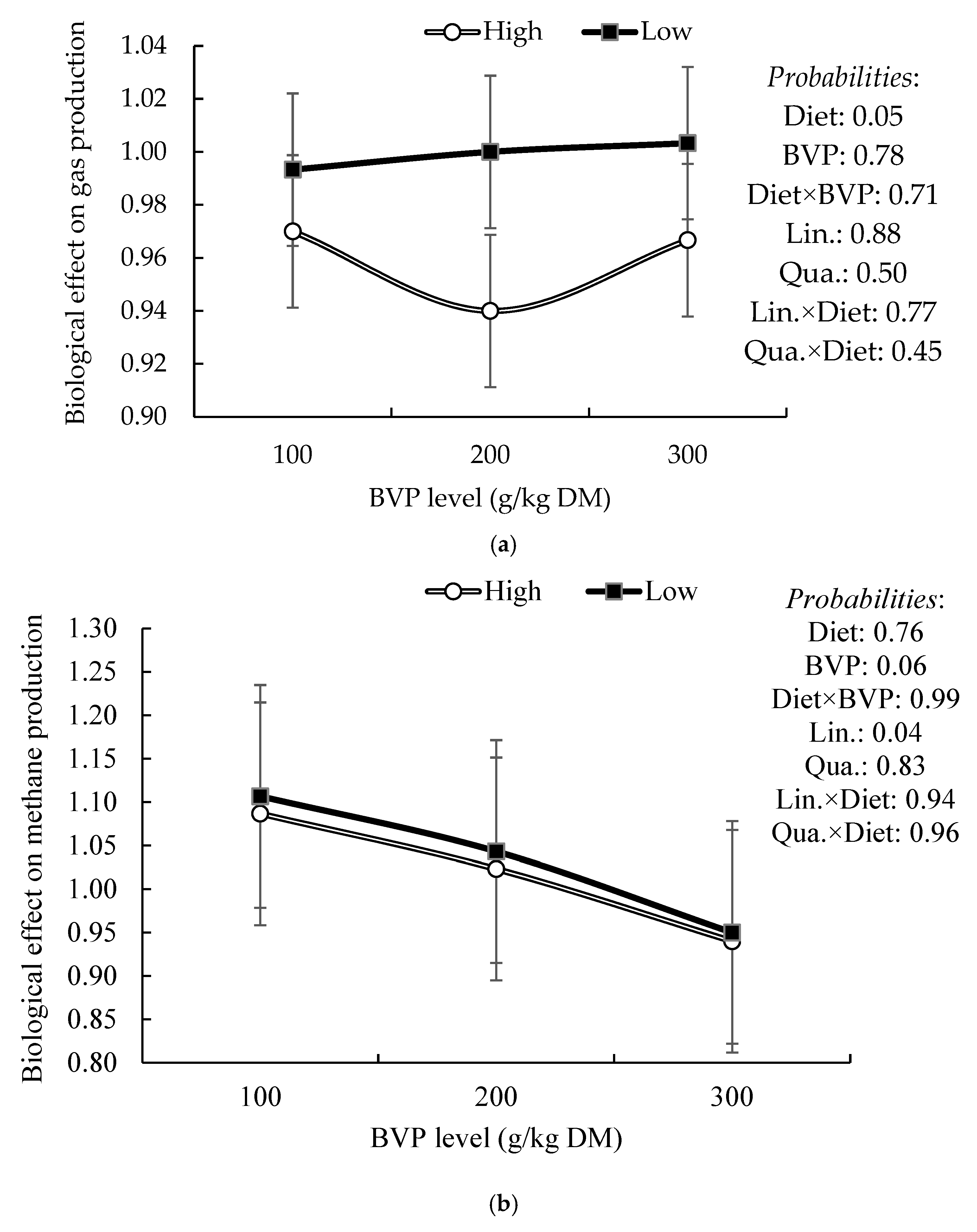
The BVP samples (n = 10) presented 917 ± 9.06 g/kg DM; 907 ± 8.16 g/kg OM; 151 ± 13.5 g/kg CP; 426 ± 22.84 g/kg NDF; 258 ± 17.40 g/kg ADF; 123 ± 9.68 g/kg Lignin; 21.2 ± 2.27 g/kg NFC; 58.3 ± 6.73 g/kg TT; and 51.9 ± 7.61 g/kg CT (Table 1). There was no BVP impact (p = 0.78) on gas production (Figure 1a). Nevertheless, BVP linearly decreased (p = 0.04) tannin-induced biological effects on methane production (Figure 1b).

3.2. In Vitro Apparent Digestibility, Partition Factor, and Gas Production

The inclusion of BVP in lactating cows’ diets did not affect (p ≥ 0.66) DM and OM digestibility independent (p ≥ 0.44) of diet energy level (Table 2). There was (p < 0.01) BVP and energy content effect on the partition factor and gas production to digestible organic matter ratio. In low-energy diets, BVP linearly increased the partition factor and reduced the gas-to-DOM ratio. In high-energy, BVP presented a quadratic effect (p ≤ 0.04) in both variables. Furthermore, BVP and dietary energy did not significantly affect methane production per g of digestible OM.

3.3. In Vitro Fermentation

There was no energy and BVP interaction effect (p ≥ 0.44) on in vitro pH, SCFA, isoacids, and substrates for gas production and microbial growth (Table 3). BVP linearly increased (p ≤ 0.03) in vitro pH and substrates for microbial growth, but decreased (p ≤ 0.02) SCFA, isoacids, and substrates for gas production. Analyses of acetate/propionate ratios indicated a BVP × energy level interaction (p = 0.09), attributable to a greater linear increase in low-energy than in high-energy diets. Intermediary BVP level increased NH3-N content in high-energy diets, while decreasing it in low-energy diets.

3.4. Kinetics of Gas Production

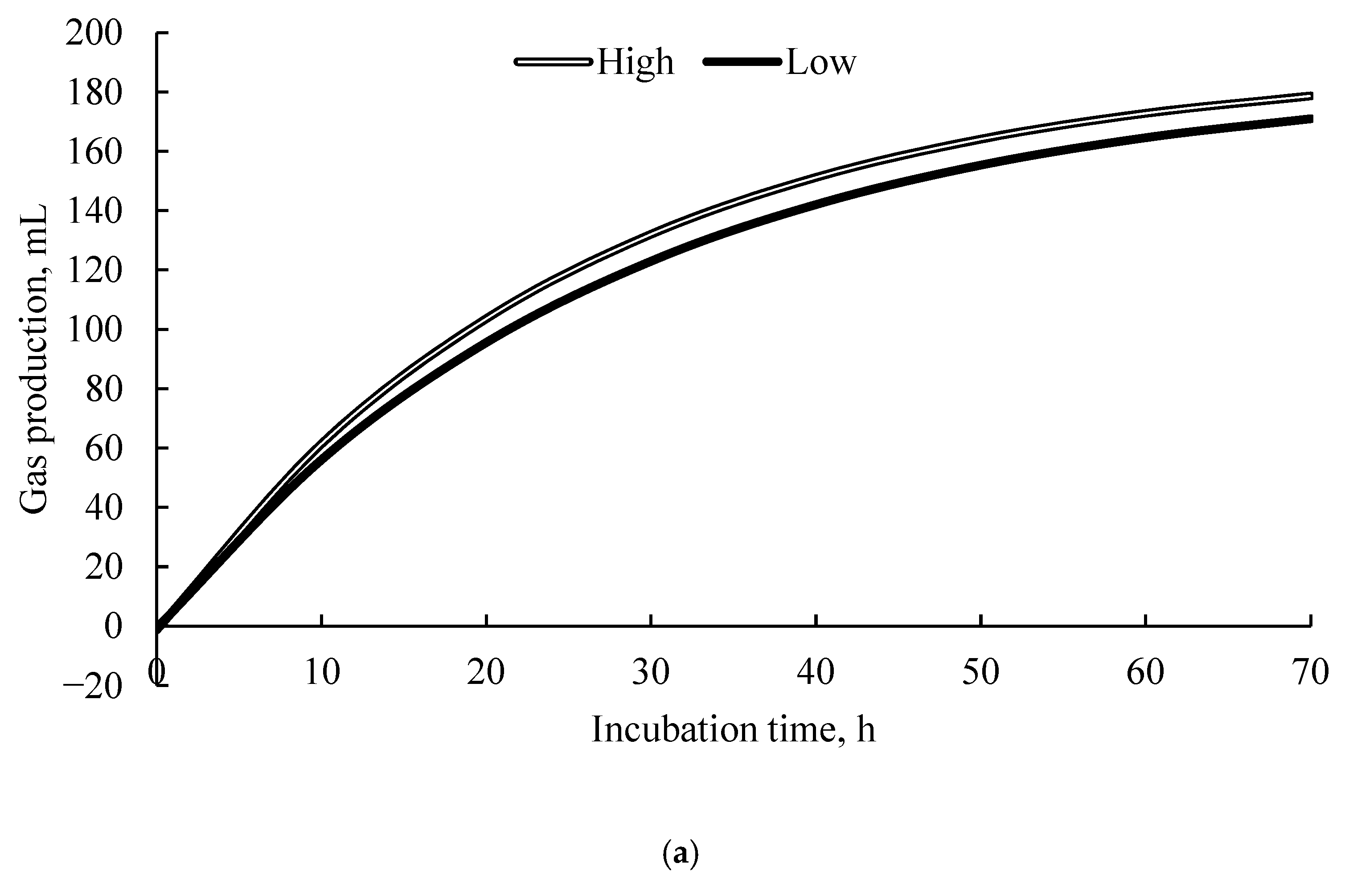
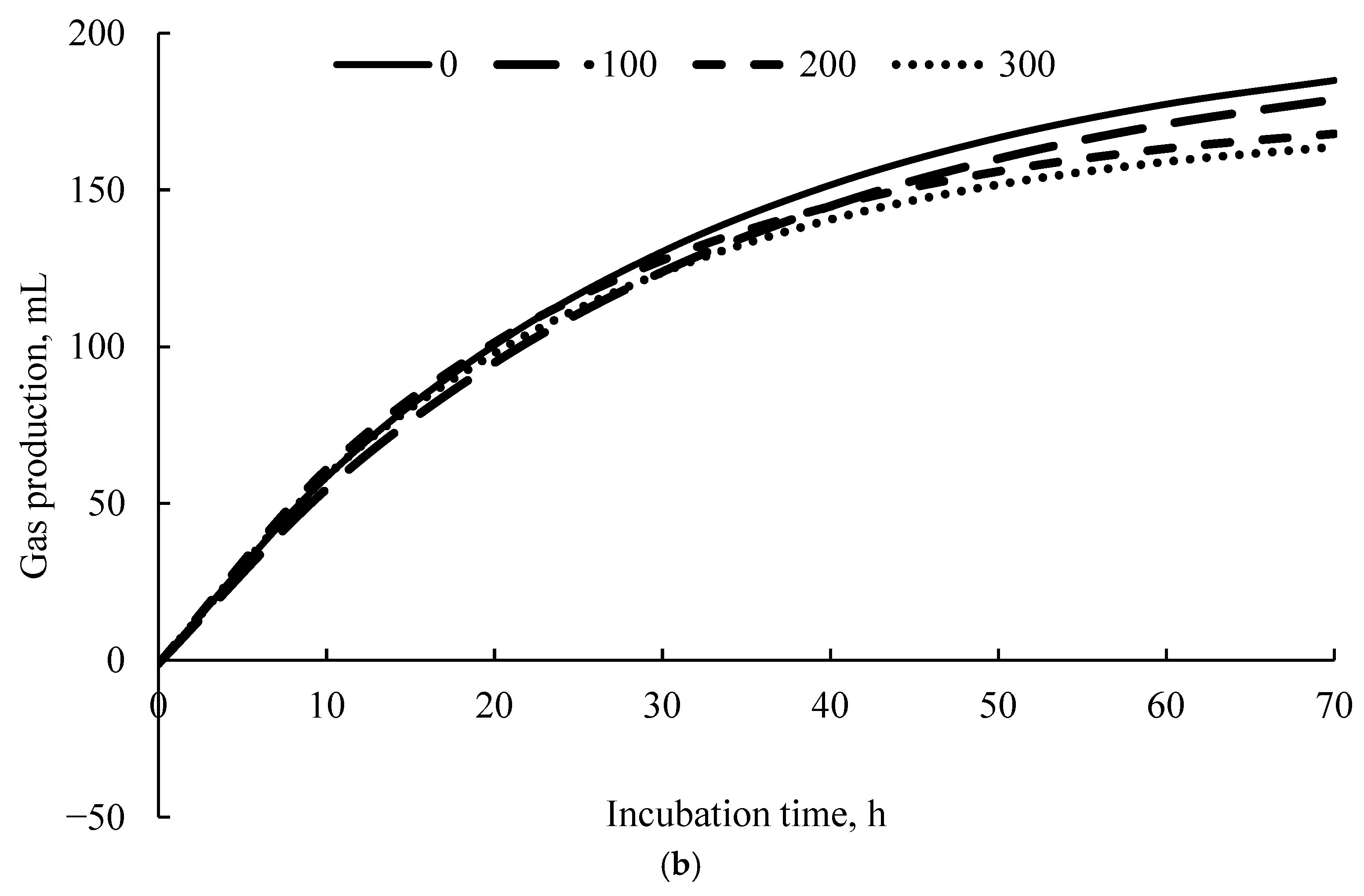
Dietary energy level did not affect (p ≥ 0.12) kinetic parameters of gas production (Table 4; Figure 2a,b). BVP linearly increased (p < 0.01) B-fraction and reduced A-fraction. High-energy diets showed higher 48 h gas production than low-energy diets, and BVP addition linearly decreased (p = 0.04) gas volume at 48 h.

4. Discussion

BVP supplementation was hypothesized to improve the fermentation profile and decrease methane production. Observed effects included linear increases in C2:C3 ratio and partition factor in low-energy diets and decreased SCFA concentration. Although BVP decreased methane production in the bioassay, no significant effects on methane were found across treatments.
The absence of BVP effects on DM and OM digestibility agrees with previous observations by Salazar et al. [5]. Lack of BVP impact may be attributed to dietary formulation, with BVP serving as a fiber source: low-energy diets contained 500 g/kg DM and high-energy diets 490 g/kg DM of total forage plus BVP. While BVP attenuated gas production potential (A-fraction kinetics) and reduced 48 h gas volume, prior work suggests in vitro gas is closely linked to SCFA profiles and acetate/butyrate ratios [14]. Increased gas in high-energy diets follows established patterns. BVP addition decreased 48 h gas volume at progressively higher inclusion levels, likely due to tannin content [18].
Despite raising C2:C3 ratios, BVP reduced SCFA production in the present study. Higher BVP levels increased tannin concentrations and partition factors in low-energy diets, in line with Bueno et al. [23]. Tannins have been scrutinized for their anti-nutritional effects but are now actively investigated as modulators of rumen fermentation for methane reduction [24]. Multiple studies document that BVP reduces ruminal methane synthesis via condensed tannins [5,8,25]. Linear decreases in methane observed with PEG exposure illustrate BVP’s anti-methanogenic capacity, though overall methane was unchanged. Methane formation depends on hydrogen availability, and BVP-induced propionate synthesis can reduce hydrogen [26,27]. Despite reductions in gas and previous reports of methane suppression by BVP, the present results found no methane effect, possibly due to rumen microorganisms’ ability to degrade polyphenolic polymers and mitigate tannin impact [24].
BVP addition and low-energy level increased in vitro pH, which is favorable for fiber degradation and microbial proliferation [28]. Fiber is necessary for acetate production and prevents ruminal acidification [29]. In the current study, BVP replaced forage sources and linearly increased pH and acetate synthesis. These findings support greater efficacy for BVP versus other forages tested. Similar results for acetate production were noted by Argôlo et al. [30] using S. tubulosa extracts in goat diets.
The use of sheep rumen fluid is justified by established in vitro methodology, as the supporting literature confirms its broad comparability to bovine inoculum for assessing general fermentation profiles [31,32]. We acknowledge, however, that while the overall approach is valid, species-specific differences exist. These variations, especially in ammonia concentration and the microbial community structure, may influence the absolute magnitude of certain endpoints, including methane production. Readers should thus interpret the precise scale of these results with appropriate caution when extrapolating directly to bovine systems, while the relative treatment effects remain robustly assessed. During in vitro fermentation assay, no ammonia-N absorption or recycling occurs [33]. Ammonia-N reflects the net balance between microbial degradation and uptake [34]. Intermediate BVP level decreased NH3-N content in low-energy diets, likely due to tannin protecting crude protein from ruminal degradation and ammoniacal nitrogen release, increasing duodenal protein supply [24,35]. In high-energy diets, BVP increased NH3-N content in the in vitro fermentation, possibly reflecting reduced N uptake due to decreased SCFA production.
Although substrate-to-gas values differed among diets, maximum gas production did not, indicating that the treatments influenced fermentation partitioning rather than the overall extent of substrate degradation. The substrate-to-gas ratio reflects how fermented substrate is distributed between gaseous (CO2 and CH4) and non-gaseous end products (VFA and microbial biomass). Thus, diets that promoted higher substrate-to-gas ratios likely redirected a greater proportion of degraded substrate toward VFA production and microbial synthesis without altering the asymptotic gas volume. This distinction in fermentation efficiency explains why shifts in substrate partitioning occurred independently of changes in maximum gas production.

5. Conclusions

The addition of BVP in dairy cow diets decreases gas and short-chain fatty acids production, increases C2:C3 ratio, and does not affect in vitro methane production.

Author Contributions

J.P.G.d.M.—Conceptualization, Supervision, and Writing—review and editing. A.L.A.—Conceptualization, Formal analysis, Funding acquisition, Investigation, Methodology, Supervision, and Writing—review and editing. A.d.A.O.—Conceptualization and Writing—review and editing. M.C.—Investigation, Methodology, Writing—original draft, and Writing—review and editing. F.B.F.—Writing—original draft and Writing—review and editing. T.A.D.V.—Conceptualization, Formal analysis, Visualization, Writing—original draft, and Writing—review and editing. All authors have read and agreed to the published version of the manuscript.

Funding

This research received no external funding.

Institutional Review Board Statement

The animal study protocol was approved by the Ethics Committee of the Center for Nuclear Energy in Agriculture of the University of São Paulo (protocol code under institutional animal ethics approval (CEUA-CENA 011/2016), approval on November 4, 2016.

Data Availability Statement

The datasets generated during the analysis are available from the corresponding author on reasonable request.

Conflicts of Interest

The authors declare no conflicts of interest.

References

  1. Olival, A.A.; Souza, S.E.X.F.; Morais, J.J.G.; Campana, M. Effect of Amazonian tree species on soil and pasture quality in silvopastoral systems. Acta Amaz. 2021, 51, 281–290. [Google Scholar] [CrossRef]
  2. Delgado, D.C.; Hera, R.; Cairo, J.; Orta, Y. Samanea saman, árbol multipropósito con potencialidades como alimento alternativo para animales de interés productivo. Rev. Cubana Cienc. Agric. 2014, 48, 205–212. [Google Scholar]
  3. Andrade, C.M.S.; Salman, A.K.D.; Oliveira, T.K. Guia Arbopasto: Manual de Identificação e Seleção de Espécies Arbóreas para Sistemas Silvipastoris; EMBRAPA: Brasília, Brazil, 2012. [Google Scholar]
  4. Staples, G.W.; Elevitch, C.R. Samanea saman (rain tree). In Species Profiles for Pacific Island Agroforestry; Elevitch, C.R., Ed.; Permanent Agriculture Resources: Holualoa, HI, USA, 2006; pp. 1–13. [Google Scholar]
  5. Salazar, S.S.V.; Vasquez, A.T.P.; Botero, I.C.M.; Balbuena, F.J.L.; Narvaez, J.J.U.; Campos, M.R.S.; Avilés, L.R.; Sánchez, F.J.S.; Vera, J.C.K. Potential of Samanea saman pod meal for enteric methane mitigation in crossbred heifers fed low-quality tropical grass. Agric. For. Meteorol. 2018, 258, 108–116. [Google Scholar] [CrossRef]
  6. Patra, A.K. Enteric methane mitigation technologies for ruminant livestock: A synthesis of current research and future directions. Environ. Monit. Assess. 2012, 184, 1929–1952. [Google Scholar] [CrossRef]
  7. Knapp, J.R.; Laur, G.L.; Vadas, P.A.; Weiss, W.P.; Tricarico, J.M. Invited review: Enteric methane in dairy cattle production: Quantifying the opportunities and impact of reducing emissions. J. Dairy Sci. 2014, 97, 3231–3261. [Google Scholar] [CrossRef]
  8. Anantasook, N.; Wanapat, M.; Cherdthong, A.; Gunun, P. Effect of tannins and saponins in Samanea saman on rumen environment, milk yield and milk composition in lactating dairy cows. J. Anim. Physiol. Anim. Nutr. 2015, 99, 335–344. [Google Scholar] [CrossRef]
  9. Yáñez-Ruiz, D.R.; Bannink, A.; Dijkstra, J.; Kebreab, E.; Morgavi, D.P.; O’Kiely, P.; Reynolds, C.K.; Schwarm, A.; Shingfield, K.J.; Yu, Z.; et al. Design, implementation and interpretation of in vitro batch culture experiments to assess enteric methane mitigation in ruminants—A review. Anim. Feed Sci. Technol. 2016, 216, 1–18. [Google Scholar] [CrossRef]
  10. Tedeschi, L.O.; Abdalla, A.L.; Álvarez, C.; Anuga, S.W.; Arango, J.; Beauchemin, K.A.; Becquet, P.; Berndt, A.; Burns, R.; De Camillis, C.; et al. Quantification of methane emitted by ruminants: A review of methods. J. Anim. Sci. 2022, 100, skac197. [Google Scholar] [CrossRef] [PubMed]
  11. National Research Council (NRC). Nutrient Requirements of Dairy Cattle, 7th ed.; National Academy Press: Washington, DC, USA, 2001. [Google Scholar]
  12. Bueno, I.C.S.; Cabral Filho, S.L.S.; Gobbo, S.P.; Louvandini, H.; Vitti, D.M.S.S.; Abdalla, A.L. Influence of inoculum source in a gas production method. Anim. Feed Sci. Technol. 2005, 123, 95–105. [Google Scholar] [CrossRef]
  13. Longo, C.; Bueno, I.C.S.; Nozella, E.F.; Godoy, P.B.; Cabral Filho, S.L.S.; Abdalla, A.L. The influence of headspace and inoculum dilution on in vitro ruminal methane measurements. Int. Congr. Ser. 2006, 1293, 62–65. [Google Scholar] [CrossRef]
  14. Blümmel, M.; Bullerdieck, P. The need to complement in vitro gas production measurements with residue determinations from in sacco degradabilities to improve the prediction of voluntary intake of hays. Anim. Sci. 1997, 64, 71–75. [Google Scholar] [CrossRef]
  15. Bueno, I.C.S.; Vitti, D.M.S.S.; Louvandini, H.; Abdalla, A.L.A. A new approach for in vitro bioassay to measure tannin biological effects based on a gas production technique. Anim. Feed Sci. Technol. 2008, 141, 153–170. [Google Scholar] [CrossRef]
  16. AOAC. Official Methods of Analysis, 18th ed.; Association of Official Analytical Chemists: Washington, DC, USA, 2005. [Google Scholar]
  17. Van Soest, P.J.; Robertson, J.B.; Lewis, B.A. Methods for dietary fiber, neutral detergent fiber, and nonstarch polysaccharides in relation to animal nutrition. J. Dairy Sci. 1991, 74, 3583–3597. [Google Scholar] [CrossRef] [PubMed]
  18. Makkar, H.P.S. Effects and fate of tannins in ruminant animals, adaptation to tannins, and strategies to overcome detrimental effects of feeding tannin-rich feeds. Small Rumin. Res. 2003, 49, 241–256. [Google Scholar] [CrossRef]
  19. Hall, M.B. Neutral Detergent-Soluble Carbohydrates: Nutritional Relevance and Analysis; University of Florida: Gainesville, FL, USA, 2000; 76p. [Google Scholar]
  20. Preston, T.R. Tropical Animal Feeding: A Manual for Research Workers; FAO: Rome, Italy, 1995. [Google Scholar]
  21. Lima, P.M.T.; Moreira, G.D.; Sakita, G.Z.; Natel, A.S.; Mattos, W.T.; Gimenes, F.M.A.; Gerdes, L.; McManus, C.; Abdalla, A.L.; Louvandini, H. Nutritional evaluation of the legume Macrotyloma axillare using in vitro and in vivo bioassays in sheep. J. Anim. Physiol. Anim. Nutr. 2018, 102, 669–676. [Google Scholar] [CrossRef]
  22. France, J.; Dhanoa, M.S.; Theodorou, M.K.; Lister, S.J.; Davies, D.R.; Isac, D. A model to interpret gas accumulation profiles associated with in vitro degradation of ruminant feeds. J. Theor. Biol. 1993, 163, 99–111. [Google Scholar] [CrossRef]
  23. Bueno, I.C.S.; Brandi, R.A.; Fagundes, G.M.; Benetel, G.; Muir, J.P. The role of condensed tannins in the in vitro rumen fermentation kinetics in ruminant species: Feeding type involved? Animals 2020, 10, 635. [Google Scholar] [CrossRef]
  24. Patra, A.K.; Saxena, J. Exploitation of dietary tannins to improve rumen metabolism and ruminant nutrition. J. Sci. Food Agric. 2011, 91, 24–37. [Google Scholar] [CrossRef]
  25. Anantasook, N.; Wanapat, M.; Cherdthong, A. Manipulation of ruminal fermentation and methane production by supplementation of rain tree pod meal containing tannins and saponins in growing dairy steers. J. Anim. Physiol. Anim. Nutr. 2012, 98, 50–55. [Google Scholar] [CrossRef]
  26. Russell, J.B. Rumen Microbiology and Its Role in Ruminant Nutrition; Cornell University: Ithaca, NY, USA, 2002. [Google Scholar]
  27. Janssen, P.H. Influence of hydrogen on rumen methane formation and fermentation balances through microbial growth kinetics and fermentation thermodynamics. Anim. Feed Sci. Technol. 2010, 160, 1–22. [Google Scholar]
  28. Wanapat, M. Feeding of Ruminants in the Tropicals Based on Local Feed Resources; Khon Kaen Publishing Company Ltd.: Khon Kaen, Thailand, 1999; 236p. [Google Scholar]
  29. Galyean, M.L.; Hubbert, M.E. Review: Traditional and alternative sources of fiber—Roughage values, effectiveness, and levels in starting and finishing diets. Prof. Anim. Sci. 2014, 30, 571–584. [Google Scholar] [CrossRef]
  30. Argôlo, L.S.; Pereira, M.L.A.; Dias, J.C.T.; Cruz, J.F.; Del Rei, A.J.; Oliveira, C.A.S. Mesquite pod meal in diets of lactating goats: Ruminal parameters and microbial efficiency synthesis. Rev. Bras. Zootec. 2010, 39, 541–548. [Google Scholar] [CrossRef]
  31. Spanghero, M.; Braidot, M.; Fabro, C.; Romanzin, A. A meta-analysis on the relationship between rumen fermentation parameters and protozoa counts in in vitro batch experiments. Anim. Feed Sci. Technol. 2022, 293, 115471. [Google Scholar] [CrossRef]
  32. Bueno, I.C.S.; Cabral Filho, S.L.M.; Gobbo, S.P.; Costa, S.F.; Stefani, P.R.; Abdalla, A.L. Comparison of inocula from sheep and cattle for the in vitro fermentation of tropical feedstuffs. Anim. Feed Sci. Technol. 1999, 83, 67–77. [Google Scholar]
  33. Lapierre, H.; Lobley, G.E. Nitrogen recycling in the ruminant: A review. J. Dairy Sci. 2001, 84, 223–236. [Google Scholar] [CrossRef]
  34. Getachew, G.; Makkar, H.P.S.; Becker, K. Tannins in tropical browses: Effects on in vitro microbial fermentation and microbial protein synthesis in media containing different amounts of nitrogen. J. Agric. Food Chem. 2000, 48, 3581–3588. [Google Scholar] [CrossRef]
  35. Waghorn, G. Beneficial and detrimental effects of dietary condensed tannins for sustainable sheep and goat production—Progress and challenges. Anim. Feed Sci. Technol. 2008, 147, 116–139. [Google Scholar] [CrossRef]
Figure 1. (a) Biological effect of tannins from BVP on gas and methane production. Mean ± standard error of mean. (b) Biological effect of tannins from BVP on gas and methane production. Mean ± standard error of mean.
Ruminants 05 00064 g001
Figure 2. (a) Curve of non-linear gas production models of dairy cows’ diets containing energy levels (low and high) and increasing BVP levels (0, 100, 200, and 300 g/kg DM). (b). Curve of non-linear gas production models of dairy cows’ diets containing energy levels (low and high) and increasing BVP levels (0, 100, 200, and 300 g/kg DM).
Ruminants 05 00064 g002aRuminants 05 00064 g002b
Table 1. Ingredients and chemical composition of experimental diets.
ItemHigh-Energy 1Low Energy 1
0 2100 2200 2300 20 2100 2200 2300 2
Ingredients, g/kg DM 3
Corn silage4603702801900.00.00.00.0
BVP 40.01002003000.0100200300
Cynodon hay30.020.010.00.0500400300200
Ground corn241248255262252214176138
Soybean meal21419116814514011080.050.0
Citric pulp45.030.015.00.090.080.070.060.0
Soybean hulls0.031.062.093.00.078.0156234
Mineral premix10.010.010.010.010.010.010.010.0
Urea0.00.00.00.08.08.08.08.0
Chemical composition, g/kg DM
Neutral detergent fiber347347347347488488488488
Non-fiber carbohydrates416416417417304302299297
Acid detergent fiber187192197202274286297309
Lignin3.13.94.75.55.25.76.26.6
Crude protein166166166166150150150150
Ether extract3027252232282522
RDP 5107105104102109107105103
RUP 660.061.362.764.041.043.345.748.0
TDN 7700683667650640623607590
1 Diets formulated to high- (40 kg/d) and low (20 kg/d)-production dairy cows. 2 Increasing levels of Bordão-de-Velho (Samanea tubulosa) pods in the diets. 3 Dry matter. 4 Bordão-de-Velho (Samanea tubulosa) pods. 5 Rumen degradable protein calculated according to [11]. 6 Rumen undegradable protein calculated according to NRC (2001). 7 Total digestible nutrients.
Table 2. In vitro apparent digestibility, partition factor, and gas production of dairy cows’ diets containing energy levels and increasing BVP levels.
ItemDiet 1BVP 2, g/kg DMSEMProbabilities 3
HighLow0100200300DietBVPLin.Qua.Diet × BVPDiet × Lin.Diet × Qua
DM 4 digestibility, g/kg6505846176226106193.56<0.010.710.890.820.570.70.26
OM 5 digestibility, g/kg6826186516576426513.67<0.010.600.660.820.440.480.22
Partition factor 64.093.933.894.013.964.180.04<0.01<0.01<0.010.20<0.01<0.010.01
High 4.144.004.024.20.04 0.040.360.01
Low 3.644.013.94.160.04 <0.01<0.010.33
GP:DOM 7, mL/g2132212232162202102.22<0.01<0.01<0.010.41<0.01<0.010.05
High 2112152162092.43 0.190.650.04
Low 2352172232112.43 <0.01<0.010.41
CH4:DOM 8, mL/g23.226.124.722.625.625.60.930.100.540.460.540.790.770.37
1 Diets formulated to high (40 kg/d) and low (20 kg/d) production dairy cows. 2 Increasing levels of Bordão-de-Velho (Samanea tubulosa) pods in the diets. 3 Probabilities. 4 Dry matter. 5 Organic matter. 6 Ratio between digestible organic matter (g) and gas production (mL). 7 Gas production (mL) and digestible organic matter (g) ratio. 8 Methane (mL) to digestible organic matter (g) ratio.
Table 3. In vitro fermentation of dairy cows’ diets containing energy levels and increasing BVP levels.
ItemDiet 1BVP 2, g/kgSEMProbabilities 3
HighLow0100200300DietBVP.Lin.Qua.Diet × BVPDiet ×
Lin.
Diet ×
Qua
pH6.696.786.686.746.746.760.012<0.010.110.030.370.420.120.74
NH3-N 4, %0.0520.0550.0520.0530.0530.0530.0071<0.010.020.010.69<0.010.75<0.01
High 0.0480.0550.0530.0510.0080 <0.010.030.01
Low 0.0550.0520.0530.0570.0080 0.010.08<0.01
SCFA 5, mmol/L1761621731741661651.6<0.010.060.020.650.210.080.49
C2:C3 6 ratio0.800.980.840.860.920.940.015<0.01<0.01<0.010.960.090.020.70
High 0.780.780.820.840.016 0.01<0.010.75
Low 0.910.951.011.040.016 <0.01<0.010.81
Isoacids, mmol/L4.334.124.374.484.183.870.0870.070.01<0.010.080.660.850.37
Substrate to gas, mg2522372492502392501.7<0.010.040.010.560.180.070.47
Substrate to microbials, mg3332873023083083223.8<0.010.060.010.440.210.070.28
1 Diets formulated to high (40 kg/d) and low (20 kg/d) production dairy cows. 2 Increasing levels of Bordão-de-Velho (Samanea tubulosa) pods in the diets. 3 Probabilities. 4 Amonnia nitrogen. 5 Short-chain fatty acids. 6 Acetate to propionate ratio.
Table 4. In vitro gas production kinetics of dairy cows’ diets containing energy levels and increasing BVP levels.
ItemDiet 1BVP 2, g/kgSEMProbabilities 3
HighLow0100200300 DietBVP.Lin.Qua.Diet × BVPDiet × Lin.Diet × Qua
A 41911862041991771735.20.34<0.01<0.010.980.210.070.33
B 50.0390.0360.0340.0320.0420.0420.00140.12<0.01<0.010.820.100.250.03
C 6−0.018−0.012−0.022−0.008−0.017−0.0130.00360.170.210.460.290.420.870.19
L 70.1640.0970.1150.1450.1370.1250.04320.120.950.900.610.870.970.45
µ48 81571471571541501472.60.010.200.040.960.240.140.49
1 Diets formulated to high (40 kg/d) and low (20 kg/d) production dairy cows. 2 Increasing levels of Bordão-de-Velho (Samanea tubulosa) pods in the diets. 3 Probabilities. 4 Potential of gas production. 5,6 Fractional degradation rates. 7 Lag time. 8 Effective gas production at 48 h of incubation.
Disclaimer/Publisher’s Note: The statements, opinions and data contained in all publications are solely those of the individual author(s) and contributor(s) and not of MDPI and/or the editor(s). MDPI and/or the editor(s) disclaim responsibility for any injury to people or property resulting from any ideas, methods, instructions or products referred to in the content.