


Abstract
This study introduces a novel matrix defined over the nonzero natural numbers, whose entries are governed by a rigorous closed-form expression. The matrix architecture replicates the topological properties of the Ulam spiral, mapping the integer sequence onto a structured lattice with a well-defined formulation. We investigate the interplay between the matrix’s linear algebraic properties and its number-theoretic implications. A primary focus is the established connection between the matrix’s lines, rows, diagonals, and antidiagonals, and the Hardy–Littlewood F-conjecture. By analyzing the matrix’s internal structure, this work provides a new analytical framework for further study of the conjecture. The matrix links its visual characteristics to quadratic polynomials, offering fresh insights into the distribution of prime numbers.
Keywords:
Ulam spiral; Hardy–Littlewood conjecture; Bateman–Horn conjecture; prime numbers; quadratic polynomials MSC:
11B34; 11C08; 15A15; 15B36
1. Introduction
The Ulam spiral, or prime spiral, is a graphical depiction of the set of prime numbers, developed by the mathematician Stanisław Ulam in 1963 [1] and later popularized by Martin Gardner [2]. While attending a scientific meeting, Ulam began doodling on a grid, labeling the nonzero natural numbers in a counterclockwise spiral starting from the center. This construction reveals unexpected linear concentrations of primes along diagonal, horizontal, and vertical paths. These alignments correspond to quadratic polynomials, such as Euler’s [3], which are conjectured to produce a high density of prime values [4]. Consequently, the spiral serves as a visual bridge to fundamental unsolved problems in number theory, illustrating deep-seated regularities in the distribution of prime numbers [5].
Ulam’s spiral is only one among several geometric constructions that reveal hidden structures in arithmetic sequences. Closely related is the Sacks spiral, in which integers are placed along an Archimedean spiral and primes tend to concentrate along smooth curves [6]. Other geometric constructions embed arithmetic information into lattices or modular spaces, such as planar visualizations of the Gaussian integers and modular multiplication circles. These representations are frequently used as exploratory tools in experimental number theory to expose symmetry and periodicity [7].
The Hardy–Littlewood F-conjecture provides the theoretical underpinning for the visual patterns observed in the Ulam spiral [8]. While the spiral geometrically arranges integers, conjecture F analytically predicts the density of primes generated by the quadratic polynomials that characterize the spiral’s diagonal lines. According to the conjecture, the frequency of primes along these paths is determined by a specific constant that depends on the polynomial’s coefficients and their arithmetic properties. The striking alignments in the Ulam spiral can thus be interpreted as geometric manifestations of these density constants, suggesting that the concentration of primes is not random but follows a predictable asymptotic distribution governed by deeper structures in analytic number theory. Bateman and Horn later generalized the Hardy–Littlewood F-conjecture employing polynomials [9].
In this research, we introduce a novel matrix whose entries are rigorously defined through a specific mathematical formulation. The matrix architecture mirrors the topological configuration of the Ulam spiral, exhibiting a recursive layering that maps the natural numbers onto a square lattice while preserving the distinctive “diagonal bias” inherent in such arrangements. Unlike traditional spiral constructions that rely on iterative walks, our approach utilizes a closed-form expression for the matrix entries. This formulation allows for the direct calculation of any element without recursive iteration, offering new insights into the behavior of prime numbers. Towards this direction, we conduct a comprehensive dual analysis of the matrix, examining its properties within the frameworks of both linear algebra and number theory. In particular, we investigate its spectral properties and the number-theoretic significance of the sequences it generates, especially in relation to the Hardy–Littlewood F-conjecture. The derivation of a closed-form expression for the matrix entries provides a robust computational framework that transforms the visual heuristics of prime-generating spirals into a structured linear operator. This unification offers new insights into the behavior of prime numbers, suggesting that the matrix serves as a critical bridge between the spatial organization of integers and the analytic depth of the Hardy–Littlewood conjecture, thereby facilitating deeper study of the regularities underlying the distribution of primes.
2. Mathematical Preliminaries
2.1. The Hardy–Littlewood Conjectures
In the early 1920s, G. H. Hardy and J. E. Littlewood introduced a series of deep conjectures concerning the distribution of prime numbers, collectively known as the Hardy–Littlewood conjectures [8]. These conjectures extend earlier ideas of Dirichlet [10] and refine the prime number theorem by predicting precise asymptotic formulas for various prime patterns.
The most general of these conjectures is the prime k-tuple conjecture. Let
be a finite set of distinct integers. The set is called admissible if, for every prime p, the residues do not cover all residue classes modulo p. Hardy and Littlewood [11] conjectured that, for admissible , the number of integers , such that all are prime, satisfies the following
with
where # represents the cardinality of the set, is the singular series, the product runs for every prime p and denotes the number of distinct residue classes modulo p occupied by the elements of .
A notable special case is obtained by taking , which yields the Twin Prime conjecture. In this case, the conjecture predicts that the number of twin primes less than x is asymptotic to
where
is the twin prime constant.
The Hardy–Littlewood F-conjecture concerns the frequency with which a fixed polynomial takes prime values. Let be a non-constant, irreducible polynomial with positive leading coefficient, and assume that there is no prime p such that for all integers n. The conjecture predicts that the number of integers for which is prime satisfies an asymptotic formula of the form
where is a convergent product over primes, known as the singular series, encoding the local congruence obstructions to primality. This conjecture generalizes earlier heuristics of Bunyakovsky and fits naturally within the broader Hardy–Littlewood circle of conjectures on prime distributions. Despite strong numerical evidence and partial results under additional hypotheses, the F-conjecture remains unproven.
Although none of the Hardy–Littlewood conjectures have been proven in full, they are supported by extensive numerical evidence and play a central role in modern analytic number theory. Partial results have been obtained under strong hypotheses such as the generalized Riemann Hypothesis [12], and recent breakthroughs on bounded gaps between primes provide indirect evidence for the validity of these conjectures.
2.2. The Bateman–Horn Conjecture
The Bateman–Horn conjecture [9] provides a far-reaching generalization of earlier conjectures of Hardy and Littlewood on the distribution of prime values of polynomials. Given a finite collection of irreducible polynomials with positive leading coefficients and no fixed prime divisor, the conjecture predicts an asymptotic formula for the number of integers for which all values are simultaneously prime. The predicted asymptotic has the form
where is a singular series encoding local congruence obstructions modulo primes. When the polynomials are linear, this conjecture reduces to the Hardy–Littlewood prime k-tuple conjecture, while the case recovers the Hardy–Littlewood F-conjecture for prime values of a single polynomial. In this way, the Bateman–Horn conjecture unifies and extends the classical Hardy–Littlewood conjectures into a single comprehensive framework for predicting prime patterns.
2.3. The Ulam Spiral
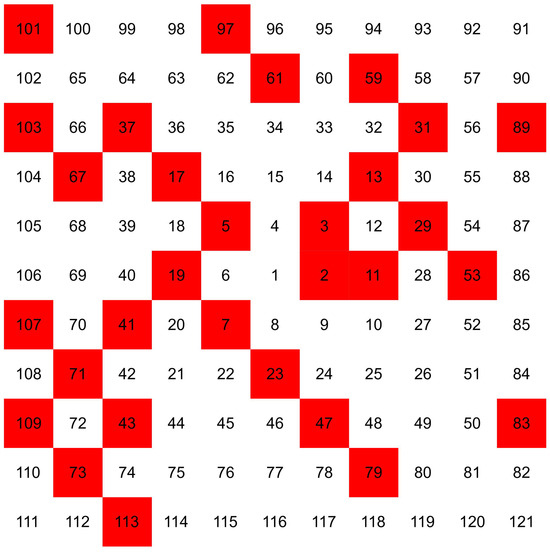
Conceived by Stanisław Ulam in 1963, the Ulam spiral is a geometric visualization of prime numbers generated by mapping positive integers onto a square lattice [1]. When the primes are marked, striking diagonal, linear, and quadratic patterns emerge, suggesting unexpected structure in the distribution of prime numbers. The construction begins by placing the natural 1 at the origin of a lattice. The subsequent naturals are placed sequentially while spiraling outward in a square pattern. Formally, this defines a bijection between the natural numbers and points in . Prime numbers are then emphasized (for example, by coloring or marking them), producing the Ulam spiral. For any non-zero natural n, its position is determined by the largest perfect square less than or equal to In Figure 1 is presented the Ulam spiral with the first 100 natural numbers, where the prime numbers are highlighted with red color.
Figure 1.
The Ulam spiral with the non-zero naturals numbers up to 121.
One of the most notable properties of the Ulam spiral is the appearance of diagonal lines containing a high density of primes. These diagonals often correspond to quadratic polynomials of the form where a, b and c are constants. A famous example of such a sequence, visible on the spiral, is Euler’s prime-generating polynomials which produces prime numbers for or depending in the sign of n [3]. This phenomenon is deeply rooted in the theory of imaginary quadratic fields; specifically, the discriminant of these polynomials is , which is the largest of the nine Heegner numbers [13] for which the corresponding ring of integers has a class number of 1. While the polynomial eventually fails to produce a prime at or , recent research continues to explore its structural properties, such as its connection to the distribution of primes in the Ulam spiral and its utility in proposing candidate exponents for Mersenne primes [14].
The presence of such diagonals is not accidental. It is closely related to the fact that certain quadratic polynomials avoid trivial divisibility obstructions modulo small primes, making them more likely to produce primes [15]. However, no nonconstant polynomial with integer coefficients can generate only primes, as has been proven using elementary modular arguments.
The visual patterns observed in the Ulam spiral provide empirical support for the Hardy–Littlewood F-conjecture, which concerns the density of primes in quadratic forms. The clustering on specific diagonals indicates that certain quadratic polynomials have a much higher density of prime values than others, a phenomenon deeply linked to the discriminant of the polynomial and the Legendre symbol [5].
3. The New Matrix
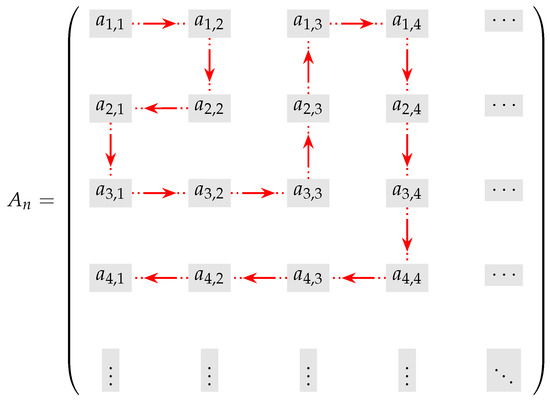
Consider a matrix which is created using a snake-like filling pattern, that traces the perimeter of expanding squares (Figure 2).
Figure 2.
The structure of the matrix.
In this matrix, each element is substituted with consecutive non-zero natural numbers. For instance the first four matrices are given in (8), (9).
The mathematical formulation of the elements of is
for all which means that elements of each row, column or diagonal of the matrix can be expressed through quadratic polynomials.
The matrix does not seem to have any obvious symmetry. This is not quite true, because
and
and, thus, the matrix is symmetric up to a sign-skew linear term and depends only on reflecting a kind of algebraic symmetry. Specifically, if
the matrix is symmetric; i.e., and the matrix is skew-symmetric, satisfying the relation and [16]. In relation (15) we present these matrices for
Specifically, the symmetric matrices have the following expressions:
where are matrices, with the first i elements equal to 1 and the others equal to
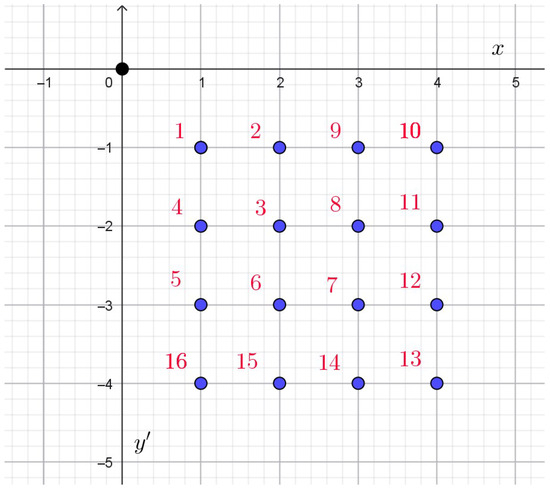
This construction defines several bijections between the natural numbers without zero, and points in For instance, we can define a bijection, via the formula
and its graphical representation is presented in Figure 3.
Figure 3.
The graphical representation of the bijection f for the non-zero natural numbers up to 16.
3.1. Number Theory from the Matrix
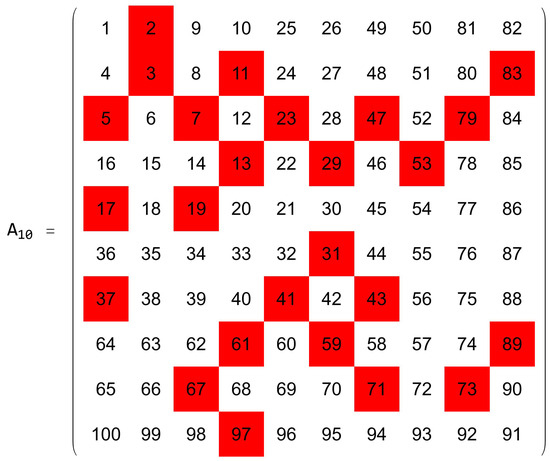
The matrix reveals structural alignments of prime numbers. Similarly to the observations made by Ulam [1], the snake-like filling pattern highlights quadratic polynomials of the form . In Figure 4 the matrix is presented, highlighting the prime numbers with red color.
Figure 4.
The constructed matrix with the non-zero natural numbers up to 100.
The main diagonal follows the sequence which is governed by the following formula:
This is one sequence of the famous centered polygonal numbers (i.e., Hogben’s numbers) that is known to be prime-rich [17]. For example, in the diagonal elements are 1, 3, 7, 13, 21, 31, 43, 57, 73, 91. Out of these, 3, 7, 13, 31, 43, 73 are prime numbers.
All the odd super/subdiagonals consist of even numbers and therefore there are no primes (except the first superdiagonal which begins with the number 2) and therefore all the odd primes are in the even super/subdiagonals of the matrix The elements of the odd super/subdiagonals have the form or , where k is odd, and the following formulas stand:
where are both even numbers, proving that these elements are even.
Moreover, the elements of each diagonal result from two second-degree polynomials which alternate one after another. For instance, the elements of second superdiagonal are given via the relation
which are all odd numbers.
The elements of the antidiagonals of the matrix have more complicated expressions, though they switch formulas at the center of the matrix. Nevertheless, they are also expressed using quadratic polynomials, despite of the fact that two quadratic polynomials are needed. The elements of the antidiagonal for are
Furthermore, all the odd super/subantidiagonals consist of even numbers and therefore there are no primes (except the first superantidiagonal) and therefore all the odd primes are in the other super/subantidiagonals of the matrix For instance, the elements for of the first superantidiagonal are given via the following formula:
which are all even.
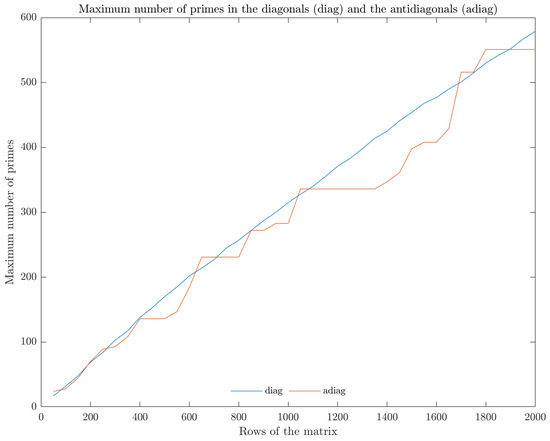
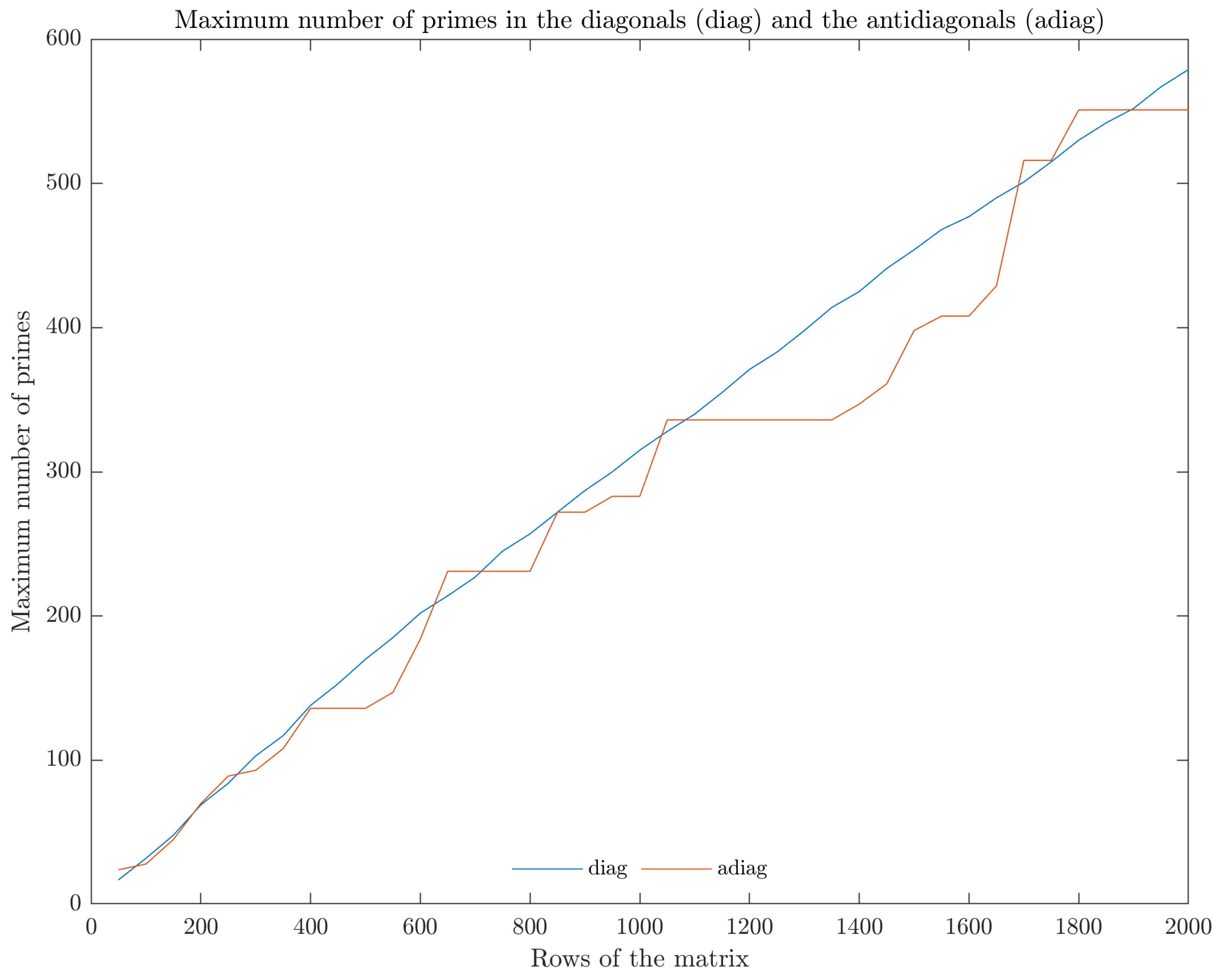
It is clear that in those matrices the position of the prime numbers arise some interesting properties. The most striking property of these matrices is that primes often fall on the even diagonals or on the odd antidiagonals of the matrix. As a matter of fact, it is a diagonal that has the maximum number of prime numbers in each matrix compared with the maximum number of prime numbers in the antidiagonals, which becomes clear after the 300 first matrices. In particular, studying the first 499 matrices (Figure 5), we conclude that in 313 the maximum number of primes is on a diagonal, while in 157 it is an antidiagonal.
Figure 5.
Maximum number of primes among all the diagonals and all the antidiagonals with matrices up to
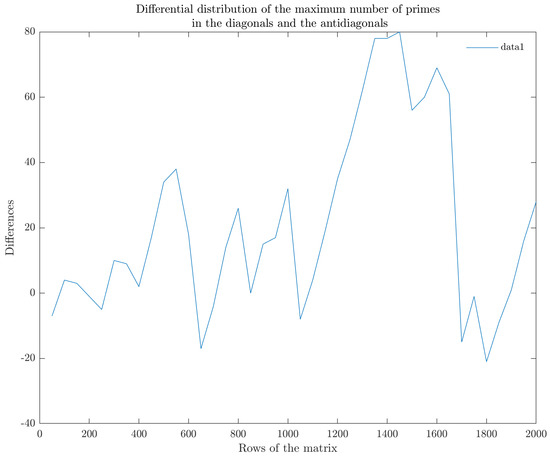
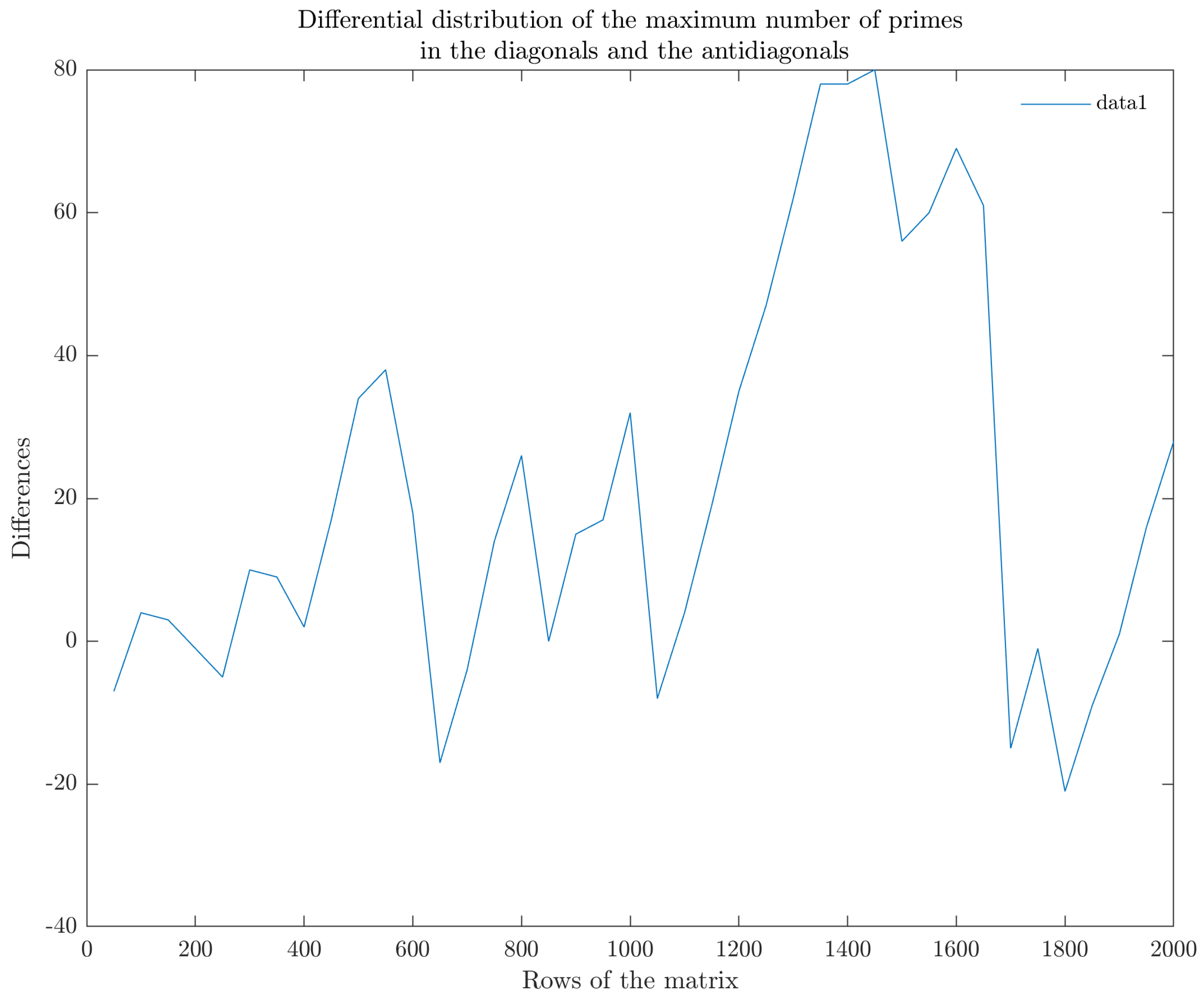
This is a conjecture which is verified with all the matrices that we used. In Figure 6 we present the differences between the maximum number of primes in the diagonal and the antidiagonal with matrices ,
Figure 6.
Differential distribution of the maximum number of prime numbers between diagonal and the antidiagonal elements for the matrices
These matrices are a discrete representation of a quadratic sieve. If you were to extend to a very large you would see the “prime lines” clearly. This is significant because it suggests that certain quadratic polynomials produce primes at a much higher rate than others, a phenomenon still being studied in analytic number theory (related to the Bateman–Horn conjecture). A special case of the Bateman–Horn conjecture is the Hardy–Littlewood F-conjecture [8], which often appears in the matrix Focusing in the first row there are the even numbers of the sequence while focusing in the first column there are their odd numbers and therefore the majority of the primes related to the most studied application of the Hardy–Littlewood F-conjecture [18].
Moreover, in this matrix the elements of every row that belong to the lower diagonal part of the matrix are parts of an arithmetic sequence with difference one (even rows) or minus one (odd rows), while the elements of every row that belong to the upper diagonal part of the matrix are defined through two quadratic polynomials separately. In order to visualize this, the elements of the third row are
Similarly, the elements of every column that belong to the upper diagonal part of the matrix construct an arithmetic sequence with difference one (odd rows) or minus one (even rows) and the elements of every column that belong to the lower diagonal part of the matrix are defined through two quadratic polynomials separately. For example, the elements of the forth column are
Note that the horizontal or the vertical direction of the numbers flips with every layer. This ensures that even numbers and odd numbers alternate in a checkerboard pattern, similar to a standard grid. This means that no two primes (except 2) will ever be orthogonally adjacent, as one must be even and one must be odd. Based on our numerical results within the examined range, we propose the computational conjecture that every row and column contains at least one prime number. We emphasize that this is an empirical observation; proving such a distribution remains a deep unsolved problem, analogous to Bunyakovsky’s conjecture, and it is not claimed here as a proven theorem.
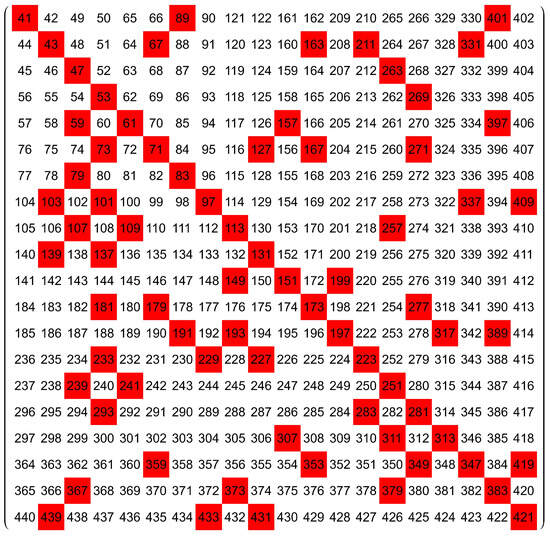
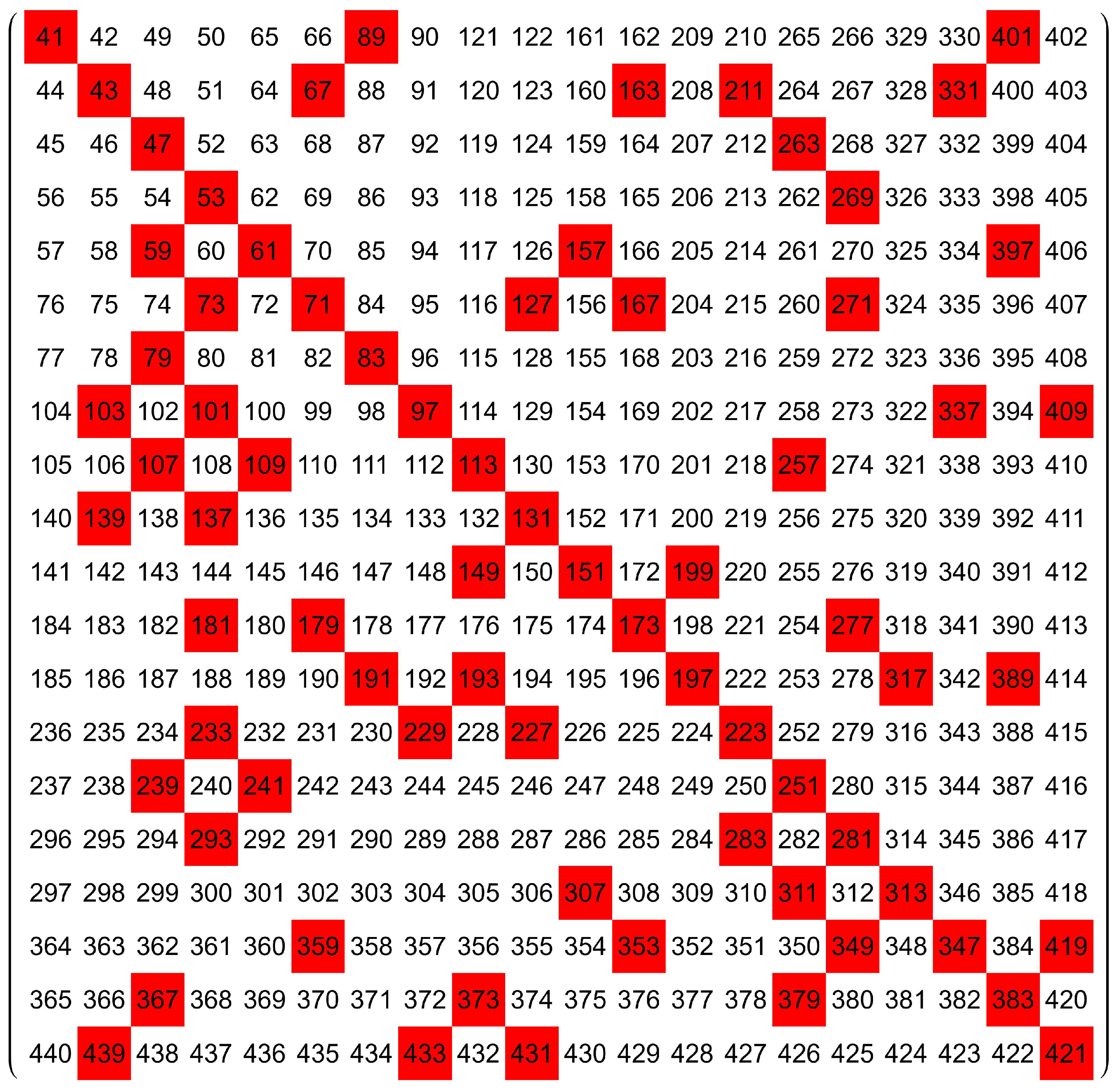
In the study of Ulam’s spiral, researchers noticed a special distribution for the prime numbers in the spiral when the first number was 41 instead of 1. Applying the same idea to our proposed matrix, matrix , where is created. In Figure 7 matrix is presented, showing that in the main diagonal all the elements are prime numbers. The first non prime number in the main diagonal is 1681 which appears in the matrix. This result is a direct application of the Euler’s prime-generating polynomials, defined as , which remains one of the most remarkable curiosities in number theory due to its ability to produce a sequence of 40 consecutive prime numbers for the integers or , depending on the sign of n [3]. In this matrix the diagonal elements are
Figure 7.
The constructed matrix with the naturals numbers from 41 up to where with red color are highlighted the prime numbers.
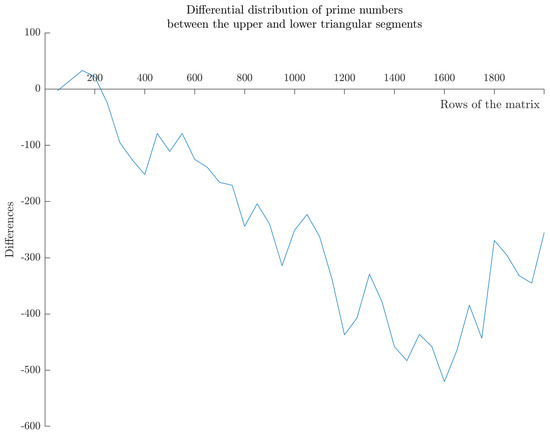
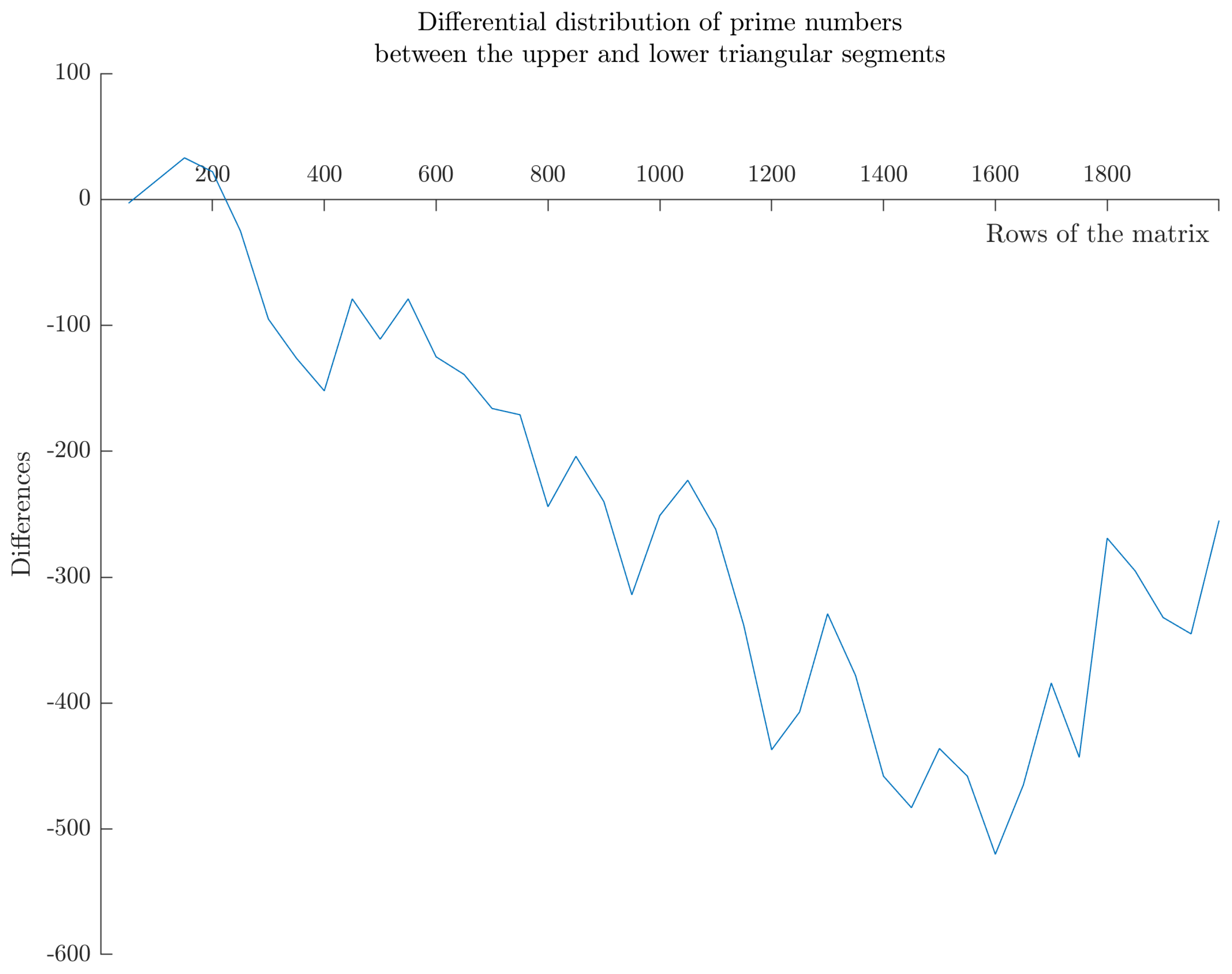
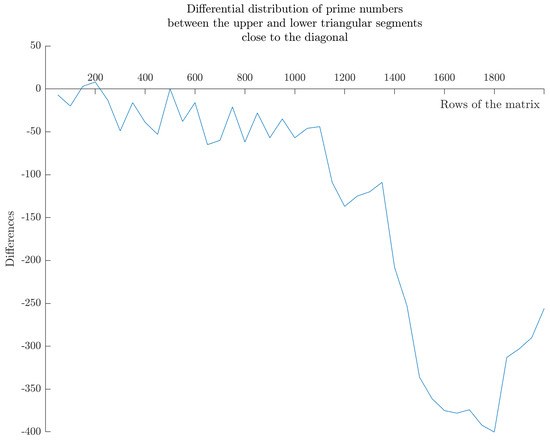
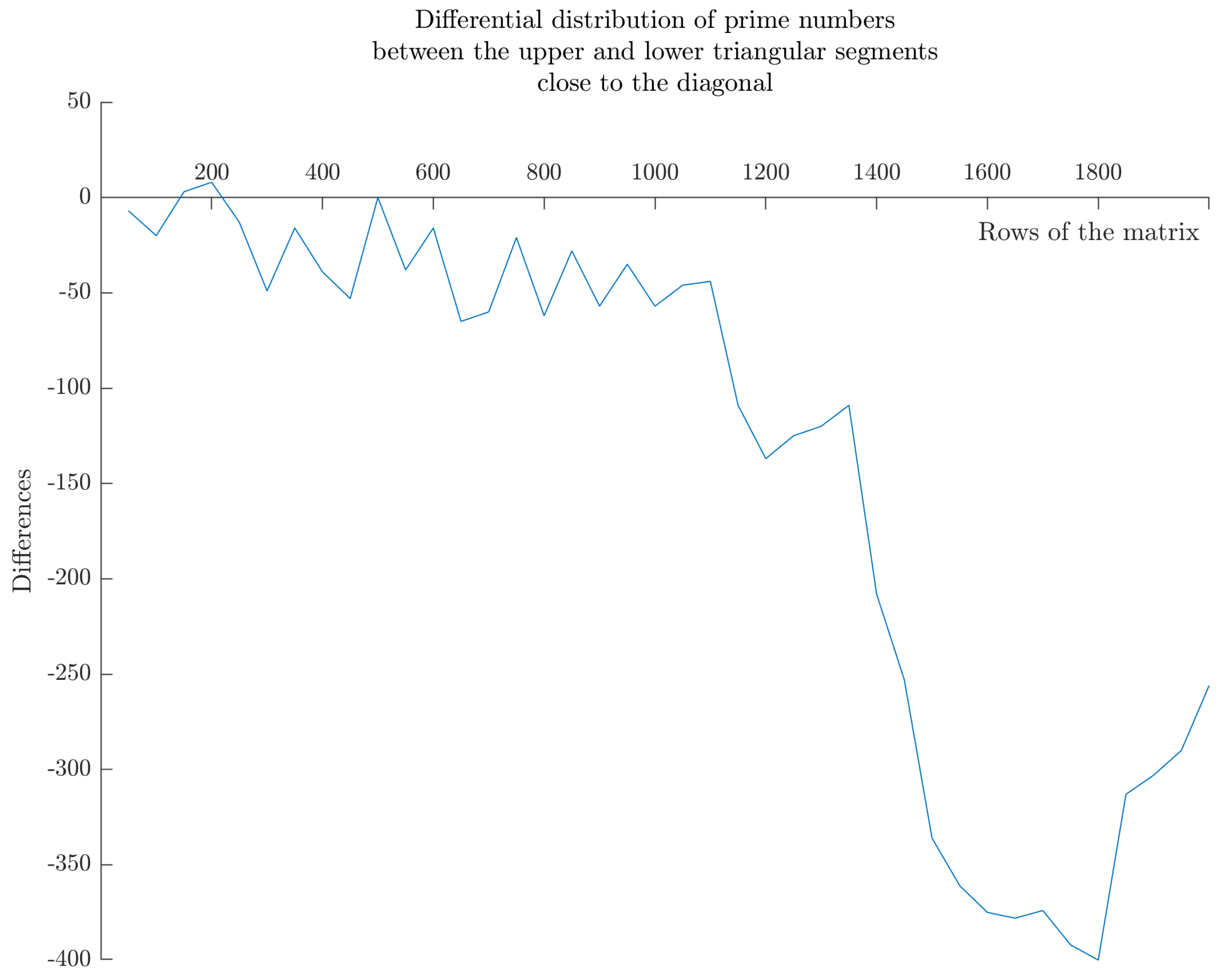
To quantify the distribution of prime numbers within the matrix we analyze the asymmetry indices derived from the upper and lower triangular segments. We first examine the global prime disparity, which captures the total net imbalance of prime occurrences across the entire matrix architecture (Figure 8). In addition to this broad analysis, we measure the proximal bias to identify the concentration of primes specifically within the “near-diagonal” strip—the region spanning the first 20% of the matrix’s dimension (Figure 9). When plotted, using matrices from to with step 50, these differences reveal how the “diagonal bias” characteristic of Ulam-like configurations scales as the system grows. This approach allows us to distinguish between a general structural preference for certain regions and a localized clustering of primes, providing a clear visual representation of whether these patterns strengthen or dissipate in higher dimensions. Therefore, we can conjecture that the lower diagonal part of the matrix seems to have significant bigger number of primes than the upper diagonal part, especially close to the diagonal.
Figure 8.
Differential distribution of the number of prime numbers between the upper and lower triangular segments, with matrices
Figure 9.
Differential distribution of the number of prime numbers between the upper and lower triangular segments close to the diagonal (distance up to with respect to the size of the matrix) with matrices
3.2. Linear Algebra Properties of Matrix
Beyond primes, the matrix has several interesting Linear Algebra properties [19]. The maximum value of the matrix is always located at if n is even and at if n is odd. The sum of all elements in the added n-th layer on is
Lemma 1.
The trace of the matrix is
the 1-norm is
and the infinity norm is
Moreover, from the inclusion property (Bendixson’s Theorem) [20], if are the eigenvalues of and are the eigenvalues of we have
Theorem 1.
Proof.
If are the lines of the determinant of the matrix we substitute line with the line In this determinant all its elements in every position where are 1 or Therefore, if are the lines of the new determinant, we substitute line with the line resulting a determinant where its elements in every position where are 0 and in the positions are 1 or Thus, if are the rows of this determinant, we substitute row with the row and then the elements in the positions are Placing the second row as the last row, the determinant is now multiplied by and the resulting determinant is on the form
where and matrices B, C, and D are defined previously in the theorem.
Since D is a lower triangular matrix with non-zero elements in the main diagonal, we can apply the Schur theorem [21], i.e.,
□
4. Conclusions
In this paper, we introduce a new matrix construction for the systematic placement of the nonzero natural numbers. Although the proposed matrix is inspired by the classical Ulam spiral, it offers a significant conceptual advantage: each nonzero natural number occupies a position determined by an explicit mathematical formula. As a consequence, the resulting structure is amenable to rigorous analytical investigation, allowing the study of nonzero natural numbers—and in particular prime numbers—through precise algebraic and geometric methods.
A key distinction of the proposed matrix is the existence of a closed-form formula for its entries, establishing a direct functional relationship between the indices and the resulting values. Unlike iterative constructions—such as the classic Ulam’s spiral, which often requires a recursive “walk” to determine the position of a specific integer—this formula allows for the independent and instantaneous calculation of any element without prior knowledge of its neighbors. This algebraic transparency not only enhances computational efficiency by enabling parallel processing of large-scale submatrices but also provides a rigorous foundation for analytical derivations, such as identifying symmetries or calculating the determinant via Schur’s theorem.
The proposed matrix exhibits a variety of noteworthy properties related to both number theory and linear algebra. Certain diagonals and antidiagonals are devoid of prime numbers, while others are comparatively rich in primes, revealing non-uniform patterns in their distribution. Due to the explicit mathematical definition of the matrix, its entries satisfy quadratic relations along specific directions, establishing a direct connection with the Hardy–Littlewood conjectures. This connection provides a natural theoretical framework for further analytical and numerical investigations.
Although the matrix does not possess classical geometric symmetry, it exhibits a form of algebraic symmetry. Specifically, the matrix can be decomposed as the sum of two matrices and where is symmetric and is skew-symmetric. This structural property is further reflected in the behavior of the induced matrix norms, particularly the 1-norm and the ∞-norm.
The construction also motivates several conjectural observations. Numerical evidence suggests that every row and every column of the matrix contains at least one prime number. Moreover, when the matrix is constructed with 41 as its initial entry instead of 1, the lower triangular region appears to contain a significantly higher density of primes than the upper triangular region, especially in the vicinity of the main diagonal.
Although the Hardy–Littlewood conjectures remain unproven, they are strongly supported by extensive numerical evidence and form the basis of many modern heuristics and partial results concerning the distribution of prime numbers. The visual regularities observed in the proposed matrix may therefore be interpreted as geometric manifestations of these deep analytic phenomena.
In this broader context, the Ulam spiral itself can be understood as a coordinate transformation that maps a one-dimensional sequence of integers onto a two-dimensional lattice, preserving local proximity while revealing hidden arithmetic structure. The proposed matrix extends this perspective by providing an explicit algebraic framework in which such phenomena can be systematically studied.
Consequently, the constructed matrix serves as a visual and analytical bridge to fundamental unsolved problems in number theory, illustrating persistent regularities in the distribution of prime numbers and offering a promising setting for future research.
Funding
This research received no external funding.
Data Availability Statement
No data were generated or analyzed during this study.
Conflicts of Interest
The author declares no conflicts of interest.
References
- Ulam, S.M. Problems in Modern Mathematics; Wiley: New York, NY, USA, 1964. [Google Scholar]
- Gardner, M. Mathematical Games: The Remarkable Lore of the Prime Numbers. Sci. Am. Mag. 1964, 210, 120–128. [Google Scholar] [CrossRef] [Scilit]
- Heffernan, R.; Lord, N.; MacHale, D. Euler’s prime-producing polynomial revisited. Math. Gaz. 2024, 108, 69–77. [Google Scholar] [CrossRef] [Scilit]
- Stein, M.L.; Ulam, S.M.; Wells, M.B. A Visual Display of Some Properties of the Distribution of Primes. Am. Math. Mon. 1964, 71, 516–520. [Google Scholar] [CrossRef] [Scilit]
- Stein, M.; Ulam, S.M. An Observation on the Distribution of Primes. Am. Math. Mon. 1967, 74, 43–44. [Google Scholar] [CrossRef] [Scilit]
- Hahn, H.K.; Sachs, R. The Distribution of Prime Numbers on the Square Root Spiral. arXiv 2008. [Google Scholar] [CrossRef] [Scilit]
- Guy, R.K. Unsolved Problems in Number Theory; Springer: New York, NY, USA, 2004. [Google Scholar] [CrossRef] [Scilit]
- Hardy, G.H.; Littlewood, J.E. Some problems of ‘Partitio Numerorum’; III: On the expression of a number as a sum of primes. Acta Math. 1923, 44, 1–70. [Google Scholar] [CrossRef] [Scilit]
- Bateman, P.T.; Horn, R.A. A heuristic asymptotic formula concerning the distribution of prime numbers. Math. Comput. 1963, 17, 445–447. [Google Scholar] [CrossRef]
- Apostol, T.M. Introduction to Analytic Number Theory; Springer: New York, NY, USA, 1976. [Google Scholar]
- Kourbatov, A.; Wolf, M. Predicting Maximal Gaps in Sets of Primes. Mathematics 2019, 7, 400. [Google Scholar] [CrossRef] [Scilit]
- Iwaniec, H.; Kowalski, E. Analytic Number Theory; American Mathematical Society Colloquium Publications: Providence, RI, USA, 2004; Volume 53. [Google Scholar]
- Thorne, J.A. E6 and the arithmetic of a family of non-hyperelliptic curves of genus 3. In Forum of Mathematics, Pi; Cambridge University Press: Cambridge, UK, 2015. [Google Scholar] [CrossRef] [Scilit]
- Prasad, K.; Kumari, M.; Mohanta, R.; Mahato, H. Higher-Order Mersenne Numbers: New Sequences, Algebraic Properties, and Binomial Transforms. Math. Sci. Appl. E-Notes 2025, 13, 209–223. [Google Scholar] [CrossRef] [Scilit]
- Soundararajan, K. The distribution of prime numbers. In Equidistribution in Number Theory, An Introduction; Granville, A., Rudnick, Z., Eds.; NATO Science Series; Springer: Dordrecht, The Netherlands, 2007; Volume 237, pp. 59–83. [Google Scholar] [CrossRef] [Scilit]
- Bini, D.A.; Benedetto, F.D.; Tyrtyshnikov, E.; Van Barel, M. Structured Matrices in Numerical Linear Algebra: Analysis, Algorithms and Applications; Springer INdAM Series, 30; Springer: Cham, Switzerland, 2019. [Google Scholar]
- Hogben, L. Mathematics for the Million; W. W. Norton and Company: New York, NY, USA, 1968. [Google Scholar]
- Shanks, D. On the Conjecture of Hardy & Littlewood concerning the Number of Primes of the Form n2 + a. Math. Comput. Am. Math. Soc. 1960, 14, 321–332. [Google Scholar] [CrossRef] [Scilit]
- Strang, G. Linear Algebra and Its Applications; Cengage Learning: Boston, MA, USA, 2006. [Google Scholar]
- Bendixson, I. Sur les racines d’une équation fondamentale. Acta Math. 1902, 25, 359–365. [Google Scholar] [CrossRef] [Scilit]
- Horn, R.A.; Johnson, C.R. Matrix Analysis; Cambridge University Press: Cambridge, UK, 2012. [Google Scholar] [CrossRef] [Scilit]
Disclaimer/Publisher’s Note: The statements, opinions and data contained in all publications are solely those of the individual author(s) and contributor(s) and not of MDPI and/or the editor(s). MDPI and/or the editor(s) disclaim responsibility for any injury to people or property resulting from any ideas, methods, instructions or products referred to in the content. |
© 2026 by the author. Licensee MDPI, Basel, Switzerland. This article is an open access article distributed under the terms and conditions of the Creative Commons Attribution (CC BY) license.