1. Introduction
Global value chains (GVCs) have become the dominant organizational structure of modern production, investment, and trade. Over the past three decades, production has fragmented across borders, creating dense networks of intermediate inputs that link firms, sectors, and countries in complex and rapidly evolving patterns. These interdependencies have yielded significant efficiency gains, but they have also exposed the global economy to increasingly systemic forms of risk. Recent disruptions—including the COVID-19 pandemic, semiconductor supply shortages, geopolitical tensions, and extreme weather events—have highlighted how shocks can propagate through GVCs in ways that traditional analytical tools cannot fully capture [
1,
2,
3]. As a result, understanding how value chains propagate shocks, reshape themselves under pressure, and create economic vulnerabilities has become a central challenge in international economics, economic geography, and network science.
Conventional empirical approaches to GVCs are based on input-output (IO) analysis [
4], value-added accounting [
5] and bilateral decomposition frameworks used by datasets such as WIOD and OECD TiVA. Although these methods have become standard tools, they are based on inherently linear structures and static assumptions. They describe how value is distributed, but provide a limited picture of resilience, substitution dynamics, non-linear adjustments, and the systemic importance of individual sectors or countries. More recent studies apply network analysis to IO tables, interpreting economies as directed, weighted graphs [
6,
7,
8]. These studies reveal topological properties—such as centrality, hierarchy, and clustering—but often lack an explicit economic interpretation of how flows adjust to shocks or policy interventions.
Research on global value chains has expanded rapidly over the past two decades, driven by the increasing fragmentation of production and the growing exposure of economies to cross-border disruptions. Early contributions focused on input–output–based decompositions of trade and value added, providing foundational insights into the structure of international production and the distribution of gains from globalization [
5,
9]. While these approaches remain central to empirical GVC analysis, they are inherently static and rely on linear production relationships, limiting their ability to capture dynamic adjustment and resilience.
More recent studies have interpreted input–output systems as weighted, directed networks, using tools from network science to identify central nodes, clustering patterns, and systemic importance [
10,
11]. This literature has demonstrated that production networks can amplify shocks through indirect linkages and that network topology plays a key role in aggregate volatility. However, network-based measures are often descriptive in nature and typically abstract from the economic costs of substitution, the feasibility of reconfiguration, and the role of policy interventions in stabilizing the system.
Concurrently, research has been undertaken to examine GVC vulnerability through sectoral or regional shock analyses, often focusing on natural disasters, trade policy changes, or geopolitical disruptions [
12,
13]. These studies provide valuable empirical evidence on shock transmission, but they generally treat adjustment as exogenous or instantaneous, rather than modeling the endogenous restructuring of supply relationships. Consequently, resilience is often inferred from observed outcomes rather than derived from explicit structural mechanisms.
A parallel line of literature has turned to optimal transfer theory [
14], dynamic factor models [
15], and control theory to capture the vulnerability of production networks [
16]. However, applications have so far been few: optimal transport has been used mainly to measure misallocation, control theory tools have been explored in ecology and engineering rather than international trade, and dynamic decomposition has been applied to macroeconomic time series but rarely to global production systems. As a result, there is still no unified mathematical framework that integrates (i) structural IO relations, (ii) the dynamics of shock propagation, (iii) the economics of substitution and restructuring, and (iv) systemic measures of power and resilience. Furthermore, the debate continues as to whether GVCs are inherently resilient—due to diversification and redundancy—or inherently vulnerable, due to hyper-specialization and concentration.
This fragmentation motivates the present study, which addresses the following research questions: (i) How do shocks propagate dynamically through global production networks when both structural interdependence and substitution frictions are taken into account? (ii) How can resilience, vulnerability, and adaptability be jointly measured within a unified analytical framework? and (iii) How does systemic importance and bargaining power emerge from the interaction of network topology, flow dynamics, and adjustment constraints? The framework developed in this paper is designed to provide coherent answers to these questions.
Throughout the paper, the concepts of resilience, vulnerability, and adaptability are used in a precise and operational sense. Resilience refers to the ability of a global value chain to absorb and mitigate shocks with limited deviation from a baseline production state, as measured by controllability and stabilization costs. Vulnerability captures the extent to which shocks are amplified through network propagation mechanisms, reflecting both structural exposure and directional dependencies. Adaptability denotes the capacity of the system to reconfigure production and sourcing relationships in response to disruptions, subject to economic frictions, and is quantified through entropy-regularized optimal-transport costs. These definitions establish a direct link between conceptual notions and the measurable indicators developed in the subsequent sections. To avoid conceptual ambiguity, it is important to distinguish clearly between several closely related terms used in the literature. In this study, a shock refers to an exogenous disturbance affecting supply capacity or final demand at specific nodes. Risk mass denotes a probabilistic representation of exposure or value-at-risk that propagates through the network via production linkages. Distortion, by contrast, captures deviations from baseline flow patterns induced by shocks, frictions, or policy interventions. These concepts are analytically distinct and play complementary roles in modeling propagation, adjustment, and vulnerability.
The novelty of this contribution does not lie in any single methodological component, but in their integration into a coherent analytical system. Unlike existing GVC resilience models that focus on sectoral exposure, regional concentration, or reduced-form shock correlations, the proposed framework simultaneously captures (i) how shocks propagate mechanically through production networks, (ii) how nonlinear dynamics and feedback effects shape adjustment paths, and (iii) how costly reconfiguration and policy intervention determine realized resilience. In this sense, the framework complements existing empirical approaches by providing a mechanism-complete representation of global value chains that is explicitly designed for comparative analysis, stress testing, and policy evaluation. Methodologically, the paper contributes by integrating input–output accounting with stochastic flow propagation, state-space control theory, entropy-regularized optimal transport, information-theoretic diagnostics, and cooperative game-theoretic measures within a single coherent structure. This approach addresses a gap in the existing literature, which typically treats structural interdependence, dynamic adjustment, substitution costs, and systemic power in isolation. By contrast, the proposed framework enables the joint analysis of how shocks propagate through production networks, how supply chains adapt under frictional constraints, and how resilience and systemic importance emerge endogenously from network structure and dynamics. Rather than estimating a single reduced-form relationship, the framework formalizes the sequence through which exogenous disturbances enter the production network, propagate along intersectoral and cross-border linkages, and induce endogenous adjustment through costly reallocation and policy intervention. In this setting, observed empirical outcomes are interpreted as the joint result of network structure, dynamic amplification, and substitution frictions. This perspective allows causal interpretation to be grounded in economic structure, while remaining compatible with empirical identification strategies that exploit exogenous shocks and time variation.
In summary, the study develops an innovative analytical framework that addresses long-standing gaps in the literature on GVCs. It goes beyond static IO models by incorporating dynamic diffusion, optimal reallocation mechanisms, and explicit measures of vulnerability and power. The main findings highlight the importance of nonlinear dynamics, the economic significance of adjustment costs, and the role of system-level controllability in shaping resilience. By offering a comprehensive mathematical language for GVCs, the study aims to support more reliable empirical analysis, more informed policy design, and a deeper understanding of how interconnected production systems respond to an increasingly unstable global environment.
2. Methods and Materials
This section outlines the methodological structure of the proposed framework and provides an overview of its main analytical components. The empirical foundation of the model relies on multi-regional input–output data describing intermediate flows, gross output, and final demand at the country–sector level. These data are used to construct a network representation of global value chains, which serves as the basis for modeling shock propagation, dynamic adjustment, and structural reconfiguration.
Methodologically, the framework proceeds in a sequence of interrelated steps. First, observed input–output relations are normalized to obtain probabilistic flow operators that capture forward and backward propagation mechanisms. Second, deviations from a baseline production state are embedded in a state-space formulation, allowing the use of control-theoretic tools to assess stabilization costs and controllability. Third, entropy-regularized optimal transport is employed to model substitution and supply-chain rewiring under economic frictions. Fourth, information-theoretic and path-dependent network measures are introduced to characterize diversification, asymmetry, and vulnerability. Finally, cooperative game-theoretic constructs are used to quantify systemic importance and bargaining power.
The key outputs of the methodology are a set of structural and dynamic indicators—such as shock amplification measures, controllability-based resilience costs, adaptation costs, entropy-based diversification indices, and flow-based power metrics—which can be analyzed individually or combined into composite resilience indicators. Together, these elements provide a coherent and empirically implementable framework for assessing vulnerability, adaptability, and resilience in global value chains. The empirical implementation of the proposed framework relies on multi-regional input–output data compiled from established international sources such as WIOD and the OECD Trade in Value Added (TiVA) database. These datasets provide harmonized accounts of intermediate flows, gross output, and final demand at the country–sector level and constitute the standard empirical foundation for quantitative analysis of global value chains. The methodology developed below is explicitly designed to operate within the informational constraints of such data, while making transparent the assumptions required to analyze dynamic adjustment and resilience.
To ensure clarity and consistency throughout the analysis, this section introduces the foundational notation, variables, operators and symbols used in the mathematical formulation of the proposed framework. All notations are defined at first use (
Appendix A summarizes the main indices, variables, operators, and parameters used throughout the methodological framework).
To describe the structure of the global production network, we index countries by and sectors by treating each country–sector combination as a distinct node denoted by , . Time evolves in discrete periods , and the total number of nodes in the system is therefore . We refer to the full set of nodes as , and when cooperative-game concepts are required, we consider the set of all permutations of nodes .
The empirical foundation of the framework rests on matrices of intermediate-input flows, vectors of gross output, and measures of final demand collected for each country–sector node over time. We denote the matrix of intermediate flows by , where each element captures the value of inputs supplied by node to node in period . Correspondingly, the vector records total gross output for each node, while represents the associated vector of final demands. In addition to these core variables, we introduce a baseline output vector , which serves as a reference point for evaluating deviations and dynamic adjustments. Shocks enter the system either as supply reductions, captured by a node-specific loss parameter , or as shifts in final demand, denoted . Together, these observed variables constitute the quantitative backbone of the model and enable the integration of input–output accounting with dynamic and network-based analyses. Final demand plays a dual role in the proposed framework. At the structural level, it is treated as an endogenous component of the production system, capable of evolving over time in response to shocks, policy interventions, and feedback effects from the production network itself. This is accommodated through the state–space formulation, in which shifts in final demand may enter either as exogenous disturbances or as part of the controlled system dynamics. However, for analytical transparency and comparability with standard input–output exercises, specific illustrative scenarios may condition on a given final-demand vector. This conditional treatment is adopted purely for expositional purposes and does not constitute a modeling restriction of the general framework.
The relationships among nodes in the global production network are formalized through a set of matrices and operators derived from observed input–output data. Central to this representation is the technical coefficients matrix , which expresses the quantity of each intermediate input required to produce one unit of output. From this, we obtain the Leontief inverse , capturing total—direct and indirect—production requirements. To analyze how value flows through the network, we normalize intermediate flows using diagonal matrices of row and column sums, and , producing the forward and backward Markov operator and . These operators encode the probabilistic propagation of shocks and exposures across suppliers and buyers. Additional notation includes the spectral radius (largest eigenvalue magnitude) , the identity matrix , and the all-ones vector , each of which supports the mathematical transformations and stability assessments used throughout the framework.
To analyze how the global value chain responds to disturbances over time, we introduce a set of dynamic variables embedded within a state-space representation. Deviations from the baseline level of output are captured by the state vector
, which evolves according to system dynamics influenced by both endogenous propagation and exogenous interventions. Policy actions, stabilization measures, or compensatory adjustments enter through the control vector
, while
represents unobserved shocks or noise affecting the system. Observable outcomes are collected in the vector
, linked to the underlying state through an observation matrix
. The controllability of the system depends on the structure of the input matrix
, which determines the nodes through which policy makers can intervene. Within this framework, quadratic cost matrices
and
define the relative penalties on deviations and interventions, enabling optimal-control solutions such as feedback policies
. The controllability Gramian
summarizes the system’s accessibility over a given horizon, and the minimal intervention energy
derived from it provides a quantitative measure of resilience [
17]. Together, these variables allow the dynamic and policy-responsive aspects of GVCs to be modeled in a rigorous and tractable manner.
To capture how value, risk, and dependencies circulate through the global production network, we express intermediate-input relationships in probabilistic terms. The vector represents the distribution of value added or risk mass across nodes at time , providing a flexible state variable for tracking how shocks diffuse through the system. Probability distributions and denote the allocation of this mass before and after a disturbance, serving as inputs to the optimal-transport framework for modeling reallocation under frictions. The stationary distribution , derived from the Markov operator , identifies the long-run importance of each node in terms of sustained flow patterns. Additionally, we define conditional distributions such as , which characterizes the set of buyers reached by a supplier , and , which captures the composition of suppliers serving a given buyer. These probabilistic representations allow the network to be analyzed not only as a system of deterministic flows but also as a stochastic propagation structure, enabling richer insights into exposure, concentration, and the multi-step transmission of shocks.
The optimal-transport framework provides a rigorous method for modeling how production and sourcing patterns adjust when parts of the global value chain are disrupted. At its core is a cost matrix , which encodes the economic frictions associated with reallocating production across countries and sectors—such as geographic distance, tariff barriers, or technological incompatibility. When a shock alters the initial value-added distribution , the model identifies a feasible post-shock allocation by solving for a transport plan that minimizes the total reallocation cost, regularized by an entropic penalty parameter . The resulting optimal plan quantifies not only how production should shift but also the cost of implementing such adjustments. Additional constructs, such as the average path cost and node-specific adaptation indices , further characterize substitution difficulty and resilience. Through this framework, we can systematically assess the feasibility, cost, and structure of supply-chain rewiring under stress, providing a principled approach to understanding adaptation dynamics in complex production networks.
Information-theoretic measures offer a powerful lens for characterizing the structural complexity and fragility of GVCs. By computing the Shannon entropies of supplier and buyer distributions—denoted and —we quantify the degree of diversification present at each node, distinguishing between concentrated and broadly distributed sourcing patterns. Extending beyond single-step relationships, the multi-step entropy rate captures the diversity of feasible production pathways across longer horizons. To assess asymmetries and irreversibilities inherent in international trade flows, we evaluate entropy production , which reflects directional biases and potential bottlenecks within the network. Complementary metrics, such as the redundancy index and transfer entropy , provide additional insights into substitutability and causal dependence. Together, these information-based indicators reveal hidden structural constraints and dynamic vulnerabilities that traditional input–output measures may overlook.
To evaluate the structural roles played by individual nodes within GVCs, we employ a range of centrality measures that capture both direct linkages and deeper, path-dependent patterns of interdependence. Traditional metrics such as Katz–Bonacich centralities—computed in forward and backward forms using and reveal how influence accumulates through chains of supplier and buyer relationships. Building on these foundations, we construct more refined indicators such as OT-weighted path centrality , which accounts for the economic frictions associated with traversing different routes through the network. Likewise, asymmetry risk measures the extent to which trade flows involving a particular node exhibit directional imbalances, highlighting potential points of systemic vulnerability. Together, these centralities offer a multi-dimensional perspective on economic importance, exposure, and intermediation capacity within the global production system.
To capture the strategic significance of sectors and countries within the global production network, we draw on cooperative game theory and flow-based evaluation methods. The key idea is to assess how much each node contributes to the system’s overall ability to sustain feasible production flows when capacity constraints or disruptions are taken into account. For any coalition of nodes , the characteristic function is defined as the maximum value-added or feasible flow that the coalition can jointly deliver. By computing the Shapley value , which averages each node’s marginal contribution across all possible coalition orderings, we derive a structurally grounded measure of bargaining power and systemic indispensability. In this formulation, a node’s influence stems not merely from its size but from its ability to maintain critical flow paths and prevent network collapse. These flow-based and game-theoretic constructs thus provide a rigorous means of identifying hidden power centers, assessing systemic leverage, and understanding the strategic architecture of GVCs.
To translate the rich set of structural and dynamic metrics into actionable insights, we aggregate them into a series of composite indicators that summarize key dimensions of global value-chain resilience. These scalar measures synthesize information on controllability, adaptation costs, diversification, asymmetry, and systemic power into interpretable scores that can be used for benchmarking and policy evaluation. For each node, resilience is captured through , while substitution difficulty is reflected in the adaptation cost index ; redundancy and exposure are summarized by and ; and strategic influence is represented through the power index . By combining these components using weighted schemes tailored to policy priorities, the resulting composite resilience score provides a concise yet multidimensional assessment of systemic vulnerability. These indicators serve as a practical interface between the analytical framework and real-world decision-making, enabling governments, firms, and international organizations to monitor evolving risks and evaluate the effectiveness of resilience-enhancing strategies.
Although many components of GVCs can be modeled within a linear framework, real-world production systems often exhibit nonlinear behaviors such as threshold effects, adjustment delays, and feedback-driven amplification. To incorporate these complexities without sacrificing analytical tractability, we employ Koopman operator theory and related Dynamic Mode Decomposition techniques. By lifting the original state variables into a higher-dimensional feature space through a nonlinear mapping the system’s evolution can be approximated by a linear operator acting on these transformed coordinates. The eigenvalues and eigenfunctions of this operator reveal persistent modes of adjustment, slow-moving structural trends, and hidden macro-dynamics that are not apparent in the raw data. This optional layer thus enriches the modeling framework by capturing nonlinear structure in a way that remains compatible with the linear control, propagation, and network components developed in previous sections.
Several additional mathematical tools support the broader framework by enabling precise formulation, estimation, and interpretation of the various components of the model. The Kullback–Leibler divergence is used to quantify informational distortions in regularized optimal-transport problems, while the Frobenius inner product provides a convenient notation for expressing matrix-based cost functions. The operator is employed throughout to construct diagonal matrices from vectors, facilitating the normalization of flows and the computation of technical coefficients. Changes in output are denoted by , with vector norms such as and used to measure magnitudes of deviations or shocks. In the context of reduced-form causal estimation, symbols such as and represent spillover coefficients, direct effects, fixed effects, control variables, and residual terms, respectively. Together, these auxiliary elements provide the mathematical precision needed to articulate and operationalize the diverse analytical components of the global value-chain framework.
To formalize the structure of GVCs, we represent the international production system as a multilayer, time-varying network in which each node corresponds to a specific country–sector pair and each directed edge captures the flow of intermediate goods or services. This tensor-based notation allows us to describe cross-border and within-country interactions in a unified mathematical framework, enabling consistent treatment of input–output accounting, dynamic propagation mechanisms, and higher-order network effects. The following definitions establish the core objects used throughout the methodology.
Let there be countries, sectors, periods. Index nodes by with , , so the total nodes .
Intermediate flows at time :
, .
Gross output vector and final demand .
Leontief operator (per period):
Supra-adjacency (multilayer): split into intra-country blocks and cross-border blocks . Stack layers by country or sector; all results below apply to the full .
2.1. Data Structure, Aggregation, and Limitations
Multi-regional input–output tables necessarily represent production systems at an aggregated level, combining heterogeneous firms, technologies, and contractual relationships within country–sector nodes. As a result, the analysis abstracts from firm-level adjustment margins, bilateral contract renegotiation, and intra-sectoral substitution that may occur in response to shocks. While this aggregation limits microeconomic interpretation, it remains appropriate for studying system-level propagation, macroeconomic exposure, and policy-relevant resilience.
Measurement error and temporal aggregation may further affect the precision of estimated flows, particularly in sectors characterized by rapid technological change or informal production. The framework treats observed input–output matrices as approximations to the underlying production network and focuses on relative rather than absolute magnitudes of propagation, adaptation costs, and vulnerability indices. Consequently, results should be interpreted as comparative diagnostics rather than point estimates of causal effects.
Despite these limitations, national and multi-regional input–output datasets remain the only sources that provide consistent, economy-wide coverage of global production linkages over time. The framework therefore prioritizes transparency and robustness to aggregation, rather than attempting to recover micro-level behavior from inherently macroeconomic data.
2.2. Flow Propagation and Stochastic Normalization
To analyze how value, shocks, and dependencies travel through GVCs, we convert raw intermediate-input flows into probabilistic transition structures. By normalizing flows into stochastic matrices, we obtain forward and backward Markov operators that capture supplier-to-buyer and buyer-to-supplier propagation dynamics. This representation transforms the input–output system into a flow-based diffusion process, allowing us to study exposure, spillovers, and path-dependent effects using established tools from stochastic processes and network dynamics.
Define the forward flow Markov operator (supplier-to-buyer):
so rows sum to 1 (assume no isolated rows). A backward operator for buyer-to-supplier exposure is:
Let
denote a value-added mass (e.g., origin shares or “risk mass”). Its natural propagation is
where
is an exogenous injection (policy or shock compensation). For buyer exposure, replace
with
.
The stochastic normalization of intermediate flows transforms observed input–output relationships into probabilistic propagation structures. This operation abstracts from scale effects and focuses on relative dependence patterns among suppliers and buyers. Implicitly, the approach assumes that proportional relationships provide a reasonable approximation of marginal adjustment paths following small to moderate shocks. While large disruptions may induce nonlinearities beyond this approximation, the normalization facilitates comparative analysis of exposure and spillovers across nodes and time, which is the primary objective of the framework.
2.3. Dynamic IO with State-Space Control
While traditional input–output models capture static interdependencies, GVCs evolve continuously and respond to disturbances over time. To account for these dynamics, we embed the IO structure within a state-space framework that models how deviations from baseline output propagate across sectors and countries. This formulation enables the use of control-theoretic tools—such as optimal feedback, controllability measures, and minimal-energy stabilization—to evaluate the system’s resilience and to design policy interventions that mitigate or redirect the effects of shocks.
We combine IO accounting with linear-quadratic control on deviations from baseline output .
State: :
Dynamics (first-order perturbation around ):
, ,
with selecting controllable nodes (police levers), mapping to observables (e.g., sector outputs, prices) and , disturbances.
Shock-mitigation problem (discrete LQR):
With time-invariant
, the optimal feedback
uses the Riccati recursion; with time-varying
use TV-LQR [
18,
19].
Minimal energy to steer
(controllability Gramian
):
Interpret as resilience cost: lower is more controllable.
2.4. Nonlinear Macro-Modes via KOOPMAN/DMD
GVCs often display nonlinear adjustments arising from capacity constraints, threshold effects, and endogenous reallocation behaviors. To capture these complexities without abandoning a tractable linear framework, we employ Koopman operator theory and Dynamic Mode Decomposition (DMD) [
20,
21]. These data-driven methods approximate nonlinear dynamics through linear evolution in an expanded feature space, allowing us to identify dominant macro-modes, persistent adjustment patterns, and slow-moving structural forces that shape the long-run evolution of the network.
To capture nonlinearities (e.g., capacity constraints), embed features
and approximate a Koopman operator
Estimate from panel data (Extended DMD). Dominant eigenvalues/eigenfunctions isolate slow GVC modes; couple them back to the control layer by projecting shocks onto Koopman modes before LQR.
2.5. Optimal-Transport (OT) Rewiring Under Shocks
Shocks to global supply chains often force firms and countries to reconfigure their sourcing and production patterns. To model this adaptive reallocation, we introduce an optimal-transport framework that translates lost supply capacity into the most efficient feasible substitution across the network, subject to frictions such as geographic distance, tariffs, and technological compatibility. This approach quantifies the cost of rewiring, identifies which nodes can be replaced with minimal disruption, and provides a principled method for evaluating alternative adjustment pathways under stress [
22].
Let
be origin distributions of value added before and after a shock. For a cost matrix
(e.g., tariff distances, supplier qualification costs), define entropically regulized OT [
23]:
Sinkhorn iterations [
24] compute
. We interpret:
- -
: reconfiguration (adaptation) cost,
- -
row/column sums of : who replaces whom,
- -
sparsity patterns: bottlenecked substitutions.
Shock-to-structure map: If a supplier loses capacity , we map the required redistribution of its outgoing mass to a feasible minimizing . This produces a policy-efficient rewiring plan consistent with frictions.
The specification of the cost matrix in the optimal-transport problem plays a central role in shaping reallocation outcomes. In empirical applications, these costs may reflect geographic distance, tariff barriers, regulatory frictions, technological incompatibilities, or composite indices derived from external data sources. While the framework remains agnostic to the precise cost specification, different choices may yield quantitatively distinct rewiring patterns. For this reason, the OT component is best interpreted as a scenario-analysis tool rather than a unique prediction mechanism. Sensitivity analysis with respect to alternative cost matrices can be used to assess the robustness of adaptation paths and to identify substitution bottlenecks that persist across specifications.
2.6. Entropy, Redundancy, and Entropy Production
Understanding the robustness of GVCs requires measuring how diversified, substitutable, and directionally asymmetric their flows are. Information-theoretic metrics offer a natural way to quantify these properties. By computing entropies of supplier and buyer distributions, we assess the degree of redundancy within the network; by evaluating entropy rates and entropy production, we capture deeper structural characteristics such as path diversity and the irreversibility of trade flows [
25,
26,
27]. These measures provide a rigorous foundation for diagnosing fragility, concentration risks, and systemic imbalances across the value chain.
Define node-level outflow distribution:
Supplier diversification (Shannon Entropy):
Multi-scale entropy rate of the chain
computed on
(or on Koopman-lifted states). Higher
.
Entropy production under nonequilibrium flows (asymmetry):
with
the stationary distribution of
. Large
flags directional fragility or market power.
2.7. Path-Dependent Centralities and Vulnerability
Standard network centralities often overlook the complex, multi-step pathways through which value and risk traverse global production systems. To better assess systemic importance and exposure, we employ path-dependent centrality measures that account for indirect linkages, substitution frictions, and cumulative amplification effects. By weighting network paths according to their economic significance and adjustment costs, these metrics reveal which nodes function as critical intermediaries, which are easily replaceable, and where structural vulnerabilities may propagate under stress [
7].
Katz-Bonacich (forward/backward) [
28,
29]:
OT-weighted path centrality (penalize costly reroutes):
where
is average edge cost from
a path weight from
. Nodes with high
are hard-to-replace hubs.
2.8. Causal Structure (Reduced Form)
Understanding global value chains requires distinguishing between structural propagation mechanisms and empirical causal identification. The framework developed in this study provides an explicit structural map of how shocks transmit through production networks via input–output linkages, dynamic feedback, and reallocation constraints. Causal effects are therefore not inferred solely from correlations in the data, but from the interaction between observed shocks and the underlying network architecture that governs feasible adjustment paths [
1,
16]. To uncover these directional effects, we combine reduced-form econometric tools—such as local projections, shock instruments, and information-theoretic measures—with the underlying network structure. This approach allows us to estimate how disturbances originating in one node influence others over time, distinguish direct effects from network-mediated spillovers, and construct empirically grounded maps of causal transmission within the value chain.
Use instrumented local projections on the network to estimate causal pass-through
with shock instruments (e.g., exogenous policy/tariff news). The
map directional spillovers over network edges.
For time-varying casual graphs, estimate transfer entropy:
Potential endogeneity concerns arise naturally in networked production systems, where output, trade flows, and policy responses may be jointly determined. To address these concerns, the framework separates the structural propagation mechanism—encoded in the normalized input–output matrices and state-space dynamics—from the empirical identification of shocks. Exogenous disturbances such as policy announcements, natural disasters, regulatory changes, or externally imposed trade restrictions can be used as instruments that shift specific nodes while remaining orthogonal to contemporaneous adjustment decisions elsewhere in the network. By conditioning on fixed effects and exploiting the predetermined structure of production linkages, the resulting estimates isolate directional spillovers rather than equilibrium correlations.
Reduced-form estimates derived from local projections or information-theoretic measures are interpreted within this structural context. Rather than serving as stand-alone causal claims, these estimates quantify the strength, direction, and persistence of shock transmission along network paths implied by the model. In this sense, econometric results complement the structural framework by validating and calibrating its dynamic implications, rather than substituting for an explicit economic mechanism.
2.9. Market Power via Cooperative Game Theory (Flow-Betweenness Shapley)
GVCs exhibit asymmetries in bargaining power that stem not only from trade volumes but also from nodes’ structural positions within the production network. To quantify these systemic power imbalances, we apply cooperative game theory and compute Shapley values based on feasible flow contributions [
23,
30,
31]. This flow-betweenness framework evaluates how essential each node is to sustaining overall production, accounting for capacity constraints and alternative routing possibilities. The resulting measure captures a node’s strategic indispensability—its ability to influence outcomes, extract rents, or disrupt the system—within the broader architecture of global value creation.
Let
be the max s-t flow (or total feasible VA delivered to final demand) when only nodes in coalition
are available (respecting constraints
). Define characteristic function:
The Shapley value of node
is
High (critical intermediation capacity).
2.10. Scalar Indices for Policy Dashboards
To translate complex network dynamics into actionable insights for policymakers, we synthesize the preceding measures into a set of interpretable scalar indices. These indicators—capturing resilience, adaptability, diversification, asymmetry, and market power—provide a compact yet comprehensive view of systemic vulnerabilities within GVCs. By aggregating high-dimensional structural information into policy-ready metrics, this framework supports benchmarking across countries and sectors, monitoring exposure to shocks, and guiding targeted interventions aimed at strengthening economic resilience.
For node at time :
- 2.
OT adaptation cost share (who is expensive to replace)
- 3.
Redundancy
- 4.
Asymmetry risk
- 5.
Power
A simple composite index is constructed after normalizing each component to the unit interval [0, 1]:
where each normalized indicator
,
,
and
is obtained via monotonic min–max scaling across nodes in the relevant cross-section, ensuring comparability in scale and bounded support.
Because all constituent indicators are rendered dimensionless and confined to a common bounded domain prior to aggregation, differences in their original means, variances, or distributional properties do not affect the validity of the composite index. Under this normalization, the arithmetic mean serves as a transparent aggregation operator that assigns equal conceptual weight to distinct dimensions of vulnerability rather than estimating a latent statistical construct.
Accordingly, a composite value of 0.5 should be interpreted as the midpoint of the normalized vulnerability spectrum rather than as the empirical mean of the underlying raw indicators. While the baseline composite index adopts equal weights for transparency and interpretability, policy applications may require differential emphasis across dimensions of resilience. To accommodate such priorities, we define a generalized weighted resilience score as
where
denotes controllability-based resilience,
shock amplification,
redundancy,
asymmetry risk, and
systemic power. The weights
0 satisfy
and reflect policy-specific preferences or strategic objectives.
All components entering the weighted score are assumed to be normalized to the unit interval , ensuring that the weighted aggregation remains scale-consistent and invariant to differences in underlying distributions.
2.11. Shock Scenarios and Policy Optimization
This subsection outlines a concrete empirical and simulation strategy for applying the proposed framework to real-world global value chains. By combining observed input–output structures with counterfactual shock scenarios, the methodology enables systematic evaluation of shock propagation, adjustment dynamics, and policy effectiveness under alternative configurations. By simulating shock scenarios—such as supply failures, demand collapses, or policy interventions—we can trace their propagation through the network and quantify the resulting economic impacts. Integrating these simulations with control-theoretic tools [
32] and optimal-transport reallocations enables a rigorous comparison of alternative policy responses. This framework allows policymakers to evaluate trade-offs, minimize output losses, and design coordinated strategies that enhance resilience while respecting real-world adjustment frictions.
Scenario: capacity loss (supply) and demand shift .
Network control to cushion. Solve LQR to minimize output gaps with budget
Rewire with OT. Given lost supplier mass , compute and minimizing ; update along edges with positive .
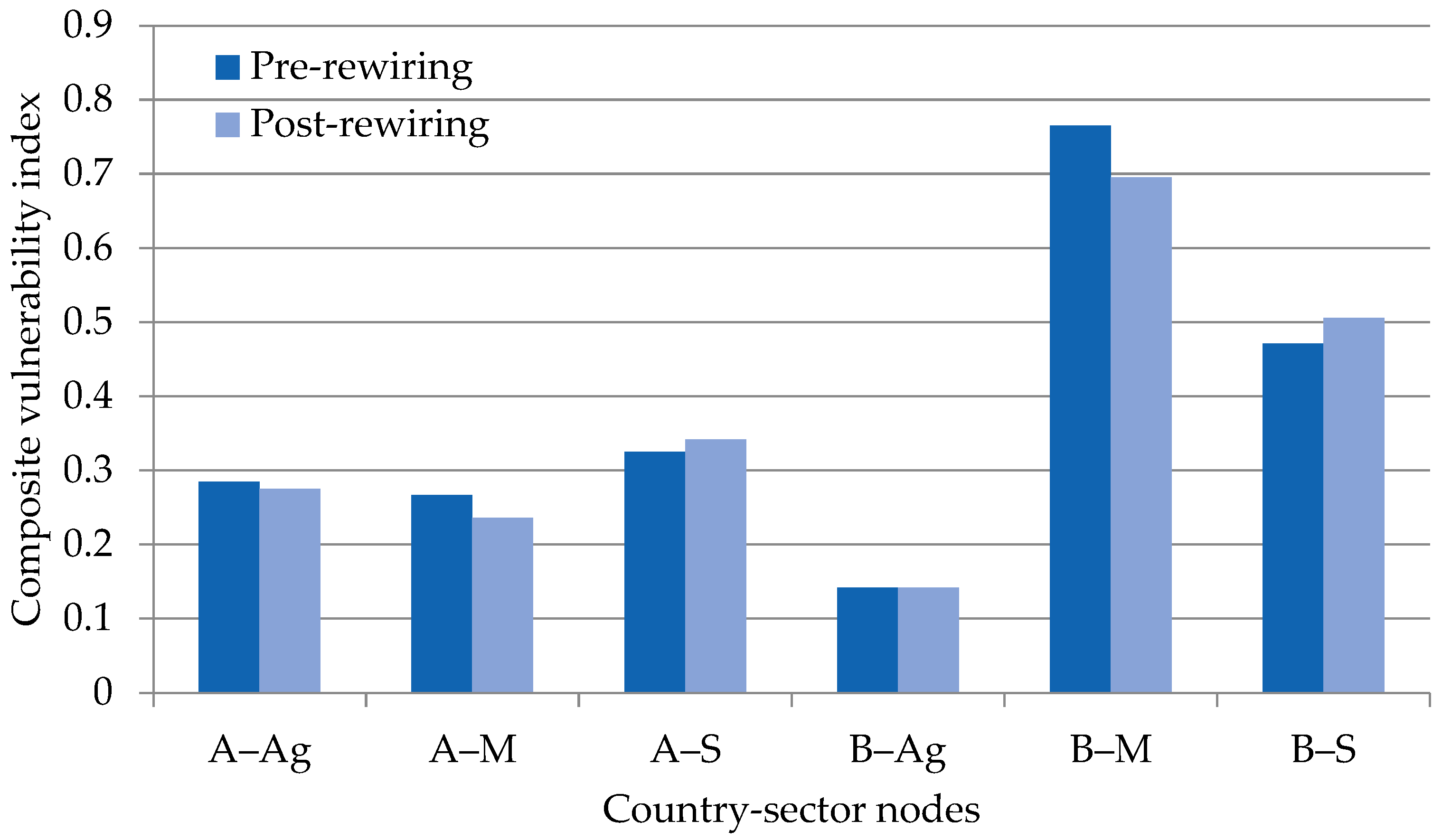
Evaluate. Recompute before/after; pick policy that maximizes systemwide welfare (e.g., minimize total loss plus adaptation cost).
From an empirical perspective, these scenarios can be calibrated using historical shock episodes, sector-specific disruptions, or policy counterfactuals derived from observed data. The resulting simulations generate node-level and system-level outcomes—such as output losses, reconfiguration costs, and resilience indices—that can be compared across countries, sectors, and time periods. This approach allows the framework to function as a stress-testing device rather than a purely descriptive model, making it suitable for applied analysis and policy evaluation. Although the framework allows the computation of node-level indicators for all country–sector combinations, it is not intended to generate an unstructured proliferation of results. Instead, the methodology is designed around systematic aggregation strategies that map high-dimensional outputs into interpretable summaries. These include country-level and sector-level aggregates, percentile rankings, distributional statistics, and composite indices that synthesize multiple dimensions of vulnerability, adaptability, and systemic importance. Such aggregation ensures that the analytical richness of the framework remains compatible with empirical interpretation and policy analysis.
A defining feature of multi-regional input–output–based GVC analysis is the presence of indirect transmission through third countries, whereby value added and shocks propagate beyond direct bilateral trade relationships. In the proposed framework, such third-country effects arise naturally from the network representation of intermediate flows and from the associated forward and backward propagation operators. Because all operators, entropy measures, optimal-transport reallocations, and cooperative game-theoretic indices are defined on the full country–sector network, indirect paths involving multiple countries are fully internalized whenever the system dimension exceeds two countries. No element of the framework relies on bilateral structure, and higher-order intermediation emerges endogenously through multi-step propagation and reallocation paths.
All components of the proposed framework are computationally tractable and scalable to large multi-regional input–output systems. The underlying operations rely on sparse matrix algebra, convex optimization, and spectral methods whose computational complexity grows polynomially with the number of country–sector nodes. In practical applications, MRIO tables with several thousand nodes—such as those derived from WIOD or OECD TiVA databases—are routinely handled using analogous matrix inversions, eigenvalue decompositions, and network centrality computations. The additional layers introduced here, including stochastic normalization, entropy measures, controllability Gramians, and entropically regularized optimal transport, are well suited to large-scale implementation and benefit from established numerical solvers and parallelization techniques.
4. Discussion
This study proposes a unified analytical framework for examining global value chains as dynamic, interconnected production systems subject to shocks, adjustment frictions, and policy interventions. By integrating input–output accounting with stochastic flow propagation, control-theoretic stabilization, optimal transport–based reallocation, information-theoretic diagnostics, and cooperative game-theoretic measures, the framework offers a coherent perspective on how vulnerability, adaptability, and systemic importance jointly emerge from network structure and dynamics. The results demonstrate that resilience is not a purely topological property, but rather a dynamic outcome shaped by adjustment costs, substitution constraints, and the controllability of key nodes within the production network.
The scalar indices derived from the framework—covering vulnerability, controllability, substitution difficulty, and systemic power—are particularly well suited for integration into policy dashboards used by national governments and international organizations. Institutions such as the OECD, the WTO, or regional development agencies could employ these indicators to conduct stress tests, benchmark resilience across countries and sectors, and monitor the evolution of strategic dependencies over time. Because the indices are constructed from standard input–output data, their implementation does not require proprietary information and can be updated as new data become available.
Although the illustrative example is intentionally simplified, the framework scales naturally to high-dimensional input–output systems such as WIOD or OECD TiVA. In such applications, country–sector nodes correspond directly to observed accounts, and shock scenarios can be calibrated using historical disruptions, policy interventions, or forward-looking stress assumptions. The resulting outputs—propagation patterns, adaptation costs, and composite resilience indices—can be aggregated or disaggregated depending on the policy question, enabling both global and country-specific analyses.
A central insight is that resilience cannot be assessed through connectivity or diversification alone. Rather, it emerges from the interaction between network structure, dynamic adjustment paths, and the economic frictions that govern substitution possibilities. The OT framework shows that seemingly redundant supplier relationships can entail high adaptation costs. Controllability results demonstrate that some nodes are inherently more difficult to stabilize due to their structural position. Additionally, entropy-based measures reveal asymmetries and irreversibilities in trade flows that are invisible in value-added or gross output data. From an operational perspective, the framework can be used to evaluate a range of policy instruments commonly discussed in the context of GVC resilience. For example, reshoring or near-shoring initiatives can be assessed by simulating capacity expansions at targeted nodes and quantifying their effects on system-wide controllability and adaptation costs. Diversification strategies can be evaluated by modifying the network’s substitution structure and measuring changes in entropy-based redundancy and shock amplification. Similarly, policies aimed at strategic stockpiling or supplier certification can be represented as reductions in effective reconfiguration costs within the optimal-transport module, allowing direct comparison of alternative resilience-enhancing interventions.
4.1. Policy Implications
The suggested methodology provides a foundation for policy evaluation. By integrating forward and backward propagation, dynamic responses, and optimal reallocation strategies, policymakers can simulate counterfactual scenarios, quantify the benefits of diversification or industrial upgrading, and identify leverage points where targeted interventions have outsized system-wide effects. The proposed scalar indices serve as a conduit between intricate analytical apparatus and policy dashboards that facilitate monitoring and strategic planning.
The policy relevance of the proposed framework can be illustrated through sector-specific supply chains characterized by high concentration and stringent substitution constraints, such as pharmaceuticals, microelectronics, or critical food inputs. In pharmaceutical value chains, for example, the production of active pharmaceutical ingredients is often geographically concentrated and subject to regulatory, technological, and certification barriers. Within the proposed framework, such constraints are reflected in elevated optimal-transport adaptation costs and low effective controllability, indicating limited short-run substitutability. As a result, sectors that appear diversified in purely topological terms may nonetheless exhibit high vulnerability once adjustment frictions are taken into account. In microelectronics supply chains, structurally central nodes combining fabrication, design, and upstream materials may display high systemic importance as measured by flow-based power indices, while simultaneously exhibiting pronounced shock amplification. These features imply that targeted interventions—such as strategic stockpiling, investment in certification capacity, or coordinated diversification—may yield disproportionately large system-wide benefits. By explicitly linking structural position, adjustment costs, and controllability, the framework enables policymakers to identify such leverage points and to design resilience-oriented interventions tailored to sector-specific constraints.
The control-theoretic analysis highlights that not all sectors are equally controllable: some nodes require disproportionately large interventions to prevent shock amplification, while others can be stabilized with minimal effort. This asymmetry suggests that governments should prioritize high-leverage sectors—those with low controllability but high systemic importance—when allocating fiscal or industrial support.
The optimal-transport module makes clear that substitution frictions matter as much as network topology. Two economies may appear similarly diversified, yet differ sharply in their adaptation costs due to geographic, regulatory, or technological constraints embedded in the cost matrix. This implies that resilience strategies should focus not merely on expanding the number of trading partners, but on reducing substitution barriers through targeted investments in logistics, regulatory harmonization, technological interoperability, and supply chain certification.
Entropy-based diagnostics reveal structural asymmetries in trade flows that can exacerbate vulnerability. Persistent imbalances—such as strong directional dependencies or highly concentrated supplier networks—indicate areas where strategic diversification or reshoring efforts may yield significant long-term benefits. Policymakers can use these metrics to monitor early-warning signals of systemic stress and to track the progress of resilience-oriented industrial policies.
The cooperative game-theoretic analysis emphasizes that market power in GVCs is a structural property, not merely a function of size or trade share. Sectors or countries with high Shapley values possess bargaining positions that can shape outcomes in trade negotiations, standards-setting, and crisis coordination. Recognizing these structural sources of influence can help governments anticipate strategic vulnerabilities and support domestic sectors that lack comparable systemic weight.
Finally, the policy dashboards derived from scalar indices offer a practical tool for operational monitoring. By translating complex network and dynamical features into interpretable metrics, they allow governments, international organizations, and central banks to benchmark resilience across countries and sectors, perform stress tests, and evaluate the effectiveness of interventions over time. Such tools can support more coherent and forward-looking strategies aimed at building adaptive, diversified, and strategically robust production systems.
These findings emphasize the importance of adopting an integrated analytical perspective when evaluating global value-chain resilience, as partial approaches focusing on structure, dynamics, or substitution in isolation may yield incomplete or misleading assessments. In practical terms, implementation follows a transparent sequence: policymakers first identify critical sectors or countries using network-based vulnerability and power indices; second, they simulate plausible shock scenarios reflecting economic, geopolitical, or environmental risks; third, they evaluate alternative policy responses—such as targeted subsidies, diversification incentives, or trade facilitation measures—by comparing their effects on output losses and adaptation costs; and finally, they select interventions that minimize systemic disruption subject to budgetary or political constraints. This workflow transforms the analytical framework into a decision-support tool rather than a purely diagnostic exercise. While the illustrative exercises condition on fixed final demand for clarity, the framework itself readily accommodates endogenous demand responses, allowing future empirical applications to jointly analyze production, demand, and policy feedbacks within a unified dynamic system. In empirical applications involving large global input–output systems, the natural presentation of results have to be graphical and synthetic rather than tabular. Heat maps, network visualizations, ranked distributions, and policy dashboards could provide effective ways to convey the structural patterns revealed by the proposed indicators.
4.2. Limitations & Future Research
Despite its strengths, the suggested framework carries several limitations. First, the quality of empirical results depends heavily on the granularity and frequency of input–output data, which remain coarse for many countries and sectors. Second, while the Koopman and DMD components offer a tractable way to approximate nonlinear dynamics, they require sufficiently rich time-series data and careful regularization to avoid overfitting. Third, the OT cost structure—while conceptually grounded—must be empirically calibrated, and different cost specifications may yield different rewiring paths. Finally, the cooperative game-theoretic analysis focuses on flow feasibility but does not explicitly incorporate strategic behavior, which may be relevant for geopolitical competition or pricing power.
Several avenues for future research naturally follow from this work. Empirically, the framework can be extended by incorporating firm-level input–output data, higher-frequency observations, and price dynamics, allowing for a more granular assessment of adjustment mechanisms. Methodologically, the integration of stochastic shocks, robust-control techniques, and model-uncertainty considerations would enhance the framework’s applicability to policy stress testing under deep uncertainty. Further extensions may also link the optimal-transport component to micro-founded models of supplier search, qualification, and matching, or embed the present approach within agent-based and hybrid simulation environments. These directions would preserve the analytical coherence of the framework while broadening its empirical scope and policy relevance.