Article

Is the Tripartite Life Model Being Reconfigured? An Exploratory Study on Retirement Expectations Among Millennials and Generation Z in Portugal

by
Ana Maria da Costa Oliveira
* and
Catarina Silva Simão
Faculdade de Ciências Humanas, Universidade Católica Portuguesa, Palma de Cima, 1649-023 Lisboa, Portugal
*
Author to whom correspondence should be addressed.
J. Ageing Longev. 2026, 6(2), 46; https://doi.org/10.3390/jal6020046 (registering DOI)
Submission received: 31 March 2026 / Revised: 1 June 2026 / Accepted: 12 June 2026 / Published: 15 June 2026

Abstract

The classic tripartite life-course model (education, work, and retirement) is under increasing pressure from rising longevity and structural labour-market change. This study examines how Millennials and Generation Z in Portugal conceptualise retirement and the life course, asking whether these cohorts adhere to a standardised, sequential logic or aspire to more fluid, multi-stage trajectories, and whether observed differences reflect generation or socioeconomic position. A cross-sectional survey of 234 participants aged 18–43 assessed perceptions of retirement, openness to non-linear life cycles, future concerns, preparation strategies, and orientations towards lifelong learning. Responses were analysed using non-parametric tests (Mann–Whitney U, Kruskal–Wallis) and multivariate linear regression, with outcomes stratified by income, education, and occupational status. Participants showed a widespread preference for greater flexibility around the tripartite sequence rather than its abandonment, the statutory retirement age persisting as a reference point. Trust in the public pension system was low and cross-cutting, with over 70% doubting its capacity to ensure an adequate retirement, while Generation Z reported significantly greater concern about losing professional purpose. Socioeconomic position was a more consistent stratifier than generation for financial preparation, which rose with income and education; distrust, by contrast, was predicted by neither socioeconomic position nor generation in multivariate models. These findings indicate that biographical deinstitutionalisation may already be underway among younger Portuguese cohorts, with structural risks increasingly individualised, carrying implications for the redesign of life-course policies and social protection systems in an era of longevity.

1. Introduction

Throughout the twentieth century, adult life in Western societies was organised around a linear or tripartite life-course model: a normative sequence of education, continuous paid work, and retirement. In life-course sociology this configuration is termed Normalbiographie [1], a standardised biographical pattern that orders adult life around a socially expected progression articulated around a stable contributory trajectory. This model presupposes stable employment trajectories and continuous contributions as conditions for the effective functioning of social protection systems [2,3]. It historically structured the social organisation of ageing across the life course and continues to inform the design of social protection policies and contemporary biographical expectations; yet its viability is increasingly challenged by structural pressures of a demographic and labour-market nature that undermine the assumptions on which it rests. The present study examines how the tripartite life-course model is being reconfigured in the biographical aspirations of cohorts whose working lives were not anticipated by the prevailing social protection system and assesses the extent to which the alternatives they envisage remain compatible with its institutional design.
Longevity constitutes the first of these pressures. In Portugal, life expectancy at birth reached 81.49 years in the 2022–2024 triennium [4], and for cohorts born in the 1990s, professional careers potentially exceeding five decades are anticipated. This temporal horizon reveals a structural misalignment with the tripartite life-course model, whose social protection frameworks were designed for shorter and more linear working cycles. Demographic pressure compounds this trend. The old-age dependency ratio, defined as the share of the population aged 65 or over relative to the population aged 15–64, is projected to reach 57.5% in Portugal by 2050 [5], reflecting a growing imbalance between contributors and beneficiaries. This imbalance stems not only from rising longevity but also from a sustained decline in fertility, a demographic shift that the cohorts studied here both inherit and help to produce. It may undermine the sustainability of a financing model built for the younger age structures of the past.
The second pressure is of a labour-market nature. The tripartite model presupposes linear and stable employment trajectories as a condition for the effective functioning of social protection systems—an assumption that the structural transformations of the contemporary labour-market systematically compromise [6]. This pattern is particularly evident among cohorts who entered the labour market following the 2008 financial crisis, whose professional integration trajectories were marked by youth unemployment rates of 38% in 2013 [7] and by the consolidation of a regime of structural precarity that persists across subsequent cohorts [8]. The effects of this transformation are equally visible in income structures: between 2007 and 2017, the share of the middle class fell from 70% among baby boomer cohorts to 60% among Millennial cohorts, with median incomes recording annual growth of just 0.3% [9]. This structural compression of intermediate incomes suggests that precarity has ceased to be a transitory condition and has instead become systemic, placing under strain the intergenerational compact that underpins contributory social protection regimes [10]. The political strategy of labour-market flexibilisation transferred responsibility for systemic risk to the individual sphere [11] and consolidated the precariat as a class deprived of stability and of a secure horizon [8]. For Millennials and Generation Z, such insecurity takes the form of a structural condition, perpetuated by fragmented contributory trajectories and reduced entry-level wages that converge with merely regulatory activation policies [12]. The deterioration of the employment relationship translates into a cumulative erosion of social bonds and intermittent access to social protection [13].
Faced with these pressures, the literature has advanced alternative conceptual frameworks for the organisation of the life course. The non-linear or multi-stage life model proposes that biographical trajectories incorporate recurrent transitions between periods of employment, continuing education, deliberate breaks, and professional reorientation [14], in place of a normative and linear sequence. Under this configuration, the three traditional life stages cease to be sequential and may alternate or overlap. This proposition articulates with the concept of structural lag [15], which describes the gap between the rigidity of institutional structures and the volatility of individual experiences, and converges with the thesis of the deinstitutionalisation of the life course [16]. The latter denotes the process through which biographical transitions lose their anchoring in rigid age norms and institutionally prescribed sequences. From this perspective, trajectories have become progressively more heterogeneous and less predictable [17]. Theorised as biographical destandardisation [18], this phenomenon refers to the empirical diversification of individual life courses in the duration, order, and timing of transitions between education, work, and retirement and renders them more dependent on individual agency. Yet such agency is socially situated and bounded: Evans [19] conceptualises bounded agency as the capacity for meaningful biographical action shaped, but not determined, by structural and biographical conditions that are asymmetrically distributed across class and material positions.
This bounded agency operates within specific cohort experiences. Life transitions are shaped by historical contexts, cohort trajectories, and interdependencies between life courses [20]. Generations share not merely a chronology but a historical experience that shapes a common horizon of expectations and possibilities [21], and intergenerational justice perceptions vary systematically across welfare regimes [22]. Analysis must therefore move beyond the diagnosis of systemic deterioration to examine how individual preferences operate as a bounded agency constrained by structural conditions [19]. Millennials and Generation Z constitute the analytically privileged population for examining the reconfiguration of the life course under contemporary structural conditions. For these cohorts, potential working careers exceed five decades, labour-market entry coincided with or followed the 2008 financial crisis, and scope remains to reconfigure the contributory trajectory.
For the Portuguese case, evidence on aspirations towards multi-stage models and on the tension between such aspirations and existing institutional barriers remains scarce. The Mediterranean welfare regime [3,23] combines a dual contributory system with a structural dependence on family solidarity [24], and the projected dependency ratio combined with the outflow of qualified workers [25] compromises both the contributory base and human capital, weakening the intergenerational contract that sustains the system.
Despite the growing empirical recognition of biographical fragmentation, three gaps remain unaddressed. First, the literature on the transition to retirement has privileged its fiduciary dimension—savings, assets, and financial literacy—and has overlooked how Millennials and Generation Z reconfigure retirement as a life stage. Second, evidence on the aspirations of these cohorts in Mediterranean welfare regimes remains scarce, even though contributory dualism, family dependence, and low coverage of complementary schemes render the individualisation of risk distinct from that observed in better-studied regimes. Third, systematic documentation of the tension between aspirations of biographical flexibility and perceived institutional rigidity is lacking—a dimension decisive for understanding whether bounded agency in these cohorts leads to a reinvention of the life-course model or to resigned adaptation.
This study contributes to the literature in three ways. First, it applies the concept of biographical destandardisation [18] to a welfare-regime context where the family remains the primary buffer, showing how destandardised aspirations coexist with standardised feasibility. Second, it extends Evans’ concept of bounded agency [19] from young adults’ educational and occupational transitions to the longer-horizon transition into retirement, distinguishing aspirations of flexibility from the perceived capacity to realise them. Third, it documents how the transfer of risk to the individual sphere is configured among cohorts that entered the labour market during and after the 2008 crisis in a peripheral European welfare regime. The findings suggest that retirement anticipation should be understood not merely as a financial planning process, but as an early stage of life-course negotiation under conditions of bounded agency.
To examine these contributions empirically, the analysis addresses two questions: how Millennials and Generation Z in Portugal conceptualise their biographical trajectories, and how the tripartite life-course model is being reconfigured in their aspirations. The analysis draws on the perceptions of 234 participants across four dimensions: (i) models of biographical organisation; (ii) perception of institutional rigidity; (iii) retirement preparedness; and (iv) trust in the public pension system and intergenerational equity.

2. Materials and Methods

2.1. Research Design

The study adopts a quantitative cross-sectional design suited to its aims: to map patterns of biographical preferences and institutional perceptions across two generational cohorts and to identify systematic differences between them. This requires standardised measurement across a sufficiently large sample—a condition that qualitative approaches, whilst suited to exploring individual meaning-making in depth, do not meet. Given the primarily comparative and distributional aims of the study, we did not adopt a mixed-methods design [26]. The structured questionnaire with Likert-scale and categorical items operationalises the theoretical constructs described in the Introduction and permits the non-parametric comparative analysis reported in Section 3.

2.2. Participants and Sampling Procedure

The sample comprises 234 individuals resident in Portugal, aged between 18 and 43. Participants were classified as Millennials (born between 1983 and 1996) and Generation Z (born between 1997 and 2008), following the nomenclature of Dimock [27]. Although Dimock [27] defines Millennials as born from 1981, the lower boundary was set at 1983 to align with the maximum age of 43 years at the time of data collection (March 2026), ensuring all participants fell within the defined age range.
The survey was disseminated via social media platforms and institutional mailing lists at Universidade Católica Portuguesa. Participants were also invited to share the survey within their own networks, following a snowball sampling approach designed to maximise reach across different age groups and social contexts within the target population. The strict inclusion criteria were: (i) residence in Portuguese territory [28]; (ii) birth between 1983 and 2008, corresponding to the age range of 18 to 43 years in March 2026; and (iii) complete submission of the questionnaire, with mandatory informed consent.
A total of 304 initial responses were recorded, with a breakoff rate of 23.1% (n = 70). Of these, 38 showed less than 50% completion and 32 between 50% and 80%. Given the sequential structure of the instrument, partial responses did not contain data on the critical dependent variables, located in the final sections [29]. Accordingly, the analytical sample was restricted to the 234 validated and complete cases [30]. Data collection took place between 7 and 17 March 2026.
The sample presents an over-representation of individuals with high educational levels and urban residence, a pattern consistent with online survey methodology in Portugal [30]. This limitation does not invalidate the internal comparisons between generational groups, which constitute the central analytical focus of the study, but limits the generalisability of findings beyond the sample studied. The detailed demographic profile is presented in Table S1.
To contextualise the representativeness of the sample, Table 1 compares the gender distribution of the two sub-samples and the total sample against census-derived reference values for the equivalent birth cohorts, derived directly from the 2021 Portuguese Census [31], which provides population counts by single year of age, allowing exact cohort boundaries to be applied without interpolation. The sample shows a marked over-representation of female respondents across both cohorts and the total sample, a pattern consistent with the known gender differential in online survey participation and in the academic and professional networks through which the survey was disseminated.
The study was conducted in accordance with the Declaration of Helsinki. Participation was voluntary, anonymous, and based on informed consent, which was a mandatory condition for access to the questionnaire.

2.3. Instrument

The instrument was developed specifically for this study. Items were constructed based on the theoretical frameworks described in the Introduction, before a pre-test with five participants, conducted to ensure clarity, coherence, and face validity. Data were collected via the Qualtrics platform, using a questionnaire comprising 61 items structured across five thematic blocks:
  • Block I—Sociodemographic Profile (8 items): Characterisation of the sample with respect to year of birth, gender, educational level, employment status, net income, region of residence, housing situation, and household composition.
  • Block II—Life Cycle Models (15 items): Exploration of attitudes towards the organisation of life stages (5-point Likert scale), preferred life model, and expectations regarding professional, academic, and personal transitions (six-category scale ranging from “not anticipated” to “may occur”).
  • Block III—Autonomy vs. Institutional Rigidity (8 items): Assessment of the perceived discrepancy between individual aspirations and systemic constraints (5-point Likert scale) and knowledge of legal and contributory conditions (yes/no/don’t know format).
  • Block IV—Preparation and Barriers (23 items): Examination of preparation strategies (6-point engagement scale), anticipated time horizon (single choice), barriers to action, concern levels (5-point Likert scale), and two items on perceived locus of control.
  • Block V—Intergenerational Justice and Expectations (7 items): Analysis of system trust and perceived equity (5-point Likert scale), expected income sources, and anticipated retirement age.
Likert scales ranged from 1 (“strongly disagree”) to 5 (“strongly agree”), except the concerns scale, anchored between 1 (“not at all concerned”) and 5 (“very concerned”).

2.4. Variables and Statistical Analysis

The main dependent variables were defined as: (a) preference for the tripartite model versus multi-stage life models; (b) perceived institutional rigidity of the Portuguese social protection system; (c) the level and type of retirement preparation; and (d) trust in the public pension system and perception of intergenerational equity. The independent variable is generational group (Millennials vs. Generation Z).
The descriptive analysis included frequency distributions for all categorical variables and descriptive statistics for all scale items. Comparisons between cohorts (Millennials and Generation Z) were conducted using Mann–Whitney U tests for ordinal and continuous variables, and Chi-square tests of independence (χ2) for categorical variables. Where contingency tables contained cells with expected frequencies below five (education), the Fisher–Freeman–Halton exact test was used in place of the Chi-square. In accordance with the assumptions of the Mann–Whitney U test, the median (Mdn) is adopted as the measure of central tendency in results tables for ordinal scale items; the mean (M) and standard deviation (SD) are presented as complementary descriptive information, in line with prevailing practice in the specialist literature.
Given the exploratory nature of the study, effect sizes are reported alongside significance values: Mann–Whitney r for U tests and Cramér’s V for χ2 tests. The significance level adopted was α = 0.05. The internal consistency of the Likert item blocks was assessed using Cronbach’s alpha, reported for descriptive purposes. All analyses were conducted using JASP 2 (version 0.96). Items were analysed individually, without aggregation into composite indices. Owing to the exploratory nature of the study, no correction for multiple testing was applied; significance values close to the 0.05 threshold should accordingly be interpreted with caution.
For the socioeconomic stratification analysis reported in Section 3.6 (Supplementary Tables S9–S13), the principal socioeconomic stratifiers were recoded into three balanced levels to preserve statistical power and to enable substantive interpretation across cohorts. Net monthly income was recoded into three bands using the national minimum wage (€820) and €1500 as cut-off points: low (≤€820), middle (€821–€1500), and high (>€1500); participants reporting no independent income (n = 23) and the small “Prefer not to answer” group (n = 3) were excluded from income-stratified analyses. Educational attainment was recoded along Bologna-cycle boundaries: Secondary or sub-degree TeSP; Bachelor or Postgraduate diploma; and Master or Doctorate. Employment status was reduced to three categories—worker (salaried employee or self-employed), worker–student (simultaneous work and study), and student (full-time)—excluding the small unemployed (n = 7) and other (n = 3) groups owing to limited cell sizes. These recoded variables are used in the bivariate Kruskal–Wallis comparisons reported in this section and in the multivariate regressions reported in Supplementary Tables S10–S12.
Three multivariate linear regressions were specified, predicting engagement in saving, engagement in investment, and trust in the public pension system, with the recoded socioeconomic stratifiers and generational group as predictors. Although these dependent variables are ordinal, linear regression was retained for the interpretability of its coefficients; the linear estimates were cross-checked against an ordinal logistic (proportional-odds) specification. The two were substantively consistent, with one exception: under the ordinal model high income additionally predicted saving engagement, so the linear finding that saving is predicted by education alone should be read with caution. These estimates are reported as exploratory rather than confirmatory and, cross-checked against the non-parametric analyses, yielded substantively consistent conclusions.

3. Results

3.1. Sample Characterisation

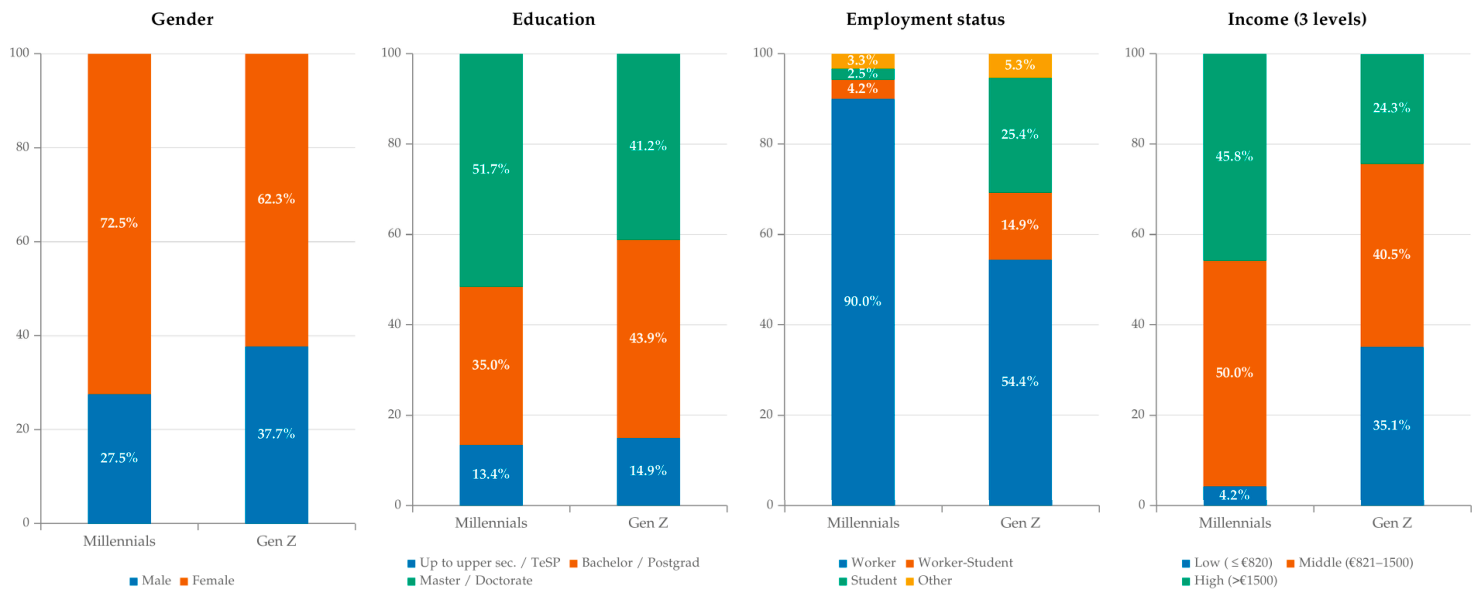
The final sample comprises 234 participants, distributed approximately equally between Millennials (n = 120) and Generation Z (n = 114). The majority identified as female (67.5%), a higher proportion than in the national reference population (Table 1), with no significant difference between the two generations (Millennials 72.5%, Generation Z 62.3%; Figure 1). The cohorts differed systematically across education, occupational status, and income (Figure 1; Table S1): more than half of Millennials held a Master’s or Doctoral degree (51.7%, vs. 41.2% of Generation Z), whereas Generation Z was more strongly represented at the Bachelor/Postgraduate level (43.9%, vs. 35.0%). The same pattern marked occupational status, with 90.0% of Millennials in work compared with 54.4% of Generation Z, among whom students (25.4%) and worker–students (14.9%) were considerably more common. Income followed suit: Millennials were concentrated in the middle and upper bands (€821–1500: 50.0%; >€1500: 45.8%), whereas a substantial share of Generation Z fell in the lowest band (≤€820: 35.1%).
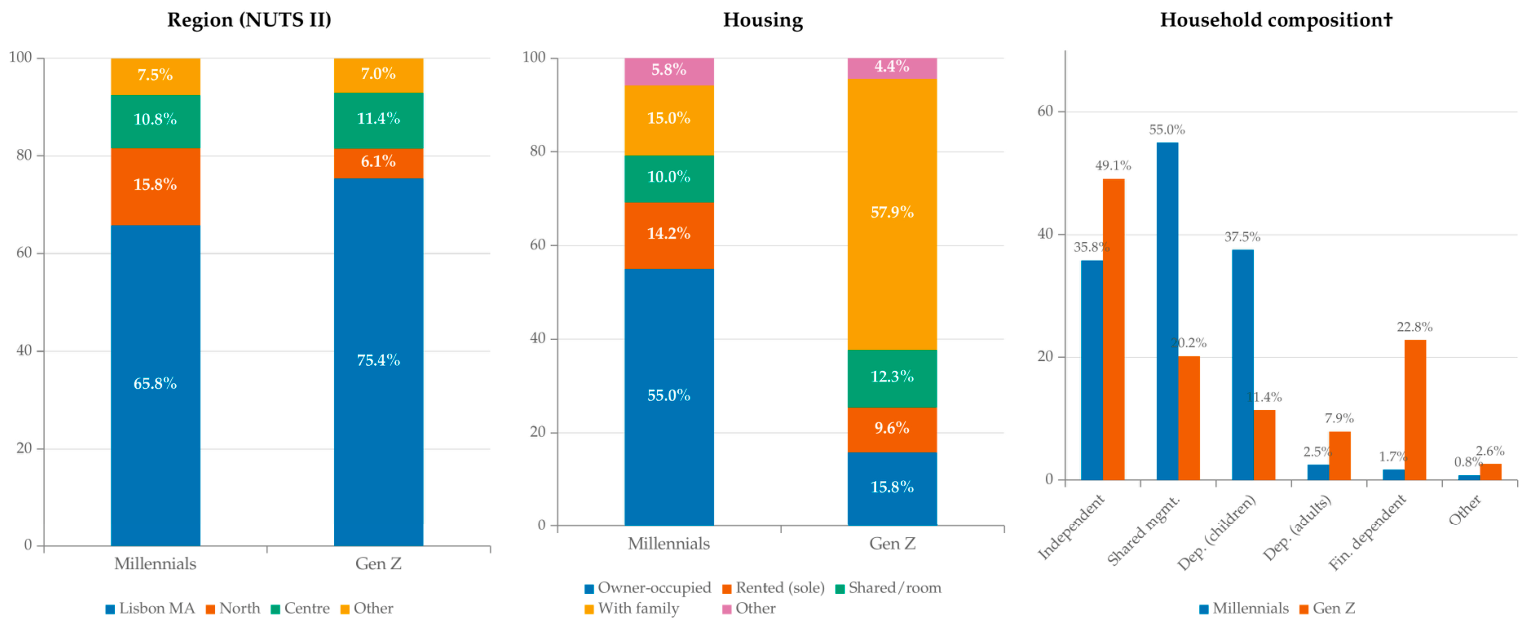
The residential and household profile captured by housing tenure, household composition, and financial responsibility further illustrates the differences between the two cohorts (Figure 2).
Geographically, both groups were concentrated in the Lisbon Metropolitan Area (Millennials 65.8%, Generation Z 75.4%; Figure 2). Housing tenure, by contrast, diverged sharply: 55.0% of Millennials were owner–occupiers, against only 15.8% of Generation Z, the majority of whom still lived with family (57.9%, vs. 15.0% of Millennials). Household composition and financial responsibility showed the same divide (Figure 2): Millennials more often shared financial management with a partner (55.0%, vs. 20.2%) and supported dependent children (37.5%, vs. 11.4%), whereas Generation Z far more frequently reported being financially dependent on others (22.8%, vs. 1.7%).
These differences largely reflect the cohorts’ distinct positions in the life course rather than generational dispositions as such—a distinction that matters for interpreting the comparisons that follow. Since income and educational attainment may shape orientations towards retirement independently of cohort, part of any apparent generational gap could instead reflect structural position; Section 3.6 therefore disentangles the two through a socioeconomic stratification analysis.

3.2. Preference for Life-Course Model

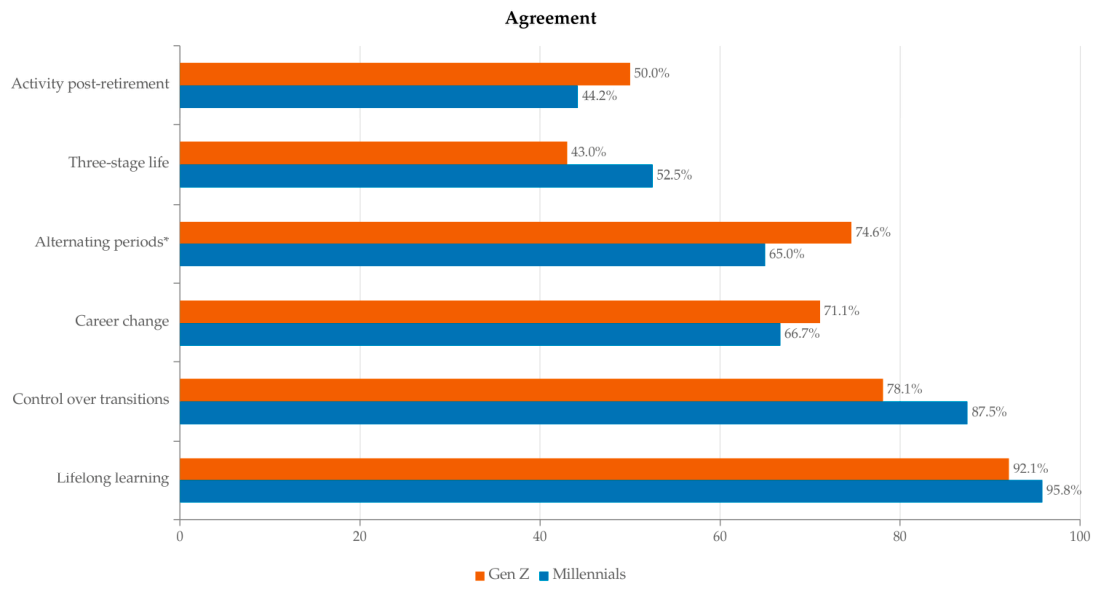
Across the six items of life-course organisation (Figure 3; Table S2), lifelong learning drew near-universal agreement (94.0%), followed by the desire for greater control over biographical transitions (82.9%) and the expectation of repeated cross-sectoral mobility (68.8%). Agreement with the classic three-stage sequence of education, work, and retirement was markedly lower (47.9%), as was support for remaining professionally active beyond the statutory retirement age (47.0%). Only one item differed significantly between cohorts: cyclically alternating periods of work, study, and leisure, endorsed by 69.7% overall and rated higher by Generation Z than by Millennials (U = 5530, p = 0.006, r = 0.192).
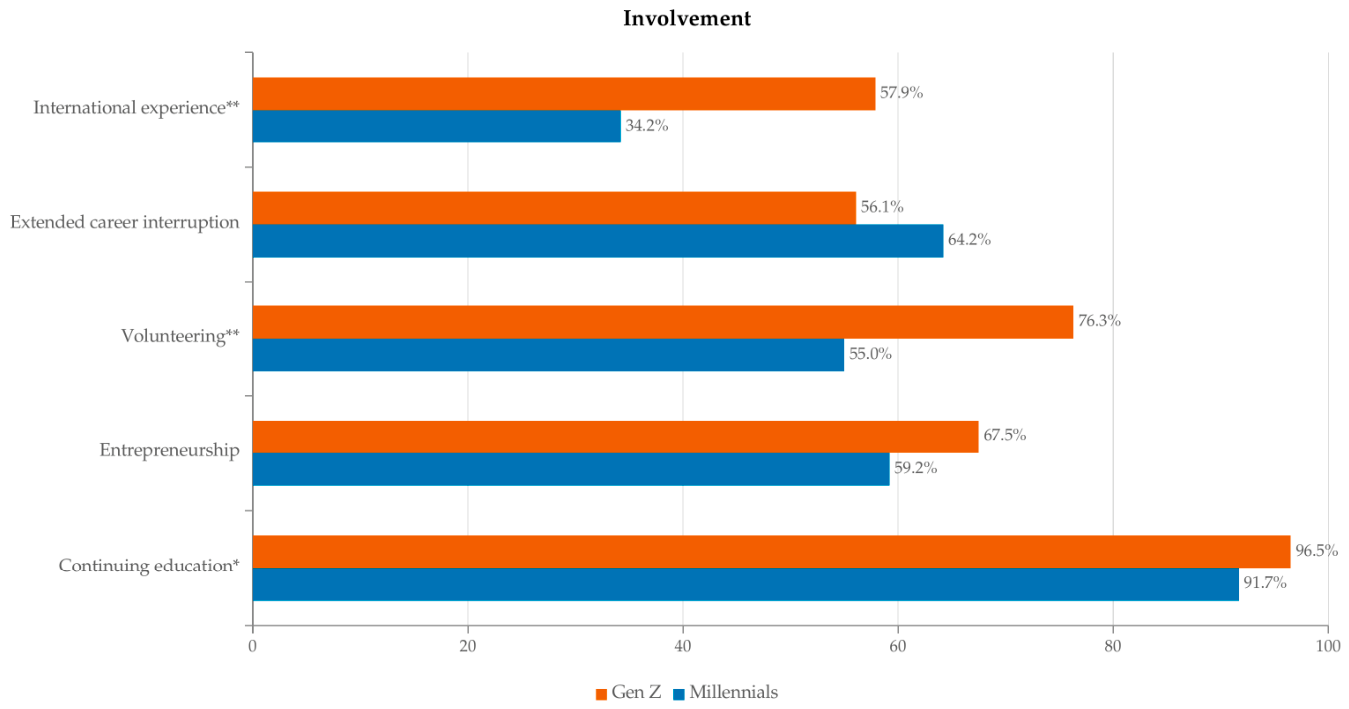
Anticipated involvement in non-normative life transitions (Figure 4; Table S5) was higher among Generation Z, significantly so for three transitions: international experience (57.9% vs. 34.2% of Millennials; U = 4648, p < 0.001, r = 0.320), volunteering (76.3% vs. 55.0%; U = 4847.5, p < 0.001, r = 0.291), and continuing education (96.5% vs. 91.7%; U = 5527.5, p = 0.009, r = 0.192). Extended career interruption and entrepreneurship did not differ significantly between cohorts.
The declared preference data reinforce this pattern (Table 2): only 9.8% of participants selected the traditional linear model, whilst the majority opted for flexible trajectories, with 38.0% preferring permanent flexibility and 39.7% multiple non-linear stages. The distribution differs significantly between generations (χ2(5) = 11.109, p = 0.049, V = 0.218): Generation Z records a higher proportion preferring the portfolio/projects model (16.7% vs. 5.0% among Millennials), whilst Millennials show greater adherence to the multiple non-linear stages model (45.8% vs. 33.3%). This generational difference is significant only at the uncorrected level and does not survive a Benjamini–Hochberg correction across the family of generational tests (see Supplementary Table S14); it should therefore be read as suggestive rather than robust.
Taken together, these results point to a coexistence of the symbolic persistence of the tripartite model with a declared preference for more flexible, non-linear trajectories, more pronounced among Generation Z.

3.3. Perceived Institutional Rigidity

Perceived institutional rigidity was assessed through two items on flexibility aspirations and three on perceived institutional constraints, with satisfactory internal consistency (α = 0.717; Table S3). The possibility of adjusting the retirement age to individual preferences is supported by 57.7% of participants, whilst 66.7% consider that the current model of transitions between life stages is not suited to younger generations. On institutional constraints, 73.1% identify a gap between their aspirations and what the system permits, and 79.1% consider the Portuguese system ill-suited to non-linear life trajectories. The only significant difference between cohorts concerns the perception that the parental retirement model will not constitute an adequate reference for one’s own trajectory (U = 7797, p = 0.049, r = 0.140).
The absence of significant differences on most items suggests a cross-cutting critical perception of the system across both cohorts. Direct assessment of system rigidity corroborates these perceptions (Table 3). Half of participants consider that the Portuguese system penalises career interruptions, with a significant difference between generations (χ2(2) = 10.652, p = 0.005, V = 0.213), driven primarily by the higher proportion of “don’t know” responses in Generation Z. A majority (53.4%) also held that the system makes it difficult to change professional field after the age of 40, without a significant difference between cohorts. As for working beyond the age of 65, 64.5% believed the system permits it, more so among Millennials (χ2(2) = 6.951, p = 0.030, V = 0.172).
The cohorts differed in familiarity rather than evaluation: criticism of the system was shared, whereas Generation Z expressed greater uncertainty about how it actually operates, consistent with its higher proportion of “don’t know” responses.

3.4. Preparation for Retirement

3.4.1. Strategies and Time Horizon

Preparation strategies were assessed through twelve indicators with satisfactory internal consistency (Table 4; α = 0.774). The most widely adopted strategies in both cohorts are those oriented towards longevity and physical health (83.0% engagement), mental well-being, and social capital, whilst strategies traditionally associated with formal financial preparation are reported with markedly lower engagement. Two strategies show statistically significant generational differences: Millennials report higher engagement in formal saving (65.3% overall, p = 0.032) and debt repayment (p = 0.031), consistent with their more advanced life stage and a greater likelihood of established financial responsibilities.
The time horizon for preparation did not differ significantly between cohorts (Table S4): about a third of participants (32.1%) had already begun concrete actions (Millennials 40.0%, Generation Z 23.7%), while 34.2% had no defined timeline (Millennials 30.8%, Generation Z 37.7%); for most respondents, the temporal framing of preparation thus remained diffuse.

3.4.2. Barriers to Preparation

The main barriers identified were insufficient income (45.3%), lack of knowledge about how to invest (40.6%), and immediate priorities (39.7%) (Table 5). The cohorts diverged: Millennials more often cited fixed expenses (45.8% vs. 24.6%) and immediate priorities (45.8% vs. 33.3%), whereas Generation Z more often cited lack of knowledge about savings instruments (46.5% vs. 35.0%) and financial instability (25.4% vs. 15.8%).
Overall, preparation in both cohorts leaned towards health, well-being, and social capital rather than formal financial instruments, and was constrained mainly by income and financial-literacy barriers.

3.5. Trust in the Public Pension System and Intergenerational Equity

3.5.1. System Trust and Intergenerational Equity

Trust in the public pension system is markedly low (Table 6). Only 5.1% of participants agree that the social security system will guarantee an adequate retirement, whilst 72.6% disagree or strongly disagree. The majority anticipated worse retirement conditions than previous generations (85.5%) and greater dependence on personal resources than on the public system (85.9%). On locus of control, 82.9% acknowledged the influence of external factors while 88.5% also believed they can shape their future through their own decisions. None of these dimensions differed significantly between cohorts.
On intergenerational equity, 37.2% agreed that older generations deserve adequate pensions even if this requires additional effort from their own generation, and 40.2% considered it unjust to contribute to a system from which they may not benefit equivalently (Table 6).

3.5.2. Retirement Expectations and Future Concerns

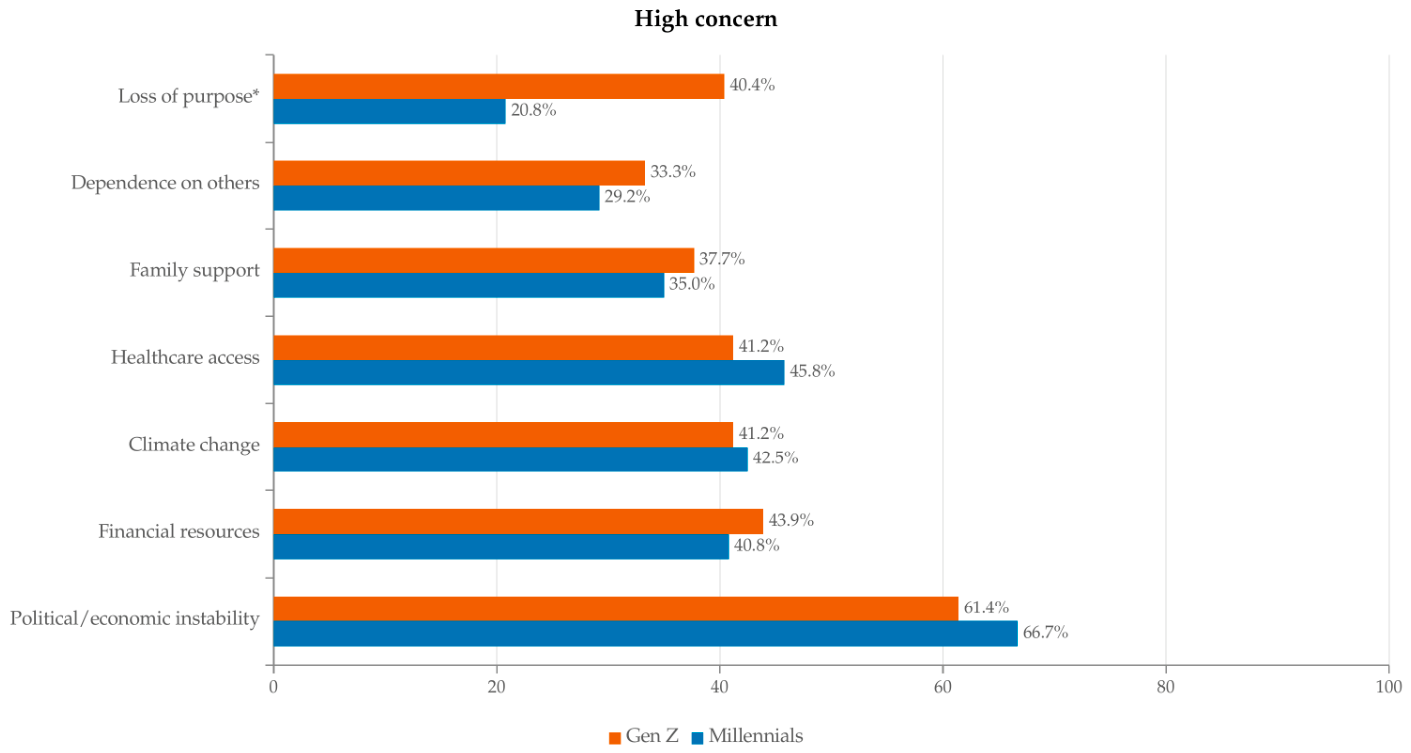
Future concerns were assessed through seven indicators with good internal consistency (α = 0.848; Figure 5, Table S6). Political or economic instability was the most intense concern in both cohorts (64.1%), followed by access to healthcare (43.6%) and financial resources in retirement (42.3%). The only significant difference between generations concerned the loss of professional relevance or sense of purpose, on which Generation Z expressed greater concern than Millennials (Mdn = 3, M = 3.07 vs. Mdn = 2, M = 2.54; U = 5301.0, p = 0.002, r = 0.225).
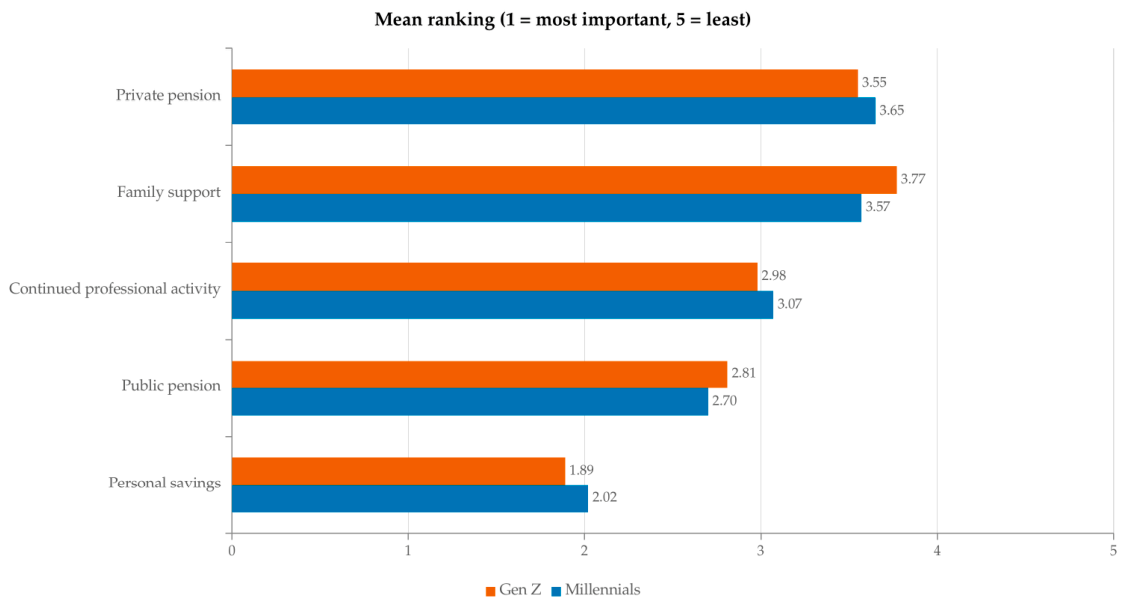
Expected sources of support in retirement (Figure 6, Table S7) placed personal savings and investments first (mean rank 1.95), followed by the public pension (2.75) and continued professional activity (3.03), whereas private pensions (3.60) and family support (3.67) ranked lowest. No significant generational differences emerged.
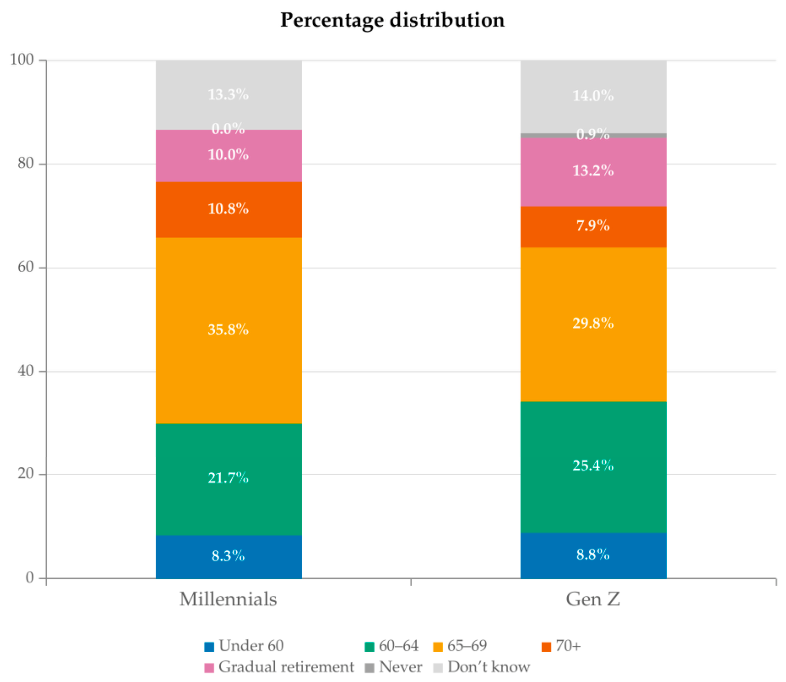
Expected retirement age (Figure 7, Table S8) most often fell in the statutory 65–69 bracket, the modal expectation in both cohorts (32.9%). A comparable share, however, anticipated retiring before 65 (32.0%), while fewer expected to work to 70 or beyond (9.4%); a further 11.5% envisaged a gradual rather than abrupt exit, and 13.7% held no defined expectation. The distribution did not differ significantly between cohorts.
Taken together, the bivariate comparisons describe a generationally convergent picture: the tripartite model is broadly rejected, the institutional framework is seen as misaligned with non-linear trajectories, and preparation is increasingly individualised amid low trust. Whether this convergence holds across socioeconomic positions is examined next.

3.6. Socioeconomic Stratification of Retirement Preparation

The bivariate generational comparisons reported in the preceding subsections were complemented by Kruskal–Wallis tests examining the association between twelve outcome items and three socioeconomic stratifiers—income, educational attainment, and professional situation—each recoded into three levels to preserve statistical power (Table S9). Income recoding excluded participants reporting no independent income; education was recoded along Bologna-cycle boundaries; and professional situation was reduced to worker, worker–student, and student categories (rank correlations between the stratifiers and the main outcomes are reported in Table S13).
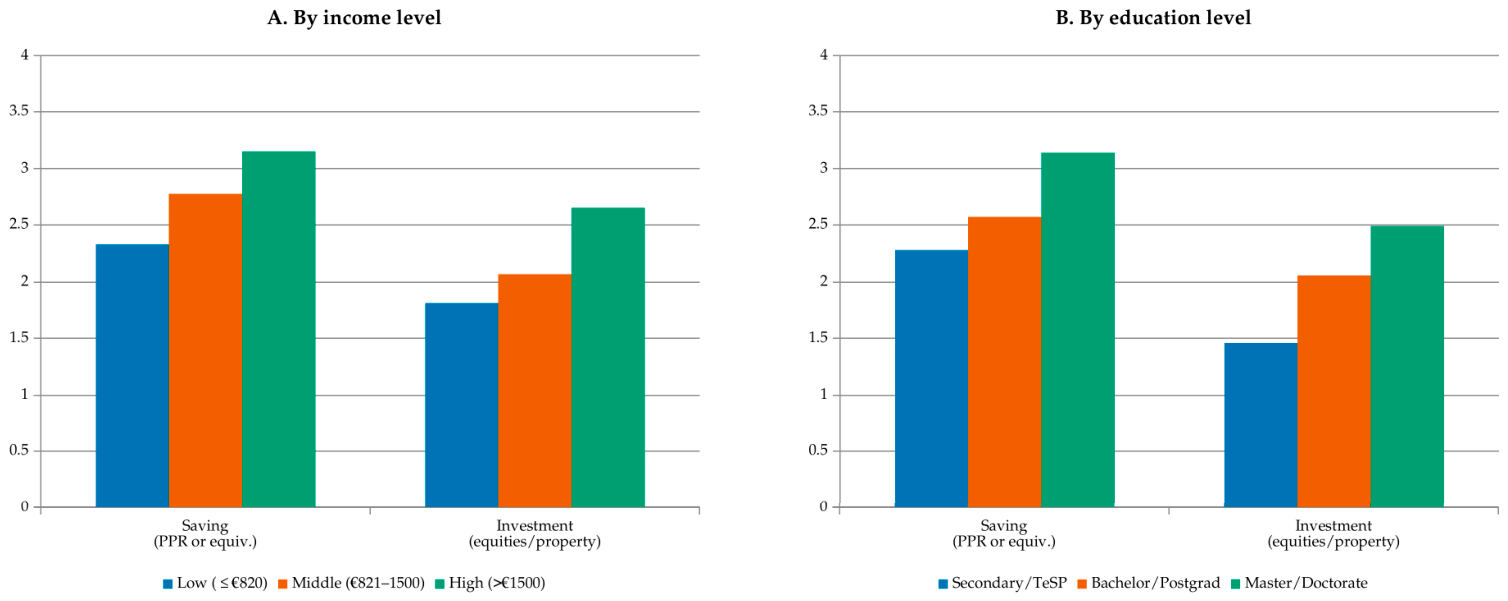
Income showed the broadest pattern of differentiation, with significant gradients on four preparation strategies, the two concern items relating to financial resources and family support, and perceived contributive injustice; engagement in saving and investment rose monotonically with income tier (post hoc comparisons in Table S9). The strongest income effect was for perceived contributive injustice, though in the opposite direction to the preparation gradients: higher-income participants perceived the system as less unjust than their middle-income peers. Under a Benjamini–Hochberg correction across the stratification family, the robust associations are those of education with saving and investment and of income with perceived contributive injustice; the income gradients on saving and investment, although monotonic, do not survive correction and are reported as indicative (Supplementary Table S14).
Educational attainment differentiated the same financial-preparation items as income, with the largest single effect across the battery on engagement in saving, and additionally predicted willingness to remain professionally active beyond the statutory retirement age and the perceived need to rely on personal rather than systemic resources.
Professional situation is the only stratifier under which trust in the public pension system varies. Workers, worker–students and full-time students differ on this item and on the perception that the parental retirement model will not apply. The worker–student category frequently occupies an intermediate position between the two extremes, consistent with its dual structural location between education and the labour market. Across these three stratifiers, income and education converge most clearly on the financial-preparation items (Figure 8).
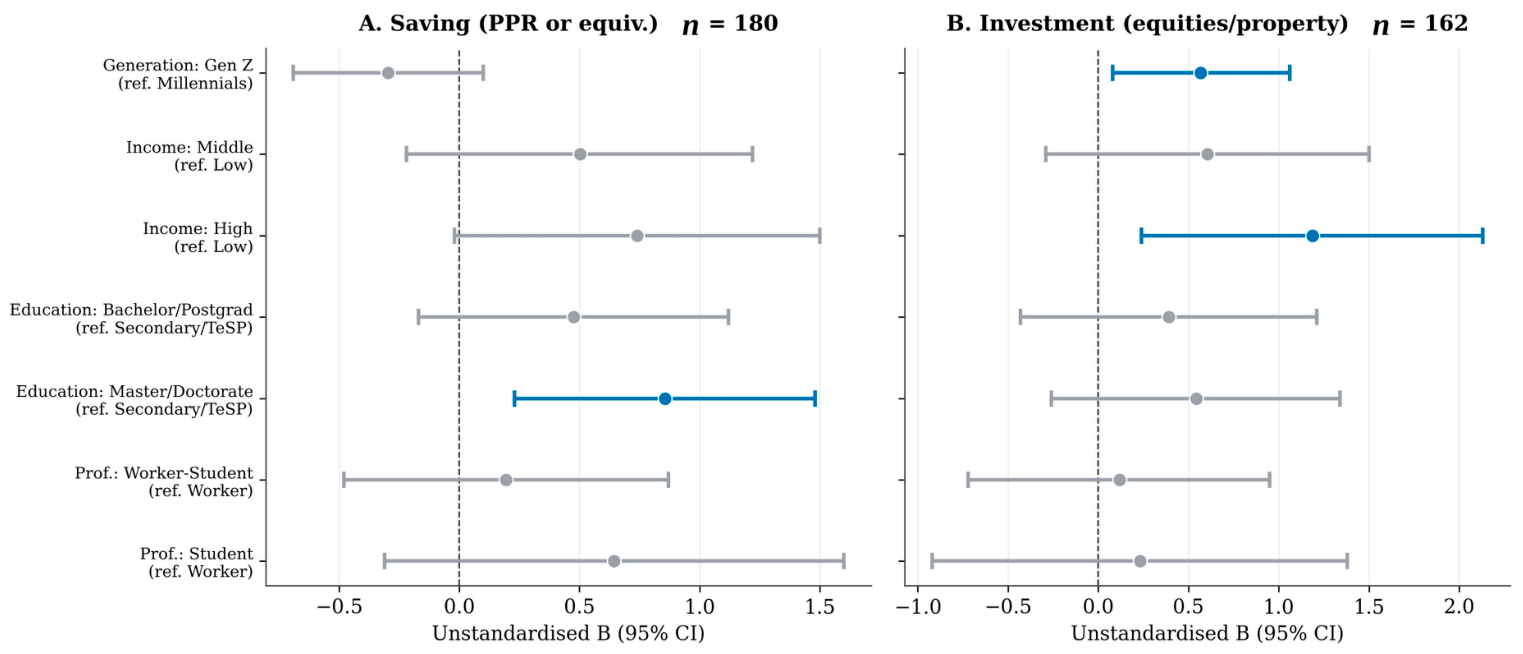
To disentangle these socioeconomic associations from the generational comparisons, three multivariate linear regressions were estimated—on saving engagement, investment engagement, and trust in the pension system (Supplementary Tables S10–S12; Figure 9). Saving engagement was independently predicted by educational attainment at the Master’s or Doctoral level; investment engagement by high income and, once socioeconomic position was partialled out, by Generation Z membership. Trust was predicted by neither socioeconomic position nor generation: the model explained only 3.7% of the variance, with no coefficient distinguishable from zero. No socioeconomic or generational predictor of distrust was detected, with the regression being non-significant (F(7, 192) = 1.04, p = 0.405), in contrast with the financial-preparation behaviours, which track income and education (Figure 9).

4. Discussion

This study examined how Millennials and Generation Z in Portugal conceptualise their biographical trajectories and anticipate their own ageing, drawing on life-course theory [6,20] and the multi-stage life model [14]. The results are discussed around four thematic axes: (i) preference for the life-course model, (ii) perceived institutional rigidity, (iii) retirement preparation, and (iv) trust in the public pension system and intergenerational equity. A final subsection examines how these patterns are stratified by socioeconomic position.
Across the four axes, the analysis reveals intergenerational convergence grounded in the recognition that the tripartite model requires reconfiguration rather than abandonment, a cross-cutting perception of institutional misalignment, the subordination of preparation strategies to the structural constraints of each cohort, and the widespread erosion of confidence in the public pension system’s capacity to deliver on its promised protection.

4.1. Preference for Life-Course Model

The vast majority of participants rejected the tripartite model as a biographical reference, split between multiple non-linear stage trajectories and permanent flexibility (Section 3.2). This pattern lends empirical support to the thesis of life-course destandardisation [17,18] and biographical deinstitutionalisation [16]. At the same time, the data warrant a cautious reading: they reveal less the obsolescence of the tripartite model than a demand for greater flexibility around it. The statutory retirement age remained the modal expectation in both cohorts (the 65–69 bracket; Figure 7), suggesting that the education–work–retirement sequence persists as a reference even as its rigidity is contested.
The distribution by cohort differs significantly. Generation Z oriented predominantly towards models of simultaneous projects and non-linear trajectories, approximating the multi-stage life model proposed by Gratton and Scott [14], whilst Millennials tended to favour staged transitions, albeit non-linear ones. Generation Z also showed greater agreement with alternating periods of work, education, and leisure throughout life, a finding consistent with the increase in life expectancy in Portugal and the consequent need to distribute professional activity across multiple stages.
This divergence may, however, reflect distinct positions within the life course rather than differentiated generational values: Millennials, already embedded in consolidated professional and financial trajectories, tend to conceptualise the life course in sequential stages; Generation Z, still entering the labour market, projects simultaneity and openness. Whether this preference for flexibility reflects a deliberate choice or the normalisation of precarity as a structural condition [8,11] cannot be determined from these data. The present findings thus document a reconfiguration in progress—one that operates, as Section 4.5 shows, within the material and structural constraints of bounded agency rather than as freely chosen biographical design.

4.2. Perceived Institutional Rigidity

The results lend empirical support to the concept of structural lag [15]; approximately three quarters of participants identified a gap between their biographical aspirations and the institutional framework and most consider the Portuguese system misaligned with non-linear trajectories. The cross-cutting nature of these perceptions across both cohorts confirms that rigidity is structural in character, reflecting the difficulty institutions face in adapting to life trajectories that are longer, more heterogeneous, and less linear.
Differences in the intensity of perception were nonetheless observed. Millennials perceive more acutely that the parental retirement model does not constitute an adequate reference for their own trajectory, a result consistent with their greater age proximity to parents who have already retired or are approaching retirement. Generation Z, for its part, displays greater uncertainty about how the system functions, particularly regarding career interruptions and the possibility of working beyond the age of 65, suggesting a more distant relationship with contributory mechanisms.
These results are consistent with the diagnosis that the model grounded in the relationship between stable employment and contributory social protection has lost empirical traction [13,22], and align with Generation Z’s greater exposure to labour-market precarity [8] and the biographical risk characteristic of late modernity [16]. This perceived rigidity does not, however, imply a straightforward remedy: a system that did not reduce entitlements after contributory gaps would require either greater redistribution or higher contributions, themselves matters of political choice. The present findings document how the system is perceived, not a prescription for its redesign.

4.3. Preparation for Retirement

Generational differences in retirement preparation are concentrated primarily in financial strategies: Millennials reported higher engagement in saving and debt repayment, whilst across the remaining strategies—investment in skills, alternative income, mental well-being, and social capital—no significant differences between cohorts were found.
This difference reflects the structural position of each generation rather than a divergence in attitudes towards the future. Millennials have higher incomes and active financial commitments such as mortgage credit, which enable them to act preventively. As the multivariate analysis reported in Section 4.5 makes clear, however, this gap is structured primarily by income and educational attainment rather than by cohort as such: once socioeconomic position is considered, the generational difference in saving engagement no longer holds.
Generation Z, with lower income and greater dependence on third parties, has less room to do so, facing structural conditions that, according to Castel [13], constitute risk factors for processes of désaffiliation—understood as the progressive dissociation from the mechanisms of social integration through work and the associated protection—though the available data do not permit confirmation of that trajectory. This dependence coexists with a nascent autonomy: Generation Z more often managed its own finances (49.1% vs. 35.8%) even as it more frequently relied financially on others (22.8% vs. 1.7%), a combination that captures the precarious, transitional character of its economic position.
Insufficient income was identified as the main barrier to preparation, which situates the problem at the structural level rather than at the level of financial literacy: educational interventions in isolation are insufficient to alter this pattern. The convergence on non-financial strategies indicates that both generations recognise the need to prepare for the future through relational, health, and capability resources, in a logic consistent with the multi-stage life model [14].

4.4. Trust in the Public Pension System and Intergenerational Equity

Low trust in the public pension system is the most unequivocal and cross-cutting finding of the study: very few participants trusted the system to guarantee an adequate retirement, with no significant differences between cohorts. The majority anticipated conditions inferior to those of previous generations, and personal savings emerge as the primary anticipated resource, surpassing the public pension—consistent with the individualisation of risk [11], by which the system transfers to the private sphere the management of uncertainties of structural origin.
This finding challenges readings that frame pension scepticism as a mere expression of generational conflict. Comparative studies have shown that perceptions of intergenerational equity tend to be shaped primarily by the institutional design of systems rather than by conflicts of interest between age groups [22]. The present study’s data are consistent with this interpretation: participants moderately endorsed the legitimacy of current pensions whilst perceiving the arrangements that await them as unjust. This judgement should be understood as a statement about subjectively experienced equity rather than about the system’s actuarial fairness. A contributory scheme may be demographically and actuarially defensible—reflecting, for instance, the larger families and longer contributory histories of earlier cohorts—while still being experienced as inequitable by those who doubt its future delivery. The distinction between actuarial fairness and perceived intergenerational equity is well established in the welfare-state literature [22], and it is the latter that the present study measures: the data do not establish that the Portuguese system is objectively unjust, only that these cohorts perceive it as such.
This combination does not reflect an attitudinal contradiction, but a rational response to a system perceived as internally incoherent. The legitimacy of the contributory contract depends on younger cohorts’ confidence in its future viability; when that confidence erodes, the intergenerational solidarity that sustains the system is compromised [16]. In the Portuguese context, this distrust is reinforced by demographic projections [5] and the widely acknowledged insufficiency of social responses to ageing, rendering it plausible that the observed scepticism constitutes less a generational trait than a rational assessment of the institutional context.
That this scepticism is uniform across socioeconomic groups and cohorts—and resistant to prediction by any measured variable—identifies it as a structural orientation rather than a positional or attitudinal one. It constitutes the affective dimension of bounded agency: participants simultaneously acknowledge the bearing of structural constraints on their retirement trajectories and retain a sense of individual navigability within them. This combination—structural distrust coexisting with personal efficacy beliefs—is not a contradiction but a coherent response to a system whose institutional fragility is perceived as beyond individual redress.

4.5. Socioeconomic Stratification of Retirement Preparation

The stratified analyses qualify the generational reading of the preceding sections. The differences that emerged most clearly between cohorts—those concerning financial preparation—were structured primarily by income and educational attainment: engagement in saving and investment rose with income tier, and the multivariate models confirmed that saving was independently predicted by educational attainment and investment by high income. Part of what appears as a generational gap therefore reflects the cohorts’ differing structural positions rather than distinct dispositions, consistent with a bounded-agency reading [8] in which orientations towards the future are conditioned by available material resources.
A residual generational effect nonetheless persisted: once socioeconomic position was partialled out, Generation Z membership independently predicted investment engagement, suggesting that the younger cohort’s openness to less conventional financial strategies is not entirely reducible to its weaker material position.
The contrast is sharpest for trust. Distrust in the public pension system was predicted by neither socioeconomic position nor generation, and the corresponding model explained almost none of the variance. No predictor of scepticism was detected, which—together with the floored distribution of trust responses—is consistent with the interpretation advanced above: it constitutes a structural assessment of institutional fragility rather than a generational trait or an artefact of social position.

4.6. Limitations

This study presents limitations that condition the interpretation of the results. First, the convenience sample may introduce self-selection biases and compromise the generalisability of the findings [26,29]. The sample’s predominantly female (67.5%), urban, and highly educated composition represents a further limitation, as evidenced by the census comparison presented in Table 1. This demographic profile may result in an overestimation of biographical reflexivity and future planning orientations relative to groups with lower educational capital and more constrained material circumstances. Contributory trajectories and retirement expectations also vary systematically by gender in Portugal, a dimension that remains under-represented in the present sample. The absence of census-based comparisons for educational attainment and region of residence reflects a data availability constraint: published INE tabulations for these variables (Quadro 6.03) disaggregate by broad age groups rather than single year of age, precluding exact cohort-boundary matching.
Second, the cross-sectional design prevents a clear distinction between age, cohort, and historical context effects, a limitation particularly relevant in a context of life-course deinstitutionalisation, wherein generational boundaries become increasingly porous [16,18,20]. Self-report measures may also be affected by social desirability, particularly in dimensions relating to retirement preparation and attitudes towards ageing. Relatedly, several items were framed in terms of perceived institutional constraint and perceived (in)justice. Such items may be susceptible to acquiescence and to response-option framing, a risk that should be weighed when interpreting findings on perceived institutional rigidity and intergenerational equity in particular.
Third, the questionnaire was developed specifically for this study and piloted with a small convenience sample (n = 5); most constructs were operationalised as single items without multi-item scales or confirmatory factor analysis, which constrains construct validity and warrants a cautious, exploratory reading of the scale-based results. The multivariate regressions rest on modest case-to-predictor ratios (approximately 26 and 23 cases per predictor in the saving and investment models, respectively); these are adequate for linear estimation but constrain the precision of the estimates and the statistical power to detect small effects.
Finally, the delimitation of generations by age cohort remains debated in the literature [21,27], and the geographic concentration in the Lisbon Metropolitan Area limits the extrapolation of the findings to the national territory.
Future research would benefit from nationally representative samples, longitudinal designs, and qualitative or mixed-method approaches capable of examining how retirement expectations, perceptions of intergenerational equity, and institutional trust evolve over time and are shaped across different socioeconomic contexts.

5. Conclusions

The findings of this study indicate that Millennials and Generation Z in Portugal conceptualise retirement and the life course under conditions marked by increasing longevity, institutional uncertainty, and the growing individualisation of risk. The sociodemographic differences between cohorts—housing, income, and employment status—reflect distinct life-course stages and should be read as contextual variables rather than autonomous generational attitudes.
Generation Z shows a more pronounced preference for flexible and non-linear life models; Millennials show greater engagement with financial-preparation strategies, in a context where the parental retirement model is perceived as an increasingly inadequate reference. Both patterns are consistent with the biographical deinstitutionalisation documented in Section 4.1 and reflect the operation of bounded agency across different material positions: orientations towards the future are shaped, but not determined, by the structural conditions of each cohort. Economic and political instability was the most salient concern across both cohorts, with no generational differentiation, consistent with the interpretation that low institutional trust reflects structural conditions rather than cohort-specific attitudes. Loss of professional purpose was the only concern to differ significantly between cohorts, with Generation Z reporting greater concern, in line with their greater temporal distance from retirement. This pattern limits the effectiveness of policy responses directed exclusively at young adults.
Whether Generation Z’s preference for flexible models represents a consolidated generational shift or a life-course position that will later converge with that of Millennials remains an open question.
Two implications follow. In research, there is value in developing more robust instruments to measure institutional trust and the anticipation of ageing, and in extending the analysis to comparative European contexts. In social policy, the findings confirm the need to adapt social protection systems to non-linear trajectories—encompassing interruptions, mobility, professional reorientation, and project-based work—whose current rigidity penalises those who do not follow the normative model and weakens the intergenerational contract. Distrust was uniform across socioeconomic groups and cohorts, and financial preparation followed material resources rather than attitudes; interventions aimed at financial literacy or individual attitudes are therefore unlikely to address the structural roots of the problem, which lie in the institutional design of social protection itself.
Whether and how social protection should be adapted to non-linear careers is a matter of policy choice rather than a fixed constraint. Such adaptation entails genuine trade-offs: extending entitlements to discontinuous trajectories implies greater redistribution or higher contributions, to be weighed against fiscal sustainability under demographic pressure—a tension particularly acute in the Mediterranean welfare regime, where the family remains the primary buffer [3,23]. The present study does not adjudicate this question; descriptive of how these cohorts perceive their prospects, it establishes only that the rigidity registered by those perceptions is institutional, and therefore amenable to reform rather than inevitable. More broadly, these findings suggest that rethinking retirement also requires rethinking how ageing is socially organised across the life course.


Supplementary Materials

The following supporting information can be downloaded at https://www.mdpi.com/article/10.3390/jal6020046/s1, Table S1: Sociodemographic Characterisation (Gender, Education, and Occupational Status); Table S2: Sociodemographic Characterisation (Income, Region of Residence, and Housing Situation); Table S3: Sociodemographic Characterisation (Household Composition and Financial Responsibility); Table S4: Preference for Life Course Organisation; Table S5: Preference for Life Model; Table S6: Anticipated Transitions in the Life Trajectory; Table S7: Perceived Institutional Rigidity (Flexibility Aspirations and Institutional Constraints); Table S8: Rigidity of the Social Protection System; Table S9: Retirement Preparation Strategies; Table S10: Horizon for Retirement Preparation; Table S11: Barriers to Retirement Preparation; Table S12: Trust in the Public Pension System, Intergenerational Equity, and Locus of Control; Table S13: Future Concerns; Table S14: Expected Sources of Support in Retirement (Importance Ranking); Table S15: Expected Retirement Age.

Author Contributions

Conceptualization, A.M.d.C.O. and C.S.S.; methodology, A.M.d.C.O. and C.S.S.; investigation, C.S.S.; formal analysis, C.S.S.; writing—original draft preparation, A.M.d.C.O. and C.S.S.; writing—review and editing, A.M.d.C.O.; supervision, A.M.d.C.O. All authors have read and agreed to the published version of the manuscript.

Funding

This research received no external funding.

Institutional Review Board Statement

The study was conducted in accordance with the Declaration of Helsinki and applicable ethical standards for social research involving human participants. Due to the non-interventional nature of the study and the use of an anonymous online survey with no collection of identifiable personal data and no procedures posing risk to participants, formal ethical approval was not required according to institutional and national guidelines. The study followed standard ethical protocols for online survey research.

Informed Consent Statement

Informed consent was obtained from all participants prior to data collection via an online statement presented at the start of the questionnaire. Participants were informed of the study’s aims, voluntary nature of participation, and anonymity and confidentiality of responses. Only participants who provided explicit consent were permitted to proceed; those who declined were automatically redirected and no data were recorded. Written signatures were not applicable given the anonymous online format.

Data Availability Statement

The data that support the findings of this study are available from the corresponding author upon reasonable request. Access is subject to the confidentiality and anonymity conditions established in the informed consent provided by participants.

Acknowledgments

The authors would like to thank all participants for their time and contribution to this study. The authors used AI-assisted tools for language refinement and support in the interpretation of statistical outputs. All outputs were reviewed and validated by the authors, who take full responsibility for the content of this publication.

Conflicts of Interest

The authors declare no conflicts of interest.

Abbreviations

The following abbreviations are used in this manuscript:
MMean
MdnMedian
SDStandard deviation
αCronbach’s alpha coefficient
UMann–Whitney U statistic
rEffect size (Mann–Whitney r)
VCramér’s V effect size
χ2Chi-square statistic
PPRPlano Poupança Reforma (Portuguese retirement savings plan)
INEInstituto Nacional de Estatística

References

  1. Kohli, M. The world we forgot: A historical review of the life course. In Later Life: The Social Psychology of Aging; Marshall, V.W., Ed.; Sage: Beverly Hills, CA, USA, 1986; pp. 271–303. [Google Scholar]
  2. Mayer, K.U.; Müller, W. The state and the structure of the life course. In Human Development and the Life Course: Multidisciplinary Perspectives; Sorensen, A.B., Weinert, F.E., Sherrod, L.R., Eds.; Erlbaum: Hillsdale, NJ, USA, 1986; pp. 217–245. [Google Scholar]
  3. Esping-Andersen, G. The Three Worlds of Welfare Capitalism; Princeton University Press: Princeton, NJ, USA, 1990. [Google Scholar]
  4. Instituto Nacional de Estatística. Esperança de Vida de 81.49 anos à Nascença e de 20.20 anos aos 65 anos; Instituto Nacional de Estatística: Lisboa, Portugal, 2025.
  5. INE. Projeções de População Residente 2018–2080; Instituto Nacional de Estatística: Lisboa, Portugal, 2020.
  6. Settersten, R.A.; Mayer, K.U. The Measurement of Age, Age Structuring, and the Life Course. Annu. Rev. Sociol. 1997, 23, 233–261. [Google Scholar] [CrossRef]
  7. Eurostat. Unemployment by Sex and Age—Annual Data (une_rt_a). Available online: https://ec.europa.eu/eurostat/databrowser/view/une_rt_a/ (accessed on 20 March 2026).
  8. Standing, G. The Precariat: The New Dangerous Class; Bloomsbury Academic: London, UK, 2011. [Google Scholar]
  9. OECD. Under Pressure: The Squeezed Middle Class; OECD Publishing: Paris, France, 2019. [Google Scholar]
  10. OECD. OECD Employment Outlook 2025: Can We Get Through the Demographic Crunch? OECD Publishing: Paris, France, 2025. [Google Scholar]
  11. Beck, U. Risk Society: Towards a New Modernity; Sage: London, UK, 1992. [Google Scholar]
  12. Santos, C.C.; Nunes, C.V.C. Políticas ativas de emprego na sociedade de risco: Emancipação ou regulação? Serviço Soc. Saúde 2016, 15, 201–218. [Google Scholar] [CrossRef]
  13. Castel, R. Les Métamorphoses de la Question Sociale: Une Chronique du Salariat; Fayard: Paris, France, 1995. [Google Scholar]
  14. Gratton, L.; Scott, A.J. The 100-Year Life: Living and Working in an Age of Longevity; Bloomsbury Publishing: London, UK, 2016. [Google Scholar]
  15. Riley, M.W.; Kahn, R.L.; Foner, A. Age and Structural Lag: Society’s Failure to Provide Meaningful Opportunities in Work, Family, and Leisure; John Wiley & Sons: New York, NY, USA, 1994. [Google Scholar]
  16. Kohli, M. The Institutionalization of the Life Course: Looking Back to Look Ahead. Res. Hum. Dev. 2007, 4, 253–271. [Google Scholar] [CrossRef]
  17. Brückner, H.; Mayer, K.U. De-Standardization of the Life Course: What it Might Mean? And if it Means Anything, Whether it Actually Took Place? Adv. Life Course Res. 2005, 9, 27–53. [Google Scholar] [CrossRef]
  18. Mayer, K.U. New Directions in Life Course Research. Annu. Rev. Sociol. 2009, 35, 413–433. [Google Scholar] [CrossRef]
  19. Evans, K. Concepts of bounded agency in education, work, and the personal lives of young adults. Int. J. Psychol. 2007, 42, 85–93. [Google Scholar] [CrossRef]
  20. Elder, G.H., Jr. The life course as developmental theory. Child Dev. 1998, 69, 1–12. [Google Scholar] [CrossRef] [PubMed]
  21. Mannheim, K. The Problem of Generations. In Essays on the Sociology of Knowledge; Kecskemeti, P., Ed.; Routledge and Kegan Paul: London, UK, 1952; pp. 276–320. [Google Scholar]
  22. Sabbagh, C.; Vanhuysse, P. Intergenerational Justice Perceptions and the Role of Welfare Regimes: A Comparative Analysis of University Students. Adm. Soc. 2010, 42, 638–667. [Google Scholar] [CrossRef]
  23. Ferrera, M. The ‘Southern Model’ of Welfare in Social Europe. J. Eur. Soc. Policy 1996, 6, 17–37. [Google Scholar] [CrossRef]
  24. Silva, C.V.; Branco, F. A desqualificação social da classe média em Portugal: Uma abordagem qualitativa. New Trends Qual. Res. 2021, 9, 21–33. [Google Scholar]
  25. Pires, R.P.; Pereira, C.; Azevedo, J.; Vidigal, I.; Veiga, C.M. A emigração portuguesa no século XXI. Sociol. Probl. Prát. 2020, 94, 9–38. [Google Scholar] [CrossRef]
  26. Babbie, E. The Practice of Social Research; Wadsworth Cengage Learning: Boston, MA, USA, 2014. [Google Scholar]
  27. Dimock, M. Defining Generations: Where Millennials End and Generation Z Begins. Available online: https://www.pewresearch.org/short-reads/2019/01/17/where-millennials-end-and-generation-z-begins/ (accessed on 17 January 2025).
  28. Observatório Nacional da Luta Contra a Pobreza. Envelhecimento e Políticas Sociais em Portugal (Boletim n.º 5); EAPN Portugal: Porto, Portugal, 2020.
  29. Peytchev, A. Survey Breakoff. Public Opin. Q. 2009, 73, 74–97. [Google Scholar] [CrossRef]
  30. Dillman, D.A.; Smyth, J.D.; Christian, L.M. Internet, Phone, Mail, and Mixed Mode Surveys: The Tailored Design Method, 4th ed.; Wiley: Hoboken, NJ, USA, 2014. [Google Scholar]
  31. Instituto Nacional de Estatística. Censos 2021—Quadro 6.01: População Residente Segundo a Dimensão dos Lugares por Idade (Ano a Ano) e Sexo. 2022. Available online: https://www.ine.pt/investigadores/Quadros_2021/Q601.zip (accessed on 25 March 2026).
  32. Instituto Nacional de Estatística. Censos 2021—Quadro 6.03: População Residente Segundo o Grupo Etário por Nível de Escolaridade Completo e Sexo. 2022. Available online: https://www.ine.pt/investigadores/Quadros_2021/Q603.zip (accessed on 25 March 2026).
Figure 1. Socioeconomic profile by generation. Notes: Percentage distribution within each generation (Millennials n = 120; Gen Z n = 114). For visual clarity, education is collapsed into three broad levels, net monthly income into three bands (low ≤€820; middle €821–€1500; high >€1500), and professional situation into worker, worker–student, student, and other. Full disaggregated categories and inferential statistics on the original response options are reported in Supplementary Table S1.
Jal 06 00046 g001
Figure 2. Residential profile by generation. Notes: Percentage distribution within each generation (Millennials n = 120; Gen Z n = 114). Income collapsed into three bands using the national minimum wage (€820) and €1500 as cut-off points; housing categories consolidated. † Household composition is a multiple-response item. Inferential statistics on the original response categories are reported in Supplementary Table S1.
Jal 06 00046 g002
Figure 3. Preference for life-course organisation by generation. Notes: Percentage of participants who agreed or strongly agreed by generation (Millennials n = 120; Gen Z n = 114). Asterisks indicate significant differences between cohorts (Mann–Whitney U tests, * p < 0.05). Full per-item statistics are reported in Supplementary Table S2.
Jal 06 00046 g003
Figure 4. Anticipated transitions in the life trajectory by generation. Notes: Percentage of participants reporting past, present, or anticipated involvement, by generation (Millennials n = 120; Gen Z n = 114). Asterisks indicate significant differences between cohorts (Mann–Whitney U tests): * p < 0.05, ** p < 0.01. Full per-item statistics are reported in Supplementary Table S5.
Jal 06 00046 g004
Figure 5. Future concerns about retirement by generation. Notes: Percentage of participants quite or very concerned, by generation (Millennials n = 120; Gen Z n = 114). Asterisks indicate significant differences between cohorts (Mann–Whitney U tests, * p < 0.05; scale Cronbach’s α = 0.848). Full per-item statistics are reported in Supplementary Table S6.
Jal 06 00046 g005
Figure 6. Expected sources of support in retirement by generation. Notes: Mean ranking by generation (Millennials n = 120; Gen Z n = 114; lower bars indicate greater anticipated importance). Mann–Whitney U tests show no significant generational differences on any source; full per-item statistics are reported in Supplementary Table S7.
Jal 06 00046 g006
Figure 7. Expected retirement age by generation. Notes: Percentage distribution by generation (Millennials n = 120; Gen Z n = 114). No statistically significant differences between cohorts (full distribution and Chi-square test in Supplementary Table S8). The 65–69 bracket is the modal expectation for both cohorts.
Jal 06 00046 g007
Figure 8. Socioeconomic gradients in retirement preparation strategies. Notes: Mean engagement by income tier (Low ≤€820, n = 21; Middle €821–1500, n = 105; High >€1500, n = 82) and by education level (Secondary or TeSP, n = 33; Bachelor or Postgraduate diploma, n = 92; Master’s or Doctorate, n = 109; Likert 1–5). Kruskal–Wallis tests: Saving by income p = 0.009; saving by education p = 0.001; investment by income p = 0.023; investment by education p = 0.004. Full statistics in Supplementary Table S9.
Jal 06 00046 g008
Figure 9. Multivariate predictors of saving and investment engagement. Notes: Points are unstandardised regression coefficients (B); horizontal bars are 95% confidence intervals. Reference categories: generation = Millennials; income = low; education = Secondary/TeSP; professional situation = worker. Blue indicates predictors whose interval excludes zero (statistically significant); grey indicates non-significant predictors. Saving model: n = 180, R2 = 0.098, F(7, 172) = 2.68, p = 0.012. Investment model: n = 162, R2 = 0.095, F(7, 154) = 2.32, p = 0.028. Significant predictors (p < 0.05): Education Master/Doctorate on saving (B = 0.86); high income on investment (B = 1.19); Generation Z on investment (B = 0.57). Full coefficients in Tables S10 and S11.
Jal 06 00046 g009
Table 1. Comparison of sample gender distribution with census reference population.
Millennials
n = 120
Gen Z
n = 114
Total
N = 234
Ref.
Millennials
Ref.
Gen Z
Ref.
Total
Male27.5%37.7%32.5%49.1%50.8%49.7%
Female72.5%62.3%67.5%50.9%49.2%50.3%
Note. Reference population values are derived from INE Censos 2021 (Table 6.01) [31], which reports resident population by single year of age and sex for Portugal. Millennials correspond to those born 1983–1996 (aged 25–38 at the census reference date of 19 April 2021); Generation Z to those born 1997–2008 (aged 13–24); total sample to those born 1983–2008 (aged 13–38). Female counts were obtained by subtracting male (H) from total (HM); single-year counts were summed directly without interpolation. Cohort-level comparisons for educational attainment and region of residence were not possible, as published INE tabulations for these variables (Table 6.03) [32] disaggregate by broad age groups rather than single year of age.
Table 2. Preference for life model.
Life ModelMillennials
n (%)
Gen Z
n (%)
Total
n (%)
Traditional model (study → work → retire at 65+)12 (10.0)11 (9.6)23 (9.8)
Intensive career with reinvention (break + new career)2 (1.7)1 (0.9)3 (1.3)
Permanent flexibility (part-time work, alternating study, travel, or volunteering)45 (37.5)44 (38.6)89 (38.0)
Multiple non-linear stages (alternating cycles of work, study, family, and leisure)55 (45.8)38 (33.3)93 (39.7)
Portfolio/projects (several simultaneous projects with permanent flexibility)6 (5.0)19 (16.7)25 (10.7)
Other model0 (0.0)1 (0.9)1 (0.4)
χ2(5) = 11.109; p = 0.049; V = 0.218 *
Note. Asterisks indicate significant differences between cohorts (chi-square test): * p < 0.05.
Table 3. Rigidity of the social protection system.
QuestionMillennials
n (%)
Gen Z
n (%)
Total
n (%)
Does the Portuguese system permit part-time work prior to retirement?
No49 (40.8)41 (36.0)90 (38.5)
Yes41 (34.2)35 (30.7)76 (32.5)
Don’t know30 (25.0)38 (33.3)68 (29.1)
χ2(2) = 1.973; p = 0.375; V = 0.092
Does the Portuguese system penalise those who interrupt their career? *
No47 (39.2)29 (25.4)76 (32.5)
Yes61 (50.8)57 (50.0)118 (50.4)
Don’t know12 (10.0)28 (24.6)40 (17.1)
χ2(2) = 10.652; p = 0.005; V = 0.213 *
Does the Portuguese system make it difficult to change professional field after the age of 40?
No31 (25.8)25 (21.9)56 (23.9)
Yes69 (57.5)56 (49.1)125 (53.4)
Don’t know20 (16.7)33 (28.9)53 (22.6)
χ2(2) = 5.033; p = 0.079; V = 0.147
Does the Portuguese system permit early retirement before the age of 65?
No48 (40.0)45 (39.5)93 (39.7)
Yes56 (46.7)45 (39.5)101 (43.2)
Don’t know16 (13.3)24 (21.1)40 (17.1)
χ2(2) = 2.743; p = 0.253; V = 0.108
Does the Portuguese system permit continued working after the age of 65? *
No18 (15.0)16 (14.0)34 (14.5)
Yes85 (70.8)66 (57.9)151 (64.5)
Don’t know17 (14.2)32 (28.1)49 (20.9)
χ2(2) = 6.951; p = 0.030; V = 0.172 *
Note. Asterisks indicate significant differences between cohorts (chi-square test): * p < 0.05.
Table 4. Retirement preparation strategies.
StrategyMillennials
Mdn|M|SD
Gen Z
Mdn|M|SD
Engaged
(%) 1
Saving (PPR or equivalent instruments) *4|3.98 (1.24)4|3.61 (1.33)65.3
Investment (equities, funds, or property)4|3.14 (1.53)3|3.24 (1.45)48.9
Debt repayment *2|2.46 (1.53)2|1.87 (1.06)21.9
Literacy on pensions and the retirement system3|2.98 (1.29)2|2.74 (1.17)40.4
Investment in new skills4|3.56 (1.17)4|3.71 (1.02)64.8
Alternative or passive income2|2.63 (1.35)2|2.56 (1.24)30.9
Lifestyle and expenditure optimisation4|3.28 (1.42)4|3.35 (1.26)58.2
Geographic mobility1|1.76 (1.20)1|1.78 (1.13)11.7
Flexible career or portfolio of projects2|2.46 (1.29)2|2.43 (1.35)24.7
Longevity and physical health5|4.24 (1.00)5|4.25 (1.10)83.0
Mental well-being and emotional balance4|4.07 (1.04)5|4.25 (1.04)81.6
Social capital and support networks5|4.46 (0.95)5|4.38 (1.08)88.4
Note. 1 Percentage of “engage occasionally” and “engage consistently” responses. Asterisks indicate significant differences between cohorts (Mann–Whitney U tests): * p < 0.05.
Table 5. Barriers to retirement preparation.
BarrierMillennials
n (%)
Gen Z
n (%)
Total
n (%)
Insufficient income52 (43.3)54 (47.4)106 (45.3)
Lack of knowledge (not knowing how or where to invest)42 (35.0)53 (46.5)95 (40.6)
Immediate priorities (current expenses or family support)55 (45.8)38 (33.3)93 (39.7)
Fixed expenses (housing, rent, or loans)55 (45.8)28 (24.6)83 (35.5)
Absence of a strategy (not knowing where to start)30 (25.0)36 (31.6)66 (28.2)
Financial instability (variable income or precarity)19 (15.8)29 (25.4)48 (20.5)
Time management22 (18.3)26 (22.8)48 (20.5)
External instability (inflation, war, or economic crises)25 (20.8)25 (21.9)50 (21.4)
Temporal perception (feeling it is still too early)13 (10.8)33 (28.9)46 (19.7)
Distrust of the public pension system23 (19.2)23 (20.2)46 (19.7)
Technical complexity (financial products or the pension system)28 (23.3)21 (18.4)49 (20.9)
Note. Multiple-response item—percentages sum to >100%. Chi-square not applicable.
Table 6. Trust in the public pension system, intergenerational equity, and locus of control.
ItemMillennials
Mdn|M
Gen Z
Mdn|M
Agreement
(%) 1
System trust and intergenerational equity
I trust that the public pension system will guarantee me an adequate retirement.2|1.98 (0.84)2|2.08 (0.86)5.1
I believe my generation will have worse retirement conditions than previous generations.4|4.24 (0.84)4|4.18 (0.93)85.5
In the future, my generation will have to depend less on the public system and more on personal resources.4|4.23 (0.75)4|4.13 (0.91)85.9
Older generations deserve adequate pensions, even if that requires additional financial effort from my generation.3|3.19 (0.91)3|3.12 (0.90)37.2
I consider it unjust to contribute to a system that may not benefit me in an equivalent way.3|3.12 (1.01)3|3.25 (0.95)40.2
Locus of control
My future will depend on factors outside my control (the economy, public policies, health, or inflation).4|4.03 (0.88)4|4.13 (0.86)82.9
I feel I can influence my future through the decisions I make now.4|4.06 (0.85)4|4.24 (0.74)88.5
1 Percentage of “Agree” and “Strongly agree” responses. Mann–Whitney U test. No dimension shows a significant difference between cohorts (p > 0.05).
Disclaimer/Publisher’s Note: The statements, opinions and data contained in all publications are solely those of the individual author(s) and contributor(s) and not of MDPI and/or the editor(s). MDPI and/or the editor(s) disclaim responsibility for any injury to people or property resulting from any ideas, methods, instructions or products referred to in the content.