
The Capability Approach in Ageing Research: A Bibliometric Mapping and Qualitative Interpretive Synthesis


Abstract
1. Introduction
2. Methodology
2.1. Bibliometric Analysis
2.1.1. Data Source and Search Strategy
2.1.2. Bibliometric Data Analysis
2.2. Qualitative Interpretive Synthesis
2.2.1. Study Screening and Selection Process
2.2.2. Quality Appraisal Process
2.2.3. Qualitative Interpretive Synthesis and Analysis
3. Bibliometric Results
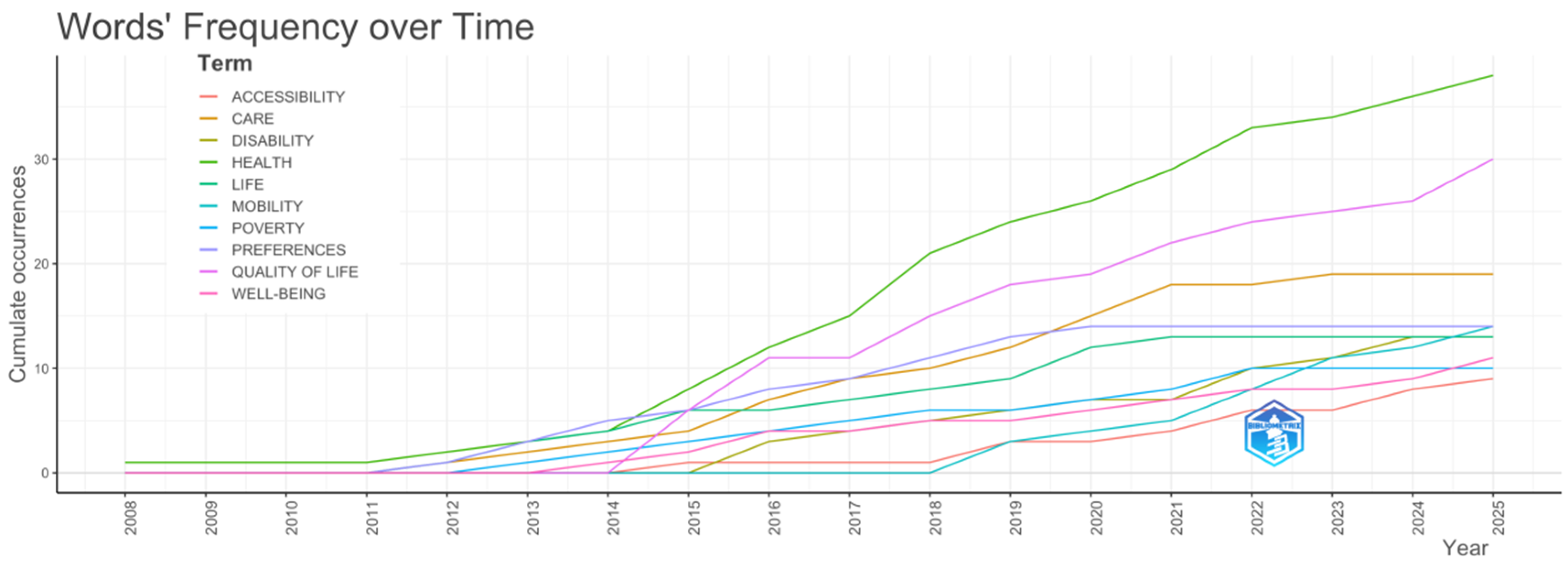
3.1. Descriptive Overview of CA Research in Ageing
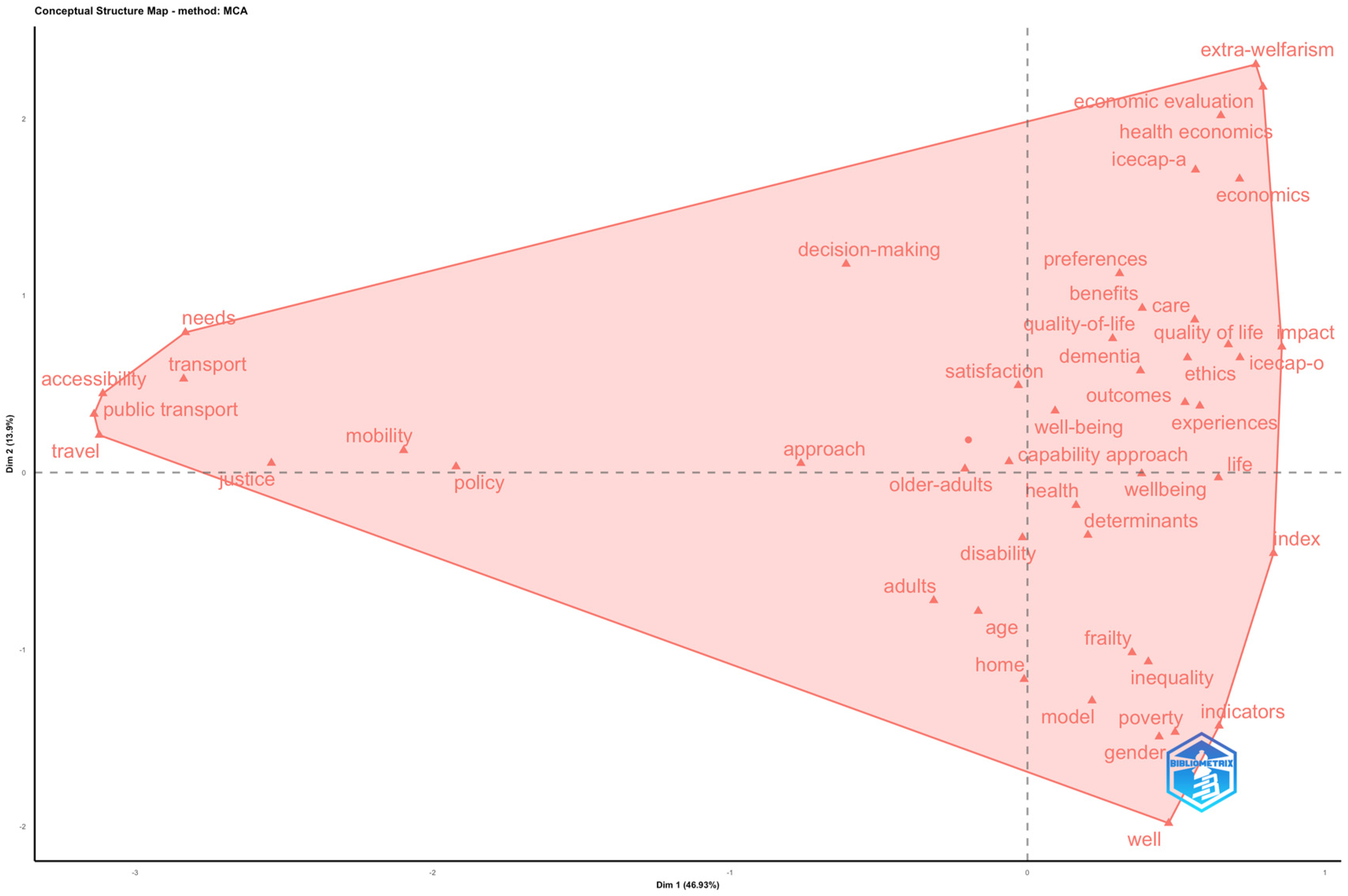
3.2. Conceptual Structure Comparison
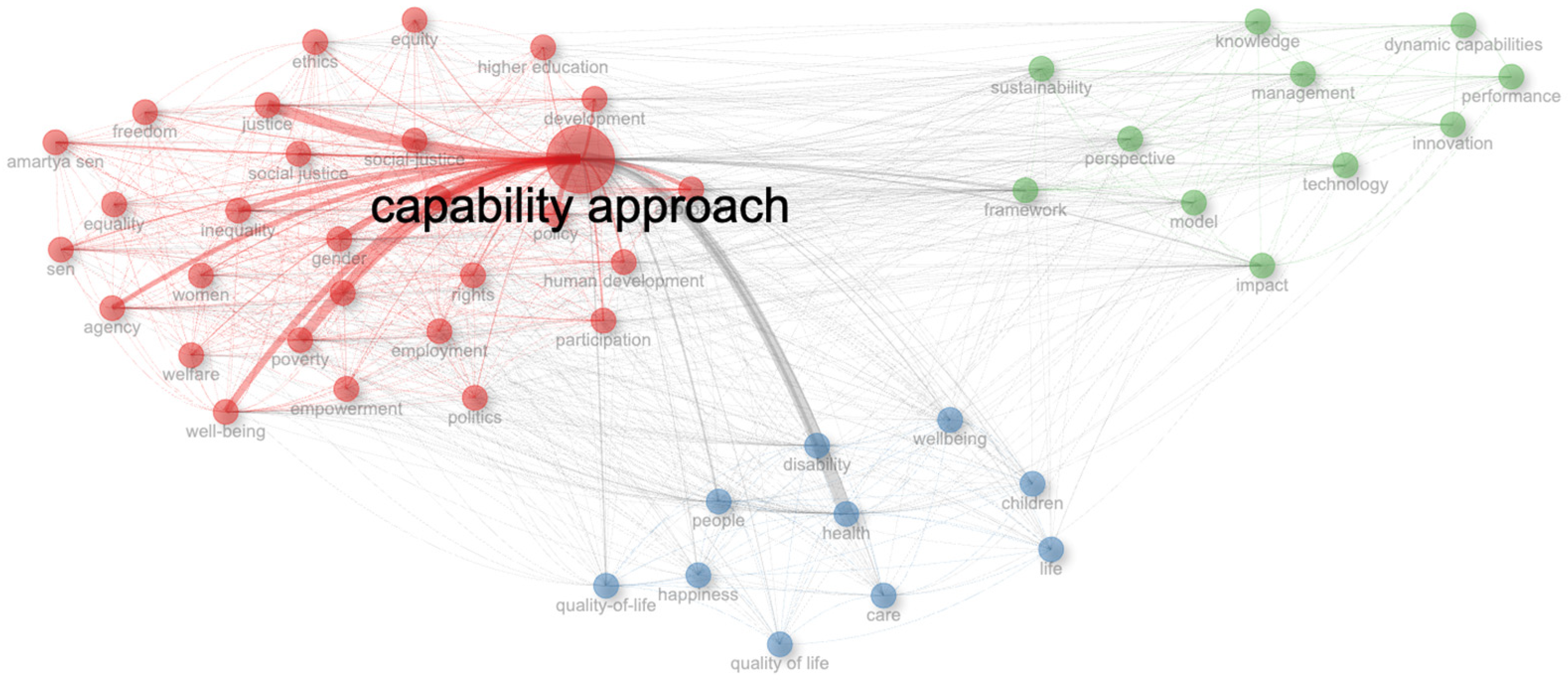
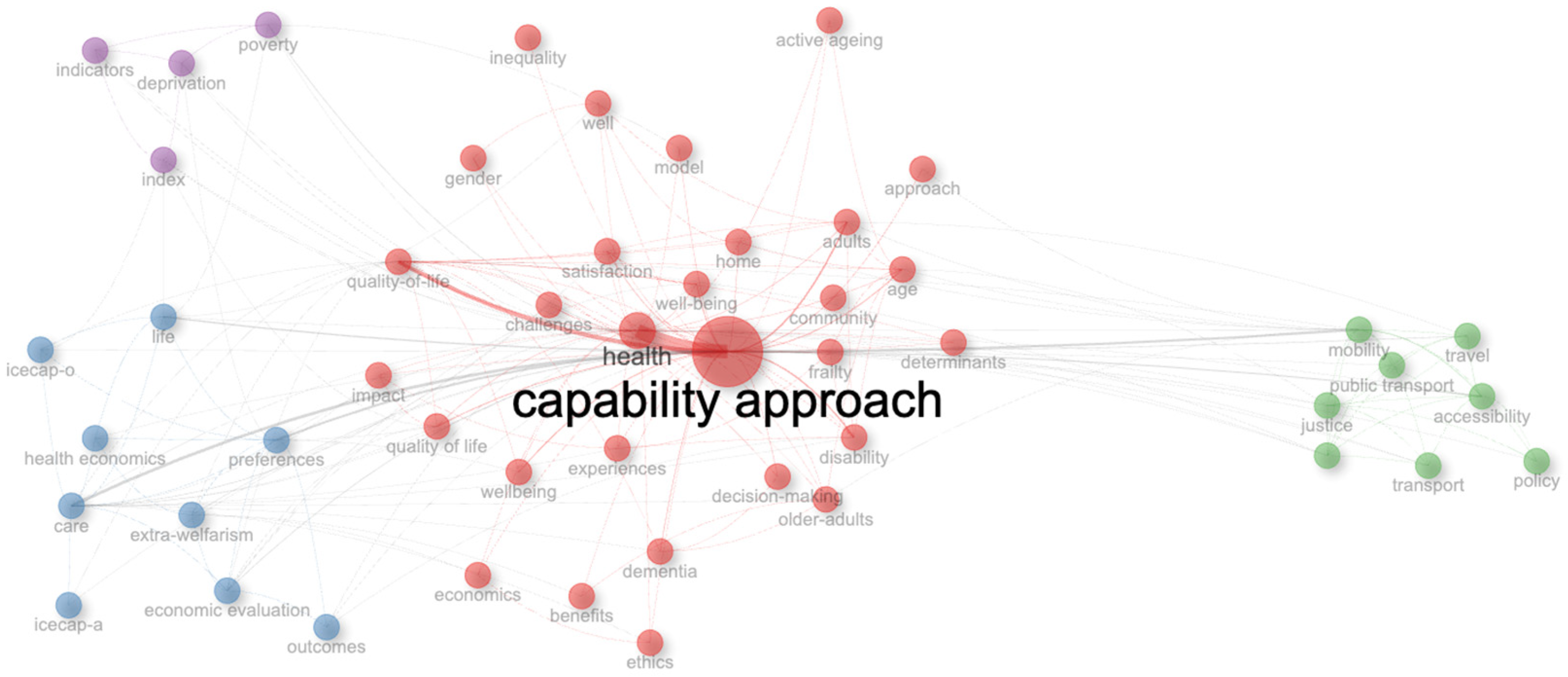
3.3. Comparative Analysis of Keyword Co-Occurrence Networks
4. Qualitative Interpretive Synthesis Results
4.1. Study Characteristics
4.2. Thematic Findings
4.2.1. Constrained Capabilities
- (a)
- Shrinking life-space
“They closed the big parks. That was a problem, because we have a very nice provincial park around here. So, I couldn’t go there.”(OA15, 68)
“They closed the big parks… So, I couldn’t go there.”(OA4, 69)
“I feel as though I have got concrete blocks on my feet because, you know, you can’t go anywhere.”(OA12, 74)
“… anywhere I’m going I really need a lift”(Moira, 66)
“[A local bus] … it is no longer running.”(Moira, 66)
- (b)
- Social participation breakdown
“And I would like to go for a walk with my friend who lives, um, down in town. Because I quite feel resentful when I see people out in family groups that I can’t go for a walk with my friend […] Even if we stay six feet apart, apparently, we’re not supposed to, although actually unofficially we have actually been for a walk, walking six feet apart.”(Ms. Foster, England)
“I find it horrible that I am no longer being touched, that I am not allowed to touch. Fortunately, I have a cat! At least where I still have some warmth, and that also wants warmth from me. But I find it humiliating to just refuse people human contact […] What do you think that does to a person if you are not touched for a year! People are dying! It’s that simple. In a 1.5 m society, people die of loneliness.”(Mrs. van Wijk, Netherlands)
“I’m missing seeing m’little ones. M’little great-grandson, who’s four, gets on the phone, and he says, ‘Gwanny, I want to give you a hug. Why can’t I come and give you a hug?’ It’s quite cruel really because m’granddaughter brings him in the car once a week, and she parks it right opposite me. And he’s looking out of the window, and he doesn’t understand, does he, at that age.”(Ms. Lee, England)
“I love to go to movies. I love to hear live music. I love to have suppers with friends. All those things totally disappeared.”(OA3, 71)
“I’m usually a very active person, so I’m missing all my long walks, all m’classes, and meeting all my friends.”(Ms. Lee, England)
“I feel lonely, alone, let down… and I just notice that I withdraw.”(Mrs. van Wijk, Netherlands)
“Well, I think once you’re able to get out, get up … you know, yourself, and take your own shower … look after your own, you know? Able to do your own cleaning and washing … once you’re able to do things like that and do your own shopping.”(Moira, 66)
“She … said she had stumbled across somebody who was doing cleaning for other people that she visited and … she had noticed that this person seemed very caring, so maybe she would help me, and sure enough … I got in touch directly with (carer) … otherwise I would not have known anybody.”(Helen, 85)
“When six weeks later they stopped providing the service according to this scheme, I got their staggering bill … I was taken aback that I had to pay … eventually I got a bill that I could hardly afford. So, I stopped the service … I cut off contact with them as quickly as possible because I was frightened of money.”(Helen, 85)
- (c)
- Precarious dignity
“I’m not sleeping very well… you think about what’s gonna happen in the future.”(OA11, 73)
“It’s said we’re in this together, but we’re not in the same boat… Mine’s a little boat with holes.”(OA8, 72)
“You don’t know who you’d meet, you know what I mean? … especially in the night-time, there are no lights, and you’d never go through. I wouldn’t.”(Moira, 66)
“It has been a bit of a punch in the gut… the reason why it hadn’t been done is really a matter of values and whose body minds are at stake.”(OA6, 70)
“I like to do things myself … You can say, ‘oh but I’ve Alzheimer’s now I’m afraid I’ll get lost’, [but] you’ve got to push yourself a bit, you know?”(Eamon, unknown age)
“I don’t want to be the sort of person who’s grabbing every bit of money that they have a right to, do you know what I mean? I don’t think that everything is just right. I want to live with myself, so I don’t want to get every penny I can get.”(Sally, 70)
4.2.2. Adaptive Strategies
- (a)
- Routine and control
“I’m able to control my exercise, my daily routine, my food intake…”(OA17, 76)
“I have to be up every morning, if it’s rain or snow, I’ve got to be up”(Eamon, unknown age)
“With 300 euros [a month], you can’t afford to eat here every day… then you’re left with nothing… I take a couple of drinks every day…”(Mrs. Jensen, age group 56–60)
- (b)
- Self-pushing and selective help
“… you’ve got to push yourself a bit, you know?”(Eamon, unknown age)
“I like to receive help when taking a shower [because I am at risk of falling], but I can do the rest myself. If I get help showering one day, I can wash myself during the rest of the week. I put a towel on my [walker], I place it in front of the washbasin, and I know how to wash myself.”(Mrs. Lutz, age group 76–80)
“You knew that if you didn’t hold your nose and jump in, it simply wouldn’t happen, so it was a choice between never having a shower ever, again, or getting over the fact that you were going to get undressed in front of someone who wasn’t intimate.”(Helen, 85)
- (c)
- Rebuilding participation
“…the centre is the place you can go to when you’re happy and when you’re sad…”(Edith, 74)
“… while I go out sometimes with a tear in my eye, I come back with a smile on my face.”(Edith, 74)
“I invite people. I have a great seat here. People come here. It’s much easier because everybody can take the elevator. So, people come to me more often. When I lived in my row house, people didn’t come so often because it was hard to reach.”(Mr. Torenstra, age group 61–65)
“… she had noticed that this person seemed very caring, so maybe she would help me, and sure enough … I got in touch directly with (carer) … otherwise I would not have known anybody.”(Helen, 85)
“So, I stopped the service … I cut off contact with them as quickly as possible because I was frightened of money.”(Helen, 85)
5. Discussion
5.1. How Constraints Compound in Later Life
5.2. Adaptive Strategies Expand Capabilities by Repairing Conversion Conditions
5.3. Theoretical and Policy Implications
5.4. Limitations and Directions for Future Research
6. Conclusions
Author Contributions
Funding
Institutional Review Board Statement
Informed Consent Statement
Data Availability Statement
Conflicts of Interest
References
- Sen, A. Development as Freedom; Oxford University Press: Oxford, UK, 1999. [Google Scholar]
- Venkatapuram, S.; Thiyagarajan, J.A. The capability approach and the WHO healthy ageing framework (for the UN Decade of Healthy Ageing). Age Ageing 2023, 52, iv6–iv9. [Google Scholar] [CrossRef] [Scilit]
- Yi, Y.; Park, Y.H. Structural equation model of the relationship between functional ability, mental health, and quality of life in older adults living alone. PLoS ONE 2022, 17, e0269003. [Google Scholar] [CrossRef] [Scilit]
- Singh, S.; Goodwin, S.; Zhong, S.; Avan, A.; Rogers, K.; Hachinski, V.; Frisbee, S. Inequalities in health-related quality of life and functional health of an aging population: A Canadian community perspective. PLoS ONE 2024, 19, e0304457. [Google Scholar] [CrossRef] [Scilit]
- Grove, H. Ageing well in place: A capability approach. Tijdschr. Econ. Soc. Geogr. 2026, 117, 10–26. [Google Scholar] [CrossRef] [Scilit]
- Moreno-Agostino, D.; Prina, M.; Chua, K.-C.; Jotheeswaran, A.T.; Sadana, R.; Officer, A.; Kamenov, K.; Cieza, A. Measuring functional ability in healthy ageing: A nationwide cross-sectional survey in the Philippine older population. BMJ Open 2021, 11, e050827. [Google Scholar] [CrossRef] [Scilit]
- Singh, L.; Goel, R.; Rai, R.K.; Singh, P.K. Socioeconomic inequality in functional deficiencies and chronic diseases among older Indian adults: A sex-stratified cross-sectional decomposition analysis. BMJ Open 2019, 9, e022787. [Google Scholar] [CrossRef] [Scilit] [PubMed]
- Jiang, H.; Burström, B.; Chen, J.; Burström, K. Rural–urban inequalities in poor self-rated health, self-reported functional disabilities, and depression among Chinese older adults: Evidence from the China Health and Retirement Longitudinal Study 2011 and 2015. Int. J. Environ. Res. Public Health 2021, 18, 6557. [Google Scholar] [CrossRef] [Scilit] [PubMed]
- Raina, P.; Ali, M.U.; Joshi, D.; Gilsing, A.; Mayhew, A.; Thompson, M.; Griffith, L.E. Associations of functional disability and behavioural risk factors with social participation of older adults: A cross-sectional analysis from the Canadian Longitudinal Study on Aging. BMJ Open 2022, 12, e052173. [Google Scholar] [CrossRef] [Scilit] [PubMed]
- García-Hernández, H.; Salinas-Escudero, G.; Reyes-Morales, H.; Carrillo-Vega, M.F. Health inequities in functional limitation among Mexican older adults: An intersectional approach. PLoS ONE 2025, 20, e0325211. [Google Scholar] [CrossRef] [Scilit]
- Wu, Y.-T.; Kingston, A.; Houlden, V.; Franklin, R. The longitudinal associations between proximity to local grocery shops and functional ability in the very old living with and without multimorbidity: Results from the Newcastle 85+ study. Arch. Gerontol. Geriatr. 2022, 101, 104703. [Google Scholar] [CrossRef] [Scilit]
- Gilroy, R. Taking a capabilities approach to evaluating supportive environments for older people. Appl. Res. Qual. Life 2006, 1, 343–356. [Google Scholar] [CrossRef] [Scilit]
- Nussbaum, M. Capabilities as fundamental entitlements: Sen and social justice. Fem. Econ. 2003, 9, 33–59. [Google Scholar] [CrossRef] [Scilit]
- Barreno-Alcalde, S.; Diez-Martin, F.; Escamilla-Solano, S. The multidisciplinary nature of the capability approach: Emerging trends and future research directions through a bibliometric analysis. SAGE Open 2024, 14, 21582440241284951. [Google Scholar] [CrossRef] [Scilit]
- United Nations Development Programme (UNDP). Human Development Reports: What Is Human Development? Available online: https://hdr.undp.org/content/what-human-development (accessed on 7 April 2026).
- Bonvin, J.-M.; Orton, M. Activation policies and organisational innovation: The added value of the capability approach. Int. J. Sociol. Soc. Policy 2009, 29, 565–574. [Google Scholar] [CrossRef] [Scilit]
- Mitchell, P.M.; Roberts, T.E.; Barton, P.M.; Coast, J. Applications of the capability approach in the health field: A literature review. Soc. Indic. Res. 2017, 133, 345–371. [Google Scholar] [CrossRef] [Scilit]
- Batista, L.F.; Correia, S.E. Capabilities approach to social innovation: A systematic review. Int. J. Innov. 2021, 9, 414–434. [Google Scholar] [CrossRef]
- Vecchio, G.; Martens, K. Accessibility and the capabilities approach: A review of the literature and proposal for conceptual advancements. Transp. Rev. 2021, 41, 833–854. [Google Scholar] [CrossRef] [Scilit]
- Garfield, E. Is citation analysis a legitimate evaluation tool? Scientometrics 1979, 1, 359–375. [Google Scholar] [CrossRef] [Scilit]
- Wu, S.; Radin Firdaus, R.B.; Wang, Y.; Kamsi, N.S. Mapping higher education research in Malaysia and Singapore (2014–2024): A bibliometric analysis through the research–policy–practice lens. SAGE Open 2026, 16, 21582440261423292. [Google Scholar] [CrossRef] [Scilit]
- Kim, H.; So, K.K.F. Two decades of customer experience research in hospitality and tourism: A bibliometric analysis and thematic content analysis. Int. J. Hosp. Manag. 2022, 100, 103082. [Google Scholar] [CrossRef] [Scilit]
- Lyu, Z.; Guo, X.; Wu, S. A bibliometric visualisation of research trends in Chinese batik (1959–2024). Cogent Arts Humanit. 2025, 12, 2587873. [Google Scholar] [CrossRef] [Scilit]
- Moral-Muñoz, J.; Herrera-Viedma, E.; Espejo, A.; Cobo, M.J. Software tools for conducting bibliometric analysis in science: An up-to-date review. Prof. Inf. 2020, 29, e290103. [Google Scholar] [CrossRef] [Scilit]
- Page, M.J.; Moher, D.; Bossuyt, P.M.; Boutron, I.; Hoffmann, T.C.; Mulrow, C.D.; Shamseer, L.; Tetzlaff, J.M.; Akl, E.A.; Brennan, S.E.; et al. PRISMA 2020 explanation and elaboration: Updated guidance and exemplars for reporting systematic reviews. BMJ 2021, 372, n160. [Google Scholar] [CrossRef]
- Aria, M.; Cuccurullo, C. Bibliometrix: An R-tool for comprehensive science mapping analysis. J. Informetr. 2017, 11, 959–975. [Google Scholar] [CrossRef] [Scilit]
- Zanini, G.S.; de Oliveira, D.M.; Oliveira, P.L.S.P.; Massini, D.A.; Pessôa Filho, D.M. Global trends in scientific production on physical exercise and spinal cord injury. Front. Sports Act. Living 2026, 7, 1678162. [Google Scholar] [CrossRef] [Scilit]
- Swedish Agency for Health Technology Assessment and Assessment of Social Services. SBU Book of Methods; Swedish Agency for Health Technology Assessment and Assessment of Social Services: Stockholm, Sweden, 2020. (In Swedish) [Google Scholar]
- Braun, V.; Clarke, V. Thematic Analysis: A Practical Guide; SAGE: London, UK, 2022. [Google Scholar]
- Mortenson, W.B.; Esfandiari, E.; Mohammadi, S.; Sakakibara, B.; Schmidt, J.; Simpson, E.; Chan, J.; Reid, H.; Rash, I.; Brooks, E.; et al. Pandemic-related experiences of older adults and people with disabilities. PLoS ONE 2025, 20, e0325306. [Google Scholar] [CrossRef] [Scilit]
- Osborne, T.; Meijering, L. ‘We may be long in the tooth, but it makes us tough’: Exploring stillness for older adults during the COVID-19 lockdowns. Soc. Cult. Geogr. 2023, 24, 447–466. [Google Scholar] [CrossRef] [Scilit]
- Meijering, L.; van Hoven, B.; Yousefzadeh, S. “I think I’m better at it myself”: The capability approach and being independent in later life. Res. Ageing Soc. Policy 2019, 7, 229–259. [Google Scholar] [CrossRef] [Scilit]
- Tanner, D.; Ward, L.; Ray, M. ‘Paying our own way’: Application of the capability approach to explore older people’s experiences of self-funding social care. Crit. Soc. Policy 2018, 38, 262–282. [Google Scholar] [CrossRef] [Scilit]
- Ryan, J.; Wretstrand, A.; Schmidt, S.M. Exploring public transport as an element of older persons’ mobility: A capability approach perspective. J. Transp. Geogr. 2015, 48, 105–114. [Google Scholar] [CrossRef] [Scilit]
- Lloyd-Sherlock, P.; Agrawal, S.; Minicuci, N. Fear of crime and older people in low- and middle-income countries. Ageing Soc. 2016, 36, 1083–1108. [Google Scholar] [CrossRef] [Scilit]
- Boom, I.; Zhang, J.; Hammond, J.; Bevilacqua, G.; Lawrence, W.; Ward, K.A.; Cooper, C.; Dennison, E.M. Impact of the COVID-19 pandemic on community-dwelling older adults: A longitudinal qualitative study of participants from the Hertfordshire Cohort Study. PLoS ONE 2022, 17, e0275486. [Google Scholar] [CrossRef] [Scilit]
- Finlay, J.M.; Kler, J.S.; O’Shea, B.Q.; Eastman, M.R.; Vinson, Y.R.; Kobayashi, L.C. Coping during the COVID-19 pandemic: A qualitative study of older adults across the United States. Front. Public Health 2021, 9, 643807. [Google Scholar] [CrossRef] [Scilit]
- Taylor, E.; Frost, J.; Ball, S.; Clegg, A.; Brown, L.; Goodwin, V.A. Participation, autonomy and control are shared concepts within older people’s interpretations of independence: A qualitative interview study. Ageing Soc. 2025, 45, 855–878. [Google Scholar] [CrossRef] [Scilit]
- Löfgren, M.; Larsson, E.; Isaksson, G.; Nyman, A. Older adults’ experiences of maintaining social participation: Creating opportunities and striving to adapt to changing situations. Scand. J. Occup. Ther. 2022, 29, 587–597. [Google Scholar] [CrossRef] [Scilit]
- Ravensbergen, L.; Van Liefferinge, M.; Isabella, J.; Zhang, M.; El-Geneidy, A. Accessibility by public transport for older adults: A systematic review. J. Transp. Geogr. 2022, 103, 103408. [Google Scholar] [CrossRef] [Scilit]
- Firdaus, R.B.R.; Mohamad, O.; Mohammad, T.; Gunaratne, M.S. Community partnership through knowledge transfer program: Assessment from the perspectives of academics’ experience. Sage Open. 2020, 10, 2158244020980742. [Google Scholar] [CrossRef] [Scilit]





| Rank | Journals/Proceedings | Number of Publications |
|---|---|---|
| 1 | Social Science & Medicine | 12 |
| 2 | Social Indicators Research | 8 |
| 3 | Ageing & Society | 6 |
| 4 | Journal of Transport Geography | 4 |
| 5 | International Journal of Care and Caring | 3 |
| 6 | Journal of Human Development and Capabilities | 3 |
| 7 | PLoS ONE | 3 |
| 8 | Quality of Life Research | 3 |
| 9 | Applied Research in Quality of Life | 2 |
| 10 | Dementia-International Journal of Social Research | 2 |
| No | Authors (Year) | Country (Region) | Sample | Ages | Results/Themes |
|---|---|---|---|---|---|
| 1 | Mortenson et al. (2025) [30] | Canada | n = 10 | 65+ | Trying to stay connected: resuming functionings via alternative means Worrying about future capability opportunities Wanting to exert control in the face of constrained capabilities. |
| 2 | Osborne & Meijering (2023) [31] | Netherlands & England | n = 38 | 50–90 | Experiences of prolonged stillness in later life Inefficient stillness and the unrealised potential in passive care Retreating home: balancing activity and contemplation |
| 3 | Grove (2026) [5] | Ireland | n = 3 | 65–89 | Wants to manage daily life independently Needs to go out and stay socially connected Tries to balance getting help and staying in control |
| 4 | Meijering et al. (2019) [32] | Netherlands | n = 32 | 65+ | To be comfortable at home and in the neighbourhood To enjoy fulfilling social relations To be mobile. |
| 5 | Tanner et al. (2018) [33] | England | n = 8 | 70–92 | Factors affecting the conversion of commodities into capabilities Factors intervening between capabilities and functionings |
| Bibliometric Thematic Concentration | Associated Keywords | Qualitative Theme | Illustrative Mechanism | Policy Implication |
|---|---|---|---|---|
| Mobility and accessibility | mobility; accessibility; public transport; travel; transport; justice | Shrinking life-space/Social participation breakdown; Rebuilding participation | Mobility and accessibility shape both capability constraint and recovery. Limited transport, inaccessible environments, and restricted service access compress older adults’ life-space and weaken participation, while accessible environments, community spaces, and workable support arrangements help rebuild social connection. | Improve age-friendly transport, safe neighbourhood accessibility, local service access, and community spaces that support participation. |
| Health and care evaluation | care; preferences; ICECAP-O; health economics; economic evaluation; extra-welfarism; outcomes | Precarious dignity | Unstable, costly, or poorly matched care arrangements can threaten older adults’ security, autonomy, and dignity. | Promote affordable, stable, person-centred, and dignity-sensitive care services. |
| Health, wellbeing, and vulnerability | health; well-being; quality of life; disability; frailty; inequality; gender | Routine and control/Self-pushing and selective help | Under conditions of health decline, frailty, and unequal vulnerability, older adults protect agency by rebuilding routines, managing daily activities, and accepting selective help while retaining control where possible. | Support self-management, flexible assistance, and integrated services that reduce vulnerability while preserving agency. |
Disclaimer/Publisher’s Note: The statements, opinions and data contained in all publications are solely those of the individual author(s) and contributor(s) and not of MDPI and/or the editor(s). MDPI and/or the editor(s) disclaim responsibility for any injury to people or property resulting from any ideas, methods, instructions or products referred to in the content. |
© 2026 by the authors. Licensee MDPI, Basel, Switzerland. This article is an open access article distributed under the terms and conditions of the Creative Commons Attribution (CC BY) license.
Share and Cite
Wu, S.; Firdaus, R.B.R.; Li, C.; Zhu, C.; Yang, J. The Capability Approach in Ageing Research: A Bibliometric Mapping and Qualitative Interpretive Synthesis. J. Ageing Longev. 2026, 6, 42. https://doi.org/10.3390/jal6020042
Wu S, Firdaus RBR, Li C, Zhu C, Yang J. The Capability Approach in Ageing Research: A Bibliometric Mapping and Qualitative Interpretive Synthesis. Journal of Ageing and Longevity. 2026; 6(2):42. https://doi.org/10.3390/jal6020042
Chicago/Turabian StyleWu, Shuo, R. B. Radin Firdaus, Chunyan Li, Chunyan Zhu, and Jinxiao Yang. 2026. "The Capability Approach in Ageing Research: A Bibliometric Mapping and Qualitative Interpretive Synthesis" Journal of Ageing and Longevity 6, no. 2: 42. https://doi.org/10.3390/jal6020042
APA StyleWu, S., Firdaus, R. B. R., Li, C., Zhu, C., & Yang, J. (2026). The Capability Approach in Ageing Research: A Bibliometric Mapping and Qualitative Interpretive Synthesis. Journal of Ageing and Longevity, 6(2), 42. https://doi.org/10.3390/jal6020042