The Overlooked Dimension: Physiotherapists’ Perceptions of Spirituality and Religion in Older Person Care

Abstract
1. Introduction
2. Materials and Methods
3. Results and Discussion
4. Limitations
5. Conclusions
Are there any religious practices or obligations that are important to you, such as attending religious services, prayer times, or fasting, that we should take into account when planning your physiotherapy sessions?
Do you have any spiritual beliefs or practices that influence how you cope with your current condition?
Are there any religious activities, such as attending a place of worship, performing prayer, or participating in religious rituals, that you would like to be able to return to or maintain as part of your rehabilitation goals?
Are there any spiritual practices, such as meditation, mindfulness, or engaging in activities that give you a sense of meaning and purpose, that you would like to be able to return to or maintain as part of your rehabilitation goals?
Author Contributions
Funding
Institutional Review Board Statement
Informed Consent Statement
Data Availability Statement
Conflicts of Interest
Appendix A
Physiotherapists’ Perception of Spirituality and Religion in Older Person Care
- Atheist: Someone who does not believe in God [35]
- Agnostic: Someone who believes it is impossible to know for sure if God exists [35]
- Humanist: Someone who believes people can meet their emotional/spiritual needs without religion [36]
- Spirituality: The pursuit of existence, including questions about meaning and purpose in life [37]
- Religion: An organised system of symbols, rituals, beliefs and practices [38]
- Gender ☐ Male ☐ Female ☐ Other
- Age group ☐ 21–30 ☐ 31–40 ☐ 41–50 ☐ 51–60 ☐ 61+
- Highest qualification ☐ Diploma ☐ Bachelor’s ☐ Master’s ☐ Doctorate ☐ Other __________
- Area of practice ☐ MDH ☐ SVP ☐ RHKG ☐ GGH ☐ SLH ☐ MCH ☐ SAMOC ☐ CDAU ☐ AACC ☐ Other __________
- Years of clinical experience __________ years
- Religious creed ☐ Religious ☐ Spiritual ☐ Agnostic ☐ Humanist ☐ Atheist ☐ More than one ☐ None ☐ Other __________
References
- Rabiei Vaziri, M.; Jaramillo, J.; Almagharbeh, W.T.; Khajehhasani, T.; Dehghan, M. Spiritual Care Competency and Spiritual Sensitivity among Nursing Students: A Cross-Sectional Study. BMC Nurs. 2025, 24, 884. [Google Scholar] [CrossRef] [PubMed]
- Büssing, A.; Kloke, M.; Gerundt, M. Unmet Spiritual Needs, Spiritual Well-Being and Support Satisfaction of End-of-Life Patients: Findings from the SpECi Programme. J. Relig. Health 2025, 64, 2275–2296. [Google Scholar] [CrossRef] [PubMed]
- Ilmi, A.A.; McKenna, L.; Murphy, M.; Kadar, K.S. Spiritual Care for Older People Living in the Community: A Scoping Review. Contemp. Nurse 2024, 60, 67–81. [Google Scholar] [CrossRef]
- Desmet, L.; Dezutter, J.; Vandenhoeck, A.; Dillen, A. Spiritual needs of older adults during hospitalization: An integrative review. Religions 2020, 11, 529. [Google Scholar] [CrossRef]
- Cameron, N.; Rayner, J.-A.; Fetherstonhaugh, D.; McAuliffe, L. What is needed to provide high-quality cultural and spiritual care in long-term care homes? J. Long-Term Care 2024, 371–382. [Google Scholar] [CrossRef]
- Balboni, M.; Sullivan, A.; Enzinger, A.C.; Epstein-Peterson, Z.D.; Tseng, Y.D.; Mitchell, C.; Niska, J.; Zollfrank, A.; VanderWeele, T.J.; Balboni, T.A. Nurse and Physician Barriers to Spiritual Care Provision at the End of Life. J. Pain Symptom Manag. 2014, 48, 400–410. [Google Scholar] [CrossRef]
- Rushton, L. What Are the Barriers to Spiritual Care in a Hospital Setting? Br. J. Nurs. 2014, 23, 370–374. [Google Scholar] [CrossRef]
- Green, A.; Kim-Godwin, Y. Perceptions of Spiritual Care Education, Competence, and Barriers among Registered Nurses. J. Holist. Nurs. 2020, 38, 41–51. [Google Scholar] [CrossRef]
- Baldacchino, D. Spiritual care education of health care professionals. Religions 2015, 6, 594–613. [Google Scholar] [CrossRef]
- Balboni, T.; VanderWeele, T.; Doan-Soares, S.; Long, K.N.G.; Ferrell, B.R.; Fitchett, G.; Koenig, H.G.; Bain, P.A.; Puchalski, C.; Steinhauser, K.E.; et al. Spirituality in Serious Illness and Health. JAMA 2022, 328, 184–197. [Google Scholar] [CrossRef]
- Cheng, L.; Liu, Y.; Chen, Q.; Zhang, F. Exploring the Spiritual Experiences of Older Adults with Chronic Disease. BMC Psychol. 2025, 13, 632. [Google Scholar] [CrossRef]
- Baldacchino, D. Spiritual Care: Being in Doing; Preca Library: Marsa, Malta, 2010. [Google Scholar]
- Lughermo Corso, C. The Right to End-of-Life Spiritual Care. Master’s Thesis, University of Malta, Msida, Malta, 2019. [Google Scholar]
- Garcia Trepte, A.; Goins, T.R.; Eubanks, B.; Joseph, V.E.; English, A. Integrating spirituality into physical therapy: Exploring its emerging role as a recognized determinant of health. Arch. Physiother. 2024, 14, 189–195. [Google Scholar] [CrossRef]
- National Statistics Office Malta. Demographic Review 2025; NSO: Valletta, Malta, 2025. [Google Scholar]
- Country Economy. Malta Population Density. 2025. Available online: https://countryeconomy.com/demography/population-density/malta (accessed on 22 November 2025).
- European Commission. Eurobarometer 2019: Social Values and Religion in the EU. 2019. Available online: https://europa.eu/eurobarometer (accessed on 14 September 2025).
- Azzopardi-Muscat, N.; Buttigieg, S.; Calleja, N.; Merkur, S. Malta: Health System Summary 2024; European Observatory on Health Systems and Policies: Brussels, Belgium, 2024; Available online: https://eurohealthobservatory.who.int/publications/i/malta-health-system-summary-2024 (accessed on 1 December 2025).
- Lavinder, G.; Liberatos, P.; Campo, M.; Leegan, E.; Moritz, M.; Campo, R.; Terziyski, S. Revisiting spirituality in physical therapy practice: Perceptions of US practitioners. J. Relig. Health 2025. [Google Scholar] [CrossRef]
- Irsay, L.; Ciortea, V.M.; Popa, T.; Iliescu, M.G.; Ciubean, A.D. Exploring the Connections between Medical Rehabilitation, Faith and Spirituality. Healthcare 2024, 12, 1202. [Google Scholar] [CrossRef]
- Nagata, K.; Tanaka, K. Components of spirituality in older adults: A phenomenological study through interviews based on dignity therapy. Scand. J. Caring Sci. 2024, 38, 476–486. [Google Scholar] [CrossRef]
- Kruk, J.; Aboul-Enein, B.H. Religion- and spirituality-based effects on health-related components with special reference to physical activity: A systematic review. Religions 2024, 15, 835. [Google Scholar] [CrossRef]
- Creswell, J.; Creswell, J. Research Design: Qualitative, Quantitative, and Mixed Methods Approaches, 4th ed.; Sage: Washington, DC, USA, 2017. [Google Scholar]
- Kuhn, T.S. The Structure of Scientific Revolutions; University of Chicago Press: Chicago, IL, USA, 1962. [Google Scholar]
- Edirisingha, P. Interpretivism and Positivism: Ontological and Epistemological Perspectives. 2012. Available online: https://prabash78.wordpress.com (accessed on 1 December 2025).
- Dudovskiy, J. Ontology in Business Research. 2022. Available online: https://research-methodology.net/research-philosophy/ontology (accessed on 22 November 2025).
- Ellis, M.R.; Campbell, J.D.; Detwiler-Breidenbach, A.; Hubbard, D.K. What do family physicians think about spirituality in clinical practice? J. Fam. Pract. 2002, 51, 249–254. [Google Scholar] [PubMed]
- Oakley, E.; Katz, G.; Sauer, K.; Dent, B.; Millar, A. Physical Therapists’ Perceptions of Spirituality and Patient Care. J. Phys. Ther. Educ. 2010, 24, 45–52. [Google Scholar] [CrossRef]
- Sargeant, D.; Newsham, K. Physical Therapist Students’ Perceptions of Spirituality and Religion in Patient Care. J. Phys. Ther. Educ. 2012, 26, 63–73. [Google Scholar] [CrossRef]
- Turner, H.; Cook, C.C.H. Perceptions of physiotherapists in relation to spiritual care. J. Study Spiritual. 2016, 6, 58–77. [Google Scholar] [CrossRef]
- So, H.; Mackenzie, L.; Chapparo, C.; Ranka, J.; McColl, M.A. Spirituality in Australian health professional practice: A scoping review and qualitative synthesis of findings. J. Relig. Health 2023, 62, 2297–2322. [Google Scholar] [CrossRef] [PubMed]
- Laranjeira, C.; Dixe, M.A.; Querido, A. Perceived Barriers to Providing Spiritual Care in Palliative Care. Int. J. Environ. Res. Public Health 2023, 20, 6121. [Google Scholar] [CrossRef] [PubMed]
- Highfield, M.E.; Osterhues, D. Spiritual Care Rights and Quality of Care: Perspectives of Physical Therapy Students. J. Healthc. Qual. 2003, 25, 12–16. [Google Scholar] [CrossRef]
- Best, M.; Leget, C.; Goodhead, A.; Paal, P. An EAPC white paper on multi-disciplinary education for spiritual care in palliative care. BMC Palliat. Care 2020, 19, 9. [Google Scholar] [CrossRef]
- Weir, K. Understanding Atheism and Agnosticism. Psychology Today. 2020. Available online: https://www.psychologytoday.com (accessed on 22 November 2025).
- Cambridge Dictionary. Definition of “Humanist”. 2013. Available online: https://dictionary.cambridge.org (accessed on 22 November 2025).
- Panzini, R.G.; Mosqueiro, B.P.; Zimpel, R.R.; Bandeira, D.R.; Rocha, N.S.; Fleck, M.P. Quality-of-life and spirituality. Int. Rev. Psychiatry 2017, 29, 263–282. [Google Scholar] [CrossRef] [PubMed]
- Koenig, H.G.; McCullough, M.E.; Larson, D.B. Handbook of Religion and Health; Oxford University Press: Oxford, UK, 2001. [Google Scholar]




| Demographic Profile of Participants | Details |
|---|---|
| Sample Size | 88 physiotherapists (after excluding incomplete responses) |
| Age Range | 20–60 years |
| Gender Distribution | 68.2% female, 31.8% male |
| Largest Age Group | 31–35 years (23.9%) |
| Average Years of Clinical Experience | 10.10 years (Standard Deviation = ±8.012) |
| Highest Qualification | Doctorate: 0% Bachelor of Science in Physiotherapy: 52.3% Master’s Degree: 38.6% Post-graduate Diploma: 5.7% Diploma (equivalent to BSc): 3.4% |
| Work Settings | Mater Dei Hospital: 26.1% Community & Residential Services: 25.0% Outpatient Clinics |
| Religious Creed | Religious: 36.4% Religious & Spiritual: 19.3% Spiritual: 18.2% Atheist: 9.1% Agnostic: 8.0% Humanist: 6.8% |
| Domain | Key Findings and Significance |
|---|---|
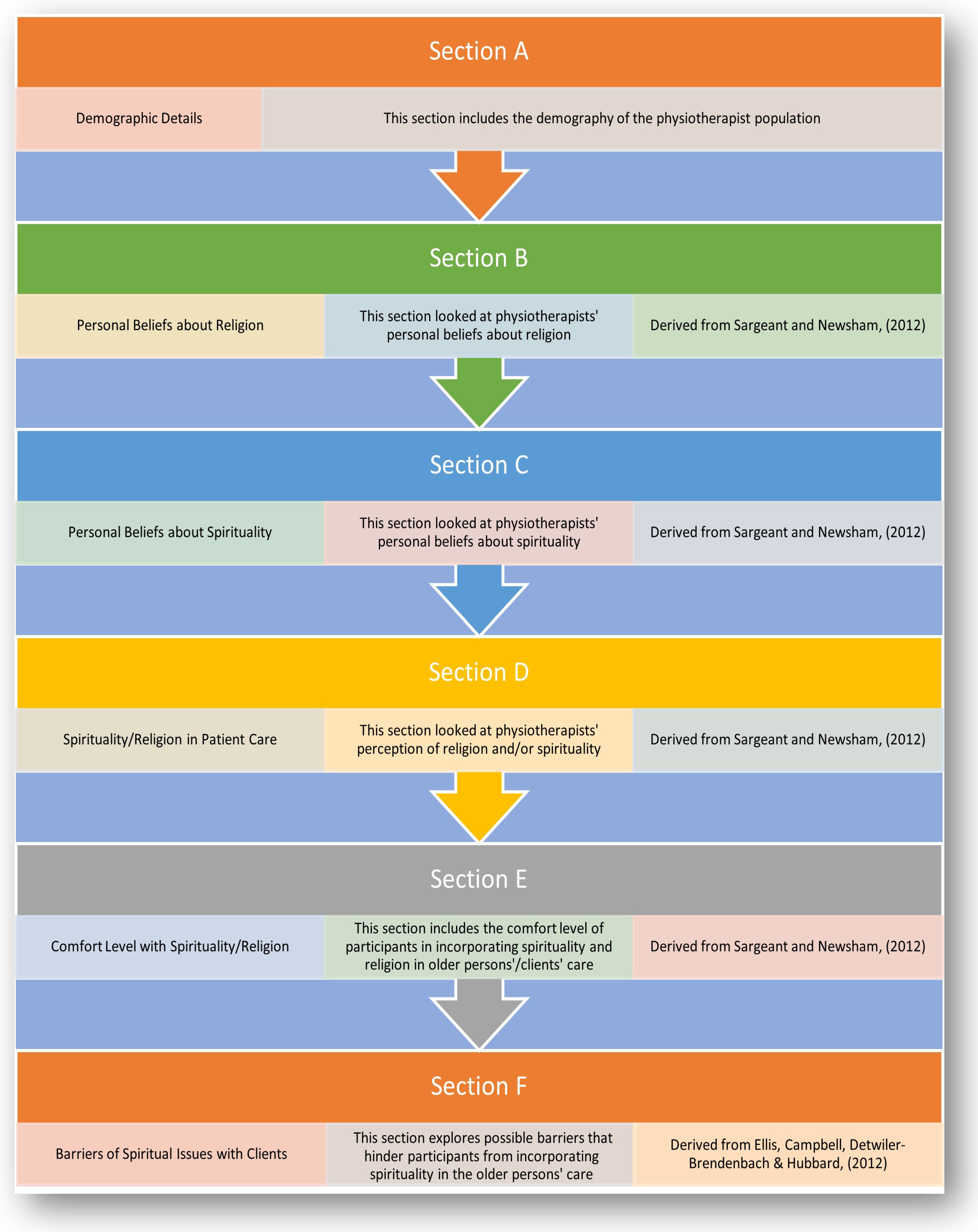
| Section B—Personal Beliefs | Religious respondents linked religion to spirituality; agnostics/atheists disagreed. Significance: p < 0.001 |
| Section C—Personal Spirituality | Spiritual participants valued spirituality as central to life’s meaning. Significance: p < 0.001 |
| Section D—Spirituality in Care | Religious respondents saw spirituality improving client relations. Significance: p < 0.05 |
| Section E—Comfort Level | Moderate comfort: low confidence integrating spirituality. Significance: p < 0.05 |
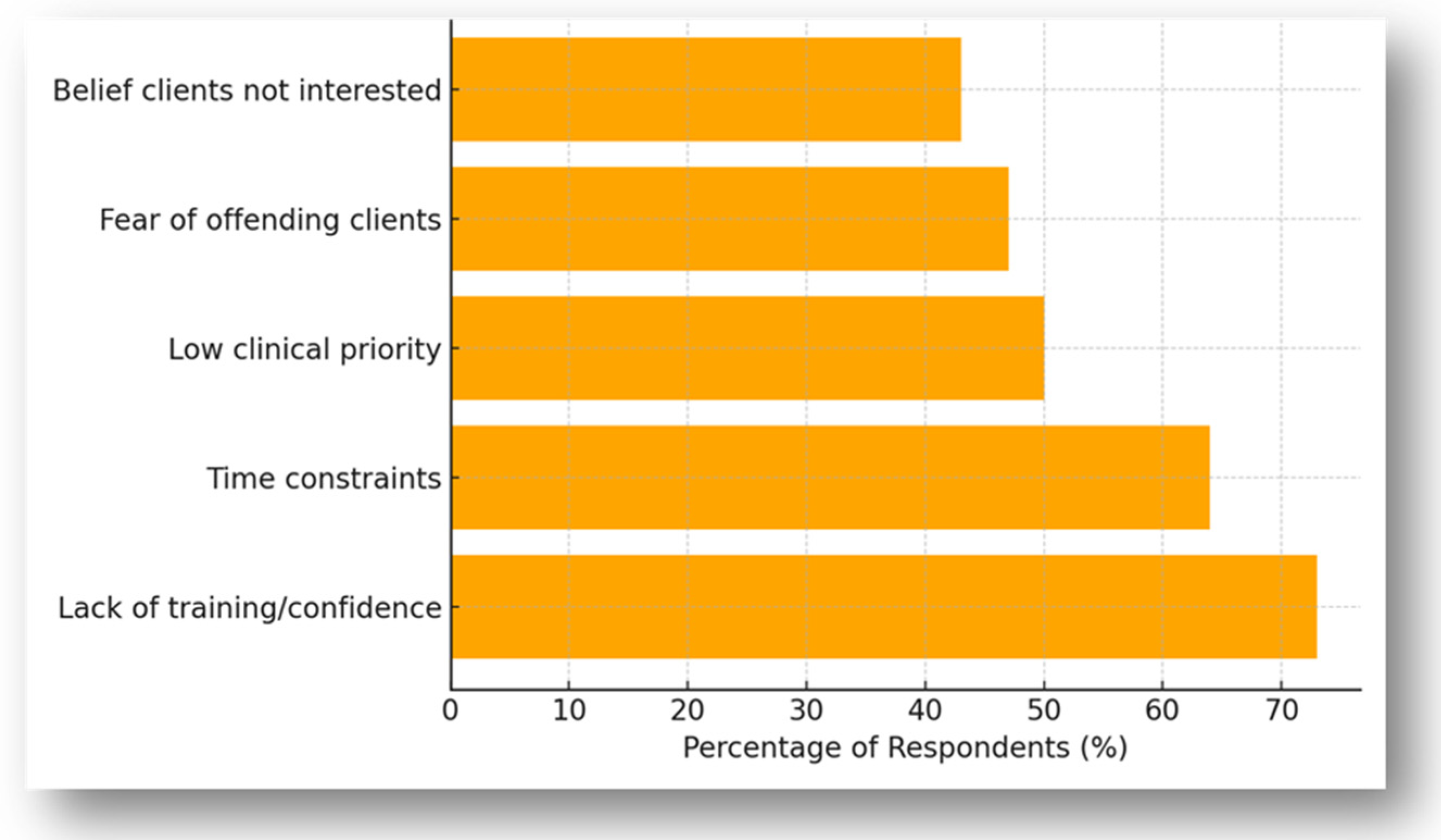
| Section F—Barriers | 73% lacked training, 64%time constraints; 47% feared offending clients. Significance: p = 0.017–0.034 |
| Theme | Findings | Statistical/Key Data |
|---|---|---|
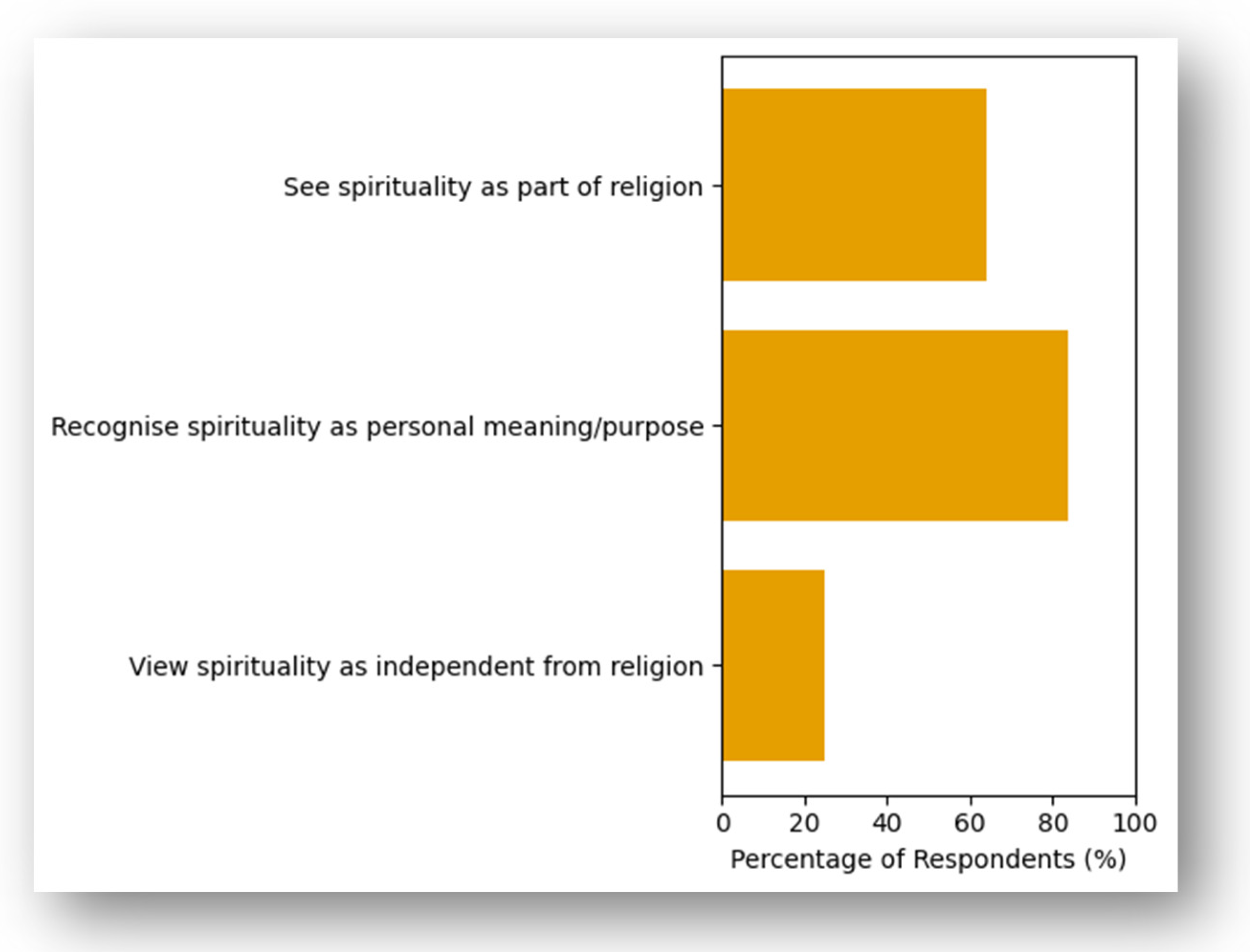
| General Awareness & Perception | Most physiotherapists were unaware of the distinction between spirituality and religion. The two terms were often used interchangeably. Spirituality seen as an integral part of religion and personal faith. | 74% agreed spirituality is part of religion. 80% linked spirituality to personal faith; 90% defined spirituality as a search for meaning/purpose. |
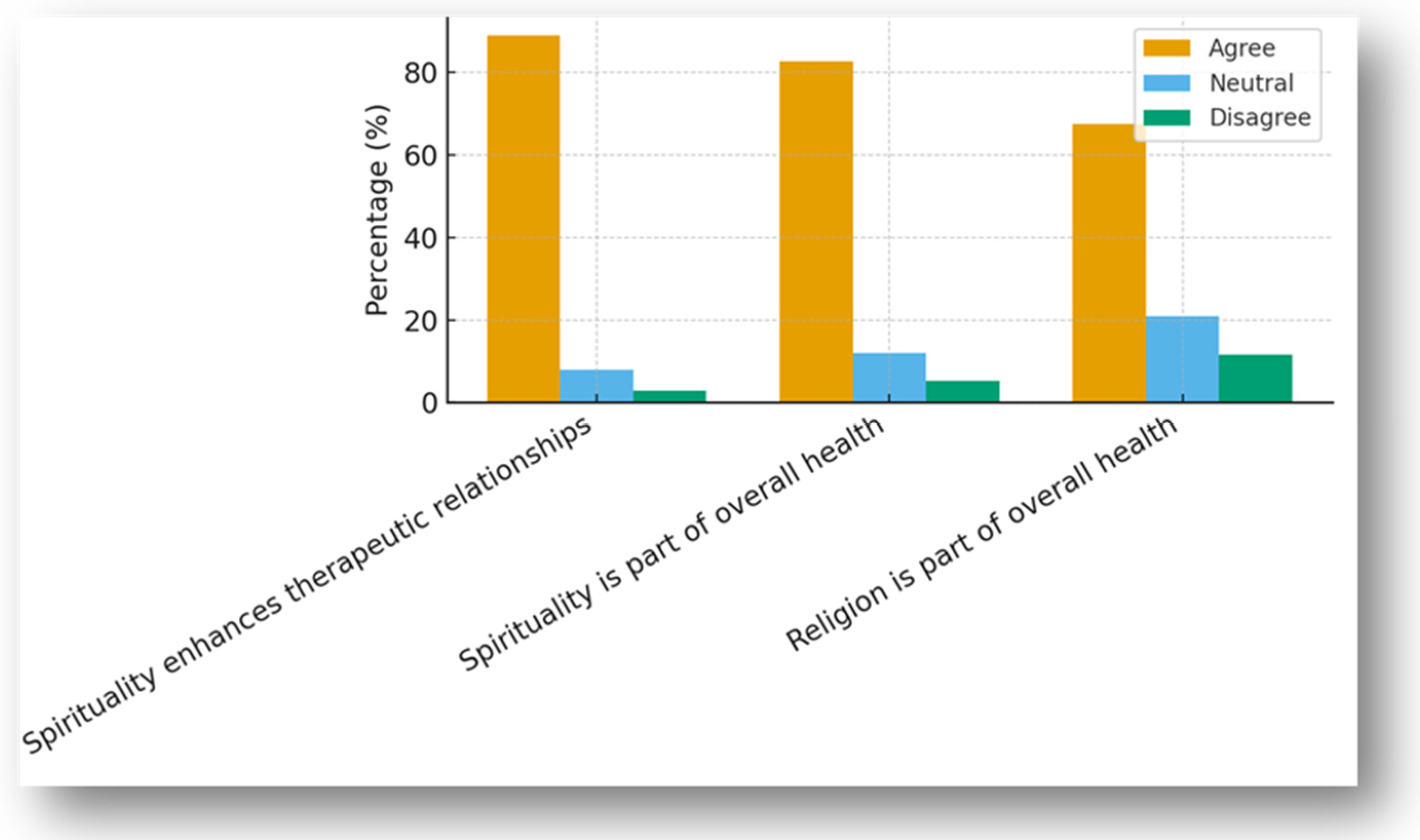
| Influence on Care | Awareness of a client’s spirituality strengthens the therapeutic relationship. Spirituality considered more central to health than religion. Spirituality viewed as aiding coping, hope, and holistic healing. | 89% agreed spirituality improves therapeutic relationships; 82.6% viewed spirituality as part of health and 67.4% viewed religion as part of health. |
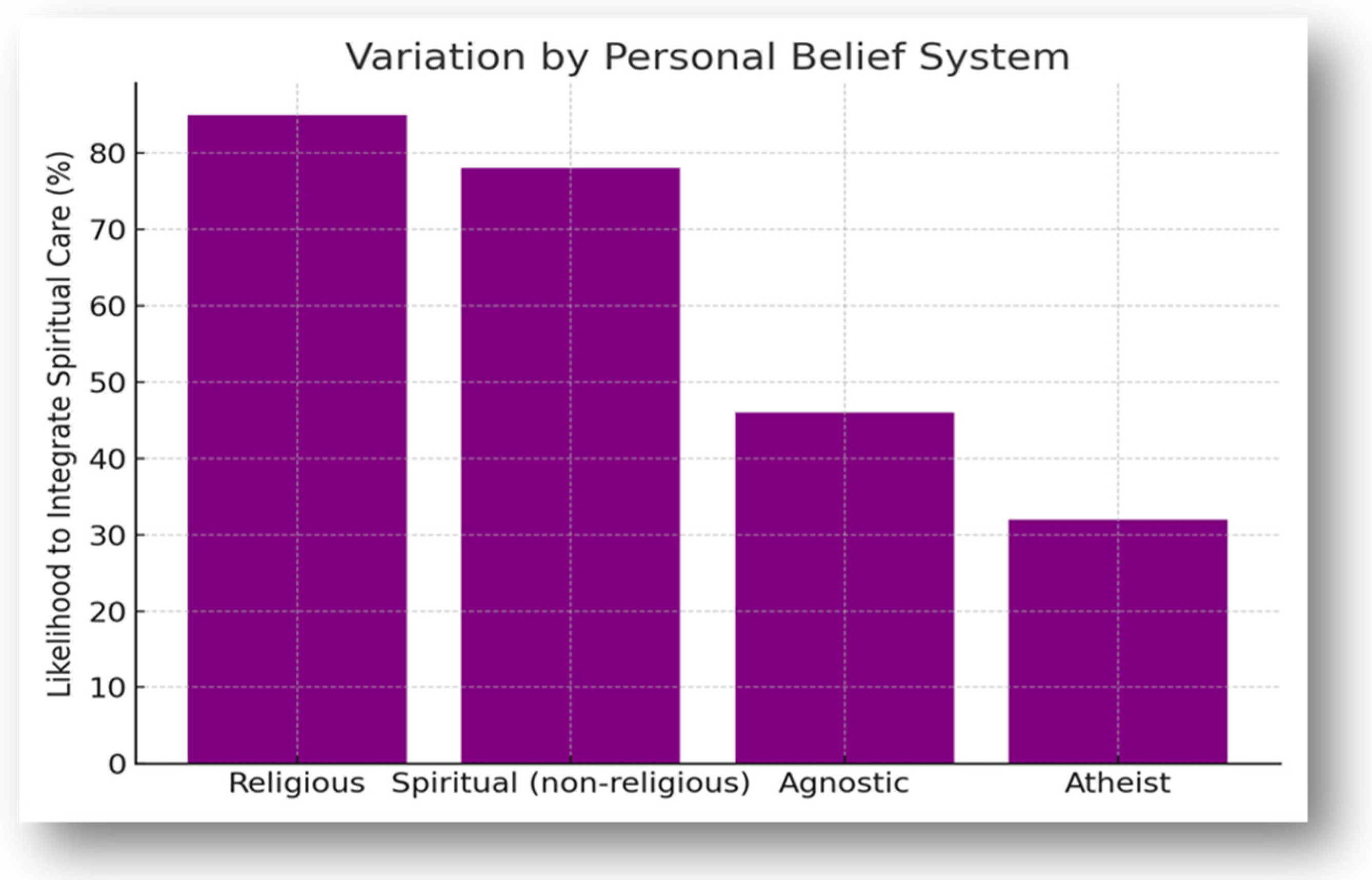
| Differences by Creed | Significant differences across religious creeds: Religious/spiritual physiotherapists more likely to integrate spiritual care; atheist/agnostic less likely to address spirituality; no significant differences in barriers by creed. | p < 0.05 for Sections B–E (beliefs, perceptions). No sig. difference in Section F (barriers). |
| Barriers to Spiritual Care | Lack of time, confidence, and training. Spiritual issues viewed as lower priority; some perceived clients uninterested in discussing spirituality. Organizational/systemic barriers dominate. | 64% cited time constraints; 73% lacked training/confidence; 50% said spirituality is a lower priority; 43% believed clients not interested. |
| Personal Beliefs & Comfort Level | Many physiotherapists felt unprepared or uncomfortable addressing spirituality. Fear of offending clients was common. Comfort linked to personal faith. | p = 0.035 between religious/spiritual vs. atheist participants. Only 23% wanted spirituality included in their own treatment. |
| Demographics & Other Factors | Age and qualification had limited effect. Small group differences noted (e.g., 41–45 vs. 20–25 years). | Kruskal–Wallis H tests: minor significance in select age bands. |
| Overall Conclusion | Physiotherapists recognise spirituality’s importance but struggle with unclear boundaries, lack of training, and time pressures. Variation in beliefs and comfort levels affects integration in practice. | |
Disclaimer/Publisher’s Note: The statements, opinions and data contained in all publications are solely those of the individual author(s) and contributor(s) and not of MDPI and/or the editor(s). MDPI and/or the editor(s) disclaim responsibility for any injury to people or property resulting from any ideas, methods, instructions or products referred to in the content. |
© 2026 by the authors. Licensee MDPI, Basel, Switzerland. This article is an open access article distributed under the terms and conditions of the Creative Commons Attribution (CC BY) license.
Share and Cite
Azzopardi, M.; Sultana, R.; Fenech, M.A. The Overlooked Dimension: Physiotherapists’ Perceptions of Spirituality and Religion in Older Person Care. J. Ageing Longev. 2026, 6, 37. https://doi.org/10.3390/jal6020037
Azzopardi M, Sultana R, Fenech MA. The Overlooked Dimension: Physiotherapists’ Perceptions of Spirituality and Religion in Older Person Care. Journal of Ageing and Longevity. 2026; 6(2):37. https://doi.org/10.3390/jal6020037
Chicago/Turabian StyleAzzopardi, Maria, Roberta Sultana, and Maria Aurora Fenech. 2026. "The Overlooked Dimension: Physiotherapists’ Perceptions of Spirituality and Religion in Older Person Care" Journal of Ageing and Longevity 6, no. 2: 37. https://doi.org/10.3390/jal6020037
APA StyleAzzopardi, M., Sultana, R., & Fenech, M. A. (2026). The Overlooked Dimension: Physiotherapists’ Perceptions of Spirituality and Religion in Older Person Care. Journal of Ageing and Longevity, 6(2), 37. https://doi.org/10.3390/jal6020037