
Place Attachment in Student Dormitories: An Analysis of Differences Across Socio-Spatial Variables



Abstract
1. Introduction
2. Place Attachment
2.1. Theoretical Background of Place Attachment
2.2. General Structure of Place Attachment
- Place Identity: This represents the cognitive dimension that becomes part of an individual’s sense of self as a result of their interaction with the physical world.
- Place Dependence: This refers to a functional link in which actions and functional needs take precedence when individuals orient themselves towards a specific place.
- Affective Attachment: This indicates the degree of inner sense of belonging an individual feels towards a place, independent of objective assessments.
- Social Bonding: This encompasses the relationships formed between people and communities who share a space, and highlights the social capital aspect of the human–place interaction.
2.3. Importance and Benefits of Place Attachment
2.4. Place Attachment in the Context of Student Dormitories
3. Methodology
3.1. Study Area and Spatial Context
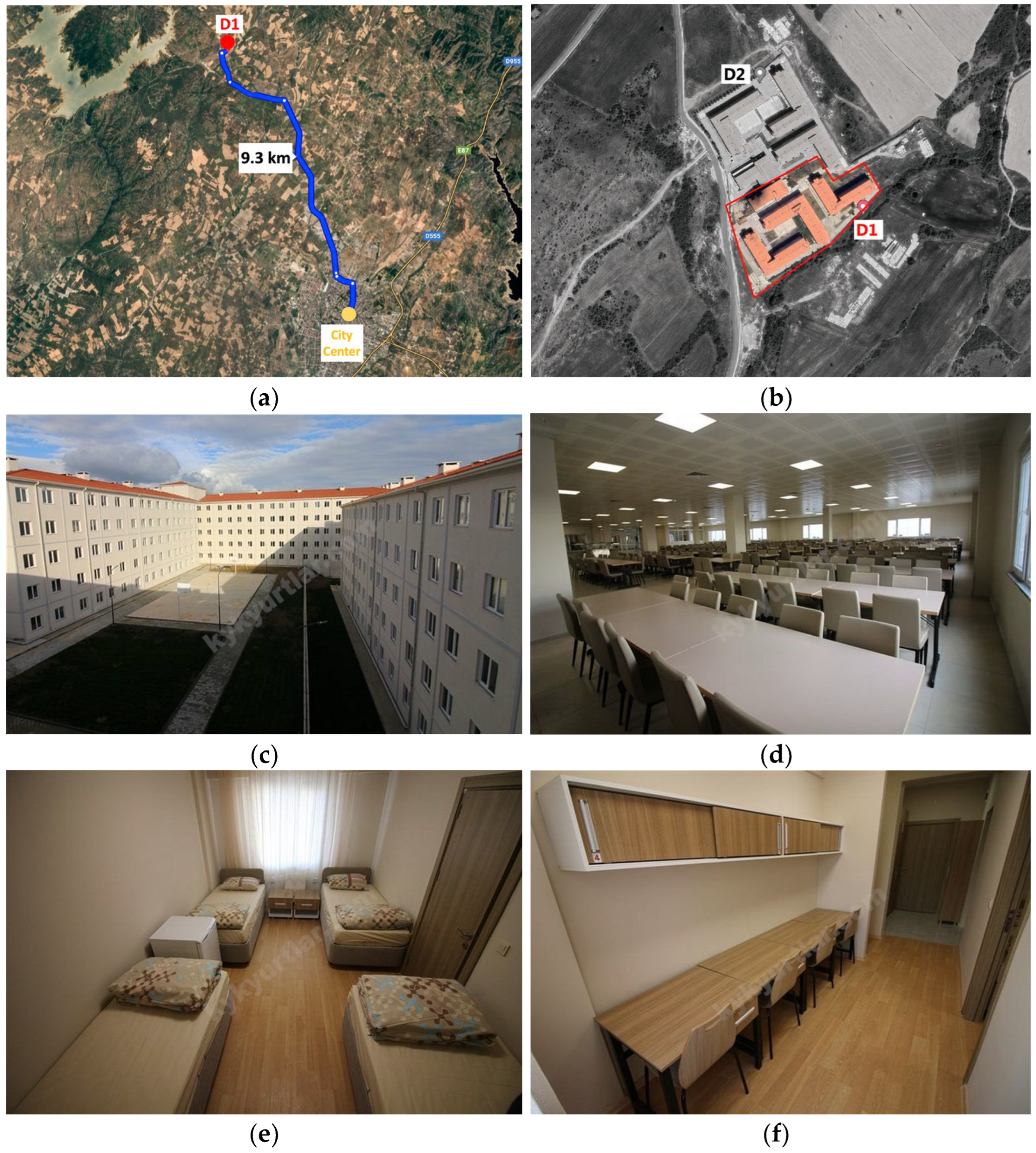
3.1.1. Evlad-ı Fatihan Female Student Dormitory (D1)
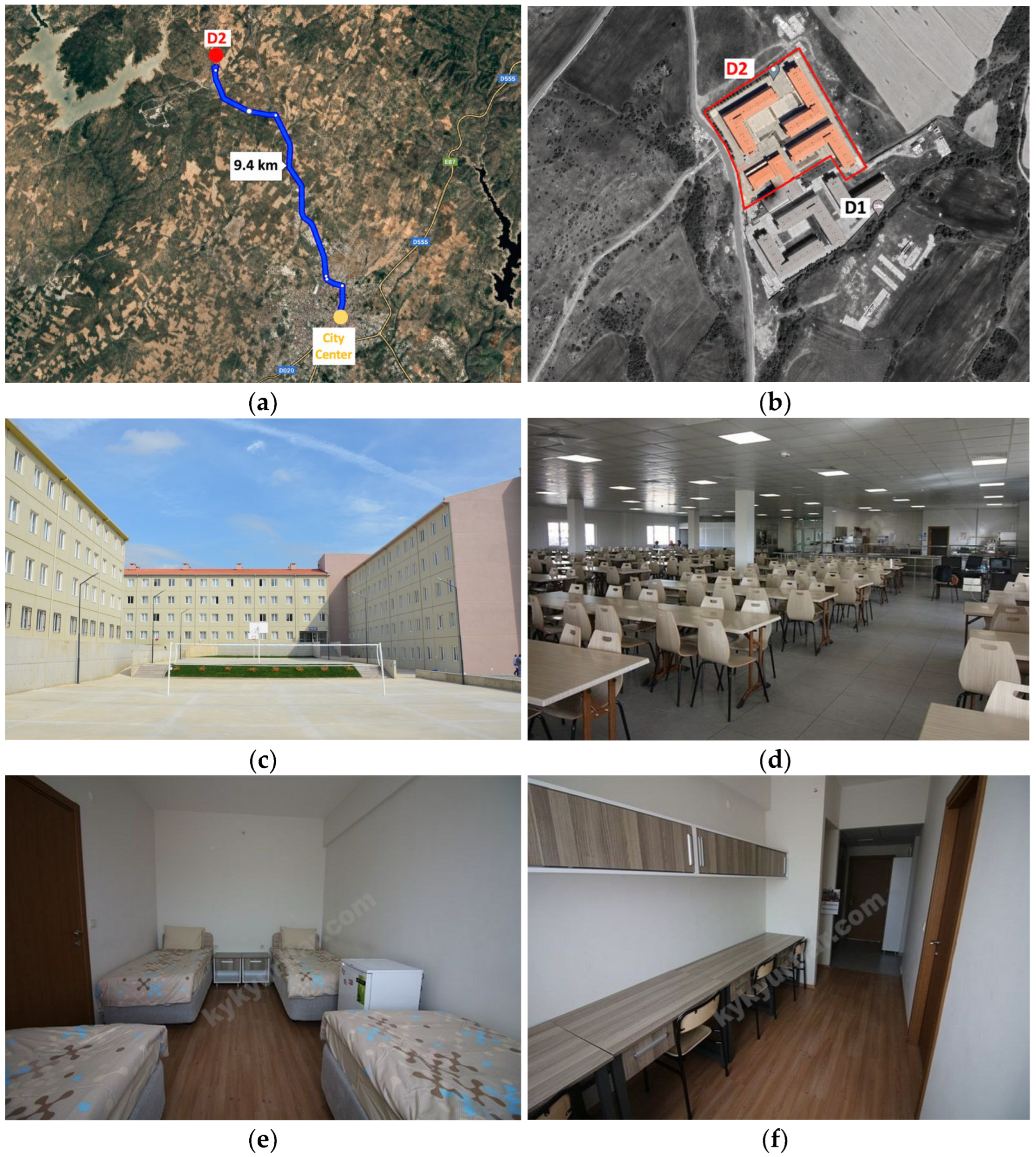
3.1.2. Hundi Hatun Female Student Dormitory (D2)
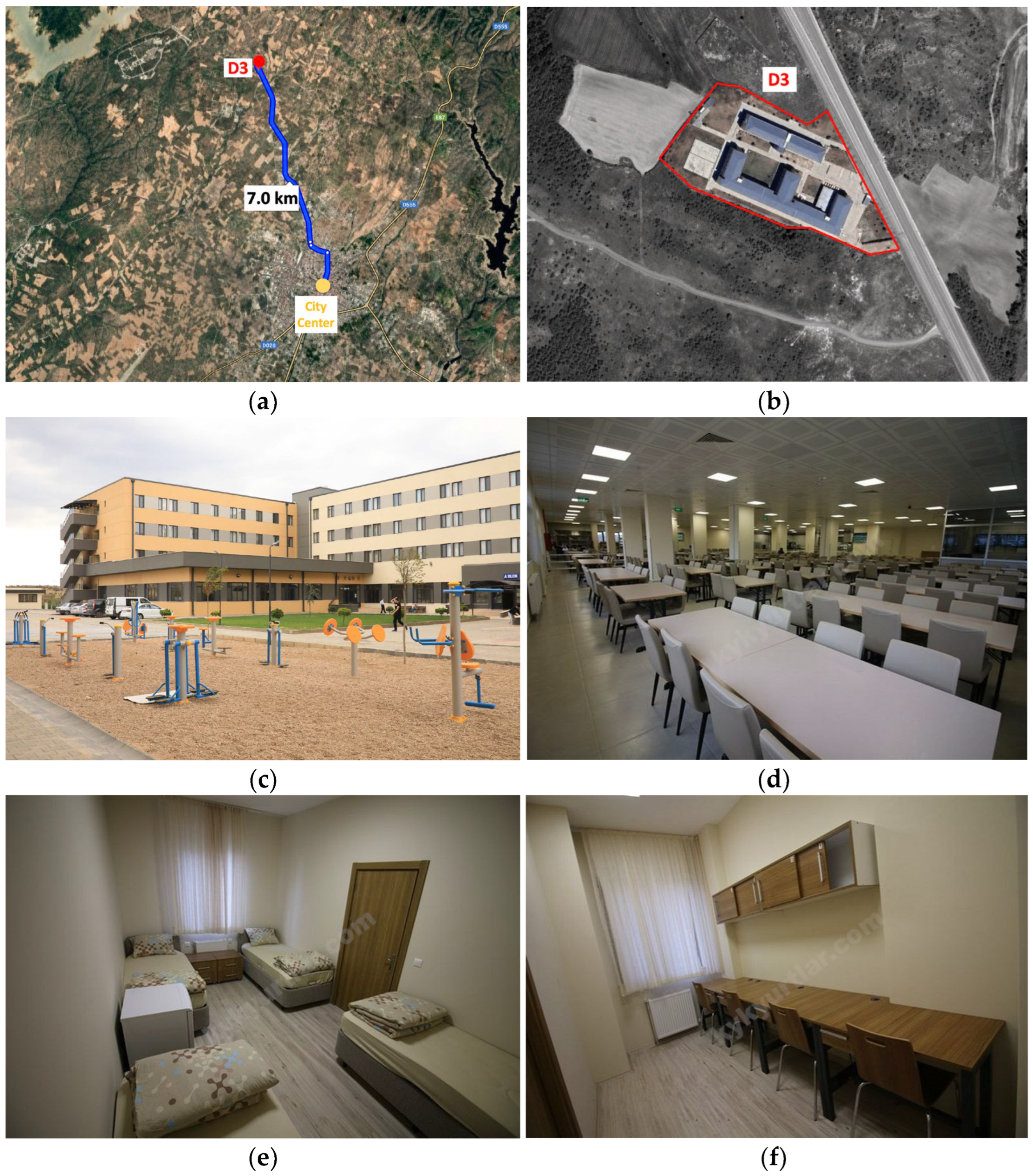
3.1.3. Ahmet Cevdet Pasha Male Student Dormitory (D3)
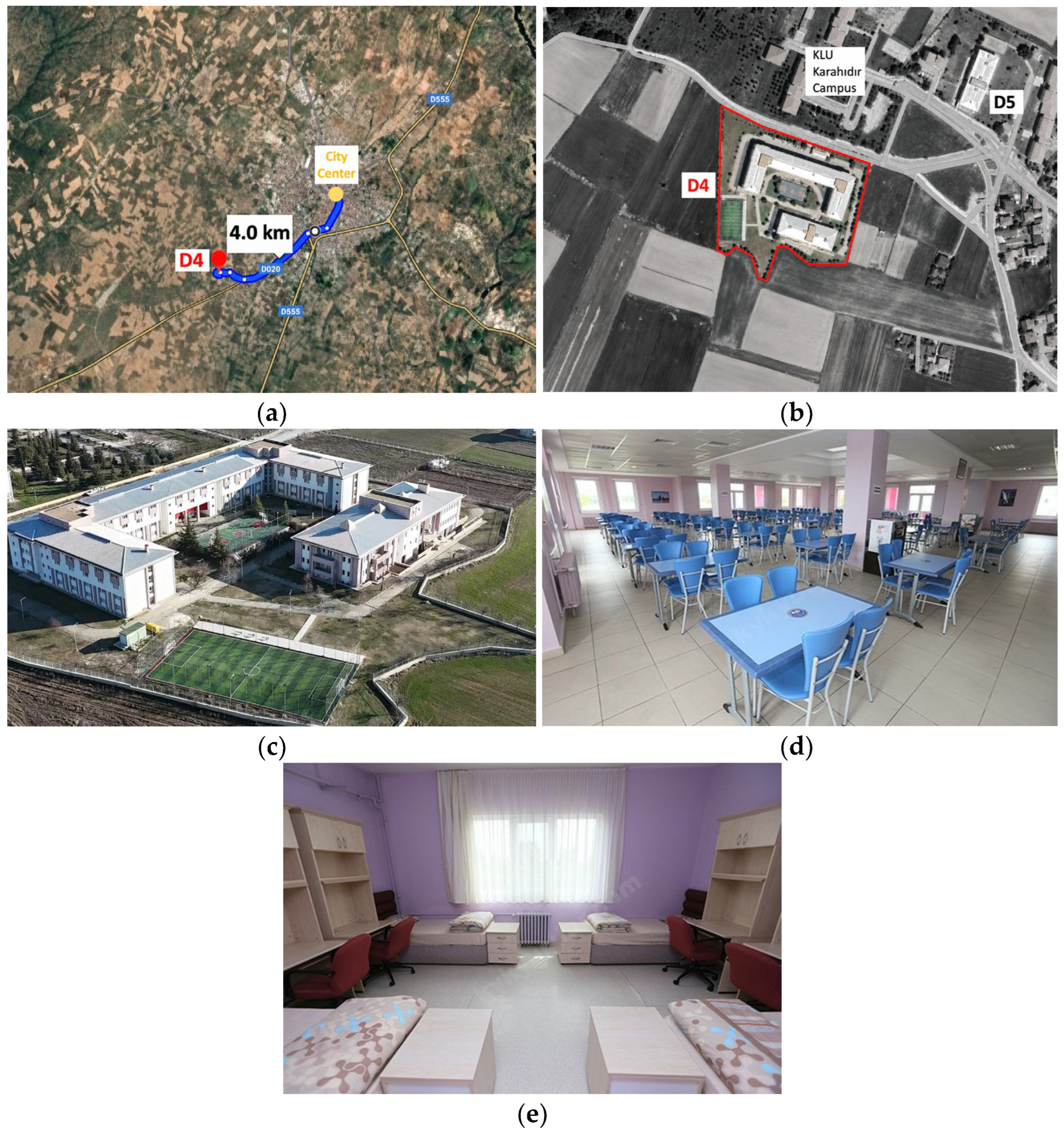
3.1.4. Şemseddin Sami Male Student Dormitory (D4)
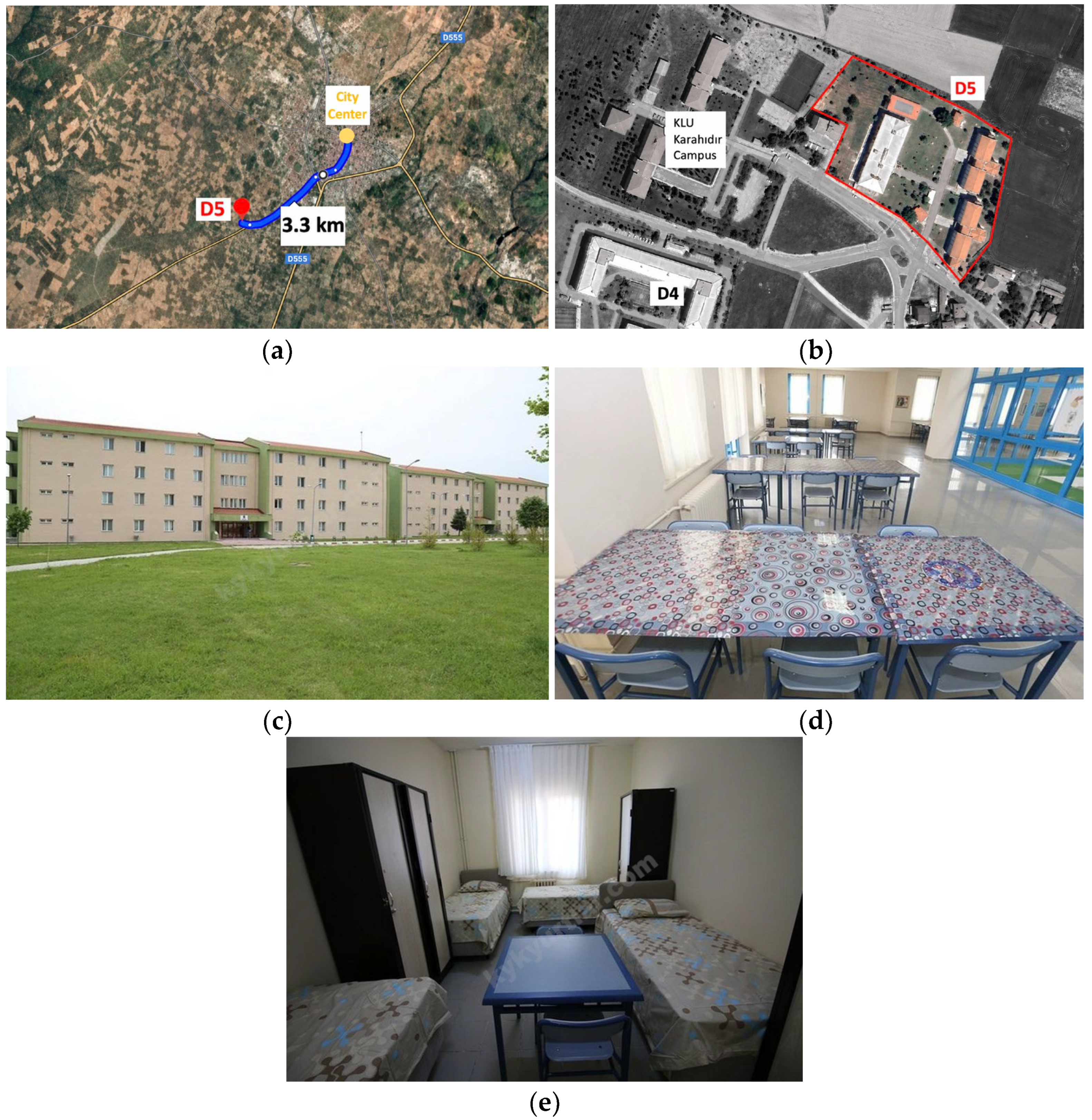
3.1.5. Kırklareli Male Student Dormitory (D5)
3.2. Sampling and Data Collection Process
3.3. Measurement Tool and Scale Validity
3.4. Data Analysis
4. Results
4.1. Descriptive Information and Statistics on Participants
4.2. Comparison of Place Attachment Levels According to Variables
5. Discussion
6. Conclusions
Author Contributions
Funding
Institutional Review Board Statement
Informed Consent Statement
Data Availability Statement
Acknowledgments
Conflicts of Interest
Abbreviations
| PA | Place attachment |
| GSB | Ministry of Youth and Sports |
| ANOVA | Analysis of variance |
| SEM | Structural equation modeling |
| D1 | Evlad-ı Fatihan Female Student Dormitory |
| D2 | Hundi Hatun Female Student Dormitory |
| D3 | Ahmet Cevdet Pasha Male Student Dormitory |
| D4 | Şemseddin Sami Male Student Dormitory |
| D5 | Kırklareli Male Student Dormitory |
| EFA | Exploratory factor analysis |
| CFA | Confirmatory factor analysis |
| CMIN/DF | Chi-square to degrees of freedom ratio |
| RMSEA | Root mean square error of approximation |
| CFI | Comparative fit index |
| TLI | Tucker–Lewis index |
| IFI | Incremental fit index |
| RFI | Relative fit index |
| NFI | Normed fit index |
| SRMR | Standardized root mean square residual |
| SPSS | Statistical Package for the Social Sciences |
| M | Mean score |
| SD | Standard deviation |
| GPA | Grade point average |
Appendix A

| Place Attachment (PA) | 1 | 2 | 3 | 4 | 5 | |
|---|---|---|---|---|---|---|
| PA1 | I know this dormitory very well. | ( ) | ( ) | ( ) | ( ) | ( ) |
| PA2 | I defend it when somebody criticizes it. | ( ) | ( ) | ( ) | ( ) | ( ) |
| PA3 | I miss it when I am not here. | ( ) | ( ) | ( ) | ( ) | ( ) |
| PA4 * | I don’t like this dormitory. | ( ) | ( ) | ( ) | ( ) | ( ) |
| PA5 | I feel secure in this dormitory. | ( ) | ( ) | ( ) | ( ) | ( ) |
| PA6 | I am proud of this dormitory. | ( ) | ( ) | ( ) | ( ) | ( ) |
| PA7 | It is a part of myself. | ( ) | ( ) | ( ) | ( ) | ( ) |
| PA8 * | I have no influence on its affairs. | ( ) | ( ) | ( ) | ( ) | ( ) |
| PA9 | I want to be involved in what is going on here. | ( ) | ( ) | ( ) | ( ) | ( ) |
| PA10 * | I leave this dormitory with pleasure. | ( ) | ( ) | ( ) | ( ) | ( ) |
| PA11 | I would not like to move out of here. | ( ) | ( ) | ( ) | ( ) | ( ) |
| PA12 | I am rooted here. | ( ) | ( ) | ( ) | ( ) | ( ) |
References
- Altman, I.; Rogoff, B. World views in psychology: Trait, interactional, organismic, and transactional perspectives. In Handbook of Environmental Psychology; Stokols, D., Altman, I., Eds.; John Wiley & Sons: New York, NY, USA, 1987; Volume 1, pp. 7–40. [Google Scholar]
- Tuan, Y.F. Space and Place: The Perspective of Experience; University of Minnesota Press: Minneapolis, MN, USA, 1977. [Google Scholar]
- Bachelard, G. The Poetics of Space; Jolas, M., Translator; Orion Press: New York, NY, USA, 1964. [Google Scholar]
- Norberg-Schulz, C. Genius Loci: Towards a Phenomenology of Architecture; Rizzoli: New York, NY, USA, 1980. [Google Scholar]
- Pallasmaa, J. The Eyes of the Skin: Architecture and the Senses, 4th ed.; John Wiley & Sons: Hoboken, NJ, USA, 2024. [Google Scholar]
- Heidegger, M. Being and Time; Macquarrie, J.; Robinson, E., Translators; Blackwell: Oxford, UK, 1962. [Google Scholar]
- Pallasmaa, J. Space, place and atmosphere: Emotion and peripheral perception in architectural experience. Lebenswelt 2014, 4, 230–245. [Google Scholar] [CrossRef] [PubMed]
- Cresswell, T. Place: A Short Introduction; Blackwell Publishing: Oxford, UK, 2004. [Google Scholar]
- Relph, E. Place and Placelessness; Pion: London, UK, 1976. [Google Scholar]
- Hashemnezhad, H.; Heidari, A.A.; Hoseini, P.P. Sense of place and place attachment. Int. J. Archit. Urban Dev. 2013, 3, 5–12. [Google Scholar]
- Scannell, L.; Gifford, R. Defining place attachment: A tripartite organizing framework. J. Environ. Psychol. 2010, 30, 1–10. [Google Scholar] [CrossRef]
- Hidalgo, M.C.; Hernández, B. Place attachment: Conceptual and empirical questions. J. Environ. Psychol. 2001, 21, 273–281. [Google Scholar] [CrossRef]
- Lewicka, M. Place attachment: How far have we come in the last 40 years? J. Environ. Psychol. 2011, 31, 207–230. [Google Scholar] [CrossRef]
- Low, S.M.; Altman, I. Place attachment: A conceptual inquiry. In Place Attachment; Altman, I., Low, S.M., Eds.; Springer: Boston, MA, USA, 1992; pp. 1–12. [Google Scholar] [CrossRef]
- Manzo, L.C. Beyond house and haven: Toward a revisioning of emotional relationships with places. J. Environ. Psychol. 2003, 23, 47–61. [Google Scholar] [CrossRef]
- Williams, D.R.; Vaske, J.J. The measurement of place attachment: Validity and generalizability of a psychometric approach. For. Sci. 2003, 49, 830–840. [Google Scholar] [CrossRef]
- Ardekani, R.B.; Helmi, F. Factors affecting the sense of belonging to dormitories. Spec. J. Archit. Constr. 2019, 5, 69–80. [Google Scholar] [CrossRef]
- Scannell, L.; Gifford, R. The experienced psychological benefits of place attachment. J. Environ. Psychol. 2017, 51, 256–269. [Google Scholar] [CrossRef]
- Khozaei, F.; Hassan, A.S.; Khozaei, Z. Understanding students’ satisfaction with hostel and sense of attachment to place, case study at University Sains Malaysia. Am. J. Eng. Appl. Sci. 2010, 3, 516–520. [Google Scholar] [CrossRef]
- Khozaei, F.; Ramayah, T.; Hassan, A.S.; Surienty, L. Sense of attachment to place and fulfilled preferences, the mediating role of housing satisfaction. Prop. Manag. 2012, 30, 292–310. [Google Scholar] [CrossRef]
- Maina, J.J.; Zaki, B.M.; Robert, B.B.; Chidoks, E. Factors influencing residential satisfaction within off-campus student housing in Kaduna state, Nigeria. J. Umm Al-Qura Univ. Eng. Archit. 2025, 16, 1442–1456. [Google Scholar] [CrossRef]
- Amole, D. Residential satisfaction in students’ housing. J. Environ. Psychol. 2009, 29, 76–85. [Google Scholar] [CrossRef]
- He, W.; Zeng, N. The relationship between university dormitory environmental factors and students’ informal learning experiences: A case study of three universities in Guangdong province. Buildings 2025, 15, 2518. [Google Scholar] [CrossRef]
- Abu-Obeid, N.N.; Ibrahim, A.F. The effect of dormitory type and room view on the perception of privacy and territoriality by female residents. Archit. Sci. Rev. 2002, 45, 231–241. [Google Scholar] [CrossRef]
- Amole, D. Coping strategies for living in student residential facilities in Nigeria. Environ. Behav. 2005, 37, 201–219. [Google Scholar] [CrossRef]
- Dazkir, S.S. Place meaning, sense of belonging, and personalization among university students in Turkey. Fam. Consum. Sci. Res. J. 2018, 46, 252–266. [Google Scholar] [CrossRef]
- Devlin, A.S.; Donovan, S.; Nicolov, A.; Nold, O.; Zandan, G. Residence hall architecture and sense of community: Everything old is new again. Environ. Behav. 2008, 40, 487–521. [Google Scholar] [CrossRef]
- Spanierman, L.B.; Soble, J.R.; Mayfield, J.B.; Neville, H.A.; Aber, M.; Khuri, L.; De La Rosa, B. Living learning communities and students’ sense of community and belonging. J. Stud. Aff. Res. Pract. 2013, 50, 308–325. [Google Scholar] [CrossRef]
- Samadieh, M.; Rezaei, N. A serial mediation model of sense of belonging to university and life satisfaction: The role of social loneliness and depression. Acta Psychol. 2024, 250, 104562. [Google Scholar] [CrossRef] [PubMed]
- Scopelliti, M.; Tiberio, L. Homesickness in university students: The role of multiple place attachment. Environ. Behav. 2010, 42, 335–350. [Google Scholar] [CrossRef]
- Aksel, E.; Imamoglu, Ç. Neighborhood location and its association with place attachment and residential satisfaction. Open House Int. 2020, 45, 327–340. [Google Scholar] [CrossRef]
- Bonaiuto, M.; Aiello, A.; Perugini, M.; Bonnes, M.; Ercolani, A.P. Multidimensional perception of residential environment quality and neighbourhood attachment in the urban environment. J. Environ. Psychol. 1999, 19, 331–352. [Google Scholar] [CrossRef]
- Lewicka, M. What makes neighborhood different from home and city? Effects of place scale on place attachment. J. Environ. Psychol. 2010, 30, 35–51. [Google Scholar] [CrossRef]
- Akoz Cevrimli, B.; Ulusoy, M. Analysing the relationship between space quality and place attachment in urban coasts using structural equation modelling: The Antalya Konyaaltı case. Int. J. Urban Sci. 2025, 1–39. [Google Scholar] [CrossRef]
- Karsono, B.; Wahid, J.; Novianti, Y.; Nurhaiza; Hassan, S.M. Place attachment in public space case study: Hiraq Square Lhokseumawe Aceh-Indonesia. Adv. Eng. Res. 2020, 195, 46–50. [Google Scholar] [CrossRef]
- Zhang, J.; Zhang, Z.; Liang, Y. Exploring the impact of accessibility on place attachment in urban public open spaces: A case study of Jiamusi City, China. Buildings 2024, 14, 957. [Google Scholar] [CrossRef]
- Yazdanfar, S.A.; Heidari, A.A.; Nekooeimehr, F. An investigation of the relationship between sense of place and place attachment among dormitory students. Int. J. Archit. Eng. Urban Plan. 2013, 23, 121–131. [Google Scholar]
- Beder, D.; Imamoglu, Ç. Correlates of dormitory satisfaction and differences involving social density and room locations. J. Hous. Built Environ. 2023, 38, 2307–2323. [Google Scholar] [CrossRef] [PubMed]
- Öztürk, S.M.; Dinçer, A.E. Evaluation of the dormitories in the physical and psychological requirements: The case of Karabük Province. ICONARP Int. J. Archit. Plan. 2020, 8, 47–61. [Google Scholar] [CrossRef]
- Milli Eğitim Bakanlığı [Ministry of National Education]. Milli Eğitim İstatistikleri: Örgün Eğitim [National Education Statistics: Formal Education]; Ministry of National Education: Ankara, Turkey, 2025. Available online: https://sgb.meb.gov.tr/www/resmi-istatistikler/icerik/64 (accessed on 20 October 2025).
- Jaglarz, A. New concepts in arrangement of living spaces for students. In Advances in Human Factors and Sustainable Infrastructure; Charytonowicz, J., Ed.; Springer: Cham, Switzerland, 2016; pp. 63–73. [Google Scholar] [CrossRef]
- Alamel, A.; Ferry, O.; Tenret, É. ‘It’s not the same to live in a house as to a small hall of residence’: Housing conditions, psychological distress and academic success of students in France during the first COVID-19 lockdown. Eur. J. High. Educ. 2024, 14, 267–289. [Google Scholar] [CrossRef]
- Gong, A.; Söderberg, B. Residential satisfaction in student housing: An empirical study in Stockholm, Sweden. J. Hous. Built Environ. 2024, 39, 537–555. [Google Scholar] [CrossRef]
- Tekin, O.; Başdoğan, S. The impact of spatial quality satisfaction on place attachment in student dormitories: A structural equation modeling approach. Buildings 2026, 16, 1575. [Google Scholar] [CrossRef]
- Seamon, D. Life Takes Place: Phenomenology, Lifeworlds, and Place Making; Routledge: London, UK, 2018. [Google Scholar]
- Bowlby, J. Attachment and Loss: Vol. 1. Attachment; Basic Books: New York, NY, USA, 1969. [Google Scholar]
- Gifford, R. Environmental Psychology: Principles and Practice, 5th ed.; Optimal Books: Colville, WA, USA, 2014. [Google Scholar]
- Fried, M. Grieving for a lost home. In Social Psychiatry; Routledge: London, UK, 1970. [Google Scholar]
- Fullilove, M.T. Psychiatric implications of displacement: Contributions from the psychology of place. Am. J. Psychiatry 1996, 153, 1516–1523. [Google Scholar] [CrossRef] [PubMed]
- Tuan, Y.F. Rootedness versus sense of place. Landscape 1980, 24, 3–8. [Google Scholar]
- Chen, N.; Hall, C.M.; Yu, K.; Qian, C. Environmental satisfaction, residential satisfaction, and place attachment: The cases of long-term residents in rural and urban areas in China. Sustainability 2019, 11, 6439. [Google Scholar] [CrossRef]
- Raymond, C.M.; Brown, G.; Weber, D. The measurement of place attachment: Personal, community, and environmental connections. J. Environ. Psychol. 2010, 30, 422–434. [Google Scholar] [CrossRef]
- Chen, N.; Dwyer, L. Residents’ place satisfaction and place attachment on destination brand-building behaviors: Conceptual and empirical differentiation. J. Travel Res. 2018, 57, 1026–1041. [Google Scholar] [CrossRef]
- Gao, F.; Sun, Y.; Zhou, Y.; Sang, M.; Zhao, J.; Han, L. Shyness and depression: The mediating roles of interpersonal competence, dormitory belonging and inferiority. Child. Youth Serv. Rev. 2020, 119, 105571. [Google Scholar] [CrossRef]
- Jorgensen, B.S.; Stedman, R.C. Sense of place as an attitude: Lakeshore owners attitudes toward their properties. J. Environ. Psychol. 2001, 21, 233–248. [Google Scholar] [CrossRef]
- Lewicka, M. Ways to make people active: The role of place attachment, cultural capital, and neighborhood ties. J. Environ. Psychol. 2005, 25, 381–395. [Google Scholar] [CrossRef]
- Fornara, F.; Bonaiuto, M.; Bonnes, M. Cross-validation of abbreviated perceived residential environment quality (PREQ) and neighborhood attachment (NA) indicators. Environ. Behav. 2010, 42, 171–196. [Google Scholar] [CrossRef]
- Devine-Wright, P. Rethinking NIMBYism: The role of place attachment and place identity in explaining place-protective action. J. Community Appl. Soc. Psychol. 2009, 19, 426–441. [Google Scholar] [CrossRef]
- Kamphuisen, F.M.; Joye, Y.; Bolderdijk, J.W. An agent-based model of the extinction of experience: How nature availability and connectedness to nature co-evolve over time. J. Environ. Psychol. 2025, 106, 102629. [Google Scholar] [CrossRef]
- Zhou, B.; Wang, L.; Huang, S.S.; Xiong, Q. Impact of perceived environmental restorativeness on tourists’ pro-environmental behavior: Examining the mediation of place attachment and the moderation of ecocentrism. J. Hosp. Tour. Manag. 2023, 56, 398–409. [Google Scholar] [CrossRef]
- Gbadegesin, J.T.; Komolafe, M.O.; Gbadegesin, T.F.; Omotoso, K.O. Off-campus student housing satisfaction indicators and the drivers: From student perspectives to policy re-awakening in governance. J. Hum. Behav. Soc. Environ. 2021, 31, 889–915. [Google Scholar] [CrossRef]
- Canter, D. The Psychology of Place; Architectural Press: London, UK, 1977. [Google Scholar]
- Baum, A.; Valins, S. Architecture and Social Behavior: Psychological Studies of Social Density; Routledge: London, UK, 1977. [Google Scholar] [CrossRef]
- Smith, K.; Asantewa, J.; AndohKwaw, P.; Owarewaa Ampaw, E. Influence of physical features of housing environment on students halls of residence. Univers. J. Bus. Manag. 2024, 4, 28–42. [Google Scholar] [CrossRef]
- Tuglo, M.E.; Olu, E.F.; Dedo, A.D. Students’ residential satisfaction with hostel facilities in universities in Ghana: A study of AAMUSTED-Kumasi campus. J. Tour. Herit. Res. 2024, 7, 126–137. [Google Scholar]
- Gabbianelli, L.; Pencarelli, T. On-campus accommodation service quality: The mediating role of students’ satisfaction on word of mouth. TQM J. 2023, 35, 1224–1255. [Google Scholar] [CrossRef]
- Yurtlar, K.Y.K. Kırklareli-KYK Yurtlar. Available online: https://www.kykyurtlar.com/kirklareli-kyk-yurtlari/ (accessed on 1 November 2025).
- Kampüsüm. Şemsettin Sami KYK Erkek Öğrenci Yurdu. Available online: https://kampusum.co/yurt/semsettin-sami-kyk-erkek-ogrenci-yurdu (accessed on 1 May 2026).
- Sekaran, U. Research Methods for Business: A Skill-Building Approach, 4th ed.; John Wiley & Sons: New York, NY, USA, 2003. [Google Scholar]
- Hair, J.F.; Black, W.C.; Babin, B.J.; Anderson, R.E. Multivariate Data Analysis, 8th ed.; Cengage Learning: Boston, MA, USA, 2019. [Google Scholar]
- Nunnally, J.C.; Bernstein, I.H. Psychometric Theory, 3rd ed.; McGraw-Hill: New York, NY, USA, 1994. [Google Scholar]
- Kline, R.B. Principles and Practice of Structural Equation Modeling, 4th ed.; Guilford Press: New York, NY, USA, 2016. [Google Scholar]
- Tabachnick, B.G.; Fidell, L.S. Using Multivariate Statistics, 7th ed.; Pearson: Boston, MA, USA, 2019. [Google Scholar]
- Cohen, J. Statistical Power Analysis for the Behavioral Sciences, 2nd ed.; Routledge: New York, NY, USA, 1988. [Google Scholar] [CrossRef]
- Funder, D.C.; Ozer, D.J. Evaluating effect size in psychological research: Sense and nonsense. Adv. Methods Pract. Psychol. Sci. 2019, 2, 156–168. [Google Scholar] [CrossRef]
- Götz, F.M.; Gosling, S.D.; Rentfrow, P.J. Small effects: The indispensable foundation for a cumulative psychological science. Perspect. Psychol. Sci. 2022, 17, 205–215. [Google Scholar] [CrossRef] [PubMed]
- Evans, G.W. The built environment and mental health. J. Urban Health 2003, 80, 536–555. [Google Scholar] [CrossRef] [PubMed]
- Stokols, D. (Ed.) Perspectives on Environment and Behavior: Theory, Research, and Applications; Plenum Press: New York, NY, USA, 1977. [Google Scholar] [CrossRef]
- Altman, I. The Environment and Social Behavior: Privacy, Personal Space, Territory, Crowding; Brooks/Cole Publishing: Monterey, CA, USA, 1975. [Google Scholar]
- Appleton, J. The Experience of Landscape; John Wiley & Sons: London, UK, 1975. [Google Scholar]


| Variables | Categories | n | % |
|---|---|---|---|
| Gender | Female | 275 | 61.1 |
| Male | 175 | 38.9 | |
| Marital Status | Single | 450 | 100.0 |
| Age | 18 | 52 | 11.6 |
| 19 | 63 | 14.0 | |
| 20 | 114 | 25.3 | |
| 21 | 112 | 24.9 | |
| 22 | 56 | 12.4 | |
| 23 and over | 53 | 11.8 | |
| Field of Study | Science, Engineering, and Architecture | 62 | 13.8 |
| Social Sciences and Humanities | 127 | 28.2 | |
| Health Sciences | 148 | 32.9 | |
| Economics and Administrative Sciences | 39 | 8.7 | |
| Technical Programs | 32 | 7.1 | |
| Transportation and Service Sciences | 42 | 9.3 | |
| Class Level | Preparatory and 1st Year | 204 | 45.3 |
| 2nd Year | 156 | 34.7 | |
| 3rd and 4th Year | 90 | 20.0 | |
| Degree Level | Associate Degree | 118 | 26.2 |
| Bachelor’s Degree | 332 | 73.8 | |
| Campus Location | Kayalı | 332 | 73.8 |
| Kavaklı | 83 | 18.4 | |
| Karahıdır | 35 | 7.8 | |
| Family’s Region of Residence | Marmara Region | 85 | 18.9 |
| Istanbul Province | 159 | 35.3 | |
| Thrace Region | 73 | 16.2 | |
| Other | 133 | 29.6 | |
| Dormitory of Residence | Evlad-ı Fatihan Female Student Dormitory (D1) | 146 | 32.4 |
| Hundi Hatun Female Student Dormitory (D2) | 129 | 28.7 | |
| Ahmet Cevdet Pasha Male Student Dormitory (D3) | 97 | 21.6 | |
| Şemseddin Sami Male Student Dormitory (D4) | 40 | 8.9 | |
| Kırklareli Male Student Dormitory (D5) | 38 | 8.4 | |
| Duration of Residence | 1–12 months | 200 | 44.4 |
| 13–24 months | 141 | 31.3 | |
| 25–36 months | 62 | 13.8 | |
| 37 months and over | 47 | 10.5 | |
| Room Capacity | 4 | 450 | 100.0 |
| Floor Level | Ground level | 112 | 24.9 |
| 1st floor | 93 | 20.6 | |
| 2nd floor | 111 | 24.7 | |
| 3rd and 4th floors | 134 | 29.8 |
| Scale | Minimum | Maximum | M | SD | Skewness | Kurtosis |
|---|---|---|---|---|---|---|
| Place Attachment (PA) | 10.00 | 50.00 | 27.19 | 7.36 | −0.142 | −0.222 |
| Variables | Categories | Place Attachment (PA) | |
|---|---|---|---|
| M | SD | ||
| Gender | Female | 26.39 | 7.40 |
| Male | 28.45 | 7.13 | |
| t | −2.909 | ||
| p | 0.004 * | ||
| Cohen’s d | 0.281 | ||
| Age | 18 | 28.50 | 6.29 |
| 19 | 27.43 | 7.41 | |
| 20 | 26.47 | 7.02 | |
| 21 | 27.65 | 7.49 | |
| 22 | 26.54 | 8.90 | |
| 23 and over | 26.89 | 6.99 | |
| F | 0.751 | ||
| p | 0.585 | ||
| Field of Study | Science, Engineering, and Architecture (1) | 26.16 | 6.78 |
| Social Sciences and Humanities (2) | 26.06 | 7.51 | |
| Health Sciences (3) | 27.84 | 7.64 | |
| Economics and Administrative Sciences (4) | 26.49 | 7.58 | |
| Technical Programs (5) | 30.78 | 5.93 | |
| Transportation and Service Sciences (6) | 27.74 | 6.66 | |
| F | 2.767 | ||
| p | 0.018 * | ||
| Bonferroni | 2 < 5 | ||
| η2 | 0.030 | ||
| Class Level | Preparatory and 1st Year | 27.16 | 6.93 |
| 2nd Year | 27.27 | 7.48 | |
| 3rd and 4th Year | 27.12 | 8.15 | |
| F | 0.014 | ||
| p | 0.986 | ||
| Degree Level | Associate Degree | 28.93 | 7.24 |
| Bachelor’s Degree | 26.57 | 7.31 | |
| t | 3.019 | ||
| p | 0.003 * | ||
| Cohen’s d | 0.324 | ||
| Campus Location | Kayalı (1) | 26.57 | 7.31 |
| Kavaklı (2) | 28.41 | 7.69 | |
| Karahıdır (3) | 30.17 | 5.96 | |
| F | 5.279 | ||
| p | 0.005 * | ||
| Bonferroni | 1 < 3 | ||
| η2 | 0.023 | ||
| Family’s Region of Residence | Marmara Region | 27.80 | 8.18 |
| Istanbul Province | 26.77 | 7.26 | |
| Thrace Region | 27.73 | 7.28 | |
| Other | 27.02 | 7.00 | |
| F | 0.522 | ||
| p | 0.667 | ||
| Dormitory of Residence | Evlad-ı Fatihan Female Student Dormitory (D1) | 27.85 | 7.90 |
| Hundi Hatun Female Student Dormitory (D2) | 24.74 | 6.44 | |
| Ahmet Cevdet Pasha Male Student Dormitory (D3) | 27.18 | 6.96 | |
| Şemseddin Sami Male Student Dormitory (D4) | 31.98 | 5.26 | |
| Kırklareli Male Student Dormitory (D5) | 27.97 | 8.15 | |
| F | 13.050 w | ||
| p | p < 0.001 | ||
| Tamhane | D2 < D1; D1, D2, D3 < D4 | ||
| η2 | 0.073 | ||
| Duration of Residence | 1–12 months | 27.27 | 7.05 |
| 13–24 months | 27.28 | 7.02 | |
| 25–36 months | 26.61 | 8.92 | |
| 37 months and over | 27.34 | 7.61 | |
| F | 0.106 w | ||
| p | 0.957 | ||
| Floor Level | Ground floor (1) | 28.86 | 7.98 |
| 1st floor (2) | 26.26 | 7.17 | |
| 2nd floor (3) | 26.64 | 6.80 | |
| 3rd and 4th floors (4) | 26.90 | 7.25 | |
| F | 2.718 | ||
| p | 0.044 * | ||
| Bonferroni | 2 < 1 | ||
| η2 | 0.018 | ||
Disclaimer/Publisher’s Note: The statements, opinions and data contained in all publications are solely those of the individual author(s) and contributor(s) and not of MDPI and/or the editor(s). MDPI and/or the editor(s) disclaim responsibility for any injury to people or property resulting from any ideas, methods, instructions or products referred to in the content. |
© 2026 by the authors. Licensee MDPI, Basel, Switzerland. This article is an open access article distributed under the terms and conditions of the Creative Commons Attribution (CC BY) license.
Share and Cite
Tekin, O.; Başdoğan, S. Place Attachment in Student Dormitories: An Analysis of Differences Across Socio-Spatial Variables. Architecture 2026, 6, 102. https://doi.org/10.3390/architecture6030102
Tekin O, Başdoğan S. Place Attachment in Student Dormitories: An Analysis of Differences Across Socio-Spatial Variables. Architecture. 2026; 6(3):102. https://doi.org/10.3390/architecture6030102
Chicago/Turabian StyleTekin, Oktay, and Serhat Başdoğan. 2026. "Place Attachment in Student Dormitories: An Analysis of Differences Across Socio-Spatial Variables" Architecture 6, no. 3: 102. https://doi.org/10.3390/architecture6030102
APA StyleTekin, O., & Başdoğan, S. (2026). Place Attachment in Student Dormitories: An Analysis of Differences Across Socio-Spatial Variables. Architecture, 6(3), 102. https://doi.org/10.3390/architecture6030102