
Children’s Perception of Urban Outdoor Spaces and Playground Design: A Sensory Walk Study in Zagreb, Croatia



Abstract
1. Introduction
2. Theoretical Framework
2.1. Children’s Development Through Interaction with Their Environment
2.2. Children’s Socio-Demographic Factors and Mobility
2.3. Children as Participatory Agents of Outdoor Space Designs
2.4. Children’s Perception of Outdoor Space
3. Materials and Methods
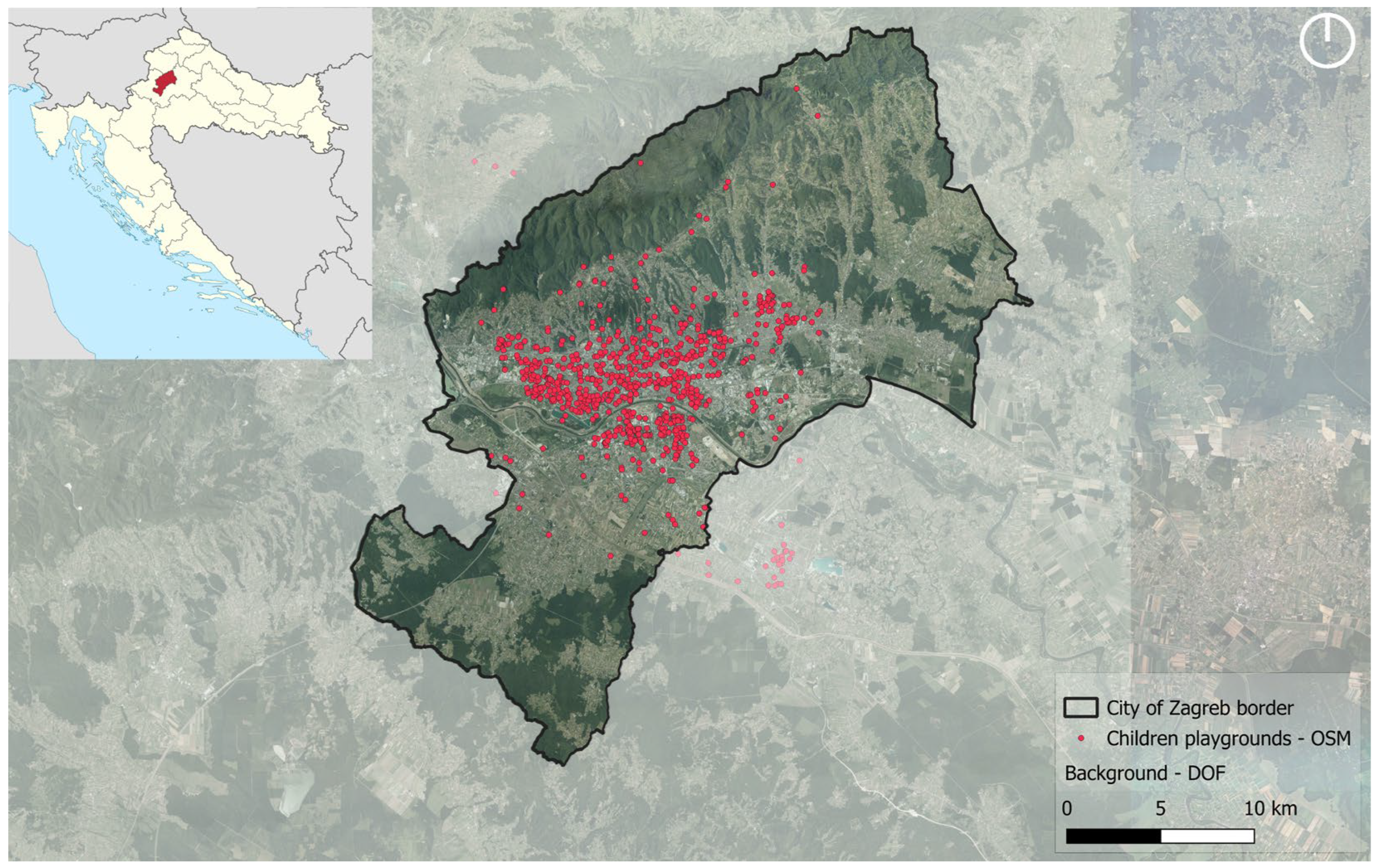
3.1. Study Area
3.2. Research Design
3.3. Sensory Walk Method
3.4. Participants and Ethical Considerations
3.5. Study Locations and Spatial Categories
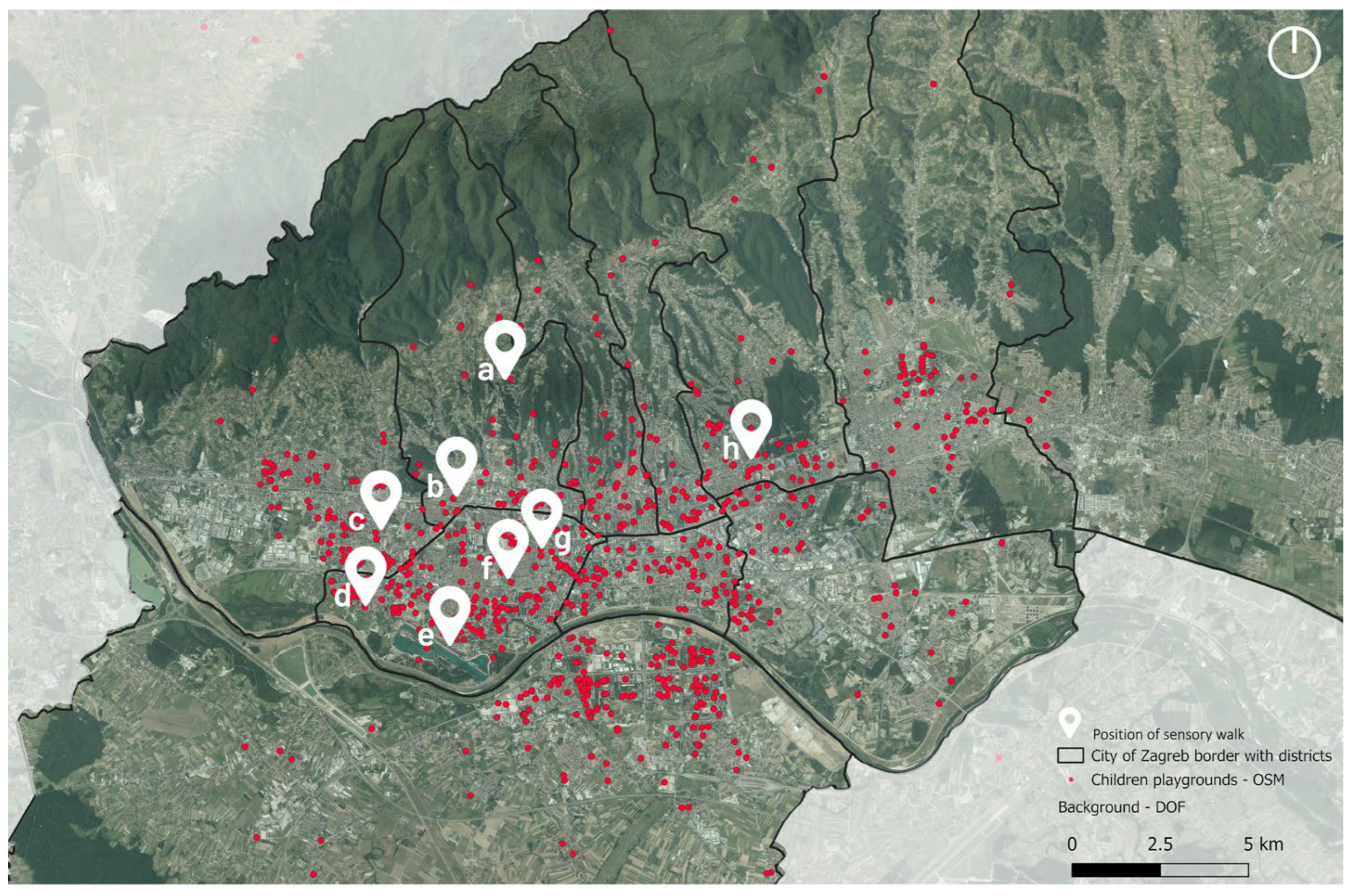
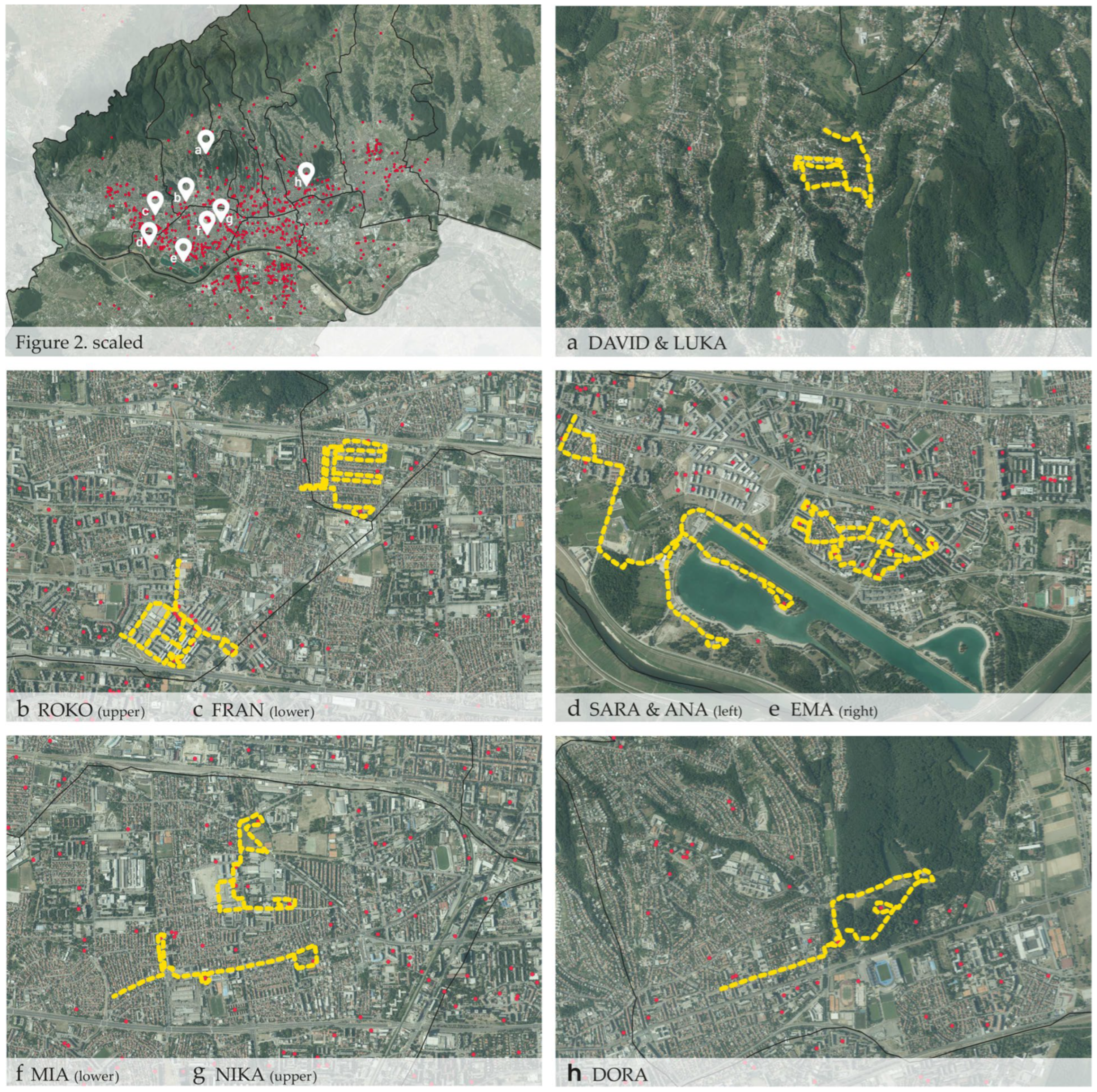
3.5.1. Spatial Context of the Sensory Walks
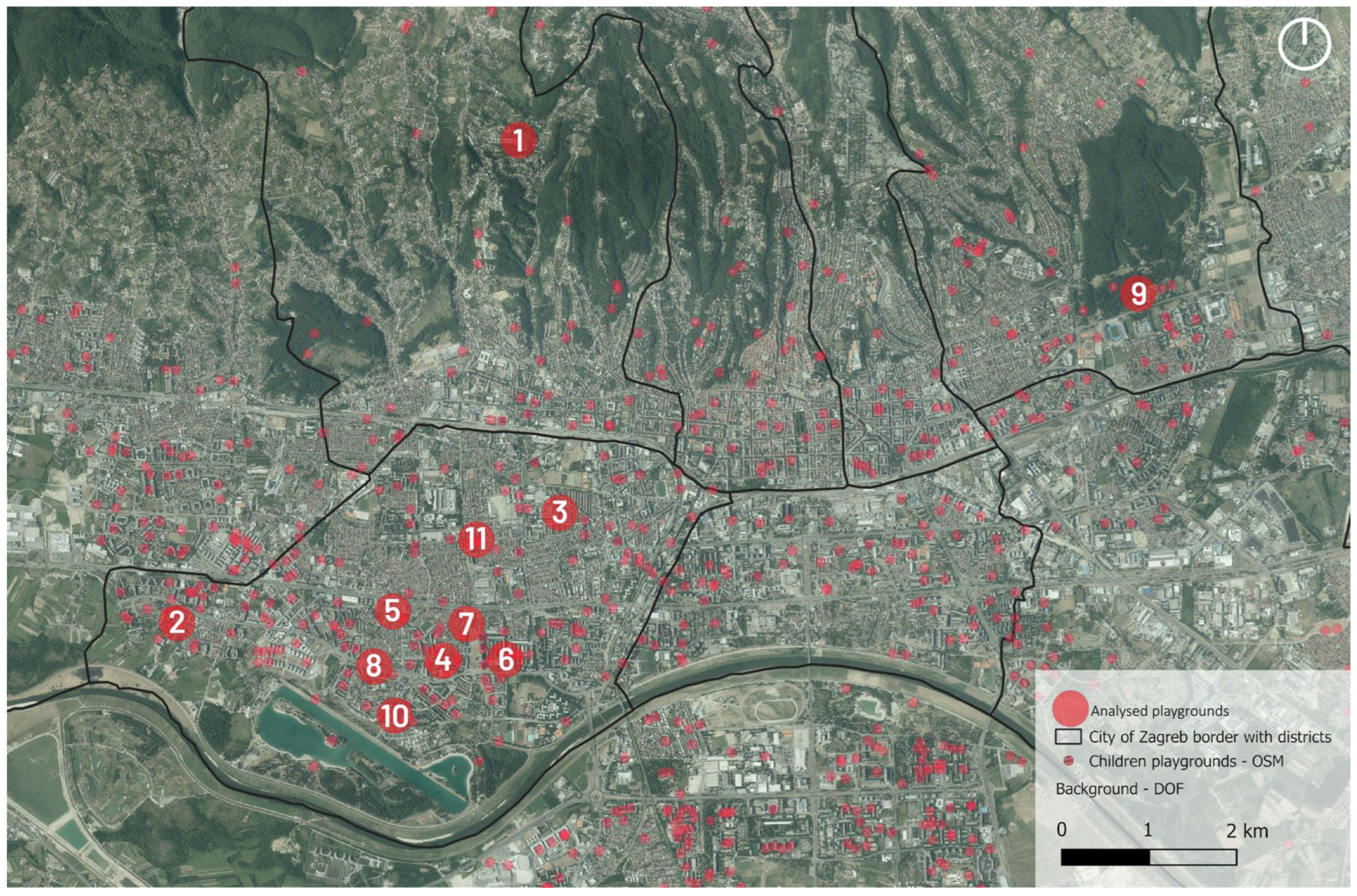
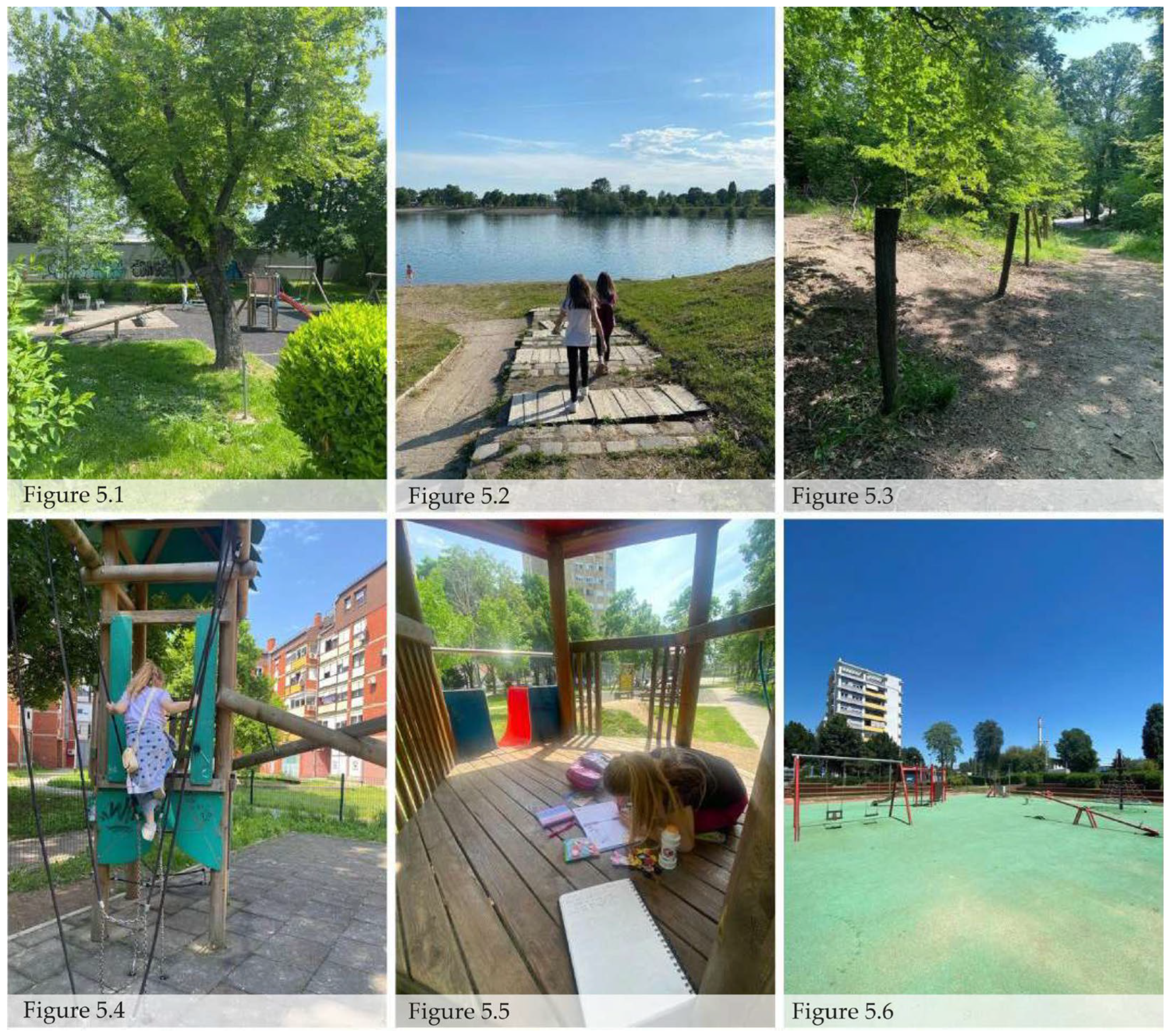
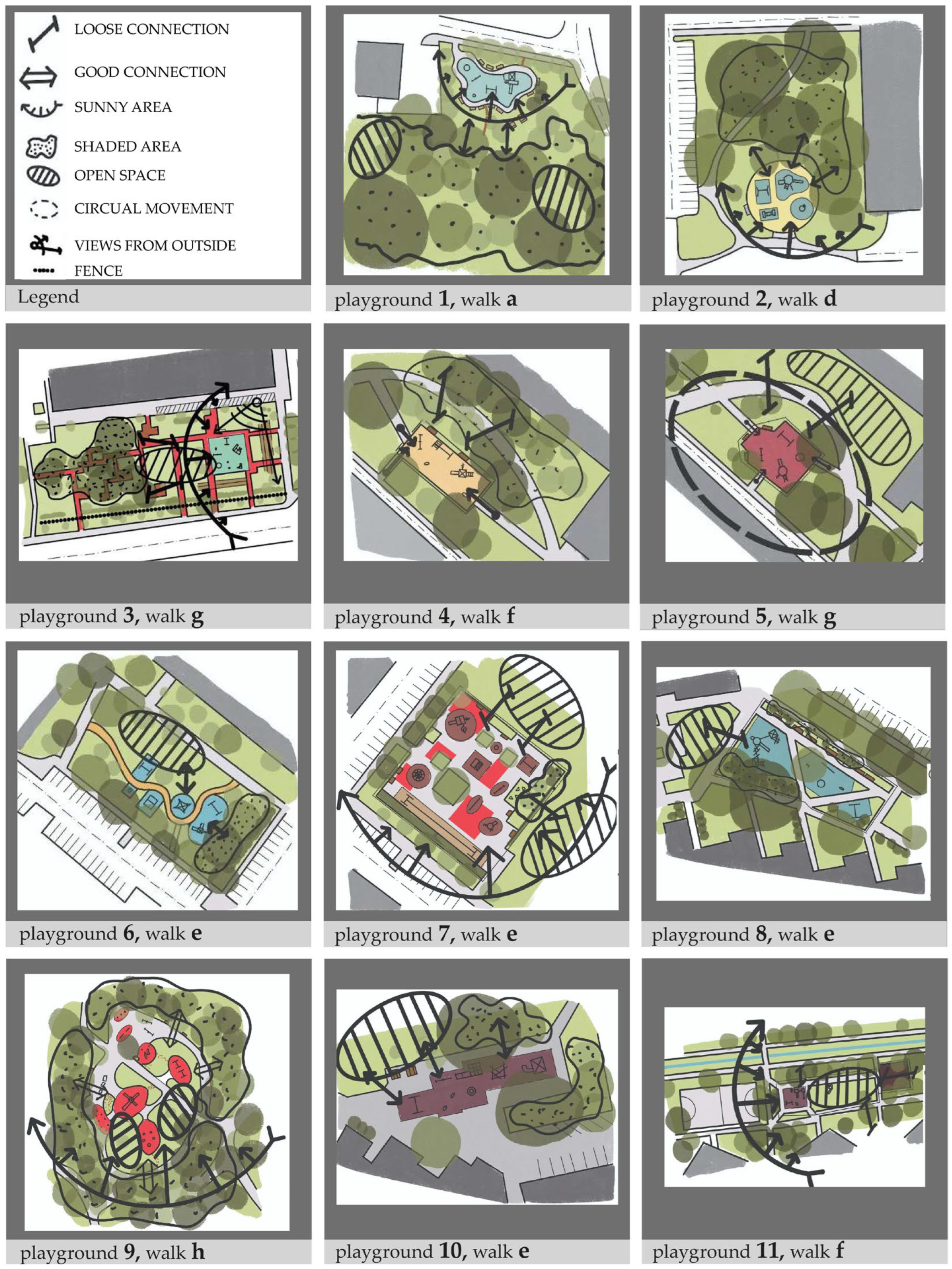
3.5.2. Children’s Playgrounds
3.6. Data Analysis
3.7. Software and Tools
4. Results
4.1. Sensory Walk Findings
4.2. Playground Content Analysis
5. Discussion
5.1. Natural Environment
5.2. Children’s Playgrounds
5.3. Urban Spaces
5.4. Implications for Playground Design
5.5. Limitations
6. Conclusions
Author Contributions
Funding
Institutional Review Board Statement
Data Availability Statement
Conflicts of Interest
Abbreviations
| GUP | Generalni urbanistički plan (General Urban Plan) |
| PPGZ | Prostorni plan Grada Zagreba (Spatial Plan of the City of Zagreb) |
| NN | Narodne novine (Official Gazette of the Republic of Croatia) |
| GPS | Global Positioning System |
| OSM | OpenStreetMap |
| DOF | Digitalni ortofoto (Digital Orthophoto) |
| QGIS | Quantum Geographic Information System |
| KFC | Kit, Fence, Carpet (playground typology term) |
Appendix A
Interview Strategy During Sensory Walk
References
- Björklid, P.; Nordström, M. Environmental Child-Friendliness: Collaboration and Future Research. Child. Youth Environ. 2007, 17, 388–401. [Google Scholar] [CrossRef]
- Karsten, L. It All Used to Be Better? Different Generations on Continuity and Change in Urban Children’s Daily Use of Space. Child. Geogr. 2005, 3, 275–290. [Google Scholar] [CrossRef]
- Nordström, M.; Wales, M. Enhancing Urban Transformative Capacity through Children’s Participation in Planning. Ambio 2019, 48, 507–514. [Google Scholar] [CrossRef]
- Ståhle, A. Closer Together: This Is the Future of Cities; Dokument Press: Årsta, Sweden, 2016. [Google Scholar]
- Cele, S. Communicating Place: Methods for Understanding Children’s Experience of Place; Acta Universitatis Stockholmiensis; Almqvist & Wiksell International: Stockholm, Sweden, 2006. [Google Scholar]
- Freeman, C.; Tranter, P. Children and Their Urban Environment: Changing Worlds; Routledge: London, UK, 2012. [Google Scholar]
- Tandarić, N.; Watkins, C.; Ives, C. Urban Planning in Socialist Croatia. Croat. Geogr. Bull. 2019, 81, 5–41. [Google Scholar] [CrossRef]
- Tandarić, N.; Ives, C.; Watkins, C. From City in the Park to “Greenery in Plant Pots”: The Influence of Socialist and Post-Socialist Planning on Opportunities for Cultural Ecosystem Services. Land Use Policy 2022, 123, 106309. [Google Scholar] [CrossRef]
- Čaldarović, O.; Šarinić, J. First Signs of Gentrification? Urban Regeneration in the Transitional Society: The Case of Croatia. Sociol. Space 2008, 46, 369–381. [Google Scholar]
- Mustapa, N.D.; Maliki, N.Z.; Hamzah, A. Benefits of Nature on Children’s Developmental Needs: A Review. Asian J. Behav. Stud. 2018, 3, 31–42. [Google Scholar] [CrossRef]
- State Pedagogical Standard for Preschool Education and Care. Available online: https://narodne-novine.nn.hr/clanci/sluzbeni/2008_06_63_2128.html (accessed on 26 April 2026).
- HRN EN 1176-1:2017; Playground Equipment and Surfacing. Croatian Standards Institute (HZN): Zagreb, Croatia, 2017. Available online: https://repozitorij.hzn.hr/norm/HRN+EN+1176-1:2017 (accessed on 26 April 2026).
- Central Catalogue of Official Documents of the Republic of Croatia. Available online: https://sredisnjikatalogrh.gov.hr/sredisnji-katalog/dokumenti-i-publikacije/detalji?searchTerm=filterfi%255B12086%255D%3D268575&id=2702199&st=1 (accessed on 26 April 2026).
- Woolley, H.; Lowe, A. Exploring the Relationship between Design Approach and Play Value of Outdoor Play Spaces. Landsc. Res. 2013, 38, 53–74. [Google Scholar] [CrossRef]
- Sandseter, E.B.H. Characteristics of Risky Play. J. Adventure Educ. Outdoor Learn. 2009, 9, 3–21. [Google Scholar] [CrossRef]
- Soga, M.; Gaston, K.J. Extinction of Experience: The Loss of Human-Nature Interactions. Front. Ecol. Environ. 2016, 14, 94–101. [Google Scholar] [CrossRef]
- Woolley, H.; Dunn, J.; Spencer, C.; Short, T.; Rowley, G. Children Describe Their Experiences of the City Centre: A Qualitative Study of the Fears and Concerns Which May Limit Their Full Participation. Landsc. Res. 1999, 24, 287–301. [Google Scholar] [CrossRef]
- Kuo, M.; Barnes, M.; Jordan, C. Do Experiences with Nature Promote Learning? Converging Evidence of a Cause-and-Effect Relationship. Front. Psychol. 2019, 10, 305. [Google Scholar] [CrossRef] [PubMed]
- Gill, T. The Benefits of Children’s Engagement with Nature: A Systematic Literature Review. Child. Youth Environ. 2014, 24, 10–34. [Google Scholar] [CrossRef]
- Bronfenbrenner, U. The Ecology of Human Development: Experiments by Nature and Design; Harvard University Press: Cambridge, MA, USA, 1979. [Google Scholar]
- Holloway, S.L.; Valentine, G. (Eds.) Children’s Geographies: Playing, Living, Learning; Routledge: London, UK, 2004. [Google Scholar]
- Mikkelsen, M.R.; Christensen, P. Is Children’s Independent Mobility Really Independent? A Study of Children’s Mobility Combining Ethnography and GPS/Mobile Phone Technologies. Mobilities 2009, 4, 37–58. [Google Scholar] [CrossRef]
- Loebach, J.; Gilliland, J. Examining the Social and Built Environment Factors Influencing Children’s Independent Use of Their Neighborhoods and the Experience of Local Settings as Child-Friendly. J. Plan. Educ. Res. 2022, 42, 611–628. [Google Scholar] [CrossRef]
- Piaget, J. Play, Dreams and Imitation in Childhood; Routledge: London, UK, 2013. [Google Scholar]
- Chawla, L. “Insight, Creativity and Thoughts on the Environment”: Integrating Children and Youth into Human Settlement Development. Environ. Urban. 2002, 14, 11–22. [Google Scholar] [CrossRef]
- Skär, L. Disabled Children’s Perceptions of Technical Aids, Assistance and Peers in Play Situations. Scand. J. Caring Sci. 2002, 16, 27–33. [Google Scholar] [CrossRef]
- Prellwitz, M.; Skär, L. Usability of Playgrounds for Children with Different Abilities. Occup. Ther. Int. 2007, 14, 144–155. [Google Scholar] [CrossRef]
- Jansson, M. Attractive Playgrounds: Some Factors Affecting User Interest and Visiting Patterns. Landsc. Res. 2010, 35, 63–81. [Google Scholar] [CrossRef]
- Mårtensson, F.; Jansson, M.; Johansson, M.; Raustorp, A.; Kylin, M.; Boldemann, C. The Role of Greenery for Physical Activity Play at School Grounds. Urban For. Urban Green. 2014, 13, 103–113. [Google Scholar] [CrossRef]
- Chawla, L. Benefits of Nature Contact for Children. J. Plan. Lit. 2015, 30, 433–452. [Google Scholar] [CrossRef]
- Gibson, J.J. The Ecological Approach to Visual Perception: Classic Edition; Psychology Press: New York, NY, USA, 2014. [Google Scholar]
- Heft, H. Affordances of Children’s Environments: A Functional Approach to Environmental Description. Child. Environ. Q. 1988, 5, 29–37. [Google Scholar]
- Cosco, N.G.; Moore, R.C.; Islam, M.Z. Behavior Mapping: A Method for Linking Preschool Physical Activity and Outdoor Design. Med. Sci. Sports Exerc. 2010, 42, 513–519. [Google Scholar] [CrossRef]
- Woolley, H. Watch This Space! Designing for Children’s Play in Public Open Spaces. Geogr. Compass 2008, 2, 495–512. [Google Scholar] [CrossRef]
- Bundy, A.C.; Luckett, T.; Naughton, G.A.; Tranter, P.J.; Wyver, S.R.; Ragen, J.; Singleton, E.; Spies, G. Playful Interaction: Occupational Therapy for All Children on the School Playground. Am. J. Occup. Ther. 2008, 62, 522–527. [Google Scholar] [CrossRef]
- Mårtensson, F. Guiding Environmental Dimensions for Outdoor Play. Soc. Tidskr. 2013, 90, 658–665. [Google Scholar] [CrossRef]
- Änggård, E. How Matter Comes to Matter in Children’s Nature Play: Posthumanist Approaches and Children’s Geographies. Child. Geogr. 2016, 14, 77–90. [Google Scholar] [CrossRef]
- Montessori, M. The Absorbent Mind; Simon and Schuster: New York, NY, USA, 2013. [Google Scholar]
- Schoeppe, S.; Duncan, M.J.; Badland, H.M.; Alley, S.; Williams, S.; Rebar, A.L.; Vandelanotte, C. Socio-Demographic Factors and Neighbourhood Social Cohesion Influence Adults’ Willingness to Grant Children Greater Independent Mobility: A Cross-Sectional Study. BMC Public Health 2015, 15, 690. [Google Scholar] [CrossRef] [PubMed]
- Rodrigues, D.; Padez, C.; Machado-Rodrigues, A.M. Environmental and Socio-Demographic Factors Associated with 6–10-Year-Old Children’s School Travel in Urban and Non-Urban Settings. J. Urban Health 2018, 95, 859–868. [Google Scholar] [CrossRef] [PubMed]
- Rigolon, A. A Space with Meaning: Children’s Involvement in Participatory Design Processes. Des. Princ. Pract. Int. J. 2011, 5, 107–122. [Google Scholar] [CrossRef]
- Herrington, S.; Lesmeister, C. The Design of Landscapes at Child-Care Centres: Seven Cs. Landsc. Res. 2006, 31, 63–82. [Google Scholar] [CrossRef]
- Hart, R.A. Children’s Participation: From Tokenism to Citizenship; Innocenti Essays No. 4; UNICEF International Child Development Centre: Florence, Italy, 1992. [Google Scholar]
- Sutton, S.E.; Kemp, S.P. Integrating Social Science and Design Inquiry Through Interdisciplinary Design Charrettes: An Approach to Participatory Community Problem Solving. Am. J. Community Psychol. 2006, 38, 125–139. [Google Scholar] [CrossRef]
- Croatian Bureau of Statistics. Available online: https://podaci.dzs.hr/hr/ (accessed on 1 April 2026).
- City of Zagreb. Zagreb in Figures. Available online: https://www.zagreb.hr/zagreb-u-brojkama/1045 (accessed on 1 April 2026).
- Croatian Bureau of Statistics. OBR-2025-2-1: Primary Schools, End of School Year 2023/2024 and Beginning of School Year 2024/2025. Available online: https://podaci.dzs.hr/2025/hr/97133 (accessed on 28 April 2026).
- Wikimedia Commons. File: Croatia Location Map, City of Zagreb County.svg. Available online: https://commons.wikimedia.org/wiki/File:Croatia_location_map,_City_of_Zagreb_county.svg (accessed on 1 April 2026).
- OpenStreetMap Data Extracts for Croatia. Available online: https://download.geofabrik.de/europe/croatia.html (accessed on 1 April 2026).
- City of Zagreb. Green Infrastructure Cadastre of the City of Zagreb. Available online: https://gis.zrinjevac.hr/ (accessed on 1 April 2026).
- City of Zagreb. General Urban Development Plan of the City of Zagreb (GUP). Available online: https://www.zagreb.hr/generalni-urbanisticki-plan-grada-zagreba-gup/89066 (accessed on 1 April 2026).
- City of Zagreb. Spatial Plan of the City of Zagreb (PPGZ). Available online: https://www.zagreb.hr/prostorni-plan-grada-zagreba-ppgz/89064 (accessed on 1 April 2026).
- Ordinance on Spatial Plans. Available online: https://narodne-novine.nn.hr/clanci/sluzbeni/2023_12_152_2228.html (accessed on 1 April 2026).
- Moore, D.; Morrissey, A.-M.; Jeavons, M. Re-Imagining Outdoor Playspaces: An Unexpected Consequence of the COVID-19 Lockdown. Child. Youth Environ. 2022, 32, 57–83. [Google Scholar] [CrossRef]
- Loebach, J.; Gilliland, J. Child-Led Tours to Uncover Children’s Perceptions and Use of Neighborhood Environments. Child. Youth Environ. 2010, 20, 52–90. [Google Scholar] [CrossRef]
- Morse, J.M. Designing Funded Qualitative Research. In Handbook of Qualitative Research; Denzin, N.K., Lincoln, Y.S., Eds.; Sage Publications: Thousand Oaks, CA, USA, 1994; pp. 220–235. [Google Scholar]
- McAteer, B.; Loudon, E.; Higgins, K. “We Live Here and Play Here, We Should Have a Say”: An Exploration of Children’s Perceptions of Place-Making in the Market Community, Belfast. Child. Soc. 2024, 38, 1602–1621. [Google Scholar] [CrossRef]
- Januškienė, E.; Kamičaitytė, J. Landscape Perception of Children Under the Age of 12 Living in Different Settings: A Systematic Review. Archit. Urban Plan. 2024, 20, 80–87. [Google Scholar] [CrossRef]
- Jansson, M.; Sundevall, E.; Wales, M. The Role of Green Spaces and Their Management in a Child-Friendly Urban Village. Urban For. Urban Green. 2016, 18, 228–236. [Google Scholar] [CrossRef]
- Morrow, V. Ethical Dilemmas in Research with Children and Young People about Their Social Environments. Child. Geogr. 2008, 6, 49–61. [Google Scholar] [CrossRef]
- Braun, V.; Clarke, V. Using Thematic Analysis in Psychology. Qual. Res. Psychol. 2006, 3, 77–101. [Google Scholar] [CrossRef]
- Creswell, J.W. Qualitative Inquiry and Research Design: Choosing Among Five Approaches, 3rd ed.; SAGE Publications: Thousand Oaks, CA, USA, 2013. [Google Scholar]
- Mayring, P. Qualitative Content Analysis. Forum Qual. Soc. Res. 2000, 1, 20. [Google Scholar] [CrossRef]
- Saldaña, J. The Coding Manual for Qualitative Researchers, 4th ed.; SAGE Publications: London, UK, 2021. [Google Scholar]
- Kyttä, M. The Extent of Children’s Independent Mobility and the Number of Actualized Affordances as Criteria for Child-Friendly Environments. J. Environ. Psychol. 2004, 24, 179–198. [Google Scholar] [CrossRef]
- Sandseter, E.B.H.; Kennair, L.E.O. Children’s Risky Play from an Evolutionary Perspective: The Anti-Phobic Effects of Thrilling Experiences. Evol. Psychol. 2011, 9, 257–284. [Google Scholar] [CrossRef] [PubMed]
- Peavey, E.; Vander Wyst, K.B. Evidence-Based Design and Research-Informed Design: What’s the Difference? Conceptual Definitions and Comparative Analysis. HERD Health Environ. Res. Des. J. 2017, 10, 143–156. [Google Scholar] [CrossRef] [PubMed]



| Name | Luka | David | Roko | Fran | Ana | Sara | Ema | Mia | Nika | Dora |
|---|---|---|---|---|---|---|---|---|---|---|
| Symbol of sensory walk | a | a | b | c | d | d | e | f | g | h |
| Age (in years) | 9 | 10 | 7 | 8 | 6 | 6 | 9 | 7 | 11 | 7 |
| Gender | M | M | M | M | F | F | F | F | F | F |
| Location type: natural space | ✔ | ✔ | ✔ | ✔ | ||||||
| Location type: playground | ✔ | ✔ | ✔ | |||||||
| Location type: urban space | ✔ | ✔ | ✔ |
| Playground Number | Walk Identifier | District | Spatial Context | Site Area |
|---|---|---|---|---|
| 1 | a | Črnomerec | low-density suburban | 900 m2 |
| 2 | d | Trešnjevka south | medium-density residential | 700 m2 |
| 3 | g | Trešnjevka north | high-density residential | 5300 m2 |
| 4 | f | Trešnjevka south | medium-density residential | 1200 m2 |
| 5 | g | Trešnjevka south | medium-density residential | 700 m2 |
| 6 | e | Trešnjevka south | medium-density residential | 1700 m2 |
| 7 | e | Trešnjevka south | medium-density residential | 1200 m2 |
| 8 | e | Trešnjevka south | medium-density residential | 2500 m2 |
| 9 | h | Maksimir | forest park | 2600 m2 |
| 10 | e | Trešnjevka south | medium-density residential | 700 m2 |
| 11 | f | Trešnjevka north | high-density residential | 500 m2 |
| Code Number | Name of the Code | Description of Content |
|---|---|---|
| 1 | Spontaneous and creative play | Building, symbolic play, and role-playing |
| 2 | Physical activity and challenge | Running, climbing, jumping, testing borders |
| 3 | A sense of safety | Calm behaviour, free movement |
| 4 | Social interaction | Cooperation, agreeing on rules, and group play |
| 5 | Environmental awareness | Care for the environment, mentioning shaded areas |
| 6 | Unpleasant sensations | Boredom, feeling insecure, discomfort, etc. |
| Spatial Context | Data (Verbal/Behavioural) | Assigned Code | Rationale |
|---|---|---|---|
| Natural environments | Children collect leaves and stones as currency and construct a shelter from dry branches. | 1, 2, 4 | Deductive derivation [31,42]. Behaviour demonstrates activation of loose-part affordances and motor challenge in an unstructured setting; it directly corresponds to affordance theory predictions. |
| Children’s playground | “Here at the playground we play, but only when it’s cold—in summer it’s really hot, so we go to the forest, it’s fresher there”. | 5, 6 | Hybrid derivation. Shade was identified as a functional constraint on playground use; Code 5 applied due to spontaneous comparison with qualities of the natural environment. |
| Urban spaces | Child raises frustration (“Why do these new blue bins have to be here so you can’t get through?”), then immediately relaxes and initiates spontaneous play when the route shifts to a traffic-free path beside a stream. | 1, 3, 6 | Inductive derivation. Behavioural shift directly observed at spatial transition; codes 1 and 3 applied to contrast between constrained urban route and affordance-rich natural corridor [65]. |
| Spatial Context | Natural Environments | Children’s Playground | URBAN SPACES | |||||||||||
|---|---|---|---|---|---|---|---|---|---|---|---|---|---|---|
| Children | Luka | David | Ana | Sara | Total | Roko | Ema | Nika | Total | Mia | Dora | Fran | Total | |
| Codes | 1. Spontaneous and creative play | 1 | 1 | 1 | 1 | 4 | 0 | 0 | 0 | 0 | - | 1 | 1 | 2 |
| 2. Physical activity and challenge | 1 | 1 | 1 | 1 | 4 | 1 | 1 | 1 | 3 | - | 1 | 1 | 2 | |
| 3. A sense of safety | 1 | 1 | 1 | 1 | 4 | 1 | 1 | 1 | 3 | - | 1 | 1 | 2 | |
| 4. Social interaction | 1 | 1 | 1 | 1 | 4 | 1 | 1 | 1 | 3 | - | 1 | 1 | 2 | |
| 5. Environmental awareness | 1 | 1 | 1 | 0 | 3 | 1 | 1 | 0 | 2 | - | 0 | 0 | 0 | |
| 6. Unpleasant sensations | 1 | 1 | 0 | 0 | 2 | 1 | 1 | 1 | 3 | - | 1 | 1 | 2 | |
| Site and Participants | Spatial Design Criteria | Dominant Behavioural Codes | ||||||
|---|---|---|---|---|---|---|---|---|
| Playground | Sensory Walk | Children | Fence | Shade | Open Space | Connectivity | Positive | Negative |
| 1 | a | Luka and David | − | − | + | + | 6 | |
| 2 | d | Sara and Ana | − | −/+ | −/+ | + | 1, 3 | |
| 3 | g | Nika | + | − | −/+ | − | 2 | 6 |
| 4 | f | Mia | + | + | − | − | * | * |
| 5 | g | Nika | + | − | − | − | 2 | 6 |
| 6 | e | Ema | − | + | + | + | 1, 2, 5 | 6 |
| 7 | e | Ema | + | − | − | − | 6 | |
| 8 | e | Ema | + | + | − | −/+ | 2, 4 | |
| 9 | h | Dora | − | −/+ | + | + | 1, 2 | |
| 10 | e | Ema | − | + | + | + | 1, 2, 4 | |
| 11 | f | Mia | + | −/+ | −/+ | − | * | * |
| Spatial Context | Key Empirical Findings | Number of Children and Code Frequency | Theoretical Interpretation | Design Implications |
|---|---|---|---|---|
| Natural environments | Children exhibited the longest stays, the most diverse physical and symbolic play, and the strongest sense of autonomy. Spontaneous construction, symbolic role-playing, and ecological commentary were recorded. Shade, sensory variety, and loose materials were identified as key attractors. | n = 4 c1 (4) c2 (4) c3 (4) c4 (4) c5 (3) c6 (2) | Natural environments offer high affordance density: loose parts (twigs, stones, water, earth) provide open-ended action possibilities [31]. Both potential and actualised affordances are high [65]. Natural spaces meet almost all of Herrington’s Seven Cs [42]: challenge, character, context, connection, change, chance, and clarity. | Integrate natural elements (vegetation, varied terrain, loose materials, and water) into playground design to increase affordance density and support diverse, self-directed play. |
| Children’s playground | Short retention times, repetitive, and equipment-defined activities. Shade absence was identified as a critical constraint on summer use. Fencing limits the spontaneous extension of play into adjacent green areas. Children appropriated natural materials found on site rather than using equipment. | n = 3 c1 (0) c2 (3) c3 (3) c4 (3) c5 (2) c6 (3) | Playgrounds correspond to Kyttä’s [65] KFC model: characterised by a high ratio of potential to actualised affordances. Spaces are formally accessible but functionally constrained, offering limited loose parts, spatial unpredictability, or motor challenge beyond predefined equipment. Risky play is largely absent [15]. | Prioritise shade provision, spatial openness, and connectivity with adjacent green areas over equipment quantity. Remove or reduce fencing where not required by proximity to traffic. Introduce loose materials and varied ground surfaces to increase actualised affordance range. |
| Urban spaces | Primarily perceived as transit environments. Spontaneous play emerged at spatial transitions. Children appropriated paving joints, raised edges, and slopes as improvised affordances. High-traffic contexts were associated with insecurity and restricted movement. | n = 2 c1 (2) c2 (2) c3 (2) c4 (2) c5 (0) c6 (2) | Urban elements function as incidental affordances [31,32]—action possibilities not designed for children but activated by them. The contrast between constrained (traffic-dominated) and permissive (traffic-free, green) urban spaces illustrates Kyttä’s [65] concept of restricted vs. actualised affordances at the neighbourhood scale. | Urban planning should recognise children’s informal appropriation of non-designated spaces. Traffic-free corridors and green connections between playgrounds and natural areas extend the range of spaces available for spontaneous play and independent movement. |
Disclaimer/Publisher’s Note: The statements, opinions and data contained in all publications are solely those of the individual author(s) and contributor(s) and not of MDPI and/or the editor(s). MDPI and/or the editor(s) disclaim responsibility for any injury to people or property resulting from any ideas, methods, instructions or products referred to in the content. |
© 2026 by the authors. Licensee MDPI, Basel, Switzerland. This article is an open access article distributed under the terms and conditions of the Creative Commons Attribution (CC BY) license.
Share and Cite
Bunjak-Pajdek, I.; Kiralj Lacković, J.; Poljak, I.; Kamenečki, M. Children’s Perception of Urban Outdoor Spaces and Playground Design: A Sensory Walk Study in Zagreb, Croatia. Architecture 2026, 6, 92. https://doi.org/10.3390/architecture6020092
Bunjak-Pajdek I, Kiralj Lacković J, Poljak I, Kamenečki M. Children’s Perception of Urban Outdoor Spaces and Playground Design: A Sensory Walk Study in Zagreb, Croatia. Architecture. 2026; 6(2):92. https://doi.org/10.3390/architecture6020092
Chicago/Turabian StyleBunjak-Pajdek, Ivana, Jana Kiralj Lacković, Ivona Poljak, and Monika Kamenečki. 2026. "Children’s Perception of Urban Outdoor Spaces and Playground Design: A Sensory Walk Study in Zagreb, Croatia" Architecture 6, no. 2: 92. https://doi.org/10.3390/architecture6020092
APA StyleBunjak-Pajdek, I., Kiralj Lacković, J., Poljak, I., & Kamenečki, M. (2026). Children’s Perception of Urban Outdoor Spaces and Playground Design: A Sensory Walk Study in Zagreb, Croatia. Architecture, 6(2), 92. https://doi.org/10.3390/architecture6020092