Case Report

Combined Therapy with Mycophenolate and Cyclosporine for the Treatment of Steroid-Dependent/Resistant Nephrotic Syndrome in Children: A 9-Case Analysis—Dual Therapy in Nephrotic Syndrome


by
Luisa Fernanda Rojas-Rosas
1,2,
Natalia Osorio
1,3,
Melissa Navarro
3,
Miguel Ángel Restrepo
3,
María Carolina Isaza-López
2,4,
Carolina Lucia Ochoa-García
2,5,
Esteban Villegas-Arbeláez
2,4,
Richard Baquero-Rodriguez
6,
Mayra Estevez
7 and
Lina Maria Serna-Higuita
2,8,*
1
Department of Pediatric Nephrology, Hospital General, Medellin 50015, Colombia
2
Research Group in Clinical Epidemiology and Pediatric, Hospital Pablo Tobon Uribe, Medellin 50040, Colombia
3
Department of Pediatrics, CES University, Medellin 50021, Colombia
4
Institut de Recerca Sant Pau, 08041 Barcelona, Spain
5
Department of Pediatrics, Clinic Somer, Rionegro 54040, Colombia
6
Department of Pediatric Nephrology, Antioquia University, Hospital San Vicente Fundación, Medellin 50010, Colombia
7
Clinic UGANEP (Pediatric Gastroenterology, Nutrition, and Endoscopy Unit), Bucaramanga 680006, Colombia
8
Institute for Clinical Epidemiology and Applied Biometry, University Hospital Tübingen, Silcherstraße 5, 72076 Tübingen, Germany
*
Author to whom correspondence should be addressed.
Int. J. Transl. Med. 2026, 6(2), 24; https://doi.org/10.3390/ijtm6020024
Submission received: 15 March 2026 / Revised: 18 May 2026 / Accepted: 21 May 2026 / Published: 27 May 2026

Abstract

Introduction: Steroid-resistant nephrotic syndrome (SRNS) represents a severe and challenging form of pediatric nephrotic syndrome and is associated with a high risk of progression to end-stage kidney disease. Calcineurin inhibitors (CNIs) are the standard second-line therapy; however, their use is limited by frequent relapses and long-term nephrotoxicity. Mycophenolate mofetil (MMF) offers a more favorable safety profile and a complementary mechanism of action; however, the clinical utility of combining MMF with CNIs remains largely under-explored in this population. Case Presentation: We describe a series of nine pediatric patients with steroid-resistant or steroid-dependent nephrotic syndrome who were refractory to cyclosporine monotherapy. These patients were treated with a combination regimen of cyclosporine (4–5 mg/kg/day; target trough levels of 75–150 ng/mL) and MMF (600 mg/m2/day). This therapeutic approach was associated with a reduction in corticosteroid dosage and a decrease in the annual number of relapses in most patients. Conclusions: In this small case series of pediatric patients with corticosteroid-dependent or steroid-resistant nephrotic syndrome refractory to cyclosporine monotherapy, the addition of mycophenolate mofetil was associated with a reduction in relapse frequency and corticosteroid requirements. Despite the limited sample size, these findings suggest that combination therapy may be a therapeutic option in difficult-to-treat pediatric nephrotic syndrome and warrant further evaluation in controlled studies.

1. Introduction

Nephrotic syndrome (NS) is the most prevalent glomerular disease in children, with a reported prevalence of approximately 12–16 cases per 100,000 children. Corticosteroids represent the first-line treatment for childhood-onset NS [1]. Although most patients respond favorably to initial corticosteroid therapy, approximately 10% to 15% of patients develop steroid-dependent NS (SDNS) or steroid-resistant NS (SRNS) [2]. SRNS is the most challenging subtype due to limited therapeutic options and a poor long-term prognosis. Longitudinal data indicate that 36% to 50% of these patients progress to end-stage kidney disease (ESKD) within 10 to 15 years of diagnosis [2,3,4].
In accordance with the 2020 International Pediatric Nephrology Association (IPNA) [2] and the updated 2025 Kidney Disease: Improving Global Outcomes (KDIGO) guidelines [1], calcineurin inhibitors (CNIs), specifically cyclosporine (CyA) and tacrolimus (Tac), are recommended as first-line therapy for SRNS. However, up to 70% of SRNS patients treated with CyA experience a relapse, defined as the recurrence of nephrotic-range proteinuria after achieving complete remission (urinary protein creatinine ratio (uPCR) < 0.2 g/g or negative or trace dipstick in three urine samples) [1,5,6]. Furthermore, the optimal duration of CyA therapy remains unclear, and clinical evidence regarding Tac is even more limited [6]. Another concern is the risk of chronic CNI-induced nephrotoxicity, which may accelerate progression toward ESKD [2].
Mycophenolate mofetil (MMF), an inhibitor of T- and B-cell proliferation and antibody production, represents an alternative immunosuppressive strategy. MMF is widely used in solid organ transplantation and is employed in several countries to manage children with SDNS [7]. Compared with CNIs, MMF exhibits a more favorable safety profile and is associated with lower nephrotoxicity [1]. Current guidelines position MMF as an alternative for SRNS patients with significantly impaired renal function (eGFR < 30 mL/min/1.73 m2) [1] or as a therapeutic option after 12 months of CNIs therapy [1].
Approximately 14.3% of children with SRNS fail to achieve complete remission after 12 months of treatment with two different steroid-sparing agents, including CNIs, and are consequently classified as having multidrug-resistant NS (MRNS) [3,6]. For these patients, the 2020 IPNA clinical practice guidelines provide only a weak recommendation (grade C) for the use of rituximab or enrollment in clinical trials evaluating novel potential therapies [2]. This weak recommendation reflects both the heterogeneity of the disease and the scarcity of robust, high-quality evidence supporting alternative treatment approaches in this setting.
From a theoretical perspective, a “multi-hit” strategy combining immunosuppressive agents with synergistic and non-overlapping mechanisms of action may offer a potential therapeutic approach. Such strategy could enhance immunological control by concurrently targeting distinct pathways implicated in podocyte injury and immune dysregulation. Furthermore, combination therapy may allow for dose reduction in individual agents, potentially mitigating cumulative toxicity and improving the overall safety profile. While similar strategies have demonstrated efficacy in other immune-mediated disorders, robust clinical evidence supporting this approach in MRNS remains scarce.
In this context, real-world evidence evaluating combination of immunosuppressive therapies in children with refractory nephrotic syndrome is limited. In this study, we report our experience with CyA and MMF in pediatric patients who were refractory or resistant to CyA monotherapy. Our findings provide exploratory clinical insights into the feasibility of this combination in a difficult-to-treat population and support further investigation in larger, controlled studies.

2. Methodology

2.1. Study Design and Patients Included

This prospective case series study included patients diagnosed with SDNS or SRNS who received a combination regimen of CyA and MMF. SDNS was defined as two consecutive relapses during prednisone therapy (at full dose or during tapering) or within 14 days of treatment discontinuation. SRNS was defined as failure to achieve complete remission after 4 weeks of prednisolone at standard dosing [1]. Patients whose parents or legal guardians declined to provide written informed consent were excluded from the study.
The inclusion criteria comprised patients younger than 18 years of age with SDNS or SRNS who experienced either a failure to achieve remission or frequent relapses despite receiving at least one steroid-sparing agent (cyclophosphamide, CyA or MMF) as monotherapy for a minimum of 6 months. The clinical decision to initiate dual immunosuppressive therapy prior to fulfilling the criteria of MRNS was based on the rationale of combining agents with complementary mechanisms of action to enhance therapeutic efficacy.
Table 1 shows the definitions used for the diagnosis and management of patients with SN.
Patients were categorized according to established guideline-based definitions (KDIGO 2025) [1,8] as follows: (1) SDNS, defined as two consecutive relapses during recommended prednisone or prednisolone therapy (either at full dose or during tapering) or within 14 days of treatment discontinuation; (2) SRNS, defined as failure to achieve complete remission after 4 weeks of daily prednisone or prednisolone at standard dosing; (3) calcineurin inhibitor-resistant SRNS, defined as absence of partial remission after at least 6 months of treatment with a calcineurin inhibitor at adequate doses and/or therapeutic levels; and (4) MRNS, defined as absence of complete remission after 12 months of treatment with at least two mechanistically distinct glucocorticoid-sparing agents at standard doses [1].

2.2. Therapy

All patients received combined immunosuppressive therapy with CyA at a dose of 4–5 mg/kg/day (target cyclosporine levels 75–150 ng/mL), MMF at a dose of 600 mg/m2/day and oral prednisone/prednisolone at a dose of 60 mg/m2/day. Full-dose corticosteroid therapy was maintained until remission was achieved, followed by gradual tapering to the lowest maintenance level necessary to prevent relapse, according to clinical response. All patients were followed up with for one year. Evaluations were performed every 1–3 months depending on individual patient needs. Assessments included renal function, blood pressure, growth parameters, complete blood count, liver function test, blood glucose, lipid profile, cyclosporine through levels, serum albumin, and proteinuria to monitor both treatment efficacy and potential adverse effects.
The duration of combination therapy was individualized according to clinical response, relapse frequency, steroid dependence, and treatment tolerance; therefore, no predefined minimum or maximum treatment duration was established. Given the well-known nephrotoxic potential of calcineurin inhibitors, follow-up renal biopsies every two years were proposed for patients requiring prolonged exposure to cyclosporine, with the aim of detecting early histological changes suggestive of calcineurin inhibitor-related nephrotoxicity.
Informed consent was obtained from the parents and confidentiality of information was ensured. This study was approved by the ethics and research committee of the Hospital General de Medellín, Colombia via Resolution No. 07_04062024, dated 4 June 2024.

2.3. Statistical Analysis

Descriptive statistics were used to summarize the data. Categorical variables are presented as absolute frequencies and percentages. Continuous variables are expressed as mean ± standard deviation (SD) for normally distributed data, or as median with interquartile range (IQR; 25th–75th percentiles) for non-normally distributed data.

3. Detailed Case Description

3.1. Clinical and Laboratory Characteristics of Patients Before MMF and CyA Therapy

A total of nine patients with either MCD or FSGS were included, eight of whom were male. The age at diagnosis ranged from 1 to 13 years. Three patients were classified as having SDNS, while six were diagnosed with SRNS. All patients underwent renal biopsy, at a median interval of 7.5 months (IQR: 2.5–14.5 months) from the initial diagnosis of NS. Histopathological findings included MCD in five patients, IgA nephropathy progressing to FSGS in one patient, and FSGS or suspected FSGS in the remaining cases. One patient presented the TIPS variant of FSGS, while specific histopathological variants were not consistently reported in the original pathology reports of the other patients with FSGS.
Before starting the MMF and CyA regimen, four patients presented complications related to steroid exposure, including obesity, osteoporosis, short stature, dyspepsia and Cushingoid manifestations (e.g., hirsutism and behavioral changes). Genetic analysis of genes associated with NS was performed in five patients; no pathogenic variants or variants of uncertain significance were identified. Notably, all patients had previously shown an inadequate response to monotherapy with either MMF or CyA. At the time when dual therapy was started, eight patients (88.9%) received steroids at a median dose of 5 mg/day (IQR: 5–30 mg). Prior immunosuppressive regimens included cyclophosphamide in five patients (55.5%), tacrolimus in three (33.3%), and gamma globulin in two (22.2%) (Table 2).

3.2. Outcomes Observed

Before initiation of dual therapy with CyA and MMF, the median relapse rate per year was four (IQR 3.5–4), and no patients were in remission at the time of transition to the combined regimen. After initiation of dual therapy, the median relapse rate decreased to one per year (IQR 0–2). Corticosteroid dose reduction was achieved in five patients (55.5%), with complete discontinuation of prednisolone in six (66.6%) patients.
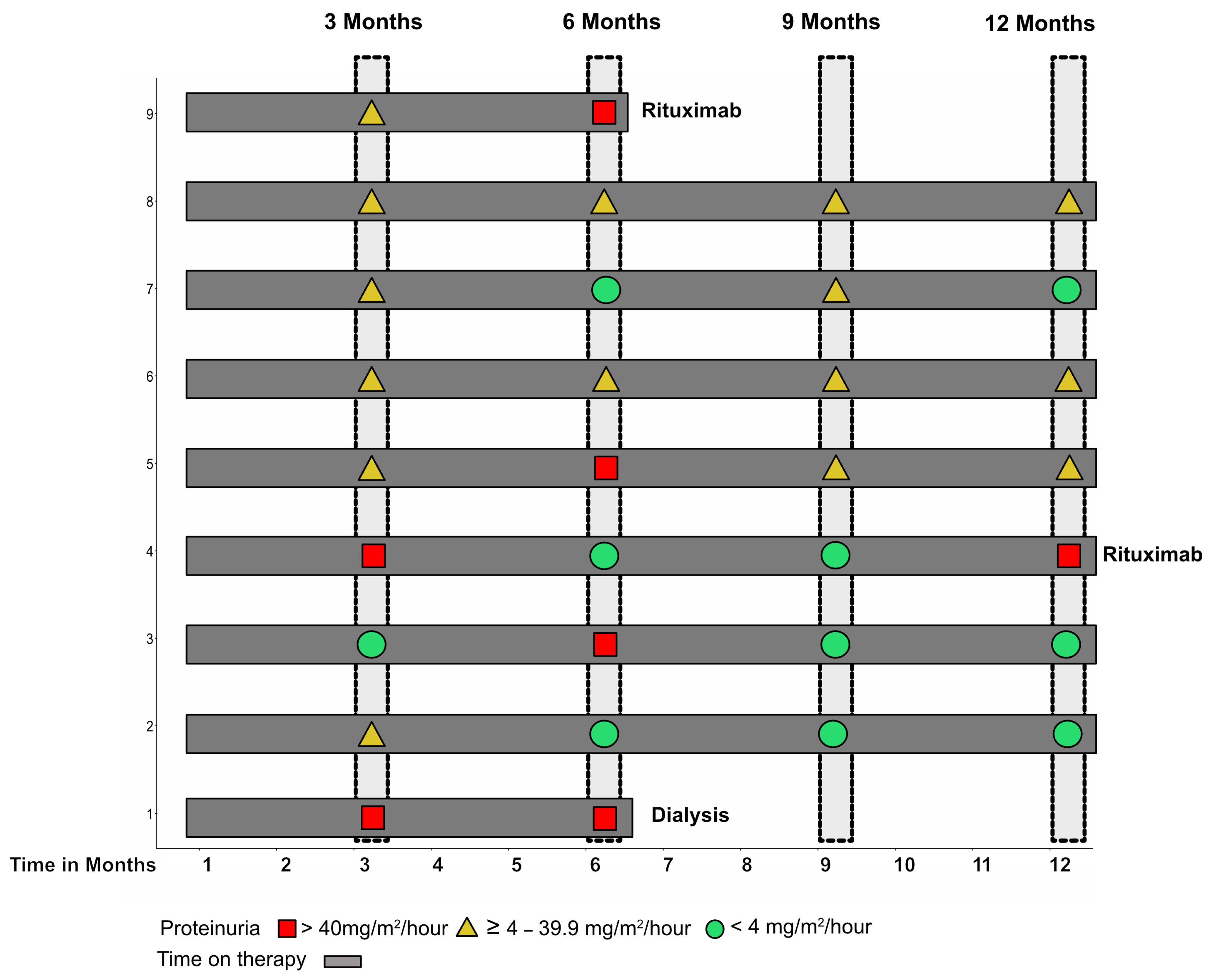
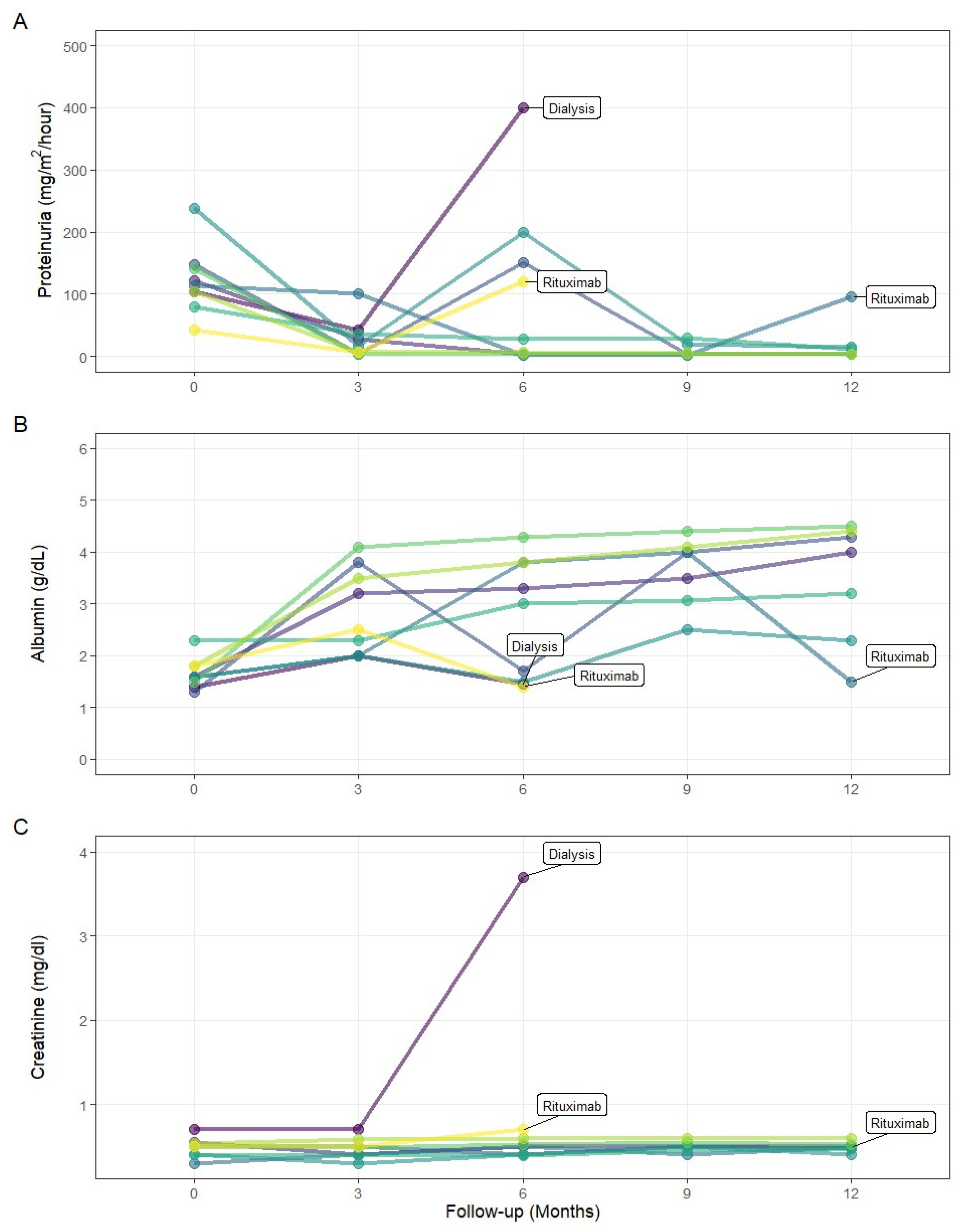
Two patients (4 and 9) did not have an adequate response to dual therapy. Two of these patients subsequently received two doses of rituximab (375 mg/m2 per dose), administered at months 6 (Patient 9) and 12 (Patient 4) after initiation of CyA and MMF therapy, respectively; this type of therapy induced remission and decreased the dose of prednisolone. The other patient progressed to end-stage renal disease, requiring dialysis therapy (Figure 1). Throughout the study period, three patients presented adverse effects, including gingival hyperplasia and obesity (n = 1), elevated transaminases (n = 1), and E. coli bacteremia (n = 1). One patient (11.1%) progressed to renal failure requiring renal replacement therapy 6 months after initiation of treatment. No other adverse events were observed during the 12-month follow-up. Other details of outcomes and treatments during MMF-Cya therapy are shown in Table 3. Figure 2 shows the longitudinal progression of proteinuria (mg/m2/h), serum albumin (g/dL), and serum creatinine (mg/dL) at baseline and at 3, 6, 9, and 12 months of follow-up.

4. Discussion

Nephrotic syndrome (NS) represents a heterogeneous histological manifestation of various pathological processes affecting the glomerulus. The clinical course and therapeutic response are dictated by a complex interplay between genetic susceptibility and environmental triggers, which influence the expression of permeability factors, podocyte cytoskeletal stability, and inflammatory cascades [9,10]. Previous studies reported that treatment based on CNIs induces complete remission in 30% of patients with SRNS and partial remission in 19%, while steroid pulses, cyclophosphamide, and MMF are ineffective in 80% of cases [3]. These findings underscore the need for alternative therapeutic strategies in patients who are refractory to second-line treatments or who develop significant treatment-related toxicity.
In this context, combination of immunosuppressive approaches using agents with complementary and non-overlapping mechanisms of action have been proposed as a potential strategy to improve disease control. In the present exploratory case series, we describe a case series of nine pediatric patients with SRNS or SDNS who were refractory to CyA monotherapy and were treated with a protocol combining CyA (4–5 mg/kg/day, target trough levels of 75–150 ng/mL) and MMF (600 mg/m2/day). This dual therapy was associated with reduced corticosteroid requirements and a lower annual relapse rate. These findings align with emerging evidence suggesting that the combination of a CNIs and an antimetabolite provides a more robust suppression of immune-mediated podocyte injury than either agent alone.
Similar favorable outcomes using comparable therapeutic protocols have been reported in previous studies. Data from the PodoNet registry showed complete and partial remission rates of 11.8% and 29.4%, respectively, in patients with SRNS and MRNS syndrome treated with combined MMF and CNIs [3]. Hibino et al. reported complete remission in 67% of patients with SRNS following the addition of MMF [11]; Moustafa et al. demonstrated an increase in CyA response from 60% to 80% after MMF add-on therapy in patients without at least partial remission after 12 weeks of CyA monotherapy [12]; and Moorani et al. reported complete and partial remission rates of 30% and 60%, respectively, in 20 patients with difficult-to-treat NS (corticosteroid-dependent, with frequent relapses, and corticosteroid-resistant) who received combination therapy with CyA and MMF [13]. Even in patients with SDNS with high-dose steroid requirements (defined as >1 mg/kg every other day), complete withdrawal of prednisolone is possible after the addition of MMF to the CyA protocol [11].
Beyond achieving remission, the “steroid-sparing” potential of the CyA-MMF combination represents a critical clinical milestone in pediatric nephrology. Chronic exposure to glucocorticoids in children is associated with severe morbidities, including growth retardation, osteoporosis, and metabolic dysfunction. Therefore, minimizing cumulative steroid exposure remains a central therapeutic objective in this population.
In our cohort, the addition of MMF was associated with a marked reduction in steroid dependence, thereby supporting its role as a steroid-sparing agent. These findings are consistent with previous reports by Hibino et al., who demonstrated that the combination of CyA and MMF was effective as a steroid-sparing strategy in children with refractory NS [11]. Collectively, these observations suggest that the combination of immunosuppressive regimens may offer dual benefits, enhancing disease control while reducing treatment-related toxicity.
Concerns regarding prolonged exposure to CNIs in pediatric patients are not minor. Chronic CyA use has been associated with progressive nephrotoxicity characterized by tubulointerstitial fibrosis, arteriolar hyalinosis, and decline in renal function, even in patients with initially preserved kidney function [14]. In contrast, mycophenolic acid derivates are generally considered to have a more favorable long-term toxicity profile compared with CNIs; however, chronic exposure has been associated with gastrointestinal symptoms, hematological abnormalities, increased susceptibility to infections, and well-established teratogenic effects following maternal exposure during pregnancy [15]. These considerations highlight the importance of individualized risk–benefit assessment and long-term safety monitoring and support consideration of protocol surveillance biopsies in selected patients when prolonged immunosuppressive therapy is required, especially when prolonged use of CNIs is necessary.
Other alternatives with multiple combined therapy regimens have been used in patients with resistance, intolerance, or nephrotoxicity with the use of CyA. The effects of adding mizoribine to CNIs regimens have been studied, and a decrease in relapse rate and in the minimum steroid dose required to maintain remission has been reported [16]. Recently, a systematic review was published about the efficacy and safety of therapies for pediatric SRNS, concluding that combination of tacrolimus with an antimetabolite enables better short- and long-term remission rates to be achieved compared to steroid plus one immunosuppressant agent [17].
Other alternatives used in patients with SRNS who fail to achieve remission with rituximab has been associated with complete remission in approximately 30% of patients with MRNS, although it has not shown superiority over plasma exchange-based therapies. Alternative approaches, including ofatumumab and other experimental pharmacological or extracorporeal treatments, have demonstrated variable efficacy in small pediatric series, underscoring the need for further investigation in clinical trials [2].

5. Limitations

Our study has several limitations. First, the small sample size and absence of a control group limit causal inference and the generalizability of our results. While each patient served as their own historical control, allowing for longitudinal assessment of individual treatment response, the non-randomized and non-blinded design cannot account for the natural history of the disease or potential confounding variables. Consequently, we could not directly evaluate this combination therapy against standard-of-care therapies. Second, the heterogeneity of the cohort, which included both steroid-dependent and steroid-resistant forms, further complicates the interpretation of treatment response. Third, the relatively short follow-up period does not allow a long-term efficacy evaluation and potential side effects like calcineurin inhibitor-related nephrotoxicity. Finally, the lack of systematic assessment of immunological markers, such as serum IgG levels, prevents a detailed analysis of the underlying immunomodulatory effects. Accordingly, this is an exploratory study, and these findings and necessitate validation through future randomized controlled trials.

6. Conclusions

This exploratory case series suggests that the addition of MMF to cyclosporine may be associated with improved disease control and reduced corticosteroid exposure in selected pediatric patients with refractory nephrotic syndrome. However, given the small sample size, heterogeneous population, absence of a control group, and limited follow-up, these findings should be interpreted with caution. Further prospective controlled studies with larger cohorts and longer follow-up are required to better define the efficacy, safety, and optimal positioning of this therapeutic strategy.

Author Contributions

All authors contributed to the study conception and design. Material preparation and data collection was performed by L.F.R.-R., N.O., M.N., M.Á.R., R.B.-R. and M.E. Data analysis was performed by E.V.-A., M.C.I.-L., L.F.R.-R. and L.M.S.-H. Literature research was performed by M.C.I.-L., E.V.-A., L.F.R.-R., C.L.O.-G. and L.M.S.-H. The first draft of the manuscript was written by L.F.R.-R., C.L.O.-G., M.C.I.-L. and L.M.S.-H. All authors contributed to manuscript revision for important intellectual content. All authors have read and agreed to the published version of the manuscript.

Funding

This research received no specific grant from any funding agency in the public, commercial, or not-for-profit sectors.

Institutional Review Board Statement

The study protocol was reviewed and approved by the ethical committee of the Hospital General (Medellín, Colombia, approval number 07_04062024, date 4 June 2024.

Informed Consent Statement

Informed consent was obtained from all subjects involved in the study.

Data Availability Statement

All data generated or analyzed during this study are included in this article. Further enquiries can be directed to the corresponding author.

Conflicts of Interest

The authors declare that they have no conflicts of interest.

References

  1. Floege, J.; Gibson, K.L.; Vivarelli, M.; Liew, A.; Radhakrishnan, J.; Rovin, B.H. KDIGO 2025 Clinical Practice Guideline for the Management of Nephrotic Syndrome in Children. Kidney Int. 2025, 107, S241–S289. [Google Scholar] [CrossRef] [PubMed]
  2. Trautmann, A.; Vivarelli, M.; Samuel, S.; Gipson, D.; Sinha, A.; Schaefer, F.; Hui, N.K.; Boyer, O.; Saleem, M.A.; Feltran, L.; et al. IPNA clinical practice recommendations for the diagnosis and management of children with steroid-resistant nephrotic syndrome. Pediatr. Nephrol. 2020, 35, 1529–1561. [Google Scholar] [CrossRef] [PubMed]
  3. Trautmann, A.; Schnaidt, S.; Lipska-Zietkiewicz, B.S.; Bodria, M.; Ozaltin, F.; Emma, F.; Anarat, A.; Melk, A.; Azocar, M.; Oh, J.; et al. Long-Term Outcome of Steroid-Resistant Nephrotic Syndrome in Children. J. Am. Soc. Nephrol. 2017, 28, 3055–3065. [Google Scholar] [CrossRef] [PubMed]
  4. Mishra, O.P.; Sidar, M.; Batra, V.V.; Prasad, R.; Singh, A.; Abhinay, A.; Mishra, A.; Yadav, A.K. Outcomes of children with idiopathic steroid resistant nephrotic syndrome: A single centre observational study. J. Bras. Nefrol. 2023, 45, 199–209. [Google Scholar] [CrossRef] [PubMed]
  5. Takemasa, Y.; Fujinaga, S.; Nakagawa, M.; Sakuraya, K.; Hirano, D. Adult survivors of childhood-onset steroid-dependent and steroid-resistant nephrotic syndrome treated with cyclosporine: A long-term single-center experience. Pediatr. Nephrol. 2024, 39, 473–482. [Google Scholar] [CrossRef] [PubMed]
  6. Hamasaki, Y.; Yoshikawa, N.; Hattori, S.; Sasaki, S.; Iijima, K.; Nakanishi, K.; Matsuyama, T.; Ishikura, K.; Yata, N.; Kaneko, T.; et al. Cyclosporine and steroid therapy in children with steroid-resistant nephrotic syndrome. Pediatr. Nephrol. 2009, 24, 2177–2185. [Google Scholar] [CrossRef] [PubMed]
  7. Iijima, K.; Sako, M.; Oba, M.; Tanaka, S.; Hamada, R.; Sakai, T.; Ohwada, Y.; Ninchoji, T.; Yamamura, T.; Machida, H.; et al. Mycophenolate Mofetil after Rituximab for Childhood-Onset Complicated Frequently-Relapsing or Steroid-Dependent Nephrotic Syndrome. J. Am. Soc. Nephrol. 2022, 33, 401–419. [Google Scholar] [CrossRef] [PubMed]
  8. Trautmann, A.; Boyer, O.; Hodson, E.; Bagga, A.; Gipson, D.S.; Samuel, S.; Wetzels, J.; Alhasan, K.; Banerjee, S.; Bhimma, R.; et al. IPNA clinical practice recommendations for the diagnosis and management of children with steroid-sensitive nephrotic syndrome. Pediatr. Nephrol. 2023, 38, 877–919. [Google Scholar] [CrossRef] [PubMed]
  9. Hackl, A.; Zed, S.; Diefenhardt, P.; Binz-Lotter, J.; Ehren, R.; Weber, L.T. The role of the immune system in idiopathic nephrotic syndrome. Mol. Cell. Pediatr. 2021, 8, 18. [Google Scholar] [CrossRef] [PubMed]
  10. Noone, D.G.; Iijima, K.; Parekh, R. Idiopathic nephrotic syndrome in children. Lancet 2018, 392, 61–74. [Google Scholar] [CrossRef] [PubMed]
  11. Hibino, S.; Uemura, O.; Nagai, T.; Yamakawa, S.; Iwata, N.; Ito, H.; Nakano, M.; Tanaka, K. Three year outcome of childhood idiopathic nephrotic syndrome under a unified immunosuppressive protocol. Pediatr. Int. 2015, 57, 85–91. [Google Scholar] [CrossRef] [PubMed]
  12. Moustafa, B.H.; Tolba, O.A. Immunosuppressive therapy in children with steroid-resistant, frequently-relapsing, and steroid-dependent idiopathic nephrotic syndrome: A single center experience. Electron. Physician 2016, 8, 2039–2047. [Google Scholar] [PubMed]
  13. Moorani, K.N.; Hotchandani, H.M.; Zubair, A.M.; Lohana, N.C.; Veerwani, N.R. Immunosuppressive therapy in children with primary nephrotic syndrome: Single center experience, Karachi, Pakistan. BMC Nephrol. 2019, 20, 239. [Google Scholar] [CrossRef] [PubMed]
  14. Yu, J.; Wei, X.; Gao, J.; Wang, C.; Wei, W. Role of cyclosporin A in the treatment of kidney disease and nephrotoxicity. Toxicology 2023, 492, 153544. [Google Scholar] [CrossRef] [PubMed]
  15. Rostas, S.; Kim, M.; Gabardi, S. Risk evaluation and mitigation strategies: A focus on the mycophenolic acid preparations. Prog. Transplant. 2014, 24, 33–36. [Google Scholar] [CrossRef] [PubMed]
  16. Aizawa-Yashiro, T.; Tsuruga, K.; Watanabe, S.; Oki, E.; Ito, E.; Tanaka, H. Novel multidrug therapy for children with cyclosporine-resistant or -intolerant nephrotic syndrome. Pediatr. Nephrol. 2011, 26, 1255–1261. [Google Scholar] [CrossRef] [PubMed]
  17. de Sousa, B.; Torres Ribeiro, J.; Azevedo, C.; Sousa, P.; Tavares, C. Efficacy and Safety of Therapies for Pediatric Steroid-Resistant Idiopathic Nephrotic Syndrome: A Systematic Review of the Last Decade. Cureus 2026, 18, e101030. [Google Scholar] [CrossRef] [PubMed]
Figure 1. Follow-up of patients.
Ijtm 06 00024 g001
Figure 2. Longitudinal monitoring of proteinuria, serum albumin, and renal function over a 12-month follow-up period. Each color line represents a different patient. (A) Proteinuria measured in mg/m2/h. (B) Serum Albumin levels in g/dL. (C) Serum creatinine levels measured in mg/dL.
Ijtm 06 00024 g002
Table 1. Definitions used for patients with NS.
TermDefinition [1,8]
Nephrotic-range proteinuriaUrinary protein creatinine ratio (uPCR) ≥ 200 mg/mmol (2 mg/mg) in a spot urine sample, or proteinuria ≥ 40 mg/m2/h in a 24 h urine sample corresponding to 3 + (300–1000 mg/dL) or 4 + (>1000 mg/dL) by urine dipstick
Complete remissionUPCR ≤ 20 mg/mmol (0.2 mg/mg) in a spot urine sample, or proteinuria ≤ 4 mg/m2/h in a 24 h urine sample or negative or trace dipstick on three or more consecutive days
Partial remissionUPCR > 20 mg/mmol but <200 mg/mmol (>0.2 mg/mg but <2 mg/mg) in a spot urine sample, or proteinuria ≥ 4 mg/m2/h but <40 mg/m2/h in a 24 h urine sample and serum albumin ≥ 30 g/L
RelapseUrine dipstick ≥ 3 + (≥300 mg/dL) or UPCR ≥ 200 mg/mmol (≥2 mg/mg) in a spot urine sample on 3 consecutive days, with or without reappearance of edema in a child who had previously achieved complete remission
Table 2. Demographic characteristics of patients before dual therapy.
IDAge *Age at Dual TherapyGenderBiopsy FindingClassificationGenetic AnalysisPrevious
Therapy
Last
Therapy &
Urine Protein (mg/m2/h)Serum Creatinine Values (mg/dL)Serum Albumin (g/dL)
924MaleMCDSDNSNegativeCP, CyACyA420.501.8
825MaleFSGSSRNSNegativeCyA, MMFCyA1040.541.8
725MaleMCDSDNSNegativeCP, CyA, MMFMMF1410.501.5
659MaleFSGSSRNSNegativeCyA, MMFCyA790.402.3
518MaleMCDSRNSNegativeCyA, MMFMMF2380.401.6
4413MaleMCDSDNSNot performedCP, CyA, MMF, TacTac1140.301.6
337MaleMCDSRNSNegativeCyA, MMFCyA1480.501.3
21314FemaleFSGSSRNSNegativeCyA, MMFCyA1220.551.6
1215MaleFSGSSRNSNot performedCP, CyA, MMF, Tac, and gamma globulinMMF1040.701.4
MCD: minimal change disease; FSGS: focal and segmental glomerulosclerosis; CP: cyclophosphamide; CyA: cyclosporine; Tac: tacrolimus; MMF: mycophenolate mofetil;. SDNS: steroid-dependent nephrotic syndrome; SRNS: steroid-resistant nephrotic syndrome; * age at diagnosis of NS; & most recent immunosuppressive therapy prior to dual therapy.
Table 3. Response to MMF and CyA therapy.
Relapses per YearMinimum Steroid Dose Received (mg/Day)
IDCyA DosesMMF DosesTime First RelapseBefore Dual TherapyAfter Dual TherapyBefore Dual TherapyAfter Dual TherapyOther TherapyAdverse Effects
950 mg/12 h500 mg/12 h1423030Losartan, RituximabNone
850 mg/12 h500 mg/12 hNo relapse3000 None
750 mg/12 h500 mg/12 h241300 Gingival hyperplasia, obesity
650 mg/12 h500 mg/12 hNo relapse40205 Elevated transaminases
575 mg/12 h500 mg/12 h61150Enalapril, enoxaparin, atorvastatinE. coli bacteremia
4100 mg/12 h500 mg/12 h2421040RituximabNone
3100 mg/12 h500 mg/12 h441100LosartanNone
2100 mg/12 h500 mg/12 hNo relapse30350LosartanNone
150 mg/12 h500 mg/12 h662105Losartan, atorvastatinRenal failure
Disclaimer/Publisher’s Note: The statements, opinions and data contained in all publications are solely those of the individual author(s) and contributor(s) and not of MDPI and/or the editor(s). MDPI and/or the editor(s) disclaim responsibility for any injury to people or property resulting from any ideas, methods, instructions or products referred to in the content.