
Complement C5 Inhibition and Short-Term Cardiovascular Outcomes After Acute Limb Ischemia: A Real-World Cohort Study


Abstract
1. Introduction
2. Materials and Methods
2.1. Study Design
2.2. Cohorts
2.3. Outcomes
2.4. Ethical Statement
2.5. Statistical Analysis
3. Results
3.1. Propensity Score Matching
3.2. Risk-Based Analyses
3.3. Time-to-Event Analyses
4. Discussion
5. Conclusions
Supplementary Materials
Author Contributions
Funding
Institutional Review Board Statement
Informed Consent Statement
Data Availability Statement
Conflicts of Interest
Abbreviations
| aHUS | atypical hemolytic uremic syndrome |
| AKI | Acute kidney injury |
| ALI | acute limb ischemia |
| CI | confidence interval |
| C5aR1 | complement component 5a receptor 1 |
| DOAC | direct oral anticoagulant |
| ECU | eculizumab |
| HIPAA | Health Insurance Portability and Accountability Act |
| HR | hazard ratio |
| ICD | International Classification of Diseases |
| MACE | major adverse cardiovascular events |
| MG | myasthenia gravis |
| NMOSD | neuromyelitis optica spectrum disorder |
| OR | odds ratio |
| PNH | paroxysmal nocturnal hemoglobinuria |
| PSM | propensity score matching |
| RAVU | ravulizumab |
| RD | risk difference |
| RR | risk ratio |
| SD | standard deviation |
| SNOMED | Systematized Nomenclature of Medicine Clinical Terms |
| STROBE | Strengthening the Reporting of Observational Studies in Epidemiology |
| TriNetX | TriNetX Analytics Network |
References
- Costa, D.; Ielapi, N.; Perri, P.; Minici, R.; Faga, T.; Michael, A.; Bracale, U.M.; Andreucci, M.; Serra, R. Molecular Insight into Acute Limb Ischemia. Biomolecules 2024, 14, 838. [Google Scholar] [CrossRef] [Scilit]
- Normahani, P.; Khosravi, S.; Sounderajah, V.; Aslam, M.; Standfield, N.J.; Jaffer, U. The Effect of Lower Limb Revascularization on Flow, Perfusion, and Systemic Endothelial Function: A Systematic Review. Angiology 2021, 72, 210–220. [Google Scholar] [CrossRef] [Scilit]
- Bavia, L.; Lidani, K.C.F.; Andrade, F.A.; Sobrinho, M.I.A.H.; Nisihara, R.M.; de Messias-Reason, I.J. Complement Activation in Acute Myocardial Infarction: An Early Marker of Inflammation and Tissue Injury? Immunol. Lett. 2018, 200, 18–25. [Google Scholar] [CrossRef] [Scilit]
- Vakeva, A.P.; Agah, A.; Rollins, S.A.; Matis, L.A.; Li, L.; Stahl, G.L. Myocardial Infarction and Apoptosis after Myocardial Ischemia and Reperfusion: Role of the Terminal Complement Components and Inhibition by Anti-C5 Therapy. Circulation 1998, 97, 2259–2267. [Google Scholar] [CrossRef] [Scilit] [PubMed]
- Vogel, C.-W. The Role of Complement in Myocardial Infarction Reperfusion Injury: An Underappreciated Therapeutic Target. Front. Cell Dev. Biol. 2020, 8, 606407. [Google Scholar] [CrossRef] [Scilit] [PubMed]
- Arumugam, T.V.; Magnus, T.; Woodruff, T.M.; Proctor, L.M.; Shiels, I.A.; Taylor, S.M. Complement Mediators in Ischemia-Reperfusion Injury. Clin. Chim. Acta 2006, 374, 33–45. [Google Scholar] [CrossRef] [Scilit]
- Vahldieck, C.; Fels, B.; Löning, S.; Nickel, L.; Weil, J.; Kusche-Vihrog, K. Prolonged Door-to-Balloon Time Leads to Endothelial Glycocalyx Damage and Endothelial Dysfunction in Patients with ST-Elevation Myocardial Infarction. Biomedicines 2023, 11, 2924. [Google Scholar] [CrossRef] [Scilit] [PubMed]
- Vahldieck, C.; Löning, S.; Hamacher, C.; Fels, B.; Rudzewski, B.; Nickel, L.; Weil, J.; Nording, H.; Baron, L.; Kleingarn, M.; et al. Dysregulated Complement Activation during Acute Myocardial Infarction Leads to Endothelial Glycocalyx Degradation and Endothelial Dysfunction via the C5a:C5a-Receptor1 Axis. Front. Immunol. 2024, 15, 1426526. [Google Scholar] [CrossRef] [Scilit]
- Foreman, K.E.; Vaporciyan, A.A.; Bonish, B.K.; Jones, M.L.; Johnson, K.J.; Glovsky, M.M.; Eddy, S.M.; Ward, P.A. C5a-Induced Expression of P-Selectin in Endothelial Cells. J. Clin. Investig. 1994, 94, 1147–1155. [Google Scholar] [CrossRef] [Scilit]
- Shivshankar, P.; Li, Y.-D.; Mueller-Ortiz, S.L.; Wetsel, R.A. In Response to Complement Anaphylatoxin Peptides C3a and C5a, Human Vascular Endothelial Cells Migrate and Mediate the Activation of B-Cells and Polarization of T-Cells. FASEB J. 2020, 34, 7540–7560. [Google Scholar] [CrossRef] [Scilit]
- Bongoni, A.K.; Lu, B.; McRae, J.L.; Salvaris, E.J.; Toonen, E.J.M.; Vikstrom, I.; Baz Morelli, A.; Pearse, M.J.; Cowan, P.J. Complement-Mediated Damage to the Glycocalyx Plays a Role in Renal Ischemia-Reperfusion Injury in Mice. Transplant. Direct 2019, 5, e341. [Google Scholar] [CrossRef] [Scilit]
- Brodsky, R.A. Paroxysmal Nocturnal Hemoglobinuria. Blood 2014, 124, 2804–2811. [Google Scholar] [CrossRef] [Scilit]
- Keating, G.M. Eculizumab: A Review of Its Use in Atypical Haemolytic Uraemic Syndrome. Drugs 2013, 73, 2053–2066. [Google Scholar] [CrossRef] [Scilit]
- Narayanaswami, P.; Sanders, D.B.; Wolfe, G.; Benatar, M.; Cea, G.; Evoli, A.; Gilhus, N.E.; Illa, I.; Kuntz, N.L.; Massey, J.; et al. International Consensus Guidance for Management of Myasthenia Gravis: 2020 Update. Neurology 2021, 96, 114–122. [Google Scholar] [CrossRef] [Scilit]
- McKeage, K. Ravulizumab: First Global Approval. Drugs 2019, 79, 347–352. [Google Scholar] [CrossRef] [Scilit]
- Kümpfel, T.; Giglhuber, K.; Aktas, O.; Ayzenberg, I.; Bellmann-Strobl, J.; Häußler, V.; Havla, J.; Hellwig, K.; Hümmert, M.W.; Jarius, S.; et al. Update on the Diagnosis and Treatment of Neuromyelitis Optica Spectrum Disorders (NMOSD)—Revised Recommendations of the Neuromyelitis Optica Study Group (NEMOS). Part II: Attack Therapy and Long-Term Management. J. Neurol. 2024, 271, 141–176, Correction in J. Neurol. 2024, 271, 3702–3707. [Google Scholar] [CrossRef] [Scilit] [PubMed]
- Gavriilaki, E.; de Latour, R.P.; Risitano, A.M. Advancing Therapeutic Complement Inhibition in Hematologic Diseases: PNH and Beyond. Blood 2022, 139, 3571–3582. [Google Scholar] [CrossRef] [Scilit] [PubMed]
- Gaeckler, A.; Al-Dakkak, I.; Saval, N.; Dieperink, H.H.; Eygenraam, M.; Greenbaum, L.A.; Isbel, N.; Walle, J.V. Effectiveness and Safety of Switching to Ravulizumab from Eculizumab in Kidney Transplant Recipients with Atypical Hemolytic Uremic Syndrome: A Global aHUS Registry Analysis. Clin. Transpl. 2025, 39, e70278. [Google Scholar] [CrossRef] [Scilit]
- Vahldieck, C. Complement C5 Inhibition with Eculizumab or Ravulizumab Is Associated with Increased Cardiovascular and Thromboembolic Risk after ST-Elevation Myocardial Infarction: A Propensity-Matched Global Retrospective Cohort Study. BMC Cardiovasc. Disord. 2026, 26, 298. [Google Scholar] [CrossRef] [Scilit] [PubMed]
- Frączek, A.; Owczarczyk-Saczonek, A.; Ludwig, R.J.; Hernandez, G.; Ständer, S.; Thaci, D.; Zirpel, H. Vitiligo Is Associated with an Increased Risk of Cardiovascular Diseases: A Large-Scale, Propensity-Matched, US-Based Retrospective Study. eBioMedicine 2024, 109, 105423. [Google Scholar] [CrossRef] [Scilit]
- Abassi, Z.; Armaly, Z.; Heyman, S.N. Glycocalyx Degradation in Ischemia-Reperfusion Injury. Am. J. Pathol. 2020, 190, 752–767. [Google Scholar] [CrossRef] [Scilit]
- Gorsuch, W.B.; Chrysanthou, E.; Schwaeble, W.J.; Stahl, G.L. The Complement System in Ischemia-Reperfusion Injuries. Immunobiology 2012, 217, 1026–1033. [Google Scholar] [CrossRef] [Scilit]
- Ghosh, M.; Rana, S. The Anaphylatoxin C5a: Structure, Function, Signaling, Physiology, Disease, and Therapeutics. Int. Immunopharmacol. 2023, 118, 110081, Correction in Int. Immunopharmacol. 2023, 125, 111089. [Google Scholar] [CrossRef] [Scilit]
- Farrar, C.A.; Asgari, E.; Schwaeble, W.J.; Sacks, S. Which Pathways Trigger the Role of Complement in Ischaemia/Reperfusion Injury? Front. Immunol. 2012, 3, 341. [Google Scholar] [CrossRef] [Scilit]
- Karakasis, P.; Stachteas, P.; Iliakis, P.; Sidiropoulos, G.; Grigoriou, K.; Patoulias, D.; Antoniadis, A.P.; Fragakis, N. Inflammation and Resolution in Obesity-Related Cardiovascular Disease. Int. J. Mol. Sci. 2026, 27, 535. [Google Scholar] [CrossRef] [Scilit] [PubMed]
- Brocklebank, V.; Wood, K.M.; Kavanagh, D. Thrombotic Microangiopathy and the Kidney. Clin. J. Am. Soc. Nephrol. 2018, 13, 300–317. [Google Scholar] [CrossRef] [Scilit] [PubMed]
- Fakhouri, F.; Frémeaux-Bacchi, V. Thrombotic Microangiopathy in aHUS and beyond: Clinical Clues from Complement Genetics. Nat. Rev. Nephrol. 2021, 17, 543–553. [Google Scholar] [CrossRef] [Scilit]
- Noris, M.; Remuzzi, G. Atypical Hemolytic-Uremic Syndrome. N. Engl. J. Med. 2009, 361, 1676–1687. [Google Scholar] [CrossRef] [Scilit]
- Wijnsma, K.L.; ter Heine, R.; Moes, D.J.A.R.; Langemeijer, S.; Schols, S.E.M.; Volokhina, E.B.; van den Heuvel, L.P.; Wetzels, J.F.M.; van de Kar, N.C.A.J.; Brüggemann, R.J. Pharmacology, Pharmacokinetics and Pharmacodynamics of Eculizumab, and Possibilities for an Individualized Approach to Eculizumab. Clin. Pharmacokinet. 2019, 58, 859–874. [Google Scholar] [CrossRef] [Scilit]
- Peffault de Latour, R.; Brodsky, R.A.; Ortiz, S.; Risitano, A.M.; Jang, J.H.; Hillmen, P.; Kulagin, A.D.; Kulasekararaj, A.G.; Rottinghaus, S.T.; Aguzzi, R.; et al. Pharmacokinetic and Pharmacodynamic Effects of Ravulizumab and Eculizumab on Complement Component 5 in Adults with Paroxysmal Nocturnal Haemoglobinuria: Results of Two Phase 3 Randomised, Multicentre Studies. Br. J. Haematol. 2020, 191, 476–485. [Google Scholar] [CrossRef] [Scilit]
- Kulasekararaj, A.; Brodsky, R.; Schrezenmeier, H.; Griffin, M.; Röth, A.; Piatek, C.; Ogawa, M.; Yu, J.; Patel, A.S.; Patel, Y.; et al. Ravulizumab Demonstrates Long-Term Efficacy, Safety and Favorable Patient Survival in Patients with Paroxysmal Nocturnal Hemoglobinuria. Ann. Hematol. 2025, 104, 81–94. [Google Scholar] [CrossRef] [Scilit]
- Padilla Kelley, T.; King, H.; Malhotra, A.; DeLoughery, T.G.; Martens, K.; Shatzel, J.J. Advancements in Complement Inhibition for PNH and Primary Complement-Mediated Thrombotic Microangiopathy. Blood Adv. 2025, 9, 3937–3945. [Google Scholar] [CrossRef] [Scilit]
- Rutherford, R.B.; Baker, J.D.; Ernst, C.; Johnston, K.W.; Porter, J.M.; Ahn, S.; Jones, D.N. Recommended Standards for Reports Dealing with Lower Extremity Ischemia: Revised Version. J. Vasc. Surg. 1997, 26, 517–538. [Google Scholar] [CrossRef] [Scilit]


| Characteristic | Before PSM C5 Inhibition (N = 115) | Before PSM Control (N = 881) | p-Value | SD | After PSM C5 Inhibition (N = 112) | After PSM Control (N = 112) | p-Value | SD |
|---|---|---|---|---|---|---|---|---|
| Demographics | ||||||||
| Age at index | 48.7 (18.8) | 61.7 (16.5) | <0.001 | 0.7326 | 49.2 (18.7) | 48.4 (18.8) | 0.7517 | 0.0423 |
| Female sex | 70 (60.9%) | 462 (52.4%) | 0.0883 | 0.1707 | 69 (61.6%) | 69 (61.6%) | 1.0000 | <0.001 |
| Predominant ethnicity | 84 (73.0%) | 619 (70.3%) | 0.5380 | 0.0618 | 81 (72.3%) | 81 (72.3%) | 1.0000 | <0.001 |
| Comorbidities | ||||||||
| Hypertension | 67 (58.3%) | 525 (59.6%) | 0.7846 | 0.0270 | 65 (58.0%) | 62 (55.4%) | 0.6858 | 0.0541 |
| Chronic kidney disease | 58 (50.4%) | 240 (27.2%) | <0.001 | 0.4899 | 55 (49.1%) | 50 (44.6%) | 0.5032 | 0.0896 |
| Ischemic heart disease | 40 (34.8%) | 312 (35.4%) | 0.8940 | 0.0132 | 39 (34.8%) | 41 (36.6%) | 0.7803 | 0.0373 |
| Diabetes mellitus | 28 (24.3%) | 289 (32.8%) | 0.0671 | 0.1880 | 27 (24.1%) | 30 (26.8%) | 0.6454 | 0.0615 |
| Overweight/obesity | 27 (23.5%) | 200 (22.7%) | 0.8518 | 0.0184 | 26 (23.2%) | 17 (15.2%) | 0.1268 | 0.2051 |
| Smoking history | 20 (17.4%) | 156 (17.7%) | 0.9334 | 0.0083 | 18 (16.1%) | 15 (13.4%) | 0.5717 | 0.0756 |
| Active Nicotine dependence | 15 (13.0%) | 128 (14.5%) | 0.6692 | 0.0431 | 14 (12.5%) | 14 (12.5%) | 1.0000 | <0.001 |
| Complement-associated diseases | ||||||||
| Hemolytic-uremic syndrome | 21 (18.3%) | 44 (5.0%) | <0.001 | 0.4230 | 20 (17.9%) | 16 (14.3%) | 0.4668 | 0.0974 |
| Myasthenia gravis | 11 (9.6%) | 302 (34.3%) | <0.001 | 0.6259 | 11 (9.8%) | 10 (8.9%) | 0.8187 | 0.0306 |
| Paroxysmal nocturnal hemoglobinuria | 10 (8.7%) | 29 (3.3%) | 0.0050 | 0.2291 | 10 (8.9%) | 10 (8.9%) | 1.0000 | <0.001 |
| Neuromyelitis optica | 10 (8.7%) | 30 (3.4%) | 0.0066 | 0.2233 | 10 (8.9%) | 10 (8.9%) | 1.0000 | <0.001 |
| Medication | ||||||||
| Heparin | 76 (66.1%) | 386 (43.8%) | <0.001 | 0.4593 | 72 (64.9%) | 71 (64.0%) | 0.8885 | 0.0188 |
| Enoxaparin | 46 (40.0%) | 225 (25.5%) | 0.0010 | 0.3118 | 43 (38.7%) | 44 (39.6%) | 0.8906 | 0.0185 |
| Apixaban | 18 (15.7%) | 105 (11.9%) | 0.2524 | 0.1085 | 17 (15.3%) | 13 (11.7%) | 0.4323 | 0.1056 |
| Rivaroxaban | 10 (8.7%) | 53 (6.0%) | 0.2669 | 0.1028 | 10 (9.0%) | 10 (9.0%) | 1.0000 | <0.001 |
| Dalteparin | 0 (0%) | 10 (1.1%) | 0.2508 | 0.1515 | 0 (0%) | 0 (0%) | - | - |
| Phenprocoumon | 0 (0%) | 10 (1.1%) | 0.2508 | 0.1515 | 0 (0%) | 0 (0%) | - | - |
| Edoxaban | 0 (0%) | 10 (1.1%) | 0.2508 | 0.1515 | 0 (0%) | 10 (9.0%) | 0.0012 | 0.4450 |
| Outcome | C5 Inhibition (N = 112) n (%) | Control (N = 112) n (%) | Risk Ratio (95% CI) | p-Value |
|---|---|---|---|---|
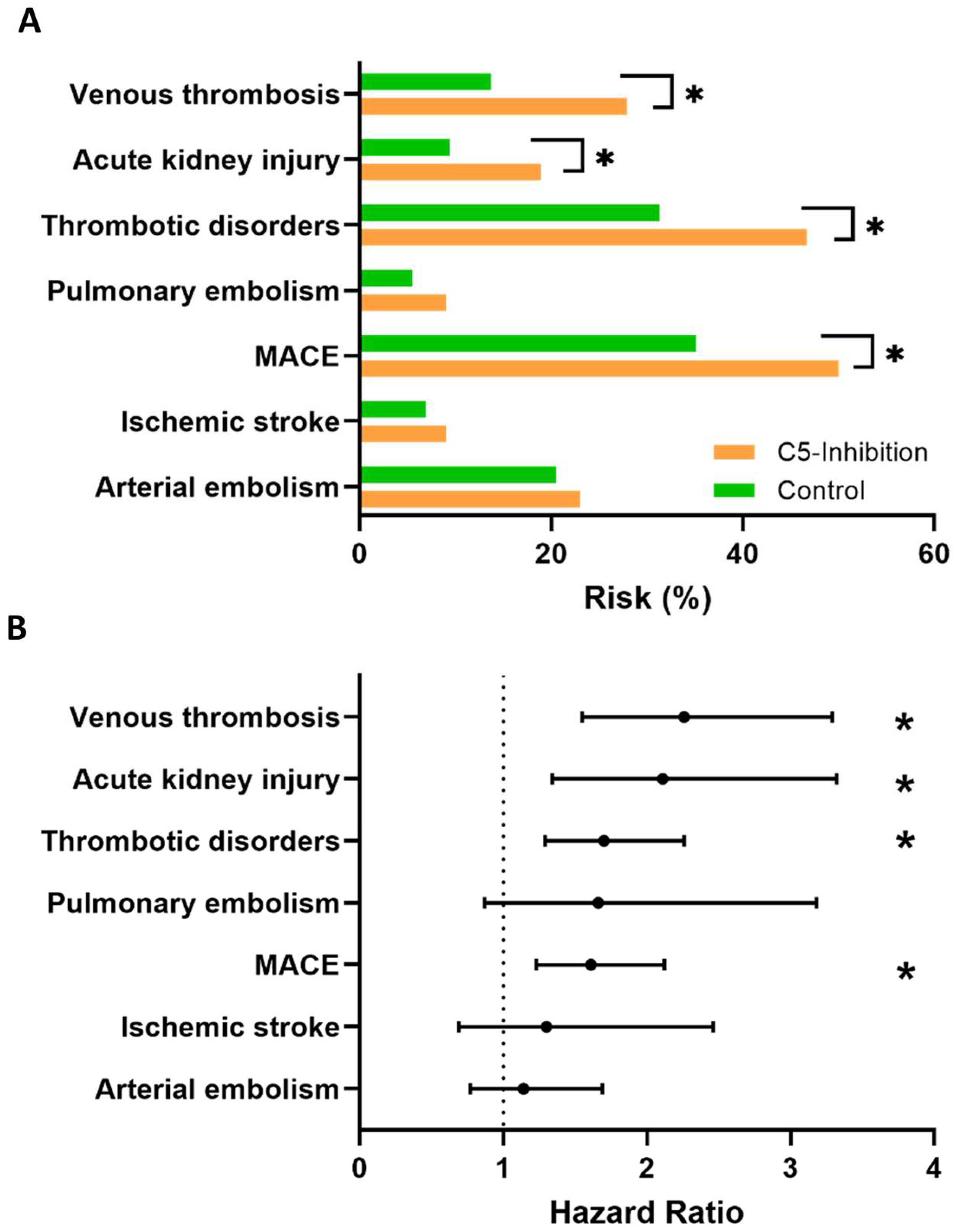
| Acute kidney injury | 23 (18.9%) | 11 (9.4%) | 1.999 (1.321–3.026) | 0.001 |
| Arterial embolism | 28 (23.0%) | 23 (20.5%) | 1.118 (0.790–1.581) | 0.534 |
| Ischemic stroke | 11 (9.0%) | 8 (6.9%) | 1.311 (0.714–2.407) | 0.385 |
| MACE | 61 (50.0%) | 39 (35.1%) | 1.426 (1.172–1.735) | 0.001 |
| Pulmonary embolism | 11 (9.0%) | 6 (5.5%) | 1.639 (0.883–3.042) | 0.119 |
| Thrombotic disorders | 57 (46.7%) | 35 (31.3%) | 1.491 (1.208–1.840) | 0.001 |
| Venous thrombosis | 34 (27.9%) | 15 (13.7%) | 2.041 (1.475–2.824) | <0.001 |
| Outcome | C5-Inhibition (N = 112) | Control (N = 112) | χ2 (Log-Rank) | p-Value | Hazard Ratio | HR 95% CI | χ2 | p-Value | ||
|---|---|---|---|---|---|---|---|---|---|---|
| N of outcomes | Survival (%) | N of outcomes | Survival (%) | |||||||
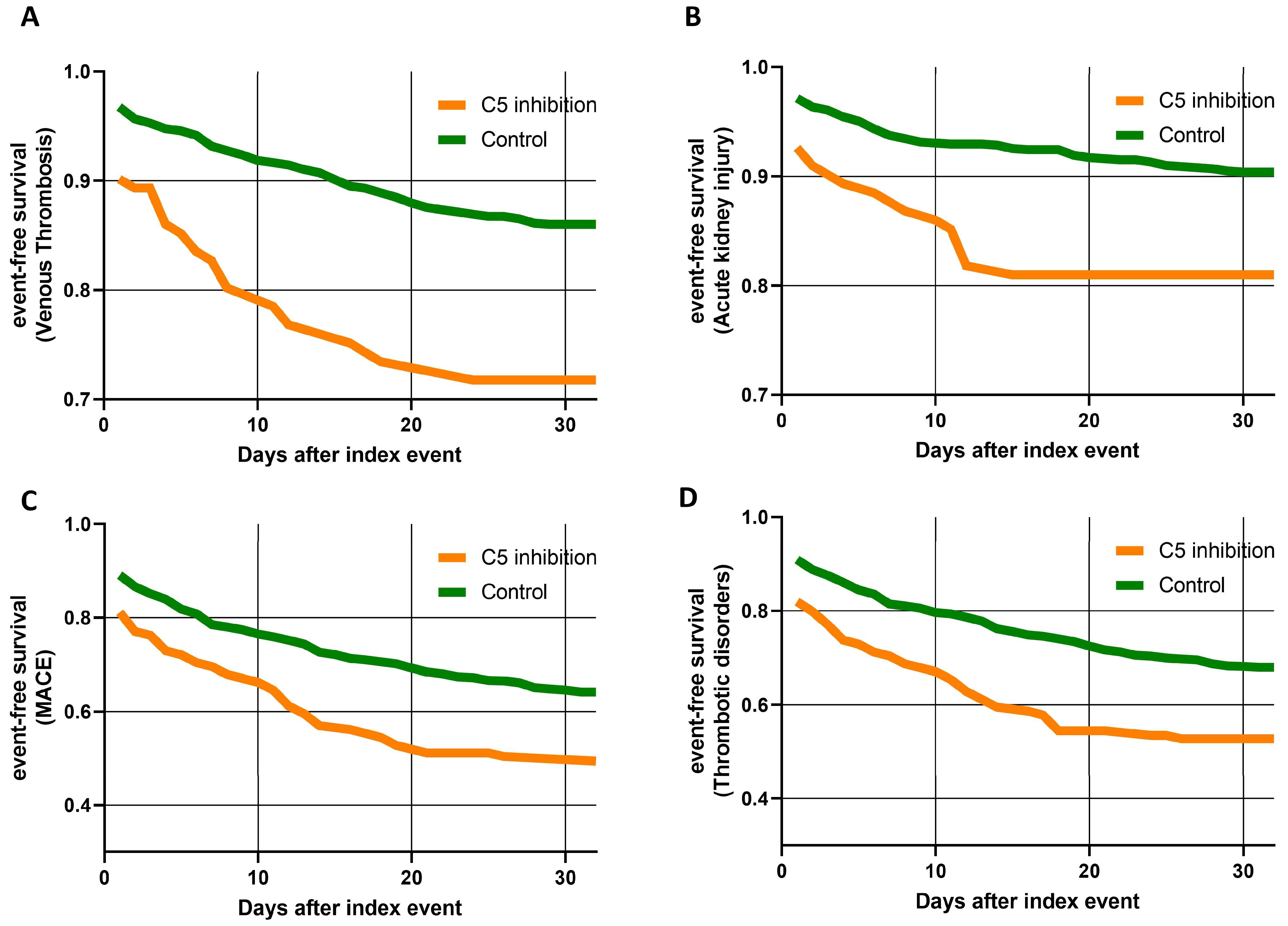
| Acute kidney injury | 23 | 80.99 | 11 | 90.39 | 10.801 | 0.001 | 2.107 | (1.337–3.321) | 1.367 | 0.242 |
| Arterial embolism | 28 | 76.81 | 24 | 78.99 | 0.433 | 0.511 | 1.142 | (0.770–1.694) | 2.011 | 0.156 |
| Ischemic stroke | 11 | 90.87 | 8 | 92.97 | 0.671 | 0.413 | 1.303 | (0.690–2.461) | 0.470 | 0.493 |
| MACE | 61 | 49.39 | 40 | 64.18 | 12.268 | <0.001 | 1.612 | (1.228–2.115) | 0.663 | 0.415 |
| Pulmonary embolism | 11 | 90.87 | 6 | 94.37 | 2.436 | 0.119 | 1.664 | (0.872–3.177) | 0.270 | 0.603 |
| Thrombotic disorders | 57 | 52.73 | 36 | 67.95 | 14.149 | <0.001 | 1.704 | (1.285–2.259) | 1.873 | 0.171 |
| Venous thrombosis | 34 | 71.76 | 16 | 86.01 | 19.152 | <0.001 | 2.260 | (1.553–3.288) | 3.099 | 0.078 |
Disclaimer/Publisher’s Note: The statements, opinions and data contained in all publications are solely those of the individual author(s) and contributor(s) and not of MDPI and/or the editor(s). MDPI and/or the editor(s) disclaim responsibility for any injury to people or property resulting from any ideas, methods, instructions or products referred to in the content. |
© 2026 by the authors. Licensee MDPI, Basel, Switzerland. This article is an open access article distributed under the terms and conditions of the Creative Commons Attribution (CC BY) license.
Share and Cite
Vahldieck, C.; Fels, B. Complement C5 Inhibition and Short-Term Cardiovascular Outcomes After Acute Limb Ischemia: A Real-World Cohort Study. Int. J. Transl. Med. 2026, 6, 23. https://doi.org/10.3390/ijtm6020023
Vahldieck C, Fels B. Complement C5 Inhibition and Short-Term Cardiovascular Outcomes After Acute Limb Ischemia: A Real-World Cohort Study. International Journal of Translational Medicine. 2026; 6(2):23. https://doi.org/10.3390/ijtm6020023
Chicago/Turabian StyleVahldieck, Carl, and Benedikt Fels. 2026. "Complement C5 Inhibition and Short-Term Cardiovascular Outcomes After Acute Limb Ischemia: A Real-World Cohort Study" International Journal of Translational Medicine 6, no. 2: 23. https://doi.org/10.3390/ijtm6020023
APA StyleVahldieck, C., & Fels, B. (2026). Complement C5 Inhibition and Short-Term Cardiovascular Outcomes After Acute Limb Ischemia: A Real-World Cohort Study. International Journal of Translational Medicine, 6(2), 23. https://doi.org/10.3390/ijtm6020023