Article

Complement C5 Inhibition and Short-Term Cardiovascular Outcomes After Acute Limb Ischemia: A Real-World Cohort Study


1
Department of Anesthesiology and Intensive Care Medicine, University Medical Centre Schleswig-Holstein Campus, 23538 Luebeck, Germany
2
Institute of Physiology, University of Luebeck, 23562 Luebeck, Germany
3
DZHK (German Research Centre for Cardiovascular Research), Partner Site North, 23562 Luebeck, Germany
*
Author to whom correspondence should be addressed.
Int. J. Transl. Med. 2026, 6(2), 23; https://doi.org/10.3390/ijtm6020023
Submission received: 19 March 2026 / Revised: 11 May 2026 / Accepted: 19 May 2026 / Published: 22 May 2026

Abstract

Background: Acute limb ischemia (ALI) is a vascular emergency characterized by abrupt limb hypoperfusion, ischemia–reperfusion injury, and a high risk of thromboinflammatory and organ complications. Complement activation has been implicated in endothelial dysfunction, glycocalyx injury, and ischemia–reperfusion damage, but the clinical relevance of ongoing terminal complement blockade in patients presenting with ALI remains unclear, highlighting a gap between mechanistic understanding and real-world clinical outcomes. Methods: A retrospective cohort study was performed using the TriNetX federated research network. Adult patients with ALI were identified and stratified according to ongoing treatment with the C5 inhibitors eculizumab or ravulizumab. Outcomes included ischemic stroke, venous thrombosis, pulmonary embolism, arterial embolism, thrombotic disorders, acute kidney injury (AKI), and the composite outcome major adverse cardiovascular events (MACE) within 31 days. Propensity score matching was performed for demographic characteristics, cardiovascular comorbidities, complement-associated diseases and medications. Results: After propensity score matching, 112 patients remained in each cohort. Compared with matched controls, patients receiving C5 inhibition had a significantly higher risk of venous thrombosis (27.9% vs. 13.7%; p < 0.001), AKI (18.9% vs. 9.4%; p = 0.001), MACE (50.0% vs. 35.1%; p = 0.001), and thrombotic disorders (46.7% vs. 31.3%; p = 0.001). Time-to-event analyses confirmed significantly lower event-free survival for venous thrombosis (HR 2.3), AKI (HR 2.1), MACE (HR 1.6), and thrombotic disorders (HR 1.7). No significant differences were observed for ischemic stroke, pulmonary embolism, or arterial embolism. Conclusions: In patients with ALI, ongoing treatment with eculizumab or ravulizumab was not associated with an apparent reduction in short-term thromboinflammatory or cardiovascular complications. Instead, the observed outcome pattern suggests persistent vulnerability in this clinically uncommon but increasingly relevant high-risk population, although substantial residual confounding by indication and disease severity remains likely. These findings support further investigation of complement-targeted therapy, endothelial injury, and short-term vascular outcomes in ALI, and emphasize the translational relevance of linking mechanistic insights with clinical data to inform risk stratification and management strategies in this population.

1. Introduction

Acute limb ischemia (ALI) is a vascular emergency caused by a sudden reduction in limb perfusion that threatens tissue viability and is associated with substantial risks of limb loss, systemic complications, and death [1]. Beyond macrovascular occlusion, the clinical course of ALI is strongly shaped by ischemia–reperfusion injury after revascularization, which amplifies inflammation, microvascular dysfunction, and organ injury [1,2]. Increasing evidence suggests that endothelial dysfunction is a key component of this process. It may represent an important link between experimental pathophysiology and clinical outcomes in acute vascular disease. In the lower-extremity setting, revascularization has been linked not only to restoration of flow and perfusion but also to changes in systemic endothelial function, underscoring the relevance of endothelial injury in acute peripheral ischemic syndromes [2].
The complement system is increasingly recognized as an important mediator of ischemia–reperfusion injury and thromboinflammation [3,4,5,6]. Experimental and clinical studies in myocardial infarction have shown that complement activation contributes to tissue injury, leukocyte recruitment, and adverse cardiovascular outcomes [3,5,7,8]. In particular, terminal pathway activation appears closely linked to endothelial damage. C5a promotes endothelial activation, including induction of adhesion molecules such as P-selectin, and modulates inflammatory vascular responses [9,10]. More recently, dysregulated complement activation during acute myocardial infarction was shown to induce endothelial glycocalyx degradation and endothelial dysfunction via the C5a–C5a receptor 1 axis [8]. These findings provide a mechanistic link between complement activation and vascular injury. Related ischemia–reperfusion models, including renal injury, further support a role for complement-mediated glycocalyx damage in end-organ dysfunction [11]. Collectively, these findings support the concept that complement activation may contribute to endothelial injury, thrombotic complications, and organ dysfunction in ALI, highlighting a potential translational link between experimental mechanisms and clinically observable outcomes.
Therapeutic inhibition of terminal complement activation has gained increasing importance in recent years. Eculizumab and ravulizumab are established C5 inhibitors that are approved for several complement-mediated disorders, including paroxysmal nocturnal hemoglobinuria (PNH), atypical hemolytic uremic syndrome (aHUS), generalized myasthenia gravis (MG), and neuromyelitis optica spectrum disorder (NMOSD) [12,13,14,15,16,17]. Ravulizumab, with its longer dosing interval, has further expanded the practical use of C5 inhibition in routine care [15,17,18,19]. Patients receiving these therapies still represent an uncommon subgroup in the context of ALI. However, their presence in routine clinical practice is likely to increase as indications broaden and long-term maintenance treatment becomes more common [15,17,18,19]. This is clinically relevant because such patients may represent a particularly vulnerable population at the intersection of complement dysregulation, endothelial stress, and thrombosis.
However, despite growing mechanistic evidence linking complement activation to endothelial injury in ischemic disease, real-world data on ALI outcomes in patients receiving ongoing C5 inhibition are lacking. Whether terminal complement blockade mitigates endothelial injury-related complications after ALI or instead identifies a population with persistently elevated thromboinflammatory risk remains unclear. To address this translational gap and to bridge mechanistic insights with real-world clinical outcomes, a retrospective cohort study was conducted to evaluate short-term cardiovascular, thrombotic, and renal outcomes in patients with ALI with and without ongoing treatment with eculizumab or ravulizumab. This study links experimental concepts of complement-mediated endothelial injury with real-world clinical outcome patterns. The aim was to provide clinically relevant insights into the role of C5 inhibition in acute vascular disease.

2. Materials and Methods

2.1. Study Design

This retrospective cohort study was conducted using the TriNetX Analytics Network (https://live.trinetx.com/, accessed on 11 May 2026), a federated real-world database platform providing access to de-identified electronic health record data from participating healthcare organizations. The network includes aggregated, de-identified, longitudinal clinical information such as demographics, diagnoses, procedures, medications, and outcomes.
The study aimed to evaluate short-term cardiovascular, thrombotic, and endothelial injury-related outcomes in patients with ALI with and without ongoing complement C5 inhibition. The index event was defined as the diagnosis of ALI. Follow-up was limited to 31 days after the index event in order to focus on early post-ischemic complications and to reduce bias related to incomplete long-term follow-up.

2.2. Cohorts

The exposed cohort consisted of patients with ALI and documented treatment with a complement C5 inhibitor, defined as eculizumab or ravulizumab, prior the index event. The control cohort included patients with ALI without documented exposure to eculizumab or ravulizumab.
To reduce baseline differences between groups, propensity score matching (PSM) was performed within the TriNetX platform using 1:1 nearest-neighbor matching without replacement. Matching variables were selected a priori based on clinical relevance and included age, sex, ethnicity, hypertension, chronic kidney disease, ischemic heart disease, diabetes mellitus, overweight/obesity, smoking history, and complement-associated diseases. Specifically, diagnoses of aHUS, PNH, MG, NMOSD were included in the matching procedure because these conditions are linked to the indication spectrum of complement C5 inhibition and may confound the association between treatment exposure and vascular outcomes. Not all patients receiving eculizumab or ravulizumab had one of these predefined complement-associated diagnoses formally coded within the available electronic health record data. This likely reflects the heterogeneous and evolving indication spectrum of terminal complement inhibition, including less frequently coded complement-mediated disorders, historical coding variability, and incomplete diagnostic granularity within federated real-world datasets. To account for this potential source of confounding, complement-associated diseases were incorporated into the propensity score matching strategy, and residual confounding by indication is acknowledged as an inherent limitation of the study.
Before matching, 115 patients were identified in the C5 inhibition cohort and 881 patients in the control cohort. After 1:1 PSM, two balanced cohorts of 112 patients each were available for outcome analysis.

2.3. Outcomes

Outcomes included ischemic stroke, venous thrombosis, pulmonary embolism, arterial embolism, thrombotic disorders, acute kidney injury (AKI) and major adverse cardiovascular events (MACE). Arterial embolism referred to non-cerebral arterial embolism and thrombosis (ICD-10 I74), whereas ischemic stroke outcomes were analyzed separately using cerebrovascular ICD-10 codes. The composite outcome “thrombotic disorders” included arterial embolism/thrombosis (I74), venous embolism/thrombosis (I82), and pulmonary embolism (I26). Individual thrombotic outcomes were additionally analyzed separately to provide outcome-specific risk estimates and to improve interpretability of the composite endpoint. Detailed ICD-10 outcome definitions are provided in Supplement Table S1. MACE was analyzed as a composite endpoint including acute myocardial infarction, ischemic stroke, pulmonary embolism, venous embolism/thrombosis, arterial embolism/thrombosis, and cardiogenic shock as defined within the TriNetX platform using ICD-10 coding. These outcomes were chosen to reflect clinically relevant cardiovascular and thromboinflammatory complications after ALI and to capture events potentially related to endothelial dysfunction, microvascular injury, and immunothrombosis.
For time-to-event analyses, patients were followed from the index date until the first occurrence of the outcome of interest, death, or the end of the 31-day observation period.

2.4. Ethical Statement

All analyses were conducted within the federated TriNetX platform using only aggregated, de-identified data in accordance with the HIPAA Privacy Rule §164.514(a). De-identification was certified by a qualified expert, with the latest renewal in December 2020. As this was a secondary analysis of existing de-identified data without patient contact or access to individual identifiers, informed consent was waived and no additional ethical approval was required, as confirmed by the Ethics Committee of the University of Lübeck. This approach is consistent with prior publications from the University of Lübeck and University Hospital Schleswig-Holstein [19]. The University Hospital Schleswig-Holstein, Lübeck, is a participating healthcare organization in the TriNetX network. Reporting followed the STROBE guidelines.

2.5. Statistical Analysis

Baseline characteristics were compared before and after PSM. PSM was performed within the TriNetX Analytics Network using 1:1 nearest-neighbor matching without replacement. Propensity scores were generated based on logistic regression incorporating predefined demographic and clinical covariates, including age, sex, ethnicity, hypertension, chronic kidney disease, ischemic heart disease, diabetes mellitus, overweight/obesity, smoking history, and complement-associated diseases. Cohort balance before and after matching was assessed using standardized differences, with values below 0.1 considered indicative of acceptable balance between groups. Continuous variables are presented as mean and standard deviation, while categorical variables are reported as counts and percentages. Group differences were assessed using p-values and standardized differences, with improved balance after matching considered indicative of successful cohort adjustment.
For risk-based analyses, outcome frequencies and risks were calculated for both cohorts. Effect estimates included risk ratios (RRs), odds ratios (ORs), and risk differences (RDs) with corresponding 95% confidence intervals (CIs). For time-to-event analyses, Kaplan–Meier survival analyses were performed and compared using the log-rank test. Hazard ratios (HRs) with 95% CIs were calculated using Cox proportional hazards models within the TriNetX platform. A two-sided p-value < 0.05 was considered statistically significant. Exploratory standardized effect size estimates (Cohen’s d) were additionally calculated for supplementary analyses (values of 0.2, 0.5, and 0.8 were interpreted as small, moderate, and large effects, respectively). All analyses were conducted within the TriNetX Analytics Network using the platform’s built-in statistical tools. Figures were created using the 2D graphics and biostatistics software GraphPad PRISM (version 8.4.2, GraphPad Software Inc., San Diego, CA, USA).

3. Results

3.1. Propensity Score Matching

To reduce potential confounding, PSM was performed using demographic variables, cardiovascular risk factors, and complement-associated diseases. Matching included age, sex, hypertension, chronic kidney disease, ischemic heart disease, diabetes mellitus, obesity, smoking history, as well as diagnoses related to complement-mediated disorders (Table 1).
Prior to matching, notable differences were observed between the cohorts. Patients receiving complement C5 inhibition were significantly younger than controls (p < 0.001) and had higher rates of chronic kidney disease (50.4% vs. 27.2%). Differences were also present in complement-associated conditions, including aHUS and MG (Table 1).
PSM yielded two well-balanced cohorts of 112 patients each. After matching, baseline characteristics were comparable across groups, with minimal standardized differences for all included variables. Age was well balanced between cohorts and no significant differences were observed for major cardiovascular comorbidities, including hypertension, chronic kidney disease, ischemic heart disease, diabetes mellitus, or smoking history. Complement-associated diseases were similarly balanced after matching, with standardized differences close to zero.
Overall, PSM substantially reduced baseline imbalances between the treatment groups, supporting the validity of the subsequent comparative outcome analyses.

3.2. Risk-Based Analyses

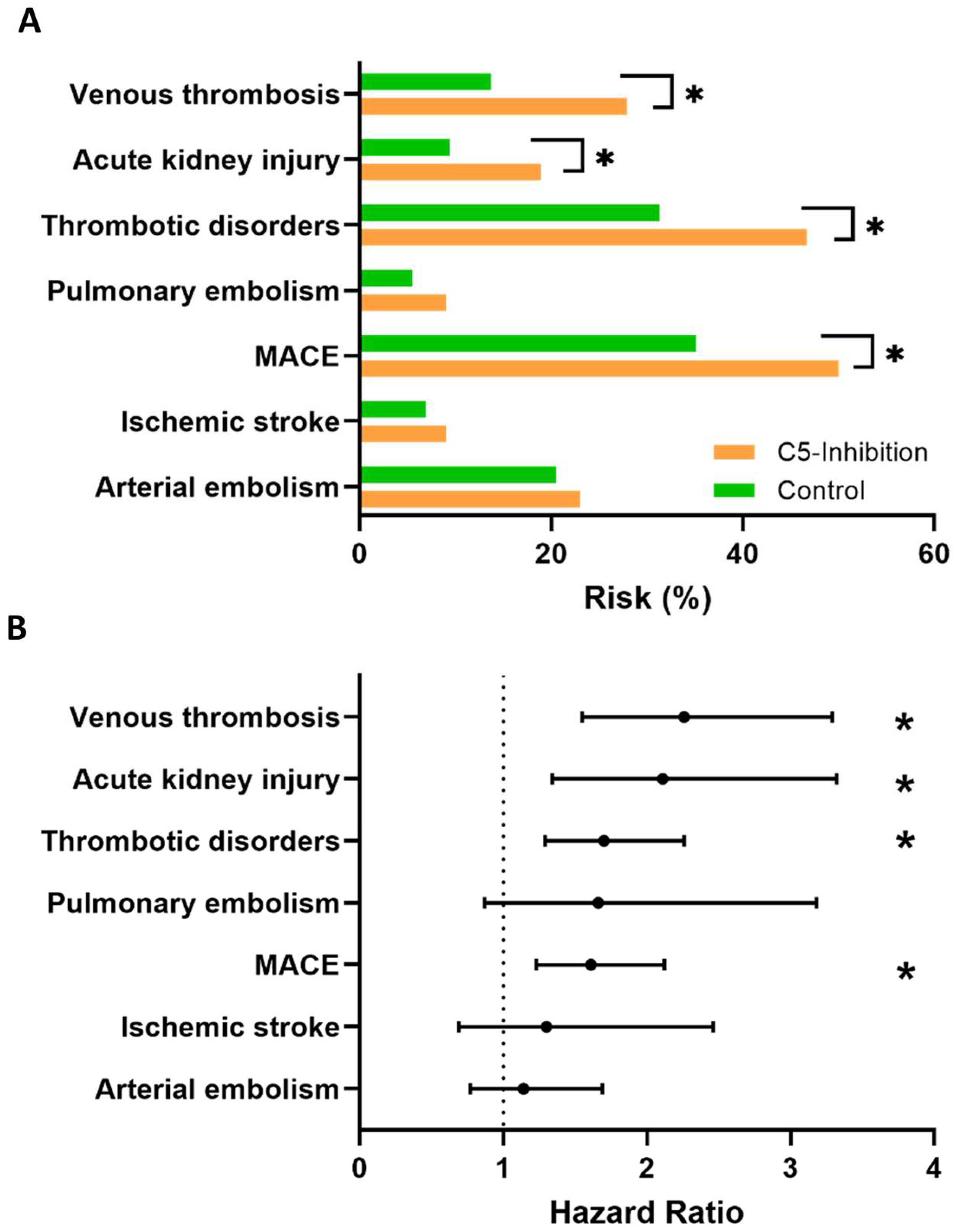
Risk-based analyses demonstrated significantly increased rates of several thrombo-inflammatory complications in patients receiving C5 inhibition (Table 2 and Supplemental Table S2). Venous thrombosis occurred more often in patients of the C5 inhibition group compared with the control group (27.9% vs. 13.7%; p < 0.001) (Figure 1A). Similarly, AKI was more frequent among patients receiving complement inhibition (18.9% vs. 9.4%; p < 0.01). MACE was also significantly increased in the C5 inhibition cohort (50.0% vs. 35.1%; p < 0.01) (Figure 1A).
Furthermore, the incidence of composite thrombotic disorders was significantly higher in patients receiving complement inhibition (46.7% vs. 31.3%; p < 0.001). In contrast, no statistically significant differences were observed for ischemic stroke, pulmonary embolism, or arterial embolism (Table 2 and Supplemental Table S2).

3.3. Time-to-Event Analyses

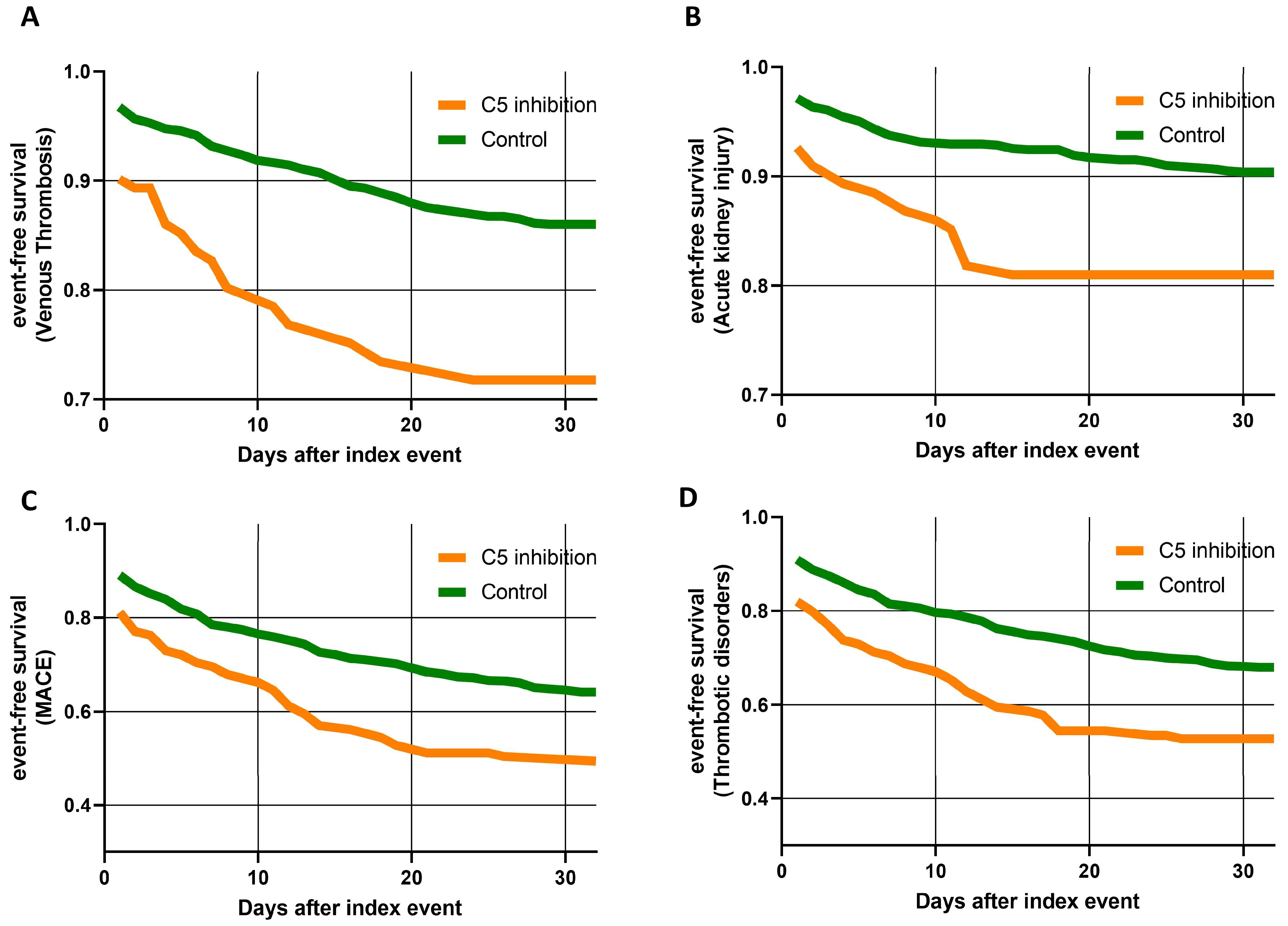
Time-to-event analyses confirmed the findings of the risk-based analyses (Table 3) (Figure 1B). Kaplan–Meier analyses demonstrated significantly reduced event-free survival in the complement inhibition cohort for venous thrombosis, AKI, MACE, and composite thrombotic disorders (Figure 2A–D). Correspondingly, hazard ratios were significantly increased for venous thrombosis (HR 2.26), AKI (HR 2.11), MACE (HR 1.61), and thrombotic disorders (HR 1.70). Detailed statistical results are presented in Table 3.

4. Discussion

In this retrospective real-world cohort study, ongoing C5 inhibition with eculizumab or ravulizumab was not associated with an apparent reduction in short-term vascular risk among patients with ALI. Instead, the analysis showed higher rates of venous thrombotic events, AKI, MACE, and composite thrombotic complications in the C5 inhibition cohort, whereas no clear differences were observed for ischemic stroke, pulmonary embolism, or arterial embolism. Taken together, these findings suggest that in the setting of ALI, ongoing terminal complement blockade does not identify a clinically protected subgroup, but rather a population that remains highly vulnerable to early thromboinflammatory and organ complications, highlighting important translational implications at the interface of complement biology and acute vascular disease.
At first glance, these observations may appear counterintuitive. Experimental and translational studies have consistently implicated complement activation in ischemia–reperfusion injury, endothelial activation, glycocalyx degradation, and inflammatory amplification across cardiovascular and organ ischemia models [5,8,20]. In myocardial infarction, complement activation has been linked to tissue injury and adverse remodeling, and terminal pathway inhibition has shown biological plausibility as a strategy to attenuate reperfusion-associated damage [3,4,5,6,8,21]. Mechanistically, C5a promotes endothelial activation and leukocyte recruitment, while recent human data indicate that dysregulated complement activation can directly contribute to endothelial glycocalyx degradation and endothelial dysfunction through the C5a–C5a receptor 1 axis [8,9,10,22,23]. Similar concepts have been demonstrated in renal ischemia–reperfusion injury, where complement-mediated glycocalyx damage appears to contribute to microvascular and parenchymal injury [11]. These data provide a strong rationale for assuming that complement blockade could, at least theoretically, mitigate part of the endothelial and thromboinflammatory burden associated with ALI, thereby establishing a mechanistic framework that can be translated into clinical hypothesis testing.
However, ALI is not merely a model of isolated macrovascular occlusion. It is increasingly understood as a syndrome of complex ischemia–reperfusion injury involving endothelial dysfunction, inflammatory activation, coagulation disturbances, and downstream organ injury [1,2]. Experimental work specifically in limb ischemia has demonstrated that reperfusion is accompanied by marked systemic inflammatory and endothelial responses, while broader reviews of ALI pathophysiology have emphasized the interaction of oxidative stress, endothelial activation, leukocyte trafficking, and complement-associated injury pathways [1,24]. In addition, lower-extremity revascularization itself appears to influence systemic endothelial function, further supporting the concept that the peripheral ischemia setting is biologically linked to generalized endothelial stress rather than confined to local limb pathology [2]. Against this background, the present findings suggest that in patients already receiving C5 inhibition, the pathobiology of ALI remains sufficient to drive substantial short-term clinical risk despite pharmacologic blockade of terminal complement, underscoring a potential dissociation between experimental expectations and real-world clinical outcomes. In addition, obesity may represent a further contributor to thromboinflammatory vulnerability in ALI. Obesity is increasingly recognized as a state of chronic low-grade inflammation associated with endothelial dysfunction, immune activation, oxidative stress, and adverse cardiometabolic remodeling. These mechanisms may amplify ischemia–reperfusion injury and vascular inflammation in acute ischemic syndromes and could therefore influence ALI severity and short-term vascular outcomes in susceptible patients [25].
A more plausible interpretation of the presented results is therefore not that C5 inhibition is harmful in ALI, but that the treated cohort represents a distinctly vulnerable clinical subgroup. Eculizumab and ravulizumab are prescribed for severe complement-mediated diseases such as PNH, aHUS, MG and NMOSD [12,13,14,15,16,17]. Several of these conditions are themselves linked to thrombosis, endothelial injury, thrombotic microangiopathy, or chronic systemic inflammation, all of which may influence outcomes during acute ischemic events [12,13,17,26,27,28]. In particular, PNH and aHUS are characterized by a close relationship between complement dysregulation, endothelial stress, and prothrombotic complications [12,13,26,27,28]. Even though PSM substantially reduced measured baseline imbalances, residual confounding by disease severity, indication, prior thrombotic burden, or unmeasured biological vulnerability is likely. Importantly, propensity score matching can only adjust for measured covariates available within the underlying real-world dataset and cannot fully account for disease severity, chronic thromboinflammatory burden, treatment intensity, prior vascular history, or other unmeasured biological determinants of risk. This limitation is particularly relevant in patients receiving terminal complement inhibition, as the underlying diseases prompting treatment are themselves strongly associated with endothelial dysfunction, thrombotic microangiopathy, systemic inflammation, and increased thrombotic susceptibility. Consequently, the observed associations are more appropriately interpreted as reflecting persistent vulnerability in a highly selected high-risk population rather than direct evidence of adverse effects caused by C5 inhibition itself. The present results should therefore be interpreted primarily as a signal that patients with ALI under ongoing C5 inhibition remain at high short-term risk, rather than as evidence against a mechanistic role of complement in ALI, and emphasize the importance of translating mechanistic insights into carefully contextualized clinical interpretation.
This interpretation is clinically relevant. Although the cohort is currently somewhat artificial from an epidemiologic perspective, it is unlikely to remain so. Over the past years, terminal complement inhibitors have gained increasing importance across hematologic, neurologic, and nephrologic indications, and their use in long-term maintenance treatment has expanded in routine care [14,15,16,29,30,31]. Consequently, more patients receiving eculizumab or ravulizumab will present to emergency departments, intensive care units, vascular services, and perioperative pathways with unrelated acute conditions, including ALI. The presented findings suggest that such patients should not be assumed to be biologically protected from thromboinflammatory complications by virtue of complement blockade alone. On the contrary, they may deserve heightened surveillance for renal dysfunction, venous thrombotic events, and major cardiovascular complications during the early post-ALI period, which has direct clinical implications for risk stratification and monitoring strategies in patients receiving complement inhibition.
The study has several strengths. It addresses a clinically uncommon but increasingly relevant population, uses a large federated real-world data platform, and focuses on a short 31-day follow-up period that is particularly appropriate for ALI and reduces bias related to long-term attrition. Nevertheless, the restricted 31-day follow-up period primarily captures early post-ischemic and thromboinflammatory complications and may underestimate longer-term vascular and organ-related consequences associated with complement-mediated disease biology. It is conceivable that short-term and long-term outcome trajectories diverge over time, particularly in patients with chronic endothelial dysfunction, thromboinflammatory activation, or persistent vascular vulnerability despite terminal complement inhibition. In related cardiovascular settings, longer-term follow-up analyses have demonstrated sustained differences in thromboembolic and cardiovascular outcomes beyond the acute phase, supporting the concept that vascular risk associated with complement-mediated disease states may extend beyond early ischemic injury [19,31,32]. Consequently, dedicated longitudinal studies are warranted to better define the temporal relationship between complement inhibition, vascular biology, and long-term cardiovascular outcomes after ALI.
At the same time, several important limitations must be acknowledged. The retrospective design precludes causal inference. The cohort receiving C5 inhibition was relatively small, reflecting the rarity of the exposure in this setting. In addition, several clinically important variables relevant to ALI severity and post-ischemic outcome assessment were not available in sufficient detail within the TriNetX platform. These included Rutherford classification [33], anatomical lesion characteristics, timing and type of revascularization, procedural success, anticoagulation strategies, medication adherence, and detailed vascular history. The absence of these variables limits the ability to fully contextualize the observed outcomes, particularly regarding ischemia–reperfusion burden, procedural heterogeneity, and baseline thrombotic risk. Furthermore, no biomarker data on complement activity, endothelial glycocalyx injury, hemolysis, inflammatory activation, or thrombogenicity were available, which substantially limits mechanistic interpretation. Finally, despite propensity score matching, residual confounding remains highly likely, particularly because the indication spectrum for C5 inhibition is closely linked to systemic thromboinflammatory disease biology and underlying vascular vulnerability. Consequently, the observed associations should not be interpreted as causal effects of complement inhibition itself. In addition, the underlying indication for C5 inhibition could not be comprehensively reconstructed in all patients from coded diagnosis data alone, reflecting the limitations of real-world federated electronic health record datasets and the evolving clinical use of complement inhibitors across heterogeneous disease entities.
From a translational perspective, the present findings highlight the complexity of complement biology in acute vascular disease. Although terminal complement inhibition represents a mechanistically attractive therapeutic concept in ischemia–reperfusion injury, the real-world clinical phenotype of patients receiving these therapies appears to remain strongly shaped by persistent endothelial dysfunction, thromboinflammatory activation, and underlying systemic disease biology. These observations underscore the importance of integrating mechanistic vascular research with clinically contextualized real-world outcome analyses. Improved characterization of endothelial injury, thrombotic vulnerability, and complement activity may ultimately contribute to more individualized risk stratification and monitoring strategies in patients with ALI receiving complement-targeted therapies.

5. Conclusions

In conclusion, among patients with ALI, ongoing treatment with eculizumab or ravulizumab was not associated with an apparent reduction in early cardiovascular or thromboinflammatory complications within this real-world cohort. The observed outcome pattern does not suggest direct harm from terminal complement inhibition itself. Instead, it is more consistent with persistent vulnerability in a highly selected high-risk population characterized by complement dysregulation, endothelial stress, systemic thromboinflammatory disease biology, and thrombosis. Substantial residual confounding by indication and disease severity remains likely despite propensity score matching. Therefore, the present findings should be considered hypothesis-generating rather than causal. Nevertheless, the study supports further investigation into complement-targeted therapy, endothelial injury, and vascular outcomes in ALI. More broadly, the findings highlight the translational relevance of integrating mechanistic insights with real-world clinical data to improve future risk stratification and management strategies.

Supplementary Materials

The following supporting information can be downloaded at: https://www.mdpi.com/article/10.3390/ijtm6020023/s1, Supplementary Table S1 providing detailed ICD-10 outcome definitions and coding strategies used within the TriNetX platform; Supplementary Table S2 showing extended risk-based statistical analyses including odds ratios, risk differences, z-values, and Cohen’s d effect sizes.

Author Contributions

C.V. conceptualized and designed the study, performed data collection and statistical analyses within the TriNetX platform, and prepared the initial manuscript draft. B.F. contributed to literature research, critical revision of the manuscript, interpretation of the data, and substantial editing of the scientific content. Both authors contributed to data analysis, manuscript refinement, and the final interpretation of the results. Both authors reviewed and approved the final version of the manuscript. All authors have read and agreed to the published version of the manuscript.

Funding

This research received no external funding.

Institutional Review Board Statement

All procedures performed in this study involving human data were conducted in accordance with the ethical standards of the responsible institutional and national research committees and with the 1964 Declaration of Helsinki and its later amendments. This study was based exclusively on de-identified electronic health record data obtained from the TriNetX Global Collaborative Network. The TriNetX platform provides access only to aggregated and de-identified patient data and operates in compliance with the de-identification standards defined in §164.514(a) of the Health Insurance Portability and Accountability Act (HIPAA) Privacy Rule. The de-identification process has been formally certified by a qualified expert as specified in §164.514(b)(1) of the HIPAA Privacy Rule. The Ethics Committee of the University of Lübeck confirmed that no additional ethical approval was required for this study design.

Informed Consent Statement

Because the analysis involved only anonymized secondary data and no direct interaction with human participants, the requirement for informed consent was waived.

Data Availability Statement

The data supporting the findings of this study are included within the article. The original contributions presented in this study are contained in the manuscript. Data were obtained from the TriNetX database; the exported dataset contains the data reported in the present manuscript. Further inquiries may be directed to the corresponding author.

Conflicts of Interest

The authors declare no conflicts of interest.

Abbreviations

aHUSatypical hemolytic uremic syndrome
AKIAcute kidney injury
ALIacute limb ischemia
CIconfidence interval
C5aR1complement component 5a receptor 1
DOACdirect oral anticoagulant
ECUeculizumab
HIPAAHealth Insurance Portability and Accountability Act
HRhazard ratio
ICDInternational Classification of Diseases
MACEmajor adverse cardiovascular events
MGmyasthenia gravis
NMOSDneuromyelitis optica spectrum disorder
ORodds ratio
PNHparoxysmal nocturnal hemoglobinuria
PSMpropensity score matching
RAVUravulizumab
RDrisk difference
RRrisk ratio
SDstandard deviation
SNOMEDSystematized Nomenclature of Medicine Clinical Terms
STROBEStrengthening the Reporting of Observational Studies in Epidemiology
TriNetXTriNetX Analytics Network

References

  1. Costa, D.; Ielapi, N.; Perri, P.; Minici, R.; Faga, T.; Michael, A.; Bracale, U.M.; Andreucci, M.; Serra, R. Molecular Insight into Acute Limb Ischemia. Biomolecules 2024, 14, 838. [Google Scholar] [CrossRef]
  2. Normahani, P.; Khosravi, S.; Sounderajah, V.; Aslam, M.; Standfield, N.J.; Jaffer, U. The Effect of Lower Limb Revascularization on Flow, Perfusion, and Systemic Endothelial Function: A Systematic Review. Angiology 2021, 72, 210–220. [Google Scholar] [CrossRef]
  3. Bavia, L.; Lidani, K.C.F.; Andrade, F.A.; Sobrinho, M.I.A.H.; Nisihara, R.M.; de Messias-Reason, I.J. Complement Activation in Acute Myocardial Infarction: An Early Marker of Inflammation and Tissue Injury? Immunol. Lett. 2018, 200, 18–25. [Google Scholar] [CrossRef]
  4. Vakeva, A.P.; Agah, A.; Rollins, S.A.; Matis, L.A.; Li, L.; Stahl, G.L. Myocardial Infarction and Apoptosis after Myocardial Ischemia and Reperfusion: Role of the Terminal Complement Components and Inhibition by Anti-C5 Therapy. Circulation 1998, 97, 2259–2267. [Google Scholar] [CrossRef] [PubMed]
  5. Vogel, C.-W. The Role of Complement in Myocardial Infarction Reperfusion Injury: An Underappreciated Therapeutic Target. Front. Cell Dev. Biol. 2020, 8, 606407. [Google Scholar] [CrossRef] [PubMed]
  6. Arumugam, T.V.; Magnus, T.; Woodruff, T.M.; Proctor, L.M.; Shiels, I.A.; Taylor, S.M. Complement Mediators in Ischemia-Reperfusion Injury. Clin. Chim. Acta 2006, 374, 33–45. [Google Scholar] [CrossRef]
  7. Vahldieck, C.; Fels, B.; Löning, S.; Nickel, L.; Weil, J.; Kusche-Vihrog, K. Prolonged Door-to-Balloon Time Leads to Endothelial Glycocalyx Damage and Endothelial Dysfunction in Patients with ST-Elevation Myocardial Infarction. Biomedicines 2023, 11, 2924. [Google Scholar] [CrossRef] [PubMed]
  8. Vahldieck, C.; Löning, S.; Hamacher, C.; Fels, B.; Rudzewski, B.; Nickel, L.; Weil, J.; Nording, H.; Baron, L.; Kleingarn, M.; et al. Dysregulated Complement Activation during Acute Myocardial Infarction Leads to Endothelial Glycocalyx Degradation and Endothelial Dysfunction via the C5a:C5a-Receptor1 Axis. Front. Immunol. 2024, 15, 1426526. [Google Scholar] [CrossRef]
  9. Foreman, K.E.; Vaporciyan, A.A.; Bonish, B.K.; Jones, M.L.; Johnson, K.J.; Glovsky, M.M.; Eddy, S.M.; Ward, P.A. C5a-Induced Expression of P-Selectin in Endothelial Cells. J. Clin. Investig. 1994, 94, 1147–1155. [Google Scholar] [CrossRef]
  10. Shivshankar, P.; Li, Y.-D.; Mueller-Ortiz, S.L.; Wetsel, R.A. In Response to Complement Anaphylatoxin Peptides C3a and C5a, Human Vascular Endothelial Cells Migrate and Mediate the Activation of B-Cells and Polarization of T-Cells. FASEB J. 2020, 34, 7540–7560. [Google Scholar] [CrossRef]
  11. Bongoni, A.K.; Lu, B.; McRae, J.L.; Salvaris, E.J.; Toonen, E.J.M.; Vikstrom, I.; Baz Morelli, A.; Pearse, M.J.; Cowan, P.J. Complement-Mediated Damage to the Glycocalyx Plays a Role in Renal Ischemia-Reperfusion Injury in Mice. Transplant. Direct 2019, 5, e341. [Google Scholar] [CrossRef]
  12. Brodsky, R.A. Paroxysmal Nocturnal Hemoglobinuria. Blood 2014, 124, 2804–2811. [Google Scholar] [CrossRef]
  13. Keating, G.M. Eculizumab: A Review of Its Use in Atypical Haemolytic Uraemic Syndrome. Drugs 2013, 73, 2053–2066. [Google Scholar] [CrossRef]
  14. Narayanaswami, P.; Sanders, D.B.; Wolfe, G.; Benatar, M.; Cea, G.; Evoli, A.; Gilhus, N.E.; Illa, I.; Kuntz, N.L.; Massey, J.; et al. International Consensus Guidance for Management of Myasthenia Gravis: 2020 Update. Neurology 2021, 96, 114–122. [Google Scholar] [CrossRef]
  15. McKeage, K. Ravulizumab: First Global Approval. Drugs 2019, 79, 347–352. [Google Scholar] [CrossRef]
  16. Kümpfel, T.; Giglhuber, K.; Aktas, O.; Ayzenberg, I.; Bellmann-Strobl, J.; Häußler, V.; Havla, J.; Hellwig, K.; Hümmert, M.W.; Jarius, S.; et al. Update on the Diagnosis and Treatment of Neuromyelitis Optica Spectrum Disorders (NMOSD)—Revised Recommendations of the Neuromyelitis Optica Study Group (NEMOS). Part II: Attack Therapy and Long-Term Management. J. Neurol. 2024, 271, 141–176, Correction in J. Neurol. 2024, 271, 3702–3707. [Google Scholar] [CrossRef] [PubMed]
  17. Gavriilaki, E.; de Latour, R.P.; Risitano, A.M. Advancing Therapeutic Complement Inhibition in Hematologic Diseases: PNH and Beyond. Blood 2022, 139, 3571–3582. [Google Scholar] [CrossRef] [PubMed]
  18. Gaeckler, A.; Al-Dakkak, I.; Saval, N.; Dieperink, H.H.; Eygenraam, M.; Greenbaum, L.A.; Isbel, N.; Walle, J.V. Effectiveness and Safety of Switching to Ravulizumab from Eculizumab in Kidney Transplant Recipients with Atypical Hemolytic Uremic Syndrome: A Global aHUS Registry Analysis. Clin. Transpl. 2025, 39, e70278. [Google Scholar] [CrossRef]
  19. Vahldieck, C. Complement C5 Inhibition with Eculizumab or Ravulizumab Is Associated with Increased Cardiovascular and Thromboembolic Risk after ST-Elevation Myocardial Infarction: A Propensity-Matched Global Retrospective Cohort Study. BMC Cardiovasc. Disord. 2026, 26, 298. [Google Scholar] [CrossRef] [PubMed]
  20. Frączek, A.; Owczarczyk-Saczonek, A.; Ludwig, R.J.; Hernandez, G.; Ständer, S.; Thaci, D.; Zirpel, H. Vitiligo Is Associated with an Increased Risk of Cardiovascular Diseases: A Large-Scale, Propensity-Matched, US-Based Retrospective Study. eBioMedicine 2024, 109, 105423. [Google Scholar] [CrossRef]
  21. Abassi, Z.; Armaly, Z.; Heyman, S.N. Glycocalyx Degradation in Ischemia-Reperfusion Injury. Am. J. Pathol. 2020, 190, 752–767. [Google Scholar] [CrossRef]
  22. Gorsuch, W.B.; Chrysanthou, E.; Schwaeble, W.J.; Stahl, G.L. The Complement System in Ischemia-Reperfusion Injuries. Immunobiology 2012, 217, 1026–1033. [Google Scholar] [CrossRef]
  23. Ghosh, M.; Rana, S. The Anaphylatoxin C5a: Structure, Function, Signaling, Physiology, Disease, and Therapeutics. Int. Immunopharmacol. 2023, 118, 110081, Correction in Int. Immunopharmacol. 2023, 125, 111089. [Google Scholar] [CrossRef]
  24. Farrar, C.A.; Asgari, E.; Schwaeble, W.J.; Sacks, S. Which Pathways Trigger the Role of Complement in Ischaemia/Reperfusion Injury? Front. Immunol. 2012, 3, 341. [Google Scholar] [CrossRef]
  25. Karakasis, P.; Stachteas, P.; Iliakis, P.; Sidiropoulos, G.; Grigoriou, K.; Patoulias, D.; Antoniadis, A.P.; Fragakis, N. Inflammation and Resolution in Obesity-Related Cardiovascular Disease. Int. J. Mol. Sci. 2026, 27, 535. [Google Scholar] [CrossRef] [PubMed]
  26. Brocklebank, V.; Wood, K.M.; Kavanagh, D. Thrombotic Microangiopathy and the Kidney. Clin. J. Am. Soc. Nephrol. 2018, 13, 300–317. [Google Scholar] [CrossRef] [PubMed]
  27. Fakhouri, F.; Frémeaux-Bacchi, V. Thrombotic Microangiopathy in aHUS and beyond: Clinical Clues from Complement Genetics. Nat. Rev. Nephrol. 2021, 17, 543–553. [Google Scholar] [CrossRef]
  28. Noris, M.; Remuzzi, G. Atypical Hemolytic-Uremic Syndrome. N. Engl. J. Med. 2009, 361, 1676–1687. [Google Scholar] [CrossRef]
  29. Wijnsma, K.L.; ter Heine, R.; Moes, D.J.A.R.; Langemeijer, S.; Schols, S.E.M.; Volokhina, E.B.; van den Heuvel, L.P.; Wetzels, J.F.M.; van de Kar, N.C.A.J.; Brüggemann, R.J. Pharmacology, Pharmacokinetics and Pharmacodynamics of Eculizumab, and Possibilities for an Individualized Approach to Eculizumab. Clin. Pharmacokinet. 2019, 58, 859–874. [Google Scholar] [CrossRef]
  30. Peffault de Latour, R.; Brodsky, R.A.; Ortiz, S.; Risitano, A.M.; Jang, J.H.; Hillmen, P.; Kulagin, A.D.; Kulasekararaj, A.G.; Rottinghaus, S.T.; Aguzzi, R.; et al. Pharmacokinetic and Pharmacodynamic Effects of Ravulizumab and Eculizumab on Complement Component 5 in Adults with Paroxysmal Nocturnal Haemoglobinuria: Results of Two Phase 3 Randomised, Multicentre Studies. Br. J. Haematol. 2020, 191, 476–485. [Google Scholar] [CrossRef]
  31. Kulasekararaj, A.; Brodsky, R.; Schrezenmeier, H.; Griffin, M.; Röth, A.; Piatek, C.; Ogawa, M.; Yu, J.; Patel, A.S.; Patel, Y.; et al. Ravulizumab Demonstrates Long-Term Efficacy, Safety and Favorable Patient Survival in Patients with Paroxysmal Nocturnal Hemoglobinuria. Ann. Hematol. 2025, 104, 81–94. [Google Scholar] [CrossRef]
  32. Padilla Kelley, T.; King, H.; Malhotra, A.; DeLoughery, T.G.; Martens, K.; Shatzel, J.J. Advancements in Complement Inhibition for PNH and Primary Complement-Mediated Thrombotic Microangiopathy. Blood Adv. 2025, 9, 3937–3945. [Google Scholar] [CrossRef]
  33. Rutherford, R.B.; Baker, J.D.; Ernst, C.; Johnston, K.W.; Porter, J.M.; Ahn, S.; Jones, D.N. Recommended Standards for Reports Dealing with Lower Extremity Ischemia: Revised Version. J. Vasc. Surg. 1997, 26, 517–538. [Google Scholar] [CrossRef]
Figure 1. Risk-based and time-to-event analyses of clinical outcomes. (A) Risk bar charts illustrating the proportion of outcomes in patients with acute limb ischemia receiving complement C5 inhibition (eculizumab or ravulizumab) compared with matched controls without C5 inhibition. Bars represent the absolute risk (%) of each outcome within the 31-day follow-up period. (B) Forest plot displaying hazard ratios (HRs) with 95% confidence intervals for time-to-event analyses of individual outcomes. The control cohort serves as the reference (HR = 1). Values greater than 1 indicate a higher risk associated with C5 inhibition. *: indicates statistically significant differences between groups. Exact p-values are provided in the main text and corresponding tables.
Ijtm 06 00023 g001
Figure 2. Kaplan–Meier analyses of significant clinical outcomes. Probability curves comparing 31-day event-free survival in patients with acute limb ischemia receiving complement C5 inhibition (eculizumab or ravulizumab) versus matched controls without C5 inhibition. Shown are (A) venous thrombosis, (B) acute kidney injury, (C) major adverse cardiovascular events (MACE), and (D) thrombotic disorders. Event-free survival was significantly lower in the C5 inhibition cohort for all displayed outcomes. Green: indicates control cohort; Yellow: indicates C5 inhibition cohort.
Ijtm 06 00023 g002
Table 1. Propensity score matching of demographics, comorbidities, complement-associated diseases and medication.
CharacteristicBefore PSM C5 Inhibition (N = 115)Before PSM Control (N = 881)p-ValueSDAfter PSM C5 Inhibition (N = 112)After PSM Control (N = 112)p-ValueSD
Demographics
Age at index48.7 (18.8)61.7 (16.5)<0.0010.732649.2 (18.7)48.4 (18.8)0.75170.0423
Female sex70 (60.9%)462 (52.4%)0.08830.170769 (61.6%)69 (61.6%)1.0000<0.001
Predominant ethnicity84 (73.0%)619 (70.3%)0.53800.061881 (72.3%)81 (72.3%)1.0000<0.001
Comorbidities
Hypertension67 (58.3%)525 (59.6%)0.78460.027065 (58.0%)62 (55.4%)0.68580.0541
Chronic kidney disease58 (50.4%)240 (27.2%)<0.0010.489955 (49.1%)50 (44.6%)0.50320.0896
Ischemic heart disease40 (34.8%)312 (35.4%)0.89400.013239 (34.8%)41 (36.6%)0.78030.0373
Diabetes mellitus28 (24.3%)289 (32.8%)0.06710.188027 (24.1%)30 (26.8%)0.64540.0615
Overweight/obesity27 (23.5%)200 (22.7%)0.85180.018426 (23.2%)17 (15.2%)0.12680.2051
Smoking history20 (17.4%)156 (17.7%)0.93340.008318 (16.1%)15 (13.4%)0.57170.0756
Active Nicotine dependence15 (13.0%)128 (14.5%)0.66920.043114 (12.5%)14 (12.5%)1.0000<0.001
Complement-associated diseases
Hemolytic-uremic syndrome21 (18.3%)44 (5.0%)<0.0010.423020 (17.9%)16 (14.3%)0.46680.0974
Myasthenia gravis11 (9.6%)302 (34.3%)<0.0010.625911 (9.8%)10 (8.9%)0.81870.0306
Paroxysmal nocturnal hemoglobinuria10 (8.7%)29 (3.3%)0.00500.229110 (8.9%)10 (8.9%)1.0000<0.001
Neuromyelitis optica10 (8.7%)30 (3.4%)0.00660.223310 (8.9%)10 (8.9%)1.0000<0.001
Medication
Heparin76 (66.1%)386 (43.8%)<0.0010.459372 (64.9%)71 (64.0%)0.88850.0188
Enoxaparin46 (40.0%)225 (25.5%)0.00100.311843 (38.7%)44 (39.6%)0.89060.0185
Apixaban18 (15.7%)105 (11.9%)0.25240.108517 (15.3%)13 (11.7%)0.43230.1056
Rivaroxaban10 (8.7%)53 (6.0%)0.26690.102810 (9.0%)10 (9.0%)1.0000<0.001
Dalteparin0 (0%)10 (1.1%)0.25080.15150 (0%)0 (0%)--
Phenprocoumon0 (0%)10 (1.1%)0.25080.15150 (0%)0 (0%)--
Edoxaban0 (0%)10 (1.1%)0.25080.15150 (0%)10 (9.0%)0.00120.4450
Table 2. Risk-Based Analyses of Clinical Outcomes.
OutcomeC5 Inhibition (N = 112) n (%)Control (N = 112) n (%)Risk Ratio (95% CI)p-Value
Acute kidney injury23 (18.9%)11 (9.4%)1.999 (1.321–3.026)0.001
Arterial embolism28 (23.0%)23 (20.5%)1.118 (0.790–1.581)0.534
Ischemic stroke11 (9.0%)8 (6.9%)1.311 (0.714–2.407)0.385
MACE61 (50.0%)39 (35.1%)1.426 (1.172–1.735)0.001
Pulmonary embolism11 (9.0%)6 (5.5%)1.639 (0.883–3.042)0.119
Thrombotic disorders57 (46.7%)35 (31.3%)1.491 (1.208–1.840)0.001
Venous thrombosis34 (27.9%)15 (13.7%)2.041 (1.475–2.824)<0.001
Table 3. Time-to-Event Analyses of Clinical Outcomes.
OutcomeC5-Inhibition (N = 112) Control (N = 112) χ2 (Log-Rank)p-ValueHazard RatioHR 95% CIχ2p-Value
N of outcomesSurvival (%)N of outcomesSurvival (%)
Acute kidney injury2380.991190.3910.8010.0012.107(1.337–3.321)1.3670.242
Arterial embolism2876.812478.990.4330.5111.142(0.770–1.694)2.0110.156
Ischemic stroke1190.87892.970.6710.4131.303(0.690–2.461)0.4700.493
MACE6149.394064.1812.268<0.0011.612(1.228–2.115)0.6630.415
Pulmonary embolism1190.87694.372.4360.1191.664(0.872–3.177)0.2700.603
Thrombotic disorders5752.733667.9514.149<0.0011.704(1.285–2.259)1.8730.171
Venous thrombosis3471.761686.0119.152<0.0012.260(1.553–3.288)3.0990.078
Disclaimer/Publisher’s Note: The statements, opinions and data contained in all publications are solely those of the individual author(s) and contributor(s) and not of MDPI and/or the editor(s). MDPI and/or the editor(s) disclaim responsibility for any injury to people or property resulting from any ideas, methods, instructions or products referred to in the content.