1. Introduction
Mesenchymal stem cells (MSCs) have been increasingly administered systemically for a wide range of clinical indications, including inflammatory, degenerative, and age-related conditions [
1,
2,
3,
4,
5]. Intravenous delivery is among the most commonly used routes because of its procedural simplicity and broad tissue distribution. As clinical utilization expands, cumulative exposure to MSCs—often at high total cell doses—has increased substantially in real-world practice.
Despite growing clinical adoption, the long-term cardiovascular and cerebrovascular safety of high-dose intravenous MSC therapy remains incompletely characterized [
6,
7]. Most published clinical studies have focused on short-term outcomes, peri-procedural safety, or disease-specific efficacy, typically with limited follow-up durations. While acute adverse events related to intravenous MSC infusion appear to be rare, the absence of systematic long-term safety data represents a critical knowledge gap, particularly for cardiovascular and cerebrovascular outcomes that may manifest years after exposure.
From a mechanistic perspective, systemic MSC administration raises several theoretical safety considerations. MSCs are known to interact with vascular endothelium [
4,
8], circulating immune cells, and coagulation pathways following intravenous infusion. Preclinical studies have demonstrated transient pulmonary sequestration and microvascular interactions, while clinical investigations have reported dose-dependent biodistribution patterns [
9]. Although these phenomena have not been conclusively linked to adverse cardiovascular events, they underscore the importance of long-term surveillance, especially in patients receiving repeated or high cumulative cell doses.
Large-scale prospective randomized trials designed specifically to assess the long-term cardiovascular safety of MSC therapy are logistically challenging and remain scarce. In this context, retrospective cohort analyses with extended follow-up, benchmarked against well-characterized population-level incidence data, provide an important complementary approach for evaluating potential safety signals. Established epidemiological cohorts, such as the Hisayama Study [
10], offer robust background incidence estimates for major adverse cardiac and cerebrovascular events (MACCEs) in Asian populations and can serve as external comparators when internal control groups are unavailable.
Accordingly, the present study aimed to assess the long-term cardiovascular and cerebrovascular safety profile of high-dose intravenous MSC therapy using a large retrospective clinical cohort with extended follow-up. By comparing observed MACCE incidence with population-based benchmarks and evaluating dose-stratified event-free survival, this study sought to determine whether systemic MSC administration is associated with an excess long-term cardiovascular or cerebrovascular risk. Rather than establishing therapeutic efficacy, the primary objective was to characterize long-term safety signals and inform future prospective investigations.
2. Methods
2.1. Study Design and Population
This study was a retrospective observational cohort analysis conducted to evaluate long-term cardiovascular and cerebrovascular safety following high-dose intravenous mesenchymal stem cell (MSC) therapy. Clinical records of patients who received MSC administration between January 2014 and December 2023 were reviewed. Eligible patients were included if they had received at least one intravenous MSC infusion and had available follow-up data for cardiovascular and cerebrovascular outcomes.
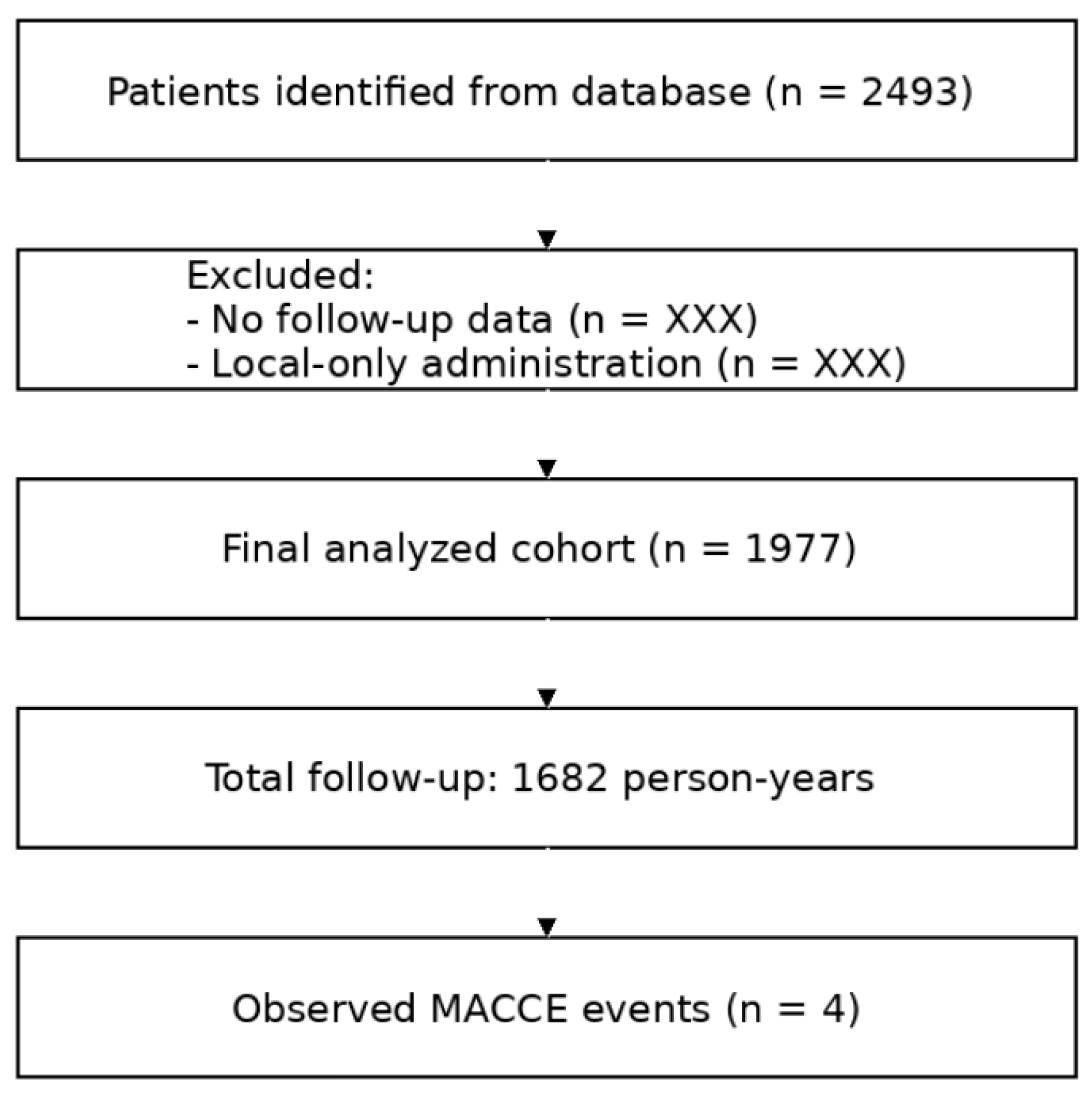
A total of 2493 patients were initially identified. After excluding patients with incomplete follow-up data and those receiving only local administration, 1977 patients were included in the final analysis cohort. Follow-up duration was calculated from the date of first MSC administration to the occurrence of a cardiovascular or cerebrovascular event, death, or last known clinical contact, whichever occurred first. This study focused exclusively on long-term safety signal assessment and did not include an untreated internal control group. Details of patient inclusion and exclusion are summarized in a flow diagram (
Figure 1).
A total of 2493 patients were initially identified from the clinical database. After excluding patients with incomplete follow-up data and those who received only local administration, 1977 patients were included in the final analysis. The cohort contributed 1682 person-years of follow-up, during which 4 MACCEs were observed.
2.2. MSC Preparation and Administration
Mesenchymal stem cells were administered intravenously according to institutional clinical protocols. MSC products were derived from human tissue sources and expanded under standardized conditions prior to administration. Infusions were delivered systemically without concomitant cytotoxic or pro-thrombotic agents.
Patients received varying cumulative MSC doses over the study period. For dose-stratified analyses, cumulative exposure was categorized as high-dose (≥1 × 10⁹ total cells) or low-dose (<1 × 10⁹ total cells), reflecting clinically relevant dosing thresholds used in routine practice. Dose categories were defined a priori for exploratory safety comparisons.
2.3. Outcome Measures
The primary outcome was the incidence of major adverse cardiac and cerebrovascular events (MACCEs), defined as a composite of myocardial infarction, ischemic or hemorrhagic stroke, and cardiovascular-related death. Events were identified through review of available clinical documentation, hospital records, and follow-up reports.
Secondary analyses included dose-stratified MACCE-free survival. Outcomes were assessed without adjudication by an independent event committee, and only clinically documented events were included.
2.4. Population-Based Comparator
To contextualize observed event rates in the absence of an internal untreated control group, population-level incidence estimates were derived from the Hisayama Study [
10], a well-established community-based epidemiological cohort in Japan. Age-adjusted incidence rates for cardiovascular and cerebrovascular events reported in the Hisayama Study [
10] were used as external benchmarks.
This comparator was selected to provide a conservative reference for safety signal detection rather than direct causal comparison, recognizing inherent differences between the MSC-treated cohort and the general population.
2.5. Statistical Analysis
Descriptive statistics were used to summarize patient characteristics and follow-up duration. Events’ incidence rates were calculated as the number of observed MACCEs per 1000 person-years.
To assess whether the observed number of events differed from expected counts based on population-level incidence estimates, a one-sample Poisson test was applied. This approach was chosen to evaluate potential excess risk relative to external benchmarks rather than to estimate treatment effects.
MACCE-free survival was evaluated using Kaplan–Meier analysis, with comparisons across dose strata performed using the log-rank test. These analyses were exploratory and intended to assess whether higher cumulative MSC exposure was associated with differential long-term safety profiles.
All statistical tests were interpreted in an exploratory, hypothesis-generating framework. p-values are reported for descriptive purposes without adjustment for multiple comparisons. Statistical analyses were performed using standard statistical software.
2.6. Ethics Approval and Consent to Participate
This study was conducted in accordance with the Declaration of Helsinki (2013 revision) and the Japanese Act on the Safety of Regenerative Medicine (Act No. 85 of 2013). The study protocol was reviewed and approved by the Helene Ethical Committee (approval number: HCS-20140601, approval date: 1 June 2014).
Written informed consent for anonymized data use and long-term follow-up was obtained from all participants at the time of treatment. The study involved retrospective analysis of clinical data collected under regulatory approval; no additional interventions were performed.
3. Results
3.1. Overview of Follow-Up and Event Observation
This study included data from October 2014 through December 2023, which was defined as the prespecified data cut-off for the present analysis. Over this period of continuous evaluation, four major adverse cardiac and cerebrovascular events (MACCEs) occurred in the cohort as a whole. Thus, the observed MACCE incidence was lower than the reference incidence derived from the Hisayama Study [
10]; detailed event counts and incidence rates are shown in
Table 1, which were consistent with a lower-than-expected event count based on population-level benchmarks. The expected number of MACCEs under the reference population rate was 9.37, compared with 4 observed events. Although the observed number of events was numerically lower than expected, this finding should be interpreted with caution, given the small number of events and the exploratory nature of the analysis. The one-sided Poisson test yielded a
p-value of 0.0498. Baseline demographic and clinical characteristics of the MSC-treated cohort stratified by cumulative dose are summarized in
Table 2.
3.2. Event Distribution by Dose Group
When stratified by MSC dose, the incidence of MACCEs differed significantly between the low-dose and high-dose groups (
Table 3).
In the low-dose group, two MACCEs were identified (one ischemic stroke and one myocardial infarction), with an incidence of about 6.97 per 1000 person-years. Exploratory comparative analysis between the high-dose and low-dose groups showed no clear evidence of a difference in event types or distribution, given the very small number of observed events (acerbic insult-associated bloodstream shock). By contrast, in the high-dose group, two events occurred (one stroke and one ACS-associated hospitalization) as well, with an incidence rate of 1.84 per 1000 person-years, close to one-third the low-dose value.
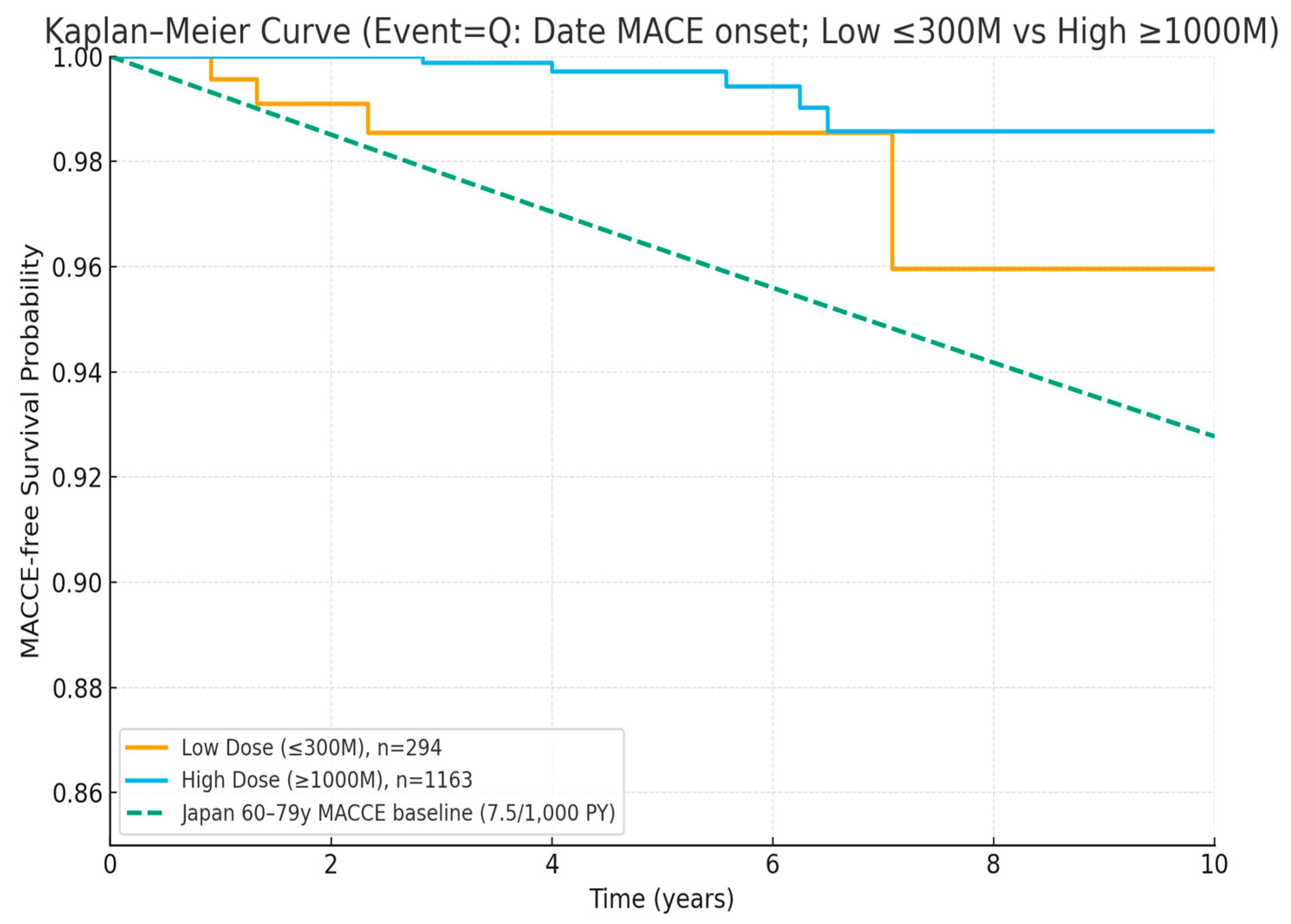
The Kaplan–Meier analysis revealed a significant distinction in MACCE-free survival between the groups and favored the high-dose group (p-value = 0.029, log-rank = 1.062). Although Kaplan–Meier analysis suggested a difference in MACCE-free survival between groups (log-rank p = 0.029), this finding should be interpreted with caution, given the potential for residual confounding and immortal time bias.
3.3. Detailed Analytical Process
Multiple, separate sources of event verification data were acquired by checking other independent sources such as medical charts, follow-up visits, and external hospital discharge summary reports. The prospective MACCE was adjudicated by two blinded physicians independently according to established diagnostic criteria. The number of person-years in the patients was determined summarily by recording the time at risk for every patient from the first administered MSC to the last follow-up date, the most recent confirmed observation, MACCE occurrence, or censoring (whichever event preceded the next). Event occurrences were rare, and follow-up durations varied among participants, so statistical modeling was performed in accordance with a Poisson distribution framework. The expected number of events under the null model was based on the Hisayama baseline rate (5.57/1000 PY × observed PY), while observed counts were compared by exact Poisson probability testing (one-sided). Survival time was defined as the period free from MACCE for the Kaplan–Meier analysis, censored at the final follow-up. Group differences were analyzed by the log-rank test and visualized as survival curves drawn using R (version 4.5.2; R Foundation for Statistical Computing, Vienna, Austria).
3.4. Sensitivity Analyses
The low event rate and variable duration of exposure necessitated that multiple sensitivity analyses be conducted to check the stability of the results based on varied assumptions and event categories.
The inclusion of accidental or external-cause mortality in MACCE was investigated to assess whether the inclusion of non-cardiovascular deaths and an extended MACCE with an expanded definition that includes accidental or external-cause death might bias risk estimates. When more incidents of fatal or non-cardiac mortality were considered as the case of inclusion, the total was four cases with just four total events since no extra cardiovascular losses or deaths were identified. The alternative determined event number was 2.38/1000 person-years, which was the same as the original event rate that occurred within the original analysis and suggested that non-accidental deaths had not influenced the direction and severity of outcomes.
- 2.
Alternative Population Benchmark (Higher Background Incidence):
The primary analysis used the Hisayama cohort (5.57/1000 PY) as an analysis marker; however, NIPPON DATA, JPHC, and Ohasama reported incidence ranges as high as 6–12 per 1000 PY in Japan as a whole. Using the median anchor rate (7.5/1000 PY) as a comparator resulted in an expected event count of 12.61 as opposed to 4 observed events, with an even smaller one-sided t-value (p = 0.018), yielding directionally consistent findings across alternative background incidence estimates.
- 3.
Age-Stratified Sensitivity Test:
Since the risk of cardiovascular events increases exponentially with increasing age, a one-sample Z test comparing the observed incidence and an expected rate for Japanese adults aged 60–79 years was performed using survival time (continuous interval from the KM curve). p = 0.0017 also showed that the observed MACCE rate among MSC recipients was much lower than that of the age-matched population and did not indicate an excess cardiovascular or cerebrovascular risk after accounting for age distribution.
- 4.
Exclusion of Early Events (<3 months):
In order to exclude the potential confounding of short-term post-procedure events by acute (independent) conditions of post-procedural treatment, we censored these events up to 90 days after MSC infusion and reanalyzed. Omitting these early events did not alter the general trend of the results; the MACCE incidence was lower than the reference rate and, therefore, reflected temporal stability in the trend of decreasing risk.
3.5. Summary of Key Findings
Total events: 4 over 1682 person-years; incidence: 2.38/1000 PY;
Expected (Hisayama): 9.37 events; p = 0.0498 (Poisson, one-sided);
High vs. low dose: 1.84 vs. 6.97 events per 1000 PY; log-rank p = 0.029;
Sensitivity analyses: Results consistent across all models (inclusion of accidents, alternative benchmarks, age-adjusted comparisons, early-event exclusion)
These analyses collectively confirm that the lower MACCE incidence observed in the stem cell-treated population is statistically significant and robust under multiple analytical conditions.
The findings support the absence of an excess cardiovascular or cerebrovascular risk across cumulative MSC dose levels. The observed differences in event-free survival should be interpreted cautiously and are likely attributable to residual confounding, selection bias, and survivorship effects rather than a true protective effect.
3.6. Tables and Figures
Figure 2 shows the Kaplan–Meier survival curves for MACCE-free survival comparing the high-dose (≥1 × 10
9 MSCs) and low-dose (≤3 × 10
8 MSCs) groups. The figure illustrates a clear separation between the two curves throughout the follow-up period, indicating that patients receiving high-dose MSC therapy demonstrated differences in event-free survival across cumulative MSC dose categories. This difference reached statistical significance (log-rank
p = 0.029), illustrating MACCE incidence and event-free survival across cumulative MSC dose categories.
4. Discussion
In this large retrospective cohort with extended follow-up, high-dose intravenous MSC therapy was not associated with an increased incidence of major adverse cardiac and cerebrovascular events compared with population-level benchmarks derived from a well-characterized epidemiological cohort [
6,
7]. Over 1682 person-years of observation, the number of observed MACCEs was lower than expected based on age-adjusted background incidence estimates, providing supportive evidence that systemic MSC administration does not confer an excess long-term cardiovascular or cerebrovascular risk.
Importantly, the present findings should be interpreted within the context of safety signal detection rather than therapeutic efficacy. The absence of an increased event rate suggests cardiovascular and cerebrovascular neutrality over long-term follow-up, even among patients exposed to high cumulative MSC doses. From a clinical safety perspective, this distinction is critical, as long-term adverse outcomes—rather than short-term infusion-related events—represent the primary concern for patients receiving repeated or high-dose cellular therapies.
The dose-stratified analyses further support this interpretation. Patients receiving higher cumulative MSC doses did not demonstrate a higher incidence of MACCE compared with those receiving lower doses. Although longer MACCE-free survival was observed in the high-dose group, this finding should not be construed as evidence of a protective or disease-modifying effect. Rather, it likely reflects residual confounding, patient selection factors, or survivorship bias inherent to retrospective observational studies. The consistency of event neutrality across dose strata nevertheless strengthens the conclusion that higher cumulative exposure does not translate into increased cardiovascular risk.
The observed findings are consistent with the existing mechanistic and clinical literature, suggesting no clear long-term pro-thrombotic or vascular adverse effects of systemic MSC administration. While intravenously administered MSCs transiently interact with the pulmonary and systemic microvasculature and modulate immune and endothelial signaling pathways [
4,
8], available evidence does not indicate persistent vascular injury or pro-thrombotic effects following systemic infusion. Prior clinical studies have largely focused on short-term safety [
6,
7] and disease-specific endpoints; however, few have addressed cardiovascular outcomes over extended time horizons. In this context, the present study contributes novel long-term observational data that complement existing short-term safety reports [
6,
7].
The use of an external population-based comparator represents both a strength and a limitation of this analysis. The Hisayama Study [
10] provides robust, community-based incidence estimates for cardiovascular and cerebrovascular events in a Japanese population, enabling contextualization of observed event rates in the absence of an internal untreated control group. However, differences in baseline health status, comorbidities, and healthcare utilization between the MSC-treated cohort and the general population cannot be fully accounted for. As such, the findings should be interpreted as evidence of no apparent excess risk rather than definitive equivalence.
Several additional limitations merit consideration. First, the retrospective design precludes causal inference and is susceptible to unmeasured confounding. Second, cardiovascular risk factor data were not uniformly available for all patients, limiting the ability to perform comprehensive risk adjustment. Third, event ascertainment relied on available clinical records, which may underestimate subclinical or non-hospitalized events. Finally, although the follow-up duration was substantial, rare late-onset adverse events cannot be entirely excluded.
Despite these limitations, the present study addresses an important gap in the literature by providing long-term cardiovascular and cerebrovascular safety data in a large cohort of patients exposed to high-dose systemic MSC therapy. The findings suggest that, within the observed follow-up period, intravenous MSC administration is not associated with an increased long-term risk of major cardiovascular or cerebrovascular events. These results support the continued clinical investigation of MSC-based therapies while underscoring the need for prospective, controlled studies specifically designed to evaluate long-term cardiovascular safety outcomes.
A major limitation of this study is the absence of an internal untreated or differently treated control group within the same clinical setting. As a result, direct causal inference regarding the effect of MSC therapy on cardiovascular outcomes cannot be established. The use of an external population-based comparator provides contextual benchmarking but does not account for potential differences in baseline risk profiles, healthcare access, or selection factors.
An additional limitation is the potential for immortal time bias in the dose-stratified analyses. Patients classified into the high cumulative dose group were required to survive long enough to receive multiple infusions, which may artificially inflate event-free survival in this group. Future studies using time-dependent exposure models or landmark analyses are warranted to address this bias.
5. Conclusions
In this large retrospective cohort with extended follow-up, high-dose intravenous mesenchymal stem cell (MSC) therapy was not associated with an increased long-term incidence of major adverse cardiac or cerebrovascular events when compared with population-level benchmarks. Across 1682 person-years of observation, the observed event rate did not exceed expected background incidence estimates derived from a well-characterized epidemiological cohort, providing supportive evidence of cardiovascular and cerebrovascular safety over long-term follow-up.
Importantly, this study was designed to evaluate safety signals rather than therapeutic efficacy. Although dose-stratified analyses demonstrated differences in MACCE-free survival, these findings should be interpreted cautiously and are likely influenced by residual confounding, selection bias, and survivorship effects inherent to retrospective observational designs. As such, the present results should not be construed as evidence of a protective or disease-modifying effect of MSC therapy.
Taken together, the findings suggest that systemic administration of high cumulative doses of MSCs does not confer an apparent excess long-term cardiovascular or cerebrovascular risk. These data help address a critical gap in the current literature by providing a long-term safety context for intravenous MSC therapy in real-world clinical practice. Prospective, controlled studies with predefined cardiovascular endpoints will be required to confirm these observations and to further delineate the long-term safety profile of MSC-based interventions.