Article

Clinical and Molecular Challenges in Diagnosing Myeloproliferative Neoplasms with Low JAK2V617F Allelic Burden: A Single-Center Perspective and Literature Overview


1
Department of Clinical and Molecular Sciences (DISCLIMO), Università Politecnica delle Marche, 60126 Ancona, Italy
2
Hematology Clinic, Azienda Ospedaliero Universitaria delle Marche, 60126 Ancona, Italy
*
Author to whom correspondence should be addressed.
Int. J. Transl. Med. 2026, 6(2), 13; https://doi.org/10.3390/ijtm6020013
Submission received: 19 February 2026 / Revised: 20 March 2026 / Accepted: 23 March 2026 / Published: 30 March 2026

Abstract

Background/Objectives: The increasing sensitivity of molecular diagnostic techniques has led to the frequent detection of low-level JAK2 V617F mutations in individuals without overt myeloproliferative neoplasms (MPNs), creating uncertainty regarding their biological and clinical significance. This study aimed to evaluate the clinical relevance, thrombotic risk, and hematologic evolution associated with low JAK2 V617F allele burden. Methods: We conducted a retrospective single-center study including adult patients tested for JAK2 V617F between January 2016 and December 2023. Patients with a variant allele frequency (VAF) <2% who did not meet WHO or 2022 International Consensus Classification diagnostic criteria for MPN at baseline were included. Clinical characteristics, laboratory parameters, molecular findings, thrombotic events, and longitudinal ou--comes were analyzed. Results: Among two-thousand-three-hundred-seventy-two tested subjects, 55 patients (9.2% of JAK2-positive cases) harbored a low-level JAK2 V617F mutation (median VAF 0.35%). Over a median follow-up of 31.7 months, 12 patients (21.8%) progressed to overt MPN. Baseline VAF was significantly higher in patients who evolved to MPN compared to non-progressors. Thrombotic events occurred in 30.9% of patients and were associated with higher VAF values irrespective of MPN diagnosis. Serial molecular analyses showed stable persistence of the mutant clone over time. Conclusions: Low-burden JAK2 V617F mutations represent clinically relevant clonal events associated with thrombotic risk and potential disease evolution. These findings support the need for structured clinical and molecular follow-up even in the absence of initial diagnostic criteria.

1. Introduction

Insight into the molecular basis of Philadelphia-negative myeloproliferative neoplasms (MPNs) was substantially advanced in 2005 through the independent identification of the JAK2 V617F mutation by multiple research groups, an achievement that laid the foundation for the current understanding of the molecular pathogenesis of these disorders [1,2,3,4]. The JAK2 V617F mutation, located in exon 14 of the JAK2 gene, arises from a G > T substitution at nucleotide 1849, resulting in a valine-to-phenylalanine change at codon 617. JAK2 encodes a non-receptor tyrosine kinase essential for cytokine receptor signaling, as these receptors lack intrinsic catalytic activity and rely on associated intracellular kinases. Ligand binding induces receptor conformational changes that activate JAK-dependent signaling cascades, including STAT transcription factors, the MAPK pathway, and the PI3K/AKT pathway. Structural studies have shown that the V617F mutation disrupts the inhibitory interaction between the JH2 pseudokinase and the JH1 catalytic domains, leading to enhanced kinase activity [5]. The overall effect is an enhanced enzymatic activity, providing a biochemical basis for the hypersensitivity to cytokine stimulation that was hypothesized by William Dameshek as a possible pathogenetic mechanism underlying myeloproliferative neoplasms [6]. The JAK2 V617F mutation represents the most prevalent founding genetic alteration in Myeloproliferative Neoplasms (MPNs) and is identified in more than 95% of patients diagnosed with Polycythemia Vera (PV) as well as in approximately 50–60% of those affected by Essential Thrombocythemia (ET) and Primary Myelofibrosis (PMF) [1,2,3,4].
Additional JAK2 gene mutations, including insertions and deletions predominantly involving exon 12, have also been described and are associated with comparable activating functional effects. These variants account for the small proportion of patients with Polycythemia Vera (approximately 5%) who do not harbor the canonical V617F mutation [7]. The prognosis of PV patients harboring JAK2 exon 12 mutations does not appear to differ from that of patients with the classic JAK2 V617F mutation [8].
In the 2008 World Health Organization (WHO) classification, identification of the JAK2 V617F mutation was formally established as a major diagnostic criterion for Philadelphia-negative Myeloproliferative Neoplasms (MPNs), including Polycythemia Vera (PV), Essential Thrombocythemia (ET), and Primary Myelofibrosis (PMF). Subsequent updates in 2016 and the more recent 2022 International Consensus Classification (ICC) confirmed the central role of bone marrow morphology while incorporating molecular markers as critical elements for establishing clonality, enhancing diagnostic accuracy, and refining prognostic stratification [9,10,11,12].
Beyond the classical MPNs, JAK2 V617F has also been reported, albeit infrequently, in other myeloid neoplasms such as chronic myelomonocytic leukemia (CMML), myelodysplastic/myeloproliferative overlap syndromes, systemic mastocytosis, and chronic neutrophilic leukemia [13].
Quantitative assessment of the JAK2 V617F allele burden, defined as the proportion of mutant relative to total JAK2 alleles, has become a clinically relevant parameter. A high allele burden (>50%) is typically associated with homozygosity for the mutation, reflecting clonal expansion and correlating with an increased risk of thrombotic complications, particularly venous thromboembolism (VTE), in both PV and ET. More broadly, the variant allele frequency (VAF) of driver mutations has been shown to correlate with disease severity, clinical complications, and long-term outcomes, including durability of response and risk of progression to myelofibrosis, thereby representing a marker of advanced disease biology [14,15,16]. In contrast, in PMF, a low allele burden (<20%) has been linked to shorter overall survival, increased leukemic transformation, and more aggressive clinical phenotypes [17,18].
From a biological perspective, allele burden reflects the proportion of hematopoietic cells harboring the driver mutation and therefore serves as an indicator of clonal dominance. In PV, patients with an allele burden >50% frequently exhibit higher hematocrit levels, reduced serum erythropoietin concentrations, and more marked myeloproliferation, whereas those with an allele burden <20% more often display indolent disease courses or early, subclinical disease manifestations [19].
Advancements in allele-specific real-time quantitative PCR, digital droplet PCR (ddPCR), and next-generation sequencing (NGS) have allowed for the detection of JAK2 V617F mutant clones at very low frequencies—down to 0.01% of total alleles [20,21]. These high-sensitivity approaches have enabled the detection of low-level JAK2-mutated clones (VAF < 1%), even in individuals without overt hematologic abnormalities, thereby reshaping the distinction between benign clonal expansion and neoplastic transformation.
Recent prospective studies indicate that small JAK2-mutant clones may persist over time without inevitably progressing to overt MPN, particularly in older individuals. This condition, encompassed within the spectrum of Clonal Hematopoiesis of Indeterminate Potential (CHIP), is characterized by the presence of somatic mutations in genes such as DNMT3A, TET2, ASXL1, or JAK2 that confer a selective advantage to hematopoietic stem cells in the absence of cytopenias or morphological dysplasia [22,23].
The prevalence of CHIP increases with advancing age and is observed in approximately 10–20% of individuals older than 70 years. Despite its asymptomatic nature, CHIP is associated with clinically relevant health risks; large genomic and epidemiologic studies have shown that individuals harboring JAK2-mutated CHIP have a 2–4-fold higher risk of cardiovascular and thromboembolic events, including stroke, myocardial infarction, and venous thrombosis. These associations are thought to reflect the pro-inflammatory phenotype of mutated myeloid cells, which promotes endothelial activation and contributes to vascular dysfunction [24]. Furthermore, the presence of JAK2 V617F in CHIP has been linked to accelerated atherosclerosis, progression of chronic kidney disease, and increased all-cause mortality. Collectively, these observations underscore that JAK2 V617F functions not only as a neoplastic driver but also as a multisystem pathogenic factor with significant implications for both hematologic and cardiovascular health [25,26,27,28].
In light of these complexities, interpretation of a low allele burden requires careful clinical context. Evidence from published studies, including the monocentric experience reported by Perricone et al., suggests that a threshold of approximately 0.8% may help distinguish true clonal myeloproliferation from reactive or CHIP-associated clones [19]. In clinical practice, repeated testing and integration with bone marrow morphology, blood counts, serum erythropoietin, and complementary mutation profiling (CALR, MPL, ASXL1, etc.) are recommended. Serial VAF monitoring also provides insight into clonal dynamics, distinguishing transient clones from expanding malignant ones; however, the optimal timing, frequency, and clinical indications for molecular monitoring have not yet been standardized and are not currently defined by international consensus guidelines.
Notably, reductions in JAK2 V617F VAF during cytoreductive or interferon therapy have been associated with improved hematologic control; however, decreases in allele burden alone should not be interpreted as a surrogate marker of molecular remission in the absence of concordant histologic and clinical findings [29,30].
In summary, quantitative assessment of JAK2 V617F has progressed beyond its original diagnostic role to become a multidimensional tool encompassing molecular characterization, prognostic stratification, and evaluation of systemic risk. Careful interpretation is particularly warranted in the context of low-level mutation detection, in order to prevent overdiagnosis while allowing timely identification of early myeloproliferative evolution. Multiple independent studies have documented the presence of JAK2 V617F in individuals without overt hematologic disease, especially among older populations, indicating that its detection is not exclusively linked to clinically manifest myeloproliferative neoplasms. These observations raise relevant biological and clinical considerations, as longitudinal cohort analyses have associated JAK2 V617F–positive clonal hematopoiesis with reduced cancer-free survival and shorter overall survival (OS) [31,32,33,34]. Beyond hematologic malignancies, the mutation has also been implicated in cardiovascular pathology, with specific reports demonstrating a significant association between JAK2 V617F and myocardial infarction risk [35].
Over the past decade, the sensitivity of molecular diagnostic techniques has increased substantially, allowing the detection of mutant clones with VAF below 1% through advanced quantitative and digital PCR methodologies. While this technical progress has broadened insights into the presence and behavior of low-level JAK2-mutant clones, their exact clinical relevance remains incompletely defined.
In this study, we aimed to characterize the clinical and biological features, disease phenotype, and outcomes of patients harboring low-JAK2 V617F allele burdens in the absence of a confirmed diagnosis of MPN at baseline.

2. Material and Methods

This retrospective study included patients tested for the JAK2 V617F mutation at the Hematology Unit of Azienda Ospedaliera Universitaria delle Marche (Ancona, Italy) between January 2016 and December 2023. Clinical and laboratory data were retrieved from electronic medical records. Eligible patients were ≥18 years old and had undergone molecular testing for JAK2 V617F, with results falling within a gray-zone range, defined as a variant allele frequency (VAF) <2% but above the analytical sensitivity threshold of the assay. At the time of initial evaluation, none of the patients fulfilled the World Health Organization (WHO) diagnostic criteria for myeloproliferative neoplasms (MPN). Baseline variables included hemoglobin level, leukocyte count, platelet count, serum erythropoietin levels, JAK2 V617F VAF, and the occurrence of thrombotic events within one year of molecular testing. Patients were subsequently followed to evaluate the development of MPN or the occurrence of thrombotic complications. Thrombotic events were classified as arterial or venous and further categorized according to their occurrence in typical or atypical anatomical sites. Clinical follow-up was performed according to routine hematologic practice, with scheduled evaluations including clinical examination and complete blood counts every six months during the first two years after detection of the mutation and annually thereafter, unless earlier reassessment was clinically indicated. Molecular reassessment of JAK2 V617F VAF during follow-up was performed when clinically required, particularly in the presence of evolving hematologic abnormalities.
Genomic DNA was extracted from peripheral blood granulocytes using the QIAamp DNA Blood Mini Kit (Qiagen, Hilden, Germany) according to the manufacturer’s instructions. DNA concentration and purity were assessed spectrophotometrically, and approximately 25 ng of genomic DNA was used for each PCR reaction. Qualitative detection of the JAK2 V617F mutation was performed using the commercial allele-specific TaqMan® probe-based assay ipsogen JAK2 MutaScreen Kit (Qiagen, Hilden, Germany; Cat. No. 673213) following the manufacturer’s protocol. This assay employs two allele-specific hydrolysis probes labeled with distinct fluorophores (FAM and VIC) designed to selectively hybridize with the mutant (V617F) or wild-type (WT) allele. During PCR amplification, the probe complementary to the target sequence is cleaved by the 5′–3′ exonuclease activity of Taq DNA polymerase, resulting in separation of the reporter fluorophore from the quencher and generation of a detectable fluorescence signal. End-point fluorescence discrimination allows identification of samples carrying the wild-type allele, the mutant allele, or both. Real-time PCR reactions were performed on Rotor-Gene 6000 or Rotor-Gene Q instruments (Qiagen, Hilden, Germany) using a final reaction volume of 25 µL, consisting of 20 µL reaction premix and 5 µL DNA template, according to the manufacturer’s instructions. The analytical sensitivity of the qualitative assay is reported by the manufacturer to be approximately 1% mutant allele burden.
Quantitative assessment of JAK2 V617F allele burden was performed using the ipsogen JAK2 MutaQuant Kit (Qiagen, Hilden, Germany; Cat. No. 673113), which employs allele-specific primers and hydrolysis probes to selectively amplify the wild-type and V617F alleles in two separate reactions. Each reaction contained 25 ng of genomic DNA in a total reaction volume of 25 µL, and amplification was performed on the Rotor-Gene Q MDx 5plex HRM platform (Qiagen, Hilden, Germany) according to the manufacturer’s cycling conditions. Real-time fluorescence monitoring during the exponential phase of amplification enabled accurate quantification of mutant and wild-type alleles. The variant allele frequency (VAF) was calculated from the cycle threshold (Ct) values obtained for the mutant and wild-type reactions using the ΔCt method, as recommended by the manufacturer. VAF was expressed as the percentage of mutant JAK2 copies relative to total JAK2 copies, calculated as the ratio between the number of V617F copies and the sum of V617F and wild-type copies multiplied by 100. Quantification was performed using calibration standards and internal controls included in the commercial kit to ensure assay accuracy and reproducibility. The analytical sensitivity of the quantitative assay is reported to be approximately 0.1% mutant allele burden.
Categorical variables were compared using the Chi-squared test, while continuous variables were analyzed using Student’s t-test, Mann–Whitney U test, or ANOVA, as appropriate. All statistical analyses were performed using R (version 4.4.1, R Foundation for Statistical Computing, Vienna, Austria) and SPSS software (version 28.0, IBM Corp., Armonk, NY, USA), with p-values < 0.05 considered statistically significant. All patients provided written informed consent for participation in the study, which was conducted in accordance with the Declaration of Helsinki and approved by the local ethics committee. Informed consent was obtained from all subjects involved in the study. The study was conducted in accordance with the Declaration of Helsinki and approved by the Regional Ethics Committee of Marche (Comitato Etico Regionale delle Marche, CERM), Azienda Ospedaliero Universitaria delle Marche (Ancona, Italy) (ID4387/2025).

3. Results

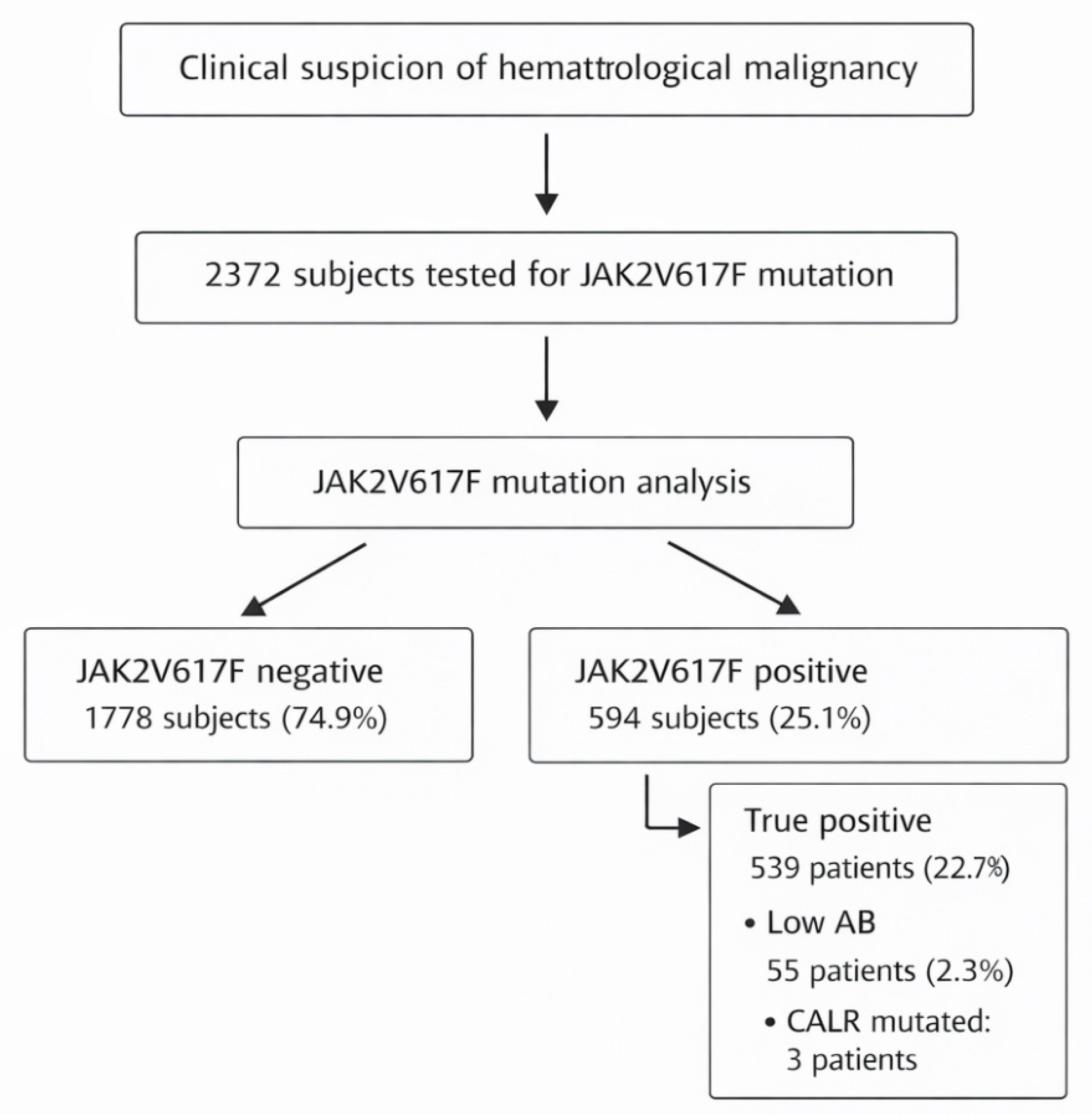
We tested 2372 subjects for JAK2V617F mutation due to clinical suspicion of hematological malignancy. Overall, 1778 (74.9%) of the 2372 subjects that were tested for the JAK2V617F mutation resulted negative for the mutation. A total of 55/594 (9.2%) patients had a low (0.02–1.9750%, median 0.35%) VAF, with higher values observed in patients with thrombocytosis compared to those with erythrocytosis (0.451% vs. 0.25%, p = 0.047). In most cases (45 patients, 81.8%), VAF was below 1%, while only 2 (3.6%) patients had a VAF above 2% (Figure 1).
Of the total cohort, 31 patients were tested for erythrocytosis, and the remaining 24 for thrombocytosis. All patients, at the time of the initial JAK2 assessment, did not meet the diagnostic criteria for myeloproliferative neoplasms (MPNs). Table 1 presents the data from the patients’ initial evaluation.
During follow-up, patients were monitored with complete blood counts, clinical assessments, and evaluation for other MPN driver mutations.
The median erythropoietin level was 5.4 mU/mL (range: 1–16.8). Among patients with polycythemia, 51% had reduced erythropoietin levels below 5 mU/mL. At the time of the reported quantitative JAK2 test, no patient met the criteria for MPN. Of the 31 cases with erythrocytosis, 4 (12.9%) were ultimately diagnosed with polycythemia vera (PV), and 1 case was diagnosed as pre-fibrotic myelofibrosis (PMF). The median hematocrit was 50.2% (range: 46.2–56.9). Ten cases required phlebotomy, and two patients underwent cytoreductive therapy.
Among the 24 cases with thrombocytosis, 7 (22.5%) were diagnosed as essential thrombocythemia (ET). The median platelet count was 564 × 109/L (range: 451–1475), and 3 out of 24 patients received cytoreductive therapy.
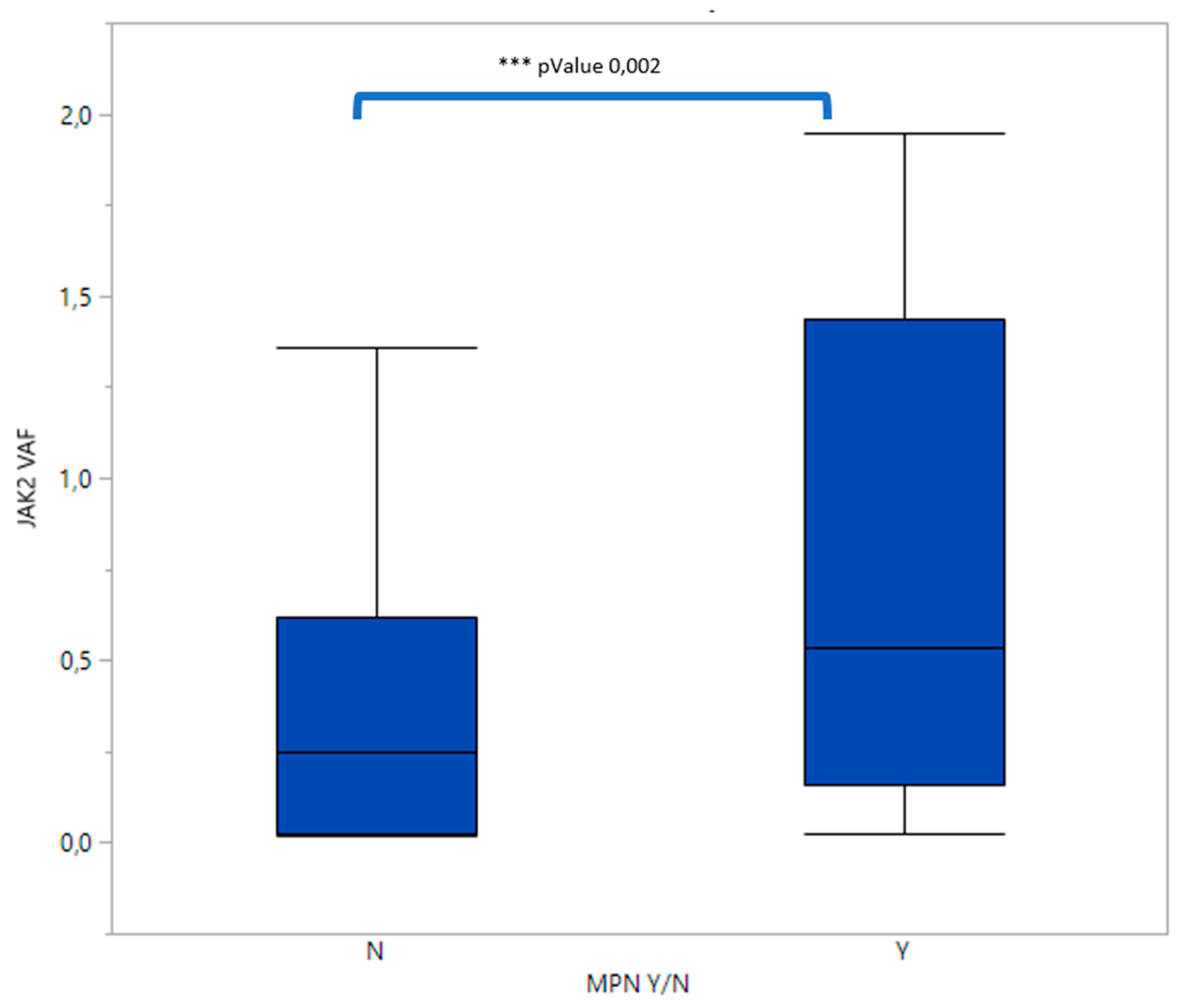
The median time from the first quantitative JAK2 assessment to the onset of MPN was 21.06 months (range: 9.2–43.6). When evaluating the VAF at onset, patients who later developed an MPN had a higher median VAF (0.532%, range: 0.023–1.946) compared to those without an MPN diagnosis (0.24%, range: 0.02–1.975; p-value = 0.02; Figure 2).
Sequential samples were collected in 27 out of 55 cases, and JAK2V617F was confirmed in all patients. With a median follow-up of 31.7 months, the JAK2V617F clone remained stable over time, with a VAF of less than 2% in all cases.
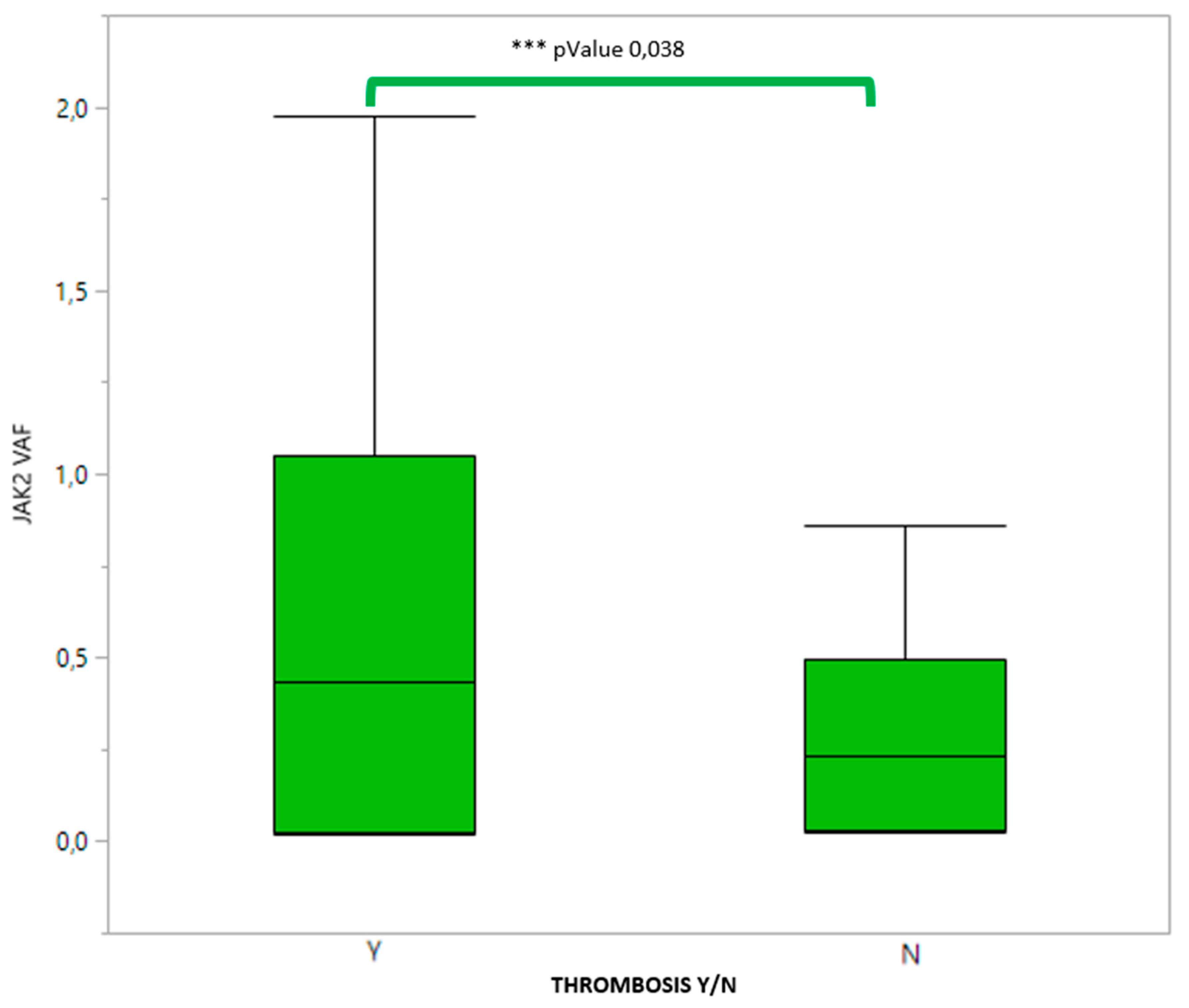
In the studied cohort, 17 patients (30.9%) experienced a thrombotic event, with a median time of 4.34 months from the molecular assessment. In 8 cases, the thrombotic event was concomitant with or occurred within the year preceding JAK2 testing. Specifically, there were 8 myocardial infarctions, 2 cases of critical limb ischemia, 2 pulmonary embolisms, 2 portal vein thromboses, and 3 lower-limb venous thromboses. Among the patients with thrombosis, 52.9% had thrombocytosis. The rate of thrombosis in patients later diagnosed with MPN was comparable to that in those without a diagnosis (25% vs. 32.5%, p-value: 0.57). However, patients who developed thrombosis had a higher median JAK2 allele burden compared to those who did not (0.44% vs. 0.23%, p-value: 0.038; Figure 3).

4. Discussion and Literature Review

While detection of the JAK2 V617F mutation remains central to the diagnostic workup of Philadelphia-negative MPNs, the increasing application of highly sensitive molecular assays has led to the identification of low-allele burden mutations both in patients with overt MPN and in individuals without clear hematologic abnormalities, thereby complicating diagnostic and prognostic interpretation. In established MPNs, a low-JAK2 V617F allele burden (VAF < 10%) does not necessarily reflect indolent disease; Perricone et al. reported that 63% of patients with an allele burden ≤3% fulfilled WHO criteria for MPN, and that all cases with VAF ≥0.8% subsequently evolved toward a definite neoplastic phenotype, indicating that even minimal mutant allele fractions may represent early clonal proliferation rather than reactive hematopoiesis [19]. Serial molecular assessment has demonstrated that clone size is not static but may vary over time, showing either expansion or regression, highlighting the dynamic nature of clonal hematopoiesis. Consistently, Nienhold et al. reported that in patients with an overall VAF ≤20%, the JAK2-mutated clone was frequently enriched within erythroid or megakaryocytic compartments, suggesting a late and lineage-restricted clonal expansion rather than diffuse hematopoietic involvement; importantly, despite the low global allele burden, these clones retained biological activity and clinical relevance, with survival outcomes comparable to those observed in high-VAF MPNs [36]. In addition to overt neoplastic disease, JAK2 V617F mutations have been described in patients presenting with thrombotic events despite normal peripheral blood counts, posing a relevant diagnostic challenge. In this setting, Levraut et al. reported a low mutation prevalence (2.65%) among 1135 patients; however, all individuals with VAF ≥2% subsequently developed MPN-related features during follow-up, whereas those with lower VAF values remained largely stable. Notably, splenomegaly emerged as the strongest independent predictor of JAK2 V617F positivity (OR 43, 95% CI 4.7–389) [37]. These findings support the concept that small JAK2-mutant clones in otherwise healthy subjects may reflect an early phase of clonal hematopoiesis of indeterminate potential (CHIP), capable of remaining quiescent or progressing toward overt MPN depending on selective pressures. In a large retrospective analysis, Limvorapitak et al. evaluated 5079 individuals tested over a six-year period and identified 189 JAK2 V617F-positive cases with VAF <10%. No significant differences in clinical outcomes were observed between patients with VAF <2% and those with VAF ranging from 2 to 10%, with similar rates of thrombosis (18% in both groups), disease progression (<5%), and comparable five-year overall survival (81.0% vs. 81.7%) [38]. Interestingly, even in patients without a hematologic diagnosis, thrombotic events occurred in approximately 20% of cases, suggesting that JAK2 mutation positivity, irrespective of allele fraction, confers an intrinsic vascular risk.
Our data suggest that approximately 2.3% of patients tested for the JAK2 V617F mutation because of suspected myeloproliferative neoplasms harbor a low-level mutation (VAF < 2%) without meeting WHO or 2022 ICC diagnostic criteria for MPN. During follow-up, a subset of these individuals developed overt MPN, accounting for up to 20% of cases, while thrombotic events were observed in more than 30%, irrespective of a formal MPN diagnosis. Although these rates appear higher than those expected in the general population, cautious interpretation is warranted given the observational nature of the study.
Taken together, these observations suggest that low-burden JAK2 V617F mutations lie along a biological continuum spanning clonal hematopoiesis and overt myeloproliferative neoplasia, with implications for both hematologic evolution and vascular risk. Methodological advances have been crucial in shaping this concept; notably, Lu et al. showed that chip-based digital PCR (cdPCR) provides a limit of detection of 0.08% and a limit of quantification of 0.2%, surpassing conventional qPCR and allowing reliable identification of very small mutant clones with potential for clonal expansion over time [39]. Despite these methodological advances, careful clinical interpretation remains essential, as the detection of subpercent mutant clones does not in itself imply pathological transformation. Collectively, available evidence underscores the need for an integrated diagnostic strategy combining molecular quantification, bone marrow morphology, and longitudinal clinical assessment. Although no universally accepted pathogenic threshold has been defined, VAF values in the range of 0.8% to 2% appear to be associated with clonal expansion and an increased likelihood of phenotypic evolution. Accordingly, individuals with low-level JAK2 V617F positivity—regardless of whether formal MPN diagnostic criteria are met—should be considered for structured hematologic surveillance, assessment for splenomegaly, and appropriate cardiovascular risk management, given that thrombotic risk and survival outcomes do not substantially differ across the low-VAF spectrum. Overall, low-burden JAK2 V617F mutations should not be viewed as incidental findings, but rather as early molecular signals of potential disease evolution, warranting vigilant monitoring and, in selected cases, preventive clinical strategies.

Author Contributions

E.M., D.L., and M.P.—study conception and design; material preparation; data collection and analysis; draft and final manuscript approval; I.B., R.C., and G.G.—made and interpreted mutational analyses; S.M., S.R., and A.P.—review and final manuscript approval. All authors have read and agreed to the published version of the manuscript.

Funding

This research received no external funding.

Institutional Review Board Statement

The study was conducted in accordance with the Declaration of Helsinki and approved by the Regional Ethics Committee of Marche (Comitato Etico Regionale delle Marche, CERM), Azienda Ospedaliero Universitaria delle Marche (Ancona, Italy) (ID4387/2025) approved on 26 November 2025.

Informed Consent Statement

Informed consent was obtained from all subjects involved in the study.

Data Availability Statement

Data is not publicly available.

Acknowledgments

I extend my heartfelt thanks to the patients, my family, and colleagues for their support and collaboration throughout this project. No external funding was received for this work.

Conflicts of Interest

The authors declare no conflicts of interest.

References

  1. Levine, R.L.; Wadleigh, M.; Cools, J.; Ebert, B.L.; Wernig, G.; Huntly, B.J.P.; Boggon, T.J.; Wlodarska, I.; Clark, J.J.; Moore, S.; et al. Activating mutation in the tyrosine kinase JAK2 in polycythemia vera, essential thrombocythemia, and myeloid metaplasia with myelofibrosis. Cancer Cell 2005, 7, 387–397. [Google Scholar] [CrossRef]
  2. Kralovics, R.; Passamonti, F.; Buser, A.S.; Teo, S.-S.; Tiedt, R.; Passweg, J.R.; Tichelli, A.; Cazzola, M.; Skoda, R.C. A gain-of-function mutation of JAK2 in myeloproliferative disorders. N. Engl. J. Med. 2005, 352, 1779–1790. [Google Scholar] [CrossRef]
  3. James, C.; Ugo, V.; Le Couedic, J.P.; Staerk, J.; Delhommeau, F.; Lacout, C.; Garçon, L.; Raslova, H.; Berger, R.; Bennaceur-Griscelli, A.; et al. A unique clonal JAK2 mutation leading to constitutive signaling causes polycythaemia vera. Nature 2005, 434, 1144–1148. [Google Scholar] [CrossRef]
  4. Baxter, E.J.; Scott, L.M.; Campbell, P.J.; East, C.; Fourouclas, N.; Swanton, S.; Vassiliou, G.S.; Bench, A.J.; Boyd, E.M.; Curtin, N.; et al. Acquired mutation of the tyrosine kinase JAK2 in human myeloproliferative disorders. Lancet 2005, 365, 1054–1061. [Google Scholar] [CrossRef]
  5. Bandaranayake, R.M.; Ungureanu, D.; Shan, Y.; Shaw, D.; Silvennoinen, O.; Hubbard, S.R. Crystal structures of the JAK2 pseudokinase domain and the pathogenic mutant V617F. Nat. Struct. Mol. Biol. 2012, 19, 754–759. [Google Scholar] [CrossRef]
  6. Dameshek, W. Some speculations on the myeloproliferative syndromes. Blood 1951, 6, 372–375. [Google Scholar] [CrossRef]
  7. Scott, L.M.; Tong, W.; Levine, R.L.; Scott, M.A.; Beer, P.A.; Stratton, M.R.; Futreal, P.A.; Erber, W.N.; McMullin, M.F.; Harrison, C.N.; et al. JAK2 exon 12 mutations in polycythemia vera and idiopathic erythrocytosis. N. Engl. J. Med. 2007, 356, 459–468, Correction in N. Engl. J. Med. 2007, 357, 1457. [Google Scholar] [CrossRef] [PubMed]
  8. Passamonti, F.; Elena, C.; Schnittger, S.; Skoda, R.C.; Green, A.R.; Girodon, F.; Kiladjian, J.J.; McMullin, M.F.; Ruggeri, M.; Besses, C.; et al. Molecular and clinical features of the myeloproliferative neoplasm associated with JAK2 exon 12 mutations. Blood 2011, 117, 2813–2816. [Google Scholar] [CrossRef] [PubMed]
  9. Vardiman, J.W.; Thiele, J.; Arber, D.A.; Brunning, R.D.; Borowitz, M.J.; Porwit, A.; Harris, N.L.; Le Beau, M.M.; Hellström-Lindberg, E.; Tefferi, A.; et al. The 2008 revision of the World Health Organization (WHO) classification of myeloid neoplasms and acute leukemia: Rationale and important changes. Blood 2009, 114, 937–951. [Google Scholar] [CrossRef]
  10. Arber, D.A.; Orazi, A.; Hasserjian, R.; Thiele, J.; Borowitz, M.J.; Le Beau, M.M.; Bloomfield, C.D.; Cazzola, M.; Vardiman, J.W. The 2016 revision to the World Health Organization classification of myeloid neoplasms and acute leukemia. Blood 2016, 127, 2391–2405, Erratum in Blood 2016, 128, 462–463. [Google Scholar] [CrossRef] [PubMed]
  11. Arber, D.A.; Orazi, A.; Hasserjian, R.P.; Borowitz, M.J.; Calvo, K.R.; Kvasnicka, H.; Wang, S.A.; Bagg, A.; Barbui, T.; Branford, S.; et al. Special Report International Consensus Classification of Myeloid Neoplasms and Acute Leukemias: Integrating morphologic, clinical, and genomic data. Blood 2022, 140, 1200–1228. [Google Scholar] [PubMed]
  12. Khoury, J.D.; Solary, E.; Abla, O.; Akkari, Y.; Alaggio, R.; Apperley, J.F.; Bejar, R.; Berti, E.; Busque, L.; Chan, J.K.C.; et al. The 5th edition of the World Health Organization Classification of Haematolymphoid Tumours: Myeloid and Histiocytic/Dendritic Neoplasms. Leukemia 2022, 36, 1703–1719. [Google Scholar] [CrossRef] [PubMed]
  13. Zhang, Y.; Zhao, Y.; Liu, Y.; Zhang, M.; Zhang, J. New advances in the role of JAK2 V617F mutation in myeloproliferative neoplasms. Cancer 2024, 130, 4229–4240. [Google Scholar] [CrossRef] [PubMed]
  14. Lebecque, B.; Croizier, C.; Tassin, T.; Louis, E.; Tribalat, N.; Bombardier, W.; Grandjean, A.-P.; Pante, V.; Monjanel, H.; Bouillon-Minois, J.-B.; et al. Contribution of molecular characterization to the diagnosis of MPN in patients with low JAK2(V617F) variant allelic fraction in a real-world cohort. Ann. Hematol. 2025, 104, 1587–1596. [Google Scholar] [CrossRef] [PubMed]
  15. Jaiswal, S.; Natarajan, P.; Silver, A.J.; Gibson, C.J.; Bick, A.G.; Shvartz, E.; McConkey, M.; Gupta, N.; Gabriel, S.; Ardissino, D.; et al. Clonal Hematopoiesis and Risk of Atherosclerotic Cardiovascular Disease. N. Engl. J. Med. 2017, 377, 111–121. [Google Scholar] [CrossRef]
  16. Guglielmelli, P.; Mora, B.; Gesullo, F.; Mannelli, F.; Loscocco, G.G.; Signori, L.; Pessina, C.; Colugnat, I.; Aquila, R.; Balliu, M.; et al. Clinical impact of mutated JAK2 allele burden reduction in polycythemia vera and essential thrombocythemia. Am. J. Hematol. 2024, 99, 1550–1559. [Google Scholar] [CrossRef]
  17. van Zeventer, I.A.; de Graaf, A.O.; Salzbrunn, J.B.; Nolte, I.M.; Kamphuis, P.; Dinmohamed, A.; van der Reijden, B.A.; Schuringa, J.J.; Jansen, J.H.; Huls, G. Evolutionary landscape of clonal hematopoiesis in 3359 individuals from the general population. Cancer Cell 2023, 41, 1017–1031.e4. [Google Scholar] [CrossRef]
  18. Soudet, S.; Jedraszak, G.; Evrard, O.; Marolleau, J.P.; Garcon, L.; Pietri, M.A.S. Is Hematopoietic Clonality of Indetermined Potential a Risk Factor for Pulmonary Embolism? TH Open Companion J. Thromb. Haemost. 2021, 5, e338–e342. [Google Scholar] [CrossRef]
  19. Perricone, M.; Polverelli, N.; Martinelli, G.; Catani, L.; Ottaviani, E.; Zuffa, E.; Franchini, E.; Dizdari, A.; Forte, D.; Sabattini, E.; et al. The relevance of a low JAK2V617F allele burden in clinical practice: A monocentric study. Oncotarget 2017, 8, 37239–37249. [Google Scholar] [CrossRef]
  20. Maslah, N.; Verger, E.; Schlageter, M.-H.; Miclea, J.-M.; Kiladjian, J.-J.; Giraudier, S.; Chomienne, C.; Cassinat, B. Next-generation sequencing for JAK2 mutation testing: Advantages and pitfalls. Ann. Hematol. 2019, 98, 111–118. [Google Scholar] [CrossRef]
  21. La Rocca, F.; Grieco, V.; Ruggieri, V.; Zifarone, E.; Villani, O.; Zoppoli, P.; Russi, S.; Laurino, S.; Falco, G.; Calice, G.; et al. Superiority of Droplet Digital PCR Over Real-Time Quantitative PCR for JAK2 V617F Allele Mutational Burden Assessment in Myeloproliferative Neoplasms: A Retrospective Study. Diagnostics 2020, 10, 143. [Google Scholar] [CrossRef]
  22. Steensma, D.P.; Bejar, R.; Jaiswal, S.; Lindsley, R.C.; Sekeres, M.A.; Hasserjian, R.P.; Ebert, B.L. Clonal hematopoiesis of indeterminate potential and its distinction from myelodysplastic syndromes. Blood 2015, 126, 9–16. [Google Scholar] [CrossRef] [PubMed]
  23. Marnell, C.S.; Bick, A.; Natarajan, P. Clonal hematopoiesis of indeterminate potential (CHIP): Linking somatic mutations, hematopoiesis, chronic inflammation and cardiovascular disease. J. Mol. Cell. Cardiol. 2021, 161, 98–105. [Google Scholar] [CrossRef]
  24. Morsia, E.; Ranalli, P.; Baldoni, S.; Mancini, S.; Morè, S.; Cantò, C.; Lame, D.; La Barba, G.; Poloni, A.; Rupoli, S.; et al. Genetic insights into myeloproliferative neoplasms and unusual sites thrombosis. Ann. Hematol. 2025, 104, 4525–4529. [Google Scholar] [CrossRef] [PubMed]
  25. Zon, R.L.; Sekar, A.; Clapham, K.; Oren, O.; Niroula, A.; Bick, A.G.; Gibson, C.J.; Griffin, G.; Uddin, M.M.; Neuberg, D.; et al. JAK2-mutant clonal hematopoiesis is associated with venous thromboembolism. Blood 2024, 144, 2149–2154. [Google Scholar] [CrossRef]
  26. Sano, S.; Wang, Y.; Yura, Y.; Sano, M.; Oshima, K.; Yang, Y.; Katanasaka, Y.; Min, K.-D.; Matsuura, S.; Ravid, K.; et al. JAK2 (V617F)-Mediated Clonal Hematopoiesis Accelerates Pathological Remodeling in Murine Heart Failure. JACC Basic Transl. Sci. 2019, 4, 684–697. [Google Scholar] [CrossRef]
  27. Molinaro, R.; Sellar, R.S.; Vromman, A.; Sausen, G.; Folco, E.; Sukhova, G.K.; McConke, M.E.; Corbo, C.; Ebert, B.L.; Libby, P. The clonal hematopoiesis mutation Jak2(V617F) aggravates endothelial injury and thrombosis in arteries with erosion-like intimas. Int. J. Cardiol. 2024, 409, 132184. [Google Scholar] [CrossRef]
  28. Liu, W.; Pircher, J.; Schuermans, A.; Ul Ain, Q.; Zhang, Z.; Honigberg, M.C.; Yalcinkaya, M.; Nakao, T.; Pournamadri, A.; Xiao, T.; et al. Jak2 V617F clonal hematopoiesis promotes arterial thrombosis via platelet activation and cross talk. Blood 2024, 143, 1539–1550. [Google Scholar] [CrossRef]
  29. Quintás-Cardama, A.; Abdel-Wahab, O.; Manshouri, T.; Kilpivaara, O.; Cortes, J.; Roupie, A.-L.; Zhang, S.-J.; Harris, D.; Estrov, Z.; Kantarjian, H.; et al. Molecular analysis of patients with polycythemia vera or essential thrombocythemia receiving pegylated interferon α-2a. Blood 2013, 122, 893–901. [Google Scholar] [CrossRef]
  30. Kuriakose, E.; Vandris, K.; Wang, Y.L.; Chow, W.; Jones, A.V.; Christos, P.; Cross, N.C.P.; Silver, R.T. Decrease in JAK2 V617F allele burden is not a prerequisite to clinical response in patients with polycythemia vera. Haematologica 2012, 97, 538–542. [Google Scholar] [CrossRef] [PubMed]
  31. Nielsen, C.; Birgens, H.S.; Nordestgaard, B.G.; Bojesen, S.E. Diagnostic value of JAK2 V617F somatic mutation for myeloproliferative cancer in 49 488 individuals from the general population. Br. J. Haematol. 2013, 160, 70–79. [Google Scholar] [CrossRef]
  32. Hinds, D.A.; Barnholt, K.E.; Mesa, R.A.; Kiefer, A.K.; Do, C.B.; Eriksson, N.; Mountain, J.L.; Francke, U.; Tung, J.Y.; Nguyen, H.M.; et al. Germ line variants predispose to both JAK2 V617F clonal hematopoiesis and myeloproliferative neoplasms. Blood 2016, 128, 1121–1128. [Google Scholar] [CrossRef]
  33. Nielsen, C.; Birgens, H.S.; Nordestgaard, B.G.; Kjaer, L.; Bojesen, S.E. The JAK2 V617F somatic mutation, mortality and cancer risk in the general population. Haematologica 2011, 96, 450–453. [Google Scholar] [CrossRef] [PubMed]
  34. Larsen, M.K.; Skov, V.; Kjær, L.; Eickhardt-Dalbøge, C.S.; Knudsen, T.A.; Kristiansen, M.H.; Sørensen, A.L.; Cordua, S.; Wienecke, T.; Jensen, M.G.; et al. The JAK2V617F and CALR mutations and risk of cancer, cardiovascular diseases, and all-cause mortality. J. Intern. Med. 2026, 299, 79–94. [Google Scholar] [CrossRef]
  35. Jaiswal, S.; Fontanillas, P.; Flannick, J.; Manning, A.; Grauman, P.V.; Mar, B.G.; Lindsley, R.C.; Mermel, C.H.; Burtt, N.; Chavez, A.; et al. Age-related clonal hematopoiesis associated with adverse outcomes. N. Engl. J. Med. 2014, 371, 2488–2498. [Google Scholar] [CrossRef]
  36. Nienhold, R.; Ashcroft, P.; Zmajkovic, J.; Rai, S.; Rao, T.N.; Drexler, B.; Meyer, S.C.; Lundberg, P.; Passweg, J.R.; Leković, D.; et al. MPN patients with low mutant JAK2 allele burden show late expansion restricted to erythroid and megakaryocytic lineages. Blood 2020, 136, 2591–2595. [Google Scholar] [CrossRef]
  37. Levraut, M.; Legros, L.; Drappier, C.; Béné, M.C.; Queyrel, V.; Raynaud, S.; Martis, N. Low prevalence of JAK2 V617F mutation in patients with thrombosis and normal blood counts: A retrospective impact study. J. Thromb. Thrombolysis 2020, 50, 995–1003. [Google Scholar] [CrossRef] [PubMed]
  38. Limvorapitak, W.; Parker, J.; Hughesman, C.; McNeil, K.; Foltz, L.; Karsan, A. No Differences in Outcomes Between JAK2 V617F-Positive Patients with Variant Allele Fraction < 2% Versus 2–10%: A 6-Year Province-wide Retrospective Analysis. Clin. Lymphoma. Myeloma Leuk. 2020, 20, e569–e578. [Google Scholar] [CrossRef] [PubMed]
  39. Lu, Y.; Lin, L.; Lin, J.; Wu, B.; Cai, G.; Wang, X.; Ma, X. Superior detection of low-allele burden Janus kinase 2 V617F mutation and monitoring clonal evolution in myeloproliferative neoplasms using chip-based digital PCR. Ann. Hematol. 2024, 103, 3553–3562. [Google Scholar] [CrossRef]
Figure 1. Workflow from JAK2 V617F mutation testing to the identification of low-allele burden cases. AB: allelic burden.
Ijtm 06 00013 g001
Figure 2. Box plot of VAF in patients who subsequently developed an MPN versus those who did not.
Ijtm 06 00013 g002
Figure 3. Box plot of VAF in patients who subsequently developed a thrombosis versus those who did not.
Ijtm 06 00013 g003
Table 1. Baseline characteristics of a cohort of 55 patients harboring the JAK2 V617F mutation in the absence of WHO or 2022 ICC diagnostic criteria for myeloproliferative neoplasms.
Erythrocytosis (N tot = 31)Thrombocytosis (N tot = 24)p-Value
Median age (range)65 (20–86)63.5 (15–85)0.3325
JAK2 VAF median (range), %0.28 (0.02–1.98)0.45 (0.02–1.50)0.6570
EPO median (range), mIU/mL3.8 (1–14.4)6.4 (3.2–16.8)0.0103
Hb level median (range), g/dL17 (14.4–18.3)13 (9.3–14.4)<0.0001
PLT level median (range), ×109/mL237 (132–420)564 (431–1475)<0.0001
WBC level median (range) ×103/mL8820 (4100–1750)7750 (4120–16,860)0.5004
N/L ratio median (range)2.27 (1.14–8.9)4.11 (1.56–9.0)0.1388
Follow-up median (range), months32.53 (3.6–144.8)23.61 (2.0–71.5)0.0790
Development of an MPN, n (%)5 (16.3)7 (29.2)0.2472
Development of thrombosis, n (%)8 (25.8)9 (37.5)0.3944
Disclaimer/Publisher’s Note: The statements, opinions and data contained in all publications are solely those of the individual author(s) and contributor(s) and not of MDPI and/or the editor(s). MDPI and/or the editor(s) disclaim responsibility for any injury to people or property resulting from any ideas, methods, instructions or products referred to in the content.