Article

Plastisphere and Planktonic Communities in Italian Lakes: Distribution of Antibiotic Resistance Genes and Potential Pathogenic Taxa


1
Water Research Institute, CNR-IRSA, National Research Council, Strada Provinciale 35d, km 0,700, Montelibretti, 00010 Rome, Italy
2
Legambiente Nazionale APS-RETE ASSOCIATIVA-ETS, Via Salaria 403, 00199 Rome, Italy
*
Author to whom correspondence should be addressed.
Microplastics 2026, 5(4), 193; https://doi.org/10.3390/microplastics5040193
Submission received: 27 August 2026 / Revised: 25 September 2026 / Accepted: 28 September 2026 / Published: 1 October 2026

Abstract

Microplastic-associated biofilms (plastisphere) have been proposed as potential reservoirs of antibiotic resistance genes (ARGs), potential pathogens, and opportunistic microorganisms. However, information on freshwater ecosystems remains limited. In this study, the occurrence and distribution of selected ARGs, predicted resistance-associated functional profiles, and potentially pathogenic bacterial taxa were investigated in the plastisphere and planktonic communities of four Italian lakes. Quantitative PCR was used to quantify four ARGs (blaCTX-M, tetA, sul2 and ermB), while 16S rRNA gene datasets were analyzed to identify potentially pathogenic bacterial genera and reconstruct predicted resistance-associated functional profiles. ARGs were detected more frequently and at higher relative abundance in the plastisphere than in surrounding waters, although their distribution was highly heterogeneous among lakes and sampling sites. In particular, blaCTX-M was frequently detected on microplastics (MPs) but only rarely in planktonic communities. Predicted resistance-associated functional profiles showed a clear separation between plastisphere and planktonic communities, with MP-associated biofilms characterized by a higher contribution of resistance- and stress-associated functions. No consistent enrichment of potentially pathogenic bacterial genera was observed on MPs. Overall, freshwater plastisphere communities may represent distinct microbial microhabitats in which ARGs and resistance-associated functions accumulate more frequently than in surrounding waters, although local ecological conditions appear to strongly influence their distribution.

1. Introduction

MPs, commonly defined as plastic particles smaller than five millimetres, composed of polymers together with additives and other added chemicals [1], are widely distributed contaminants in aquatic environments, including freshwater systems. MPs originate from numerous sources, including textiles, cosmetics, fragmentation of larger plastic debris, wastewater discharge, and urban runoff [1,2,3,4]. Their widespread occurrence and documented effects at different biological levels [1,5] have raised concerns regarding their presence in aquatic environments and potential ecological implications. Over the past two decades, research has substantially improved current knowledge on MP distribution, composition, and ecological effects [6,7,8,9,10]. However, several aspects remain insufficiently understood, particularly their role as potential carriers of microbial contamination.
Once released into aquatic environments, MPs provide a stable and persistent substratum that promotes microbial colonization, thereby establishing a novel pelagic niche for microbial assemblages [11,12,13]. These plastic-associated biofilms, collectively known as the “plastisphere” [14], host microbial communities that may differ in composition and structure compared with those in surrounding waters [15,16,17,18,19]. The plastisphere was consistently described as complex microbial consortia, including primary producers, heterotrophs and decomposers, whose composition is shaped by both environmental conditions and substrate properties [5,20,21]. Recent evidence further suggests that plastisphere development may follow predictable ecological succession patterns, with community assembly largely driven by biofilm dynamics and environmental filtering rather than by substrate properties alone [19].
Several studies have reported the occurrence of opportunistic and potentially pathogenic bacteria, including Pseudomonas, Legionella, Klebsiella, Aeromonas, and Mycobacterium, on MPs and plastic surfaces. In addition, the plastisphere has been proposed as a potential environment for horizontal gene transfer, including the exchange of antibiotic resistance genes (ARGs) and mobile genetic elements [17,19,22,23,24,25,26]. These observations suggest that MPs may contribute to the persistence and redistribution of ARGs within aquatic systems [27,28,29,30,31]. Although this hypothesis is increasingly discussed, the extent to which MP-associated biofilms contribute to ARG enrichment compared to surrounding planktonic communities remains insufficiently resolved. Some studies on freshwater plastisphere reported limited differences in ARG abundance and composition between MPs and natural substrates [32,33], whereas others have identified MPs as potential reservoirs of ARGs, particularly in impacted systems or under co-selective pressures such as heavy metals and adsorbed pollutants [27,34]. Such variability suggests that plastisphere–microorganism interactions are strongly influenced by environmental context and contamination levels, resulting in heterogeneous and site-dependent patterns that are still poorly constrained, and further investigations are still needed, especially in freshwater ecosystems where available data remain limited [5].
Although interest in plastisphere-associated microorganisms is increasing, most studies have been conducted in marine environments, while lake systems remain relatively less investigated. This gap is relevant considering the ecological and socio-economic importance of lake ecosystems, which provide essential services including drinking water supply, irrigation, industrial use, and recreation.
Building upon previous findings on the occurrence of the intI1 gene and biofilm-forming opportunistic pathogens, such as Legionella spp., Pseudomonas aeruginosa, and Salmonella spp., on MPs collected from different Italian lakes [22], the present study contributes to expanding the currently limited dataset on ARG occurrence in freshwater plastisphere communities. In this context, the present study investigates the occurrence, diversity, and relative abundance of selected ARGs (chosen due to their widespread occurrence in aquatic environments and their frequent association with anthropogenic contamination and mobile genetic elements) in MP-associated biofilms collected from four Italian lakes, in comparison with the surrounding planktonic microbial communities. Quantitative PCR combined with 16S rRNA gene amplicon sequencing was used to quantify ARGs, investigate the distribution of opportunistic and potentially pathogenic bacterial taxa, and reconstruct the inferred resistome associated with MPs of different polymer compositions.

2. Materials and Methods

2.1. Study Area and Sampling

The study was conducted in four Italian lakes, including three large subalpine lakes located in Northern Italy (Lake Maggiore, Lake Como and Lake Iseo) and one coastal brackish lake in Central Italy (Lake Paola). These lakes differ in morphometry, hydrology and anthropogenic pressure, representing contrasting freshwater environments of ecological and socio-economic relevance.
Lake Maggiore (194 m a.s.l.; surface area 212 km2; volume 37 km3; maximum depth 370 m), Lake Como (198 m a.s.l.; surface area 145 km2; volume 23 km3; maximum depth 410 m) and Lake Iseo (186 m a.s.l.; surface area 60.9 km2; volume 7.6 km3; maximum depth 256 m) are deep glacial lakes characterized by long water residence time. In contrast, Lake Paola is a shallow coastal system (surface area 4 km2; volume 0.014 km3; maximum depth 10 m), influenced by limited seawater exchange and groundwater inputs.
Sampling was carried out in July 2019 during the “Goletta dei Laghi” monitoring campaign organized by Legambiente, aimed at assessing water quality in major Italian lakes [15,22]. Sampling sites were selected among transects previously identified as highly impacted by microplastic contamination [35].
MPs were collected using a manta trawl (40 × 20 cm opening, 330 μm mesh size) deployed at approximately 20 cm depth. Each sampling replicate consisted of a 15 min trawl at constant speed (3 knots), filtering an average volume of approximately 240 m3 of surface water. Collected material was sieved on board and stored for further processing.
MP particles were manually separated, rinsed with sterile saline solution and stored at −20 °C for subsequent DNA extraction. A subset of 29 MP samples was selected for molecular analyses based on availability and previous characterization. Water samples (500 mL) were collected in duplicate at each site and filtered through 0.2 μm polycarbonate filters to retain planktonic microbial communities. Filters were stored at −20 °C until DNA extraction (Table S1).

2.2. DNA Extraction, Sequencing Data and Downstream Analyses

DNA extraction and high-throughput sequencing data used in this study were obtained from previous investigations conducted on the same sampling campaign [15,22]. Details on DNA extraction procedures, amplification and sequencing of 16S and 18S rRNA genes are provided in the original publications [15,22].
In the present study, previously generated 16S rRNA gene sequencing data were used to identify potentially pathogenic bacterial taxa based on literature and reference databases, and to reconstruct the inferred resistome of microbial communities through PICRUSt2-based functional inference and subsequent screening of resistance-associated functions.
All raw sequencing data are publicly available in the Sequence Read Archive under accession numbers PRJNA855619 and PRJNA855607.

2.3. Detection and Quantification of ARGs

Quantification of ARGs was performed on DNA extracts obtained from microplastic-associated biofilms and corresponding water samples.
Four ARGs conferring resistance to different antibiotic classes were selected: the β-lactam resistance gene blaCTX-M, the tetracycline resistance gene tetA, the sulphonamide resistance gene sul2, and the macrolide resistance gene ermB.
Quantitative PCR (qPCR) assays were carried out using a CFX96™ Real-Time PCR Detection System (Bio-Rad Laboratories, Hercules, CA, USA) in 96-well plates with a final reaction volume of 20 μL. Each reaction mixture contained 2 μL of DNA template, 10 μL of 1× SYBR Green Supermix (Bio-Rad, Hercules, CA, USA), and primers at a final concentration of 0.5 μM.
Amplification conditions and primer sequences are reported in Table S2. All qPCR assays included melt-curve analysis to verify amplification specificity. Amplification efficiency and coefficient of determination (R2), calculated from standard curves, averaged 91.3 ± 8.4% and 0.9985 ± 0.0014, respectively. No-template controls (NTCs) were included in each qPCR run. A target was considered detected when positive amplification was observed in at least two of the three technical replicates; otherwise, the target was classified as non-detected.
Data acquisition and analysis were performed using CFX Manager™ software (version 3.1, Bio-Rad). Gene copy numbers were quantified using standard curves generated from ten-fold serial dilutions of plasmid or PCR-amplified standards. Standards ranged from 103 to 107 gene copies per reaction for ARGs and from 103 to 109 gene copies per reaction for the 16S rRNA gene.
Relative ARG abundance was expressed as the ratio between ARG copy numbers and 16S rRNA gene copies, used as a proxy for total bacterial abundance, thereby allowing comparison among samples with different bacterial abundances.

2.4. Functional Profile Prediction and Identification of Potentially Pathogenic Taxa

The functional potential of bacterial communities associated with MPs and water samples was inferred from 16S rRNA gene sequencing data using PICRUSt2 (v2.5.2). ASV representative sequences and corresponding relative abundances were used to predict KEGG Orthology (KO) profiles based on reference genomes available in the Kyoto Encyclopedia of Genes and Genomes (KEGG) database. Predicted functions were expressed as relative abundances of KEGG Orthologs (KOs).
Predicted KOs were manually screened using the Comprehensive Antibiotic Resistance Database (CARD) as a reference [36]. KOs associated with antibiotic resistance mechanisms and resistance-related regulatory functions, including antibiotic efflux, antibiotic target protection, antibiotic target alteration, antibiotic inactivation and antibiotic target replacement, were retained and used for subsequent analyses.
The identification of potentially pathogenic bacterial taxa was manually curated from 16S rRNA gene datasets by cross-referencing taxonomic assignments with available pathogen databases and literature sources [37,38].

2.5. Statistical Analyses

Statistical analyses were performed in R (R Foundation for Statistical Computing, Vienna, Austria; version 4.3.3) using the packages rstatix, vegan, ggplot2, and brunnermunzel. Differences in ARG abundance between MPs and water (W) samples were assessed separately for each gene using the Mann–Whitney U test and confirmed using the Brunner–Munzel test. Differences among sampling sites (IS, CO, MA, and SA) were evaluated using the Kruskal–Wallis test followed by Dunn’s post hoc test with Benjamini–Hochberg correction for multiple comparisons. Differences in overall ARG composition were explored by non-metric multidimensional scaling (NMDS) based on Bray–Curtis dissimilarities and tested using permutational multivariate analysis of variance (PERMANOVA; 999 permutations). Homogeneity of multivariate dispersions was assessed using a permutation test. To investigate the relationships between predicted resistance-associated functional profiles and potential pathogenic bacterial taxa, detrended correspondence analysis (DCA) was first performed to evaluate gradient length and guide the choice of constrained ordination. The DCA results indicated that a linear constrained ordination approach was appropriate; therefore, redundancy analysis (RDA) was selected as the primary constrained ordination method. Canonical correspondence analysis (CCA) was also performed as a complementary constrained ordination analysis. In both analyses, predicted resistance-associated functional profiles were used as the response matrix and the relative abundances of potential pathogenic taxa as explanatory variables. The significance of the overall models, canonical axes, and individual explanatory variables was assessed using Monte Carlo permutation tests (999 permutations), while multicollinearity among explanatory variables was evaluated using variance inflation factors (VIF). Ordination patterns were visualized using the first two constrained axes. Prior to DCA, RDA, and CCA, predicted resistance-associated functional profile data were log-transformed using the log (x + 1) transformation to reduce the influence of highly abundant genes. Adjusted p-values < 0.05 were considered statistically significant.

3. Results and Discussion

3.1. ARGs in Plastisphere and Planktonic Communities

A total of 29 MPs and 9 water samples were analyzed via qPCR to quantify the relative abundance of four representative ARGs conferring resistance to different classes of antibiotics: macrolide (ermB), sulphonamides (sul2), tetracycline (tetA), and β-lactam (blaCTX-M).
All the monitored ARGs are associated with mobile genetic elements (MGEs), commonly present in plasmids or other MGEs, and as such, may represent a proxy for horizontal gene transfer processes occurring within MP biofilms [39]. Moreover, they have been previously suggested as resistance and human health risk indicators in aquatic environments [39,40,41,42,43,44].
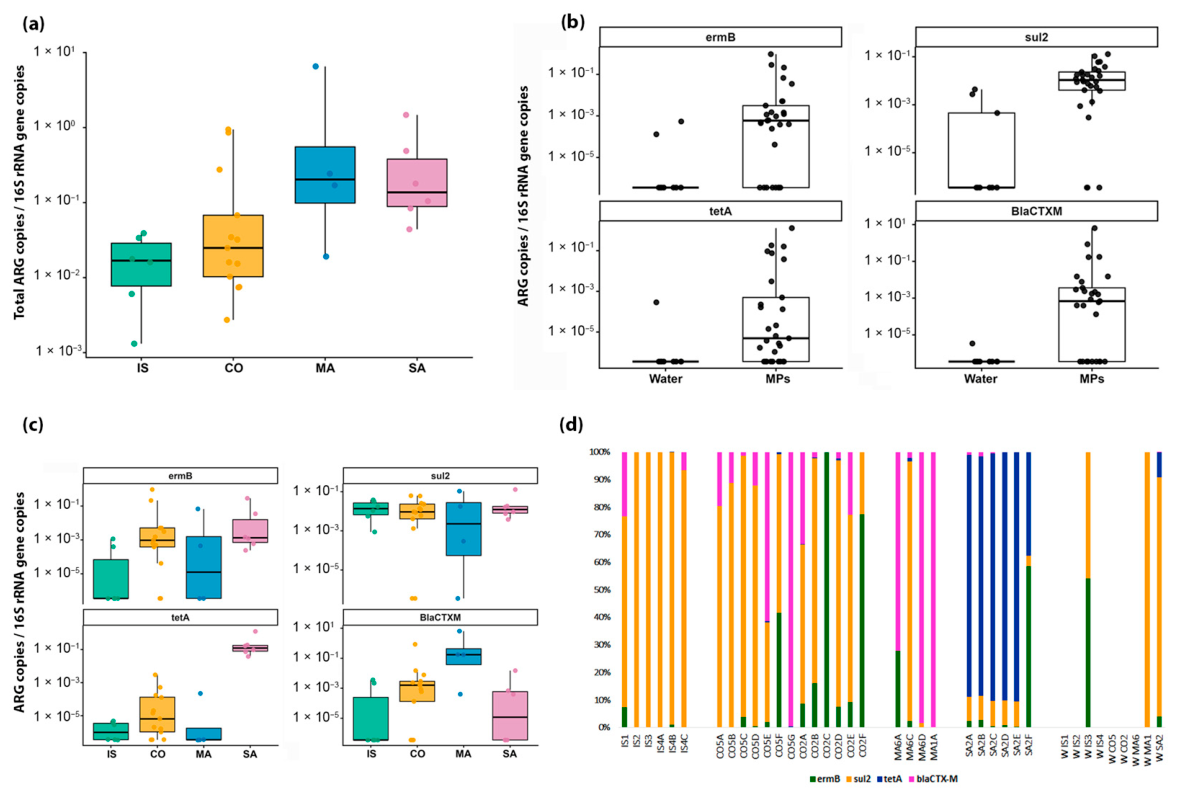
qPCR results showed higher ARG relative abundance in MP-associated biofilms compared to surrounding planktonic microbial communities (Mann–Whitney test, p < 0.01), although with a markedly heterogeneous and site-dependent distribution pattern (Figure 1a–c). ARGs were indeed detected in all analyzed MP samples, with gene-specific detection frequencies ranging from 0.66 for blaCTX-M to 0.90 for sul2. In contrast, ARGs were less frequently detected in water samples, where sul2 occurred in 33% of samples, whereas blaCTX-M and tetA were each detected in only 11% of samples. Despite these differences in occurrence and abundance, no significant differences among sites were detected for most ARGs (ermB, sul2 and blaCTX-M: p > 0.05), suggesting that ARG distribution was characterized by substantial small-scale heterogeneity rather than by consistent lake-specific patterns. Taken together, these observations indicate that MP-associated biofilms may represent favorable microhabitats for the persistence and local accumulation of ARGs, potentially acting as high-density microbial assemblages in which close cell proximity and biofilm architecture may facilitate gene exchange processes [5].
Recently the baseline level of ARGs in the environment, in terms of ARGs GC/16SrRNA GC obtained by qPCR data, was defined through a comprehensive literature survey to assess deviations in ARG abundance as indicators of pollution or selection pressure [44]. According to their results, Abramova and colleagues [44] reported ARG relative abundances between 10−3 and 10−5 ARG GC/16SrRNA GC in anthropogenically impacted environments, while lower levels, typically below 10−5 ARG GC/16SrRNA, were instead reported in presumably unimpacted sampling sites. In this study, ARG relative abundance in plastisphere communities was generally higher than the environmental background reported for impacted environments [44], with values varying over several orders of magnitude across lakes and sample types. Total ARG relative abundance in MPs ranged from ~10−3 to 6.4 GC/16SrRNA gene copies (Figure 1a), highlighting a strong site-specific heterogeneity across the dataset. Water samples, on the contrary, showed ARG relative abundance (between 10−4 and 10−3 GC/16SrRNA) within or below the determined environmental background levels defined by Abramova et al. [44]. These results suggest that ARGs were generally less abundant in planktonic communities than in MP-associated biofilms collected from the same sites (Figure 1a).
Notably, although less abundant and less frequently detected than the other monitored ARGs, the extended-spectrum Beta lactamase (ESBL) gene blaCTX-M was detected in a substantial fraction of MP samples (Figure 1c,d). This gene, belonging to the ESBL group, confers resistance to third-generation β-lactams (e.g., cephalosporins), which are widely used in clinical settings, and is therefore considered of high clinical relevance [45] and an index of human health risk in the environment. Differently from the other monitored genes, blaCTX-M is generally reported at low abundance or undetectable levels in surface waters and environmental matrices [46,47]. In this study, blaCTX-M was detected in 66% of the analyzed MP samples, with relative abundances ranging from 10−4 to 6.4 GC/16S rRNA gene copies (Figure 1c). The highest values were observed in samples from Lake Maggiore, where clear hotspots were detected. Conversely, blaCTX-M was rarely detected in water samples (11% of samples) and, when present, occurred at very low levels (around 10−6–10−4 GC/16S rRNA, Figure 1b,d) and was not detected in water from Lake Maggiore. According to Abramova et al. [44], the blaCTX-M abundances observed in several MP samples represent a deviation from the expected environmental background levels. This deviation was observed exclusively in MP-associated communities, suggesting a localized enrichment of this clinically relevant ARG within plastisphere biofilms. The highest values were mainly observed in samples from Lake Maggiore. Although these patterns may reflect localized enrichment processes within specific plastisphere communities, ARG abundances were expressed relative to 16S rRNA gene copies and may therefore also be affected by variability in 16S rRNA gene copy number among bacterial taxa. At the same time, the occurrence of these hotspots is consistent with previous observations indicating that plastisphere biofilms may favour the persistence and dissemination of ARGs through the accumulation of mobile genetic elements and close microbial associations [5,25,31]. This aspect may be particularly relevant for blaCTX-M, which is commonly associated with plasmid-mediated transfer. Taken together, these observations suggest that the observed variability likely reflects the combined effect of multiple factors. Consistently, despite the occurrence of localized hotspots, statistical analyses did not indicate significant differences among sites (Kruskal–Wallis test, p > 0.05), indicating that these elevated values were restricted to a limited number of samples rather than representing a consistent pattern across the investigated lakes.
Differently from blaCTX-M, the genes sul2, tetA and ermB were more widely distributed across both planktonic and plastisphere communities, although with marked differences in abundance and spatial occurrence among lakes, sul2 was the most frequently detected ARG across all MPs and water samples, confirming its widespread occurrence in freshwater environments [32,48,49,50]. Compared to the other monitored genes, sul2 generally showed lower relative abundances in MP-associated biofilms and relatively higher abundances in water samples. Overall, sul2 abundance in planktonic communities fell within the range commonly reported for anthropogenically influenced freshwater systems. Sulphonamide resistance genes are frequently detected in aquatic environments due to the long-term and widespread use of sulphonamides in human medicine, veterinary applications and agricultural practices [51,52,53,54]. In particular, sul2 is commonly associated with mobile genetic elements and is considered one of the most ubiquitous ARGs in freshwater and wastewater-associated resistomes [39,44]. In agreement with these observations, no significant differences among sites were detected for sul2 (p > 0.05), indicating a relatively homogeneous distribution of this gene across the investigated systems. In contrast, tetA showed the highest overall relative abundance among the monitored ARGs. This gene was detected predominantly in Lake Paola samples and was mainly associated with MPs, reaching values up to 1.3 GC/16S rRNA gene copies. Water samples from the same sites showed lower abundances. Tetracycline resistance genes are commonly associated with anthropogenic pressure and fecal contamination and are widely used as indicators of agricultural and wastewater-derived pollution in environmental systems [42,44]. Among them, tetA is frequently used as a proxy for tetracycline resistance due to its widespread environmental distribution and frequent association with mobile genetic elements [55]. The high tetA abundances observed in selected MP samples therefore indicate local enrichment of tetracycline resistance-associated functions within plastisphere communities. Differently from the other ARGs, statistical analysis supported this pattern, showing significant differences among sites (Kruskal–Wallis test, p < 0.01), with higher values associated with Lake Paola samples, suggesting a strong site-specific enrichment likely linked to local environmental pressures. The macrolide resistance gene ermB was also detected in MP samples from different lakes, with relative abundances generally ranging between 10−3 and 10−1 GC/16S rRNA gene copies. The highest values were observed in Lake Como (up to 0.9 GC/16S rRNA gene copies) and Lake Paola (up to 0.3 GC/16S rRNA gene copies). Conversely, ermB was generally undetectable or detected at very low abundance in the corresponding water samples (<10−4 GC/16S rRNA gene copy). Previous metagenomic studies have frequently associated ermB with wastewater-derived resistomes. This gene was proposed as an indicator of anthropogenic ARG contamination in aquatic systems [39]. Similarly to tetA, ermB is commonly found in clinically relevant bacterial taxa and is often linked to plasmids and other mobile genetic elements contributing to horizontal ARG dissemination [39,42].
Overall, the distribution of sul2, tetA and ermB showed marked spatial heterogeneity across lakes and sampling sites, with plastisphere communities characterized by higher ARG abundances compared to surrounding planktonic communities. Differences among MP samples were also observed in relation to polymer composition. MPs predominantly composed of polyethylene, particularly abundant in Lake Paola and Lake Maggiore, were frequently associated with higher ARG abundances, especially for tetA and sul2, compared to other polymer types. These patterns are consistent with previous observations indicating that polymer-associated physicochemical properties may influence microbial colonization and biofilm development, potentially contributing to differences in ARG distribution within plastisphere communities [56,57]. However, given the strong site-dependent variability observed, these patterns should be interpreted with caution, as environmental conditions are likely the primary drivers of ARG distribution, while polymer-related effects appear secondary.

3.2. Predicted Functional Profiles and Inferred Resistome

Across all planktonic samples, the inferred resistome showed a relatively conserved structure, with total predicted abundance ranging between 0.96 and 1.35% of total reads, with limited variation across lake systems. At the functional level, the inferred resistome was dominated by multidrug resistance mechanisms associated with efflux systems. Resistance-Nodulation-Division (RND) transporters, including acrB/mexB/mtrD homologues, together with Major Facilitator Superfamily (MFS) components such as mdtK, emrB and bcr, represented the most abundant functional categories across all planktonic samples. Genes associated with transcriptional regulation and stress response, including marR, CRP and two-component regulatory systems such as baeS/baeR, were widely distributed across planktonic communities, co-occurring with efflux-associated functions and suggesting a coordinated functional profile within the inferred resistome (Supplementary Table S3).
Class-specific antibiotic resistance functions were also detected, although at lower predicted abundance. Tetracycline-associated genes (tetA, tetR) and macrolide resistance determinants (msrA, msrB) were widely distributed across samples, whereas β-lactam-related functions (ampC, blaB) and vancomycin-associated determinants (vanA, vanB) showed lower and more variable inferred abundance. Resistance-associated functions related to tetracycline, macrolide and β-lactam resistance identified within the inferred resistome corresponded to the major resistance classes targeted by qPCR analyses (tetA, ermB and blaCTX-M). Overall, these results indicate that planktonic communities share a conserved functional baseline, with variability among lakes mainly driven by differences in relative abundance rather than presence/absence of specific resistance determinants.
In contrast, plastisphere communities showed a distinct functional profile compared to planktonic assemblages, showing a higher relative contribution of efflux-related functions, membrane transport systems, and genes associated with horizontal gene transfer and stress response. This pattern indicates a selective enrichment of resistance- and persistence-associated traits on MP surfaces. This observation is consistent with the hypothesis that plastisphere communities may favor microorganisms characterized by increased stress tolerance and persistence-related traits. However, as the inferred resistome was reconstructed from PICRUSt2-predicted functions, the observed patterns should be interpreted as differences in potential resistance-associated functions rather than as direct evidence of ARG occurrence or expression [5].
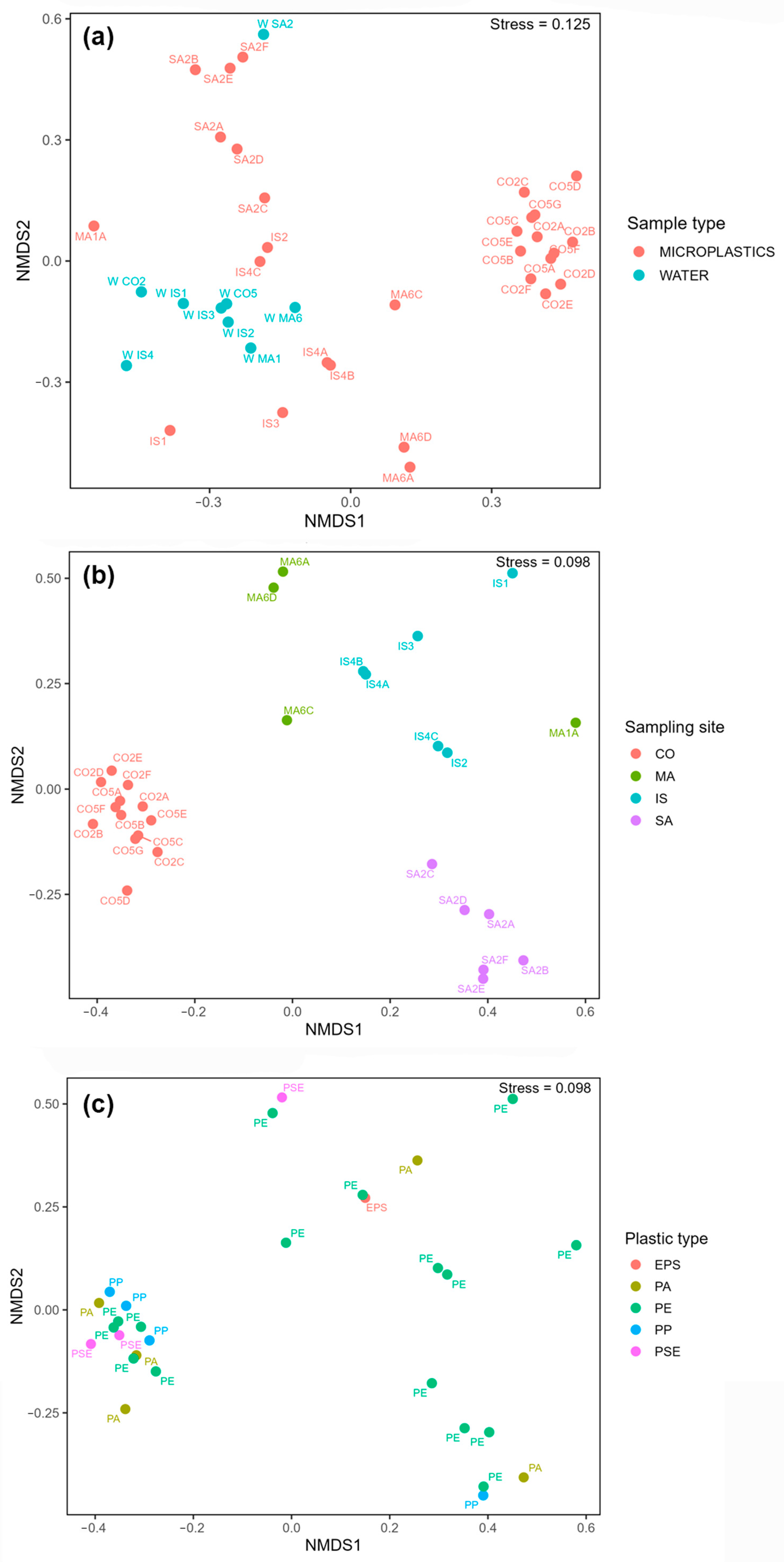
The ordination patterns observed in the NMDS analysis were consistent with the structure of the inferred resistome (Figure 2a), showing a significant separation between planktonic and microplastic-associated communities (PERMANOVA, p < 0.01). The separation between planktonic and MP-associated communities reflected differences in the functional composition of antibiotic resistance genes, further supported by PERMANOVA results (p < 0.01). In particular, plastisphere samples were characterized by a higher relative contribution of multidrug resistance mechanisms, mainly associated with efflux systems (RND, MFS and SMR transporters), together with an increased contribution of accessory and clinically relevant ARGs, including tetracycline and macrolide resistance determinants and blaCTX-M, also detected by qPCR. These features contributed to a distinct functional configuration separating plastisphere assemblages from the more homogeneous inferred resistome of the planktonic communities. This separation was also associated with higher dispersion among MP samples compared to planktonic communities, reflecting increased variability in plastisphere functional profiles. The enrichment of multidrug resistance and stress-associated functions is in agreement with previous observations from freshwater and marine plastisphere communities, where biofilm-associated microorganisms were frequently associated with persistence- and stress-related adaptive traits. Nevertheless, the extent to which these predicted functions translate into measurable resistance phenotypes remains unresolved. Despite these limitations, data on ARG occurrence and distribution remain important to expand the currently limited knowledge of resistance dissemination in freshwater plastisphere communities [5].
Within MP-associated communities, clustering according to lake of origin was statistically supported (PERMANOVA, p < 0.01) (Figure 2b) and was associated with variability in the accessory component of the putative resistome rather than in the conserved efflux-dominated core. Differences in the relative abundance of β-lactam-, tetracycline- and macrolide-associated functions contributed to lake-specific functional patterns, consistent with both PICRUSt-inferred profiles and qPCR data, which showed spatial variability in ARG abundance.
No consistent grouping according to polymer type was observed (Figure 2c), indicating that resistome structure was primarily associated with environmental conditions rather than substrate characteristics. Although polymer composition varied among lakes, no clear polymer-specific pattern emerged. This result further supports previous observations suggesting that local ecological conditions may exert a stronger influence on plastisphere composition and function than polymer type alone, particularly in natural freshwater environments. Overall, the predicted functional profiles indicate a conserved background of antimicrobial resistance functions in freshwater planktonic communities, structured around efflux-mediated systems and a limited set of accessory resistance determinants. The plastisphere shows a consistent functional shift characterized by an increased relative contribution of resistance- and stress-associated functions, together with a stronger effect of local environmental conditions.

3.3. Potentially Pathogenic Taxa in Plastisphere and Planktonic Communities

The sequencing of targeted 16S rRNA genes showed the presence of a diverse assemblage of bacterial taxa including opportunistic pathogens, environmentally relevant microorganisms and putatively toxic taxa in both planktonic and plastisphere communities.
Overall, potentially pathogenic genera were detected at low relative abundance across all samples, with communities largely dominated by environmental and opportunistic taxa rather than obligate pathogens. Most detected microorganisms correspond to genera that include environmentally widespread opportunists capable of transient association with the human host under specific exposure conditions. It should be noted that several of the identified genera are common members of freshwater microbial communities and may play important ecological roles in aquatic ecosystems. Consequently, their inclusion among potentially pathogenic taxa reflects the presence of species with documented opportunistic or pathogenic potential within these genera and should not be interpreted as evidence of pathogenicity or health risk.
Among bacterial taxa of recognized clinical relevance, genera such as Pseudomonas, Legionella, Staphylococcus, Vibrio, Mycobacterium, and Aeromonas were detected across both planktonic and plastisphere communities. These taxa include species that have been previously reported in aquatic environments influenced by wastewater discharge and urban runoff, and that are frequently associated with opportunistic infections, including waterborne and healthcare-associated conditions [5,58,59,60]. Notably, several of these genera overlap with lineages discussed within the so-called ESKAPE group, although the genus-level resolution of the present amplicon-based dataset does not allow discrimination between environmental and clinically relevant strains, nor inference regarding virulence determinants or infectivity. Accordingly, the detection of potentially pathogenic genera should not be interpreted as evidence of pathogenicity or health risk. Species- or strain-level characterization, together with the detection of virulence-associated traits and their functional expression, would be required before any assessment of potential health relevance can be made [5].
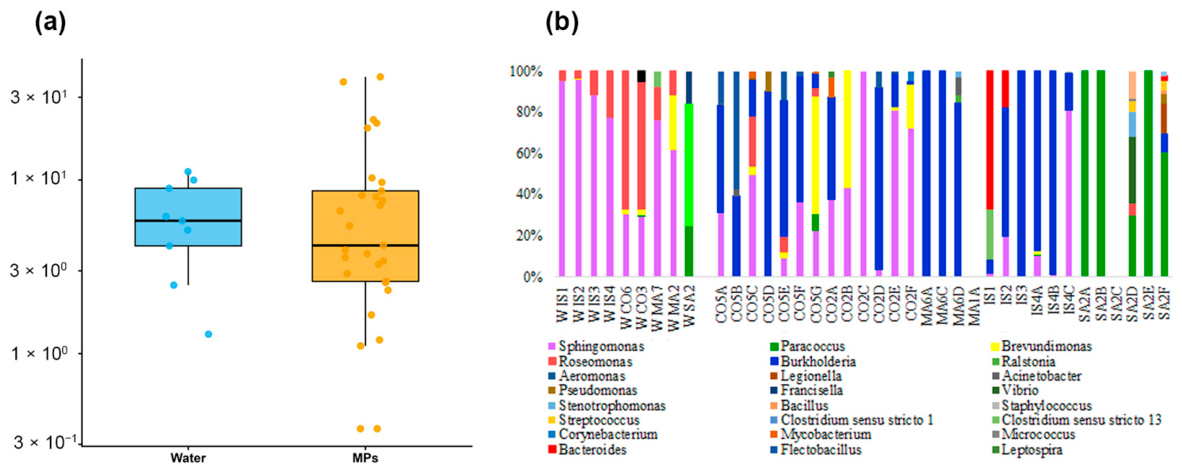
No statistically significant differences were observed in the total relative abundance of potentially pathogenic genera between planktonic and MP-associated communities (Figure 3a) indicating that plastisphere assemblages are not characterized by an overall enrichment of these taxa relative to the surrounding water column. However, differences were observed in taxonomic composition (Figure 3b). Several genera characterized by environmental adaptability and biofilm-associated lifestyles were more frequently associated with MP samples. In particular, Burkholderia was among the most recurrent taxa within plastisphere assemblages, reaching high relative abundances in selected samples from Lakes Maggiore and Iseo. This genus is ecologically versatile and comprises taxa with opportunistic pathogenic potential. Similarly, Flectobacillus and Paracoccus, genera commonly associated with freshwater biofilms and organic matter turnover, were recurrently associated with MP-associated biofilms, with occasional detection in surrounding waters. In contrast, Bacteroides and Clostridium sensu stricto groups, generally linked to fecal-associated or anaerobic environments, respectively, were primarily associated with planktonic samples. Other genera of recognized waterborne relevance, including Pseudomonas, Legionella, Aeromonas, Mycobacterium, Acinetobacter, Staphylococcus and Vibrio, were detected in both planktonic and MP-associated communities, generally at low relative abundance. Their occurrence across both communities is consistent with their broad distribution within freshwater microbial communities and with their ability to associate with particulate and surface-attached habitats, including aquatic plastisphere communities [5,59,61,62,63,64,65,66,67,68,69,70,71,72,73]. In particular, Vibrio spp., although detected at low frequency, include taxa widely described in aquatic environments and plastisphere biofilms, where several species are recognized as opportunistic pathogens capable of persistence within surface-associated biofilm assemblages [66,74,75,76].

3.4. Relationships Between Potential Pathogens and Inferred Resistome

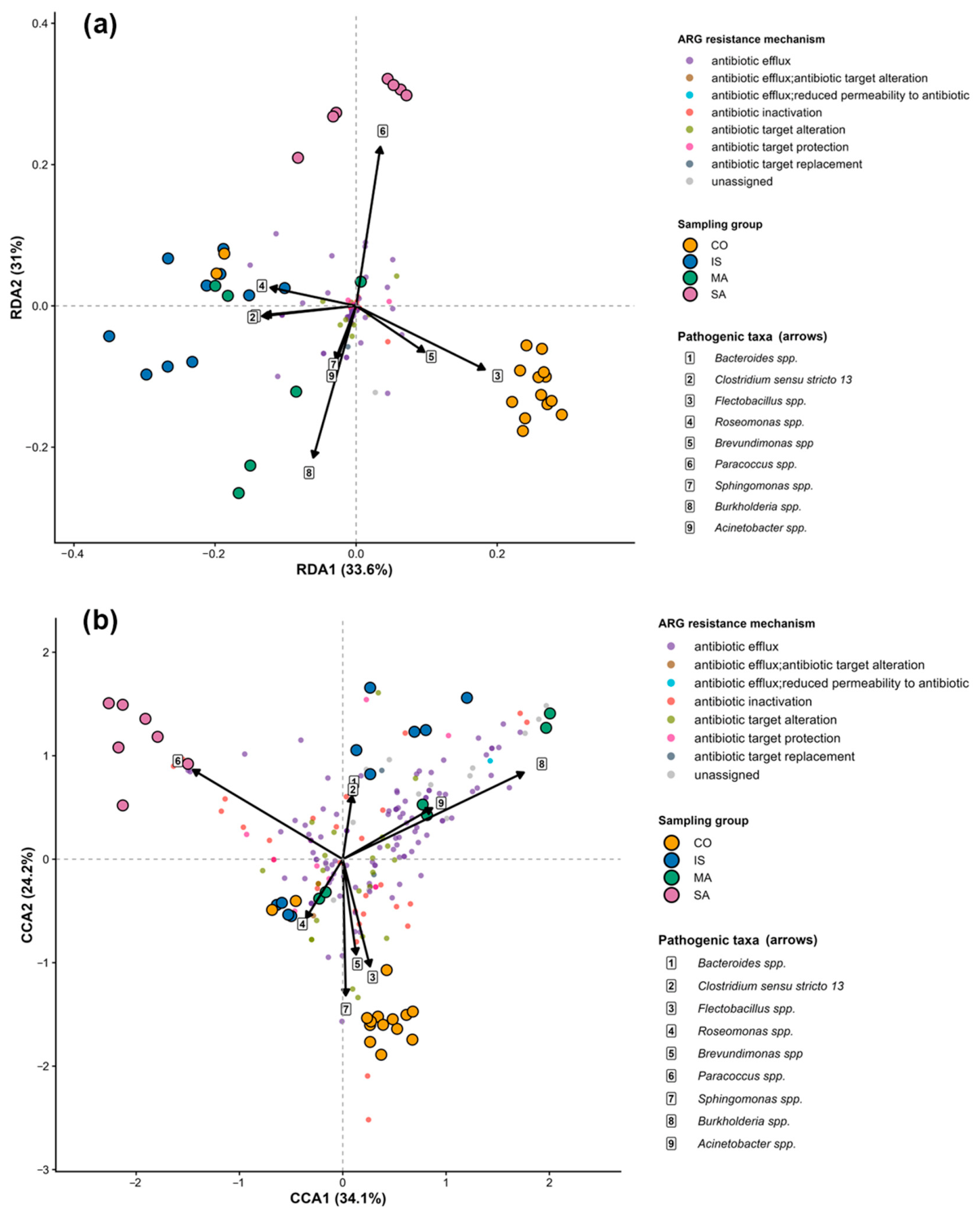
Multivariate analyses revealed a significant association between potential pathogens and the inferred resistome (overall model, p < 0.01), with the first two constrained axes explaining 33.6% and 31.0% of the constrained variance, respectively (Figure 4). Samples clustered according to lake of origin, indicating lake-specific associations between bacterial taxa and predicted ARG profiles. In particular, samples from Lake Maggiore were associated with Burkholderia spp. and, to a lesser extent, Acinetobacter spp., whereas communities from Lake Paola were more closely associated with Paracoccus spp. Samples from the different lake systems were associated with distinct bacterial genera, including Roseomonas, Bacteroides, Clostridium sensu stricto, Flectobacillus and Sphingomonas. Among the analyzed taxa, Burkholderia, Flectobacillus, Roseomonas and Paracoccus showed the strongest contribution to the observed resistome patterns (RDA permutation tests, p < 0.05).
These patterns suggest that differences in inferred resistome among lakes were more closely related to variations in microbial community structure than to the occurrence of single potentially pathogenic taxa. In agreement with the current view of the freshwater plastisphere [5], the observed associations likely reflect lake-specific ecological conditions and differences in microbial recruitment from the surrounding environment rather than the selective enrichment of specific pathogenic groups.
The relationships between specific taxa and resistome profiles are also consistent with previous observations from freshwater plastisphere communities, where biofilm development followed dynamic successions and community composition changed over time in response to local ecological conditions [19,77]. Within this framework, differences in inferred resistome may arise from shifts in community composition and biofilm development rather than from direct selection of specific resistance traits or pathogenic taxa.
Overall, the observed patterns do not support the presence of a distinct or consistently enriched pathogenic assemblage associated with MPs. Rather, plastisphere-associated communities largely reflect the surrounding freshwater microbial communities, with contributions from environmental inputs and the general capacity of biofilm-forming microorganisms to persist on surface-associated substrates. In agreement with the conceptual framework proposed for the “pathogenic plastisphere” [5], plastic particles may act as stable substrates supporting microbial persistence and dispersal within aquatic systems. Previous observations from long-term freshwater studies further indicated that opportunistic taxa may remain associated with plastisphere biofilms during community development, although their relative abundance tends to decrease during later stages of biofilm maturation as community structure becomes more complex [19]. These findings suggest that the ecological relevance of the plastisphere may be more closely related to the persistence and dispersal of microorganisms within structured biofilms than to the selective enrichment of pathogenic taxa.

4. Conclusions

The MP-associated biofilms were characterized by higher ARG abundances than the corresponding planktonic communities, suggesting that the plastisphere may represent favourable microhabitats for the persistence and local accumulation of ARGs. In addition, predicted resistance-associated functional profiles differed between MP-associated and planktonic communities, indicating the occurrence of distinct resistance-related functional patterns associated with the plastisphere. In contrast, no evidence of a consistent enrichment of potentially pathogenic bacterial genera on MPs was observed, although differences in taxonomic composition were detected among lakes and between habitats. Across all analyses, marked variability among lakes and sampling sites emerged as a recurrent feature, highlighting the importance of local ecological conditions in shaping both ARG distribution and the inferred resistome, whereas polymer-related effects appeared limited.
Although plastisphere research is increasingly moving beyond descriptive approaches towards a better understanding of the functional and mechanistic processes underlying microbial colonization and resistance dissemination, robust information on ARG occurrence and distribution in freshwater ecosystems remains necessary to support these developments. In this context, the present study contributes to expanding the available dataset on ARG occurrence in lake-associated plastisphere communities and provides a data-driven basis for future investigations on the ecological role of MP-associated biofilms.

Supplementary Materials

The following supporting information can be downloaded at https://www.mdpi.com/article/10.3390/microplastics5040193/s1: Table S1: List of water and MP samples collected in each transect of the investigated lakes and abundance of polymer types in each MP sample; Table S2: Amplification conditions used to quantify the 16S rRNA gene and antibiotic resistance genes by qPCR; Table S3: Relative abundance of predicted resistance-associated KEGG Orthologs (KOs) in water and microplastic-associated communities.

Author Contributions

Conceptualization, F.D.P. and S.R.; methodology, F.D.P., V.B. and S.R.; software, V.B.; validation, F.D.P. and S.R.; formal analysis, V.B. and S.C.; investigation, F.D.P., S.R., S.A., V.B. and S.C.; data curation, V.B., F.D.P., S.A. and S.C.; writing—original draft preparation, F.D.P. and V.B.; writing—review and editing, F.D.P., V.B., S.C., C.L., S.A., B.T., S.R., S.D.V. and L.P.; supervision, F.D.P. and S.R. All authors have read and agreed to the published version of the manuscript.

Funding

This research received no external funding.

Institutional Review Board Statement

Not applicable.

Data Availability Statement

The original contributions presented in this study are included in the article. Further inquiries can be directed to the corresponding author.

Acknowledgments

The authors would like to thank all the volunteers who made the Goletta dei Laghi campaign possible, especially those who took part in the microplastic sampling, including Simone Nuglio, Annalisa Leone, Roberto Regina and Federica Zennaro.

Conflicts of Interest

The authors declare no conflicts of interest.

References

  1. Thompson, R.C.; Courtene-Jones, W.; Boucher, J.; Pahl, S.; Raubenheimer, K.; Koelmans, A.A. Twenty years of microplastic pollution research—What have we learned? Science 2024, 386, eadl2746. [Google Scholar] [CrossRef] [Scilit] [PubMed]
  2. Chellasamy, G.; Ramasundaram, S.; Veerapandian, M.; Chandran, M.; Dhanasekaran, B.; Oh, T.H.; Govindaraju, S.; Yun, K. Systematic review on fate and behavior of microplastics towards the environment. TrAC Trends Anal. Chem. 2023, 169, 117390. [Google Scholar] [CrossRef] [Scilit]
  3. Haque, F.; Fan, C. Fate and impacts of microplastics in the environment: Hydrosphere, pedosphere, and atmosphere. Environments 2023, 10, 70. [Google Scholar] [CrossRef] [Scilit]
  4. Luo, Q.; Tan, H.; Ye, M.; Jho, E.H.; Wang, P.; Iqbal, B.; Zhao, X.; Shi, H.; Lu, H.; Li, G. Microplastics as an emerging threat to human health: An overview of potential health impacts. J. Environ. Manag. 2025, 387, 125915. [Google Scholar] [CrossRef] [Scilit] [PubMed]
  5. Ormsby, M.J.; Quilliam, R.S. The aquatic plastisphere: Ecology, pathogen dissemination and antimicrobial resistance. Nat. Rev. Microbiol. 2026, 24, 446–462. [Google Scholar] [CrossRef] [Scilit] [PubMed]
  6. De Ruijter, V.N.; Redondo-Hasselerharm, P.E.; Gouin, T.; Koelmans, A.A. Quality criteria for microplastic effect studies in the context of risk assessment: A critical review. Environ. Sci. Technol. 2020, 54, 11692–11705. [Google Scholar] [CrossRef] [Scilit] [PubMed]
  7. Thornton Hampton, L.M.; Brander, S.M.; Coffin, S.; Cole, M.; Hermabessiere, L.; Koelmans, A.A.; Rochman, C.M. Characterizing microplastic hazards: Which concentration metrics and particle characteristics are most informative for understanding toxicity in aquatic organisms? Microplast. Nanoplast. 2022, 2, 20. [Google Scholar] [CrossRef] [Scilit]
  8. Singh, S.S.; Chanda, R.; Singh, N.S.; Ramtharmawi; Devi, N.R.; Devi, K.V.; Upadhyay, K.K.; Tripathi, S.K. Microplastic pollution: Exploring trophic transfer pathways and ecological impacts. Discov. Environ. 2024, 2, 103. [Google Scholar] [CrossRef] [Scilit]
  9. Verma, A.; Chand, N.; Upadhyay, P.; Sharma, S.; Prajapati, S.K. Systematic review on microplastics as a threat to terrestrial and aquatic eco-environment. Sustain. Chem. One World 2024, 3, 100013. [Google Scholar] [CrossRef] [Scilit]
  10. Suman, T.Y.; Rajendiran, K.; Kwak, I.-S. Microplastics and nanoplastics in human health: A comprehensive review of exposure pathways, cellular mechanisms, and toxicological implications. Arch. Toxicol. 2026, 100, 811–836. [Google Scholar] [CrossRef] [Scilit] [PubMed]
  11. Yang, Y.; Liu, W.; Zhang, Z.; Grossart, H.-P.; Gadd, G.M. Microplastics provide new microbial niches in aquatic environments. Appl. Microbiol. Biotechnol. 2020, 104, 6501–6511. [Google Scholar] [CrossRef] [Scilit] [PubMed]
  12. Dąbrowska, A. A roadmap for a plastisphere. Mar. Pollut. Bull. 2021, 167, 112322. [Google Scholar] [CrossRef] [Scilit] [PubMed]
  13. Haram, L.E.; Carlton, J.T.; Centurioni, L.; Crowley, M.; Hafner, J.; Maximenko, N.; Murray, C.C.; Shcherbina, A.Y.; Hormann, V.; Wright, C.; et al. Emergence of a neopelagic community through the establishment of coastal species on the high seas. Nat. Commun. 2021, 12, 6885. [Google Scholar] [CrossRef] [Scilit] [PubMed]
  14. Zettler, E.R.; Mincer, T.J.; Amaral-Zettler, L.A. Life in the “Plastisphere”: Microbial communities on plastic marine debris. Environ. Sci. Technol. 2013, 47, 7137–7146. [Google Scholar] [CrossRef] [Scilit] [PubMed]
  15. Di Pippo, F.; Venezia, C.; Sighicelli, M.; Pietrelli, L.; Di Vito, S.; Nuglio, S.; Rossetti, S. Microplastic-associated biofilms in lentic Italian ecosystems. Water Res. 2020, 187, 116429. [Google Scholar] [CrossRef] [Scilit] [PubMed]
  16. Odobel, C.; Dussud, C.; Philip, L.; Derippe, G.; Lauters, M.; Eyheraguibel, B.; Burgaud, G.; Ter Halle, A.; Meistertzheim, A.-L.; Bruzaud, S.; et al. Bacterial abundance, diversity and activity during long-term colonization of non-biodegradable and biodegradable plastics in seawater. Front. Microbiol. 2021, 12, 734782. [Google Scholar] [CrossRef] [Scilit] [PubMed]
  17. Du, Y.; Liu, X.; Dong, X.; Yin, Z. A review on marine plastisphere: Biodiversity, formation, and role in degradation. Comput. Struct. Biotechnol. J. 2022, 20, 975–988. [Google Scholar] [CrossRef] [Scilit] [PubMed]
  18. Li, W.; Miao, L.; Adyel, T.M.; Wu, J.; Yu, Y.; Hou, J. Characterization of dynamic plastisphere and their underlying effects on the aging of biodegradable and traditional plastics in freshwater ecosystems. J. Hazard. Mater. 2023, 446, 130714. [Google Scholar] [CrossRef] [Scilit] [PubMed]
  19. Bocci, V.; De Vivo, M.; Pietrelli, L.; Martinelli, A.; Crognale, S.; Tonanzi, B.; Levantesi, C.; Amalfitano, S.; Congestri, R.; Rossetti, S.; et al. Freshwater plastisphere structure and succession on diverse polymer surfaces: Linking plastisphere ecology and surface alterations in a 210-day field experiment. J. Hazard. Mater. 2026, 510, 142087. [Google Scholar] [CrossRef] [Scilit] [PubMed]
  20. Amaral-Zettler, L.A.; Zettler, E.R.; Mincer, T.J. Ecology of the plastisphere. Nat. Rev. Microbiol. 2020, 18, 139–151. [Google Scholar] [CrossRef] [Scilit] [PubMed]
  21. Sooriyakumar, P.; Bolan, N.; Kumar, M.; Singh, L.; Yu, Y.; Li, Y.; Weralupitiya, C.; Vithanage, M.; Ramanayaka, S.; Sarkar, B.; et al. Biofilm formation and its implications on the properties and fate of microplastics in aquatic environments: A review. J. Hazard. Mater. Adv. 2022, 6, 100077. [Google Scholar] [CrossRef] [Scilit]
  22. Di Pippo, F.; Crognale, S.; Levantesi, C.; Vitanza, L.; Sighicelli, M.; Pietrelli, L.; Di Vito, S.; Amalfitano, S.; Rossetti, S. Plastisphere in lake waters: Microbial diversity, biofilm structure, and potential implications for freshwater ecosystems. Environ. Pollut. 2022, 310, 119876. [Google Scholar] [CrossRef] [Scilit] [PubMed]
  23. Rubin, A.E.; Zucker, I. Interactions of microplastics and organic compounds in aquatic environments: A case study of augmented joint toxicity. Chemosphere 2022, 289, 133212. [Google Scholar] [CrossRef] [Scilit] [PubMed]
  24. Luo, G.; Liang, B.; Cui, H.; Kang, Y.; Zhou, X.; Tao, Y.; Lu, L.; Fan, L.; Guo, J.; Wang, A.; et al. Determining the contribution of micro/nanoplastics to antimicrobial resistance: Challenges and perspectives. Environ. Sci. Technol. 2023, 57, 12137–12152. [Google Scholar] [CrossRef] [Scilit] [PubMed]
  25. Chen, Y.; Yan, Z.; Zhou, Y.; Zhang, Y.; Jiang, R.; Wang, M.; Yuan, S.; Lu, G. Dynamic evolution of antibiotic resistance genes in plastisphere in the vertical profile of urban rivers. Water Res. 2024, 249, 120946. [Google Scholar] [CrossRef] [Scilit] [PubMed]
  26. Li, K.; Xu, L.; Bai, X.; Zhang, G.; Zhang, M.; Huang, Y. Potential environmental risks of field bio/non-degradable microplastic from mulching residues in farmland: Evidence from metagenomic analysis of plastisphere. J. Hazard. Mater. 2024, 465, 133428. [Google Scholar] [CrossRef] [Scilit] [PubMed]
  27. Junaid, M.; Liu, S.; Liao, H.; Liu, X.; Wu, Y.; Wang, J. Wastewater plastisphere enhances antibiotic resistant elements, bacterial pathogens, and toxicological impacts in the environment. Sci. Total Environ. 2022, 841, 156805. [Google Scholar] [CrossRef] [Scilit] [PubMed]
  28. Wei, J.; Chen, M.; Wang, J. Insight into combined pollution of antibiotics and microplastics in aquatic and soil environment: Environmental behavior, interaction mechanism and associated impact of resistant genes. TrAC Trends Anal. Chem. 2023, 166, 117214. [Google Scholar] [CrossRef] [Scilit]
  29. Wu, J.; Liu, D.-F.; Wu, J.; He, R.-L.; Cheng, Z.-H.; Li, W.-W. Underestimated risks of microplastics on the environmental spread of antibiotic resistance genes. ACS EST Water 2023, 3, 1976–1979. [Google Scholar] [CrossRef] [Scilit]
  30. Zhou, Y.; Zhang, G.; Zhang, D.; Zhu, N.; Bo, J.; Meng, X.; Chen, Y.; Qin, Y.; Liu, H.; Li, W. Microplastic biofilms promote the horizontal transfer of antibiotic resistance genes in estuarine environments. Mar. Environ. Res. 2024, 202, 106777. [Google Scholar] [CrossRef] [Scilit] [PubMed]
  31. Ni, N.; Qiu, J.; Ge, W.; Guo, X.; Zhu, D.; Wang, N.; Luo, Y. Fibrous and fragmented microplastics discharged from sewage amplify health risks associated with antibiotic resistance genes in aquatic environments. Environ. Sci. Technol. 2025, 59, 15919–15930. [Google Scholar] [CrossRef] [Scilit] [PubMed]
  32. Wu, X.; Pan, J.; Li, M.; Li, Y.; Bartlam, M.; Wang, Y. Selective enrichment of bacterial pathogens by microplastic biofilm. Water Res. 2019, 165, 114979. [Google Scholar] [CrossRef] [Scilit] [PubMed]
  33. Hu, H.; Jin, D.; Yang, Y.; Zhang, J.; Ma, C.; Qiu, Z. Distinct profile of bacterial community and antibiotic resistance genes on microplastics in Ganjiang River at the watershed level. Environ. Res. 2021, 200, 111363. [Google Scholar] [CrossRef] [Scilit] [PubMed]
  34. Michaelis, C.; Grohmann, E. Horizontal gene transfer of antibiotic resistance genes in biofilms. Antibiotics 2023, 12, 328. [Google Scholar] [CrossRef] [Scilit] [PubMed]
  35. Sighicelli, M.; Pietrelli, L.; Lecce, F.; Iannilli, V.; Falconieri, M.; Coscia, L.; Di Vito, S.; Nuglio, S.; Zampetti, G. Microplastic pollution in the surface waters of Italian subalpine lakes. Environ. Pollut. 2018, 236, 645–651. [Google Scholar] [CrossRef] [Scilit] [PubMed]
  36. Alcock, B.P.; Raphenya, A.R.; Lau, T.T.Y.; Tsang, K.K.; Bouchard, M.; Edalatmand, A.; Huynh, W.; Nguyen, A.-L.V.; Cheng, A.A.; Liu, S.; et al. CARD 2020: Antibiotic resistome surveillance with the comprehensive antibiotic resistance database. Nucleic Acids Res. 2019, 48, D517–D525. [Google Scholar] [CrossRef] [Scilit] [PubMed]
  37. Di Cesare, A.; De Carluccio, M.; Eckert, E.M.; Fontaneto, D.; Fiorentino, A.; Corno, G.; Prete, P.; Cucciniello, R.; Proto, A.; Rizzo, L. Combination of flow cytometry and molecular analysis to monitor the effect of UVC/H2O2 vs UVC/H2O2/Cu-IDS processes on pathogens and antibiotic resistant genes in secondary wastewater effluents. Water Res. 2020, 184, 116194. [Google Scholar] [CrossRef] [Scilit] [PubMed]
  38. Galafassi, S.; Sabatino, R.; Sathicq, M.B.; Eckert, E.M.; Fontaneto, D.; Dalla Fontana, G.; Mossotti, R.; Corno, G.; Volta, P.; Di Cesare, A. Contribution of microplastic particles to the spread of resistances and pathogenic bacteria in treated wastewaters. Water Res. 2021, 201, 117368. [Google Scholar] [CrossRef] [Scilit] [PubMed]
  39. Tarek, M.H.; Garner, E. A proposed framework for the identification of indicator genes for monitoring antibiotic resistance in wastewater: Insights from metagenomic sequencing. Sci. Total Environ. 2023, 854, 158698. [Google Scholar] [CrossRef] [Scilit] [PubMed]
  40. Berendonk, T.U.; Manaia, C.M.; Merlin, C.; Fatta-Kassinos, D.; Cytryn, E.; Walsh, F.; Bürgmann, H.; Sørum, H.; Norström, M.; Pons, M.-N.; et al. Tackling antibiotic resistance: The environmental framework. Nat. Rev. Microbiol. 2015, 13, 310–317. [Google Scholar] [CrossRef] [Scilit] [PubMed]
  41. Bengtsson-Palme, J.; Kristiansson, E.; Larsson, D.G.J. Environmental factors influencing the development and spread of antibiotic resistance. FEMS Microbiol. Rev. 2018, 42, fux053. [Google Scholar] [CrossRef] [Scilit] [PubMed]
  42. Zhang, A.-N.; Gaston, J.M.; Dai, C.L.; Zhao, S.; Poyet, M.; Groussin, M.; Yin, X.; Li, L.-G.; Van Loosdrecht, M.C.M.; Topp, E.; et al. An omics-based framework for assessing the health risk of antimicrobial resistance genes. Nat. Commun. 2021, 12, 4765. [Google Scholar] [CrossRef] [Scilit] [PubMed]
  43. Keenum, I.; Liguori, K.; Calarco, J.; Davis, B.C.; Milligan, E.; Harwood, V.J.; Pruden, A. A framework for standardized qPCR-targets and protocols for quantifying antibiotic resistance in surface water, recycled water and wastewater. Crit. Rev. Environ. Sci. Technol. 2022, 52, 4395–4419. [Google Scholar] [CrossRef] [Scilit]
  44. Abramova, A.; Berendonk, T.U.; Bengtsson-Palme, J. A global baseline for qPCR-determined antimicrobial resistance gene prevalence across environments. Environ. Int. 2023, 178, 108084. [Google Scholar] [CrossRef] [Scilit] [PubMed]
  45. World Health Organization. WHO’s List of Medically Important Antimicrobials: A Risk Management Tool for Mitigating Antimicrobial Resistance Due to Non-Human Use; World Health Organization: Geneva, Switzerland, 2024. [Google Scholar]
  46. Di Cesare, A.; Mammola, S.; Sabatino, R.; Fontaneto, D.; Eckert, E.M.; Rogora, M.; Tonsi, T.; Corno, G. Where do the antibiotic resistance genes come from? A modulated analysis of sources and loads of resistances in Lake Maggiore. FEMS Microbiol. Ecol. 2024, 100, fiae025. [Google Scholar] [CrossRef] [Scilit] [PubMed]
  47. Sabatino, R.; Zullo, R.; Di Cesare, A.; Piscia, R.; Musazzi, S.; Corno, G.; Volta, P.; Galafassi, S. Traditional and biodegradable plastics host distinct and potentially more hazardous microbes when compared to both natural materials and planktonic community. J. Hazard. Mater. 2024, 465, 133166. [Google Scholar] [CrossRef] [Scilit] [PubMed]
  48. Chaturvedi, P.; Singh, A.; Chowdhary, P.; Pandey, A.; Gupta, P. Occurrence of emerging sulfonamide resistance (sul1 and sul2) associated with mobile integrons-integrase (intI1 and intI2) in riverine systems. Sci. Total Environ. 2021, 751, 142217. [Google Scholar] [CrossRef] [Scilit] [PubMed]
  49. Haenelt, S.; Wang, G.; Kasmanas, J.C.; Musat, F.; Richnow, H.H.; Da Rocha, U.N.; Müller, J.A.; Musat, N. The fate of sulfonamide resistance genes and anthropogenic pollution marker intI1 after discharge of wastewater into a pristine river stream. Front. Microbiol. 2023, 14, 1058350. [Google Scholar] [CrossRef] [Scilit] [PubMed]
  50. Zarean, M.; Mousavi, S.E.; Dave, S.H.; O’Brien, J.W.; Thomas, K.V.; Stevenson, E.M.; Singh, P.; Karimpour, S.; Zhong, H.; Brar, S.K.; et al. Enrichment of high-risk antibiotic resistance genes on microplastics in freshwater environments: A meta-analysis. Environ. Pollut. 2026, 398, 128053. [Google Scholar] [CrossRef] [Scilit] [PubMed]
  51. Baran, W.; Adamek, E.; Makowski, A.; Sobczak, A. Assessment of sulfonamides occurrence in the biosphere. Ecol. Chem. Eng. A 2012, 19, 1153–1171. [Google Scholar] [CrossRef] [Scilit] [PubMed]
  52. Wojnarowski, K.; Cholewińska, P.; Zhao, D.; Pacoń, J.; Bodkowski, R. Antibiotic resistance genes in food animal production: Environmental implications and One Health challenges. Environments 2025, 12, 427. [Google Scholar] [CrossRef] [Scilit]
  53. Abdul Khaliq, S.; Masihullah, W.; Sheikh, M. A comprehensive review on sulfonamide resistance: Recent trends and implications in primary care clinical settings. Liaquat Natl. J. Prim. Care 2026, 8, 78–83. [Google Scholar] [CrossRef] [Scilit]
  54. Ahmad, S. Sulfonamide resistance as a global One Health challenge. J. Antibiot. 2026, 79, 493–497. [Google Scholar] [CrossRef] [Scilit] [PubMed]
  55. Nnadozie, C.F.; Odume, O.N. Freshwater environments as reservoirs of antibiotic resistant bacteria and their role in the dissemination of antibiotic resistance genes. Environ. Pollut. 2019, 254, 113067. [Google Scholar] [CrossRef] [Scilit] [PubMed]
  56. Keswani, A.; Oliver, D.M.; Gutierrez, T.; Quilliam, R.S. Microbial hitchhikers on marine plastic debris: Human exposure risks at bathing waters and beach environments. Mar. Environ. Res. 2016, 118, 10–19. [Google Scholar] [CrossRef] [Scilit] [PubMed]
  57. Pinto, M.; Langer, T.M.; Hüffer, T.; Hofmann, T.; Herndl, G.J. The composition of bacterial communities associated with plastic biofilms differs between different polymers and stages of biofilm succession. PLoS ONE 2019, 14, e0217165. [Google Scholar] [CrossRef] [Scilit] [PubMed]
  58. Viršek, M.K.; Lovšin, M.N.; Koren, Š.; Kržan, A.; Peterlin, M. Microplastics as a vector for the transport of the bacterial fish pathogen species Aeromonas salmonicida. Mar. Pollut. Bull. 2017, 125, 301–309. [Google Scholar] [CrossRef] [Scilit] [PubMed]
  59. Tavelli, R.; Callens, M.; Grootaert, C.; Abdallah, M.F.; Rajkovic, A. Foodborne pathogens in the plastisphere: Can microplastics in the food chain threaten microbial food safety? Trends Food Sci. Technol. 2022, 129, 1–10. [Google Scholar] [CrossRef] [Scilit]
  60. Garcés-Ordóñez, O.; Córdoba-Meza, T.; Sáenz-Arias, S.; Blandón, L.; Espinosa-Díaz, L.F.; Pérez-Duque, A.; Thiel, M.; Canals, M. Potentially pathogenic bacteria in the plastisphere from water, sediments, and commercial fish in a tropical coastal lagoon: An assessment and management proposal. J. Hazard. Mater. 2024, 479, 135638. [Google Scholar] [CrossRef] [Scilit] [PubMed]
  61. Flores-Kim, J.; Darwin, A.J. Regulation of bacterial virulence gene expression by cell envelope stress responses. Virulence 2014, 5, 835–851. [Google Scholar] [CrossRef] [Scilit] [PubMed]
  62. Barna, J.; Csermely, P.; Vellai, T. Roles of heat shock factor 1 beyond the heat shock response. Cell. Mol. Life Sci. 2018, 75, 2897–2916. [Google Scholar] [CrossRef] [Scilit] [PubMed]
  63. Grinberg, M.; Orevi, T.; Steinberg, S.; Kashtan, N. Bacterial survival in microscopic surface wetness. eLife 2019, 8, e48508. [Google Scholar] [CrossRef] [Scilit] [PubMed]
  64. Beloe, C.J.; Browne, M.A.; Johnston, E.L. Plastic debris as a vector for bacterial disease: An interdisciplinary systematic review. Environ. Sci. Technol. 2022, 56, 2950–2958. [Google Scholar] [CrossRef] [Scilit] [PubMed]
  65. Sun, R.; He, L.; Li, T.; Dai, Z.; Sun, S.; Ren, L.; Liang, Y.-Q.; Zhang, Y.; Li, C. Impact of the surrounding environment on antibiotic resistance genes carried by microplastics in mangroves. Sci. Total Environ. 2022, 837, 155771. [Google Scholar] [CrossRef] [Scilit] [PubMed]
  66. Tan, B.; Li, Y.; Xie, H.; Dai, Z.; Zhou, C.; Qian, Z.-J.; Hong, P.; Liang, Y.; Ren, L.; Sun, S.; et al. Microplastics accumulation in mangroves increasing the resistance of its colonization Vibrio and Shewanella. Chemosphere 2022, 295, 133861. [Google Scholar] [CrossRef] [Scilit] [PubMed]
  67. Ormsby, M.J.; White, H.L.; Metcalf, R.; Oliver, D.M.; Quilliam, R.S. Clinically important E. coli strains can persist, and retain their pathogenicity, on environmental plastic and fabric waste. Environ. Pollut. 2023, 326, 121466. [Google Scholar] [CrossRef] [Scilit] [PubMed]
  68. Witsø, I.L.; Basson, A.; Vinje, H.; Llarena, A.-K.; Bringas, C.S.; Aspholm, M.; Wasteson, Y.; Myrmel, M. Freshwater plastispheres as a vector for foodborne bacteria and viruses. Environ. Microbiol. 2023, 25, 2864–2881. [Google Scholar] [CrossRef] [Scilit] [PubMed]
  69. Zadjelovic, V.; Wright, R.J.; Borsetto, C.; Quartey, J.; Cairns, T.N.; Langille, M.G.I.; Wellington, E.M.H.; Christie-Oleza, J.A. Microbial hitchhikers harbouring antimicrobial-resistance genes in the riverine plastisphere. Microbiome 2023, 11, 225. [Google Scholar] [CrossRef] [Scilit] [PubMed]
  70. Oliver, D.M.; Metcalf, R.; Jones, D.L.; Matallana-Surget, S.; Thomas, D.N.; Robins, P.; Tulloch, C.L.; Cotterell, B.M.; Williams, G.; Christie-Oleza, J.A.; et al. Plastic pollution and human pathogens: Towards a conceptual shift in risk management at bathing water and beach environments. Water Res. 2024, 261, 122028. [Google Scholar] [CrossRef] [Scilit] [PubMed]
  71. Wang, L.; Zhang, T.-L.; Xiang, Q.; Fu, C.-X.; Qiao, M.; Ding, L.-J.; Zhu, D. Selective enrichment of virulence factor genes in the plastisphere under antibiotic and heavy metal pressures. J. Hazard. Mater. 2024, 465, 133319. [Google Scholar] [CrossRef] [Scilit] [PubMed]
  72. Hassanin, A.; Lories, B.; Steenackers, H.P. Salmonella stress response systems as targets for anti-virulence strategies. BMC Microbiol. 2025, 25, 378. [Google Scholar] [CrossRef] [Scilit] [PubMed]
  73. Witsø, I.L.; Basson, A.; Aspholm, M.; Wasteson, Y.; Myrmel, M. Wastewater-associated plastispheres: A hidden habitat for microbial pathogens? PLoS ONE 2024, 19, e0312157. [Google Scholar] [CrossRef] [Scilit] [PubMed]
  74. Laverty, A.L.; Primpke, S.; Lorenz, C.; Gerdts, G.; Dobbs, F.C. Bacterial biofilms colonizing plastics in estuarine waters, with an emphasis on Vibrio spp. and their antibacterial resistance. PLoS ONE 2020, 15, e0237704. [Google Scholar] [CrossRef] [Scilit] [PubMed]
  75. Leighton, R.E.; Correa Vélez, K.E.; Xiong, L.; Creech, A.G.; Amirichetty, K.P.; Anderson, G.K.; Cai, G.; Norman, R.S.; Decho, A.W. Vibrio parahaemolyticus and Vibrio vulnificus in vitro colonization on plastics influenced by temperature and strain variability. Front. Microbiol. 2023, 13, 1099502. [Google Scholar] [CrossRef] [Scilit] [PubMed]
  76. Kim, J.-G. Influence of climatic factors on the occurrence of Vibrio parahaemolyticus food poisoning in the Republic of Korea. Climate 2024, 12, 25. [Google Scholar] [CrossRef] [Scilit]
  77. Parida, D.; Dhali, S.L.; Bala, K.; Nogueira, R. Early microbial colonization study of daily-use plastics exposed to river water. World J. Microbiol. Biotechnol. 2026, 42, 218. [Google Scholar] [CrossRef] [Scilit] [PubMed]
Figure 1. Relative abundances of total ARGs (a). Relative abundances of ARGs in water and MP samples (b). Relative abundances of ARGs in the plastisphere at different sites (c). Composition of different ARGs within planktonic and plastisphere communities (d). IS: ISEO, CO: COMO, MA: MAGGIORE, SA: PAOLA.
Microplastics 05 00193 g001
Figure 2. Non-metric multidimensional scaling (NMDS) graph based on Bray–Curtis dissimilarities of predicted ARG profiles. Comparison between MPs and water samples (a); MP samples grouped according to lake of origin and polymer type (b,c).
Microplastics 05 00193 g002
Figure 3. Distribution of potentially pathogenic bacterial genera in planktonic communities and MP-associated biofilms. (a) Total relative abundance (%) of potentially pathogenic genera identified from 16S rRNA gene amplicon sequencing data. (b) Taxonomic composition of the dominant potentially pathogenic genera detected in water samples and plastisphere communities from the investigated lakes. Data are expressed as relative abundance (%) within the pool of identified potentially pathogenic genera.
Microplastics 05 00193 g003
Figure 4. Relationship between predicted resistance-associated functional profiles and potentially pathogenic bacterial taxa. (a) Redundancy analysis (RDA). (b) Canonical correspondence analysis (CCA). Sample scores are shown according to lake of origin, while coloured points represent predicted resistance-associated functions grouped by resistance mechanism. Arrows indicate potentially pathogenic taxa included as explanatory variables.
Microplastics 05 00193 g004
Disclaimer/Publisher’s Note: The statements, opinions and data contained in all publications are solely those of the individual author(s) and contributor(s) and not of MDPI and/or the editor(s). MDPI and/or the editor(s) disclaim responsibility for any injury to people or property resulting from any ideas, methods, instructions or products referred to in the content.