Review

Engineering Microbial Systems for Plastic Biodegradation into Monomers to Bridge Natural Plastisphere Ecology with Industrial Circularity


by
Aubrey Dickson Chigwada
* and
Memory Tekere
Department of Environmental Sciences, College of Agriculture and Environmental Sciences, University of South Africa (UNISA), Florida Campus, Roodepoort 1709, South Africa
*
Author to whom correspondence should be addressed.
Microplastics 2026, 5(3), 180; https://doi.org/10.3390/microplastics5030180
Submission received: 7 August 2026 / Revised: 11 September 2026 / Accepted: 14 September 2026 / Published: 16 September 2026

Abstract

Plastic pollution remains one of the most pressing environmental challenges of the twenty-first century. Global production reached 413.8 million tons in 2023 and 430.9 million tons in 2024, while annual post-consumer waste continues to approach 300 million tons. Conventional mechanical and chemical recycling routes remain limited in scale, efficiency, and applicability to mixed or contaminated streams. Microbial systems that enzymatically depolymerize synthetic polymers can, for hydrolyzable polyesters, release monomers under mild conditions and thereby support biological recycling. This review synthesizes the engineering of microbial systems for plastic depolymerization and monomer recovery, progressing from natural degraders and plastisphere communities through the redesign of enzymes and metabolic pathways to synthetic consortia and early industrial translation. PET hydrolases such as LCCICCG and TurboPETase achieve 90–98% conversion of pretreated, amorphized PET under high-solid loadings. Equivalent monomer recovery from untreated high-molecular-weight polyolefins has not been demonstrated. Bibliometric analyses document a sharp acceleration in research output after the 2016 discovery of Ideonella sakaiensis. Limitations in catalytic rate, substrate scope, assay standardization, environmental relevance, and process scalability are examined, and a framework is set out that links plastisphere colonization to engineered monomer recovery without equating surface enrichment or mass loss with complete biodegradation. Engineered microbial platforms can contribute to a circular plastics economy only if laboratory advances are validated under industrially and environmentally realistic conditions.

1. Introduction

The isolation of Ideonella sakaiensis 201-F6 from a polyethylene terephthalate (PET) bottle recycling facility in Sakai, Japan, provided the first conclusive demonstration that a single bacterial species can utilize PET as its primary carbon and energy source [1]. This organism secretes a two-enzyme cascade, PETase and MHETase, that sequentially hydrolyses the polymer to mono(2-hydroxyethyl) terephthalate and ultimately to the monomers terephthalic acid and ethylene glycol [1]. The 2016 report transformed microbial plastic research from a fragmented collection of observational studies to a coherent engineering discipline [1].
Global plastics production has increased continuously since the mid-twentieth century and reached 413.8 million tons in 2023 before climbing to 430.9 million tons in 2024 [2,3]. China accounted for 34.5% of global output in 2024, followed by the rest of Asia (20.1%), North America (16.3%), and Europe (12.0%) [3]. Cumulative historical analyses show that the majority of all plastics ever produced have been discarded rather than recycled [4]. Annual post-consumer plastics waste remains near 300 million tons, of which a substantial fraction is mismanaged or enters terrestrial and aquatic environments [4,5]. Packaging dominates short-lifetime material flows, whereas textiles, construction products, and consumer durables constitute longer-lived stocks that eventually enter waste streams [4,5]. Despite progressive improvements in collection infrastructure, global recycling rates remain low. Even under modeled packages of feasible interventions, hundreds of millions of tons of plastic are still projected to enter terrestrial and aquatic ecosystems by 2040 [6]. Plastics already account for approximately 4.5% of global greenhouse gas emissions, and demand is projected to double by 2050 in the absence of new policy [7].
Natural microbial communities recovered from soils, composts, marine sediments, landfill leachates, and the plastisphere (the microbial biofilm that colonizes discarded plastic surfaces) have yielded more than 400 bacterial and fungal taxa with reported activity against one or more commodity plastics [8,9]. That figure records published claims, not verified bulk conversion to monomers or CO2. The PlasticDB compilation, which continues to expand those records, likewise catalogues reported rather than universally validated degraders [10]. Japan and India together account for a disproportionately large share of described isolates (14.1% and 13.8% of reported species, respectively), reflecting intensive screening programs and the prevalence of plastic-contaminated environments, while China, Europe, and North America have contributed substantially through both cultivation and metagenomic surveys [9]. Proteobacteria, Actinobacteria, and Firmicutes predominate among reported bacterial degraders, and Ascomycota and Basidiomycota supply important oxidative and hydrolytic activities [8,9].
Engineered microbial systems have achieved markedly different levels of performance across polymer classes. For PET, the leaf-branch compost cutinase variant LCCICCG routinely converts 90–98% of pretreated, amorphized PET into terephthalic acid and ethylene glycol within 10–24 h under industrially relevant high-solid loadings of up to 200 g kg−1 [11,12]. The computationally redesigned hydrolase TurboPETase has reached approximately 98% depolymerization of pretreated post-consumer PET in 8 h at the same solids loading [13]. Earlier engineered PETase derivatives such as FAST-PETase and HotPETase typically achieve substantially lower conversions under comparable high-loading, continuous process conditions without enzyme replenishment [12]. These figures describe enzymatic depolymerization of pretreated polyester to recoverable monomers. They do not describe mineralization of untreated plastic in the environment.
For polyolefins, the evidence is far more limited. Polyethylene and polypropylene lack reactive heteroatoms in the carbon backbone and require initial oxidative activation before any further metabolism can proceed [14,15,16]. Even the most active natural or modestly engineered microbial systems rarely exceed single-digit to low-double-digit percentage weight loss of untreated high-molecular-weight polyethylene or polypropylene after weeks to months of incubation, and many reported figures depend on prior oxidative pretreatment or utilization of low-molecular-weight fractions and additives [14,15,16,17]. Publicity surrounding polyester hydrolases has tended to obscure the fact that the majority of commodity plastics, including polyethylene, polypropylene, polystyrene, and polyvinyl chloride, remain non-hydrolyzable and are not biodegradable under practical conditions [18]. Where mixed polyolefin-rich waste has been converted to useful products, the successful routes have combined chemical oxidation with subsequent biological funneling rather than relying on a single microbial catalyst acting on the untreated polymer [19]. Polystyrene weight loss values under laboratory microbial conditions are similarly modest and must be interpreted with the same caution [14,17]. Complete mineralization of untreated, high-molecular-weight polyolefins under controlled conditions has not been demonstrated [14,17,18].
In the context of this review, microbial engineering is defined as the deliberate redesign of enzymes, metabolic pathways, regulatory networks, and intercellular interactions to improve the catalytic rate, substrate range, operational stability, and product spectrum of plastic depolymerization and upcycling [20,21]. The discipline encompasses four interlocking layers. Protein engineering employs rational design, directed evolution, and machine-learning-guided mutagenesis to optimize individual biocatalysts [20,21]. Metabolic engineering rewires central carbon metabolism and introduces heterologous pathways so that polymer-derived monomers can be assimilated and converted into biomass or value-added chemicals [20,22]. Synthetic consortia engineering constructs multi-species systems that distribute metabolic labor and stabilize community function [23]. Process engineering integrates these biological components with pretreatment, reactor design, and downstream recovery, and it must be compared on equal terms with chemical catalysis for plastics recycling [24,25].
Parallel industrial sectors already illustrate the maturity of this toolkit. Engineered microbial cell factories produce pharmaceuticals, industrial enzymes, biofuels, and precision fermentation ingredients at commercial scale once kinetic, stability, and process constraints are overcome [20,25]. The promise of microbial plastic processing therefore extends beyond environmental remediation. Successful systems could recover monomers for closed-loop repolymerization, convert depolymerization intermediates into platform chemicals or biopolymers, and operate under milder conditions than many chemical recycling routes [19,24,25,26,27]. Realization of this promise requires that laboratory performance on pure, amorphous substrates be translated to mixed, contaminated, and highly crystalline post-consumer waste at industrially relevant solid loadings, residence times, and process economics, challenges that remain only partially solved, particularly for polyolefins [17,18,19,26,27].
The contribution of the present review is an engineering-centered synthesis that bridges natural plastisphere ecology with industrial process requirements without equating the two. Unlike surveys that focus predominantly on enzyme discovery or isolated case studies, this work combines a tutorial account of microbial engineering principles with polymer-specific performance benchmarks, a critical appraisal of degradation evidence, and an explicit framework linking colonization, enzymatic depolymerization, metabolite exchange, synthetic consortia, and monomer recovery. By quantifying the disparity between near-complete PET conversion achieved by optimized hydrolases and the persistently low, often poorly controlled percentages reported for polyolefins, the review provides both an educational foundation and a strategic roadmap for advancing microbial plastic processing from proof-of-concept to scalable circular economy technology.

2. Bibliometric Overview: Methodology and Detailed Analysis

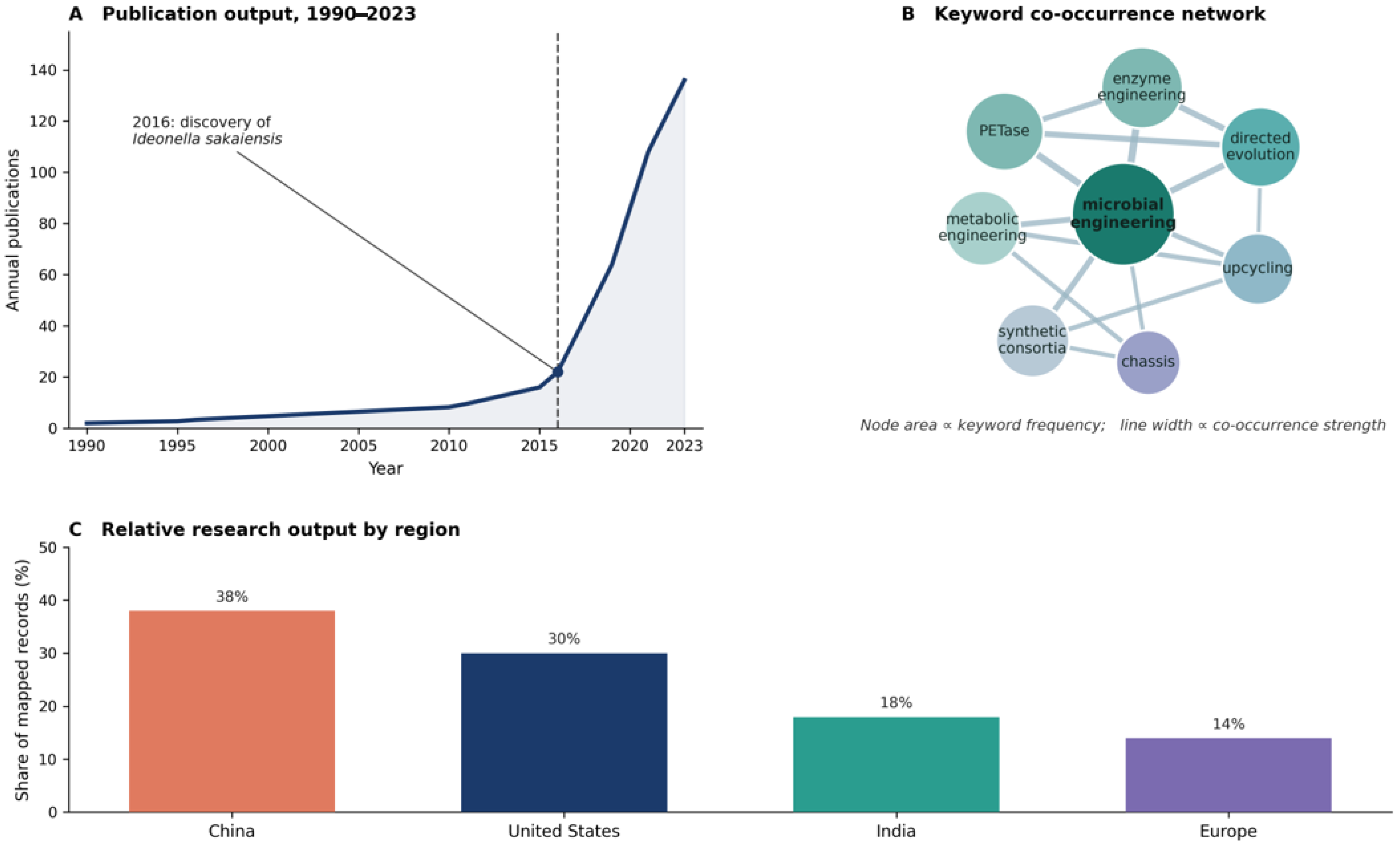
Quantitative mapping of the literature confirms the transformative impact of the 2016 discovery (Figure 1A–C). Yang and colleagues conducted a systematic search spanning 1960 to May 2023 and retrieved a core set of 1500 original research articles on the biodegradation of petroleum-based synthetic plastics from the Web of Science Core Collection (1991–May 2023) [28]. CiteSpace (C. Chen, Drexel University, Philadelphia, PA, USA) was used to construct collaborative networks, detect citation bursts, map keyword co-occurrence, and identify emerging research fronts [28]. A complementary analysis focused on microplastic biodegradation searched the American Chemical Society, Elsevier, Springer Link, and American Society for Microbiology databases for the period of 2012–2022, yielding 545 records, of which 331 were retained after screening; that study used CiteSpace version 5.6.R3 and VOSviewer version 1.6.15 (Centre for Science and Technology Studies, Leiden University, Leiden, The Netherlands) [29].
Publication output remained modest until the early 1990s, increased steadily thereafter, and accelerated sharply after 2016, with a further surge after 2018–2020 (Figure 1A) [28,29]. Annual growth rates of 11–13% have been reported for the broader plastics biodegradation corpus; microplastic-focused literature showed a particularly pronounced rise that peaked in 2020–2021 [28,29]. Keyword co-occurrence networks document a thematic shift from early descriptive isolation studies toward enzyme engineering, microplastics, microbial consortia, multi-omics approaches, and process optimization (Figure 1B) [28,29]. Leading institutions and authors are concentrated in China, the United States, and India, with strong collaborative links to European groups (Figure 1C) [28,29]. Citation bursts cluster around the Ideonella sakaiensis report, structural and directed evolution studies of PETase variants, and early industrial demonstrations of enzymatic recycling [28]. These quantitative patterns establish both the scientific momentum and the rationale for the hierarchical synthesis presented in the remainder of this review.

3. Natural Microbial Systems for Plastic Biodegradation

The plastisphere is the microbial biofilm that rapidly colonizes plastic surfaces in aquatic and terrestrial environments [30,31]. Community composition on that surface shifts with polymer type, weathering, and the surrounding matrix [31,32]. Plastic-associated enrichment does not, by itself, demonstrate that the enriched microorganisms catalyze polymer breakdown [30,31,32,33]. Mature marine biofilms on plastic often resemble biofilms on other inert surfaces more closely than a specialized polymer catabolic guild, and functional assignment therefore requires isolate physiology, demonstrated oligomer or monomer release, molar mass decline, or isotope tracing [33]. Against that background, surveys of soils, composts, marine sediments, landfill leachates, wastewater, and the plastisphere have reported more than 400 bacterial and fungal taxa with published claims of activity against one or more commodity plastics [8,9,34]. That figure records published claims, not verified bulk conversion to monomers or CO2.
Among bacteria, the phylum Proteobacteria is particularly well represented. The most intensively studied species is Ideonella sakaiensis 201-F6, originally isolated from a PET bottle recycling facility in Japan [1]. Other notable proteobacterial genera include Pseudomonas (for example, P. putida and P. aeruginosa), Alcanivorax, Oleispira, and several marine Alteromonas and Pseudoalteromonas isolates [8,9,35]. Within the Actinobacteria, thermophilic species such as Thermobifida fusca, Thermobifida alba, and Streptomyces species produce highly active cutinases and esterases [35,36]. Firmicutes are dominated by members of the genera Bacillus (including B. subtilis, B. cereus, and B. licheniformis), Rhodococcus (especially R. ruber and R. rhodochrous), and Clostridium [9,15,30].
Fungi contribute hydrolytic and oxidative enzymes that act on polyester surfaces and, in white-rot systems, can initiate oxidation of polyolefin surfaces. Within the Ascomycota, species of Aspergillus (notably, A. niger and A. oryzae), Fusarium, Penicillium, and Trichoderma secrete esterases, cutinases, and oxidative enzymes. Basidiomycota, particularly white-rot fungi belonging to the genera Phanerochaete, Trametes, and Pleurotus are valued for ligninolytic systems that can initiate oxidation of polyolefin surfaces [9,30,37]. These major groups and their typical reported substrates are summarized in Table 1. The polymer assignments in Table 1 indicate the substrates against which activity has been claimed; they do not imply complete biodegradation.
Substrate-specific assembly is illustrated by field data. In the Jukskei River, an urban waterway in Johannesburg, South Africa, polyethylene and polystyrene supported distinct bacterial and fungal assemblages, with polyethylene enriched in Romboutsia, Cutibacterium, and Sphingomonas and polystyrene favored by Lactococcus and Clostridium sensu stricto [38]. Such substrate-specific assembly is evidence of niche differentiation. It is not evidence that the enriched taxa depolymerize the bulk polymer [30,31,32,33,43]. Although many isolates form biofilms and secrete surface-active or oxidative enzymes, complete mineralization of high-molecular-weight, highly crystalline polymers by a single species remains uncommon. Most reported weight loss or surface erosion phenotypes reflect partial surface change, utilization of low-molecular-weight additives or oligomers, or limited chain scission rather than bulk conversion to CO2 and biomass [14,17,31].
Polymer specificity is pronounced. Polyesters possessing hydrolyzable ester bonds, particularly PET, polyurethane, and polylactic acid, are the most readily attacked substrates. Multiple bacterial and fungal cutinases, esterases, and the canonical PETase–MHETase system of I. sakaiensis have been characterized in detail [1,8,36,44]. In contrast, polyolefins and polystyrene lack reactive heteroatoms in the carbon backbone and require initial oxidative activation by laccases, manganese peroxidases, or alkane monooxygenases before further metabolism can proceed [14,15,16]. Verified high-efficiency degraders of untreated, high-molecular-weight polyolefins remain scarce. Among the more frequently cited candidates are certain strains of Rhodococcus ruber, Bacillus spp., and white-rot fungi, yet many earlier claims have not withstood re-examination under controlled conditions that exclude additive utilization or abiotic contributions [14,15,17].
Geographic patterns of isolation are informative. Japan and India together account for a disproportionately large share of described plastic-degrading strains, reflecting both intensive screening programs and the prevalence of plastic-contaminated environments [9]. China, Europe, and North America have also contributed substantially, particularly through metagenomic surveys of the plastisphere and insect gut microbiomes [9,35]. Marine and deep sea communities harbor taxa adapted to oligotrophic, high-pressure, or saline conditions, such as, for example, Alcanivorax and Oleispira [35,45]. The guts of certain insect larvae, Tenebrio molitor and Galleria mellonella, support rapid fragmentation of polystyrene and polyethylene [39,40,41,42]. In these systems, the relative contributions of host enzymes, gut microbiota, and mechanical mastication remain incompletely resolved, although antibiotic suppression and isolate studies indicate a microbial contribution to chain cleavage in mealworms [39,40,41].
Collectively, natural systems demonstrate both the feasibility of microbial attack on some synthetic polymers and the kinetic and ecological constraints on that attack. They supply the genetic and enzymatic raw material, most notably Ideonella sakaiensis PETase, Thermobifida cutinases, Pseudomonas and Rhodococcus oxidative systems, and diverse fungal hydrolases, for subsequent engineering. They also show that efficient, complete conversion of the most abundant and recalcitrant polymers will require deliberate redesign of enzymes, pathways, and communities and that plastisphere membership is a starting hypothesis rather than a functional proof.

4. Biochemical Mechanisms and Key Enzymes

Consistent terminology is required before mechanisms can be compared. Following the four-stage scheme used in polymer biodegradation research [46], this review distinguishes biodeterioration, a change in surface properties or mechanical integrity without obligatory chain cleavage; depolymerization, enzymatic or abiotic scission that releases oligomers or monomers; assimilation, intracellular uptake and anabolic use of those products; and mineralization, conversion to CO2, H2O, and inorganic ions. Biodegradation denotes the full sequence from colonization to mineralization. Biological recycling or monomer recovery denotes a process goal in which monomers are captured for repolymerization rather than respired. Surface erosion, biofilm formation, carbonyl index increase, and gravimetric mass loss are not interchangeable with biodegradation [17,46]. Extracellular enzyme activity on model esters or nanoparticles does not, by itself, demonstrate efficient attack on bulk, high-crystallinity objects [12,47]. Recent synthesis of polymer-specific metabolic routes reaches the same conclusion: hydrolytic and oxidative pathways must be scored against the same experimental standard, and many widely cited degraders remain poorly validated [48].
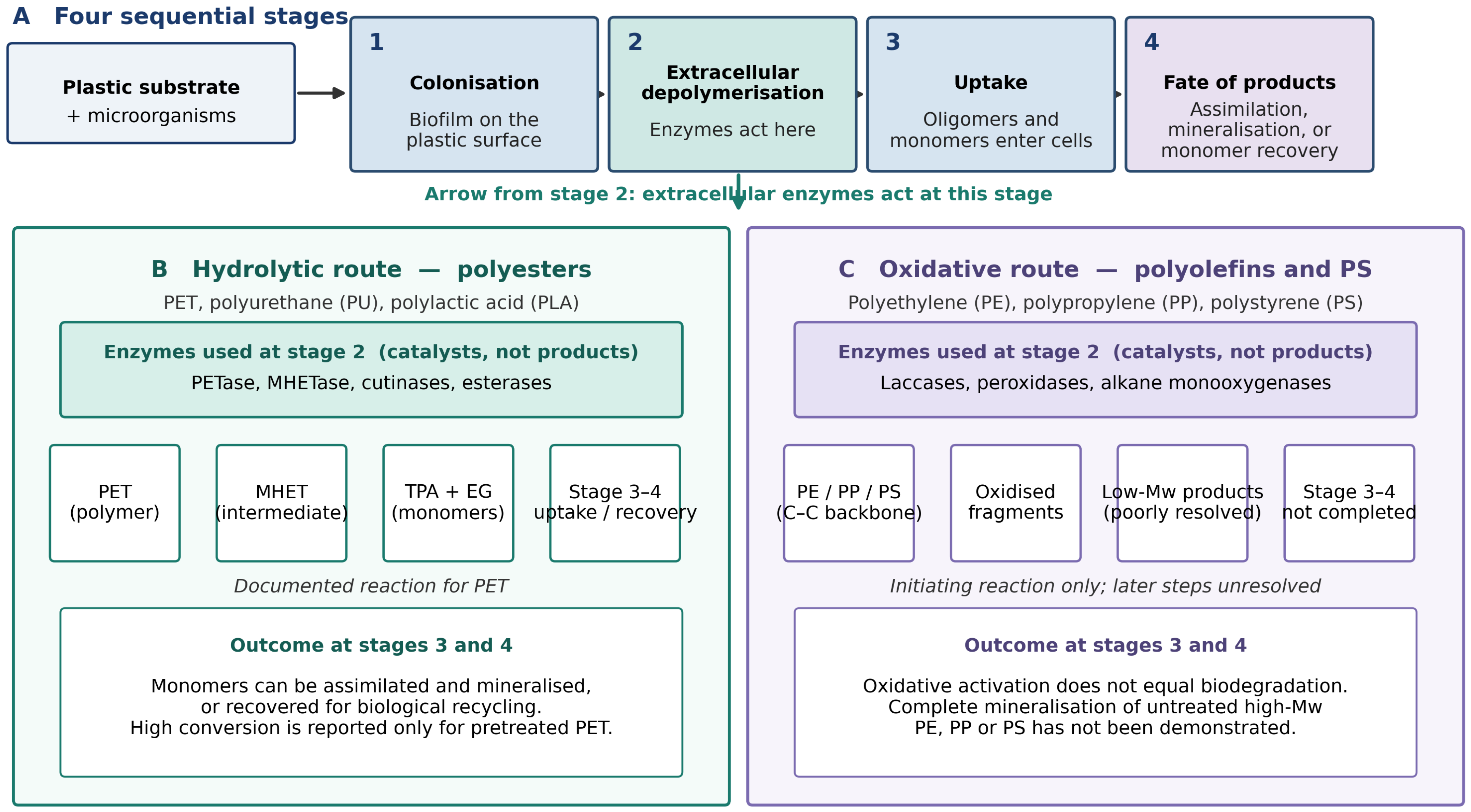
Plastic processing by microorganisms proceeds through four sequential stages: surface colonization and biofilm formation, extracellular enzymatic depolymerization, cellular uptake of oligomers or monomers, and intracellular assimilation or mineralization [34,37,46]. In the first stage, hydrophobic interactions, extracellular polymeric substances, and biosurfactants increase the accessibility of the polymer surface [46]. Two principal catalytic strategies are then employed. Hydrolytic cleavage is used against polyesters that contain ester or amide bonds (PET, polyurethane, and polylactic acid), whereas oxidative attack is required for the carbon–carbon backbones of polyethylene, polypropylene, and polystyrene (Figure 2) [14,16,34,48].
For PET, the best-characterized route is the two-enzyme cascade of Ideonella sakaiensis. PETase hydrolyses the polymer primarily to mono(2-hydroxyethyl) terephthalate (MHET), with smaller amounts of bis(2-hydroxyethyl) terephthalate and terephthalic acid [1,49,50]. MHETase then converts MHET into terephthalic acid and ethylene glycol [1,49,50]. Both monomers can enter central metabolism via the β-ketoadipate and glycolate pathways, respectively [50,51]. Cutinases are serine hydrolases that cleave cutin and by extension, ester bonds in synthetic polyesters; they use a Ser-His-Asp catalytic triad [36,44]. Structural work at atomic resolution revealed that PETase possesses a more open active-site cleft than homologous cutinases, a feature that accommodates the aromatic terephthalate units of PET [52,53]. Thermophilic cutinases from Thermobifida fusca and leaf-branch compost share the same catalytic triad yet exhibit higher intrinsic thermostability [11,36]. In contrast, oxidative enzymes, including laccases, manganese peroxidases, and alkane monooxygenases, introduce carbonyl and hydroxyl groups into polyolefins and thereby render the polymer more susceptible to further chain scission [15,16,48]. The catalytic efficiency of these oxidative systems remains orders of magnitude lower than that of the best PET hydrolases, and complete mineralization of untreated high-molecular-weight polyolefins under controlled conditions has not been achieved [14,15,16,17].

5. Enzyme Engineering of PET Hydrolases for Enhanced Performance

This section is restricted to PET hydrolases, the only plastic-active enzymes for which structure-guided design, directed evolution, and machine learning campaigns have produced quantitatively benchmarked industrial candidates. Comparable engineering of laccases, peroxidases, or alkane monooxygenases for untreated polyolefins has not reached the same performance standard [16,18]. Wild-type PET hydrolases suffer from limited activity, modest thermostability, and restricted performance on crystalline substrates. Three complementary engineering strategies have been pursued: structure-guided rational design, directed evolution, and machine-learning-assisted mutagenesis [21,52,53]. Directed evolution is treated here rather than in a separate later section to avoid repetition. Broader surveys of PET hydrolase diversity and application constraints provide the context for those campaigns [54,55].
The first high-resolution crystal structure of IsPETase (0.92 Å) was reported by Austin and co-workers [56]. Their work revealed an unusually open active-site cleft relative to cutinases. Narrowing the cleft by the double mutation S238F/W159H unexpectedly improved activity on crystalline PET, demonstrating that the wild-type enzyme is not fully optimized for its synthetic substrate [56]. Subsequent rational campaigns produced thermostable IsPETase variants [57] and the GRAPE-redesigned DuraPETase scaffold that improved ambient temperature robustness [58].
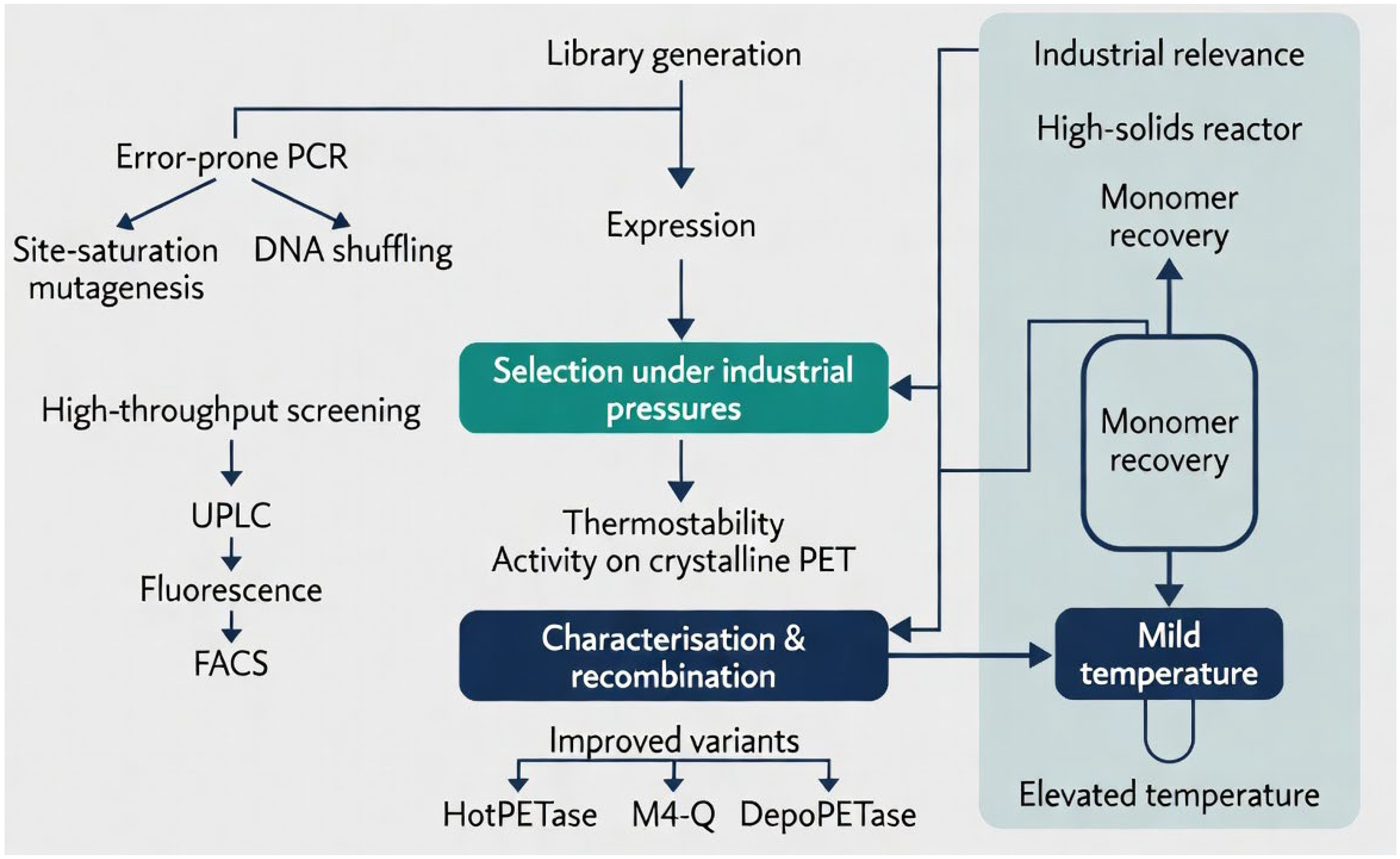
Directed evolution under elevated temperature selection produced HotPETase, which contains 21 amino acid substitutions and exhibits a melting temperature of 82.5 °C [59]. The campaign used six iterative rounds of saturation mutagenesis and DNA shuffling and evaluated more than 13,000 variants [59]. HotPETase operates near or above the glass transition temperature of PET and depolymerizes semi-crystalline material more rapidly than earlier PETase variants [59]. Library construction has relied on error-prone PCR, site saturation mutagenesis of flexible loops, DNA shuffling, and semi-rational targeting of the β-sheet core [53,59,60,61,62]. Because PET is an insoluble polymer, screening has required ultra-performance liquid chromatography of terephthalic acid and MHET, agar-plate clearing assays, fluorescence- or pH-sensitive reporters, and yeast surface display coupled to fluorescence-activated cell sorting [59,60,61,63].
In parallel, a machine learning approach predicted beneficial mutations that, when combined with a thermostable scaffold, produced FAST-PETase (N233K/R224Q/S121E/D186H/R280A) [64]. This variant displays superior activity between 30 °C and 50 °C across a range of pH values and can almost completely depolymerize untreated post-consumer PET from diverse thermoformed products within one week under laboratory batch conditions [64]. Those conditions are not equivalent to the high-solids continuous format used to benchmark LCCICCG and TurboPETase [12,13].
Attention has also focused on the flexible loops that surround the active site. Semi-rational design combined with directed evolution identified four loop-region mutations (N114I/N205K/N233K/S269V). The resulting quadruple mutant, QM-PETase-2, exhibited a 4.9-fold increase in catalytic efficiency and a +12.4 °C rise in melting temperature [65]. Transfer of these sites into FAST-PETase, PA-PETase, and DepoPETase backgrounds produced further gains [65]. An independent loop-targeted campaign produced the M4-Q variant, which enhanced mild-temperature depolymerization of PET and aliphatic–aromatic copolyesters [66]. Error-prone PCR libraries of approximately 10,000 clones generated DepoPETase, which combined a substantial increase in melting temperature with elevated product formation on amorphous PET film [60]. Systematic saturation of core β-sheet regions likewise yielded variants with improved packing and operational stability [62].
The industrially most advanced catalyst remains the leaf-branch compost cutinase variant LCCICCG. In the original study, this enzyme achieved a minimum of 90% PET depolymerization within 10 h under high-solid loadings [11]. Subsequent comparative evaluation confirmed conversions of 90–98% under industrially relevant conditions and demonstrated superior operational stability relative to FAST-PETase and HotPETase in that format [12]. TurboPETase, redesigned from a hydrolase of bacterium HR29, achieved 98.2% depolymerization of pretreated post-consumer PET in 8 h at 200 g kg−1 and 65 °C with enzyme loading of 2 mg g−1 PET [13]. Table 2 reports these comparisons with substrate, loading, time, and reactor format stated explicitly so that laboratory batch results are not read as industrial continuous performance.
Despite these advances, several limitations persist. Activity on highly crystalline, untreated PET remains slower than on amorphized material; enzyme production cost and longevity under process conditions still constrain economics; high-throughput assays on model substrates do not always predict performance on real post-consumer objects; and no equivalent high-efficiency biocatalysts exist for polyolefins [12,14,17,21]. Current efforts therefore emphasize multi-objective optimization, continued loop region and β-sheet engineering, metagenomic discovery of new scaffolds, including marine and thermophilic esterases, and artificial-intelligence-guided design [21,67,68,69,70,71].

6. Engineering Microbial Hosts and Metabolic Pathways for PET Monomer Upcycling

While enzyme engineering has improved the catalytic performance of PET hydrolases, practical deployment also requires robust microbial chassis capable of high-level enzyme production, efficient monomer assimilation, and conversion of the resulting carbon into biomass or value-added products [22,72]. Microbial host engineering therefore encompasses heterologous expression, secretion optimization, metabolic pathway reconstruction, and adaptive laboratory evolution [22,73,74]. Claims below specify the host, the genetic intervention, and the condition under which the phenotype was measured. Metabolic and enzymatic engineering strategies for PET degradation and valorization have been reviewed by Satta and colleagues [75]; the account below is limited to chassis, construct, and measured phenotype.
Escherichia coli remains the most widely used laboratory host for rapid cloning, expression, and characterization of PETase and MHETase variants because of its fast growth, simple genetics, and well-established molecular toolbox [76]. Surface display of soluble PETase variants on E. coli has been demonstrated using auto display scaffolds, increasing local enzyme concentration at a model polymer surface under shake-flask conditions [76]. A one-pot whole-cell route has also converted PET-derived terephthalic acid to vanillin in E. coli, illustrating upcycling beyond mineralization under laboratory conditions [77]. Limited tolerance to aromatic monomers and a modest native capacity for protein secretion have nevertheless motivated exploration of alternative chassis [22].
Pseudomonas putida KT2440 has emerged as a particularly attractive platform. This soil bacterium possesses innate tolerance to a wide range of aromatic compounds, a versatile central metabolism, and an extensive genetic toolkit that supports both chromosomal integration and plasmid-based expression [22]. Engineered KT2440 strains have been constructed that express PETase and MHETase and that catabolize terephthalic acid via tph genes from Comamonas and tpaK from Rhodococcus jostii, together with ethylene glycol after overexpression of the native gcl and glcDEF operons [78,79]. In a tandem chemical–biological scheme, a KT2440 strain converted bis(2-hydroxyethyl) terephthalate to 15.1 g L−1 β-ketoadipic acid at 76% molar yield in bioreactors [79]. A separate lineage, Pseudomonas umsongensis GO16 evolved for ethylene glycol use, converted enzymatic PET hydrolysate into medium-chain-length polyhydroxyalkanoates [72]. The principal advantages and limitations of commonly used chassis are summarized in Table 3.
Metabolic engineering efforts have focused on efficient assimilation and further conversion of the two PET monomers. Terephthalic acid is channeled into the β-ketoadipate pathway, while ethylene glycol is metabolized via glycolaldehyde and glycolate before entering central carbon metabolism [72,78,79]. Pathway extensions have enabled conversion of these intermediates into polyhydroxyalkanoates, muconic acid, β-ketoadipic acid, and aromatic products such as vanillin, illustrating biological upcycling rather than simple mineralization [72,77,79,80]. Whole-cell biocatalysts and surface display systems increase the local concentration of enzyme at the polymer surface and can simplify downstream enzyme handling [76]. These phenotypes have been measured on hydrolysates or model monomers; they do not by themselves constitute depolymerization of crystalline post-consumer objects.
Adaptive laboratory evolution provides a complementary method for improving host performance under process-relevant stresses [73,74]. In typical protocols, a microbial population is serially transferred for tens to hundreds of generations under a selective pressure such as elevated temperature, increasing concentrations of terephthalic acid or ethylene glycol, mixed plastic hydrolysates, or osmotic stress [73,74]. Periodic whole-genome sequencing identifies beneficial mutations that can then be reverse-engineered into clean chassis backgrounds. Adaptive laboratory evolution has enhanced ethylene glycol utilization in P. putida KT2440 and in P. umsongensis GO16 and has improved growth on PET hydrolysates [72,78]. When combined with targeted metabolic engineering, the approach accelerates development of strains that maintain productivity under fluctuating and non-ideal process conditions.
Despite these advances, several challenges remain. Stable, high-level secretion of large multi-domain enzymes is still difficult to achieve, and the metabolic burden imposed by heterologous pathway expression can reduce cellular fitness [22,74]. Balancing enzyme production, monomer uptake, and product formation while maintaining genetic stability under industrial operating conditions continues to be an active area of research [74,79]. Whole-cell systems also raise containment questions that isolated enzyme processes largely avoid.
Collectively, host engineering and adaptive laboratory evolution extend the capabilities of individual enzymes into whole-cell systems capable of both depolymerization support and upcycling, thereby strengthening the technological foundation for industrial translation of polyester recycling. They do not yet provide an equivalent platform for untreated polyolefins.

7. Synthetic Microbial Consortia and Systems-Level Approaches

Single-strain systems are frequently limited by incomplete substrate conversion or the inability to process mixed plastic waste. Synthetic microbial consortia address these constraints by distributing metabolic labor among specialized members [23,80].
In a typical division-of-labor design, one or more strains secrete depolymerizing enzymes while partner strains assimilate the resulting monomers. Bao and colleagues constructed a two-member P. putida consortium in which one strain specialized in terephthalic acid utilization and the other in ethylene glycol utilization; relative to a monoculture carrying both pathways, the consortium reduced catabolic crosstalk and improved conversion of PET hydrolysate to polyhydroxyalkanoates and cis-muconate [80]. Qi and colleagues assembled a four-member system comprising two engineered Bacillus subtilis strains that secreted PETase and MHETase, Rhodococcus jostii to consume terephthalic acid, and P. putida to consume ethylene glycol; PET-film weight loss reached 23.2% under ambient laboratory conditions after parameter optimization [81]. These studies demonstrate improved hydrolysate handling and, in the Qi system, modest film weight loss. They do not demonstrate industrial depolymerization of mixed post-consumer waste.
Rational consortium design is increasingly informed by natural plastisphere communities, provided membership is not mistaken for function [30,31,32,38]. Under environmental conditions, plastic surfaces in rivers, oceans, and soils rapidly develop substrate-specific biofilms [30,31,38]. Multi-omics data and computational modeling further guide consortium design by predicting cross-feeding interactions and population stability [23,82,83]. Multi-member systems that combine fungal partners for oxidative activation of polyolefins with bacterial hydrolase producers have been proposed for mixed-plastic streams [23,34], but experimental conversions remain low and poorly standardized [14,17]. Recent reviews summarize global progress in synthetic consortia for PET and wastewater [82,83].
Maintaining stable population ratios, preventing contamination, and ensuring long-term genetic stability remain significant challenges [23,82]. Containment strategies, including kill-switch circuits, are being developed to address biosafety concerns associated with potential environmental release of engineered consortia [31,82]. When combined, host engineering, adaptive laboratory evolution, and systems-level consortium techniques expand individual enzymes into solutions that can handle the complexity of plastic hydrolysates. Translation to untreated mixed plastic waste is not yet established.

8. Translation from Laboratory to Industry

The successful transfer of microbial plastic processing from controlled laboratory settings to industrial practice requires coordinated advances in biocatalyst performance, process engineering, feedstock handling, and economic viability. Laboratory studies frequently report high conversion yields under idealized conditions, yet industrial feedstocks are heterogeneous, contaminated, and often highly crystalline. Bridging this gap demands systematic attention to pretreatment, scale-up validation, techno-economic performance, and regulatory readiness [26,27]. This section distinguishes laboratory, pilot, demonstration, and commercial stages so that industrial readiness is not overstated.

8.1. Pretreatment and Process Requirements

Industrial post-consumer plastics differ markedly from the pure, low-crystallinity substrates used in most laboratory assays. Mechanical micronization increases available surface area, while thermal or solvent-assisted amorphization reduces crystallinity and thereby accelerates enzymatic attack. In the most advanced enzymatic PET recycling schemes, post-consumer PET is first size-reduced and amorphized before being fed to a high-solid enzymatic reactor operated at elevated temperature and controlled pH [11,12]. These pretreatment steps remain energy-intensive and constitute a major cost and environmental burden; development of milder or integrated pretreatment methods compatible with mixed plastic waste is therefore an active research priority [26,27].

8.2. Pilot- and Demonstration-Scale Achievements

Readiness differs sharply by catalyst and by polymer. LCCICCG has been advanced furthest. Under optimized high-solids conditions (up to 200 g kg−1), this enzyme achieves 90–98% depolymerization of pretreated PET within 10–24 h, yielding monomers that can be re-polymerized into virgin-quality PET [11,12]. Carbios is a French industrial developer of enzymatic PET recycling. Its process uses LCCICCG to hydrolyze pretreated, amorphized PET to terephthalic acid and ethylene glycol that can be purified and re-polymerized. The process built around this biocatalyst has progressed from laboratory optimization through pilot operation to construction of larger demonstration facilities [11,84]. That trajectory is pilot-to-demonstration, not commercial commodity operation. TurboPETase has reached 98% conversion in 8 h at 200 g kg−1 in laboratory bioreactors [13] and remains at laboratory-to-early-pilot evaluation. FAST-PETase, HotPETase, and recent loop-engineered variants continue at laboratory scale; none has matched the operational stability and conversion metrics of LCCICCG under continuous high-loading conditions [12,59,64,65]. Whole-cell and consortium systems for PET hydrolysate upcycling remain laboratory demonstrations [72,79,80,81]. No polyolefin process has left the laboratory with verified bulk depolymerization of untreated high-molecular-weight polymer [14,17].

8.3. Techno-Economic and Life-Cycle Considerations

Techno-economic analyses identify enzyme production cost, reactor residence time, pretreatment energy demand, and downstream monomer purification as the dominant cost drivers [26]. The principal technical and economic factors that currently govern industrial translation of enzymatic PET recycling are summarized in Table 4.
Under favorable assumptions of high conversion, efficient enzyme recycling, and large-scale operation, projected production costs for enzymatically recycled PET approach parity with virgin material [26]. Life-cycle assessments indicate that enzymatic routes can deliver lower greenhouse gas emissions and cumulative energy demand than conventional mechanical recycling or virgin synthesis, provided high monomer recovery and minimal solvent use are achieved [26,27]. These projections remain sensitive to feedstock variability, pretreatment energy demand, and enzyme longevity. Comprehensive assessments that incorporate mixed plastic streams, real-world contamination, and full supply-chain logistics are still limited [26,27]. Cost parity should therefore be treated as a model-dependent projection, not as an established industrial fact.

8.4. Regulatory, Biosafety, and Implementation Barriers

The use of isolated engineered enzymes in contained industrial reactors raises fewer regulatory concerns than the environmental release of living engineered microorganisms [84]. Residual enzyme activity in process wastewater, the fate of incomplete depolymerization products, and the possible presence of plastic additives must nevertheless be managed through appropriate treatment and monitoring protocols [86]. For whole-cell or consortium-based systems, robust containment strategies, genetic safeguards, and clear regulatory pathways will be required before large-scale deployment can be contemplated [82,86]. The absence of internationally harmonized standards for enzymatic recycling performance and product quality continues to slow commercial adoption. PET depolymerization is technically feasible at pilot and demonstration scale; wider industrial translation still requires reductions in pretreatment intensity, enzyme cost, and process complexity, together with supportive policy and standardization frameworks [26,27,84].

9. From Plastisphere Ecology to Engineered Circularity

The title of this review asserts a bridge between natural plastisphere ecology and industrial circularity. That bridge is not automatic. Natural communities illustrate colonization logic, polymer-dependent assembly, and occasional hydrolytic or oxidative activity. Engineered systems must convert those observations into controllable catalysts, hosts, and processes that recover monomers. The following framework makes the linkage explicit and states where it currently fails.

9.1. A Six-Stage Translational Framework

Six stages connect environmental observation to industrial monomer recovery. Stage 1 is colonization and biofilm formation on weathered polymer, as described for marine debris and urban river plastics [30,31,38]. Stage 2 is extracellular enzymatic depolymerization, which is efficient for pretreated polyesters and inefficient for untreated polyolefins [11,12,13,14,15,16,17]. Stage 3 is metabolite exchange: oligomers and monomers move between producers and consumers, as in PETase–MHETase cascades and hydrolysate cross-feeding [1,50,80,81]. Stage 4 comprises microbial interactions that stabilize or destabilize the community, including competition, inhibition by terephthalic acid or ethylene glycol, and polymer-specific assembly [38,80,81]. Stage 5 is the construction of synthetic consortia that assign those roles deliberately [23,80,81,82,83]. Stage 6 is process-level monomer recovery, in which depolymerization products are purified for repolymerization rather than mineralized [11,26,27]. Circularity is achieved only at stage 6. Stages 1–4 can occur without any contribution to a circular plastics economy.

9.2. What Engineering Can Take from the Plastisphere

Plastisphere studies supply three usable design principles. First, community composition is polymer-dependent, so consortium membership should be matched to feedstock chemistry rather than assembled from generic soil isolates [31,38]. Second, oxidative weathering increases surface polarity and can prime subsequent enzymatic attack; low-energy pretreatments that mimic this priming are therefore a rational process target [31,32]. Third, cross-feeding of monomers and detoxification of inhibitory intermediates are recurring ecological motifs that map directly onto division-of-labor designs already implemented for PET hydrolysate [80,81]. These principles inform chassis choice, consortium architecture, and pretreatment strategy. They do not license the inference that a taxon enriched on plastic is a polymer-degrading catalyst [30,31,32].

9.3. What Engineering Must Add

Natural systems do not supply industrially adequate rates, host robustness, containment, or downstream recovery. Protein engineering, directed evolution, and machine learning redesign have been required to bring PET hydrolases to high-solids performance [11,12,13,59,64]. Metabolic engineering and adaptive laboratory evolution have been required to assimilate terephthalic acid and ethylene glycol at useful titers [72,78,79]. Process engineering has been required to couple amorphization, high-solids reactors, and monomer purification [11,26]. For polyolefins, even these additions have not produced a catalyst or consortium that converts untreated high-molecular-weight polymer to recoverable products at scale [14,17]. The ecological limitation is therefore not solved by copying community composition; it is solved, where it is solved at all, by redesigning catalysts and processes.

9.4. Implications for Assay Design and Claims

The framework imposes an evidentiary standard. A plastisphere survey that reports differential abundance has completed stage 1. An isolate that etches a film surface or lowers mass by a few percent has at most begun stage 2. An engineered hydrolase that releases quantified terephthalic acid from pretreated PET under stated loadings has completed stage 2 for that substrate [11,12,13]. A consortium that grows on hydrolysate has completed stages 3–5 for that hydrolysate [80,81]. Only processes that recover polymer-grade monomers at documented yield, time, solids loading, and energy cost have reached stage 6 [11,26,84]. Mixing these stages in a single sentence is the principal source of over-interpretation in the literature this review covers [17,46].
Directed evolution remains the experimental engine that moves PET hydrolases from stage 2 laboratory activity to stage 6 process compatibility. The workflow, library methods, screening platforms, and landmark variants are summarized in Section 5 and in Figure 3. Their industrial relevance is that thermostable and loop-stabilized enzymes can operate near the glass transition temperature of PET, reduce pretreatment intensity, and shorten residence time [11,12,13,59]. Those gains apply to pretreated polyesters. They have not been reproduced for polyolefins.
In summary, plastisphere ecology informs who colonizes which polymer and how metabolites may be shared. Microbial engineering determines whether those observations can be converted into contained, rate-sufficient, monomer-recovering processes. The remainder of this review evaluates that conversion against kinetic, analytical, ecological, and economic limits.

10. Critical Limitations, Controversies, and Knowledge Gaps

Despite substantial progress in enzyme discovery, protein engineering, and pilot-scale demonstration, several fundamental scientific, technical, and socio-technical limitations continue to constrain widespread adoption of microbial plastic processing. A balanced appraisal of these constraints is essential if the field is to move beyond proof-of-concept studies.

10.1. Kinetic and Substrate Limitations

Catalytic rates on highly crystalline and untreated post-consumer PET remain substantially lower than those achieved with laboratory-grade, amorphized substrates. Even the best-engineered hydrolases, including LCCICCG, TurboPETase, FAST-PETase, and recent loop-optimized variants, require energy-intensive mechanical micronization and thermal or solvent-assisted amorphization to reach industrially acceptable productivities [11,12,13,26]. Without such pretreatment, conversion kinetics decline sharply, and residence times become economically prohibitive.
For polyolefins, the situation is more difficult. Reported weight losses for polyethylene and polypropylene under microbial or enzymatic treatment are typically limited to single-digit or low double-digit percentages after weeks or months of incubation. Many of these reductions can be attributed to utilization of low-molecular-weight additives, surface oxidation products, or oligomeric fractions rather than true bulk polymer conversion [14,15,16,17]. Inadequate abiotic controls, unaccounted additive loss, and confusion between mass loss and biodegradation are recurrent weaknesses in this literature [17]. Verified, high-efficiency biocatalysts capable of depolymerizing untreated, high-molecular-weight polyolefins under realistic conditions remain essentially unavailable.

10.2. Disconnect Between Laboratory Conditions and Real-World Matrices

A recurring controversy concerns the environmental and industrial relevance of laboratory results. The majority of published studies employ pure, low-crystallinity polymers, high enzyme-to-substrate ratios, optimized buffer systems, and controlled temperature regimes that do not reflect the complex, contaminated, and fluctuating conditions of real waste streams or environmental compartments [17,44]. Inhibitory compounds (dyes, additives, residual detergents, heavy metals), mixed polymer compositions, and variable particle sizes routinely reduce observed activities relative to idealized assays. Enzyme activity on BHET, MHET, nanoparticles, or amorphous films does not establish conversion of bulk, high-crystallinity post-consumer objects [12,47].
Standardization of experimental protocols remains inadequate. Differences in polymer crystallinity measurement, surface area normalization, enzyme quantification, and endpoint definitions (weight loss, monomer release, CO2 evolution, molar mass decline) render direct comparison across studies difficult and occasionally misleading [17,46]. Enrichment, surface pitting, and spectroscopic change do not demonstrate complete biodegradation [17,30]. Calls for community-wide assay standards have intensified, yet consensus protocols have not been widely adopted.

10.3. Ecological, Toxicological, and Biosafety Concerns

Incomplete depolymerization can generate micro- and nano-plastic fragments as well as soluble oligomers whose ecological and toxicological profiles are incompletely characterized. Plastic additives (plasticizers, flame retardants, stabilizers) may be released during enzymatic or microbial treatment, potentially increasing rather than decreasing environmental hazard in the short term [86].
For whole-cell or consortium-based systems, the possibility of horizontal gene transfer of engineered traits and the long-term ecological fitness of released strains raise legitimate biosafety questions. Contained industrial reactors using isolated enzymes pose a comparatively low risk. Any future open-environment or large-scale bioaugmentation application would require robust containment strategies, genetic safeguards, and rigorous risk assessment frameworks that are not yet fully developed [82,86].

10.4. Economic, Scalability, and Systemic Barriers

Techno-economic analyses consistently identify enzyme production cost, reactor residence time, pretreatment energy demand, and downstream monomer purification as the dominant cost centers [26,27]. While projections under optimistic assumptions approach cost parity with virgin PET, these models remain sensitive to feedstock heterogeneity, enzyme longevity, and scale. Comprehensive life-cycle assessments that incorporate realistic mixed-plastic streams, contamination levels, and full supply chain logistics are still scarce [26,27].
In addition, the field faces systemic challenges: limited public and regulatory acceptance of genetically engineered organisms in some jurisdictions, insufficient infrastructure for segregated collection of enzyme-compatible waste streams, and competition from rapidly advancing chemical recycling technologies and from broader circular economy and bio-based material strategies that may offer higher throughput for mixed plastics [25,85,87].

10.5. Priority Knowledge Gaps

The principal knowledge gaps that must be addressed to advance the field can be summarized as follows.
(i) Discovery or de novo design of high-efficiency oxidative or hybrid catalysts capable of attacking untreated polyolefins under mild conditions; (ii) development of robust, low-energy pretreatment methods compatible with mixed and contaminated plastic waste; (iii) long-term operational stability, genetic containment, and population control strategies for engineered hosts and synthetic consortia; (iv) harmonized, community-endorsed assay standards that enable reproducible comparison of enzyme and process performance and that separate biodeterioration from depolymerization, assimilation, and mineralization; (v) comprehensive techno-economic and life-cycle assessments that incorporate realistic feedstock variability, additive fate, and downstream purification costs; and (vi) systematic evaluation of the ecological and toxicological consequences of incomplete degradation products and released additives.
Addressing these interconnected gaps will determine whether microbial systems remain confined to niche applications or whether they can contribute meaningfully, safely, and economically to a circular plastics economy. Progress will require sustained interdisciplinary collaboration among protein engineers, process chemists, environmental microbiologists, life-cycle analysts, and policy makers.

11. Discussion

The engineering of microbial systems for plastic processing has progressed from observational studies of natural degraders to the deliberate redesign of enzymes, pathways, and communities capable of operating under industrially relevant conditions for one polymer class. The sections of this review collectively demonstrate both the substantial advances achieved since the isolation of Ideonella sakaiensis and the persistent scientific and translational barriers that continue to limit broad application. The discussion that follows separates what is firmly demonstrated from what is promising and what remains speculative.
Established I. sakaiensis PETase and MHETase hydrolyze PET to terephthalic acid and ethylene glycol, and both monomers can enter central metabolism [1,49,50,75]. Structure-guided, evolutionary, and machine learning optimization has produced hydrolases that convert pretreated, amorphized PET to monomers at 90–98% under high-solid loadings within 8–24 h [11,12,13]. LCCICCG has been operated at pilot and demonstration scale with recovery of polymer-grade monomers [11,84]. These results constitute enzymatic depolymerization and monomer recovery for pretreated polyester. They do not constitute environmental biodegradation of mixed plastic waste.
Promising but incomplete. Pseudomonas putida KT2440 and related pseudomonads can be engineered to assimilate PET monomers and produce polyhydroxyalkanoates, muconate, or β-ketoadipic acid from hydrolysates [22,72,78,79,80]. Synthetic consortia improve hydrolysate handling by dividing labor between terephthalic acid and ethylene glycol specialists [80,81]. Adaptive laboratory evolution improves host tolerance [72,73,74,78]. Techno-economic and life-cycle models indicate that enzymatic PET recycling can approach cost parity and reduce greenhouse gas emissions relative to virgin synthesis under optimistic assumptions of conversion, enzyme recycling, and feedstock quality [26,27]. Natural plastisphere patterns, including polymer-specific assembly in an urban African river [38], supply design principles for consortium membership. Each of these lines remains short of industrial demonstration on mixed, contaminated post-consumer streams.
Speculative. complete mineralization or monomer recovery from untreated high-molecular-weight polyethylene, polypropylene, or polystyrene by a single isolate, an engineered enzyme, or a synthetic consortium has not been demonstrated under controlled conditions that exclude additive utilization and abiotic weathering [14,15,16,17]. Open-environment bioaugmentation with living engineered organisms is not supported by current biosafety evidence [82,86]. Cost parity on realistic mixed-plastic feedstocks is a model output, not a measured industrial result [26,27]. Claims that plastisphere enrichment equals polymer catabolism, or that film weight loss equals biodegradation, belong in this category [17,30,46].
The biochemical mechanism explains the split. Hydrolytic cascades convert PET efficiently into recoverable monomers under optimized conditions [1,11,12,13], whereas oxidative enzymes required for polyolefin activation remain orders of magnitude less efficient [14,15,16]. Structural insights into PETase, including its open active-site cleft relative to homologous cutinases, have guided rational and evolutionary improvements [56,59,64,88]. Equivalent scaffolds for carbon backbone polymers have not materialized.
Critical limitations therefore persist across multiple dimensions. Catalytic rates on crystalline and polyolefin substrates remain inadequate for economic operation without intensive pretreatment [12,14]. Laboratory assays frequently overestimate real-world performance because they employ pure, low-crystallinity polymers and optimized buffer conditions [17]. Standardization of experimental protocols is still insufficient. Incomplete degradation products, additive release, and potential horizontal gene transfer introduce ecological and toxicological uncertainties that have not been systematically evaluated [86]. Comprehensive life-cycle assessments that incorporate realistic mixed-plastic streams and full supply-chain logistics remain scarce [26,27].
Taken together, the evidence indicates that microbial engineering has transformed PET depolymerization into a coherent technological platform with clear pilot- and demonstration-scale potential. The same cannot yet be said for polyolefins or mixed plastic waste. Progress will depend on the discovery or de novo design of efficient catalysts for carbon backbone polymers, the development of low-energy pretreatment methods, the construction of stable and containable host and consortium platforms, and rigorous validation under industrially and environmentally realistic conditions. When these interconnected challenges are addressed, engineered microbial systems, drawing on the maturity already demonstrated in pharmaceutical, enzyme, and biofuel industries [20,25], can contribute meaningfully to a circular plastics economy.

12. Conclusions

Microbial engineering has transformed plastic research from an observational curiosity into a coherent technological platform for one polymer class. The discovery of Ideonella sakaiensis and the subsequent structure-guided, evolutionary, and machine learning optimization of PET hydrolases have produced catalysts capable of near-complete depolymerization of pretreated PET under industrially relevant solids loadings. Parallel advances in chassis engineering, adaptive laboratory evolution, and synthetic consortia have begun to address monomer assimilation, product diversification, and process robustness. Natural plastisphere communities, including those characterized in urban African rivers, continue to supply genetic resources and ecological design principles, provided membership is not mistaken for catabolic function.
The field remains constrained by persistent kinetic limitations on crystalline and polyolefin substrates, energy-intensive pretreatment requirements, inadequate assay standardization, incomplete understanding of degradation by-products, and unresolved techno-economic and biosafety questions. These gaps are not merely technical; they determine whether microbial systems will remain confined to niche applications or contribute meaningfully to a circular plastics economy.
Future progress will depend on four interlocking priorities: (i) the discovery or de novo design of efficient catalysts for polyolefins; (ii) integration of low-energy pretreatment with continuous high-solids bioprocessing; (iii) development of stable, containable host and consortium platforms; and (iv) rigorous, transparent life-cycle and techno-economic assessment under realistic feedstock conditions using assays that distinguish biodeterioration, depolymerization, assimilation, mineralization, and monomer recovery. When these challenges are met, engineered microbial systems can become an integral component of sustainable plastic management.

Author Contributions

Conceptualization, A.D.C.; methodology, A.D.C.; software, A.D.C.; validation, A.D.C.; formal analysis, A.D.C.; investigation, A.D.C.; resources, A.D.C. and M.T.; data curation, A.D.C.; writing—original draft preparation, A.D.C.; writing—review and editing, A.D.C. and M.T.; visualization, A.D.C.; supervision, A.D.C. and M.T.; project administration, A.D.C. and M.T.; funding acquisition, M.T. All authors have read and agreed to the published version of the manuscript.

Funding

This work was funded by NRF Africa–Japan Collaborative Research (AJ-CORE) grant number AJCR240820261195.

Data Availability Statement

No new data were created or analyzed in this study. Data sharing is not applicable to this article.

Conflicts of Interest

The authors declare no conflicts of interest.

References

  1. Yoshida, S.; Hiraga, K.; Takehana, T.; Taniguchi, I.; Yamaji, H.; Maeda, Y.; Toyohara, K.; Miyamoto, K.; Kimura, Y.; Oda, K. A bacterium that degrades and assimilates poly(ethylene terephthalate). Science 2016, 351, 1196–1199. [Google Scholar] [CrossRef] [Scilit] [PubMed]
  2. Plastics Europe. Plastics—The Fast Facts 2024. Plastics Europe. 2024. Available online: https://plasticseurope.org/knowledge-hub/plastics-the-fast-facts-2024/ (accessed on 22 June 2026).
  3. Plastics Europe. Plastics—The Fast Facts 2025. Plastics Europe. 2025. Available online: https://plasticseurope.org/knowledge-hub/plastics-the-fast-facts-2025/ (accessed on 23 June 2026).
  4. Geyer, R.; Jambeck, J.R.; Law, K.L. Production, use, and fate of all plastics ever made. Sci. Adv. 2017, 3, e1700782. [Google Scholar] [CrossRef] [Scilit] [PubMed]
  5. Organisation for Economic Cooperation and Development. Global Plastics Outlook: Economic Drivers, Environmental Impacts and Policy Options; OECD Publishing: Paris, France, 2022. [Google Scholar] [CrossRef] [Scilit]
  6. Lau, W.W.Y.; Shiran, Y.; Bailey, R.M.; Cook, E.; Stuchtey, M.R.; Koskella, J.; Velis, C.A.; Godfrey, L.; Boucher, J.; Murphy, M.B.; et al. Evaluating scenarios toward zero plastic pollution. Science 2020, 369, 1455–1461. [Google Scholar] [CrossRef] [Scilit] [PubMed]
  7. Stegmann, P.; Daioglou, V.; Londo, M.; van Vuuren, D.P.; Junginger, M. Plastic futures and their CO2 emissions. Nature 2022, 612, 272–276. [Google Scholar] [CrossRef] [Scilit] [PubMed]
  8. Danso, D.; Chow, J.; Streit, W.R. Plastics: Environmental and biotechnological perspectives on microbial degradation. Appl. Environ. Microbiol. 2019, 85, e01095-19. [Google Scholar] [CrossRef] [Scilit] [PubMed]
  9. Gambarini, V.; Pantos, O.; Kingsbury, J.M.; Weaver, L.; Handley, K.M.; Lear, G. Phylogenetic distribution of plastic-degrading microorganisms. mSystems 2021, 6, e01112-20. [Google Scholar] [CrossRef] [Scilit] [PubMed]
  10. Gambarini, V.; Pantos, O.; Kingsbury, J.M.; Weaver, L.; Handley, K.M.; Lear, G. PlasticDB: A database of microorganisms and proteins linked to plastic biodegradation. Database 2022, 2022, baac008. [Google Scholar] [CrossRef] [Scilit] [PubMed]
  11. Tournier, V.; Topham, C.M.; Gilles, A.; David, B.; Folgoas, C.; Moya-Leclair, E.; Kamionka, E.; Desrousseaux, M.-L.; Texier, H.; Gavalda, S.; et al. An engineered PET depolymerase to break down and recycle plastic bottles. Nature 2020, 580, 216–219. [Google Scholar] [CrossRef] [Scilit] [PubMed]
  12. Arnal, G.; Anglade, J.; Gavalda, S.; Tournier, V.; Chabot, N.; Bornscheuer, U.T.; Weber, G.; Marty, A. Assessment of four engineered PET degrading enzymes considering large-scale industrial applications. ACS Catal. 2023, 13, 13156–13166. [Google Scholar] [CrossRef] [Scilit] [PubMed]
  13. Cui, Y.; Chen, Y.; Sun, J.; Zhu, T.; Pang, H.; Li, C.; Geng, W.-C.; Wu, B. Computational redesign of a hydrolase for nearly complete PET depolymerization at industrially relevant high-solids loading. Nat. Commun. 2024, 15, 1417. [Google Scholar] [CrossRef] [Scilit] [PubMed]
  14. Restrepo-Flórez, J.-M.; Bassi, A.; Thompson, M.R. Microbial degradation and deterioration of polyethylene—A review. Int. Biodeterior. Biodegrad. 2014, 88, 83–90. [Google Scholar] [CrossRef] [Scilit]
  15. Santo, M.; Weitsman, R.; Sivan, A. The role of the copper-binding enzyme—Laccase—In the biodegradation of polyethylene by the actinomycete Rhodococcus ruber. Int. Biodeterior. Biodegrad. 2013, 84, 204–210. [Google Scholar] [CrossRef] [Scilit]
  16. Wei, R.; Zimmermann, W. Microbial enzymes for the recycling of recalcitrant petroleum-based plastics: How far are we? Microb. Biotechnol. 2017, 10, 1308–1322. [Google Scholar] [CrossRef] [Scilit] [PubMed]
  17. Montazer, Z.; Habibi Najafi, M.B.; Levin, D.B. Challenges with verifying microbial degradation of polyethylene. Polymers 2020, 12, 123. [Google Scholar] [CrossRef] [Scilit] [PubMed]
  18. Inderthal, H.; Tai, S.L.; Harrison, S.T.L. Non-hydrolyzable plastics—An interdisciplinary look at plastic bio-oxidation. Trends Biotechnol. 2021, 39, 12–23. [Google Scholar] [CrossRef] [Scilit] [PubMed]
  19. Sullivan, K.P.; Werner, A.Z.; Ramirez, K.J.; Ellis, L.D.; Bussard, J.R.; Black, B.A.; Brandner, D.G.; Bratti, F.; Buss, B.L.; Dong, X.; et al. Mixed plastics waste valorization through tandem chemical oxidation and biological funneling. Science 2022, 378, 207–211. [Google Scholar] [CrossRef] [Scilit] [PubMed]
  20. Nielsen, J.; Keasling, J.D. Engineering cellular metabolism. Cell 2016, 164, 1185–1197. [Google Scholar] [CrossRef] [Scilit] [PubMed]
  21. Zhu, B.; Wang, D.; Wei, N. Enzyme discovery and engineering for sustainable plastic recycling. Trends Biotechnol. 2022, 40, 22–37. [Google Scholar] [CrossRef] [Scilit] [PubMed]
  22. Nikel, P.I.; Chavarría, M.; Danchin, A.; de Lorenzo, V. From dirt to industrial applications: Pseudomonas putida as a Synthetic Biology chassis for hosting harsh biochemical reactions. Curr. Opin. Chem. Biol. 2016, 34, 20–29. [Google Scholar] [CrossRef] [Scilit] [PubMed]
  23. Roell, G.W.; Zha, J.; Carr, R.R.; Koffas, M.A.; Fong, S.S.; Tang, Y.J. Engineering microbial consortia by division of labor. Microb. Cell Fact. 2019, 18, 35. [Google Scholar] [CrossRef] [Scilit] [PubMed]
  24. Ellis, L.D.; Rorrer, N.A.; Sullivan, K.P.; Otto, M.; McGeehan, J.E.; Román-Leshkov, Y.; Wierckx, N.; Beckham, G.T. Chemical and biological catalysis for plastics recycling and upcycling. Nat. Catal. 2021, 4, 539–556. [Google Scholar] [CrossRef] [Scilit]
  25. Clomburg, J.M.; Crumbley, A.M.; Gonzalez, R. Industrial biomanufacturing: The future of chemical production. Science 2017, 355, aag0804. [Google Scholar] [CrossRef] [Scilit] [PubMed]
  26. Singh, A.; Rorrer, N.A.; Nicholson, S.R.; Erickson, E.; DesVeaux, J.S.; Avelino, A.F.T.; Lamers, P.; Bhatt, A.; Zhang, Y.; Avery, G.; et al. Techno-economic, life-cycle, and socioeconomic impact analysis of enzymatic recycling of poly(ethylene terephthalate). Joule 2021, 5, 2479–2503. [Google Scholar] [CrossRef] [Scilit]
  27. Uekert, T.; DesVeaux, J.S.; Singh, A.; Nicholson, S.R.; Lamers, P.; Ghosh, T.; McGeehan, J.E.; Carpenter, A.C.; Beckham, G.T. Life cycle assessment of enzymatic poly(ethylene terephthalate) recycling. Green Chem. 2022, 24, 6531–6543. [Google Scholar] [CrossRef] [Scilit]
  28. Yang, S.-S.; Wu, W.-M.; Pang, J.-W.; He, L.; Ding, M.-Q.; Li, M.-X.; Zhao, Y.-L.; Sun, H.-J.; Xing, D.-F.; Ren, N.-Q.; et al. Bibliometric analysis of publications on biodegradation of plastics: Explosively emerging research over 70 years. J. Clean. Prod. 2023, 428, 139423. [Google Scholar] [CrossRef] [Scilit]
  29. Cao, Y.; Bian, J.; Han, Y.; Liu, J.; Ma, Y.; Feng, W.; Deng, Y.; Yu, Y. Progress and prospects of microplastic biodegradation processes and mechanisms: A bibliometric analysis. Toxics 2024, 12, 463. [Google Scholar] [CrossRef] [Scilit] [PubMed]
  30. Zettler, E.R.; Mincer, T.J.; Amaral-Zettler, L.A. Life in the “plastisphere”: Microbial communities on plastic marine debris. Environ. Sci. Technol. 2013, 47, 7137–7146. [Google Scholar] [CrossRef] [Scilit] [PubMed]
  31. Amaral-Zettler, L.A.; Zettler, E.R.; Mincer, T.J. Ecology of the plastisphere. Nat. Rev. Microbiol. 2020, 18, 139–151. [Google Scholar] [CrossRef] [Scilit] [PubMed]
  32. Oberbeckmann, S.; Labrenz, M. Marine microbial assemblages on microplastics: Diversity, adaptation, and role in degradation. Annu. Rev. Mar. Sci. 2020, 12, 209–232. [Google Scholar] [CrossRef] [Scilit] [PubMed]
  33. Wright, R.J.; Erni-Cassola, G.; Zadjelovic, V.; Latva, M.; Christie-Oleza, J.A. Marine plastic debris: A new surface for microbial colonization. Environ. Sci. Technol. 2020, 54, 11657–11672. [Google Scholar] [CrossRef] [Scilit] [PubMed]
  34. Mohanan, N.; Montazer, Z.; Sharma, P.K.; Levin, D.B. Microbial and enzymatic degradation of synthetic plastics. Front. Microbiol. 2020, 11, 580709. [Google Scholar] [CrossRef] [Scilit] [PubMed]
  35. Danso, D.; Schmeisser, C.; Chow, J.; Zimmermann, W.; Wei, R.; Leggewie, C.; Li, X.; Hazen, T.; Streit, W.R. New insights into the function and global distribution of polyethylene terephthalate (PET)-degrading bacteria and enzymes. Appl. Environ. Microbiol. 2018, 84, e02773-17. [Google Scholar] [CrossRef] [Scilit] [PubMed]
  36. Sulaiman, S.; Yamato, S.; Kanaya, E.; Kim, J.-J.; Koga, Y.; Takano, K.; Kanaya, S. Isolation of a novel cutinase homolog with polyethylene terephthalate-degrading activity from leaf-branch compost by using a metagenomic approach. Appl. Environ. Microbiol. 2012, 78, 1556–1562. [Google Scholar] [CrossRef] [Scilit] [PubMed]
  37. Ru, J.; Huo, Y.; Yang, Y. Microbial degradation and valorization of plastic wastes. Front. Microbiol. 2020, 11, 442. [Google Scholar] [CrossRef] [Scilit] [PubMed]
  38. Chigwada, A.D.; Kalu, C.M.; Tekere, M. Substrate-specific bacterial and fungal communities in the Jukskei River plastisphere revealed by full-length amplicon sequencing. Sci. Total Environ. 2026, 1042, 181894. [Google Scholar] [CrossRef] [Scilit] [PubMed]
  39. Yang, Y.; Yang, J.; Wu, W.-M.; Zhao, J.; Song, Y.; Gao, L.; Yang, R.; Jiang, L. Biodegradation and mineralization of polystyrene by plastic-eating mealworms: Part 1. Chemical and physical characterization and isotopic tests. Environ. Sci. Technol. 2015, 49, 12080–12086. [Google Scholar] [CrossRef] [Scilit] [PubMed]
  40. Yang, Y.; Yang, J.; Wu, W.-M.; Zhao, J.; Song, Y.; Gao, L.; Yang, R.; Jiang, L. Biodegradation and mineralization of polystyrene by plastic-eating mealworms: Part 2. Role of gut microorganisms. Environ. Sci. Technol. 2015, 49, 12087–12093. [Google Scholar] [CrossRef] [Scilit] [PubMed]
  41. Brandon, A.M.; Gao, S.-H.; Tian, R.; Ning, D.; Yang, S.-S.; Zhou, J.; Wu, W.-M.; Criddle, C.S. Biodegradation of polyethylene and plastic mixtures in mealworms (larvae of Tenebrio molitor) and effects on the gut microbiome. Environ. Sci. Technol. 2018, 52, 6526–6533. [Google Scholar] [CrossRef] [Scilit] [PubMed]
  42. Bombelli, P.; Howe, C.J.; Bertocchini, F. Polyethylene bio-degradation by caterpillars of the wax moth Galleria mellonella. Curr. Biol. 2017, 27, R292–R293. [Google Scholar] [CrossRef] [Scilit] [PubMed]
  43. Jacquin, J.; Cheng, J.; Odobel, C.; Pandin, C.; Conan, P.; Pujo-Pay, M.; Barbe, V.; Meistertzheim, A.-L.; Ghiglione, J.-F. Microbial ecotoxicology of marine plastic debris: A review on colonization and biodegradation by the “plastisphere”. Front. Microbiol. 2019, 10, 865. [Google Scholar] [CrossRef] [Scilit] [PubMed]
  44. Kawai, F.; Kawabata, T.; Oda, M. Current knowledge on enzymatic PET degradation and its possible application to waste stream management and other fields. Appl. Microbiol. Biotechnol. 2019, 103, 4253–4268. [Google Scholar] [CrossRef] [Scilit] [PubMed]
  45. Urbanek, A.K.; Rymowicz, W.; Mirończuk, A.M. Degradation of plastics and plastic-degrading bacteria in cold marine habitats. Appl. Microbiol. Biotechnol. 2018, 102, 7669–7678. [Google Scholar] [CrossRef] [Scilit] [PubMed]
  46. Lucas, N.; Bienaime, C.; Belloy, C.; Queneudec, M.; Silvestre, F.; Nava-Saucedo, J.-E. Polymer biodegradation: Mechanisms and estimation techniques. Chemosphere 2008, 73, 429–442. [Google Scholar] [CrossRef] [Scilit] [PubMed]
  47. Wei, R.; Song, C.; Gräsing, D.; Schneider, T.; Bielytskyi, P.; Böttcher, D.; Matysik, J.; Bornscheuer, U.T.; Zimmermann, W. Conformational fitting of a flexible oligomeric substrate does not explain the enzymatic PET degradation. Nat. Commun. 2019, 10, 5581. [Google Scholar] [CrossRef] [Scilit] [PubMed]
  48. Gates, E.G.; Crook, N. The biochemical mechanisms of plastic biodegradation. FEMS Microbiol. Rev. 2024, 48, fuae027. [Google Scholar] [CrossRef] [Scilit] [PubMed]
  49. Palm, G.J.; Reisky, L.; Böttcher, D.; Müller, H.; Michels, E.A.P.; Walczak, M.C.; Berndt, L.; Weiss, M.S.; Bornscheuer, U.T.; Weber, G. Structure of the plastic-degrading Ideonella sakaiensis MHETase bound to a substrate. Nat. Commun. 2019, 10, 1717. [Google Scholar] [CrossRef] [Scilit] [PubMed]
  50. Knott, B.C.; Erickson, E.; Allen, M.D.; Gado, J.E.; Graham, R.; Kearns, F.L.; Pardo, I.; Topuzlu, E.; Anderson, J.J.; Austin, H.P.; et al. Characterization and engineering of a two-enzyme system for plastics depolymerization. Proc. Natl. Acad. Sci. USA 2020, 117, 25476–25485. [Google Scholar] [CrossRef] [Scilit] [PubMed]
  51. Yoshida, S.; Hiraga, K.; Taniguchi, I.; Oda, K. Ideonella sakaiensis, PETase, and MHETase: From identification of microbial PET degradation to engineering. Methods Enzymol. 2021, 648, 187–204. [Google Scholar] [CrossRef] [Scilit] [PubMed]
  52. Chen, C.-C.; Dai, L.; Ma, L.; Guo, R.-T. Enzymatic degradation of plant biomass and synthetic polymers. Nat. Rev. Chem. 2020, 4, 114–126. [Google Scholar] [CrossRef] [Scilit] [PubMed]
  53. Arnold, F.H. Directed evolution: Bringing new chemistry to life. Angew. Chem. Int. Ed. 2018, 57, 4143–4148. [Google Scholar] [CrossRef] [Scilit] [PubMed]
  54. Taniguchi, I.; Yoshida, S.; Hiraga, K.; Miyamoto, K.; Kimura, Y.; Oda, K. Biodegradation of PET: Current status and application aspects. ACS Catal. 2019, 9, 4089–4105. [Google Scholar] [CrossRef] [Scilit]
  55. Carr, C.M.; Clarke, D.J.; Dobson, A.D.W. Microbial polyethylene terephthalate hydrolases: Current and future perspectives. Front. Microbiol. 2020, 11, 571265. [Google Scholar] [CrossRef] [Scilit] [PubMed]
  56. Austin, H.P.; Allen, M.D.; Donohoe, B.S.; Rorrer, N.A.; Kearns, F.L.; Silveira, R.L.; Pollard, B.C.; Dominick, G.; Duman, R.; El Omari, K.; et al. Characterization and engineering of a plastic-degrading aromatic polyesterase. Proc. Natl. Acad. Sci. USA 2018, 115, E4350–E4357. [Google Scholar] [CrossRef] [Scilit] [PubMed]
  57. Son, H.F.; Cho, I.J.; Joo, S.; Seo, H.; Sagong, H.-Y.; Choi, S.Y.; Lee, S.Y.; Kim, K.-J. Rational protein engineering of thermo-stable PETase from Ideonella sakaiensis for highly efficient PET degradation. ACS Catal. 2019, 9, 3519–3526. [Google Scholar] [CrossRef] [Scilit]
  58. Cui, Y.; Chen, Y.; Liu, X.; Dong, S.; Tian, Y.; Qiao, Y.; Mitra, R.; Han, J.; Li, C.; Han, X.; et al. Computational redesign of a PETase for plastic biodegradation under ambient condition by the GRAPE strategy. ACS Catal. 2021, 11, 1340–1350. [Google Scholar] [CrossRef] [Scilit]
  59. Bell, E.L.; Smithson, R.; Kilbride, S.; Foster, J.; Hardy, F.J.; Ramachandran, S.; Tedstone, A.A.; Haigh, S.J.; Garforth, A.A.; Day, P.J.R.; et al. Directed evolution of an efficient and thermostable PET depolymerase. Nat. Catal. 2022, 5, 673–681. [Google Scholar] [CrossRef] [Scilit]
  60. Shi, L.; Liu, P.; Tan, Z.; Zhao, W.; Gao, J.; Gu, Q.; Ma, H.; Liu, H.; Zhu, L. Complete depolymerization of PET wastes by an evolved PET hydrolase from directed evolution. Angew. Chem. Int. Ed. 2023, 62, e202218390. [Google Scholar] [CrossRef] [Scilit] [PubMed]
  61. Zurier, H.S.; Goddard, J.M. A high-throughput expression and screening platform for applications-driven PETase engineering. Biotechnol. Bioeng. 2023, 120, 1023–1035. [Google Scholar] [CrossRef] [Scilit] [PubMed]
  62. Gao, S.; Shi, L.; Wei, H.; Liu, P.; Zhao, W.; Gong, L.; Tan, Z.; Zhai, H.; Liu, W.; Liu, H.; et al. β-sheet engineering of IsPETase for PET depolymerization. Engineering 2025, 47, 180–193. [Google Scholar] [CrossRef] [Scilit]
  63. Sun, S. Recent advances in screening and identification of PET-degrading enzymes. Environ. Rev. 2024, 32, 294–314. [Google Scholar] [CrossRef] [Scilit]
  64. Lu, H.; Diaz, D.J.; Czarnecki, N.J.; Zhu, C.; Kim, W.; Shroff, R.; Acosta, D.J.; Alexander, B.R.; Cole, H.O.; Zhang, Y.; et al. Machine learning-aided engineering of hydrolases for PET depolymerization. Nature 2022, 604, 662–667. [Google Scholar] [CrossRef] [Scilit] [PubMed]
  65. Han, Y.; Xing, S.; Ding, M.; Wang, Y.; Xiao, W.; Jiang, Y.; Yao, M. Synergistic engineering PETase reveals loop-region mutations for enhanced catalytic activity and thermal stability. Synth. Syst. Biotechnol. 2026, 11, 419–429. [Google Scholar] [CrossRef] [Scilit] [PubMed]
  66. Liu, Y.; Lin, H.; Wei, Z.; Bai, S.; Chen, S.; Wu, J.; Liu, Z. Efficient mild depolymerization of polyester plastics accomplished by engineered PETase via directed evolution of flexible loops. Cell Rep. Phys. Sci. 2024, 5, 102295. [Google Scholar] [CrossRef] [Scilit]
  67. Erickson, E.; Gado, J.E.; Avilán, L.; Bratti, F.; Brizendine, R.K.; Cox, P.A.; Gill, R.; Graham, R.; Kim, D.-J.; König, G.; et al. Sourcing thermotolerant poly(ethylene terephthalate) hydrolase scaffolds from natural diversity. Nat. Commun. 2022, 13, 7850. [Google Scholar] [CrossRef] [Scilit] [PubMed]
  68. Pfaff, L.; Gao, J.; Li, Z.; Jäckering, A.; Weber, G.; Mican, J.; Chen, Y.; Dong, W.; Han, X.; Feiler, C.G.; et al. Multiple substrate binding mode-guided engineering of a thermophilic PET hydrolase. ACS Catal. 2022, 12, 9790–9800. [Google Scholar] [CrossRef] [Scilit] [PubMed]
  69. Richter, P.K.; Blázquez-Sánchez, P.; Zhao, Z.; Engelberger, F.; Wiebeler, C.; Künze, G.; Frank, R.; Krinke, D.; Frezzotti, E.; Lihanova, Y.; et al. Structure and function of the metagenomic plastic-degrading polyester hydrolase PHL7 bound to its product. Nat. Commun. 2023, 14, 1905. [Google Scholar] [CrossRef] [Scilit] [PubMed]
  70. Bollinger, A.; Thies, S.; Knieps-Grünhagen, E.; Gertzen, C.; Kobus, S.; Höppner, A.; Ferrer, M.; Gohlke, H.; Smits, S.H.J.; Jaeger, K.-E. A novel polyester hydrolase from the marine bacterium Pseudomonas aestusnigri. Front. Microbiol. 2020, 11, 114. [Google Scholar] [CrossRef] [Scilit] [PubMed]
  71. Chen, Z.; Wang, Y.; Cheng, Y.; Wang, X.; Tong, S.; Yang, H.; Wang, Z. Efficient biodegradation of highly crystallized polyethylene terephthalate through cell surface display of bacterial PETase. Sci. Total Environ. 2020, 709, 136138. [Google Scholar] [CrossRef] [Scilit] [PubMed]
  72. Tiso, T.; Narancic, T.; Wei, R.; Pollet, E.; Beagan, N.; Schröder, K.; Honak, A.; Jiang, M.; Kenny, S.T.; Wierckx, N.; et al. Towards bio-upcycling of polyethylene terephthalate. Metab. Eng. 2021, 66, 167–178. [Google Scholar] [CrossRef] [Scilit] [PubMed]
  73. Dragosits, M.; Mattanovich, D. Adaptive laboratory evolution—Principles and applications for biotechnology. Microb. Cell Fact. 2013, 12, 64. [Google Scholar] [CrossRef] [Scilit] [PubMed]
  74. Sandberg, T.E.; Salazar, M.J.; Weng, L.L.; Palsson, B.O.; Feist, A.M. The emergence of adaptive laboratory evolution as an efficient approach for biological discovery and industrial biotechnology. Metab. Eng. 2019, 56, 1–16. [Google Scholar] [CrossRef] [Scilit] [PubMed]
  75. Satta, A.; Zampieri, G.; Loprete, G.; Campanaro, S.; Treu, L.; Bergantino, E. Metabolic and enzymatic engineering strategies for polyethylene terephthalate degradation and valorization. Rev. Environ. Sci. Bio/Technol. 2024, 23, 351–383. [Google Scholar] [CrossRef] [Scilit]
  76. Gercke, D.; Furtmann, C.; Tozakidis, I.E.P.; Jose, J. Highly crystalline post-consumer PET waste hydrolysis by surface displayed PETase using a bacterial whole-cell biocatalyst. ChemCatChem 2021, 13, 3479–3489. [Google Scholar] [CrossRef] [Scilit]
  77. Sadler, J.C.; Wallace, S. Microbial synthesis of vanillin from waste poly(ethylene terephthalate). Green Chem. 2021, 23, 4665–4672. [Google Scholar] [CrossRef] [Scilit] [PubMed]
  78. Franden, M.A.; Jayakody, L.N.; Li, W.-J.; Wagner, N.J.; Cleveland, N.S.; Michener, W.E.; Hauer, B.; Blank, L.M.; Wierckx, N.; Klebensberger, J.; et al. Engineering Pseudomonas putida KT2440 for efficient ethylene glycol utilization. Metab. Eng. 2018, 48, 197–207. [Google Scholar] [CrossRef] [Scilit] [PubMed]
  79. Werner, A.Z.; Clare, R.; Mand, T.D.; Pardo, I.; Ramirez, K.J.; Haugen, S.J.; Bratti, F.; Dexter, G.N.; Elmore, J.R.; Huenemann, J.D.; et al. Tandem chemical deconstruction and biological upcycling of poly(ethylene terephthalate) to β-ketoadipic acid by Pseudomonas putida KT2440. Metab. Eng. 2021, 67, 250–261. [Google Scholar] [CrossRef] [Scilit] [PubMed]
  80. Bao, T.; Qian, Y.; Xin, Y.; Collins, J.J.; Lu, T. Engineering microbial division of labor for plastic upcycling. Nat. Commun. 2023, 14, 5712. [Google Scholar] [CrossRef] [Scilit] [PubMed]
  81. Qi, X.; Ma, Y.; Chang, H.; Li, B.; Ding, M.; Yuan, Y. Evaluation of PET degradation using artificial microbial consortia. Front. Microbiol. 2021, 12, 778828. [Google Scholar] [CrossRef] [Scilit] [PubMed]
  82. Zhou, Y.; Zeeshan Ul Haq, M. Engineering of synthetic microbial consortia for sustainable management of wastewater and polyethylene terephthalate: A comprehensive review. Int. J. Mol. Sci. 2025, 26, 11623. [Google Scholar] [CrossRef] [Scilit] [PubMed]
  83. He, D.; Gong, Y.; Ding, M.; Yuan, Y. Construction of microbial systems for polyethylene terephthalate degradation. Synth. Syst. Biotechnol. 2025, 10, 1341–1351. [Google Scholar] [CrossRef] [Scilit] [PubMed]
  84. García, J.L. Enzymatic recycling of polyethylene terephthalate through the lens of proprietary processes. Microb. Biotechnol. 2022, 15, 2699–2704. [Google Scholar] [CrossRef] [Scilit] [PubMed]
  85. Anwar, M.; Konnova, M.E.; Dastgir, S. Circular plastic economy for sustainable development: Current advances and future perspectives. RSC Sustain. 2025, 3, 3724–3840. [Google Scholar] [CrossRef] [Scilit]
  86. Omidoyin, K.C.; Jho, E.H. Environmental occurrence and ecotoxicological risks of plastic leachates in aquatic and terrestrial environments. Sci. Total Environ. 2024, 954, 176728. [Google Scholar] [CrossRef] [Scilit] [PubMed]
  87. Haq, F.; Kiran, M.; Khan, I.A.; Mehmood, S.; Aziz, T.; Haroon, M. Exploring the pathways to sustainability: A comprehensive review of biodegradable plastics in the circular economy. Mater. Today Sustain. 2025, 29, 101067. [Google Scholar] [CrossRef] [Scilit]
  88. Joo, S.; Cho, I.J.; Seo, H.; Son, H.F.; Sagong, H.-Y.; Shin, T.J.; Choi, S.Y.; Lee, S.Y.; Kim, K.-J. Structural insight into molecular mechanism of poly(ethylene terephthalate) degradation. Nat. Commun. 2018, 9, 382. [Google Scholar] [CrossRef] [Scilit] [PubMed]
Figure 1. Bibliometric trends in microbial plastic biodegradation research, redrawn after published analyses [28,29]. (A) Annual publication output from 1990 to 2023. The dashed line marks 2016, the year of the Ideonella sakaiensis report [1]; output is modest through the early 1990s, rises gradually, and accelerates after 2016, with a further increase after 2018–2020 [28,29]. The trajectory follows Yang et al. [28] and Cao et al. [29] and is not a new primary search. (B) Keyword co-occurrence network centered on microbial engineering. Node area is proportional to keyword frequency; line width is proportional to co-occurrence strength among PETase, enzyme engineering, directed evolution, metabolic engineering, synthetic consortia, chassis, and upcycling [28,29]. (C) Regional share of mapped records for China, the United States, India, and Europe. Schematic ranking after Yang et al. [28] and Cao et al. [29]; not a new country-level count. Bar height is percentage share, not raw paper counts from a new search.
Microplastics 05 00180 g001
Figure 2. Microbial action on plastic substrates. (A) Four sequential stages: colonization of the polymer surface, extracellular depolymerization, cellular uptake of oligomers or monomers, and intracellular assimilation, mineralization, or monomer recovery. The downward arrow originates from stage 2 because that is the stage at which extracellular enzymes act. (B) Hydrolytic route used at stage 2 for polyesters (PET, PU, PLA). PETase, MHETase, cutinases, and esterases convert PET via MHET to terephthalic acid (TPA) and ethylene glycol (EG), which may then enter stages 3 and 4. (C) Oxidative route used at stage 2 for polyethylene (PE), polypropylene (PP), and polystyrene (PS). Laccases, peroxidases, and alkane monooxygenases initiate C–C activation to oxidized fragments; subsequent metabolism remains poorly resolved. Enzyme names sit in the stage-2 enzyme boxes; they are catalysts, not reaction products. The schematic describes catalytic logic. It does not imply that stages 3 and 4 have been completed for untreated high-molecular-weight polyolefins.
Microplastics 05 00180 g002
Figure 3. Directed evolution cycle applied to PETase and its linkage to industrial process requirements. Library generation methods feed into high-throughput screening under industrially relevant selection pressures (thermostability and activity on crystalline PET). Improved variants such as HotPETase, M4-Q, and DepoPETase enable operation in high-solids reactors at mild or elevated temperatures with efficient monomer recovery from pretreated PET. The cycle addresses stages 2 and 6 of the frameworks in Section 9; it does not depict polyolefin conversion. Original schematic prepared by the authors for this review; it is not reproduced from a published figure and does not require third-party permission.
Microplastics 05 00180 g003
Table 1. Taxa with published claims of activity against commodity plastics. PET (polyethylene terephthalate), PE (polyethylene), PP (polypropylene), and PS (polystyrene). Polymer assignments are reported substrates, not native ecological substrates of the listed taxa, and do not imply complete biodegradation. The enzyme column lists activities reported in the cited sources.
Phylum/GroupRepresentative Genera/SpeciesPrincipal Polymers ReportedReported Enzyme ActivityReferences
ProteobacteriaIdeonella sakaiensis, Pseudomonas species, AlcanivoraxPET; claimed activity on some polyolefinsPETase, MHETase, esterases, monooxygenases[1,9,35]
ActinobacteriaThermobifida fusca, Thermobifida alba, StreptomycesPET, cutin, polyestersCutinases, esterases[9,36]
FirmicutesBacillus species, Rhodococcus ruber, R. rhodochrousClaimed PE, PP, PS, and polyestersOxidative enzymes, hydrolases[9,15,34,38]
AscomycotaAspergillus niger, A. oryzae, Fusarium, Penicillium, TrichodermaPolyesters; claimed activity on some polyolefinsEsterases, cutinases, laccases[9,34,37]
BasidiomycotaPhanerochaete, Trametes, PleurotusClaimed polyolefin surface oxidationLaccases, peroxidases[9,34,37]
Insect-gut-associatedTenebrio molitor/Galleria mellonella gut microbiota (Citrobacter, Enterobacter, Bacillus, Exiguobacterium)PS, PE (fragmentation plus microbial chain cleavage)Host mastication plus gut microbial depolymerization[39,40,41,42]
Table 2. Comparative performance of selected engineered PET hydrolases. Conversion values are not directly comparable across rows unless substrate crystallinity, solids loading, enzyme loading, time, and reactor format are equivalent.
Enzyme VariantKey Mutations/FeaturesOptimal Temperature (°C)Approximate Conversion/Activity GainReference
Wild-type IsPETaseNone~30–40Baseline activity on amorphous PET films; low activity on crystalline PET[1,56]
PETase S238F/W159HActive-site cleft narrowing~30–40Improved activity on crystalline PET relative to wild type; laboratory film assays[56]
HotPETase21 substitutions; Tm = 82.5 °C~70Faster depolymerization of semi-crystalline PET than earlier IsPETase variants; laboratory evolution campaign[59]
FAST-PETaseN233K/R224Q/S121E/D186H/R280A30–50Near-complete depolymerization of untreated thermoformed post-consumer PET in ≤1 week under laboratory batch conditions; lower conversion than LCCICCG under high-solid continuous comparison[12,64]
QM-PETase-2N114I/N205K/N233K/S269V (loop region)Mild temperatures4.9-fold catalytic efficiency; +12.4 °C Tm; laboratory kinetic assays[65]
LCCICCGICCG mutations on leaf-branch compost cutinase65–7290–98% conversion of pretreated, amorphized PET at ≤200 g kg−1 in 10–24 h; pilot/demonstration format[11,12]
TurboPETaseComputational redesign of HR29 hydrolase65 (Tm ≈ 84)98.2% depolymerization of pretreated post-consumer PET in 8 h at 200 g kg−1 and 2 mg enzyme g−1 PET; laboratory bioreactor[13]
Table 3. Comparative features of microbial chassis used for PET hydrolase expression and monomer upcycling.
Chassis OrganismKey AdvantagesMain LimitationsTypical Applications in Plastic Biodegradation
Escherichia coliFast growth, simple genetics, rapid cloningLow tolerance to aromatic monomers, limited secretionInitial expression screening and laboratory characterization
Pseudomonas putidaHigh aromatic tolerance, versatile metabolism, robust genetic toolsMore complex genetics than E. coliWhole-cell biocatalysis, monomer assimilation and upcycling
Bacillus subtilisStrong native secretion capacity, GRAS statusLower aromatic tolerance than P. putidaSecreted enzyme production
Saccharomyces cerevisiae/Pichia pastorisEukaryotic post-translational modifications, high-density fermentationSlower growth, more complex cultivationAlternative expression hosts for eukaryotic-like enzymes
Table 4. Key technical and economic factors influencing the industrial translation of enzymatic PET recycling.
FactorCurrent Status/ChallengeImplications for Scale-UpReferences
Pretreatment intensityMechanical micronization plus thermal or solvent amorphization still requiredMajor energy and cost burden; limits overall process efficiency[11,12,26]
Enzyme performanceLCCICCG achieves 90–98% conversion at high solids (≤200 g kg−1); TurboPETase reaches ~98% in 8 h at the same loading in laboratory reactorsSets current industrial benchmark; other variants lag under continuous high-loading conditions[11,12,13,72]
Enzyme production costStill a dominant operating cost driverRequires high expression yields and enzyme recycling[26,27]
Reactor residence time8–24 h for high conversion with best enzymesAffects capital cost and throughput[11,12,13,26]
Monomer purificationRecovery of polymer-grade TPA and EG is essentialDownstream processing complexity and cost[26,27]
Feedstock variabilityMixed, contaminated, and highly crystalline post-consumer PETPerformance drops relative to ideal laboratory substrates[12,17,27]
Life-cycle performanceFavorable GHG and energy metrics under optimistic assumptionsSensitive to pretreatment energy and enzyme longevity; not yet measured on mixed waste at scale[26,27]
Regulatory/biosafetyContained enzyme processes face fewer barriers than living GMOs; no commercial commodity plant is operatingWhole-cell or consortium systems require additional safeguards; readiness is pilot/demonstration for PET enzymes only[72,82,85]
Disclaimer/Publisher’s Note: The statements, opinions and data contained in all publications are solely those of the individual author(s) and contributor(s) and not of MDPI and/or the editor(s). MDPI and/or the editor(s) disclaim responsibility for any injury to people or property resulting from any ideas, methods, instructions or products referred to in the content.