Article

Occurrence, Characteristics, and Risk Implications of Microplastics in Coastal Sediments and Shallow Groundwater: Evidence from Cox’s Bazar, Bangladesh


1
Department of Environmental Science and Engineering, Jatiya Kabi Kazi Nazrul Islam University, Mymensingh 2220, Bangladesh
2
Institute of Environmental Science and Disaster Management, Bangladesh Agricultural University, Mymensingh 2202, Bangladesh
3
Department of Environmental Science and Disaster Management, Noakhali Science and Technology University, Noakhali 3814, Bangladesh
4
Department of Environmental Sciences, Jahangirnagar University, Dhaka 1342, Bangladesh
5
Department of Geography, Florida State University, Tallahassee, FL 32304, USA
6
Biodiversity Conservation and Fisheries Research Center, Dhaka 1100, Bangladesh
7
Istituto Zooprofilattico Sperimentale del Piemonte, Liguria e Valle d’Aosta, 10154 Torino, Italy
*
Authors to whom correspondence should be addressed.
Microplastics 2026, 5(2), 64; https://doi.org/10.3390/microplastics5020064
Submission received: 7 January 2026 / Revised: 14 February 2026 / Accepted: 10 March 2026 / Published: 2 April 2026

Abstract

Microplastics (MPs) are prevalent in coastal habitats, but their occurrence in highly vulnerable coastal zones and human exposure risk are poorly understood, especially in developing nations like Bangladesh. This inquiry focused on the prevalence and potential hazards of MPs in surface sediment and shallow groundwater samples collected from 12 sites in Cox’s Bazar, Bangladesh, from August to October 2023. Using stereomicroscopy and FTIR, MPs were quantified, with concentrations ranging from 60 to 813.33 MPs/kg in surficial sediment and 3.34 to 36.66 MPs/L in shallow groundwater, with mean values of 294.38 ± 26.61 MPs/kg and 18.91 ± 4.75 MPs/L. The dominant MPs were composed of transparent and white fibers, ranging in size from 0 to 0.5 mm, with HDPE (High-Density Polyethylene) and PP (Polypropylene) identified as the most commonly found polymers. To assess MP exposure in humans and the environment, this investigation used three indices: the polymer hazard index (PHI), the pollutant load index (PLI), and the estimated daily intake (EDI). The findings indicate that children exhibit greater exposure than adults, with observed low contamination levels, alongside a spectrum of toxicity from moderate to extreme. This study enhances understanding of MP contamination in the surficial sediments and shallow groundwater of Bangladesh, highlighting the need for further investigation into ecotoxicology, human health risks, legislation, and related issues.

1. Introduction

Plastic has become useful in contemporary civilization because of its cost-effectiveness, lightweight characteristics, remarkable strength, inertness, versatility, water resistance, and durability [1,2]. Global plastic production increased from 330 Mt in 2016 [3] to 460 Mt in 2019 [4,5], with projections indicating a rise to 12.3 billion tons by 2060 [5,6]. However, the worldwide rate of plastic mismanagement stands at 22%, and the recycling rate is significantly low at 9%, with 85% resulting in environmental waste [7]. For instance, in Bangladesh, the daily collection of plastic waste amounts to 646 metric tons; however, only 10% of this waste is recycled, while 37.2% is discarded [7]. When plastics enter the environment, they are difficult to dispose of. For instance, a pipe takes 2400 years to break down in a marine environment, whereas a bottle takes just 116 years [8]. Microplastics (MPs) are created when plastics decompose under a variety of abiotic and biotic conditions, such as UV light, temperature, mechanical deterioration, enzymatic digestion, and biofouling after environmental release [2,9]. MPs, tiny bits of plastic garbage, were first mentioned in a 2004 public publication [10]. MPs are extremely small particles (<5 mm in size). Primary and secondary MPs are categorized based on their source [11]. Primary MPs are produced directly from industrial manufacturing processes, while secondary MPs arise from the breakdown of larger plastic debris [12,13]. In terms of their physical properties, the most notable characteristics of MPs are their colour, shape, size, density, and crystallinity. Furthermore, polyethene (PE), polystyrene (PS), polypropylene (PP), polyethene terephthalate (PET), polyvinyl chloride (PVC), polyamide (PA), polyester (PES), and polyurethanes (PU) exemplify the essential chemical properties of MPs [2,14]. Human activities significantly influence the presence of MPs in aquatic environments. Synthetic textiles contribute 35%, vehicle tires account for 28%, city dust makes up 24%, road markings represent 7%, marine coasting adds 3.7%, personal care products contribute 2%, plastic pellets account for 0.3%, and agricultural sources also play a role, as reported by [15].
Upon entering the environment, MPs can disperse widely from their sources and are not constrained by national borders. Rivers are essential in linking inland sources to marine ecosystems, and wind-driven redistribution of MPs is likely a significant factor [10]. MPs are widespread throughout nature. To illustrate, MPs are frequently found in various ecological systems, including coastal sediments [16,17], groundwater [18,19], freshwater Fish [20], seagrass ecosystems [21], etc. MPs are transferred from surface waters (oceans) to sediments and subsequently to groundwater. For instance, recent research on inland water systems examined the transmission of MPs from surface water to bed sediments and groundwater in Germany, emphasizing critical transport and retention mechanisms in saturated porous media [22]. Coastal sediments provide habitat for numerous organisms, thereby supporting biodiversity and ecological balance. Additionally, it acts as a storehouse for organic matter, contaminants, and nutrients, which affects the productivity and well-being of marine ecosystems [23]. The bioavailability of MPs to diverse aquatic organisms, including invertebrate filter feeders, deposit feeders, detritivores, and higher trophic levels such as birds and fish, suggests potential transfer within food chains. For instance, MPs are confirmed in over 1300 species across aquatic and terrestrial environments. Consequently, MPs harm ecosystems, aquatic species, biodiversity, and the environment [10,24]. Moreover, MPs can harm aquatic species by ingestion or adsorption. At the population level, MPs can decrease species numbers and biomass. Survival, reproduction, growth, eating, emergence, embryonic development, mobility, and photosynthetic efficiency are just a few of the biological processes that MPs can affect. Increased oxygen consumption, inflammation, lysosomal instability, decreased antioxidant capacity, DNA damage, neurotoxicity, oxidative damage, intestinal dysbiosis, altered genetic expression, ionic exchange, enzymatic activity, and more can all result from MPs at the sub-organismal level [15,25]. Groundwater serves as a vital resource for all living organisms. The resource serves as the primary source of safe drinking, agricultural, and industrial water for over 2 billion people in both developing and industrialized countries [26]. The detection of MPs in groundwater and various drinking water sources is a cause of considerable concern for consumers, due to the harmful effects associated with MPs [27]. The ingestion or inhalation of MPs is associated with various adverse health effects, including lipid accumulation, inflammation, metabolic disruption, and oxidative stress [28,29]. Moreover, MPs may influence human health by triggering local immune responses and elevating cancer incidence [30].
Bangladesh’s total coastline spans 710 km, beginning at Satkhira in the Sundarbans mangrove forest and extending to St. Martin’s Island. Cox’s Bazar boasts an impressive stretch of 120–125 km of coastline, positioning it as one of the longest natural sandy sea beaches globally [31]. Cox’s Bazar is a well-known tourist destination, both nationally and internationally, distinguished by its expansive sea beach, nearby tertiary hills, rich natural resources, and biodiversity. This location is acknowledged as a premier tourist destination within the nation, drawing in roughly 85,000 visitors each day and producing an estimated daily revenue of about 3 crores [32]. Apart from daily visitors, during peak tourist season (November–March), about 2 million tourists from all over the world visit here. The rapid expansion of tourism, coupled with population growth, has led to the construction of various tourist-related infrastructure, such as over 400 multistory residential hotels, motels, and guest houses, which generate plastic waste in Cox’s Bazar. It has also hosted various cultural and religious events that have contributed to plastic waste. Furthermore, the coastal city of Cox’s Bazar engages in fishing (i.e., gillnets, beach seine nets, and estuary set bag nets, etc.), and agricultural activities contribute to ocean contamination [33,34]. The significant human pressures in this coastal city have led to increased plastic pollution, underscoring its importance for studying MP pollution. Currently, MPs have been discovered in beach sediments [33], estuarine surface water [35] commercial sea salts [36] marine fish and shrimp populations [37], dried marine fish [38] within the northern coast of Bangladesh. No investigation has been conducted on surficial coastal sediments and shallow groundwater in Cox’s Bazar to date. Therefore, the aim of the study are: (a) to investigate the prevalence, distribution, and characterization of MP pollution in the surficial sediment and shallow groundwater of Cox’s Bazar, and (b) to evaluate potential human exposure and environmental hazards linked to the use of groundwater contaminated with MPs. This will provide essential information to consumers, the public, and policymakers on the origins, distribution, and effects of MPs, thereby supporting the formulation of effective strategies to reduce and manage plastic waste.

2. Materials and Methods

2.1. Study Area

This study examined the surficial sediments and shallow groundwater of Cox’s Bazar, a notable tourist destination in Bangladesh, focusing on both inland and seashore areas. Situated 150 km south of Chittagong, this coastal district lies at the periphery of the Bay of Bengal and is recognized for its uninterrupted sea beach extending over 125 km. The Cox’s Bazar district covers an area of 2491.86 km2 and has a population of 2,823,265 residents [32]. The climatic conditions in Cox’s Bazar are tropical, with high temperatures, heavy rain, high humidity, and seasonal fluctuations. The mean annual temperature is 25.6 °C, while the mean annual precipitation measures 3770 mm [39]. Cox’s Bazar coast is characterized primarily by its beach and dunes. Fine sands and silty clay are key sedimentary components [40]. The groundwater aquifer of the study area dates back to the early Miocene epoch and consists of the upper and middle Bokabil formations. The freshwater aquifer in the research area is primarily composed of fine- to moderately fine sandstone, whereas the brackish water aquifer is mostly composed of silt, fine sand, and clayey silt [41]. However, several million visitors, both locals and foreigners, visit Cox’s Bazar throughout the year due to its natural attractions, including extensive sandy shores, rising cliffs, favourable surfing conditions, conch shells, salt marshes, coral reefs, and rich biodiversity [42]. Several locations in Cox’s Bazar draw considerable visitor interest, including Laboni, Sungandha, Kolatali, Patuartek, Inani, Sonapara beach, and the Himchari tourist area. The area under investigation includes a salt marsh or raised beach, extending from the popular tourist destination of Teknaf to Ukhiya, covering roughly 50 km along the coastline of Cox’s Bazar (Figure 1). Alongside tourist spots, certain urban bazars were selected for this study, owing to their significant levels of human activity. The latitude, longitude, and primary activities of the studied locations are presented in the Supplementary Table S1.

2.2. Sampling

Samples of shallow groundwater and surficial sediments were collected from 12 distinct locations in Cox’s Bazar during the period from August to October 2023, as shown in (Figure 1), which was the immediate post-monsoon season of the country. The timing was more suitable because peak tourist activity in the study area and seasonal hydrological dynamics significantly affect the transport and deposition of MPs. The site selection was based on proximity to MPs’ input (e.g., urban settlements, tourism activities) and environmental characteristics (e.g., hydrodynamic conditions, land-use influences). Both surficial sediment and shallow groundwater samples were collected in triplicate. At each sampling location, 500 g of surface sediment was collected utilizing a clean stainless-steel scraper from a depth of 1 to 2 m. Similarly, shallow groundwater samples were collected from hand-operated tubewells employing a grab sampling method near the sediment sample collecting spots. A 1 L groundwater sample was collected directly into pre-cleaned glass bottles from a shallow tubewell at each sampling site, at depths ranging from 5 to 45 m below ground surface. Sampling tubewells were initially constructed from metal (i.e., iron/steel), which is primarily used in the study area. Prior to sampling, each tubewell was purged for several minutes to remove stagnant water.

2.3. Sample Preparation and Extraction Methods

The methodology described in the National Oceanic and Atmospheric Administration (NOAA) laboratory methods [43], was used to extract MPs from the shallow groundwater and surficial sediment samples, with minor adjustments made from earlier studies [2,44]. Initially, 200 mL of water samples for shallow groundwater were quantified using a 250 mL measuring cylinder. Subsequently, to decompose the organic compounds, each sample was treated with 10 mL of 30% H2O2 (Merck, Darmstadt, Germany) and a 0.05 M Fe(II) catalyst. Samples were positioned for a duration of 48 h at room temperature and were covered with sheets of aluminum foil. Afterwards, the digested samples were run through a vacuum filter with a glass microfiber membrane (GFF, 47 mm diameter, Whatman, Leeds, UK) with a 0.7 μm pore size. To avoid contamination, the filtered paper was finally placed in a sterile glass Petri dish and left to dry at room temperature for further examination.
MPs were extracted from surficial sediment using the methodology outlined in the NOAA laboratory methods [43], with adjustments based on previous studies [2,45]. To begin with, samples were dried in an oven at 70 °C for 72 h until constant weight. Subsequently, a 15 g dried sample was measured using an electronic balance. To extract organic compounds from the sediment samples, they were treated with 10–20 mL of 30% H2O2 (Merck, Germany) for 48 h at room temperature. Then, a ZnCl2 solution (ρ = 1.6 g/mL) was added to the 30–35 mL sample beaker, and the sediment-ZnCl2 mixture was allowed to sit for 48 h to achieve MP flotation via density separation. After successful separation, the solutions were filtered under vacuum using a 0.7 µm glass microfiber membrane (GFF, 47 mm diameter, Whatman).

2.4. Stereomicroscope Analysis

A Nikon digital network camera was used in conjunction with a Nikon stereoscopic microscope (SMZ745T, Tokyo, Japan) at ×40 magnification to visually identify and count morphological characteristics of MP, such as shape, colour, and size. The dimensions of MP items were assessed via ImageJ software (version 1.54g).

2.5. Fourier Transform Infrared Spectroscopy (FTIR) Characterization of Samples

A total of 30 visually detected MP items were randomly chosen from surficial sediment and shallow groundwater samples for polymer identification of MPs. The polymer types were identified through Fourier transform infrared spectroscopy (FTIR), performed with a Shimadzu (IR Prestige-21, Kyoto, Japan) FTIR Spectrometer; Serial No.: A21004602 at the Wazed Miah Science Research Centre, Jahangirnagar University, Savar, Dhaka-1342, Bangladesh. The 400–4000 cm−1 range was used to record the spectra [2,46]. The absorption bands of each polymer have been determined using the spectra Base TM databases, an online spectrum library offered by John Wiley and Sons, Inc. (Hoboken, NJ, USA), as well as the pertinent literature [2].

2.6. Human Uptake and Risk Evaluation of MPs

2.6.1. Human Accumulation of MPs Through Drinking Groundwater

The intake index is an effective approach for assessing human exposure to MPs. In this study, exposure was evaluated assuming that groundwater in the study area is obtained from hand-operated tubewells and routinely consumed without prior treatment. Accordingly, MP concentrations measured in groundwater were used as a proxy for drinking-water exposure. This represents a conservative, screening-level scenario reflecting the widespread reliance on shallow groundwater in rural areas lacking centralized water treatment. Actual exposure may be lower due to the use of alternative water sources or household-level treatment practices. The estimated daily intake (EDI) of MPs was calculated (Equation (1)) using the mean MP concentration measured in shallow groundwater samples, consistent with a conservative exposure scenario:
E D I = I R ×   c B w
where IR (ingestion rate) denotes the daily per capita consumption of drinking water, while c signifies the quantity of MPs. Bw denotes a person’s body weight. The IR in this study was found to be 1 L/day for children and 2 L/day for adults. In this investigation, MP exposure was estimated using a body weight of 70 kg for adults and 16 kg for children [47,48]. By incorporating these factors, researchers can gain critical insights into the potential hazards associated with MP exposure through drinking water.

2.6.2. Pollution Load Index

This study utilized contamination factor (CFi) and pollution load index (PLI) methods to evaluate the potential ecological risks linked to MP pollution in surficial sediment and shallow groundwater [49]. Typically, these methods are used to assess the risk posed by heavy metals. In recent years, various studies have sought to use these methods to assess the severity of pollution in ecosystems. The definition of the assessment model was as follows [50,51].
C F i = C i C o i  
P L I = C F i
P L I = P L I 1 P L I 2 P L I n n
where Ci is the MPs at each sampling site. The minimal concentrations of MPs observed across all studied sites are indicative of Coi, with values of 60 MPs/kg for sediment and 3.34 MPs/L for groundwater, which are considered baseline values due to the absence of prior baseline concentrations. The correlation between the PLI value of the MPs and CFi is evident, with CFi depending on MPs’ concentration. Study sites are classified as polluted when the PLI value exceeds 1 [2]. PLI were considered into the following classifications: minimal risk level I (PLI < 10), moderate risk level II (PLI range: 10–20), high risk level III (PLI range: 20–30), and danger level IV (PLI > 30) [52,53].

2.6.3. Hazard Index of Identified Polymers

Assessing the environmental impacts of MPs requires a comprehensive analysis of the chemical toxicity associated with various polymers. The formula provided is employed for estimating the polymer hazard index (PHI) [2].
PHI = ∑ Pn × Sn
where Pn denotes the percentage (%) of specific types of MPs polymers, whereas the Sn value signifies the scores related to polymeric hazards. The hazard scores of PP, PET, LDPE, HDPE, and PVC polymers in this study are 1, 10, 11, 11, and 11,100, respectively [54,55]. Minimal risk level I (PHI < 10), moderate risk level II (PHI range: 10–100), high risk level III (PHI range: 101–1001), extremely high risk IV (PHI range: 1001–10,000), and extreme danger V (PHI range: > 10,000) were the classifications used for PHI [52].

2.7. Quality Assurance/Quality Control

Contamination prevention processes were systematically applied during the field data collection and analysis phases to ensure accurate results [56]. Field samples were sealed immediately after collection to prevent contamination, then transported with great attention to detail, and preserved in the laboratory at room temperature. The laboratory windows were kept sealed, and sample processing took place under controlled air conditions to minimize airborne microplastic contamination. Furthermore, the lab bench and other surfaces were routinely cleaned with a 70% alcohol and distilled water solution to preserve a sterile environment. Throughout the experiment, materials that do not contain plastic were utilized. In the course of the analysis, nitrile gloves and cotton lab coats were adopted [57]. The water and reagents used for rinsing and extracting the samples were pre-filtered through a 0.7 μm glass microfiber membrane (GFF, 47 mm diameter, Whatman). Airborne contaminants were assessed by exposing blank filter disks. Field blanks were included throughout the analytical process to account for potential environmental and procedural contamination. Blank samples were handled, transported, and processed in the same manner as field samples, including all preparation, extraction, visual sorting, and FTIR identification steps. No MPs were detected in the field blanks. To ensure analytical quality, a positive procedural control was performed under laboratory conditions. Standard polymer materials (polypropylene and polyethylene terephthalate) were spiked into sediment and groundwater samples (n = 3). Specifically, fibers within the size range of 0.5–5 mm were added to each sample and processed using the same analytical workflow applied to field samples, including visual sorting and FTIR identification. Under these controlled conditions, all spiked fibers were successfully recovered, resulting in a recovery rate of 100%.

2.8. Statistical Analysis

Microsoft Excel 2021 was used to calculate descriptive statistics (e.g., mean, median, standard deviation). Before conducting inferential analyses, the Shapiro–Wilk test is employed to check data normality. In order to determine if there were significant differences among the sampling locations, a one-way analysis of variance (ANOVA) was used, followed by Tukey’s post hoc test. A Pearson correlation analysis was performed alongside linear regression to examine the relationship between MP abundance in shallow groundwater and surficial sediment. Advanced data visualization techniques, including principal component analysis and hierarchical clustering, were used to elucidate relationships among independent variables. Dancey and Reidy [58] described the strength of correlations using r-values: 0.10–0.30 indicates a weak correlation, 0.30–0.60 an average dependence, and 0.60–1.00 a strong correlation. Statistical tests were performed using a significance threshold of p < 0.05. The data analysis was performed using Origin Pro (version 2024b).

3. Results and Discussion

3.1. Abundance of MPs

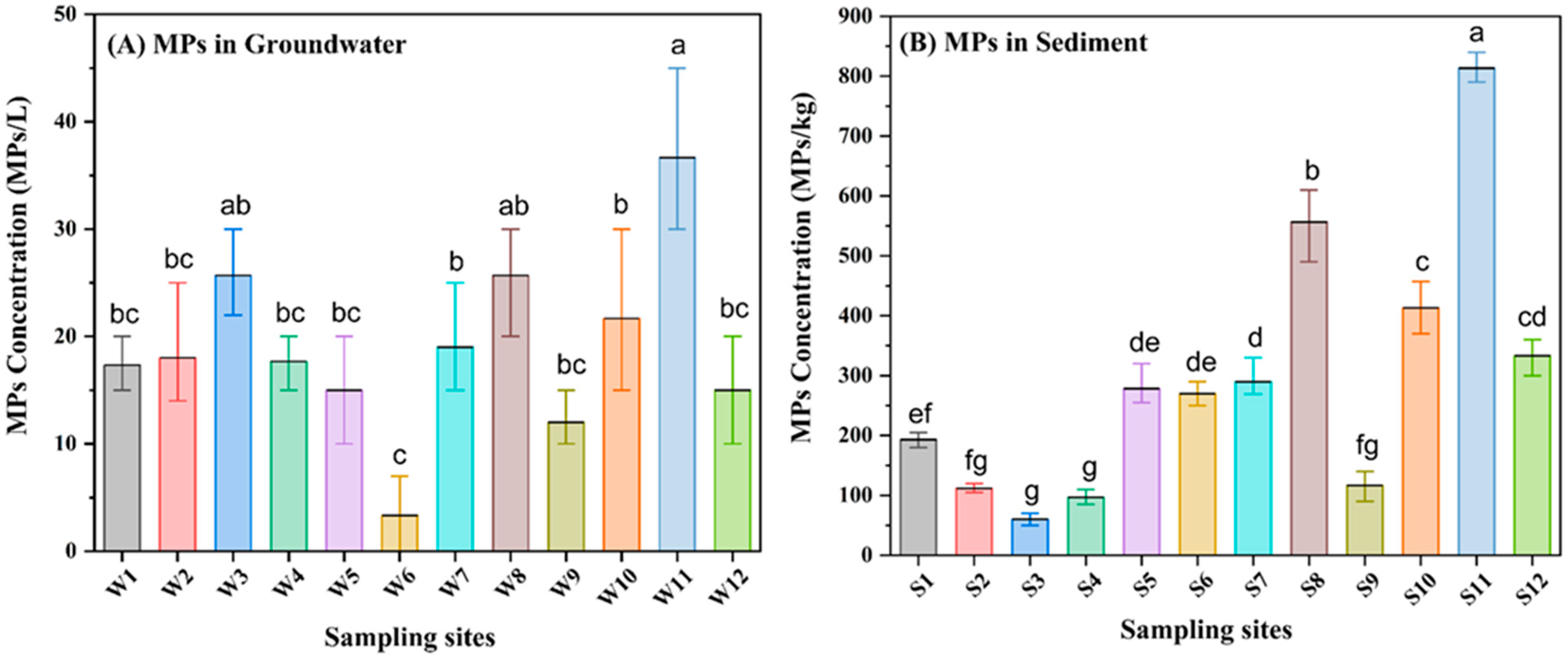
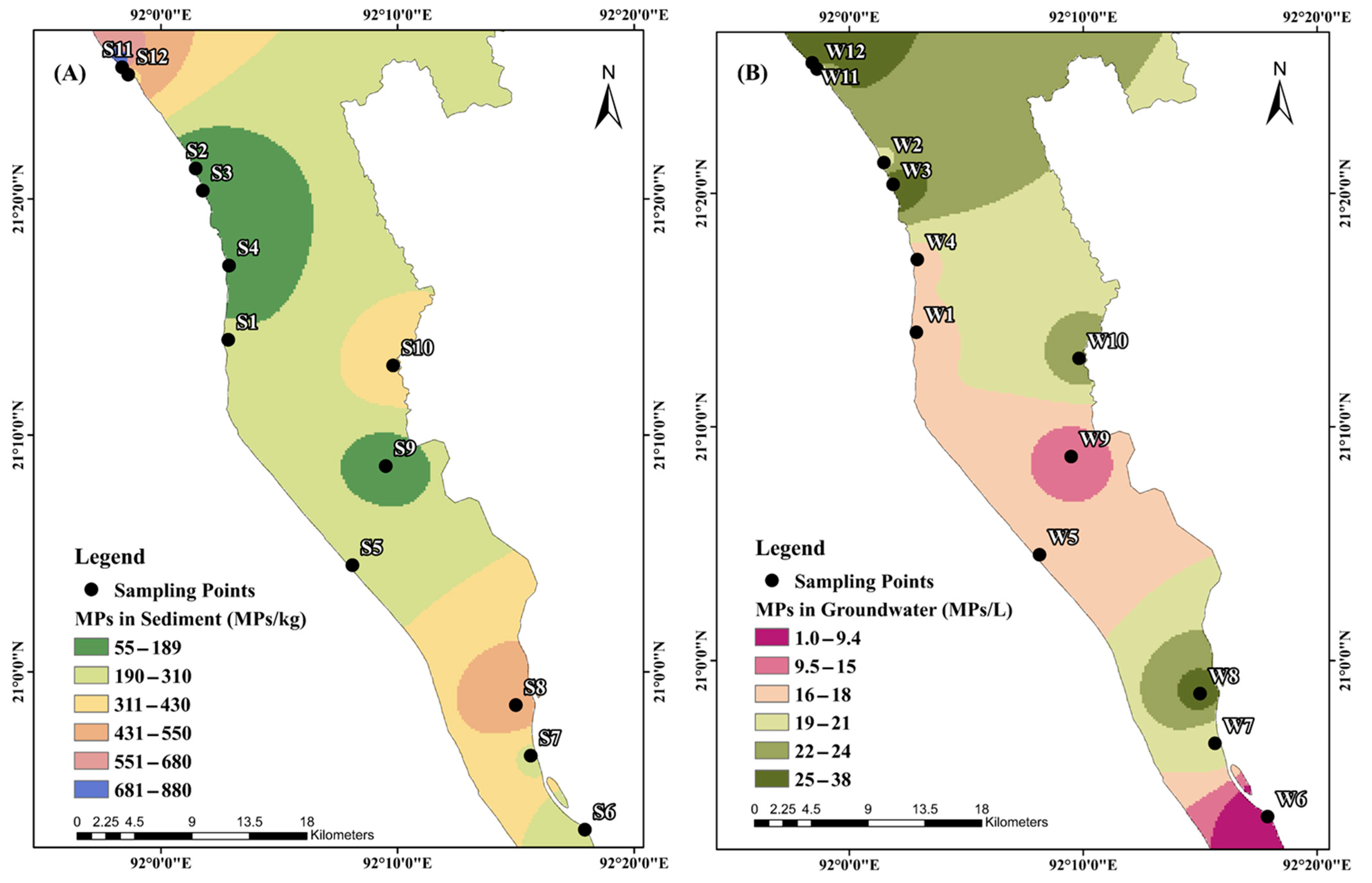
Microplastics (MPs) were detected in both surficial sediment and shallow groundwater samples (Figure 2A,B) across all studied sites. In surficial sediment, study site S11 demonstrated the highest concentration of MPs, measuring (813.33 ± 25.16) MPs/kg, while site S3 showed the lowest concentration at (60.00 ± 10.15) MPs/kg. The overall average across the sites was (294.38 ± 26.61) MPs/kg. The distribution of MPs in surficial sediment across the studied sites was observed to decrease in the following order: S11 > S8 > S10 > S12 > S7 > S5 > S6 > S1 > S9 > S2 > S4 > S3. One-way ANOVA assessed differences in MP concentration across sites and showed a significant result (p < 0.05). A post hoc analysis using Tukey’s Honest Significant Difference (HSD) test identified specific pairwise differences among the sites. Based on ANOVA and the subsequent Tukey’s HSD test, sampling stations that shared identical letter groupings (e.g., S5–S7 and S6–S12) demonstrated no significant differences (p > 0.05). In contrast, sampling stations that did not share similar letters (e.g., S8 vs. S11) exhibited significant differences (p < 0.05). Similarly, the shallow groundwater sampling site W11 revealed the maximum concentration of MPs, with a measurement of (36.66 ± 7.63) MPs/L, whereas site W6 recorded the lowest concentration at (3.34 ± 3.51) MPs/L. The overall average across the sites was (18.91 ± 4.75) MPs/L. The prevalence of MPs in shallow groundwater at various sampling sites decreased in the following order: W11 > W8 > W3 > W10 > W7 > W2 > W4 > W1 > W5 > W12 > W9 > W6. The results of ANOVA and Tukey’s post hoc analysis revealed significant differences among groundwater sampling stations (p < 0.05), with W6 exhibiting the lowest and W11 the highest MP concentrations. Significant differences were also noted between sampling sites W1–W5, W8–W9, and W12. Figure 3 illustrates the spatial interpolation of MP abundance, revealing elevated concentrations in the surficial sediment and shallow groundwater of Cox’s Bazar, an area marked by significant tourism activities, including hotels, restaurants, and recreational beaches.
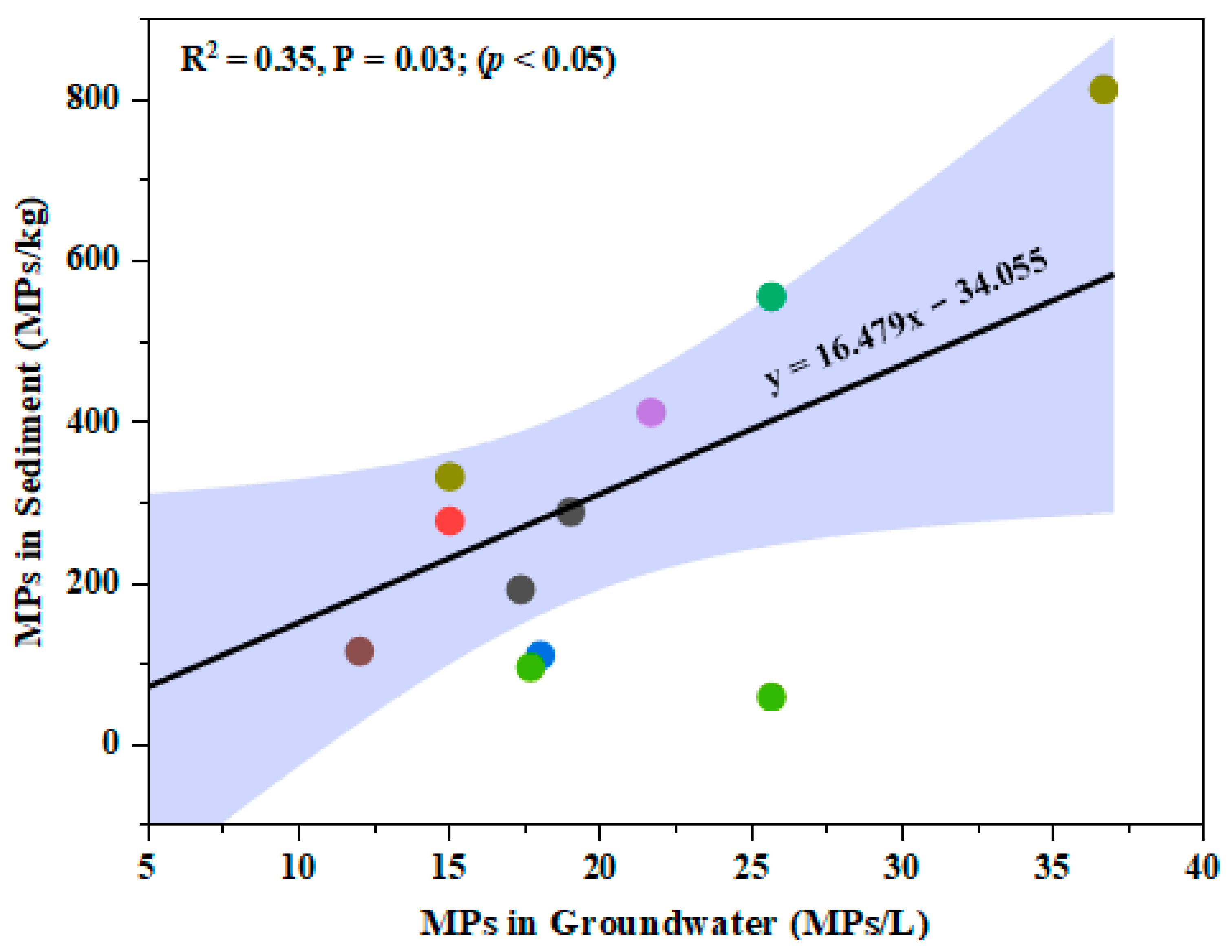
A Pearson correlation analysis (Figure 4) was conducted, followed by linear regression to examine the relationship between MP abundance in shallow groundwater and surficial sediment samples from Cox’s Bazar. The results demonstrated a statistically significant medium positive correlation (r = 0.59; p = 0.03; (p < 0.05)) concerning the abundance of MPs. The observed correlation likely reflects shared contamination pressures and environmental links rather than a straightforward transfer of MPs from sediments to groundwater. Nonetheless, the presence of larger MP particles (1–5 mm) in groundwater is likely linked to construction activities associated with wells, surface-derived inputs during pumping, or possibly common human-made sources that affect both sediments and groundwater. Moreover, Munz et al. [59] found that MPs retained in porous media, especially larger MP particles, were more dependent on pore throat size, flow velocity, sediment, and particle grain size. Therefore, further investigation is needed.
At sampling site 11 (Laboni point), the highest MP concentrations were detected in both surficial sediment and shallow groundwater. Tourism, industry (e.g., textiles and chemicals), agricultural activities (e.g., nets, mulching, pipes, films), and routine human activities could be the primary sources of MP pollution in the study area. The disposal of plastic waste from tourism activities, including bottles, bags, cans, foam, face masks, packaging, and clothing, as well as marine litter, may be the primary contributors to MP pollution in this study area. Another source of MP pollution in coastal areas is fishing. Fishing activities, such as nets, gear, and ropes, take place year-round in this coastal region, where wind and tidal currents may facilitate the deposition/transportation of MPs. Furthermore, improper waste handling, landfilling practices, municipal wastewater discharge, atmospheric deposition, and river recharge could significantly influence the presence of MPs in this study. In addition, Cox’s Bazar serves as an important hub for marine aquaculture in Bangladesh.
Routine marine operations performed by various manual labourers may play a critical role in the presence of MPs [60]. Moreover, MPs in shallow groundwater samples may originate from contamination through processes such as weathering, erosion, percolation, and sediment transport. The prevalence of MPs in this study may partially reflect contamination from well-building materials, such as PVC pipes or casing; therefore, PVC-derived MPs should be interpreted with caution when assessing aquifer-related MP contamination. The presence of MPs in surface sediments may infiltrate the coastal zone environment and subsequently migrate into groundwater systems through the interaction between seawater and groundwater. Furthermore, the ocean is a repository for MPs, and seawater intrusion is likely to affect their distribution, potentially leading to considerable groundwater MP contamination near the coastal aquifers of Cox’s Bazar [61].
In contrast, the studied site 3 (Pechar dwip) showed minimal presence of MPs in the surficial sediment, which may be linked to reduced restaurant and market activities resulting from migratory tourism. Sampling site 6 (Teknaf) had the lowest MPs in shallow groundwater samples. This may be because the area is less urbanized and non-industrialized than other sampling sites. Additionally, the location is adjacent to the Naf River, a major network of natural waterways that may dilute MPs.
The results of this study are consistent with earlier research by Tajwar et al. [62] shown that Laboni Beach sediment was the most contaminated, while Himchari was the least contaminated. A recent research by [63] on Sandwip Island sediment, MPs averaged 305 ± 37.16 items/kg. Similarly, (232 ± 52 items/kg; [64]) and (9.48 ± 3.63 items/100 g; [65]) of MPs were found in the sediment of Kuakata Beach, located in the southern coastal part of Bangladesh. In addition to Bangladesh, MPs have been identified in coastal sediment worldwide, including Naifaru island, Maldives (241.88 ± 15.37 items/kg; [66]), the Dapoli coast, India (153 ± 26.8 items/kg; [67]), the Gulf of Suez, Egypt (204.3 ± 146.6 MPs/kg; [68]), the Xisha Islands, South China (682 items/kg; [69]), Sablettes beach, Algeria (55.47 ± 48.01 items/m2; [70]), Sri Lankan coast (42.0–91.3 items/kg; [71]).
No studies have investigated the presence of MPs in the shallow groundwater of Bangladesh’s coastal environment. However, the findings of MPs in shallow groundwater in this investigation are compared to previous outcomes from coastal cities worldwide including the Dawanshan Island, China (38–64 MPs/L; [72]), Tamil Nadu, India (0–10 MPs/L; [73]), Karnataka, India (0.15–0.75 MPs/L; [74]), Karst aquifer, Slovenia (93.33–991.67 MPs/L; [75]). The current study’s findings suggest that differences in the distribution of MPs in sediment and groundwater across locations worldwide can be influenced by multiple factors, including sampling strategy, sampling seasons, analytical techniques, geographic conditions, pollutant characteristics, aquifer types, well types, depths, and so forth. For instance, Jeong et al. [76] reported that MP concentrations in groundwater were lower during the rainy season (0.014–0.554 MPs/L) than during the dry season (0.042–1.026 MPs/L), likely due to dilution from rainfall. In addition, a range of 16 to 97 MPs was identified in Australia’s (Victoria) unconfined aquifer, according to the findings of Samandra et al. [77]. Furthermore, Jin et al. [78] reported substantial differences in MPs across areas and sites, influenced by weathering and ageing. Moreover, a recent investigation conducted by Xu et al. [79] uncovered potential factors affecting the distribution and transport of MPs in groundwater. The factors encompass climate-induced events such as sea-level rise and extreme temperatures; hydrochemical properties including pH, dissolved organic matter, and ionic composition; hydrogeological background elements such as vadose-zone characteristics, aquifer properties, and lithology; and MP properties such as size, shape, density, and surface chemistry.

3.2. Type of MPs

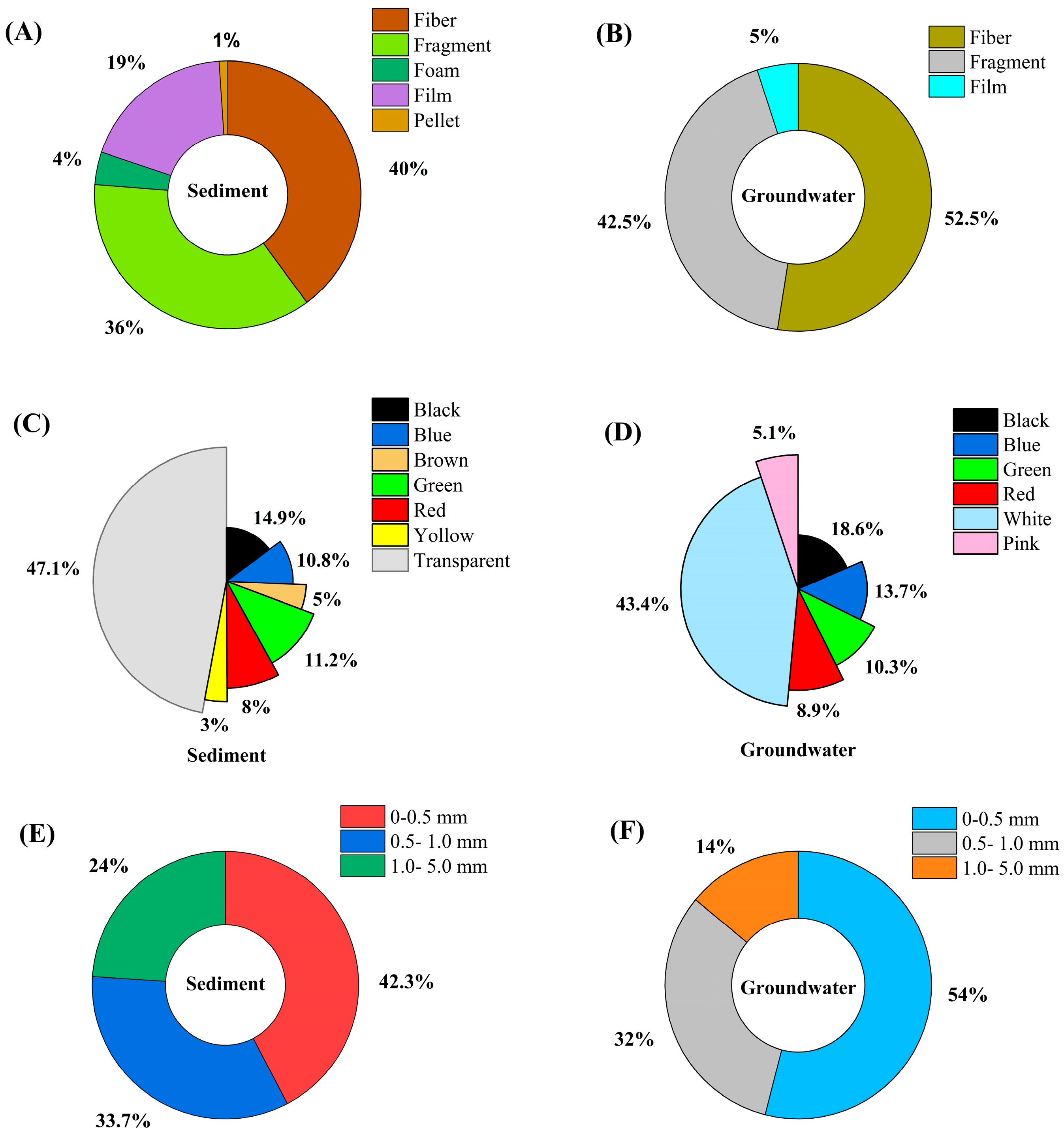
The MP shape, colour, and size are shown in the Supplementary figure (Figure S1). MP shapes were classified into 5 categories: fragments, fibers, foams, films, and pellets, as observed in both shallow groundwater and surficial sediment samples. The shallow groundwater samples comprised fibers (52.5%), fragments (42.5%), and films (5%) (Figure 5B). In surficial sediment, fibers were the predominant shape, accounting for 40% of the total. Fragments were observed in 36% of the samples, films in 19%, foams in 4%, and pellets in 1%, representing the lowest occurrence (Figure 5A). Globally, fibers constituted the predominant MPs in groundwater, as evidenced by various recent studies, including 60% in the southeast coast of India [80], 79% in a coastal aquifer in northwest Mexico [81], 44.74% in northern China [82], which support the findings of the present study. In a similar manner, 55% [62] and 87.80 to 92.13% [56] of fibers were identified in the coastal sediment of Bangladesh. Furthermore, in the global context [83,84] corroborates the findings of the present study regarding fibers content. However, the primary source of fibers in the coastal environment may be fishing gear such as nets and ropes, the laundering of synthetic textiles, and wastewater discharge [3]. For instance, a standard wash load can release over 700,000 fibers [85]. These fibers may subsequently enter aquatic environments through various pathways, such as river discharges, wastewater, and surface run-off [35,86].

3.3. Colour Variation in MPs

Multiple vibrant MPs were identified in surface sediment and shallow groundwater samples obtained from Cox’s Bazar. A total of 6 and 7 colour variations were observed in the shallow groundwater and surficial sediment samples, respectively. In shallow groundwater, 43.4% of the dominant colour was white, while the least dominant colour was pink at 5.1%. The distribution of colours of MPs in shallow groundwater was as follows: white (43.4%), black (18.6%), blue (13.7%), green (10.3%), red (8.9%), and pink (5.1%) (Figure 5D). In surficial sediment, 47.1% of the dominant colour was transparent, whereas the least dominant yellow colour comprised 3.0%. The distribution of colours of MPs in surficial sediment was as follows: transparent (47.1%), black (14.9%), green (11.2%), blue (10.8%), red (8.0%), brown (5.0%) and yellow (3.0%) (Figure 5C). Several prior studies have reported similar findings as white is the dominate colour for groundwater, with 30% in Tamil Nadu, India [73], 19% in Chennai, India [87], 51.3% in Mexico [88] and 70–85% in the Netherlands [89]. However, recent findings [56,63] indicate that transparent MPs were the most abundant in Bangladesh’s coastal sediments. Also, 32% of MPs in Tampico beach, southern Gulf of Mexico [83] and 38% in Barra beach sediments in Aveiro, Portugal [90] are transparent, supporting the current study’s findings. The occurrence of coloured MPs in the study area can be linked to the substantial use of plastic products near the beach market. The use of nylon threads or ropes in fishing nets, personal care items, coatings, and packaging materials may be linked to the existence of white and clear MPs. Furthermore, the biodiversity of Cox’s Bazar may be threatened by fish, birds, and other aquatic and terrestrial organisms that occasionally ingest MPs, mistaking them for food because of their colour. Further examination is required to assess the identification of MPs and their influence on local biodiversity and its organisms.

3.4. Size Variation in MPs

MPs were identified in surficial sediment and shallow groundwater and categorized into three distinct size ranges: 0–0.5, 0.5–1.0, and 1.0–5.0 mm. The surficial sediment samples indicated that the predominant MP size range was 0–0.5 mm, accounting for 42.3% of the total MPs. In addition, 33.7% of MPs were identified within the 0.5–1.0 mm, and 24.0% within the 1.0–5.0 mm in size (Figure 5E). On the other hand, in shallow groundwater samples, the distribution of MPs was as follows: 54% were identified within the 0–0.5 mm size, 32% within the 0.5–1.0 mm, and 14% within the 1.0–5.0 mm (Figure 5F). Previous studies have identified similar results for small MPs in size was dominant in sediment composition: 78% in Sandwip island [63], and 88.72% in the Chittagong coast of Bangladesh [56], 43% on the beach of Auckland, New Zealand [91], 37.87% in the Bohai and Yellow Sea, China [60], and in groundwater composition: 91.7% from the coastal geographic area of Bangladesh [92], 100% in southwest Iran [93], 90% in the rural area, the eastern part of Korea [76]. A crucial factor is MPs’ particle size, which can range from less than 0.5 mm to sizes comparable to those injected into the body by food and drink. Extremely tiny particles can enter the body through the skin. People with skin disorders such as eczema, ulcers, or dermatitis may be vulnerable to plastic particles. People with existing health conditions, such as respiratory issues, cardiovascular disease, digestive issues, reproductive effects, or cancer, may also be more susceptible to adverse effects from plastics entering the body through percutaneous absorption because of weakened physiological defenses. Also, they can easily penetrate the pore space of soil or fractured rock and reach groundwater aquifers as per [94,95], absorbed by plant roots [96], demanding further investigation on the aquatic organisms and plants of Cox’s Bazar.

3.5. Chemical Composition of MPs

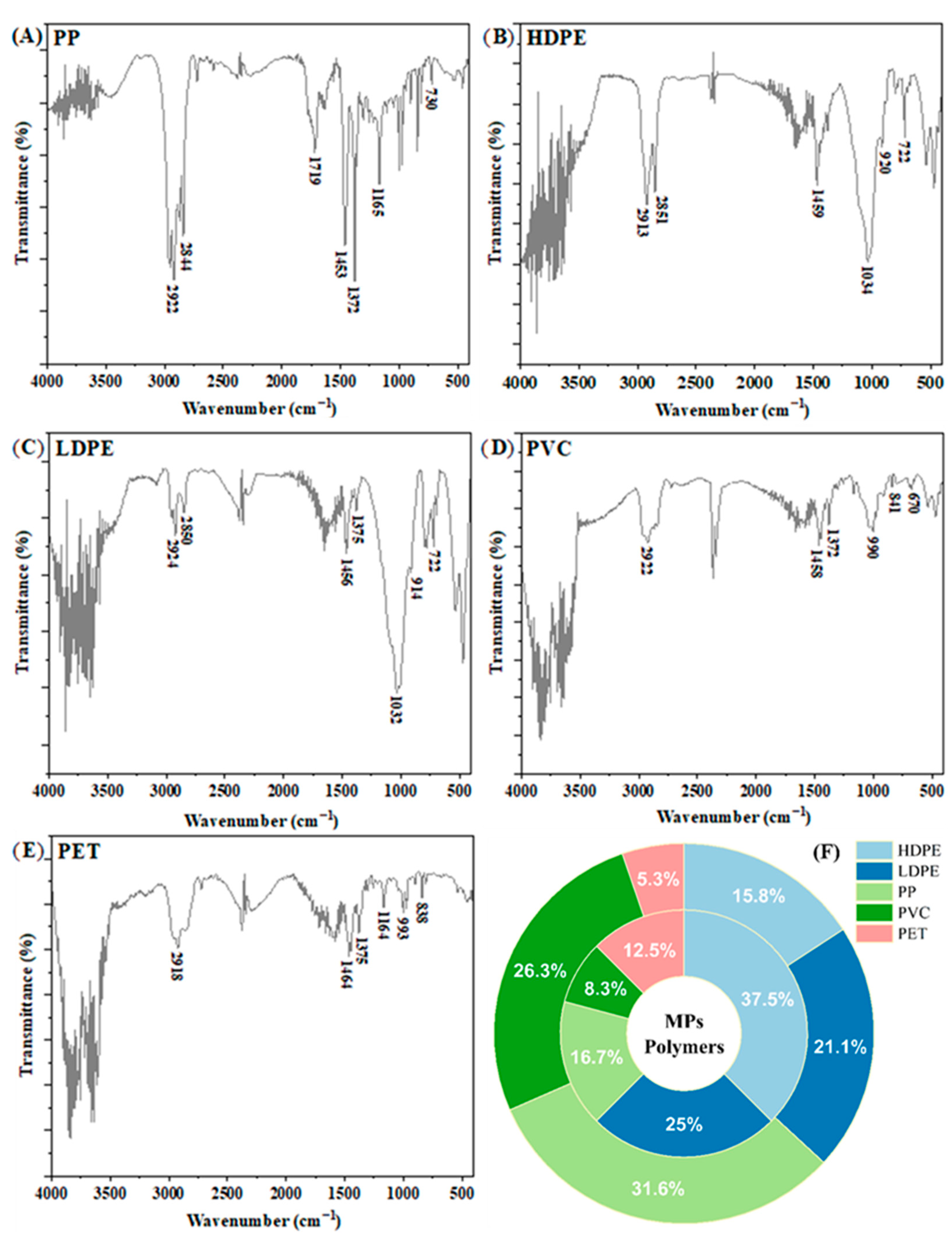
FTIR analysis was performed using a substantial number of samples. In the analysis, it was found that 80% of the sample consisted of plastic polymer. Through FTIR analysis of surficial sediment and shallow groundwater samples from Cox’s Bazar, a total of five types of polymers were identified: PP, HDPE, LDPE, PVC, and PET (Figure 6). HDPE was the most prevalent material in the surficial sediment sample, with HDPE (37.5%), LDPE (25%), PP (16.7%), PET (12.5%), and PVC (8.3%) following in that order. Contrary, the distribution pattern was characterized by PP (31.6%), PVC (26.3%), LDPE (21.1%), HDPE (15.8%), and PET (5.3%), with PP being the most prevalent in shallow groundwater samples, as shown in (Figure 6F). Comprehensive information regarding the polymer peaks and their attributes is available in the Supplementary Material (Table S2). The fragmentation of disposable tableware and plastic bags, which could result from tourism activities, may contribute to a heightened presence of HDPE and PP in the surficial sediment and shallow groundwater of Cox’s Bazar. A primary reason is that PE and PP are produced in large volumes worldwide and are widely used. Furthermore, plastic containers, film, bags, freezer bags, shampoo, food wraps, etc., could be the primary sources of PE-based polymers [20]. PP is a versatile polymer utilized in diverse applications such as ropes, packaging, and fishing gear. PVC pipe is the principal source of PVC, used in window frames, flooring, shower curtains, cable insulation, and more. PET is a significant component of synthetic fibers. PET MP is widely used in blister packs, food packaging, soft drink bottles, clothes washing, and thermal insulation [97].

3.6. Multivariate Pattern Analysis Based on HCA and PCA

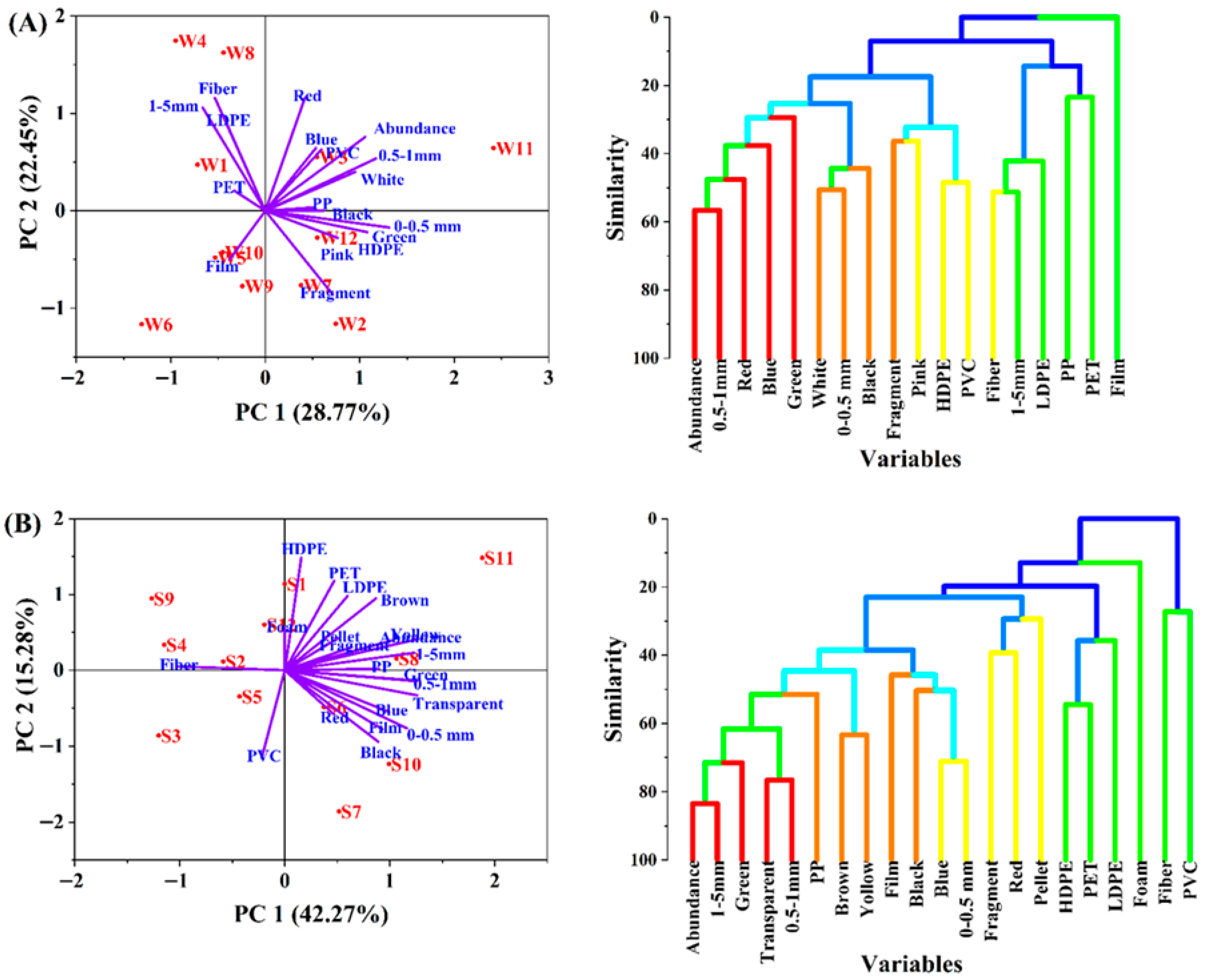
To identify the potential sources of MPs in Cox’s Bazar, shapes, sizes, colours, abundance, and polymer types were analyzed using hierarchical cluster analysis (HCA) and principal component analysis (PCA) across all sampling locations (Figure 7). The PCA analysis revealed that shallow groundwater (Figure 7A) contributions were 28.77% for PC1, linked to particle size (0.5–1 mm), abundance, and polymer types (PP and PET) at sites W11 and W12. Additionally, PC2 accounted for 22.45%, with sites W4 and W8 being significantly influenced by fiber-shaped MPs (1–5 mm) and HDPE. In contrast, the PCA of surficial sediment (Figure 7B) shows that PC1 is significantly influenced by transparent and blue colours and by polymer types such as HDPE, PET, and LDPE, accounting for 42.27% of the variation at S9 and S11. Meanwhile, PC2, which accounts for 15.28% at S3 and S7, is primarily driven by factors such as shape (foam), size (0.5–1 mm), and polymer type (PVC). This indicates a notable pollution gradient that may be affected by primary sources such as tourism, industrial discharges, or urban and agricultural activities. The components vary due to localized factors and MPs’ characteristics at a specific site, as well as from significant pollution sources.
HCA identified five clusters in both shallow groundwater and surficial sediment, with closely related samples clustering into small, easily distinguishable groups with varying degrees of connectivity. This indicates similar sources or deposition factors of MP, aligning with the PCA results (Figure 7). In shallow groundwater, abundance, red, and blue MPs clustered with 0.5–1 mm particles and fragment shapes, while fibers and HDPE formed a separate characteristic grouping of MPs, whereas in surficial sediment, transparent, green and 1–5 mm MPs associated with abundance in one cluster, and HDPE, LDPE, PET, fibers, and foams grouped closely with another cluster. The analyses underscore the characteristics of MPs and their potential origins in Cox’s Bazar.

3.7. Human Accumulation of MPs via Drinking Water Uptake

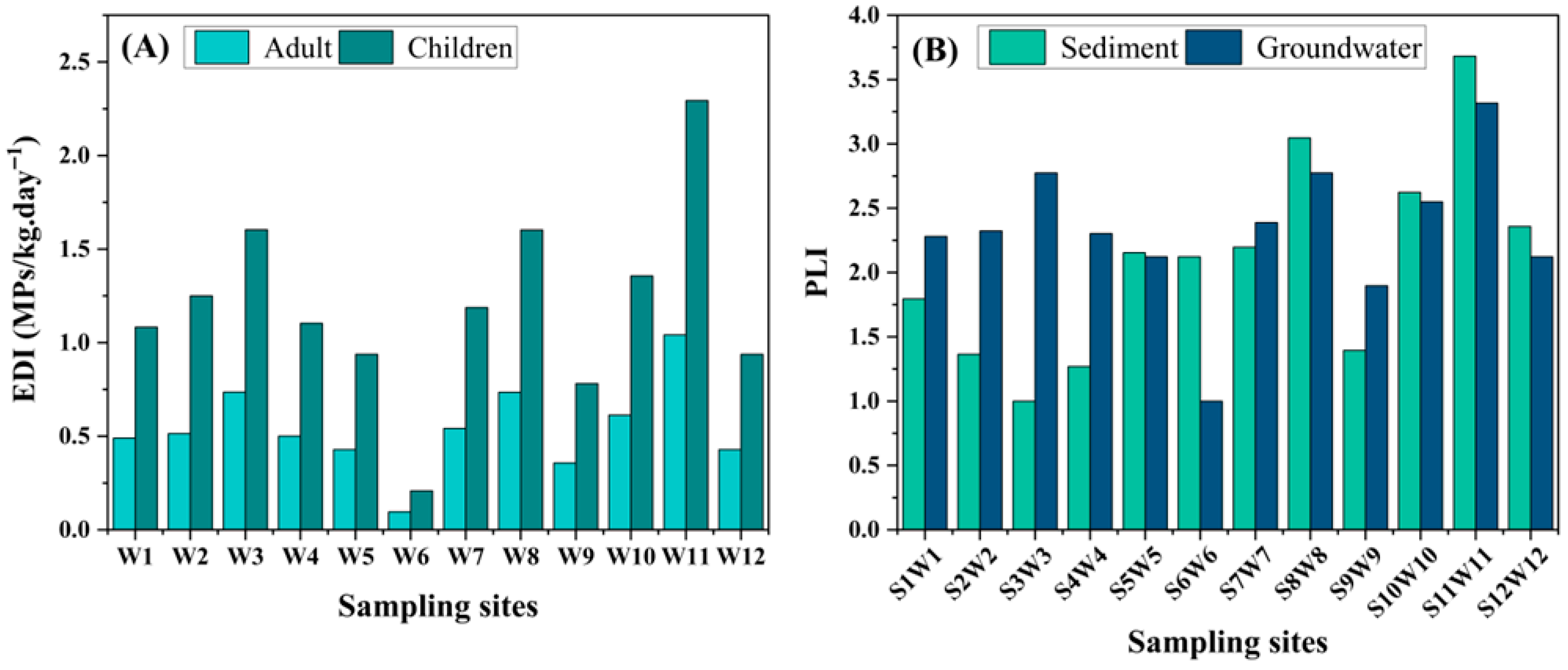
The estimated daily intake (EDI) was calculated to evaluate human exposure to microplastics (MPs) through the regular ingestion of shallow groundwater (Figure 8A). Therefore, the estimated exposure should be interpreted as a potential upper-bound scenario rather than an exact representation of individual intake. The maximum EDI recorded was 1.04 and 2.29 MPs/kg.day−1 at sampling site 11 for both children and adults, respectively. The average EDI for MPs from shallow groundwater in children and adults was 1.18 and 0.54 MPs/kg.day−1, respectively. This investigation demonstrates that children ingest more MPs than adults, consistent with previous findings [98]. This could be because children eat and drink more than adults, and the majority of their dishes and cups are made of plastic. The current study findings are consistent with the previous EDIs reported by [99] for Chinese children (0.60 MPs/kg/day) and adults (0.27 MPs/kg/day), as well as for South African children (1.2 MPs/kg/day) and adults (men: 0.71 and women: 0.50 MPs/kg/day) [53]. Further, the projected daily intake of MPs is detailed as follows: male children at 113, male adults at 142, female children at 106, and female adults at 126, as reported by [100]. Nevertheless, the distribution of MPs in human tissues, specifically in the placenta [101], the blood [102], and the lung tissue [103], has been documented in previous research. The duration of human exposure to MPs and their absorption of these particles are directly influenced by human activity levels, which, in turn, affect the risk that MPs pose to human health. The potential dangers linked to the consumption of MP particles in both children and adults remain inadequately characterized [104,105]. Also, urgent actions are required to diminish plastic consumption and minimize MPs’ exposure to humans, thereby protecting both human health and environmental integrity.

3.8. Evaluation of MPs Risk

The evaluation of pollution and the associated risks of polymer MPs was carried out using the PLI and PHI methodologies. The PLI values for surficial sediment varied between 3.68 and 1.00, with the maximum recorded at S11 and the minimum at S3. The distribution of surficial sediment based on PLI values was as follows: S11 > S8 > S10 > S12 > S7 > S5 > S6 > S1 > S9 > S2 > S4 > and S3. The PLI values for shallow groundwater varied between 1.00 and 3.31, with exhibiting the highest value at W11 and the lowest at W6 (Figure 8B). The distribution of shallow groundwater based on PLI values was as follows: W11 > W3 > W8 > W10 > W7 > W2 > W4 > W1 > W12 > W5 > W9 > W6. The average PLI scores for surficial sediment were recorded at 2.08, while for shallow groundwater, it was noted at 2.32, which is lower than the previous outcomes from coastal soil and groundwater in South Korea [106], groundwater in China [107], yet higher than the Chittagong’s coastal sediment in Bangladesh [56]. The findings across all sampling sites fall under risk category I, indicating low contamination levels; thus, the ecological risk associated with MP exposure in Cox’s Bazar was minimal.
The surficial sediment exhibited an average PHI of 18,665.83, with values ranging from 16.66 to 92,500. The PHI values for HDPE, LDPE, PP, PVC, and PET polymers in surficial sediment samples were 412.5, 275, 16.66, 92,500, and 125, respectively. The overall PHI risk category was V, while most polymers fell into categories II (20%), III (60%), and V (20%). Opposing the shallow groundwater PHI, the shallow groundwater PHI exhibited an average value of 58,518.94, with a range from 31.57 to 292,105.26. Shallow groundwater samples contained HDPE, LDPE, PP, PVC, and PET polymers, with PHI values of 173.68, 231.58, 31.57, 292,105.26, and 52.63, respectively. The overall risk category for PHI was V, with most polymers classified as II (40%), III (40%), and V (20%). Both surficial sediment and shallow groundwater’s polymers exhibited moderate to extreme dangerous toxicity levels. Lithner et al. [54] state that the following is a ranking of harmful materials: PVC is the most dangerous, followed by PA, PS, PE, PET, and PP. In this investigation, PVC was detected in shallow groundwater, which may pose a potential health risk owing to its elevated toxicity. Additionally, PVC and PP exhibit carcinogenic potential, indicated by their carcinogenic slope factors of 1.9 and 0.24, respectively [105]. The presence of MP polymers could be contributing to health impacts among residents of Cox’s Bazar through regular use of shallow groundwater, underscoring the need for targeted mitigation measures. Furthermore, chemical components like polychlorinated biphenyls, polycyclic aromatic hydrocarbons, and heavy metals are frequently found on the surfaces of synthetic MPs. MPs in the subsurface can biodegrade or undergo chemical reactions, releasing compounds into groundwater as well [79,94]. Therefore, consistent observation of surficial sediment and shallow groundwater MPs is crucial, along with investigation of MPs’ movement in the environment and their effects on human health.

4. Conclusions

The presence and properties of microplastics (MPs) in shallow groundwater and surficial sediment of a representative area in Cox’s Bazar were investigated in this study. The abundances of MPs in surficial sediment and shallow groundwater ranged from 60 to 813.33 MPs/kg and from 3.34 to 36.66 MPs/L, respectively. The diversity of MP types, sizes, and colours was evident in surface sediment and shallow groundwater samples, highlighting the influence of tourism and the extensive use of plastic bottles, bags, packaging materials, and personal care products in Cox’s Bazar. The presence of MPs notably heightens ecological risks. Alongside ecological risk, there is clear evidence of daily human exposure to MPs through the consumption of shallow groundwater. The existing data on the health implications of MP exposure are insufficient, underscoring the need for further studies and direct investigations involving human populations, especially regarding differences in occurrence and transport mechanisms between surficial sediment and shallow groundwater. Therefore, a proactive approach is essential for protecting the environmental compartments of Cox’s Bazar. To effectively manage and mitigate MP pollution in surficial sediment and shallow groundwater, local governments should improve solid waste management practices, limit tourism and enhance ecotourism, impose strict rules and regulations on plastic production and consumption, conduct regular monitoring, and promote public education initiatives to reduce plastic waste.

Supplementary Materials

The following supporting information can be downloaded at: https://www.mdpi.com/article/10.3390/microplastics5020064/s1, Figure S1: Visualization of various forms of MPs in surficial sediment and shallow groundwater samples from Cox’s Bazar; Table S1: Sampling location and major activities of the studied sites; Table S2: FTIR wavenumber data related to various polymer types identified in this study.

Author Contributions

M.A.: Writing—original draft, Conceptualization, Methodology, Data curation, Investigation, Formal analysis. A.A.S.: Supervision, Validation, Writing—review and editing, Resources. M.M. (Mohammed Manik): Writing—original draft, Methodology, Software, Data curation, Formal analysis. H.A.: Investigation, Data curation. M.M. (Mohammad Mohinuzzaman): Supervision, Resources, Validation, Writing—review and editing. S.A.S.: Validation, Resources. T.H.: Software, Resources. M.S.I.: Data curation, Resources. S.A.J.: Writing—review and editing, Validation. M.M.H.: Writing—review and editing, Validation. P.P.: Supervision, Validation, Writing—review and editing. All authors have read and agreed to the published version of the manuscript.

Funding

This research work did not receive any external funding.

Institutional Review Board Statement

Not applicable.

Informed Consent Statement

Not applicable.

Data Availability Statement

The original contributions presented in this study are included in the article/Supplementary Material. Further inquiries can be directed to the corresponding authors.

Acknowledgments

We express our gratitude to the Environmental Science and Disaster Management department of Noakhali Science and Technology University and the Wazed Miah Science Research Centre of Jahangirnagar University for providing access to their lab simulations.

Conflicts of Interest

The authors declare no conflicts of interest.

References

  1. Sharma, S.; Bhardwaj, A.; Thakur, M.; Saini, A. Understanding Microplastic Pollution of Marine Ecosystem: A Review. Environ. Sci. Pollut. Res. 2024, 31, 41402–41445. [Google Scholar] [CrossRef]
  2. Manik, M.; Hossain, M.T.; Pastorino, P. Characterization and Risk Assessment of Microplastics Pollution in Mohamaya Lake, Bangladesh. J. Contam. Hydrol. 2025, 269, 104487. [Google Scholar] [CrossRef] [PubMed]
  3. Sharma, D.; Dhanker, R.; Bhawna; Tomar, A.; Raza, S.; Sharma, A. Fishing Gears and Nets as a Source of Microplastic. In Microplastic Pollution; Shahnawaz, M., Adetunji, C.O., Dar, M.A., Zhu, D., Eds.; Springer Nature: Singapore, 2024; pp. 127–140. [Google Scholar]
  4. Pastorino, P.; Prearo, M.; Pizzul, E.; Concetta Elia, A.; Renzi, M.; Ginebreda, A.; Barceló, D. High-Mountain Lakes as Indicators of Microplastic Pollution: Current and Future Perspectives. Water Emerg. Contam. Nanoplastics 2022, 1, 3. [Google Scholar] [CrossRef]
  5. Zhang, L.; Wang, D.; Li, W.; Liu, X.; Zhang, Z.; Tian, Z.-Q. Microplastics Distribution and Pollution Characterization in Two Typical Wetlands on the Qinghai-Tibet Plateau, China. J. Clean. Prod. 2025, 486, 144455. [Google Scholar] [CrossRef]
  6. Sutkar, P.R.; Gadewar, R.D.; Dhulap, V.P. Recent Trends in Degradation of Microplastics in the Environment: A State-of-the-Art Review. J. Hazard. Mater. Adv. 2023, 11, 100343. [Google Scholar] [CrossRef]
  7. Abdullah, M.; Abedin, M.Z. Assessment of Plastic Waste Management in Bangladesh: A Comprehensive Perspective on Sorting, Production, Separation, and Recycling. Results Surf. Interfaces 2024, 15, 100221. [Google Scholar] [CrossRef]
  8. Chamas, A.; Moon, H.; Zheng, J.; Qiu, Y.; Tabassum, T.; Jang, J.H.; Abu-Omar, M.; Scott, S.L.; Suh, S. Degradation Rates of Plastics in the Environment. ACS Sustain. Chem. Eng. 2020, 8, 3494–3511. [Google Scholar] [CrossRef]
  9. Li, W.C.; Tse, H.F.; Fok, L. Plastic Waste in the Marine Environment: A Review of Sources, Occurrence and Effects. Sci. Total Environ. 2016, 566–567, 333–349. [Google Scholar] [CrossRef]
  10. Thompson, R.C.; Courtene-Jones, W.; Boucher, J.; Pahl, S.; Raubenheimer, K.; Koelmans, A.A. Twenty Years of Microplastic Pollution Research—What Have We Learned? Science 2024, 386, eadl2746. [Google Scholar] [CrossRef]
  11. Garcés-Ordóñez, O.; Mejía-Esquivia, K.A.; Sierra-Labastidas, T.; Patiño, A.; Blandón, L.M.; Espinosa Díaz, L.F. Prevalence of Microplastic Contamination in the Digestive Tract of Fishes from Mangrove Ecosystem in Cispata, Colombian Caribbean. Mar. Pollut. Bull. 2020, 154, 111085. [Google Scholar] [CrossRef]
  12. Cole, M.; Lindeque, P.; Halsband, C.; Galloway, T.S. Microplastics as Contaminants in the Marine Environment: A Review. Mar. Pollut. Bull. 2011, 62, 2588–2597. [Google Scholar] [CrossRef]
  13. Hossain, M.J.; AftabUddin, S.; Akhter, F.; Nusrat, N.; Rahaman, A.; Sikder, M.N.A.; Monwar, M.M.; Chowdhury, M.S.N.; Jiang, S.; Shi, H.; et al. Surface Water, Sediment, and Biota: The First Multi-Compartment Analysis of Microplastics in the Karnafully River, Bangladesh. Mar. Pollut. Bull. 2022, 180, 113820. [Google Scholar] [CrossRef]
  14. Osman, A.I.; Hosny, M.; Eltaweil, A.S.; Omar, S.; Elgarahy, A.M.; Farghali, M.; Yap, P.-S.; Wu, Y.-S.; Nagandran, S.; Batumalaie, K.; et al. Microplastic Sources, Formation, Toxicity and Remediation: A Review. Environ. Chem. Lett. 2023, 21, 2129–2169. [Google Scholar] [CrossRef]
  15. Nawaz, F.; Islam, Z.U.; Ghori, S.A.; Bahadur, A.; Ullah, H.; Ahmad, M.; Khan, G.U. Microplastic and Nanoplastic Pollution: Assessing Translocation, Impact, and Mitigation Strategies in Marine Ecosystems. Water Environ. Res. 2025, 97, e70032. [Google Scholar] [CrossRef] [PubMed]
  16. Bailey, W.S.; Olariu, C.; Mohrig, D. Microplastics in Bays along the Central Texas Coast. Environ. Sci. Technol. 2025, 59, 5249–5260. [Google Scholar] [CrossRef]
  17. Molina, N.; López Pérez, T.M.; Puerta Cerpa, Y.D. Molecular Mechanisms of Microplastic Toxicity in Coastal Sediments of La Guajira Colombia and Emerging Ecological Risks. Case Stud. Chem. Environ. Eng. 2025, 11, 101108. [Google Scholar] [CrossRef]
  18. Colmenarejo Calero, E.; Kovač Viršek, M.; Mali, N. Microplastics in Groundwater: Pathways, Occurrence, and Monitoring Challenges. Water 2024, 16, 1228. [Google Scholar] [CrossRef]
  19. Cha, J.; Lee, J.-Y.; Lee, J. Effects of Groundwater Sample Volume on Identified Microplastics in Groundwater of an Agricultural Area in Korea. Sci. Total Environ. 2024, 911, 168650. [Google Scholar] [CrossRef] [PubMed]
  20. Khan, H.S.; Hasan, J.; Manik, M.; Farukh, M.A.; Shahjahan, M. Pervasiveness of Microplastics in the Gastrointestinal Tract of Some Selected Fish Species from Turag River alongside the Capital City of Bangladesh. Emerg. Contam. 2024, 10, 100309. [Google Scholar] [CrossRef]
  21. Kreitsberg, R.; Raudna-Kristoffersen, M.; Heinlaan, M.; Ward, R.; Visnapuu, M.; Kisand, V.; Meitern, R.; Kotta, J.; Tuvikene, A. Seagrass Beds Reveal High Abundance of Microplastic in Sediments: A Case Study in the Baltic Sea. Mar. Pollut. Bull. 2021, 168, 112417. [Google Scholar] [CrossRef]
  22. Loui, C.; Pittroff, M.; Oswald, S.E.; Straßer, D.; Bochow, M.; Munz, M. Polymer-Specific Transfer and Retention of Microplastics at the River–Sediment–Groundwater Interface. Water Res. 2026, 289, 125018. [Google Scholar] [CrossRef] [PubMed]
  23. Doshi, M.; Rabari, V.; Trivedi, J. A Systematic Review on Microplastic Contamination in Marine Sediment and Water of Asia: Concentration, Characterization, and Polymeric Risk Assessment. Water Environ. Res. 2025, 97, e70042. [Google Scholar] [CrossRef]
  24. Isobe, A.; Azuma, T.; Cordova, M.R.; Cózar, A.; Galgani, F.; Hagita, R.; Kanhai, L.D.; Imai, K.; Iwasaki, S.; Kako, S.; et al. A Multilevel Dataset of Microplastic Abundance in the World’s Upper Ocean and the Laurentian Great Lakes. Microplastics Nanoplastics 2021, 1, 16. [Google Scholar] [CrossRef]
  25. Koelmans, A.A.; Redondo-Hasselerharm, P.E.; Nor, N.H.M.; De Ruijter, V.N.; Mintenig, S.M.; Kooi, M. Risk Assessment of Microplastic Particles. Nat. Rev. Mater. 2022, 7, 138–152. [Google Scholar] [CrossRef]
  26. Re, V. Shedding Light on the Invisible: Addressing the Potential for Groundwater Contamination by Plastic Microfibers. Hydrogeol. J. 2019, 27, 2719–2727. [Google Scholar] [CrossRef]
  27. Agbasi, J.C.; Egbueri, J.C.; Pande, C.B.; Khan, M.Y.A.; Ighalo, J.O.; Uwajingba, H.C.; Abba, S.I. Review of the Potential Effects and Remediation Strategies of Microplastic Pollutants in Drinking Water Sources. Anal. Lett. 2025, 58, 799–839. [Google Scholar] [CrossRef]
  28. Ding, R.; Ma, Y.; Li, T.; Sun, M.; Sun, Z.; Duan, J. The Detrimental Effects of Micro-and Nano-Plastics on Digestive System: An Overview of Oxidative Stress-Related Adverse Outcome Pathway. Sci. Total Environ. 2023, 878, 163144. [Google Scholar] [CrossRef]
  29. Deng, Y.; Chen, H.; Huang, Y.; Zhang, Y.; Ren, H.; Fang, M.; Wang, Q.; Chen, W.; Hale, R.C.; Galloway, T.S.; et al. Long-Term Exposure to Environmentally Relevant Doses of Large Polystyrene Microplastics Disturbs Lipid Homeostasis via Bowel Function Interference. Environ. Sci. Technol. 2022, 56, 15805–15817. [Google Scholar] [CrossRef]
  30. Guo, Y.; Wu, R.; Zhang, H.; Guo, C.; Wu, L.; Xu, J. Distribution of Microplastics in the Soils of a Petrochemical Industrial Region in China: Ecological and Human Health Risks. Environ. Geochem. Health 2025, 47, 13. [Google Scholar] [CrossRef]
  31. Karmaker, K.D.; Khan, N.; Akhtar, U.S.; Moniruzzaman, M.; Parvin, A.; Ghosh, A.; Saha, B.; Hossain, M.K. First Assessment of Trace Metals in the Intertidal Zone of the World’s Longest Continuous Beach, Cox’s Bazar, Bangladesh. Mar. Pollut. Bull. 2024, 207, 116928. [Google Scholar] [CrossRef]
  32. Howlader, M.; Selim, A.; Shuvo, S.N.A.; Islam, M.M.; Sultana, T.; Moniruzzaman, M.; Mia, M.S.; Afrin, S.; Akter, N.; Rahman, M.H. Evaluating Cigarette Butt Pollution: Insights from Cox’s Bazar Sea Beach of Bangladesh. Mar. Pollut. Bull. 2023, 197, 115705. [Google Scholar] [CrossRef]
  33. Hossain, M.B.; Banik, P.; Nur, A.-A.U.; Rahman, T. Abundance and Characteristics of Microplastics in Sediments from the World’s Longest Natural Beach, Cox’s Bazar, Bangladesh. Mar. Pollut. Bull. 2021, 163, 111956. [Google Scholar] [CrossRef] [PubMed]
  34. Rahman, S.M.A.; Robin, G.S.; Momotaj, M.; Uddin, J.; Siddique, M.A.M. Occurrence and Spatial Distribution of Microplastics in Beach Sediments of Cox’s Bazar, Bangladesh. Mar. Pollut. Bull. 2020, 160, 111587. [Google Scholar] [CrossRef]
  35. Banik, P.; Anisuzzaman, M.; Bhattacharjee, S.; Marshall, D.J.; Yu, J.; Nur, A.-A.U.; Jolly, Y.N.; Al-Mamun, M.; Paray, B.A.; Bappy, M.M.M.; et al. Quantification, Characterization and Risk Assessment of Microplastics from Five Major Estuaries along the Northern Bay of Bengal Coast. Environ. Pollut. 2024, 342, 123036. [Google Scholar] [CrossRef] [PubMed]
  36. Parvin, F.; Nath, J.; Hannan, T.; Tareq, S.M. Proliferation of Microplastics in Commercial Sea Salts from the World Longest Sea Beach of Bangladesh. Environ. Adv. 2022, 7, 100173. [Google Scholar] [CrossRef]
  37. Hossain, M.S.; Sobhan, F.; Uddin, M.N.; Sharifuzzaman, S.M.; Chowdhury, S.R.; Sarker, S.; Chowdhury, M.S.N. Microplastics in Fishes from the Northern Bay of Bengal. Sci. Total Environ. 2019, 690, 821–830. [Google Scholar] [CrossRef]
  38. Hasan, J.; Islam, S.M.M.; Alam, M.S.; Johnson, D.; Belton, B.; Hossain, M.A.R.; Shahjahan, M. Presence of Microplastics in Two Common Dried Marine Fish Species from Bangladesh. Mar. Pollut. Bull. 2022, 176, 113430. [Google Scholar] [CrossRef]
  39. Seddique, A.A.; Kon, Y.; Anma, R.; Masuda, H.; Bhattacharya, P.; Yokoo, Y.; Bipulendu Basak, S.; Shinoda, K. Sources of U and Th in Groundwater of the Paleobeach Aquifer at Cox’s Bazar, Southeast Bangladesh. Groundw. Sustain. Dev. 2020, 10, 100332. [Google Scholar] [CrossRef]
  40. Alam, M.S.; Huq, N.E.; Rashid, M.S. Morphology and Sediments of the Cox’s Bazar Coastal Plain, South-East Bangladesh. J. Coast. Res. 1999, 15, 902–908. [Google Scholar]
  41. Khan, F.H.; Monir, M.U.; Ahmed, M.T.; Hasan, M.Y.; Islam, M.N.; Hasan, M.M.; Akter, R. Hydrostratigraphic Evaluation Using Lithological and Step-Drawdown Test: A Case Study on the Aquifer of Ukhia, Cox’s Bazar, Bangladesh. Dhaka Univ. J. Earth Env. Sci. 2022, 10, 53–62. [Google Scholar] [CrossRef]
  42. Hossain, M.E.; Quaddus, M.; Shanka, T. Effects of Intrinsic and Extrinsic Quality Cues and Perceived Risk on Visitors’ Satisfaction and Loyalty. J. Qual. Assur. Hosp. Tour. 2015, 16, 119–140. [Google Scholar] [CrossRef]
  43. Mausra, J.; Baker, J.; Foster, G.; Arthur, C.; Herring, C. Laboratory Methods for the Analysis of Microplastics in the Marine Environment: Recommendations for Quantifying Synthetic Particles in Waters and Sediments; NOAA Technical Memorandum NOS-OR&R-48; NOAA Marine Debris Division: Siver Spring, MD, USA, 2015; 31p. [Google Scholar] [CrossRef]
  44. Wang, W.; Yuan, W.; Chen, Y.; Wang, J. Microplastics in Surface Waters of Dongting Lake and Hong Lake, China. Sci. Total Environ. 2018, 633, 539–545. [Google Scholar] [CrossRef]
  45. Qin, Y.; Wang, Z.; Li, W.; Chang, X.; Yang, J.; Yang, F. Microplastics in the Sediment of Lake Ulansuhai of Yellow River Basin, China. Water Environ. Res. 2020, 92, 829–839. [Google Scholar] [CrossRef]
  46. Jabeen, K.; Su, L.; Li, J.; Yang, D.; Tong, C.; Mu, J.; Shi, H. Microplastics and Mesoplastics in Fish from Coastal and Fresh Waters of China. Environ. Pollut. 2017, 221, 141–149. [Google Scholar] [CrossRef]
  47. Nayak, A.; Matta, G.; Prasad Uniyal, D.; Kumar, A.; Kumar, P.; Pant, G. Assessment of Potentially Toxic Elements in Groundwater through Interpolation, Pollution Indices, and Chemometric Techniques in Dehradun in Uttarakhand State. Environ. Sci. Pollut. Res. 2023, 31, 36241–36263. [Google Scholar] [CrossRef] [PubMed]
  48. Nath, J.; Parvin, F.; Tareq, S.M. Bioaccumulation of Microplastics in the Edible Tissues of Fish Collected from Urban Lakes of Bangladesh: A Potential Exposure to Public Health. Environ. Sci. Pollut. Res. 2024, 31, 2067–2078. [Google Scholar] [CrossRef]
  49. Thompson, R.C.; Olsen, Y.; Mitchell, R.P.; Davis, A.; Rowland, S.J.; John, A.W.G.; McGonigle, D.; Russell, A.E. Lost at Sea: Where Is All the Plastic? Science 2004, 304, 838. [Google Scholar] [CrossRef]
  50. Xu, P.; Peng, G.; Su, L.; Gao, Y.; Gao, L.; Li, D. Microplastic Risk Assessment in Surface Waters: A Case Study in the Changjiang Estuary, China. Mar. Pollut. Bull. 2018, 133, 647–654. [Google Scholar] [CrossRef] [PubMed]
  51. Wang, G.; Lu, J.; Li, W.; Ning, J.; Zhou, L.; Tong, Y.; Liu, Z.; Zhou, H.; Xiayihazi, N. Seasonal Variation and Risk Assessment of Microplastics in Surface Water of the Manas River Basin, China. Ecotoxicol. Environ. Saf. 2021, 208, 111477. [Google Scholar] [CrossRef]
  52. Alam, M.J.; Shammi, M.; Tareq, S.M. Distribution of Microplastics in Shoreline Water and Sediment of the Ganges River Basin to Meghna Estuary in Bangladesh. Ecotoxicol. Environ. Saf. 2023, 266, 115537. [Google Scholar] [CrossRef] [PubMed]
  53. Ramaremisa, G.; Tutu, H.; Saad, D. Detection and Characterisation of Microplastics in Tap Water from Gauteng, South Africa. Chemosphere 2024, 356, 141903. [Google Scholar] [CrossRef] [PubMed]
  54. Lithner, D.; Larsson, Å.; Dave, G. Environmental and Health Hazard Ranking and Assessment of Plastic Polymers Based on Chemical Composition. Sci. Total Environ. 2011, 409, 3309–3324. [Google Scholar] [CrossRef] [PubMed]
  55. Wu, X.; Zhong, C.; Wang, T.; Zou, X. Assessment on the Pollution Level and Risk of Microplastics on Bathing Beaches: A Case Study of Liandao, China. Environ. Monit. Assess. 2023, 195, 383. [Google Scholar] [CrossRef]
  56. Faisal, M.; Lipi, J.A.; Rima, N.N.; Riya, K.K.; Hossain, M.K.; Paray, B.A.; Arai, T.; Yu, J.; Hossain, M.B. Microplastic Contamination and Ecological Risk Assessment in Sediments and Waters of Ship-Dismantling Yards along the Bay of Bengal. Mar. Pollut. Bull. 2025, 217, 118032. [Google Scholar] [CrossRef]
  57. Wang, W.; Ndungu, A.W.; Li, Z.; Wang, J. Microplastics Pollution in Inland Freshwaters of China: A Case Study in Urban Surface Waters of Wuhan, China. Sci. Total Environ. 2017, 575, 1369–1374. [Google Scholar] [CrossRef]
  58. Dancey, C.; Reidy, J. Statistics Without Maths for Psychology, 8th ed.; Pearson Education Limited: London, UK, 2020. [Google Scholar]
  59. Munz, M.; Loui, C.; Postler, D.; Pittroff, M.; Oswald, S.E. Transport and Retention of Micro-Polystyrene in Coarse Riverbed Sediments: Effects of Flow Velocity, Particle and Sediment Sizes. Microplastics Nanoplastics 2024, 4, 2. [Google Scholar] [CrossRef]
  60. Zhao, J.; Ran, W.; Teng, J.; Liu, Y.; Liu, H.; Yin, X.; Cao, R.; Wang, Q. Microplastic Pollution in Sediments from the Bohai Sea and the Yellow Sea, China. Sci. Total Environ. 2018, 640–641, 637–645. [Google Scholar] [CrossRef]
  61. Chen, G.; Zou, Y.; Xiong, G.; Wang, Y.; Zhao, W.; Xu, X.; Zhu, X.; Wu, J.; Song, F.; Yu, H. Microplastic Transport and Ecological Risk in Coastal Intruded Aquifers Based on a Coupled Seawater Intrusion and Microplastic Risk Assessment Model. J. Hazard. Mater. 2024, 480, 135996. [Google Scholar] [CrossRef]
  62. Tajwar, M.; Yousuf Gazi, M.; Saha, S.K. Characterization and Spatial Abundance of Microplastics in the Coastal Regions of Cox’s Bazar, Bangladesh: An Integration of Field, Laboratory, and GIS Techniques. Soil Sediment Contam. Int. J. 2022, 31, 57–80. [Google Scholar] [CrossRef]
  63. Mia, M.S.; Islam, A.R.M.T.; Ali, M.M.; Siddique, M.A.B.; Pal, S.C.; Idris, A.M.; Senapathi, V. Microplastics in Sediment and Surface Water from an Island Ecosystem in Bay of Bengal. Reg. Stud. Mar. Sci. 2024, 69, 103332. [Google Scholar] [CrossRef]
  64. Banik, P.; Hossain, M.B.; Nur, A.-A.U.; Choudhury, T.R.; Liba, S.I.; Yu, J.; Noman, M.A.; Sun, J. Microplastics in Sediment of Kuakata Beach, Bangladesh: Occurrence, Spatial Distribution, and Risk Assessment. Front. Mar. Sci. 2022, 9, 860989. [Google Scholar] [CrossRef]
  65. Hossain, M.S.; Saifullah, A.S.M.; Uddin, M.J.; Hasibur Rahaman, M. Assessment of Microplastics in Coastal Ecosystem of Bangladesh. Ecotoxicol. Environ. Saf. 2024, 281, 116622. [Google Scholar] [CrossRef]
  66. Patti, T.B.; Fobert, E.K.; Reeves, S.E.; Burke Da Silva, K. Spatial Distribution of Microplastics around an Inhabited Coral Island in the Maldives, Indian Ocean. Sci. Total Environ. 2020, 748, 141263. [Google Scholar] [CrossRef] [PubMed]
  67. Borah, A.; Hande, O.M.; Jayakumar, S.; Devipriya, S.P. Microplastic Pollution in Beach Sediments in the Dapoli Coast, Maharashtra, the Western Peninsular Region of India. Reg. Stud. Mar. Sci. 2024, 77, 103640. [Google Scholar] [CrossRef]
  68. Taher, N.Z.; Shabaka, S.; Soliman, Y.A.; Younis, A.M. Assessment of Microplastic Pollution in the Gulf of Suez: Abundance and Polymeric Composition in Beach Sediments. Egypt. J. Aquat. Biol. Fish. 2023, 27, 671–682. [Google Scholar] [CrossRef]
  69. Lin, J.; Zhao, Y.-M.; Zhan, Z.-G.; Zheng, J.-Y.; Zhou, Q.-Z.; Peng, J.; Li, Y.; Xiao, X.; Wang, J.-H. Microplastics in Remote Coral Reef Environments of the Xisha Islands in the South China Sea: Source, Accumulation and Potential Risk. J. Hazard. Mater. 2024, 469, 133872. [Google Scholar] [CrossRef]
  70. Bentaallah, M.E.A.; Baghdadi, D.; Gündoğdu, S.; Megharbi, A.; Taibi, N.-E.; Büyükdeveci, F. Assessment of Microplastic Abundance and Impact on Recreational Beaches along the Western Algerian Coastline. Mar. Pollut. Bull. 2024, 199, 116007. [Google Scholar] [CrossRef]
  71. Piyumali, H.; Sewwandi, M.; Atugoda, T.; Wijesekara, H.; Mahatantila, K.; Vithanage, M. Microplastic Abundance, Characteristics, and Heavy Metal Contamination in Coastal Environments of Western Sri Lanka. Phys. Chem. Earth Parts A B C 2024, 136, 103770. [Google Scholar] [CrossRef]
  72. Gong, X.; Tian, L.; Wang, P.; Wang, Z.; Zeng, L.; Hu, J. Microplastic Pollution in the Groundwater under a Bedrock Island in the South China Sea. Environ. Res. 2023, 239, 117277. [Google Scholar] [CrossRef]
  73. Selvam, S.; Jesuraja, K.; Venkatramanan, S.; Roy, P.D.; Jeyanthi Kumari, V. Hazardous Microplastic Characteristics and Its Role as a Vector of Heavy Metal in Groundwater and Surface Water of Coastal South India. J. Hazard. Mater. 2021, 402, 123786. [Google Scholar] [CrossRef] [PubMed]
  74. Valsan, G.; Warrier, A.K.; Amrutha, K.; Anusree, S.; Rangel-Buitrago, N. Exploring the Presence and Distribution of Microplastics in Subterranean Estuaries from Southwest India. Mar. Pollut. Bull. 2023, 190, 114820. [Google Scholar] [CrossRef] [PubMed]
  75. Valentić, L.; Kozel, P.; Pipan, T. Microplastic Pollution in Vulnerable Karst Environments: Case Study from the Slovenian Classical Karst Region. Acta Carsologica 2022, 51, 79–92. [Google Scholar] [CrossRef]
  76. Jeong, E.; Kim, Y.-I.; Lee, J.-Y.; Raza, M. Microplastic Contamination in Groundwater of Rural Area, Eastern Part of Korea. Sci. Total Environ. 2023, 895, 165006. [Google Scholar] [CrossRef]
  77. Samandra, S.; Johnston, J.M.; Jaeger, J.E.; Symons, B.; Xie, S.; Currell, M.; Ellis, A.V.; Clarke, B.O. Microplastic Contamination of an Unconfined Groundwater Aquifer in Victoria, Australia. Sci. Total Environ. 2022, 802, 149727. [Google Scholar] [CrossRef]
  78. Jin, R.; Li, H.; Li, X.; Shen, M. Research Advances of Micro/Nanoplastics in Groundwater: Occurrence, Environmental Impacts and Control Strategies. Environ. Pollut. 2025, 383, 126899. [Google Scholar] [CrossRef] [PubMed]
  79. Xu, J.; Zuo, R.; Wu, G.; Liu, J.; Liu, J.; Huang, C.; Wang, Z. Global Distribution, Drivers, and Potential Hazards of Microplastics in Groundwater: A Review. Sci. Total Environ. 2024, 954, 176194. [Google Scholar] [CrossRef]
  80. Patterson, J.; Laju, R.L.; Jeyasanta, K.I.; Shelciya, S.; Esmeralda, V.G.; Asir, N.G.G.; Narmatha, M.; Booth, A.M. Hydrochemical Quality and Microplastic Levels of the Groundwaters of Tuticorin, Southeast Coast of India. Hydrogeol. J. 2023, 31, 167–184. [Google Scholar] [CrossRef]
  81. Alvarado-Zambrano, D.; Rivera-Hernández, J.R.; Green-Ruiz, C. First Insight into Microplastic Groundwater Pollution in Latin America: The Case of a Coastal Aquifer in Northwest Mexico. Environ. Sci. Pollut. Res. 2023, 30, 73600–73611. [Google Scholar] [CrossRef]
  82. Wu, B.; Li, L.-W.; Zu, Y.-X.; Nan, J.; Chen, X.-Q.; Sun, K.; Li, Z.-L. Microplastics Contamination in Groundwater of a Drinking-Water Source Area, Northern China. Environ. Res. 2022, 214, 114048. [Google Scholar] [CrossRef]
  83. Flores-Ocampo, I.Z.; Armstrong-Altrin, J.S. Abundance and Composition of Microplastics in Tampico Beach Sediments, Tamaulipas State, Southern Gulf of Mexico. Mar. Pollut. Bull. 2023, 191, 114891. [Google Scholar] [CrossRef]
  84. Villanova-Solano, C.; Díaz-Peña, F.J.; Hernández-Sánchez, C.; González-Sálamo, J.; González-Pleiter, M.; Vega-Moreno, D.; Fernández-Piñas, F.; Fraile-Nuez, E.; Machín, F.; Hernández-Borges, J. Microplastic Pollution in Sublittoral Coastal Sediments of a North Atlantic Island: The Case of La Palma (Canary Islands, Spain). Chemosphere 2022, 288, 132530. [Google Scholar] [CrossRef]
  85. Napper, I.E.; Thompson, R.C. Release of Synthetic Microplastic Plastic Fibres from Domestic Washing Machines: Effects of Fabric Type and Washing Conditions. Mar. Pollut. Bull. 2016, 112, 39–45. [Google Scholar] [CrossRef]
  86. Meijer, L.J.J.; van Emmerik, T.; van der Ent, R.; Schmidt, C.; Lebreton, L. More than 1000 Rivers Account for 80% of Global Riverine Plastic Emissions into the Ocean. Sci. Adv. 2021, 7, eaaz5803. [Google Scholar] [CrossRef]
  87. Manikanda, B.K.; Natesan, U.; Vaikunth, R.; Kumar, P.; Ruthra, R.; Srinivasalu, S. Spatial Distribution of Microplastic Concentration around Landfill Sites and Its Potential Risk on Groundwater. Chemosphere 2021, 277, 130263. [Google Scholar] [CrossRef]
  88. Mendoza-Olea, I.J.; Leal-Bautista, R.M.; Cejudo, E.; Cervantes-Uc, J.M.; Rodríguez-Fuentes, N.; Acosta-González, G. Contaminación por microplásticos en el acuífero kárstico de la península de Yucatán. Ecosist. Recur. Agropec 2022, 9, e3360. [Google Scholar] [CrossRef]
  89. Bäuerlein, P.S.; Hofman-Caris, R.C.H.M.; Pieke, E.N.; Ter Laak, T.L. Fate of Microplastics in the Drinking Water Production. Water Res. 2022, 221, 118790. [Google Scholar] [CrossRef]
  90. Chouchene, K.; Prata, J.C.; Da Costa, J.; Duarte, A.C.; Rocha-Santos, T.; Ksibi, M. Microplastics on Barra Beach Sediments in Aveiro, Portugal. Mar. Pollut. Bull. 2021, 167, 112264. [Google Scholar] [CrossRef] [PubMed]
  91. Bridson, J.H.; Patel, M.; Lewis, A.; Gaw, S.; Parker, K. Microplastic Contamination in Auckland (New Zealand) Beach Sediments. Mar. Pollut. Bull. 2020, 151, 110867. [Google Scholar] [CrossRef] [PubMed]
  92. Paray, B.A.; Yu, J.; Sultana, S.; Banik, P.; Nur, A.-A.U.; Haque, M.R.; Rahman, M.M.; Arai, T.; Yan, L.; Hossain, M.B. Contamination, Morphological and Chemical Characterization, and Hazard Risk Analyses of Microplastics in Drinking Water Sourced from Groundwater in a Developing Nation. Front. Environ. Sci. 2024, 12, 1379311. [Google Scholar] [CrossRef]
  93. Esfandiari, A.; Abbasi, S.; Peely, A.B.; Mowla, D.; Ghanbarian, M.A.; Oleszczuk, P.; Turner, A. Distribution and Transport of Microplastics in Groundwater (Shiraz Aquifer, Southwest Iran). Water Res. 2022, 220, 118622. [Google Scholar] [CrossRef]
  94. Sangkham, S.; Aminul Islam, M.; Adhikari, S.; Kumar, R.; Sharma, P.; Sakunkoo, P.; Bhattacharya, P.; Tiwari, A. Evidence of Microplastics in Groundwater: A Growing Risk for Human Health. Groundw. Sustain. Dev. 2023, 23, 100981. [Google Scholar] [CrossRef]
  95. Kim, Y.-I.; Jeong, E.; Lee, J.-Y.; Chia, R.W.; Raza, M. Microplastic Contamination in Groundwater on a Volcanic Jeju Island of Korea. Environ. Res. 2023, 226, 115682. [Google Scholar] [CrossRef]
  96. Azeem, I.; Adeel, M.; Ahmad, M.A.; Shakoor, N.; Jiangcuo, G.D.; Azeem, K.; Ishfaq, M.; Shakoor, A.; Ayaz, M.; Xu, M.; et al. Uptake and Accumulation of Nano/Microplastics in Plants: A Critical Review. Nanomaterials 2021, 11, 2935. [Google Scholar] [CrossRef]
  97. Shu, X.; Xu, L.; Yang, M.; Qin, Z.; Zhang, Q.; Zhang, L. Spatial Distribution Characteristics and Migration of Microplastics in Surface Water, Groundwater and Sediment in Karst Areas: The Case of Yulong River in Guilin, Southwest China. Sci. Total Environ. 2023, 868, 161578. [Google Scholar] [CrossRef] [PubMed]
  98. Zuri, G.; Karanasiou, A.; Lacorte, S. Microplastics: Human Exposure Assessment through Air, Water, and Food. Environ. Int. 2023, 179, 108150. [Google Scholar] [CrossRef]
  99. Zhou, X.; Wang, J.; Li, H.; Zhang, H.; Jiang, H.; Zhang, D.L. Microplastic Pollution of Bottled Water in China. J. Water Process Eng. 2021, 40, 101884. [Google Scholar] [CrossRef]
  100. Cox, K.D.; Covernton, G.A.; Davies, H.L.; Dower, J.F.; Juanes, F.; Dudas, S.E. Human Consumption of Microplastics. Environ. Sci. Technol. 2019, 53, 7068–7074. [Google Scholar] [CrossRef]
  101. Ragusa, A.; Svelato, A.; Santacroce, C.; Catalano, P.; Notarstefano, V.; Carnevali, O.; Papa, F.; Rongioletti, M.C.A.; Baiocco, F.; Draghi, S.; et al. Plasticenta: First Evidence of Microplastics in Human Placenta. Environ. Int. 2021, 146, 106274. [Google Scholar] [CrossRef] [PubMed]
  102. Leslie, H.A.; Van Velzen, M.J.M.; Brandsma, S.H.; Vethaak, A.D.; Garcia-Vallejo, J.J.; Lamoree, M.H. Discovery and Quantification of Plastic Particle Pollution in Human Blood. Environ. Int. 2022, 163, 107199. [Google Scholar] [CrossRef]
  103. Amato-Lourenço, L.F.; Carvalho-Oliveira, R.; Júnior, G.R.; Dos Santos Galvão, L.; Ando, R.A.; Mauad, T. Presence of Airborne Microplastics in Human Lung Tissue. J. Hazard. Mater. 2021, 416, 126124. [Google Scholar] [CrossRef]
  104. Rakib, M.R.J.; Al Nahian, S.; Alfonso, M.B.; Khandaker, M.U.; Enyoh, C.E.; Hamid, F.S.; Alsubaie, A.; Almalki, A.S.A.; Bradley, D.A.; Mohafez, H.; et al. Microplastics Pollution in Salt Pans from the Maheshkhali Channel, Bangladesh. Sci. Rep. 2021, 11, 23187. [Google Scholar] [CrossRef] [PubMed]
  105. Vignesh, K.S.; Prapanchan, V.N.; Selvan, V.N.I.; Karmegam, N.; Kim, W.; Barcelo, D.; Govarthanan, M. Microplastics, Their Abundance, and Distribution in Water and Sediments in North Chennai, India: An Assessment of Pollution Risk and Human Health Impacts. J. Contam. Hydrol. 2024, 263, 104339. [Google Scholar] [CrossRef] [PubMed]
  106. Lee, J.-Y.; Cha, J.; Jeong, E.; Chia, R.W. Microplastics in Soil and Groundwater of Korea: Occurrence, Characteristics and Risk Assessment. Episodes 2024, 47, 685–696. [Google Scholar] [CrossRef]
  107. Wei, Z.; Wei, T.; Chen, Y.; Zhou, R.; Zhang, L.; Zhong, S. Seasonal Dynamics and Typology of Microplastic Pollution in Huixian Karst Wetland Groundwater: Implications for Ecosystem Health. J. Environ. Manag. 2024, 358, 120882. [Google Scholar] [CrossRef] [PubMed]
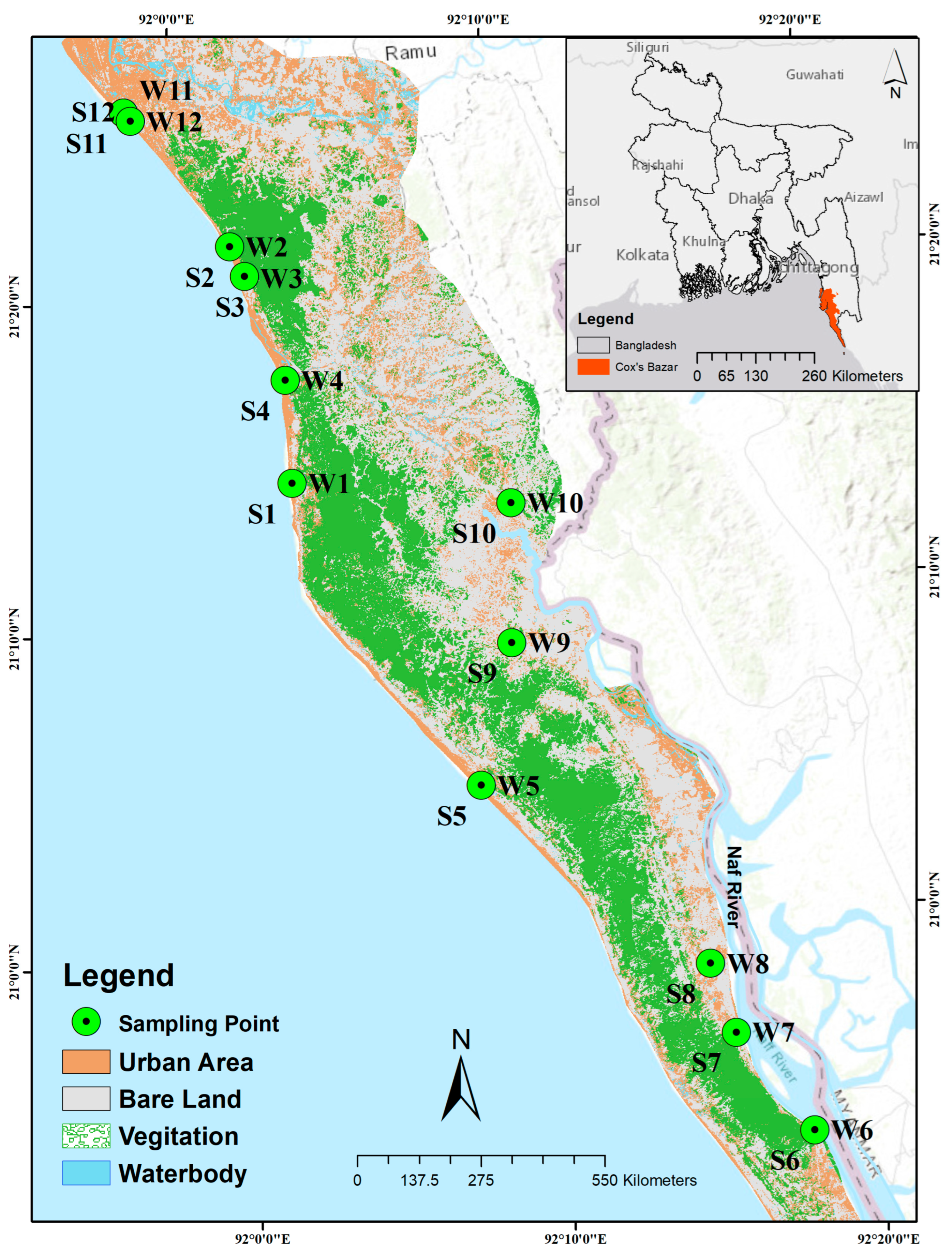
Figure 1. Study area and the designated sampling sites in Cox’s Bazar, Bangladesh. The sampling sites S1W1–S5W5 and S11W11–S12W12 are located in tourist areas, while S6W6–S10W10 are in market areas.
Microplastics 05 00064 g001
Figure 2. Microplastics abundance in shallow groundwater (A) and surficial sediment (B) samples. All data are shown as mean ± SD (n = 3). The results of Tukey’s post hoc test are shown by the letter labels above the boxplots. Sampling sites marked with the same letter (e.g., a or b) show no significant differences in MP concentrations (p > 0.05).
Microplastics 05 00064 g002
Figure 3. Illustration of the prevalence of microplastics in surficial sediment (A) and shallow groundwater (B) at Cox’s Bazar.
Microplastics 05 00064 g003
Figure 4. Pearson correlation analysis of microplastics abundance between shallow groundwater and surficial sediment samples of Cox’s Bazar.
Microplastics 05 00064 g004
Figure 5. (A,B) types, (C,D) colours, (E,F) size of microplastics in surficial sediment and shallow groundwater of Cox’s Bazar.
Microplastics 05 00064 g005
Figure 6. Snapshot of the polymer composition of microplastics detected by FTIR analysis using 30 randomly chosen particles (AE) and the polymer content (F) of Cox’s Bazar shallow groundwater and surficial sediment samples.
Microplastics 05 00064 g006
Figure 7. Microplastics in shallow groundwater (A) and surface sediment (B) in Cox’s Bazar were analyzed using principal component and hierarchical clustering methods.
Microplastics 05 00064 g007
Figure 8. (A) Human ingestion of MPs, and (B) the pollution load index for sampling sites in Cox’s Bazar.
Microplastics 05 00064 g008
Disclaimer/Publisher’s Note: The statements, opinions and data contained in all publications are solely those of the individual author(s) and contributor(s) and not of MDPI and/or the editor(s). MDPI and/or the editor(s) disclaim responsibility for any injury to people or property resulting from any ideas, methods, instructions or products referred to in the content.