


Abstract
The widespread presence of nanoplastics (NPs) in the environment creates a significant and growing concern for global health, with ingestion, inhalation, and dermal contact identified as primary exposure pathways. Despite their documented presence in various environmental matrices and human tissues, robust quantitative data on NP levels remains scarce. This study addresses this critical gap by employing a novel and rapid flow cytometry technique to quantify nanoplastic concentrations in commercial waters, common beverages and infant food, with special focus in packaging influence. Pyrogen-free water was analyzed to establish the negative control for NP concentration, yielding 5.24 ± 2.02 events/µL. Ten commercial waters from natural springs in Spain and France showed NP levels ranging from 1.75 NP/µL to 67.94 NP/µL (mean: 19.90 ± 14.53 NP/µL), where three of those brands showed significantly higher NP numbers than the pyrogen-free water control. Compared to pyrogen-free water, infant formula and cereal porridge showed very low NP concentrations, with values of 10.27 ± 6.85 and 6.78 ± 2.27 events/µL, respectively, following triplicate analyses of six samples. Additional analyses comparing three similar soft drinks across different packaging (can, plastic bottle, or glass bottle) found no significant differences in NP concentration attributable to the container type. NPs, as ubiquitous contaminants, can be ingested by organisms through food and drink. Potential NP contamination in commercial water may be due to factors such as source water contamination, filtration and packaging. The presence of very low concentrations of NPs in infant foods suggests rigorous and effective quality control. Finally, the presence of NP in soft drinks was not affected by the type of packaging. Although soft drinks have higher NP levels than water, the type of packaging had no effect on the presence of NP in these soft drinks. Despite all plastic bottles being made of polyethylene terephthalate, variation in NP accumulation implies that material quality, storage condition, and substantially, water treatment and filtering processes contribute to NP contamination. This research gives evidence for widespread nanoplastic accumulation in bottled water, common beverages and infant formula and sets the stage for demanding research to further investigate sources, health effects, and development into effective quality control and preventive measures for public health.
1. Introduction
One of the most urgent ecological and global health issues of our time is the growing amount of plastic pollution in all environmental compartments. Although both macro and microplastics have drawn a lot of attention, the sneaky spread of nanoplastics (NP) is becoming a more concerning aspect of this problem. Because of their special physical and chemical characteristics that allow for their widespread dissemination and possible biological interactions, these tiny particles—which are frequently invisible to the human eye—are becoming more and more recognized as a growing global health concern [1].
Because of their affordability, durability, and versatility, plastics have become essential materials in almost every aspect of modern life since their mass production started in the middle of the 20th century. But because of their tenacity and poor waste management techniques, they have accumulated in previously unheard-of levels in terrestrial, aquatic, and atmospheric environments [2]. Over time, larger pieces of plastic break down into smaller fragments through a mix of physical, chemical, and biological processes. This gradual breakdown leads to the creation of microplastics (MPs), which are tiny plastic particles measuring between 1 micrometer (µm) and 5 mm (mm). Even smaller particles are nanoplastics (NPs), typically less than 1 µm, and they can even reach down to the nanometer scale (1–100 nm) [3,4].
According to the dimensions, MPs and NPs behave differently in the environment and interact with biological systems. While MPs produce alarming effects, NPs can possess even greater mobility and penetration owing to their smaller dimensions and high surface area-to-volume ratio. Such a high surface area-to-volume ratio would allow NPs to cross biological barriers that larger particles are prevented from. This will thereby present a more direct and menacing hazard to human health [5]. The sources of MPs and NPs include a variety of mechanisms such as the fragmentation and weathering of larger plastic items (plastic bottles, fishing nets, washing out of synthetic textile fibers), direct release of deliberately manufactured micro- and nanoplastics across the various consumer products (microbeads in cosmetics) and industrial processes [6].
There are several proposed internal pathways through which nanoplastics could enter the human organism, increasingly understood to be via ingestion, inhalation, or dermal exposure [7]. The rating of source strength related to a particular route and the kind of hazard that the material presents must be evaluated.
Ingestion is widely considered the most common pathway that exposure follows. Nanoplastic uptake occurs in the food chain through marine animals—especially shellfish and fish—consuming other nanoplastics along with their food. These are found in sea salts, honey, and quite a few other normal, common foods [8]. Key evidence is emerging concerning significant NP contamination of beverages. NP has been shown to already accumulate in tap water. Kirstein et al. [9], and other studies have found micro- and nanoplastics in bottled water, which means that daily sources for hydration could also play an important part in chronic exposure to NPs [10,11,12]. Food packing should also be considered, especially as disposable plastics may cause NP leaching into foods and beverages at certain conditions such as heat, long exposure, etc. [13,14,15].
Inhalation presents another major avenue for human nanoplastic exposure. Nanoplastics find their way into the air via various mechanisms such as the wear and tear of synthetic textiles (releasing fibers), tire abrasion, and the degradation of outdoor plastic infrastructure. These tiny particles can, then, be inhaled into the respiratory tract. Similarly, in indoor environments laden with synthetic materials and dust, significant concentrations of airborne NPs can exist, and can result in chronic low-level exposure. Because of their ultramicrometrical size, inhaled NPs are capable of derailing the natural defense mechanisms of the lung and entering circulation with relative ease [16].
The route of dermal contact, although probably less studied than ingestion or inhalation, still remains a substantial route. Nanoplastics are present in cosmetics for exfoliation (beads, or film formers), personal care products, and manufactured clothing [17]. Skin may be seen as a strong barrier, but poor integrity of skin or prolonged application of high concentrations of NPs in certain formulations may allow their penetration [18].
The small size of nanoplastics allows these particles to act variously in the human body compared to larger particles. Nanoplastics are believed to cross various biological barriers: the gut lining, the blood–brain barrier, and the placental barrier [19,20,21,22]. This ability promotes their accumulation and wide distribution in all kinds of tissues and organs in humans. NP have actually been detected in human tissues: lungs, liver, kidneys, splenic system, and even in the placenta, causing greater concern toward their systemic distribution and long-term health implications [19,23]. The exact mechanisms through which they enter cells, their intracellular fate, and their interactions with biological molecules (e.g., proteins, lipids, DNA) is an area of active research. However, preliminary evidence points to potential causes of inflammation, oxidative stress, cytotoxicity, and disruption of endocrine systems [24].
Despite the overwhelming evidence for their presence in environmental matrices and tissues of human nature, there is still a gaping hole in the robustness of quantification methods. Most of the detection methods for micro- and nanoplastics—Fourier transform infrared spectroscopy (FTIR), Raman spectroscopy, pyrolysis-GC/MS—are challenged with the problem of intrinsic characteristics endowed to NPs: very tiny size, heterogeneous chemical compositions, and typically low concentration in complex biological or environmental matrices. These techniques usually are labor-intensive, need elaborated sample preparation, destroy the samples, and frequently lack the necessary sensitivity or throughput to permit accurate quantification of individual nanoparticles in high numbers. Thus, though we know about the presence of NPs, obtaining precise and reliable quantitative data on their real levels in various matrices, particularly the biological ones, still remains a daunting challenge. Such absence of quantitative data throws a pall on our ability to assess exposure risks, set safe limits, and aid dose–response studies—crucial for public health policy [25].
This critical need for improved quantification has led to the introduction of a new flow cytometric method to quantify nanoplastic levels in different commercial waters. Flow cytometry provides a potent platform for detecting and characterizing single particles. Among many such techniques, flow cytometry is best suited to counter the limitations imposed by conventional NP detection methods because it possesses a high ability to analyze thousands of individual particles based on their light scattering and fluorescence properties in a matter of few minutes [26].
The novelty of our approach rests on optimized methodologies that directly address the challenges of NP quantification in complex matrices like blood. In contrast to techniques requiring lengthy and possibly sample-altering preparatory steps (e.g., filtration, digestion, solvent extraction), our method minimizes these steps and thus retains the integrity of the NP samples best and reduces the risk of contamination or loss. The term quick implies that flow cytometry is a high-throughput technique that allows many samples to be analyzed at a rapid pace, an important consideration in large-scale monitoring and epidemiological studies. This technique is very sensitive, as it can detect NPs at environmentally relevant concentrations.
2. Materials and Methods
Sample Preparation and Staining: For all commercial water samples (n = 10), ten replicates were prepared for ensuring the statistics and reproducibility of our findings, minimizing random error, and thus providing a more reliable average measurement for our readings across the different water types. An identical final volume of 1000 µL (1 mL) was prepared for each replicate per water sample. The choice of this particular volume was important for obtaining optimal particle counts, with reasonable acquisition times on the flow cytometer. For the specific detection and quantification of plastic particles, every 1000 µL of sample was stained with 2 µL of Nile Red (Sigma-Aldrich, Burlington, MA, USA; 0.1 mg/mL stock solution). Nile Red is a fluorescent dye with very high lipophilicity, which selectively intercalates into hydrophobic environments, that is, the polymer matrix of plastic particles. Therefore, it turns out to be a very suitable fluorescent probe for distinguishing plastic NPs from all other particulate matter in the water samples, which are not plastic [27]. The addition of 2 µL from a 0.1 mg/mL stock results in a working concentration that ensures effective staining without causing aggregation or altering the inherent properties of the NPs. Following the addition of Nile Red, samples were incubated for 15 min at room temperature and in the dark, which allows Nile Red to diffuse into the plastic particles therefore ensuring sufficient penetration for optimal and consistent staining [28].
Flow Cytometry Acquisition Parameters: Samples were acquired using the Attune™ NxT Flow Cytometer (Thermo Fisher Scientific, Waltham, MA, USA). Acquisition was performed at the lowest possible sample rate of 12.5 µL/min. The H-pulse parameter was specifically employed during acquisition and analysis. Nanoplastic detection relied on collecting the violet-side scattering using the Attune™ NxT Violet Side-Scatter Filter Kit. Violet lasers (typically around 405 nm) are particularly effective for detecting very small particles due to shorter wavelengths leading to more efficient light scattering by submicron objects. For the detection of stained nanoplastics, Nile Red was excited at a 561 nm (using a yellow-green laser). Its emitted fluorescence was then collected with a 585/16 BP (bandpass) filter in the YL1 detector. This specific excitation and emission wavelength pair is optimized for Nile Red, ensuring maximum fluorescence signal and minimal interference from autofluorescence of the sample matrix or other non-specific signals.
Protocols for Contamination Control and Cleaning: Between each sample, a thorough rinse with filtered deionized water was carried out. This is an essential washing procedure for minimizing the carry-over contamination such that particles from the previous sample do not falsely contribute to the counts of the subsequent sample. In addition to inter-sample rinsing, a thorough cleaning of the flow cell was performed both prior to and after the entire sampling session using Hellmanex® III, the Attune NxT Flow Cell Cleaning Solution (Cat# A43635). Such thorough cleaning is essential for the removal of any residual plastic particles or contaminants that might accumulate in the fluidics system.
Calibration and Controls: The calibration was performed using a submicron sized particle reference kit of sized beads of 0.2 μm, 0.5 μm, and 0.8 μm (Bangs Laboratories, Inc., Fishers, IN, USA). The calibration used pyrogen-free water as a negative control. This water is rigorously purified to remove all particulate matter and biological contaminants, serving as the baseline against which any background noise within the instrument or possible reagent contamination is seen, ensuring specificity and accuracy for quantification.
Sample Preparation and Raman Spectroscopy: Standard particles down to 290 nm were measured using a spontaneous Raman microscope by drying them onto glass bottom well plates (sensoplate, 24-well plates). To measure the standards, 100 µL of samples at varying concentrations ranging 107~104 particles/µL were dried into wells of a 24-well plate by placing them under vacuum for 1 week. Drying was necessary to prevent the particles from moving during the measurement. The Raman system used was an inVia Raman confocal inverted microscope (Renishaw, Wotton-under-Edge, UK) integrated with a Leica DMi8/SP8 laser scanning confocal microscope system (Wetzlar, Germany), with a DPSS Diode 532 nm laser (intensity of 22 mW on the sample) and a 1800 L/mm grating. Light was collected using a Newton EMCCD Sensor (DU970P, 1600 × 200 px, Andor Technology, Oxford Instruments, Abingdon, UK). The instrument was calibrated to the silicone 520.5 cm−1 peak prior to the experiment. For larger particles, a 40× air objective was used. For the smallest particle, the best signal was obtained using a 100× oil objective. Larger beads showed very clear Raman features corresponding to polystyrene. Nanoparticles of 580 nm and 290 nm diameters were also measured. These particles showed strong polystyrene characteristic peaks (see specifically the 1001 and the 3054 cm−1; Supplementary Materials), as well as glass features, that was more prominent for the smallest particles.
Statistical significance was calculated by Kruskal–Wallis test and is graphically represented as follows: p-value ≤ 0.05, *; ≤0.01, **; ≤0.001, ***; and ≤0.0001, ****.
3. Results and Discussion
3.1. Nanoplastic Contamination in Commercial Waters
Our use of the new flow cytometry method produced important and concerning results about the amount of nanoplastics in bottled water that is commercially available. An important finding was that nanoplastic particles were found in all bottled waters analyzed, confirming that, in addition to microplastics [29,30], nanoplastics are contaminating commercial water. This widespread occurrence emphasizes how ubiquitous nanoplastic contamination is, even in products intended for human consumption that are frequently thought to be pure.
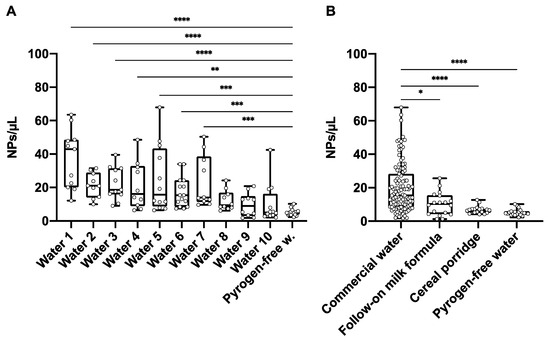
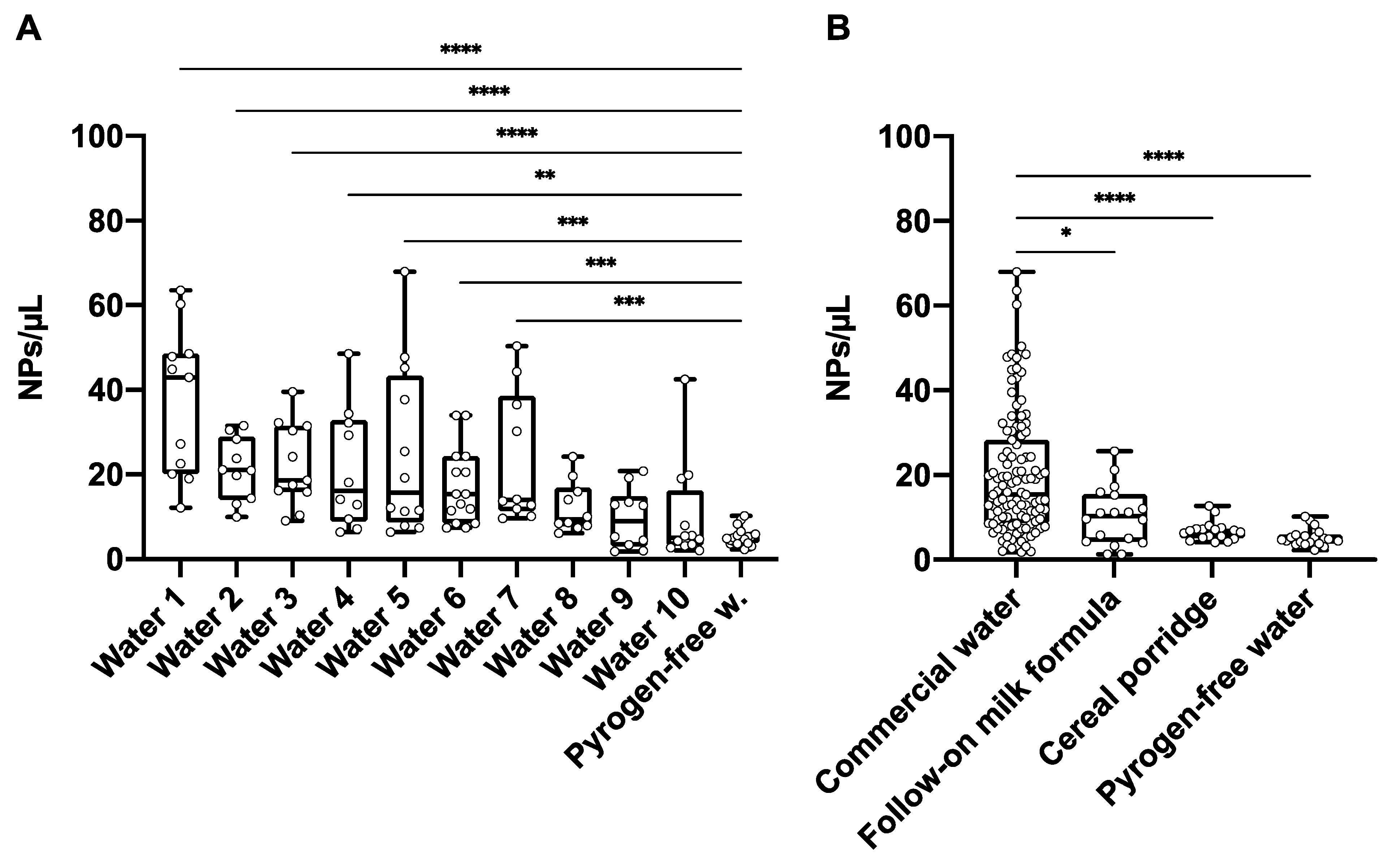
To provide a robust quantitative assessment, ten commercial waters from various natural springs in Spain and France were carefully examined for the accumulation of nanoplastics in order to provide a reliable quantitative evaluation. The results revealed a considerable variability in NP concentrations among these brands, ranging from a minimum of 1.75 NP/µL to a maximum of 67.94 NP/µL (Figure 1A). Three of the ten brands showed no significantly different levels of NP accumulation compared to pyrogen-free water. However, the other seven brands of water showed significant accumulation compared to pyrogen-free water, with water 1 showing 42.98 NP/µL (12.14–63.54 NP/µL; p-value < 0.0001) and water 7 showing 13.93 NP/µL (9.65–50.36 NP/µL; p-value = 0.0003). This considerable range suggests that not all bottled waters are equally contaminated, raising the possibility that contamination occurs in source water, through mass bottling processes, or through the materials used to create the bottle itself. The average concentration of nanoplastics for each of these ten samples was calculated to be 19.90 ± 14.53 NP/µL. This high standard deviation (±14.53 NP/µL) highlights the significant variability seen in various commercial water products. To further contextualize these microliter concentrations further, these values translate to millions of nanoplastics per liter indicating a substantial potential for human exposure.
Figure 1.
Nanoplastic accumulation in different brands of commercial bottled waters. Ten commercial bottled waters in plastic bottles were evaluated by analyzing ten replicates and compared with pyrogen-free water (A). These commercial waters were also compared with follow-on milk and baby cereal porridge from six replicates (B). The pyrogen-free water consisted of a series of twenty samples. The Kruskal–Wallis test was performed using the pyrogen-free water as a reference.
3.2. Nanoplastic Contamination in Infant Formula, Cereal Porridge and Carbonated Beverages
The study also evaluated nanoplastic accumulation in newborn- and continuation-food products, specifically follow-on formula and cereal porridge (Figure 1B). Follow-on formula ranged from a minimum value of 1.308 to a maximum of 25.59 and had a mean of 10.27 ± 6.85 NP/µL, while cereal porridge ranged from 4.12 to 12.69 and had a mean of 6.78 ± 2.27 NP/µL, with both levels of NP values similarly low to pyrogen-free water (p-value = 0.1690 and 0.9999, respectively).
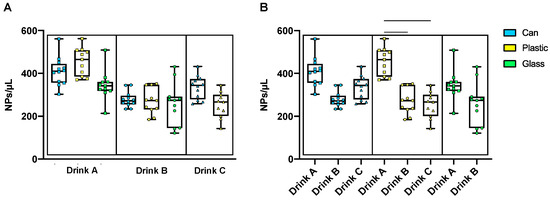
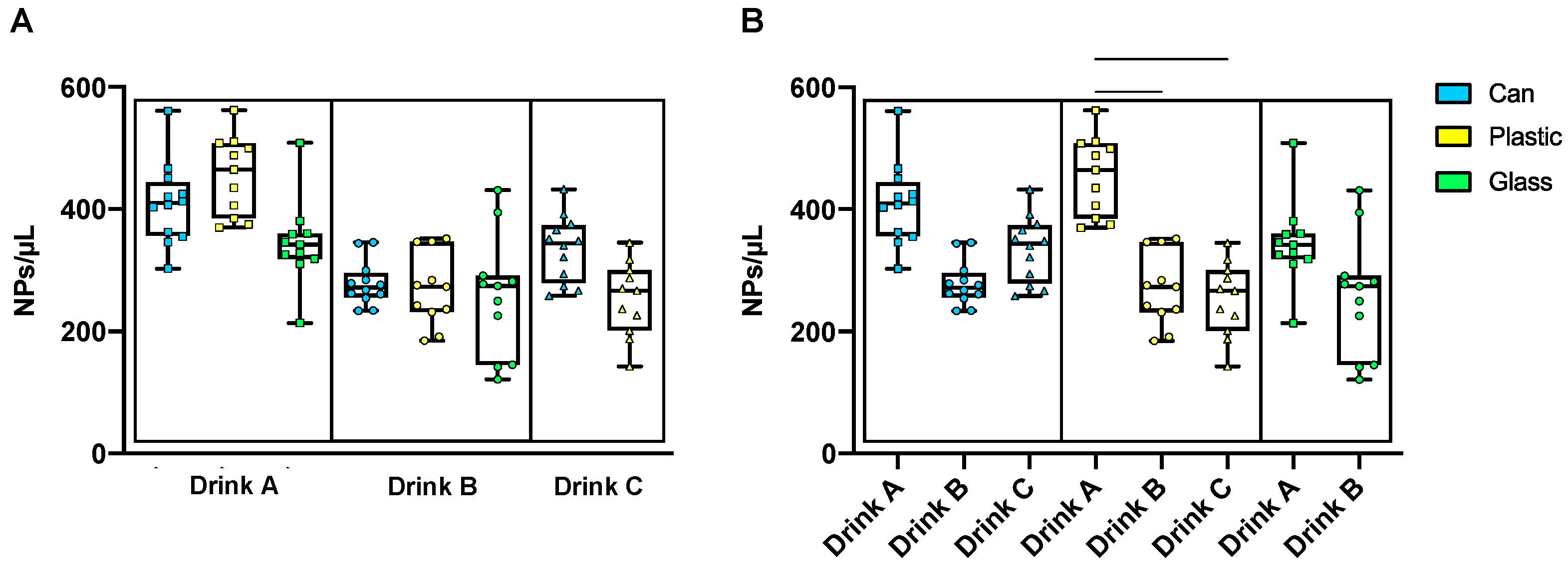
Attention was also focused on the influence of packaging on NP accumulation, and the presence of NPs was compared between cans, glass bottles, and plastic bottles for three similar carbonated soft drinks (Figure 2A). No significant differences were observed across packaging types for the same beverage (p-value > 0.9999). Similarly, when comparing the original soft drink to its two low/reduced sugar versions in cans and glass bottles, no significant differences were found. The only exception was Beverage A in plastic bottles, which exhibited significantly higher nanoplastic (NP) levels (Figure 2B).
Figure 2.
NP assessment of different carbonated soft drinks in different containers. Three similar carbonated soft drinks were assessed in three containers: can, plastic or glass bottles (blue, yellow and green, respectively). No differences were observed among containers from the same drink (A), whereas for the soft drinks, significant differences were observed only in drink A in plastic bottle (B). Pyrogen-free water (n = 20) was compared as a control. Multiple comparisons between containers were performed with the Kruskal–Wallis test.
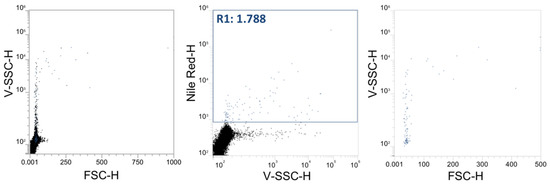
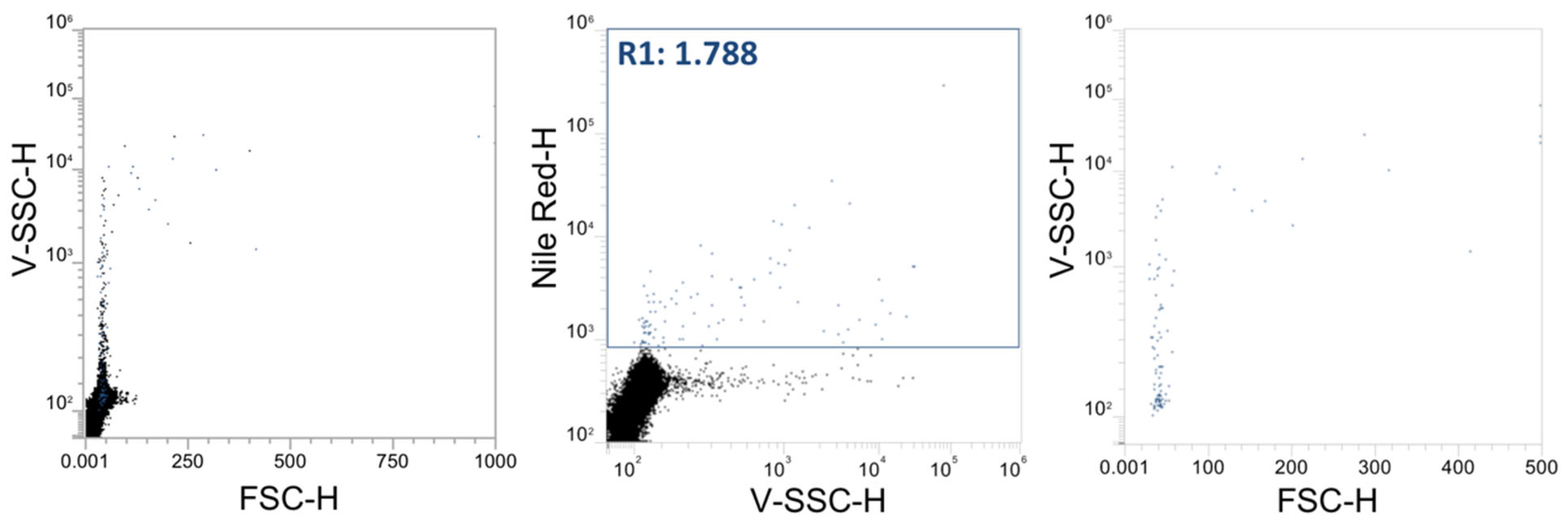
To establish a comparison baseline and capture any background signal from the analytical system itself, pyrogen-free water was used as a daily control (Figure 3). This highly purified water is free for biological contaminants and particulate matter. Pyrogen-free water served as our negative control during the experimental period. Over 20 independent measurements (n = 20), the pyrogen-free water exhibited a mean nanoplastic count of 5.24 ± 2.02 NP/µL. This low and consistent background level confirms the high sensitivity and low inherent noise of our flow cytometry technique, which allows us to confidently attribute higher counts in commercial water samples to the actual presence of nanoplastics.
Figure 3.
Flow cytometry detection of nanoplastics in water. The NP concentration (events/μL) of a pyrogen-free water sample is calculated in R1. Violet-SSC is shown on a hyperlogarithmic scale, FSC on a linear scale, and Nile Red on a logarithmic scale.
3.3. Significance of Nanoplastic Levels in Commercial Bottled Waters and Beverages: Sources, Variability, and Future Directions
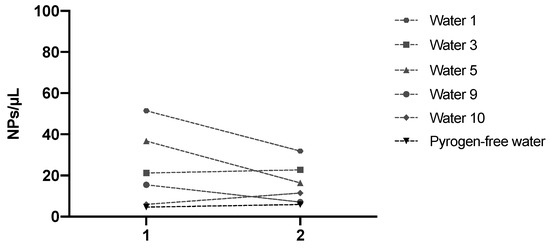
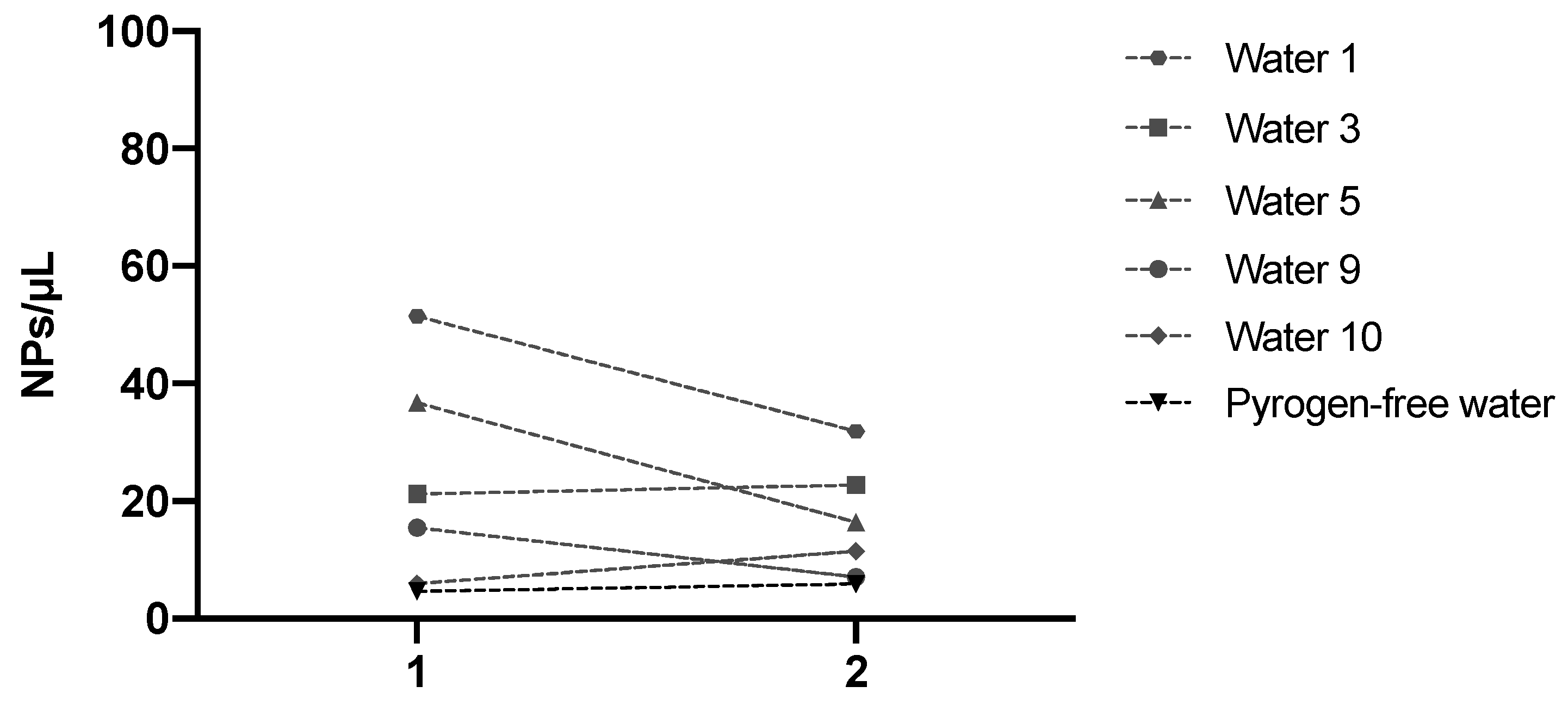
A critical finding of our comparative analysis was that seven out of the ten commercial waters had significantly higher NP levels than the pyrogen-free water control. This statistical significance indicates that the elevated nanoplastic counts in these specific commercial waters are not merely due to background noise or instrument variability, but represent genuine, measurable contamination. The fact that the majority of the commercial waters tested showed such a marked difference from the purified control raises serious questions about the sources of contamination in the bottled water industry. Possible factors contributing to these elevated levels could be: (A) Source Water Contamination: While sourced from “natural springs,” these waters may still be exposed to environmental plastic pollution at their origin or during collection [31]. (B) Bottling Process Contamination: The industrial bottling process itself, involving various plastic components (pipes, filters, tanks), could introduce nanoplastics through wear and tear [32,33]. (C) Packaging Leaching: The plastic bottles themselves (typically PET, polyethylene terephthalate) and their caps can shed nanoplastics into the water over time, especially when exposed to temperature fluctuations, UV light, or physical agitation during transport and storage [34,35]. The type of plastic, its age, and storage conditions likely play a significant role in the extent of leaching. However, no significant leaching was observed over a ten-month period when storing pyrogen-free water at room temperature, even using different lots, or when storing the mineral waters (which were comparable to pyrogen-free water) at 4 °C (Figure 4).
Figure 4.
Impact of storage on NP accumulation. Storage did not significantly impact nanoplastic (NP) accumulation in the samples. Five commercial water products (grey) were compared to the pyrogen-free control water (black) at two time points, and a multiple unpaired t-test with Welch’s correction revealed no significant differences in NP levels due to storage.
The observed control value of 5.24 ± 2.02 NP/μL background signal probably represents environmental contamination. Since all of our materials, including the pyrogen-free water container, are made of high quality/grade plastic and the test tube must be opened for analysis in the flow cytometer, both the act of dispensing the sample and the final step of analysis present an unavoidable opportunity for laboratory airborne particulates and dust to introduce environmental contamination. This variable background is always controlled to reliably detect and quantify low levels of NP, even in samples such as infant formula and cereal porridge, as we are very close to the approximate limit of detection that makes noise and control contamination statistically indistinguishable.
The fundamental challenge in quantifying nanoplastics in water lies in the critical lack of specificity in current staining methods, which poses a major risk of overestimation. These techniques use dyes that adhere to any hydrophobic (water-repelling) material, not exclusively plastic. The use of Nile Red dye, a lipophilic compound, is justified for the initial screening of particles because it fluoresces upon binding to hydrophobic domains; however, since its binding is not only specific to polymeric materials (i.e., plastics), it does not provide chemical confirmation of a particle’s plastic nature. While bottled mineral water is processed to be exceptionally pure and is expected to be largely free of organic colloids, it is not guaranteed to be entirely devoid of all non-plastic hydrophobic matter, and from an analytical perspective, assuming purity is not a sufficient substitute for experimental controls. Consequently, the final count of stained particles will include both authentic plastic particles and any eventually remaining hydrophobic contaminants or non-plastic particles, resulting in even minimal levels of non-plastic hydrophobic substances contributing to the observed fluorescence and thus skewing the data, leading to a calculated concentration of nanoplastics higher than the amount actually present.
To accurately measure nanoplastics despite the non-specific dyes, researchers can destroy the organic matter before staining. However, aggressive treatments might simultaneously damage or dissolve the nanoplastics they are trying to count, as occurs with peroxide. Quantification using techniques like fluorescence microscopy or flow cytometry can be very helpful to obtain true estimations. So, to conclusively characterize challenges associated with the smallest particles, we have applied a rigorous analytical protocol. This was necessary because the high Brownian motion of the nanoparticles in solution prevents the acquisition of reliable in situ Raman data.
We proceeded to test the feasibility of measuring these samples using spontaneous Raman spectroscopy. To this end, we measured standard particles down to 290 nm using milliQ water by drying them onto glass bottom well plates. These particles showed strong polystyrene characteristic peaks (see specifically the 1001 and the 3054 cm−1), as well as glass features in the baseline (Supplementary Materials). We also explored different submicron particle concentrations. Using ~10,000 particles/μL in a well of a 24-well plate gave optimal number of events per field of view. We could also analyze samples with a concentration of ~1000 particles/μL, although the lower surface density of particles made the analysis more challenging. Lower concentrations (such as the ones we identified in plastic bottles) would require mapping an unpractically large area, so pre-concentration of the samples is required. Drying large volumes of samples can result in the precipitation of crystals and adds another step where contamination of the samples with laboratory nanoplastics can occur.
Flow cytometry offers high sensitivity for detecting small, dim particles, particularly when dealing with the nano-size range. While conventional flow cytometers typically struggle below 200 nm, some specialized instruments, often referred to as nanocytometers, have been specifically engineered to overcome these optical limitations. These high-end systems use optimized optics and advanced laser configurations to reduce background noise and maximize signal capture from the tiny particles, allowing them to reliably measure and count particles—such as polystyrene standards—down to ∼50 nm to 100 nm. This sensitivity is crucial because the majority of nanoplastics are expected to fall into this extremely small size fraction, which is below the detection limit of many traditional analytical tools like Raman or FTIR spectroscopy. Without this high sensitivity, the smallest, and potentially most abundant nanoplastics would be completely missed, leading to a significant underestimation of environmental contamination.
These results provide compelling quantitative evidence of widespread nanoplastic contamination in popular brands of bottled water. They highlight the urgent need for further investigation of the specific sources of these particles and their potential health implications for regular consumers.
The implications of this work are far-reaching. By providing a rapid, sensitive and quantitative method for NP detection, this research will enable us to (A) enhance exposure assessment by significantly improving our ability to accurately assess human exposure to nanoplastics through a major ingestion pathway. This quantitative data is essential for developing robust risk assessment models. (B) To inform public health policy by providing critical evidence for policymakers to consider when establishing guidelines or regulations for plastic content in drinking water and food products. (C) To drive innovation in filtration, highlighting the effectiveness (or lack thereof) of current water filtration technologies in removing NPs, thereby stimulating the development of more advanced filtration solutions. (D) To increase consumer awareness empowering consumers with more precise information about the nanoplastic content in their drinking water, enabling more informed decisions, and (E) to facilitate future research, helping as a widely used research methodology that can be adapted and applied to quantify NPs in other complex environmental matrices (e.g., air, soil, food) and biological samples (e.g., blood, urine, tissues), thereby accelerating our understanding of their environmental fate and health impacts.
Our comprehensive analysis of nanoplastic contamination in commercial still waters has yielded nuanced and important results. While some brands of commercial still water showed no significant accumulation of nanoparticles (likely referring to nanoparticles in this context, given the study’s focus on nanoplastics and the above discussion of nanoparticle quantification), indicating a cleaner profile, nanoparticles were unequivocally detected in other brands. This important contrast between products, all of which are widely consumed, underscores the variability in the quality and purity of commercially available bottled water [36].
Notably, all of the water bottles analyzed in this study were made of polyethylene terephthalate (PET), a plastic commonly used for beverage packaging. Despite this apparent uniformity in packaging material, the observed differential accumulation of NPs strongly suggests that factors beyond the basic polymer type are at play. Several hypotheses can be put forward to explain this variability such as those involving differences in material quality. Even within the same polymer type (PET), variations in manufacturing processes, resin purity, or the presence of additives could influence the stability of the plastic and its propensity to shed nanoparticles [37]. Higher quality or more robust PET formulations might be more resistant to degradation and particle release. Thus, storage conditions and the journey from the bottling plant to the consumer may involve diverse and often uncontrolled storage conditions. Exposure to elevated temperatures, direct sunlight (UV radiation) or prolonged storage periods can accelerate plastic degradation, leading to increased leaching and fragmentation of NPs [38,39]. Therefore, differences in supply chain management and retail display practices could significantly influence the final NP content.
Several studies have confirmed that polyethylene terephthalate (PET) is not chemically inert. Research by Westerhoff and Keresztes (2008, 2009) established that the catalyst Antimony (Sb) migrates into the contents, a rate directly accelerated by the increase in temperature and the duration of storage [40,41]. This chemical release acquires toxicological urgency with the detection by Wagner and Oehlmann (2009) of estrogenic activity of PET leachates [42]. Further work by Bach et al. (2013) quantified the thermal dependence of Sb and acetaldehyde migration [39]. Steimel et al. (2024) demonstrated that recycled PET (rPET) presents an amplified risk, releasing a more complex set of contaminants (e.g., BPA, benzene), confirming that current reprocessing methods fail to completely neutralize the chemical burden of the material [35].
More importantly, the water treatment and filtration process employed by each bottling company likely plays a key role. Although “natural spring” water involves minimal processing, many bottled water companies use several filtration and purification steps. The effectiveness of these processes in removing submicron particles, including nanoplastics, can vary dramatically depending on the pore size of the filters used, the number of filtration stages, and the overall sophistication of the treatment plant [43]. This highlights a critical area for improvement and standardization within the industry.
The findings of this work, particularly the quantitative data on NP levels and the disparities observed between brands, provide a crucial basis for future research. Undoubtedly, further research is needed to understand the full extent of plastic contamination in our drinking water and its broader environmental and health implications. This includes identifying specific polymer types. While Nile Red staining provides a general indication of plastic, future studies should aim to identify the specific chemical composition of the detected NPs to trace their origin more precisely.
Investigating health impacts will need longitudinal studies and toxicological assessments, essential to determine the long-term health effects of chronic nanoplastic ingestion on human physiology [44]. Research and development efforts should focus on designing and implementing more effective filtration technologies capable of consistently removing nanoplastics from water sources at both industrial and household levels, as well as the establishment of international quality control standards and regulatory frameworks for nanoplastic content in food and beverages, which is paramount to protect public health.
Ultimately, this study contributes to a growing body of evidence that underscores the urgent need to determine future quality control and prevention strategies to mitigate nanoplastic contamination. This includes not only improvements in bottled water production but also broader efforts to reduce plastic production, enhance recycling infrastructure, and develop sustainable alternatives to conventional plastics. Only through concerted scientific investigation, technological innovation, and policy implementation can we effectively address this emerging global health challenge.
Supplementary Materials
The following supporting information can be downloaded at: https://www.mdpi.com/article/10.3390/microplastics4040108/s1.
Author Contributions
Conceptualization, J.G.d.P. and J.P.; methodology, R.S., C.S., I.C., E.E., J.G.d.P., M.D.W. and J.P.; software, R.S., C.S., I.C., E.E., J.G.d.P. and J.P.; validation, R.S., C.S., I.C., M.S., M.D.W. and J.P.; formal analysis, R.S., C.S., I.C. and J.P.; investigation, R.S., C.S., I.C., M.S., J.G.d.P., M.D.W. and J.P.; resources, M.D.W. and J.P.; data curation, R.S., M.S. and J.P.; writing—original draft, R.S. and J.P.; writing—review and editing, R.S., M.S., J.G.d.P., M.D.W. and J.P.; visualization, R.S., C.S., I.C., E.E., J.G.d.P., M.D.W., and J.P.; supervision, M.S., M.D.W., and J.P.; project administration, M.D.W. and J.P.; Funding acquisition, J.G.d.P., M.D.W., and J.P. All authors have read and agreed to the published version of the manuscript.
Funding
Obra Social la Caixa, Agency for Management of University and Research Grants (AGAUR, Generalitat de Catalunya), Catalan Research Group (SGR) 2021 SGR 00002, Thermo Fisher Scientific.
Institutional Review Board Statement
Not applicable.
Data Availability Statement
The raw data supporting the conclusions of this article will be made available by the authors on request.
Acknowledgments
This study was made possible in part by support from Thermo Fisher Scientific. We thank the CERCA Programme/Generalitat de Catalunya and the Germans Trias i Pujol Research Foundation for institutional support and acknowledge financial support from the Obra Social la Caixa. This work was also supported by Consolidated Research Group 2021 SGR 00002, AGAUR, Generalitat de Catalunya. The authors are very grateful to Pierre Le Ninan, Marjorie Joiner, Clara Streiff, Paola Paglia, Sergio Ramon, and Víctor Querol from Thermo Fisher Scientific for all their help in this research field. The authors thank the Hyperspectral BioImaging Facility for technical assistance. Specifically, we acknowledge the use of the Leica STELLARIS Confocal Platform for all advanced imaging and spectral analysis presented in this work (EPSRC funded Strategic Equipment, University of Leeds, UK).
Conflicts of Interest
Michael D. Ward works for Thermo Fisher Scientific, which is in the business of selling flow cytometers and flow cytometry reagents. The rest of the authors declare no potential conflicts of interest. The funding sponsors had no role in the design of the study; in the collection, analyses, or interpretation of data; in the writing of the manuscript, and in the decision to publish the results.
References
- Li, Y.; Tao, L.; Wang, Q.; Wang, F.; Li, G.; Song, M. Potential Health Impact of Microplastics: A Review of Environmental Distribution, Human Exposure, and Toxic Effects. Environ. Health 2023, 1, 249–257. [Google Scholar] [CrossRef] [Scilit] [PubMed]
- Thompson, R.C.; Olsen, Y.; Mitchell, R.P.; Davis, A.; Rowland, S.J.; John, A.W.G.; McGonigle, D.; Russell, A.E. Lost at Sea: Where Is All the Plastic? Science 2004, 304, 838. [Google Scholar] [CrossRef] [Scilit] [PubMed]
- Jolaosho, T.L.; Rasaq, M.F.; Omotoye, E.V.; Araomo, O.V.; Adekoya, O.S.; Abolaji, O.Y.; Hungbo, J.J. Microplastics in freshwater and marine ecosystems: Occurrence, characterization, sources, distribution dynamics, fate, transport processes, potential mitigation strategies, and policy interventions. Ecotoxicol. Environ. Saf. 2025, 294, 118036. [Google Scholar] [CrossRef] [Scilit] [PubMed]
- Gigault, J.; ter Halle, A.; Baudrimont, M.; Pascal, P.-Y.; Gauffre, F.; Phi, T.-L.; El Hadri, H.; Grassl, B.; Reynaud, S. Current opinion: What is a nanoplastic? Environ. Pollut. 2018, 235, 1030–1034. [Google Scholar] [CrossRef] [Scilit]
- Gigault, J.; El Hadri, H.; Nguyen, B.; Grassl, B.; Rowenczyk, L.; Tufenkji, N.; Feng, S.; Wiesner, M. Nanoplastics are neither microplastics nor engineered nanoparticles. Nat. Nanotechnol. 2021, 16, 501–507. [Google Scholar] [CrossRef] [Scilit]
- Boucher, J.; Friot, D. Primary Microplastics in the Oceans: A Global Evaluation of Sources; IUCN: Gland, Switzerland, 2017; p. 43. [Google Scholar]
- Nawab, A.; Ahmad, M.; Khan, M.T.; Nafees, M.; Khan, I.; Ihsanullah, I. Human exposure to microplastics: A review on exposure routes and public health impacts. J. Hazard. Mater. Adv. 2024, 16, 100487. [Google Scholar] [CrossRef] [Scilit]
- Van Cauwenberghe, L.; Janssen, C.R. Microplastics in bivalves cultured for human consumption. Environ. Pollut. 2014, 193, 65–70. [Google Scholar] [CrossRef] [Scilit]
- Kirstein, I.V.; Gomiero, A.; Vollertsen, J. Microplastic pollution in drinking water. Curr. Opin. Toxicol. 2021, 28, 70–75. [Google Scholar] [CrossRef] [Scilit]
- Huang, Y.; Wong, K.K.; Li, W.; Zhao, H.; Wang, T.; Stanescu, S.; Boult, S.; van Dongen, B.; Mativenga, P.; Li, L. Characteristics of nano-plastics in bottled drinking water. J. Hazard. Mater. 2022, 424, 127404. [Google Scholar] [CrossRef] [Scilit]
- Mason, S.A.; Welch, V.G.; Neratko, J. Synthetic Polymer Contamination in Bottled Water. Front. Chem. 2018, 6, 407. [Google Scholar] [CrossRef] [Scilit]
- Brancaleone, E.; Mattei, D.; Fuscoletti, V.; Lucentini, L.; Favero, G.; Cecchini, G.; Frugis, A.; Gioia, V.; Lazzazzara, M. Microplastic in Drinking Water: A Pilot Study. Microplastics 2024, 3, 31–45. [Google Scholar] [CrossRef] [Scilit]
- Crompton, T.R. Additive Migration from Plastics into Foods. A Guide for Analytical Chemists, 1st ed.; Smithers Rapra Technology: Shrewsbury, UK, 2007. [Google Scholar]
- Waring, R.; Harris, R.; Mitchell, S. Plastic contamination of the food chain: A threat to human health? Maturitas 2018, 115, 64–68. [Google Scholar] [CrossRef] [Scilit] [PubMed]
- Wang, Y.-L.; Lee, Y.-H.; Chiu, I.-J.; Lin, Y.-F.; Chiu, H.-W. Potent Impact of Plastic Nanomaterials and Micromaterials on the Food Chain and Human Health. Int. J. Mol. Sci. 2020, 21, 1727. [Google Scholar] [CrossRef] [Scilit] [PubMed]
- Oberdörster, G.; Elder, A.; Rinderknecht, A. Nanoparticles and the Brain: Cause for Concern? J. Nanosci. Nanotechnol. 2009, 9, 4996–5007. [Google Scholar] [CrossRef] [Scilit]
- Kukkola, A.; Chetwynd, A.J.; Krause, S.; Lynch, I. Beyond microbeads: Examining the role of cosmetics in microplastic pollution and spotlighting unanswered questions. J. Hazard. Mater. 2024, 476, 135053. [Google Scholar] [CrossRef] [Scilit]
- Campanale, C.; Massarelli, C.; Savino, I.; Locaputo, V.; Uricchio, V.F. A Detailed Review Study on Potential Effects of Microplastics and Additives of Concern on Human Health. Int. J. Environ. Res. Public Health 2020, 17, 1212. [Google Scholar] [CrossRef] [Scilit]
- Ragusa, A.; Svelato, A.; Santacroce, C.; Catalano, P.; Notarstefano, V.; Carnevali, O.; Papa, F.; Rongioletti, M.C.A.; Baiocco, F.; Draghi, S.; et al. Plasticenta: First evidence of microplastics in human placenta. Environ. Int. 2021, 146, 106274. [Google Scholar] [CrossRef] [Scilit]
- Yang, C.-S.; Chang, C.-H.; Tsai, P.-J.; Chen, W.-Y.; Tseng, F.-G.; Lo, L.-W. Nanoparticle-Based in Vivo Investigation on Blood−Brain Barrier Permeability Following Ischemia and Reperfusion. Anal. Chem. 2004, 76, 4465–4471. [Google Scholar] [CrossRef] [Scilit]
- Shan, S.; Zhang, Y.; Zhao, H.; Zeng, T.; Zhao, X. Polystyrene nanoplastics penetrate across the blood-brain barrier and induce activation of microglia in the brain of mice. Chemosphere 2022, 298, 134261. [Google Scholar] [CrossRef] [Scilit]
- Yong, C.Q.Y.; Valiyaveettil, S.; Tang, B.L. Toxicity of Microplastics and Nanoplastics in Mammalian Systems. Int. J. Environ. Res. Public Health 2020, 17, 1509. [Google Scholar] [CrossRef] [Scilit]
- Schwabl, P.; Köppel, S.; Königshofer, P.; Bucsics, T.; Trauner, M.; Reiberger, T.; Liebmann, B. Detection of Various Microplastics in Human Stool. Ann. Intern. Med. 2019, 171, 453–457. [Google Scholar] [CrossRef] [Scilit] [PubMed]
- Habumugisha, T.; Zhang, Z.; Uwizewe, C.; Yan, C.; Ndayishimiye, J.C.; Rehman, A.; Zhang, X. Toxicological review of micro- and nano-plastics in aquatic environments: Risks to ecosystems, food web dynamics and human health. Ecotoxicol. Environ. Saf. 2024, 278, 116426. [Google Scholar] [CrossRef] [Scilit] [PubMed]
- Horton, A.A.; Walton, A.; Spurgeon, D.J.; Lahive, E.; Svendsen, C. Microplastics in freshwater and terrestrial environments: Evaluating the current understanding to identify the knowledge gaps and future research priorities. Sci. Total Environ. 2017, 586, 127–141. [Google Scholar] [CrossRef] [Scilit] [PubMed]
- Tirelli, V.; Grasso, F.; Barreca, V.; Polignano, D.; Gallinaro, A.; Cara, A.; Sargiacomo, M.; Fiani, M.L.; Sanchez, M. Flow cytometric procedures for deep characterization of nanoparticles. Biol. Methods Protoc. 2025, 10, bpaf019. [Google Scholar] [CrossRef] [Scilit]
- Meyers, N.; Catarino, A.I.; Declercq, A.M.; Brenan, A.; Devriese, L.; Vandegehuchte, M.; De Witte, B.; Janssen, C.; Everaert, G. Microplastic detection and identification by Nile red staining: Towards a semi-automated, cost- and time-effective technique. Sci. Total Environ. 2022, 823, 153441. [Google Scholar] [CrossRef] [Scilit]
- Salvia, R.; Rico, L.G.; Bradford, J.A.; Ward, M.D.; Olszowy, M.W.; Martínez, C.; Madrid-Aris, Á.D.; Grífols, J.R.; Ancochea, Á.; Gomez-Muñoz, L.; et al. Fast-screening flow cytometry method for detecting nanoplastics in human peripheral blood. MethodsX 2023, 10, 102057. [Google Scholar] [CrossRef] [Scilit]
- Li, H.; Zhu, L.; Ma, M.; Wu, H.; An, L.; Yang, Z. Occurrence of microplastics in commercially sold bottled water. Sci. Total Environ. 2023, 867, 161553. [Google Scholar] [CrossRef] [Scilit]
- Oßmann, B.E.; Sarau, G.; Holtmannspötter, H.; Pischetsrieder, M.; Christiansen, S.H.; Dicke, W. Small-sized microplastics and pigmented particles in bottled mineral water. Water Res. 2018, 141, 307–316. [Google Scholar] [CrossRef] [Scilit]
- Jambeck, J.R.; Geyer, R.; Wilcox, C.; Siegler, T.R.; Perryman, M.; Andrady, A.; Narayan, R.; Law, K.L. Plastic waste inputs from land into the ocean. Science 2015, 347, 768–771. [Google Scholar] [CrossRef] [Scilit]
- Ziani, K.; Ioniță-Mîndrican, C.-B.; Mititelu, M.; Neacșu, S.M.; Negrei, C.; Moroșan, E.; Drăgănescu, D.; Preda, O.-T. Microplastics: A Real Global Threat for Environment and Food Safety: A State of the Art Review. Nutrients 2023, 15, 617. [Google Scholar] [CrossRef] [Scilit]
- Hammodat, A.R.; Nassar, S.; Mortula, M.; Shamsuzzaman, M. Factors affecting the leaching of micro and nanoplastics in the water distribution system. J. Environ. Manag. 2023, 345, 118779. [Google Scholar] [CrossRef] [Scilit] [PubMed]
- Qian, N.; Gao, X.; Lang, X.; Deng, H.; Bratu, T.M.; Chen, Q.; Stapleton, P.; Yan, B.; Min, W. Rapid single-particle chemical imaging of nanoplastics by SRS microscopy. Proc. Natl. Acad. Sci. USA 2024, 121, e2300582121. [Google Scholar] [CrossRef] [Scilit] [PubMed]
- Steimel, K.G.; Hwang, R.; Dinh, D.; Donnell, M.T.; More, S.; Fung, E. Evaluation of chemicals leached from PET and recycled PET containers into beverages. Rev. Environ. Health 2024, 39, 251–260. [Google Scholar] [CrossRef] [Scilit]
- Maharjan, K.K. Microplastic pollution in bottled water: A systematic review. Int. J. Environ. Sci. Technol. 2024, 22, 1283–1296. [Google Scholar] [CrossRef] [Scilit]
- Hahladakis, J.N.; Velis, C.A.; Weber, R.; Iacovidou, E.; Purnell, P. An overview of chemical additives present in plastics: Migration, release, fate and environmental impact during their use, disposal and recycling. J. Hazard. Mater. 2018, 344, 179–199. [Google Scholar] [CrossRef] [Scilit]
- Liu, L.; Xu, M.; Ye, Y.; Zhang, B. On the degradation of (micro)plastics: Degradation methods, influencing factors, environmental impacts. Sci. Total Environ. 2022, 806, 151312. [Google Scholar] [CrossRef] [Scilit]
- Bach, C.; Dauchy, X.; Severin, I.; Munoz, J.-F.; Etienne, S.; Chagnon, M.-C. Effect of temperature on the release of intentionally and non-intentionally added substances from polyethylene terephthalate (PET) bottles into water: Chemical analysis and potential toxicity. Food Chem. 2013, 139, 672–680. [Google Scholar] [CrossRef] [Scilit]
- Westerhoff, P.; Prapaipong, P.; Shock, E.; Hillaireau, A. Antimony leaching from polyethylene terephthalate (PET) plastic used for bottled drinking water. Water Res. 2008, 42, 551–556. [Google Scholar] [CrossRef] [Scilit]
- Keresztes, S.; Tatár, E.; Mihucz, V.G.; Virág, I.; Majdik, C.; Záray, G. Leaching of antimony from polyethylene terephthalate (PET) bottles into mineral water. Sci. Total Environ. 2009, 407, 4731–4735. [Google Scholar] [CrossRef] [Scilit]
- Wagner, M.; Oehlmann, J. Endocrine disruptors in bottled mineral water: Total estrogenic burden and migration from plastic bottles. Environ. Sci. Pollut. Res. 2009, 16, 278–286. [Google Scholar] [CrossRef] [Scilit]
- Pan, Y.; Gao, S.-H.; Ge, C.; Gao, Q.; Huang, S.; Kang, Y.; Luo, G.; Zhang, Z.; Fan, L.; Zhu, Y.; et al. Removing microplastics from aquatic environments: A critical review. Environ. Sci. Ecotechnol. 2022, 13, 100222. [Google Scholar] [CrossRef] [Scilit]
- Smith, M.; Love, D.C.; Rochman, C.M.; Neff, R.A. Microplastics in Seafood and the Implications for Human Health. Curr. Environ. Health Rep. 2018, 5, 375–386. [Google Scholar] [CrossRef] [Scilit]
Disclaimer/Publisher’s Note: The statements, opinions and data contained in all publications are solely those of the individual author(s) and contributor(s) and not of MDPI and/or the editor(s). MDPI and/or the editor(s) disclaim responsibility for any injury to people or property resulting from any ideas, methods, instructions or products referred to in the content. |
© 2025 by the authors. Licensee MDPI, Basel, Switzerland. This article is an open access article distributed under the terms and conditions of the Creative Commons Attribution (CC BY) license (https://creativecommons.org/licenses/by/4.0/).