
Overview of Genetic and Genomic Research Related to Stingless Bees (Meliponini): An AI-Assisted Science Mapping and Structural Topic Modeling Analysis


 , , , , and
Abstract
1. Introduction
2. Materials and Methods
2.1. Search Strategy and Eligibility Criteria
2.2. Structural Topic Modeling
2.3. Taxonomic, Biogeographic, and Subtribe Covariates
2.4. Phylogenetic Mapping
3. Results
3.1. Corpus Overview and Thematic Structure of Topics
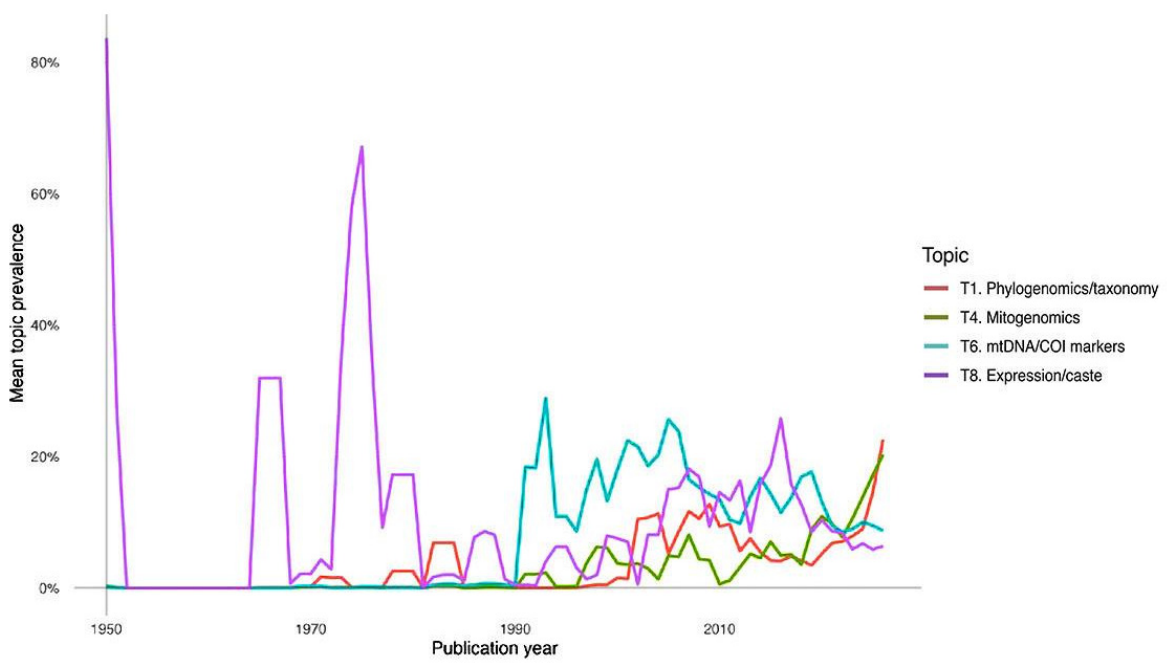
3.2. Temporal Trends in Research Themes
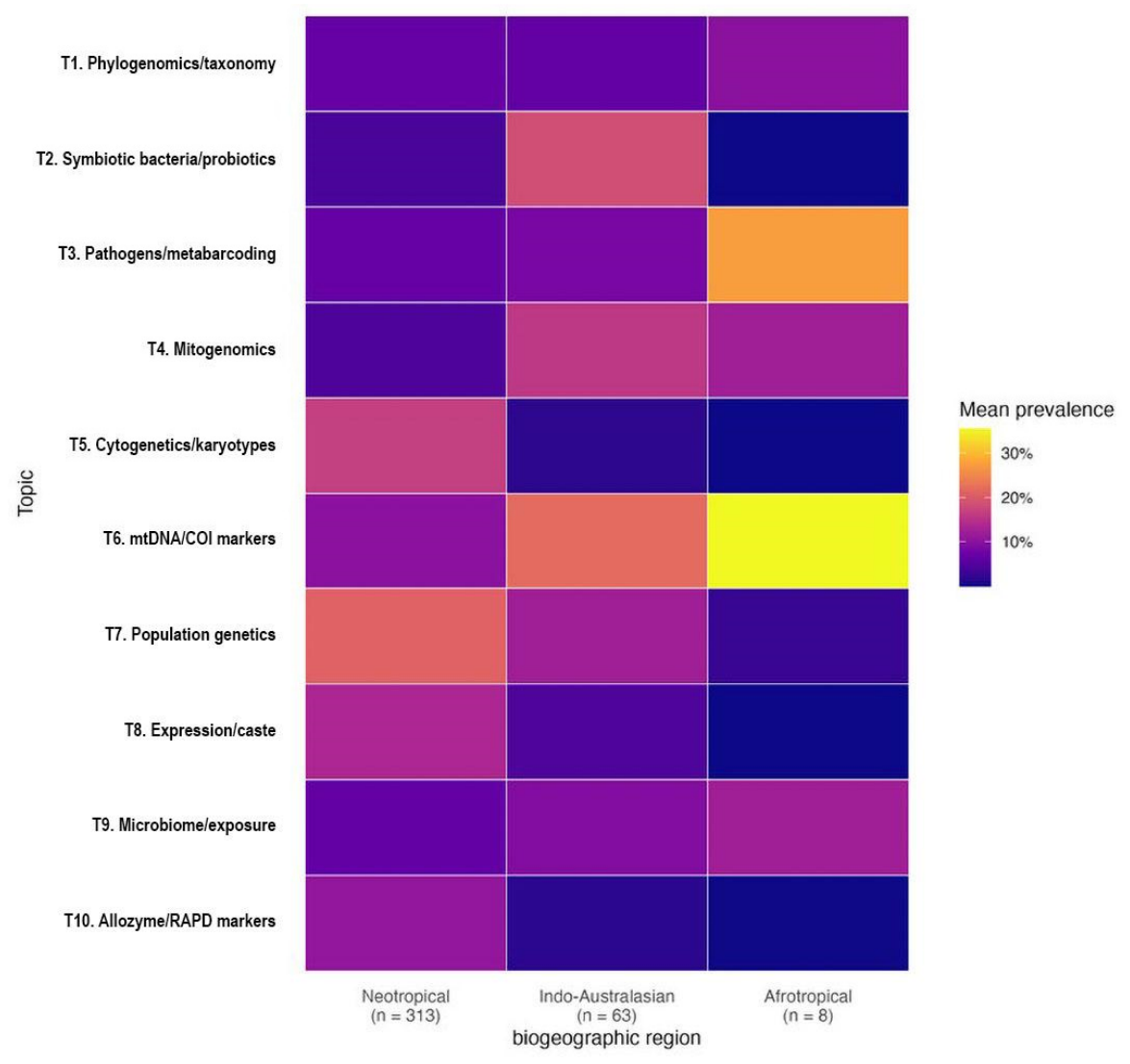
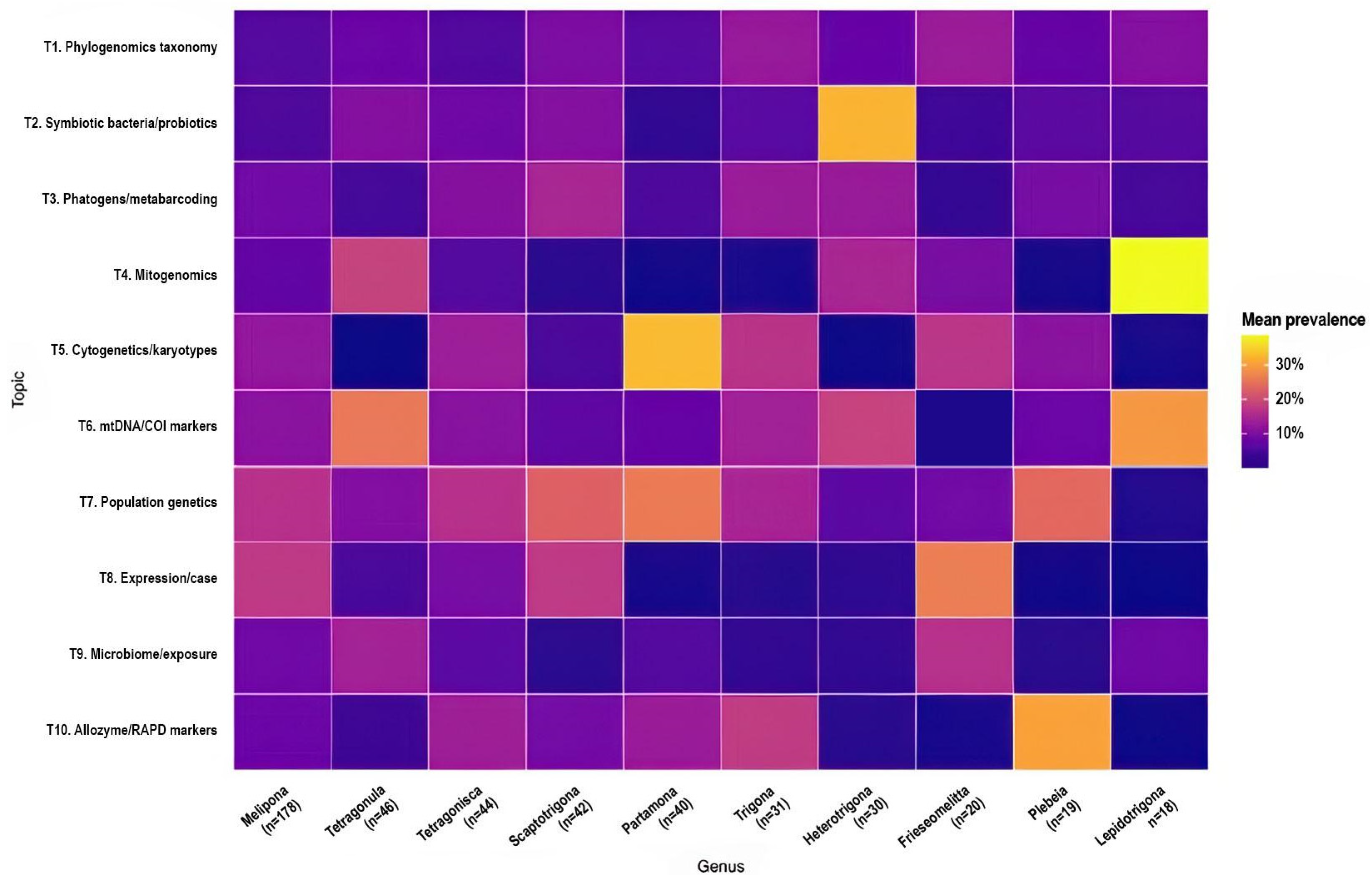
3.3. Biogeographic and Subtribe Structure
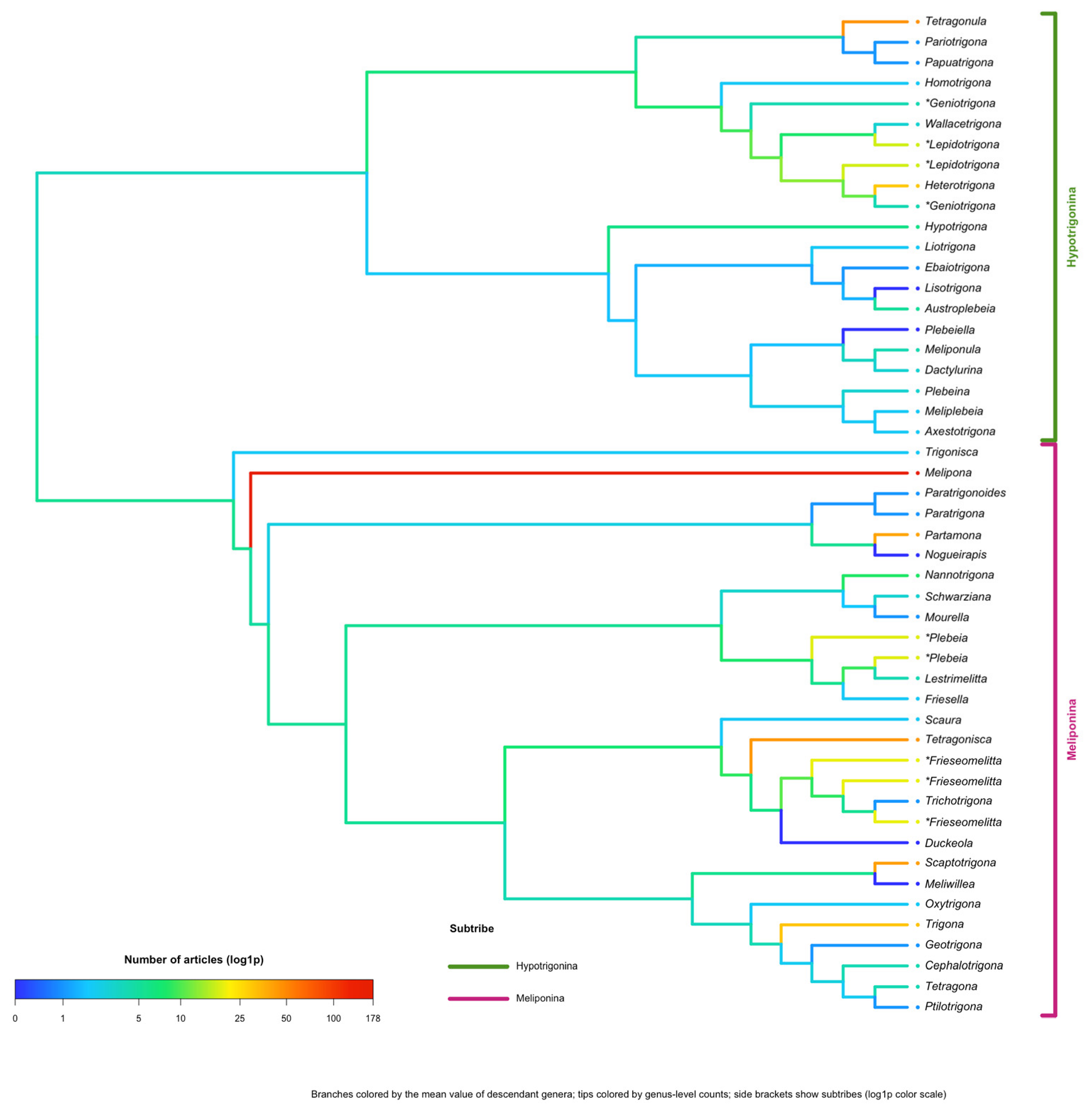
3.4. Taxonomic Coverage and Bias
4. Discussion
4.1. The Evolution of Genetic and Genomic Research on Stingless Bees
4.2. Taxonomic and Geographic Biases: Causes and Consequences
4.3. Conservation Genetics and the Risks of Human-Mediated Gene Flow
4.4. Mitogenomics, Gene Rearrangement and the Limits of DNA Barcoding
4.5. Future Directions: Toward a Comparative Genomics Framework
5. Conclusions
Supplementary Materials
Author Contributions
Funding
Institutional Review Board Statement
Informed Consent Statement
Data Availability Statement
Conflicts of Interest
References
- Engel, M.S.; Rasmussen, C.; Ayala, R.; de Oliveira, F.F. Stingless Bee Classification and Biology (Hymenoptera, Apidae): A Review, with an Updated Key to Genera and Subgenera. Zookeys 2023, 1172, 239–312. [Google Scholar] [CrossRef] [Scilit] [PubMed]
- Quezada-Euán, J.J.G.; Paxton, R.J.; Palmer, K.A.; Itzá, W.D.J.M.; Tay, W.T.; Oldroyd, B.P. Morphological and Molecular Characters Reveal Differentiation in a Neotropical Social Bee, Melipona beecheii (Apidae: Meliponini). Apidologie 2007, 38, 247–258. [Google Scholar] [CrossRef] [Scilit]
- Grüter, C. Importance for Pollination. In Stingless Bees: Their Behaviour, Ecology and Evolution; Springer International Publishing: Cham, Switzerland, 2020; pp. 323–339. [Google Scholar]
- de Sousa Silveira, Z.; Gonçalves, C.A.C.; Macêdo, N.S.; de Menezes Dantas, D.; Brito, S.V.; Torquato, I.H.S.; da Cunha, F.A.B.; da Silva, M.V. Floral Visits by Stingless Bees of the Genus Scaptotrigona (Hymenoptera, Apidae, Meliponini): A Review. Arthropod. Plant. Interact. 2025, 19, 96. [Google Scholar] [CrossRef] [Scilit]
- Heard, T.A. The Role of Stingless Bees in Crop Pollination. Annu. Rev. Entomol. 1999, 44, 183–206. [Google Scholar] [CrossRef] [Scilit]
- Gyeltshen, T.; Bhatta, C.P.; Gurung, T.; Dorji, P.; Tenzin, J. Ethno-Medicinal Uses and Cultural Importance of Stingless Bees and Their Hive Products in Several Ethnic Communities of Bhutan. J. Ethnobiol. Ethnomed. 2024, 20, 42. [Google Scholar] [CrossRef] [Scilit] [PubMed]
- Lepeco, A.; Almeida, E.A.B. Comparative Morphology of the Stingless Bees (Apidae, Meliponini) and Its Phylogenetic Relevance. Bull. Am. Mus. Nat. Hist. 2026, 2026, 1–103. [Google Scholar] [CrossRef] [Scilit]
- Rasmussen, C.; Cameron, S.A. A Molecular Phylogeny of the Old World Stingless Bees (Hymenoptera: Apidae: Meliponini) and the Non-Monophyly of the Large Genus Trigona. Syst. Entomol. 2007, 32, 26–39. [Google Scholar] [CrossRef] [Scilit]
- Rasmussen, C.; Cameron, S.A. Global Stingless Bee Phylogeny Supports Ancient Divergence, Vicariance, and Long-Distance Dispersal. Biol. J. Linn. Soc. 2010, 99, 206–232. [Google Scholar] [CrossRef] [Scilit]
- Quezada-Euán, J.J.G.; May-Itzá, W.d.J.; Rincón, M.; De La Rúa, P.; Paxton, R.J. Genetic and Phenotypic Differentiation in Endemic Scaptotrigona hellwegeri (Apidae: Meliponini): Implications for the Conservation of Stingless Bee Populations in Contrasting Environments. Insect Conserv. Divers. 2012, 5, 433–443. [Google Scholar] [CrossRef] [Scilit]
- Francisco, F.O.; Nunes-Silva, P.; Francoy, T.M.; Wittmann, D.; Imperatriz-Fonseca, V.L.; Arias, M.C.; Morgan, E.D. Morphometrical, Biochemical and Molecular Tools for Assessing Biodiversity. An Example in Plebeia remota (Holmberg, 1903) (Apidae, Meliponini). Insectes Soc. 2008, 55, 231–237. [Google Scholar] [CrossRef] [Scilit]
- Cunha, M.S.; Garcia, M.V.B.; Campos, L.A.O.; Lopes, D.M. Cytotaxonomy and Karyotype Evolution in Neotropical Meliponini (Hymenoptera: Apidae) Inferred by Chromosomal Mapping of 18S RDNA and Five Microsatellites. J. Apic. Res. 2024, 63, 208–218. [Google Scholar] [CrossRef] [Scilit]
- Arias, M.C.; Brito, R.M.; Francisco, F.D.O.; Moretto, G.; De Oliveira, F.F.; Silvestre, D.; Sheppard, W.S. Molecular Markers as a Tool for Population and Evolutionary Studies of Stingless Bees. Apidologie 2006, 37, 259–274. [Google Scholar] [CrossRef] [Scilit]
- Negreiros, A.B.; Silva, G.R.; Oliveira, F.A.S.; Resende, H.C.; Fernandes-Salomão, T.M.; Maggioni, R.; Pereira, F.M.; Souza, B.A.; Lopes, M.T.R.; Diniz, F.M. Microsatellite Marker Discovery in the Stingless Bee Uruçu-Amarela (Melipona rufiventris Group, Hymenoptera, Meliponini) for Population Genetic Analysis. Insects 2019, 10, 450. [Google Scholar] [CrossRef] [Scilit]
- Tavares, M.G.; Ferreira, R.d.P.; Travenzoli, N.M.; Lopes, D.M. Karyotypic Variation in the Stingless Bee Trigona spinipes (Hymenoptera: Apidae: Meliponini) from Different Geographical Regions of Brazil. Apidologie 2021, 52, 1358–1367. [Google Scholar] [CrossRef] [Scilit]
- Souza, R.O.; Del Lama, M.A.; Cervini, M.; Mortari, N.; Eltz, T.; Zimmermann, Y.; Bach, C.; Brosi, B.J.; Suni, S.; Quezada-Euán, J.J.G.; et al. Conservation Genetics of Neotropical Pollinators Revisited: Microsatellite Analysis Suggests That Diploid Males Are Rare in Orchid Bees. Evolution 2010, 64, 3318–3326. [Google Scholar] [CrossRef] [Scilit]
- Faircloth, B.C.; McCormack, J.E.; Crawford, N.G.; Harvey, M.G.; Brumfield, R.T.; Glenn, T.C. Ultraconserved Elements Anchor Thousands of Genetic Markers Spanning Multiple Evolutionary Timescales. Syst. Biol. 2012, 61, 717–726. [Google Scholar] [CrossRef] [Scilit]
- Lepeco, A.; Branstetter, M.G.; Melo, G.A.R.; Freitas, F.V.; Tobin, K.B.; Gan, J.; Jensen, J.; Almeida, E.A.B. Phylogenomic Insights into the Worldwide Evolutionary Relationships of the Stingless Bees (Apidae, Meliponini). Mol. Phylogenet. Evol. 2024, 201, 108219. [Google Scholar] [CrossRef] [Scilit]
- Hofstatter, P.G.; Freitas, F.C.d.P.; Luna-Lucena, D.; Campana, L.; Hartfelder, K. The Genomes Sequenced for the Neotropical Stingless Bees Scaptotrigona bipunctata and S. depilis Strengthen the Phylogenomics Support for the Taxonomy of Social Bees. Genet. Mol. Biol. 2025, 48, e20240255. [Google Scholar] [CrossRef] [Scilit]
- Pereira, U.d.P.; Bonetti, A.M.; Goulart, L.R.; Dos Santos, A.R.; De Oliveira, G.C.; Cuadros-Orellana, S.; Ueira-Vieira, C. Complete Mitochondrial Genome Sequence of Melipona Scutellaris, a Brazilian Stingless Bee. Mitochondrial DNA 2016, 27, 3387–3388. [Google Scholar] [CrossRef] [Scilit]
- Totikov, A.; Tomarovsky, A.; Prokopov, D.; Yakupova, A.; Bulyonkova, T.; Derezanin, L.; Rasskazov, D.; Wolfsberger, W.W.; Koepfli, K.P.; Oleksyk, T.K.; et al. Chromosome-Level Genome Assemblies Expand Capabilities of Genomics for Conservation Biology. Genes 2021, 12, 1336. [Google Scholar] [CrossRef] [Scilit]
- Araujo, N.d.S.; Ogihara, F.; Martins, P.M.; Arias, M.C. Insights from Melipona bicolor Hybrid Genome Assembly: A Stingless Bee Genome with Chromosome-Level Scaffold. BMC Genom. 2024, 25, 171. [Google Scholar] [CrossRef] [Scilit]
- Yong, H.-S.; Song, S.L.; Chua, K.O.; Liew, Y.J.M.; Chan, K.G.; Lim, P.E.; Eamsobhana, P. Mitochondrial Genome Heteroplasmy and Phylogenomics of the Stingless Bee Tetragonula laeviceps (Apidae, Apinae, Meliponini). Apidologie 2024, 55, 57. [Google Scholar] [CrossRef] [Scilit]
- Ferrari, R.R.; Ricardo, P.C.; Dias, F.C.; de Souza Araujo, N.; Soares, D.O.; Zhou, Q.S.; Zhu, C.D.; Coutinho, L.L.; Arias, M.C.; Batista, T.M. The Nuclear and Mitochondrial Genome Assemblies of Tetragonisca angustula (Apidae: Meliponini), a Tiny yet Remarkable Pollinator in the Neotropics. BMC Genom. 2024, 25, 587. [Google Scholar] [CrossRef] [Scilit]
- da Silva, G.; Pereira, F.d.M.; Souza, B.d.A.; Lopes, M.T.d.R.; Diniz, F.M. Pesquisas Com Abelhas-Sem-Ferrão (Hymenoptera: Meliponini) e Aplicabilidade Dos Marcadores Moleculares: Uma Revisão Sistemática Da Literatura. Pubvet 2019, 13, 148. [Google Scholar] [CrossRef] [Scilit]
- Aria, M.; Cuccurullo, C. Bibliometrix: An R-Tool for Comprehensive Science Mapping Analysis. J. Informetr. 2017, 11, 959–975. [Google Scholar] [CrossRef] [Scilit]
- Marlés-Sáenz, E.; Gómez-Luna, E.; Guerrero, J.M.; Vasquez, J.C. Innovative Bibliometric Methodology: A New Big Data-Based Framework for Scientific Research. Energies 2025, 18, 2437. [Google Scholar] [CrossRef] [Scilit]
- Roberts, M.E.; Stewart, B.M.; Tingley, D.; Lucas, C.; Leder-Luis, J.; Gadarian, S.K.; Albertson, B.; Rand, D.G. Structural Topic Models for Open-Ended Survey Responses. Am. J. Polit. Sci. 2014, 58, 1064–1082. [Google Scholar] [CrossRef] [Scilit]
- Roberts, M.E.; Stewart, B.M.; Tingley, D. Stm: An R Package for Structural Topic Models. J. Stat. Softw. 2019, 91, 1–40. [Google Scholar] [CrossRef] [Scilit]
- O’Dea, R.E.; Lagisz, M.; Jennions, M.D.; Koricheva, J.; Noble, D.W.A.; Parker, T.H.; Gurevitch, J.; Page, M.J.; Stewart, G.; Moher, D.; et al. Preferred Reporting Items for Systematic Reviews and Meta-Analyses in Ecology and Evolutionary Biology: A PRISMA Extension. Biol. Rev. 2021, 96, 1695–1722. [Google Scholar] [CrossRef] [Scilit]
- Roberts, M.E.; Stewart, B.M.; Airoldi, E.M. A Model of Text for Experimentation in the Social Sciences. J. Am. Stat. Assoc. 2016, 111, 988–1003. [Google Scholar] [CrossRef] [Scilit]
- Taylor, R.S.; Jensen, E.L.; Coltman, D.W.; Foote, A.D.; Lamichhaney, S. Seeing the Whole Picture: What Molecular Ecology Is Gaining from Whole Genomes. Mol. Ecol. 2021, 30, 5917–5922. [Google Scholar] [CrossRef] [Scilit]
- Davey, J.W.; Hohenlohe, P.A.; Etter, P.D.; Boone, J.Q.; Catchen, J.M.; Blaxter, M.L. Genome-Wide Genetic Marker Discovery and Genotyping Using next-Generation Sequencing. Nat. Rev. Genet. 2011, 12, 499–510. [Google Scholar] [CrossRef] [Scilit]
- Miles Zhang, Y.; Williams, J.L.; Lucky, A. Understanding UCEs: A Comprehensive Primer on Using Ultraconserved Elements for Arthropod Phylogenomics. Insect Syst. Divers. 2019, 3, 3. [Google Scholar] [CrossRef] [Scilit]
- Jeronimo Corvalán, L.C.; Carvalho, L.R.; Dias, R.d.O.; Braga-Ferreira, R.d.S.; Rosa Gonçalves, A.; Targueta, C.P.; Azevedo Brito, P.V.d.; Campos Telles, M.P.d.; de Melo e Silva-Neto, C.; Nunes, R. The Mitochondrial Genome of Melipona fasciculata and Melipona quadrifasciata: Molecular Evolution Dynamics in Stingless Bees (Hymenoptera: Meliponini) Mitogenomes. J. Apic. Res. 2025, 65, 713–726. [Google Scholar] [CrossRef] [Scilit]
- de Souza, L.D.R.; Hartfelder, K. Reproductive Potential Shapes the Expression of Nurse-to-Forager Transition Genes in the Workers of Stingless Bees (Meliponini). Apidologie 2023, 54, 41. [Google Scholar] [CrossRef] [Scilit]
- Farfan, S.J.A.; Celentano, D.; Silva Junior, C.H.L.; de Freitas Silveira, M.V.; Serra, R.T.A.; Gutierrez, J.A.M.; Barros, H.C.; Ribeiro, M.H.M.; Barth, O.M.; de Oliveira Alves, R.M.; et al. The Effect of Landscape Composition on Stingless Bee (Melipona fasciculata) Honey Productivity in a Wetland Ecosystem of Eastern Amazon, Brazil. J. Apic. Res. 2023, 62, 1102–1114. [Google Scholar] [CrossRef] [Scilit]
- Cortopassi-Laurino, M.; Imperatriz-Fonseca, V.L.; Roubik, D.W.; Dollin, A.; Heard, T.; Aguilar, I.; Venturieri, G.C.; Eardley, C.; Noguera-Neto, P. Global Meliponiculture: Challenges and Opportunities. Apidologie 2006, 37, 275–292. [Google Scholar] [CrossRef] [Scilit]
- Nogueira, D.S. Overview of Stingless Bees in Brazil (Hymenoptera: Apidae: Meliponini). EntomoBrasilis 2023, 16, e1041. [Google Scholar] [CrossRef] [Scilit]
- Engel, M.S.; Nguyen, L.T.P.; Tran, N.T.; Truong, T.A.; Herrera Motta, A.F. A New Genus of Minute Stingless Bees from Southeast Asia (Hymenoptera, Apidae). Zookeys 2022, 2022, 53–72. [Google Scholar] [CrossRef] [Scilit]
- Dorey, J.B.; Gilpin, A.M.; Johnston, N.P.; Esquerré, D.; Hughes, A.C.; Ascher, J.S.; Orr, M.C. Estimating Global Bee Species Richness and Taxonomic Gaps. Nat. Commun. 2026, 17, 1762. [Google Scholar] [CrossRef] [Scilit]
- Vereecken, N.J.; Héger, M.; Aganze Mweze, M.; Razakamiaramanana, A.; Karanja, R.H.N.; Nkoba, K.; Noiset, P. Afrotropical Stingless Bees Illustrate a Persistent Cultural Blind Spot in Research, Policy and Conservation. Diversity 2025, 17, 826. [Google Scholar] [CrossRef] [Scilit]
- Toledo-Hernández, E.; Peña-Chora, G.; Hernández-Velázquez, V.M.; Lormendez, C.C.; Toribio-Jiménez, J.; Romero-Ramírez, Y.; León-Rodríguez, R. The Stingless Bees (Hymenoptera: Apidae: Meliponini): A Review of the Current Threats to Their Survival. Apidologie 2022, 53, 8. [Google Scholar] [CrossRef] [Scilit]
- Jaffé, R.; Pope, N.; Acosta, A.L.; Alves, D.A.; Arias, M.C.; De la Rúa, P.; Francisco, F.O.; Giannini, T.C.; González-Chaves, A.; Imperatriz-Fonseca, V.L.; et al. Beekeeping Practices and Geographic Distance, Not Land Use, Drive Gene Flow across Tropical Bees. Mol. Ecol. 2016, 25, 5345–5358. [Google Scholar] [CrossRef] [Scilit] [PubMed]
- May-Itzá, W.d.J.; Quezada-Euán, J.J.G.; Medina, L.A.M.; Enríquez, E.; de la Rúa, P. Morphometric and Genetic Differentiation in Isolated Populations of the Endangered Mesoamerican Stingless Bee Melipona yucatanica (Hymenoptera: Apoidea) Suggest the Existence of a Two Species Complex. Conserv. Genet. 2010, 11, 2079–2084. [Google Scholar] [CrossRef] [Scilit]
- Wongsa, K.; Jeratthitikul, E.; Poolprasert, P.; Duangphakdee, O.; Rattanawannee, A. Genetic Structure of the Commercial Stingless Bee Heterotrigona itama (Apidae: Meliponini) in Thailand. PLoS ONE 2024, 19, e0312386. [Google Scholar] [CrossRef] [Scilit] [PubMed]
- Duangphakdee, O.; Jeratthitikul, E.; Poolprasert, P.; Pongkitsittiporn, R.; Inson, C.; Rattanawannee, A. Human-Mediated Dispersal of Geniotrigona thoracica (Apidae: Meliponini) Colonies Promotes High Genetic Diversity and Reduces Population Structuring in Managed Populations. PeerJ 2025, 13, e20460. [Google Scholar] [CrossRef] [Scilit]
- Quezada-Euán, J.J.G.; May-Itzá, W.J.; de la Rúa, P.; Roubik, D.W. From Neglect to Stardom: How the Rising Popularity of Stingless Bees Threatens Diversity and Meliponiculture in Mexico. Apidologie 2022, 53, 70. [Google Scholar] [CrossRef] [Scilit]
- dos Santos, C.F.; Acosta, A.L.; Halinski, R.; Souza-Santos, P.D.; Borges, R.C.; Gianinni, T.C.; Blochtein, B. The Widespread Trade in Stingless Beehives May Introduce Them into Novel Places and Could Threaten Species. J. Appl. Ecol. 2022, 59, 965–981. [Google Scholar] [CrossRef] [Scilit]
- Carvalho, A.F. Illegalities in the Online Trade of Stingless Bees in Brazil. Insect Conserv. Divers. 2022, 15, 673–681. [Google Scholar] [CrossRef] [Scilit]
- Wang, C.Y.; Zhao, M.; Wang, S.J.; Xu, H.L.; Yang, Y.M.; Liu, L.N.; Feng, Y. The Complete Mitochondrial Genome of Lepidotrigona flavibasis (Hymenoptera: Meliponini) and High Gene Rearrangement in Lepidotrigona Mitogenomes. J. Insect Sci. 2021, 21, 10. [Google Scholar] [CrossRef] [Scilit]
- Wang, S.J.; Wu, J.; Wubie, A.J.; Wang, C.Y. The Complete Mitochondrial Genome of the Stingless Bee Meliplebeia beccarii (Hymenoptera: Apidae: Meliponini) and Insights into Unusual Gene Rearrangement. Int. J. Mol. Sci. 2025, 26, 10588. [Google Scholar] [CrossRef] [Scilit]
- Marconi, M.; Modesti, A.; Alvarez, L.P.; Ogoña, P.V.; Mendoza, A.C.; Vecco-Giove, C.D.; Luna, J.O.; Di Giulio, A.; Mancini, E. DNA Barcoding of Stingless Bees (Hymenoptera: Meliponini) in Northern Peruvian Forests: A Plea for Integrative Taxonomy. Diversity 2022, 14, 632. [Google Scholar] [CrossRef] [Scilit]
- Hurtado-Burillo, M.; Ruiz, C.; De Jesús May-Itzá, W.; Quezada-Eúan, J.J.G.; De La Rúa, P. Barcoding Stingless Bees: Genetic Diversity of the Economically Important Genus Scaptotrigona in Mesoamerica. Apidologie 2013, 44, 1–10. [Google Scholar] [CrossRef] [Scilit]
- Jaramillo, J.; Ospina, R.; Gonzalez, V.H. Stingless Bees of the Genus Nannotrigona Cockerell (Hymenoptera: Apidae: Meliponini) in Colombia. Zootaxa 2019, 4706, 349–365. [Google Scholar] [CrossRef] [Scilit]
- Storfer, A.; Patton, A.; Fraik, A.K. Navigating the Interface between Landscape Genetics and Landscape Genomics. Front. Genet. 2018, 9, 68. [Google Scholar] [CrossRef] [Scilit]
- Jaffé, R.; Veiga, J.C.; Pope, N.S.; Lanes, É.C.M.; Carvalho, C.S.; Alves, R.; Andrade, S.C.S.; Arias, M.C.; Bonatti, V.; Carvalho, A.T.; et al. Landscape Genomics to the Rescue of a Tropical Bee Threatened by Habitat Loss and Climate Change. Evol. Appl. 2019, 12, 1164–1177. [Google Scholar] [CrossRef] [Scilit]
- Grozinger, C.M.; Robinson, G.E. The Power and Promise of Applying Genomics to Honey Bee Health. Curr. Opin. Insect Sci. 2015, 10, 124–132. [Google Scholar] [CrossRef] [Scilit]



| Topic | Label | Short Name | Broad Theme |
|---|---|---|---|
| 1 | Phylogenomics, taxonomy, and evolutionary relationships | Phylogenomics/taxonomy | Evolutionary relationships and taxonomy |
| 2 | Symbiotic bacteria and probiotics | Symbiotic bacteria/probiotics | Microbiome and symbiosis |
| 3 | Viral pathogens, floral resources, and metabarcoding | Pathogens/metabarcoding | Disease ecology and environmental DNA |
| 4 | Mitogenomics and mitochondrial genome evolution | Mitogenomics | Genome architecture and comparative genomics |
| 5 | Cytogenetics, karyotypes, and chromosome architecture | Cytogenetics/karyotypes | Cytogenetics and cytogenomics |
| 6 | mtDNA/COI marker assays and DNA barcoding | mtDNA/COI markers | Marker assays, barcoding, and molecular identification |
| 7 | Population genetics, microsatellites, and morphometrics | Population genetics | Population structure and phenotypic differentiation |
| 8 | Gene expression, caste differentiation, and reproductive genetics | Expression/caste | Functional and reproductive genomics |
| 9 | Gut microbiome, detoxification, and exposure responses | Microbiome/exposure | Microbiome and environmental stress |
| 10 | Allozyme, RAPD, and enzyme polymorphism markers | Allozyme/RAPD markers | Classical marker-based genetics |
| Rank | Topic | Theme | Mean Recent Prevalence | Slope | Prevalence in 2026 |
|---|---|---|---|---|---|
| 1 | T1 | Phylogenomics/taxonomy | 0.115 | 0.035 | 0.226 |
| 2 | T4 | Mitogenomics | 0.137 | 0.034 | 0.203 |
| 3 | T6 | mtDNA/COI markers | 0.092 | 0.003 | 0.087 |
| 4 | T8 | Expression/caste | 0.062 | 0.002 | 0.064 |
Disclaimer/Publisher’s Note: The statements, opinions and data contained in all publications are solely those of the individual author(s) and contributor(s) and not of MDPI and/or the editor(s). MDPI and/or the editor(s) disclaim responsibility for any injury to people or property resulting from any ideas, methods, instructions or products referred to in the content. |
© 2026 by the authors. Licensee MDPI, Basel, Switzerland. This article is an open access article distributed under the terms and conditions of the Creative Commons Attribution (CC BY) license.
Share and Cite
de Oliveira Rosa Marques, L.; Rocha, J.D.; Corvalán, L.C.J.; dos Reis, J.C.; Targueta, C.P.; Brito, P.V.d.A.; Silva Neto, C.d.M.e.; Mafra Batista, T.; Telles, M.P.d.C.; Dias, R.d.O.; et al. Overview of Genetic and Genomic Research Related to Stingless Bees (Meliponini): An AI-Assisted Science Mapping and Structural Topic Modeling Analysis. DNA 2026, 6, 42. https://doi.org/10.3390/dna6030042
de Oliveira Rosa Marques L, Rocha JD, Corvalán LCJ, dos Reis JC, Targueta CP, Brito PVdA, Silva Neto CdMe, Mafra Batista T, Telles MPdC, Dias RdO, et al. Overview of Genetic and Genomic Research Related to Stingless Bees (Meliponini): An AI-Assisted Science Mapping and Structural Topic Modeling Analysis. DNA. 2026; 6(3):42. https://doi.org/10.3390/dna6030042
Chicago/Turabian Stylede Oliveira Rosa Marques, Larissa, Jamira Dias Rocha, Leonardo Carlos Jeronimo Corvalán, Júllia Costa dos Reis, Cíntia Pelegrineti Targueta, Pedro Vale de Azevedo Brito, Carlos de Melo e Silva Neto, Thiago Mafra Batista, Mariana Pires de Campos Telles, Renata de Oliveira Dias, and et al. 2026. "Overview of Genetic and Genomic Research Related to Stingless Bees (Meliponini): An AI-Assisted Science Mapping and Structural Topic Modeling Analysis" DNA 6, no. 3: 42. https://doi.org/10.3390/dna6030042
APA Stylede Oliveira Rosa Marques, L., Rocha, J. D., Corvalán, L. C. J., dos Reis, J. C., Targueta, C. P., Brito, P. V. d. A., Silva Neto, C. d. M. e., Mafra Batista, T., Telles, M. P. d. C., Dias, R. d. O., & Nunes, R. (2026). Overview of Genetic and Genomic Research Related to Stingless Bees (Meliponini): An AI-Assisted Science Mapping and Structural Topic Modeling Analysis. DNA, 6(3), 42. https://doi.org/10.3390/dna6030042