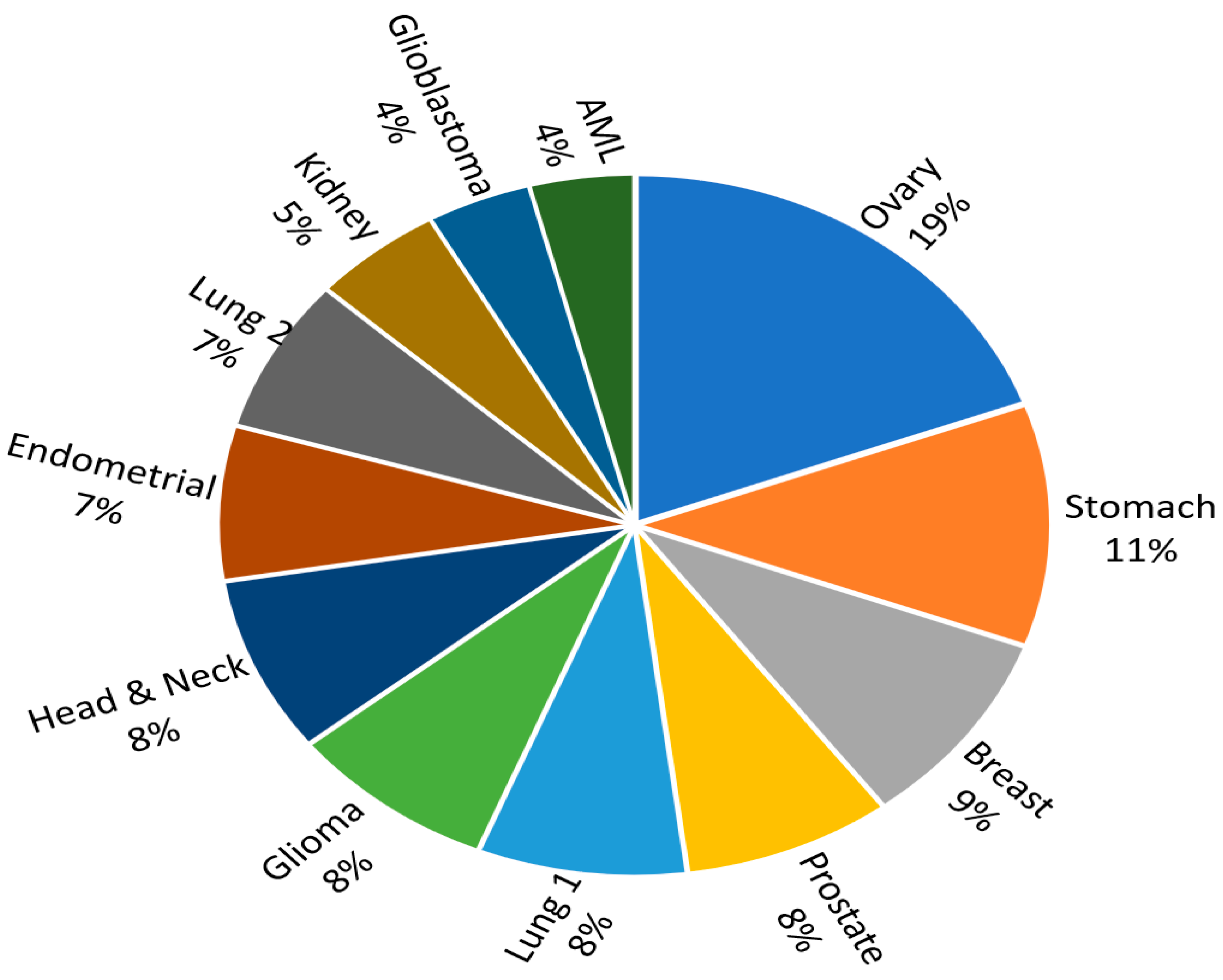

Genetic Basis of Familial Cancer Risk: A Narrative Review


Abstract
1. Introduction
2. Key Genes Involved in Familial Cancer
2.1. Tumor Suppressor Genes
2.1.1. BRCA1 and BRCA2
2.1.2. RB1
2.1.3. APC (Adenomatous Polyposis Coli)
2.1.4. DNA Mismatch Repair Genes
2.1.5. PTEN
2.1.6. TP53 (p53)
2.2. Oncogenes
2.2.1. HER2/Neu (ERBB2)
2.2.2. Ras
2.2.3. MYC
2.2.4. BCR-ABL
3. Epigenetic Inheritance in Familial Cancer
3.1. Mechanisms of Epigenetic Inheritance
3.2. DNA Methylation
3.3. Histone Modifications
3.4. Non-Coding RNAs
4. Inheritance Patterns
4.1. Autosomal Dominant
4.2. Autosomal Recessive
4.3. X-Linked Hereditary Cancer
4.4. Mitochondrial Inheritance (Maternal Inheritance)
5. General Recommendations for Cancer Genetic Testing in the Community
6. Concluding Remarks
Funding
Institutional Review Board Statement
Informed Consent Statement
Data Availability Statement
Acknowledgments
Conflicts of Interest
References
- Daly, M.B.; Pal, T.; Berry, M.P.; Buys, S.S.; Dickson, P.; Domchek, S.M.; Elkhanany, A.; Friedman, S.; Goggins, M.; Hutton, M.L.; et al. Genetic/Familial High-Risk Assessment: Breast, Ovarian, and Pancreatic, Version 2.2021. J. Natl. Compr. Cancer Netw. 2021, 19, 77–102. [Google Scholar] [CrossRef]
- Grant, R.C.; Selander, I.; Connor, A.A.; Selvarajah, S.; Borgida, A.; Briollais, L.; Petersen, G.M.; Lerner-Ellis, J.; Spring Holter, S.; Gallinger, S. Prevalence of Germline Mutations in Cancer Predisposition Genes in Patients With Pancreatic Cancer. Gastroenterology 2015, 148, 556–564. [Google Scholar] [CrossRef]
- Tung, N.; Lin, N.U.; Kidd, J.; Allen, B.A.; Singh, N.; Wenstrup, R.J.; Hartman, A.R.; Winer, E.P.; Garber, J.E. Frequency of Germline Mutations in 25 Cancer Susceptibility Genes in a Sequential Series of Patients With Breast Cancer. J. Clin. Oncol. 2016, 34, 1460–1468. [Google Scholar] [CrossRef]
- Pourmasoumi, P.; Ali Moradi, A.; Bayat, M. BRCA1/2 mutations and breast/ovarian cancer risk: A new insights review. Gynecol. Oncol. 2024, 31, 3624–3634. [Google Scholar] [CrossRef]
- Lakeman, I.M.M.; Broek, A.J.; Vos, J.A.M.; Barnes, D.R.B.; Adlard, J.; Andrulis, I.L.; Arason, A.; Arnold, N.; Arun, B.K.; Balmaña, J.; et al. The predictive ability of the 313 variant–based polygenic risk score for contralateral breast cancer risk prediction in women of European ancestry with a heterozygous BRCA1 or BRCA2 pathogenic variant. Genet. Med. 2021, 23, 1726–1737. [Google Scholar] [CrossRef] [PubMed]
- Li, H.; Engel, C.; Hoya, M.; Peterlongo, P.; Yannoukakos, D.; Livragh, L.; Radice, P.; Thomassen, M.; Hansen, T.V.O.; Gerdes, A.M.; et al. Risks of breast and ovarian cancer for women harboring pathogenic missense variants in BRCA1 and BRCA2 compared with those harboring protein truncating variants. Genet. Med. 2022, 24, 119–129. [Google Scholar] [CrossRef]
- Raghallaigh, O.N.; Eeles, R. Genetic predisposition to prastate cancer: An update. Fam. Cancer 2022, 21, 101–114. [Google Scholar] [CrossRef] [PubMed]
- Rajwa, P.; Quhal, F.; Pradere, B.; Gandaglia, G.; Ploussard, G.; Leapman, M.S.; Gore, J.L.; Paradysz, A.; Tilki, D.; Merseburger, A.S.; et al. Prostate cancer risk, screening and management in patients with germline BRCA1/2 mutations. Nat. Rev. Urol. 2023, 20, 205–216. [Google Scholar] [CrossRef]
- Yang, W.; Ding, P.-R. Update on Familial Adenomatous Polyposis-Associated Desmoid Tumors. Clin. Colon Rectal Surg. 2023, 36, 400–405. [Google Scholar] [CrossRef]
- Win, A.K.; Dowty, J.G.; Reece, J.C.; Lee, G.; Templeton, A.S.; Plazzer, J.-P.; Buchanan, D.D.; Akagi, K.; Seçil Aksoy, S.; Alonso, A.; et al. Variation in the Risk of Colorectal Cancer for Lynch Syndrome: A retrospective family cohort study. Lancet Oncol. 2021, 22, 1014–1022. [Google Scholar] [CrossRef] [PubMed]
- Stephanie ACohen, S.A.; Leininger, A. The genetic basis of Lynch syndrome and its implications for clinical practice and risk management. Appl. Clin. Genet. 2014, 7, 147–158. [Google Scholar] [CrossRef]
- Yang, X.; Karapetyan, L.; Huang, Z.; Knight, A.D.; Rajendran, S.; Sander, C.; Minnier, C.P.; Wilson, M.J.; Kirkwood, J.M. Multiple primary melanoma in association with other personal and familial cancers. Cancer Med. 2023, 12, 2474–2483. [Google Scholar] [CrossRef]
- Angelina, T.; Regua, A.T.; Najjar, M.; Lo, H.-W. RET signaling pathway and RET inhibitors in human cancer. Front. Oncol. 2022, 12, 932353. [Google Scholar] [CrossRef]
- Azzam, N.; Bar-Shalom, R.B.; Saab, A.; Fares, F. Germline Polymorphisms on RET Proto-oncogene involved in Medullary Thyroid Carcinoma in a Druze Family–A case study. Eur. J. Cancer 2017, 82, 149–152. [Google Scholar] [CrossRef]
- Mocci, E.; Milne, R.L.; Méndez-Villamil, E.Y.; Hopper, J.L.; John, E.M.; Andrulis, I.L.; Chung, W.K.; Daly, M.; Buys, S.S.; Malats, N.; et al. Risk of Pancreatic Cancer in Breast Cancer Families from the Breast Cancer Family Registry. Cancer Epidemiol. Biomark. Prev. 2013, 22, 803–811. [Google Scholar] [CrossRef]
- Vasen, H.F.A.; Canto, M.I.; Goggins, M. Twenty-five years of surveillance for familial and hereditary pancreatic ductal adenocarcinoma: Historical perspectives and introduction to the special issue. Fam. Cancer 2024, 23, 209–215. [Google Scholar] [CrossRef]
- Schubert, S.A.; Ruano, D.; Joruiz, S.M.; Stroosma, J.; Glavak, N.; Montali, A.; Pinto, L.M.; Rodríguez-Girondo, M.; Barge-Schaapveld, D.Q.C.M.; Maartje Nielsen, M.; et al. Germline variant affecting p53β isoforms predisposes to familial cancer. Nat. Commun. 2024, 15, 8208. [Google Scholar] [CrossRef] [PubMed]
- Palles, C.; Cazier, J.B.; Howarth, K.M.; Domingo, E.; AJones, A.M.; Broderick, P.; Kemp, Z.; Spain, S.L.; Estrella Guarino, E.; Israel Salguero, I.; et al. Germline mutations afecting the proofreading domains of POLE and POLD1 predispose to colorectal adenomas and carcinomas. Nat. Genet. 2013, 45, 136–144. [Google Scholar] [CrossRef] [PubMed]
- Zhu, L.-H.; Dong, J.; Li, W.-L.; Kou, Z.-Y.; Yang, J. Genotype–Phenotype Correlations in Autosomal Dominant and Recessive APC Mutation-Negative Colorectal Adenomatous Polyposis. Dig. Dis. Sci. 2023, 68, 2799–2810. [Google Scholar] [CrossRef] [PubMed]
- Renella, R.; Gagne, K.; Beauchamp, E.; Fogel, J.; Perlov, A.; Sola, M.; Schlaeger, T.; Hofmann, I.; Shimamura, A.; Ebert, B.L.; et al. Congenital X-linked Neutropenia with Myelodysplasia and Somatic Tetraploidy due to a Germline Mutation in SEPT6. Am. J. Hematol. 2023, 97, 18–29. [Google Scholar] [CrossRef]
- Imyanitov, E.N.; Kuligina, E.S.; Sokolenko, A.P.; Suspitsin, E.N.; Yanus, G.A.; Iyevleva, A.G.; Ivantsov, A.O.; Aleksakhina, S.N. Hereditary cancer syndromes. World J. Clin. Oncol. 2023, 14, 40–68. [Google Scholar] [CrossRef]
- Aryanti, C.; Uwuratuw, J.A.; Labeda, I.; Raharjo, W.; Lusikooy, R.E.; Rauf, M.A.; Mappincara, A.; Sampetoding, S.; Kusuma, M.I.; Syarifuddin, E. The Mutation Portraits of Oncogenes and Tumor Supressor Genes in Predicting the Overall Survival in Pancreatic Cancer: A Bayesian Network Meta-Analysis. Asian Pac. J. Cancer Prev. 2023, 24, 2895–2902. [Google Scholar] [CrossRef]
- D’Orazi, G. p53 Function and Dysfunction in Human Health and Diseases. Biomolecules 2023, 13, 506. [Google Scholar] [CrossRef] [PubMed]
- Ngeow, J.; Eng, C. PTEN in Hereditary and Sporadic Cancer. Cold Spring Harb. Perspect. Med. 2020, 10, a036087. [Google Scholar] [CrossRef] [PubMed]
- Hodgson, S.V.; Foulkes, W.D.; Maher, E.R.; ClareTurnbull, C. Inherited Susceptibility to Cancer: Past, Present and Future. Ann. Hum. Genet. 2025, 89, 354–365. [Google Scholar] [CrossRef]
- Kanai, Y. Molecular pathological approach to cancer epigenomics and its clinical application. Pathol. Int. 2024, 74, 167–186. [Google Scholar] [CrossRef] [PubMed]
- Gu, M.; Ren, B.; Fang, Y.; Ren, J.; Liu, X.; Wang, X.; Zhou, F.; Xiao, R.; Luo, X.; You, L.; et al. Epigenetic regulation in cancer. MedComm 2024, 5, e495. [Google Scholar] [CrossRef]
- Lu, C.; Xie, M.; Wendl, M.C.; Wang, J.; McLellan, M.D.; Leiserson, M.D.M.; Huang, K.-L.; Wyczalkowski, M.A.; Jayasinghe, R.; Banerjee, T.; et al. Patterns and functional implications of rare germline variants across 12 cancer types. Nat. Commun. 2015, 6, 10086. [Google Scholar] [CrossRef]
- Li, S.; Silvestri, V.; Leslie, G.; Rebbeck, T.R.; Neuhausen, S.L.; Hopper, J.L.; Nielsen, H.R.; Lee, A.; Yang, X.; McGuffog, L.; et al. Cancer Risks Associated With BRCA1 and BRCA2 Pathogenic Variants. J. Clin. Oncol. 2022, 40, 1529–1541. [Google Scholar] [CrossRef]
- Narod, S.A.; Foulkes, W.D. BRCA1 and BRCA2, 1994 and beyond. Nat. Rev. Cancer 2004, 4, 814–819. [Google Scholar] [CrossRef]
- Al-Shamsi, H.O.; Alwbari, A.; Azribi, F.; Calaud, F.; Thuruthel, S.; Tirmazy, S.H.H.; Kullab, S.; Ostomane, S.; Abulkhair, O. RCA testing and management of BRCA-mutated early-stage breast cancer: A comprehensive statement by expert group from GCC region. Front. Oncol. 2024, 14, 1358982. [Google Scholar] [CrossRef]
- Miki, Y.; Swensen, J.; Shattuck-Eidens, D.; Futreal, P.A.; Harshman, K.; Tavtigian, S.; Liu, Q. A Strong Candidate for the Breast and Ovarian Cancer Susceptibility Gene BRCA1. Science 1994, 266, 66–67. [Google Scholar] [CrossRef] [PubMed]
- Antoniou, A.; Pharoah, P.D.P.; Narod, S.; Risch, H.A.; Eyfjord, J.E.; Hopper, J.L.; Loman, N.; Olsson, H.; Johannsson, O.; Borg, A.; et al. Average risks of breast and ovarian cancer associated with BRCA1 or BRCA2 mutations detected in case series unselected for family history: A combined analysis of 22 studies. Am. J. Hum. Genet. 2003, 72, 1117–1130. [Google Scholar] [CrossRef] [PubMed]
- Kuchenbaecker, K.B.; Hopper, J.L.; Barnes, D.R.; Phillips, K.-A.; Mooij, T.M.; Roos-Blom, M.-J.; Jervis, S.; van Leeuwen, F.E.; Milne, R.L.; Andrieu, N.; et al. Risks of Breast, Ovarian, and Contralateral Breast Cancer for BRCA1 and BRCA2 Mutation Carriers. JAMA 2017, 317, 2402–2416. [Google Scholar] [CrossRef] [PubMed]
- Mavaddat, N.; Peock, S.; Frost, D.; Ellis, S.; Platte, R.; Fineberg, E.; Evans, D.G.; Izatt, L.; Eeles, R.A.; Adlard, J.; et al. Cancer Risks for BRCA1 and BRCA2 Mutation Carriers: Results From Prospective Analysis of EMBRACE. J. Nat. Cancer Inst. 2013, 105, 812–822. [Google Scholar] [CrossRef]
- Tai, Y.C.; Domchek, S.; Parmigiani, G.; Chen, S. Breast Cancer Risk Among Male BRCA1 and BRCA2 Mutation Carriers. J. Nat. Cancer Inst. 2007, 99, 1811–1814. [Google Scholar] [CrossRef]
- Mastrodomenico, L.; Piombino, C.; Riccò, B.; Barbieri, E.; Venturelli, M.; Federico Piacentini, F.; Dominici, M.; Cortesi, L.; Toss, A. Personalized Systemic Therapies in Hereditary Cancer Syndromes. Genes 2023, 14, 684. [Google Scholar] [CrossRef]
- Odemis, D.A.; Kebudi, R.; Bayramova, J.; Erciyas, S.K.; Turkcan, G.K.; Tuncer, S.B.; Erdogan, O.Z.; Celik, B.; Gultaslar, B.K.; Bay, S.B.; et al. RB1 gene mutations and genetic spectrum in retinoblastoma cases. Medicine 2023, 102, e35068. [Google Scholar] [CrossRef]
- Wang, T.; Fu, J.; Huang, Y.; Fu, C. Mechanism of APC truncation involved in colorectal cancer tumorigenesis (Review). Oncol. Lett. 2025, 29, 2. [Google Scholar] [CrossRef]
- Groden, J.; Thliveris, A.; Samowitz, W.; Carlson, M.; Gelbert, L.; Albertsen, H.; Joslyn, G.; Stevens, J.; Spirio, L.; Robertson, M.; et al. Identification and characterization of the familial adenomatous polyposis coli gene. Cell 1991, 66, 3589–3600. [Google Scholar] [CrossRef]
- Aelvoet, S.; Buttitta, F.; Ricciardiello, L.; Dekker, E. Management of familial adenomatous polyposis and MUTYH-associated polyposis; new insights. Best Pract. Res. Clin. Gastroenterol. 2022, 58–59, 101793. [Google Scholar] [CrossRef]
- Kayhanian, H.; Cross, W.; van der Horst, S.E.M.; Barmpoutis, P.; Lakatos, E.; Caravagna, G.; Zapata, L.; Hoeck, A.V.; Middelkamp, S.; Litchfield, K.; et al. Homopolymer switches mediate adaptive mutability in mismatch repair-deficient colorectal cancer. Nat. Genet. 2024, 56, 1420–1433. [Google Scholar] [CrossRef] [PubMed]
- Lindner, A.K.; Schachtner, G.; Tulchiner, G.; Thurnher, M.; Untergasser, G.; Obrist, P.; Pipp, I.; Steinkohl, F.; Horninger, W.; Culig, Z.; et al. Lynch Syndrome: Its Impact on Urothelial Carcinoma. Int. J. Mol. Sci. 2021, 22, 531. [Google Scholar] [CrossRef]
- Li, G.M. Mechanisms and functions of DNA mismatch repair. Cell Res. 2008, 18, 85–98. [Google Scholar] [CrossRef] [PubMed]
- Jiricny, J. The multifaceted mismatch-repair system. Nat. Rev. Mol. Cell Biol. 2006, 7, 335–346. [Google Scholar] [CrossRef]
- Campos, F.G.; Bustamante-Lopez, L.A.; D’Albuquerque, L.A.C.; Ribeiro Junior, U.; Herman, P.; Martinez, C.A.R. A review to honor the historical contribution of pauline gross, Aldred Warthin and Henry Lynch in the description and recognition of inheritance in colorectal cancer. Arq. Bras. Cir. Dig. 2024, 37, e1812. [Google Scholar] [CrossRef] [PubMed]
- Hollander, M.C.; Blumenthal, G.M.; Dennis, P.A. PTEN loss in the continuum of common cancers, rare syndromes and mouse models. Nat. Rev. Cancer 2011, 11, 289–301. [Google Scholar] [CrossRef]
- Liu, A.; Zhu, Y.; Chen, W.; Merlino, G.; Yu, Y. PTEN Dual Lipid- and Protein-Phosphatase Function in Tumor Progression. Cancers 2022, 14, 3666. [Google Scholar] [CrossRef]
- Zhang, P.; Kitchen-Smith, I.; Xiong, L.; Stracquadanio, G.; Brown, K.; Richter, P.H.; Wallace, M.D.; Bond, E.; Sahgal, N.; Moore, S.; et al. Germline and Somatic Genetic Variants in the p53 Pathway Interact to Affect Cancer Risk, Progression, and Drug Response. Cancer Res. 2021, 81, 1667–1680. [Google Scholar] [CrossRef]
- Liu, Y.; Su, Z.; Tavana, O.; Gu, W. Understanding the complexity of p53 in a new era of tumor suppression. Cancer Cell 2024, 42, 946–967. [Google Scholar] [CrossRef]
- Ghatak, D.; Ghosh, D.D.; Roychoudhury, S. Cancer Stemness: P53 at the Wheel. Front. Oncol. 2021, 10, 604124. [Google Scholar] [CrossRef]
- Mai, P.L.; Best, A.F.; Peters, J.A.; DeCastro, R.M.; Khincha, P.P.; Loud, J.T.; Bremer, R.C.; Rosenberg, P.S.; Savage, S.A. Risks of first and subsequent cancers among TP53 mutation carriers in the National Cancer Institute Li-Fraumeni syndrome cohort. Cancer 2026, 122, 3673–3681. [Google Scholar] [CrossRef]
- Baumont, A.C.; Cadore, N.A.; Pedrotti, L.G.; Curzel, G.D.; Schuch, J.B.; Bessel, M.; Bordignon, C.; Rosa, M.L.; Macedo, G.D.S.; Daniela Dornelles Rosa, D.D. Germline rare variants in HER2-positive breast cancer predisposition: A systematic review and meta-analysis. Front. Oncol. 2024, 14, 1395970. [Google Scholar] [CrossRef]
- Kang, S.; Kim, S.B. HER2-Low Breast Cancer: Now and in the Future. Cancer Res. Treat. 2024, 56, 700–720. [Google Scholar] [CrossRef]
- Mahar, F.; Haider, G.; Priyanka Zahoor, S. Correlation between grade of the tumour and HER2NEU status in breast cancer. Prof. Med. J. 2025, 32, 71–76. [Google Scholar] [CrossRef]
- Dunnett-Kane, V.; Burkitt-Wright, E.; Blackhall, F.H.; Malliri, A.; Evans, D.G.; Lindsay, C.R. Germline and sporadic cancers driven by the RAS pathway: Parallels and contrasts. Ann. Oncol. 2020, 31, 873–883. [Google Scholar] [CrossRef] [PubMed]
- Fernández-Medarde, A.F.; Rivas, J.D.L.; Santos, E. 40 Years of RAS—A Historic Overview. Genes 2021, 12, 681. [Google Scholar] [CrossRef]
- Chen, K.; Zhang, Y.; Qian, L.; Wang, P. Emerging strategies to target RAS signaling in human cancer therapy. J. Hematol. Oncol. 2021, 14, 116. [Google Scholar] [CrossRef] [PubMed]
- Jafry, M.; Sidbury, R. RASopathies. Clin. Dermatol. 2020, 38, 455–461. [Google Scholar] [CrossRef] [PubMed]
- Uniyal, P.; Kashyap, V.K.; Behl, T.; Parashar, D.; Rawat, R. KRAS Mutations in Cancer: Understanding Signaling Pathways to Immune Regulation and the Potential of Immunotherapy. Cancers 2025, 17, 785. [Google Scholar] [CrossRef]
- Freie, B.; Carroll, P.A.; Varnum-Finney, B.J.; Ramsey, E.L.; Ramani, V.; Bernstein, I.; Eisenman, R.N. A germline point mutation in the MYC-FBW7 phosphodegron initiates hematopoietic malignancies. Genes Dev. 2024, 38, 253–272. [Google Scholar] [CrossRef] [PubMed]
- Dang, C.V. MYC on the path to cancer. Cell 2012, 149, 22–35. [Google Scholar] [CrossRef] [PubMed]
- Mato, S.; Castrejón-de-Anta, N.; Colmenero, A.; Carità, L.; Salmerón-Villalobos, J.; Ramis-Zaldivar, J.E.; Nadeu, F.; Garcia, N.; Wang, L.; Verdú-Amorós, J.; et al. MYC-rearranged mature B-cell lymphomas in children and young adults are molecularly Burkitt Lymphoma. Blood Cancer J. 2024, 14, 171. [Google Scholar] [CrossRef]
- Hidaka, M.; Inokuchi, K.; Uoshima, N.; Takahashi, N.; Yoshida, N.; Ota, S.; Hirohisa Nakamae, H.; Hiromi Iwasaki, H.; Watanabe, K.; Kosaka, Y.; et al. Development and evaluation of a rapid one-step high sensitivity real-time quantitative PCR system for minor BCR-ABL (e1a2) test in Philadelphia-positive acute lymphoblastic leukemia (Ph+ ALL). Jpn. J. Clin. Oncol. 2024, 54, 153–159. [Google Scholar] [CrossRef]
- Soverini, S.; Hochhaus, A.; Nicolini, F.E.; Gruber, F.; Lange, T.; Saglio, G.; Pane, F.; Müller, M.C.; Ernst, T.; Rosti, G.; et al. BCR-ABL kinase domain mutation analysis in chronic myeloid leukemia patients treated with tyrosine kinase inhibitors: Recommendations from an expert panel on behalf of European LeukemiaNet. Blood 2011, 118, 1208–1215. [Google Scholar] [CrossRef]
- Nicolella, H.D.; de Assis, S. Epigenetic Inheritance: Intergenerational Effects of Pesticides and Other Endocrine Disruptors on Cancer Development. Int. J. Mol. Sci. 2022, 23, 4671. [Google Scholar] [CrossRef]
- Lønning, P.E.; Nikolaienko, O.; Pan, K.; Kurian, A.W.; Eikesdal, H.P.; Pettinger, M.; Anderson, G.L.; Prentice, R.L.; Chlebowski, R.T.; Knappskog, S. Constitutional BRCA1 Methylation and Risk of Incident Triple-Negative Breast Cancer and High-grade Serous Ovarian Cancer. JAMA Oncol. 2022, 8, 1579–1587. [Google Scholar] [CrossRef]
- Hitchins, M.P. Constitutional epimutation as a mechanism for cancer causality and heritability? Nat. Rev. Cancer 2015, 15, 625–634. [Google Scholar] [CrossRef]
- Koch, A.; Joosten, S.C.; Feng, Z.; de Ruijter, T.C.; Draht, M.X.; Melotte, V.; Smits, K.M.; Veeck, J.; Herman, J.G.; Van Neste, L.; et al. Analysis of DNA methylation in cancer: Location revisited. Nat. Rev. Clin. Oncol. 2018, 15, 459–466. [Google Scholar] [CrossRef] [PubMed]
- Costa, F.F. Epigenomics in cancer management. Cancer Manag. Res. 2010, 2, 255–265. [Google Scholar] [CrossRef]
- Sherif, Z.A.; Ogunwobi, O.O.; Ressom, H.W. Mechanisms and technologies in cancer epigenetics. Front. Oncol. 2024, 14, 1513654. [Google Scholar] [CrossRef] [PubMed]
- Helderman, N.C.; Andini, K.D.; Leerdam, M.E.V.; Hest, L.P.V.; Hoekman, D.R.; Ahadova, A.; Broeke, S.W.B.-T.; Bosse, T.; Logt, E.M.J.V.; Imhann, F.; et al. MLH1 Promotor Hypermethylation in Colorectal and Endometrial Carcinomas from Patients with Lynch Syndrome. J. Mol. Diagn. 2024, 26, 106–114. [Google Scholar] [CrossRef] [PubMed]
- Younesian, S.; Mohammadi, M.H.; Younesian, O.; Momeny, M.; Ghaffari, S.H.; Bashas, D. DNA methylation in human diseases. Heliyon 2024, 10, e32366. [Google Scholar] [CrossRef] [PubMed]
- Martisova, A.; Holcakova, J.; Izadi, N.; Sebuyoya, R.; Hrstka, R.; Martin Bartosik, M. DNA Methylation in Solid Tumors: Functions and Methods of Detection. Int. J. Mol. Sci. 2021, 228, 4247. [Google Scholar] [CrossRef]
- Voss, T.C.; Hager, G.L. Dynamic regulation of transcriptional states by chromatin and transcription factors. Nat. Rev. Genet 2014, 152, 69–81. [Google Scholar] [CrossRef]
- Chris, P.; Ponting, P.L.; Oliver, W.R. Evolution and Functions of Long Noncoding RNAs. Cell 2009, 136, 629–641. [Google Scholar] [CrossRef]
- Lauria, F.; Iacomino, G. The landscape of circulating miRNAs in the post-genomic era. Genes 2021, 13, 94. [Google Scholar] [CrossRef]
- Lin, S.; Gregory, R.I. MicroRNA biogenesis pathways in cancer. Nat. Rev. Cancer 2015, 15, 321–333. [Google Scholar] [CrossRef]
- Mattick, J.S.; Amaral, P.P.; Carninci, P.; Carpenter, S.; Chang, H.Y.; Chen, L.-L.; Chen, R.; Dean, C.; Dinger, M.E.; Fitzgerald, K.A.; et al. Long non-coding RNAs: Definitions, functions, challenges and recommendations. Nat. Rev. Mol. Cell Biol. 2023, 24, 430–447. [Google Scholar] [CrossRef]
- Gupta, R.A.; Shah, N.; Wang, K.C.; Kim, J.; Horlings, H.M.; Wong, D.J.; Tsai, M.C.; THung, T.; Argani, P.; Rinn, J.L.; et al. Long non-coding RNA HOTAIR reprograms chromatin state to promote cancer metastasis. Nature 2010, 464, 1071–1076. [Google Scholar] [CrossRef]
- Wang, X.; Li, H.; Lu, Y.; Cheng, L. Circular RNAs in human cancer. Front. Oncol. 2021, 10, 577118. [Google Scholar] [CrossRef]
- Hansen, T.B.; Jensen, T.I.; Clausen, B.H.; Bramsen, J.B.; Finsen, B.; Damgaard, C.K.; Kjems, J. Natural RNA circles function as efficient microRNA sponges. Nature 2013, 495, 384–388. [Google Scholar] [CrossRef]
- Liang, J.; Wen, J.; Huang, Z.; Chen, X.; Zhang, B.; Chu, L. Small Nucleolar RNAs: Insight Into Their Function in Cancer. Front. Oncol. 2019, 9, 587. [Google Scholar] [CrossRef]
- Hussen, B.M.; Hidayat, H.J.; Salihi, A.; Sabir, D.; Taheri, M.; Ghafouri-Fard, S. MicroRNA: A signature for cancer progression. Biomed. Pharmacother. 2021, 138, 111528. [Google Scholar] [CrossRef]
- Kabbage, M.; Ben Aissa-Haj, J.; Othman, H.; Jaballah-Gabteni, A.; Laarayedh, S.; Elouej, S.; Medhioub, M.; Kettiti, H.T.; Khsiba, A.; Mahmoudi, M.; et al. A Rare MSH2 Variant as a Candidate Marker for Lynch Syndrome II Screening in Tunisia: A Case of Diffuse Gastric Carcinoma. Genes 2022, 13, 1355. [Google Scholar] [CrossRef]
- Garutti, M.; Foffano, L.; Mazzeo, R.; Michelotti, A.; Da Ros, L.; Viel, A.; Miolo, G.; Zambelli, A.; Puglis, F. Hereditary Cancer Syndromes: A Comprehensive Review with a Visual Tool. Genes 2023, 14, 1025. [Google Scholar] [CrossRef] [PubMed]
- Jackson, L.; Weedon, M.N.; Harrison, J.W.; Wood, A.R.; Ruth, K.S.; Tyrrell, J.; Wright, C.F. Influence of family history on penetrance of hereditary cancers in a population setting. EClinicalMedicine 2023, 64, 102159. [Google Scholar] [CrossRef] [PubMed]
- Alter, B.P. Cancer in Fanconi anemia, 1927–2001. Cancer 2003, 97, 425–440. [Google Scholar] [CrossRef]
- Muralidharan, M.; Muthupandian, S.; Dejene, T.A. Bloom syndrome: An oral potentially malignant disorders aiding in malignancy vigour. Int. J. Surg. 2023, 109, 529–530. [Google Scholar] [CrossRef] [PubMed]
- Tsuge, K.; Shimamoto, A. Research on Werner Syndrome: Trends from Past to Present and Future Prospects. Genes 2022, 13, 1802. [Google Scholar] [CrossRef]
- Lee, J.-H.; Paull, T.T. Cellular Functions of the Protein Kinase ATM and Their Relevance to Human Disease. Nat. Rev. Mol. Cell Biol. 2021, 22, 796–814. [Google Scholar] [CrossRef]
- Sun, Y.; Song, X.; Pan, H.; Li, X.; Sun, L.; Song, L.; Fei Ma, F.; Junnan Hao, J. Wiskott-Aldrich syndrome: A new synonym mutation in the WAS gene. Intractable Rare Dis. Res. 2024, 13, 69–72. [Google Scholar] [CrossRef] [PubMed]
- Xue, K.; Zhang, A.; Yan, X.; Liu, S.; Chen, D. Primary central nervous system Burkitt lymphoma in a 38-year-old immunocompetent woman: A case report. Medicine 2025, 104, e42321. [Google Scholar] [CrossRef] [PubMed]
- Alston, C.L.; Stenton, S.L.; Hudson, G.; Prokisch, H.; Taylor, R.W. The genetics of mitochondrial disease: Dissecting mitochondrial pathology using multi-omic pipelines. J. Pathol. 2021, 254, 430–442. [Google Scholar] [CrossRef] [PubMed]
- Wallace, D.C. Mitochondria and cancer. Nat. Rev. Cancer 2012, 12, 685–698. [Google Scholar] [CrossRef]
- Martínez-Reyes, I.; Chandel, N.S. Cancer metabolism: Looking forward. Nat. Rev. Cancer 2021, 21, 669–680. [Google Scholar] [CrossRef]
- Kim, M.; Mahmood, M.; Reznik, E.; Gammage, P.A. Mitochondrial DNA is a major source of driver mutations in cancer. Trends Cancer 2022, 8, 1046–1059. [Google Scholar] [CrossRef]


| Syndrome | miRNA Role |
|---|---|
| DICER1 syndrome | Germline mutations in DICER1 → impaired miRNA processing tumours in lung, ovary, thyroid, etc. |
| Li-Fraumeni syndrome | miR-34 family is regulated by TP53; dysfunction may amplify cancer risk in TP53 mutation carriers. |
| HBOC (Hereditary Breast and Ovarian Cancer) | miR-182 and others regulate BRCA1 expression; dysregulation may affect DNA repair. |
| Familial colorectal cancer | miR-155 and others can target MMR genes (MLH1, MSH2), influencing Lynch syndrome pathogenesis. |
| Syndrome/Condition | Gene(s) Involved | Associated Cancers |
|---|---|---|
| Hereditary Breast and Ovarian Cancer | BRCA1, BRCA2 | Breast, ovarian, prostate, pancreatic |
| Lynch Syndrome (HNPCC) | MLH1, MSH2, MSH6, PMS2, EPCAM | Colorectal, endometrial, ovarian, gastric, urinary tract |
| Li-Fraumeni Syndrome | TP53 | Breast, brain, sarcomas, adrenal, leukemia |
| Familial Adenomatous Polyposis (FAP) | APC | Colorectal (almost 100% risk), small intestine, stomach |
| Cowden Syndrome | PTEN | Breast, thyroid (follicular), endometrial |
| Peutz-Jeghers Syndrome | STK11 (LKB1) | GI tract (colon, stomach, pancreas), breast, cervix, testes |
| Hereditary Retinoblastoma | RB1 | Retinoblastoma (eye), osteosarcoma |
| Von Hippel–Lindau Disease (VHL) | VHL | Kidney (RCC), pheochromocytoma, CNS hemangioblastomas |
| Multiple Endocrine Neoplasia type 1 (MEN1) | MEN1 | Parathyroid, pancreatic, pituitary tumours |
| Multiple Endocrine Neoplasia type 2 (MEN2) | RET | Medullary thyroid carcinoma, pheochromocytoma |
| Syndrome | Common Genes | Associated Cancers |
|---|---|---|
| Hereditary Breast & Ovarian Cancer (HBOC) | BRCA1, BRCA2 | Breast, ovarian, prostate, pancreas |
| Lynch Syndrome | MLH1, MSH2, MSH6, PMS2, EPCAM | Colorectal, endometrial, ovarian, gastric |
| Li-Fraumeni Syndrome | TP53 | Sarcomas, brain, breast, adrenal |
| Cowden Syndrome | PTEN | Breast, thyroid, endometrial |
| Familial Adenomatous Polyposis (FAP) | APC | Colorectal (hundreds of polyps) |
| MUTYH-Associated Polyposis | MUTYH | Colorectal polyps/cancer |
Disclaimer/Publisher’s Note: The statements, opinions and data contained in all publications are solely those of the individual author(s) and contributor(s) and not of MDPI and/or the editor(s). MDPI and/or the editor(s) disclaim responsibility for any injury to people or property resulting from any ideas, methods, instructions or products referred to in the content. |
© 2026 by the author. Licensee MDPI, Basel, Switzerland. This article is an open access article distributed under the terms and conditions of the Creative Commons Attribution (CC BY) license.
Share and Cite
Fares Sabik, E. Genetic Basis of Familial Cancer Risk: A Narrative Review. DNA 2026, 6, 5. https://doi.org/10.3390/dna6010005
Fares Sabik E. Genetic Basis of Familial Cancer Risk: A Narrative Review. DNA. 2026; 6(1):5. https://doi.org/10.3390/dna6010005
Chicago/Turabian StyleFares Sabik, Eman. 2026. "Genetic Basis of Familial Cancer Risk: A Narrative Review" DNA 6, no. 1: 5. https://doi.org/10.3390/dna6010005
APA StyleFares Sabik, E. (2026). Genetic Basis of Familial Cancer Risk: A Narrative Review. DNA, 6(1), 5. https://doi.org/10.3390/dna6010005