Article

The Effect of Fatty Acid-Binding Protein 3 Exposure on Endothelial Transcriptomics

1
Department of Medical Biophysics, Schulich School of Medicine and Dentistry, University of Western Ontario, 1151 Richmond St. N., London, ON N6A 5C1, Canada
2
Department of Anatomy and Cell Biology, Schulich School of Medicine and Dentistry, University of Western Ontario, 1151 Richmond St. N., London, ON N6A 5C1, Canada
3
Department of Pathology and Laboratory Medicine, Schulich School of Medicine and Dentistry, University of Western Ontario, 1151 Richmond St. N., London, ON N6A 5C1, Canada
4
Department of Epidemiology and Biostatistics, Schulich School of Medicine and Dentistry, University of Western Ontario, 1151 Richmond St. N., London, ON N6A 5C1, Canada
5
Institute of Medical Science, University of Toronto, Toronto, ON M5S 1A1, Canada
*
Author to whom correspondence should be addressed.
Submission received: 7 August 2025 / Revised: 17 September 2025 / Accepted: 21 November 2025 / Published: 8 January 2026

Abstract

Background: Fatty acid-binding protein 3 (FABP3) is released in circulation following myocardial infarction, and an increased level of circulatory FABP3 has also been reported in peripheral artery disease patients, exposing endothelial cells to higher levels of FABP3. Recently, loss of endothelial FABP3 was shown to protect endothelial cells against inflammation-induced endothelial dysfunction; however, the effect of FABP3 exposure on endothelial cells is unknown. Accordingly, to study the effect of FABP3 exposure on endothelial cells, we performed transcriptomic profiling following recombinant human FABP3 (rhFABP3) treatment of endothelial cells. Methods: Cultured human endothelial cells were treated with either a vehicle or rhFABP3 (50 ng/mL, 6 h); then, RNA sequencing was performed. Gene expression analysis followed by gene ontology (GO) and Kyoto Encyclopedia of Genes and Genomes (KEGG) pathway analyses was performed to identify differentially expressed genes and affected cellular functions and pathways. Results: Differential gene expression analysis revealed kinesin family member 26b (KIF26B) to be the most upregulated and survival of motor neuron 2 (SMN2) to be the most downregulated genes in rhFABP3-treated compared to vehicle-treated endothelial cells. Most of the differentially expressed genes were associated with endothelial cell motility, immune response, and angiogenesis. GO and KEGG analyses indicated that rhFABP3 exposure impacts several crucial pathways, predominantly “Regulation of leukocyte mediated cytotoxicity” and “Natural killer cell mediated cytotoxicity”, suggesting its involvement in endothelial cell physiology and response mechanisms to cardiovascular stress. Conclusions: This is the first study to evaluate rhFABP3-induced transcriptomics in human endothelial cells. Our data reveal novel genes and pathways affected by the exposure of endothelial cells to FABP3. Further research is necessary to validate these findings and fully understand FABP3’s role in endothelial biology and in cardiovascular diseases like myocardial infarction and peripheral artery disease.

1. Introduction

Lipid-related physiology linked to cardiovascular impacts crucially depends upon the bioavailability of cellular lipids, which is implied by the role of metabolic syndrome in cardiovascular diseases (CVDs) [1,2,3]. Central to the regulation of cellular lipid bioavailability and signaling is a family of intracellular lipid chaperones, the fatty acid-binding proteins (FABPs). Heart-type FABP, or FABP3, mainly known to be expressed in myocardiocytes, is integral to cardiac metabolic homeostasis [1,2,4,5] FABP3 can also be found in many other tissues, notably skeletal muscles and, to a lesser extent, the brain, testes, kidneys, adrenal glands, and other organs [6]. Indeed, the unique function of FABP3 remains complex and unclear [7].
Nonetheless, FABP3 is currently being investigated as a potential biomarker for cardiac injuries, having been characterized in both animal models and heart failure patients due to negligible plasma concentration and a significantly high cytosolic to plasma ratio at rest; and blood elevation detectable within 30 min of chest pain, peak in a few hours, and returning to baseline via renal clearance, all within 24 h [8,9,10]. Peripheral artery disease (PAD) and heart failure are cardiovascular complications of atherosclerosis, a chronic vascular inflammatory disorder characterized by circulatory blockage due to the build-up of lipid-laden plaques in the vascular inner walls, leading to downstream ischemia, hypoxia, and organ failures [11]. Atherosclerosis is the primary cause of CVDs and is driven by endothelial dysfunction [12,13]. Interestingly, a consistently higher level of circulatory FABP3 was reported in PAD patients without any signs of cardiac injury, and FABP3 levels correlated with the severity of PAD [14,15,16]. Notably, a significant upregulation of FABP3 in skeletal muscle cells has been reported in PAD patients compared to healthy individuals. Recently, we reported basal and inflammation-induced expression of FABP3 in endothelial cells; we also demonstrated that endothelial cell-specific loss of FABP3 protects endothelial cells against inflammation-induced endothelial dysfunction and apoptosis [17]. Overall, these findings suggest that FABP3 releases are not exclusive to cardiac injury and may signal earlier cardiovascular events.
A single layer of endothelial cells comprises the inner luminal walls of virtually all blood vessels. Endothelial cells are versatile, in direct contact with blood, and establish a delicate semi-permeable blood/tissue barrier known to extensively regulate selective exchanges and vascular homeostasis at varying capacities across organ systems. They oversee the production of signaling agents that maintain or mediate vasotone (vasodilation vs. vasoconstriction), vessel compliance, barrier/exchange permeability, blood fluidity, inflammation, wound healing, angiogenesis, and thrombosis [18]. In CVD pathogenesis, endothelial cells are often impaired by various stresses, and stressed endothelial cells are activated into a hyper-functional state to alleviate the source of stress. Prolonged endothelial activation causes endothelial dysfunction, featuring a leaky and oxidative barrier that exacerbates injuries and propagates the damaging agents, a hyper-inflammatory environment leading to chronic inflammation, dysregulated metabolism, diminished vasotone, and impaired vascular homeostasis [19].
Given the remarkable capacity of FABP3 as a biomarker, albeit not specific to cardiac injury, and that endothelial cells are one of the first cell types to be exposed to elevated levels of circulatory FABP3 in conditions such as heart failure and PAD, the impacts of circulatory FABP3 on endothelial cells and endothelial function are yet to be elucidated. As endothelial dysfunction is central in atherosclerosis and CVD, the mechanisms by which FABP3 influences endothelial function warrant an investigation. This study explores the transcriptomic profiles of endothelial cells subjected to FABP3 exposure under the hypothesis that circulatory FABP3 regulates endothelial function. We aim to pursue insights into the link between FABP3 and endothelial dysfunction, potentiating the development of novel clinical applications of FABP3 in the cardiovascular field.

2. Materials and Methods

Cell Culture and Treatment

Human umbilical vein endothelial cells (HUVECs, pooled, passage 4; Lonza, Walkersville, MD, USA) were cultured in endothelial cell growth medium-2 (EGM-2 Bulletkit; Lonza, Walkersville, MD, USA) supplemented with growth factors, serum, and antibiotics at 37 °C in humidified 5% CO2. Confluent HUVECs were maintained in six-well plates and starved overnight before being treated with either a vehicle (PBS) or rhFABP3 (50 ng/mL; Cayman Chemical, Ann Arbor, MI, USA) for 6 h.
RNA Sequencing (RNA-seq) and Analysis: Total RNA was extracted from HUVECs using TRIzol (Invitrogen, Carlsbad, CA, USA) reagent. RNA quantification and purity were assessed with the NanoDrop ND-1000 spectrophotometer (NanoDrop, Wilmington, DE, USA), in accordance with the manufacturer’s instructions. RNA sequencing was performed at The Centre for Applied Genomics, The Hospital for Sick Children, Toronto, Canada. Sequencing was conducted on the Illumina HiSeq 2500 platform, using the NEBNext Ultra II Directional RNA Library Prep Kit for Illumina (E7760; New England Biolabs, Ipswich, MA, USA) and bcl2fastq2 v2.20 for paired-end reads (125 base pairs). Reads were generated in FASTQ format and, on the Compute Canada platform, were subjected to (1) trimming of low-quality reads using Trimmomatic based on the adapter sequences TruSeq3-PE [20], (2) quality assessment using FASTQC (version v0.12.1) and (3) Kallisto transcriptome pseudoalignment using the GRCh38 (Genome Reference Consortium human genome build 38) indices [21,22,23]. Low-quality counts in RNA sequencing data are identified and filtered out during the preprocessing steps to ensure data accuracy before differential expression analysis. Raw reads are subjected to Trimmomatic to trim low-quality sections, such as the adapter sequences TruSeq3-PE. Reads with a high proportion of ambiguous bases and those trimmed to a length below thresholds are considered low quality and are discarded. The quality of the trimmed reads is also assessed using FASTQC (version v0.12.1), which generates reports on base quality, GC content, and the presence of sequencing artifacts. Differential gene expression analysis was conducted using edgeR on R version 4.3.1 [24,25]. p-values were generated using edgeR’s model for discrete count data that includes dispersion estimation, and the Benjamini–Hochberg method was applied for false discovery rate (FDR) adjustment.
Pathway Analysis: Gene ontology (GO) and Kyoto Encyclopedia of Genes and Genomes (KEGG) pathway analyses were performed using the goana and kegga functions in the limma package; for both types of analysis, all genes that passed quality control were used as the universe/background [26]. To enable a broader assessment of biological mechanisms, given a relatively low number of differentially expressed genes following FDR correction, genes with raw p-values < 0.05 and log (2) fold change of less than or greater than −1 or 1 from edgeR were considered for GO and KEGG analysis, acknowledging the trade-off of potentially increasing the rate of type-1 errors [27,28].
RT-qPCR Analysis and Statistical Evaluation: HUVECs were cultured, and following 6 h of rhFABP3 or vehicle treatment, total RNA was reverse-transcribed into complementary DNA (cDNA) using the QuantiTect Reverse Transcription Kit (Qiagen, Hilden, Germany), following the manufacturer’s protocol. Quantitative PCR (qPCR) was carried out on the ABI ViiA 7 Real-Time PCR System (Applied Biosystems) using Power SYBR™ Green PCR Master Mix (Applied Biosystems, Foster City, CA, USA). Gene-specific primers were designed for human genes KIF26B (forward, 5′-GCTGGGAATAAAGAGAGGCTTG-3′; reverse, 5′-ACTCCTCGTATGCTTTCCGGT-3′) NCR1 (forward, 5′-TGGACCCGAAGTGATCTCG-3′; reverse, 5′-TCCTTGAGCAGTAAGAACATGC-3′), DNAJC14 (forward, 5′-CGCAGCTATGATGACCAGCTC-3′; reverse, 5′-GCCTCACGCTGTGAAACTG-3′) and SMN2 (forward, 5′-CCTGTGTTGTGGTTTACACTGG-3′; reverse, 5′-GGGGGAATTATCTTTCCTGGTCC-3′) (Sigma, St. Louis, MO, USA). GAPDH was used as a housekeeping gene [17]. Each qPCR reaction was performed in triplicate using three replicates (n = 3). Relative gene expression levels were calculated using the comparative ΔΔCt method. Statistical analysis of qPCR data was performed using Student’s t-test to assess differences between groups, with p-values < 0.05 considered statistically significant.

3. Results

RNA Quality Assessment: RNA integrity, quantity, and purity were assessed with the NanoDrop ND-1000. The A260/A280 optical density (OD) ratios yielded values of about 2.0, which confirmed the purity of our RNAs (Table S1). The intensity of the 28S ribosomal RNA was about twice (indicated by % of total area) that of the 18S ribosomal RNA, confirming the integrity of the RNA (Figures S1 and S2) used in this study. These results indicate that the RNA used to perform RNA-seq was pure and not degraded.
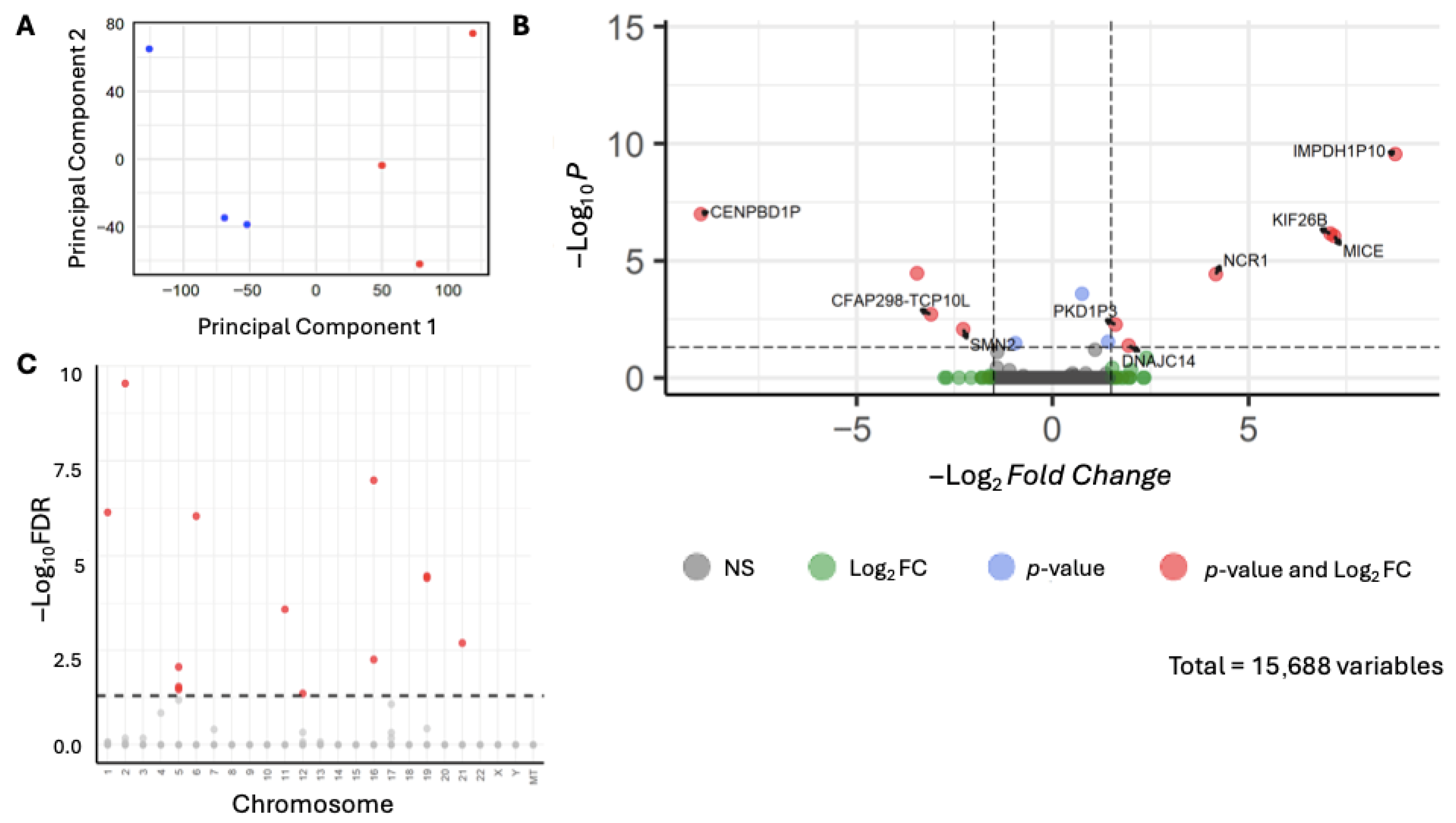
Differential Gene Expression Induced by rhFABP3 in Endothelial Cells: The impact of rhFABP3 exposure on HUVECs’ gene expression was examined using RNA-seq. The genome-wide differential gene expression (DGE) of 15,688 genes in rhFABP3-treated HUVECs vs. vehicle control cells was assessed following the removal of low-quality counts. Principal component analysis (PCA) on the first and second principal components, capturing 58.71% and 20.7% variance, respectively, showed distinct sample clustering between the rhFABP3-treated and vehicle-treated groups in PC1, suggesting changes in global gene expression profiles in HUVECs due to rhFABP3 exposure (Figure 1A). The DGE analysis results visualized using Volcano and Manhattan plots identified 11 genes with significant differential expression that satisfy a log (2) fold change threshold of 1 and −1 (equivalent to one doubling of gene expression up- or downward) in the rhFABP3-treated group vs. vehicle controls; genes with FDR-adjusted p-values < 0.05 are considered significantly differentially expressed, and of these genes, 7 were upregulated and 4 were downregulated (Figure 1B,C, Table 1). Accordingly, differentially expressed genes are distributed between chromosomes 1, 2, 5, 6, 12, 16, 19, and 21, and the IMPDH1P10-processed pseudogene is the most upregulated (log (2) fold change of 8.75), followed by the protein-coding genes KIF26B (7.10), NCR1 (4.17), and DNAJC14 (1.95). The CENPBD1P pseudogene is the most downregulated (log (2) fold change of −8.98), followed by the protein-coding genes ENSG00000269242 (−3.45), CFAP298-TCP10L (−3.10), and SMN2 (−2.28). Validation with qPCR confirmed a 3.1-fold and 1.39-fold increase in NCR1 (p < 0.01) and DNAJC14 (p < 0.05) and 2.7-fold decrease in SMN2 expression (p < 0.001) in rhFABP3-treated cells compared to vehicle-treated controls.
Functional Enrichment Analysis of rhFABP3-Induced Gene Expression: GO and KEGG pathway analyses were conducted to assess the biological significance of the observed differential gene expression in rhFABP3-treated HUVECs. Due to the low number of significant genes meeting our FDR/fold change filter, we performed GO/KEGG analysis with 80 genes (38 upregulated and 42 downregulated) selected using the unadjusted edgeR p-values < 0.05 and log (2) fold change of less than or greater than −1 or 1, respectively, against a total of 15,688 tested genes. The analyses revealed several cellular functions and pathways potentially impacted by rhFABP3 exposure, suggesting a multifaceted role of FABP3 in endothelial cell physiology (Table 2 and Table 3). The GO and KEGG results are predominantly related to immune response and cell cytotoxicity biological processes for the upregulated differentially expressed genes, with the most significant being “Regulation of leukocyte mediated cytotoxicity” and “Natural killer cell mediated cytotoxicity”, respectively. On the other hand, the downregulated DE genes are associated with GO and KEGG terms of complex regulatory implication, including “RNA processing and inflammatory and immune systems mechanisms, with the SMN complex (cellular component)” and “NOD-like receptor signaling” pathway being the most significant. Further, a broader assessment of gene expression patterns is illustrated on a heatmap generated from 231 protein-coding genes with edgeR-derived unadjusted p-values < 0.05, showing distinct clusters of differential expression patterns in rhFABP3-treated HUVECs (Table S2, Figure S3). These findings illustrate the specific gene expression signatures associated with FABP3 exposure and underscore the potential functional impacts on endothelial cells.

4. Discussion

Our RNA-seq DGE analyses identified several significantly impacted genes in rhFABP3-treated HUVECs, which underline the complex nature of endothelial cells’ response to circulatory FABP3. Of the upregulated genes, KIF26B is an oncogene that has been studied in breast, gastric, colorectal, and hepatocellular cancers; its upregulation correlates with risk of metastases, stage progression, and poor prognosis, suggesting capacities as a biomarker [29]. KIF26B is regulated by miR-372 [30] and is essential in developmental processes, being implicated in the adhesion and polarization of mesenchymal cells [31]. In cancer, KIF26B is involved in the VEGF signaling pathway, which prompts angiogenesis [32]. The upregulation of KIF26B in rhFABP3-treated endothelial cells suggests induced mobilization of cellular motility and possibly angiogenesis, suggesting a regulatory metabolic impact of FABP3 exposure on endothelial cells. It is also important to note that FABP3 is released in circulation mainly during ischemic/hypoxic stress [2] and increased angiogenesis may be a compensatory response of endothelial cells. In our validation qPCR, KIF26B exhibited extremely low expression levels in control (vehicle-treated) endothelial cells but was markedly upregulated in rhFABP3-treated cells. However, due to the very low baseline expression of KIF26B in control endothelial cells, we were unable to obtain consistent and reproducible Ct values. Therefore, these data were not included. It is important to note that in comparison to qPCR, RNA sequencing often detects a wider range of gene expression changes and can sometimes show larger fold changes due to its high sensitivity and broad dynamic range, which can capture more subtle expression changes across different transcript isoforms. The upregulated NCR1 gene encodes an activating receptor on natural killer cells, which imposes innate cytotoxicity and surveillance against bacteria, virally infected cells, and tumor cells [33]. NCR1 is known to mediate the pathogenesis of cancer, autoimmune disorders, and infectious diseases, being a target for immunomodulation and immunotherapy [33]. Regulatory factors of NCR1 include cytokines, transcription factors, microRNAs, and post-translational modifications [34,35,36,37] While the gene’s expression is a main feature of natural killer cells, NCR1 has been found in other cell types, such as T cells [38]. Endothelial NCR1 is poorly understood, and our detection of NCR1’s expression in endothelial cells suggests a novel regulatory link between the innate immune system and the endothelium. In particular, NCR1 upregulation in HUVECs indicates stimulation of the innate immune system by FABP3 exposure. Next, the upregulated DNAJC14 gene encodes a member of the DNAJ family of intracellular heat-shock chaperone proteins, which are engaged in the cellular stress response and protein quality controls [39]. In particular, they interact with the Hsp70 chaperone proteins via the distinguishing J-domain and assist Hsp70 in refolding misfolded proteins [40]. While the specific roles of DNAJC14 remain under investigation, aberrant expression of DNAJC14 has been implicated in multiple diseases, including viral infections and neurodegenerative diseases, particularly in the context of misfolded proteins [41,42]. The upregulation of DNAJC14 in endothelial cells under FABP3 exposure indicates stress response mechanisms, reinforcing the metabolic impact of circulatory FABP3 on the endothelium. Among the downregulated genes, SMN2, canonically crucial in motor neuron functions and spinal muscular atrophy, encodes a more truncated and less functional protein than the full-length version expressed by SMN1 [43]. Validation with qPCR confirmed SMN2 downregulation in rhFABP3-treated compared to control endothelial cells. SMN proteins mediate the assembly of small nuclear ribonucleoproteins of spliceosomes, thereby regulating RNA splicing, post-transcriptional processing, and non-coding RNAs [44]. SMN2 downregulation in rhFABP3-treated endothelial cells indicates a negative modulation of RNAs in the endothelium, suggesting a regulatory effect on transcript levels. The rest of the identified DE genes are less well characterized. CCDC125 encodes a protein that is not well characterized and may be involved in cellular motility according to its Uniprot profile. The human genome GRCh37 ensembl profile of CFAP298-TCP10L (ENSG00000265590) indicates that it is a protein-coding readthrough transcription between the neighboring chromosome 21 open reading frame 59 and TCP10L (t-complex 10 like) that has not been investigated for any functions. Glycosyl Hydrolases Family 38 C-Terminal Beta Sandwich Domain-Containing Protein (ENSG00000269242) is a novel transcript with gene ontology annotations related to carbohydrate binding and mannosidase activities, according to its gene card profile. IMPDH1P10, ENSG00000251581, PKD1P3, and CENPBD1P are pseudogenes that remain functionally elusive. Overall, although some DE genes suggest a metabolic and immunity-based response in rhFABP3-treated endothelial cells, a notable amount are pseudogenes, and more than half are currently not characterized. Future validation, such as via qPCR, and characterization of the identified DE genes are necessary to establish more robust mechanistic implications. Together, these transcriptional changes indicate that extracellular FABP3 acts as a signaling mediator that influences endothelial gene expression by inducing inflammatory, metabolic, angiogenic, and stress response pathways, thereby modulating endothelial function and potentially contributing to vascular pathophysiology.
A total of 11 significantly differentially expressed genes were identified from our RNA-seq and differential gene analyses (a total of 15,688 genes tested) that meet a log (2) fold change of 1.0 cutoff. This presents an ostensive limitation which may be explained by the small sample size of this study and the stringent cutoffs employed. The limitation may be attributed to our low dose of FABP3 (50 ng/mL for 6 h). In a study that evaluated 2287 patients with acute coronary syndromes, 332 patients (14.5%) were found with elevated circulatory H-FABP levels (>8 ng/mL). This elevation was associated with an increased risk of death and major cardiac events through a 10-month follow-up period, including recurrent myocardial infarction and congestive heart failure. From the elevated H-FABP cohort, the median level of H-FABP3 in circulation was 16 ng/mL, ranging from 8 to 434 ng/mL [45]. In our previous PAD patients’ study that identified a robust positive correlation between the severity of PAD and blood FABP3 levels, severe PAD patients (ABI < 0.4) exhibited up to an average of 7.22 ng/mL of blood FABP3 [14]. Therefore, our 50 ng/mL of FABP3 is informed by existing clinical data, fitting within these variable ranges of circulatory FABP3 reported in human patients. However, from our study on the loss of FABP3 in endothelial dysfunction, 200 ng/mL of rhFABP3, but not 50 ng/mL, was found to exacerbate ICAM1 and VCAM1 upregulation in HUVECs stressed by LPS for 6 h [17]. This not only suggests a negative inflammatory role of FABP3 exposure but also indicates that our current FABP3 dose may fall short in inducing a pronounced gene expression response, overall implying that a different dose should be considered within the provided clinical ranges for future investigation. The 6 h exposure duration is used in RNA expression studies because it effectively captures early transcriptional responses to treatment while minimizing secondary effects or cell toxicity. This timepoint balances the need to observe meaningful gene expression changes without the confounding effects that may arise from longer exposures. Importantly, in our previous study, a 6 h treatment was sufficient to reveal significant differences in transcriptional profiles, supporting the appropriateness of this exposure duration for detecting gene expression changes in endothelial cells [17]. Nevertheless, our suggestive previous findings substantiated the current attempt to analyze the total RNAs from rhFABP3-treated endothelial cells using RNA-seq. Hence, the transcriptomic analysis was conducted at our selected dosing regimen to clarify how endothelial cells are affected by FABP3 exposure. It is important to note that FABP3 may directly interact with endothelial cells through receptor-mediated uptake, whereby binding to specific surface receptors facilitates its internalization. Once internalized, FABP3 can participate in intracellular lipid transport and signaling, thereby influencing endothelial metabolism and function. Moreover, FABP3 may modulate oxidative stress and inflammatory pathways, further impacting endothelial cell homeostasis. Collectively, these observations suggest that FABP3 has both extracellular signaling and intracellular regulatory roles in endothelial biology. We used human umbilical vein endothelial cells in this study, which is the most characterized and an established model to study endothelial biology in vitro [17]. However, it is important to note that endothelial cells are differentiated differently depending on their location [46,47] and, accordingly, future studies should be performed in endothelial cells of aortic, micro- and macro-vasculature origin. Another limitation of this study is the small RNA-seq sample size (n = 3 per group), which reduces the statistical power to detect subtle but biologically meaningful changes in gene expression and limits the identification of significantly enriched pathways. While the current findings provide preliminary insights into rhFABP3-induced transcriptional alterations in endothelial cells, increasing the sample size in future studies is strongly recommended to improve the robustness, reproducibility, and generalizability of the results.

5. Conclusions

In conclusion, the endothelial genome-wide alterations in response to FABP3 exposure were delineated. Differential gene analyses highlighted several genes associated with endothelial cells’ metabolic and immune-related stress response elicited by FABP3 treatment, suggesting that FABP3 releases during cardiovascular events impact endothelial function. While the roles of less-characterized genes remain to be elucidated, we provide a transcriptomic profile for future research into FABP3’s impact on endothelial biology. Our analysis’s sensitivity and specificity underscore the need for validation in larger sample sizes and with additional experimental treatments. Given that endothelial cells form the first interaction with circulatory FABP3 and FABP3 has recently been shown to induce inflammation and dysfunction in endothelial cells in patients [48], future studies should expand on these findings, exploring the therapeutic and diagnostic applications of FABP3 within the vascular system.

Supplementary Materials

The following supporting information can be downloaded at: https://www.mdpi.com/article/10.3390/dna6010004/s1, Figure S1: Confirmation of RNA quantity and purity for the control-treatment samples (Con1, Con2, and Con3); Figure S2: Confirmation of RNA quantity and purity for the FABP3-treated samples (Fab1, Fab2, and Fab3); Figure S3: Gene expression heatmap showing clusters of samples from HUVECs treated with rhFABP3 (50ng/mL) for 6 h vs. Vehicle groups. Table S1: RNA quantity and purity were assessed with the NanoDrop ND-1000; Table S2: Gene expression analysis showing a total of 231 protein-coding genes differentially expressed in HUVECs treated with rhFABP3 (50ng/mL) for 6 h vs. Vehicle groups. N = 3. HUVEC = Human Umbilical Vein Endothelial Cells; rhFABP3 = recombinant human FABP3, FDR = fold regulation.

Author Contributions

Conceptualization, K.K.S. and M.Q.; performing of the experiments, H.C.N. and A.S.; data analysis, H.C.N. and C.A.C.; resources, K.K.S.; writing—original draft, H.C.N. and K.K.S.; writing—review and editing, H.C.N., A.S., C.A.C., and K.K.S.; supervision, K.K.S.; and funding acquisition, K.K.S. All authors have read and agreed to the published version of the manuscript.

Funding

This research was funded by the Heart and Stroke Foundation of Canada, grant number G-22-0032104.

Institutional Review Board Statement

Not applicable.

Informed Consent Statement

Not applicable.

Data Availability Statement

Data are available upon request to the corresponding author.

Conflicts of Interest

The authors declare no conflicts of interest.

References

  1. Nguyen, H.C.; Qadura, M.; Singh, K.K. Role of the Fatty Acid Binding Proteins in Cardiovascular Diseases: A Systematic Review. J. Clin. Med. 2020, 9, 3390. [Google Scholar] [CrossRef]
  2. Li, B.; Syed, M.H.; Khan, H.; Singh, K.K.; Qadura, M. The Role of Fatty Acid Binding Protein 3 in Cardiovascular Diseases. Biomedicines 2022, 10, 2283. [Google Scholar] [CrossRef] [PubMed]
  3. Denisenko, Y.K.; Kytikova, O.Y.; Novgorodtseva, T.P.; Antonyuk, M.V.; Gvozdenko, T.A.; Kantur, T.A. Lipid-Induced Mechanisms of Metabolic Syndrome. J. Obes. 2020, 2020, 5762395. [Google Scholar] [CrossRef]
  4. Karbek, B.; Özbek, M.; Bozkurt, N.C.; Ginis, Z.; Güngünes, A.; Ünsal, I.Ö.; Cakal, E.; Delibası, T. Heart-type fatty acid binding protein (H-FABP): Relationship with arterial intima-media thickness and role as diagnostic marker for atherosclerosis in patients with ımpaired glucose metabolism. Cardiovasc. Diabetol. 2011, 10, 37. [Google Scholar] [CrossRef] [PubMed]
  5. Binas, B.; Danneberg, H.; Mcwhir, J.; Mullins, L.; Clark, A.J. Requirement for the heart-type fatty acid binding protein in cardiac fatty acid utilization. FASEB J. 1999, 13, 805–812. [Google Scholar] [CrossRef] [PubMed]
  6. Chmurzyńska, A. The multigene family of fatty acid-binding proteins (FABPs): Function, structure and polymorphism. J. Appl. Genet. 2006, 47, 39–48. [Google Scholar] [CrossRef]
  7. Zhuang, L.; Li, C.; Chen, Q.; Jin, Q.; Wu, L.; Lu, L.; Yan, X.; Chen, K. Fatty acid-binding protein 3 contributes to ischemic heart injury by regulating cardiac myocyte apoptosis and MAPK pathways. Am. J. Physiol.-Heart Circ. Physiol. 2019, 316, H971–H984. [Google Scholar] [CrossRef]
  8. Glatz, J.F.; Kleine, A.H.; van Nieuwenhoven, F.A.; Hermens, W.T.; van Dieijen-Visser, M.P.; van der Vusse, G.J. Fatty-acid-binding protein as a plasma marker for the estimation of myocardial infarct size in humans. Br. Heart J. 1994, 71, 135–140. [Google Scholar] [CrossRef]
  9. Knowlton, A. Leakage of heart fatty acid binding protein with ischemia and reperfusion in the rat. J. Mol. Cell. Cardiol. 1989, 21, 577–583. [Google Scholar] [CrossRef]
  10. Haastrup, B.; Gill, S.; Kristensen, S.R.; Jørgensen, P.J.; Glatz, J.F.C.; Haghfelt, T.; Hørder, M. Biochemical Markers of Ischaemia for the Early Identification of Acute Myocardial Infarction without ST Segment Elevation. Cardiology 2000, 94, 254–261. [Google Scholar] [CrossRef]
  11. Bergheanu, S.C.; Bodde, M.C.; Jukema, J.W. Pathophysiology and treatment of atherosclerosis: Current view and future perspective on lipoprotein modification treatment. Neth. Heart J. 2017, 25, 231–242. [Google Scholar] [CrossRef] [PubMed]
  12. Davignon, J.; Ganz, P. Role of endothelial dysfunction in atherosclerosis. Circulation 2004, 109, III27–III32. [Google Scholar] [CrossRef] [PubMed]
  13. Singh, S.; Nguyen, H.; Michels, D.; Bazinet, H.; Matkar, P.N.; Liu, Z.; Esene, L.; Adam, M.; Bugyei-Twum, A.; Mebrahtu, E.; et al. BReast CAncer susceptibility gene 2 deficiency exacerbates oxidized LDL-induced DNA damage and endothelial apoptosis. Physiol. Rep. 2020, 8, e14481. [Google Scholar] [CrossRef]
  14. Syed, M.H.; Zamzam, A.; Khan, H.; Singh, K.; Forbes, T.L.; Rotstein, O.; Abdin, R.; Eikelboom, J.; Qadura, M. Fatty acid binding protein 3 is associated with peripheral arterial disease. JVS Vasc. Sci. 2020, 1, 168–175. [Google Scholar] [CrossRef] [PubMed]
  15. Zamzam, A.; Syed, M.H.; Harlock, J.; Eikelboom, J.; Singh, K.K.; Abdin, R.; Qadura, M. Urinary fatty acid binding protein 3 (uFABP3) is a potential biomarker for peripheral arterial disease. Sci. Rep. 2021, 11, 11061. [Google Scholar] [CrossRef]
  16. Zamzam, A.; Syed, M.H.; Rotstein, O.D.; Eikelboom, J.; Klein, D.J.; Singh, K.K.; Abdin, R.; Qadura, M. Validating fatty acid binding protein 3 as a diagnostic and prognostic biomarker for peripheral arterial disease: A three-year prospective follow-up study. EClinicalMedicine 2023, 55, 101766. [Google Scholar] [CrossRef]
  17. Nguyen, H.C.; Bu, S.; Nikfarjam, S.; Rasheed, B.; Michels, D.C.R.; Singh, A.; Singh, S.; Marszal, C.; McGuire, J.J.; Feng, Q.; et al. Loss of fatty acid binding protein 3 ameliorates lipopolysaccharide-induced inflammation and endothelial dysfunction. J. Biol. Chem. 2023, 299, 102921. [Google Scholar] [CrossRef]
  18. Félétou, M. The Endothelium: Part 1, Multiple Functions of the Endothelial Cells—Focus on Endothelium-Derived Vasoactive Mediators; Morgan & Claypool Life Sciences: San Rafael, CA, USA, 2011. Available online: http://www.ncbi.nlm.nih.gov/books/NBK57149/ (accessed on 9 April 2025).
  19. Pober, J.S.; Min, W.; Bradley, J.R. Mechanisms of Endothelial Dysfunction, Injury, and Death. Annu. Rev. Pathol. Mech. Dis. 2009, 4, 71–95. [Google Scholar] [CrossRef]
  20. Sewe, S.O.; Silva, G.; Sicat, P.; Seal, S.E.; Visendi, P. Trimming and Validation of Illumina Short Reads Using Trimmomatic, Trinity Assembly, and Assessment of RNA-Seq Data. In Plant Bioinformatics: Methods and Protocols; Edwards, D., Ed.; Springer: New York, NY, USA, 2022; pp. 211–232. [Google Scholar] [CrossRef]
  21. Leggett, R.M.; Ramirez-Gonzalez, R.H.; Clavijo, B.J.; Waite, D.; Davey, R.P. Sequencing quality assessment tools to enable data-driven informatics for high throughput genomics. Front. Genet. 2013, 4, 288. [Google Scholar] [CrossRef]
  22. Schneider, V.A.; Graves-Lindsay, T.; Howe, K.; Bouk, N.; Chen, H.-C.; Kitts, P.A.; Murphy, T.D.; Pruitt, K.D.; Thibaud-Nissen, F.; Albracht, D.; et al. Evaluation of GRCh38 and de novo haploid genome assemblies demonstrates the enduring quality of the reference assembly. Genome Res. 2017, 27, 849–864. [Google Scholar] [CrossRef]
  23. Schaarschmidt, S.; Fischer, A.; Zuther, E.; Hincha, D.K. Evaluation of Seven Different RNA-Seq Alignment Tools Based on Experimental Data from the Model Plant Arabidopsis thaliana. Int. J. Mol. Sci. 2020, 21, 1720. [Google Scholar] [CrossRef] [PubMed]
  24. Robinson, M.D.; McCarthy, D.J.; Smyth, G.K. edgeR: A Bioconductor package for differential expression analysis of digital gene expression data. Bioinformatics 2010, 26, 139–140. [Google Scholar] [CrossRef] [PubMed]
  25. Chen, Y.; Lun, A.T.L.; Smyth, G.K. From reads to genes to pathways: Differential expression analysis of RNA-Seq experiments using Rsubread and the edgeR quasi-likelihood pipeline. F1000Research 2016, 5, 1438. [Google Scholar] [CrossRef] [PubMed]
  26. Zhang, Y.; Xiang, J.; Tang, L.; Li, J.; Lu, Q.; Tian, G.; He, B.-S.; Yang, J. Identifying Breast Cancer-Related Genes Based on a Novel Computational Framework Involving KEGG Pathways and PPI Network Modularity. Front. Genet. 2021, 12, 596794. [Google Scholar] [CrossRef]
  27. Chicco, D.; Agapito, G. Nine quick tips for pathway enrichment analysis. PLoS Comput. Biol. 2022, 18, e1010348. [Google Scholar] [CrossRef]
  28. Jafari, M.; Ansari-Pour, N. Why, When and How to Adjust Your P Values? Cell J. 2019, 20, 604–607. [Google Scholar] [CrossRef]
  29. Wang, J.; Cui, F.; Wang, X.; Xue, Y.; Chen, J.; Yu, Y.; Lu, H.; Zhang, M.; Tang, H.; Peng, Z. Elevated kinesin family member 26B is a prognostic biomarker and a potential therapeutic target for colorectal cancer. J. Exp. Clin. Cancer Res. 2015, 34, 13. [Google Scholar] [CrossRef]
  30. Li, H.; Shen, S.; Chen, X.; Ren, Z.; Li, Z.; Yu, Z. miR-450b-5p loss mediated KIF26B activation promoted hepatocellular carcinoma progression by activating PI3K/AKT pathway. Cancer Cell Int. 2019, 19, 205. [Google Scholar] [CrossRef]
  31. Susman, M.W.; Karuna, E.P.; Kunz, R.C.; Gujral, T.S.; Cantú, A.V.; Choi, S.S.; Jong, B.Y.; Okada, K.; Scales, M.K.; Hum, J.; et al. Kinesin superfamily protein Kif26b links Wnt5a-Ror signaling to the control of cell and tissue behaviors in vertebrates. eLife 2017, 6, e26509. [Google Scholar] [CrossRef]
  32. Zhang, H.; Ma, R.-R.; Wang, X.-J.; Su, Z.-X.; Chen, X.; Shi, D.-B.; Guo, X.-Y.; Liu, H.-T.; Gao, P. KIF26B, a novel oncogene, promotes proliferation and metastasis by activating the VEGF pathway in gastric cancer. Oncogene 2017, 36, 5609–5619. [Google Scholar] [CrossRef]
  33. Barrow, A.D.; Martin, C.J.; Colonna, M. The Natural Cytotoxicity Receptors in Health and Disease. Front. Immunol. 2019, 10, 909. Available online: https://www.frontiersin.org/journals/immunology/articles/10.3389/fimmu.2019.00909 (accessed on 12 April 2025). [CrossRef]
  34. Kim, H.K.; Jeong, M.G.; Hwang, E.S. Post-Translational Modifications in Transcription Factors that Determine T Helper Cell Differentiation. Mol. Cells 2021, 44, 318–327. [Google Scholar] [CrossRef] [PubMed]
  35. Nanbakhsh, A.; Malarkannan, S. The Role of microRNAs in NK Cell Development and Function. Cells 2021, 10, 2020. [Google Scholar] [CrossRef] [PubMed]
  36. Lai, C.B.; Mager, D.L. Role of Runt-related Transcription Factor 3 (RUNX3) in Transcription Regulation of Natural Cytotoxicity Receptor 1 (NCR1/NKp46), an Activating Natural Killer (NK) Cell Receptor. J. Biol. Chem. 2012, 287, 7324–7334. [Google Scholar] [CrossRef] [PubMed]
  37. Eckelhart, E.; Warsch, W.; Zebedin, E.; Simma, O.; Stoiber, D.; Kolbe, T.; Rülicke, T.; Mueller, M.; Casanova, E.; Sexl, V. A novel Ncr1-Cre mouse reveals the essential role of STAT5 for NK-cell survival and development. Blood 2011, 117, 1565–1573. [Google Scholar] [CrossRef]
  38. Obajdin, J.; Davies, D.M.; Maher, J. Engineering of chimeric natural killer cell receptors to develop precision adoptive immunotherapies for cancer. Clin. Exp. Immunol. 2020, 202, 11–27. [Google Scholar] [CrossRef]
  39. Bermak, J.C.; Li, M.; Bullock, C.; Zhou, Q.Y. Regulation of transport of the dopamine D1 receptor by a new membrane-associated ER protein. Nat. Cell Biol. 2001, 3, 492–498. [Google Scholar] [CrossRef]
  40. Jung, J.; Kim, J.; Roh, S.H.; Jun, I.; Sampson, R.D.; Gee, H.Y.; Choi, J.Y.; Lee, M.G. The HSP70 co-chaperone DNAJC14 targets misfolded pendrin for unconventional protein secretion. Nat. Commun. 2016, 7, 11386. [Google Scholar] [CrossRef]
  41. Isken, O.; Postel, A.; Bruhn, B.; Lattwein, E.; Becher, P.; Tautz, N. CRISPR/Cas9-Mediated Knockout of DNAJC14 Verifies This Chaperone as a Pivotal Host Factor for RNA Replication of Pestiviruses. J. Virol. 2019, 93, e01714-18. [Google Scholar] [CrossRef]
  42. Zarouchlioti, C.; Parfitt, D.A.; Li, W.; Gittings, L.M.; Cheetham, M.E. DNAJ Proteins in neurodegeneration: Essential and protective factors. Philos. Trans. R. Soc. Lond. B Biol. Sci. 2018, 373, 20160534. [Google Scholar] [CrossRef]
  43. Day, J.W.; Howell, K.; Place, A.; Long, K.; Rossello, J.; Kertesz, N.; Nomikos, G. Advances and limitations for the treatment of spinal muscular atrophy. BMC Pediatr. 2022, 22, 632. [Google Scholar] [CrossRef] [PubMed]
  44. Raimer, A.C.; Gray, K.M.; Matera, A.G. SMN—A chaperone for nuclear RNP social occasions? RNA Biol. 2017, 14, 701–711. [Google Scholar] [CrossRef] [PubMed]
  45. Hai-Long, W.; Xiao-Hua, P.; Jian-Jun, Y. The Prognostic Value of Heart-Type Fatty Acid Binding Protein in Patients with Acute Coronary Syndrome. J. Coll. Physicians Surg. Pak. 2018, 28, 56–60. [Google Scholar] [CrossRef] [PubMed]
  46. Przysinda, A.; Feng, W.; Li, G. Diversity of Organism-Wide and Organ-Specific Endothelial Cells. Curr. Cardiol. Rep. 2020, 22, 19. [Google Scholar] [CrossRef]
  47. Bryant, A.; Li, Z.; Jayakumar, R.; Serrano-Pozo, A.; Woost, B.; Hu, M.; Woodbury, M.E.; Wachter, A.; Lin, G.; Kwon, T.; et al. Endothelial Cells Are Heterogeneous in Different Brain Regions and Are Dramatically Altered in Alzheimer’s Disease. J. Neurosci. 2023, 43, 4541–4557. [Google Scholar] [CrossRef]
  48. Wu, Y.-W.; Chen, J.-W.; Tsai, H.-Y.; Leu, H.-B.; Chang, C.-C.; Chang, T.-T. Fatty acid binding protein 3 activates endothelial adhesion of circulating monocytes and impairs endothelial angiogenesis. Br. J. Pharmacol. 2025, 182, 1989–2013. [Google Scholar] [CrossRef]
Figure 1. Differential gene expression (DGE) analysis of HUVECs treated with rhFABP3 (50 ng/mL) for 6 h vs. vehicle. (A) Principal component analysis (PCA) plot clustering of samples of HUVECs treated with rhFABP3 (50 ng/mL) for 6 h vs. vehicle (red = rhFABP3; blue = vehicle), accessing their global expression of 15,688 genes derived from RNA sequencing results; the x- and y-axes represent the first and second principal components, which capture the most (58.71%) and second-most (20.70%) variance within the data, respectively. Volcano (B) and Manhattan (C) plots of DGE genes in HUVECs treated with rhFABP3 (50 ng/mL) for 6 h vs. vehicle controls. (B) Log (2) fold change is plotted against −log (10) false discovery rate (FDR) adjusted p-values; genes with FDR-adjusted p-values of less than 0.05 (dashed y-intercept) that pass the log (2) fold change of 1 or −1 (dashed x-intercepts) in differential expression are labeled (red). (C) DGE genes tested are localized to their chromosomes (x-axis); genes with FDR-adjusted p-values of less than 0.05 (dashed y-intercept) are highlighted (red). N = 3. HUVEC = human umbilical vein endothelial cells; rhFABP3 = recombinant human FABP3; MT = mitochondria.
Dna 06 00004 g001
Table 1. Summary of differentially expressed genes. Summary of FDR significant (FDR < 0.05) top-differentially expressed genes by at least a log (2) fold-change of 1, including top up- and downregulated DE protein-coding genes, in HUVECs treated with rhFAB3 (50 ng/mL, 6 h) vs. vehicle controls. Human Genome Organization (HUGO) classification utilized in the gene annotation database. A total of 15,688 genome-wide genes were validated from processed RNA-seq results and tested for differential gene expression. Gene names are derived from genecards.org. FDR significant (p < 0.05) top differentially expressed genes by at least log (2) fold change of 1.
Top Upregulated Differentially Expressed Genes
HUGO GeneGene NameLog (2) Fold Changep-Value
KIF26BKinesin Family Member 26B7.107.16 × 10−7
NCR1Natural Cytotoxicity-Triggering Receptor 14.173.89 × 10−5
DNAJC14DnaJ Heat Shock Protein Family (Hsp40) Member1.954.31 × 10−2
CCDC125Coiled-Coil Domain Containing 1251.422.90 × 10−2
IMPDH1P10Inosine Monophosphate Dehydrogenase 1 Pseudogene 108.752.87 × 10−10
MICEUnnamed7.199.12 × 10−7
PKD1P3Polycystin 1, Transient Receptor Potential Channel Interacting Pseudogene 31.625.55 × 10−3
Top Downregulated Differentially Expressed Genes
SMN2Survival Of Motor Neuron 2, Centromeric−2.288.64 × 10−3
CFAP298-TCP10LCFAP298-TCP10L Readthrough −3.102.02 × 10−3
UnnamedGlycosyl Hydrolases Family 38 C-Terminal Beta Sandwich Domain-Containing Protein−3.453.44 × 10−5
CENPBD1PCENPB DNA-Binding Domain Containing 1, Pseudogene −8.981.02 × 10−7
Table 2. Top up- and downregulated gene ontologies impacted in HUVECs under rhFABP3 exposure. BP = biological processes; CC = cellular component. Gene ontology (GO) analysis is conducted by enriching 38 genes with unadjusted p-values of less than 0.05 and a log (2) fold change of at least 1 or −1 (one gene expression doubling increase or decrease) against 15,688 RNA-seq genes tested for differential gene expression. DE = differentially expressed.
Upregulated GO terms
GO TermsGO CategoriesDE GenesFDR (p-Adjusted)
Regulation of leukocyte-mediated cytotoxicityBP32.73 × 10−3
Regulation of cell killingBP32.73 × 10−3
Leukocyte-mediated cytotoxicityBP32.73 × 10−3
Positive regulation of T cell-mediated cytotoxicityBP22.73 × 10−3
Regulation of lymphocyte-mediated immunityBP32.73 × 10−3
Regulation of T cell-mediated cytotoxicityBP23.04 × 10−3
Positive regulation of leukocyte-mediated cytotoxicityBP23.53 × 10−3
Positive regulation of cell killingBP23.64 × 10−3
T cell-mediated cytotoxicityBP23.64 × 10−3
Downregulated GO terms
SMN complexCC21.63 × 10−3
Canonical inflammasome complexCC21.63 × 10−3
Gemini of coiled bodiesCC21.63 × 10−3
SMN-Sm protein complexCC22.81 × 10−3
DNA-templated transcription terminationBP23.29 × 10−3
PyroptosisBP23.29 × 10−3
Positive regulation of interleukin-1 beta productionBP23.49 × 10−3
Spliceosomal snRNP assemblyBP23.49 × 10−3
Positive regulation of interleukin-1 productionBP23.78 × 10−3
Immune response-regulating signaling pathwayBP43.94 × 10−3
Table 3. Top up- and downregulated functional pathways impacted in HUVECs under rhFABP3 exposure. Kyoto Encyclopedia of Genes and Genomes (KEGG)-based pathway analysis is conducted by enriching 42 genes with unadjusted p-values of less than 0.05 and a log (2) fold change of at least 1 or −1 (one gene expression doubling increase or decrease) against 15,688 RNA-seq genes tested for differential gene expression. DE = differentially expressed.
Upregulated Pathways
KEGG Pathway TermsDE GenesFDR (p-Adjusted)
Natural killer cell-mediated cytotoxicity28.09 × 10−2
JAK-STAT signaling pathway28.09 × 10−2
Downregulated Pathways
NOD-like receptor signaling pathway23.94 × 10−1
Disclaimer/Publisher’s Note: The statements, opinions and data contained in all publications are solely those of the individual author(s) and contributor(s) and not of MDPI and/or the editor(s). MDPI and/or the editor(s) disclaim responsibility for any injury to people or property resulting from any ideas, methods, instructions or products referred to in the content.