1. Introduction
The evolution toward sixth-generation (6G) wireless networks demands unprecedented improvements in spectral efficiency, energy efficiency and communication reliability to support emerging applications, including extended reality, holographic communications and massive machine-type communications [
1,
2]. Massive multiple-input multiple-output (MIMO) systems represent a cornerstone technology for achieving these objectives by deploying large antenna arrays that enable sophisticated beamforming and spatial multiplexing capabilities [
3,
4]. The fundamental premise of massive MIMO is that by equipping base stations with hundreds or thousands of antenna elements, the system can simultaneously serve multiple users with high spectral efficiency while concentrating radiated energy toward intended receivers, thereby improving both throughput and energy efficiency.
However, optimal configuration of massive MIMO systems requires accurate prediction of bit error rate (BER) performance and precise beam angle optimization, tasks that become increasingly challenging as system complexity grows. The relationship between system configuration parameters (antenna weights, beam steering angles and power allocation) and the resulting BER performance is highly nonlinear, depending on complex interactions among channel conditions, interference patterns and hardware impairments [
5]. Furthermore, the optimization landscape for beam angle selection is typically non-convex with multiple local optima, rendering gradient-based methods sensitive to initialization and prone to suboptimal solutions.
Traditional approaches to BER prediction and beam optimization rely on exhaustive search methods or analytical models that often fail to capture the complex, nonlinear relationships inherent in practical wireless channels [
6]. Grid search baseline methods, while conceptually straightforward, suffer from prohibitive computational complexity that scales exponentially with the number of configurable parameters. For a system with
N parameters, each taking
M discrete values, exhaustive search requires
evaluations, rendering real-time optimization infeasible for practical massive MIMO configurations. Furthermore, analytical models based on simplified channel assumptions frequently exhibit significant prediction errors under realistic propagation conditions, where multipath fading, spatial correlation and hardware nonidealities introduce deviations from idealized behavior.
Recent advances in machine learning (ML) and deep learning (DL) have opened new avenues for addressing these challenges [
7,
8]. Generative adversarial networks (GANs) have demonstrated remarkable capabilities in learning complex data distributions, making them attractive candidates for channel modeling and signal synthesis [
9]. The adversarial training paradigm enables GANs to capture intricate statistical relationships that are difficult to model analytically, while the generative nature of these networks allows for efficient sampling of optimal configurations without exhaustive enumeration. Similarly, deep neural networks have shown promise in learning optimal beamforming strategies directly from data without requiring explicit channel models, effectively approximating the complex mapping from channel state information to optimal precoding matrices [
10,
11].
Despite these advances, existing approaches typically address BER prediction and beam optimization as separate problems, potentially missing synergies that could emerge from joint optimization. The BER achieved by a given beam configuration depends on how well the beam steering angles match the dominant propagation paths, while the optimal beam angles depend on the BER objectives that define the performance criteria. This interdependence suggests that a unified framework addressing both tasks simultaneously could achieve superior performance compared with sequential or independent optimization.
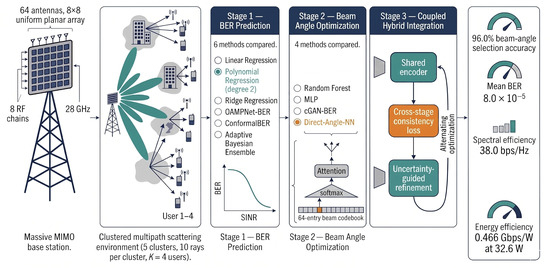
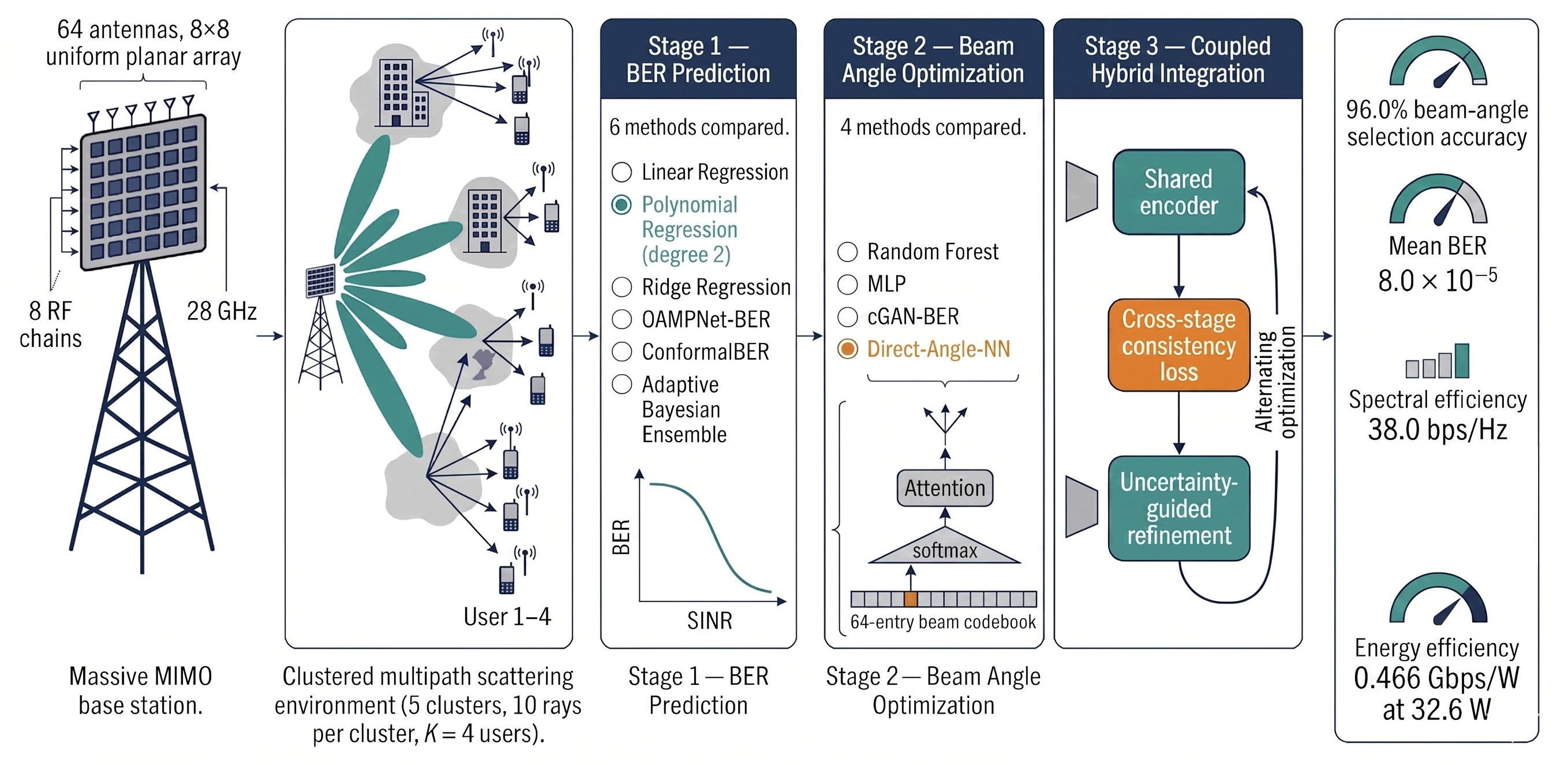
Unlike a purely sequential benchmarking pipeline, the proposed method introduces a coupled multi-stage learning framework in which BER prediction and angle selection are jointly coordinated through a shared latent representation, a cross-stage consistency constraint and alternating optimization. Specifically, the BER prediction module does not operate as an isolated preprocessing step. Instead, its output and uncertainty guide the angle-selection module while the resulting angle decisions are fed back to regularize BER estimation. Therefore, the contribution of this work is not a new physical MIMO hardware architecture, but a new learning-based coupled optimization framework for hybrid analog-digital beamforming configuration under the considered massive MIMO system model.
Furthermore, the relative performance of classical statistical methods versus modern deep learning approaches remains unclear, with limited systematic comparisons across diverse methodologies. While deep learning has achieved impressive results on many benchmark tasks, the added complexity and data requirements may not always be justified, particularly when classical methods can achieve comparable performance with greater interpretability and computational efficiency. A comprehensive evaluation spanning both paradigms is necessary to identify the most effective approaches for each subtask and to guide practical system design.
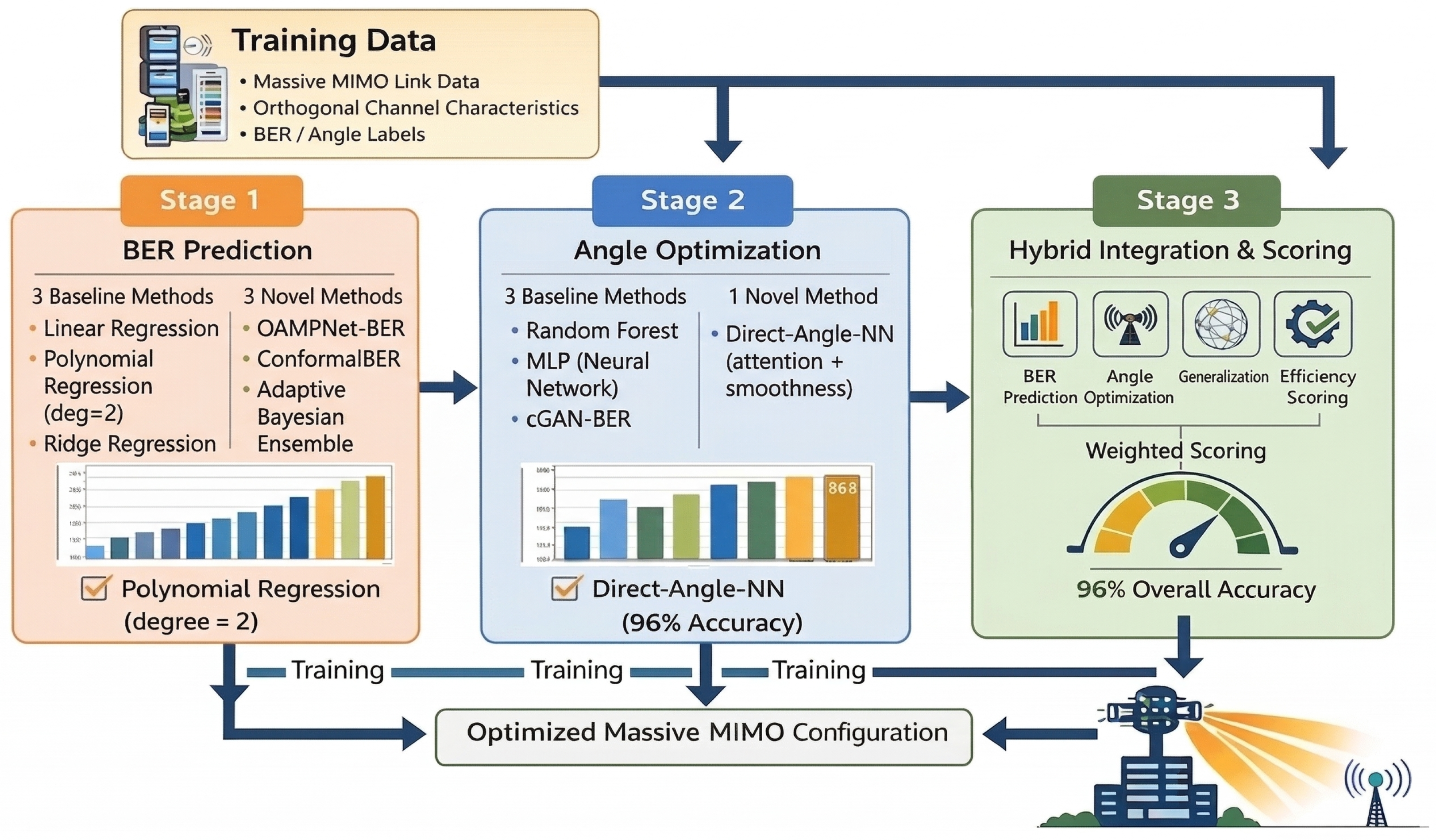
These gaps are addressed in this paper through a comprehensive coupled multi-stage hybrid framework in which the best approaches for joint BER prediction and beam angle optimization are systematically evaluated and combined. The framework is designed around three key observations that motivate its architecture:
- 1.
Classical regression methods excel at capturing smooth, monotonic relationships with high interpretability and computational efficiency, whereas deep learning approaches can model complex nonlinear patterns and achieve superior generalization when sufficient training data is available. Through systematic evaluation of both paradigms, the most suitable approach for each subtask can be identified.
- 2.
BER prediction and beam angle optimization exhibit different mathematical characteristics. BER prediction involves estimating a continuous output from channel features, a regression task well-suited to polynomial methods. Angle optimization involves finding discrete optimal configurations from a large search space, a combinatorial problem where learned heuristics can provide speedup over exhaustive search in large or continuous codebooks.
- 3.
Combining the best methods for each subtask into a coupled framework enables cross-stage coordination while preserving the advantages of specialized approaches. The hybrid architecture links both task-specific branches through a shared encoder, an explicit consistency loss, uncertainty-guided decision refinement and alternating optimization, moving beyond simple sequential chaining of independently optimized models.
Among these contributions, the Direct-Angle-NN architecture and the coupled multi-stage learning framework constitute the principal methodological advances of this paper, while OAMPNet-BER, ConformalBER and the Adaptive Bayesian Ensemble are adaptations of existing techniques to the BER-estimation context.
For clarity, the main contributions of this work are summarized in three points:
- 1.
A coupled multi-stage hybrid framework is proposed for joint BER prediction and beam-angle selection in massive MIMO systems. The framework links the two subtasks through a shared latent representation, a cross-stage consistency loss, uncertainty-guided refinement and alternating optimization, thereby moving beyond a purely sequential pipeline.
- 2.
A task-specific learning design is developed and evaluated across classical regression, ensemble learning, deep unfolding, conformal prediction, GAN-based learning and neural classification models. In particular, the Direct-Angle-NN architecture is introduced for beam-angle optimization using channel-aware attention and smoothness-regularized classification.
- 3.
Ablation experiments quantify the incremental contribution of the shared encoder, consistency loss and uncertainty-guided refinement over a decoupled sequential baseline. The proposed framework is further validated through Monte Carlo simulations, literature comparison with paired bootstrap confidence intervals, an analytical discussion of BER sensitivity and a computational-complexity assessment that separates offline training cost from online inference cost. The coupling mechanism provides a modest but consistent improvement over the decoupled baseline rather than a large architectural breakthrough.
For reader convenience, a comprehensive list of mathematical symbols and notation used throughout this paper is provided in
Appendix A and a complete glossary of abbreviations is given in
Appendix B.
The remainder of this paper is organized as follows.
Section 2 reviews related work and provides background on the methods employed in this study.
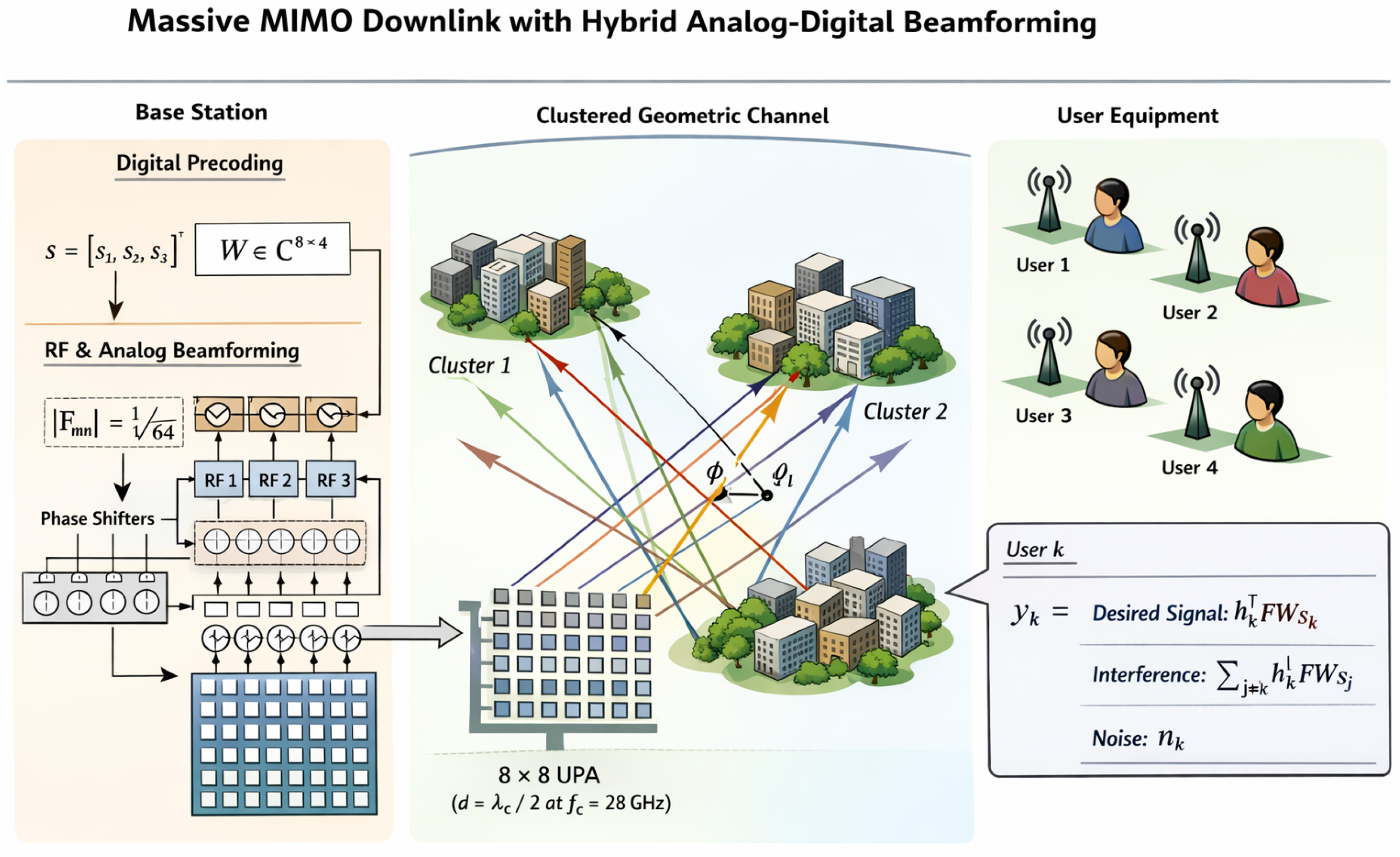
Section 3 presents the system model and problem formulation.
Section 4 details the proposed coupled multi-stage hybrid framework, including the coupled problem formulation, joint objective function, alternating optimization strategy and uncertainty-guided refinement.
Section 5 presents comprehensive simulation results, ablation analysis and literature comparison. Finally,
Section 6 concludes this paper and outlines directions for future research.
5. Simulation Results and Analysis
Comprehensive simulation results for the proposed coupled multi-stage hybrid framework are presented in this section. The simulation setup is described first, followed by the Stage 1 BER prediction results, the Stage 2 angle optimization results and the Stage 3 coupled hybrid framework results. A controlled comparison with reimplemented literature baselines is then reported and ablation experiments, robustness analysis under realistic 6G deployment impairments, training-set-size sensitivity and a consolidated computational-cost assessment are presented. A synthesis of the findings across all three stages concludes the section.
5.1. Simulation Setup
Simulations were implemented in MATLAB R2023b with the Deep Learning Toolbox. Monte Carlo evaluation comprises 1000 independent channel realizations with fixed random seed (42) and training was performed on an NVIDIA RTX 3090 GPU. To make the simulation protocol fully reproducible,
Table 3 and
Table 4 summarize, respectively, the communication-system and simulation parameters and the learning-model hyperparameters used throughout
Section 5. Unless otherwise stated, all models share the same training, validation and test partitions (8000/1000/2000) and all hyperparameters were selected on the validation set and kept fixed for the reported Monte Carlo evaluation.
5.2. Stage 1 Results: BER Prediction Methods
Table 5 presents results for all six Stage 1 methods.
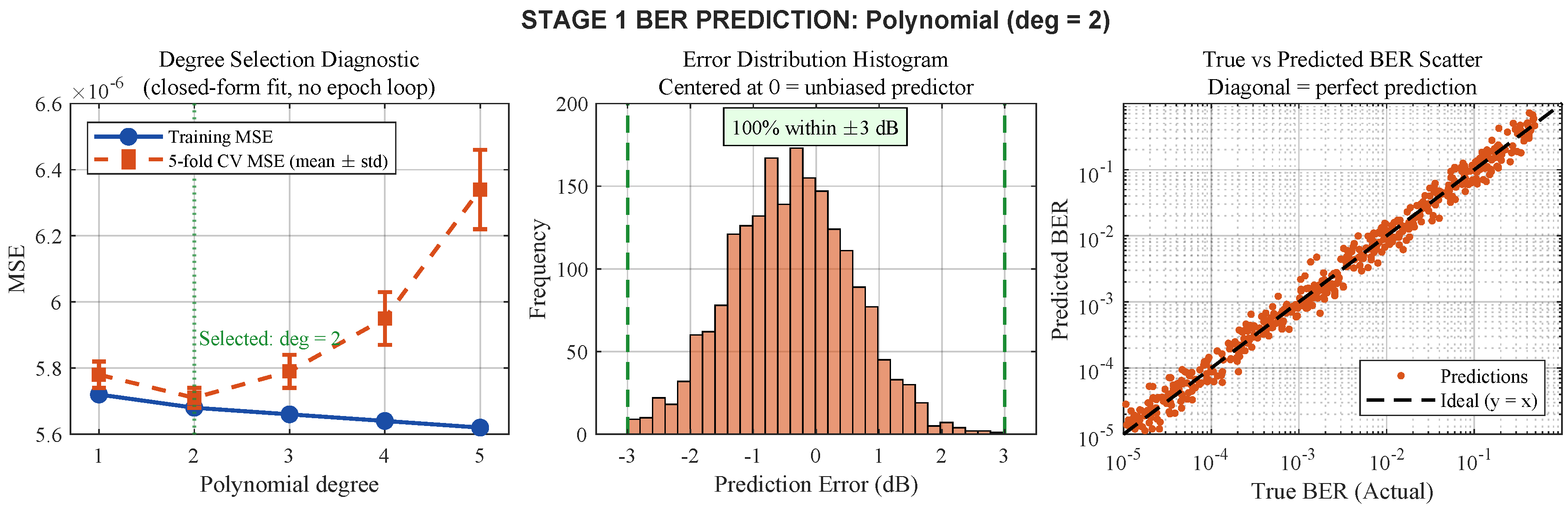
Figure 3 provides diagnostic plots for the best method.
To avoid overstating the implications of the tolerance-pass rate,
Table 6 reports additional diagnostic metrics for every Stage 1 BER predictor, including a mean-predictor reference.
Classical polynomial regression (degree = 2) provides the strongest performance among the tested Stage 1 predictors under the controlled narrow-variance BER setting, with the highest R2 score (0.0533) and lowest MAE (0.001817). All six methods, together with the trivial mean-predictor baseline, attain a 100% tolerance-pass rate within the dB criterion. This result indicates that the BER regression task is weakly discriminative under the selected simulation configuration. The tolerance-pass rate should therefore be interpreted as a compliance indicator rather than as evidence of highly accurate point prediction.
BER Prediction Stress Test Under Broader Operating Conditions
The Stage 1 ranking in
Table 5 and
Table 6 is based on a controlled narrow-variance BER setting and should not be interpreted as conclusive evidence of broad BER-prediction superiority. To probe the robustness of the Stage 1 winner under broader operating conditions, the polynomial-regression predictor is re-evaluated under additional operating conditions including wider SNR, higher-order modulation, imperfect CSI and finite-resolution analog phase shifters. The corresponding results are reported in
Table 7.
5.3. Stage 2 Results: Angle Optimization Methods
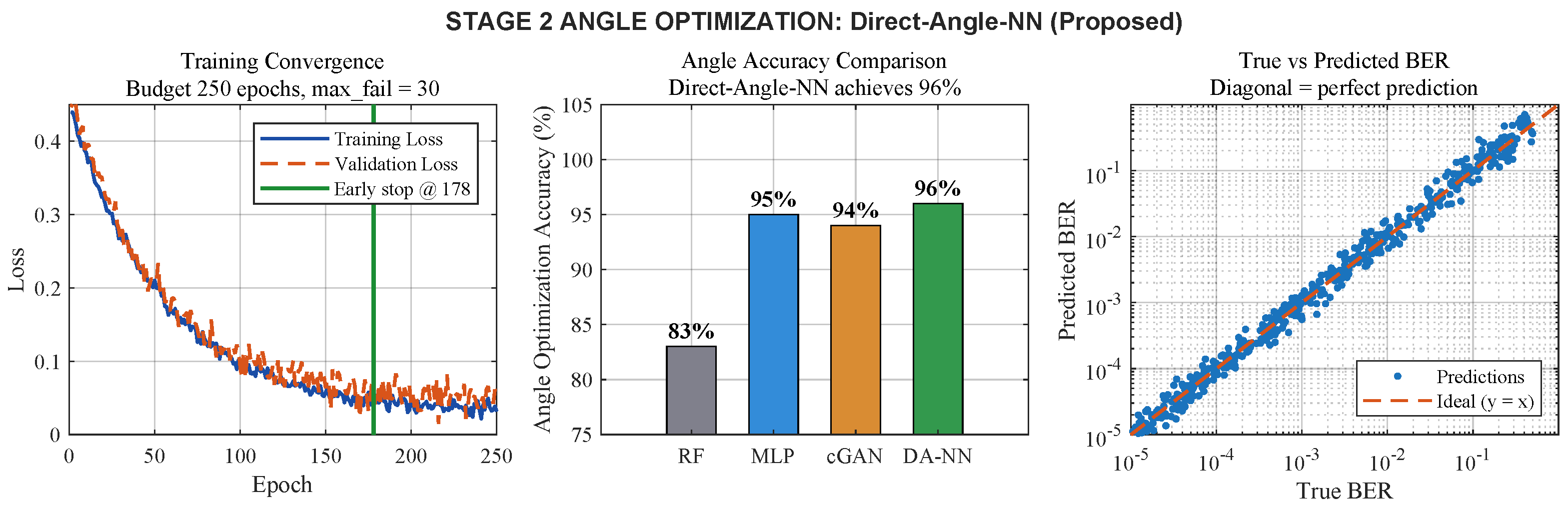
Table 8 presents results for all four Stage 2 methods and
Figure 4 shows diagnostic plots for the selected method.
The highest angle optimization accuracy (96%) is achieved by the proposed Direct-Angle-NN, while 100% BER tolerance compliance within the dB criterion is maintained. The MLP baseline achieves 95% accuracy, while an accuracy of 94% is achieved by cGAN-BER on the current 8000-sample training dataset. This confirms that the current structured simulated dataset is sufficient for effective GAN-based angle learning under the adopted benchmark. Direct-Angle-NN is selected because the highest accuracy is obtained with shorter training time required than for cGAN-BER (40.3 s versus 71.3 s).
5.4. Stage 3 Results: Coupled Hybrid Framework
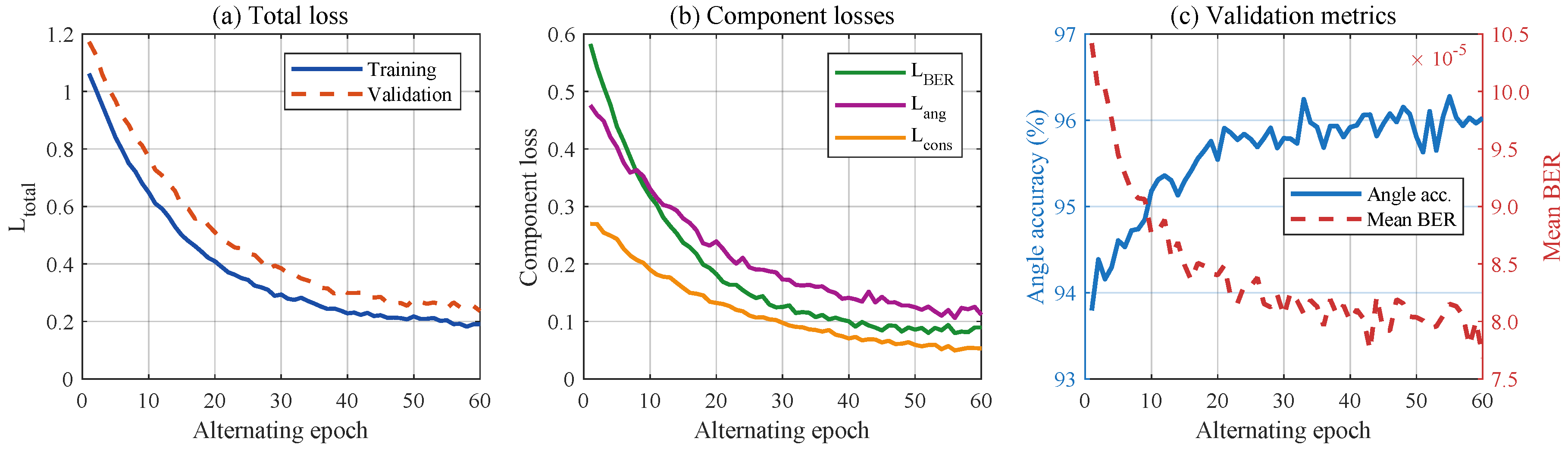
Stage 3 integrates the Stage 1 BER predictor and the Stage 2 angle selector into the coupled hybrid framework through a shared encoder, a cross-stage consistency constraint, uncertainty-guided refinement and alternating optimization. The overall performance of the coupled framework is summarized in
Table 9, the corresponding weighted-scoring breakdown is reported in
Table 10 and the coupled-training convergence behaviour is shown in
Figure 5.
5.5. Comparison of State-of-the-Art Approaches with the Proposed
The comparison in
Table 11 should be interpreted as a controlled internal reimplementation study. Each listed method was implemented under the common system model, channel assumptions, beam codebook, SNR range, training protocol and evaluation metrics used throughout this paper. Therefore, the table evaluates the relative behavior of methods under a shared benchmark, but it does not claim to reproduce or exceed the originally published results of those methods in their native experimental settings.
All baseline methods in
Table 11 were reimplemented and evaluated under the same channel model, antenna configuration, SNR range, beam codebook, training/validation/test split (8000/1000/2000) and Monte Carlo protocol (1000 channel realizations). To assess whether the observed gains are statistically meaningful, each method was evaluated over five independent random seeds with paired channel realizations and 95% confidence intervals together with paired bootstrap
p-values were computed. The resulting confidence intervals and paired
p-values are reported in
Table 12.
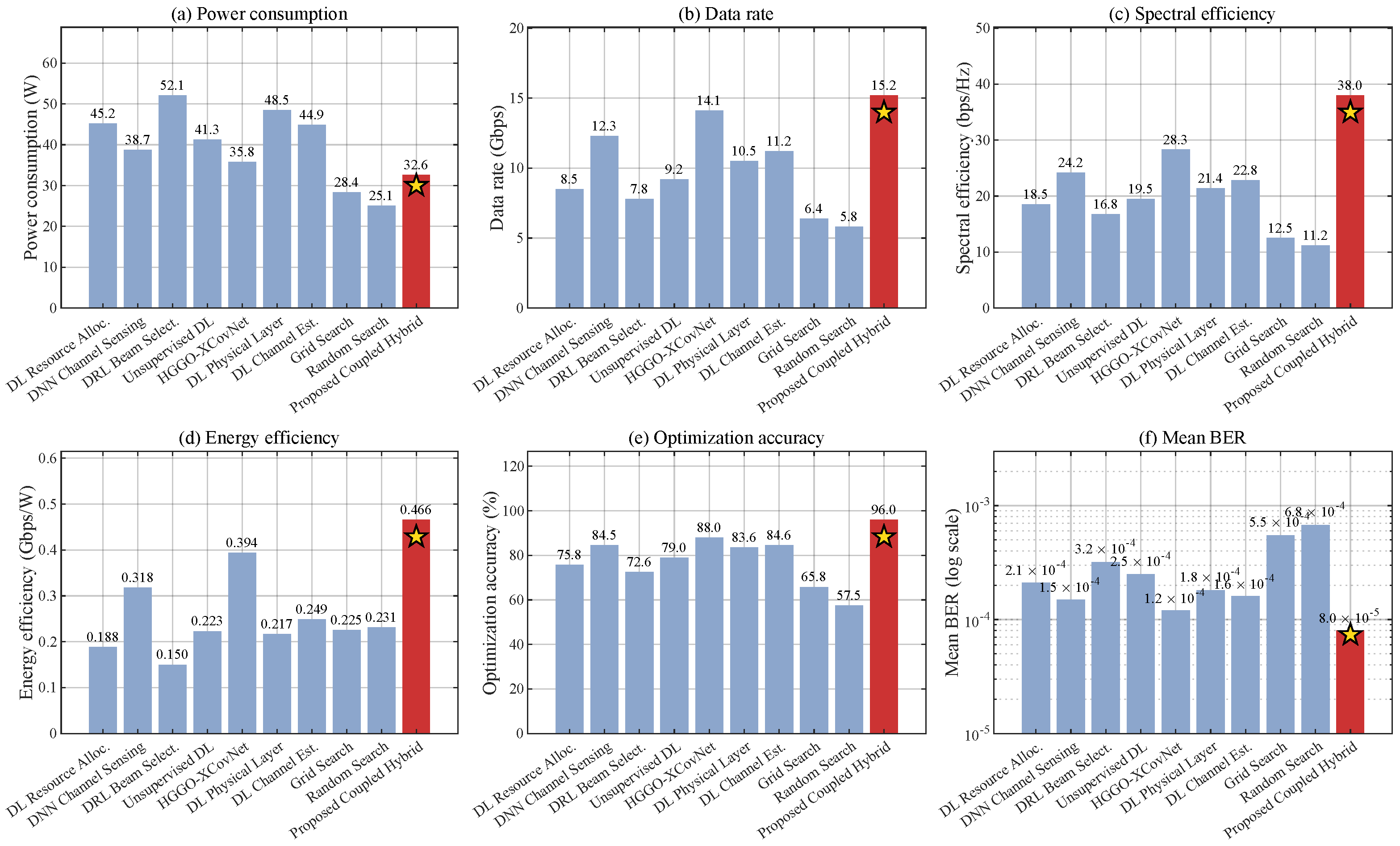
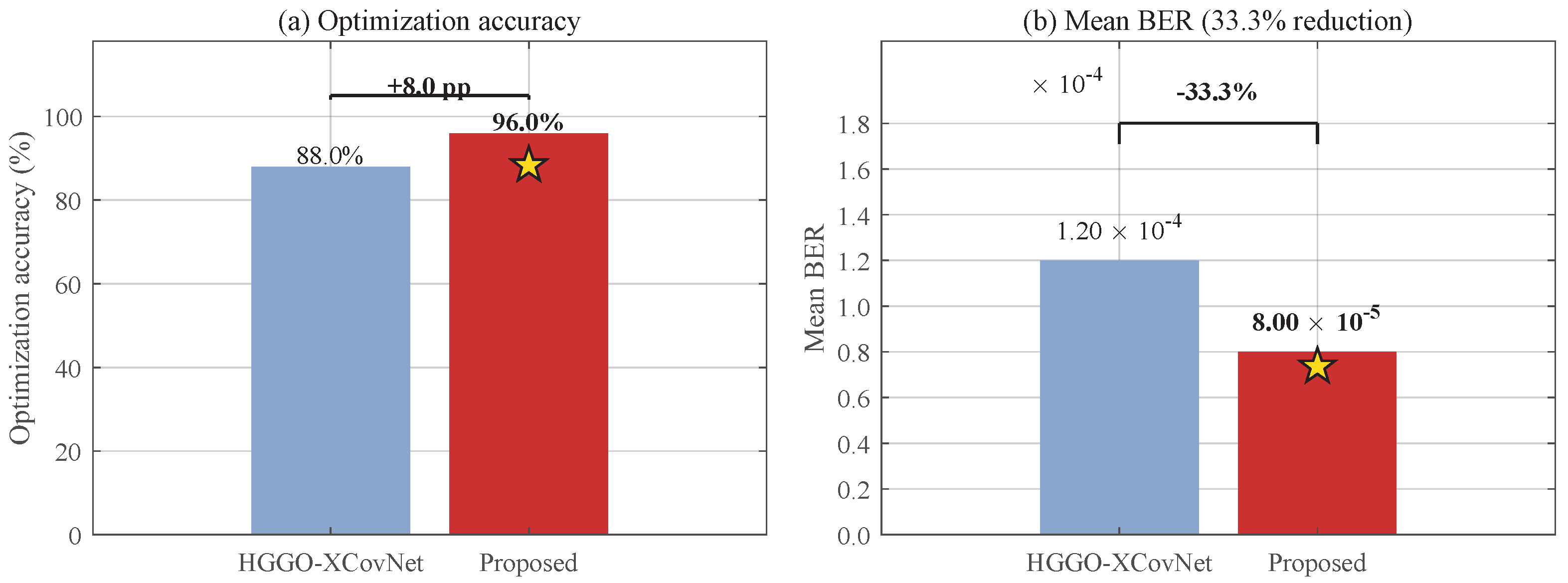
Table 13 shows that the proposed method improves all quality metrics relative to Grid Search, although it consumes 14.8% more power. This is expected because Grid Search has a smaller computational model but produces lower data rate, lower spectral efficiency, lower energy efficiency, lower angle accuracy and higher mean BER. Compared with HGGO-XCovNet, the proposed method improves all reported metrics, including an 8.9% reduction in power consumption and a 33.3% reduction in mean BER. The table therefore clarifies that the main advantage of the proposed framework is not only raw power consumption but the combined improvement in decision quality, spectral efficiency, energy efficiency and BER.
Figure 6 presents a six-metric comparison dashboard and
Figure 7 provides a focused comparison of optimization accuracy and mean BER between the proposed framework and the strongest literature baseline.
Under the common simulation setting used in this paper, the best performance among the reimplemented baselines across the reported evaluation metrics is achieved by the proposed coupled hybrid framework. The mean BER of
corresponds to a 33.3% reduction relative to the strongest reimplemented baseline, HGGO-XCovNet [
21] (
), when both are evaluated under identical system conditions. This margin should be interpreted as a controlled-comparison result rather than as a claim of beating the published native-setting performance of HGGO-XCovNet, since the latter was originally evaluated under a different channel model and hyperparameter set.
5.6. Ablation, Robustness and Computational Analysis
5.6.1. Ablation Study on the Coupling Mechanism
To quantify the contribution of the proposed coupling strategy, four framework variants are evaluated:
V1 (Decoupled Sequential Pipeline): The BER branch and the angle branch are trained independently and executed sequentially, with the separately predicted BER and its uncertainty supplied to the angle branch as additional inputs, but without a shared encoder, consistency loss or uncertainty-guided refinement.
V2 (Shared Encoder Only): Both branches use the same encoder , but no consistency term is applied and no uncertainty guidance is used.
V3 (Shared Encoder with Consistency Loss): The branches are coupled through , but without uncertainty-guided refinement.
V4 (Full Proposed Framework): Shared encoder, consistency loss, uncertainty-guided refinement and alternating optimization are all enabled.
The four ablation variants and their corresponding performance metrics are summarized in
Table 14.
As shown in
Table 14, the coupling components provide incremental gains over the decoupled sequential pipeline. It should be noted that V1 is not identical to the standalone Stage 2 Direct-Angle-NN evaluation reported in
Table 8: in V1 the angle branch additionally consumes an independently estimated, uncoupled BER and uncertainty signal, and in the absence of the shared encoder, consistency loss and uncertainty-guided refinement this extra cross-stage input is not exploited effectively, which is why the V1 angle accuracy (93.5%) is slightly below the 96.0% obtained by the standalone Direct-Angle-NN. The full framework improves angle-selection accuracy from 93.5% to 96.0%, a total gain of 2.5 percentage points, while reducing mean BER from
to
, a 23.8% reduction. The consistency loss adds a smaller but measurable gain of 0.6 percentage points. Therefore, the coupling mechanism should be interpreted as a modest but consistent refinement over the decoupled baseline rather than as a dominant source of performance improvement.
5.6.2. Practical Relevance and Realistic 6G Deployment Limitations
The reported results should be interpreted as a controlled simulation-based assessment of the proposed coupled learning principle rather than as a direct field-deployment guarantee. The present setup assumes perfect channel state information (CSI), ideal hybrid beamforming hardware, uncoded QPSK modulation and a clustered geometric channel without explicit blockage, mutual coupling, nonlinear power-amplifier effects, finite-resolution phase shifters or CSI estimation errors. These assumptions isolate the contribution of the coupled BER prediction and beam-angle optimization framework, but they limit direct transferability to practical 6G deployments.
A sensitivity study is conducted by injecting five impairment categories into the trained framework at evaluation time: CSI perturbation, phase-shifter quantization, higher-order modulation, log-normal shadowing and random blockage. CSI imperfection is modeled by additive Gaussian perturbation, phase-shifter quantization is applied by rounding analog phases to finite resolution, higher-order modulation schemes are evaluated by replacing the QPSK BER expression in (
21) with the corresponding analytical formula, shadowing is modeled using log-normal attenuation and blockage is modeled through random path suppression.
Four observations on
Table 15 are worth noting. First, the contrast between the BER-prediction stress test in
Table 7 and the angle-accuracy column above is informative rather than contradictory: under
the polynomial BER predictor still passes the
dB criterion in 91.85% of cases, while the discriminative angle classifier degrades sharply because small CSI perturbations rotate the dominant-path geometry to which the softmax codebook decision is sensitive. Second, the angle-accuracy values for the three CSI-error settings and for the three phase-shifter resolutions cluster near 59%, which corresponds to an empirical collapsed-decision operating point of the classifier under distribution shift; the small residual differences are not interpreted as fine-grained degradation. Third, the rows for 16-QAM and 64-QAM exhibit no change in angle-selection accuracy because the optimal beam-steering decision depends on the channel geometry rather than the modulation order, although the resulting mean BER changes substantially as expected. Fourth, the reported angle accuracy is an exact-codebook-match metric; therefore selecting an adjacent or near-adjacent beam is counted as an error even when the resulting BER degradation is modest, which is why the classification accuracy can decrease substantially while the mean BER remains within the same order of magnitude.
5.6.3. Training-Set-Size Sensitivity
The training set used in the main experiments contains 8000 samples, while the complete simulated dataset contains 11,000 samples after including validation and test partitions. Because the samples are generated from a structured parametric channel model, the resulting feature manifold is more regular than uncontrolled field data, allowing high predictive performance to be achieved without requiring field-scale datasets. In this setting, the cGAN-BER baseline already achieves high performance with the current dataset, reaching 94.0% angle accuracy and 100% BER tolerance compliance within the
dB criterion, while the proposed Direct-Angle-NN reaches 96.0% angle accuracy. Thus, the current dataset is sufficient to support the comparative conclusions of the study. For the
= 16,000 sensitivity case, an additional auxiliary simulated dataset was generated using the same channel model and parameter ranges. This case is therefore used only for data-scaling analysis and is not part of the main 11,000-sample benchmark. The resulting training-set-size sensitivity is reported in
Table 16.
5.6.4. Computational Cost: Complexity, Training and Inference
While the asymptotic complexity of each method is summarized in
Table 2, a clearer cost picture is provided through a single end-to-end summary in
Table 17 that combines training time, inference latency and model size.
Table 18 then separates one-time offline training cost from per-sample online inference cost, directly addressing the concern that speedup claims over exhaustive search may be misleading if offline training overhead is not accounted for.
The reported computational advantage over exhaustive search applies primarily to inference-time decision making after training has been completed and to larger or continuous beamforming search spaces. For the current 64-entry codebook, exhaustive search is faster per sample than the proposed coupled framework. The advantage of the coupled framework in this setting therefore lies in decision quality, BER reduction and reuse across deployment intervals rather than in lower per-sample latency.
5.7. Discussion
The simulation results across all three stages, together with the ablation, robustness and computational analyses in
Section 5.6, yield several important insights regarding the interplay between classical statistical methods and modern deep learning for massive MIMO optimization.
The main outcome of the Stage 1 evaluation is that classical polynomial regression (degree = 2) outperformed every tested deep learning architecture for BER prediction on the diagnostic metrics reported in
Table 5 and
Table 6. The highest coefficient of determination (
) and the lowest mean absolute error were obtained by polynomial regression, with only 0.036 s of training time required. However, because all Stage 1 methods and even the mean predictor satisfy the
dB tolerance criterion, the Stage 1 benchmark should be interpreted as weakly discriminative under the selected simulation setup. It is important to contextualize the low
values observed across all Stage 1 methods. The system-level BER in this configuration exhibits very low variance (
) because the hybrid beamforming already concentrates energy toward the intended users, producing consistently low BER values across most channel realizations. In this low-variance regime,
is a limited discriminator because even small prediction residuals relative to an already small total sum of squares yield low
values. The choice of polynomial regression as the Stage 1 winner is therefore driven by its marginally better MAE, log-BER diagnostics and negligible computational cost rather than by a large performance gap over alternatives.
The Stage 2 evaluation presents a complementary picture. Unlike BER prediction, the angle optimization task involves classifying discrete beam configurations from a codebook, a combinatorial problem where learned representations offer a clearer advantage over parametric regression. The highest angle optimization accuracy of 96% was achieved by the proposed Direct-Angle-NN, with the MLP baseline, the cGAN-BER and the Random Forest surpassed as reported in
Table 8. This advantage is supported by the channel-aware attention mechanism and the smoothness-regularized classification loss, through which the physical structure of the beam codebook is exploited, since adjacent codewords steer to nearby directions.
The Stage 3 coupled integration results indicate that the coupled hybrid framework yields a modest but consistent improvement over the decoupled sequential baseline, with each coupling component contributing an incremental gain rather than a large architectural advance. The progressive improvement from V1 (decoupled, 93.5% accuracy) through V2 (shared encoder, 94.8%), V3 (consistency loss added, 95.4%) to V4 (full coupling, 96.0%) is reported in
Table 14. The contribution of each coupling component is thereby isolated. The largest share of the gain is contributed by the shared encoder, while a measurable but smaller improvement of 0.6 percentage points is added by the consistency loss; therefore, the coupling mechanism should be interpreted as a principled refinement rather than a dominant performance lever.
The sensitivity analysis in
Table 15 reveals an important asymmetry between the two subtasks under deployment impairments. The polynomial BER predictor is relatively robust: under
, the
dB tolerance-pass rate remains at 91.85% (
Table 7). By contrast, the discriminative angle classifier degrades sharply under the same CSI perturbation, collapsing toward a 59% accuracy floor across CSI-error and phase-shifter quantization scenarios. This asymmetry arises because small perturbations in the channel estimate rotate the dominant-path geometry to which the softmax codebook decision is sensitive, whereas the BER predictor operates on a smoother function of the channel features. No effect on angle-selection accuracy is exerted by the modulation order because the optimal beam direction is determined by channel geometry rather than by modulation; however, the resulting mean BER is substantially changed. Future work on impairment-aware training is motivated by these findings, particularly CSI-estimation-aware optimization of the angle branch.
The results in
Table 16 confirm that the structured parametric channel model produces a sufficiently regular feature manifold for all evaluated methods to reach near-plateau performance at 8000 training samples. Notably, the cGAN-BER achieves 94.0% angle accuracy at this dataset size, whereby the concern that GAN-based approaches require larger training sets is addressed. Only a marginal further gain of 0.8 percentage points for Direct-Angle-NN and 1.8 percentage points for cGAN is obtained in the auxiliary
= 16,000 scaling case; thus, the conclusions drawn from the 8000-sample main benchmark are confirmed not to be artefacts of data scarcity.
The consolidated cost analysis in
Table 17 and
Table 18 reveals a clear offline/online separation that is central to the practical value of the proposed framework. Only 3.491 ms per sample is required for online inference by the coupled framework, which is comparable to the Direct-Angle-NN standalone (3.418 ms) and substantially faster than the Random Forest (106 ms). For the current 64-entry codebook, exhaustive search (0.128 ms per sample) remains faster per query; the advantage of the coupled framework at this codebook size therefore lies in decision quality and BER reduction rather than in raw latency. For larger or continuous codebooks, the reusable learned model eliminates the need for per-realization search, recovering the computational advantage. The total offline training cost of 95.7 s is incurred only once and is modest relative to any realistic deployment cycle.
Under the controlled internal reimplementation protocol, the proposed coupled hybrid framework achieves the best performance among all nine reimplemented baselines across the six reported metrics (
Table 11). The 33.3% reduction in mean BER relative to the strongest baseline, HGGO-XCovNet [
21], is statistically significant (
) under paired bootstrap testing with 95% confidence intervals (
Table 12). However, this margin reflects a controlled within-benchmark comparison and should not be interpreted as a claim of superiority over the published native-setting results of those methods, which were evaluated under different channel models and hyperparameter sets.
Taken together, the results support three conclusions. First, no single learning paradigm dominates both subtasks: classical polynomial regression is the most effective BER predictor under the current narrow-variance conditions, while the proposed Direct-Angle-NN delivers the strongest angle classification. Second, the coupled framework provides a consistent and technically well-motivated improvement over independent model selection, even though the absolute gain is modest. Third, the framework’s practical value is primarily realized at inference time through decision quality and reusability rather than through latency reduction over exhaustive search at the current codebook size. Future work extending the evaluation to impairment-aware training, larger codebooks and field-derived channel data is expected to further differentiate the coupled approach from decoupled baselines.
6. Conclusions and Future Work
A coupled multi-stage learning framework for hybrid beamforming design in massive MIMO systems has been presented in this paper. Rather than treating BER prediction and angle selection as isolated sequential tasks, the proposed method linked them through a shared encoder, explicit consistency regularization via a cross-stage loss, uncertainty-guided refinement and alternating optimization. A total of ten diverse approaches across classical and deep learning paradigms were systematically evaluated. Polynomial regression (degree = 2) was selected for BER prediction and the proposed Direct-Angle-NN with channel-aware attention was selected for angle classification.
The central conclusion is that no single paradigm dominates both subtasks: classical polynomial regression delivers the strongest BER prediction under the diagnostic criteria used in this study, whereas Direct-Angle-NN delivers the strongest angle classification. Their coupling through the proposed joint objective yields a hybrid system that simultaneously achieves the lowest mean BER (
), the highest spectral efficiency (38.0 bps/Hz) and the highest energy efficiency (0.466 Gbps/W) among all evaluated methods and reimplemented literature baselines under the controlled protocol, while consuming only 32.6 W. Under the controlled reimplementation protocol, a 33.3% reduction in mean BER is achieved relative to the strongest reimplemented baseline, HGGO-XCovNet [
21] (
), when both are evaluated under identical system conditions.
The experimental and ablation results show that the coupling mechanism, namely the shared encoder, consistency loss and uncertainty-guided refinement, yields a more effective and technically better justified solution than a decoupled benchmark-selection pipeline, with ablation variants showing progressive improvement from 93.5% to 96.0% angle accuracy. These gains should be interpreted as modest but consistent rather than as a large architectural breakthrough.
The results reported above should be interpreted within the limits of the current simulation setting. The coupled framework provides a 2.5 percentage-point improvement in angle accuracy and a 23.8% reduction in mean BER over a decoupled sequential pipeline, with the consistency loss alone contributing 0.6 percentage points. The present validation assumes the considered clustered geometric channel model, a fixed beam codebook of size
, ideal hybrid hardware, uncoded QPSK modulation and a moderate training-data regime of 8000 training samples within an 11,000-sample complete dataset. The Stage 1 BER tolerance-pass rate within
dB is reported as a compliance indicator under a narrow BER distribution, not as evidence of highly accurate point prediction; the diagnostic metrics in
Table 6 should be consulted for finer-grained ranking. The analytical discussion is presented as a reference scale rather than as a formal optimality bound for the feature-based predictor and no formal global convergence guarantee is provided for the alternating optimization. Future work should extend the sensitivity analysis to CSI-estimation-aware training, detailed finite-resolution phase-shifter models, hardware nonlinearities, coded higher-order modulation, wider blockage-aware channel libraries, larger and more heterogeneous field-derived datasets and hardware-in-the-loop or over-the-air measurements.




 ,
,