Article

Analytic Expressions for Shielded Halbach Multipoles

Thomas Jefferson National Accelerator Facility, 12000 Jefferson Avenue, Newport News, VA 23606, USA
Magnetism 2026, 6(2), 16; https://doi.org/10.3390/magnetism6020016

Submission received: 27 February 2026 / Revised: 15 April 2026 / Accepted: 17 April 2026 / Published: 20 April 2026

Abstract

Rare-earth-based permanent magnets have the unique ability to create Tesla-strength magnetic fields without the need for power supplies. Moreover, Halbach showed that the fields of assemblies of magnets can be calculated analytically, because the permeability of permanent magnets is very close to unity. But that only worked in the absence of materials with a non-unity permeability, which implies that numerical tools must be employed to account, for example, for materials used to shield stray fields. Here we employ the method of images to derive analytic expressions for the magnetic field of Halbach multipoles that are enclosed in infinite-permeability shielding.

1. Introduction

Permanent magnets provide strong magnetic fields without using power supplies. This makes them very popular in in today’s energy-conscious world, which is striving for sustainability. Thus they are used in a wide range of applications, ranging from holding and lifting [1], levitating high-speed trains [2], removing iron debris [3], and in magnetic bearings [4] and clutches [5]. Another wide arena of applications is their use in motors [6], generators [7], and energy harvesting [8]. For an overview, see [9]. Most of these applications depend mainly on the force or torque exerted by the magnets, rather than the field quality. But the latter plays an important role when permanent magnets are employed to create the fields for nuclear-magnetic resonance imaging devices [10] and in particle accelerators [11,12,13,14,15]. The latter use magnets with tightly specified tolerances on the desired multipole components. Many of those multipole magnets evolve from Halbach’s analytic expressions [16] for two-dimensional fields, which exploit the fact that the permeability of permanent-magnet material is very close to unity and that the fields of separate magnets are given by the superposition of the fields from the individual blocks, as long as no ferromagnetic material, such as iron, is close by. Extending and improving Halbach’s calculations [17] is still an active field of research.
The absence of ferromagnetic material makes it impossible to account for shielding the stray fields of the magnets with high-permeability materials. In this report we generalize Halbach’s analytic expressions to account for magnetic shielding configurations that exhibit a high degree of symmetry. We do so by introducing image field for dipoles in an analogous way, where image fields are used to solve boundary-value problems in electrostatic calculations [18]. This might prove useful in a first estimate of a magnet performance and before resorting to numerical methods [19,20,21].
In the following sections we first describe how to account for shielding with infinite-permeability material by introducing the image fields for magnetic dipoles. We then apply the theory to multipoles with a continuously rotating easy axis. In Section 4 we calculate the expressions for segmented multipoles, followed by Section 5 on multipoles constructed from magnetic cubes. Section 6 wraps up this report with the conclusions.

2. Image Fields for Magnetic Dipoles

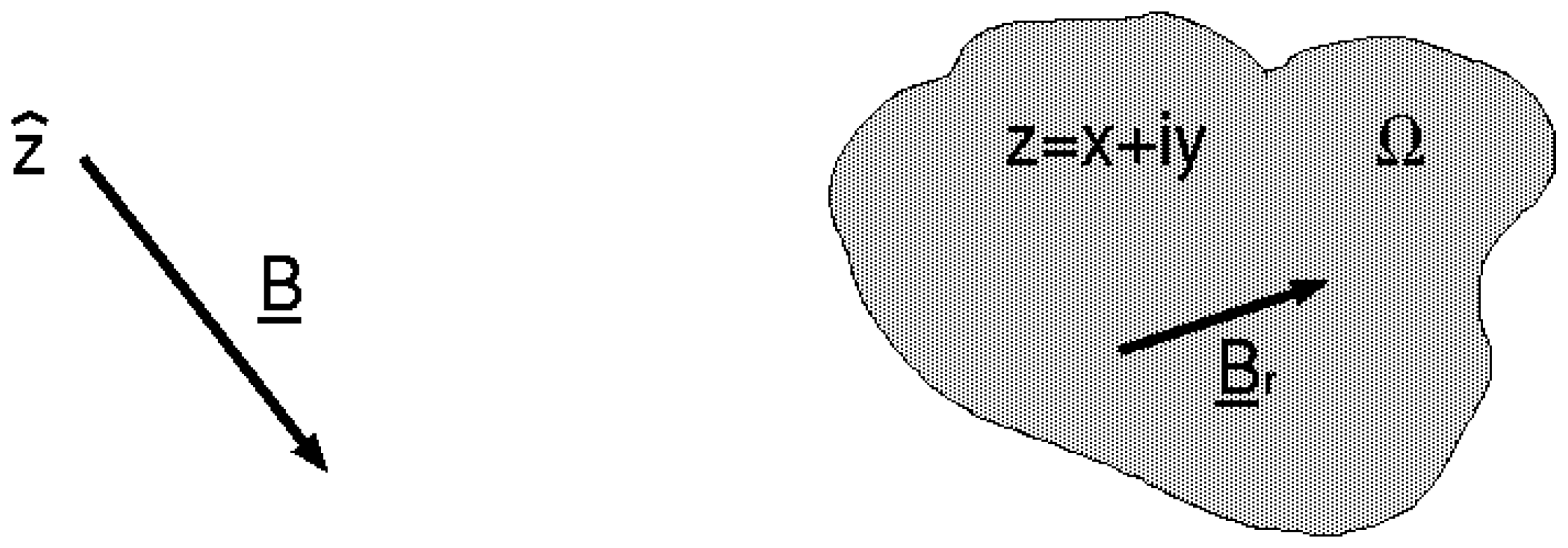
Halbach’s derivations from [16] rely on the fact that Maxwell’s equations in two dimensions are equivalent to the Cauchy–Riemann equations [22] for one complex variable. All fields are therefore expressed as complex-valued functions B ̲ ( z ) = B x + i B y , denoted by underscored symbols, of complex-valued positions z = x + i y . In particular, the field generated by permanent magnets with permanent field B ̲ r = ( B r ) x + i ( B r ) y can be written as [23]
B ̲ ( z ^ ) = B x i B y = 1 2 π Ω B ̲ r ( z ^ z ) 2 d x d y   ,
where Ω is the region that the permanent magnet occupies, B ̲ is the complex conjugate of B ̲ , and G ( z ^ , z ) = 1 / ( 2 π ) ( z ^ z ) 2 is the Green’s function of a dipole. We thus have to integrate over all sources at points z = x + i y in the shaded area Ω in Figure 1 and weigh their contribution with the Green’s function G ( z ^ , z ) to obtain the field B ̲ at the point z ^ .
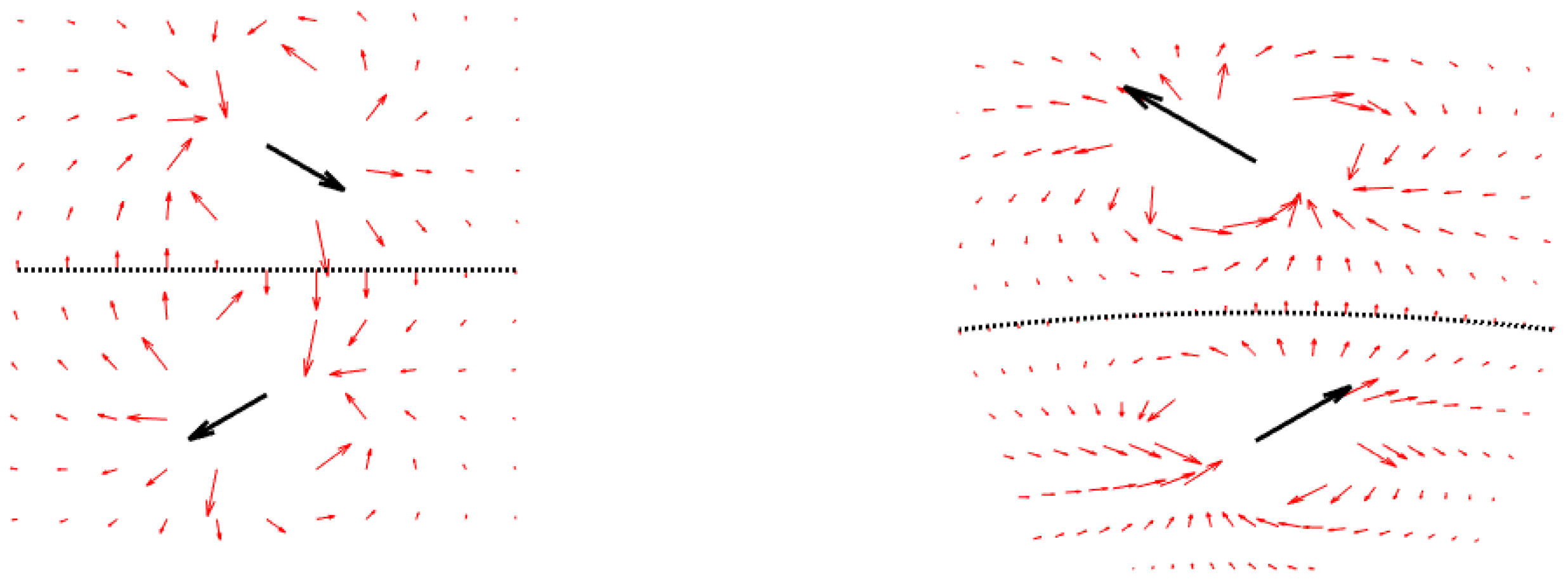
The magnetic fields on a boundary, assumed to have infinite permeability, are purely normal, because the field lines prefer go through the high-permeability material rather than through air. We first consider a single dipole close to and below a planar magnetic boundary, as shown on the left-hand side in Figure 2. The orientation of the image above the plane has the same normal component of the dipole moment below the plane, but the sign of the tangential component is reversed. This is easy to see when considering a magnetic dipole that is composed of two very close monopoles; the one closer to the boundary also must have its image closer to the boundary. We illustrate the field of this configuration by red arrows visible on the left-hand side in Figure 2. We thus find that for a boundary along the x-direction, the image dipole must be the negative and complex conjugate B ̲ ~ r = B ̲ r of the original dipole B ̲ r and it must be located at the mirrored position on the “other” side of the boundary.
Let us now consider a cylindrical boundary with radius R and centered at the origin. Inside, there is a single dipole source located at radius r and placed on the vertical axis. Later we will remove this restriction. We point out that sources inside the cylinder have images that are located outside the cylinder at a distance R 2 / r from its center [23]. This is also true for two infinitesimally close (virtual) magnetic monopoles that make up a dipole; their distance increases by a factor ( R / r ) 2 . For very close points, the sagitta is almost equal to the length of the arc between points and that increases by R / r when going from r to the cylinder at R. It then increases by ( R 2 / r ) / R = R / r once again when going from the cylinder to the image point. Therefore the strength of the image dipole must be larger by a factor ( R / r ) 2 compared to the original dipole, which is consistent with the reasoning from [24]. The right-hand side of Figure 2 shows the original dipole below and the image above the cylindrical boundary as well as the field they create, shown by the red arrows. We see that the image is stronger and further away from the boundary, causing the field to become purely normal close to the boundary.
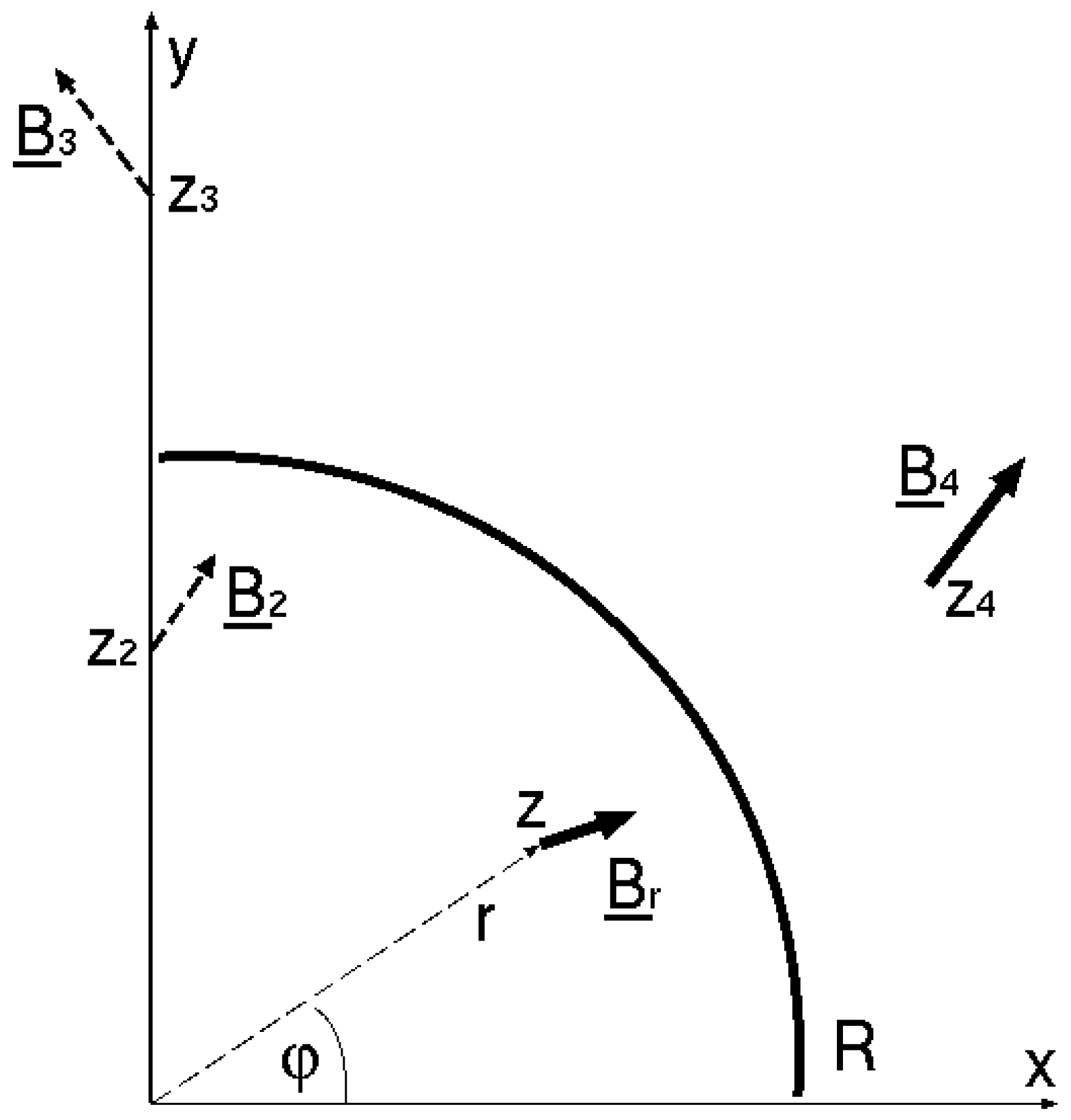
We now generalize the geometry to account for arbitrary positions of the original dipole inside the cylinder at z = x + i y = r e i φ , such as the dipole labeled B ̲ r in Figure 3. In order to determine its image, we first rotate it by the angle π / 2 φ to lie on the imaginary axis at z 2 , where it becomes B ̲ 2 = e i ( π / 2 φ ) B ̲ r . Applying the procedure from the previous paragraph, we obtain its image
B ̲ 3 = R 2 r 2 B ̲ 2 = R 2 r 2 e i ( π / 2 φ ) B ̲ r
at z 3 . Rotating back with angle ( π / 2 φ ) we finally obtain the image B ̲ 4 , located at z 4 = R 2 / z
B ̲ 4 = e i ( π / 2 φ ) R 2 r 2 e i ( π / 2 φ ) B ̲ r = R 2 e i π r 2 e 2 i φ B ̲ r = R 2 z 2 B ̲ r   ,
where z = x i y is the complex conjugate of the original dipole’s location. Finding the image thus requires scaling with ( R / z ) 2 and taking the complex conjugate of the original dipole B ̲ r .

3. Shielded Continuously Rotating Multipole Ring

We now proceed to calculate the field and its multipole contents at the center of the cylinder created by the the permanent-magnet material and its images. Adding the images caused by a cylindrical enclosure to Equation (1), we obtain
B ̲ ( z ^ ) = 1 2 π Ω B ̲ r ( z ^ z ) 2 + R 2 z 2 B ̲ r ( z ^ R 2 / z ) 2 d x d y   .
Using the identity
1 ( z ^ z ) 2 = d d z 1 z ^ z = d d z m = 0 z ^ m z m + 1 = m = 0 ( m + 1 ) z ^ m z m + 2
we rewrite Equation (4) as a multipole expansion around the origin
B ̲ ( z ^ ) = 1 2 π Ω d x d y m = 0 ( m + 1 ) B ̲ r z m + 2 + R 2 z 2 ( m + 1 ) B ̲ r ( R 2 / z ) m + 2 z ^ m = m = 0 m + 1 2 π Ω d x d y B ̲ r z m + 2 + B ̲ r R 2 m + 2 ( z ) m z ^ m   .
Introducing cylindrical coordinates with z = x + i y = r e i φ and d x d y = r d r d φ we arrive at
B ̲ ( z ^ ) = m = 0 m + 1 2 π r i r o d r 0 2 π d φ B ̲ r r m + 1 e i ( m + 2 ) φ + B ̲ r R 2 m + 2 r m + 1 e i m φ z ^ m   ,
where we assume that the magnetic material extends from inner radius r i to outer radius r o .
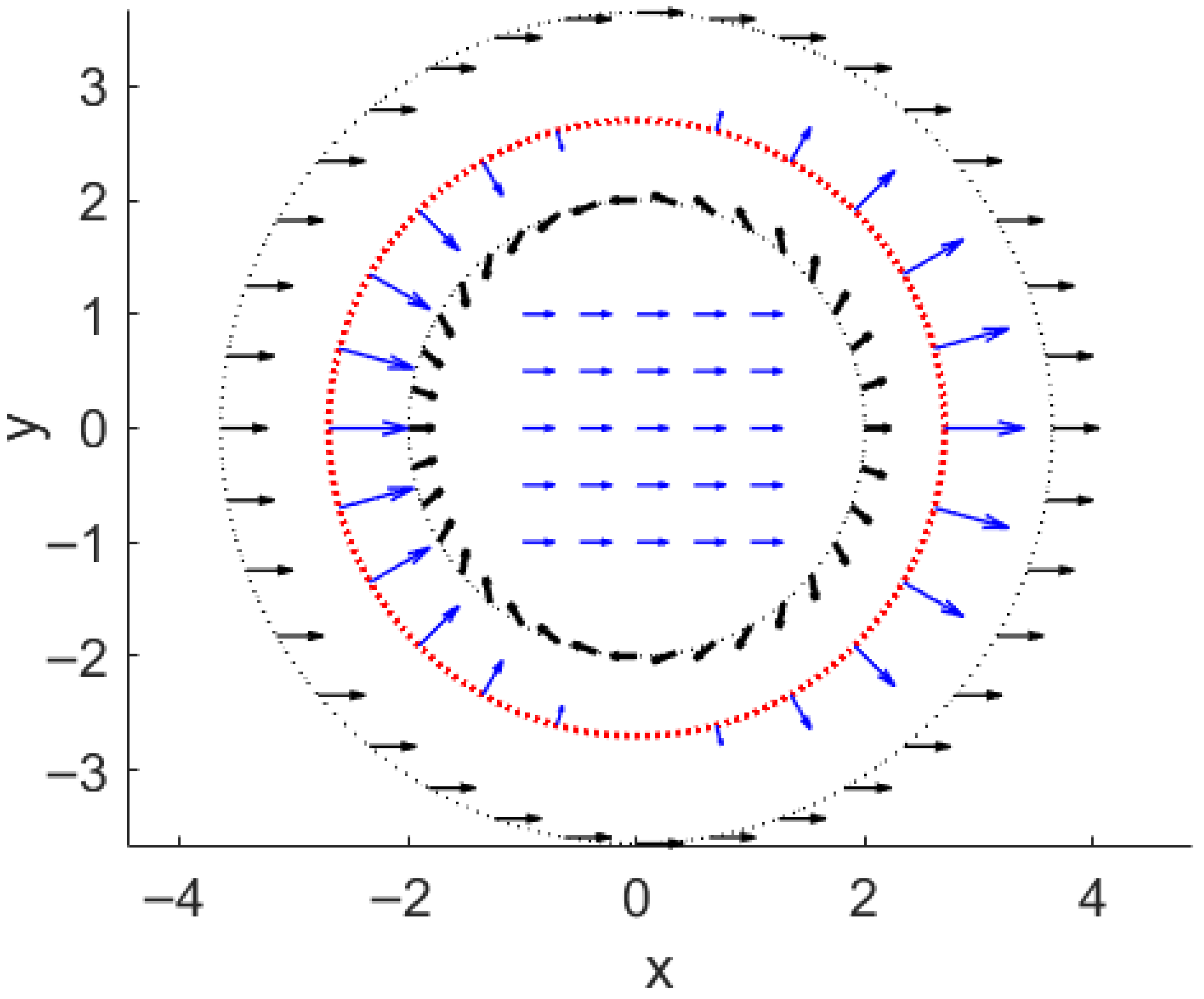
The multipolarity is determined by the tumbling factor k that specifies how often the easy axis of the permanent-magnet material rotates as a function of the azimuthal angle φ . For example, dipoles have k = 2 and quadrupoles have k = 3 . The easy axis is thus given by B ̲ r = B r e i k φ . Here B r = | B r | e i ψ describes the magnitude and direction of the permanent-magnet material at the positive horizontal axis at φ = 0 . As an aside note, in Figure 4 the easy axis points along the horizontal axis, which makes ψ = 0 . Without this restriction Equation (7) then leads to
B ̲ ( z ^ ) = | B r | m = 0 m + 1 2 π r i r o d r 0 2 π d φ × e i ψ 1 r m + 1 e i ( k m 2 ) φ + e i ψ r m + 1 R m + 2 e i ( k + m ) φ z ^ m   ,
where the first term in the square brackets denotes the field created by the original dipoles already derived in [16] and the second term describes the contribution from the image fields. Note that integral over d φ of the first term in the square bracket vanishes unless k = m + 2 , which provides a motivation of the tumbling factor k. In particular, for a dipole with m = 0 , only k = 2 gives a non-zero contribution. We also need to point out that magnets with a continuously rotating easy axis are a mathematical idealization; they cannot be manufactured in reality. Finally, we observe that, due the high symmetry of the problem, the second term in the square bracket always vanishes, because integrating e i ( k + m ) φ between zero and 2 π vanishes for all tumbling factors k > 0 .
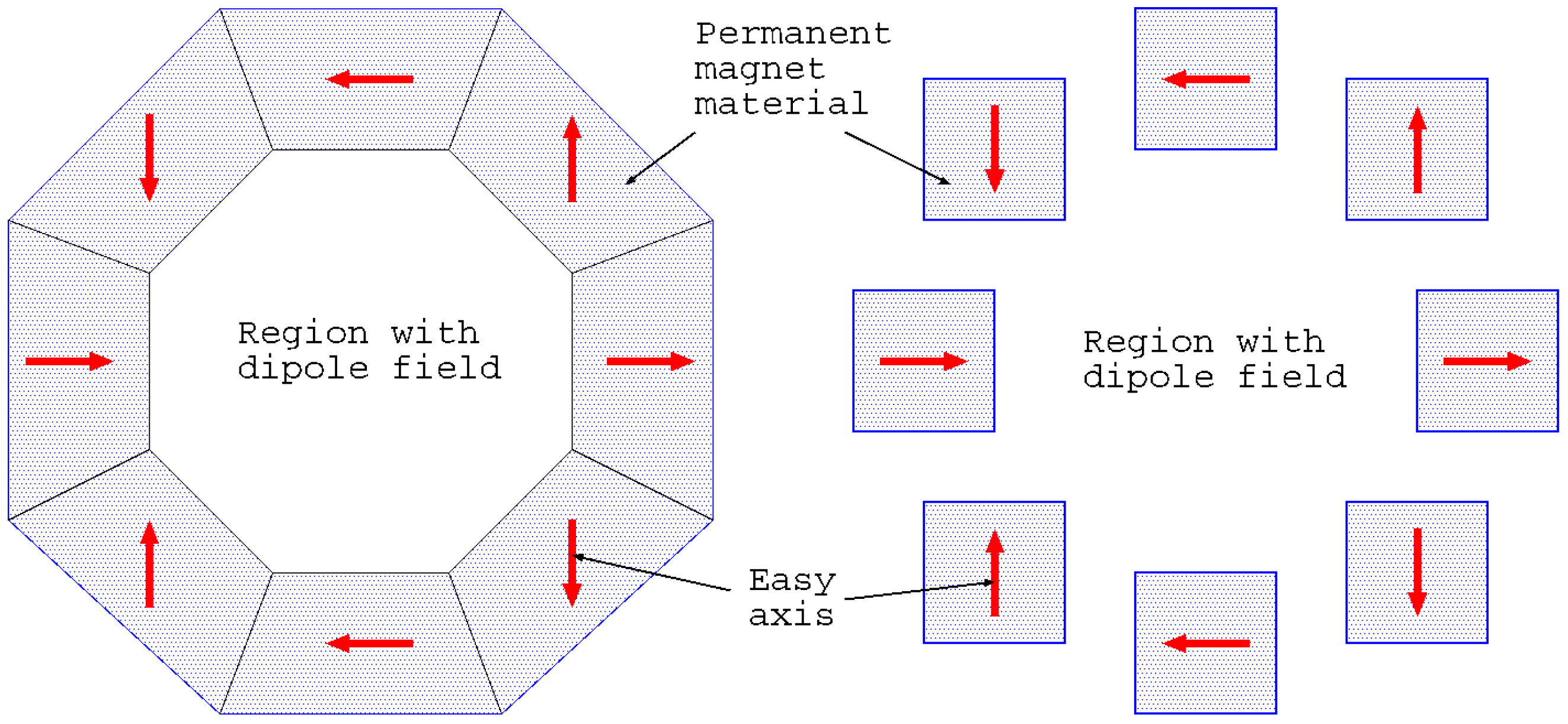
In order to analyze this surprising observation, we consider the simple magnet with continuously rotating dipoles and k = 2 in Figure 4, where the original dipoles are placed on the inner ring denoted by black dots. Note how the dipoles rotate twice along the ring. The shielding is shown as the red dotted line slightly outside of the original dipoles. The image dipoles, calculated from Equation (3), are shown on the outer dotted ring, where for k = 2 they always point to the right. We verify that the sum of the original and the image fields is always normal on the shielding, which is shown by the superimposed blue arrows. We also calculate the magnetic field inside the cylindrical shielding, which is shown by the right-pointing arrows near the center. Moreover, inspecting the numerical values shows that the contribution from the images to the field on the inside is negligible.
We conclude that for a continuously varying dipole field shielding the magnet will not affect the magnetic field on the inside. But what about segmented magnets?

4. Shielded and Segmented Multipoles

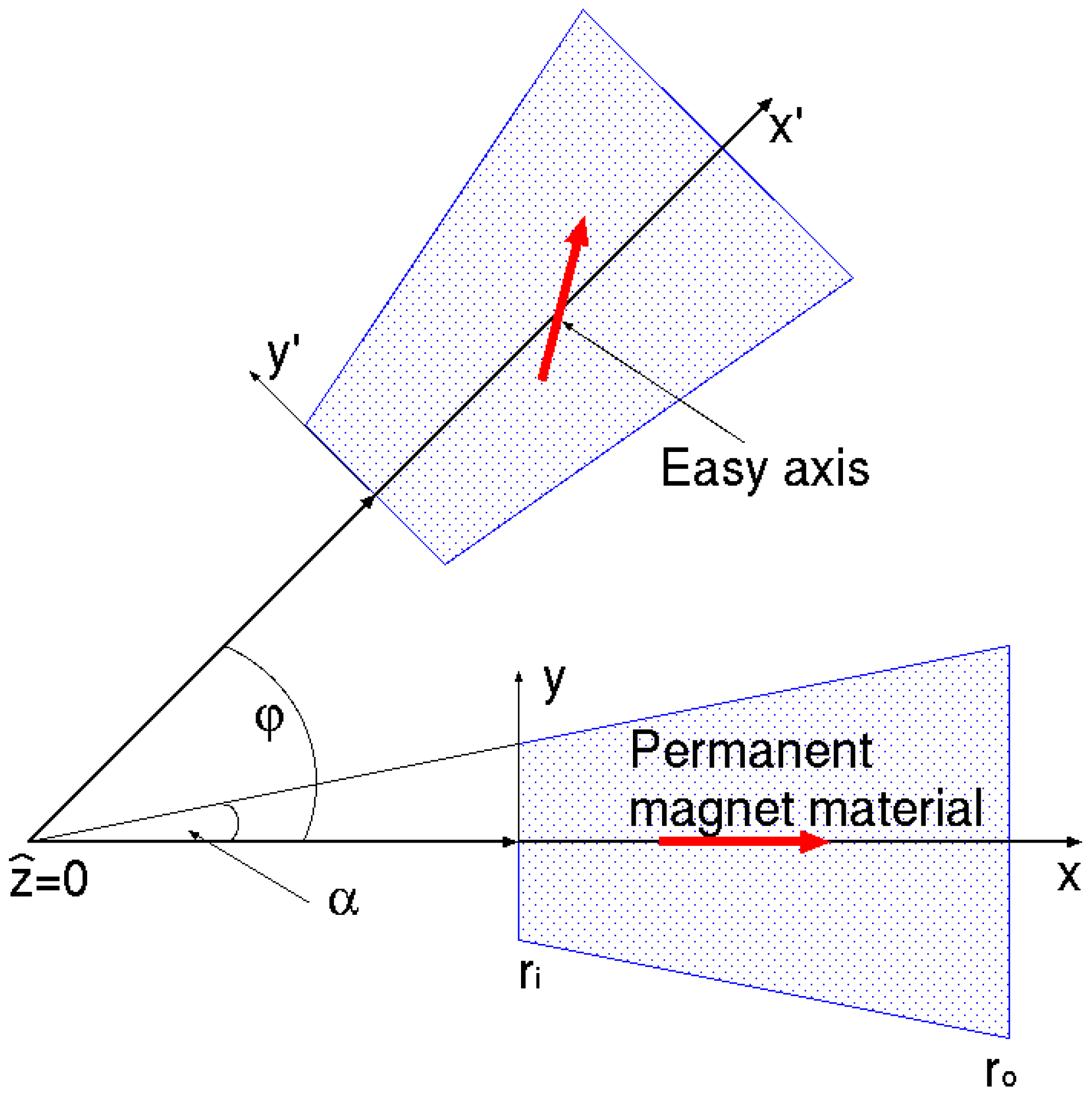
Figure 5 shows two of the segments that are part of a full multipole. We start by calculating the contribution of the field B ̲ of the segment that is lying on the horizontal axis to the multipoles around z ^ = 0 . Rewriting Equation (6) leads to
B ̲ ( z ^ ) = m = 0 m + 1 2 π B ̲ r I m + B ̲ r J m z ^ m   ,
where B ̲ r describes the easy axis of the segment on the horizontal axis. The integrals I m and J m are defined by
I m = Ω d x d y z m + 2 and J m = 1 R 2 m + 2 Ω z m d x d y   ,
where I m describes the contribution of the “real” permanent magnets and J m that of their images. We calculate these integrals by suitably parameterizing the trapezoidal region Ω using the notation introduced in Figure 5, which gives us
I m = r i r o d x x tan α x tan α d y ( x + i y ) m + 2 = i m + 1 r i r o d x x m + 1 1 ( 1 + i tan α ) m + 1 1 ( 1 i tan α ) m + 1 = 2 m + 1 ( cos α ) m + 1 sin ( ( m + 1 ) α ) G m ( r i , r o )   ,
where we introduce the abbreviation G m ( r i , r o ) by
G m ( r i , r o ) = r i r o d x x m + 1 = log ( r o / r i ) for   m = 0 1 m 1 r i m 1 r o m otherwise .
For the contribution of the image fields we evaluate J m and obtain
J m = 1 R 2 m + 2 r i r o d x x tan α x tan α ( x i y ) m d y = i R 2 m + 2 ( m + 1 ) ( 1 i tan α ) m + 1 ( 1 + i tan α ) m + 1 r i r o x m + 1 d x = 2 sin ( ( m + 1 ) α ) ( m + 1 ) ( m + 2 ) ( cos α ) m + 1 H m ( r i , r o , R )
with
H m ( r i , r o , R ) = 1 R 2 m + 2 r i r o x m + 1 d x = r o m + 2 r i m + 2 R 2 m + 2   .
Note that H m scales inversely with a rather high power of R, namely R 2 m + 2 . Moreover, we have to keep in mind that for a magnet composed of M segments 2 α = 2 π / M . After inserting I m and J m in Equation (9) we finally obtain
B ̲ ( z ^ ) = m = 0 B ̲ r g m ( α ) G m ( r i , r o ) + B ̲ r h m ( α ) H m ( r i , r o , R ) z ^ m
with
g m ( α ) = 1 π ( cos α ) m + 1 sin ( ( m + 1 ) α ) h m ( α ) = sin ( ( m + 1 ) α ) π ( m + 2 ) ( cos α ) m + 1
for the multipole coefficients generated by a single segment.
In the next step we have to add the contributions of the M segments by noting that each segment j with 0 j M 1 is rotated by an angle φ = 2 π j / M with respect to the one lying on the horizontal axis. This changes the integration variable from z to z = x + i y = e i φ ( x + i y ) = e i φ z . Moreover, the angle of the easy axis changes by k φ . Thus we can add up contributions from the segments by ornamenting the easy axis B ̲ r and B ̲ r in Equation (9) and the integrals I m and J m from Equations (11) and (13) with appropriate phase factors to obtain for the field due to all segments
B ̲ ( z ^ ) = m = 0 B ̲ r g m ( α ) G ( r i , r o ) j = 0 M 1 e 2 π i ( k m 2 ) j / M + B ̲ r h m ( α ) H ( r i , r o , R ) j = 0 M 1 e 2 π i ( m k ) j / M z ^ m   .
The first sum with the exponential factors vanishes unless the k m 2 is a multiple of M, or m = k 2 + ν M for some integer ν in which case the sum evaluates to M. Likewise, the second sum vanishes unless m k is a multiple of M, or m = k + ν M . This allows us to write the field from all segments as
B ̲ ( z ^ ) = M m = 0 ν = 0 B ̲ r g m ( α ) G m ( r i , r o ) δ m , k 2 + ν M + B ̲ r h m ( α ) H m ( r i , r o , R ) δ m , k + ν M z ^ m   ,
where g m ( α ) and h m ( α ) are defined in Equation (16), G m ( r i , r o ) in Equation (12), and H m ( r i , r o , R ) in Equation (14). The second term in the curly brackets describes the image fields. For a dipole with k = 2 the first multipole due to the image fields has multipolarity m = k ; it is thus sextupolar. On the other hand, considering the first term in the square brackets, the first spurious multipole that arises from assembling the magnet from discrete blocks has multipolarity m given by m = k 2 + M . For an eight-magnet dipole with tumbling factor k = 2 the first spurious multipolarity is m = 8 , which is of higher order than the contribution from the image fields. As a corollary, we deduce that increasing the number of magnets M pushes the first spurious multipole to an ever higher order. It vanishes in the limit of M , which defines the magnet with the continuously rotating easy axis already discussed in Section 3.
As an illustration we consider a dipole magnet ( k = 2 ) made of M = 8 segments, whose inner radius r i is 10 mm and whose outer radius r o is 20 mm. We assume that the shielding cylinder has a radius of R = 22 mm. The main contribution comes from the first term in Equation (18) for m = 0 , in which case g m ( α ) = 0.115 with α = π / M and G m ( r i , r o ) = log ( 2 ) . The first term—the dipole—is constant and has magnitude 0.62 B ̲ r . The smallest non-zero second term is for m = k = 2 , which describes a sextupole. Its magnitude at a radius | z ^ | = r i / 2 becomes M h 2 ( α ) H ( r i , r o , R ) B ̲ r ( r i / 2 ) 2 0.025 B ̲ r or about 4% of the dipole component.
For quadrupole magnets ( k = 3 ) made of M = 8 magnets and otherwise the same geometry as the dipole from the previous paragraph, we find that the direct field from the “real” permanent magnets at radius | z ^ | = r i / 2 has magnitude 0.38 B ̲ r , whereas the first contribution (octupolar) of the image fields is 0.005 B ̲ r , or a little over 1% of the quadrupole component.

5. Shielded Multipoles Made of Permanent-Magnet Cubes

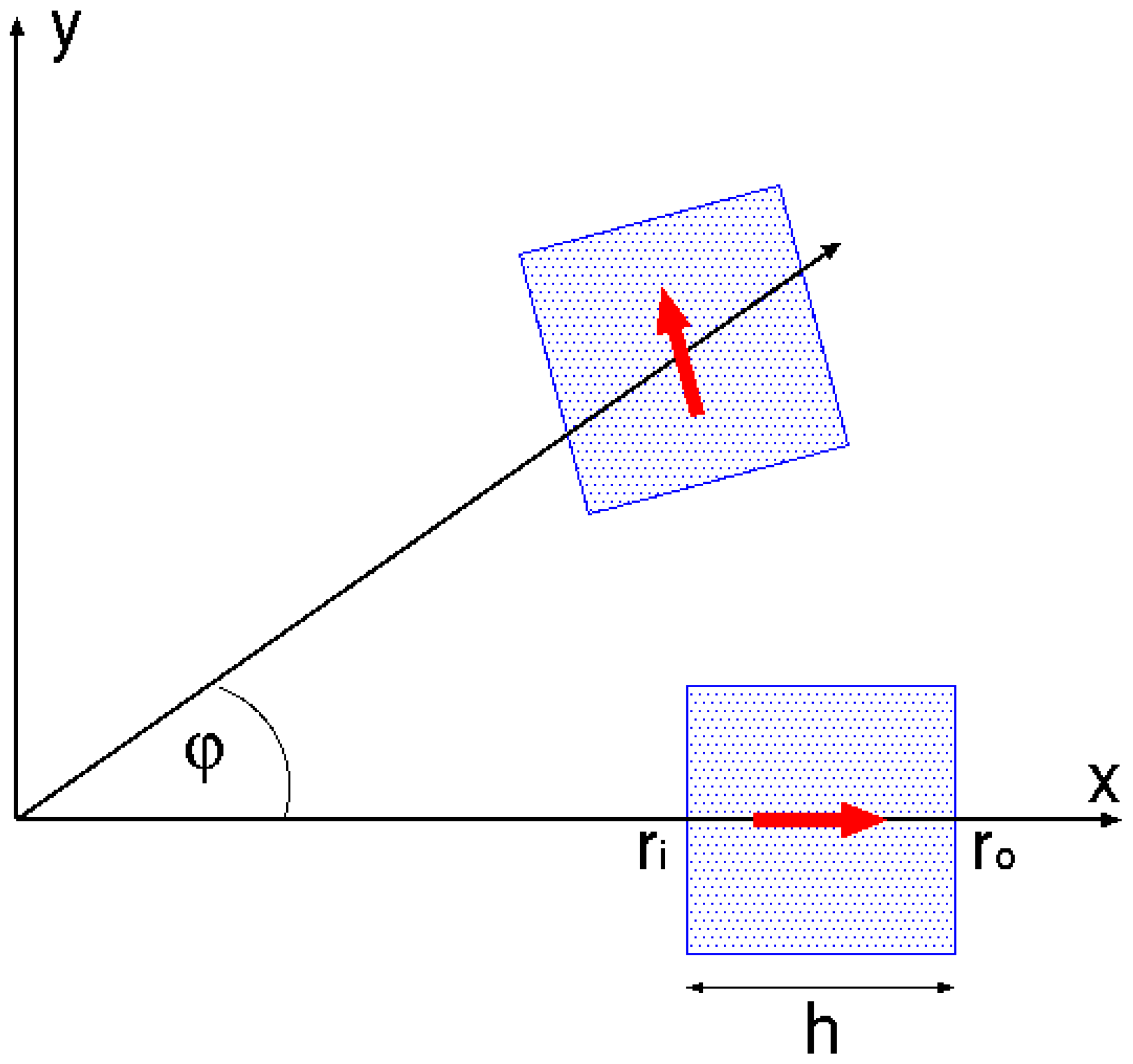
Permanent-magnet cubes are easier to find and less expensive than the trapezoidal segments used in Section 4. We therefore analyze how shielding affects multipoles that are constructed of cubes [23,25]. The right-hand side in Figure 6 illustrates such a magnet that generates a purely horizontal magnetic field. We calculate the field from Equations (9) and (10) after adapting the integration region Ω to reflect the cubic shape shown in Figure 7. The first integral I m then becomes
I m = r i r o d x h / 2 h / 2 d y ( x + i y ) m + 2 = i m + 1 r i r o 1 ( x + i h / 2 ) m + 1 1 ( x i h / 2 ) m + 1 d x   .
For m = 0 the integral leads to
I 0 = h r i r o d x x 2 + h 2 / 4 = 2 arctan ( 2 r o / h ) 2 arctan ( 2 r i / h ) = 2 arctan ( h 2 / 2 r ¯ 2 )   ,
where we introduce r ¯ = ( r o + r i ) / 2 and use the identity arctan x arctan y = arctan ( ( x y ) / ( 1 + x y ) ) in order to simplify the last equality. For m = 1 the integral becomes
I 1 = h 2 1 r o 2 + h 2 / 4 1 r i 2 + h 2 / 4 = h 2 r ¯ r ¯ 4 + h 4 / 4   .
For general m > 0 we perform the integral over x and then introduce the abbreviations
ρ o 2 = r o 2 + h 2 / 4 ρ i 2 = r i 2 + h 2 / 4 β o = arctan ( h / 2 r o ) β i = arctan ( h / 2 r i )   .
This allows us to express r o ± i h / 2 = ρ o e ± i β o and r i ± i h / 2 = ρ i e ± i β i and turn Equation (19) into
I m = i m ( m + 1 ) 1 ( r o + i h / 2 ) m 1 ( r i + i h / 2 ) m 1 ( r o i h / 2 ) m + 1 ( r i i h / 2 ) m = i m ( m + 1 ) e i m β o e i m β o ρ o m e i m β i e i m β i ρ i m = 2 m ( m + 1 ) sin ( m β i ) ρ i m sin ( m β o ) ρ o m   .
For cubic magnets the integral J m corresponding to Equation (13) becomes
J m = 1 R 2 m + 2 r i r o d x h / 2 h / 2 ( x i y ) m d y = i ( m + 1 ) R 2 m + 2 r i r o ( x + i h / 2 ) m + 1 ( x i h / 2 ) m + 1 d x = 2 ( m + 1 ) ( m + 2 ) ρ o m + 2 R 2 m + 2 sin ( ( m + 2 ) β o ) ρ i m + 2 R 2 m + 2 sin ( ( m + 2 ) β i )   ,
where ρ o , ρ i , β o , and β i are defined in Equation (22). As before, the contribution of the image field scales inversely with R 2 m + 2 .
Adding the fields from M cubes with their appropriate rotations progresses in much the same way as in the previous section. The easy axis of B ̲ r rotates by e 2 π i k j / M and the powers z by e 2 π i j / M for cube number j with 0 j M 1 . Again, the sum of the M permanent-magnet cubes becomes zero except for multipoles m = k 2 + ν M and for multipoles m = k + ν M for the image fields. Only the numerical factors differ from those in Section 4; for the cubes the field thus becomes
B ̲ ( z ^ ) = M m = 0 ν = 0 m + 1 2 π B ̲ r I m δ m , k 2 + ν M + B ̲ r J m δ m , k + ν M z ^ m   ,
with I m from Equation (20) or (23) and J m from Equation (24).
For a dipole with tumbling factor k = 2 the direct field from the cubes generates multipoles m = ν M and the image fields generate multipoles m = 2 + ν M , such that the two lowest-order contributions are the dipole field m = 0 from the cubes and m = 2 from the images. The fields are thus given by
B ̲ ( z ^ ) M 2 π B ̲ r I 0 + B ̲ r J 2 z ^ 2 = M π B ̲ r arctan ( h 2 / 2 r ¯ 2 ) + B ̲ r ρ o 4 4 R 6 sin ( 4 β o ) ρ i 4 4 R 6 sin ( 4 β i ) z ^ 2   .
Notably, the image fields decrease with the sixth power of the radius R of the shielding. Increasing R therefore efficiently helps to reduce the unwanted sextupole component. We refrain from discussing numerical examples, because they are similar to those of segmented magnets from Section 4.

6. Conclusions and Outlook

From expressions for the image dipoles outside a magnetically shielding cylinder, we calculated the additional multipole components they cause in Halbach-type multipoles. These additional fields are typically rather small, which can be already expected from the perfect cancellation of the additional fields for an idealized multipole with a continuously rotating easy axis (Section 3). But even for segmented or cube-based magnets, the additional fields are small and are attenuated at least by a factor ( r ~ / R ) 6 for dipoles and ( r ~ / R ) 8 for quadrupoles. Here r ~ typically is the outer radius of the permanent-magnet material. Making the shielding cylinder even a little larger thus reduces the additional fields substantially. The multipolarity m of the additional fields is given by m = k + ν M where k = 2 for dipoles and k = 3 for quadrupoles. M is the number of segments or cubes.
In general, Equations (18) and (25) can be used to calculate the multipolarity and the magnitude of the additional fields. Overall, we find that the shielding has a small influence on the field quality in Halbach-type multipoles.
On the other hand, the methodology employed and the mathematical machinery might become useful for other magnetic systems, especially in magnet assemblies with tight constraints on the available space that must be shielded. Calculating the magnetic field perturbations analytically will provide a rapid assessment of the trade-off between the field quality and the additional space for shielding.
We need, however, to point out that the assumption of infinite-permeability shielding, which is implicit when using image fields, is a limitation that can only be overcome with numerical simulations.
This work was produced in part by Jefferson Science Associates, LLC, under Contract No. AC05-06OR23177 with the U.S. Department of Energy. The publisher acknowledges the U.S. Government license and provides public access under the DOE Public Access Plan http://energy.gov/downloads/doe-public-access-plan (accessed on 16 April 2026).

Funding

This work was produced in part by Jefferson Science Associates, LLC, under Contract No. AC05-06OR23177 with the U.S. Department of Energy.

Data Availability Statement

The original contributions presented in this study are included in the article. Further inquiries can be directed to the corresponding author.

Conflicts of Interest

The funding sponsors had no role in the design of the study; in the collection, analyses, or interpretation of data; in the writing of the manuscript, and in the decision to publish the results. The author declares no conflicts of interest.

References

  1. Ding, N.; Cui, S.; Liu, C.; Duan, J.; Jiang, S. Review of Permanent Magnet Lifting Technology. J. Phys. 2020, 1635, 012057. [Google Scholar] [CrossRef]
  2. Prasad, N.; Jain, S.; Gupta, S. Electrical Components of Maglev Systems: Emerging Trends. Urban Rail Transit 2019, 5, 67. [Google Scholar] [CrossRef]
  3. Birss, R.; Gerber, R.; Parker, M.; Sheere, T. Laminar flow model of particle capture of axial magnetic filters. IEEE Trans. Magn. 1978, 14, 1165. [Google Scholar] [CrossRef]
  4. Kluyskens, V.; Dehez, B. Dynamical electromechanical model for passive magnetic bearings. IEEE Trans. Magn. 2007, 43, 3287. [Google Scholar] [CrossRef]
  5. Flemming, F. Friction and magnetism, Basics of Electromagnetic Clutches and Brakes. Mach. Des. 2009, 55–58. [Google Scholar]
  6. Rabinovici, R. Magnetic field analysis of permanent magnet motors. IEEE Trans. Magn. 1996, 32, 265. [Google Scholar] [CrossRef]
  7. Hanrahan, D.; Toffolo, D. Permanent Magnet Generators, Part 1–Theory. Trans. Am. Inst. Electr. Eng. 1957, 76, 1098. [Google Scholar] [CrossRef]
  8. Seo, D.; Kim, B.; Ha, M.; Han, S.; Yoon, S.; Cho, B. Energy harvesting with magneto-mechano-electric harvester for AC circular magnetic fields. Sens. Actuators Phys. 2025, 387, 116422. [Google Scholar] [CrossRef]
  9. Coey, J. Permanent magnet applications. J. Magn. Magn. Mater. 2002, 248, 441. [Google Scholar] [CrossRef]
  10. Chonlathep, K.; Sakamoto, T.; Sugahara, K.; Kondo, Y. A simple and low-cost permanent magnet system for NMR. J. Magn. Reson. 2017, 275, 114. [Google Scholar] [CrossRef] [PubMed]
  11. Volk, J. Experiences with permanent magnets at the Fermilab recycler ring. J. Instrum. 2011, 6, T08003. [Google Scholar] [CrossRef]
  12. Bartnik, A.; Banerjee, N.; Burke, D.; Crittenden, J.; Deitrick, K.; Dobbins, J.; Gulliford, C.; Hoffstaetter, G.H.; Li, Y.; Lou, W.; et al. CBETA: First Multipass Superconducting Linear Accelerator with Energy Recovery. Phys. Rev. Lett. 2020, 125, 044803. [Google Scholar] [CrossRef] [PubMed]
  13. Watanabe, T.; Taniuchi, T.; Takano, S.; Aoki, T.; Fukami, K. Permanent magnet based dipole magnets for next generation light sources. Phys. Rev. Accel. Beams 2017, 20, 072401. [Google Scholar] [CrossRef]
  14. Streun, A. SLS 2.0, The Upgrade of the Swiss Light Source. In Proceedings of the IPAC 2022, Bangkok, Thailand, 12–17 June 2022; p. 925. [Google Scholar]
  15. Steinberg, A.; Appleby, R.; Yap, J.; Sheehy, S. Design of a large energy acceptance beamline using fixed field accelerator optics. Phys. Rev. Accel. Beams 2024, 27, 071601. [Google Scholar] [CrossRef]
  16. Halbach, K. Design of Permanent Multipole Magnets with Oriented Rare Earth Cobald Magnets. Nucl. Instrum. Methods 1980, 169, 1. [Google Scholar] [CrossRef]
  17. Rehberg, I.; Blümler, P. Analytic approach to creating homogeneous fields with finite-size magnets. Phys. Rev. Appl. 2025, 23, 064029. [Google Scholar] [CrossRef]
  18. Jackson, J. Classical Electrodynamics, 2nd ed.; Wiley: New York, NY, USA, 1975. [Google Scholar]
  19. OPERA Software. Available online: https://www.3ds.com/products-services/simulia/products/opera/ (accessed on 16 April 2026).
  20. Ellaume, P.; Chubar, O.; Chavanne, K. Computing 3D magnetic fields from insertion devices. In Proceedings of the Particle Accelerator Conference, Vancouver, BC, Canada, 12–16 May 1997; p. 3509. [Google Scholar]
  21. Scheer, M. UNDUMAG—A new computer code to calculate the magnetic properties of undulators. In Proceedings of the IPAC2017, Copenhagen, Denmark, 14–19 May 2017; p. 3071. [Google Scholar]
  22. Levinson, N.; Redheffer, R. Complex Variables; Holden Day: San Francisco, CA, USA, 1970. [Google Scholar]
  23. Ziemann, V. Hands-On Accelerator Physics Using MATLAB, 2nd ed.; Especially Sections 4.2 and 4.5; CRC Press: Boca Raton, FL, USA, 2025. [Google Scholar]
  24. Plonesy, R. Current dipole images and reference potentials. IEEE Trans. Bio-Med. Electron. 1963, 10, 3. [Google Scholar] [CrossRef] [PubMed]
  25. Ziemann, V. Strap-on magnets: A framework for rapid prototyping of magnets and beam lines. Instruments 2021, 5, 36. [Google Scholar] [CrossRef]
Figure 1. The geometry with the domain Ω containing permanent-magnet material with permanent field B ̲ r and the field B ̲ that it creates at position z ^ .
Magnetism 06 00016 g001
Figure 2. Dipole images of a plane (left) and a cylindrical surface (right). The black arrows denote the dipole and the red arrows show the field intensity and direction.
Magnetism 06 00016 g002
Figure 3. The image dipole at z 4 is constructed by first rotating the original dipole B ̲ r from z to the imaginary axis at z 2 , followed by scaling its magnitude with ( R / r ) 2 , complex conjugating it, and moving it to z 3 . Finally the dipole is rotated back and arrives at z 4 . See the text for further explanations.
Magnetism 06 00016 g003
Figure 4. The original dipoles are visualized by the arrows on the inner dotted black circle. They rotate twice as one goes along the circle, consistent with a tumbling factor of k = 2 . The shielding is shown as the red circle, whereas the image dipoles calculated from Equation (3) are located further outside and are also given by black arrows. The blue arrows on the shielding are calculated by adding the field from all dipoles, weighted by the Green’s function G ( z ^ , z ) , on the shielding.
Magnetism 06 00016 g004
Figure 5. Two segments of a segmented multipole that extends radially from r i to r o . Each segment has an azimuthal width, given by 2 α . Note the orientation of the easy axis, determined by the tumbling factor k, changes from segment to segment.
Magnetism 06 00016 g005
Figure 6. Segmented dipole (left) and a dipole made of permanent-magnet cubes (right).
Magnetism 06 00016 g006
Figure 7. Geometry with variables used to calculate the fields of a permanent-magnet multipole composed of cubes.
Magnetism 06 00016 g007
Disclaimer/Publisher’s Note: The statements, opinions and data contained in all publications are solely those of the individual author(s) and contributor(s) and not of MDPI and/or the editor(s). MDPI and/or the editor(s) disclaim responsibility for any injury to people or property resulting from any ideas, methods, instructions or products referred to in the content.