
Article

Analog Circuit Simplification of a Chaotic Hopfield Neural Network Based on the Shil’nikov’s Theorem


by
Diego S. de la Vega
,
Lizbeth Vargas-Cabrera
,
Olga G. Félix-Beltrán
and
Jesus M. Munoz-Pacheco
*
Faculty of Electronics Sciences, Benemérita Universidad Autónoma de Puebla, Av. San Claudio y 18 Sur, Puebla 72570, Puebla, Mexico
*
Author to whom correspondence should be addressed.
Dynamics 2026, 6(1), 1; https://doi.org/10.3390/dynamics6010001
Submission received: 17 November 2025 / Revised: 20 December 2025 / Accepted: 25 December 2025 / Published: 1 January 2026

Abstract

Circuit implementation is a widely accepted method for validating theoretical insights observed in chaotic systems. It also serves as a basis for numerous chaos-based engineering applications, including data encryption, random number generation, secure communication, neuromorphic computing, and so forth. To get feasible, compact, and cost-effective circuit implementations of chaotic systems, the underlying mathematical model may be simplified while preserving all rich nonlinear behaviors. In this framework, this manuscript presents a simplified Hopfield Neural Network (HNN) capable of generating a broad spectrum of complex behaviors using a minimal number of electronic elements. Based on Shil’nikov’s theorem for heteroclinic orbits, the number of non-zero synaptic connections in the matrix weights is reduced, while simultaneously using only one nonlinear activation function. As a result of these simplifications, we obtain the most compact electronic implementation of a tri-neuron HNN with the lowest component count but retaining complex dynamics. Comprehensive theoretical and numerical analyses by equilibrium points, density-colored continuation diagrams, basin of attraction, and Lyapunov exponents, confirm the presence of periodic oscillations, spiking, bursting, and chaos. Such chaotic dynamics range from single-scroll chaotic attractors to double-scroll chaotic attractors, as well as coexisting attractors to transient chaos. A brief security application of an S-Box utilizing the presented HNN is also given. Finally, a physical implementation of the HNN is given to confirm the proposed approach. Experimental observations are in good agreement with numerical results, demonstrating the usefulness of the proposed approach.

1. Introduction

Behavioral emulation of biological systems remains a key area of interest in scientific research [1], for instance, in brain-inspired systems such as artificial neural networks (ANNs) [2]. Warren McCulloch and Walter Pitts proposed the first mathematical model of an ANN in 1943 [3]. Since then, multiple mathematical proposals have been developed. ANNs describe how neurons transmit electrical signals to solve complex cognitive tasks. ANNs with a unidirectional signal flow are called feed-forward. In contrast, those with bidirectional signal flow are called recurrent neural networks, such as Hopfield neural networks (HNNs), which improve the modeling of neural behavior [4]. In 1984, J. Hopfield introduced a fully connected neural network architecture with discrete behavior [5]. Next, this dynamical system was extended to a continuous-time HNN [6], termed CHNN herein. Due to its nonlinear activation functions, a large number of interacting neurons, and full connectivity, a CHNN can generate complex behaviors such as fixed points, p-periodic, quasiperiodic, chaotic, hyperchaotic, spiking, bursting, and multistability [7,8]. Also, it is well known that chaotic systems are fundamental to the development of diverse applications in science and engineering, ranging from fluid turbulence [9] and plasma physics [10] to electrical circuits [11], economic models [12], and even neural networks as shown in this work.
In particular, because we apply Shil’nikov’s theorem on heteroclinic orbits to optimize the matrix weights of CHNN while using only one nonlinear activation function, we present the theoretical background on Shil’nikov. After Lorenz discovered chaos in a simplified Rayleigh–Bénard convection in 1963 [13], a comprehensive mathematical framework was sought to explain the observed extreme sensitivity to tiny variations of initial conditions. Then, Shil’nikov’s theorem provided the first formal framework for chaotic motion, enunciating sufficient conditions for the emergence of chaos in three-dimensional continuous-flow systems [14]. Subsequently, many chaotic systems were discovered by applying Shil’nikov’s criteria. For example, the Lotka-Volterra predator-prey model [15,16], nonlinear-optical systems [17,18,19], atmospheric dynamics [20], chemical reactions [21,22,23], among others. Experimental realizations using laser and electronic technologies corroborated Shil’nikov’s theorem, demonstrating its applicability to physical systems [11,17,18,19,24]. Moreover, Shil’nikov’s theorem provided a boost to theories such as homoclinic orbits [25,26] and bifurcations [27,28], allowing the study of mixed-mode oscillations [29], wave traveling problem [30,31], and chaos synchronization [32]. It also laid the foundation for a formal proof of chaos in a double-scroll system [33]. However, recent work has introduced novel chaotic systems that operate outside the Shil’nikov paradigm, as they possess only stable equilibria [34,35] or are defined with fractional-order derivatives [36].
Additionally, homoclinic orbits and heteroclinic cycles remain among the most fundamental and actively investigated structures in nonlinear dynamical systems [37]. These invariant trajectories govern the interplay between local stability properties near equilibrium points and the global geometry of the flow, often serving as precursors to bifurcations, chaotic attractors, and intricate transition mechanisms [38]. As a result, substantial research efforts continue to focus on the analytical detection, persistence, and bifurcation of such orbits, especially through perturbative techniques such as the Melnikov method and its modern extensions [39,40]. Additionally, the physical validation of these phenomena has been extensively investigated through electronic and optical implementations [41,42]. For example, electronic circuit validation of the existence of homoclinic behavior in a universal oscillator [43], generation of Shil’nikov heteroclinic cycles in nonlinear electronic systems [44], emergence of chaotic motion originating in relaxation oscillator architectures [45], and non-transversality and reversible orbit-flip bifurcation [46]. Such electronic implementations form the basis of numerous chaos-based engineering applications, including secure communications [47], random number generation [7], neuromorphic and machine-learning hardware [48], and nonlinear control systems [49], among others.
In such scenarios, significant effort has been devoted to implementing chaotic systems by electronic devices. Among these implementations, chaotic CHNNs stand out as an essential class of dynamical systems because they combine the associative memory properties of neural networks with the unpredictability and complexity of chaos. Both analog and digital implementations of chaotic HNNs have been investigated. However, analog realizations are preferable because they enable real-time operation and do not suffer from dynamical degradation [50,51].
However, one of the bottlenecks of analog CHNN implementations is their form factor and the resulting bulky circuits. In this framework, simplifying CHNN is crucial for reducing hardware components while preserving their chaotic properties. Such simplifications not only facilitate analytical studies and numerical simulations but also generate efficient circuit implementations, making them more suitable for real-world applications. For instance, Chen et al. [52] proposed a ReLU-type CHNN with rich dynamics while reducing the number of analog components needed for implementation. Ref. [53] built a simplified Hopfield neural network based on a piecewise-linear memristor synapse using 13 operational amplifiers (OpAmps), 3 capacitors, 2 multipliers, and 31 resistors. In Ref. [50], a bineuron Hopfield neural network using the ReLU function instead of the hyperbolic tangent ( tanh ( · ) ) function as the activation function was proposed and implemented. They employed 6 OpAmps, 16 resistors, 2 capacitors, and 4 diodes. Ref. [52] presented an analog/digital circuit simplification for a ReLU-type Hopfield neural network with 6 OpAmps, 19 resistors, 3 capacitors, and 6 diodes. Ref. [54] introduced an analog implementation of a cascade tri-neuron Hopfield neural network with 12 OpAmps, 28 resistors, 3 capacitors, and 6 diodes. Finally, Ref. [51] designed an HNN based on a PWL function activation function using only 11 OpAmps, 29 resistors, and 3 capacitors. As observed, while the ReLU and PWL activation functions can reduce hardware complexity in CHNN, the component count remains somewhat elevated.
Motivated by these insights and based on Shil’nikov’s theorem [55], a simplified CHNN, capable of generating several complex behaviors using a minimal number of electronic elements, is proposed in this paper. Shil’nikov’s theorem establishes rigorous conditions under which a nonlinear system, a CHNN in this case, can exhibit complex dynamical behavior through the presence of homoclinic orbits associated with a saddle-focus equilibrium point [56].
More specifically, the contributions of this paper are as follows:
  • A theoretical approach to optimize the synaptic weights of a CHNN using Shil’nikov’s theorem is proposed.
  • To the best of the knowledge of the authors, this is the most compact analog implementation of a continuous-time tri-neuron Hopfield neural network, i.e., the number of electronic components and form factor are minimal with only 4 OpAmps, 10 resistors, and 3 capacitors.
  • Experimental observations of the chaotic behavior in a CHNN using low-cost off-the-shelf electronics components.
  • Theoretical, extensive numerical analyses, and physical experiments confirm the proposed approach.
The manuscript is organized as follows: Section 2 presents the mathematical model of a simplified continuous-time Hopfield neural network and provides a formal analysis based on Shil’nikov’s theorem, enabling the reduction of the number of nonzero weights and the design of activation functions with simple electronic equivalents. Section 3 gives a numerical investigation of the different dynamics of the simplified CHNN. By computing phase portraits, basins of attraction, equilibrium-point stability, continuation diagrams, and Largest Lyapunov Exponents, diverse and rich dynamics in the proposed CHNN are found. Section 4 shows the analog-circuit implementation of the simplified CHNN. A comparison between numerical and experimental results is also presented. Additionally, a brief example of a secure application is provided. Finally, Section 5 gives a conclusion.

2. The Simplified Hopfield Neural Network

The mathematical model of a Hopfield neural network in continuous-time (CHNN) with n neurons is defined by
d d t x = C x + W f ( x ) + b ,
which describes the set of differential equations
d x i d t = c i x i + j = 1 n w i j f j ( x j ) + b i ,
where x i denotes the membrane potential of the i-th neuron at any time t. The constant c i is a positive real number representing the decay or leakage. A constant w i j , called weight, reflects the influence of other neurons on the i-th neuron. While b i is an external input current. Finally, f j ( x j ) is the Activation Function (AF) applied to each neuron state. Substantial research has focused on designing AFs that adhere to biological constraints while optimizing some aspect of system behavior [57]. The primary objective of an AF is to determine whether the state of a neuron x R is active or inactive by evaluating two distinct values X D , X A where AF f : R A R satisfied lim x f j ( x j ) = X D and lim x f j ( x j ) = X A .
Typical AF in CHNN are bounded functions, for instance, the sign function [5], the hyperbolic tangent, and the sigmoid function [6], etc. Other CHNN use unbounded AFs such as linear transfer function [58], ReLU ( · ) [52], leaky ReLU ( · ) , Swish ( · ) [59], among others. Although there is no consensus for the properties of an AF, the following conditions are commonly imposed to ensure its suitability for modeling and training of CHNN:
  • f i is continuous in all R , ensuring the activation state of the neuron is always defined.
  • For all i = ( 1 , 2 , , n ) the AF limits lim x f i ( x ) = X D and lim x f i = X A then X D X A ; i.e., the AF value for the active or inactive state of a neuron is strictly distinct.
  • There exist some Lebesgue measurable set A R with m ( R A ) = 0 such that f i ( x ) exist for all x A . These criteria allow the nonlinear AF to be differentiable almost everywhere, enabling the use of gradient-based methods. Meaning, piecewise linear functions, such as ReLU ( · ) , can be introduced.
In this manner, we propose herein the following principles to reduce the number of electronic elements of a chaotic CHNN:
1.
Utilize only one nonlinear Activation Function (AF).
2.
Reduce the number of non-zero synaptic connections in the matrix weights.
3.
Obtain an irreducible CHNN system of dimension n = 3 .
4.
Design the most simplified electronic circuit of an AF.
Note that no external input current b i is considered, and all c i values are set to 1. The principles for CHNN design are presented as follows. First, to generalize the model and incorporate nonlinear behavior across all neurons, we define the following dimensionless system for the case n = 3 as
d x 1 d t = x 1 + w 11 f 1 ( x 1 ) + w 12 f 2 ( x 2 ) + w 13 f 3 ( x 3 ) , d x 2 d t = x 2 + w 21 f 1 ( x 1 ) + w 22 f 2 ( x 2 ) + w 23 f 3 ( x 3 ) , d x 3 d t = x 3 + w 31 f 1 ( x 1 ) + w 32 f 2 ( x 2 ) + w 33 f 3 ( x 3 ) ,
where f 1 , f 2 , f 3 : R R are the AFs designed according to the imposed constraints, stability requirements discussed in subsequent sections, and practical considerations for electronic circuit implementation. To simplify the proposed CHNN and reduce the number of nonzero synaptic weights, we introduce the following theory.
Lemma 1. 
Let f : R A R be a nonlinear function that satisfies all the imposed conditions of an AF the solution x ( t ) of the following differential equation
d x ( t ) d t = x ( t ) + a f ( x ( t ) ) , x ( 0 ) = x 0 .
is asymptotically stable if f ( x ( t ) ) x | x = x e < 1 a , where x e is a solution of the equation x e = a f ( x e ) .
Proof. 
Since f C we can expand the right hand side of Equation (4) through the Taylor expansion around x e as
d x ( t ) d t = x e + a f ( x e ) ( x ( t ) x e ) + a k = 1 1 k ! k f ( x ( t ) ) x k | x = x e ( x ( t ) x e ) k ,
since x e + a f ( x e ) = 0 the expression is reduced as follows
d x ( t ) d t = ( x ( t ) x e ) + a k = 1 1 k ! k f ( x ( t ) ) x k | x = x e ( x ( t ) x e ) k .
Note that the k 2 terms will be smaller around x e than the term with k = 1 , hence, a linearized system can be introduced as
d x ( t ) d t ( x ( t ) x e ) + a f ( x ( t ) ) x | x = x e ( x ( t ) x e ) ,
with a trivial solution
x ( t ) ( x 0 x e ) exp a f ( x ( t ) ) x | x = x e 1 t + x e ,
hence, the solution x ( t ) tends to x e as t if the following condition is satisfied
f ( x ( t ) ) x | x = x e < 1 a .
The proof is completed.    □
Theorem 1 
(Reducibility of the system). Consider the 3-dimensional CHNN described in Equation (3). If in the i-th equation it holds that w i , j = 0 , i j and the AF f i meet the condition f i ( x i ) x i < 1 w i i , x R then the system cannot be chaotic.
Proof. 
For any i = ( 1 , 2 , 3 ) let w i j = 0 , i j then the i-th differential equation have the next form
d x i d t = x i + w i i f i ( x i ) , x i ( 0 ) = x i 0 ,
since the resulting differential equation is continuous with respect to time and x i d x i d t = 1 + w i i f i x i is also continuous then the differential equation satisfy the conditions of the Picard-Lindelöf theorem and, as such, a unique solution exists. Since f i satisfies the condition of Lemma 1, then as t , the value of x i ( t ) tends to a fixed value and the system is reduced to a two-dimensional one. Now, we recall the Poincaré-Bendixson theorem, which implies that no second-order differential equation behaves chaotically. The proof is completed.    □
To address the second and third proposed principles, we use the result of Theorem 1 by setting w 11 = w 13 = w 21 = w 22 = 0 . Since none of the differential equations in the CHNN model has the form of Equation (5), the CHNN is irreducible to dimension two, and therefore, it can behave chaotically. On the other hand, in the literature, some chaotic systems have only one nonlinearity; thus, we propose that f 1 be a nonlinear AF and f 2 and f 3 be linear AFs [58]. As a result, we obtain the three-dimensional CHNN model described by
d x 1 d t = x 1 + w 12 I ( x 2 ) , d x 2 d t = x 2 + w 23 I ( x 3 ) , d x 3 d t = x 3 + w 31 ψ k ( x 1 ) + w 32 I ( x 2 ) + w 33 I ( x 3 ) ,
where I ( · ) is the linear AF I : R R , x x and ψ k : R R is a continuous nonlinear AF defined by
ψ k ( x 1 ) : = M e k x 1 1 e k x 1 + 1 ,
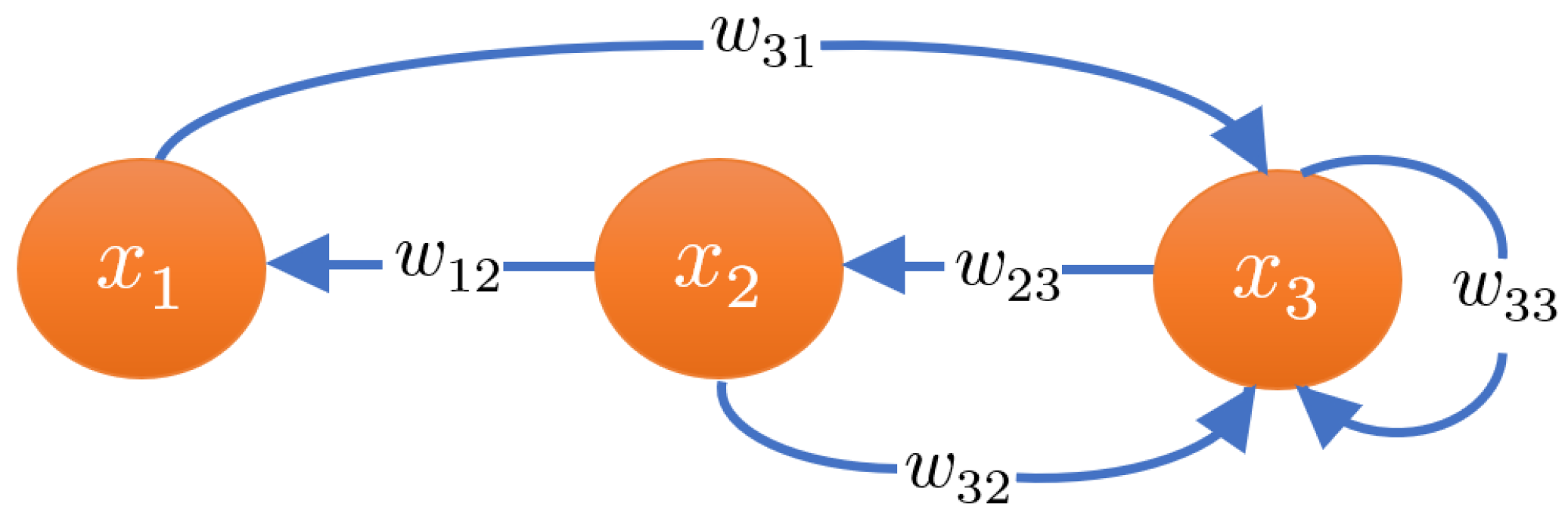
where k 1 denotes a gain factor which can be adjusted to induce Shil’nikov chaos in the CHNN model, M corresponds to the neuron state x 1 , i.e., active or inactive, and w 12 , w 23 , w 31 , w 32 , w 33 are the synaptic weights which needs to be optimized to generate chaos. Figure 1 shows the network topology of the proposed CHNN, which possesses one of the most straightforward topologies in the literature [7,50,60].

2.1. Dissipativity Analysis

The average rate of fractional volume contraction or expansion of the state space in a dynamical system, denoted by V ( t ) , characterizes its dissipative or conservative nature [61]. In dissipative systems, a negative average rate indicates the existence of a global bounded attractor in a finite region of the state space for some specific parameter space. In this case, V ( t ) of the CHNN (6) is given by 1 V ( t ) d V ( t ) d t = i = 0 3 x i d x i ( t ) d t , which yields
d V ( t ) d t = ( 3 + w 33 ) V ( t ) ,
whose solution is given by
V ( t ) = V ( 0 ) e ( 3 + w 33 ) t .
Then, the space state volume reduces to 0 as time goes to at a rate of 3 + w 33 . Hence, the CHNN (6) is uniformly dissipative and can guarantee the presence of a global attractor if w 33 < 3 .

2.2. Equilibrium Points

Let us recast the CHNN (6) as
d d t x = ξ ( x ) , t R ,
where the vector field ξ : R 3 R 3 is class C p . Now, the equilibrium points x * = ( x 1 * , x 2 * , x 3 * ) of CHNN (6) can be obtained by solving
x 1 * + w 12 x 2 * = 0 , x 2 * + w 23 x 3 * = 0 , ( w 33 1 ) x 3 * + w 32 x 2 * + w 31 ψ k ( x 1 * ) = 0 ,
with solutions
ψ k ( x 1 * ) = w 23 w 32 w 33 + 1 w 12 w 23 w 31 x 1 * ,
x 2 * = w 23 w 31 w 23 w 32 w 33 + 1 ψ k ( x 1 * ) ,
x 3 * = w 31 w 23 w 32 w 33 + 1 ψ k ( x 1 * ) .
From those equations, we found that the CHNN admits an equilibrium point (EP) whenever the linear expression w 23 w 32 w 33 + 1 w 12 w 23 w 31 x 1 * intersects the nonlinear AF ψ k ( x 1 * ) .

2.3. Stability Analysis

By denoting D ξ ( x * ) = ξ ( x ) x R 3 × 3 as the Jacobian with eigenvalues λ i where i = ( 1 , 2 , , n ) , an EP of the CHNN (6) is called hyperbolic saddle focus if the eigenvalues at x * has the form of
λ 1 = α 1 , λ 2 , 3 = α 2 ± j α 3 , α 1 α 2 < 0 ,
where α 1 , α 2 , α 3 R 0 . By using Sprott’s stability classification [62], the eigenvalues in Equation (15) can be hyperbolic saddle points of index 1 if α > 0 and index 2 for α 2 > 0 . This type of EP describes a trajectory with one or multiple unstable manifolds depending on the number of positive Re ( λ i ) values. Therefore, hyperbolic saddle points of index 2 have received considerable attention for chaos generation. In addition, one of the most important results in the theory of dynamical systems is Shil’nikov’s theorem for homoclinic and heteroclinic orbits [55], which can be stated as follows x :
Definition 1 
(and heteroclinic orbits). Consider x 1 * , x 2 * R n as two EPs of the system described by Equation (10). If the orbit H satisfy lim t x ( t ) = x 1 * and lim t x ( t ) = x 2 * then H is called heteroclinic. If x 1 * = x 2 * = x * then the orbit is called homoclinic based on x * [8].
Definition 2 
(Shil’nikov heteroclinic loop). Consider two hyperbolic saddle focus x 1 * , x 2 * R 3 of Equation (10). Assume there are heteroclinic connections x 1 * x 2 * and x 2 * x 1 * forming a heteroclinic loop, and the connections are transverse. Then, in a neighborhood of the loop, the associated Shil’nikov return map contains a countable family of Smale horseshoes; in particular, there exist chaotic invariant sets and infinitely many periodic orbits accumulating on the loop. Moreover, these features persist under sufficiently small C 1 perturbations.
It is important to remark that depending on the type of orbit, there are two formulations of Shil’nikov’s theorem [55], which are stated as follows.
Theorem 2 
(Shil’nikov’s homoclinic theorem). Consider x * an EP of the three dimensional system in Equation (10) generating an orbit H and assume the following conditions
1.
The point x * is a hyperbolic saddle focus that satisfies the Shil’nikov inequality
| α 1 |   >   | α 2 | .
2.
There is a homoclinic orbit based on x * .
Then
1.
In a neighborhood of this homoclinic orbit, the associated Shil’nikov return map contains a countable infinity of Smale horseshoes.
2.
For any sufficiently small C 1 -perturbation denoted δ of ξ the perturbed system
d x d t = δ ( x ) , x R 3 ,
has at least a finite number of Smale horseshoes in the discrete Shil’nikov map defined near the homoclinic orbit.
3.
The original and perturbed systems exhibit horseshoe chaos.
Theorem 3 
(Shil’nikov heteroclinic theorem). Consider two distinct EPs x 1 * , x 2 * R 3 of the system in Equation (10) generating an orbit H and assuming the following conditions.
1.
Both equilibrium points x 1 * and x 2 * are hyperbolic saddle focus that satisfy the Shil’nikov condition
| α 1 i |   >   | α 2 i |   >   0 ( i = 1 , 2 )
with the further constraint α 1 1 α 1 2 > 0 or α 2 1 α 2 2 > 0 .
2.
There is a heteroclinic loop H joining x 1 * and x 2 * that is constructed using two heteroclinic orbits H 1 and H 2 .
Then, results 1–3 of Theorem 2 are satisfied once more.
Based on Theorem 2 and Theorem 3, we can determine the synaptic weights in the simplified CHNN in Equation (6). To this end, we compute the Jacobian of the system as
D ξ ( x ) = 1 w 12 0 0 1 w 23 w 31 ψ k ( x 1 * ) x 1 w 23 1 + w 33 ,
whose eigenvalues at EP x * are found by
λ I d 3 × 3 D ξ ( x * ) = 0 ,
where I d 3 × 3 R 3 × 3 is the identity matrix. So, we have
( λ + 1 ) 3 w 33 ( λ + 1 ) 2 w 23 w 32 ( λ + 1 ) w 12 w 23 w 31 ψ k ( x 1 * ) x 1 = 0 .
By considering ψ k ( x 1 * ) x 1 = 0 , it yields
λ 1 = 1 , λ 2 , 3 = w 33 2 1 ± w 33 2 + 4 w 23 w 32 1 / 2 .
Therefore, the linearized CHNN around x * satisfy Shil’nikov’s inequality if
2 < w 33 < 4 , w 33 2 + 4 w 23 w 32 < 0 .
In addition, based on the dissipativity analysis in Section 2.1, the previous inequalities can be further constrained as
2 < w 33 < 3 , w 23 w 32 < 1 .
Consequently, the AF ψ k ( · ) of CHNN (6) should be designed such that ψ k ( x 1 * ) x 1 = 0 when a linear function w 23 w 32 w 33 + 1 w 12 w 23 w 31 x 1 * intersects it.
In this manner, step-like functions can be employed as nonlinear AFs in CHNN (6) if the following inequalities hold
w 12 w 23 w 31 < 0 , 0 < ψ k ( x 1 * ) x 1 .
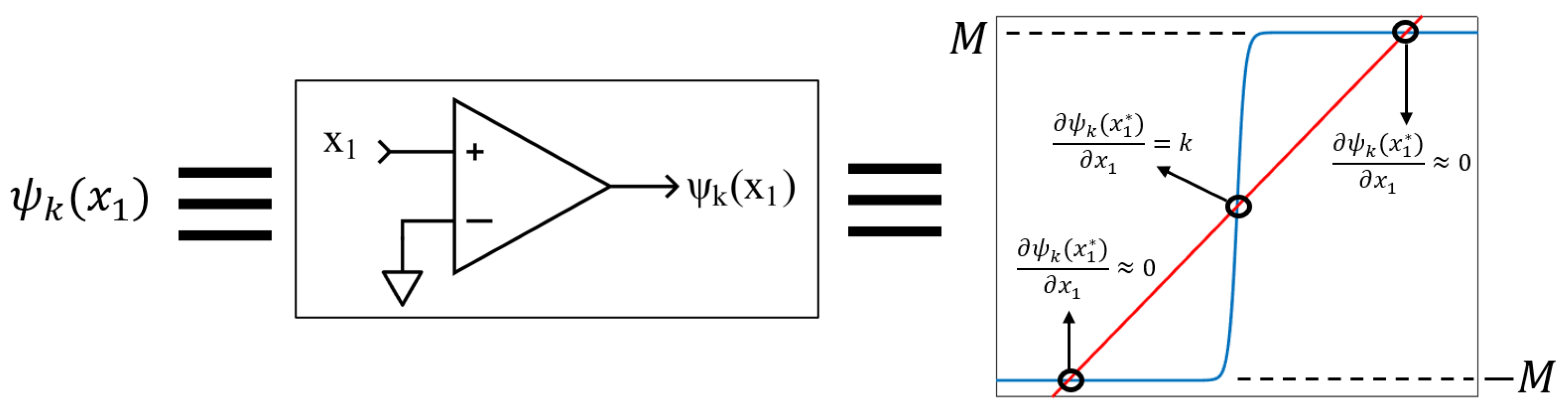
For setting suitable synaptic weights in the proposed CHNN, the linear function should intersect ψ k ( · ) in three distinct regions, as illustrated in Figure 2. Moreover, we have another equilibrium point (EP) x * located between the hyperbolic saddle points of index 2. To construct a heteroclinic loop for this additional EP, it must also satisfy the Shil’nikov inequality. Specifically, its stability can be tuned by choosing an appropriate value of ψ k ( x 1 * ) x 1 so that the EP becomes a hyperbolic saddle point of index 1. For ψ k ( x 1 * ) x 1 0 , we obtain
λ 1 = w 33 3 + b + c b 1 , λ 2 , 3 = w 33 3 b 2 c 2 b 1 ± a j ,
where j = 1 is the imaginary unit and
a = ( b c b ) 1 / 3 2 , b = d 2 c 3 2 + d 1 / 3 , c = w 33 2 9 + w 23 w 32 3 , d = w 33 3 27 + w 23 w 32 w 33 6 + w 12 w 23 w 31 ψ k ( x 1 * ) x 1 2 .
Notice that ψ k ( x 1 * ) x > > 0 implies a , b , d > > 0 . Hence, the EP is a hyperbolic saddle point of index 1. Given all previous insights, we obtain the simplified CHNN described by
d x 1 d t = x 1 w 12 x 2 , d x 2 d t = x 2 + w 23 x 3 , d x 3 d t = x 3 w 31 ψ k ( x 1 ) w 32 x 2 + w 33 x 3 ,
where w 31 = 0.2 , w 32 = 2 ( w 33 0.1 ) , and w 12 = 2.5 is a tuning parameter to establish the amplitude of chaotic signals of CHNN in a ± 5 range. Also, we observed that from Equation (18), system stability depends on w 23 and w 33 , which will be numerically explored in the next section. ψ k : R R is a continuous nonlinear AF defined by ψ k ( x 1 ) : = M e k x 1 1 e k x 1 + 1 , where k 1 denotes a gain factor which can be adjusted to induce Shil’nikov chaos in the CHNN model and M corresponds to the neuron state x 1 , i.e., active or inactive. Note that ψ k ( x 1 * ) x 1 = k when x 1 * = 0 , while for sufficiently large k, we have ψ k ( x 1 * ) x 1 0 for all | x 1 * | > 0 .
Such behavior may correspond to an amplifier with high gain, which is crucial for designing a highly compact circuit of CHNN (6). For example, at the circuit level, an operational amplifier (OpAmp) can easily emulate the nonlinear activation function ψ k ( x 1 )  (7), where M can be associated with the rail voltages of the device.

2.4. Boundedness Proof

A chaotic attractor is bounded by definition. A formal proof of the proposal of a new chaotic system is required. The following result applies the concept of Lyapunov surfaces to prove boundedness.
Theorem 4 
(CHNN boundedness proof). The orbit ϕ t ( x 0 ) described by the system in Equation (25) is confined in a bounded region V ( x ) R .
Proof. 
Consider the positive energy function V ( x ) = 1 2 ( x 1 2 + x 2 2 + x 3 2 ) , since V C the time derivative exist and is given by
d V ( x ) d t = V ( x ) · d x d t , = x 1 d x 1 d t + x 2 d x 2 d t + x 3 d x 3 d t , = ( x 1 2 + x 2 2 + x 3 2 ) + χ ( x ) ,
where = x 1 x 2 x 3 and
χ ( x ) = w 32 w 23 w 33 + 1 w 23 x 1 x 2 + ( w 23 w 32 ) x 2 x 3 w 31 ψ k , s ( x 1 ) x 3 + w 33 x 3 2 , | w 32 w 23 w 33 + 1 w 23 x 1 x 2 | + | ( w 23 w 32 ) x 2 x 3 | + | k w 31 x 1 x 3 | + | w 33 x 3 2 | ,
where k is the gain factor of the nonlinear AF in Equation (7) which satisfy | ψ k ( x 1 ) | k | x 1 | x 1 R . Now let for some large enough region D = V ( x ) for all ( x 1 , x 2 , x 3 ) T and let a D 0 > 0 that satisfy D 0 < D , here lies the inequality
| χ ( x ) | < w 32 w 23 w 33 + 1 w 23 | x 1 x 2 | + ( w 32 w 23 ) | x 2 x 3 | + k w 31 | x 1 x 3 | + w 33 | x 3 2 | , < x 1 2 + x 2 2 + x 3 2 = 2 V ( x ) .
Therefore, on the surface
{ D = x | V ( x ) : D > D 0 } ,
resides
d V ( x ) d t = 2 V ( x ) + χ ( x ) < 0 ,
which is a bounded region that contains the flow ϕ t ( x 0 ) , and as a result, the system in Equation (6) is bounded for some existing parameter space.    □

3. Chaotic Dynamics

This section presents the numerical analysis based on the standard 4th-order Runge-Kutta (RK-45) method to obtain several chaos metrics. We explore the dynamics of the proposed CHNN varying w 12 , w 23 and w 33 values under the constraints established in Section 2.3.

3.1. Long Term Dynamics Based on Lyapunov Exponents

It is well known that the sign of LEs in a three-dimensional system provides the long-term behavior. It means that one positive LE ( + , 0 , ) is an indication of chaos, two zero LEs ( 0 , 0 , ) quasiperiodic motion, and two negative values stipulate the existence of a periodic motion ( 0 , , ) , and three negative values specify a fixed point behavior.
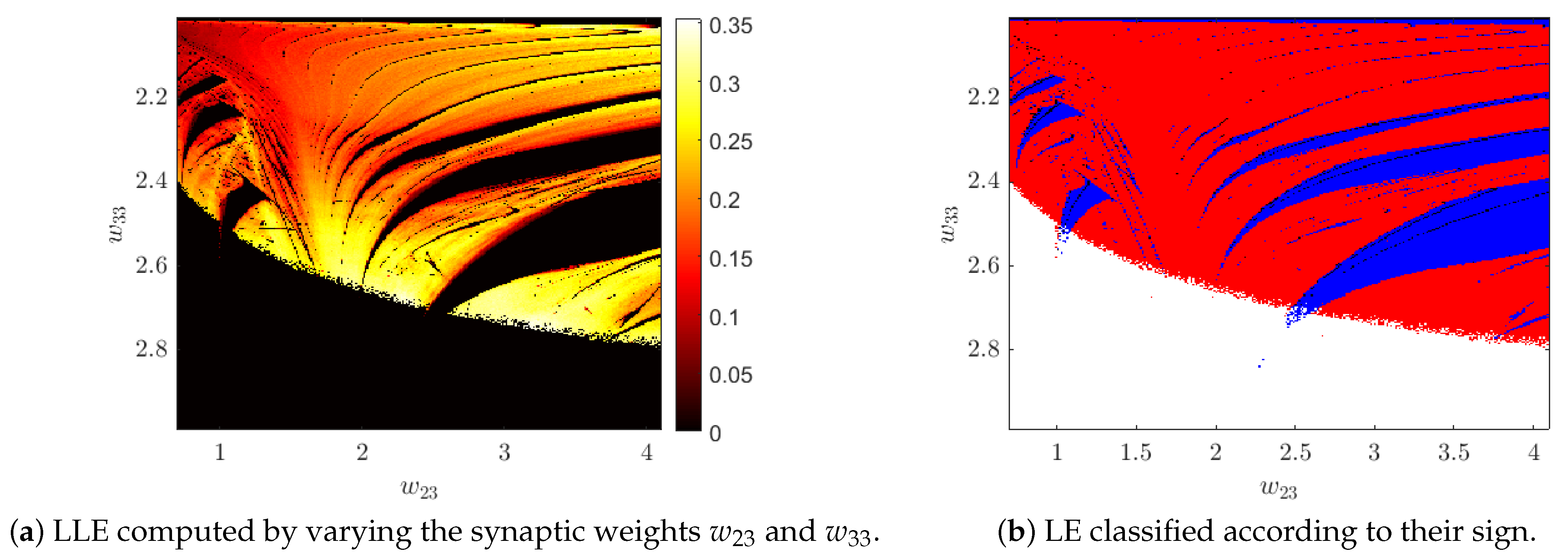
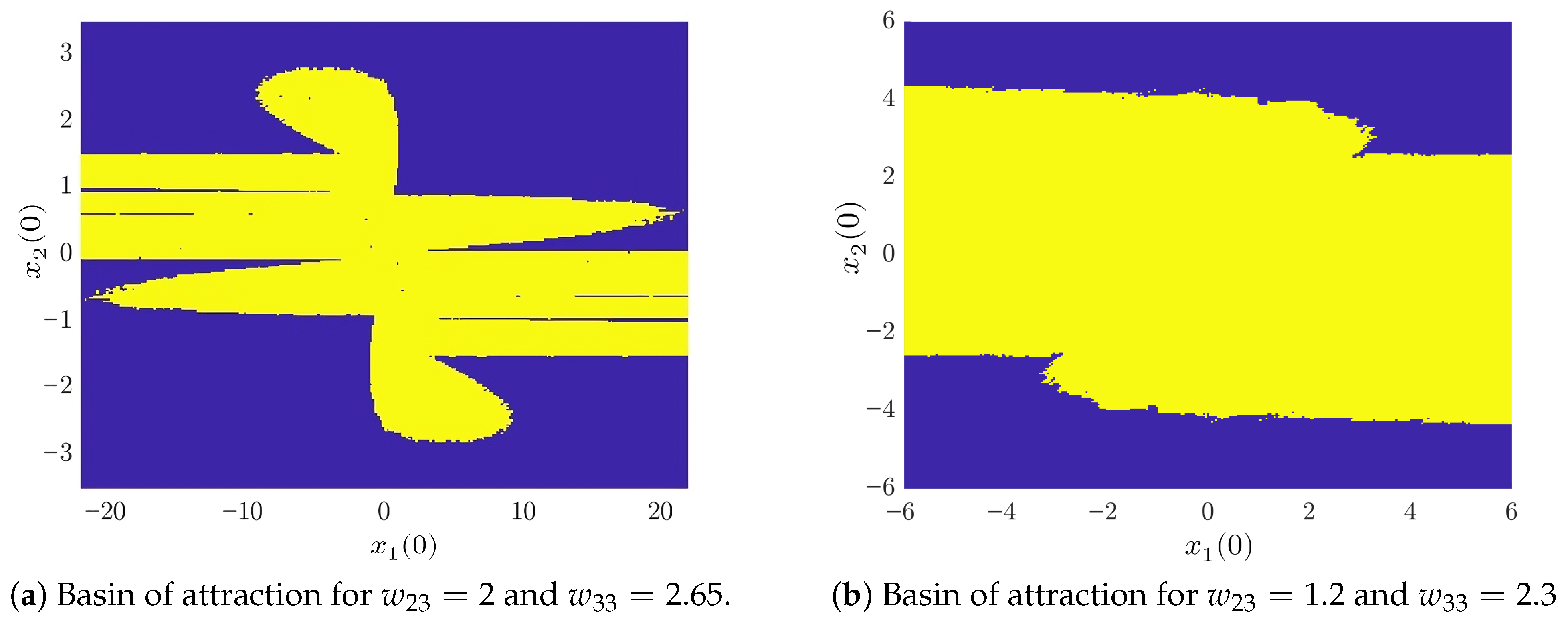
Several methods exist for computing the LE for continuous-time chaotic systems. One of them solves the variational equation by computing a numerical Jacobian and applying a QR decomposition. Such an approach is provided by the JuliaDynamics library [63]. In this manner, Figure 3a provides the largest LE sketched in a colormap. The black color indicates non-chaotic motion, whereas the magnitude of the largest LE is represented from red to white color. Figure 3b gives the long-term dynamics of the simplified chaotic CHNN in Equation (6). Four different long-term behaviors are plotted. Zones with a red color indicate chaotic behavior, blue highlights periodic motion, black represents quasiperiodic motion, and white indicates unstable behavior. The values of w 23 and w 33 explored in this colormap are determined according to the stability conditions discussed in Section 2.3. Based on these results, the analysis now focuses on regions defined by 0.75 w 23 4.1 and in the vicinity of 2.01 w 33 < 2.75 , where we anticipate the emergence of distinct dynamical behaviors. Also, we compute the basins of attraction of CHNN in Equation (6). These are illustrated in the color map in Figure 4. Figure 4a corresponds to the parameter point ( w 23 , w 33 ) = ( 2 , 2.65 ) , and Figure 4b to ( w 23 , w 33 ) = ( 1.2 , 2.3 ) . In the plots, yellow regions represent chaotic trajectories, while blue areas denote unstable zones, providing a visual characterization of the coexistence of multiple dynamical regimes across two distinct parameter regions.

3.2. Density Colored Continuation Diagrams

A bifurcation diagram is a qualitative tool for studying the changes arising in a dynamical system as a bifurcation parameter is varied. In this context, a continuation bifurcation diagram provides a refined approach. Instead of running each simulation independently, the system is reinitialized using the final state of the previous solution. This procedure introduces continuity across parameter sweeps, enabling a bifurcation diagram to more accurately capture attractor coexistence and multistability, hallmarks of many nonlinear systems. Therefore, we compute this type of bifurcation plot by plotting the histogram density of local maxima or another qualitative change in the CHNN. Hence, we denote more dense zones using a color scheme based on the approach in the seminal work [64].
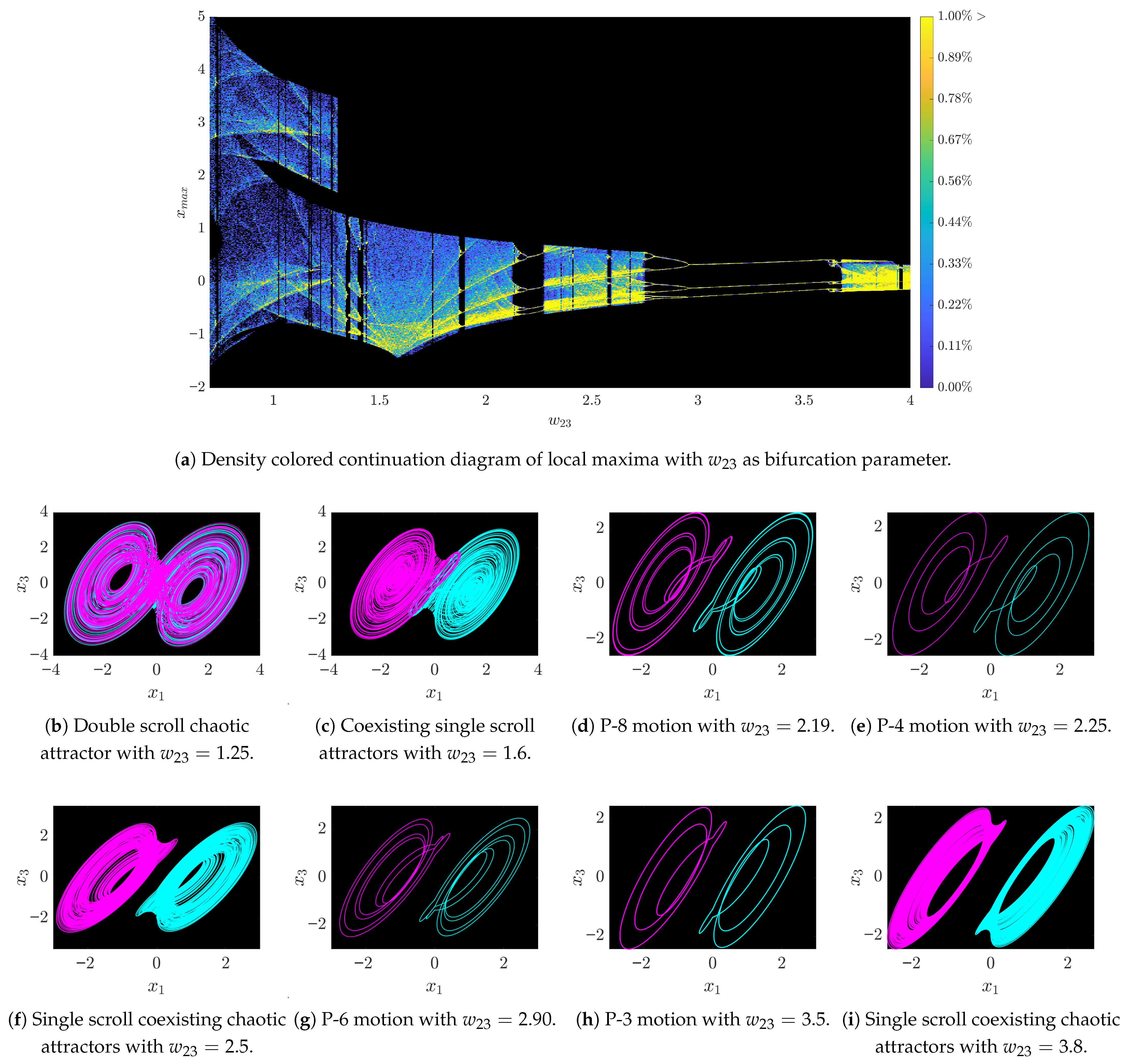
Therefore, we present continuation diagrams of local maxima by setting w 12 , w 23 , and w 33 as bifurcation parameters. From Equation (18), the weight w 23 has a direct implication in the type of long-time dynamics as was explored in Section 3. For this reason, the continuation diagram with w 31 = 0.2 , w 33 = 2.35 , k = 1000 , w 12 = 2.5 and varying 0.7 w 33 4 is presented in Figure 5a under the initial conditions ( 0.01 , 0 , 0 ) . A transient time of 900 s and a simulation time of 4500 s, sectioned in 600 divisions, are considered.
For 0.7 w 23 1.3 , the system undergoes chaotic evolution characterized by the emergence of a double-scroll attractor. As the bifurcation parameter increases, a bifurcation occurs, leading to the collapse of the double-scroll into a single-scroll attractor. Given the nature of the CHNN (6) for this parametric zone and the next one, two coexisting attractors arise. This regime persists up to w 23 2.18 , at which the system transitions into a period-eight (p-8) dynamic, followed by a long-term period-four (p-4) dynamic. Beyond w 23 2.32 , chaotic behavior emerges again, with localized regions of higher attractor density. This chaotic regime terminates at w 23 2.78 , where the system stabilizes into periodic dynamics, specifically exhibiting p-12, p-6, and p-3 cycles. Finally, for w 23 3.7 , the periodic windows vanish, and the system once again goes into sustained chaotic motion. All phase portraits corresponding to the described dynamical regimes are presented in Figure 5, where Figure 5b through Figure 5i explores the parameter w 23 .
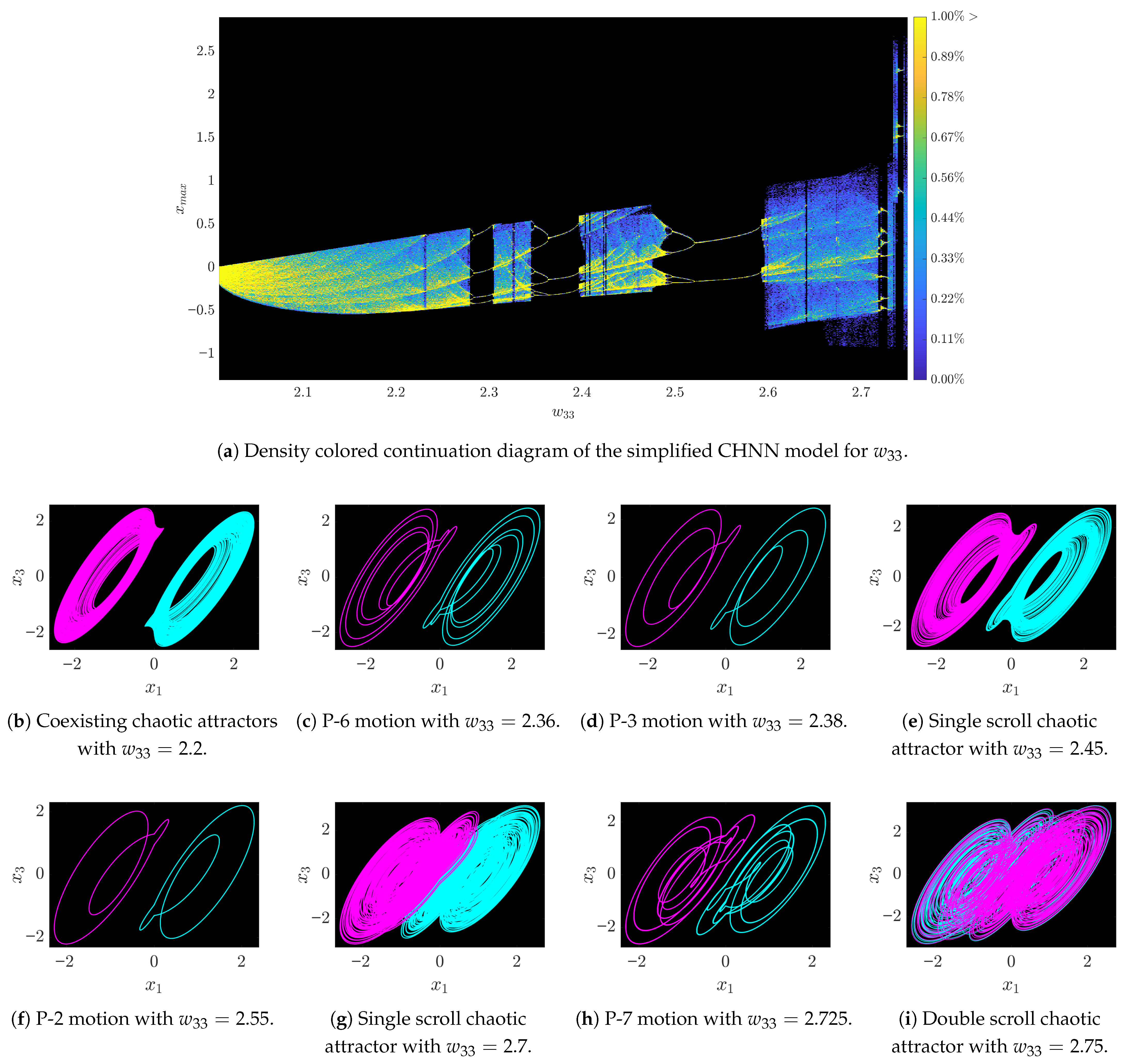
Based on Equation (18), another parameter closely related to the stability of the proposed CHNN is w 33 . In this case, following the results obtained from the LEs, we explore the parametric zone from 2.01 to 2.75 whereas w 23 is fixed at 2.8 and w 32 = 2 ( w 33 0.1 ) is dependent on the w 33 . All remaining parameters and simulation settings used in this computation are identical to those employed in the generation of the previous continuation bifurcation diagrams. The resulting density colored continuation diagram is presented in Figure 6a. For the parametric zone 2.01 w 33 2.26 , an extended single-scroll chaotic motion exists with extremely brief periodicity areas. Note that the density distribution in this region remains equal and only the magnitude of x 1 gradually increases. Further, for larger values of w 33 , a number of dynamics arise as the coexistence of two attractors with periodicity p-2, p-3, p-4, p-6, p-7, p-8, and a double scroll chaotic system is formed for w 33 = 2.75 .

3.3. Transient Chaos in the Simplified CHNN

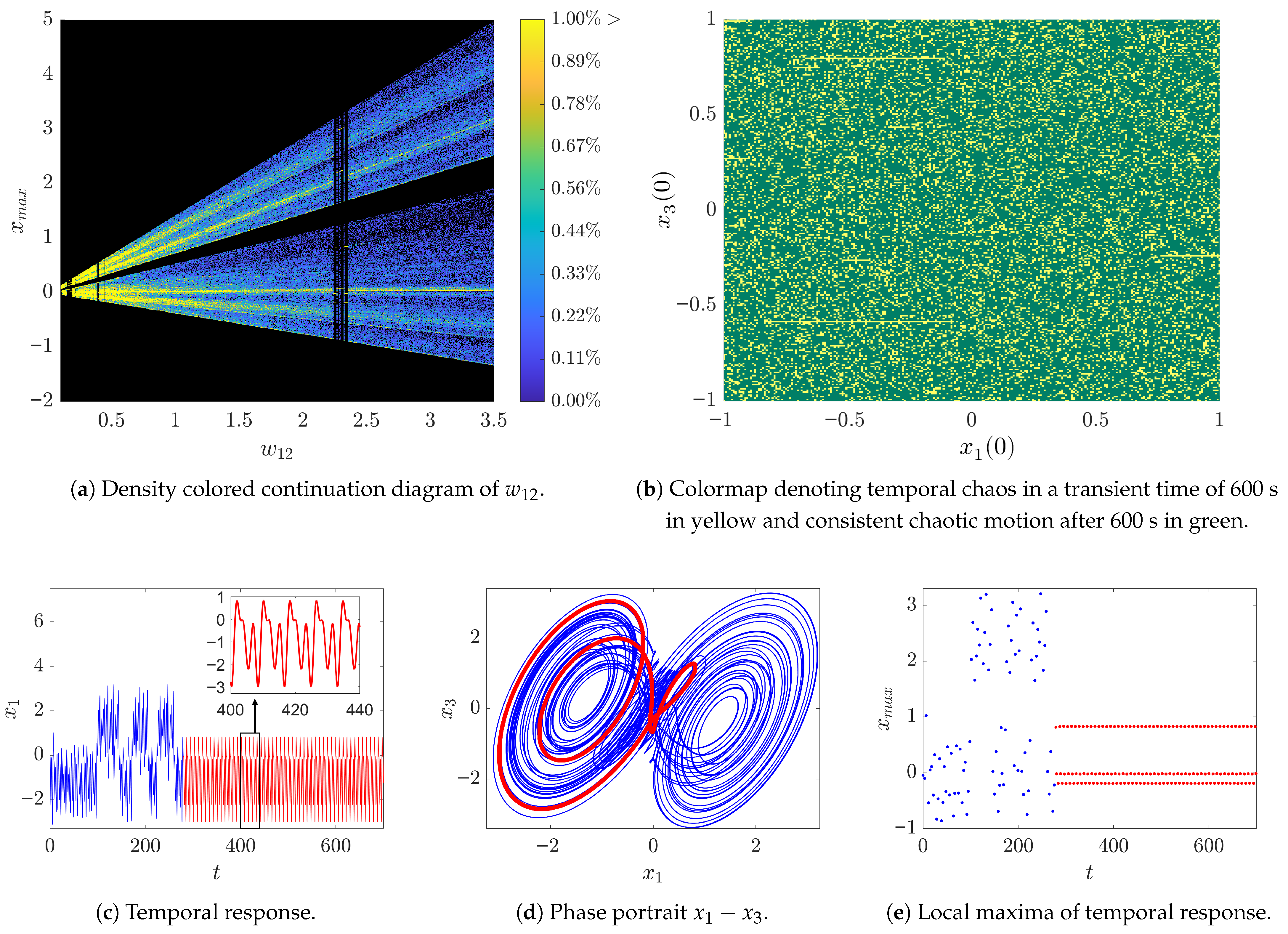
Another parametric region investigated via density-colored continuation diagrams is the synaptic weight w 12 (see Figure 7a). In contrast to the previously examined bifurcation parameters, and as predicted by Equation (18), w 12 does not directly affect system stability. However, within a narrow interval centered at w 12 = 2.3 , the system undergoes a transient chaos [65]. The occurrence of chaotic motion during a limited-time evolution has already been reported and is closely related to various brain activities, including specific memory storage [66]. In the proposed CHNN, the appearance of this phenomenon is captured with parameter values w 12 = 2.3 , w 23 = 1.27 , w 31 = 0.2 , w 32 = 4.444 , w 33 = 2.35 , k = 200 , and initial conditions x 0 = ( 0.1 , 0.1 , 0.1 ) as given in Figure 7c. The transient chaotic response for t < 270 is denoted in blue, while the long-term dynamics of CHNN are denoted in red. Similarly, Figure 7d presents the phase portrait of the transient chaotic response in blue, while the three-period behavior is shown in red. Figure 7e plots the local maxima for the x 1 solution, revealing this transient chaos phenomenon. To further investigate transient chaos, Figure 7b depicts the basin of attraction as a colormap over initial states x 1 ( 0 ) and x 2 ( 0 ) with x 3 ( 0 ) = 0.1 . Regions shown in green color correspond to trajectories that maintain chaotic behavior beyond a 700 s transient, whereas yellow regions denote those that converge to a 3-period orbit.

3.4. Bursting Patterns and Conservative Behavior in the Simplified CHNN

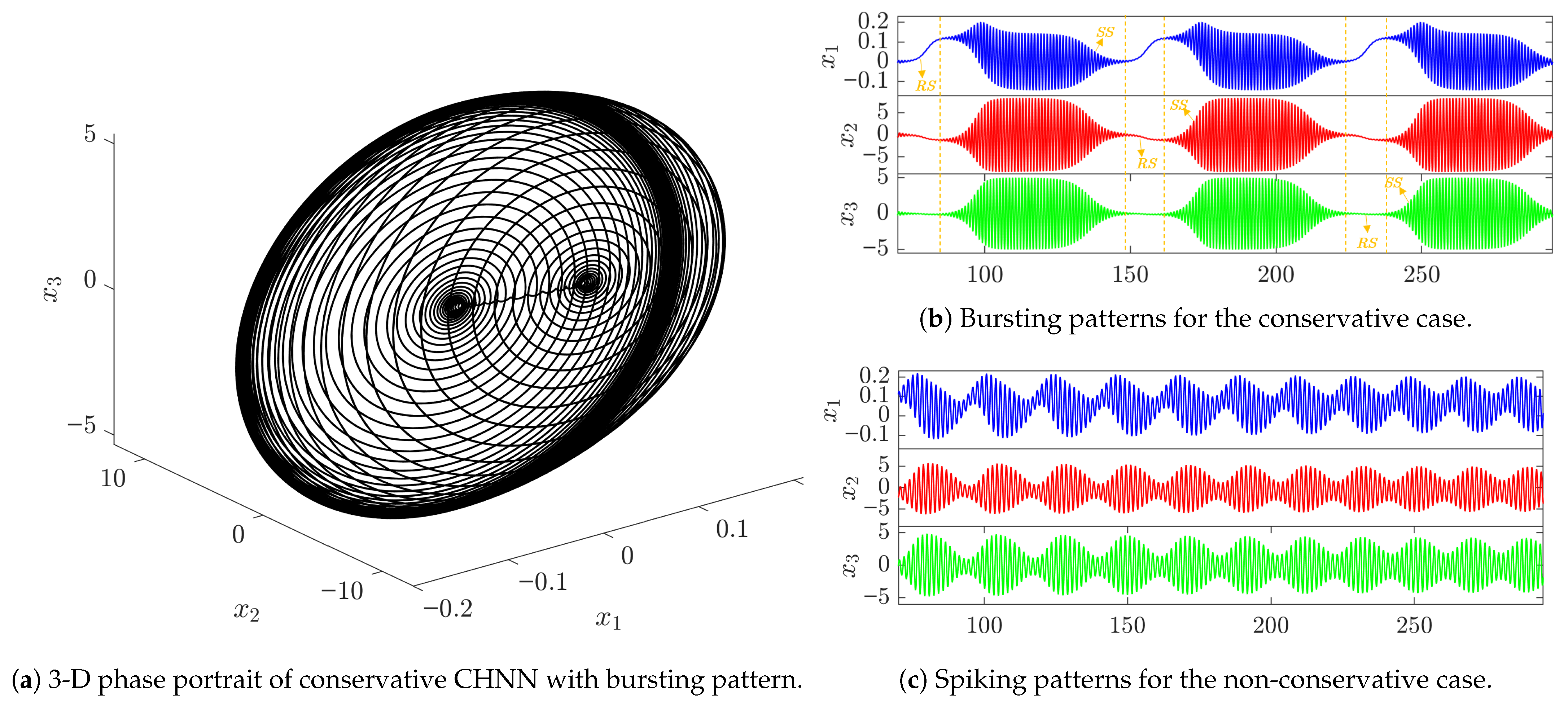
Brain activity involves a diverse and rich array of dynamics, including neuronal firing, which remains essential for proper brain function. This firing process comprises two principal phases, a resting state and a spiking firing state, collectively referred to as bursting patterns [67,68]. In particular, this bursting pattern emerges in the conservative limit of the proposed model. By setting w 33 = 3 , w 23 = 5 , w 31 = 0.5 , w 32 = 3.6364 , w 12 = 0.1 , and k = 20 , the vector field becomes conservative on its space-state volume, and this is preserved for all times where no global attractor can be found. It reveals quasiperiodic oscillations punctuated by explicit bursting events. Figure 8 illustrates the trajectory of the conservative CHNN. Figure 8a depicts the three-dimensional phase portrait, highlighting the quasiperiodic dynamics of CHNN. Figure 8b presents the time series of each state variable, where RS and SS denote the resting and spiking states, respectively. Finally, Figure 8c shows the system trajectory in the near-conservative regime ( w 33 = 2.995 ). In this case, the resting phase is suppressed, and the dynamics remain in a constant spiking state.

4. Electronic Design and Implementation of CHNN

In this section, we present the analog electronic implementation of the proposed CHNN using operational amplifiers. We begin by rewriting the system (25) as an inverting integrator, a summing amplifier, and a nonlinear feedback element, respectively. The use of potentiometers allows fine adjustment of parameters to explore bifurcation scenarios in hardware. We verify experimentally the emergence of p-1, p-2, p-3, p-4, p-5, p-6, p-8 periodic behaviors as well as limit cycles, single-scroll and double-scroll chaotic attractors, and compare them with those of numerical simulations.

4.1. OpAmp-Based Design of CHNN

To implement the proposed CHNN using electronic components, frequency scaling is required. Thus, we introduce a positive constant k f N in the dimensionless CHNN (6) as follows
d x 1 d t = k f ( x 1 + w 12 x 2 ) ,
d x 2 d t = k f ( x 2 + w 23 x 3 ) ,
d x 3 d t = k f ( ( w 33 1 ) x 3 + w 31 ψ k ( x 1 ) + w 32 x 2 ) ,
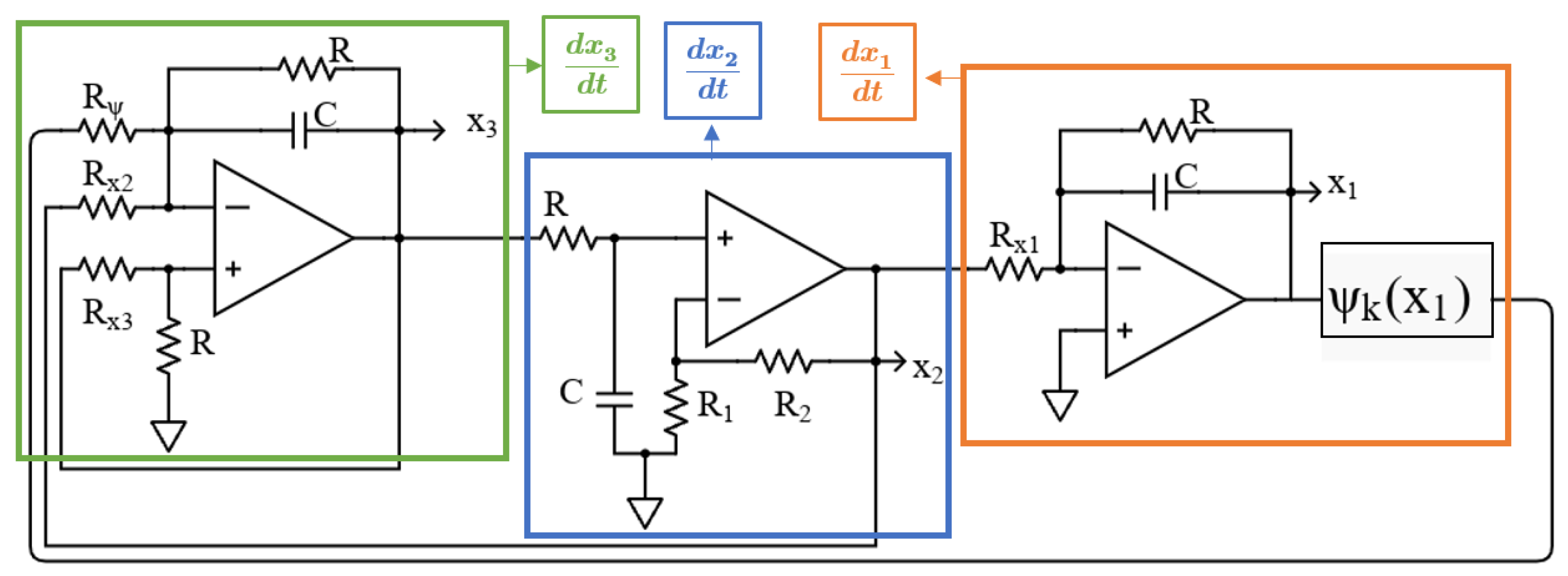
where k f > > 1 . Note that Equations (27)–(29) can be easily adapted to first-order low-pass filters as shown in Figure 9. The schematic is separated into three sections for each differential equation of the proposed CHNN. The section in orange emulates the d x 1 d t , which can be derived by determining the current that flows through resistance R, R x 1 , and C, respectively, and based on Kirchhoff’s Current Law (KCL), it yields
x 2 R x 1 = x 1 R + C d x 1 d t ,
d x 1 d t = 1 C R x 1 x 2 C R x 1 .
Now for d x 2 d t (blue square in Figure 9), we consider that the current that flows through the resistance R is equal to the current that flows through the capacitance C. Besides, the OpAmp is in a non-inverting gain configuration, so it is obtained
R 1 R 1 + R 2 x 2 x 3 R = C R 1 R 1 + R 2 d x 2 d t ,
d x 2 d t = 1 R C x 2 + 1 R C 1 + R 2 R 1 x 3 .
Finally, the green square in Figure 9 represents d x 3 d t . We denote as i 3 , R , i 3 , R ψ , i 3 , R x 2 and i 3 , C the current flow that goes through R, R ψ , R x 2 and C, respectively. By following KLC, we get
i ψ + i R x 2 = i R + i C .
Furthermore, the voltage in the positive node of the OpAmp is given by R x 3 / ( R x 3 + R ) . Then the voltage expression yields
1 R ψ + 1 R x 2 R R x 3 + R x 3 ψ k ( x 1 ) R ψ x 2 R x 2 = x 3 R + C d x 3 d t 1 R R x 3 + R .
Let R x 3 = R and solving for d x 3 d t , we have
d x 3 d t = 1 R C x 3 2 C R ψ ψ k ( x 1 ) 2 C R x 2 x 2 + 1 R ψ + 1 R x 2 1 C x 3 .
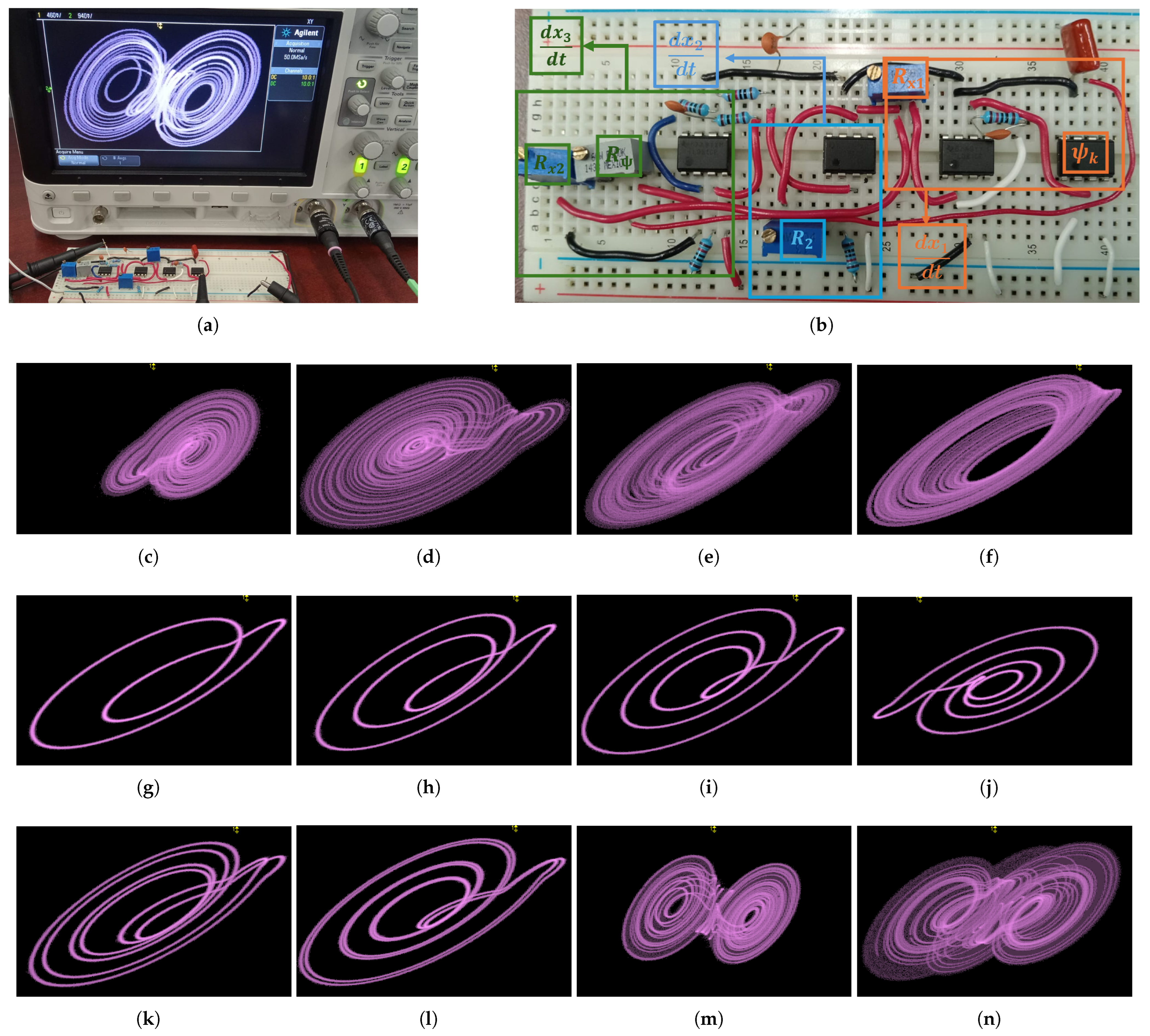
Note that the weight w 33 is related to the resistance R x 2 and is selected by the expression R x 2 = 10 / ( w 33 0.1 ) k Ω . As a result, the weight w 32 depends on w 33 by the relation w 32 = 2 ( w 33 0.1 ) . By selecting a frequency gain of k f = 10 , 000 and weights w 12 = 2.5 , w 31 = 0.2 , w 23 = 1.1 , w 33 = 2.35 , with C = 10 nF, we find the components values given in Table 1. For this specific set of values, the simplified CHNN exhibits a chaotic attractor with two scrolls as shown in panel (a) in Figure 10. Further, since the weight w 23 is computed by the expression w 23 = 1 + R 2 / R 1 , it can be explored just for w 23 > 1 .

4.2. Implementation of Simplified Chaotic CHNN

Following the schematic diagram in Figure 9, the simplified CHNN circuit is assembled. Each integrator and summing stage employs an LM081 operational amplifier. Furthermore, all OpAmp supply rails are decoupled with 10 μ F capacitors to suppress noise. The synaptic weights w 23 and w 33 are associated with the trimmer potentiometers R 2 and R x 2 , respectively. By varying these potentiometers, we can reproduce the long-term dynamics detailed in Section 3.2, including periodic orbits, single-scroll, and double-scroll chaotic attractors.
Figure 10a,b show the circuit implementation and the oscilloscope results of a double-scroll chaotic attractor. Figure 10c–n present the experimental evidence of the different dynamic behaviors of the proposed CHNN, which confirm the theoretical and numerical results. Finally, Table 2 exhaustively compares the number of op-amps and elements necessary to implement different activation functions with analog circuits. Notably, the proposed nonlinear AF in Figure 2 is efficient and requires fewer components than previous approaches.

4.3. CHNN-Based S-Box

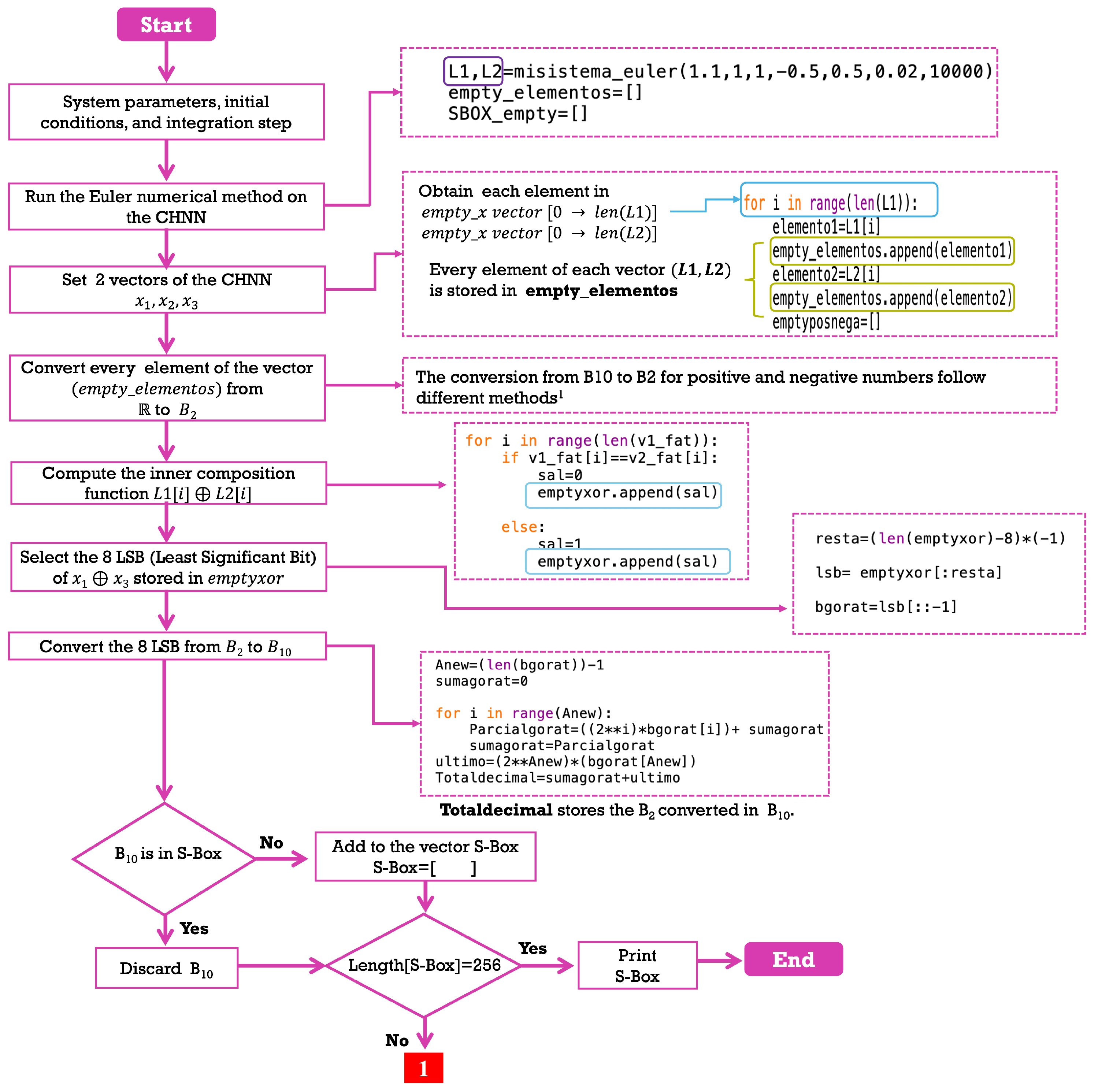
In this subsection, we present a brief example of a possible application of the simplified CHNN (6) in data security. In particular, we have designed a Substitution Box (S-Box) using the neuron-state-variables x 1 and x 3 . An S-Box is a fundamental component of a symmetric-key encryption scheme. An S-Box is a nonlinear transformation that maps one input value to another that is uncorrelated. Here, the chaotic values from neurons x 1 and x 3 serve as the entropy source to generate the table entries. The algorithm for designing the S-Box is based on a composition function and XOR operations as described in Algorithm 1. The fundamental operation of the presented S-Box is as follows. The decimal-type input data can be split into 2048-bit blocks, yielding 256 8-bit vectors, which can be expressed as f : { 0 , 1 } 2048 × { 0 , 1 } 2048 { 0 , 1 } 2048 . So, we get
f : { 0 , 1 } 8 × { 0 , 1 } 8 { 0 , 1 } 8 ,
where f represents the nonlinear function of S-Box, which is based on the composition function denoted by
f g ( ϕ ) : = L S B ( x 1 x 3 ) ,
where ⊕ is the X O R bitwise operation, L S B means least significant bit, and x 1 and x 3 are the neuron-state-variables of the proposed CHNN. However, before XORing x 1 and x 3 , we first need to perform preprocessing on x 1 and x 3 because they are signed real numbers. The next step is to convert real numbers to a signed binary string as follows.
Algorithm 1 Main steps to design an S-Box based on the CHNN.
  1:
Input: System parameters, initial conditions, and iterations n i t for CHNN.
  2:
for  k 1  to size( n i t ) do
  3:
   Compute the solution of CHNN using the Euler method.
  4:
   Select two vectors ( X 1 , X 3 ) from the CHNN (6).
  5:
   Transform each element in ( X 1 , X 3 ) to a signed binary number with Lemmas 2 and 3.
  6:
   Compute the composition function f g ( x 1 , x 3 ) as Equation (38).
  7:
   Transform the resulting 8-bit binary string to a decimal number B 10 .
  8:
   Construct the S-Box with no repeated numbers B 10 , otherwise dismissed.
  9:
   Return to the step 2 until the S-Box is completed.
10:
end for
11:
Output:  16 × 16 S-Box.
Lemma 2. 
A positive real number can be expressed as a signed binary number in fixed point format Q n , m by specifying the n-bits for the integer part ( R n ), and the m-bits for the fractional part( b n ), plus the sign bit. The range of the integer part is { 2 n , 2 n 1 } while the precision of the fractional part is 1 2 m . To get the integer bits from LSB to MSB, we have
R n 2 = R n + 1 , if R n + 1 0 , the bit is 1 , otherwise the bit is 0 ,
where R n and R n + 1 stand for the quotients, i.e., the integer part obtained from recursive divisions. The procedure finishes when the quotient is zero. On the other hand, the fractional bits from MSB to LSB are obtained by 2 b n = a n + 1 . b n + 1 the fractional bit takes the value of a n + 1 . The method completes to the required precision. Finally, the signed binary number is formed by concatenating the sign, integer, and fractional bits.
Lemma 3. 
A negative real number can be expressed as a signed binary number in fixed point format Q n , m by the following steps:
  • Apply Lemma 1.
  • Compute 2’s–complement to the resulting signed binary number from Lemma 1.
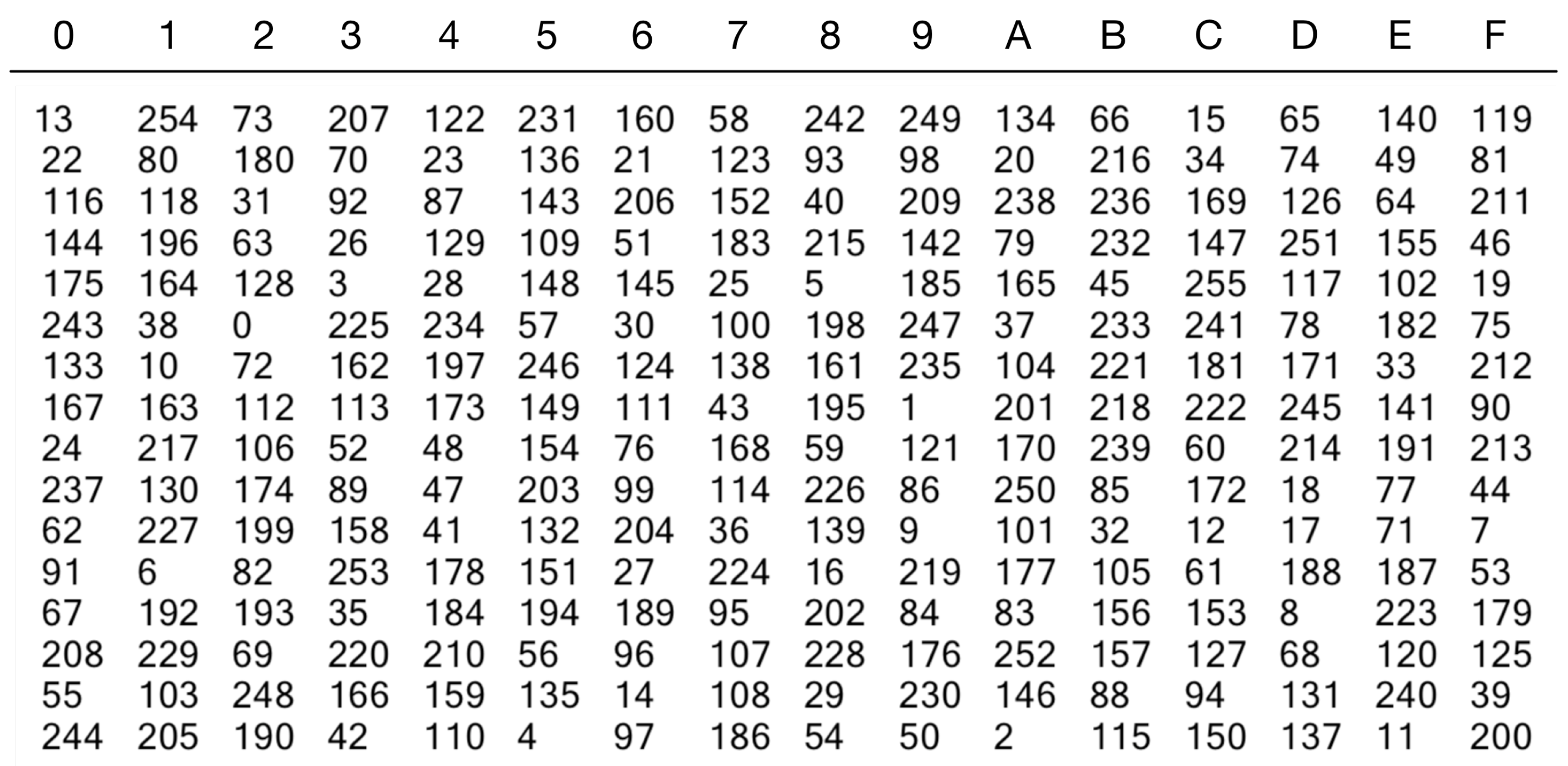
Figure 11 and Algorithm 1 outline the main steps and flowchart, respectively, for constructing an S-Box using the proposed CHNN (6). By using Lemmas 2 and 3, and selecting initial conditions and parameters in the CHNN as: x 1 = 0.1 , x 2 = 0.1 , x 3 = 0 , w 12 = 2.5 , w 23 = 1.25 , w 31 = 0.2 , w 33 = 2.55 , M = 10.5 , k = 1000 , h = 0.01 , the resulting S-Box is shown in Figure 12. The security metrics of the S-Box in Figure 12, such as non-linearity (NL), strict avalanche criterion (SAC), bit independence criterion (BIC), BIC-NL, BIC-SAC, and differential approximation probability (DP), are presented in Table 3.

5. Discussion

A simplified chaotic continuous-time Hopfield neural network (CHNN) and its corresponding minimal analog implementation are presented in this work. As previously shown, the application of Shil’nikov’s theorem enables the generation of single- and multi-scroll chaotic attractors within a rigorous theoretical framework and an efficient hardware realization. In particular, we employ Shil’nikov’s theorem as a criterion to determine the minimal set of suitable system parameters that ensure the existence of horseshoe-type chaotic behavior.
As a result of this approach, the electronic design is optimized for hardware efficiency, with respect to component count, form factor, power consumption, and hardware complexity. Unlike previously reported CHNN models, which typically required at least three activation functions (AF), the proposed system employs only two linear AFs and a single nonlinear AF. This reduction significantly minimizes the circuit complexity. Moreover, the selected nonlinear AF is implemented with a single analog component, further reducing the number of elements required for the physical realization of CHNN.
Subsequently, from the LEs and continuation diagrams, the rich dynamical behaviors and long-term evolution of the CHNN are revealed. We identify parameter regions in the Lyapunov spectrum that correspond to chaotic, quasiperiodic, and periodic behaviors. These exponents were computed using the JuliaDynamics library. Additionally, we identify several periodic cycles and visualize the density distribution of attractor states as one bifurcation parameter is varied, showing the rich dynamics of the CHNN. Notably, these diagrams reveal a narrow parameter region in which the system exhibits transient chaos. In this striking regime, the trajectory displays chaotic motion only during a finite transient interval before eventually settling into a stable periodic orbit.
Another intriguing observation is that the bifurcation parameter w 12 , which was not expected to affect the system’s stability based on the stability analysis, also induces transient chaotic behavior. To further explore this phenomenon, the basin of attraction is mapped by varying the initial conditions and identifying the regions where chaotic motion vanishes after a transient period of 600 s . Interestingly, no discernible structure or pattern was found in the basins of attraction, suggesting a highly sensitive dependence on the initial state.
The conservative case of the proposed system is also analyzed. As the parameter w 33 approaches the value of 3 from below, the system transitions from a dissipative to a conservative regime, effectively eliminating the existence of a bounded attractor. At this critical point, the system exhibits a bursting pattern, a temporal response characterized by alternating epochs of quiescent (resting) and spiking activity. Such dynamics are closely linked to the fundamental behavior of biological neurons and play a crucial role in the reliable transmission of electrical signals within neuronal networks.
Finally, the observed dynamical behaviors in the proposed system are confirmed using a simplified analog circuit. This hardware realization not only corroborated the numerical simulations but also demonstrated the system’s ability to reproduce a wide range of dynamic behaviors. Specifically, distinct regions of the parameter space are experimentally identified exhibiting periodic oscillations with cycles p-1, p-2, p-3, p-4, p-5, p-6, p-7, p-8, and p-12, as well as the emergence of both single-scroll and double-scroll chaotic attractors. These results highlight the consistency among the theoretical insights, numerical simulations, and physical implementation, reinforcing the robustness and feasibility of the proposed chaotic CHNN for analog computation and broadening its potential applications in secure communications, neuromorphic computation, and analog information processing.

6. Conclusions

In this work, an analog simplification of a chaotic continuous-time Hopfield neural network (CHNN) is presented. Compared with prior implementations using hyperbolic-tangent, ReLU, and PWL activation functions, the proposed design reduces the total component count (Table 2) by 74.6%, 40–50%, and 30–40%, respectively. A rigorous theoretical framework for constructing the simplified model was also provided. First, by systematically eliminating nonessential synaptic weights while preserving chaotic dynamics via the development of Lemma 1 and Theorem 1. As a result, the number of resistive elements required to implement the network is minimized. Second, the proposed CHNN requires only one nonlinear activation function (AF). Hence, only one AF circuit module is needed. Finally, by applying Shil’nikov’s heteroclinic theorem, we derive a set of constraints on the synaptic weights under which the proposed CHNN exhibits horseshoe chaos. This analysis required several dynamical studies of the CHNN, including dissipative and conservative properties, stability analysis around the EPs, and a boundedness proof (Theorem 4).
Later, the main parameters related to system stability were thoroughly studied using standard numerical metrics, such as LEs and continuation diagrams, to identify the qualitative behavior of the CHNN (periodic and chaotic attractors). Moreover, exploring w 12 revealed transient chaos, whereas in the conservative case with w 33 = 3 , a bursting pattern emerged. Both are considered highly relevant to the proper functioning of brain activity.
Finally, the theoretical insights and numerical results were experimentally validated using a highly compact analog circuit based on operational amplifiers (OpAmps), demonstrating the feasibility and robustness of the proposed chaotic CHNN for various engineering applications, including secure communications, data encryption and substitution boxes, random number generators, neuromorphic computation, and analog information processing.

Author Contributions

Conceptualization, D.S.d.l.V. and J.M.M.-P.; methodology, D.S.d.l.V., L.V.-C., O.G.F.-B. and J.M.M.-P.; software, D.S.d.l.V. and L.V.-C.; validation, D.S.d.l.V. and J.M.M.-P.; formal analysis, D.S.d.l.V., L.V.-C., O.G.F.-B. and J.M.M.-P.; investigation, D.S.d.l.V. and J.M.M.-P.; writing—original draft preparation, D.S.d.l.V., L.V.-C., O.G.F.-B. and J.M.M.-P.; writing—review and editing, D.S.d.l.V., L.V.-C., O.G.F.-B. and J.M.M.-P.; All authors have read and agreed to the published version of the manuscript.

Funding

This research received no external funding.

Data Availability Statement

Data supporting the findings of this study are available from the corresponding author upon request.

Acknowledgments

The first and second authors thank SECIHTI/Mexico for the support through the scholarship CVU 1301246 and CVU 105600, respectively. The authors acknowledge BUAP for the support via the project VIEP 2025-2026.

Conflicts of Interest

The authors declare no conflicts of interest.

Abbreviations

The following abbreviations are used in this manuscript:
ANNArtifitial Neural Networks
CHNNContinous time Hopfield Neural Networks
EPEquilibrium Point
AFActivation Function
KCLKirchhoff’s Current Law
LELyapunov Exponent
SSSpiking State
RSResting State

References

  1. Jacob, J.; Patel, N.; Sehgal, S. Emulation of Biological Cells. In Proceedings of the 2022 Computing in Cardiology (CinC), Tampere, Finland, 4–7 September 2022. [Google Scholar] [CrossRef]
  2. Wunderlich, T.; Kungl, A.F.; Müller, E.; Hartel, A.; Stradmann, Y.; Aamir, S.A.; Grübl, A.; Heimbrecht, A.; Schreiber, K.; Stöckel, D.; et al. Demonstrating Advantages of Neuromorphic Computation: A Pilot Study. Front. Neurosci. 2019, 13, 260. [Google Scholar] [CrossRef]
  3. McCulloch, W.S.; Pitts, W. A logical calculus of the ideas immanent in nervous activity. Bull. Math. Biophys. 1943, 5, 115–133. [Google Scholar] [CrossRef]
  4. Xu, Z.B.; Hu, G.Q.; Kwong, C.P. Asymmetric Hopfield-type networks: Theory and applications. Neural Netw. 1996, 9, 483–501. [Google Scholar] [CrossRef]
  5. Hopfield, J.J. Neural networks and physical systems with emergent collective computational abilities. Proc. Natl. Acad. Sci. USA 1982, 79, 2554–2558. [Google Scholar] [CrossRef]
  6. Hopfield, J.J. Neurons with graded response have collective computational properties like those of two-state neurons. Proc. Natl. Acad. Sci. USA 1984, 81, 3088–3092. [Google Scholar] [CrossRef]
  7. de la Vega, D.S.; Munoz-Pacheco, J.M.; Félix-Beltrán, O.G.; Volos, C. Rich dynamics and analog implementation of a Hopfield neural network in integer and fractional order domains. Integration 2025, 103, 102389. [Google Scholar] [CrossRef]
  8. Hirsch, M.W.; Smale, S.; Devaney, R.L. Differential Equations, Dynamical Systems, and an Introduction to Chaos, 3rd ed.; Academic Press: Waltham, MA, USA, 2013. [Google Scholar]
  9. Muddada, S.; Patnaik, B.S.V. Application of Chaos Control Techniques to Fluid Turbulence. In Applications of Chaos and Nonlinear Dynamics in Engineering—Volume 1; Series Title: Understanding Complex Systems; Banerjee, S., Mitra, M., Rondoni, L., Eds.; Springer: Berlin/Heidelberg, Germany, 2011; pp. 87–136. [Google Scholar] [CrossRef]
  10. Yang, Y.; Qi, G. Mechanical analysis and bound of plasma chaotic system. Chaos Solitons Fractals 2018, 108, 187–195. [Google Scholar] [CrossRef]
  11. Chua, L.; Wu, C.; Huang, A.; Zhong, G. A universal circuit for studying and generating chaos. I. Routes to chaos. IEEE Trans. Circuits Syst. Fundam. Theory Appl. 1993, 40, 732–744. [Google Scholar] [CrossRef]
  12. Alexeeva, T.A.; Kuznetsov, N.V.; Mokaev, T.N. Study of irregular dynamics in an economic model: Attractor localization and Lyapunov exponents. Chaos Solitons Fractals 2021, 152, 111365. [Google Scholar] [CrossRef]
  13. Lorenz, E.N. Deterministic Nonperiodic Flow. J. Atmos. Sci. 1963, 20, 130–141. [Google Scholar] [CrossRef]
  14. Shilnikov, L.P. A case of the existence of a denumerable set of periodic motions. Sov. Math. Dokl. 1965, 6, 163–166. [Google Scholar]
  15. Arneodo, A.; Coullet, P.; Tresser, C. Occurence of strange attractors in three-dimensional Volterra equations. Phys. Lett. A 1980, 79, 259–263. [Google Scholar] [CrossRef]
  16. Arneodo, A.; Coullet, P.; Peyraud, J.; Tresser, C. Strange attractors in Volterra equations for species in competition. J. Math. Biol. 1982, 14, 153–157. [Google Scholar] [CrossRef] [PubMed]
  17. Arecchi, F.; Meucci, R.; Gadomski, W. Laser dynamics with competing instabilities. Phys. Rev. Lett. 1987, 58, 2205. [Google Scholar] [CrossRef]
  18. Arecchi, F.; Gadomski, W.; Lapucci, A.; Mancini, H.; Meucci, R.; Roversi, J. Laser with feedback: An optical implementation of competing instabilities, Shil’nikov chaos, and transient fluctuation enhancement. J. Opt. Soc. Am. B 1988, 5, 1153–1159. [Google Scholar] [CrossRef][Green Version]
  19. Dangoisse, D.; Bekkali, A.; Papoff, F.; Glorieux, P. Shilnikov dynamics in a passive Q-switching laser. Europhys. Lett. 1988, 6, 335. [Google Scholar] [CrossRef]
  20. Legras, B.; Ghil, M. Persistent anomalies, blocking and variations in atmospheric predictability. J. Atmos. Sci. 1985, 42, 433–471. [Google Scholar] [CrossRef]
  21. Richetti, P.; Arneodo, A. The periodic-chaotic sequences in chemical reactions: A scenario close to homoclinic conditions? Phys. Lett. A 1985, 109, 359–366. [Google Scholar] [CrossRef]
  22. Bar-Eli, K.; Brøns, M. Period lengthening near the end of oscillations in chemical systems. J. Phys. Chem. 1990, 94, 7170–7177. [Google Scholar] [CrossRef]
  23. Argoul, F.; Arneodo, A.; Richetti, P. Experimental evidence for homoclinic chaos in the Belousov-Zhabotinskii reaction. Phys. Lett. A 1987, 120, 269–275. [Google Scholar] [CrossRef]
  24. Matsumoto, T. Chaos in electronic circuits. Proc. IEEE 1987, 75, 1033–1057. [Google Scholar] [CrossRef]
  25. Chow, S.N.; Deng, B.; Fiedler, B. Homoclinic bifurcation at resonant eigenvalues. J. Dyn. Differ. Equ. 1990, 2, 177–244. [Google Scholar] [CrossRef]
  26. Wang, F.; Wei, Z.; Zhang, W. Sliding homoclinic orbits and chaotic dynamics in a class of 3D piecewise-linear Filippov systems. Nonlinear Dyn. 2024, 112, 20461–20481. [Google Scholar] [CrossRef]
  27. Koper, M.T. Bifurcations of mixed-mode oscillations in a three-variable autonomous Van der Pol-Duffing model with a cross-shaped phase diagram. Phys. D Nonlinear Phenom. 1995, 80, 72–94. [Google Scholar] [CrossRef]
  28. Wei, Z.; Wang, F. Two-parameter bifurcations and hidden attractors in a class of 3D linear Filippov systems. Int. J. Bifurc. Chaos 2024, 34, 2450052. [Google Scholar] [CrossRef]
  29. Koper, M.T.; Gaspard, P. Mixed-mode and chaotic oscillations in a simple model of an electrochemical oscillator. J. Phys. Chem. 1991, 95, 4945–4947. [Google Scholar] [CrossRef]
  30. Chang, H.h.; Demekhin, E.A. Complex Wave Dynamics on Thin Films; Elsevier: Amsterdam, The Netherlands, 2002. [Google Scholar]
  31. Sandstede, B. Stability of travelling waves. In Handbook of Dynamical Systems; Elsevier: Amsterdam, The Netherlands, 2002; Volume 2, pp. 983–1055. [Google Scholar]
  32. Pisarchik, A.N.; Feudel, U. Control of multistability. Phys. Rep. 2014, 540, 167–218. [Google Scholar] [CrossRef]
  33. Chua, L.; Komuro, M.; Matsumoto, T. The double scroll family. IEEE Trans. Circuits Syst. 2003, 33, 1072–1118. [Google Scholar] [CrossRef]
  34. Pham, V.T.; Volos, C.; Jafari, S.; Wei, Z.; Wang, X. Constructing a novel no-equilibrium chaotic system. Int. J. Bifurc. Chaos 2014, 24, 1450073. [Google Scholar] [CrossRef]
  35. Cafagna, D.; Grassi, G. Chaos in a new fractional-order system without equilibrium points. Commun. Nonlinear Sci. Numer. Simul. 2014, 19, 2919–2927. [Google Scholar] [CrossRef]
  36. Lin, Y.; Zhou, X.; Gong, J.; Yu, F.; Huang, Y. Design of Grid Multi-Wing Chaotic Attractors Based on Fractional-Order Differential Systems. Front. Phys. 2022, 10, 927991. [Google Scholar] [CrossRef]
  37. Li, Y.; Wei, Z.; Moroz, I. Melnikov-type method and homoclinic bifurcation in a class of hybrid piecewise smooth systems under noise and impulsive excitation. J. Nonlinear Sci. 2025, 35, 59. [Google Scholar] [CrossRef]
  38. Wu, T.; Zhao, Z.; Huan, S. Sliding Homoclinic Bifurcations in a Class of Three-Dimensional Piecewise Affine Systems. Int. J. Bifurc. Chaos 2024, 34, 2430019. [Google Scholar] [CrossRef]
  39. Li, Y.; Wei, Z.; Zhang, W.; Yi, M. Melnikov-type method for a class of hybrid piecewise-smooth systems with impulsive effect and noise excitation: Homoclinic orbits. Chaos Interdiscip. J. Nonlinear Sci. 2022, 32, 073119. [Google Scholar] [CrossRef]
  40. Wei, Z.; Li, Y.; Moroz, I.; Zhang, W. Melnikov-type method for a class of planar hybrid piecewise-smooth systems with impulsive effect and noise excitation: Heteroclinic orbits. Chaos Interdiscip. J. Nonlinear Sci. 2022, 32, 103127. [Google Scholar]
  41. Meucci, R.; Euzzor, S.; Tito Arecchi, F.; Ginoux, J.M. Minimal universal model for chaos in laser with feedback. Int. J. Bifurc. Chaos 2021, 31, 2130013. [Google Scholar] [CrossRef]
  42. Cavalcante, H.L.d.S.; Rios Leite, J. Experimental bifurcations and homoclinic chaos in a laser with a saturable absorber. Chaos Interdiscip. J. Nonlinear Sci. 2008, 18, 023107. [Google Scholar] [CrossRef]
  43. Dana, S.K.; Chakraborty, S.; Ananthakrishna, G. Homoclinic bifurcation in Chua’s circuit. Pramana 2005, 64, 443–454. [Google Scholar] [CrossRef]
  44. Lü, J.; Chen, G. Generating multiscroll chaotic attractors: Theories, methods and applications. Int. J. Bifurc. Chaos 2006, 16, 775–858. [Google Scholar] [CrossRef]
  45. Elwakil, A.; Kennedy, M. A low-voltage, low-power, chaotic oscillator, derived from a relaxation oscillator. Microelectron. J. 2000, 31, 459–468. [Google Scholar] [CrossRef]
  46. Champneys, A.R. Homoclinic orbits in reversible systems and their applications in mechanics, fluids and optics. Phys. D Nonlinear Phenom. 1998, 112, 158–186. [Google Scholar] [CrossRef]
  47. Moysis, L.; Volos, C.; Pham, V.T.; Goudos, S.; Stouboulos, I.; Gupta, M.K.; Mishra, V.K. Analysis of a Chaotic System with Line Equilibrium and Its Application to Secure Communications Using a Descriptor Observer. Technologies 2019, 7, 76. [Google Scholar] [CrossRef]
  48. Kesgin, B.U.; Teğin, U. Implementing the analogous neural network using chaotic strange attractors. Commun. Eng. 2024, 3, 99. [Google Scholar] [CrossRef]
  49. Almutairi, N.; Saber, S. On chaos control of nonlinear fractional Newton-Leipnik system via fractional Caputo-Fabrizio derivatives. Sci. Rep. 2023, 13, 22726. [Google Scholar] [CrossRef]
  50. Chen, C.; Min, F.; Zhang, Y.; Bao, H. ReLU-type Hopfield neural network with analog hardware implementation. Chaos Solitons Fractals 2023, 167, 113068. [Google Scholar] [CrossRef]
  51. Lujano-Hernandez, L.C.; Munoz-Pacheco, J.M.; Pham, V.T. A fully piecewise linear Hopfield neural network with simplified mixed-mode activation function: Dynamic analysis and analog implementation. Nonlinear Dyn. 2025, 113, 18583–18604. [Google Scholar] [CrossRef]
  52. Chen, C.; Min, F.; Hu, F.; Cai, J.; Zhang, Y. Analog/digital circuit simplification for Hopfield neural network. Chaos Solitons Fractals 2023, 173, 113727. [Google Scholar] [CrossRef]
  53. Ding, S.; Wang, N.; Bao, H.; Chen, B.; Wu, H.; Xu, Q. Memristor synapse-coupled piecewise-linear simplified Hopfield neural network: Dynamics analysis and circuit implementation. Chaos Solitons Fractals 2023, 166, 112899. [Google Scholar] [CrossRef]
  54. Li, F.; Chen, Z.; Zhang, Y.; Bai, L.; Bao, B. Cascade tri-neuron hopfield neural network: Dynamical analysis and analog circuit implementation. AEU-Int. J. Electron. Commun. 2024, 174, 155037. [Google Scholar] [CrossRef]
  55. Silva, C. Shil’nikov’s theorem-a tutorial. IEEE Trans. Circuits Syst. Fundam. Theory Appl. 1993, 40, 675–682. [Google Scholar] [CrossRef]
  56. Chen, B.; Zhou, T.; Chen, G. An extended Shilnikov homoclinic theorem and its applications. Int. J. Bifurc. Chaos 2009, 19, 1679–1693. [Google Scholar] [CrossRef]
  57. Zhang, H.; Wang, Z.; Liu, D. A Comprehensive Review of Stability Analysis of Continuous-Time Recurrent Neural Networks. IEEE Trans. Neural Netw. Learn. Syst. 2014, 25, 1229–1262. [Google Scholar] [CrossRef]
  58. Li, C.; Zheng, B.; Ou, Q.; Wang, Q.; Yue, C.; Chen, L.; Zhang, Z.; Yu, J.; Liu, P.X. A novel varying-parameter periodic rhythm neural network for solving time-varying matrix equation in finite energy noise environment and its application to robot arm. Neural Comput. Appl. 2023, 35, 22577–22593. [Google Scholar] [CrossRef]
  59. Dubey, S.R.; Singh, S.K.; Chaudhuri, B.B. Activation functions in deep learning: A comprehensive survey and benchmark. Neurocomputing 2022, 503, 92–108. [Google Scholar] [CrossRef]
  60. Jafari, A.; Hussain, I.; Nazarimehr, F.; Golpayegani, S.M.R.H.; Jafari, S. A Simple Guide for Plotting a Proper Bifurcation Diagram. Int. J. Bifurc. Chaos 2021, 31, 2150011. [Google Scholar] [CrossRef]
  61. Strogatz, S. Nonlinear Dynamics and Chaos: With Applications to Physics, Biology, Chemistry and Engineering, 2nd ed.; Studies in nonlinearity; CRC Press: Boca Raton, FL, USA, 2018. [Google Scholar] [CrossRef]
  62. Sprott, J.C. Strange attractors with various equilibrium types. Eur. Phys. J. Spec. Top. 2015, 224, 1409–1419. [Google Scholar] [CrossRef]
  63. Datseris, G.; Parlitz, U. Nonlinear Dynamics: A Concise Introduction Interlaced with Code; Undergraduate Lecture Notes in Physics; Springer International Publishing: Cham, Switzerland, 2022. [Google Scholar] [CrossRef]
  64. Moysis, L.; Lawnik, M.; Fragulis, G.F.; Volos, C. Continuous-Time Density-Colored Bifurcation Diagrams. Int. J. Bifurc. Chaos 2025, 35, 2530028. [Google Scholar] [CrossRef]
  65. Lai, Y.C.; Tél, T. Transient Chaos; Applied Mathematical Sciences; Springer: New York, NY, USA, 2011; Volume 173. [Google Scholar] [CrossRef]
  66. Nobukawa, S.; Wagatsuma, N.; Nishimura, H.; Inagaki, K.; Yamanishi, T. Memory Storage Systems Utilizing Chaotic Attractor-Merging Bifurcation. IEEE Access 2022, 10, 15699–15706. [Google Scholar] [CrossRef]
  67. Li, F.; Chen, Z.; Bao, H.; Bai, L.; Bao, B. Chaos and bursting patterns in two-neuron Hopfield neural network and analog implementation. Chaos Solitons Fractals 2024, 184, 115046. [Google Scholar] [CrossRef]
  68. Yu, F.; He, S.; Yao, W.; Cai, S.; Xu, Q. Bursting Firings in Memristive Hopfield Neural Network with Image Encryption and Hardware Implementation. IEEE Trans. Comput.-Aided Des. Integr. Circuits Syst. 2025, 44, 4565–4576. [Google Scholar] [CrossRef]
  69. Xu, Q.; Song, Z.; Qian, H.; Chen, M.; Wu, P.; Bao, B. Numerical analyses and breadboard experiments of twin attractors in two-neuron-based non-autonomous Hopfield neural network. Eur. Phys. J. Spec. Top. 2018, 227, 777–786. [Google Scholar] [CrossRef]
  70. Egorov, N.M.; Sysoev, I.V.; Ponomarenko, V.I.; Sysoeva, M.V. Complex regimes in electronic neuron-like oscillators with sigmoid coupling. Chaos Solitons Fractals 2022, 160, 112171. [Google Scholar] [CrossRef]
  71. Xu, Q.; Ding, S.; Bao, H.; Chen, B.; Bao, B. Activation Function Effects and Simplified Implementation for Hopfield Neural Network. J. Circuits Syst. Comput. 2023, 32, 2350313. [Google Scholar] [CrossRef]
  72. Xu, Q.; Ding, S.; Bao, H.; Chen, M.; Bao, B. Piecewise-Linear Simplification for Adaptive Synaptic Neuron Model. IEEE Trans. Circuits Syst. II Express Briefs 2022, 69, 1832–1836. [Google Scholar] [CrossRef]
  73. Alexan, W.; Shabasy, N.H.E.; Ehab, N.; Maher, E.A. A secure and efficient image encryption scheme based on chaotic systems and nonlinear transformations. Sci. Rep. 2025, 15, 31246. [Google Scholar] [CrossRef]
  74. Alexan, W.; Hosny, K.; Gabr, M. A new fast multiple color image encryption algorithm. Clust. Comput. 2025, 28, 1–34. [Google Scholar] [CrossRef]
  75. Alexan, W.; Youssef, M.; Hussein, H.H.; Ahmed, K.K.; Hosny, K.M.; Fathy, A.; Mansour, M.B.M. A new multiple image encryption algorithm using hyperchaotic systems, SVD, and modified RC5. Sci. Rep. 2025, 15, 9775. [Google Scholar] [CrossRef]
  76. Alexan, W.; Korayem, Y.; Gabr, M.; El-Aasser, M.; Maher, E.A.; El-Damak, D.; Aboshousha, A. Anteater: When arnold’s cat meets langton’s ant to encrypt images. IEEE Access 2023, 11, 106249–106276. [Google Scholar] [CrossRef]
  77. Ullah, S.; Liu, X.; Waheed, A.; Zhang, S. S-box using fractional-order 4D hyperchaotic system and its application to RSA cryptosystem-based color image encryption. Comput. Stand. Interfaces 2025, 93, 103980. [Google Scholar] [CrossRef]
  78. Tang, G.; Liao, X. A method for designing dynamical S-boxes based on discretized chaotic map. Chaos Solitons Fractals 2005, 23, 1901–1909. [Google Scholar] [CrossRef]
  79. Chen, G. A novel heuristic method for obtaining S-boxes. Chaos Solitons Fractals 2008, 36, 1028–1036. [Google Scholar] [CrossRef]
  80. Khan, M.; Shah, T. A construction of novel chaos base nonlinear component of block cipher. Nonlinear Dyn. 2014, 76, 377–382. [Google Scholar] [CrossRef]
  81. Khan, M. A novel image encryption scheme based on multiple chaotic S-boxes. Nonlinear Dyn. 2015, 82, 527–533. [Google Scholar] [CrossRef]
  82. Özkaynak, F. On the effect of chaotic system in performance characteristics of chaos based s-box designs. Phys. A Stat. Mech. Its Appl. 2020, 550, 124072. [Google Scholar] [CrossRef]
Figure 1. Topology of the proposed simplified continuous-time Hopfield neural network (CHNN).
Dynamics 06 00001 g001
Figure 2. Nonlinear activation function (AF) designed for the CHNN electronic simplicity.
Dynamics 06 00001 g002
Figure 3. Colormap of the simplified CHNN. (a) Largest Lyapunov exponent (LLE) and (b) Different dynamic behaviors where red indicates chaotic motion, blue limit cycle, black quasiperiodic, and white unbounded behavior.
Dynamics 06 00001 g003
Figure 4. Basin of attraction of the proposed CHNN with two different sets of parameters. The yellow color represents chaotic motion, while blue represents unstable behavior.
Dynamics 06 00001 g004
Figure 5. Qualitative analysis of the simplified CHNN model described by Equation (6). (a) A density-colored bifurcation diagram over 0.7 w 23 4 , computed by fixing w 31 = 0.2 , w 33 = 2.35 , w 32 = 4.444 , w 12 = 2.5 , and k = 1000 . The simulation spans 4500 s with a transient period of 500 s and initial conditions ( 0.01 , 0 , 0 ) . (bi) Phase portraits of coexisting attractors corresponding to distinct long-term dynamics, generated using two different initial conditions x 0 = ( 0.01 , 0 , 0 ) in cyan, and x 0 = ( 0.01 , 0 , 0 ) in magenta.
Dynamics 06 00001 g005
Figure 6. Qualitative analysis of the simplified CHNN model described by Equation (6) for bifurcation parameter w 33 . (a) A density colored bifurcation diagram over the parameter range 2.01 w 33 2.75 , computed by using w 31 = 0.2 , w 23 = 2.8 , w 32 = 2 ( w 33 0.1 ) , w 12 = 2.5 , and k = 1000 . The simulation spans 4500 s with a transient period of 900 s and initial conditions ( 0.01 , 0 , 0 ) . (bi) Phase portraits of coexisting attractors corresponding to distinct long-term dynamics generated by two distinct initial conditions x 0 = ( 0.01 , 0 , 0 ) in cyan, and x 0 = ( 0.01 , 0 , 0 ) in magenta.
Dynamics 06 00001 g006
Figure 7. Transient chaos found with synaptic weights w 31 = 0.2 , w 23 = 1.27 , w 32 = 4.44 , w 33 = 2.35 , k = 200 and w 12 = 2.3 . (a) A density colored continuation bifurcation diagram for w 12 . (b) Colormap by varying the initial conditions ( x 1 ( 0 ) , 0.1 , x 3 ( 0 ) ) , where green represents persistent chaotic motion after a simulation time of 700 s, and yellow denotes transient chaos. (ce) Temporal response, phase portrait, and local maxima of the CHNN evidencing transient and long-term chaos with initial conditions ( 0.1 , 0.1 , 0.1 ) .
Dynamics 06 00001 g007
Figure 8. Bursting-like behaviors in the simplified conservative CHNN model with w 23 = 5 , k = 10 , w 12 = 0.1 , w 31 = 0.5 , w 32 = 3.6363 , w 33 = 3 . (a) Three-dimensional phase portrait and (b) Transient response of bursting oscillations. (c) Spiking patterns for the non-conservative case with w 33 = 2.995 .
Dynamics 06 00001 g008
Figure 9. Analog circuit design of proposed simplified CHNN.
Dynamics 06 00001 g009
Figure 10. Experimental results of the simplified CHNN obtained with the circuit in Figure 9. (a) Experimental setup. (b) Top view of the CHNN circuit. (cf) Distinct single-scroll chaotic attractors. (gl) Limit cycles p-2, p-3, p-4, p-5, p-6, and p-8, respectively. (m,n) Double-scroll chaotic attractors.
Dynamics 06 00001 g010
Figure 11. Flowchart of the S-Box design using the proposed CHNN (6). On the left, each block describes the steps of Algorithm 1 while the corresponding Python 3.13.7 code is shown on the right.
Dynamics 06 00001 g011
Figure 12. CHNN-based S-Box using the Algorithm 1.
Dynamics 06 00001 g012
Table 1. Components values for the schematic diagram in Figure 9 to generate a double-scroll chaotic attractor in the simplified CHNN (6).
SymbolR R x 1 R 1 R 2 R Ψ R x 2 R x 3 C
Value10 k Ω 4 k Ω 100 k Ω 10 k Ω 100 k Ω 4.444 k Ω 10 k Ω 10 nF
Table 2. Comparison of analog circuit implementations for activation functions.
Ref.Activation FunctionOpAmpsTransistors DiodesResistors
This workStep-like (Figure 2)10/00
[69]Tanh24/011
[54]Tanh20/24
[70]Sigmoid22/011
[50]ReLU10/22
[52]ReLU10/22
[53]PWL20/05
[71]PWL20/05
[72]PWL20/05
[51]PWL10/02
Table 3. Performance metrics and comparison of the S-Box based on the proposed CHNN (6).
S-BoxNLSACBIC-NLBIC-SACDP
Proposed1080.5032104.210.49580.0390
[73]1060.50141120.0156
[74]1080.4996105.30.0156
[75]1080.50681000.0156
[76]1080.49411080.0156
[77]1120.5725103.360.0156
[78]1060.4995103.30.49870.0390
[79]1060.5024103.10.50.0546
[80]1060.4990102.50.49460.0390
[81]1060.4962101.90.48120.0625
[81]1060.4962101.90.48120.0625
[82]1040.4965103.570.49150.0468
Disclaimer/Publisher’s Note: The statements, opinions and data contained in all publications are solely those of the individual author(s) and contributor(s) and not of MDPI and/or the editor(s). MDPI and/or the editor(s) disclaim responsibility for any injury to people or property resulting from any ideas, methods, instructions or products referred to in the content.