Article

Waveguide Arrays Interaction to Second Neighbors: Semi-Infinite Case

by
Marco A. Tapia-Valerdi
,
Irán Ramos-Prieto
,
Francisco Soto-Eguibar
and
Héctor M. Moya-Cessa
*
Instituto Nacional de Astrofísica Óptica y Electrónica, Calle Luis Enrique Erro No. 1, Santa María Tonantzintla, Puebla 72840, Mexico
*
Author to whom correspondence should be addressed.
Dynamics 2025, 5(4), 51; https://doi.org/10.3390/dynamics5040051
Submission received: 16 October 2025 / Revised: 14 November 2025 / Accepted: 18 November 2025 / Published: 1 December 2025

Abstract

We provide an analytical framework for describing the propagation of light in waveguide arrays, considering both infinite and semi-infinite cases. The interaction up to second neighbors is taken into account, which provides a more realistic setup. We show that these solutions follow a distinctive structural pattern. This pattern reflects a transition from conventional Bessel functions to the lesser-known one-parameter generalized Bessel functions, offering new insights into the propagation dynamics in these systems.

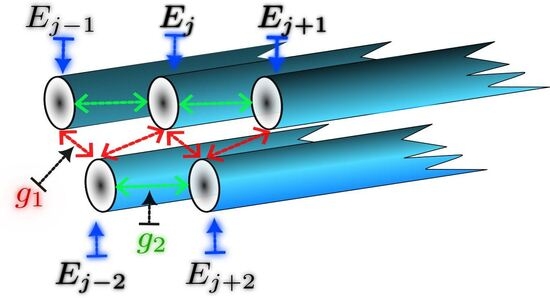
Graphical Abstract

1. Introduction

Discreteness is a fundamental concept prevalent in many areas of modern physics, such as quantum mechanics. However, the experimental verification of theoretical predictions regarding discrete systems is often challenging. Consequently, systems that exhibit analogous structures in both their physical behavior and mathematical formalism are needed. Arrays of evanescently coupled waveguides serve as a prominent example of such systems [1,2]. In quantum optics, the ability to design and control the dynamics of discrete coupling or tunneling processes between periodically arranged potential wells is crucial. This topic has gained significant importance in scientific research, and arrays of weakly coupled waveguides have been used to investigate a wide range of phenomena, including quantum walks, Anderson localization, the simulation of PT symmetric Hamiltonians, and quantum state generation, among other applications [3,4,5,6,7,8,9,10,11,12,13,14].
The development of new schemes to extend the concept of waveguides in other settings is of significant importance. In many of these structures, only couplings to nearest-neighboring waveguides are considered [15,16,17], while interactions with more distant waveguides are often neglected due to the assumption that the coupling strength decays exponentially with distance, rendering second-order couplings negligible. However, under certain conditions, the influence of a second interaction becomes remarkably significant. For example, in quantum computation and quantum information processing using optical waveguides, it is crucial to fabricate compact waveguide circuits to minimize their footprints [18]. As the separation between waveguides in these circuits decreases or as the waveguide length increases, higher-order couplings must be considered. The two-dimensional zigzag waveguide lattice, which is topologically equivalent to a one-dimensional waveguide lattice, has been used to study second-order couplings [19,20]. The benefits of non-nearest-neighbor couplings have been well documented in the literature, such as modeling quantum states, Bloch oscillations, and photon–number correlations [21,22,23]. Moreover, the role of boundaries and surfaces introduces additional complexities to wave dynamics by breaking translational symmetry, significantly altering the interaction landscape that is not present in infinite arrays [24,25]. Experimentally, this can be managed by altering the separation between the boundary waveguide and its neighbors or by adjusting its refractive index, which in turn affects the periodicity of the entire array [26,27]. These modifications affect both nearest-neighbor and non-nearest-neighbor interactions, underscoring the nuanced relationship between boundary effects and waveguide couplings.
Recently, we have solved the problem of interaction to many neighbors [28]; however, we studied the case of infinite waveguide arrays. Here, we show the solution to interaction to second neighbors when the array is semi-infinite, a harder problem as it involves non-commuting operators. It is worth noting that the Schrödinger-like formulation adopted here is equivalent to the paraxial approximation in the optical domain. While this assumption is well justified for typical waveguide arrays and coupled-mode regimes, recent studies have shown that nonparaxial effects, such as spin–orbit interactions of light, asymmetric diffraction, or nonparaxial Airy-type propagation, can become relevant in systems with strong confinement or high-refractive-index contrast [29,30,31,32,33]. These effects may modify the effective coupling constants or introduce additional phase terms, potentially leading to novel interference or transport phenomena. Although the present work focuses on the paraxial regime, extending this formalism to explicitly include nonparaxial corrections constitutes an interesting direction for future research.
The article is organized as follows. In Section 2, we start by analyzing the fully infinite waveguide array in the case where only first-neighbor interactions are allowed. In Section 3, we expand on this by studying the semi-infinite waveguide array, demonstrating that the system’s evolution operator can be factorized in terms of Bessel functions. In Section 4, we extend the analysis considering second-neighbor interactions in the complete infinity case. Using the generating function for one-parameter generalized Bessel functions, we derive the optical field, revealing a correlation between the solutions for the semi-infinite and infinite cases, as well as for first- and second-neighbor interactions. In Section 5, we propose a factorization for the evolution operator in the semi-infinite case with second-neighbor interactions, and applying the method of Section 3, we demonstrate its validity. We then calculate the evolution of the amplitude for each waveguide and apply this solution to standard initial conditions in quantum optics. The article concludes with Section 6, where we present our final remarks.

2. Interaction to First Neighbors: Case in Which the Operators Are Infinite on Both Sides

In coupled mode theory, the propagation of an optical field through a waveguide array with nearest-neighbor evanescent coupling without frontiers is governed by the following set of coupled first-order ordinary differential equations
i d E j ( z ) d z = g 1 ( E j 1 + E j + 1 ) , j = , , ,
with z the propagation distance, g 1 the coupling constant and j runs from to through all integers.
This framework can also be viewed as the problem of solving the Schrödinger-like equation with the Hamiltonian.
H ^ = g 1 V ^ + V ^ ,
where the operators V ^ and V ^ are the infinite counterparts of the London–Susskind–Glogower operators [34,35], defined as
V ^ = n = | n n + 1 | , V ^ = n = | n + 1 n | ;
the states | n , n Z , are generalized Fock states, and it is possible to show that [ V ^ , V ^ ] = 0 and V ^ V ^ = I ^ .
If we denote the solution of the Schrödinger-type equation obtained from the Hamiltonian (2) as | ψ ( z ) , it is easy to demonstrate that the solutions of system (1) are given by E j ( z ) = j | ψ ( z ) , j Z .
Using operational methods, we proceed to solve the Schrödinger-like equation obtained from the Hamiltonian (2), and subsequently derive the solution for the infinite system in (1). Given the initial condition | ψ ( 0 ) = | n 0 , the formal solution of the Schrödinger-like equation can be written as | ψ n 0 ( z ) = exp [ i g 1 z ( V ^ + V ^ ) ] | n 0 ; to calculate this expression, we use the fact that V ^ V ^ = I ^ implies V ^ = 1 V ^ ; therefore, we can write
| ψ n 0 ( z ) = exp g 1 z i V ^ 1 i V ^ | n 0 .
Since the generating function for the Bessel functions of the first kind [36] is apparent in the preceding equation, we can reformulate the solution to the Schrödinger-like equation as
| ψ n 0 ( z ) = n = J n ( 2 g 1 z ) i n V ^ n | n 0 .
Using V ^ n | n 0 = | n 0 + n , we get
| ψ n 0 ( z ) = n = J n ( 2 g 1 z ) i n | n 0 + n ,
and in order to find the amplitudes E j that are the solutions of the system (1), we simply multiply by the bra j | and obtain
E n 0 , j ( z ) = j | ψ n 0 ( z ) = i j n 0 J j n 0 ( 2 g 1 z ) , j Z .

3. Interaction to First Neighbors: Case Semi-Infinite

In the case of propagation of an optical field through a waveguide array with nearest-neighbor evanescent coupling with frontiers, the set of coupled differential equations which rules the behavior is
i d E 0 ( z ) d z = g 1 E 1 , i d E j ( z ) d z = g 1 ( E j 1 + E j + 1 ) , j = 1 , 2 , 3 , ,
being g 1 again the coupling constant.
As in the previous case, this system of equations is equivalent to the Schrödinger equation i d | ψ ( z ) d z = H ^ | ψ ( z ) considering the Hamiltonian H ^ = g 1 ( V ^ + V ^ ) , where V ^ and V ^ are the known London–Susskind–Glogower operators [34,35] and | ψ ( z ) = j = 0 E j ( z ) | j . The evolution operator for our Hamiltonian can then be expressed as U ^ ( z ) = exp [ i g 1 z ( V ^ + V ^ ) ] ; by employing operational methods [37], it is possible to show that it can be rewritten as
U ^ ( z ) = n , m = 0 i m n J m n ( 2 g 1 z ) + i n + m J m + n + 2 ( 2 g 1 z ) V ^ m | 0 0 | V ^ n .
In order to demonstrate the method that will later be used to verify the correctness of our ansatz for second-neighbor interactions in the semi-infinite case, we will first prove the validity of Equation (9). We start by differentiating both sides of the equation with respect to z, then group terms and separate one of the sums over m. On the one hand, this leads to the expression
d U ^ ( z ) d z = n , m = 0 g 1 i m n J m n + 1 ( 2 g 1 z ) + i n + m J m + n + 3 ( 2 g 1 z ) V ^ m | 0 0 | V ^ n n = 0 , m = 1 g 1 i m n J m n 1 ( 2 g 1 z ) + i n + m J m + n + 1 ( 2 g 1 z ) V ^ m | 0 0 | V ^ n ,
where we have used the Bessel functions property J n ( z ) = ( 1 ) n J n ( z ) , n Z that implies i n J n 1 ( 2 g 1 z ) + i n J n + 1 ( 2 g 1 z ) = 0 , which we used to simplify the result.
Additionally, based on Equation (9) and keeping in mind that U ^ ( z ) = exp [ i g 1 z ( V ^ + V ^ ) ] , we can derive that
d U ^ ( z ) d z = i g 1 ( V ^ + V ^ ) n , k = 0 i k n J k n ( 2 g 1 z ) + i n + k J k + n + 2 ( 2 g 1 z ) V ^ k | 0 0 | V ^ n .
It is possible to show from the commutation relations between V ^ and V that [ V ^ , V ^ k ] = V ^ ( k 1 ) | 0 0 | . Performing the product and using the previous equation, it is easy to see that the derivative can be written as
d U ^ ( z ) d z = i g 1 n , m = 0 [ i m n + 1 J m n + 1 ( 2 g 1 z ) + i n + m + 1 J m + n + 3 ( 2 g 1 z ) ] V ^ m | 0 0 | V ^ n i g 1 n = 0 , m = 1 [ i m n 1 J m n 1 ( 2 g 1 z ) + i n + m 1 J m + n + 1 ( 2 g 1 z ) ] V ^ m | 0 0 | V ^ n ,
where we have made the index substitutions m = k 1 and m = k + 1 when needed; as expected, Equations (10) and (12) are exactly equivalent.
It is evident that the optical field at the j-th site, when the n 0 -th guide is excited, is given by
E n 0 , j ( z ) = i j n 0 J j n 0 ( 2 g 1 z ) + i j + n 0 J j + n 0 + 2 ( 2 g 1 z ) , j = 0 , 1 , 2 , , .
This result aligns with the work of Makris and Christodoulides [38], who employed the method of images to analyze a finite one-dimensional array of N waveguides.
In the next sections, we show how to extend the solution for the interaction to the second neighbors. Although the solution to first neighbors is difficult to obtain, we show that it may be generalized using extensions of the Bessel functions introduced by Dattoli et al. [39].

4. Interaction to Second Neighbors: Case in Which the Operators Are Infinite on Both Sides

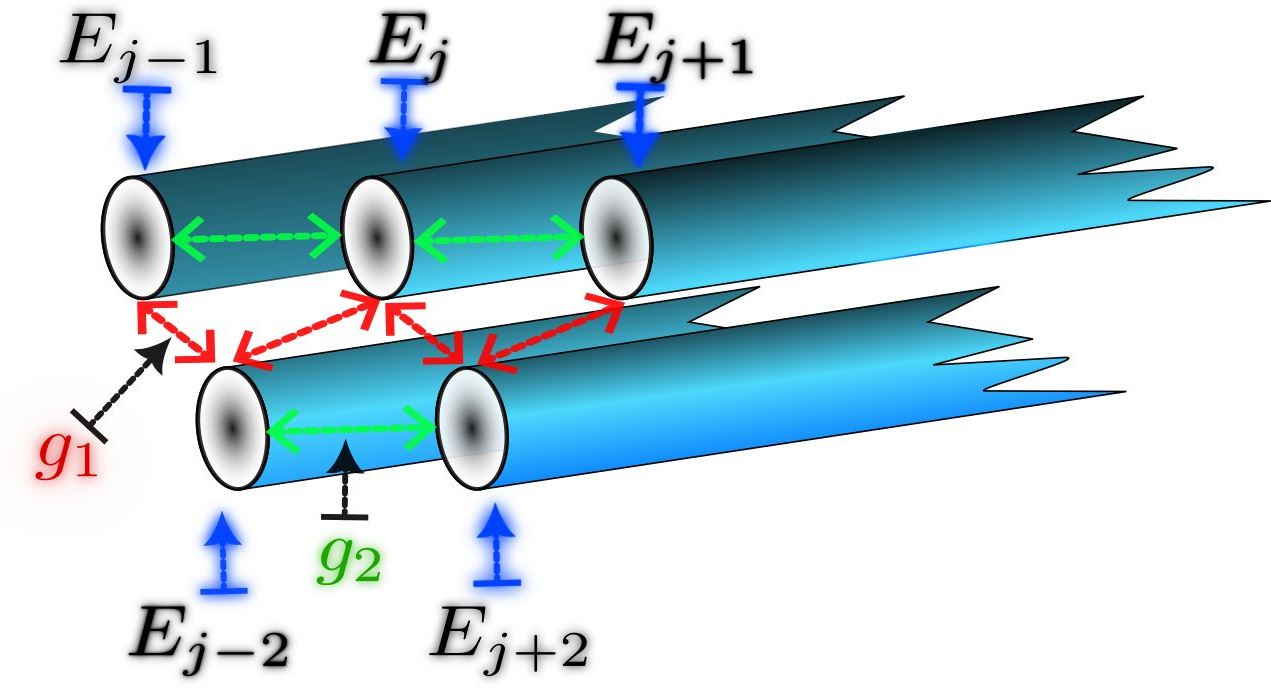
Under coupled mode theory, the dynamics of an optical field in a waveguide array with next-nearest-neighbor evanescent coupling is described by the following set of coupled differential equations
i d E j ( z ) d z = g 1 ( E j 1 + E j + 1 ) + g 2 ( E j 2 + E j + 2 ) ,
with j running through all integers Z .
As in the previous sections, this system is equivalent to a Schrödinger-like equation with the Hamiltonian H ^ = g 1 ( V ^ + V ^ ) + g 2 ( V ^ 2 + V ^ 2 ) . The evolution operator corresponding to this Hamiltonian is
U ^ ( z ) = exp i z g 1 V ^ + V ^ + g 2 V ^ 2 + V ^ 2 .
Using again V ^ = 1 V ^ , we can cast this evolution operator as
U ^ ( z ) = exp g 1 z i V ^ 1 i V ^ g 2 z i V ^ 2 1 i V ^ 2 .
It is convenient to introduce the not so well known one parameter generalized Bessel functions J n ( x , y ; s ) [39] defined as
J n ( x , y ; s ) = k = s k J n 2 k ( x ) J k ( y ) ,
whose generating function is
n = t n J n ( x , y ; s ) = exp x 2 t 1 t + y 2 s t 2 1 s t 2 .
The two operators in the propagator Equation (16), i V ^ 1 i V ^ and i V ^ 2 1 i V ^ 2 commute, and we can identify the terms with those of the generating function (18); thus, if in the generating function Equation (18) we identify t i V ^ , x 2 g 1 z , y 2 g 2 z , s i , we obtain
U ^ ( z ) = n = i V ^ n J n ( 2 g 1 z , 2 g 2 z ; i ) .
Rearranging and commuting,
U ^ ( z ) = n = i n J n ( 2 g 1 z , 2 g 2 z ; i ) V ^ n ,
and we have the solution to our problem.
If we have an initial condition | ψ ( 0 ) , we get
| ψ ( z ) = n = i n J n ( 2 g 1 z , 2 g 2 z ; i ) V ^ n | ψ ( 0 ) .
Let us specify the initial condition setting | ψ ( 0 ) = | n 0 , with n 0 an integer; as V ^ n | n 0 = | n 0 + n ,
| ψ n 0 ( z ) = n = i n J n ( 2 g 1 z , 2 g 2 z ; i ) | n 0 + n ,
and so we have
E n 0 , j ( z ) = j | ψ n 0 ( z ) = i j n 0 J j n 0 ( 2 g 1 z , 2 g 2 z ; i ) , j = , , 2 , 1 , 0 , 1 , 2 , , .
The structure of this result is similar to that of the infinite case of an optical field propagating through a waveguide array with nearest-neighbor evanescent coupling, Equation (7), except that the Bessel functions are replaced by the one parameter generalized Bessel functions. It is easy to show that for z = 0 the solution (23) reduces to the initial condition E n 0 , j ( 0 ) = δ n 0 , j , and by direct substitution of the said solution in the system of Equation (14) it is found that it is indeed the solution.
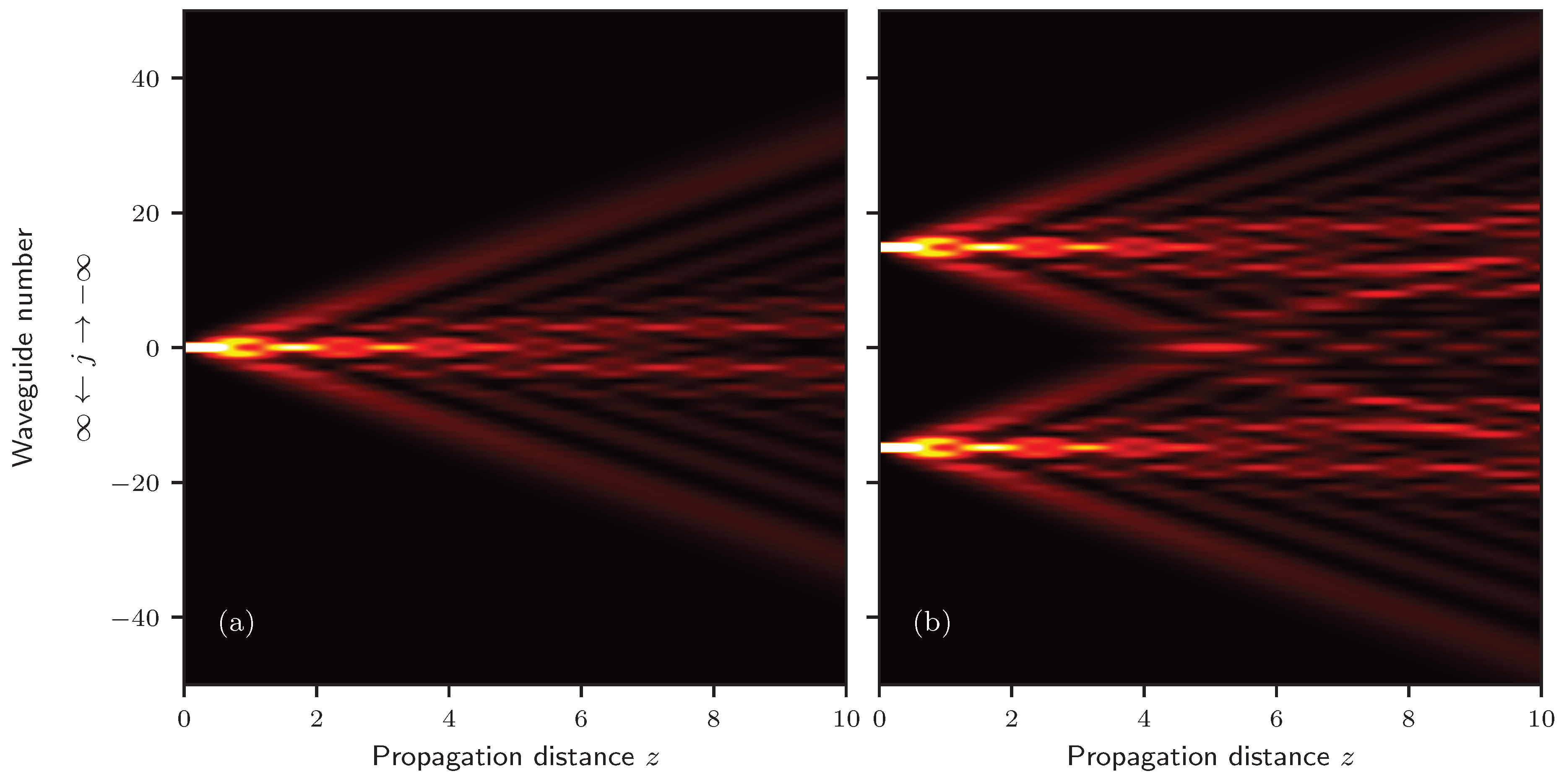
In Figure 1, we present the intensity distribution in the waveguides as a function of the propagation distance z given by (23). We assume g 1 > g 2 to be a realistic condition, based on the fact that the coupling strength between the waveguides decreases as the light propagates farther along the array. In panel (a), the central guide is illuminated. To show the interaction between the guides, in panel (b), two guides are excited, j = 15 and j = 15 .

5. Interaction to Second Neighbors: Case Semi-Infinite

In the following, we will analyze the dynamics of an optical field in a waveguide array with next-nearest-neighbor evanescent coupling with boundaries. The system is described by the following coupled differential equations
i d E 0 ( z ) d z = g 1 E 1 + g 2 ( E 2 E 0 ) , i d E 1 ( z ) d z = g 1 ( E 0 + E 2 ) + g 2 E 3 , i d E j ( z ) d z = g 1 ( E j 1 + E j + 1 ) + g 2 ( E j 2 + E j + 2 ) ,
where j = 2 , 3 , 4 , .
Now, we consider the Hamiltonian H ^ = g 1 ( V ^ + V ^ ) + g 2 ( V ^ 2 + V ^ 2 | 0 0 | ) , The additional term g 2 | 0 0 | accounts for the asymmetry introduced by the boundary in the semi-infinite configuration. In the infinite lattice, each waveguide couples symmetrically to its two next-nearest neighbors, while in the semi-infinite case the first site ( j = 0 ) lacks the couplings toward j = 1 and j = 2 . The operator g 2 | 0 0 | effectively compensates for this absence and ensures that the Schrödinger equation derived from the Hamiltonian reproduces the correct boundary conditions in Equation (24). Physically, this term represents a correction to the local propagation constant at the edge, reflecting the modification of the coupling landscape at the boundary. Its inclusion guaranties full consistency between the operator formulation and the coupled-mode equations governing the semi-infinite waveguide array. Where once again V ^ and V ^ are the usual London–Susskind–Glogower operators [34,35], and the evolution operator may be written as
U ^ ( z ) = exp { i z [ g 1 ( V ^ + V ^ ) + g 2 ( V ^ 2 + V ^ 2 | 0 0 | ) ] } .
We propose an ansatz for the evolution operator, maintaining the same structure as Equation (9), but replacing the Bessel functions with one-parameter generalized Bessel functions [39]:
U ^ ( z ) = n , m = 0 i m n J m n ( 2 g 1 z , 2 g 2 z ; i ) + i n + m J m + n + 2 ( 2 g 1 z , 2 g 2 z ; i ) V ^ m | 0 0 | V ^ n .
To demonstrate the validity of our ansatz, as done in Section 3, we differentiate the above expression with respect to z. In Appendix A, we show that this yields the result
n = 0 , m = 0 g 1 i m n J m n + 1 ( 2 g 1 z , 2 g 2 z ; i ) + i n + m J m + n + 3 ( 2 g 1 z , 2 g 2 z ; i ) V ^ m | 0 0 | V ^ n n = 0 , m = 1 g 1 i m n J m n 1 ( 2 g 1 z , 2 g 2 z ; i ) + i n + m J m + n + 1 ( 2 g 1 z , 2 g 2 z ; i ) V ^ m | 0 0 | V ^ n + n = 0 , m = 0 g 2 [ i m n + 1 J m n + 2 ( 2 g 1 z , 2 g 2 z ; i ) | + i n + m + 1 J m + n + 4 ( 2 g 1 z , 2 g 2 z ; i ) ] V ^ m | 0 0 | V ^ n n = 0 , m = 2 g 2 [ i m n 1 J m n 2 ( 2 g 1 z , 2 g 2 z ; i ) + i n + m 1 J m + n ( 2 g 1 z , 2 g 2 z ; i ) ] V ^ m | 0 0 | V ^ n n = 0 g 2 [ i n 1 J n + 2 ( 2 g 1 z , 2 g 2 z ; i ) + i n 1 J n ( 2 g 1 z , 2 g 2 z ; i ) ] | 0 0 | V ^ n .
On the other hand, from Equations (25) and (26), we have that
d U ^ ( z ) d z = i [ g 1 ( V ^ + V ^ ) + g 2 ( V ^ 2 + V ^ 2 | 0 0 | ) ] n , k = 0 i k n J k n ( 2 g 1 z , 2 g 2 z ; i ) + i n + k J k + n + 2 ( 2 g 1 z , 2 g 2 z ; i ) V ^ k | 0 0 | V ^ n ;
calculating the product of the operators, recognizing V ^ k | 0 = | k , and applying the commutation rules, we obtain the following result,
i g 1 n = 0 , k = 1 i k n J k n ( 2 g 1 z , 2 g 2 z ; i ) + i n + k J k + n + 2 ( 2 g 1 z , 2 g 2 z ; i ) V ^ ( k 1 ) | 0 0 | V ^ n i g 1 n , k = 0 i k n J k n ( 2 g 1 z , 2 g 2 z ; i ) + i n + k J k + n + 2 ( 2 g 1 z , 2 g 2 z ; i ) V ^ ( k + 1 ) | 0 0 | V ^ n i g 2 n = 0 , k = 2 i k n J k n ( 2 g 1 z , 2 g 2 z ; i ) + i n + k J k + n + 2 ( 2 g 1 z , 2 g 2 z ; i ) V ^ ( k 2 ) | 0 0 | V ^ n i g 2 n , k = 0 i k n J k n ( 2 g 1 z , 2 g 2 z ; i ) + i n + k J k + n + 2 ( 2 g 1 z , 2 g 2 z ; i ) V ^ ( k + 2 ) | 0 0 | V ^ n + i g 2 n = 0 i n J n ( 2 g 1 z , 2 g 2 z ; i ) + i n J n + 2 ( 2 g 1 z , 2 g 2 z ; i ) | 0 0 | V ^ n .
Assigning m = k 1 to the first sum, m = k + 1 to the second, m = k 2 to the third, m = k + 2 to the fourth, and applying Equation (A3), we obtain the final expression
i g 1 n = 0 , m = 0 [ i m n + 1 J m n + 1 ( 2 g 1 z , 2 g 2 z ; i ) + i m + n + 1 J m + n + 3 ( 2 g 1 z , 2 g 2 z ; i ) ] V ^ m | 0 0 | V ^ n i g 1 n = 0 , m = 1 [ i m n 1 J m n 1 ( 2 g 1 z , 2 g 2 z ; i ) + i m + n 1 J m + n + 1 ( 2 g 1 z , 2 g 2 z ; i ) ] V ^ m | 0 0 | V ^ n i g 2 n = 0 , m = 0 [ i m n + 2 J m n + 2 ( 2 g 1 z , 2 g 2 z ; i ) + i m + n + 2 J m + n + 4 ( 2 g 1 z , 2 g 2 z ; i ) ] V ^ m | 0 0 | V ^ n i g 2 n = 0 , m = 2 [ i m n 2 J m n 2 ( 2 g 1 z , 2 g 2 z ; i ) + i m + n 2 J m + n ( 2 g 1 z , 2 g 2 z ; i ) ] V ^ m | 0 0 | V ^ n g 2 n = 0 [ i n 1 J n + 2 ( 2 g 1 z , 2 g 2 z ; i ) + i n 1 J n ( 2 g 1 z , 2 g 2 z ; i ) ] | 0 0 | V ^ n ,
When we compare Equations (27) and (30), the equality is evident, as intended. Therefore, we can express the solution in the form
| ψ ( z ) = n = 0 , m = 0 i m n J m n ( 2 g 1 z , 2 g 2 z ; i ) + i n + m J m + n + 2 ( 2 g 1 z , 2 g 2 z ; i ) ] V ^ m | 0 0 | V ^ n | ψ ( 0 ) .
We consider as initial conditions a Fock state and a coherent state. First, taking | ψ ( 0 ) = | n 0 , we get
| ψ n 0 ( z ) = n , m = 0 i m n J m n ( 2 g 1 z , 2 g 2 z ; i ) + i n + m J m + n + 2 ( 2 g 1 z , 2 g 2 z ; i ) | m n | n 0
To obtain the evolution of the amplitude of each guide along the direction propagation, we multiply by the bra j | to obtain
E n 0 , j ( z ) = i j n 0 J j n 0 ( 2 g 1 z , 2 g 2 z ; i ) + i n 0 + j J n 0 + j + 2 ( 2 g 1 z , 2 g 2 z ; i ) , j = 0 , 1 , 2 , .
As a check, we can set z = 0 in the above solution, and we get the correct initial condition, i.e., initially only the guide n 0 is illuminated; furthermore, if we substitute the solution (33) in the system of Equation (24), we verify that it is indeed the solution.
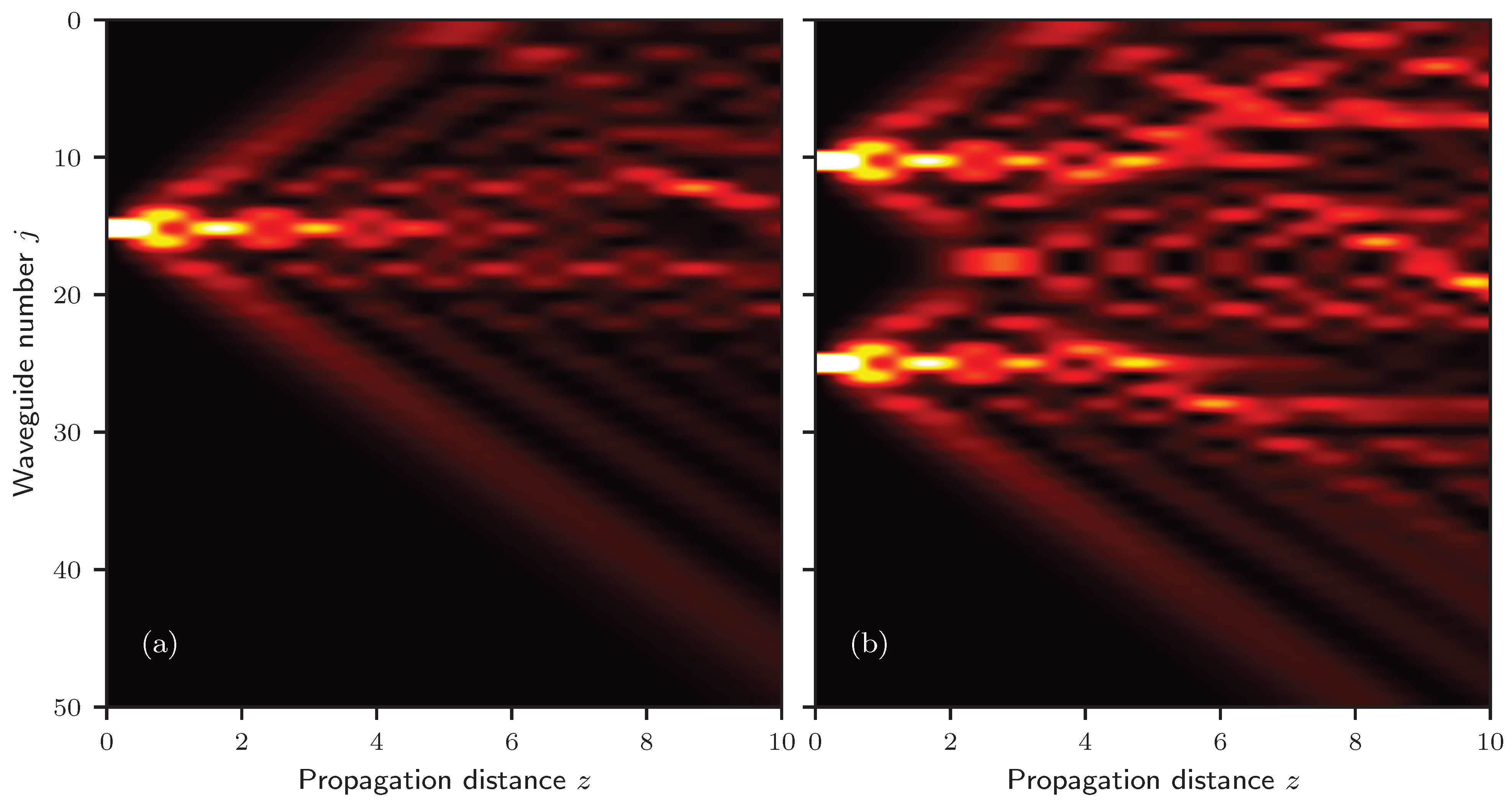
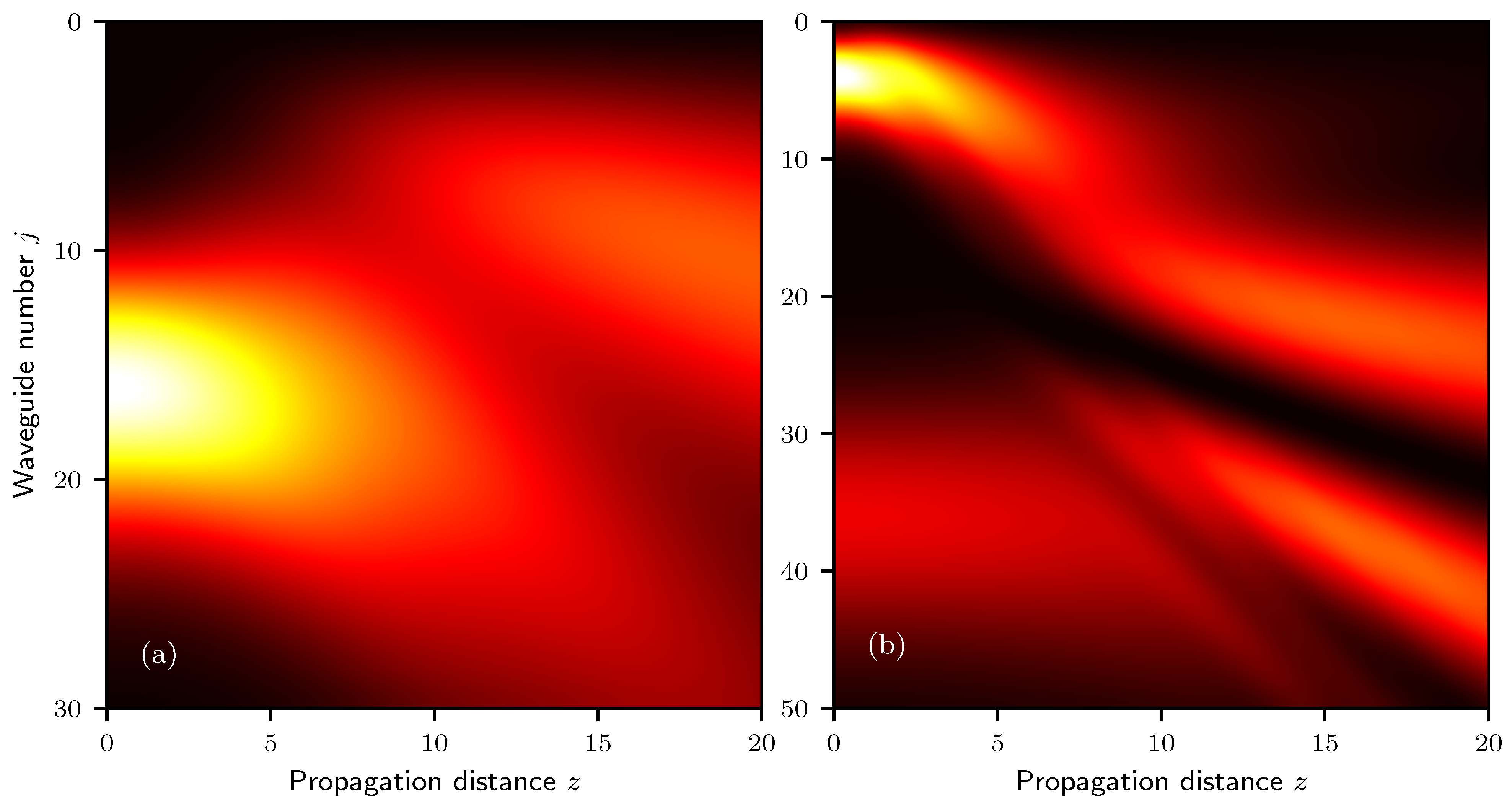
In Figure 2, we present the intensity distribution in the waveguides as a function of the propagation distance z, considering the scenario in which light hits different waveguides. As explained in the preceding paragraph of Figure 1, we assume g 1 > g 2 . In panel (a), the guide j = 15 is irradiated, the light travels a certain distance before encountering the edge and interacting with the boundary, resulting in a noticeable reflection, and panel (b) shows the case where two guides are illuminated, one located near the edge and the other more in the center.
The present analysis was restricted to linear coupling between first and second neighbors. However, the analytical formulation can be generalized to nonlinear propagation by incorporating intensity-dependent terms in the Hamiltonian, such as Kerr-type nonlinearities. The resulting equations correspond to the discrete nonlinear Schrödinger model, which exhibits rich phenomena including soliton propagation, self-trapping, and power-dependent coupling [40,41,42,43,44]. Extending our analytical framework to such nonlinear settings could provide deeper insight into nontrivial light transport and localization mechanisms in photonic lattices [45,46].
We now consider the case where the initial condition is a coherent state | ψ ( 0 ) = | α = e | α | 2 2 l = 0 α l l ! | l , and we get
| ψ α ( z ) = e | α | 2 2 l = 0 , m = 0 i m l J m l ( 2 g 1 z , 2 g 2 z ; i ) + i l + m J m + l + 2 ( 2 g 1 z , 2 g 2 z ; i ) | m α l l ! ;
now, we multiply by the bra j | to obtain the evolution of the amplitude of each guide along the direction propagation as
E α , j ( z ) = e | α | 2 2 l = 0 α l l ! i j l J j l ( 2 g 1 z , 2 g 2 z ; i ) + i l + j J l + j + 2 ( 2 g 1 z , 2 g 2 z ; i ) .
In this case, it can also be shown by direct substitution that the above solution satisfies the initial conditions and the system of Equation (24).
Figure 3 shows the distribution of light intensity along the z axis and across the site number when a coherent light distribution is injected into the initial plane. Similarly to the previous scenario, we assume that it is physically reasonable that g 1 > g 2 , since the coupling strength between the waveguides diminishes during light transmission from one to the other. This configuration can be achieved using the femtosecond laser writing technique, which allows the creation of large two-dimensional lattices with customizable topologies. In practical implementations, the number of waveguides is, of course, finite [47,48]. Nevertheless, the analytical results obtained for the infinite and semi-infinite arrays remain valid approximations, provided that the light field does not reach the physical boundaries within the propagation length considered. This condition can be expressed in terms of the coupling length L c : As long as the total array size is several times larger than L c , the central region of the lattice effectively reproduces the idealized dynamics. For realistic coupling parameters typically achieved in femtosecond-laser-written arrays, configurations comprising approximately forty to fifty waveguides already reproduce the infinite-lattice limit to a high degree of accuracy. Finite-size effects mainly manifest as weak reflections at the edges and slight distortions of the interference pattern near the boundaries, while the overall propagation characteristics predicted by our analytical solutions remain essentially unaffected [49,50]. Panel (a) shows the evolution of a coherent state with the average photon number n ^ = 16 , ( α = 4 ), illustrating the reflection from the upper boundary of the semi-infinite array. In panel (b), in order to present the interaction between different guides, we introduced two coherent states; the first with a mean photon number of 4 ( α = 2 ), and the second with an average number of photons of 36 ( α = 6 ).
A comparison between the infinite and semi-infinite configurations highlights their conceptual and physical differences. In the infinite lattice, translational symmetry is preserved and the operators remain unitary, leading to perfectly symmetric propagation patterns governed by Bessel or generalized Bessel functions. In contrast, the semi-infinite system breaks this symmetry due to the boundary, where the London–Susskind–Glogower operators become nonunitary. This asymmetry introduces reflected and self-interfering field components, which are analytically represented by the additional terms in the semi-infinite solution. While the infinite model describes propagation in the central region of an extended array, the semi-infinite formulation captures the boundary-induced effects that become significant near the edge and are experimentally relevant in truncated photonic lattices. Therefore, the two cases are complementary: the infinite lattice provides the theoretical reference for extended propagation, and the semi-infinite configuration extends the analysis to realistic systems where boundaries play a crucial role.

6. Conclusions

The method for deriving a solution for field propagation in optical lattices, accounting for interaction with second neighbors, has been demonstrated. We have successfully extended the solution for the semi-infinite interaction, initially applied to first-neighbor interactions, as described in [38]. This extension is nontrivial, as the London phase operators do not close to an algebra [37]. The complete solution was achieved by adapting fully infinite case solutions, expressed through generalized Bessel functions [39], to the semi-infinite context.

Author Contributions

All authors (M.A.T.-V., I.R.-P., F.S.-E. and H.M.M.-C.) contributed equally to each of the requirements necessary for the elaboration of this manuscript. All authors have read and agreed to the published version of the manuscript.

Funding

This research received no external funding.

Data Availability Statement

No new data were created or analyzed in this study.

Acknowledgments

Marco Antonio Tapia Valerdi thanks the Secretariat of Science, Humanities, Technology and Innovation (SECIHTI) and the National Institute of Astrophysics, Optics and Electronics (INAOE) for the doctoral scholarship.

Conflicts of Interest

The authors declare no conflicts of interest.

Appendix A

In this Appendix, we show that the differentiation of Equation (26) with respect to z yields the expression given by (27). This result is obtained first by applying the recurrence properties of the one-parameter generalized Bessel functions and appropriately rearranging the terms as follows,
d U ^ ( z ) d z = n , m = 0 g 1 i m n J m n + 1 ( 2 g 1 z , 2 g 2 z ; i ) + i n + m J m + n + 3 ( 2 g 1 z , 2 g 2 z ; i ) V ^ m | 0 0 | V ^ n n , m = 0 g 1 i m n J m n 1 ( 2 g 1 z , 2 g 2 z ; i ) + i n + m J m + n + 1 ( 2 g 1 z , 2 g 2 z ; i ) V ^ m | 0 0 | V ^ n + n , m = 0 g 2 [ i m n + 1 J m n + 2 ( 2 g 1 z , 2 g 2 z ; i ) + i n + m + 1 J m + n + 4 ( 2 g 1 z , 2 g 2 z ; i ) ] V ^ m | 0 0 | V ^ n n , m = 0 g 2 [ i m n 1 J m n 2 ( 2 g 1 z , 2 g 2 z ; i ) + i n + m 1 J m + n ( 2 g 1 z , 2 g 2 z ; i ) ] V ^ m | 0 0 | V ^ n ,
separating the second and fourth sums with respect to m, the previous expression can be rewritten as
n = 0 , m = 0 g 1 i m n J m n + 1 ( 2 g 1 z , 2 g 2 z ; i ) + i n + m J m + n + 3 ( 2 g 1 z , 2 g 2 z ; i ) V ^ m | 0 0 | V ^ n n = 0 , m = 1 g 1 i m n J m n 1 ( 2 g 1 z , 2 g 2 z ; i ) + i n + m J m + n + 1 ( 2 g 1 z , 2 g 2 z ; i ) V ^ m | 0 0 | V ^ n n = 0 g 1 i n J n 1 ( 2 g 1 z , 2 g 2 z ; i ) + i n J n + 1 ( 2 g 1 z , 2 g 2 z ; i ) | 0 0 | V ^ n + n = 0 , m = 0 g 2 [ i m n + 1 J m n + 2 ( 2 g 1 z , 2 g 2 z ; i ) + i n + m + 1 J m + n + 4 ( 2 g 1 z , 2 g 2 z ; i ) ] V ^ m | 0 0 | V ^ n n = 0 , m = 2 g 2 [ i m n 1 J m n 2 ( 2 g 1 z , 2 g 2 z ; i ) + i n + m 1 J m + n ( 2 g 1 z , 2 g 2 z ; i ) ] V ^ m | 0 0 | V ^ n n = 0 g 2 i n J n 1 ( 2 g 1 z , 2 g 2 z ; i ) + i n J n + 1 ( 2 g 1 z , 2 g 2 z ; i ) V ^ | 0 0 | V ^ n g 2 [ i n 1 J n 2 ( 2 g 1 z , 2 g 2 z ; i ) + i n 1 J n ( 2 g 1 z , 2 g 2 z ; i ) ] | 0 0 | V ^ n .
To simplify these results, we use the following relations for the one-parameter generalized Bessel function J n ( x , y ; s ) = J n ( x , y , 1 / s ) , J n ( x , y ; s ) = ( 1 ) n J n ( x , y ; s ) and J n ( x , y ; s ) = J n ( x , y ; s ) , and we can be convinced that for the specific case in which s = i it is true that
J n ( x , y ; i ) = ( 1 ) n J n ( x , y ; i ) ,
so for all non-negative integers n, it is easy to show that
n = 0 g 1 i n J n 1 ( 2 g 1 z , 2 g 2 z ; i ) + i n J n + 1 ( 2 g 1 z , 2 g 2 z ; i ) | 0 0 | V ^ n = 0 , n = 0 g 2 i n J n 1 ( 2 g 1 z , 2 g 2 z ; i ) + i n J n + 1 ( 2 g 1 z , 2 g 2 z ; i ) V | 0 0 | V ^ n = 0 ,
identifying the equations above in Equation (A2), we get the desired result.

References

  1. Christodoulides, D.N.; Lederer, F.; Silberberg, Y. Discretizing light behaviour in linear and nonlinear waveguide lattices. Nature 2003, 424, 817–823. [Google Scholar] [CrossRef]
  2. Barral, D.; Walschaers, M.; Bencheikh, K.; Parigi, V.; Levenson, J.A.; Treps, N.; Belabas, N. Quantum state engineering in arrays of nonlinear waveguides. Phys. Rev. A 2020, 102, 043706. [Google Scholar] [CrossRef]
  3. Perets, H.B.; Lahini, Y.; Pozzi, F.; Sorel, M.; Morandotti, R.; Silberberg, Y. Realization of quantum walks with negligible decoherence in waveguide lattices. Phys. Rev. Lett. 2008, 100, 170506. [Google Scholar] [CrossRef] [PubMed]
  4. Peruzzo, A.; Lobino, M.; Matthews, J.C.; Matsuda, N.; Politi, A.; Poulios, K.; Zhou, X.Q.; Lahini, Y.; Ismail, N.; Wörhoff, K.; et al. Quantum walks of correlated photons. Science 2010, 329, 1500–1503. [Google Scholar] [CrossRef] [PubMed]
  5. Lahini, Y.; Avidan, A.; Pozzi, F.; Sorel, M.; Morandotti, R.; Christodoulides, D.N.; Silberberg, Y. Anderson localization and nonlinearity in one-dimensional disordered photonic lattices. Phys. Rev. Lett. 2008, 100, 013906. [Google Scholar] [CrossRef] [PubMed]
  6. Joglekar, Y.N.; Thompson, C.; Scott, D.D.; Vemuri, G. Optical waveguide arrays: Quantum effects and PT symmetry breaking. Eur. Phys. J. Appl. Phys. 2013, 63, 30001. [Google Scholar] [CrossRef]
  7. Rai, A.; Das, S.; Agarwal, G. Quantum entanglement in coupled lossy waveguides. Opt. Express 2010, 18, 6241–6254. [Google Scholar] [CrossRef]
  8. Perez-Leija, A.; Szameit, A.; Ramos-Prieto, I.; Moya-Cessa, H.; Christodoulides, D.N. Generalized Schrödinger cat states and their classical emulation. Phys. Rev. A 2016, 93, 053815. [Google Scholar] [CrossRef][Green Version]
  9. Biggerstaff, D.N.; Heilmann, R.; Zecevik, A.A.; Gräfe, M.; Broome, M.A.; Fedrizzi, A.; Nolte, S.; Szameit, A.; White, A.G.; Kassal, I. Enhancing coherent transport in a photonic network using controllable decoherence. Nat. Commun. 2016, 7, 11282. [Google Scholar] [CrossRef]
  10. Paulisch, V.; Kimble, H.; González-Tudela, A. Universal quantum computation in waveguide QED using decoherence free subspaces. New J. Phys. 2016, 18, 043041. [Google Scholar] [CrossRef]
  11. Román-Ancheyta, R.; Ramos-Prieto, I.; Perez-Leija, A.; Busch, K.; León-Montiel, R.d.J. Dynamical Casimir effect in stochastic systems: Photon harvesting through noise. Phys. Rev. A 2017, 96, 032501. [Google Scholar] [CrossRef]
  12. Ramos-Prieto, I.; Uriostegui, K.; Récamier, J.; Soto-Eguibar, F.; Moya-Cessa, H.M. Kapitza–Dirac photonic lattices. Opt. Lett. 2021, 46, 4690–4693. [Google Scholar] [CrossRef] [PubMed]
  13. Hernández-Sánchez, L.; Ramos-Prieto, I.; Soto-Eguibar, F.; Moya-Cessa, H.M. Exact solution for the interaction of two decaying quantized fields. Opt. Lett. 2023, 48, 5435–5438. [Google Scholar] [CrossRef]
  14. Urzúa, A.R.; Ramos-Prieto, I.; Moya-Cessa, H.M. Integrated optical wave analyzer using the discrete fractional Fourier transform. J. Opt. Soc. Am. B 2024, 41, 2358–2365. [Google Scholar] [CrossRef]
  15. Perez-Leija, A.; Moya-Cessa, H.; Soto-Eguibar, F.; Aguilar-Loreto, O.; Christodoulides, D.N. Classical analogues to quantum nonlinear coherent states in photonic lattices. Opt. Commun. 2011, 284, 1833–1836. [Google Scholar] [CrossRef]
  16. Schäfer, F.; Fukuhara, T.; Sugawa, S.; Takasu, Y.; Takahashi, Y. Tools for quantum simulation with ultracold atoms in optical lattices. Nat. Rev. Phys. 2020, 2, 411–425. [Google Scholar] [CrossRef]
  17. Vicencio, R.A.; Cantillano, C.; Morales-Inostroza, L.; Real, B.; Mejía-Cortés, C.; Weimann, S.; Szameit, A.; Molina, M.I. Observation of Localized States in Lieb Photonic Lattices. Phys. Rev. Lett. 2015, 114, 245503. [Google Scholar] [CrossRef]
  18. Meany, T.; Gräfe, M.; Heilmann, R.; Perez-Leija, A.; Gross, S.; Steel, M.J.; Withford, M.J.; Szameit, A. Laser written circuits for quantum photonics. Laser Photonics Rev. 2015, 9, 363–384. [Google Scholar] [CrossRef]
  19. Efremidis, N.K.; Christodoulides, D.N. Discrete solitons in nonlinear zigzag optical waveguide arrays with tailored diffraction properties. Phys. Rev. E 2002, 65, 056607. [Google Scholar] [CrossRef]
  20. Szameit, A.; Pertsch, T.; Nolte, S.; Tünnermann, A.; Lederer, F. Long-range interaction in waveguide lattices. Phys. Rev. A 2008, 77, 043804. [Google Scholar] [CrossRef]
  21. Wang, G.; Huang, J.P.; Yu, K.W. Nontrivial Bloch oscillations in waveguide arrays with second-order coupling. Opt. Lett. 2010, 35, 1908–1910. [Google Scholar] [CrossRef] [PubMed]
  22. Dreisow, F.; Wang, G.; Heinrich, M.; Keil, R.; Tünnermann, A.; Nolte, S.; Szameit, A. Observation of anharmonic Bloch oscillations. Opt. Lett. 2011, 36, 3963–3965. [Google Scholar] [CrossRef] [PubMed]
  23. Qi, F.; Feng, Z.; Wang, Y.; Xu, P.; Zhu, S.; Zheng, W. Photon-number correlations in waveguide lattices with second order coupling. J. Opt. 2014, 16, 125007. [Google Scholar] [CrossRef]
  24. Longhi, S. Tunneling escape in optical waveguide arrays with a boundary defect. Phys. Rev. E 2006, 74, 026602. [Google Scholar] [CrossRef] [PubMed]
  25. Istrate, E.; Sargent, E.H. Photonic crystal waveguide analysis using interface boundary conditions. IEEE J. Quantum Electron. 2005, 41, 461–467. [Google Scholar] [CrossRef]
  26. Ablowitz, M.J.; Musslimani, Z.H. Discrete spatial solitons in a diffraction-managed nonlinear waveguide array: A unified approach. Phys. D Nonlinear Phenom. 2003, 184, 276–303. [Google Scholar] [CrossRef]
  27. Trompeter, H.; Peschel, U.; Pertsch, T.; Lederer, F.; Streppel, U.; Michaelis, D.; Bräuer, A. Tailoring guided modes in waveguide arrays. Opt. Express 2003, 11, 3404–3411. [Google Scholar] [CrossRef]
  28. Tapia-Valerdi, M.; Ramos-Prieto, I.; Soto-Eguibar, F.; Moya-Cessa, H. Waveguide Arrays: Interaction to Many Neighbors. Dynamics 2025, 5, 25. [Google Scholar] [CrossRef]
  29. Smirnova, D.; Kruk, S.; Leykam, D.; Melik-Gaykazyan, E.; Choi, D.Y.; Kivshar, Y. Third-Harmonic Generation in Photonic Topological Metasurfaces. Phys. Rev. Lett. 2019, 123, 103901. [Google Scholar] [CrossRef]
  30. Wang, G. Third-harmonic generation in cylindrical parabolic quantum wires with an applied electric field. Phys. Rev. B 2005, 72, 155329. [Google Scholar] [CrossRef]
  31. Privitera, L.; Russomanno, A.; Citro, R.; Santoro, G.E. Nonadiabatic Breaking of Topological Pumping. Phys. Rev. Lett. 2018, 120, 106601. [Google Scholar] [CrossRef] [PubMed]
  32. Cheng, Q.; Wang, H.; Ke, Y.; Chen, T.; Yu, Y.; Kivshar, Y.S.; Lee, C.; Pan, Y. Asymmetric topological pumping in nonparaxial photonics. Nat. Commun. 2022, 13, 249. [Google Scholar] [CrossRef] [PubMed]
  33. Lan, Z.; Chen, M.L.; Gao, F.; Zhang, S.; Sha, W.E. A brief review of topological photonics in one, two, and three dimensions. Rev. Phys. 2022, 9, 100076. [Google Scholar] [CrossRef]
  34. London, F. Über die Jacobischen transformationen der quantenmechanik. Z. Phys. 1926, 37, 915–925. [Google Scholar] [CrossRef]
  35. Susskind, L.; Glogower, J. Quantum mechanical phase and time operator. Phys. Phys. Fiz. 1964, 1, 49–61. [Google Scholar] [CrossRef]
  36. Arfken, G.; Weber, H.; Harris, F. Mathematical Methods for Physicists: A Comprehensive Guide; Elsevier Science: Amsterdam, The Netherlands, 2011. [Google Scholar]
  37. León-Montiel, R.d.J.; Moya-Cessa, H. Modeling non-linear coherent states in fiber array. Int. J. Quantum Inf. 2011, 9, 349–355. [Google Scholar] [CrossRef]
  38. Makris, K.G.; Christodoulides, D.N. Method of images in optical discrete systems. Phys. Rev. E 2006, 73, 036616. [Google Scholar] [CrossRef]
  39. Dattoli, G.; Torre, A.; Lorenzutta, S.; Maino, G.; Chiccoli, C. Theory of generalized Bessel functions.-ii. Il Nuovo C. B (1971–1996) 1991, 106, 21–51. [Google Scholar] [CrossRef]
  40. Khomeriki, R. Nonlinear Band Gap Transmission in Optical Waveguide Arrays. Phys. Rev. Lett. 2004, 92, 063905. [Google Scholar] [CrossRef]
  41. Fleischer, J.W.; Segev, M.; Efremidis, N.K.; Christodoulides, D.N. Observation of two-dimensional discrete solitons in optically induced nonlinear photonic lattices. Nature 2003, 422, 147–150. [Google Scholar] [CrossRef]
  42. Tetarwal, A.; Sharma, S.; Mukherjee, S. Nonlinearity-induced band gap transmission in dispersive and flat-band photonic lattices. Opt. Lett. 2025, 50, 4626–4629. [Google Scholar] [CrossRef] [PubMed]
  43. Rai, A.; Angelakis, D.G. Dynamics of nonclassical light in integrated nonlinear waveguide arrays and generation of robust continuous-variable entanglement. Phys. Rev. A 2012, 85, 052330. [Google Scholar] [CrossRef]
  44. Jakubczyk, Z.; Jerominek, H.; Patela, S.; Tremblay, R.; Delisle, C. Power-dependent attenuation of TE waves propagating in optical nonlinear waveguiding structures. IEEE J. Quantum Electron. 1987, 23, 1921–1928. [Google Scholar] [CrossRef]
  45. Huang, H.; Chen, H.; Liu, H.; Zhang, Z.; Feng, X.; Chen, J.; Wu, H.; Deng, J.; Liang, W.; Lin, W. High-intensity spatial-mode steerable frequency up-converter toward on-chip integration. Opto-Electron. Sci. 2024, 3, 230036-1–230036-9. [Google Scholar] [CrossRef]
  46. Huang, H.; Balčytis, A.; Dubey, A.; Boes, A.; Nguyen, T.G.; Ren, G.; Tan, M.; Mitchell, A. Spatio-temporal isolator in lithium niobate on insulator. Opto-Electron. Sci. 2023, 2, 220022. [Google Scholar] [CrossRef]
  47. Yang, Y.; Guo, Y.; Huang, Y.; Pu, M.; Wang, Y.; Ma, X.; Li, X.; Luo, X. Crosstalk reduction of integrated optical waveguides with nonuniform subwavelength silicon strips. Sci. Rep. 2020, 10, 4491. [Google Scholar] [CrossRef]
  48. Yin, S.Y.; Guo, Q.; Liu, S.R.; He, J.W.; Yu, Y.S.; Tian, Z.N.; Chen, Q.D. Three-dimensional multichannel waveguide grating filters. Opto-Electron. Sci. 2024, 3, 240003-1–240003-11. [Google Scholar] [CrossRef]
  49. Szameit, A.; Dreisow, F.; Pertsch, T.; Nolte, S.; Tünnermann, A. Control of directional evanescent coupling in fs laser written waveguides. Opt. Express 2007, 15, 1579–1587. [Google Scholar] [CrossRef]
  50. Szameit, A.; Blömer, D.; Burghoff, J.; Pertsch, T.; Nolte, S.; Tünnermann, A. Hexagonal waveguide arrays written with fs-laser pulses. Appl. Phys. B 2006, 82, 507–512. [Google Scholar] [CrossRef]
Figure 1. The evolution of the squared amplitude modulus in each waveguide is depicted for an infinite waveguide array governed by Equation (23), with the parameters g 1 = 1.0 and g 2 = 0.5 ; (a) The central guide, j = 0 is illuminated, (b) The guides j = 15 and j = 15 are illuminated.
Dynamics 05 00051 g001
Figure 2. Intensity of the field in each waveguide for different initial condition Equation (33); the parameters are g 1 = 1.0 and g 2 = 0.5 ; (a) The guide j = 15 is illuminated, (b) The guides j = 10 and j = 25 are excited.
Dynamics 05 00051 g002
Figure 3. Intensity of the field in each waveguide when the initial conditions corresponds to a coherent state, Equation (35). The parameters are g 1 = 1.0 and g 2 = 0.5 ; (a) Case with α = 4 (average photon number n ^ = 16 ), (b) Superposition of two coherent states, one with α = 2 and the other with α = 6 .
Dynamics 05 00051 g003
Disclaimer/Publisher’s Note: The statements, opinions and data contained in all publications are solely those of the individual author(s) and contributor(s) and not of MDPI and/or the editor(s). MDPI and/or the editor(s) disclaim responsibility for any injury to people or property resulting from any ideas, methods, instructions or products referred to in the content.