


Abstract
Background: Despite the therapeutic advances made in castration-sensitive prostate cancer, progression to castration-resistant disease is inevitable. Lutetium-177 vipivotide tetraxetan (177Lu-PSMA-617) is a novel radioligand approved for use in metastatic castration-resistant prostate cancer (mCRPC). With promising efficacy, it is not without numerous potential side effects, namely cytopenias, which are often a reason for early discontinuation of 177Lu-PSMA-617. We sought to describe the incidence of cytopenias associated with permanent discontinuation of 177Lu-PSMA-617 at our institution. Methods: We conducted a retrospective review of patients who received 177Lu-PSMA-617at the University of Virginia Comprehensive Cancer Center from 2018 to 2025. From this we assessed for the incidence of toxicities resulting in permanent discontinuation of 177Lu-PSMA-617, which we refer to as dose-limiting toxicities. Descriptive statistics were used to summarize characteristics of the study population. Median overall survival from time of initiation of 177Lu-PSMA-617 was estimated using a Kaplan–Meier curve. Results: Of the patients who received 177Lu-PSMA-617 (n = 64), grade 3 or greater anemia occurred in 36% (n = 23), thrombocytopenia in 3% (n = 2), leukopenia in 3% (n = 2), neutropenia in 0% (n = 0), and lymphopenia in 33% (n = 21). In our cohort, 10.9% (n = 7) developed toxicities necessitating permanent discontinuation. Of these, 9.3% (n = 6) were attributable to cytopenias. Those cytopenias consisted of anemias in 100% (n = 6) of cases, leukopenia in 83% (n = 5), thrombocytopenia in 67% (n = 4), lymphopenia in 100% (n = 6), and neutropenia in 33% (n = 2). Aside from cytopenias, the remaining 1.6% (n = 1) of dose-limiting toxicities were attributable to renal injury. In the VISION trial, the 177Lu-PSMA-617 treatment arm reported dose-limiting toxicities necessitating permanent discontinuation in 11.9% of participants, but did not report if these were attributable to cytopenia or other toxicities. Notably, 2 patients developed grade 5 pancytopenia and 1 patient developed grade 5 bone marrow failure in the VISION 177Lu-PSMA-617 treatment arm. Compared to the VISION 177Lu-PSMA-617 treatment arm, our cohort differed in the distribution of organ metastases, younger median age of patients, and a higher portion of those with ECOG 2 functional status. From the time of 177Lu-PSMA-617 initiation, median overall survival was estimated to be 18.5 months, compared to 15.3 months in the VISION 177Lu-PSMA-617 treatment arm. Conclusions: In our real-world analysis, 85% of dose-limiting toxicities necessitating 177Lu-PSMA-617 discontinuation were attributed to cytopenias. Though a direct comparison cannot be made with the VISION 177Lu-PSMA-617 treatment arm in terms of dose-limiting toxicity attributable specifically to cytopenias, they reported total dose-limiting toxicity to a similar degree, and cytopenias were the most common causes of grade 3 or greater toxicities. Therefore, it is important to recognize the ubiquity of these adverse events as well as the role that they play in therapy-limiting toxicity.
1. Introduction
Prostate cancer is the most common malignancy diagnosed in men, and second leading cause of cancer-related death in men [1]. Prostate cancer is potentially curable when localized; however, when metastatic, the disease is not just incurable, but will inevitably progress from castration-sensitive disease to castration-resistant disease [2], whereby additional therapeutic options are necessary.
One new, promising therapy for patients with metastatic castration-resistant prostate cancer (mCRPC) is Lutetium-177 vipivotide tetraxetan (177Lu-PSMA-617) [3]. 177Lu-PSMA-617 is a radioligand that targets prostate-specific membrane antigen (PSMA), a protein commonly expressed on prostate cancer cells [3]. However, despite its promising efficacy, 177Lu-PSMA-617 is not without numerous potential side effects [4]. In the VISION trial, which led to therapeutic approval, the most common side effects in the 177Lu-PSMA-617 treatment arm included fatigue (43.1%), dry mouth (38.8%), and nausea (35.3%) [4]. These led to Grade 3 and above toxicities in 5.9%, 0%, and 1.3% of patients, respectively [4]. Less common but often more severe were cytopenias [4]. Anemia occurred at a rate of 31.8%, thrombocytopenia 17.2%, lymphopenia 14.2%, and leukopenia 12.5% [4]. These resulted in Grade 3 or greater toxicities in 12.9%, 7.9%, 7.8%, and 2.5% of cases, respectively [4]. A total of 5 adverse events led to drug-related death, and 3 of these were due to either pancytopenia or bone marrow failure [4].
The adverse events described above played a significant role in limiting 177Lu-PSMA-617 administration [4]. Adverse events led to an interruption in 177Lu-PSMA-617 in 16.1% of cases, a reduction in 177Lu-PSMA-617 dosing in 5.7% of cases, and discontinuation of 177Lu-PSMA-617 altogether in 11.9% of cases [4]. Per the study protocol, grade 2 or greater cytopenias necessitated at minimum an interruption in 177Lu-PSMA-617 and at most complete discontinuation if the toxicity failed to resolve [4]. Though the specific type of adverse event attributed to each modification in 177Lu-PSMA-617 administration is not reported, cytopenias likely played an important role [4]. Cytopenias accounted for the most common causes of grade 3 or greater toxicities [4]. Beyond cytopenias, the next most common causes of grade 3 or greater toxicities were fatigue (5.9%) and back pain (3.2%) [4]. It should be noted that more than one toxicity may have occurred in the same patient.
In addition to the VISION trial, the secondary effects of 177Lu-PSMA-617 have been described in a large, retrospective real-world trial called ARON-3 [5]. This study included n = 285 patients with mCRPC across 16 countries, and its primary goal was to compare outcomes between patients receiving 177Lu-PSMA-617 compared to cabazitaxel [5]. The patients included had already received docetaxel and 1–2 ARPI’s (Androgen Receptor Pathway Inhibitor) prior to receiving 177Lu-PSMA-617 or cabazitaxel [5]. They found that Grade 3–4 anemias occurred in the 177Lu-PSMA-617 treatment arm at a rate of 15%, thrombocytopenia of 6%, and neutropenia of 3% [5]. Fatigue, with an incidence of 16%, was the greatest contributor to grade 3–4 toxicity [5]. Anemia and thrombocytopenia were the next greatest contributors behind fatigue [5]. The rates of cytopenias that the investigators identified largely mirrored the VISION trial’s findings, and likewise served to underscore their high frequency and severity [5].
Cytopenias are a significant source of morbidity and potential mortality for patients. A cytopenia refers to low counts of 1 or more of the 3 major cell lines: leukopenia, anemia, or thrombocytopenia. Anemia, or low hemoglobin, can make patients feel weak, fatigued, and dyspneic [6]. Blood loss anemia can be corrected with transfusions but anemia due to bone marrow failure can make patients transfusion-dependent [7,8]. Thrombocytopenia places the patient at an increased risk for bleeding [9], and similarly to anemia, thrombocytopenia due to bone marrow failure can make patients transfusion-dependent [10]. It should be noted that in certain cases of anemias and thrombocytopenias, Erythrocyte-Stimulating Agent (ESA) and Thrombopoietin Receptor (TPO) agonists can be used, respectively, to manage the condition [11,12]. Finally, leukopenia places patients at high risk of infection, with a high mortality rate, especially for the subset of neutropenic patients [13,14,15].
177Lu-PSMA-617 has promising efficacy in mCRPC, a disease state in need of novel therapies. Cytopenias are a well-documented side effect of 177Lu-PSMA-617 that often preclude further doses of this therapy. Despite the known association of 177Lu-PSMA-617 and cytopenias, there remains a lack of real-world studies dedicated to characterizing this toxicity. Our aim was to describe our single-institution experience with 177Lu-PSMA-617 with a focus on dose-limiting cytopenias.
2. Materials and Methods
We conducted a retrospective review of patients who received 177Lu-PSMA-617 at the University of Virginia (UVA) Comprehensive Cancer Center from 2018 to 2025. From this we assessed for the incidence of dose-limiting toxicities (DLTs), defined as a toxicity resulting in the permanent discontinuation of 177Lu-PSMA-617. To define the grades of cytopenia and other adverse events, CTCAE (Common Toxicity Criteria for Adverse Events) version 5 was used. A toxicity was documented using these criteria if it was present within 30 days of the administration of a dose of 177Lu-PSMA-617. The toxicity was considered to have contributed to a DLT only if it was grade 2 or greater in severity. Time to nadir was calculated from the date of treatment initiation. Descriptive statistics were used to summarize characteristics of the study population. Categorical variables were presented as frequencies and percentages, and continuous variables were summarized using means with standard deviations or medians with interquartile ranges or ranges, as appropriate based on data distribution. Time-to-event outcomes were analyzed using the Kaplan–Meier method to estimate survival probabilities. DLTs were summarized descriptively. The incidence of DLTs was reported as the number and proportion of patients experiencing DLT. Statistical analyses were conducted using R software version 4.5.2. Median overall survival from time of initiation of 177Lu-PSMA-617 was estimated using a Kaplan–Meier curve.
3. Results
3.1. Patient Characteristics
A total of 64 patients treated with 177Lu-PSMA-617 were included in the UVA cohort. Baseline demographic and disease characteristics are summarized in Table 1 and compared descriptively with those reported in the original phase III VISION trial published in The New England Journal of Medicine (VISION 177Lu-PSMA-617 treatment arm, n = 385) [4]. As individual-level trial data were not available, comparisons are purely descriptive and no p-value could be assigned.
Table 1.
Descriptive table outlining the patient characteristics that described our treatment population compared with the patient characteristics in the VISION 177Lu-PSMA-617 treatment arm [4]. Median values are listed with adjacent brackets that denote the lower and upper limits of the range. All other values are listed as number of patients with percentage listed in adjacent parentheses. Characteristics at time of diagnosis include age, race, Gleason score. Site of disease based on PSMA PET prior to initiation of 177Lu-PSMA-617 is included for the UVA cohort. From the VISION 177Lu-PSMA-617 treatment arm, baseline imaging also included MRI, CT, and bone scan prior to 177Lu-PSMA-617 initiation. ECOG, PSA, and cell counts were recorded at the time of 177Lu-PSMA-617 initiation. Beyond that, the table shows a detailed history of prior treatments such as radiotherapy, prior ARPI, specific ARPI, prior taxane treatment, prior radium-223, and prior sipuleucel-T. NA (Not Assessed) indicates that the parameter was not assessed in the study. Abbreviations not previously defined: WBC (White Blood Cell); ANC (Absolute Neutrophil Count); ALC (Absolute Lymphocyte Count); NLR (Neutrophil-to-Lymphocyte Ratio). * Other includes native Hawaiian or other Pacific islander, American or Alaskan native, and more than one race reported.
In comparing the baseline characteristics of patients between the VISION trial data and our UVA cohort, the median age was lower in the UVA cohort (65.0 years) compared to the VISION 177Lu-PSMA-617 treatment arm (71.0 years). With respect to ethnicity, the UVA cohort was 31.2% African American and 68.8% white; the VISION 177Lu-PSMA-617 treatment arm was 7.5% African American and 87.3% white. Gleason score 2–7 was similar between the two groups with 32.8% and 34.0% in the UVA and VISION 177Lu-PSMA-617 treatment arms respectively. However, patients recorded as Gleason 8–10 or unknown were 46.9% and 20.3% in the UVA group compared to 58.7% and 7.3% in the VISION 177Lu-PSMA-617 treatment arm. Baseline cell counts are shown for the UVA group with medians indicating mild baseline anemia and mild elevation in NLR (Neutrophil-to-Lymphocyte Ratio). No direct comparison with the VISION 177Lu-PSMA-617 treatment arm can be made with respect to these cell counts as this information was not reported. While the percentage of ECOG 2 at baseline was similar (10.9% in UVA; 8.6% VISION), ECOG 0–1 differed between groups. The UVA group was characterized by 73.4% with ECOG 0–1 while the VISION 177Lu-PSMA-617 treatment arm had 91.4% ECOG 0–1.
Baseline imaging to assess for metastases in the VISION 177Lu-PSMA-617 treatment arm consisted of CT, MRI or 99mTc bone scan 28 days prior to 177Lu-PSMA-617 initiation. It also consisted of PSMA PET performed 1–6 weeks prior to 177Lu-PSMA-617 start. Patients in the UVA cohort had PSMA PET imaging 1–6 weeks prior to start of 177Lu-PSMA-617, and may or may not have had other imaging modalities in that timeframe. Imaging differences included lesser incidence of bone involvement in the UVA group, which demonstrated 79.7% compared to 91.3% in the VISION 177Lu-PSMA-617 treatment arm. The distribution of lung and liver metastases also varied, with a lesser incidence of liver involvement (3.1% UVA compared to 12.2% VISION) and a greater incidence of lung involvement (15.6% UVA compared to 9.1% VISION) in the UVA group. However, lymph node and proportion of visceral involvement on the whole remained similar. Regarding treatment history, the groups were more similar than different. Prior radiation therapy, number of prior ARPI, docetaxel use, and specific ARPI used were similar between groups. History of cabazitaxel use (26.6% UVA compared to 41.8% VISION) and sipuleucel-T were less favored in the UVA cohort (14.1% UVA compared to 19.0% VISION). Certain treatment histories were present to varying degrees in the UVA cohort that were not commented on as part of the baseline VISION 177Lu-PSMA-617 treatment arm. These included darolutamide, olaparib, carboplatin, pembrolizumab, and clinical trial involvement.
3.2. Treatment Summary
The treatment summary of the UVA cohort (Table 2) reveals that the majority of the treatments occurred via standard clinical practice (92%), though a minority occurred via a clinical trial (8%). Dose reductions were rare (1.5%), but dose delays (20.3%) and treatment discontinuation (51.2%) occurred more frequently. The single dose reduction occurred as a result of renal toxicity. The dose delays mostly occurred as a result of cytopenias (62%), though other causes such as manufacturing delays (15%) and unrelated medical workup (15%) are listed as well. The unrelated medical workups in the 2 patients were related to cardiac stress testing for suspected angina in 1 patient and cholecystectomy in the other. In both cases, primary documentation by the patient’s oncologist indicated that these were unrelated to 177Lu-PSMA-617. Last, reasons for treatment discontinuation are listed. The most common reason was disease progression (58%), followed by dose-limiting toxicity (21%), and then functional decline (15%) and patient death (6%). The patient deaths were due to progressive disease.
Table 2.
Table outlining treatment details and modifications for the UVA cohort. Details of treatment listed include the clinical context in which the treatment was given, number of cycles, cumulative dose in millicurie (mCi), and dose modifications. The potential dose modifications include dose reduction, dose delay, and treatment discontinuation. Below each modification type, the reason behind the modification and its associated frequency is listed.
3.3. Cytopenia Toxicity
Toxicities in the UVA cohort related to cytopenias are listed in Table 3. Cytopenia toxicity to some degree occurred in all 64 patients, with grade 3 toxicities occurring at a rate of 36%. The most common treatment modification due to cytopenia was dose delay (12.5%) followed by treatment discontinuation (9.3%). Dose reduction did not occur as a result of cytopenias in our cohort. Anemias and lymphopenias had the greatest frequency of toxicity of all grades (100% and 77% respectively), greatest frequency of grade 3 or greater toxicity (13% and 33%), and most frequent association with treatment discontinuation (9.3% for both). Leukopenia and thrombocytopenia were reasonably common causes of toxicity of all grades (48% for both), though they were more rarely implicated in grade 3 or greater toxicities (3% for both). Leukopenia and thrombocytopenia were associated with treatment delay (11% and 4.7%) and discontinuation (7.8% and 6.3%) to a lesser extent. Neutropenia was a rare cause of toxicity of all grades (9%) and infrequently associated with treatment discontinuation (3.1%). No grade 3 or greater toxicities or dose delays were associated with neutropenia. Please note that more than one cytopenia may have contributed to a single dose delay or treatment discontinuation event.
Table 3.
Description of the various cytopenia toxicities that occurred. The table lists toxicity of both all grades and specifically those of grade 3 or greater. Also listed is the frequency of dose modification for each cytopenia. Note that more than one cytopenia may have contributed to the same dose modification.
3.4. Dose-Limiting Toxicities
Dose-limiting toxicities occurred in 10.9% of patients (Table 4) in the UVA cohort. Cytopenias were the most frequent toxicity, affecting 9.3% of patients. Among those with dose-limiting cytopenias, anemia occurred in 100% of cases, leukopenia in 83%, thrombocytopenia in 67%, lymphopenia in 100%, and neutropenia in 33%. In all cases, at least 3 cell lines were involved. Exactly 3 cell lines were implicated in 50% of cases, 4 in 17%, and all 5 in 33%. Besides cytopenia, the other major cause of dose-limiting toxicity was renal toxicity exhibited by 1 patient (1.6%).
Table 4.
Descriptive table outlining incidence of dose-limiting toxicities documented in our cohort. The majority of these toxicities included cytopenia, though renal toxicity was also identified as a cause. Anemias and lymphopenia occurred in all cases of dose-limiting cytopenias, though leukopenia and thrombocytopenia were common as well. In all patients affected, 3 or more cell lines were involved. Note that different types of cytopenias may overlap in the same patient.
3.5. Case Series of Patients with Dose-Limiting Toxicity Due to Cytopenias
Table 5 describes the cases of the six patients that developed dose-limiting toxicities as a result of cytopenias, denoted as patients 1–6. The majority of the six patients had the highest PSMA PET score for their bone metastases of 3. The PSMA PET score is based on the PROMISE V2 scoring system and expresses the amount of radiotracer uptake to an organ, in this case bone, relative to the liver and spleen. All of the patients had metastases to bone and received some amount of prior taxane therapies. The majority had received prior pelvic radiation. Half of these patients had received prior radium-223 and half had a history of a prior treatment-related cytopenia. With respect to baseline laboratory values, many displayed elevated NLR and PSA values. Several patients began treatment with cell counts that were already low—particularly hemoglobin, ALC, and platelet counts.
Table 5.
Case series describing the details of the 6 patients with dose-limiting toxicity due to cytopenias. The baseline characteristics are outlined including information about disease metastasis, prior treatments, and laboratory values. Each type of cytopenia toxicity is listed along with the baseline cell line levels, nadir, time to nadir, grade of toxicity, reversibility, interventions, and complications such as hospitalization or long-term transfusion dependence. Details of treatment are added as well to outline the clinical context of therapy, dosing, and any modifications to the dosing schedule. The dash symbol (-) indicates that the associated toxicity did not occur in that patient and there is no information to report. The PSMA PET score is based on the PROMISE V2 scoring system. This scoring system expresses the uptake of PSMA PET radiotracer relative to uptake in the liver and spleen.
Anemia was present in all six cases. The time to nadir varied considerably between cases from 24 to 196 days. Grade also varied, though was generally more severe than other cytopenia and ranged from 2 to 4. Anemia was the most common cause of transfusion use in the acute setting as well as long-term transfusion dependence following therapy cessation. The “Transfusion use” category referred to transfusion need within 30 days of receiving a dose of 177Lu PSMA-617, while “Long-term Transfusion-Dependence Following Therapy” refers to transfusion dependence > 30 days after a dose was given. In all six cases, the anemia was not reversible.
Leukopenia was often less severe in grade than anemia, ranging in grade from 2 to 3. In these six patients, it was not a cause for transfusion, GF (growth factor) use, hospitalization, or long-term transfusion need. The range in time to nadir was similarly broad at 51 to 164 days. It was more often reversible than not.
Thrombocytopenia was present in all six patients and ranged in grade from 1 to 3. Yet, like leukopenia it was not a cause of acute transfusion need. However, it did result in a long-term transfusion dependence in one case. The time to nadir was variable at 24 to 196 days. No GF or hospitalization was needed. It was rarely reversible.
Lymphopenia was common—like anemia and thrombocytopenia it was present in all 6 patients. The time to nadir appeared to be somewhat less than that of other cytopenias at 24 to 115 days. It was often more severe in grade and ranged from 2 to 3 with more at 3 than 2. However, it was not a cause for interventions; it resulted in no use of GF, transfusions, or long-term transfusion dependence. It was also not a cause of hospitalization. The lymphopenia was reversible in half of the patients.
Neutropenia occurred in only 2 of the 6 patients. It was a grade 2 toxicity in both cases and did not result in interventions such as growth factor or transfusion use. It did not result in complications such as hospitalization. The time to nadir was relatively short at 24 to 70 days.
In all 6 cases, treatment involved standard clinical practice. The number of cycles received varied considerably from 1 to 5. The cumulative activity mirrored this variability from 200 to 988 mCi (millicurie). In 2 of the cases, a treatment delay occurred prior to complete discontinuation.
3.6. Kaplan–Meier Curve
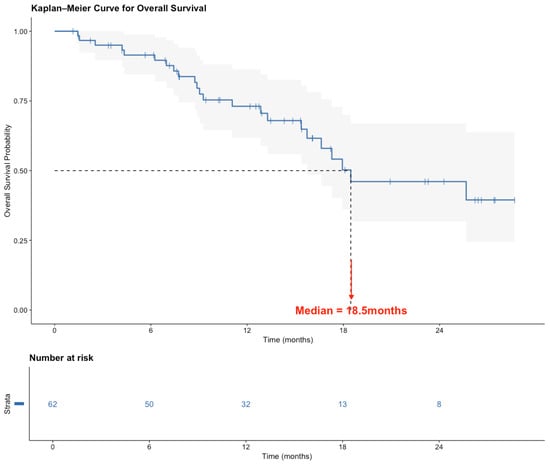
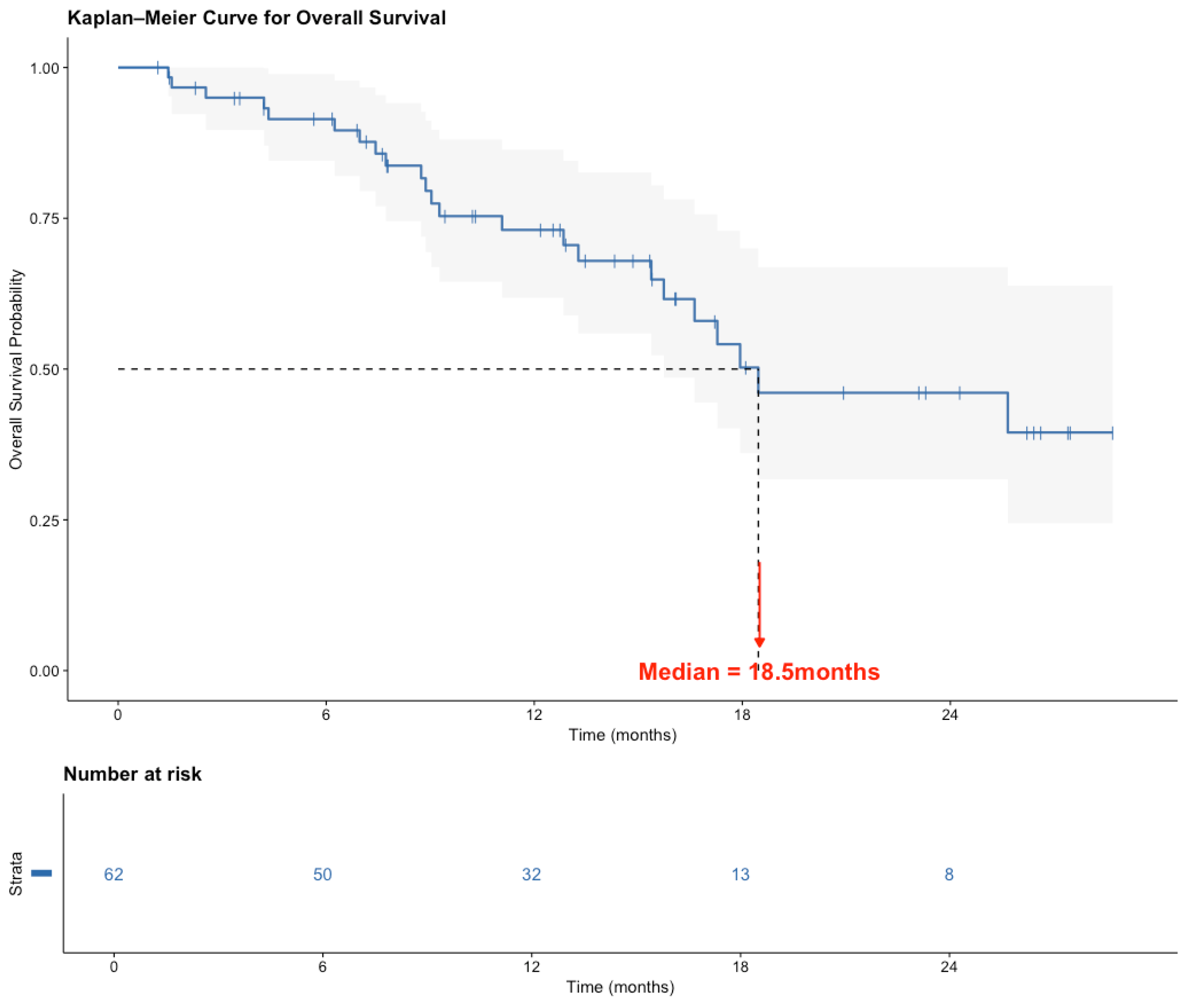
Figure 1 displays a Kaplan–Meier Curve with the overall survival for the UVA cohort of patients. Median overall survival was 18.5 months (95% CI: 15.7–NA), with the upper bound not reached due to insufficient follow-up at the time of analysis. Note that 62 of 64 patients were included in the survival analysis. The remaining 2 were excluded due to missing follow-up data.
Figure 1.
Kaplan–Meier curve showing overall survival for the 177Lu-PSMA-617 cohort studied. Median overall survival was 18.5 months (95% CI: 15.7–NA), with the upper bound not reached due to insufficient follow-up at the time of analysis. Note that 62 of 64 patients were included in the survival analysis; 2 were excluded due to missing follow-up data.
4. Discussion
Our real-world institutional experience with 177Lu-PSMA-617 echoed the findings in the VISION trial in many ways [4]. A major limitation to our analysis was the size of our cohort, which included a total of n = 6 patients that developed dose-limiting toxicity attributable to cytopenias as a result of 177Lu-PSMA-617 therapy. Direct comparisons with the VISION trial are descriptive, as the study designs differ considerably along with inclusion criteria, imaging definitions, follow-up, and toxicity ascertainment. With this in mind, there were a number of these descriptive differences in the baseline characteristics between our group and the VISION 177Lu-PSMA-617 treatment arm that are important to recognize. The inclusion criteria would have made the VISION 177Lu-PSMA-617 treatment arm different from the UVA cohort in important ways from the outset. Any patients that had received radium-223 would have been excluded [4]. Likewise, any patient with baseline cell counts below their specified threshold would have been excluded as well. These thresholds were: hemoglobin < 9 g/dL, platelets < 100 × 109/L, or WBC count < 2.5 × 10⁹/L [4]. In addition to the inclusion and exclusion criteria, differences existed in the median age, ethnicity, preponderance of Gleason 8–10 disease, ECOG 0–1, and disease site. Despite having a younger median age, lower ECOG 0–1, and greater proportion of African American patients, the UVA cohort demonstrated a relative decrease in the number of patients with more advanced Gleason 8–10 disease compared to the VISION 177Lu-PSMA-617 treatment arm. The VISION 177Lu-PSMA-617 treatment arm additionally demonstrated a greater proportion of bone and liver metastases along with fewer lung metastases compared to the UVA group. A direct comparison is difficult to draw in terms of location of metastases between the two groups. The VISION 177Lu-PSMA-617 treatment arm considered a metastasis any metastatic lesion present on any of the preceding scans (MRI, CT, or 99mTc bone scan) along with a PSMA positive metastatic lesion on PSMA PET. Comparatively, the UVA cohort considered metastases identified on PSMA PET only.
Besides these notable differences, the groups were similar in terms of prior therapies including radiotherapy, ARPI, radium-223, and sipuleucel-T. The most salient difference in terms of treatment was a favoring of cabazitaxel therapy in the VISION 177Lu-PSMA-617 treatment arm. With respect to differences in prior treatments, it should also be mentioned that the UVA cohort collected data on a variety of treatments that were not included in the baseline for the VISION 177Lu-PSMA-617 treatment arm. These included darolutamide, olaparib, carboplatin, pembrolizumab, and clinical trial involvement. These prior treatments were present to a significant degree in the UVA cohort, and may represent another area in which the 2 cohorts could differ in terms of treatment history.
The treatments that patients received in the VISION 177Lu-PSMA-617 treatment arm and the UVA cohort were largely similar. The median cycle number in both were 5 cycles [4]. The cumulative administered activity was 981 mCi in the UVA cohort and 1014 mCi in the VISION 177Lu-PSMA-617 treatment arm [4]. The UVA cohort reported dose delays and reductions in 20.3% and 1.5%, respectively, compared to 17.6% and 5.7% in the VISION 177Lu-PSMA-617 treatment arm [4]. In the UVA cohort, treatment discontinuation for any reason occurred in 51.2% of patients. The most common reasons were progressive disease (58%), dose-limiting toxicity (21%), or functional decline (15%). In the VISION 177Lu-PSMA-617 treatment arm, 279 of the 529 (52.7%) of patients had treatment discontinued, with discontinuation occurring in 127 for progressive disease (45.5%), 54 for adverse events (19.4%), and 36 for lack of clinical benefit (12.9%) [4].
Cytopenia toxicity specifically differed between the UVA cohort and the VISION 177Lu-PSMA-617 treatment arm. Anemia was considerably more common in the UVA cohort, occurring to some degree in 100% of patients compared to 31.8% in the VISION 177Lu-PSMA-617 treatment arm [4]. Despite this, the incidence of grade 3 or greater toxicity was similar to the VISION 177Lu-PSMA-617 treatment arm (13% vs. 12.9%) [4]. Thrombocytopenia, lymphopenia, and leukopenia occurred in all grades with frequencies of 17.2%, 14.2%, 12.5% in the VISION 177Lu-PSMA-617 treatment arm compared to 48%, 77%, and 48% in the UVA cohort [4]. The grade 3 or greater toxicities of these 3 cytopenias in the VISION 177Lu-PSMA-617 treatment arm were 7.9%, 7.8%, 2.5%, respectively, compared to 3%, 33%, and 3% in the UVA cohort [4]. The most likely reason for these discrepancies was the inclusion criteria mentioned previously, in which the VISION 177Lu-PSMA-617 treatment arm excluded patients below certain baseline cell counts [4]. Interestingly, this seems to have resulted in a greater proportion of low-grade toxicities with mostly concordant grade 3 or greater toxicities in the UVA cohort [4]. Lymphopenia stands out as an exception. It may be that this cell line is particularly affected in patients that start with a lessened bone marrow reserve, as was likely the case in the UVA cohort compared to the VISION 177Lu-PSMA-617 treatment arm [4].
In our analysis, we identified cytopenia as the most common cause of dose-limiting toxicity. This seems to be in line with what was found in the VISION trial [4]. Cytopenias were the most frequent causes of grade 3 or greater toxicities in the VISION 177Lu-PSMA-617 treatment arm, though their specific contribution to dose-limiting toxicity is not reported [4]. Notably, the VISION trial necessitated holding of 177Lu-PSMA-617 for grade 2 or greater toxicities until the toxicity improved to grade 1 or better [4]. In our analysis, dose-limiting toxicities consisted entirely of either cytopenias or renal toxicity. This likely differed from the VISION trial, in which grade 3 or greater toxicities from back pain and fatigue may also have contributed [4]. A reduced sample size compared to the VISION trial may be a potential explanation for these discrepancies.
When examining the 6 cases of patients that developed dose-limiting toxicities, certain features are worth emphasizing. Half of them would have been excluded from the VISION 177Lu-PSMA-617 treatment arm due to prior radium-223 use or low baseline cell counts [4]. Many of them had endured pre-treatment with other bone marrow depleting therapies such as pelvic radiation and many prior cycles of taxol therapy. Half of them also had experienced a prior cytopenia due to chemotherapy before initiating 177Lu-PSMA-617. The severity and irreversibility of the anemia in particular should be recognized, as this toxicity was not reversible in any of the 6 cases and in all but 1 resulted in long-term transfusion dependence. Lymphopenia on the other hand was commonly a grade 3 toxicity but did not cause of hospitalization in our 6 patients. The toxicities occurred at a variety of 177Lu-PSMA-617 cycle numbers and cumulative doses.
Though as with the VISION trial the comparisons are largely descriptive, it is worth pointing out certain distinctions between our research and the ARON-3 study [5]. Compared to our cohort, the ARON-3 cohort had a greater proportion of ECOG 0–1 patients (90% vs. 73.4%) and a greater number of patients with Gleason > 8 disease at baseline (68% vs. 46.9%) [5]. Sites of metastases included a similar proportion of metastases to lymph nodes compared to our study (50% vs. 53.1%), but fewer to bone (62% vs. 79.7%) or viscera (10% vs. 20.3%) [5]. Our cohort was more heavily pre-treated with a variety of therapies that would have been cause for exclusion from the ARON-3 trial (radium-223, olaparib, carboplatin, etc.) [5]. ARON-3 mentions prior radiation therapy for localized hormone-sensitive prostate cancer, which occurred at a rate of 15% [5]. However, a direct comparison cannot be made with our cohort which included prior radiotherapy for any reason (75%). Overall, ARON-3 demonstrated a low relative incidence of cytopenias compared to our cohort, but consisted of a population that was less pre-treated and included fewer bone metastases, which may have played a role.
Lastly, we calculated overall survival to see if our results aligned with the findings in the VISION trial. Median overall survival was 562 days (18.5 months) (Figure 1) in the UVA cohort compared to 15.3 months in VISION 177Lu-PSMA-617 treatment arm [4]. As with the comparison with patient characteristics in VISION, a direct comparison of the UVA and VISION 177Lu-PSMA-617 treatment arms with respect to survival is descriptive in nature. Differences in study design, patient selection, treatment era, disease burden, and subsequent therapies may confound the comparison.
Our real-world experience at UVA with 177Lu-PSMA-617 demonstrated overlap with the VISION trial on a number of fronts but also differed in important ways. The study limitations include retrospective design, a cohort limited to a single institution, the potential for selection bias, and the limited number of dose-limiting cytopenia events. Due to the small number of cytopenia events, we cannot rule out confounding factors that may be affected by the patient characteristic associations. The principal limitation of our study was sample size. A future direction of this research could utilize a larger sample size to validate our findings.
5. Conclusions
In our real-world analysis, 85% of dose-limiting toxicities necessitating 177Lu-PSMA-617 discontinuation were attributed to cytopenias. Though a direct comparison cannot be made with VISION in terms of dose-limiting toxicity attributable specifically to cytopenias, they reported total dose-limiting toxicity to a similar degree, and cytopenias were the most common causes of grade 3 or greater toxicities. Therefore, it is important to recognize the ubiquity of these adverse events as well as the role that they play in therapy-limiting toxicity.
Author Contributions
Conceptualization, W.P.S.IV and E.A.; methodology, D.K.; formal analysis, D.K.; data curation, E.A. and K.G.; writing—original draft preparation, E.A. and W.P.S.IV; writing—review and editing, J.M., P.V., M.D., R.D. and W.P.S.IV; supervision, W.P.S.IV. All authors have read and agreed to the published version of the manuscript.
Funding
This research received no external funding.
Institutional Review Board Statement
The study was conducted in accordance with the Declaration of Helsinki, and approved by the Institutional Review Board of the University of Virginia HSR 302191 on 30 January 2025. No data collection was performed beyond the ethics approval date of 30 January 2025.
Informed Consent Statement
Patient consent was waived due to study design of retrospective chart review using existing data with de-identified patient information posing minimal risk.
Data Availability Statement
The data presented in this study are available on request from the corresponding author due to privacy restrictions.
Acknowledgments
The graphical abstract was drafted using the AI-assisted design tool FigureLabs (figurelabs.ai) which utilized Gemini Image Pro version 3.0. The initial layouts were vectorized and subsequently manually refined, labeled, and verified by the authors to ensure scientific accuracy.
Conflicts of Interest
Author P.V. serves in a consulting role for Pfizer and Exelixis. M.D. receives research funding from Seagen, Propella Therapeutics, Arvinas, Merck, and Astellas Pharma. R.D. serves in a consulting role for Astellas Pharma, Pfizer, Merck, Urogen Pharma, and LNC Pharma. He receives research funding from Exelixis. W.P.S.IV serves a consulting role for Exelixis. The following authors have no conflicts of interest to declare: E.A., K.G., D.K. and J.M. The funders had no role in the design of the study; in the collection, analyses, or interpretation of data; in the writing of the manuscript; or in the decision to publish the results.
Abbreviations
The following abbreviations are used in this manuscript:
| 177Lu-PSMA-617 | Lutetium-177 Vipivotide Tetraxetan |
| mCRPC | Metastatic Castration-Resistant Prostate Cancer |
| UVA | University of Virginia |
| KM | Kaplan–Meier |
| PSA | Prostate-Specific Antigen |
| WBC | White Blood Cell |
| ALC | Absolute Lymphocyte Count |
| ANC | Absolute Neutrophil Count |
| NLR | Neutrophil-to-Lymphocyte Ratio |
| ECOG | Eastern Cooperative Oncology Group |
| PSMA | Prostate-Specific Membrane Antigen |
| DLT | Dose-Limiting Toxicity |
| ARPI | Androgen Receptor Pathway Inhibitor |
| mCi | Millicurie |
| GF | Growth Factor |
References
- Rawla, P. Epidemiology of Prostate Cancer. World J. Oncol. 2019, 10, 63–89. [Google Scholar] [CrossRef] [Scilit] [PubMed]
- Sekhoacha, M.; Riet, K.; Motloung, P.; Gumenku, L.; Adegoke, A.; Mashele, S. Prostate Cancer Review: Genetics, Diagnosis, Treatment Options, and Alternative Approaches. Molecules 2022, 27, 5730. [Google Scholar] [CrossRef] [Scilit] [PubMed]
- Violet, J.; Jackson, P.; Ferdinandus, J.; Sandhu, S.; Akhurst, T.; Iravani, A.; Kong, G.; Kumar, A.R.; Thang, S.P.; Eu, P.; et al. Dosimetry of 177Lu-PSMA-617 in metastatic castration-resistant prostate cancer: Correlations between pretherapeutic imaging and whole-body tumor dosimetry with treatment outcomes. J. Nucl. Med. 2019, 60, 517–523. [Google Scholar] [PubMed]
- Sartor, O.; de Bono, J.; Chi, K.N.; Fizazi, K.; Herrmann, K.; Rahbar, K.; Tagawa, S.T.; Nordquist, L.T.; Vaishampayan, N.; El-Haddad, G.; et al. Lutetium-177-PSMA-617 for Metastatic Castration-Resistant Prostate Cancer. N. Engl. J. Med. 2021, 385, 1091–1103. [Google Scholar] [CrossRef] [Scilit] [PubMed]
- Mandel, P.; Groener, D.; Follacchio, G.; Ürün, Y.; Bourlon, M.T.; Sabet, A.; Grünwald, F.; Tural, D.; Büttner, T.; Kopp, R.M.; et al. 177Lu-PSMA vs. cabazitaxel in patients with castration-resistant prostate cancer: Real-world efficacy and safety data from the ARON-3 study. Eur. J. Cancer 2025, 229, 115789. [Google Scholar] [CrossRef] [Scilit] [PubMed]
- Ludwig, H.; Strasser, K. Symptomatology of anemia. Semin. Oncol. 2001, 28, 7–14. [Google Scholar] [CrossRef] [Scilit] [PubMed]
- Schrijvers, D. Management of anemia in cancer patients: Transfusions. Oncologist 2011, 16, 12–18. [Google Scholar] [CrossRef] [Scilit] [PubMed]
- Peffault de Latour, R. Transplantation for bone marrow failure: Current issues. Hematol. Am. Soc. Hematol. Educ. Program 2016, 2016, 90–98. [Google Scholar] [CrossRef] [Scilit] [PubMed]
- Gauer, R.L.; Braun, M.M. Thrombocytopenia. Am. Fam. Physician 2012, 85, 612–622. [Google Scholar] [PubMed]
- Izak, M.; Bussel, J.B. Management of thrombocytopenia. F1000prime Rep. 2014, 6, 45. [Google Scholar] [CrossRef] [Scilit] [PubMed]
- Al-Samkari, H.; Muñoz, C.; Geredeli, Ç.; Korantzis, I.; González Astorga, B.; Arslan, C.; Cordeiro Camargo, J.F.; Scotté, F.; Borges, G.; Wang, K.; et al. Romiplostim versus Placebo for Chemotherapy-Induced Thrombocytopenia. N. Engl. J. Med. 2026, 394, 1061–1073. [Google Scholar] [CrossRef] [Scilit] [PubMed]
- Rodriguez Garzotto, A.; Cortijo Casacajares, S.; Pernaut, C.; Ruiz Ares, G.J.; Otero Blas, I.; Heine, O.; Turner, M.; Rebollo Laserna, F.; Cortes Funes, H.; Lorenz, A. Erythropoiesis-stimulating agents for the treatment of chemotherapy-induced anemia: Comparisons from real-world clinical experience. J. Blood Med. 2014, 5, 43–48. [Google Scholar] [CrossRef] [Scilit] [PubMed]
- Ing, V.W. The etiology and management of leukopenia. Can. Fam. Physician Med. Fam. Can. 1984, 30, 1835–1839. [Google Scholar]
- Giamarellou, H.; Antoniadou, A. Infectious complications of febrile leukopenia. Infect. Dis. Clin. N. Am. 2001, 15, 457–482. [Google Scholar] [CrossRef] [Scilit] [PubMed]
- Zimmer, A.J.; Freifeld, A.G. Optimal Management of Neutropenic Fever in Patients With Cancer. J. Oncol. Pract. 2019, 15, 19–24. [Google Scholar] [CrossRef] [Scilit] [PubMed]

Disclaimer/Publisher’s Note: The statements, opinions and data contained in all publications are solely those of the individual author(s) and contributor(s) and not of MDPI and/or the editor(s). MDPI and/or the editor(s) disclaim responsibility for any injury to people or property resulting from any ideas, methods, instructions or products referred to in the content. |
© 2026 by the authors. Licensee MDPI, Basel, Switzerland. This article is an open access article distributed under the terms and conditions of the Creative Commons Attribution (CC BY) license.