Review

Perioperative Modulation of Microglia in Glioblastoma Resection

1
Faculty of Medicine, University of Rijeka, 51000 Rijeka, Croatia
2
Department of Neurosurgery, University Hospital Center Osijek, 31000 Osijek, Croatia
3
Faculty of Medicine Osijek, Josip Juraj Strossmayer University of Osijek, 31000 Osijek, Croatia
4
Department of Medical Chemistry, Biochemistry and Clinical Chemistry, Faculty of Medicine, University of Rijeka, 51000 Rijeka, Croatia
*
Author to whom correspondence should be addressed.
Biologics 2026, 6(2), 17; https://doi.org/10.3390/biologics6020017
Submission received: 8 April 2026 / Revised: 25 May 2026 / Accepted: 31 May 2026 / Published: 4 June 2026

Abstract

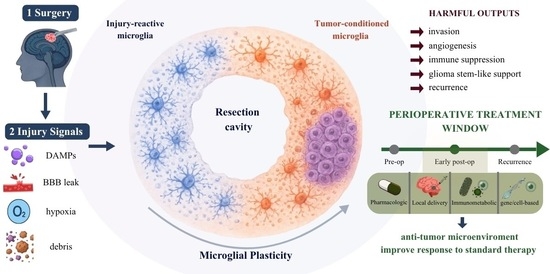
Glioblastoma recurrence remains nearly universal despite maximal safe surgical resection and multimodal adjuvant therapy. Beyond tumor debulking, resection induces profound local brain microenvironment alterations, including sterile neuroinflammation, blood–brain barrier disruption, extracellular matrix remodeling, and rapid activation of innate immune pathways. Among resident immune populations, microglia emerge as central regulators of the post-resection microenvironment, influencing inflammatory signaling, tissue repair, and tumor–host interactions. Activated microglia accumulate at the resection margin, where they adopt highly plastic functional states shaped by cytokine gradients, metabolic stress, hypoxia, and tumor-derived mediators. This dynamic activation landscape establishes bidirectional crosstalk with residual glioblastoma cells, promoting invasion, angiogenesis, maintenance of stem-like phenotypes, and suppression of anti-tumor immunity. As a result, microglial responses contribute to a permissive microenvironment that supports therapeutic resistance and tumor regrowth. Importantly, the perioperative period represents a short but important opportunity to modify microglial activity. Targeted therapeutic strategies, including pharmacologic modulation, local drug delivery systems, immunometabolic approaches, and gene- and cell-based therapies, may help alter the tumor microenvironment. This narrative review synthesizes current mechanistic insights into microglial dynamics following glioblastoma resection and evaluates emerging therapeutic strategies targeting microglial function. We further discuss integration with standard-of-care treatments and highlight evolving biomarker platforms for monitoring microglial states. Ultimately, targeting microglial plasticity represents a biologically grounded and clinically actionable strategy to improve outcomes after glioblastoma surgery.

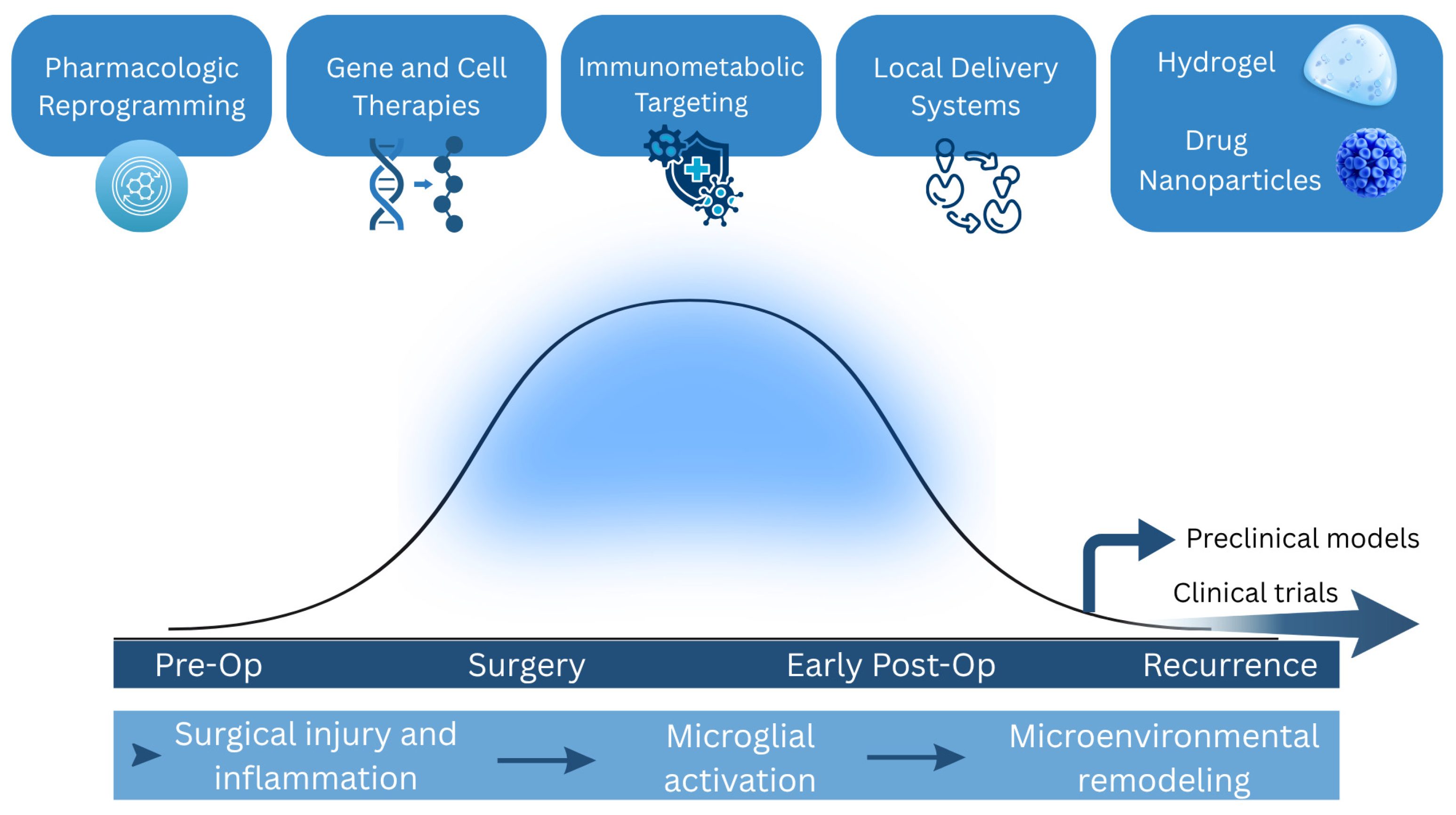
Graphical Abstract

1. Introduction

Glioblastoma is the most aggressive primary tumor of the central nervous system, characterized by rapid progression and poor prognosis [1]. Despite advances in neurosurgical techniques and adjuvant therapies, median survival remains limited to 15–20 months, with no durable long-term tumor control [2]. Maximal safe resection remains the cornerstone of treatment, enabling tumor cytoreduction, symptom relief, and improved responsiveness to adjuvant radiochemotherapy. However, complete elimination of tumor cells remains unattainable. Glioblastoma exhibits diffuse infiltrative growth into surrounding brain tissue, extending beyond both radiographically visible margins and functionally resectable boundaries [3]. Consequently, recurrence is nearly universal and typically occurs at the tumor bed. Residual tumor cells exhibit increased therapeutic resistance, stem-like characteristics, and adaptive survival mechanisms that enable rapid tumor repopulation. Thus, therapeutic failure reflects not only tumor burden but also intrinsic tumor biology [4].
Surgical resection is not biologically neutral, as it not only removes the tumor but also induces significant changes in the surrounding brain tissue that may contribute to glioblastoma progression [5,6]. Tissue injury during surgery triggers sterile neuroinflammation and activation of the innate immune response within the resection microenvironment. This response is further enhanced by blood–brain barrier disruption, hypoxia, necrotic tissue, cellular debris, and the release of blood- and plasma-derived factors [7,8]. The post-resection environment comprises interconnected cellular and molecular mechanisms that promote tumor invasion, immune modulation, and metabolic adaptation [9]. Concurrently, immunoregulatory mechanisms impair effective immune surveillance of residual tumor cells. As a result, the microenvironment can either suppress or promote residual tumor growth, depending on the balance of signaling pathways [10]. Within this evolving microenvironment, microglia, the resident innate immune cells of the central nervous system, representing the main innate immune population in the healthy brain, emerge as key regulators of post-resection neurobiology. Microglia are rapidly activated following resection and accumulate at the resection margin, where they orchestrate inflammatory responses, tissue repair, and immune cell recruitment. Microglia perform diverse functions, including regulation of extracellular matrix remodeling, vascular dynamics, and antigen presentation, extending beyond their classical role in host defense [11,12,13].
In glioblastoma, however, the tumor microenvironment also contains infiltrating macrophages derived from circulating monocytes that enter the brain through the disrupted blood–brain barrier (BBB). Although microglia and infiltrating macrophages differ in origin, they often share overlapping functional properties and molecular markers within the tumor microenvironment. As a result, many studies discuss these populations together as tumor-associated myeloid cells or glioma-associated microglia/macrophages. In this review, the term “microglia” primarily refers to resident CNS microglia while acknowledging the important contribution of infiltrating macrophages to the post-resection immune microenvironment.
Moreover, microglia exhibit phenotypic and metabolic plasticity in the post-resection state, where tumor-derived factors and cytokine gradients can induce a variety of activation phenotypes that can be either tumor-antagonistic or tumor-promoting [14]. Glioblastoma cells exploit this microglial plasticity by engaging in bidirectional signaling pathways that can induce tumor-promoting phenotypes of the microglia. This functional plasticity positions microglia as a compelling therapeutic target for limiting glioblastoma recurrence, owing to their relative genomic stability and amenability to reprogramming [15,16].
Considering the significant impact of the post-resection microenvironment in the progression of glioblastoma, strategies targeting the modulation of microglial cells are highly relevant and rational approaches to improving patient outcomes in glioblastoma surgery [17]. The present review aims to summarize the current mechanistic understanding of microglial cells in the post-resection glioblastoma microenvironment and their plasticity as an emerging target in the perioperative period. In this narrative review, we summarize current knowledge on the molecular and cellular mechanisms of microglia-tumor interaction and emerging strategies in the modulation of microglia and their integration with current therapies. Additionally, this review aims to present emerging biomarker technology in the monitoring of microglia and their plasticity and translate this into the context of improving patient outcomes in glioblastoma surgery. The aim is to establish a framework for perioperative microglial modulation and to explore strategies for reshaping the glioblastoma microenvironment to prevent recurrence.

2. The Post-Resection Neuroimmune Microenvironment

2.1. Surgical Injury and Sterile Neuroinflammation

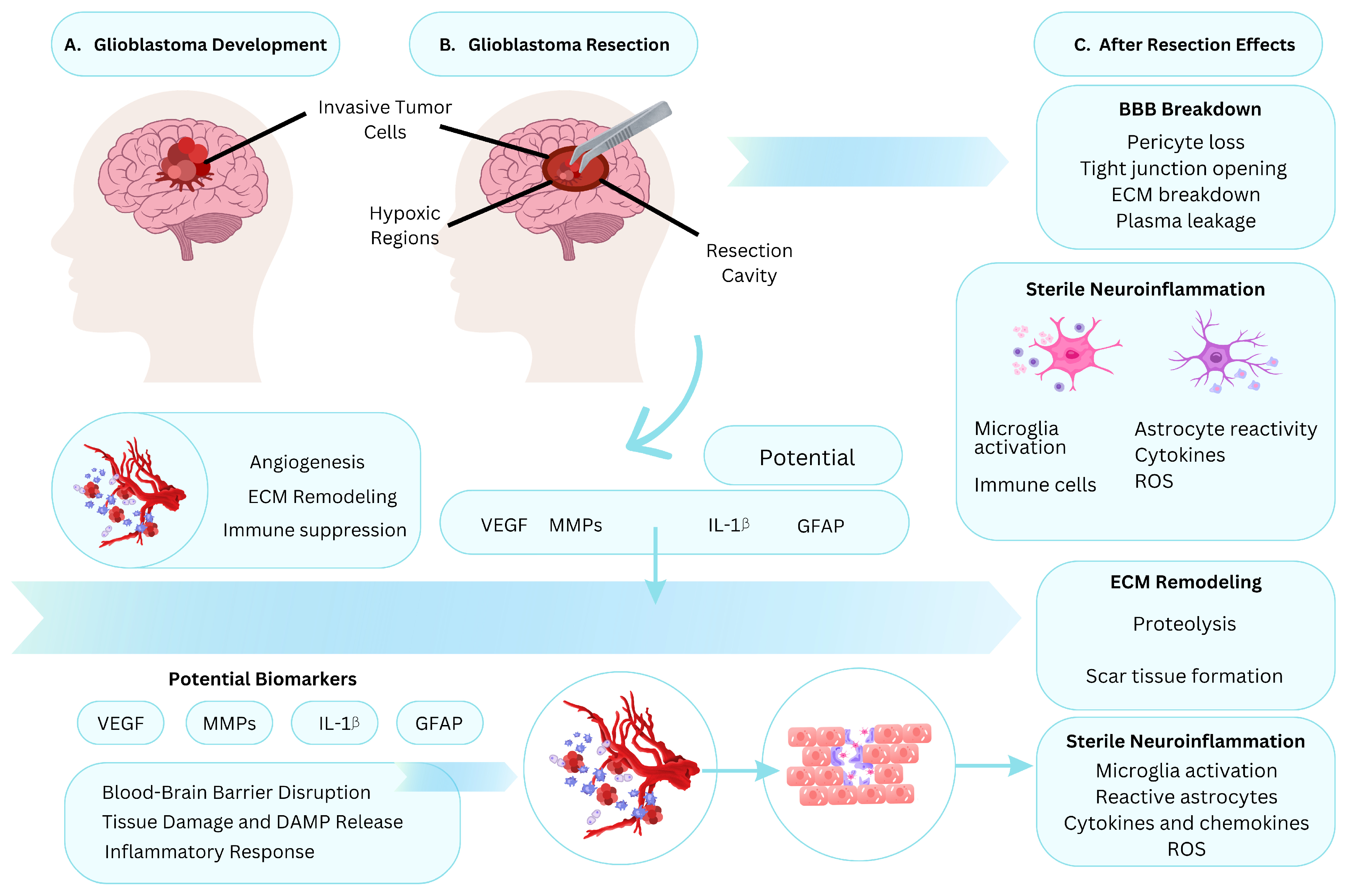
Following resection, a coordinated neuroimmune response extends beyond tumor removal. Surgical intervention induces cellular, vascular, and neural tissue damage, initiating a tissue injury response. The process constitutes sterile tissue trauma, whereby inflammation is triggered in the absence of pathogens but engages many of the same innate immune mechanisms [18,19].
Tissue damage leads to the rapid endogenous danger signal release, referred to as damage-associated molecular patterns (DAMPs). The released DAMPs include purines, nuclear DNA, mitochondrial DNA, chromatin, cytoskeletal components, and matrix-derived products. DAMPs act as molecular signals that detect tissue damage and activate innate immune responses [20].
Immune cells recognize these signals through pattern recognition receptors. Receptor activation triggers intracellular signaling cascades that regulate transcriptional responses involved in cytokine production, chemotaxis, inflammasome activation, and oxidative stress. The resulting inflammatory response establishes a rapidly evolving biochemical milieu, characterized by interleukins and chemokines gradients, reactive oxygen intermediates, lipid mediators, and proteolytic enzymes [21,22].
Concurrently, surgical manipulation of the cerebral microvasculature affects barrier function and blood flow dynamics. Increased vascular permeability allows the influx of circulating proteins and peripheral immune cells [23]. Blood-derived components and coagulation factors further amplify the pro-inflammatory environment. Vasculature and hemostasis alterations are closely linked with the immune responses of glial cells and will significantly impact the molecular signature of the resection margin [24,25].
Importantly, this inflammatory cascade is both spatially organized and temporally dynamic. Early pro-inflammatory responses are focused on the clearance of cellular debris and the restriction of tissue damage. However, prolonged inflammation alters cellular recruitment, matrix remodeling, and metabolic adaptation during tissue repair [26].
Recognizing sterile neuroinflammation as the initiating force of the post-resection niche provides a mechanistic foundation for subsequent cellular events. The resulting inflammatory landscape governs microglial activation states, spatial distribution, and functional polarization, positioning microglia as central regulators of the post-resection immune ecosystem [27,28].

2.2. Blood–Brain Barrier Disruption and Tissue Remodeling

In addition to the initiation of an inflammatory cascade, surgical resection significantly impacts the adjacent brain tissue integrity. The blood–brain barrier (BBB), a key neurovascular structure regulating molecular and immune cell exchange between the circulation and the central nervous system, is disrupted during surgery [29,30]. The mechanical disruption of the tissue, transection of blood vessels, thermal injury, and subsequent tissue ischemia compromise the integrity of the blood–brain barrier, leading to increased vascular permeability at the surgical resection site [31,32].
The BBB disruption results in the extravasation of blood components into the tissue, significantly changing the biochemical environment. Fibrinogen, thrombin, and complement signaling pathways play an essential role in the immune response, thereby affecting the behavior of cells within the compromised tissue environment. It also induces vasogenic edema and hypoxia, which profoundly affect both immune and tumor cell behavior [33,34].
Extracellular matrix remodeling is another key feature of the post-resection environment. Various proteolytic enzymes, such as matrix metalloproteinases and serine proteases, mediate the structural degradation of the extracellular matrix and basement membranes. Consequently, tissue loosening occurs, facilitating cellular migration [35,36]. Astrocytes, endothelial cells, immune cells, and stroma contribute to extracellular matrix remodeling by producing structural extracellular matrices, adhesion molecules, and remodeling agents. This remodeling process results in the creation of an environment that has different mechanical properties [37,38].
Vascular remodeling is another feature of the post-resection environment. Activation of endothelial cells, inflammation around the vasculature, and angiogenic signaling contribute to vascular remodeling. However, these new blood vessels exhibit structural immaturity and instability. This promotes an inflammatory environment that facilitates bidirectional communication between central and peripheral immune systems [5,39].
Collectively, these processes contribute to a highly permissive and dynamically regulated interface at the resection margin and support tissue repair while also establishing gradients that regulate immune cell distribution [40].
Resident microglia interact with a complex array of vascular signals, matrix cues, and metabolic stressors within this altered microenvironment (Figure 1). These interactions shape their activation state and spatial organization, positioning them at the forefront of the post-resection immune response [41].

2.3. Recruitment and Innate Immune Pathway Activation

The post-resection niche evolves from mechanical disruption into an immunologically active interface [42,43]. Chemotactic gradients that are generated by injury mediators and permeability changes in the vascular interface guide the recruitment and redistribution of immune cells at the resection interface. These processes lead to the cellular network formation that coordinates local and systemic immune responses [44].
Monocytes in the circulation are among the initial peripheral immune cells that respond to tissue damage. After transmigration across the compromised vascular interface, monocytes differentiate into macrophage-like cells that integrate into the immune cell network at the resection interface [45]. Neutrophils are recruited in smaller numbers to the post-resection interface, where they release proteases, reactive oxygen species, and neutrophil extracellular traps that drive the inflammatory response. In parallel, dendritic cells orchestrate the adaptive immune response activation [46,47].
Concurrently, resident glial cell types become functionally activated. Astrocytes assume reactive phenotypes that impact barrier, metabolic, and cytokine-mediated responses, whereas perivascular macrophages orchestrate vascular immune communication [48,49]. The cellular responses are coordinated by interrelated signaling cascades, including chemokine receptor activation, inflammasome activation, complement activation, and lipid mediator cascades. The cellular responses regulate immune cell migration, survival, and effector functions in the resection microenvironment [50].
Importantly, innate immune activation is not only non-additive but also exhibits significant interactivity. The intercellular interactions among infiltrating immune cells and resident glial cells establish feedback mechanisms that either potentiate or inhibit inflammatory responses, regulate phagocytic responses, and impact tissue repair responses [51]. The cellular organization of these immune cell networks establishes microdomains with unique immunologic features in the resection margin [50].
Collectively, the coordinated response establishes the framework for subsequent tumor–host interactions. Within this network, microglia integrate vascular, metabolic, and immune cues. Accordingly, defining how microglia interpret these inputs is critical for the development of therapeutic strategies in the post-resection microenvironment [13,43].

3. Microglial Plasticity After Glioblastoma Resection

3.1. Microglial Activation States and Phenotypic Spectrum

Within the remodeled post-resection microenvironment, microglia emerge as key regulators of neuroimmune responses. Rather than adopting fixed activation states, microglia exhibit remarkable plasticity, transitioning across a multidimensional spectrum in response to environmental cues [52,53].
Following surgical injury, microglia shift from homeostatic surveillant cells to reactive effectors, characterized by morphological changes, increased motility, and transcriptional reprogramming [54]. This activation is driven by converging signals, including cytokine gradients, extracellular matrix fragments, metabolic stress, vascular mediators, and tumor-derived factors. The phenotypic landscape of microglia comprises a spectrum of activation states and has shifted away from binary classification [55].
Traditionally, microglial activation has been viewed as either pro-inflammatory or anti-inflammatory polarization responses [13]. However, more recent transcriptomic and single-cell RNA analyses have revealed the complex and heterogeneous microglial activation responses and have identified various functional programs that are associated with immune surveillance, phagocytic clearance, tissue repair, metabolic adaptation, antigen presentation, and immunoregulation. These activation states are dynamic and closely linked to evolving biochemical and structural features of the resection microenvironment [52,56,57].
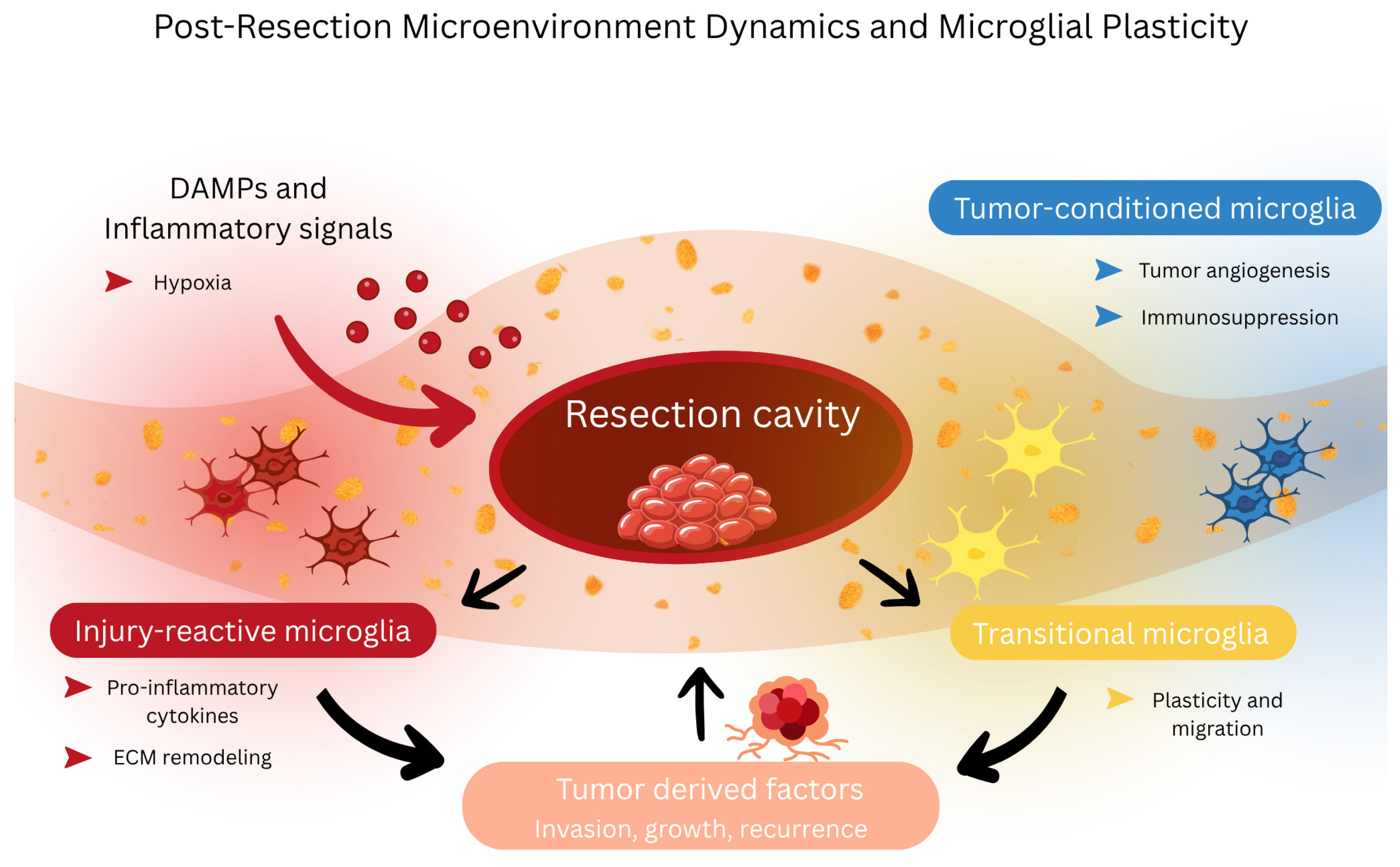
In addition, different activation responses are also influenced by their spatial location. Microglia at the resection site are exposed to high levels of injury-associated mediators and vascular signals, promoting reactive and migratory phenotypes. However, microglia present in the peritumoral parenchyma are more influenced by tumor-derived signals and have their functional states reoriented towards immunosuppressive and tumor-permissive responses [58,59,60].
Phenotypic changes are, in part, a result of metabolic reprogramming. Changes in mitochondrial activity, glycolytic rate, lipid metabolism, and redox status impact signaling cascades that regulate inflammatory responses, phagocytic activity, and cytokine production. The phenotypes of microglial activation integrate immune signaling cascades with cellular metabolism [61,62].
Importantly, microglial phenotypes are highly reversible. This characteristic differentiates microglia from genetically unstable tumor cell populations. This plasticity enables therapeutic reprogramming toward anti-tumor activity [63,64].
Knowledge of the phenotypic range of microglial activation establishes a conceptual framework for evaluating the molecular and environmental determinants of these phenotypes in the post-resection microenvironment.

3.2. Metabolic and Environmental Determinants

Microglial phenotypic diversity in the post-resection microenvironment arises from interactions between metabolic constraints and environmental factors. Rather than responding solely to inflammatory signals, microglia integrate biochemical, structural, and metabolic inputs that cumulatively dictate the activation phenotype of the cell. Such integration is conducive to the prompt adaptation of microglial functions in response to the changing environment of the injured and tumor-adjacent brain [65,66].
Metabolic reprogramming is a major regulatory mechanism of microglial activation phenotypes. Microglial activation phenotypes are strongly associated with changes in cellular metabolism, including the mitochondrial oxidative phosphorylation activity, glycolytic activity, the activity of fatty acid metabolism, and redox status [67,68]. Energy-intensive processes such as cytokine production, phagocytosis, migration, and antigen presentation require continuous redistribution of cellular energy resources. Alterations in the availability of oxygen, glucose, and lipids, which are often present in the post-resection environment, have a direct impact on the immune effector functions of microglia [61,69].
Such conditions create dominant environmental stressors, including perfusion instability and microvascular remodeling, leading to gradients of oxygen that activate hypoxia-inducible transcriptional responses, influencing inflammatory responses and pathway selection in metabolism. Likewise, tissue injury-induced changes in extracellular pH and ion balance affect enzyme activity, receptor function, and intracellular signaling cascades involved in immune responses [70,71,72].
Tumor-derived mediators also fine-tune microglial phenotypes. The remaining glioblastoma cells produce growth factors, extracellular vesicles, metabolic products, and immune response modifiers that direct immune responses to be favorable for tumor survival. These mediators regulate nutrient sensing, lipid metabolism, and mitochondrial function, promoting phenotypes associated with tissue remodeling, angiogenesis, and immunosuppression [73,74].
Structural and mechanical factors are also involved in phenotypic determination. For example, the composition of the extracellular matrix and the presence of stiffness gradients are associated with the organization of the cytoskeleton and the migratory activity of immune cells [75,76]. At the same time, the presence of mediators from the vasculature and plasma that penetrate the compromised barrier interface provides further context-dependent information that influences activation thresholds and effector functions [77,78].
The microglial microenvironment constitutes an integrated regulatory system that governs cellular plasticity, driving phenotypic variability and revealing targetable pathways for therapeutic modulation [52,74].

3.3. Spatial Organization at the Resection Margin

Microglial responses following glioblastoma resection surgery do not uniformly occur, as there is a strong spatial organization of these responses, which is influenced by gradients of tissue injury signals, vascular changes, and tumor-derived factors [16,79]. The surgical resection cavity is a heterogeneous interface in which biochemical, structural, and metabolic conditions change over short distances, thereby generating localized microenvironments that differentially regulate immune cell responses [80,81].
Microglia at the cavity boundary are exposed to high concentrations of injury-related signals, plasma-derived factors, and extracellular matrix components [82]. Typically, these microglia show reactive phenotypes, including increased motility, in response to tissue injury. The presence of high concentrations of coagulation-derived signals, complement-derived signals, and oxidative stress signals also supports the development of tissue injury responses in these microglia [83,84].
At increasing distance from the core of the cavity, microglial behavior is progressively shaped by signals from infiltrative tumor cells. Here, gradients of growth factors, metabolic byproducts, and immune modulators create new immune signaling networks that favor phenotypes associated with tissue remodeling, angiogenesis, and immunomodulation, and it shows a shift from an injury-driven to a tumor-conditioned functional state [40,85].
Perivascular microdomains are further specialized sites of microglial organization. This is mediated by their close anatomical relationship with remodeled microvessels, allowing them to interact with endothelial-derived mediators, shear stress signaling, and plasma constituents that permeate the compromised barrier interface. This facilitates communication between the systemic immune system and the central immune system, as well as in modulating immune cell trafficking in the resection cavity [86,87].
Spatial compartmentalization is also known to play an important role in the formation of intercellular networks [88]. Interactions illustrate how microglia engage with astrocytes, infiltrating macrophages, endothelial cells, and neural elements, giving rise to localized signaling hubs that regulate inflammatory tone, matrix remodeling, and tissue repair. This functional heterogeneity arises from region-specific interactions within the resection margin [74,85,89].
This spatial organization highlights the importance of local microenvironments in shaping post-resection immune responses. This provides critical insight into interactions between the immune system and glioblastoma [90].

4. Microglia–Tumor Crosstalk in Residual Disease

4.1. Promotion of Tumor Invasion and Extracellular Matrix Remodeling

Following glioblastoma resection, residual infiltrative tumor cells persist within a structurally and immunologically altered brain parenchyma. In this context, microglia actively regulate tumor cell behavior through direct interactions. Their plasticity enables them to influence key processes driving tumor invasion [91,92].
Microglia promote glioblastoma invasion by secreting proteolytic enzymes that degrade the extracellular matrix, removing structural barriers to cell migration [75]. The matrix metalloproteinases, cysteine proteases, and serine protease systems act together in breaking down the basement membrane and interstitial matrix, thereby facilitating the expansion of tumor cells into the tissue. The simultaneous release of matrix-modifying enzymes changes tissue structure, creating favorable migration channels at the surgical resection bed [35,93].
Microglia also secrete chemotactic and motility-promoting factors that enhance tumor cell dispersion [12,94]. Molecules such as matrix metalloproteinases (MMP2 and MMP9), transforming growth factor beta (TGF-β), interleukin 6 (IL-6), epidermal growth factor (EGF), vascular endothelial growth factor (VEGF), colony-stimulating factor 1 (CSF1), and CCL2/CCR2 signaling contribute to extracellular matrix degradation, cytoskeletal remodeling, angiogenesis, and increased tumor cell motility. In addition, activation of signaling pathways such as STAT3, PI3K/Akt, and NF-κB promotes tumor cell survival, migration, and adaptation to metabolic and inflammatory stress within the post-resection microenvironment. These molecular interactions facilitate the transition from less invasive to more invasive glioblastoma phenotypes, enabling residual tumor cells to infiltrate surrounding brain tissue, evade immune surveillance, and contribute to tumor recurrence after surgery [95,96]. Reciprocal signaling further amplifies this process. The residual tumor cells release soluble factors and vesicles that stimulate microglia to release proteases and motility-promoting substances. This further augments the invasive phenotype in glioblastoma cells [97,98].
Microglia are also involved in the modulation of the biomechanical properties of the tumor microenvironment. Through the modulation of the mechanical properties of the ECM, such as the stiffness of the tissue and the organization of the collagen fibers, as well as the distribution of adhesion molecules, tumor cell migration is promoted. Changes in ECM mechanics further promote tumor cell migration [99,100].
Overall, the restructuring of the ECM and the promotion of cell migration by the microglia create an environment that favors the extension of the residual glioblastoma cells beyond the surgical margin [94,101]. These interactions highlight the need to target microglia–tumor communication to limit local invasion [12,102]. The major mechanisms through which microglia contribute to glioblastoma progression and recurrence are summarized in Table 1. These processes are mediated by several signaling molecules and pathways involved in extracellular matrix remodeling, tumor invasion, angiogenesis, immune suppression, and support of glioma stem-like cells. Important mediators include matrix metalloproteinases (MMP2 and MMP9), transforming growth factor beta (TGF-β), interleukin 6 (IL-6), interleukin 10 (IL-10), vascular endothelial growth factor (VEGF), colony-stimulating factor 1 (CSF1), and CCL2/CCR2 signaling. In addition, signaling pathways such as STAT3, NF-κB, PD-L1, and CXCL12/CXCR4 contribute to tumor cell migration, immunosuppression, abnormal vascular remodeling, and resistance to therapy. Table 1 also includes representative therapeutic targets and pharmacologic agents currently under investigation for modulation of these pathways in glioblastoma.

4.2. Support of Glioma Stem-like Populations

In addition to promoting invasion, microglia support glioblastoma progression by maintaining stem-like tumor cell populations responsible for relapse [56]. The glioma stem-like cells (GSCs) display self-renewal capacity, multilineage potential, metabolic flexibility, and relative resistance to cytotoxic treatments, thereby enabling sustained regeneration of tumors even after surgical intervention [145,146].
Microglia sustain glioma stem-like cells through paracrine signaling that reinforces stemness. The growth factors, cytokines, and trophic factors secreted by activated microglia activate receptor-mediated responses in glioma stem-like cells, which regulate self-renewal, survival, and relative resistance to apoptosis. Important signaling pathways involved in these interactions include STAT3, TGF-β, IL-6, and CSF1R signaling, which support stem cell maintenance, survival, and resistance to therapy. These signals maintain undifferentiated, stem-like phenotypes [102,109,110].
Reciprocal communication between glioma stem-like cells and microglia further sustains tumor growth [52]. The glioma stem-like cell populations secrete factors that regulate immune responses and metabolism in microglia, sustaining phenotypes of tissue remodeling. The bidirectional communication establishes a self-sustaining microenvironment that protects glioma stem-like cell populations from immune-mediated destruction [147].
Additionally, microglia mediate the structural organization of the stem cell niche. This occurs primarily through regulation of the extracellular matrix, adhesion molecules, and the perivascular microenvironment [148]. The stem cell niche is thereby preserved as a specialized microdomain that supports the quiescence and plasticity of stem cell populations. The protected niche is a spatial refuge for the tumor-initiating cell populations that protects them from therapeutic stress and enables repopulation within the tumor [149,150].
Metabolic coupling represents an additional mechanism through which microglia support tumor progression. Adaptation to local metabolic constraints maintains microenvironmental stability, thereby sustaining conditions that favor stem cell populations [151,152]. Microglial support of stem-like populations is therefore critical for tumor persistence and recurrence. It is a strategic target for the development of effective therapy for the disease [153].

4.3. Angiogenesis and Vascular Remodeling

Continued tumor growth requires re-establishment and expansion of the vascular network to meet increasing metabolic and oxygen demands [154,155]. Angiogenesis and vascular remodeling in residual glioblastoma are not merely tumor-autonomous processes but are significantly influenced by the tumor microenvironment’s immune compartment, with microglia playing a central role in regulating the tumor-vascular interface [156,157].
Activated microglia actively facilitate angiogenic signaling through the release of pro-vascular mediators that promote endothelial proliferation, migration, and tube formation. Key mediators involved in this process include vascular endothelial growth factor (VEGF), hypoxia inducible factor 1 alpha (HIF-1α), and angiopoietins, which promote endothelial activation and abnormal vessel formation. Microglia-derived growth factors, cytokines, and lipid signaling molecules have been shown to augment endothelial cell responsiveness and facilitate neovascular sprouting in the tumor microenvironment [121,122,123].
Besides playing a role in the initiation of vessel formation, microglia also affect vessel architecture [124]. They do this by affecting the composition of the extracellular matrix, as well as structural elements of the vessels. This, in turn, affects endothelial cell adhesion, basement membrane organization, and branching patterns. The remodeling of these vessels affects their geometry as well as their permeability [93,125].
Microglia interactions with endothelial cells, as well as other stromal cell types found in association with blood vessels, regulate endothelial cell activation status, as well as inflammation. This is seen in the formation of abnormal yet functionally effective vessels, as seen in glioblastoma [126,127].
Vascular remodeling is also known to support tumor progression by creating feedback loops. The mediators from endothelial cells affect the movement of immune cells and metabolic gradients [128]. The heterogeneity in blood flow also generates localized hypoxic areas that support pro-angiogenic and adaptive tumor programs. Microglia function in this feedback loop and enhance the signals that connect vascular remodeling and tumor survival [129,130].
Through cooperative action in angiogenic signaling and structural control in the vascular niche, microglia are involved in the reestablishment of nutrient supply routes and microenvironments that are conducive to tumor survival. Microglia are therefore key effectors in the vascular remodeling that enables glioblastoma cells to reinitiate growth after surgical intervention [12,131].

4.4. Immunosuppressive Signaling and T-Cell Exclusion

Effective anti-tumor immunity depends on the activation, trafficking, and cytotoxic function of adaptive immune cells within the tumor microenvironment [158]. However, within the glioblastoma resection bed, recurrence persists in an immunosuppressive microenvironment shaped by microglia-derived regulatory signaling. These alterations limit T-cell infiltration and effector function, thereby enabling tumor immune escape [111].
Microglia activation is believed to drive the immunosuppressive environment in glioblastoma recurrence by producing regulatory cytokines and inhibitory co-stimulatory molecules that suppress adaptive immune activation [112]. Molecules such as programmed death ligand 1 (PD-L1), interleukin 10 (IL-10), transforming growth factor beta (TGF-β), CD47–SIRPα, and CXCL12/CXCR4 signaling contribute to T cell suppression, immune evasion, and reduced anti-tumor immunity in the glioblastoma microenvironment. Microglia promote these immunosuppressive responses through the production of regulatory cytokines, particularly IL-10 and TGF-β, which suppress T cell activation and proliferation and support tumor-supportive immune phenotypes. In addition, TGF-β contributes to extracellular matrix remodeling, tumor invasion, and angiogenesis, while IL-10 helps maintain a chronic immunosuppressive inflammatory environment. Together, these signaling pathways enable residual glioblastoma cells to evade immune surveillance and promote tumor progression after surgery. These regulatory factors limit the ability of the adaptive immune system to become cytotoxic and thereby hinder the activation and proliferation of T-cells in the tumor bed [113].
Additionally, microglia regulate chemokine networks that direct lymphocyte homing. Abnormal chemotactic mediator expression affects the homing gradients that facilitate T-cell homing to the site of the residual tumor burden. At the same time, the retention signals in the perivascular and stroma compartments hinder the infiltration of immune cells into the tumor-bearing parenchyma [114,115].
Metabolic competition is another factor that hinders the effective functioning of the immune response. Tumor cells and microglia respond to the metabolic stress caused by a nutrient-poor environment through metabolic reprogramming that affects the availability of nutrients and the release of metabolites that modulate the immune response. This affects the metabolic fitness of T-cells, contributing to the exhaustion phenotype [14,116].
Physical factors also contribute to the exclusion of the immune response from the tumor site. Alterations in the extracellular matrix and the vasculature hinder the infiltration of lymphocytes into the tumor-bearing parenchyma. Microglia contribute to the establishment of these exclusionary conditions through the regulation of the extracellular matrix and the vasculature [117,118].
This is through the process of integrated regulatory signaling, metabolic modulation, and the maintenance of the structural niche, which results in the formation of an immune-privileged microenvironment that allows the persistence of the tumor despite the host’s immune surveillance [119]. These findings position microglia as key regulators of anti-tumor immunity and highlight them as promising targets for strategies aimed at restoring host immune responses after glioblastoma surgery [120].

5. Therapeutic Modulation of Microglia in the Perioperative Window

5.1. Pharmacologic Reprogramming

The perioperative period represents a critical window during which microglial functional states can be therapeutically modulated [103]. Pharmacologic reprogramming aims to shift microglial activity from tumor-supportive states toward phenotypes that promote anti-tumor immunity and tissue homeostasis. Unlike other cells in the tumor microenvironment, microglia retain genetic stability and signaling pathway reactivity. This profile makes them particularly suitable targets for pharmacologic intervention [12,104].
Small molecules and biologics modulate microglial function by targeting receptor-mediated signaling pathways. Targeting growth factor receptors, chemokine pathways, and innate immune receptors alters transcriptional programs governing cytokine production, antigen presentation, and inflammatory responses [82,105,106].
Several pharmacologic agents targeting microglial signaling pathways are currently being investigated in GBM. CSF1R inhibitors, such as pexidartinib, PLX3397, and BLZ945, may reduce tumor-supportive microglial and macrophage activity or shift these cells toward less immunosuppressive phenotypes. In addition, CCR2 and CXCR4 antagonists are being explored for their ability to interfere with chemokine-mediated recruitment of monocytes and other immune cells into the tumor microenvironment. Modulation of intracellular pathways such as PI3Kγ, STAT3, and NF-κB may further influence cytokine production, phagocytic activity, antigen presentation, and the balance between pro-tumor and anti-tumor inflammatory responses. Immune-modulating strategies targeting TREM2 and CD47–SIRPα signaling may also enhance anti-tumor immunity by promoting microglial activation and phagocytosis of tumor cells. Inhibition of CSF1R signaling may reduce immunosuppressive microglial phenotypes and decrease the production of tumor supportive cytokines such as IL-10 and TGF-β. Similarly, targeting PI3Kγ, STAT3, and NF-κB signaling pathways may reduce inflammatory programs associated with immune suppression and tumor progression while enhancing antigen presentation and anti-tumor immune activity. Blockade of CD47–SIRPα signaling may further promote the phagocytosis of glioblastoma cells by activated microglia [103,104,105,106,107,108].
Another level of leverage is available with intracellular signaling cascades. The signaling cascades that control inflammatory transcription factors, kinase cascades, and second messenger systems are integrated into the functional outputs that control immune–tumor interactions [107,108]. Pharmacologic modulation of these signaling cascades holds the potential to downregulate tumor-promoting inflammatory responses while preserving protective aspects of immune surveillance and tissue repair functions. Epigenetic control is an emerging aspect of reprogramming microglia [159,160].
Chromatin remodeling and transcriptional accessibility are key determinants that control the persistence of activation status and responses to external stimuli [161]. The development of agents that modulate epigenetic status holds the potential to reprogram the long-term microglial identity in the post-resection microenvironment. The timing of intervention is an essential aspect that needs to be considered. The timing of intervention could either prevent the development of tumor-permissive immune responses or risk reinforcing detrimental aspects of inflammation. The perioperative period represents an opportunity to strategically intervene in the development of tumor-promoting microenvironmental programs [108,162,163].
The pharmacologic reprogramming strategies’ effectiveness is enhanced by the possibility of using these strategies in combination with other standard-of-care therapies. Rational combinations have the potential of boosting the immunogenicity of radiotherapy, chemotherapy, and other immunotherapies [164,165].
The pharmacologic intervention’s potential for selectively modulating microglial signaling networks provides a promising and feasible strategy for reprogramming the tumor microenvironment after surgery and lowering the recurrence risk [17,166]. Therapeutic modulation of microglia may enhance the efficacy of immune checkpoint inhibitors in glioblastoma [103,104,105,106,107,108,111,112,113,114,115,116,117,118,119,120]. Within the post-resection microenvironment, activated microglia frequently adopt immunosuppressive phenotypes characterized by the production of IL-10, TGF-β, PD-L1, and other inhibitory mediators that suppress T-cell activation and promote tumor immune escape [111,112,113,114,115,116,117,118,119,120]. Pharmacologic strategies targeting CSF1R, PI3Kγ, STAT3, NF-κB, TREM2, and CD47–SIRPα signaling may partially reverse these tumor-supportive phenotypes and promote restoration of anti-tumor immune responses [103,104,105,106,107,108]. Microglial reprogramming may improve responsiveness to immune checkpoint inhibition therapies such as PD-1/PD-L1 and CTLA-4 inhibitors [103,104,105,106,107,108,111,112,113,114,115,116,117,118,119,120]. Reduction of immunosuppressive cytokine production, enhancement of antigen presentation, increased phagocytosis of tumor cells, and restoration of pro-inflammatory immune signaling may facilitate T-cell recruitment and cytotoxic activity within the glioblastoma microenvironment [103,104,105,106,107,108,112,113,114,115,116,117,118,119,120]. Therefore, anti-microglial therapies are not intended only to suppress microglial activity but rather to shift microglial functional polarization toward immune-supportive and anti-tumor functions [104,105,106,107,108].
Preclinical studies suggest that combining microglial modulation with immune checkpoint inhibitors may help overcome immune resistance that reduces the effectiveness of immunotherapy in glioblastoma [103,104,105,106,107,108,159,160,161,162,163,164,165]. These approaches may be especially important during the perioperative period, when microglial activity and immune changes are most pronounced [103,108,162,163]. Although clinical evidence is still limited, targeting both innate and adaptive immune responses together represents a promising strategy for improving glioblastoma control after surgery [164,165,166].

5.2. Local Perioperative Drug Delivery Systems

Systemic drug treatments are limited by poor penetration into the brain, unwanted effects on healthy tissues, and reduced drug concentration within the tumor microenvironment [167,168]. In contrast, the surgical setting provides direct access to the resection cavity, enabling localized delivery strategies that achieve high drug concentrations while minimizing systemic toxicity. Accordingly, perioperative drug delivery systems represent a powerful strategy for targeted microglial modulation [169,170].
Local drug delivery systems allow immunotherapy drugs to be released directly and continuously into the area with the highest risk of tumor recurrence. Biodegradable polymers, drug-loaded implantable wafers, and injectable hydrogels can be placed in the resection cavity to form drug reservoirs. They offer sustained drug concentrations of active agents, optimizing drug concentrations in the early post-resection period when microglial plasticity is highest [171,172,173].
Another form of flexibility can be achieved with injectable hydrogel technology, which can adapt to the complex space of the surgical resection. Hydrogels can also facilitate the homogeneous distribution of drugs. The physicochemical properties of hydrogels can be adjusted to control the degradation rates and drug release. Hydrogels can be engineered to react to certain environmental cues, facilitating drug release in a manner that correlates with inflammation or metabolic activity [174,175].
Nanoparticle technology can be used to fine-tune targeting approaches. Nanoparticles can be functionalized to allow for efficient uptake by immune cells [176]. The particles can be optimized to target microglial cells in the peritumoral microenvironment. Nanoparticles can also be used to encapsulate drugs and protect them from degradation. They can be used to co-deliver drugs with different modes of action [177,178].
Localized delivery strategies are particularly advantageous for immunomodulatory therapies, which require precise spatial targeting. The localized nature of these strategies limits systemic immunosuppression, thereby avoiding alterations in peripheral immune homeostasis. Integration with surgical workflows enables immediate treatment initiation without compromising subsequent adjuvant therapies [179,180]. Perioperative drug delivery systems leverage surgical access and advances in biomaterials to precisely modulate microglial activity within the post-resection microenvironment [181,182].

5.3. Immunometabolic Targeting

In microglia, cellular metabolic state is tightly coupled to functional phenotype. Immunometabolic regulation represents a promising strategy for reprogramming cellular behavior. Activation programs, inflammatory signaling, phagocytic capacity, and antigen presentation are all subject to bioenergetic regulation. This is an attractive approach in that it bypasses individual signaling mechanisms in favor of systems-level regulation [132,133,134].
Phenotypic microglia exhibit characteristic metabolic signatures. For instance, pro-inflammatory phenotypes are associated with increased glycolytic rates and rapid ATP turnover, whereas tissue-repair and regulatory phenotypes exhibit increased oxidative phosphorylation [136,137]. Therapeutic strategies that target these phenotypes by modulating substrate preference or oxidative phosphorylation efficiency can redirect microglia towards tumor-restrictive phenotypes. Modulation of glycolysis, mitochondrial metabolism, and lipid metabolism may reduce chronic inflammatory and immunosuppressive microglial states while promoting immune surveillance and phagocytic activity against tumor cells [62].
Numerous metabolic vulnerabilities in the post-resection microenvironment can be therapeutically targeted. Hypoxia, nutrient competition, oxidative stress, and lipid availability can all affect the bioenergetic status of immune cells. This environment is subject to pharmacological regulation by agents that modulate mitochondrial function, redox balance, and metabolic enzyme activity [137,138,139,151].
Lipid metabolism represents a central regulatory axis in microglial function. Regulation of fatty acid oxidation, cholesterol metabolism, and bioactive lipid mediator production controls membrane dynamics, receptor signaling, and inflammatory resolution. Targeting lipid metabolic pathways can suppress pro-tumor immune activity while preserving tissue repair functions [140].
Metabolic intermediates act as signaling that influences epigenetic regulation and transcriptional programming. Modulating metabolite availability induces sustained changes in gene expression that define microglial identity and responsiveness. This mechanism underlies the capacity of immunometabolic therapies to induce sustained immune reprogramming [141,142].
Immunometabolic therapies may synergize with radiotherapy and chemotherapy, which induce metabolic stress within the tumor and immune compartments. Such combinations may enhance therapeutic efficacy while limiting immunosuppressive effects [143].
Overall, immunometabolic therapies provide a dynamic and controllable strategy for modulating microglial responses within the tumor microenvironment by targeting metabolic regulatory pathways [144].

5.4. Gene- and Cell-Based Modulation Strategies

Advances in molecular engineering and cellular therapeutics have expanded microglial modulation beyond pharmacologic approaches toward direct reprogramming of immune identity and function. Gene- and cell-based strategies enable reprogramming of microglial function at both transcriptional and cellular levels, facilitating targeted modulation within the post-resection tumor microenvironment [183].
Gene-editing modalities have the potential for providing direct access and intervention in the regulatory mechanisms that dictate the microglial cells activation and the immune response. These precision approaches enable selective suppression of tumor-supportive microglial functions while preserving roles in tissue repair and host defense [184,185].
Epigenetic engineering further expands microglial reprogramming capacity. The modification of chromatin structure, as well as transcriptional accessibility, offers opportunities to generate stable changes in gene expression profiles that define microglial functional states [186,187]. Cell-based therapies represent an additional strategy based on adoptive immune cell transfer. Peripheral myeloid-derived cells can be genetically engineered to express therapeutic payloads, improve their capacity to target tumors, or regulate immune responses. After transfer, these immune cells become part of the post-resection microenvironment, acting as programmable regulators of interactions with tumors [188,189].
New approaches in cancer treatment include cellular reprogramming, in situ, by using viral as well as non-viral vectors to regulate gene expression in immune cell populations. The goal of these approaches is to convert endogenous microglia into tumor-restrictive effectors [190,191]. Integration of these interventions with surgical procedures will improve the feasibility of the approach. Local delivery at the time of resection will facilitate targeting of the developing tumor niche and coincide with the period of maximal microglial plasticity [169,181]. Although still at an early stage of clinical translation, genetic and cellular engineering strategies represent a rapidly emerging field in neuroimmunomodulation. These approaches enable precise targeting and sustained functional reprogramming, positioning them as promising tools for reshaping the post-resection immune microenvironment in glioblastoma. Collectively, they provide a versatile platform for durable and targeted modulation of microglial function in the perioperative setting.

6. Integration with Standard Glioblastoma Therapy

6.1. Radiotherapy

Radiotherapy is still a major part of glioblastoma treatment and has effects beyond the cytotoxic impact of the radiation on the tumor. Ionizing radiation can have significant effects on the tumor microenvironment, including the tumor vasculature, the immune system, and cellular stress responses. These effects are closely related to the biology of microglia and provide opportunities for combined immunomodulatory effects in the context of glioblastoma therapy [192,193].
The cytotoxic effects of radiotherapy on tumor cells can induce the release of immunostimulatory signals that enhance the activation of the innate immune system and the presentation of tumor antigens. Microglia, as the resident immune cells in the CNS, can respond to these effects by increasing their phagocytic activity and inflammatory responses [194,195].
However, radiotherapy can also enhance maladaptive inflammatory responses. Prolonged activation of injury-associated signaling pathways can induce immunoregulatory phenotypes that are permissive for tissue remodeling and tumor tolerance. Microglial responses can be placed along a functional spectrum where radiotherapy can either enhance anti-tumor responses or sustain tumor-supportive responses depending on the tumor microenvironment [196,197].
Modulation of microglial responses can be a useful approach for influencing the outcome of radiotherapy in the direction of favorable immune responses. Pharmacologic reprogramming and metabolism can be useful for augmenting the immunogenic effects of radiotherapy while limiting tumor-supportive inflammatory responses. These interventions can be useful for optimizing the efficiency of antigen presentation and tumor clearance by the immune system [151,198].
Additionally, it can affect vascular permeability and the structure of the extracellular matrix. These effects can influence the spatial distribution of immune cells. Modulation of microglia can be an additional tool to stabilize the immune-vascular interface [199,200].
It is essential to ensure that microglial modulation occurs in synchronization with or after radiotherapy. This can enhance the response to radiotherapy by exploiting the heightened sensitivity of the immune system to radiotherapy [201,202]. With microglial modulation, it is possible to enhance the immunologic and cytotoxic potential of radiotherapy while reducing its inflammatory consequences [200,203].

6.2. Chemotherapy

Chemotherapy remains an integral part of glioblastoma treatment, with Temozolomide, an alkylating agent, providing the foundation for modern standard treatment protocols following surgical resection and radiotherapy. Although the main mode of chemotherapy action against tumor cells is to induce DNA damage and inhibit tumor cell proliferation, chemotherapy has several secondary effects on the tumor microenvironment. Chemotherapeutic agents are known to affect the tumor microenvironment by modifying inflammation, metabolic conditions, and immune responses, including those of microglia [204,205].
Damage to tumor cells following chemotherapy treatment triggers the release of intracellular damage-associated molecular patterns, nucleic acids, and metabolic intermediates into the tumor microenvironment. These are secondary inflammation-inducing agents that are capable of activating immune responses. Microglia are immediately responsive to chemotherapy-induced cellular damage, which activates microglia to exhibit increased phagocytic activity and inflammation. Efficient clearance of damaged tumor cells may be a key determinant of effective immune surveillance. However, prolonged chemotherapy-induced cellular debris may sustain inflammation to drive tissue remodeling and tumor adaptation [82,206].
The chemotherapeutic agents may also alter the metabolic profile of the tumor microenvironment [207]. Since the activated state of microglia is closely related to its metabolic profile, this may significantly affect the immune response. Such alterations in the metabolic profile may shift the signaling pathways of microglia to an inflammatory, reparative, or immunosuppressive state, depending on the context [62,141].
In addition to recognizing the signals produced by chemotherapy, microglia may be involved in the mechanisms that lead to therapeutic resistance. Microglia may produce various trophic factors that alter the tumor microenvironment to protect the remaining tumor cells from the cytotoxic effects of chemotherapy. Microglia may alter the composition of the extracellular matrix and vascular permeability to protect the tumor cells. Such alterations may influence the diffusion and accessibility of chemotherapeutic agents to the tumor cells. Microglia may produce various growth factors and cytokines that activate the tumor cells to become resistant to the cytotoxic effects of chemotherapy [208,209].
However, a new dimension of interaction is also seen in terms of immune-mediated chemotherapy. Some chemotherapeutic agents are capable of inducing immunogenic cell death, thus increasing antigen availability for immune surveillance. Microglia are also important in this regard because they are capable of engulfing dying tumor cells and presenting tumor antigens in the local immune network. This can be a valuable strategy in activating adaptive immunity against tumors [210,211].
With all these complex interactions in place, modulation of microglial signaling in response to chemotherapy appears to be a valuable strategy. This can be done by reprogramming microglial responses to pro-tumor-clearing or pro-inflammatory phenotypes. This might help in clearing damaged tumor cells more effectively, thus reducing tumor microenvironmental niches. This strategy might also help in reducing tumor recurrence caused by maladaptive inflammation [17,212].
The integration of microglial cell-targeting therapies and chemotherapy could, therefore, present a novel opportunity to synchronize the immune response and tumor cell stress, which could transform the tumor microenvironment from a protective niche to a site of immune-mediated tumor control [12,213].
It is important to emphasize that the timing of microglial modulation in relation to radiotherapy and chemotherapy is an important factor that may influence therapeutic outcomes. Radiotherapy can promote immunogenic cell death and increase tumor antigen release, potentially enhancing anti-tumor immune responses [192,193,194,195,196,197,198,199,200,201,202,203,204,205,206,207,208,209,210,211,212,213]. However, radiation may also induce prolonged neuroinflammation and stimulate tumor-supportive microglial activation within the tumor microenvironment. Therefore, the balance between beneficial immune activation and harmful inflammatory responses may depend on the timing and sequence of therapeutic interventions. Early modulation of microglial signaling during the perioperative and post-radiotherapy period may help reduce excessive inflammation while preserving anti-tumor immune activity. Combining microglia-targeted therapies with standard treatment approaches in a carefully timed manner may improve treatment efficacy and reduce the risk of tumor recurrence.

6.3. Immunotherapy Combinations

The effectiveness of immunotherapeutic regimens for the treatment of various types of cancer, including glioblastoma, is limited. Various immunotherapeutic regimens, such as immune checkpoint inhibitors, therapeutic cancer vaccines, and adoptive cell therapies, have shown limited therapeutic benefits. However, the effectiveness of these therapies for the treatment of glioblastoma patients has been limited. The limited effectiveness of immunotherapeutic regimens for the treatment of glioblastoma patients results mostly from the immunosuppressive nature of the tumor microenvironment, which inhibits the function of the immune system [214,215].
Microglia play a crucial role in the regulation of the cancer immunity cycle, and their role in the glioblastoma microenvironment is crucial [156,216]. One major way by which microglia shape the outcome of immunotherapy includes the regulation of antigen presentation. T-cell activation should be supported by the presentation of tumor antigens. Microglia are capable of supporting the presentation of tumor antigens by major histocompatibility complex molecules. However, this ability may be inhibited by the tumor microenvironment. Inhibition of the ability to present tumor antigens efficiently may limit the ability to induce tumor-specific T cells [111,217].
Another major way by which microglia shape the outcome of immunotherapy includes the modulation of immune checkpoint pathways. The effectiveness of immune checkpoint modulators such as Programmed Cell Death Protein 1 and Cytotoxic T-Lymphocyte-Associated Protein 4 relies on the ability of T cells to access the tumor microenvironment. Microglia may induce immune checkpoint pathways that limit the ability of T cells to proliferate. This may induce T-cell exhaustion [60,116].
Additionally, the structural and metabolic properties of the tumor microenvironment may hinder the infiltration of the immune response. All these mechanisms may establish a tumor microenvironment that is hostile to the immune response [9,117].
Targeting pathways such as PD-L1, TREM2, CD47–SIRPα, and CXCL12/CXCR4 signaling may help convert tumor supportive microglial phenotypes into more immune-active states characterized by improved antigen presentation, increased phagocytosis, and enhanced T cell activation. Microglial-targeting approaches could be particularly effective in improving the efficacy of checkpoint inhibitors by relieving local immunosuppression, improving the persistence and migration of engineered immune cells in adoptive immunotherapy, and augmenting the efficacy of tumor vaccine-induced immunity. Furthermore, combining microglial targeting in the perioperative period could enable the early reprogramming of the tumor microenvironment, even before immunosuppression is fully established [12,218].
In this regard, microglia are seen to play an essential role in dictating whether immunotherapy interventions are successful or unsuccessful in the context of glioblastoma. Therapeutic approaches that simultaneously target tumor cells and microglial immunity could hold promise in developing effective immunotherapy in glioblastoma [219,220].

7. Biomarkers for Monitoring Microglial Modulation

The therapeutic approaches discussed above are becoming more dependent on the capacity to identify the immune response in the glioblastoma tumor microenvironment and to monitor the progression of the immune response over time. Biomarkers that have the capacity to identify the activation and distribution of the immune response of the microglial cell population play a significant role in the translation of the therapeutic approaches targeting the microglial cell population into the clinic [156,221].
Unlike systemic cancers, the monitoring of the immune response in the context of brain tumors is more difficult because of the physical constraints of the central nervous system. In addition, the difficulty of accessing the tumor after surgical intervention is significant. Therefore, the discovery of biomarkers for glioblastoma is becoming more dependent on the capacity to use non-invasive imaging techniques, as well as the use of high-resolution transcriptomics, to monitor the activity of the microglial cell population [221,222].
Microglia, for instance, offer a very promising target for the development of biomarkers since their activation status represents a complex response to tumor cell signals, vascular changes, metabolic stress, and therapeutic interventions. Thus, the ability to monitor the activation status of microglia could offer a way to measure the changes in the tumor microenvironment following surgery, irradiation, chemotherapy, or immunotherapy [223,224].
The new biomarker technologies being developed offer the possibility of monitoring the changes in the tumor microenvironment, particularly the changes in the tumor immune response, at different spatial and temporal resolutions. For instance, the use of imaging technologies could enable the visualization of neuroinflammatory responses, whereas the analysis of cerebrospinal fluid or blood could offer the possibility of identifying soluble factors and cells associated with the tumor immune response [225]. Moreover, the use of new single-cell and spatial transcriptomics technologies could enable the characterization of the microglia activation status in the tumor microenvironment. Thus, it may be possible to develop biomarkers for the effective use of microglia-targeting therapies and for the improvement of personalized treatment approaches [58].

7.1. Advanced Neuroimaging

Neuroimaging remains the mainstay in the diagnosis, treatment planning, and longitudinal assessment of patients with glioblastoma. While neuroimaging traditionally focuses on tumor burden and response to treatment, recent advances in neuroimaging aim to elucidate biological changes in the tumor microenvironment. Imaging biomarkers that can detect neuroinflammation and immune system activation have significant potential in monitoring microglial activity in the context of disease progression and treatment [226,227].
While conventional magnetic resonance imaging (MRI) is excellent in providing high-resolution anatomical information on tumor burden, peritumoral edema, and contrast enhancement, it lacks specificity in differentiating between tumor progression and immune system activation [228]. This is particularly relevant in the post-treatment setting, where neuroinflammation due to radiotherapy and immunotherapy can mimic tumor progression on conventional neuroimaging studies. As such, advanced neuroimaging techniques are being investigated to better understand the role of the immune system in the glioblastoma microenvironment [229].
The most extensively investigated target of molecular imaging in microglial activation is the mitochondrial translocator protein (TSPO). The expression of TSPO is upregulated in activated microglia and other inflammatory cell phenotypes. Therefore, TSPO imaging is widely used to monitor neuroinflammatory responses in the brain [230]. Positron Emission Tomography (PET) tracers of Translocator Protein are used to monitor inflammatory responses in neurodegenerative and neuroinflammatory disorders. The increase in TSPO in glioblastomas may indicate increased microglial activation in response to tumor invasion, tissue remodeling, or anti-tumor immune responses in the tumor microenvironment [231,232].
However, there are limitations to TSPO imaging in glioblastomas. For example, TSPO expression varies among individuals. TSPO imaging is not absolutely specific to microglia activation in glioblastomas. Therefore, other Positron Emission Tomography (PET) tracers are being investigated to target other immune response pathways in glioblastomas. For example, new tracers targeting inflammatory cytokine signaling pathways, amino acid metabolism, and mitochondrial activity are being investigated to characterize immune responses in glioblastomas. Such tracers may help to distinguish tumor-associated inflammation from anti-tumor immune responses induced by therapy [233,234,235].
Other advanced MRI techniques can also complement molecular imaging techniques. Diffusion-weighted imaging can be used to observe changes in tissue cellularity and the extracellular compartment due to the infiltration of inflammatory cells [236]. In addition, perfusion-weighted imaging can be used to understand changes in vascular remodeling and blood flow, which are critical in immune cell infiltration in the tumor microenvironment. Other techniques, such as susceptibility-weighted imaging, can be used to observe changes in microvascular structures, bleeding, and iron deposition, which are often associated with immune responses and microglial activity [237].
In addition to PET imaging, magnetic resonance spectroscopy (MRS) can also be used to understand the role of inflammation in the tumor microenvironment. MRS can be used to observe changes in the concentration of certain metabolites, including choline, lactate, and myo-inositol, which are often associated with cellular proliferation, metabolic stress, and microglial activity in the tumor-adjacent brain tissue [238,239,240].
Significantly, the use of a multi-modal imaging approach, incorporating PET and other MRI techniques, may offer the best chance of fully understanding the role of the immune response in glioblastoma. By using a multi-modal approach, the microglial response to the tumor and its changes over time can be fully understood, as the changes in the tumor and its vasculature can be assessed simultaneously [241,242,243].
The use of longitudinal imaging studies to evaluate the changes in the microglial response to treatment may also offer significant advantages. By using these studies, the changes in the neuroinflammatory response over time may be assessed, offering a measure of the effectiveness of treatment or the onset of resistance. These studies may also offer a way of differentiating tumor progression from inflammatory pseudoprogression, a common problem following treatment with radiotherapy or immunotherapy [244,245,246].
As the therapeutic options for modulating the microglial response to tumor development continue to advance, the use of biomarkers to evaluate the effectiveness of treatment may offer a significant advantage. By offering a way of non-invasively assessing the changes in the tumor microenvironment, the translation of microglial modulation to the clinic may offer a significant advantage [247,248].

7.2. Liquid Biopsy and CSF Profiling

Although the use of imaging techniques provides valuable insights into the tumor microenvironment, the use of molecular biomarkers from biological fluids provides a novel approach to the study of the immune response in glioblastoma. These types of studies, particularly the use of circulating and cerebrospinal fluid biomarkers, offer the advantage of repeated sampling over time. These types of studies are being increasingly explored to evaluate the microglial activation status, inflammatory responses, and tumor-immune cell interactions in the CNS [221,249,250].
The cerebrospinal fluid provides a window into the biochemical environment of the brain and spinal cord. Since the cerebrospinal fluid is in proximity to the brain parenchyma and tumor, the molecules present in the cerebrospinal fluid would reflect the tumor microenvironment. In the context of glioblastoma, the cerebrospinal fluid biomarkers have shown the presence of cytokines, chemokines, and growth factors related to neuroinflammatory responses. These changes might reflect alterations in the status of microglial activation or the tumor-immune cell interactions following therapeutic interventions [251,252].
Among these soluble mediators, pro-inflammatory and immunoregulatory cytokines are of particular interest. These include mediators such as Interleukin-6 and Tumor Necrosis Factor, which are implicated in glioblastoma-associated neuroinflammation [7]. These cytokines may act as markers for immune responses within the glioblastoma microenvironment. Changes in cytokine levels over time may give us a clue regarding the influence of therapeutic interventions on microglial activity and immune responses [253].
Another class of biomarkers for glioblastoma includes extracellular vesicles. These are nanoscale membrane-bound vesicles shed by glioblastoma cells, immune cells, and glial cells. These vesicles carry information on the cell type and functional activity of the cells. Microglia-derived extracellular vesicles are known to carry pro-inflammatory mediators, microRNAs, and signaling molecules. These vesicles may give us an indirect clue regarding microglial activity [254,255,256].
Another class of biomarkers in active development is circulating nucleic acids. These include tumor-derived DNA and RNA, measurable in both CSF and, to a lesser degree, in peripheral circulation [257]. These nucleic acids hold promise in offering information on tumor biology, response to therapy, and tumor progression. Although circulating tumor-derived nucleic acids are primarily related to tumor biology, their correlation with immune-related biomarkers could offer valuable information on the relationship between tumor evolution and immunity [257,258].
Peripheral circulation biomarkers could offer valuable information on systemic immunological changes related to glioblastoma therapy. These include circulating immune cells, inflammatory, and metabolic markers related to immunological changes in response to surgery, radiation, and immunotherapy. Although nonspecific, these changes could be valuable in conjunction with CSF-based studies [221,259].
Furthermore, improvements in high-sensitivity molecular detection technologies will likely continue to improve the clinical value of fluid-based biomarkers. Technologies that have shown promise include digital PCR, next-generation sequencing, and multiplex cytokine analysis. These technologies may allow for the more precise monitoring of signaling pathways mediated by microglial cell populations [260,261].
Combining fluid-based biomarkers with imaging biomarkers may ultimately allow clinicians to view the immune response in glioblastoma from a multidimensional perspective. Such approaches may allow clinicians to monitor the early response to therapy, identify the population of patients that may benefit from microglial cell-based therapies, and monitor the immune response in real time.

7.3. Spatial and Single-Cell Technologies

Though imaging and fluid-based biomarkers help understand immune activity in glioblastoma, these biomarkers are not always precise enough to understand the heterogeneity and organization of the tumor microenvironment. Recent breakthroughs in single-cell and spatial transcriptomics are helping to overcome these limitations by enabling high-resolution analysis of individual cell populations and their functional state within the tumor microenvironment [58,262,263].
Single-cell RNA sequencing has emerged as a highly effective method for understanding the complex cell ecosystem within glioblastoma. By analyzing gene expression within individual cells, researchers are now able to identify differences between various immune and stromal cell types that coexist within the glioblastoma microenvironment. Importantly, single-cell RNA sequencing has revealed considerable heterogeneity within tumor-associated myeloid cells, which include various subtypes of microglia and macrophages [264,265,266].
These studies have shown that the microglia present in glioblastoma exhibit an activation state range, rather than the two distinct states of activation and quiescence. These activation states range over a continuum of transcriptional states [267]. While some of these activation states are associated with inflammatory responses and immune surveillance, other states may be associated with tissue remodeling, metabolic adaptation, and immunosuppressive functions. This diversity of microglial activation states emphasizes the complex nature of their response and the importance of having the ability to measure these states during therapeutic intervention [60,268].
The use of single-cell RNA sequencing technologies also provides a window into the nature of the signals present and their ability to influence tumor-immune interactions. Such signals may include the activation of pathways related to cytokine signals, metabolic adaptation, antigen presentation, and the expression of checkpoint molecules. This provides a better understanding of the role of microglia in the tumor and their response to immunomodulatory therapies [269,270].
The spatial transcriptomic approaches build upon the aforementioned techniques by maintaining the anatomical context of the gene expression in the tumor tissue. Unlike the conventional sequencing techniques that require the dissociation of the cell from the natural environment, spatial transcriptomics enables researchers to visualize the precise location of the specific patterns of gene expression in the tumor architecture. This is particularly useful in the study of glioblastoma, as the heterogeneous microenvironment of the tumor is characterized by gradients of hypoxia, vascular remodeling, and immune cell infiltration [271,272,273].
The application of the spatial transcriptomic techniques in the study of glioblastoma has enabled researchers to identify the immune microdomains in the tumor and the surrounding brain tissue. The microglial cells may be clustered in the tumor-invaded regions, the perivascular regions, or the regions of tissue damage in the resection margins of the tumor. Spatial transcriptomics provides critical insights into microglial behavior, revealing progressive modulation by signals from infiltrative tumor cells [85,274].
The use of single-cell sequencing and spatial mapping, as a combination, represents a powerful approach to the analysis of the tumor microenvironment. This could enable the identification of the function of the tumor microenvironment and the role of the immune system as a whole. This could, in turn, lead to the identification of biomarkers for the outcome of treatment or the identification of the population of patients most likely to benefit from therapies targeting microglia [58,275]. As the capabilities of these technologies improve, they could play a more important role, both as a tool for future research and as a method for gaining a greater understanding of the mechanisms of treatment failure. Ultimately, the use of these technologies could enable a complete understanding of the role of microglia and the tumor microenvironment.

8. Translational Evidence and Clinical Perspective

8.1. Preclinical Post-Resection Models

The recent development of post-resection glioblastoma models has greatly enhanced the translational validity of preclinical research by accurately reflecting the context of disease recurrence. Although orthotopic models have been instrumental in the study of tumor growth dynamics and treatment responsiveness, they do not reflect the extensive disruption of the tumor microenvironment caused by surgical procedures [276,277]. In contrast, post-resection models simulate the process of tumor resection followed by tumor regrowth, accurately reflecting the spatial constraint and temporal progression of glioblastoma recurrence. Within this context, surgical debulking triggers a series of cellular events that profoundly remodel the tumor microenvironment. This includes a potent inflammatory response, characterized by the rapid activation of resident microglia and the recruitment of myeloid-derived cells [278,279]. Notably, this series of early events is not passive but rather actively drives the regulation of tumor regrowth. This is through the regulation of the balance between tumor-inhibitory and tumor-permissive signals [110,216].
One of the most salient findings from post-resection models is the role of microglial plasticity in the regulation of tumor regrowth. Following surgical injury, there is a coordinated reprogramming of microglia. This reprogramming involves transcriptional, metabolic, and functional changes. Notably, this results in a heightened responsiveness of microglia to their environment. This allows for a rapid adaptation to changes in the tumor niche, including fluctuations in oxygen tension and nutrient availability. This allows for the regulation of the tumor microenvironment through either tumor-promoting or tumor-inhibiting signals [60,102,151].
Resection-based models demonstrate that early intervention in the tumor microenvironment can produce sustained effects on tumor behavior. Interventions initiated shortly after tumor removal modulate microglial activation states, cytokine networks, and the composition of tumor-infiltrating immune cells. This suggests that this early post-resection period is a biologically active state where tumor microenvironment programming is likely to be plastic and where it is possible to redirect this system away from tumor-promoting pathways [280,281,282].
Resection-based models have also been used to investigate tumor recurrence in more detail, specifically in relation to spatial effects on tumor recurrence. This is because tumor cells that persist in the tumor invasion front tend to interact closely with tumor-activated microglia and other tumor stroma elements to form a tumor recurrence niche [91,153,283]. This interaction is mediated by gradients in tumor-derived factors, extracellular matrix changes, and local metabolic factors, all of which are more likely to be modeled using resection-based systems but are largely absent in non-resection models. This model system has therefore provided more accurate insights into how local signals regulate tumor-immune interactions in recurrence sites [130,284,285].
Concurrently, these models have also given us a platform to assess the effects of specific perturbations in function in the context of a microenvironment that closely resembles the clinical scenario. Modulation of the microglial cell’s intracellular signaling, metabolism, or epigenetics has been demonstrated to affect the function of the microglia in the post-resection microenvironment. Moreover, it is also evident that the effects are not only transient in nature but also result in sustained changes in gene expression and function, thereby indicating the possibility of sustained changes in the microenvironment [52,190,286].
Although the post-resection models have their own merits and provide a platform for understanding the role of the microenvironment in the tumor, they are also associated with certain limitations, such as interspecies differences in the composition of the immune system and the artificial nature of the tumor model. However, the fact that all the models are yielding similar results indicates that the microenvironment in the post-resection scenario is not just the result of surgery but is, in fact, an evolving microenvironment that is amenable to manipulation [9,287,288].
Collectively, preclinical post-resection models have provided a mechanistic basis for understanding the effects of surgical intervention on the glioblastoma microenvironment. By defining the temporal dynamics and spatial organization associated with recurrence, post-resection models offer an essential tool for evaluating approaches designed to manipulate microglial activity and affect the course of tumor progression at the earliest time points (Figure 2).

8.2. Emerging Clinical Studies

This increased knowledge of the post-resection microenvironment has driven the development of clinical strategies designed to capitalize on this opportunity for therapeutic intervention. These clinical strategies have focused on the assessment of the feasibility, safety, and early efficacy of interventions designed to target the tumor microenvironment post-resection, in stark contrast to the preclinical models that have been designed to elucidate the underlying mechanisms of this process. These strategies have focused primarily on localized delivery systems, immunomodulatory strategies, and biologically driven combination therapies designed to operate within the boundaries of the human brain tumor microenvironment [169,181,289].
One of the first clinical confirmations of this process is the clinical application of intracavitary drug delivery post-tumor resection. The clinical trial of Gliadel wafer technology demonstrated the ability to safely deliver therapeutic agents into the resection cavity of brain tumor patients. The survival benefit of this technology is limited, but the clinical significance of this trial is in the demonstration of the clinical feasibility of this process and in the confirmation of the tumor resection cavity as a viable target site [290,291,292,293].
Following this precedent, recent clinical research has focused on novel delivery modalities to optimize spatial distribution and pharmacokinetics. Convection-enhanced delivery (CED), for instance, involves continuous and direct infusion of therapeutic agents into brain tissue under positive pressure, thus bypassing limitations of diffusion to infiltrative tumor margins. Early-phase clinical trials utilizing CED-mediated delivery of target agents, immunotoxin, and nanoparticles have shown promising results in terms of an acceptable safety profile and improved spatial distribution within tumor masses [181,294,295].
Biomaterial-based approaches to glioma therapy are also being evaluated in the clinic, particularly injectable hydrogels and polymer-based platforms for intracavitary delivery [296]. These approaches aim to optimize sustained release of therapeutic agents within the tumor resection cavity, maintaining high concentrations of drugs within the tumor microenvironment in the early stages following surgery. Initial results suggest that such platforms can be easily incorporated into surgical protocols without undue morbidity, offering a promising platform for delivering immunomodulatory or metabolic therapies to the tumor microenvironment [297,298].
The clinical investigation of immunotherapy in glioblastoma is now starting to incorporate strategies that take into account the spatial and temporal nature of the intervention. Although systemic immunotherapy has had limited success in the treatment of glioblastoma, emerging clinical studies are now demonstrating that perioperative immune modulation holds promise in the treatment of the disease by acting in the space where immune suppression is most active. Initial clinical studies investigating the efficacy of intracavitary cytokine therapies, viral vectors, and viral therapies have demonstrated the ability to induce immune activation in the space where the tumor is present [299,300,301].
Furthermore, the clinical investigation of cell-based therapies is now starting to emerge in the treatment of glioblastoma. Engineered immune cells, such as macrophage and monocyte cell populations, are now being studied for their ability to migrate into the tumor space and modulate the immune environment in the tumor bed. These therapies are taking advantage of the natural migratory and regulatory functions of myeloid cells to act as a type of ‘programmable’ modulator of tumor immune interactions upon transfer into the tumor space. Although in the early stages, these studies are demonstrating the potential of cell-based therapies in the treatment of glioblastoma [302,303,304].
Notably, emerging clinical studies highlight the importance of time considerations. Interventions administered in close temporal association with resection have been shown to exploit enhanced access to the tumor bed, altered vascular permeability, and an immunologic microenvironment. This has stimulated interest in the development of “perioperative” therapies, which exploit the temporal association between intervention delivery and microenvironmental change. Although firm evidence is still lacking, emerging studies indicate that such approaches may improve local control and maximize the effectiveness of subsequent therapies [305,306,307].
Taken together, the emerging clinical studies represent an emerging shift in the treatment paradigm for glioblastoma, from traditional systemic therapies to spatially precise, temporally coordinated therapies. These approaches exploit the access provided by surgery and the microenvironment post-resection to extend the mechanistic observations made in preclinical models to the clinic. Figure 3 illustrates Perioperative Therapeutic strategies and translational pathways.

8.3. Barriers and Future Directions

Despite the ever-increasing speed of the microenvironment-targeted and perioperative approaches in the treatment of glioblastoma, several important challenges persist that hinder their clinical application and efficacy.
The complexity of the glioblastoma microenvironment is one such challenge that is affecting the effective translation of the targeted therapies. The tumor microenvironment in the post-resection site and the surrounding regions is highly heterogeneous in nature. The oxygen and nutrient levels in the tumor site vary considerably, affecting the outcome of the therapies [130,308,309]. Moreover, the microglial cells in the tumor site are highly heterogeneous in function, ranging from pro-inflammatory to immunosuppressive functions, often in the same region. This heterogeneity in the tumor microenvironment makes it difficult to design targeted therapies that can effectively program the microenvironment, as the therapies that are effective in one region might not work in the other [40,60,102].
Another major limitation is associated with the lack of understanding of microglial biology in the context of human glioblastoma, especially in the perioperative setting.
Though the preclinical models have greatly contributed to our understanding of microglial biology, the difference in immune response and brain physiology between species is still considerable. It is still not clear to what extent the microglial biology in mice reflects what is happening in humans, especially in the context of immune reprogramming and the interaction between microglia and myeloid cells. This issue is likely to be resolved by the application of human-relevant models, especially patient-derived systems and ex vivo systems [52,310,311].
In terms of therapy, the specific and timely modulation of microglial biology is still a complex issue. Most of the approaches are focused on the modulation of specific signaling pathways and/or metabolism, which is not specific to microglia. This is likely to result in off-target effects. Though localized approaches are likely to be effective, the diffusion of the therapeutic agents to other sites and/or their uptake by other cells is likely to compromise the specificity of the response. Overinhibition of inflammatory pathways is likely to compromise other important biological processes, such as tissue repair and immune defense [12,312,313].
Another set of technical challenges is associated with the delivery of therapeutics into the brain. Localized approaches are clearly advantageous, but achieving uniform delivery into the infiltrative tumor margin is not trivial. Heterogeneity in the shape of the cavity, permeability of the tissue, and pressure within the interstitium are all challenges that must be addressed. Moreover, the physical and chemical properties of the platforms must be optimized to achieve the desired level of release without inducing undesirable effects in the brain [314,315,316].
The clinical translation of advanced therapeutic systems is also associated with a number of challenges. The integration of advanced therapeutics into the surgical process requires coordination and collaboration among neurosurgery, oncology, and bioengineering disciplines. The standardization of the delivery process and reproducibility in other centers are also challenges that must be overcome. Moreover, the evaluation of the efficacy of the treatment is complicated by the inability to differentiate true tumor progression from treatment effects in the imaging studies [317,318,319].
Looking forward, some avenues of research hold promise to address these issues. An important area of focus will be the design of integrative therapeutic strategies, which will incorporate different tiers of therapeutic interventions, including immunometabolic modulation, epigenetic reprogramming, and targeted delivery systems. The goal of these strategies will be to obtain a system-level control of microglial cells and tumor–immune interactions rather than targeting individual pathways in isolation [320,321,322,323].
Significant breakthroughs in spatial and single-cell technologies will also be critical for advancing this field. For instance, the tumor microenvironment will be mapped in detail to understand region-specific vulnerabilities and design targeted therapeutic strategies. Moreover, biomaterials and nanotechnologies will enable the development of adaptive delivery systems responsive to regional cues such as inflammation and metabolism [324,325,326].
The perioperative period itself is likely to become an increasingly important therapeutic window. Future therapeutic strategies will likely involve pre-planned, multimodal interventions timed to the perioperative period and capable of immediately impacting microenvironmental remodeling. Such strategies will require optimization of timing and dosing regimens but have the potential to dramatically alter disease progression.
In summary, although many hurdles must still be overcome, the intersection of immunological, bioengineering, and clinical advances is creating novel avenues for glioblastoma treatment. By overcoming the hurdles described in this review and continuing to optimize translational strategies, a more precise and dynamic approach to therapy is emerging, targeting not only the tumor but also the ecosystem in which it resides.

9. Conclusions

Glioblastoma recurrence following surgical resection is not solely driven by residual tumor burden but is profoundly shaped by a highly dynamic post-resection microenvironment. Surgical injury induces sterile neuroinflammation, BBB disruption, extracellular matrix remodeling, and activation of innate immune pathways, collectively creating conditions that support tumor regrowth. Within this context, microglia emerge as central regulators of neuroimmune responses, integrating environmental cues and orchestrating tumor–host interactions.
The remarkable phenotypic and metabolic plasticity of microglia enables adaptive responses to tissue injury; however, glioblastoma cells exploit this flexibility through bidirectional signaling to promote tumor invasion, maintenance of stem-like states, angiogenesis, and immunosuppression. Importantly, the perioperative period represents a critical therapeutic window during which microglial phenotypes are particularly amenable to reprogramming. Targeted modulation of microglial function—including pharmacologic, immunometabolic, and gene- or cell-based approaches—offers a biologically plausible strategy to reshape the tumor microenvironment toward anti-tumor activity.
Future efforts should focus on integrating microglial-targeted interventions with existing therapies while advancing biomarker platforms and in vivo monitoring technologies to better define microglial states and guide treatment strategies. Collectively, these findings highlight that glioblastoma recurrence is not solely driven by intrinsic tumor biology but is profoundly shaped by the post-resection microenvironment. Microglia occupy a central position within this niche, integrating inflammatory, metabolic, and structural signals that ultimately influence tumor progression. From a clinical perspective, this underscores the importance of targeting the perioperative period as a critical therapeutic window. Ultimately, targeting microglial plasticity represents a biologically grounded and clinically actionable strategy with the potential to improve outcomes in patients undergoing glioblastoma resection.

Author Contributions

Conceptualization, A.K. and N.K.; writing—original draft preparation, A.K.; writing—review and editing, L.B. and N.K.; visualization, A.K.; supervision, L.B. and N.K. All authors have read and agreed to the published version of the manuscript.

Funding

This paper received no external funding.

Institutional Review Board Statement

Not applicable.

Informed Consent Statement

Not applicable.

Data Availability Statement

No new data was created or analyzed in this study. Data sharing is not applicable to this article.

Acknowledgments

The authors would like to extend their thanks and acknowledgments to Marko Dolibašić for his assistance with reference preparation.

Conflicts of Interest

The authors declare no conflicts of interest.

Abbreviations

The following abbreviations are used in this manuscript:
BBBBlood–brain barrier
CCLChemokine (C–C motif) ligand
CNSCentral nervous system
CSFCerebrospinal fluid
DAMPsDamage-associated molecular patterns
DNADeoxyribonucleic acid
ECMExtracellular matrix
GSCsGlioma stem-like cells
ILInterleukin
MMPsMatrix metalloproteinases
MRIMagnetic resonance imaging
MRSMagnetic resonance spectroscopy
PETPositron emission tomography
RNARibonucleic acid
TSPOTranslocator protein
VEGFVascular endothelial growth factor

References

  1. Królikowska, K.; Błaszczak, K.; Ławicki, S.; Zajkowska, M.; Gudowska-Sawczuk, M. Glioblastoma—A Contemporary Overview of Epidemiology, Classification, Pathogenesis, Diagnosis, and Treatment: A Review Article. Int. J. Mol. Sci. 2025, 26, 12162. [Google Scholar] [CrossRef]
  2. Sipos, D.; Raposa, B.L.; Freihat, O.; Simon, M.; Mekis, N.; Cornacchione, P.; Kovács, Á. Glioblastoma: Clinical Presentation, Multidisciplinary Management, and Long-Term Outcomes. Cancers 2025, 17, 146. [Google Scholar] [CrossRef]
  3. Jagtiani, P.; Karabacak, M.; Carrasquilla, A.; Yong, R.; Margetis, K. Impact of Extent of Resection on Overall Survival in Glioblastomas: An Umbrella Review of Meta-Analyses. Onco 2024, 4, 359–368. [Google Scholar] [CrossRef]
  4. Rončević, A.; Koruga, N.; Soldo Koruga, A.; Rončević, R. Why Do Glioblastoma Treatments Fail? Future Pharmacol. 2025, 5, 7. [Google Scholar] [CrossRef]
  5. Kwak, S.B.; Kim, S.J.; Kim, J. Tumor regionalization after surgery: Roles of the tumor microenvironment and neutrophil extracellular traps. Exp. Mol. Med. 2022, 54, 720–729. [Google Scholar] [CrossRef]
  6. Tini, P.; Donnini, F.; Rubino, G.; Battaglia, G.; Pastina, P.; Vannini, M.; Carfagno, T.; Tiezzi, G.; Cellini, L.; Minniti, G.; et al. Beyond Resection: How Surgical Biology Shapes Tumor Evolution and Treatment Response in Central Nervous System Tumors. Preprints 2026. [Google Scholar] [CrossRef]
  7. Li, X.; Gou, W.; Zhang, X. Neuroinflammation in Glioblastoma: Progress and Perspectives. Brain Sci. 2024, 14, 687. [Google Scholar] [CrossRef]
  8. Feldman, L. Hypoxia within the glioblastoma tumor microenvironment: A master saboteur of novel treatments. Front. Immunol. 2024, 15, 1384249. [Google Scholar] [CrossRef]
  9. Sharma, P.; Aaroe, A.; Liang, J.; Puduvalli, V.K. Tumor microenvironment in glioblastoma: Current and emerging concepts. Neurooncol. Adv. 2023, 5, vdad009. [Google Scholar] [CrossRef] [PubMed]
  10. Puviindran, B.J.; Wallace, S.; Ayasoufi, K.; Lerner, E.; Fecci, P.E. Within and beyond the tumor: Mechanisms of glioblastoma-induced immunosuppression. Neurooncol. Adv. 2025, 7, iv4–iv18. [Google Scholar] [CrossRef]
  11. Knudsen, A.M.; Halle, B.; Cédile, O.; Burton, M.; Baun, C.; Thisgaard, H.; Anand, A.; Hubert, C.; Thomassen, M.; Michaelsen, S.R.; et al. Surgical resection of glioblastomas induces pleiotrophin-mediated self-renewal of glioblastoma stem cells in recurrent tumors. Neuro-Oncology 2021, 24, 1074–1087. [Google Scholar] [CrossRef] [PubMed]
  12. Wang, B.; Li, C.; Gu, J.; Wang, X.; Xun, M.; Jiang, B.; Yan, J. Targeting glioma-associated microglia and macrophages: A new frontier in glioblastoma immunotherapy. Front. Immunol. 2025, 16, 1726440. [Google Scholar] [CrossRef] [PubMed]
  13. Pallarés-Moratalla, C.; Bergers, G. The ins and outs of microglial cells in brain health and disease. Front. Immunol. 2024, 15, 1305087. [Google Scholar] [CrossRef]
  14. Gao, Y.; Zhang, M.; Wang, G.; Lai, W.; Liao, S.; Chen, Y.; Ning, Q.; Tang, S. Metabolic cross-talk between glioblastoma and glioblastoma-associated microglia/macrophages: From basic insights to therapeutic strategies. Crit. Rev. Oncol. Hematol. 2025, 208, 104649. [Google Scholar] [CrossRef]
  15. Cvitković, J.; Tan, W.L.; Jiang, T. Glioma tumor microenvironment and immunotherapy: Past, present, and future. Biomark. Res. 2025, 13, 150. [Google Scholar] [CrossRef]
  16. Zheng, Y.; Fuse, H.; Alzoubi, I.; Graeber, M.B. Microglia-Derived Brain Macrophages Associate with Glioblastoma Stem Cells: A Potential Mechanism for Tumor Progression Revealed by AI-Assisted Analysis. Cells 2025, 14, 413. [Google Scholar] [CrossRef]
  17. Zhou, F.; Mukherjee, P.; Mu, J.; Chen, P. Therapeutic potential of targeting macrophages and microglia in glioblastoma. Trends Pharmacol. Sci. 2025, 46, 848–862. [Google Scholar] [CrossRef]
  18. Cavalcanti, R.R.; Almeida, F.M.; Martinez, A.M.B.; Freria, C.M. Neuroinflammation: Targeting microglia for neuroprotection and repair after spinal cord injury. Front. Immunol. 2025, 16, 1670650. [Google Scholar] [CrossRef]
  19. Clements, M.; Tang, W.; Florjanic Baronik, Z.; Ragdale, H.S.; Oria, R.; Volteras, D.; White, I.J.; Beattie, G.; Uddin, I.; Lenn, T.; et al. Axonal injury is a targetable driver of glioblastoma progression. Nature 2025, 646, 452–461. [Google Scholar] [CrossRef]
  20. Lin, H.; Xiong, W.; Fu, L.; Yi, J.; Yang, J. Damage-associated molecular patterns (DAMPs) in diseases: Implications for therapy. Mol. Biomed. 2025, 6, 60. [Google Scholar] [CrossRef] [PubMed]
  21. Chen, R.; Zou, J.; Chen, J.; Zhong, X.; Kang, R.; Tang, D. Pattern recognition receptors: Function, regulation and therapeutic potential. Signal Transduct. Target. Ther. 2025, 10, 216. [Google Scholar] [CrossRef]
  22. Man, S.M.; Kanneganti, T.D. Innate immune sensing of cell death in disease and therapeutics. Nat. Cell Biol. 2024, 26, 1420–1433. [Google Scholar] [CrossRef] [PubMed]
  23. Shigemoto-Mogami, Y.; Nakayama-Kitamura, K.; Sato, K. The arrangements of the microvasculature and surrounding glial cells are linked to blood–brain barrier formation in the cerebral cortex. Front. Neuroanat. 2024, 18, 1438190. [Google Scholar] [CrossRef]
  24. Starikova, E.A.; Mammedova, J.T.; Porembskaya, O.Y. Thrombin in the crossroad hemostasis and inflammation. J. Evol. Biochem. Phys. 2023, 59, 1710–1739. [Google Scholar] [CrossRef]
  25. Yadav, A.K.; Verma, P.; Srivastava, A.; Srivastava, P.; Rai, R.; Rathour, S. Molecular insights into glial neuroimmune cross reactivity with CNS antigens and its role in neuroinflammation. Inflammopharmacology 2026, 34, 1399–1424. [Google Scholar] [CrossRef]
  26. Leiba, J.; Özbilgiç, R.; Hernández, L.; Demou, M.; Lutfalla, G.; Yatime, L.; Nguyen-Chi, M. Molecular actors of inflammation and their signaling pathways: Mechanistic insights from zebrafish. Biology 2023, 12, 153. [Google Scholar] [CrossRef] [PubMed]
  27. Cheng, C.; Wan, H.; Cong, P.; Huang, X.; Wu, T.; He, M.; Zhang, Q.; Xiong, L.; Tian, L. Targeting neuroinflammation as a preventive and therapeutic approach for perioperative neurocognitive disorders. J. Neuroinflammation 2022, 19, 297. [Google Scholar] [CrossRef] [PubMed]
  28. Silva, G.N.; Brandão, V.G.A.; Perez, M.V.; Blum, K.; Lewandrowski, K.-U.; Fiorelli, R.K.A. Neuroinflammatory approach to surgical trauma: Biomarkers and mechanisms of immune and neuroendocrine responses. J. Pers. Med. 2024, 14, 829. [Google Scholar] [CrossRef]
  29. Nielsen, S.H.; Skjøth-Rasmussen, J.; Larsen, V.A.; Carlsen, J.F.; Larsson, H.B.W.; Christoffersen, C.; Rasmussen, R.; Hansen, A.E. Blood-brain barrier disruption following MR-guided laser interstitial thermal therapy. Neurooncol. Adv. 2025, 7, vdaf148. [Google Scholar] [CrossRef]
  30. Behan, C.; Greene, C.; Hanley, N.; Salla, C.V.; Brennan, D.; Connolly, R.; Sweeney, K.; O’Brien, D.; Farrell, M.; Meaney, J.; et al. Restoration of blood brain barrier integrity post neurosurgical resection in drug resistant epilepsy. Epilepsy Behav. 2025, 168, 110425. [Google Scholar] [CrossRef]
  31. Zaky, M.Y.; Lamloum, N.S. Understanding pathophysiological changes of traumatic brain injury. In Nutrition and Traumatic Brain Injury (TBI); Mohamed, W., Ed.; Springer: Singapore, 2024. [Google Scholar]
  32. McKee, A.C.; Daneshvar, D.H. The neuropathology of traumatic brain injury. Handb. Clin. Neurol. 2015, 127, 45–66. [Google Scholar]
  33. Chen, Y.; Han, L.; Zhu, D.S.; Guan, Y.T. Fibrinogen and neuroinflammation in the neurovascular unit in stroke. J. Inflamm. Res. 2025, 18, 4567–4584. [Google Scholar] [CrossRef]
  34. Tao, C.; Li, Y.; An, N.; Liu, H.; Liu, Z.; Sun, Y.; Qian, Y.; Li, N.; Xing, Y.; Gao, Y. Pathological mechanisms and future therapeutic directions of thrombin in intracerebral hemorrhage: A systematic review. Front. Pharmacol. 2024, 15, 1293428. [Google Scholar] [CrossRef]
  35. Zheng, B.; Han, Y.; Zhang, H. Role of matrix metalloproteinases in the invasion of glioblastoma and drug interventions (Review). Int. J. Mol. Med. 2026, 57, 33. [Google Scholar] [CrossRef]
  36. Crossley, R.M.; Johnson, S.; Tsingos, E.; Bell, Z.; Berardi, M.; Botticelli, M.; Braat, Q.J.S.; Metzcar, J.; Ruscone, M.; Yin, Y.; et al. Modeling the extracellular matrix in cell migration and morphogenesis: A guide for the curious biologist. Front. Cell Dev. Biol. 2024, 12, 1354132. [Google Scholar] [CrossRef]
  37. Di Vito, A.; Donato, A.; Bria, J.; Conforti, F.; La Torre, D.; Malara, N.; Donato, G. Extracellular matrix structure and interaction with immune cells in adult astrocytic tumors. Cell. Mol. Neurobiol. 2024, 44, 54. [Google Scholar] [CrossRef]
  38. Garcia-Martínez, T.; Gornatti, D.G.; Ortiz, M.; Cañellas, G.; Heine-Suñer, D.; Vives-Bauzà, C. The triad of blood–brain barrier integrity: Endothelial cells, astrocytes, and pericytes in perinatal stroke pathophysiology. Int. J. Mol. Sci. 2025, 26, 1886. [Google Scholar] [CrossRef]
  39. Boahen, A.; Hu, D.; Adams, M.J.; Nicholls, P.K.; Greene, W.K.; Ma, B. Bidirectional crosstalk between the peripheral nervous system and lymphoid tissues/organs. Front. Immunol. 2023, 14, 1254054. [Google Scholar] [CrossRef]
  40. Lin, H.; Liu, C.; Hu, A. Understanding the immunosuppressive microenvironment of glioma: Mechanistic insights and clinical perspectives. J. Hematol. Oncol. 2024, 17, 31. [Google Scholar] [CrossRef] [PubMed]
  41. Kitaoka, S. Microglia regulate neuronal and behavioural functions under physiological and pathological conditions. J. Biochem. 2022, 173, 153–157. [Google Scholar] [CrossRef] [PubMed]
  42. Muendane, A.; Babaei Bidhendi, A.; Imesch, P.; Witzel, I.; Betschart, C. Robotic-assisted laparoscopic niche repair (RALNR): Technique development and pregnancy-associated outcomes. J. Robot. Surg. 2025, 19, 248. [Google Scholar] [CrossRef]
  43. Zhang, W.; Zhang, W.; Wu, H.; Han, X. Harnessing innate immunity against glioblastoma microenvironment. Front. Immunol. 2025, 16, 1648601. [Google Scholar] [CrossRef]
  44. Krummey, S.M.; Bromberg, J.S. Chemokine gradients spare graft endothelium from CD8+ T cell–mediated injury during allograft rejection. J. Clin. Investig. 2025, 135, 193454. [Google Scholar] [CrossRef] [PubMed]
  45. Medrano-Bosch, M.; Simón-Codina, B.; Jiménez, W.; Edelman, E.R.; Melgar-Lesmes, P. Monocyte-endothelial cell interactions in vascular and tissue remodeling. Front. Immunol. 2023, 14, 1196033. [Google Scholar] [CrossRef]
  46. Nolan, E.; Malanchi, I. Connecting the dots: Neutrophils at the interface of tissue regeneration and cancer. Semin. Immunol. 2021, 57, 101598. [Google Scholar] [CrossRef]
  47. Bouchery, T.; Harris, N. Neutrophil–macrophage cooperation and its impact on tissue repair. Immunol. Cell Biol. 2019, 97, 289–298. [Google Scholar] [CrossRef]
  48. Lawrence, J.M.; Schardien, K.; Wigdahl, B.; Nonnemacher, M.R. Roles of neuropathology-associated reactive astrocytes: A systematic review. Acta Neuropathol. Commun. 2023, 11, 42. [Google Scholar] [CrossRef] [PubMed]
  49. Garland, E.F.; Hartnell, I.J.; Boche, D. Microglia and astrocyte function and communication: What do we know in humans? Front. Neurosci. 2022, 16, 824888. [Google Scholar] [CrossRef] [PubMed]
  50. Satapathy, T.; Patel, N.; Sahu, P.; Satapathy, A. Decoding inflammatory signaling networks: From molecular mechanisms to therapeutic targets. Adv. Biomark. Sci. Technol. 2025, 7, 204–221. [Google Scholar] [CrossRef]
  51. Lakatos, S.; Rosta, J. Bidirectional interplay between microglia and mast cells. Int. J. Mol. Sci. 2025, 26, 7556. [Google Scholar] [CrossRef]
  52. Yabo, Y.A.; Moreno-Sanchez, P.M.; Pires-Afonso, Y.; Kaoma, T.; Nosirov, B.; Scafidi, A.; Ermini, L.; Lipsa, A.; Oudin, A.; Kyriakis, D.; et al. Glioblastoma-instructed microglia transition to heterogeneous phenotypic states with phagocytic and dendritic cell-like features in patient tumors and patient-derived orthotopic xenografts. Genome Med. 2024, 16, 51. [Google Scholar] [CrossRef]
  53. Matsuzaki, H.; Pan, C.; Komohara, Y.; Yamada, R.; Yano, H.; Fujiwara, Y.; Kai, K.; Mukasa, A. The roles of glioma-associated macrophages/microglia and potential targets for anti-glioma therapy. Immunol. Med. 2025, 48, 24–32. [Google Scholar] [CrossRef] [PubMed]
  54. Zhao, J.Y.; Zhou, Y.; Zhou, C.W.; Zhan, K.B.; Yang, M.; Wen, M.; Zhu, L.Q. Revisiting the critical roles of reactive microglia in traumatic brain injury. Int. J. Surg. 2025, 111, 3942–3978. [Google Scholar] [CrossRef]
  55. Alemán-Villa, K.M.; Armienta-Rojas, D.A.; Camberos-Barraza, J.; Rábago-Monzón, Á.R.; Camacho-Zamora, A.; Osuna-Ramos, J.F.; Magaña-Gómez, J.A.; Guadrón-Llanos, A.M.; Calderón-Zamora, L.; Norzagaray-Valenzuela, C.D.; et al. Neuroinflammation across the spectrum of neurodegenerative diseases: Mechanisms and therapeutic frontiers. Neuroimmunomodulation 2025, 32, 278–305. [Google Scholar] [CrossRef]
  56. Solomou, G.; Young, A.M.H.; Bulstrode, H.J.C.J. Microglia and macrophages in glioblastoma: Landscapes and treatment directions. Mol. Oncol. 2024, 18, 2906–2926. [Google Scholar] [CrossRef] [PubMed]
  57. Gao, C.; Jiang, J.; Tan, Y.; Chen, S. Microglia in neurodegenerative diseases: Mechanism and potential therapeutic targets. Signal Transduct. Target. Ther. 2023, 8, 359. [Google Scholar] [CrossRef]
  58. Fu, Y.; Yi, Y.; Shao, Y.; Jiang, J.; Deng, Q. Single-cell and spatial transcriptomic insights into glioma cellular heterogeneity and metabolic adaptations. Front. Immunol. 2025, 16, 1561388. [Google Scholar] [CrossRef]
  59. Wang, G.; Zhong, K.; Wang, Z.; Zhang, Z.; Tang, X.; Tong, A.; Zhou, L. Tumor-associated microglia and macrophages in glioblastoma: From basic insights to therapeutic opportunities. Front. Immunol. 2022, 13, 964898. [Google Scholar] [CrossRef]
  60. Khan, F.; Pang, L.; Dunterman, M.; Lesniak, M.S.; Heimberger, A.B.; Chen, P. Macrophages and microglia in glioblastoma: Heterogeneity, plasticity, and therapy. J. Clin. Investig. 2023, 133, 163446. [Google Scholar] [CrossRef] [PubMed]
  61. Lauro, C.; Limatola, C. Metabolic reprograming of microglia in the regulation of the innate inflammatory response. Front. Immunol. 2020, 11, 493. [Google Scholar] [CrossRef]
  62. Yang, S.; Qin, C.; Hu, Z.; Zhou, L.; Yu, H.; Chen, M.; Bosco, D.B.; Wang, W.; Wu, L.; Tian, D. Microglia reprogram metabolic profiles for phenotype and function changes in central nervous system. Neurobiol. Dis. 2021, 152, 105290. [Google Scholar] [CrossRef]
  63. Michelucci, A.; Mittelbronn, M.; Gomez-Nicola, D. Microglia in health and disease: A unique immune cell population. Front. Immunol. 2018, 9, 1779. [Google Scholar] [CrossRef]
  64. Long, Y.; Li, X.; Deng, J.; Ye, Q.; Li, D.; Ma, Y.; Wu, Y.; Hu, Y.; He, X.; Wen, J.; et al. Modulating the polarization phenotype of microglia—A valuable strategy for central nervous system diseases. Ageing Res. Rev. 2023, 93, 102160. [Google Scholar] [CrossRef]
  65. Paolicelli, R.C.; Sierra, A.; Stevens, B.; Tremblay, M.; Aguzzi, A.; Ajami, B.; Amit, I.; Audinat, E.; Bechmann, I.; Bennett, M.; et al. Microglia states and nomenclature: A field at its crossroads. Neuron 2022, 110, 3458–3483. [Google Scholar] [CrossRef]
  66. Borst, K.; Dumas, A.A.; Prinz, M. Microglia: Immune and non-immune functions. Immunity 2021, 54, 2194–2208. [Google Scholar] [CrossRef]
  67. Miao, J.; Chen, L.; Pan, X.; Li, L.; Zhao, B.; Lan, J. Microglial metabolic reprogramming: Emerging insights and therapeutic strategies in neurodegenerative diseases. Cell. Mol. Neurobiol. 2023, 43, 3191–3210. [Google Scholar] [CrossRef]
  68. Orihuela, R.; McPherson, C.A.; Harry, G.J. Microglial M1/M2 polarization and metabolic states. Br. J. Pharmacol. 2016, 173, 649–665. [Google Scholar] [CrossRef]
  69. Van den Bossche, J.; O’Neill, L.A.; Menon, D. Macrophage immunometabolism: Where are we (going)? Trends Immunol. 2017, 38, 395–406. [Google Scholar] [CrossRef]
  70. Li, J.; Yang, F.; Deng, X.; Yu, Y.; Huang, X.; Yang, X.; Yang, L.; Zhang, T.; Xiong, H. HIF-1α at the intersection of hypoxia, ferroptosis-associated stress, and cell death crosstalk in osteomyelitis. Front. Cell Dev. Biol. 2026, 14, 1672284. [Google Scholar] [CrossRef]
  71. Hajjar, S.; Zhou, X. pH sensing at the intersection of tissue homeostasis and inflammation. Trends Immunol. 2023, 44, 807–825. [Google Scholar] [CrossRef]
  72. Gong, X.; Yang, S.-Y.; Wang, Z.-Y.; Tang, M. The role of hypoxic microenvironment in autoimmune diseases. Front. Immunol. 2024, 15, 1435306. [Google Scholar] [CrossRef]
  73. Zekanovic, S.; Achaiber Sing, P.; Leenstra, S.; Lamfers, M.L.M. Cut the fat: Targeting cholesterol and lipid metabolism in glioblastoma. Cell Death Dis. 2025, 16, 717. [Google Scholar] [CrossRef]
  74. Jang, H.J.; Park, J.-W. Microenvironmental drivers of glioma progression. Int. J. Mol. Sci. 2025, 26, 2108. [Google Scholar] [CrossRef]
  75. Wareham, L.K.; Calkins, D.J. Making tracks: Microglia and the extracellular matrix. Mol. Neurodegener. 2025, 20, 101. [Google Scholar] [CrossRef]
  76. Liu, Y.; Zhang, J.; Li, Y.; Zhao, Y.; Kuermanbayi, S.; Zhuang, J.; Zhang, H.; Xu, F.; Li, F. Matrix stiffness-dependent microglia activation in response to inflammatory cues: In situ investigation by scanning electrochemical microscopy. Chem. Sci. 2023, 15, 171–184. [Google Scholar] [CrossRef]
  77. Mayer, M.G.; Fischer, T. Microglia at the blood brain barrier in health and disease. Front. Cell. Neurosci. 2024, 18, 1360195. [Google Scholar] [CrossRef]
  78. Luo, L.; Qiao, S. Neuroinflammation and blood–brain barrier dysfunction in cerebral small vessel disease: Mechanisms, biomarkers, and therapeutic implications. Eur. J. Med. Res. 2026, 31, 307. [Google Scholar] [CrossRef]
  79. Greenwald, A.C.; Darnell, N.G.; Hoefflin, R.; Simkin, D.; Mount, C.W.; Castro, L.N.G.; Harnik, Y.; Dumont, S.; Hirsch, D.; Nomura, M.; et al. Integrative spatial analysis reveals a multi-layered organization of glioblastoma. Cell 2024, 187, 2485–2501.e26. [Google Scholar] [CrossRef]
  80. Saha, S.; Bhat, A.; Kukal, S.; Phalak, M.; Kumar, S. Spatial heterogeneity in glioblastoma: Decoding the role of perfusion. Biochim. Biophys. Acta Rev. Cancer 2025, 1880, 189383. [Google Scholar]
  81. Faisal, S.M.; Ravi, V.M.; Miska, J.M. Editorial: Spatiotemporal heterogeneity in CNS tumors. Front. Immunol. 2024, 15, 1430227. [Google Scholar] [CrossRef]
  82. Tao, J.; Yu, D.; Shao, W.; Zhou, D.; Wang, Y.; Hou, S.; Deng, K.; Lin, N. Interactions between microglia and glioma in tumor microenvironment. Front. Oncol. 2023, 13, 1236268. [Google Scholar] [CrossRef]
  83. Ziebell, J.M.; Morganti-Kossmann, M.C. Involvement of pro- and anti-inflammatory cytokines and chemokines in the pathophysiology of traumatic brain injury. Neurotherapeutics 2010, 7, 22–30. [Google Scholar] [CrossRef]
  84. Smith, A.N.; Shaughness, M.; Collier, S.; Hopkins, D.; Byrnes, K.R. Therapeutic targeting of microglia mediated oxidative stress after neurotrauma. Front. Med. 2022, 9, 1034692. [Google Scholar] [CrossRef]
  85. Prakash, P.; Trippett, J.; Ehsan, C.; Namkung, J.; Lad, M.; Aghi, M.K. Tumor microenvironment shapes the spatial organization of glioblastoma cell states. Neuro-Oncology 2026, 28, 585–596. [Google Scholar] [CrossRef] [PubMed]
  86. Rustenhoven, J.; Drieu, A.; Mamuladze, T.; De Lima, K.A.; Dykstra, T.; Wall, M.; Papadopoulos, Z.; Kanamori, M.; Salvador, A.F.; Baker, W.; et al. Functional characterization of the dural sinuses as a neuroimmune interface. Cell 2021, 184, 1000–1016.e27. [Google Scholar] [CrossRef]
  87. Chen, Z.; Hambardzumyan, D. Immune microenvironment in glioblastoma subtypes. Front. Immunol. 2018, 9, 1004. [Google Scholar] [CrossRef]
  88. Groppa, E.; Martini, P.; Derakhshan, N.; Theret, M.; Ritso, M.; Tung, L.W.; Wang, Y.X.; Soliman, H.; Hamer, M.S.; Stankiewicz, L.; et al. Spatial compartmentalization of signaling imparts source-specific functions on secreted factors. Cell Rep. 2023, 42, 112051. [Google Scholar] [CrossRef]
  89. Masuda, T.; Sankowski, R.; Staszewski, O. Spatial and temporal heterogeneity of mouse and human microglia at single-cell resolution. Nature 2019, 566, 388–392. [Google Scholar] [CrossRef]
  90. Sankowski, R.; Süß, P.; Benkendorff, A.; Böttcher, C.; Fernandez-Zapata, C.; Chhatbar, C.; Cahueau, J.; Monaco, G.; Gasull, A.D.; Khavaran, A.; et al. Multiomic spatial landscape of innate immune cells at human central nervous system borders. Nat. Med. 2024, 30, 186–198. [Google Scholar] [CrossRef] [PubMed]
  91. García-Sáez, C.; Alonso-Marañón, J.; García-Puga, M.; Rubio-Zulaika, A.; de Goñi-Garcia, I.; Blázquez, L.; Camarero-Espinosa, S. 3D heterotypic models of glioblastoma reveal the impact of microglia on cellular organization and the production of a distinct secretome. Sci. Rep. 2026, 16, 7246. [Google Scholar] [CrossRef]
  92. Husain, A.; Ahmad, F.; Pandey, S.; Upadhyay, T.K.; Kang, S.; Choi, M.; Choi, J.; Park, M.N.; Kim, B. Progenitor cells, microglia, and non-coding RNAs: Orchestrators of glioblastoma pathogenesis and therapeutic resistance. Noncoding RNA Res. 2025, 15, 85–99. [Google Scholar] [CrossRef]
  93. Aitchison, E.E.; Dimesa, A.M.; Shoari, A. Matrix metalloproteinases in glioma: Drivers of invasion and therapeutic targets. BioTech 2025, 14, 28. [Google Scholar] [CrossRef]
  94. Chang, C.; Bale, A.; Bhargava, R.; Harley, B.A. Glioblastoma drives protease-independent extracellular matrix invasion of microglia. Mater. Today Bio 2025, 31, 101475. [Google Scholar] [CrossRef]
  95. Tripathy, D.K.; Panda, L.P.; Biswal, S.; Barhwal, K. Insights into the glioblastoma tumor microenvironment: Current and emerging therapeutic approaches. Front. Pharmacol. 2024, 15, 1355242. [Google Scholar] [CrossRef]
  96. Pouyan, A.; Ghorbanlo, M.; Eslami, M.; Jahanshahi, M.; Ziaei, E.; Salami, A.; Mokhtari, K.; Shahpasand, K.; Farahani, N.; Meybodi, T.E.; et al. Glioblastoma multiforme: Insights into pathogenesis, key signaling pathways, and therapeutic strategies. Mol. Cancer 2025, 24, 58. [Google Scholar] [CrossRef] [PubMed]
  97. Mancini, V.S.B.W.; Mattera, V.S.; Pasquini, J.M.; Pasquini, L.A.; Correale, J.D. Microglia-derived extracellular vesicles in homeostasis and demyelination/remyelination processes. J. Neurochem. 2023, 168, 3–25. [Google Scholar]
  98. Lyukmanova, E.N.; Kirichenko, A.V.; Medyanik, I.A.; Yashin, K.S.; Kirpichnikov, M.P.; Bychkov, M.L. Extracellular vesicles from plasma of patients with glioblastoma promote invasion of glioblastoma cells even after tumor resection. Biomedicines 2024, 12, 2834. [Google Scholar] [CrossRef]
  99. Rubio, C.; Pérez-Villavicencio, J.; Esteban-Román, N.F.; Lee, Á.; Reyes-Soto, G.; Rubio-Osornio, M. The extracellular matrix, the silent ‘architect’ of glioma. Biomedicines 2026, 14, 205. [Google Scholar] [CrossRef] [PubMed]
  100. Suarez-Meade, P.; Whitehead, R.; Rosenfeld, S.; Schiapparelli, P.; Konstantopoulos, K.; Quinones-Hinojosa, A. Extracellular matrix stiffness conditions glioblastoma cells for long-term migration: Mechanical memory as a driver of invasion and recurrence in glioblastoma. Neuro-Oncology 2026, 28, 19–37. [Google Scholar] [CrossRef]
  101. Ballestín, A.; Armocida, D.; Ribecco, V.; Seano, G. Peritumoral brain zone in glioblastoma: Biological, clinical and mechanical features. Front. Immunol. 2024, 15, 1347877. [Google Scholar] [CrossRef]
  102. Zhao, W.; Zhang, Z.; Xie, M.; Ding, F.; Zheng, X.; Sun, S.; Du, J. Exploring tumor-associated macrophages in glioblastoma: From diversity to therapy. npj Precis. Oncol. 2025, 9, 126. [Google Scholar] [CrossRef]
  103. Liu, X.; Zhang, A. Microglial modulation as a therapeutic avenue for perioperative neurocognitive disorders: Unveiling pathophysiological mechanisms and clinical implications. CNS Neurosci. Ther. 2025, 31, e70481. [Google Scholar] [CrossRef] [PubMed]
  104. Coniglio, S.J.; Segall, J.E. Molecular mechanism of microglia stimulated glioblastoma invasion. Matrix Biol. 2013, 32, 372–380. [Google Scholar] [CrossRef]
  105. Hambardzumyan, D.; Gutmann, D.H.; Kettenmann, H. The role of microglia and macrophages in glioma maintenance and progression. Nat. Neurosci. 2016, 19, 20–27. [Google Scholar]
  106. Song, G.J.; Suk, K. Pharmacological modulation of functional phenotypes of microglia in neurodegenerative diseases. Front. Aging Neurosci. 2017, 9, 139. [Google Scholar] [CrossRef]
  107. Mao, H.; Zhao, X.; Sun, S.C. NF-κB in inflammation and cancer. Cell. Mol. Immunol. 2025, 22, 811–839. [Google Scholar] [PubMed]
  108. Huang, M.; Malovic, E.; Ealy, A.; Jin, H.; Anantharam, V.; Kanthasamy, A.; Kanthasamy, A.G. Microglial immune regulation by epigenetic reprogramming through histone H3K27 acetylation in neuroinflammation. Front. Immunol. 2023, 14, 1052925. [Google Scholar] [CrossRef] [PubMed]
  109. Wang, J.; Li, S.; Lan, Y.; Liu, X.; Li, W. Glioma-associated macrophages: Unraveling their dual role in the microenvironment and therapeutic implications. Curr. Med. 2024, 3, 4. [Google Scholar] [CrossRef]
  110. Nusraty, S.; Boddeti, U.; Zaghloul, K.A.; Brown, D.A. Microglia in glioblastomas: Molecular insight and immunotherapeutic potential. Cancers 2024, 16, 1972. [Google Scholar] [CrossRef]
  111. Yi, M.H.; Lee, J.; Moon, S.; So, E.; Bang, G.; Moon, K.S.; Lee, K.H. Divergent crosstalk between microglia and T cells in brain cancers: Implications for novel therapeutic strategies. Biomedicines 2025, 13, 216. [Google Scholar] [CrossRef]
  112. Li, J.; Ross, J.L.; Hambardzumyan, D.; Brat, D.J. Immunopathology of glioblastoma. Annu. Rev. Pathol. Mech. Dis. 2025, 21, 135–162. [Google Scholar]
  113. Wei, J.; Barr, J.; Kong, L.; Wang, Y.; Wu, A.; Sharma, A.K.; Gumin, J.; Henry, V.; Colman, H.; Priebe, W.; et al. Glioblastoma cancer-initiating cells inhibit T-cell proliferation and effector responses by the signal transducers and activators of transcription 3 pathway. Mol. Cancer Ther. 2010, 9, 67–78. [Google Scholar] [CrossRef]
  114. Ratnam, N.M.; Gilbert, M.R.; Giles, A.J. Immunotherapy in CNS cancers: The role of immune cell trafficking. Neuro-Oncology 2018, 21, 37–46. [Google Scholar] [CrossRef]
  115. Chen, J.; Wu, Q.; Berglund, A.E.; Macaulay, R.J.; Mulé, J.J.; Etame, A.B. Tumor-associated macrophages in glioblastoma: Mechanisms of tumor progression and therapeutic strategies. Cells 2025, 14, 1458. [Google Scholar] [CrossRef]
  116. Mirzaei, R.; Sarkar, S.; Yong, V.W. T cell exhaustion in glioblastoma: Intricacies of immune checkpoints. Trends Immunol. 2017, 38, 104–115. [Google Scholar] [CrossRef]
  117. Faisal, S.M.; Comba, A.; Varela, M.L.; Argento, A.E.; Brumley, E.; Abel, C., II; Castro, M.G.; Lowenstein, P.R. The complex interactions between the cellular and non-cellular components of the brain tumor microenvironmental landscape and their therapeutic implications. Front. Oncol. 2022, 12, 1005069. [Google Scholar] [CrossRef]
  118. Marino, S.; Menna, G.; Di Bonaventura, R.; Lisi, L.; Mattogno, P.; Figà, F.; Bilgin, L.; D’Alessandris, Q.G.; Olivi, A.; Della Pepa, G.M. The extracellular matrix in glioblastomas: A glance at its structural modifications in shaping the tumoral microenvironment—A systematic review. Cancers 2023, 15, 1879. [Google Scholar] [CrossRef]
  119. Medikonda, R.; Abikenari, M.; Schonfeld, E.; Lim, M. The metabolic orchestration of immune evasion in glioblastoma: From molecular perspectives to therapeutic vulnerabilities. Cancers 2025, 17, 1881. [Google Scholar] [CrossRef]
  120. Poon, C.C.; Sarkar, S.; Yong, V.W.; Kelly, J.J.P. Glioblastoma-associated microglia and macrophages: Targets for therapies to improve prognosis. Brain 2017, 140, 1548–1560. [Google Scholar] [CrossRef]
  121. Ding, X.; Gu, R.; Zhang, M.; Ren, H.; Shu, Q.; Xu, G.; Wu, H. Microglia enhanced the angiogenesis, migration and proliferation of co-cultured RMECs. BMC Ophthalmol. 2018, 18, 249. [Google Scholar] [CrossRef]
  122. Groblewska, M.; Mroczko, B. Pro- and antiangiogenic factors in gliomas: Implications for novel therapeutic possibilities. Int. J. Mol. Sci. 2021, 22, 6126. [Google Scholar] [CrossRef]
  123. Lee, C.; Kim, M.J.; Kumar, A.; Lee, H.-W.; Yang, Y.; Kim, Y. Vascular endothelial growth factor signaling in health and disease: From molecular mechanisms to therapeutic perspectives. Signal Transduct. Target. Ther. 2025, 10, 170. [Google Scholar] [CrossRef]
  124. Dudiki, T.; Meller, J.; Mahajan, G.; Liu, H.; Zhevlakova, I.; Stefl, S.; Witherow, C.; Podrez, E.; Kothapalli, C.R.; Byzova, T.V. Microglia control vascular architecture via a TGFβ1 dependent paracrine mechanism linked to tissue mechanics. Nat. Commun. 2020, 11, 986. [Google Scholar] [CrossRef]
  125. Wang, D.; Brady, T.; Santhanam, L.; Gerecht, S. The extracellular matrix mechanics in the vasculature. Nat. Cardiovasc. Res. 2023, 2, 718–732. [Google Scholar] [CrossRef]
  126. Ghosh, M.; Lenkiewicz, A.M.; Kaminska, B. The interplay of tumor vessels and immune cells affects immunotherapy of glioblastoma. Biomedicines 2022, 10, 2292. [Google Scholar] [CrossRef]
  127. Ben, S.; Ma, Y.; Bai, Y.; Zhang, Q.; Zhao, Y.; Xia, J.; Yao, M. Microglia-endothelial cross-talk regulates diabetes-induced retinal vascular dysfunction through remodeling inflammatory microenvironment. iScience 2024, 27, 109145. [Google Scholar] [CrossRef]
  128. Leone, P.; Malerba, E.; Susca, N.; Favoino, E.; Perosa, F.; Brunori, G.; Prete, M.; Racanelli, V. Endothelial cells in tumor microenvironment: Insights and perspectives. Front. Immunol. 2024, 15, 1367875. [Google Scholar] [CrossRef]
  129. Abikenari, M.; Sjoholm, M.A.; Liu, J.; Nageeb, G.; Ha, J.H.; Wu, J.; Ren, A.; Sayadi, J.; Lim, J.; Cho, K.B.; et al. Molecular and biophysical remodeling of the blood–brain barrier in glioblastoma: Mechanistic drivers of tumor–neurovascular crosstalk. Front. Phys. 2025, 13, 1723329. [Google Scholar]
  130. Bayona, C.; Ranđelović, T.; Ochoa, I. Tumor microenvironment in glioblastoma: The central role of the hypoxic–necrotic core. Cancer Lett. 2025, 639, 218216. [Google Scholar] [CrossRef]
  131. Mosteiro, A.; Pedrosa, L.; Ferrés, A.; Diao, D.; Sierra, À.; González, J.J. The vascular microenvironment in glioblastoma: A comprehensive review. Biomedicines 2022, 10, 1285. [Google Scholar] [CrossRef]
  132. Fairley, L.H.; Wong, J.H.; Barron, A.M. Mitochondrial regulation of microglial immunometabolism in Alzheimer’s disease. Front. Immunol. 2021, 12, 624538. [Google Scholar] [CrossRef]
  133. Lepiarz-Raba, I.; Gbadamosi, I.; Florea, R.; Paolicelli, R.C.; Jawaid, A. Metabolic regulation of microglial phagocytosis: Implications for Alzheimer’s disease therapeutics. Transl. Neurodegener. 2023, 12, 48. [Google Scholar]
  134. Codocedo, J.F.; Mera-Reina, C.; Lin, P.B.; Fallen, P.B.; Puntambekar, S.S.; Casali, B.T.; Jury-Garfe, N.; Martinez, P.; Lasagna-Reeves, C.A.; Landreth, G.E. Therapeutic targeting of immunometabolism reveals a critical reliance on hexokinase 2 dosage for microglial activation and Alzheimer’s progression. Cell Rep. 2024, 43, 114488. [Google Scholar] [CrossRef]
  135. Li, X.; Fang, C.; Li, Y.; Xiong, X.; Xu, X.; Gu, L. Glycolytic reprogramming during microglial polarization in neurological diseases. Front. Immunol. 2025, 16, 1648887. [Google Scholar] [CrossRef] [PubMed]
  136. Cheng, J.; Zhang, R.; Xu, Z.; Ke, Y.; Sun, R.; Yang, H.; Zhang, X.; Zhen, X.; Zheng, L.T. Early glycolytic reprogramming controls microglial inflammatory activation. J. Neuroinflammation 2021, 18, 129. [Google Scholar] [CrossRef]
  137. Chen, Z.; Han, F.; Du, Y.; Shi, H.; Zhou, W. Hypoxic microenvironment in cancer: Molecular mechanisms and therapeutic interventions. Signal Transduct. Target. Ther. 2023, 8, 70. [Google Scholar] [CrossRef] [PubMed]
  138. Lobel, G.P.; Jiang, Y.; Simon, M.C. Tumor microenvironmental nutrients, cellular responses, and cancer. Cell Chem. Biol. 2023, 30, 1015–1032. [Google Scholar] [CrossRef] [PubMed]
  139. Zhang, H.; Fan, J.; Kong, D.; Sun, Y.; Zhang, Q.; Xiang, R.; Lu, S.; Yang, W.; Feng, L.; Zhang, H. Immunometabolism: Crosstalk with tumor metabolism and implications for cancer immunotherapy. Mol. Cancer 2025, 24, 249. [Google Scholar] [CrossRef]
  140. Wang, Y.; Guo, Z.; Isah, A.D.; Chen, S.; Ren, Y.; Cai, H. Lipid metabolism and tumor immunotherapy. Front. Cell Dev. Biol. 2023, 11, 1187989. [Google Scholar] [CrossRef]
  141. Nirakis, N.; Dimothyra, S.; Karadima, E.; Alexaki, V.I. Metabolic regulation of immune memory and function of microglia. eLife 2025, 14, e107552. [Google Scholar] [CrossRef]
  142. Hu, T.; Liu, C.H.; Lei, M.; Zeng, Q.; Li, L.; Tang, H.; Zhang, N. Metabolic regulation of the immune system in health and diseases: Mechanisms and interventions. Signal Transduct. Target. Ther. 2024, 9, 268. [Google Scholar] [CrossRef] [PubMed]
  143. Hang, Z.S.; Huang, Y.Y.; Song, A.; Sun, Z.J. Radiotherapy elicits immunogenic cell death and metabolic shifts in the tumor microenvironment: Implications for immunotherapy. Int. J. Med. Sci. 2025, 22, 3277–3291. [Google Scholar] [CrossRef]
  144. Jung, E.S.; Choi, H.; Mook-Jung, I. Decoding microglial immunometabolism: A new frontier in Alzheimer’s disease research. Mol. Neurodegener. 2025, 20, 37. [Google Scholar] [CrossRef]
  145. He, J.; Yan, X.; Hu, S. Glioma stem cells: Drivers of tumor progression and recurrence. Stem Cell Res. Ther. 2025, 16, 293. [Google Scholar] [CrossRef]
  146. Amirmahani, F.; Kumar, S.; Muthukrishnan, S.D. Epigenetic mechanisms of plasticity and resistance in glioblastoma: Therapeutic targets and implications. Front. Epigenet. Epigenom. 2025, 3, 1519449. [Google Scholar]
  147. Fei, X.; Wu, J.; Tian, H.; Jiang, D.; Chen, H.; Yan, K.; Wang, Y.; Zhao, Y.; Chen, H.; Xie, X.; et al. Glioma stem cells remodel immunotolerant microenvironment in GBM and are associated with therapeutic advancements. Cancer Biomark. 2024, 41, 1–24. [Google Scholar] [CrossRef]
  148. Collado, J.; Boland, L.; Ahrendsen, J.T.; Miska, J.; Lee-Chang, C. Understanding the glioblastoma tumor microenvironment: Leveraging the extracellular matrix to increase immunotherapy efficacy. Front. Immunol. 2024, 15, 1336476. [Google Scholar] [CrossRef]
  149. Tang, J.; Amin, M.A.; Campian, J.L. Glioblastoma stem cells at the nexus of tumor heterogeneity, immune evasion, and therapeutic resistance. Cells 2025, 14, 562. [Google Scholar] [CrossRef]
  150. Pan, Y.; Yuan, C.; Zeng, C.; Sun, C.; Xia, L.; Wang, G.; Chen, X.; Zhang, B.; Liu, J.; Ding, Z.Y. Cancer stem cells and niches: Challenges in immunotherapy resistance. Mol. Cancer 2025, 24, 52. [Google Scholar] [CrossRef]
  151. Deng, Y.; Chen, Q.; Wan, C.; Sun, Y.; Huang, F.; Hu, Y.; Yang, K. Microglia and macrophage metabolism: A regulator of cerebral gliomas. Cell Biosci. 2024, 14, 49. [Google Scholar] [CrossRef] [PubMed]
  152. Jiang, D.; Wang, C.; Zhao, Y.; Li, Y. Metabolic remodeling and immune evasion in glioblastoma: A focus on serine and lipid networks. Front. Oncol. 2026, 16, 1676560. [Google Scholar] [CrossRef]
  153. Hide, T.; Komohara, Y.; Miyasato, Y.; Nakamura, H.; Makino, K.; Takeya, M.; Kuratsu, J.; Mukasa, A.; Yano, S. Oligodendrocyte progenitor cells and macrophages/microglia produce glioma stem cell niches at the tumor border. EBioMedicine 2018, 30, 94–104. [Google Scholar] [CrossRef]
  154. Ballato, M.; Germanà, E.; Ricciardi, G.; Giordano, W.G.; Tralongo, P.; Buccarelli, M.; Castellani, G.; Ricci-Vitiani, L.; D’Alessandris, Q.G.; Giuffrè, G.; et al. Understanding neovascularization in glioblastoma: Insights from the current literature. Int. J. Mol. Sci. 2025, 26, 2763. [Google Scholar] [CrossRef]
  155. Pacheco, C.; Martins, C.; Monteiro, J.; Baltazar, F.; Costa, B.M.; Sarmento, B. Glioblastoma vasculature: From its critical role in tumor survival to relevant in vitro modelling. Front. Drug Deliv. 2022, 2, 823412. [Google Scholar] [CrossRef]
  156. Geribaldi-Doldán, N.; Fernández-Ponce, C.; Quiroz, R.N.; Sánchez-Gomar, I.; Escorcia, L.G.; Velásquez, E.P.; Quiroz, E.N. The role of microglia in glioblastoma. Front. Oncol. 2021, 10, 603495. [Google Scholar] [CrossRef] [PubMed]
  157. Lisi, L.; Ciotti, G.P.; Chiavari, M.; Ruffini, F.; Lacal, P.; Graziani, G.; Navarra, P. Vascular endothelial growth factor receptor 1 in glioblastoma-associated microglia/macrophages. Oncol. Rep. 2020, 43, 2083–2092. [Google Scholar] [CrossRef] [PubMed]
  158. Gajewski, T.F.; Schreiber, H.; Fu, Y.X. Innate and adaptive immune cells in the tumor microenvironment. Nat. Immunol. 2013, 14, 1014–1022. [Google Scholar] [CrossRef]
  159. Sun, S.; Han, Y.; Li, H.; Wang, C.; Zhou, S.; Zhang, X.; Dai, S.; Peng, Y.; Wang, Z. Beyond the genome: Epigenetic regulation of immune responses and T cells in brain tumors. Front. Immunol. 2025, 16, 1690552. [Google Scholar] [CrossRef]
  160. Pang, L.; Zhou, F.; Liu, Y.; Ali, H.; Khan, F.; Heimberger, A.B.; Chen, P. Epigenetic regulation of tumor immunity. J. Clin. Investig. 2024, 134, 178540. [Google Scholar] [CrossRef]
  161. Chen, Y.; Liang, R.; Li, Y.; Jiang, L.; Ma, D.; Luo, Q.; Song, G. Chromatin accessibility: Biological functions, molecular mechanisms and therapeutic application. Signal Transduct. Target. Ther. 2024, 9, 340. [Google Scholar] [CrossRef]
  162. Riyas Mohamed, F.R.; Yaqinuddin, A. Epigenetic reprogramming and antitumor immune responses in gliomas: A systematic review. Med. Oncol. 2025, 42, 213. [Google Scholar] [CrossRef]
  163. McClellan, B.L.; Haase, S.; Nunez, F.J.; Alghamri, M.S.; Dabaja, A.A.; Lowenstein, P.R.; Castro, M.G. Impact of epigenetic reprogramming on antitumor immune responses in glioma. J. Clin. Investig. 2023, 133, 163450. [Google Scholar] [CrossRef] [PubMed]
  164. Jiao, R.; Dadachova, E. Combination of radioligand therapy and immunotherapy: How to make it work in clinic? Immunotargets Ther. 2025, 14, 755–759. [Google Scholar] [CrossRef]
  165. Wu, B.; Zhang, B.; Li, B.; Wu, H.; Jiang, M. Cold and hot tumors: From molecular mechanisms to targeted therapy. Signal Transduct. Target. Ther. 2024, 9, 274. [Google Scholar] [CrossRef]
  166. Huang, K.; Han, Y.; Chen, Y.; Shen, H.; Zeng, S.; Cai, C. Tumor metabolic regulators: Key drivers of metabolic reprogramming and the promising targets in cancer therapy. Mol. Cancer 2025, 24, 7. [Google Scholar] [CrossRef]
  167. Wu, D.; Chen, Q.; Chen, X.; Han, F.; Chen, Z.; Wang, Y. The blood–brain barrier: Structure, regulation and drug delivery. Signal Transduct. Target. Ther. 2023, 8, 217. [Google Scholar] [CrossRef]
  168. Du, X.; Chen, C.; Zeng, Y.; Lin, Z. Overcoming the blood-brain barrier: Targeted delivery strategies for gliomas. Front. Pharmacol. 2025, 16, 1705234. [Google Scholar] [CrossRef]
  169. Bastiancich, C.; Malfanti, A.; Préat, V.; Rahman, R. Rationally designed drug delivery systems for the local treatment of resected glioblastoma. Adv. Drug Deliv. Rev. 2021, 177, 113951. [Google Scholar] [CrossRef] [PubMed]
  170. Alghamdi, M.; Gumbleton, M.; Newland, B. Local delivery to malignant brain tumors: Potential biomaterial-based therapeutic/adjuvant strategies. Biomater. Sci. 2021, 9, 6037–6051. [Google Scholar] [CrossRef]
  171. Wang, Y.; Bastiancich, C.; Newland, B. Injectable local drug delivery systems for glioblastoma: A systematic review and meta-analysis of progress to date. Biomater. Sci. 2023, 11, 1553–1566. [Google Scholar] [CrossRef] [PubMed]
  172. Gazaille, C.; Sicot, M.; Saulnier, P.; Eyer, J.; Bastiat, G. Local delivery and glioblastoma: Why not combining sustained release and targeting? Front. Med. Technol. 2021, 3, 791596. [Google Scholar] [CrossRef]
  173. Erthal, L.C.S.; Shi, Y.; Sweeney, K.J.; Gobbo, O.L.; Ruiz-Hernandez, E. Nanocomposite formulation for a sustained release of free drug and drug-loaded responsive nanoparticles: An approach for a local therapy of glioblastoma multiforme. Sci. Rep. 2023, 13, 5094. [Google Scholar] [CrossRef] [PubMed]
  174. Wang, Z.; Zhai, B.; Sun, J.; Zhang, X.; Zou, J.; Shi, Y.; Guo, D. Recent advances of injectable in situ-forming hydrogels for preventing postoperative tumor recurrence. Drug Deliv. 2024, 31, 2400476. [Google Scholar] [CrossRef]
  175. Jowell, B.; Zhan, W. Design parameter effects on controlled drug delivery through implantable hydrogels. Drug Deliv. Transl. Res. 2026. [Google Scholar] [CrossRef]
  176. Lee, N.K.; Kim, S.N.; Park, C.G. Immune cell targeting nanoparticles: A review. Biomater. Res. 2021, 25, 44. [Google Scholar] [CrossRef]
  177. Zhao, N.; Francis, N.L.; Calvelli, H.R.; Moghe, P.V. Microglia-targeting nanotherapeutics for neurodegenerative diseases. APL Bioeng. 2020, 4, 030902. [Google Scholar] [CrossRef] [PubMed]
  178. Bartusik-Aebisher, D.; Rudy, I.; Pięta, K.; Aebisher, D. Nano-based technology in glioblastoma. Molecules 2025, 30, 3485. [Google Scholar] [CrossRef]
  179. Woodring, R.N.; Gurysh, E.G.; Bachelder, E.M.; Ainslie, K.M. Drug delivery systems for localized cancer combination therapy. ACS Appl. Bio Mater. 2023, 6, 934–950. [Google Scholar] [CrossRef]
  180. Zhu, M.; Yang, M.; Li, R.; Hu, X.; Chen, J.; Xu, L.; Chen, S.; Li, T.; Wang, J.; Zheng, B.; et al. Local therapeutic platform prevents postsurgical GBM recurrence by diminishing GICs and reshaping immunosuppressive microenvironment. Nat. Commun. 2026, 17, 636. [Google Scholar] [CrossRef]
  181. Pesce, C.; Rodella, G.; Fragassi, A.; Garofalo, M.; Salmaso, S.; Caliceti, P.; Gallez, B.; Malfanti, A. Localized treatment of glioblastoma: A review of clinical strategies and advances in drug delivery systems. Nanomedicine 2025, 20, 2571–2599. [Google Scholar] [CrossRef] [PubMed]
  182. Chen, C.; Jing, W.; Chen, Y.; Wang, G.; Abdalla, M.; Gao, L.; Han, M.; Shi, C.; Li, A.; Sun, P.; et al. Intracavity generation of glioma stem cell–specific CAR macrophages primes locoregional immunity for postoperative glioblastoma therapy. Sci. Transl. Med. 2022, 14, eabn1128. [Google Scholar] [CrossRef]
  183. Luo, E.Y.; Sugimura, R.R. Taming microglia: The promise of engineered microglia in treating neurological diseases. J. Neuroinflammation 2024, 21, 19. [Google Scholar] [CrossRef]
  184. Akbar, A.; Haider, R.; Agnello, L.; Noor, B.; Maqsood, N.; Atif, F.; Ali, W.; Ciaccio, M.; Tariq, H. CRISPR in neurodegenerative diseases treatment: An alternative approach to current therapies. Genes 2025, 16, 850. [Google Scholar] [CrossRef]
  185. Dräger, N.M.; Sattler, S.M.; Huang, C.T.L.; Teter, O.M.; Leng, K.; Hashemi, S.H.; Hong, J.; Aviles, G.; Clelland, C.D.; Zhan, L.; et al. A CRISPRi/a platform in human iPSC-derived microglia uncovers regulators of disease states. Nat. Neurosci. 2022, 25, 1149–1162. [Google Scholar] [CrossRef] [PubMed]
  186. Marei, H.E. Epigenetic editing in neurological and neuropsychiatric disorders: Pioneering next-gen therapeutics for precision gene control. Mol. Neurobiol. 2025, 63, 330. [Google Scholar] [CrossRef]
  187. Li, X.; Li, Y.; Jin, Y.; Zhang, Y.; Wu, J.; Xu, Z.; Huang, Y.; Cai, L.; Gao, S.; Liu, T.; et al. Transcriptional and epigenetic decoding of the microglial aging process. Nat. Aging 2023, 3, 1288–1311. [Google Scholar] [CrossRef] [PubMed]
  188. Canella, A.; Nazzaro, M.; Rajendran, S.; Schmitt, C.; Haffey, A.; Nigita, G.; Thomas, D.; Lyberger, J.M.; Behbehani, G.K.; Amankulor, N.M.; et al. Genetically modified IL2 bone-marrow-derived myeloid cells reprogram the glioma immunosuppressive tumor microenvironment. Cell Rep. 2023, 42, 112891. [Google Scholar] [CrossRef] [PubMed]
  189. Brancewicz, J.; Kucharzewska, P. Emerging macrophage-based therapies for cancer: A review of preclinical and clinical advances. Front. Immunol. 2025, 16, 1679271. [Google Scholar] [CrossRef]
  190. Cheray, M.; Posada-Pérez, M.; Fragkopoulou, A.; Rodrigues, C.F.D.; Murgoci, A.-N.; Osman, A.M.; Vázquez-Cabrera, G.; Škandík, M.; Hong, C.C.; Engskog-Vlachos, P.; et al. Glioma-induced DNMT3A reduction in microglia promotes an anti-tumoral phenotype. Cell Death Differ. 2026. [Google Scholar] [CrossRef]
  191. Qi, Z.; Long, X.; Liu, J.; Cheng, P. Glioblastoma microenvironment and its reprogramming by oncolytic virotherapy. Front. Cell. Neurosci. 2022, 16, 819363. [Google Scholar] [CrossRef]
  192. Lerouge, L.; Ruch, A.; Pierson, J.; Thomas, N.; Barberi-Heyob, M. Non-targeted effects of radiation therapy for glioblastoma. Heliyon 2024, 10, e30813. [Google Scholar] [CrossRef]
  193. Ilgın, C.; Meral, R. Radioimmunotherapy in glioblastoma multiforme: A hypothesis to benefit immune effects of radiotherapy with full potential. Med. Hypotheses 2025, 196, 111582. [Google Scholar] [CrossRef]
  194. Vaes, R.D.W.; Hendriks, L.E.L.; Vooijs, M.; De Ruysscher, D. Biomarkers of radiotherapy-induced immunogenic cell death. Cells 2021, 10, 930. [Google Scholar] [CrossRef]
  195. Lumniczky, K.; Szatmári, T.; Sáfrány, G. Ionizing radiation-induced immune and inflammatory reactions in the brain. Front. Immunol. 2017, 8, 517. [Google Scholar] [CrossRef] [PubMed]
  196. Zhu, S.; Wang, Y.; Tang, J.; Cao, M. Radiotherapy induced immunogenic cell death by remodeling tumor immune microenvironment. Front. Immunol. 2022, 13, 1074477. [Google Scholar] [CrossRef] [PubMed]
  197. Voshart, D.C.; Oshima, T.; Jiang, Y.; Van Der Linden, G.P.; Ainslie, A.P.; Nazario, L.R.; Van Buuren-Broek, F.; Scholma, A.C.; Van Weering, H.R.; Brouwer, N.; et al. Radiotherapy induces persistent innate immune reprogramming of microglia into a primed state. Cell Rep. 2024, 43, 113764. [Google Scholar] [CrossRef]
  198. De Martino, M.; Padilla, O.; Daviaud, C.; Wu, C.; Gartrell, R.D.; Vanpouille-Box, C. Exploiting radiation therapy to restore immune reactivity of glioblastoma. Front. Oncol. 2021, 11, 671044. [Google Scholar] [CrossRef] [PubMed]
  199. Bouten, R.M.; Young, E.F.; Selwyn, R.; Iacono, D.; Rittase, W.B.; Day, R.M. Effects of radiation on endothelial barrier and vascular integrity. In Tissue Barriers in Disease, Injury and Regeneration; Elsevier eBooks: Amsterdam, The Netherlands, 2021; pp. 43–94. [Google Scholar]
  200. Liu, Q.; Huang, Y.; Duan, M.; Yang, Q.; Ren, B.; Tang, F. Microglia as therapeutic target for radiation-induced brain injury. Int. J. Mol. Sci. 2022, 23, 8286. [Google Scholar] [CrossRef]
  201. Jiang, J.; Li, H.; Ma, Q.; Liu, J.; Ren, F.; Song, Y.; Wang, T.; Li, K.; Li, N. Synergies between radiotherapy and immunotherapy: A systematic review from mechanism to clinical application. Front. Immunol. 2025, 16, 1554499. [Google Scholar] [CrossRef]
  202. Boffelli, L.; Fimiani, C.; Núñez, N.G.; Kienzler, J.C. Synergy of radiotherapy, focused ultrasound, and immunotherapy in the treatment of brain metastases. J. Neurooncol. 2025, 176, 124. [Google Scholar] [CrossRef]
  203. Martins, T.A.; Schmassmann, P.; Shekarian, T.; Boulay, J.; Ritz, M.; Zanganeh, S.; Berg, J.V.; Hutter, G. Microglia-centered combinatorial strategies against glioblastoma. Front. Immunol. 2020, 11, 571951. [Google Scholar] [CrossRef]
  204. Karachi, A.; Dastmalchi, F.; Mitchell, D.A.; Rahman, M. Temozolomide for immunomodulation in the treatment of glioblastoma. Neuro-Oncology 2018, 20, 1566–1572. [Google Scholar] [CrossRef]
  205. Riva, M.; Wouters, R.; Sterpin, E.; Giovannoni, R.; Boon, L.; Himmelreich, U.; Gsell, W.; Van Ranst, M.; Coosemans, A. Radiotherapy, temozolomide, and antiprogrammed cell death protein 1 treatments modulate the immune microenvironment in experimental high-grade glioma. Neurosurgery 2020, 88, E205–E215. [Google Scholar] [CrossRef]
  206. Zhang, H.; Li, S.; Liu, S.; Liao, Y.; Liu, H.; Yang, M.; Chen, P. Therapeutic targeting of cell death-immune crosstalk in cancer to rewire the tumor immune microenvironment. Mol. Cancer 2025, 24, 277. [Google Scholar] [CrossRef]
  207. Van Soom, T.; El Bakkali, S.; Gebruers, N.; Verbelen, H.; Tjalma, W.; van Breda, E. The effects of chemotherapy on energy metabolic aspects in cancer patients: A systematic review. Clin. Nutr. 2020, 39, 1863–1877. [Google Scholar] [CrossRef]
  208. Buonfiglioli, A.; Hambardzumyan, D. Macrophages and microglia: The cerberus of glioblastoma. Acta Neuropathol. Commun. 2021, 9, 54. [Google Scholar] [CrossRef]
  209. Tataranu, L.G.; Turliuc, S.; Kamel, A.; Rizea, R.E.; Dricu, A.; Staicu, G.; Baloi, S.C.; Rodriguez, S.M.B.; Manole, A.I.M. Glioblastoma tumor microenvironment: An important modulator for tumoral progression and therapy resistance. Curr. Issues Mol. Biol. 2024, 46, 9881–9894. [Google Scholar] [CrossRef]
  210. Sun, Z.; Jiang, H.; Yan, T.; Deng, G.; Chen, Q. Identification of immunogenic cell death-related signature for glioma to predict survival and response to immunotherapy. Cancers 2022, 14, 5665. [Google Scholar] [CrossRef]
  211. Mishchenko, T.A.; Turubanova, V.D.; Gorshkova, E.N.; Krysko, O.; Vedunova, M.V.; Krysko, D.V. Glioma: Bridging the tumor microenvironment, patient immune profiles and novel personalized immunotherapy. Front. Immunol. 2024, 14, 1299064. [Google Scholar] [CrossRef] [PubMed]
  212. Rodriguez-Baena, F.J.; Marquez-Galera, A.; Ballesteros-Martinez, P.; Castillo, A.; Diaz, E.; Moreno-Bueno, G.; Lopez-Atalaya, J.P.; Sanchez-Laorden, B. Microglial reprogramming enhances antitumor immunity and immunotherapy response in melanoma brain metastases. Cancer Cell 2025, 43, 413–427.e9. [Google Scholar] [CrossRef] [PubMed]
  213. Eckert, T.; Walton, C.; Bell, M.; Small, C.; Rowland, N.C.; Rivers, C.; Zukas, A.; Lindhorst, S.; Fecci, P.; Strickland, B.A. The basis for targeting the tumor macrophage compartment in glioblastoma immunotherapy. Cancers 2025, 17, 1631. [Google Scholar] [CrossRef] [PubMed]
  214. Ser, M.H.; Webb, M.J.; Sener, U.; Campian, J.L. Immune checkpoint inhibitors and glioblastoma: A review on current state and future directions. J. Immunother. Precis. Oncol. 2023, 7, 97–110. [Google Scholar] [CrossRef]
  215. Zoi, V.; Galani, V.; Sioka, C.; Alexiou, G.A.; Kyritsis, A.P. Immunotherapy for glioblastoma: A focus on PD-1/PD-L1 inhibitors. Cancers 2025, 17, 3777. [Google Scholar] [CrossRef] [PubMed]
  216. Andersen, R.S.; Anand, A.; Harwood, D.S.L.; Kristensen, B.W. Tumor-associated microglia and macrophages in the glioblastoma microenvironment and their implications for therapy. Cancers 2021, 13, 4255. [Google Scholar] [CrossRef]
  217. Tu, S.; Lin, X.; Qiu, J.; Zhou, J.; Wang, H.; Hu, S.; Yao, Y.; Wang, Y.; Deng, Y.; Zhou, Y.; et al. Crosstalk between tumor-associated microglia/macrophages and CD8-positive T cells plays a key role in glioblastoma. Front. Immunol. 2021, 12, 650105. [Google Scholar] [CrossRef]
  218. Liu, Y.; Wu, J.; Najem, H.; Lin, Y.; Pang, L.; Khan, F.; Zhou, F.; Ali, H.; Heimberger, A.B.; Chen, P. Dual targeting macrophages and microglia is a therapeutic vulnerability in models of PTEN-deficient glioblastoma. J. Clin. Investig. 2024, 134, 178628. [Google Scholar] [CrossRef]
  219. Lamorlette, C.; Boura, C.; Pinel, S.; Bensoussan, D.; Dotti, G.; Alanio, C.; Reppel, L. The dynamic myeloid-enriched microenvironment of glioblastoma: A major challenge to immunotherapy efficacy. Front. Immunol. 2026, 17, 1755073. [Google Scholar] [CrossRef]
  220. Ye, Z.; Ai, X.; Yang, K.; Yang, Z.; Fei, F.; Liao, X.; Qiu, Z.; Gimple, R.C.; Yuan, H.; Huang, H.; et al. Targeting microglial metabolic rewiring synergizes with immune-checkpoint blockade therapy for glioblastoma. Cancer Discov. 2023, 13, 974–1001. [Google Scholar] [CrossRef] [PubMed]
  221. Jackson, L.R.; Erickson, A.; Camphausen, K.; Krauze, A.V. Understanding the immune system and biospecimen-based response in glioblastoma: A practical guide to utilizing signal redundancy for biomarker and immune signature discovery. Curr. Oncol. 2024, 32, 16. [Google Scholar] [CrossRef] [PubMed]
  222. Ghimire, P.; Kinnersley, B.; Karami, G.; Arumugam, P.; Houlston, R.; Ashkan, K.; Modat, M.; Booth, T.C. Radiogenomic biomarkers for immunotherapy in glioblastoma: A systematic review of magnetic resonance imaging studies. Neurooncol. Adv. 2024, 6, vdae055. [Google Scholar] [CrossRef]
  223. Shi, J.; Huang, S. Comparative insight into microglia/macrophages-associated pathways in glioblastoma and Alzheimer’s disease. Int. J. Mol. Sci. 2023, 25, 16. [Google Scholar] [CrossRef]
  224. Garden, G.A.; Campbell, B.M. Glial biomarkers in human central nervous system disease. Glia 2016, 64, 1755–1771. [Google Scholar] [CrossRef]
  225. Papadimitrakis, D.; Perdikakis, M.; Gargalionis, A.N.; Papavassiliou, A.G. Biomarkers in cerebrospinal fluid for the diagnosis and monitoring of gliomas. Biomolecules 2024, 14, 801. [Google Scholar] [CrossRef]
  226. Roesler, R.; Dini, S.A.; Isolan, G.R. Neuroinflammation and immunoregulation in glioblastoma and brain metastases: Recent developments in imaging approaches. Clin. Exp. Immunol. 2021, 206, 314–324. [Google Scholar] [CrossRef]
  227. Dong, W.; Wang, N.; Qi, Z. Advances in the application of neuroinflammatory molecular imaging in brain malignancies. Front. Immunol. 2023, 14, 1211900. [Google Scholar] [CrossRef] [PubMed]
  228. Sidibe, I.; Tensaouti, F.; Roques, M.; Cohen-Jonathan-Moyal, E.; Laprie, A. Pseudoprogression in glioblastoma: Role of metabolic and functional MRI—Systematic review. Biomedicines 2022, 10, 285. [Google Scholar] [CrossRef] [PubMed]
  229. Li, Y.; Ma, Y.; Wu, Z.; Xie, R.; Zeng, F.; Cai, H.; Lui, S.; Song, B.; Chen, L.; Wu, M. Advanced imaging techniques for differentiating pseudoprogression and tumor recurrence after immunotherapy for glioblastoma. Front. Immunol. 2021, 12, 790674. [Google Scholar] [CrossRef] [PubMed]
  230. Werry, E.L.; Bright, F.M.; Piguet, O.; Ittner, L.M.; Halliday, G.M.; Hodges, J.R.; Kiernan, M.C.; Loy, C.T.; Kril, J.J.; Kassiou, M. Recent developments in TSPO PET imaging as a biomarker of neuroinflammation in neurodegenerative disorders. Int. J. Mol. Sci. 2019, 20, 3161. [Google Scholar] [CrossRef]
  231. Ghadery, C.; Best, L.A.; Pavese, N.; Tai, Y.F.; Strafella, A.P. PET evaluation of microglial activation in non-neurodegenerative brain diseases. Curr. Neurol. Neurosci. Rep. 2019, 19, 38. [Google Scholar] [CrossRef]
  232. Chevaleyre, C.; Kereselidze, D.; Caillé, F.; Tournier, N.; Olaciregui, N.G.; Winkeler, A.; Declèves, X.; Jego, B.; Cisternino, S.; Auvity, S.; et al. TSPO PET imaging as a potent non-invasive biomarker for diffuse intrinsic pontine glioma in a patient-derived orthotopic rat model. Int. J. Mol. Sci. 2022, 23, 12476. [Google Scholar] [CrossRef]
  233. Tronel, C.; Largeau, B.; Ribeiro, M.S.; Guilloteau, D.; Dupont, A.; Arlicot, N. Molecular targets for PET imaging of activated microglia: The current situation and future expectations. Int. J. Mol. Sci. 2017, 18, 802. [Google Scholar] [CrossRef]
  234. Van Camp, N.; Lavisse, S.; Roost, P.; Gubinelli, F.; Hillmer, A.; Boutin, H. TSPO imaging in animal models of brain diseases. Eur. J. Nucl. Med. Mol. Imaging 2021, 49, 77–109. [Google Scholar] [CrossRef] [PubMed]
  235. Chauveau, F.; Winkeler, A.; Chalon, S.; Boutin, H.; Becker, G. PET imaging of neuroinflammation: Any credible alternatives to TSPO yet? Mol. Psychiatry 2024, 30, 213–228. [Google Scholar] [CrossRef]
  236. Hagiwara, A.; Oughourlian, T.C.; Cho, N.S.; Schlossman, J.; Wang, C.; Yao, J.; Raymond, C.; Everson, R.; Patel, K.; Mareninov, S.; et al. Diffusion MRI is an early biomarker of overall survival benefit in IDH wild-type recurrent glioblastoma treated with immune checkpoint inhibitors. Neuro-Oncology 2021, 24, 1020–1028. [Google Scholar] [CrossRef]
  237. Xu, W.; Wang, Q.; Shao, A.; Xu, B.; Zhang, J. The performance of MR perfusion-weighted imaging for the differentiation of high-grade glioma from primary central nervous system lymphoma: A systematic review and meta-analysis. PLoS ONE 2017, 12, e0173430. [Google Scholar] [CrossRef] [PubMed]
  238. Panigrahy, A.; Jakacki, R.I.; Pollack, I.F.; Ceschin, R.; Okada, H.; Nelson, M.D.; Kohanbash, G.; Dhall, G.; Bluml, S. Magnetic resonance spectroscopy metabolites as biomarkers of disease status in pediatric diffuse intrinsic pontine gliomas (DIPG) treated with glioma-associated antigen peptide vaccines. Cancers 2022, 14, 5995. [Google Scholar] [CrossRef]
  239. Das, P.J.; Shashikant, R.C. Role of MR spectroscopy in distinguishing and grading different types of enhancing intracranial focal lesions. Eur. J. Cardiovasc. Med. 2024, 14, 1427–1431. [Google Scholar]
  240. Cosgrove, K.; Hillmer, A.; Mason, G.; Woodcock, E. Imaging biomarkers of the neuroimmune system among substance use disorders: A systematic review. Complex Psychiatry 2019, 5, 125–146. [Google Scholar] [CrossRef]
  241. Zhuang, D.; Zhang, H.; Hu, G.; Guo, B. Recent development of contrast agents for magnetic resonance and multimodal imaging of glioblastoma. J. Nanobiotechnol. 2022, 20, 284. [Google Scholar] [CrossRef]
  242. Laukamp, K.R.; Lindemann, F.; Weckesser, M.; Hesselmann, V.; Ligges, S.; Wölfer, J.; Jeibmann, A.; Zinnhardt, B.; Viel, T.; Schäfers, M.; et al. Multimodal imaging of patients with gliomas confirms 11C-MET PET as a complementary marker to MRI for noninvasive tumor grading and intraindividual follow-up after therapy. Mol. Imaging 2017, 16, 1536012116687651. [Google Scholar] [CrossRef]
  243. Holzgreve, A.; Pötter, D.; Brendel, M.; Orth, M.; Weidner, L.; Gold, L.; Kirchner, M.A.; Bartos, L.M.; Unterrainer, L.M.; Unterrainer, M.; et al. Longitudinal [18F]GE-180 PET imaging facilitates in vivo monitoring of TSPO expression in the GL261 glioblastoma mouse model. Biomedicines 2022, 10, 738. [Google Scholar] [CrossRef]
  244. Mulumba, J.; Luo, B.; Wu, J.; Wang, F.; Yang, Y. Translocator protein (TSPO) in glioma: Implications for diagnosis, disease progression monitoring, and targeted therapies. Explor. Neurosci. 2025, 4, 100681. [Google Scholar] [CrossRef]
  245. Li, K.; Zhu, Q.; Yang, J.; Zheng, Y.; Du, S.; Song, M.; Peng, Q.; Yang, R.; Liu, Y.; Qi, L. Imaging and liquid biopsy for distinguishing true progression from pseudoprogression in gliomas, current advances and challenges. Acad. Radiol. 2024, 31, 3366–3383. [Google Scholar] [CrossRef]
  246. Wang, X.; Li, S.; Yu, F.; Cui, X. State-of-the-art multimodal imaging and therapeutic strategies in radiation-induced brain injury: A comprehensive review. Neurosurg. Subspec. 2025, 1, 125–135. [Google Scholar] [CrossRef]
  247. Avry, F.; Rousseau, C.; Kraeber-Bodéré, F.; Bourgeois, M.; Arlicot, N. Potential of TSPO radioligands: Bridging brain tumor diagnostics to the peripheries. Biochimie 2024, 224, 114–119. [Google Scholar] [CrossRef] [PubMed]
  248. Liu, Y.D.; Chang, Y.H.; Xie, X.T.; Wang, X.Y.; Ma, H.Y.; Liu, M.C.; Zhang, H.M. PET imaging unveils neuroinflammatory mechanisms in psychiatric disorders: From microglial activation to therapeutic innovation. Mol. Neurobiol. 2025, 62, 15318–15335. [Google Scholar] [CrossRef] [PubMed]
  249. Wasiak, T.; Jaskólska, M.; Filiks, K.; Bartkowiak, J.; Rutkowska, A. Decoding glioblastoma through liquid biopsy: Molecular insights and clinical prospects. Cells 2026, 15, 309. [Google Scholar] [CrossRef]
  250. Riviere-Cazaux, C.; Graser, C.J.; Warrington, A.E.; Hoplin, M.D.; Andersen, K.M.; Malik, N.; Palmer, E.A.; Carlstrom, L.P.; Dasari, S.; Munoz-Casabella, A.; et al. A field resource for the glioma cerebrospinal fluid proteome: Impacts of resection and location on biomarker discovery. Neuro-Oncology 2024, 27, 948–962. [Google Scholar] [CrossRef]
  251. Riviere-Cazaux, C.; Keough, M.; Zuccato, J.; Kumar, R.; Schulz, S.; Warrington, A.; Ruff, M.; Ellingson, B.; Sanai, N.; Campian, J.L.; et al. A hitchhiker’s guide to cerebrospinal fluid biomarkers for neuro-oncology. Neuro-Oncology 2025, 27, 1165–1179, Erratum in Neuro-Oncology 2026, 18, e13. [Google Scholar] [CrossRef]
  252. Xiao, F.; Lv, S.; Zong, Z.; Wu, L.; Tang, X.; Kuang, W.; Zhang, P.; Li, X.; Fu, J.; Xiao, M.; et al. Cerebrospinal fluid biomarkers for brain tumor detection: Clinical roles and current progress. Am. J. Transl. Res. 2020, 12, 1379–1396. [Google Scholar]
  253. Puri, S.; Sloan, L.; Doucet, M.; Katulis, L.; Redmond, K.; Quon, H.; Jackson, C.; Lim, M.; Pardoll, D.; Eberhart, C.; et al. Radiation immunodynamics: Longitudinal cytokine levels during radiotherapy in glioblastoma predict survival. Res. Square 2025. [Google Scholar] [CrossRef]
  254. Ghazi, B.; Harmak, Z.; Rghioui, M.; Kone, A.-S.; El Ghanmi, A.; Badou, A. Decoding the secret of extracellular vesicles in the immune tumor microenvironment of glioblastoma: On the border of kingdoms. Front. Immunol. 2024, 15, 1423232. [Google Scholar] [CrossRef]
  255. Rooj, A.K.; Mineo, M.; Godlewski, J. MicroRNA and extracellular vesicles in glioblastoma: Small but powerful. Brain Tumor Pathol. 2016, 33, 77–88. [Google Scholar] [CrossRef] [PubMed]
  256. Catalano, M.; Serpe, C.; Limatola, C. Microglial extracellular vesicles as modulators of brain microenvironment in glioma. Int. J. Mol. Sci. 2022, 23, 13165. [Google Scholar] [CrossRef]
  257. Chahardehi, A.M.; Faraji, N.; Emtiazi, N.; Nasiri, R.; Daghagheleh, M.; Mohammadaein, H.; Masoudi, F.; Vakili, K.G.; Azar, A.S.; Fatemian, H.; et al. The emerging role of circulating tumor DNA in brain tumor research. IBRO Neurosci. Rep. 2025, 18, 714–725. [Google Scholar] [CrossRef]
  258. Guo, G.; Zhang, Z.; Zhang, J.; Wang, D.; Xu, S.; Liu, G.; Gao, Y.; Mei, J.; Yan, Z.; Zhao, R.; et al. Predicting recurrent glioblastoma clinical outcome to immune checkpoint inhibition and low-dose bevacizumab with tumor in situ fluid circulating tumor DNA analysis. Cancer Immunol. Immunother. 2024, 73, 193. [Google Scholar] [CrossRef]
  259. Hampe, L.; Daumoine, S.; Limagne, E.; Roussot, N.; Borsotti, F.; Vincent, J.; Ilie, S.; Truntzer, C.; Ghiringhelli, F.; Thibaudin, M. Effect of radiochemotherapy on peripheral immune response in glioblastoma. Cancer Immunol. Immunother. 2024, 73, 133. [Google Scholar] [CrossRef]
  260. de Lima, B.P.; Ferraz, L.S.; Devalle, S.; Borges, H.L. Liquid biopsy-derived tumor biomarkers for clinical applications in glioblastoma. Biomolecules 2025, 15, 658. [Google Scholar] [CrossRef]
  261. Otsuji, R.; Fujioka, Y.; Hata, N.; Kuga, D.; Hatae, R.; Sangatsuda, Y.; Nakamizo, A.; Mizoguchi, M.; Yoshimoto, K. Liquid biopsy for glioma using cell-free DNA in cerebrospinal fluid. Cancers 2024, 16, 1009. [Google Scholar] [CrossRef]
  262. Li, Q.; Zhang, X.; Ke, R. Spatial transcriptomics for tumor heterogeneity analysis. Front. Genet. 2022, 13, 906158. [Google Scholar] [CrossRef] [PubMed]
  263. Moffet, J.J.D.; Fatunla, O.E.; Freytag, L.; Kriel, J.; Jones, J.J.; Roberts-Thomson, S.J.; Pavenko, A.; Scoville, D.K.; Zhang, L.; Liang, Y.; et al. Spatial architecture of high-grade glioma reveals tumor heterogeneity within distinct domains. Neuro-Oncol. Adv. 2023, 5, vdad142. [Google Scholar] [CrossRef] [PubMed]
  264. Ochocka, N.; Segit, P.; Walentynowicz, K.A.; Wojnicki, K.; Cyranowski, S.; Swatler, J.; Mieczkowski, J.; Kaminska, B. Single-cell RNA sequencing reveals functional heterogeneity of glioma-associated brain macrophages. Nat. Commun. 2021, 12, 1151. [Google Scholar] [CrossRef]
  265. Abdelfattah, N.; Kumar, P.; Wang, C.; Leu, J.S.; Flynn, W.F.; Gao, R.; Baskin, D.S.; Pichumani, K.; Ijare, O.B.; Wood, S.L.; et al. Single-cell analysis of human glioma and immune cells identifies S100A4 as an immunotherapy target. Nat. Commun. 2022, 13, 767. [Google Scholar] [CrossRef]
  266. Darmanis, S.; Sloan, S.A.; Croote, D.; Mignardi, M.; Chernikova, S.; Samghababi, P.; Zhang, Y.; Neff, N.; Kowarsky, M.; Caneda, C.; et al. Single-cell RNA-seq analysis of infiltrating neoplastic cells at the migrating front of human glioblastoma. Cell Rep. 2017, 21, 1399–1410. [Google Scholar] [CrossRef]
  267. Virtuoso, A.; Giovannoni, R.; De Luca, C.; Gargano, F.; Cerasuolo, M.; Maggio, N.; Lavitrano, M.; Papa, M. The glioblastoma microenvironment: Morphology, metabolism, and molecular signature of glial dynamics to discover metabolic rewiring sequence. Int. J. Mol. Sci. 2021, 22, 3301. [Google Scholar] [CrossRef] [PubMed]
  268. Pombo Antunes, A.R.; Scheyltjens, I.; Lodi, F.; Messiaen, J.; Antoranz, A.; Duerinck, J.; Kancheva, D.; Martens, L.; De Vlaminck, K.; Van Hove, H.; et al. Single-cell profiling of myeloid cells in glioblastoma across species and disease stage reveals macrophage competition and specialization. Nat. Neurosci. 2021, 24, 595–610. [Google Scholar] [CrossRef]
  269. Chen, J.; Wu, Q.; Berglund, A.E.; Macaulay, R.J.; Mulé, J.J.; Etame, A.B. Identification of an immune-related gene signature for prognostic prediction in glioblastoma: Insights from integrated bulk and single-cell RNA sequencing. Cancers 2025, 17, 1799. [Google Scholar] [CrossRef]
  270. Yeo, A.T.; Rawal, S.; Delcuze, B.; Christofides, A.; Atayde, A.; Strauss, L.; Balaj, L.; Rogers, V.A.; Uhlmann, E.J.; Varma, H.; et al. Single-cell RNA sequencing reveals evolution of immune landscape during glioblastoma progression. Nat. Immunol. 2022, 23, 971–984. [Google Scholar] [CrossRef]
  271. Ravi, V.M.; Will, P.; Kueckelhaus, J.; Sun, N.; Joseph, K.; Salié, H.; Vollmer, L.; Kuliesiute, U.; Von Ehr, J.; Benotmane, J.K.; et al. Spatially resolved multi-omics deciphers bidirectional tumor-host interdependence in glioblastoma. Cancer Cell 2022, 40, 639–655.e13. [Google Scholar] [CrossRef] [PubMed]
  272. Jing, S.Y.; Wang, H.Q.; Lin, P.; Yuan, J.; Tang, Z.X.; Li, H. Quantifying and interpreting biologically meaningful spatial signatures within tumor microenvironments. NPJ Precis. Oncol. 2025, 9, 68. [Google Scholar] [CrossRef] [PubMed]
  273. Ståhl, P.L.; Salmén, F.; Vickovic, S.; Lundmark, A.; Navarro, J.F.; Magnusson, J.; Giacomello, S.; Asp, M.; Westholm, J.O.; Huss, M.; et al. Visualization and analysis of gene expression in tissue sections by spatial transcriptomics. Science 2016, 353, 78–82. [Google Scholar] [CrossRef]
  274. Onubogu, U.; Gatenbee, C.D.; Prabhakaran, S.; Wolfe, K.L.; Oakes, B.; Salatino, R.; Vaubel, R.; Szentirmai, O.; Anderson, A.R.; Janiszewska, M. Spatial analysis of recurrent glioblastoma reveals perivascular niche organization. JCI Insight 2024, 9, e179853. [Google Scholar] [CrossRef]
  275. Yoshimoto, M.; Sugihara, K.; Tokumura, K.; Tsuji, S.; Hinoi, E. Integrated spatial and single-cell transcriptomics reveals poor prognostic ligand–receptor pairs in glioblastoma. Cells 2025, 14, 1540. [Google Scholar] [CrossRef] [PubMed]
  276. Van Nieuwenhuyze, J.; Zeryouh, A.Z.; De Vleeschauwer, S.; Riva, M.; Coosemans, A. Tumor resection in glioblastoma mouse models: Surgical techniques and translational potential. Neuro-Oncol. Adv. 2026, 8, vdag044. [Google Scholar] [CrossRef] [PubMed]
  277. Déry, L.; Charest, G.; Guérin, B.; Fortin, D. Detailed characterization of partial tumor resection in the syngeneic Fischer/F98 glioma model. J. Neurosci. Methods 2025, 418, 110447. [Google Scholar] [CrossRef] [PubMed]
  278. Bastiancich, C.; Snacel-Fazy, E.; Fernandez, S.; Robert, S.; Stacchini, R.; Plantureux, L.; Boissonneau, S.; Testud, B.; Guillet, B.; Debarbieux, F.; et al. Tailoring glioblastoma treatment based on longitudinal analysis of post-surgical tumor microenvironment. J. Exp. Clin. Cancer Res. 2024, 43, 311. [Google Scholar] [CrossRef]
  279. Nóbrega, A.H.L.; do Prado, A.P.S.; Pimentel, R.S.; Santos, Á.R.C.; Valerio, R.R.; Dos Santos de Souza, L.C.; Souza, M.A.; e Silva, P.M.R.; Martins, M.A.; Frozza, R.L.; et al. Microglial inflammatory response in the glioblastoma microenvironment in preclinical models. Mol. Neurobiol. 2025, 63, 191. [Google Scholar] [CrossRef]
  280. Graham-Gurysh, E.G.; Woodring, R.N.; Simpson, S.R.; Mendell, S.E.; Lukesh, N.R.; Pena, E.S.; Moore, K.M.; Ontiveros-Padilla, L.A.; Hendricksen, A.T.; Lopez, A.M.; et al. Post-resection delivery of a TLR7/8 agonist from a biodegradable scaffold achieves immune-mediated glioblastoma clearance and protection against tumor challenge in mice. Nat. Commun. 2025, 16, 8603. [Google Scholar] [CrossRef]
  281. Ainslie, K. Modifying post-surgical immunity: Controlled release of TLR7/8 agonist for immune-mediated clearance of glioblastoma. Res. Square 2024. [Google Scholar] [CrossRef]
  282. Ortiz-Rivera, J.; Albors, A.; Kucheryavykh, Y.; Harrison, J.K.; Kucheryavykh, L. The dynamics of tumor-infiltrating myeloid cell activation and the cytokine expression profile in a glioma resection site during the post-surgical period in mice. Brain Sci. 2022, 12, 893. [Google Scholar] [CrossRef]
  283. Roos, A.; Ding, Z.; Loftus, J.C.; Tran, N.L. Molecular and microenvironmental determinants of glioma stem-like cell survival and invasion. Front. Oncol. 2017, 7, 120. [Google Scholar] [CrossRef]
  284. Erices, J.I.; Bizama, C.; Niechi, I.; Uribe, D.; Rosales, A.; Fabres, K.; Navarro-Martínez, G.; Torres, Á.; San Martín, R.; Roa, J.C.; et al. Glioblastoma microenvironment and invasiveness: New insights and therapeutic targets. Int. J. Mol. Sci. 2023, 24, 7047. [Google Scholar] [CrossRef]
  285. Schiffer, D.; Annovazzi, L.; Casalone, C.; Corona, C.; Mellai, M. Glioblastoma: Microenvironment and niche concept. Cancers 2018, 11, 5. [Google Scholar] [CrossRef] [PubMed]
  286. Zeiner, P.; Schulz, M.; Schomber, J.; Weinem, J.; Lorenz, N.; Sauer, B.; Roller, B.; Weber, K.; Luger, A.; Berger, A.; et al. Glioma-associated microglia and macrophages as a potential target for mTOR inhibition in glioblastoma. Mol. Med. Rep. 2025, 32, 343. [Google Scholar] [CrossRef] [PubMed]
  287. Pasupuleti, V.; Vora, L.; Prasad, R.; Nandakumar, D.; Khatri, D.K. Glioblastoma preclinical models: Strengths and weaknesses. Biochim. Biophys. Acta Rev. Cancer 2023, 1879, 189059. [Google Scholar] [PubMed]
  288. Elguindy, M.M.; Young, J.S.; Ho, W.S.; Lu, R.O. Co-evolution of glioma and immune microenvironment. J. Immunother. Cancer 2024, 12, e009175. [Google Scholar] [CrossRef]
  289. Liu, Y.; Zhou, F.; Ali, H.; Lathia, J.D.; Chen, P. Immunotherapy for glioblastoma: Current state, challenges, and future perspectives. Cell. Mol. Immunol. 2024, 21, 1354–1375. [Google Scholar] [CrossRef]
  290. Westphal, M.; Hilt, D.C.; Bortey, E.; Delavault, P.; Olivares, R.; Warnke, P.C.; Whittle, I.R.; Jääskeläinen, J.; Ram, Z. A phase 3 trial of local chemotherapy with biodegradable carmustine (BCNU) wafers (Gliadel wafers) in patients with primary malignant glioma. Neuro-Oncology 2003, 5, 79–88. [Google Scholar] [CrossRef]
  291. Ricciardi, L.; Manini, I.; Cesselli, D.; Trungu, S.; Piazza, A.; Mangraviti, A.; Miscusi, M.; Raco, A.; Ius, T. Carmustine wafers implantation in patients with newly diagnosed high-grade glioma: Is it still an option? Front. Neurol. 2022, 13, 884158. [Google Scholar] [CrossRef]
  292. Kartal, A.; Kim, M.J.; Chanbour, H.; Tsehay, Y.; Alomari, S. Limitations of Gliadel wafers and strategies for next-generation local delivery systems for glioblastoma. Cancers 2026, 18, 907. [Google Scholar] [CrossRef]
  293. Valerius, A.R.; Webb, L.M.; Thomsen, A.; Lehrer, E.J.; Breen, W.G.; Campian, J.L.; Riviere-Cazaux, C.; Burns, T.C.; Sener, U. Review of novel surgical, radiation, and systemic therapies and clinical trials in glioblastoma. Int. J. Mol. Sci. 2024, 25, 10570. [Google Scholar] [CrossRef]
  294. Mueller, S.; Kline, C.; Lu, A.Y.; Hoogendijk, R.; Wembacher-Schroeder, E.; Banerjee, A.; Reddy, A.T.; Raber, S.; Hoffman, C.; Stoller, S.; et al. PNOC009: Convection-enhanced delivery of liposomal irinotecan in patients with newly diagnosed diffuse intrinsic pontine glioma. Neuro-Oncol. Adv. 2025, 7, vdaf093. [Google Scholar] [CrossRef]
  295. Kang, J.H.; Desjardins, A. Convection-enhanced delivery for high-grade glioma. Neuro-Oncol. Pract. 2021, 9, 24–34. [Google Scholar] [CrossRef]
  296. Anas, Z.; Hasan, S.F.S.; Moiz, M.A.; Zuberi, M.A.W.; Shah, H.H.; Ejaz, A.; Dave, T.; Panjwani, M.H.; Rauf, S.A.; Hussain, M.S.; et al. The role of hydrogels in the management of brain tumours: A narrative review. Ann. Med. Surg. 2024, 86, 2004–2010. [Google Scholar] [CrossRef]
  297. Shang, Q.; Jiang, C.; Guo, M.; Tang, M.; Yang, J.; Xie, J.; An, X.; Zhang, Q.; Wang, F. STING stimulation via supramolecular prodrug hydrogel boosts innate-adaptive immune cross-talk to prevent glioblastoma recurrence. Sci. Adv. 2026, 12, eadx9671. [Google Scholar] [CrossRef]
  298. Ali, A.; Ali, W.; Aleem, A.R.; Yan, Z.; Liu, C.; Fu, C. Recent advances in natural biomaterial-based hydrogels for controlled drug release and cancer immunotherapy applications. Nano Res. 2025, 18, 94908152. [Google Scholar] [CrossRef]
  299. Zhou, Y.; Shi, F.; Zhu, J.; Yuan, Y. An update on the clinical trial research of immunotherapy for glioblastoma. Front. Immunol. 2025, 16, 1582296. [Google Scholar] [CrossRef]
  300. Van Solinge, T.S.; Nieland, L.; Chiocca, E.A.; Broekman, M.L.D. Advances in local therapy for glioblastoma—Taking the fight to the tumour. Nat. Rev. Neurol. 2022, 18, 221–236. [Google Scholar] [CrossRef]
  301. Romanishin, A.; Vasilev, A.; Khasanshin, E.; Evtekhov, A.; Pusynin, E.; Rubina, K.; Kakotkin, V.; Agapov, M.; Semina, E. Oncolytic viral therapy for gliomas: Advances in the mechanisms and approaches to delivery. Virology 2024, 593, 110033. [Google Scholar] [CrossRef] [PubMed]
  302. Koppers, M.J.A.; Monnikhof, M.; Meeldijk, J.; Koorman, T.; Bovenschen, N. Chimeric antigen receptor-macrophages: Emerging next-generation cell therapy for brain cancer. Neuro-Oncol. Adv. 2025, 7, vdaf059. [Google Scholar] [CrossRef] [PubMed]
  303. Zhai, Q.; Cui, J.; Tan, Z.; Wu, H.; Yu, Y.; Sun, J. Chimeric antigen receptor macrophages therapy for glioblastoma: Challenges and opportunities from preclinical evidence to clinical translation. Front. Immunol. 2026, 17, 1726329. [Google Scholar] [CrossRef] [PubMed]
  304. Mariniello, A.; Migliorini, D. CAR-T cell therapies are coming after glioblastoma: An overview of early phase clinical trials and future perspectives. iScience 2026, 29, 114609. [Google Scholar] [CrossRef] [PubMed]
  305. Vargas, L.O.; Himic, V.; Otaner, F.; Abikenari, M.; Chandar, J.; Govindarajan, V.; Kreatsoulas, D.; Jahangiri, A.; Komotar, R.J.; Ivan, M.E.; et al. Modulating the glioma microenvironment with laser interstitial thermal therapy: Mechanisms and therapeutic implications. J. Neurooncol. 2026, 176, 99. [Google Scholar] [CrossRef]
  306. Ius, T.; Somma, T.; Pasqualetti, F.; Berardinelli, J.; Vitulli, F.; Caccese, M.; Cella, E.; Cenciarelli, C.; Pozzoli, G.; Sconocchia, G.; et al. Local therapy in glioma: An evolving paradigm from history to horizons. Oncol. Lett. 2024, 28, 440. [Google Scholar] [CrossRef]
  307. Rocha Pinheiro, S.L.; Lemos, F.F.B.; Marques, H.S.; Silva Luz, M.; de Oliveira Silva, L.G.; Faria Souza Mendes Dos Santos, C.; da Costa Evangelista, K.; Calmon, M.S.; Sande Loureiro, M.; Freire de Melo, F. Immunotherapy in glioblastoma treatment: Current state and future prospects. World J. Clin. Oncol. 2023, 14, 138–159. [Google Scholar] [CrossRef] [PubMed]
  308. Tamma, R.; Ingravallo, G.; Annese, T.; d’Amati, A.; Lorusso, L.; Ribatti, D. Tumor microenvironment and microvascular density in human glioblastoma. Cells 2022, 12, 11. [Google Scholar] [CrossRef]
  309. Ho, I.A.W.; Shim, W.S.N. Contribution of the microenvironmental niche to glioblastoma heterogeneity. BioMed Res. Int. 2017, 2017, 9634172. [Google Scholar] [CrossRef]
  310. Woolf, Z.; Stevenson, T.J.; Lee, K.; Highet, B.; Foliaki, J.M.; Ratiu, R.; Rustenhoven, J.; Correia, J.; Schweder, P.; Heppner, P.; et al. In vitro models of microglia: A comparative study. Sci. Rep. 2025, 15, 15621. [Google Scholar] [CrossRef]
  311. Petralia, C.C.T.; D’Amico, A.G.; D’Agata, V.; Broggi, G.; Barbagallo, G.M.V. Ex vivo organotypic brain slice models for glioblastoma: A systematic review. Cancers 2026, 18, 372. [Google Scholar] [CrossRef]
  312. Akhmetzyanova, E.; Rizvanov, A.; Mukhamedshina, Y. The main signaling pathways determining the microglia responses in spinal cord injury: Potential effectors among known pharmaceuticals. Exp. Neurol. 2025, 396, 115523. [Google Scholar] [CrossRef] [PubMed]
  313. Maziz, M.N.H.; Chakravarthi, S.; Aung, T.; Htoo, P.M.; Shwe, W.H.; Gupalo, S.; Udayah, M.W.; Singh, H.; Kabir, M.S.; Thangarajan, R.; et al. Microglia-mediated neuroinflammation through phosphatidylinositol 3-kinase signaling causes cognitive dysfunction. Int. J. Mol. Sci. 2025, 26, 7212. [Google Scholar] [CrossRef]
  314. ter Linden, E.; Abels, E.R.; van Solinge, T.S.; Neefjes, J.; Broekman, M.L.D. Overcoming barriers in glioblastoma—Advances in drug delivery strategies. Cells 2024, 13, 998. [Google Scholar] [CrossRef]
  315. Shadab, A.; Farokhi, S.; Fakouri, A.; Mohagheghzadeh, N.; Noroozi, A.; Razavi, Z.S.; Rouzbahani, A.K.; Zalpoor, H.; Mahjoor, M. Hydrogel-based nanoparticles: Revolutionizing brain tumor treatment and paving the way for future innovations. Eur. J. Med. Res. 2025, 30, 71. [Google Scholar] [CrossRef] [PubMed]
  316. D’Amico, R.S.; Aghi, M.K.; Vogelbaum, M.A.; Bruce, J.N. Convection-enhanced drug delivery for glioblastoma: A review. J. Neurooncol. 2021, 151, 415–427. [Google Scholar] [CrossRef]
  317. Vollmuth, P.; Karschnia, P.; Sahm, F.; Park, Y.W.; Ahn, S.S.; Jain, R. A radiologist’s guide to IDH-wildtype glioblastoma for efficient communication with clinicians: Part II—Essential information on post-treatment imaging. Korean J. Radiol. 2025, 26, 368–389. [Google Scholar] [CrossRef]
  318. Elshafeey, N.; Kotrotsou, A.; Hassan, A.; Elshafei, N.; Hassan, I.; Ahmed, S.; Abrol, S.; Agarwal, A.; El Salek, K.; Bergamaschi, S.; et al. Multicenter study demonstrates radiomic features derived from magnetic resonance perfusion images identify pseudoprogression in glioblastoma. Nat. Commun. 2019, 10, 3170. [Google Scholar] [CrossRef]
  319. Bai, J.; He, M.; Gao, E.; Yang, G.; Zhang, C.; Yang, H.; Dong, J.; Ma, X.; Gao, Y.; Zhang, H.; et al. High-performance presurgical differentiation of glioblastoma and metastasis by means of multiparametric neurite orientation dispersion and density imaging (NODDI) radiomics. Eur. Radiol. 2024, 34, 6616–6628. [Google Scholar] [CrossRef]
  320. Xie, X.; Zhou, W.; Ku, Y.; Li, S.; Yang, Y.; Hao, X.; Chen, Y. Lactate-mediated epigenetic and immunometabolic reprogramming in glioma: An emerging axis linking metabolism to tumor progression. Biomedicines 2025, 13, 3041. [Google Scholar] [CrossRef] [PubMed]
  321. Poe, J.; Kim, C.; Coleman, C.; Nguyen, H.; Velazhahan, V.; Bergsneider, B.; Sanker, V.; Kim, S.; Chen, Y.; Abikenari, M.; et al. Precision immunotherapeutics for glioblastoma: Current approaches and emerging strategies in 2026. Cells 2026, 15, 561. [Google Scholar] [CrossRef]
  322. Liu, Y.; Ali, H.; Khan, F.; Pang, L.; Chen, P. Epigenetic regulation of tumor-immune symbiosis in glioma. Trends Mol. Med. 2024, 30, 429–442. [Google Scholar] [CrossRef] [PubMed]
  323. Essakhi, N.; Bertucci, A.; Baeza-Kallee, N.; Colin, C.; Lavignolle-Heguy, R.; Garcia-Gonzalez, P.; Argüello, R.J.; Tchoghandjian, A.; Tabouret, E. Metabolic adaptation of myeloid cells in the glioblastoma microenvironment. Front. Immunol. 2024, 15, 1431112. [Google Scholar] [CrossRef]
  324. Robinson, S.D.; Filippopoulou, C.; Besta, S.; Samuels, M.; Betrán, A.L.; Ajamieh, M.A.; Vella, V.; Jones, W.; Giamas, G. Spatial biology—Unravelling complexity within the glioblastoma microenvironment. Trends Mol. Med. 2025, 31, 846–859. [Google Scholar] [CrossRef] [PubMed]
  325. De, A.; Forero, S.A.; Pirani, A.; Morales, J.E.; De La Fuente-Granada, M.; Sebastian, S.; Huse, J.T.; Ballester, L.Y.; Weinberg, J.S.; Lang, F.F.; et al. Single-cell spatial profiling of the matrisome identifies region-specific adhesion and signaling networks in glioblastoma. Commun. Biol. 2026, 9, 17. [Google Scholar] [CrossRef] [PubMed]
  326. He, J.; Xue, W.; Li, Y. Tumor microenvironment-responsive nanomedicine: Monitoring and modulating the tumor microenvironment for precision cancer therapy. Int. J. Nanomed. 2026, 21, 560983. [Google Scholar] [CrossRef]
Figure 1. Mechanisms of Post-Resection Brain Microenvironment Remodeling in Glioblastoma. This figure illustrates the major biological changes that occur in the brain microenvironment following glioblastoma resection. Surgical injury induces blood–brain barrier disruption, tissue damage, and release of damage-associated molecular patterns (DAMPs), leading to sterile neuroinflammation and activation of microglia and astrocytes. These inflammatory responses promote cytokine release, oxidative stress, extracellular matrix (ECM) remodeling, angiogenesis, and immune dysregulation within the resection cavity. The resulting microenvironment supports residual tumor cell survival, invasion, and recurrence. Potential biomarkers associated with these processes, including vascular endothelial growth factor (VEGF), matrix metalloproteinases (MMPs), interleukin-1β (IL-1β), and glial fibrillary acidic protein (GFAP), are also highlighted. Abbreviations: BBB, blood–brain barrier; DAMPs, damage-associated molecular patterns; ECM, extracellular matrix; GFAP, glial fibrillary acidic protein; IL-1β, interleukin-1 beta; MMPs, matrix metalloproteinases; ROS, reactive oxygen species; VEGF, vascular endothelial growth factor.
Biologics 06 00017 g001
Figure 2. Microglial Plasticity and Spatial Organization in the Post-Resection Glioblastoma Microenvironment. This figure illustrates the dynamic interactions between surgical injury, residual glioblastoma cells, and microglial activation states within the post-resection microenvironment. Following tumor resection, damage-associated molecular patterns (DAMPs), inflammatory mediators, and hypoxia generated at the resection cavity activate resident microglia. In regions closest to tissue injury, microglia predominantly adopt injury-reactive phenotypes characterized by pro-inflammatory cytokine production and extracellular matrix (ECM) remodeling. Simultaneously, tumor-derived factors released by residual glioblastoma cells promote the transition of microglia toward more tumor-conditioned phenotypes associated with immunosuppression, angiogenesis, tumor invasion, and recurrence. Transitional microglial states represent intermediate and highly plastic phenotypes capable of migration and functional adaptation in response to local environmental cues. The figure highlights the spatial and functional heterogeneity of microglial responses following glioblastoma surgery and their central role in shaping the post-resection tumor microenvironment. Abbreviations: DAMPs, damage-associated molecular patterns; ECM, extracellular matrix.
Biologics 06 00017 g002
Figure 3. Therapeutic Strategies for Perioperative Microglial Modulation in Glioblastoma. This figure summarizes major therapeutic approaches aimed at modulating microglial activity during the perioperative period following glioblastoma resection. Surgical injury initiates inflammatory responses and activates microglia within the post-resection microenvironment, leading to progressive microenvironmental remodeling that may support tumor recurrence. Several emerging therapeutic strategies are illustrated, including pharmacologic reprogramming, gene- and cell-based therapies, immunometabolic targeting, and local delivery systems. Localized treatment approaches, such as hydrogels and drug-loaded nanoparticles, are designed to improve targeted drug delivery within the resection cavity while minimizing systemic toxicity. The figure also highlights the temporal therapeutic window extending from the preoperative and early postoperative period toward recurrence, emphasizing the importance of early intervention during phases of maximal microglial plasticity. Current translational efforts include both preclinical models and ongoing clinical investigation. Abbreviations: Post-Op, postoperative.
Biologics 06 00017 g003
Table 1. Key Mechanisms of Microglia–Tumor Interactions in the Post-Resection Microenvironment.
MechanismMicroglial ActionEffect on TumorKey MediatorsPotential Therapeutic Targets/Agents
ECM remodelingSecretion of proteasesFacilitates invasion and migrationMMPs, serine proteasesMMP inhibitors; CSF1R inhibitors (pexidartinib, PLX3397, BLZ945) [12,35,93,103,104,105,106,107,108]
Tumor invasionRelease of chemotactic signalsEnhances tumor cell motilityCytokines, growth factorsCCR2 and CXCR4 antagonists [94,95,96,103,104,105,106,107,108]
Stem cell supportParacrine signaling to GSCsMaintains stemness and resistanceIL-6, TGF-β, growth factorsSTAT3 pathway modulators; TGF-β signaling inhibitors [102,103,104,105,106,107,108,109,110]
ImmunosuppressionModulation of immune responsesReduces anti-tumor immunityIL-10, TGF-βTREM2-targeting approaches; CD47–SIRPα blockade; NF-κB and PI3Kγ modulators [103,104,105,106,107,108,111,112,113,114,115,116,117,118,119,120]
AngiogenesisRelease of pro-angiogenic factorsPromotes vascular growthVEGF, cytokinesAnti-VEGF strategies; CSF1R-targeted modulation [103,104,105,106,107,108,121,122,123,124,125,126,127,128,129,130,131]
Metabolic supportAdaptation to metabolic stressStabilizes tumor microenvironmentLipids, metabolitesImmunometabolic targeting of lipid metabolism and mitochondrial function [132,133,134,135,136,137,138,139,140,141,142,143,144]
Disclaimer/Publisher’s Note: The statements, opinions and data contained in all publications are solely those of the individual author(s) and contributor(s) and not of MDPI and/or the editor(s). MDPI and/or the editor(s) disclaim responsibility for any injury to people or property resulting from any ideas, methods, instructions or products referred to in the content.