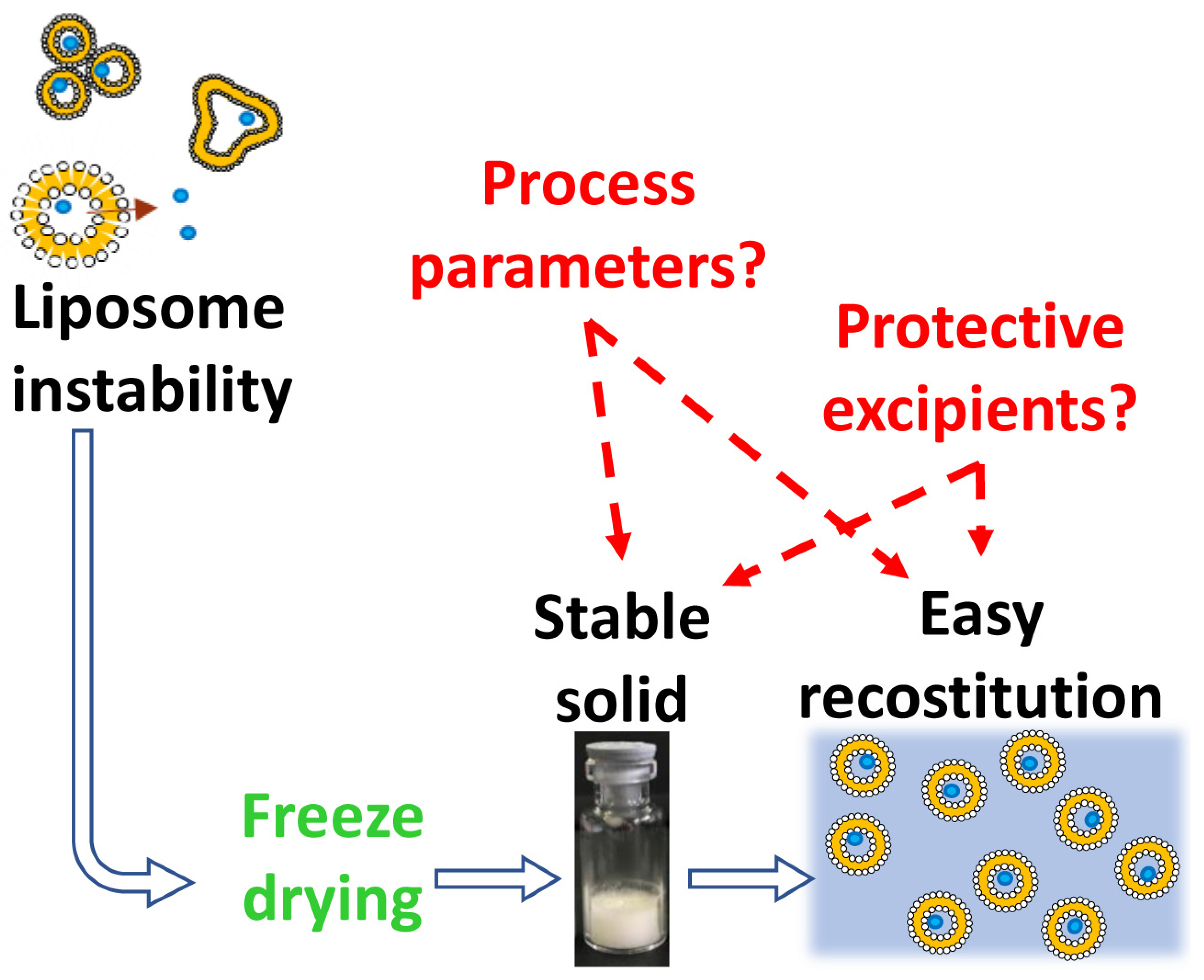

Advancements in Pharmaceutical Lyophilization: Integrating QbD, AI, and Novel Formulation Strategies for Next-Generation Biopharmaceuticals



Abstract
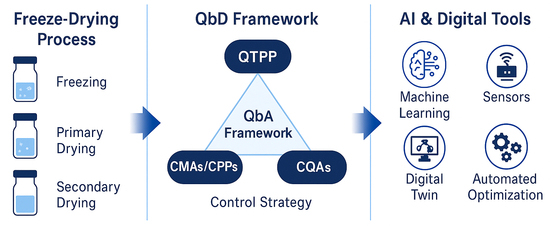
1. Introduction
2. QbD-Driven Development and Performance of Lyophilized Products
2.1. QTPP Identification and Risk Assessment Analysis
2.2. Overview of Lyophilization Process: Process Control Parameters and Critical Temperatures
2.3. Critical Drug Product Attributes
2.3.1. Cake Appearance
2.3.2. Reconstitution
2.3.3. Assay and Impurities
2.3.4. Moisture Content
3. Technology-Driven Advances in Pharmaceutical Lyophilization
4. Scope, Industrial Relevance and Pharmaceutical Applications
4.1. Conventional Small Molecules
4.2. Liposomes
4.3. Synthetic Surfactants
4.4. Nanoparticles
4.5. Biologics/Vaccines
5. Scientific and Regulatory Considerations (FDA Perspective)
6. Conclusions and Future Perspectives
Author Contributions
Funding
Institutional Review Board Statement
Informed Consent Statement
Data Availability Statement
Conflicts of Interest
References
- Costantino, H.R.; Pikal, M.J. Lyophilization of Biopharmaceuticals; Springer Science & Business Media: New York, NY, USA, 2005; Volume 2. [Google Scholar]
- Ledet, G.A.; Graves, R.A.; Bostanian, L.A.; Mandal, T.K. Spray-Drying of Biopharmaceuticals. In Lyophilized Biologics and Vaccines: Modality-Based Approaches; Springer: New York, NY, USA, 2015; pp. 273–297. [Google Scholar]
- Connolly, B.D.; Le, L.; Patapoff, T.W.; Cromwell, M.E.M.; Moore, J.M.R.; Lam, P. Protein Aggregation in Frozen Trehalose Formulations: Effects of Composition, Cooling Rate, and Storage Temperature. J. Pharm. Sci. 2015, 104, 4170–4184. [Google Scholar] [CrossRef] [Scilit] [PubMed]
- Bisht, D.; Iqbal, Z. Lyophilization—Process and optimization for pharmaceuticals. Int. J. Drug Regul. Aff. 2018, 3, 30. [Google Scholar] [CrossRef] [Scilit]
- Gaidhani, K.A.; Harwalkar, M.; Bhambere, D.; Nirgude, P.S. Lyophilization/Freeze Drying—A Review. World J. Pharm. Res. 2015, 4, 516–543. [Google Scholar]
- Jones, B.; Patel, R.; Wang, B.; Evans-Nguyen, T.; Patel, N.A. Lyophilized Small Extracellular Vesicles (sEVs) Derived from Human Adipose Stem Cells Maintain Efficacy to Promote Healing in Neuronal Injuries. Biomedicines 2025, 13, 275. [Google Scholar] [CrossRef] [Scilit]
- Praveen Kumar, G.; Prashanth, N.; Chaitanya Kumari, B. Fundamentals and Applications of Lyophilization. J. Adv. Pharm. Res. 2011, 2, 157–169. [Google Scholar]
- Woodcock, J. The concept of pharmaceutical quality. Am. Pharm. Rev. 2004, 7, 10–15. [Google Scholar]
- Ansari, M.T.; Alahmed, T.A.A.; Sami, F. Quality by Design (QbD) Concept for Formulation of Oral Formulations for Tablets. In Introduction to Quality by Design (QbD) From Theory to Practice; Springer: New York, NY, USA, 2024; pp. 161–184. [Google Scholar]
- Yu, L.X.; Amidon, G.; Khan, M.A.; Hoag, S.W.; Polli, J.; Raju, G.K.; Woodcock, J. Understanding pharmaceutical quality by design. AAPS J. 2014, 16, 771–783. [Google Scholar] [CrossRef] [Scilit]
- Atre, P.; Rizvi, S.A.A. Advances in Oral Solid Drug Delivery Systems: Quality by Design Approach in Development of Controlled Release Tablets. BioChem 2025, 5, 9. [Google Scholar] [CrossRef] [Scilit]
- Lee, S.H.; Kim, J.K.; Jee, J.P.; Jang, D.J.; Park, Y.J.; Kim, J.E. Quality by Design (QbD) application for the pharmaceutical development process. J. Pharm. Investig. 2022, 52, 649–682. [Google Scholar] [CrossRef] [Scilit]
- FDA. Pharmaceutical CGMPs for the 21s Century—A Risk-Based Approach; Food and Drug Administration: Washington, DC, USA, 2004.
- Xu, X.; Khan, M.A.; Burgess, D.J. A quality by design (QbD) case study on liposomes containing hydrophilic API: I. Formulation, processing design and risk assessment. Int. J. Pharm. 2011, 419, 52–59. [Google Scholar] [CrossRef] [Scilit] [PubMed]
- Juckers, A.; Knerr, P.; Harms, F.; Strube, J. Effect of the Freezing Step on Primary Drying Experiments and Simulation of Lyophilization Processes. Processes 2023, 11, 1404. [Google Scholar] [CrossRef] [Scilit]
- Yu, L.X. Pharmaceutical quality by design: Product and process development, understanding, and control. Pharm. Res. 2008, 25, 781–791. [Google Scholar] [CrossRef] [Scilit] [PubMed]
- Joshi, D.; Choudhary, N.K. Enhancing Sublingual Tablet-Quality Through Quality-by-Design Principles: Current Trends and Insights. Precis. Med. 2023, 6, 1099–1108. [Google Scholar]
- Jagan, B.G.V.S.; Murthy, P.N.; Mahapatra, A.K.; Patra, R.K. Quality by design (QBD): Principles, underlying concepts, and regulatory prospects. Thai J. Pharm. Sci. 2021, 45, 54–69. [Google Scholar] [CrossRef] [Scilit]
- Osborne, D.W. Impact of quality by design on topical product excipient suppliers, part I: A drug manufacturer’s perspective. Pharm. Technol. 2016, 40, 38–43. [Google Scholar]
- Rosas, J.G.; Blanco, M.; González, J.M.; Alcalá, M. Quality by design approach of a pharmaceutical gel manufacturing process, part 1: Determination of the design space. J. Pharm. Sci. 2011, 100, 4432–4441. [Google Scholar] [CrossRef] [Scilit] [PubMed]
- Chavda, H. Qbd in developing topical dosage forms. Ely. J. Pharm. Res. 2016, 2, 1–2. [Google Scholar]
- Jain, S. Quality by design (QBD): A comprehensive understanding of implementation and challenges in pharmaceuticals development. Int. J. Pharm. Pharm. Sci. 2014, 6, 1738–1748. [Google Scholar]
- Kawasaki, H.; Shimanouchi, T.; Kimura, Y. Recent Development of Optimization of Lyophilization Process. J. Chem. 2019, 2019, 9502856. [Google Scholar] [CrossRef] [Scilit]
- Chang, R.K.; Raw, A.; Lionberger, R.; Yu, L. Generic development of topical dermatologic products: Formulation development, process development, and testing of topical dermatologic products. AAPS J. 2012, 15, 41–52, Erratum in AAPS J. 2013, 17, 1522. [Google Scholar] [CrossRef] [Scilit]
- Kimball, M. Manufacturing Topical Formulations: Scale-up from Lab to Pilot Production. In Handbook of Formulating Dermal Applications; Scrivener Publishing LLC: Beverly, MA, USA, 2016. [Google Scholar]
- Borchert, D.; Zahel, T.; Thomassen, Y.E.; Herwig, C.; Suarez-Zuluaga, D.A. Quantitative CPP Evaluation from Risk Assessment Using Integrated Process Modeling. Bioengineering 2019, 6, 114. [Google Scholar] [CrossRef] [Scilit]
- Nowak, D.; Jakubczyk, E. The freeze-drying of foods—The characteristic of the process course and the effect of its parameters on the physical proNoperties of food materials. Foods 2020, 9, 1488. [Google Scholar] [CrossRef] [Scilit]
- Roy, I.; Gupta, M.N. Freeze-drying of proteins: Some emerging concerns. Biotechnol. Appl. Biochem. 2004, 39, 165–177. [Google Scholar] [CrossRef] [Scilit]
- Liu, Y.; Zhao, Y.; Feng, X. Exergy analysis for a freeze-drying process. Appl. Therm. Eng. 2008, 28, 675–690. [Google Scholar] [CrossRef] [Scilit]
- Shukla, S. Freeze drying process: A review. Int. J. Pharm. Sci. Res. 2011, 2, 3061. [Google Scholar]
- Arora, S.; Dash, S.K.; Dhawan, D.; Sahoo, P.K.; Jindal, A.; Gugulothu, D. Freeze-drying revolution: Unleashing the potential of lyophilization in advancing drug delivery systems. Drug Deliv. Transl. Res. 2024, 14, 1111–1153. [Google Scholar] [CrossRef] [Scilit] [PubMed]
- Passot, S.; Tréléa, I.C.; Marin, M.; Galan, M.; Morris, G.J.; Fonseca, F. Effect of controlled ice nucleation on primary drying stage and protein recovery in vials cooled in a modified freeze-dryer. J. Biomech. Eng. 2009, 131, 074511. [Google Scholar] [CrossRef] [Scilit] [PubMed]
- Butreddy, A.; Dudhipala, N.; Janga, K.Y.; Gaddam, R.P. Lyophilization of Small-Molecule Injectables: An Industry Perspective on Formulation Development, Process Optimization, Scale-Up Challenges, and Drug Product Quality Attributes. AAPS PharmSciTech 2020, 21, 252. [Google Scholar] [CrossRef] [Scilit] [PubMed]
- Franks, F.; Auffret, T. Freeze-Drying of Pharmaceuticals and Biopharmaceuticals; Royal Society of Chemistry: Cambridge, UK, 2007. [Google Scholar]
- Ullrich, S.; Seyferth, S.; Lee, G. Measurement of shrinkage and cracking in lyophilized amorphous cakes. Part I: Final-product assessment. J. Pharm. Sci. 2015, 104, 155–164. [Google Scholar] [CrossRef] [Scilit]
- Tang, X.C.; Nail, S.L.; Pikal, M.J. Evaluation of manometric temperature measurement, a process analytical technology tool for freeze-drying: Part II measurement of dry-layer resistance. AAPS PharmSciTech 2006, 7, 93. [Google Scholar] [CrossRef] [Scilit]
- Schneid, S.; Gieseler, H. Effect of Concentration, Vial Size, and Fill Depth, on Product Resistance of Sucrose Solution During Freeze-Drying. In Proceedings of the 6th World Meeting on Pharmaceutics, Biopharmaceutics and Pharmaceutical Technology, Barcelona, Spain, 7–10 April 2008. [Google Scholar]
- Searles, J.A.; Carpenter, J.F.; Randolph, T.W. The ice nucleation temperature determines the primary drying rate of lyophilization for samples frozen on a temperature-controlled shelf. J. Pharm. Sci. 2001, 90, 861–871. [Google Scholar] [CrossRef] [Scilit]
- Pérez, R.; Alvarez, M.A.; Acosta, L.L.; Terry, A.M.; Labrada, A. Establishing a Multi-Vial Design Space for the Freeze-Drying Process by Means of Mathematical Modeling of the Primary Drying Stage. J. Pharm. Sci. 2024, 113, 1506–1514. [Google Scholar] [CrossRef] [Scilit]
- Lale, S.V.; Goyal, M.; Bansal, A.K. Development of lyophilization cycle and effect of excipients on the stability of catalase during lyophilization. Int. J. Pharm. Investig. 2011, 1, 214. [Google Scholar] [CrossRef] [Scilit] [PubMed]
- Tang, X.; Pikal, M.J. Design of Freeze-Drying Processes for Pharmaceuticals: Practical Advice. Pharm. Res. 2004, 21, 191–200. [Google Scholar] [CrossRef] [Scilit] [PubMed]
- Patel, S.M.; Nail, S.L.; Pikal, M.J.; Geidobler, R.; Winter, G.; Hawe, A.; Davagnino, J.; Gupta, S.R. Lyophilized Drug Product Cake Appearance: What Is Acceptable? J. Pharm. Sci. 2017, 106, 1706–1721. [Google Scholar] [CrossRef] [Scilit]
- Esfandiary, R.; Gattu, S.K.; Stewart, J.M.; Patel, S.M. Effect of Freezing on Lyophilization Process Performance and Drug Product Cake Appearance. J. Pharm. Sci. 2016, 105, 1427–1433. [Google Scholar] [CrossRef] [Scilit]
- Franks, F. Freeze-drying of bioproducts: Putting principles into practice. Eur. J. Pharm. Biopharm. 1998, 45, 221–229. [Google Scholar] [CrossRef] [Scilit]
- Werk, T.; Huwyler, J.; Hafner, M.; Luemkemann, J.; Mahler, H.C. An Impedance-Based Method to Determine Reconstitution Time for Freeze-Dried Pharmaceuticals. J. Pharm. Sci. 2015, 104, 2948–2955. [Google Scholar] [CrossRef] [Scilit]
- Hiwale, P.; Amin, A.; Kumar, L.; Bansal, A.K. Variables affecting reconstitution time of dry powder for injection. Pharm. Technol. 2008, 32, 62–68. [Google Scholar]
- Bansal, A.K. Product development issues of powders for injection. Pharm. Technol. 2002, 26, 122–132. [Google Scholar]
- Lin, L.F.; Bunnell, R. Moisture matters in lyophilized drug product using an alternate moisture-generation method may provide more accurate data for regulatory submissions. Biopharm Int. 2012, 25, 64–67. [Google Scholar]
- Mirasol, F. Lyophilization presents complex challenges. Biopharm Int. 2020, 33, 22–24. [Google Scholar]
- Huanbutta, K.; Burapapadh, K.; Kraisit, P.; Sriamornsak, P.; Ganokratana, T.; Suwanpitak, K.; Sangnim, T. The Artificial Intelligence-Driven Pharmaceutical Industry: A Paradigm Shift in Drug Discovery, Formulation Development, Manufacturing, Quality Control, and Post-Market Surveillance. Eur. J. Pharm. Sci. 2024, 203, 106938. [Google Scholar] [CrossRef] [Scilit]
- Munir, N.; Nugent, M.; Whitaker, D.; McAfee, M. Machine learning for process monitoring and control of hot-melt extrusion: Current state of the art and future directions. Pharmaceutics 2021, 13, 1432. [Google Scholar] [CrossRef] [Scilit] [PubMed]
- Jiang, J.; Ma, X.; Ouyang, D.; Williams, R.O. Emerging Artificial Intelligence (AI) Technologies Used in the Development of Solid Dosage Forms. Pharmaceutics 2022, 14, 2257. [Google Scholar] [CrossRef] [Scilit]
- Malheiro, V.; Santos, B.; Figueiras, A.; Mascarenhas-Melo, F. The potential of artificial intelligence in pharmaceutical innovation: From drug discovery to clinical trials. Pharmaceuticals 2025, 18, 788. [Google Scholar] [CrossRef] [Scilit] [PubMed]
- Jena, G.K.; Patra, C.N.; Jammula, S.; Rana, R.; Chand, S. Artificial Intelligence and Machine Learning Implemented Drug Delivery Systems: A Paradigm Shift in the Pharmaceutical Industry. J. BioX Res. 2024, 7, 16. [Google Scholar] [CrossRef] [Scilit]
- Yadav, S.; Singh, A.; Singhal, R.; Yadav, J.P. Revolutionizing drug discovery: The impact of artificial intelligence on advancements in pharmacology and the pharmaceutical industry. Intell. Pharm. 2024, 2, 367–380. [Google Scholar] [CrossRef] [Scilit]
- Arora, P.; Behera, M.; Saraf, S.A.; Shukla, R. Leveraging Artificial Intelligence for Synergies in Drug Discovery: From Computers to Clinics. Curr. Pharm. Des. 2024, 30, 2187–2205. [Google Scholar] [CrossRef] [Scilit]
- Tsay, C.; Li, Z. Automating Visual Inspection of Lyophilized Drug Products with Multi-Input Deep Neural Networks. In Proceedings of the IEEE International Conference on Automation Science and Engineering, Vancouver, BC, Canada, 22–26 August 2019. [Google Scholar]
- Herve, Q.; Ipek, N.; Verwaeren, J.; De Beer, T. Automated particle inspection of continuously freeze-dried products using computer vision. Int. J. Pharm. 2024, 664, 124629. [Google Scholar] [CrossRef] [Scilit]
- Müller, P.; Sack, A.; Dümler, J.; Heckel, M.; Wenzel, T.; Siegert, T.; Schuldt-Lieb, S.; Gieseler, H.; Pöschel, T. Automated tomographic assessment of structural defects of freeze-dried pharmaceuticals. AAPS PharmSciTech 2024, 25, 143. [Google Scholar] [CrossRef] [Scilit]
- Drǎgoi, E.N.; Curteanu, S.; Fissore, D. On the Use of Artificial Neural Networks to Monitor a Pharmaceutical Freeze-Drying Process. Dry. Technol. 2013, 31, 72–81. [Google Scholar] [CrossRef] [Scilit]
- Al Hagbani, T.; Alamoudi, J.A.; Bajaber, M.A.; Alsayed, H.I.; Al-Fanhrawi, H.J. Theoretical investigations on analysis and optimization of freeze drying of pharmaceutical powder using machine learning modeling of temperature distribution. Sci. Rep. 2025, 15, 948. [Google Scholar] [CrossRef] [Scilit]
- Alqarni, M.; Alqarni, A.A. Computational and intelligence modeling analysis of pharmaceutical freeze drying for prediction of temperature in the process. Case Stud. Therm. Eng. 2024, 61, 105136. [Google Scholar] [CrossRef] [Scilit]
- Hang, N.T.; Long, N.T.; Duy, N.D.; Chien, N.N.; Van Phuong, N. Towards safer and efficient formulations: Machine learning approaches to predict drug-excipient compatibility. Int. J. Pharm. 2024, 653, 123884. [Google Scholar] [CrossRef] [Scilit] [PubMed]
- Huang, Z.; Shen, Y.; Li, J.; Fey, M.; Brecher, C. A survey on AI-driven digital twins in industry 4.0: Smart manufacturing and advanced robotics. Sensors 2021, 21, 6340. [Google Scholar] [CrossRef] [Scilit] [PubMed]
- Mayer, A.; Greif, L.; Häußermann, T.M.; Otto, S.; Kastner, K.; El Bobbou, S.; Chardonnet, J.-R.; Reichwald, J.; Fleischer, J.; Ovtcharova, J. Digital Twins, Extended Reality, and Artificial Intelligence in Manufacturing Reconfiguration: A Systematic Literature Review. Sustainability 2025, 17, 2318. [Google Scholar] [CrossRef] [Scilit]
- Kumar, D.R.; Vasanth, P.M.; Ramesh, T.; Ramesh, M. Formulation and evaluation of lyophilized antibacterial agent. Int. J. Pharmtech Res. 2013, 5, 1581–1589. [Google Scholar]
- Ahammad, S.R.; Narayanasamy, D. A QbD approach for optimizing the lyophilization parameters of cyclophosphamide monohydrate. Drug Dev. Ind. Pharm. 2025, 51, 566–576. [Google Scholar] [CrossRef] [Scilit] [PubMed]
- Pattni, B.S.; Chupin, V.V.; Torchilin, V.P. New Developments in Liposomal Drug Delivery. Chem. Rev. 2015, 115, 10938–10966. [Google Scholar] [CrossRef] [Scilit]
- Pande, S. Liposomes for drug delivery: Review of vesicular composition, factors affecting drug release and drug loading in liposomes. Artif. Cells Nanomed. Biotechnol. 2023, 51, 428–440. [Google Scholar] [CrossRef] [Scilit]
- Gao, W.; Hu, C.M.J.; Fang, R.H.; Zhang, L. Liposome-like nanostructures for drug delivery. J. Mater Chem. B 2013, 1, 6569–6585. [Google Scholar] [CrossRef] [Scilit] [PubMed]
- Boafo, G.F.; Magar, K.T.; Ekpo, M.D.; Qian, W.; Tan, S.; Chen, C. The Role of Cryoprotective Agents in Liposome Stabilization and Preservation. Int. J. Mol. Sci. 2022, 23, 12487. [Google Scholar] [CrossRef] [Scilit]
- Atre, P.; Rizvi, S.A.A. A brief overview of quality by design approach for developing pharmaceutical liposomes as nano-sized parenteral drug delivery systems. RSC Pharm. 2024, 1, 675–688. [Google Scholar] [CrossRef] [Scilit]
- Sonju, J.J.; Shrestha, P.; Dahal, A.; Gu, X.; Johnson, W.D.; Zhang, D.; Muthumula, C.M.R.; Meyer, S.A.; Mattheolabakis, G.; Jois, S.D. Lyophilized liposomal formulation of a peptidomimetic-Dox conjugate for HER2 positive breast and lung cancer. Int. J. Pharm. 2023, 639, 122950. [Google Scholar] [CrossRef] [Scilit]
- Franzé, S.; Selmin, F.; Samaritani, E.; Minghetti, P.; Cilurzo, F. Lyophilization of liposomal formulations: Still necessary, still challenging. Pharmaceutics 2018, 10, 139. [Google Scholar] [CrossRef] [Scilit]
- Glavas-Dodov, M.; Fredro-Kumbaradzi, E.; Goracinova, K.; Simonoska, M.; Calis, S.; Trajkovic-Jolevska, S.; Hincal, A.A. The effects of lyophilization on the stability of liposomes containing 5-FU. Int. J. Pharm. 2005, 291, 79–86. [Google Scholar] [CrossRef] [Scilit] [PubMed]
- King, T.E.; Humphrey, J.R.; Laughton, C.A.; Thomas, N.R.; Hirst, J.D. Optimizing Excipient Properties to Prevent Aggregation in Biopharmaceutical Formulations. J. Chem. Inf. Model. 2024, 64, 265–275. [Google Scholar] [CrossRef] [Scilit]
- Kommineni, N.; Butreddy, A.; Sainaga Jyothi, V.G.S.; Angsantikul, P. Freeze-drying for the preservation of immunoengineering products. iScience 2022, 25, 105127. [Google Scholar] [CrossRef] [Scilit]
- Bollenbach, L.; Buske, J.; Mäder, K.; Garidel, P. Poloxamer 188 as surfactant in biological formulations—An alternative for polysorbate 20/80? Int. J. Pharm. 2022, 620, 121706. [Google Scholar] [CrossRef] [Scilit]
- Singh, S.M.; Bandi, S.; Jones, D.N.M.; Mallela, K.M.G. Effect of Polysorbate 20 and Polysorbate 80 on the Higher-Order Structure of a Monoclonal Antibody and Its Fab and Fc Fragments Probed Using 2D Nuclear Magnetic Resonance Spectroscopy. J. Pharm. Sci. 2017, 106, 3486–3498. [Google Scholar] [CrossRef] [Scilit]
- Powar, T.; Hajare, A.; Jarag, R.; Nangare, S. Development and Evaluation of Lyophilized Methotrexate Nanosuspension using Quality by Design Approach. Acta Chim. Slov. 2021, 68, 861–881. [Google Scholar] [CrossRef] [Scilit]
- Miyazawa, T.; Itaya, M.; Burdeos, G.C.; Nakagawa, K.; Miyazawa, T. A critical review of the use of surfactant-coated nanoparticles in nanomedicine and food nanotechnology. Int. J. Nanomed. 2021, 16, 3937–3999. [Google Scholar] [CrossRef] [Scilit]
- Preston, K.B.; Randolph, T.W. Stability of lyophilized and spray dried vaccine formulations. Adv. Drug Deliv. Rev. 2021, 171, 50–61. [Google Scholar] [CrossRef] [Scilit] [PubMed]
- Hwang, D.; Ramsey, J.D.; Kabanov, A.V. Polymeric micelles for the delivery of poorly soluble drugs: From nanoformulation to clinical approval. Adv. Drug Deliv. Rev. 2020, 156, 80–118. [Google Scholar] [CrossRef] [Scilit]
- Haikala, R.; Eerola, R.; Tanninen, V.P.; Yliruusi, J. Polymorphic changes of mannitol during freeze-drying: Effect of surface- active agents. PDA J. Pharm. Sci. Technol. 1997, 51, 96–101. [Google Scholar] [PubMed]
- Nnadili, M.; Okafor, A.N.; Olayiwola, T.; Akinpelu, D.; Kumar, R.; Romagnoli, J.A. Surfactant-specific ai-driven molecular design: Integrating generative models, predictive modeling, and reinforcement learning for tailored surfactant synthesis. Ind. Eng. Chem. Res. 2024, 63, 6313–6324. [Google Scholar] [CrossRef] [Scilit]
- Li, T.; Li, J.; Morozov, K.I.; Wu, Z.; Xu, T.; Rozen, I.; Leshansky, A.M.; Li, L.; Wang, J. Highly efficient freestyle magnetic nanoswimmer. Nano Lett. 2017, 17, 5092–5098. [Google Scholar] [CrossRef] [Scilit] [PubMed]
- Reza Mozafari, M. Nanomaterials and Nanosystems for Biomedical Applications; Springer: Dordrecht, The Netherlands, 2007. [Google Scholar]
- Potara, M.; Nagy-Simon, T.; Focsan, M.; Licarete, E.; Soritau, O.; Vulpoi, A.; Astilean, S. Folate-targeted Pluronic-chitosan nanocapsules loaded with IR780 for near-infrared fluorescence imaging and photothermal-photodynamic therapy of ovarian cancer. Colloids Surf. B Biointerfaces 2021, 203, 111755. [Google Scholar] [CrossRef] [Scilit]
- Nankali, E.; Shaabanzadeh, M.; Torbati, M.B. Fluorescent tamoxifen-encapsulated nanocapsules functionalized with folic acid for enhanced drug delivery toward breast cancer cell line MCF-7 and cancer cell imaging. Naunyn Schmiedebergs Arch Pharmacol. 2020, 393, 1211–1219. [Google Scholar] [CrossRef] [Scilit]
- Bechnak, L.; El Kurdi, R.; Patra, D. Fluorescence Sensing of Nucleic Acid by Curcumin Encapsulated Poly(Ethylene Oxide)-Block-Poly(Propylene Oxide)-Block-Poly(Ethylene Oxide) Based Nanocapsules. J. Fluoresc. 2020, 30, 547–556. [Google Scholar] [CrossRef] [Scilit]
- Tai, W.; Gu, Z. Enzyme Nanocapsules for Glucose Sensing and Insulin Delivery. In Biocatalysis and Nanotechnology; Pan Stanford Publishing Pte Ltd.: Singapore, 2017. [Google Scholar]
- Karthikeyan, K.; Jain, A.; Cring, M.; Searby, C.; Sheffield, V.C. Positively Charged TPGS-Chiotsan Nanocapsules as a Non-Viral Vector for Glaucoma Gene Therapy. Investig. Ophthalmol. Vis. Sci. 2020, 61, 2896. [Google Scholar]
- Chen, X.; Zhang, Q.; Li, J.; Yang, M.; Zhao, N.; Xu, F.J. Rattle-Structured Rough Nanocapsules with in-Situ-Formed Gold Nanorod Cores for Complementary Gene/Chemo/Photothermal Therapy. ACS Nano 2018, 12, 5646–5656. [Google Scholar] [CrossRef] [Scilit]
- Calvo, P.; Remuñán-López, C.; Vila-Jato, J.L.; Alonso, M.J. Development of positively charged colloidal drug carriers: Chitosan-coated polyester nanocapsules and submicron-emulsions. Colloid Polym. Sci. 1997, 275, 46–53. [Google Scholar] [CrossRef] [Scilit]
- Garg, U.; Chauhan, S.; Nagaich, U.; Jain, N. Current advances in chitosan nanoparticles based drug delivery and targeting. Adv. Pharm. Bull. 2019, 9, 195–204. [Google Scholar] [CrossRef] [Scilit] [PubMed]
- Kolluru, L.P.; Atre, P.; Rizvi, S.A.A. Characterization and applications of colloidal systems as versatile drug delivery carriers for parenteral formulations. Pharmaceuticals 2021, 14, 108. [Google Scholar] [CrossRef] [Scilit] [PubMed]
- Rizvi, S.A.A.; Saleh, A.M. Applications of nanoparticle systems in drug delivery technology. Saudi Pharm. J. 2018, 26, 64–70. [Google Scholar] [CrossRef] [Scilit]
- Shahzad, Y.; Rizvi, S.A.A.; Yousaf, A.M.; Hussain, T. Drug Delivery Using Nanomaterials; CRC Press: Boca Raton, FL, USA, 2022. [Google Scholar]
- Aranda-Barradas, M.E.; Márquez, M.; Quintanar, L.; Santoyo-Salazar, J.; Espadas-Álvarez, A.J.; Martínez-Fong, D.; García-García, E. Development of a parenteral formulation of NTS-polyplex nanoparticles for clinical purpose. Pharmaceutics 2018, 10, 5. [Google Scholar] [CrossRef] [Scilit]
- Xu, H.; Fang, G.; Gou, J.; Wang, S.; Yao, Q.; Zhang, Y.; Tang, X.; Zhao, Y. Lyophilization of self-assembled polymeric nanoparticles without compromising their microstructure and their in vivo evaluation: Pharmacokinetics, tissue distribution and toxicity. J. Biomater. Tissue Eng. 2015, 5, 919–929. [Google Scholar] [CrossRef] [Scilit]
- Awotwe-Otoo, D.; Khan, M.A. Lyophilization of Biologics: An FDA Perspective. In Lyophilized Biologics and Vaccines; Springer: New York, NY, USA, 2015. [Google Scholar]
- Awotwe-Otoo, D.; Agarabi, C.; Wu, G.K.; Casey, E.; Read, E.; Lute, S.; Brorson, K.A.; Khaln, M.A.; Shah, R.B. Quality by design: Impact of formulation variables and their interactions on quality attributes of a lyophilized monoclonal antibody. Int. J. Pharm. 2012, 438, 167–175. [Google Scholar] [CrossRef] [Scilit]
- Santana, H.; Sotolongo, J.; González, Y.; Hernández, G.; Chinea, G.; Gerónimo, H.; Amarantes, O.; Beldarraín, A.; Páez, R. Stabilization of a recombinant human epidermal growth factor parenteral formulation through freeze-drying. Biologicals 2014, 42, 322–333. [Google Scholar] [CrossRef] [Scilit] [PubMed]
- Kraan, H.; Van Herpen, P.; Kersten, G.; Amorij, J.P. Development of thermostable lyophilized inactivated polio vaccine. Pharm. Res. 2014, 31, 2618–2629. [Google Scholar] [CrossRef] [Scilit]
- Wan, J.; Wang, Z.; Wang, L.; Wu, L.; Zhang, C.; Zhou, M.; Fu, Z.F.; Zhao, L. Circular RNA vaccines with long-term lymph node-targeting delivery stability after lyophilization induce potent and persistent immune responses. mBio 2024, 15, e0177523. [Google Scholar] [CrossRef] [Scilit]
- Magoola, M.; Niazi, S.K. Current Progress and Future Perspectives of RNA-Based Cancer Vaccines: A 2025 Update. Cancers 2025, 17, 1882. [Google Scholar] [CrossRef] [Scilit]
- Gravante, F.; Sacchini, F.; Mancin, S.; Lopane, D.; Parozzi, M.; Ferrara, G.; Sguanci, M.; Palomares, S.M.; Biondini, F.; Marfella, F.; et al. Preventing Microorganism Contamination in Starting Active Materials for Synthesis from Global Regulatory Agencies: Overview for Public Health Implications. Microorganisms 2025, 13, 1595. [Google Scholar] [CrossRef] [Scilit]
- Campbell, C. FDA 2011 Process Validation Guidance: Lifecycle Compliance Model. PDA J. Pharm. Sci. Technol. 2014, 68, 185–191. [Google Scholar] [CrossRef] [Scilit] [PubMed]
- Brown, H.; Mahler, H.-C.; Mellman, J.; Nieto, A.; Wagner, D.; Schaar, M.; Mathaes, R.; Kossinna, J.; Schmitting, F.; Dreher, S.; et al. Container Closure Integrity Testing—Practical Aspects and Approaches in the Pharmaceutical Industry. PDA J. Pharm. Sci. Technol. 2016, 71, 147–162. [Google Scholar] [CrossRef] [Scilit] [PubMed]
- Mirakhori, F.; Niazi, S.K. Harnessing the AI/ML in Drug and Biological Products Discovery and Development: The Regulatory Perspective. Pharmaceuticals 2025, 18, 47. [Google Scholar] [CrossRef] [Scilit]



| Excipient Class | Representative Compounds | Primary Function | Impact on Product Quality |
|---|---|---|---|
| Cryoprotectants | Sucrose, Trehalose, Mannitol | Protect biomolecules during freezing/drying | Preventing aggregation and structural collapse |
| Bulking agents | Glycine, Mannitol | Provide structural support to cake | Improve mechanical strength and cake appearance |
| Surfactants | Polysorbates, poloxamers | Reduce interfacial stress and foaming | Prevent protein adsorption and collapse |
| Tonicity agents | Sodium chloride, dextrose | Ensure isotonicity upon reconstitution | Maintain osmotic balance |
| Novel stabilizers | Cyclodextrins, amino acids | Enhance stability of active moieties | Enable stabilization |
| CQAs/CMAs | Cryoprotectants | Tonicity Agents | Surfactants | Bulking Agents | Reconstituting Diluent(s) |
|---|---|---|---|---|---|
| Cake Appearance | High | Low | Medium | High | N/A |
| Reconstitution | Medium | High | High | Medium | High |
| Residual Moisture | Medium | Low | Medium | Medium | Low |
| Assay and Impurities | High | Low | High | Low | High |
| CQAs/CPPs | Freezing rate/temperature | Annealing rate/temperature | Primary drying time/temperature/ pressure | Secondary drying time/temperature/ pressure | Critical Temperatures (Tg/Teu/Tc) |
| Cake Appearance | Medium | Medium | High | High | High |
| Reconstitution | Low | Low | High | High | Low |
| Residual Moisture | Low | Low | High | High | Low |
| Assay and Impurities | Low | Low | Medium | Medium | Low |
| Drug Product CQA (with High/Medium Risk) | CMAs/CPPs | Justification |
|---|---|---|
| Cake Appearance | Cryoprotectants | Cryoprotectants, bulking agents, and surfactants affect cake appearance by stabilizing the matrix, providing structural support, and minimizing surface defects, resulting in a uniform and intact lyophilized cake. |
| Surfactants | ||
| Bulking agents | ||
| Freezing rate/temperature | Cake appearance is governed by the interplay of freezing, annealing, and drying parameters, each influencing ice crystal morphology, pore structure, and moisture distribution. All these factors can impact structural integrityof the cake and need to be optimized to prevent meltback, collapse or cracked cake. | |
| Annealing rate/temperature | ||
| Primary drying time/temperature/pressure | ||
| Secondary drying time/temperature/pressure | ||
| Critical Temperatures (Tg/Teu/Tc) | ||
| Reconstitution | Cryoprotectants | Cryoprotectants, surfactants, bulking agents, tonicity agents, and the reconstituting diluent influence reconstitution by affecting wetting, solubility, and porosity, thereby determining the reconstituion time, completeness and clarity; and osmolality of the reconstituted solution. |
| Surfactants | ||
| Bulking agents | ||
| Tonicity agents | ||
| Reconstituting diluent | ||
| Primary drying time/temperature/pressure | Primary and secondary drying parameters affect reconstitution by influencing residual moisture content, pore structure, and cake integrity. Inadequate drying can lead to incomplete dissolution or prolonged reconstitution time, whereas optimized conditions yield a porous, easily wettable cake that reconstitutes rapidly and uniformly. | |
| Secondary drying time/temperature/pressure | ||
| Residual Moisture | Cryoprotectants | Cryoprotectants, surfactants, and bulking agents influence residual moisture by altering the formulation’s glass transition behavior, drying kinetics, and solid-state structure. |
| Surfactants | ||
| Bulking agents | ||
| Primary drying time/temperature/pressure | Primary and secondary drying parameters affect residual moisture by controlling the efficiency of ice sublimation and bound water desorption. Inadequate primary drying temperature or pressure can leave trapped ice within the matrix, while insufficient secondary drying time or temperature results in incomplete removal of bound moisture. | |
| Secondary drying time/temperature/pressure | ||
| Assay and Impurfities | Cryoprotectants | Cryoprotectants stabilize the active ingredient against degradation during freezing and drying, preserving assay potency and minimizing impurity formation. Surfactants prevent interfacial stress–induced denaturation or aggregation, reducing related impurities. The composition and pH of the reconstituting diluent can impact assay recovery and impurity profile by influencing solubility, degradation kinetics, and reconstitution completeness. |
| Surfactants | ||
| Reconstituting diluent | ||
| Primary drying time/temperature/pressure | Elevated temperatures or extended drying times can cause loss of potency and formation of degradation products. | |
| Secondary drying time/temperature/pressure |
| Feature | Traditional Lyophilization | QbD/AI-Driven Lyophilization |
|---|---|---|
| Development Approach | Empirical, trial and error | Science based on AI optimization |
| Cycle Design | Empirical, trial and error | Modeled using critical parameters, digital twins, and AI |
| Cycle Optimization Time | Weeks to Months | Few Days |
| Cost | High | Low |
| Process Robustness | Moderate | High |
| Documentation | Manual | Digital, real-time process and quality monitoring |
| Regulatory Acceptance | Compliant, however difficult to justify | Aligned with ICH Q8–Q11, well justified |
| Success rates | 50–70% | 85–90% |
| Feature | Synthetic Surfactants | Bioengineered Surfactants |
|---|---|---|
| Source | Petrochemical or plant-based | Microbial fermentation/metabolic engineering |
| Production method | Chemical synthesis | Biological |
| Toxicity | High | Low |
| Cost | Low | High |
| Biodegradability | Limited | High |
| Examples | Sodium lauryl sulfate (SLS), cetyltrimethylammonium bromide (CTAB), polysorbates (Tween), etc. | Rhamnolipids, sophorolipids, surfactin, etc. |
Disclaimer/Publisher’s Note: The statements, opinions and data contained in all publications are solely those of the individual author(s) and contributor(s) and not of MDPI and/or the editor(s). MDPI and/or the editor(s) disclaim responsibility for any injury to people or property resulting from any ideas, methods, instructions or products referred to in the content. |
© 2025 by the authors. Licensee MDPI, Basel, Switzerland. This article is an open access article distributed under the terms and conditions of the Creative Commons Attribution (CC BY) license (https://creativecommons.org/licenses/by/4.0/).
Share and Cite
Atre, P.; Rizvi, S.A.A. Advancements in Pharmaceutical Lyophilization: Integrating QbD, AI, and Novel Formulation Strategies for Next-Generation Biopharmaceuticals. Biologics 2025, 5, 35. https://doi.org/10.3390/biologics5040035
Atre P, Rizvi SAA. Advancements in Pharmaceutical Lyophilization: Integrating QbD, AI, and Novel Formulation Strategies for Next-Generation Biopharmaceuticals. Biologics. 2025; 5(4):35. https://doi.org/10.3390/biologics5040035
Chicago/Turabian StyleAtre, Prachi, and Syed A. A. Rizvi. 2025. "Advancements in Pharmaceutical Lyophilization: Integrating QbD, AI, and Novel Formulation Strategies for Next-Generation Biopharmaceuticals" Biologics 5, no. 4: 35. https://doi.org/10.3390/biologics5040035
APA StyleAtre, P., & Rizvi, S. A. A. (2025). Advancements in Pharmaceutical Lyophilization: Integrating QbD, AI, and Novel Formulation Strategies for Next-Generation Biopharmaceuticals. Biologics, 5(4), 35. https://doi.org/10.3390/biologics5040035