
Fueling the Fire: How Glutamine Metabolism Sustains Leukemia Growth and Resistance


Abstract
1. Introduction
2. Glutamine Biochemistry and Its Central Importance in Leukemic Cells
2.1. Cellular Uptake and Compartmentalization of Glutamine
2.2. Anaplerosis, Reductive Carboxylation and Biosynthesis
2.3. Redox Regulation and Glutathione Synthesis
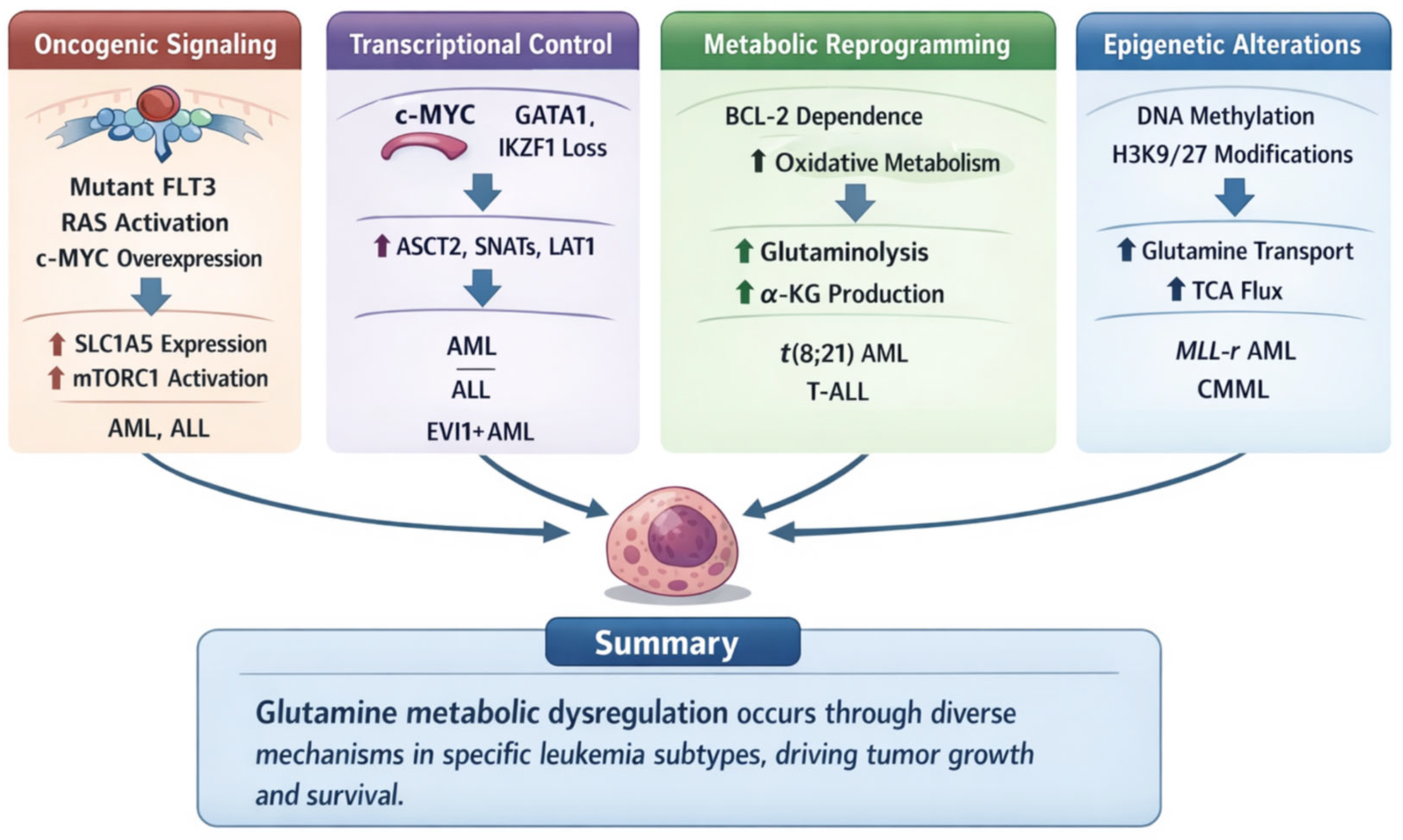
3. Mechanisms Enforcing Glutamine Dependency in Leukemia
3.1. Transcriptional Control by Oncogenes and Stress Pathways
3.2. Post-Transcriptional and Epigenetic Regulation: The IGF2BP2 Axis
3.3. Enforced Glutamine Dependency via Loss of Synthesis Pathways
3.4. Therapeutic Stress and Adaptive Remodeling of Glutamine Metabolism
4. Functional Consequences of Glutamine Metabolism in Leukemia
4.1. Proliferation, Bioenergetics and Cell Cycle Progression
4.2. Redox Homeostasis and DNA Damage Responses
4.3. Epigenetic Regulation and Leukemic Differentiation
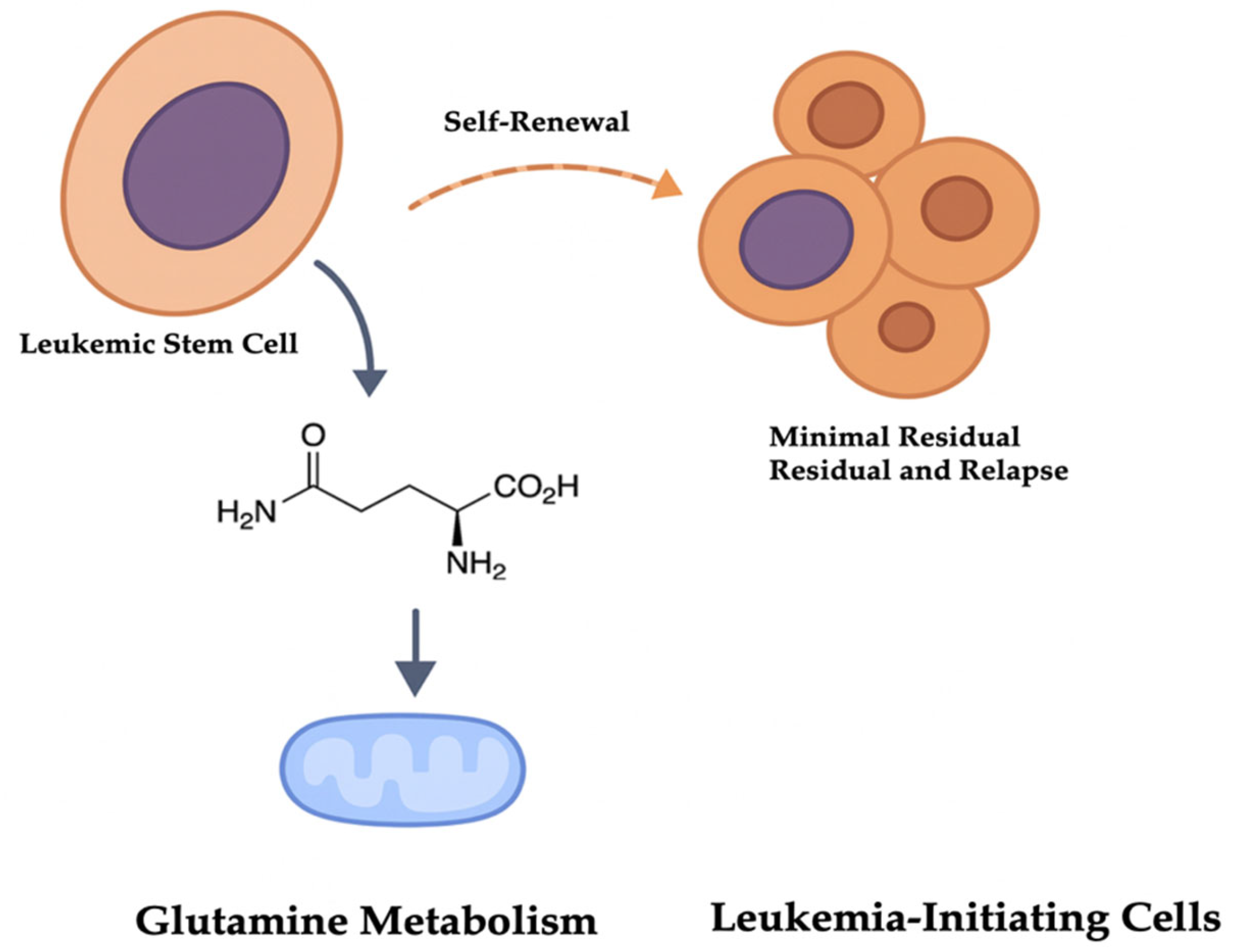
4.4. Leukemic Stem Cells, Minimal Residual Disease and Relapse
5. Therapeutic Targeting of Glutamine Metabolism in Leukemia
5.1. Glutaminase Inhibition
5.2. Glutamine Depletion and Transporter Inhibition
5.3. Rational Combinations with Targeted and Cytotoxic Agents
6. Challenges, Limitations and Resistance Mechanisms
6.1. Metabolic Plasticity and Pathway Redundancy
6.2. Contexts Where Glutamine Targeting Fails or Loses Efficacy
6.3. Microenvironmental Buffering and Stromal Support
6.4. Toxicity and Effects on Normal Hematopoiesis and Immunity
6.5. Disease Heterogeneity and Lack of Predictive Biomarkers
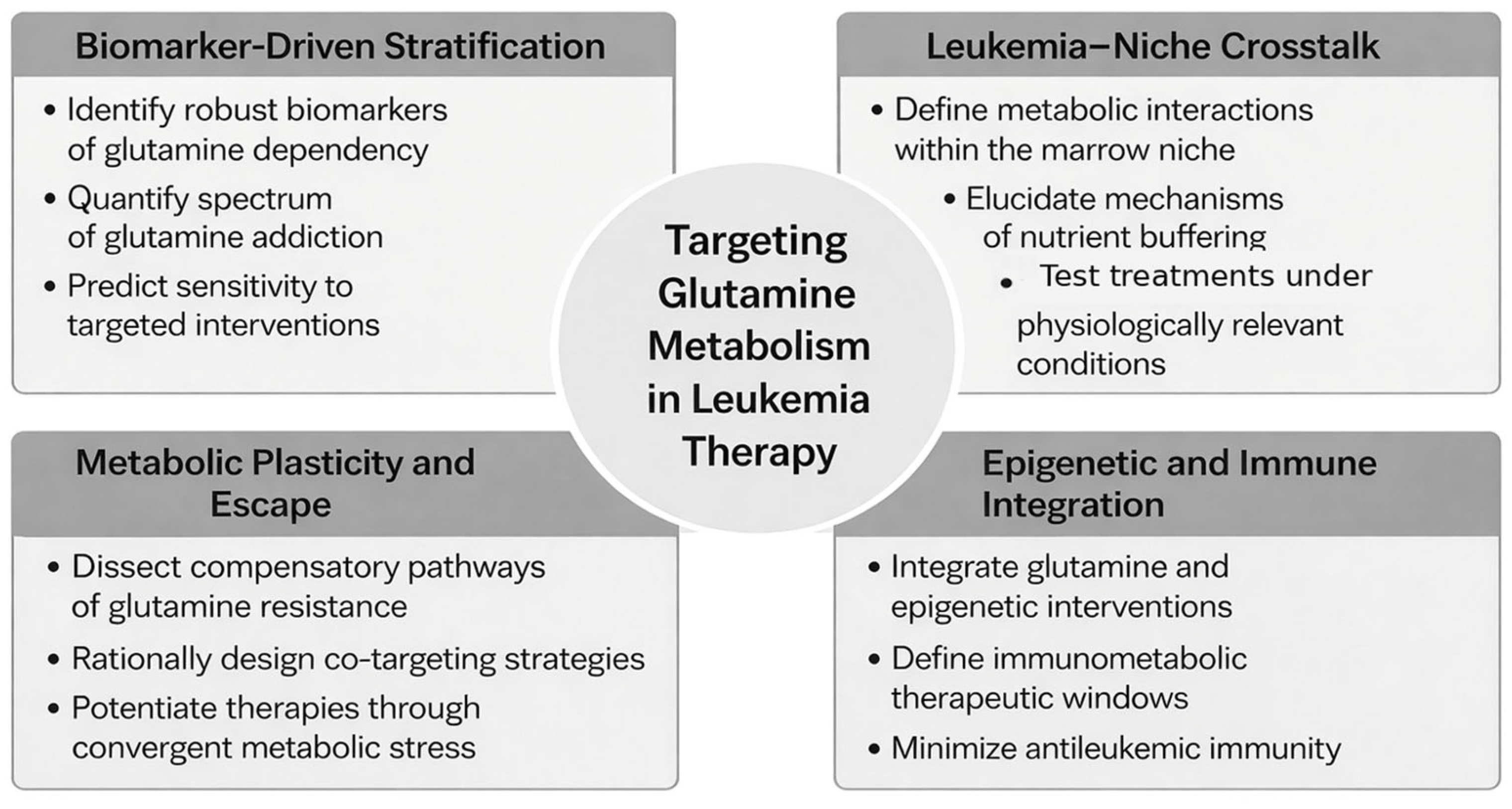
7. Future Directions
8. Conclusions
Funding
Institutional Review Board Statement
Informed Consent Statement
Data Availability Statement
Conflicts of Interest
References
- Yang, L.; Venneti, S.; Nagrath, D. Glutaminolysis: A hallmark of cancer metabolism. Annu. Rev. Biomed. Eng. 2017, 19, 163–194. [Google Scholar] [CrossRef] [PubMed]
- Schulze, A.; Harris, A.L. How cancer metabolism is tuned for proliferation and vulnerable to disruption. Nature 2012, 491, 364–373. [Google Scholar] [CrossRef] [PubMed]
- Panuzzo, C.; Jovanovski, A.; Pergolizzi, B.; Pironi, L.; Stanga, S.; Fava, C.; Cilloni, D. Mitochondria: A galaxy in the hematopoietic and leukemic stem cell universe. Int. J. Mol. Sci. 2020, 21, 3928. [Google Scholar] [CrossRef] [PubMed]
- Basak, N.P.; Banerjee, S. Mitochondrial dependency in progression of acute myeloid leukemia. Mitochondrion 2015, 21, 41–48. [Google Scholar] [CrossRef]
- Wang, Y.; Zhang, L.; Chen, W.-L.; Wang, J.-H.; Li, N.; Li, J.-M.; Mi, J.-Q.; Zhang, W.-N.; Li, Y.; Wu, S.-F.; et al. Rapid diagnosis and prognosis of de novo acute myeloid leukemia by serum metabonomic analysis. J. Proteome Res. 2013, 12, 4393–4401. [Google Scholar] [CrossRef]
- Rudman, D.; Vogler, W.R.; Howard, C.H.; Gerron, G.G. Observations on the plasma amino acids of patients with acute leukemia. Cancer Res. 1971, 31, 1159–1165. [Google Scholar]
- Wang, D.; Tan, G.; Wang, H.; Chen, P.; Hao, J.; Wang, Y. Identification of novel serum biomarker for the detection of acute myeloid leukemia based on liquid chromatography-mass spectrometry. J. Pharm. Biomed. Anal. 2019, 166, 357–363. [Google Scholar] [CrossRef]
- Gregory, M.A.; Nemkov, T.; Park, H.J.; Zaberezhnyy, V.; Gehrke, S.; Adane, B.; Jordan, C.T.; Hansen, K.C.; D’Alessandro, A.; DeGregori, J. Targeting glutamine metabolism and redox state for leukemia therapy. Clin. Cancer Res. Off. J. Am. Assoc. Cancer Res. 2019, 25, 4079–4090. [Google Scholar] [CrossRef]
- Döhner, H.; Weisdorf, D.J.; Bloomfield, C.D. Acute myeloid leukemia. N. Engl. J. Med. 2015, 373, 1136–1152. [Google Scholar] [CrossRef]
- Willems, L.; Jacque, N.; Jacquel, A.; Neveux, N.; Maciel, T.T.; Lambert, M.; Schmitt, A.; Poulain, L.; Green, A.S.; Uzunov, M.; et al. Inhibiting glutamine uptake represents an attractive new strategy for treating acute myeloid leukemia. Blood 2013, 122, 3521–3532. [Google Scholar] [CrossRef]
- Culp-Hill, R.; D’Alessandro, A.; Pietras, E.M. Extinguishing the embers: Targeting AML metabolism. Trends Mol. Med. 2021, 27, 332–344. [Google Scholar] [CrossRef]
- Lagadinou, E.D.; Sach, A.; Callahan, K.; Rossi, R.M.; Neering, S.J.; Minhajuddin, M.; Ashton, J.M.; Pei, S.; Grose, V.; O’Dwyer, K.M.; et al. BCL-2 inhibition targets oxidative phosphorylation and selectively eradicates quiescent human leukemia stem cells. Cell Stem Cell 2013, 12, 329–341. [Google Scholar] [CrossRef] [PubMed]
- Farge, T.; Saland, E.; de Toni, F.; Aroua, N.; Hosseini, M.; Perry, R.; Bosc, C.; Sugita, M.; Stuani, L.; Fraisse, M.; et al. Chemotherapy-resistant human acute myeloid leukemia cells are not enriched for leukemic stem cells but require oxidative metabolism. Cancer Discov. 2017, 7, 716–735. [Google Scholar] [CrossRef] [PubMed]
- van Gastel, N.; Spinelli, J.B.; Sharda, A.; Schajnovitz, A.; Baryawno, N.; Rhee, C.; Oki, T.; Grace, E.; Soled, H.J.; Milosevic, J.; et al. Induction of a timed metabolic collapse to overcome cancer chemoresistance. Cell Metab. 2020, 32, 391–403.e6. [Google Scholar] [CrossRef] [PubMed]
- Ma, G.; Zhang, Z.; Li, P.; Zhang, Z.; Zeng, M.; Liang, Z.; Li, D.; Wang, L.; Chen, Y.; Liang, Y.; et al. Reprogramming of glutamine metabolism and its impact on immune response in the tumor microenvironment. Cell Commun. Signal. CCS 2022, 20, 114. [Google Scholar] [CrossRef]
- Sornsuvit, C.; Komindr, S.; Chuncharunee, S.; Wanikiat, P.; Archararit, N.; Santanirand, P. Pilot Study: Effects of parenteral glutamine dipeptide supplementation on neutrophil functions and prevention of chemotherapy-induced side-effects in acute myeloid leukaemia patients. J. Int. Med. Res. 2008, 36, 1383–1391. [Google Scholar] [CrossRef]
- Liu, P.-S.; Wang, H.; Li, X.; Chao, T.; Teav, T.; Christen, S.; Di Conza, G.; Cheng, W.-C.; Chou, C.-H.; Vavakova, M.; et al. α-ketoglutarate orchestrates macrophage activation through metabolic and epigenetic reprogramming. Nat. Immunol. 2017, 18, 985–994. [Google Scholar] [CrossRef]
- Darmaun, D.; Matthews, D.E.; Bier, D.M. Glutamine and glutamate kinetics in humans. Am. J. Physiol. 1986, 251, E117–E126. [Google Scholar] [CrossRef]
- Cormerais, Y.; Massard, P.A.; Vucetic, M.; Giuliano, S.; Tambutté, E.; Durivault, J.; Vial, V.; Endou, H.; Wempe, M.F.; Parks, S.K.; et al. The glutamine transporter ASCT2 (SLC1A5) promotes tumor growth independently of the amino acid transporter LAT1 (SLC7A5). J. Biol. Chem. 2018, 293, 2877–2887. [Google Scholar] [CrossRef]
- Ni, F.; Yu, W.-M.; Li, Z.; Graham, D.K.; Jin, L.; Kang, S.; Rossi, M.R.; Li, S.; Broxmeyer, H.E.; Qu, C.-K. Critical role of ASCT2-mediated amino acid metabolism in promoting leukaemia development and progression. Nat. Metab. 2019, 1, 390–403. [Google Scholar] [CrossRef]
- Schulte, M.L.; Fu, A.; Zhao, P.; Li, J.; Geng, L.; Smith, S.T.; Kondo, J.; Coffey, R.J.; Johnson, M.O.; Rathmell, J.C.; et al. Pharmacological blockade of ASCT2-dependent glutamine transport leads to anti-tumor efficacy in preclinical models. Nat. Med. 2018, 24, 194–202. [Google Scholar] [CrossRef] [PubMed]
- Polet, F.; Martherus, R.; Corbet, C.; Pinto, A.; Feron, O. Inhibition of glucose metabolism prevents glycosylation of the glutamine transporter ASCT2 and promotes compensatory LAT1 upregulation in leukemia cells. Oncotarget 2016, 7, 46371–46383. [Google Scholar] [CrossRef] [PubMed]
- Durán, R.V.; Oppliger, W.; Robitaille, A.M.; Heiserich, L.; Skendaj, R.; Gottlieb, E.; Hall, M.N. Glutaminolysis activates Rag-mTORC1 signaling. Mol. Cell 2012, 47, 349–358. [Google Scholar] [CrossRef] [PubMed]
- Wang, L.; Zhu, L.; Wu, K.; Chen, Y.; Lee, D.-Y.; Gucek, M.; Sack, M.N. Mitochondrial general control of amino acid synthesis 5 Like 1 regulates glutaminolysis, mTORC1 activity and murine liver regeneration. Hepatology 2020, 71, 643–657. [Google Scholar] [CrossRef]
- Dernie, F. Characterisation of a mitochondrial glutamine transporter provides a new opportunity for targeting glutamine metabolism in acute myeloid leukaemia. Blood Cells Mol. Dis. 2021, 88, 102422. [Google Scholar] [CrossRef]
- Rex, M.R.; Williams, R.; Birsoy, K.; Ta Llman, M.S.; Stahl, M. Targeting mitochondrial metabolism in acute myeloid leukemia. Leuk. Lymphoma 2022, 63, 530–537. [Google Scholar] [CrossRef]
- Gao, M.; Yi, J.; Zhu, J.; Minikes, A.M.; Monian, P.; Thompson, C.B.; Jiang, X. Role of mitochondria in ferroptosis. Mol. Cell 2019, 73, 354–363.e3. [Google Scholar] [CrossRef]
- Zuo, F.; Yu, J.; He, X. Single-cell metabolomics in hematopoiesis and hematological malignancies. Front. Oncol. 2022, 12, 931393. [Google Scholar] [CrossRef]
- DeBerardinis, R.J.; Mancuso, A.; Daikhin, E.; Nissim, I.; Yudkoff, M.; Wehrli, S.; Thompson, C.B. Beyond aerobic glycolysis: Transformed cells can engage in glutamine metabolism that exceeds the requirement for protein and nucleotide synthesis. Proc. Natl. Acad. Sci. USA 2007, 104, 19345–19350. [Google Scholar] [CrossRef]
- Sharma, N.D.; Keewan, E.; Matlawska-Wasowska, K. Metabolic reprogramming and cell adhesion in acute leukemia adaptation to the CNS niche. Front. Cell Dev. Biol. 2021, 9, 767510. [Google Scholar] [CrossRef]
- Jacque, N.; Ronchetti, A.M.; Larrue, C.; Meunier, G.; Birsen, R.; Willems, L.; Saland, E.; Decroocq, J.; Maciel, T.T.; Lambert, M.; et al. Targeting glutaminolysis has antileukemic activity in acute myeloid leukemia and synergizes with BCL-2 inhibition. Blood 2015, 126, 1346–1356. [Google Scholar] [CrossRef] [PubMed]
- Romo-González, M.; Ijurko, C.; Hernández-Hernández, Á. Reactive oxygen species and metabolism in leukemia: A dangerous liaison. Front. Immunol. 2022, 13, 889875. [Google Scholar] [CrossRef] [PubMed]
- Chen, Y.-F.; Liu, H.; Luo, X.-J.; Zhao, Z.; Zou, Z.-Y.; Li, J.; Lin, X.-J.; Liang, Y. The roles of reactive oxygen species (ROS) and autophagy in the survival and death of leukemia cells. Crit. Rev. Oncol. Hematol. 2017, 112, 21–30. [Google Scholar] [CrossRef] [PubMed]
- Emadi, A.; Jun, S.A.; Tsukamoto, T.; Fathi, A.T.; Minden, M.D.; Dang, C.V. Inhibition of glutaminase selectively suppresses the growth of primary acute myeloid leukemia cells with IDH mutations. Exp. Hematol. 2014, 42, 247–251. [Google Scholar] [CrossRef]
- Sánchez-Mendoza, S.E.; Rego, E.M. Targeting the mitochondria in acute myeloid leukemia. Appl. Cancer Res. 2017, 37, 22. [Google Scholar] [CrossRef]
- Ward, P.S.; Patel, J.; Wise, D.R.; Abdel-Wahab, O.; Bennett, B.D.; Coller, H.A.; Cross, J.R.; Fantin, V.R.; Hedvat, C.V.; Perl, A.E.; et al. The common feature of leukemia-associated IDH1 and IDH2 mutations is a neomorphic enzymatic activity that converts α-ketoglutarate to 2-hydroxyglutarate. Cancer Cell 2010, 17, 225–234. [Google Scholar] [CrossRef]
- Polet, F.; Corbet, C.; Pinto, A.; Rubio, L.I.; Martherus, R.; Bol, V.; Drozak, X.; Grégoire, V.; Riant, O.; Feron, O. Reducing the serine availability complements the inhibition of the glutamine metabolism to block leukemia cell growth. Oncotarget 2016, 7, 1765–1776. [Google Scholar] [CrossRef]
- Weng, H.; Huang, F.; Yu, Z.; Chen, Z.; Prince, E.; Kang, Y.; Zhou, K.; Li, W.; Hu, J.; Fu, C.; et al. The m6A reader IGF2BP2 regulates glutamine metabolism and represents a therapeutic target in acute myeloid leukemia. Cancer Cell 2022, 40, 1566–1582.e10. [Google Scholar] [CrossRef]
- Srinivasan Rajsri, K.; Roy, N.; Chakraborty, S. Acute Myeloid Leukemia Stem Cells in Minimal/Measurable Residual Disease Detection. Cancers 2023, 15, 2866, Erratum in Cancers 2024, 16, 954. [Google Scholar] [CrossRef]
- Álvarez, N.; Martín, A.; Dorado, S.; Colmenares, R.; Rufián, L.; Rodríguez, M.; Giménez, A.; Carneros, L.; Sanchez, R.; Carreño, G.; et al. Detection of minimal residual disease in acute myeloid leukemia: Evaluating utility and challenges. Front. Immunol. 2024, 15, 1252258. [Google Scholar] [CrossRef]
- Nguyen, T.L.; Nokin, M.-J.; Terés, S.; Tomé, M.; Bodineau, C.; Galmar, O.; Pasquet, J.-M.; Rousseau, B.; van Liempd, S.; Falcon-Perez, J.M.; et al. Downregulation of glutamine synthetase, not glutaminolysis, is responsible for glutamine addiction in Notch1-driven acute lymphoblastic leukemia. Mol. Oncol. 2021, 15, 1412–1431. [Google Scholar] [CrossRef]
- Firmanty, P.; Chomczyk, M.; Dash, S.; Konopleva, M.; Baran, N. Feasibility and Safety of Targeting Mitochondria Function and Metabolism in Acute Myeloid Leukemia. Curr. Pharmacol. Rep. 2024, 10, 388–404. [Google Scholar] [CrossRef]
- Baran, N.; Lodi, A.; Dhungana, Y.; Herbrich, S.; Collins, M.; Sweeney, S.; Pandey, R.; Skwarska, A.; Patel, S.; Tremblay, M.; et al. Inhibition of mitochondrial complex I reverses NOTCH1-driven metabolic reprogramming in T-cell acute lymphoblastic leukemia. Nat. Commun. 2022, 13, 2801. [Google Scholar] [CrossRef]
- Gao, P.; Tchernyshyov, I.; Chang, T.-C.; Lee, Y.-S.; Kita, K.; Ochi, T.; Zeller, K.; De Marzo, A.M.; Van Eyk, J.E.; Mendell, J.T.; et al. c-Myc suppression of miR-23 enhances mitochondrial glutaminase and glutamine metabolism. Nature 2009, 458, 762–765. [Google Scholar] [CrossRef] [PubMed]
- Mao, H.; Wen, Y.; Yu, Y.; Li, H.; Wang, J.; Sun, B. Bioinspired nanocatalytic tumor therapy by simultaneous reactive oxygen species generation enhancement and glutamine pathway-mediated glutathione depletion. J. Mater. Chem. B 2022, 11, 131–143. [Google Scholar] [CrossRef] [PubMed]
- Stäubert, C.; Bhuiyan, H.; Lindahl, A.; Broom, O.J.; Zhu, Y.; Islam, S.; Linnarsson, S.; Lehtiö, J.; Nordström, A. Rewired metabolism in drug-resistant leukemia cells: A metabolic switch hallmarked by reduced dependence on exogenous glutamine. J. Biol. Chem. 2015, 290, 8348–8359. [Google Scholar] [CrossRef] [PubMed]
- Mannan, A.; Germon, Z.P.; Chamberlain, J.; Sillar, J.R.; Nixon, B.; Dun, M.D. Reactive oxygen species in acute lymphoblastic leukaemia: Reducing radicals to refine responses. Antioxidants 2021, 10, 1616. [Google Scholar] [CrossRef]
- Birben, E.; Sahiner, U.M.; Sackesen, C.; Erzurum, S.; Kalayci, O. Oxidative stress and antioxidant defense. World Allergy Organ. J. 2012, 5, 9–19. [Google Scholar] [CrossRef]
- Konopleva, M.; DiNardo, C.; Bhagat, T.; Baran, N.; Lodi, A.; Saxena, K.; Cai, T.; Su, X.; Skwarska, A.; Guerra, V.; et al. Glutaminase inhibition in combination with azacytidine in myelodysplastic syndromes: Clinical efficacy and correlative analyses. Res. Sq. 2023, rs.3.rs-2518774. [Google Scholar] [CrossRef]
- Usart, M.; Hansen, N.; Stetka, J.; Almeida Fonseca, T.; Guy, A.; Kimmerlin, Q.; Rai, S.; Hao-Shen, H.; Roux, J.; Dirnhofer, S.; et al. The glutaminase inhibitor CB-839 targets metabolic dependencies of JAK2-mutant hematopoiesis in MPN. Blood Adv. 2024, 8, 2312–2325. [Google Scholar] [CrossRef]
- Timofeeva, N.; Ayres, M.L.; Baran, N.; Santiago-O’Farrill, J.M.; Bildik, G.; Lu, Z.; Konopleva, M.; Gandhi, V. Preclinical investigations of the efficacy of the glutaminase inhibitor CB-839 alone and in combinations in chronic lymphocytic leukemia. Front. Oncol. 2023, 13, 1161254. [Google Scholar] [CrossRef]
- Jin, J.; Byun, J.K.; Choi, Y.K.; Park, K.G. Targeting glutamine metabolism as a therapeutic strategy for cancer. Exp. Mol. Med. 2023, 55, 706–715. [Google Scholar] [CrossRef] [PubMed]
- Wang, Z.; Liu, M.; Yang, Q. Glutamine and leukemia research: Progress and clinical prospects. Discov. Oncol. 2024, 15, 391. [Google Scholar] [CrossRef] [PubMed]
- Gregory, M.A.; D’Alessandro, A.; Alvarez-Calderon, F.; Kim, J.; Nemkov, T.; Adane, B.; Rozhok, A.I.; Kumar, A.; Kumar, V.; Pollyea, D.A.; et al. ATM/G6PD-driven redox metabolism promotes FLT3 inhibitor resistance in acute myeloid leukemia. Proc. Natl. Acad. Sci. USA 2016, 113, E6669–E6678. [Google Scholar] [CrossRef] [PubMed]
- Wang, Y.; Huang, B.; Liang, T.; Jiang, L.; Wu, M.; Liu, X.; Zhu, M.; Song, X.; Zhao, N.; Wei, H.; et al. Venetoclax acts as an immunometabolic modulator to potentiate adoptive NK cell immunotherapy against leukemia. Cell Rep. Med. 2024, 5, 101580. [Google Scholar] [CrossRef]
- Dembitz, V.; Gallipoli, P. The Role of Metabolism in the Development of Personalized Therapies in Acute Myeloid Leukemia. Front. Oncol. 2021, 11, 665291. [Google Scholar] [CrossRef]
- Fan, Y.; Xue, H.; Li, Z.; Huo, M.; Gao, H.; Guan, X. Exploiting the Achilles’ heel of cancer: Disrupting glutamine metabolism for effective cancer treatment. Front. Pharmacol. 2024, 15, 1345522. [Google Scholar] [CrossRef]
- Corti, A.; Dominici, S.; Piaggi, S.; Belcastro, E.; Chiu, M.; Taurino, G.; Pacini, S.; Bussolati, O.; Pompella, A. γ-Glutamyltransferase enzyme activity of cancer cells modulates L-γ-glutamyl-p-nitroanilide (GPNA) cytotoxicity. Sci. Rep. 2019, 9, 891. [Google Scholar] [CrossRef]
- Tabe, Y.; Konopleva, M.; Andreeff, M. Fatty acid metabolism, bone marrow adipocytes, and AML. Front. Oncol. 2020, 10, 155. [Google Scholar] [CrossRef]
- Röhrig, F.; Schulze, A. The multifaceted roles of fatty acid synthesis in cancer. Nat. Rev. Cancer 2016, 16, 732–749. [Google Scholar] [CrossRef]
- Beloribi-Djefaflia, S.; Vasseur, S.; Guillaumond, F. Lipid metabolic reprogramming in cancer cells. Oncogenesis 2016, 5, e189. [Google Scholar] [CrossRef]
- Chen, Q.; Kirk, K.; Shurubor, Y.I.; Zhao, D.; Arreguin, A.J.; Shahi, I.; Valsecchi, F.; Primiano, G.; Calder, E.L.; Carelli, V.; et al. Rewiring of glutamine metabolism is a bioenergetic adaptation of human cells with mitochondrial DNA mutations. Cell Metab. 2018, 27, 1007–1025.e5. [Google Scholar] [CrossRef]
- Tabe, Y.; Lorenzi, P.L.; Konopleva, M. Amino acid metabolism in hematologic malignancies and the era of targeted therapy. Blood 2019, 134, 1014–1023. [Google Scholar] [CrossRef]



| Transporter/Family | Common Name | Directionality | Key Substrate(s) | Role in Leukemia | Functional Coupling | Key References |
|---|---|---|---|---|---|---|
| SLC1A5 | ASCT2 | Influx (Na⁺-dependent) | Glutamine | Primary glutamine entry; supports mitochondrial fueling and survival | Supplies intracellular glutamine for LAT1 exchange and mTORC1 activation | [10,22] |
| SLC38 family | SNATs | Influx/Efflux (context-dependent) | Glutamine, neutral AAs | Maintains cytosolic glutamine under nutrient stress | Compensates for SLC1A5; feeds exchange systems | [22] |
| SLC7A5 + SLC3A2 | LAT1 (CD98) | Obligate exchanger | Leucine ↔ Glutamine | Enables anabolic signaling | Requires intracellular glutamine to drive leucine uptake → mTORC1 | [23,24] |
| Metabolic Step | Key Enzyme/Transporter | Compartment | Major Product(s) | Primary Functional Output | Leukemia Context | Key References |
|---|---|---|---|---|---|---|
| Glutamine uptake | SLC1A5 (ASCT2) | Plasma membrane | Intracellular glutamine | Substrate supply for metabolism | AML, ALL | [10,19,20,21] |
| Homeostatic transport | SLC38 (SNATs) | Plasma membrane | Glutamine flux balance | Nutrient buffering | Bone marrow niche | [22] |
| Amino acid exchange | LAT1 (SLC7A5) | Plasma membrane | Leucine ↔ Glutamine | mTORC1 activation | Proliferative AML | [23,24] |
| Glutaminolysis | GLS1 | Mitochondria | Glutamate | TCA entry, redox support | OXPHOS-high AML | [8,26,31] |
| Anaplerosis | GLDH/aminotransferases | Mitochondria | α-ketoglutarate | Sustains TCA and OXPHOS | Chemoresistant AML | [11,12,13,26] |
| Redox buffering | GSH synthesis enzymes | Cytosol/mitochondria | Glutathione | ROS detoxification | LSCs, resistance | [8,31,32,33] |
| Biosynthesis | Purine/pyrimidine enzymes | Cytosol | Nucleotides | Supports proliferation | Cycling blasts | [26,28] |
| Epigenetic regulation | TET/JmjC enzymes | Nucleus | Demethylated chromatin | Controls differentiation | IDH-mut AML | [34,35,36] |
| Functional Domain | Role of Glutamine | Key Pathway/Node | Biological Consequence | Resistance/Limitations | Key References |
|---|---|---|---|---|---|
| Bioenergetics | Anaplerosis into TCA | GLS → α-KG | Supports OXPHOS and ATP production | FAO compensation; autophagy | [11,12,13,26] |
| Biosynthesis | Nucleotide synthesis | Purine/pyrimidine pathways | Supports proliferation | Serine–glycine/1C metabolism | [26,28,37] |
| Redox | GSH synthesis | Glutamate → GSH | ROS buffering | Alternative antioxidant systems | [8,31,32,33] |
| Epigenetics | α-KG cofactor | TET/JmjC enzymes | Controls differentiation | IDH mutations, 2-HG | [34,35,36] |
| Stemness | Mitochondrial support | OXPHOS-high LSCs | Self-renewal, MRD | Metabolic plasticity | [38,39,40] |
| Regulatory Layer | Regulator | Mechanism | Leukemia Context | Failure Context | Key References |
|---|---|---|---|---|---|
| Oncogenic TF | MYC | Induces SLC1A5, GLS | AML, MYC-high | MYC-low leukemias | [34,44] |
| Nutrient sensing | mTORC1 | Leucine exchange via LAT1 | Proliferative AML | Nutrient-poor niche | [23,24] |
| RNA regulation | IGF2BP2 | m6A-dependent stabilization | AML stem-like cells | IGF2BP2-low AML | [38] |
| Synthesis loss | GS suppression | Enforced addiction | NOTCH1 T-ALL | GS-high leukemias | [41] |
| Therapy stress | FLT3i | Shift to OXPHOS/glutamine | FLT3-mut AML | FAO-adapted AML | [42,43] |
| Strategy | Target | Example Agents | Main Effect | Resistance Mechanisms | Clinical Status | Key References |
|---|---|---|---|---|---|---|
| GLS inhibition | GLS1 | Telaglenastat (CB-839) | ↓ TCA, ↓ GSH | ASNS activity, FAO | Phase I–II | [8,31,49,50,51] |
| Transport block | SLC1A5 | V-9302 | ↓ uptake | Transport redundancy | Preclinical | [10,52] |
| Enzymatic depletion | Asparaginase | Peg-ASNase | ↓ Asn + Gln | Toxicity, immunity | Standard in ALL | [53] |
| Combinations | Mitochondria/ redox | Venetoclax, ATO | Synergy | Plasticity | Early trials | [54,55] |
Disclaimer/Publisher’s Note: The statements, opinions and data contained in all publications are solely those of the individual author(s) and contributor(s) and not of MDPI and/or the editor(s). MDPI and/or the editor(s) disclaim responsibility for any injury to people or property resulting from any ideas, methods, instructions or products referred to in the content. |
© 2026 by the author. Licensee MDPI, Basel, Switzerland. This article is an open access article distributed under the terms and conditions of the Creative Commons Attribution (CC BY) license.
Share and Cite
Silvestri, G. Fueling the Fire: How Glutamine Metabolism Sustains Leukemia Growth and Resistance. BioMed 2026, 6, 7. https://doi.org/10.3390/biomed6010007
Silvestri G. Fueling the Fire: How Glutamine Metabolism Sustains Leukemia Growth and Resistance. BioMed. 2026; 6(1):7. https://doi.org/10.3390/biomed6010007
Chicago/Turabian StyleSilvestri, Giovannino. 2026. "Fueling the Fire: How Glutamine Metabolism Sustains Leukemia Growth and Resistance" BioMed 6, no. 1: 7. https://doi.org/10.3390/biomed6010007
APA StyleSilvestri, G. (2026). Fueling the Fire: How Glutamine Metabolism Sustains Leukemia Growth and Resistance. BioMed, 6(1), 7. https://doi.org/10.3390/biomed6010007